EPISTEMOLOGY PROCESS OF KNOWLEDGE BUILDING AND GENERATION Dr. Goutam Patra Govt. College of Education, Banipur North 24 Paraganas West Bengal Epistemos-a Greek word means Knowledge Source of knowledge- 1. Experience 2. Sense Perception
"EPISTEMOLOGY –PROCESS OF KNOWLEDGE BUILDING AND" is the property of its rightful owner. Permission is granted to
download and print the materials on this website for personal, non-commercial use only, and to display it
on your personal computer provided you do not modify the materials and that you retain all copyright
notices contained in the materials. By downloading content from our website, you accept the terms of this
agreement.
Presentation Transcript
01
EPISTEMOLOGY –PROCESS OF KNOWLEDGE BUILDING AND GENERATION Dr. Goutam Patra
Govt. College of Education, Banipur
North 24 Paraganas
West Bengal<br>
02
‘Epistemos’-a Greek word means Knowledge
Source of knowledge- 1. Experience
2. Sense Perception
Locke- Knowledge is the interrelation of ideas through the perception of mind
Indian philosophy;- process of generation of knowledge depends on the combination of- sensory organs, subject matter, mind, intelligence and soul
Source- perception, inference and analogy<br>
03
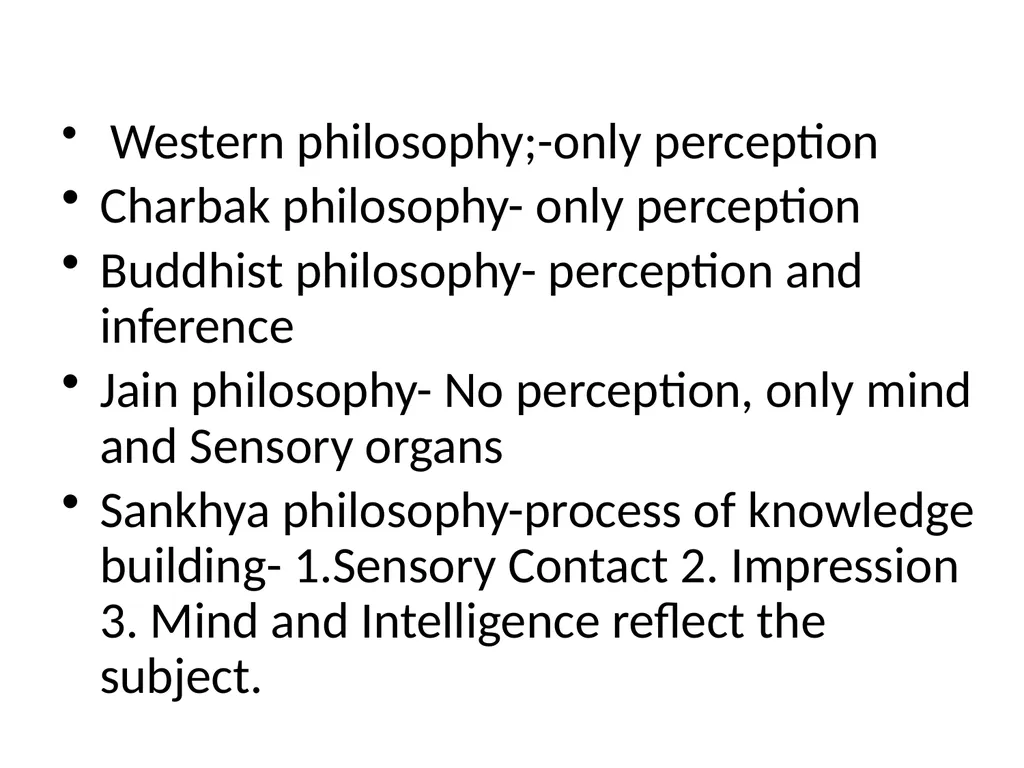
Western philosophy;-only perception
Charbak philosophy- only perception
Buddhist philosophy- perception and inference
Jain philosophy- No perception, only mind and Sensory organs
Sankhya philosophy-process of knowledge building- 1.Sensory Contact 2. Impression 3. Mind and Intelligence reflect the subject.<br>
04
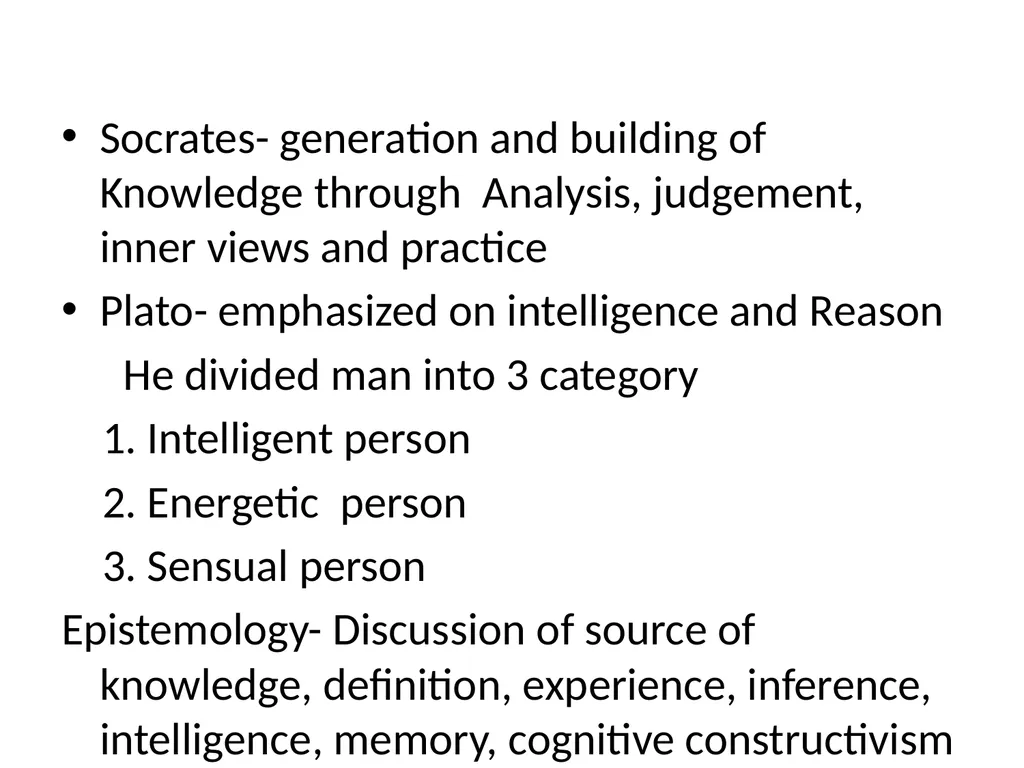
Socrates- generation and building of Knowledge through Analysis, judgement, inner views and practice
Plato- emphasized on intelligence and Reason
He divided man into 3 category
1. Intelligent person
2. Energetic person
3. Sensual person
Epistemology- Discussion of source of knowledge, definition, experience, inference, intelligence, memory, cognitive constructivism<br>
05
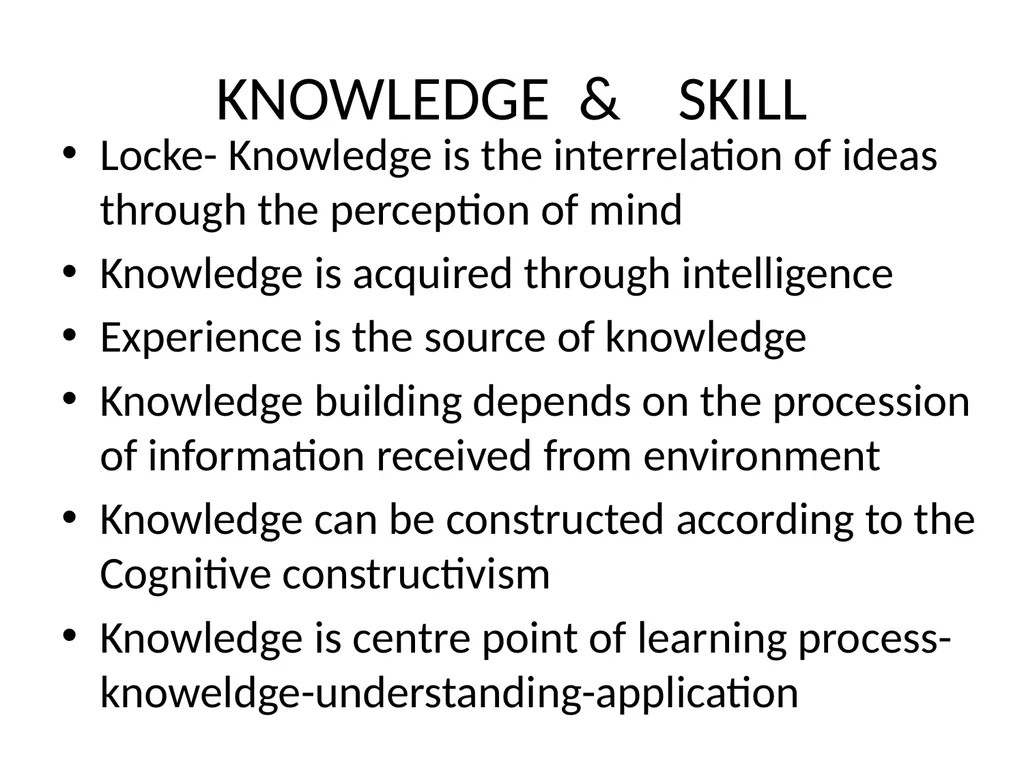
KNOWLEDGE & SKILL Locke- Knowledge is the interrelation of ideas through the perception of mind
Knowledge is acquired through intelligence
Experience is the source of knowledge
Knowledge building depends on the procession of information received from environment
Knowledge can be constructed according to the Cognitive constructivism
Knowledge is centre point of learning process-knoweldge-understanding-application<br>
06
Knowledge represents the lowest level of learning outcomes in the cognitive domain
Skill: It indicates the development of muscular action and neuro-motoric coordination
Skills concern with1.Reflex movement 2.Basic –fundamental movement 3. Perceptual abilities 4. skilled movement 4. Non-discursive communication-Movement communication<br>
07
Teaching and Training ‘A complex Process’ ‘interactive communication’ ‘Art’ ‘Science’ ‘a creative process’
Teaching- ‘a kind of communication’ –Edgar Dale
‘communication and projection of experiences’-G.G Stern<br>
08
DEFINITOIN BURTON: Teaching is the stimulation, guidance, direction and encouragement of learning
THOMAS: Teaching is the task of a teacher which is performed for the development of a child.
N. L. GAGE: Teaching is a form of interpersonal influence aimed at changing the behavior potential of another personal
Michael Oakeshort: Teaching is two-fold activity of communicating information and communicating judgment.
Ryburn: Teaching is a relationship which helps the child to develop his powers
B.O.Smith: Teaching is a system of actions intended to induce learning…a tripolar process’<br>
09
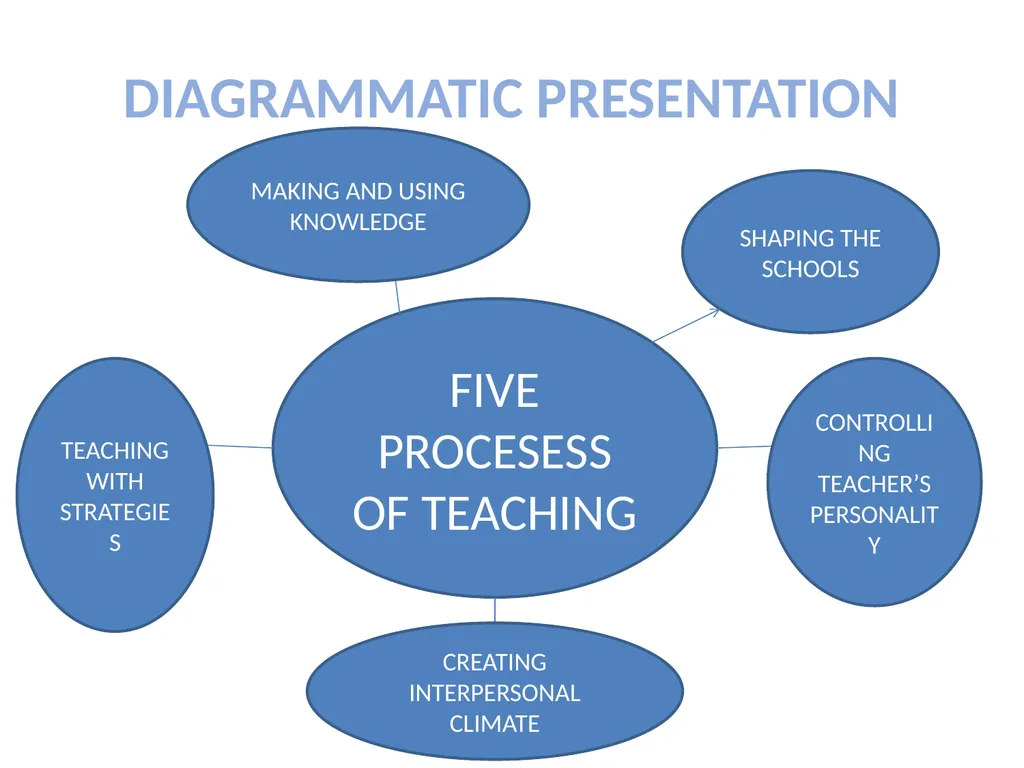
DIAGRAMMATIC PRESENTATION FIVE PROCESESS OF TEACHING MAKING AND USING KNOWLEDGE TEACHING WITH STRATEGIES CONTROLLING TEACHER’S PERSONALITY CREATING INTERPERSONAL CLIMATE SHAPING THE SCHOOLS<br>
10
TRAINING Training implies development of perfection of skills and competencies
It is a period bound process
Its aim is to develop one or more skills
The place of training is Training Institution or workshop or training centre
More emphasis on practical aspects
It has fixed and limited methods and changes from skill to skill
Training environment is authoritarian<br>
11
No flexibility in methods
Only proficiency in the skill of the profession is tested
Scope is limited to psychomotor dimension only<br>
12
‘Information’ is derived from a Latin word ‘informatio’ – ‘Informere’ means to instruct mind or to shape the mind
It is symbolic or non-symbolic
It related to memory or beyond memory
It enters into the sensory organs as input
Dusenbery defines it in ‘Sensory Ecology’ as casual input and energetic input
Information is created, received and maintained<br>
13
Relation between Information and Knowledge Information is processed data and knowledge is such information which is usaable
Information is necessary for generating knowledge
Knowledge is reflection of information patter
Processing is needed to form knowledge
Belief (PROVED BELIEF IS KNOWLEDGE)
Trust-faith , Asuurance, hope
Truth derived from self-judgement
Imagination-Delusion –Paranoid scyzophrenia<br>