Ethical non-naturalism Michael Lacewing

Published  . 0 views
↓ Download
Ethical non-naturalism Michael Lacewing
1 / 1
Ethical non-naturalism Michael Lacewing - slide 1 of 10 Ethical non-naturalism Michael Lacewing - slide 2 of 10 Ethical non-naturalism Michael Lacewing - slide 3 of 10 Ethical non-naturalism Michael Lacewing - slide 4 of 10 Ethical non-naturalism Michael Lacewing - slide 5 of 10 Ethical non-naturalism Michael Lacewing - slide 6 of 10 Ethical non-naturalism Michael Lacewing - slide 7 of 10 Ethical non-naturalism Michael Lacewing - slide 8 of 10 Ethical non-naturalism Michael Lacewing - slide 9 of 10 Ethical non-naturalism Michael Lacewing - slide 10 of 10
Description: Ethical non-naturalism Michael Lacewing enquiriesalevelphilosophy.co.uk Michael Lacewing Metaethics What is morality, philosophical speaking? Can ethical claims be objectively true or false? Are moral properties part of reality?

Related Topics

Download Presentation

"Ethical non-naturalism Michael Lacewing" is the property of its rightful owner. Permission is granted to download and print the materials on this website for personal, non-commercial use only, and to display it on your personal computer provided you do not modify the materials and that you retain all copyright notices contained in the materials. By downloading content from our website, you accept the terms of this agreement.

Presentation Transcript

slide1. Ethical non-naturalism Michael Lacewing
enquiries@alevelphilosophy.co.uk © Michael Lacewing<br>
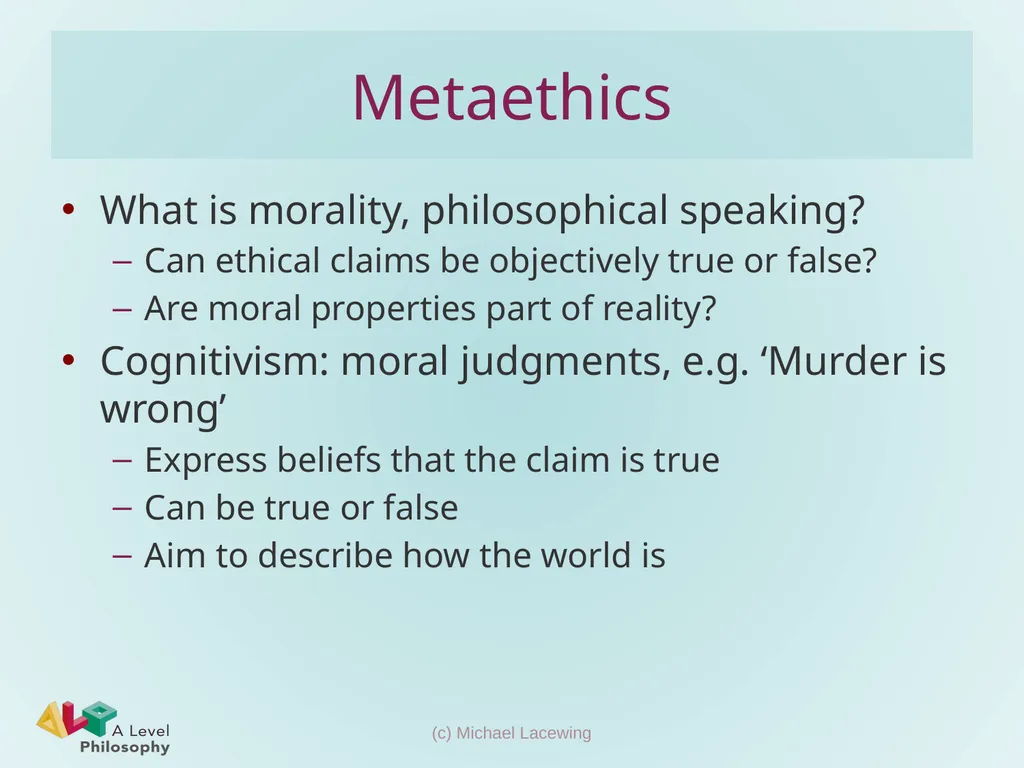
slide2. Metaethics What is morality, philosophical speaking?
Can ethical claims be objectively true or false?
Are moral properties part of reality?
Cognitivism: moral judgments, e.g. ‘Murder is wrong’
Express beliefs that the claim is true
Can be true or false
Aim to describe how the world is (c) Michael Lacewing<br>

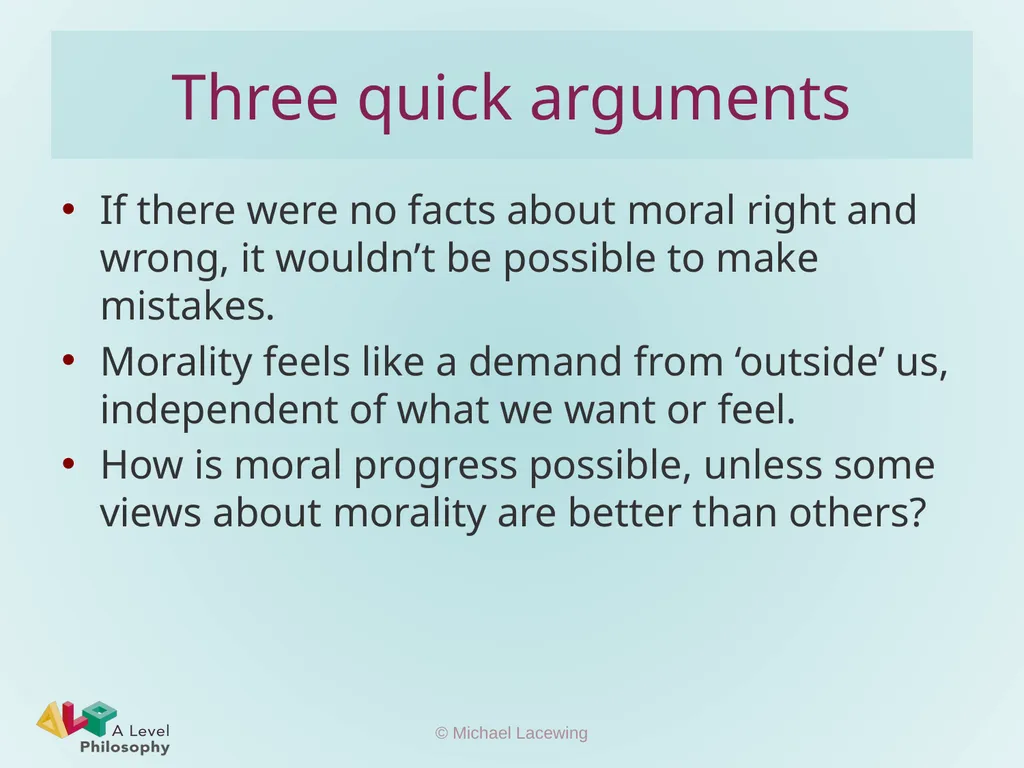
slide3. Three quick arguments If there were no facts about moral right and wrong, it wouldn’t be possible to make mistakes.
Morality feels like a demand from ‘outside’ us, independent of what we want or feel.
How is moral progress possible, unless some views about morality are better than others? © Michael Lacewing<br>
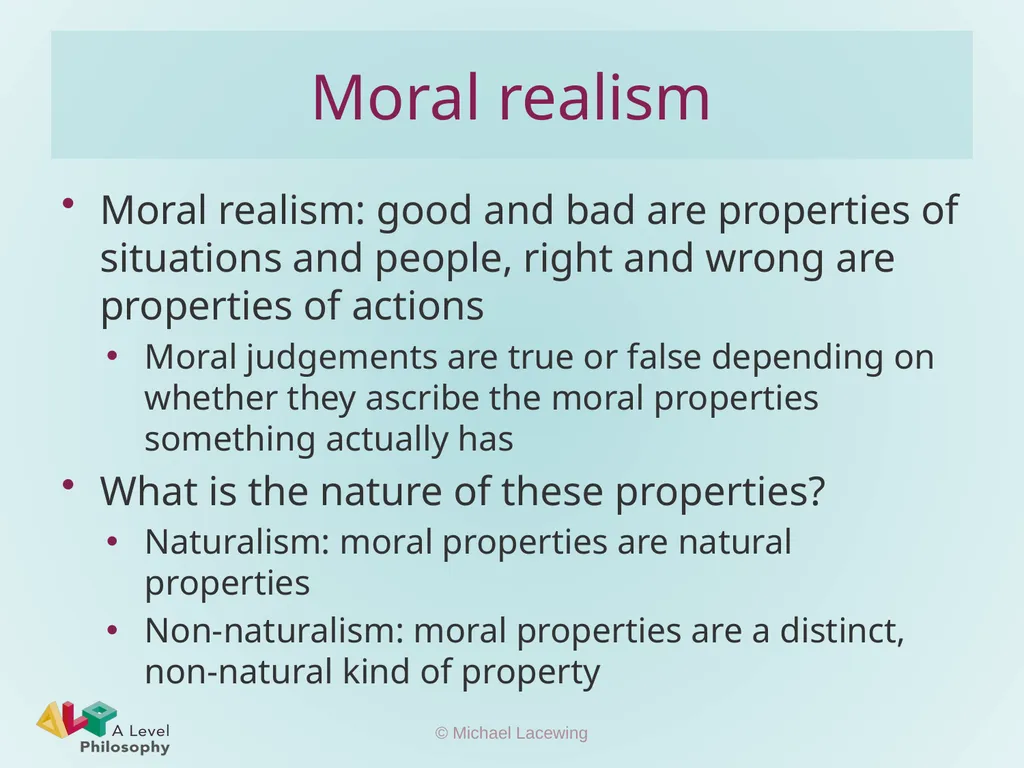
slide4. Moral realism Moral realism: good and bad are properties of situations and people, right and wrong are properties of actions
Moral judgements are true or false depending on whether they ascribe the moral properties something actually has
What is the nature of these properties?
Naturalism: moral properties are natural properties
Non-naturalism: moral properties are a distinct, non-natural kind of property © Michael Lacewing<br>
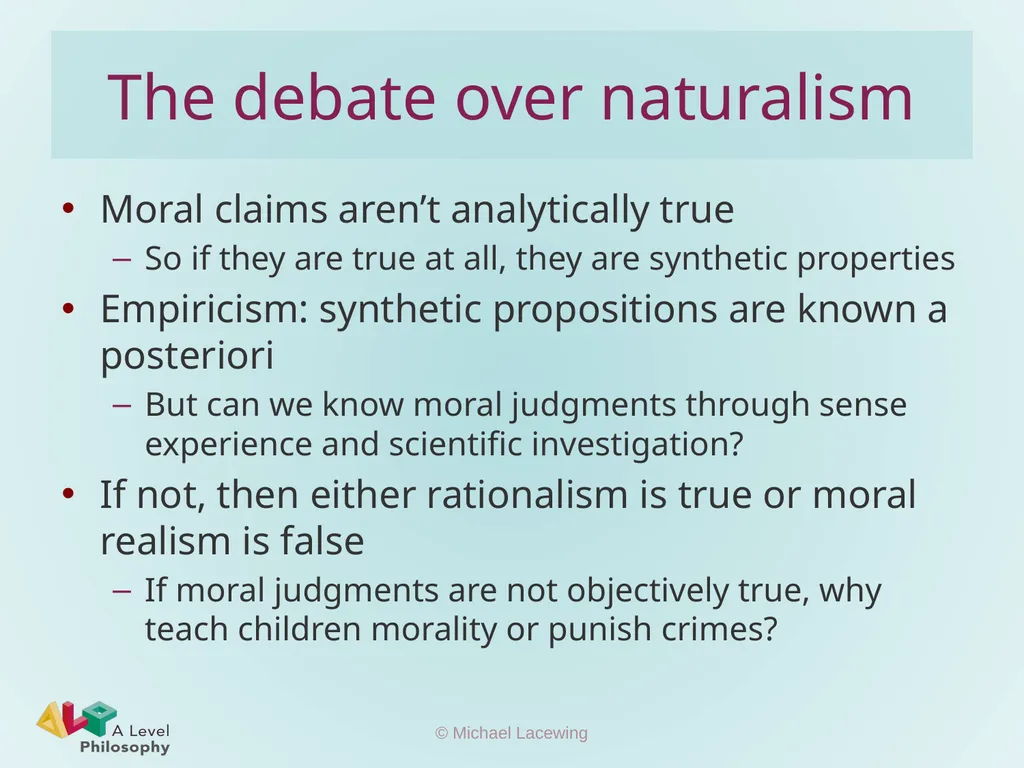
slide5. The debate over naturalism Moral claims aren’t analytically true
So if they are true at all, they are synthetic properties
Empiricism: synthetic propositions are known a posteriori
But can we know moral judgments through sense experience and scientific investigation?
If not, then either rationalism is true or moral realism is false
If moral judgments are not objectively true, why teach children morality or punish crimes? © Michael Lacewing<br>
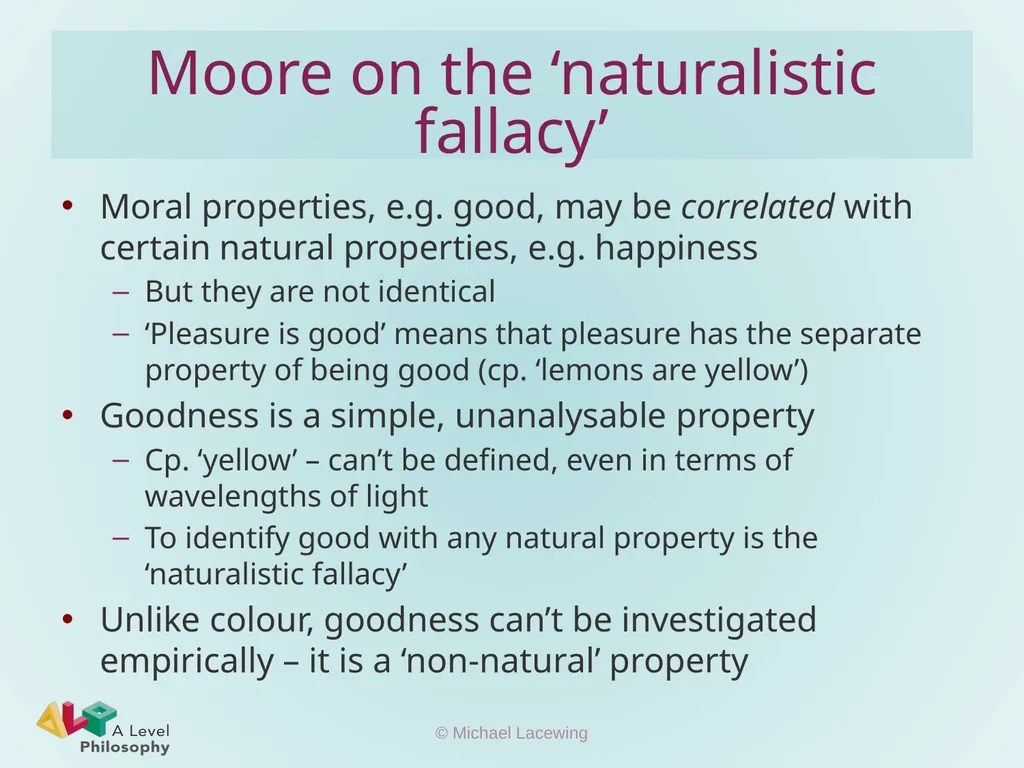
slide6. Moore on the ‘naturalistic fallacy’ Moral properties, e.g. good, may be correlated with certain natural properties, e.g. happiness
But they are not identical
‘Pleasure is good’ means that pleasure has the separate property of being good (cp. ‘lemons are yellow’)
Goodness is a simple, unanalysable property
Cp. ‘yellow’ – can’t be defined, even in terms of wavelengths of light
To identify good with any natural property is the ‘naturalistic fallacy’
Unlike colour, goodness can’t be investigated empirically – it is a ‘non-natural’ property © Michael Lacewing<br>
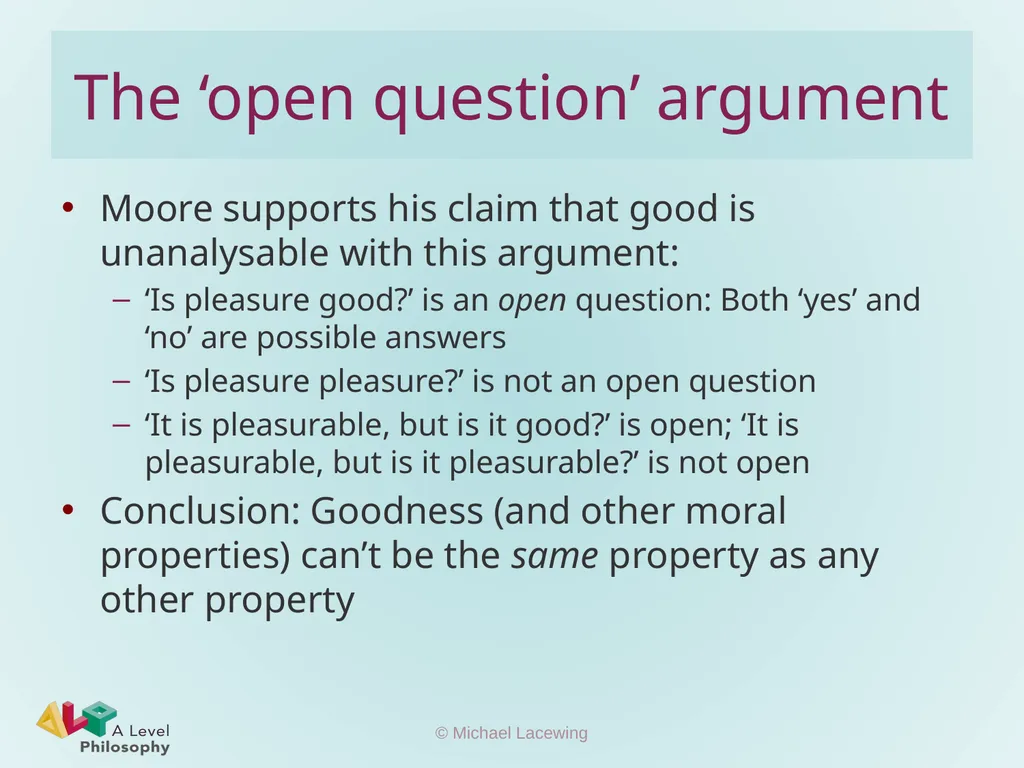
slide7. The ‘open question’ argument Moore supports his claim that good is unanalysable with this argument:
‘Is pleasure good?’ is an open question: Both ‘yes’ and ‘no’ are possible answers
‘Is pleasure pleasure?’ is not an open question
‘It is pleasurable, but is it good?’ is open; ‘It is pleasurable, but is it pleasurable?’ is not open
Conclusion: Goodness (and other moral properties) can’t be the same property as any other property © Michael Lacewing<br>
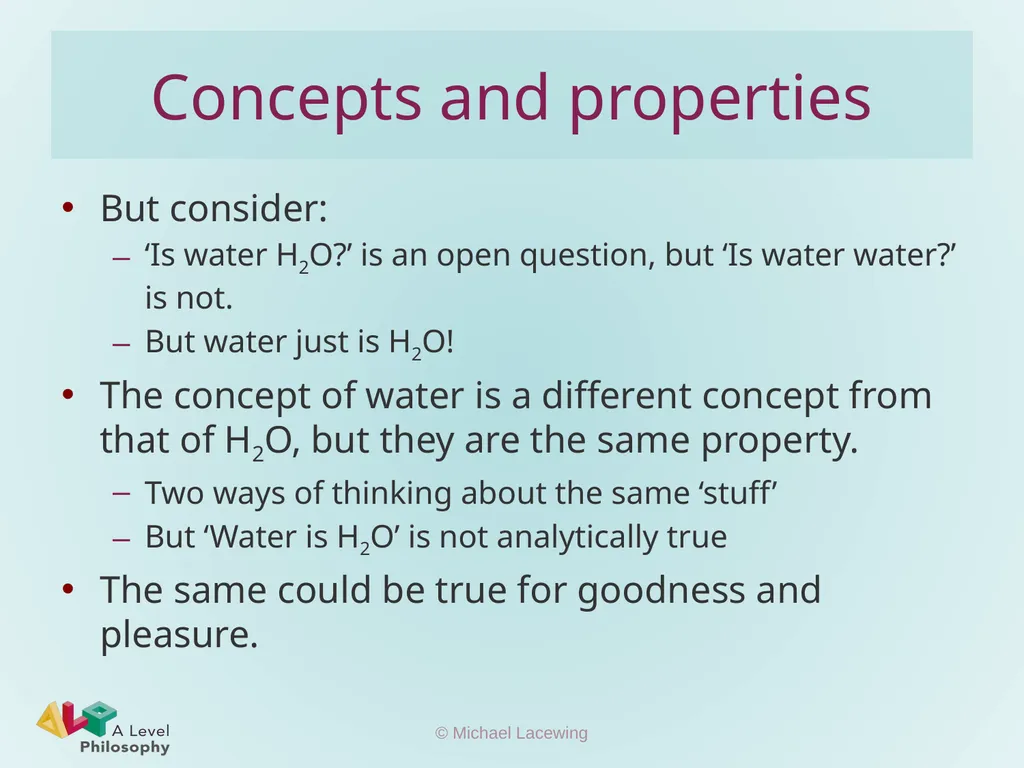
slide8. Concepts and properties But consider:
‘Is water H2O?’ is an open question, but ‘Is water water?’ is not.
But water just is H2O!
The concept of water is a different concept from that of H2O, but they are the same property.
Two ways of thinking about the same ‘stuff’
But ‘Water is H2O’ is not analytically true
The same could be true for goodness and pleasure. © Michael Lacewing<br>
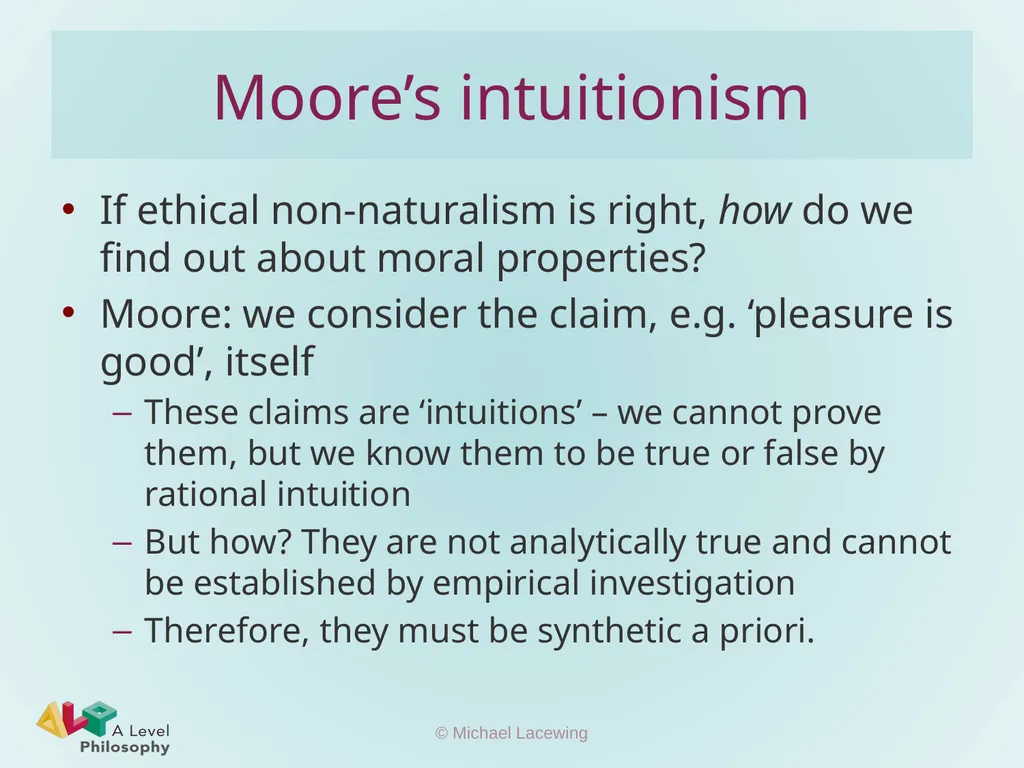
slide9. Moore’s intuitionism If ethical non-naturalism is right, how do we find out about moral properties?
Moore: we consider the claim, e.g. ‘pleasure is good’, itself
These claims are ‘intuitions’ – we cannot prove them, but we know them to be true or false by rational intuition
But how? They are not analytically true and cannot be established by empirical investigation
Therefore, they must be synthetic a priori. © Michael Lacewing<br>
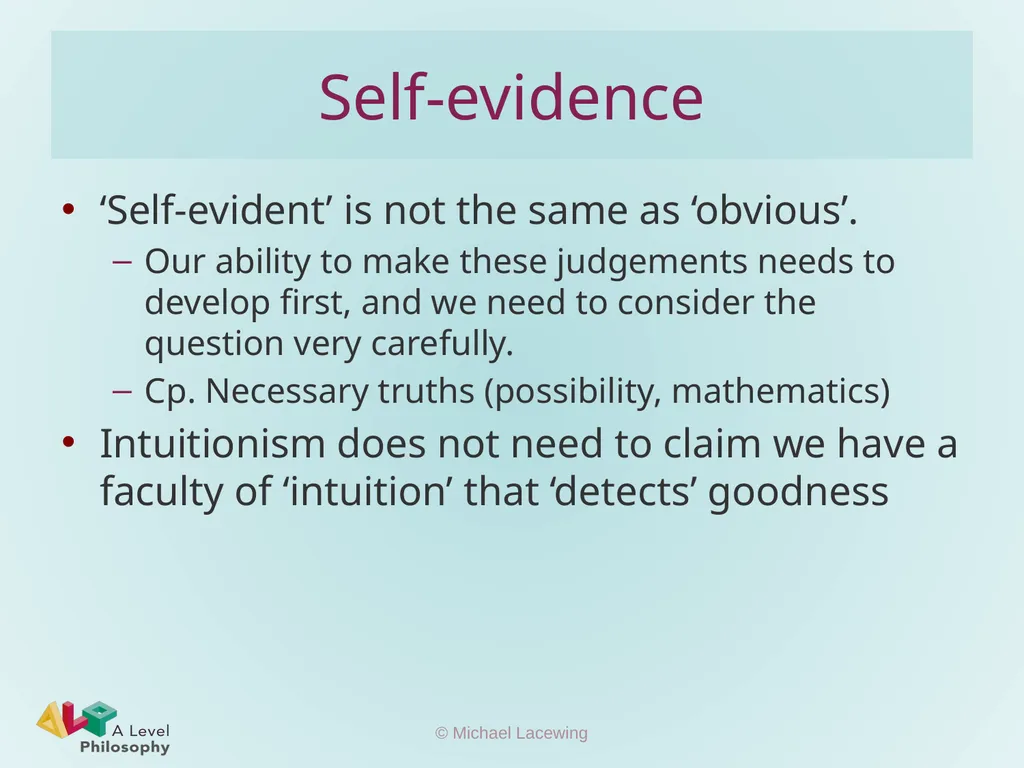
slide10. Self-evidence ‘Self-evident’ is not the same as ‘obvious’.
Our ability to make these judgements needs to develop first, and we need to consider the question very carefully.
Cp. Necessary truths (possibility, mathematics)
Intuitionism does not need to claim we have a faculty of ‘intuition’ that ‘detects’ goodness © Michael Lacewing<br>