
Failure Detectors Presented by, Archana Bharath
SB
Published · 79 slides · 0 views

1 / 1

Description
Failure Detectors Presented by, Archana Bharath Lakshmi Distributed Systems Instructor: Ajay Kshemkalyani 1 Failure detector is an application that is responsible for detection of node failures or crashes in a distributed system. A failure
Related Topics
Share
Embed code
Download this presentation From Below
"Failure Detectors Presented by, Archana Bharath" is the property of its rightful owner. Permission is granted to download and print the materials on this website for personal, non-commercial use only, and to display it on your personal computer provided you do not modify the materials and that you retain all copyright notices contained in the materials. By downloading content from our website, you accept the terms of this agreement.
Presentation Transcript
01
Failure Detectors Presented by,
Archana
Bharath
Lakshmi Distributed Systems
Instructor: Ajay Kshemkalyani 1<br>
Archana
Bharath
Lakshmi Distributed Systems
Instructor: Ajay Kshemkalyani 1<br>
02
Failure detector is an application that is responsible for detection of node failures or crashes in a distributed system.
A failure detector is a distributed oracle that provides hints about the operational status of other processes Failure Detector 2<br>
A failure detector is a distributed oracle that provides hints about the operational status of other processes Failure Detector 2<br>
03
Why Failure Detectors The design and verification of fault- tolerant distributed system is a difficult problem.
The detection of process failures is a crucial problem, system designers have to cope with in order to build fault tolerant distributed platforms 3<br>
The detection of process failures is a crucial problem, system designers have to cope with in order to build fault tolerant distributed platforms 3<br>
04
Synchronous Vs Asynchronous A distributed system is synchronous if:
there is a known upper bound on the transmission delay of messages
there is a known upper bound on the processing time of a piece of code
A distributed system is asynchronous if:
there is no bound on the transmission delay of messages
there is no bound on the processing time of a piece of code 4<br>
there is a known upper bound on the transmission delay of messages
there is a known upper bound on the processing time of a piece of code
A distributed system is asynchronous if:
there is no bound on the transmission delay of messages
there is no bound on the processing time of a piece of code 4<br>
05
Why Failure Detectors cont… To stop waiting or not to stop waiting?
Unfortunately, it is impossible to distinguish with certainty a crashed process from a very slow process in a purely asynchronous distributed system.
Look at two major problems
Consensus
Atomic Broadcast 5<br>
Unfortunately, it is impossible to distinguish with certainty a crashed process from a very slow process in a purely asynchronous distributed system.
Look at two major problems
Consensus
Atomic Broadcast 5<br>
06
The problem can be defined with a safety and a liveness property.
The safety property stipulates that “nothing bad ever happens”
The liveness property stipulates that “something good eventually happens” 6 Liveness & Safety<br>
The safety property stipulates that “nothing bad ever happens”
The liveness property stipulates that “something good eventually happens” 6 Liveness & Safety<br>
07
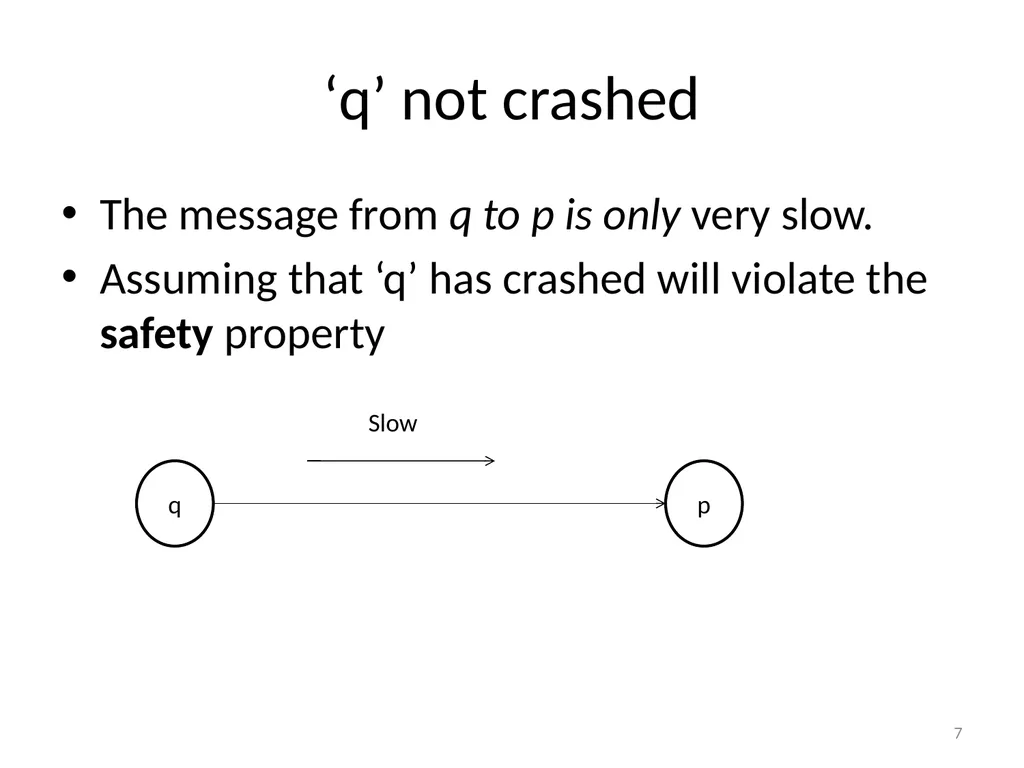
‘q’ not crashed The message from q to p is only very slow.
Assuming that ‘q’ has crashed will violate the safety property 7<br>
Assuming that ‘q’ has crashed will violate the safety property 7<br>
08
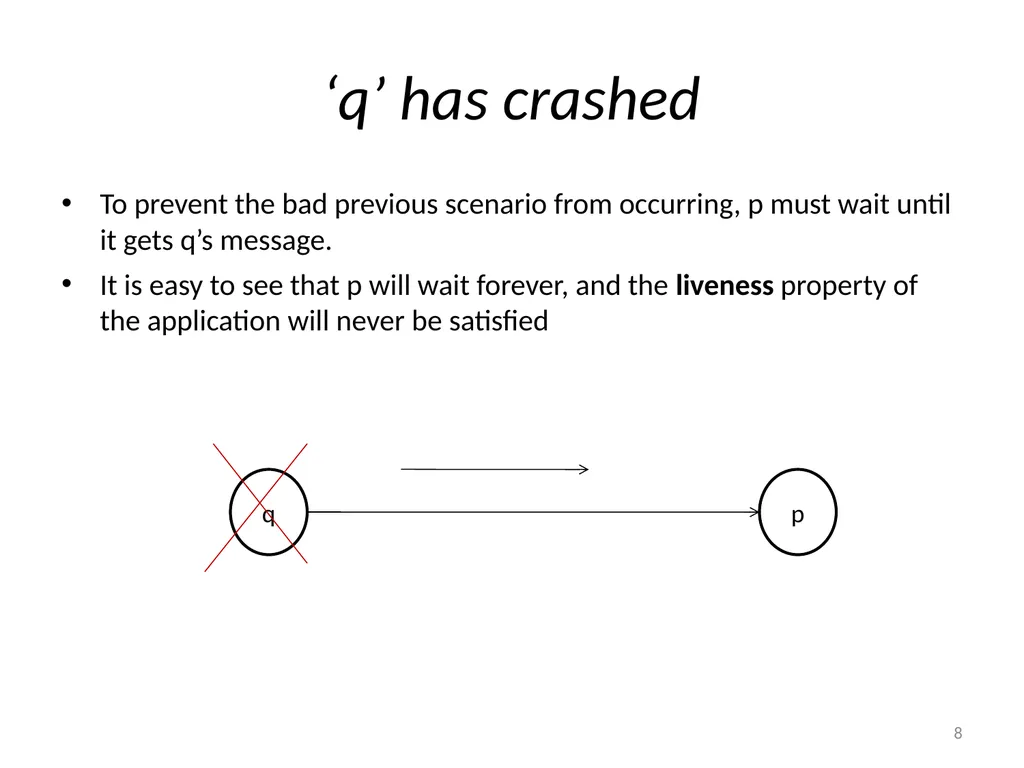
‘q’ has crashed To prevent the bad previous scenario from occurring, p must wait until it gets q’s message.
It is easy to see that p will wait forever, and the liveness property of the application will never be satisfied 8<br>
It is easy to see that p will wait forever, and the liveness property of the application will never be satisfied 8<br>
09
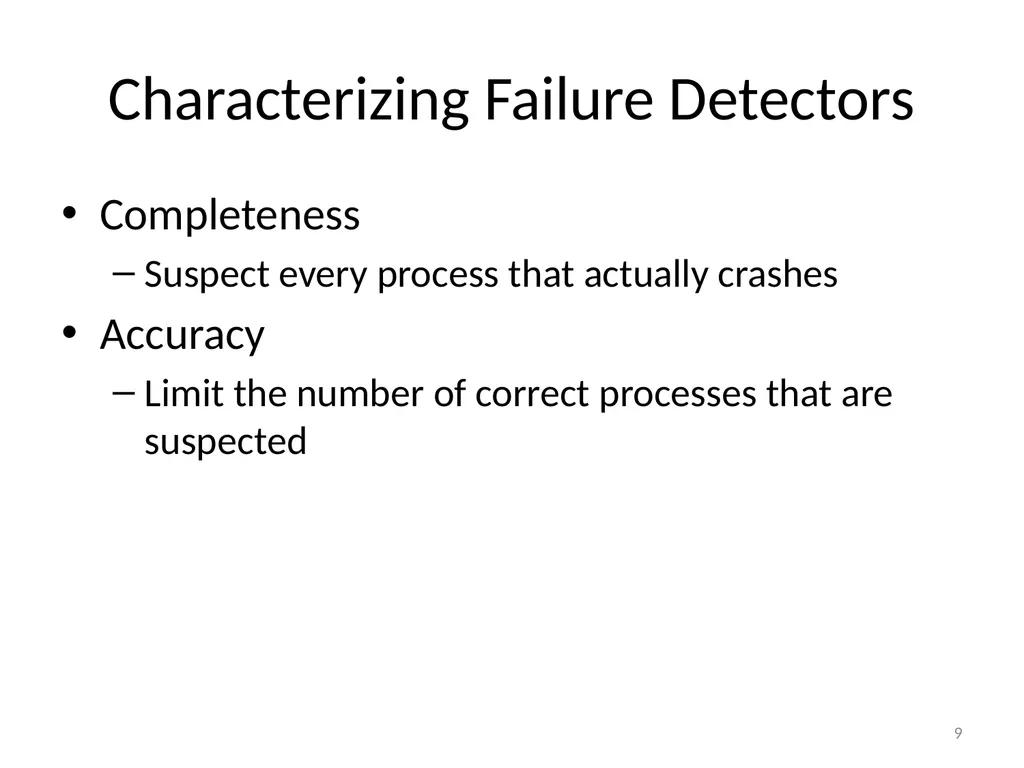
Characterizing Failure Detectors Completeness
Suspect every process that actually crashes
Accuracy
Limit the number of correct processes that are suspected 9<br>
Suspect every process that actually crashes
Accuracy
Limit the number of correct processes that are suspected 9<br>
10
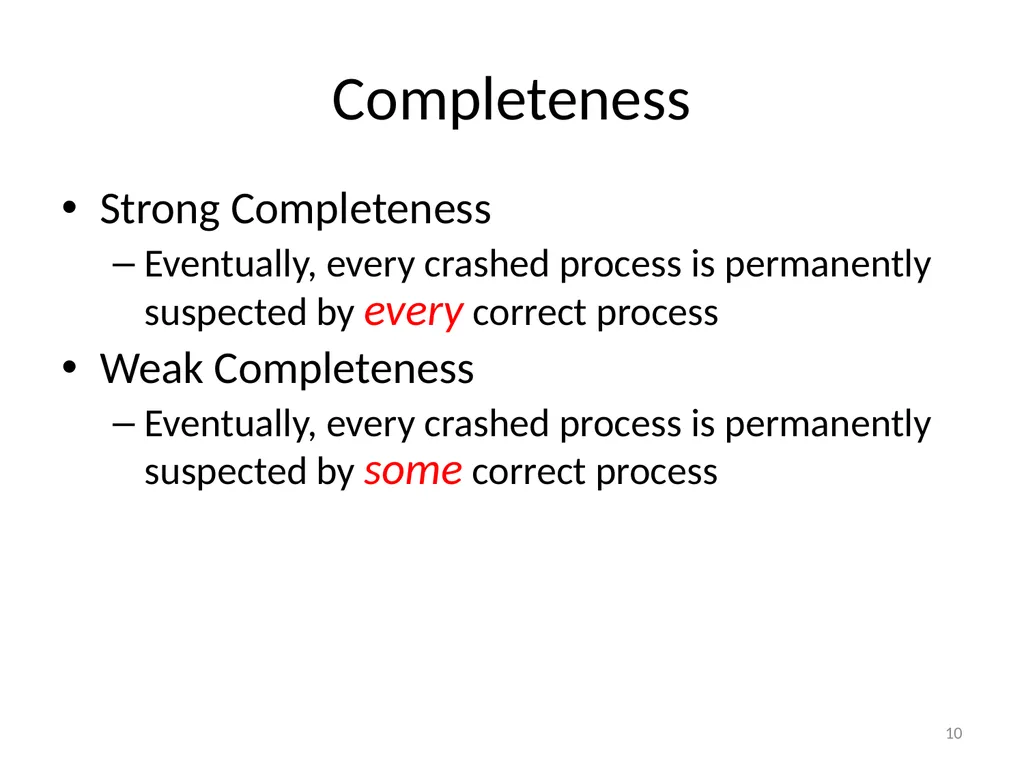
Completeness Strong Completeness
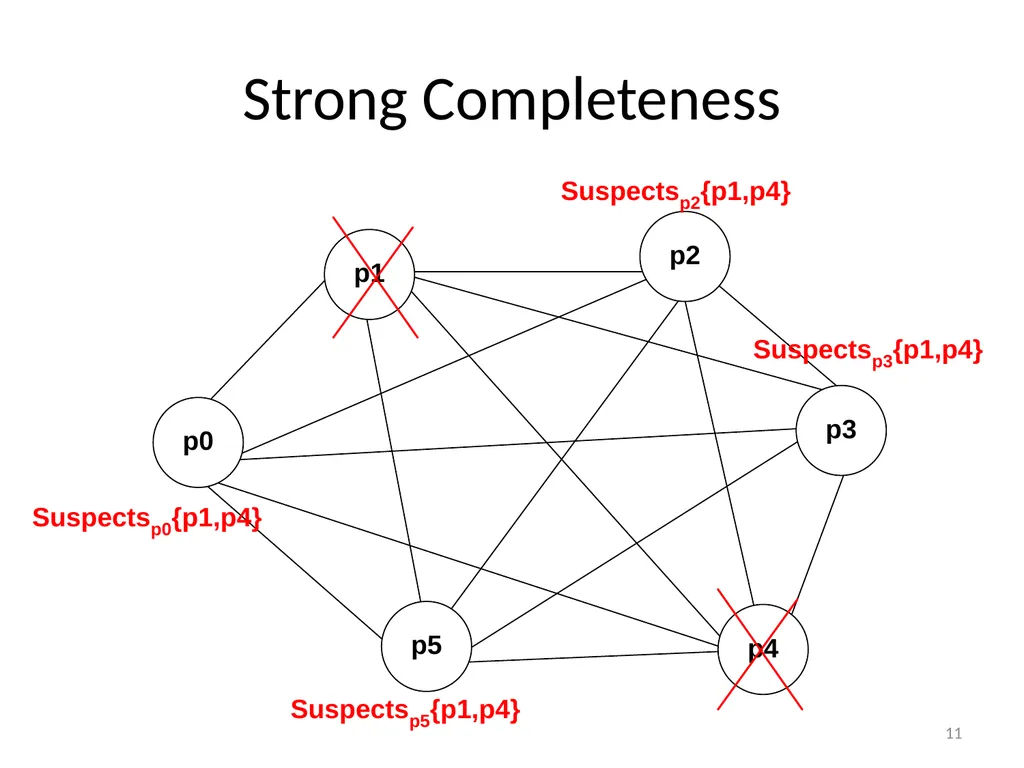
Eventually, every crashed process is permanently suspected by every correct process
Weak Completeness
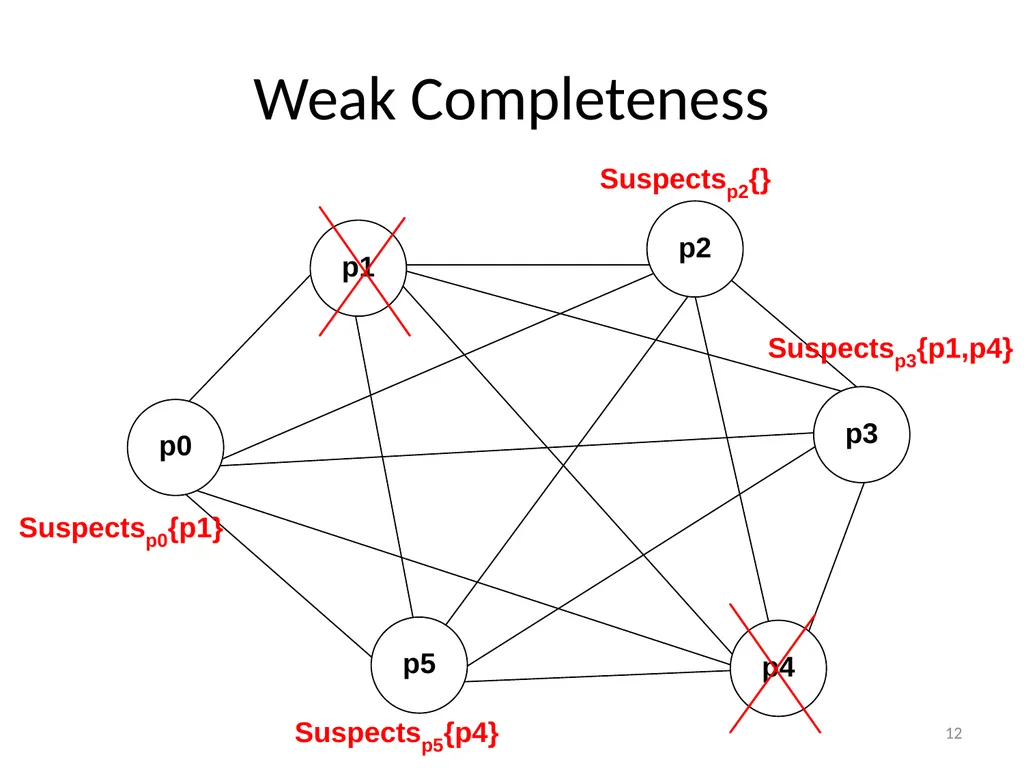
Eventually, every crashed process is permanently suspected by some correct process 10<br>
Eventually, every crashed process is permanently suspected by every correct process
Weak Completeness
Eventually, every crashed process is permanently suspected by some correct process 10<br>
11
Strong Completeness 11<br>
12
Weak Completeness 12<br>
13
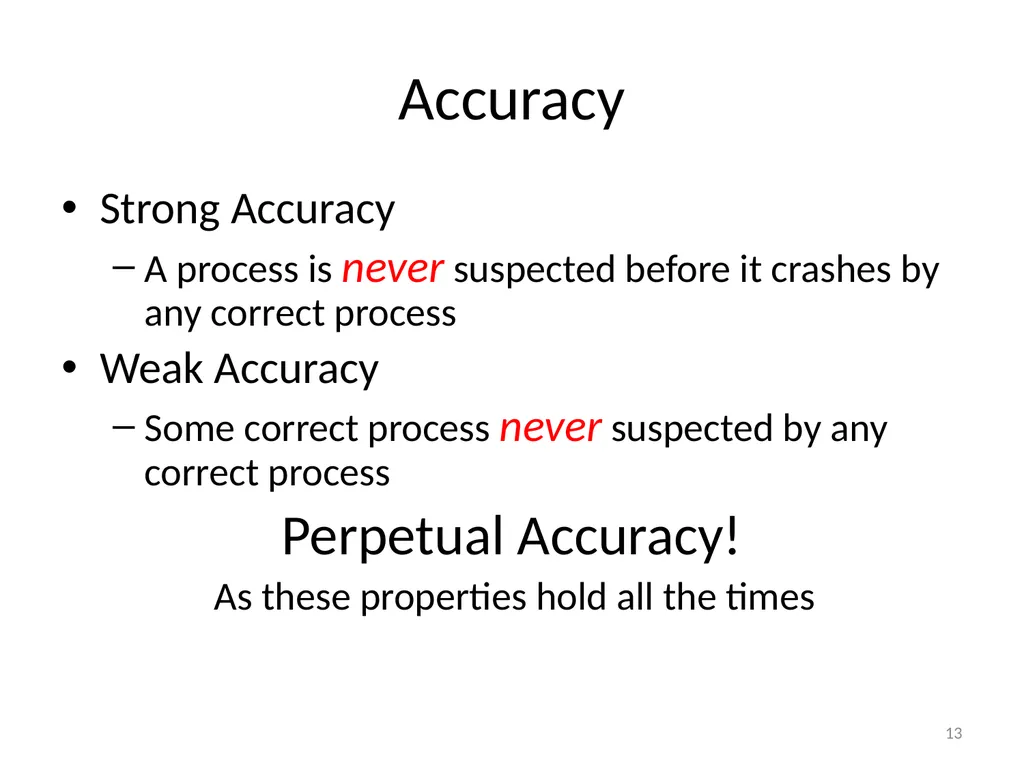
Accuracy Strong Accuracy
A process is never suspected before it crashes by any correct process
Weak Accuracy
Some correct process never suspected by any correct process
Perpetual Accuracy!
As these properties hold all the times 13<br>
A process is never suspected before it crashes by any correct process
Weak Accuracy
Some correct process never suspected by any correct process
Perpetual Accuracy!
As these properties hold all the times 13<br>
14
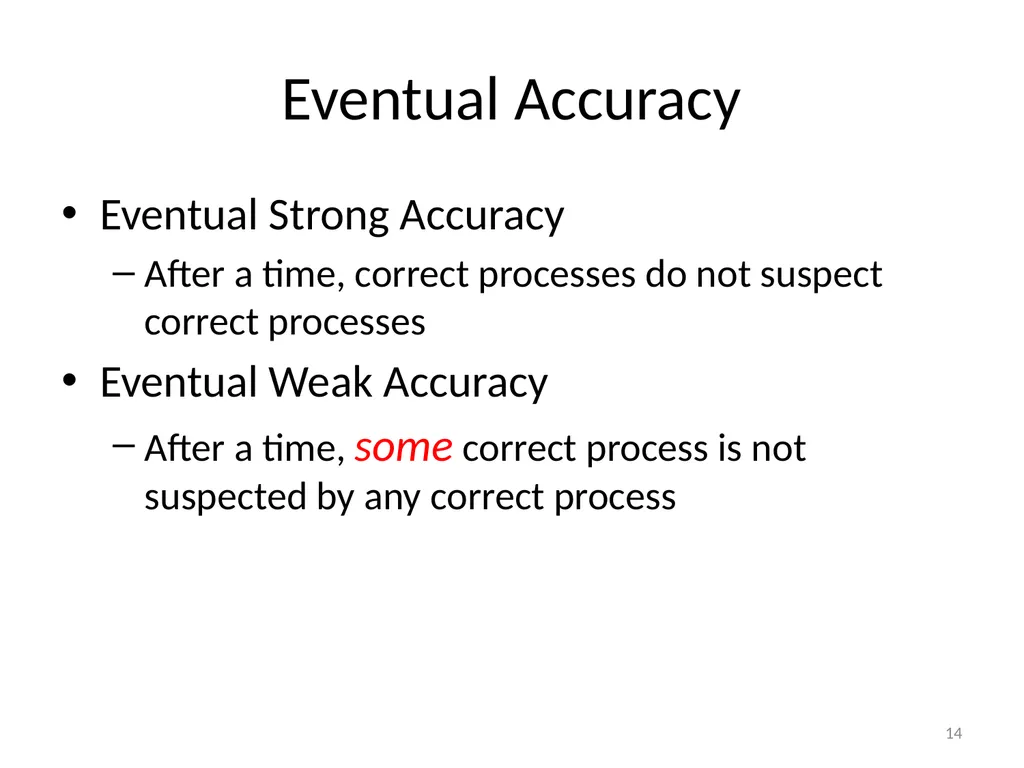
Eventual Accuracy Eventual Strong Accuracy
After a time, correct processes do not suspect correct processes
Eventual Weak Accuracy
After a time, some correct process is not suspected by any correct process 14<br>
After a time, correct processes do not suspect correct processes
Eventual Weak Accuracy
After a time, some correct process is not suspected by any correct process 14<br>
15
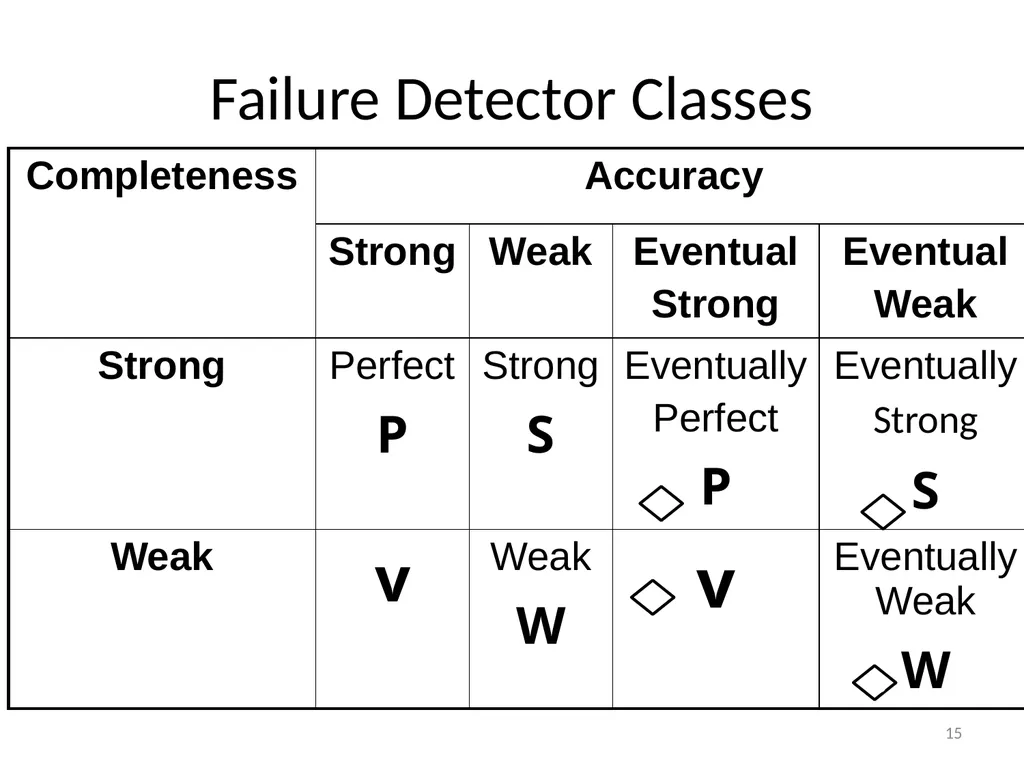
Failure Detector Classes 0 15<br>
16
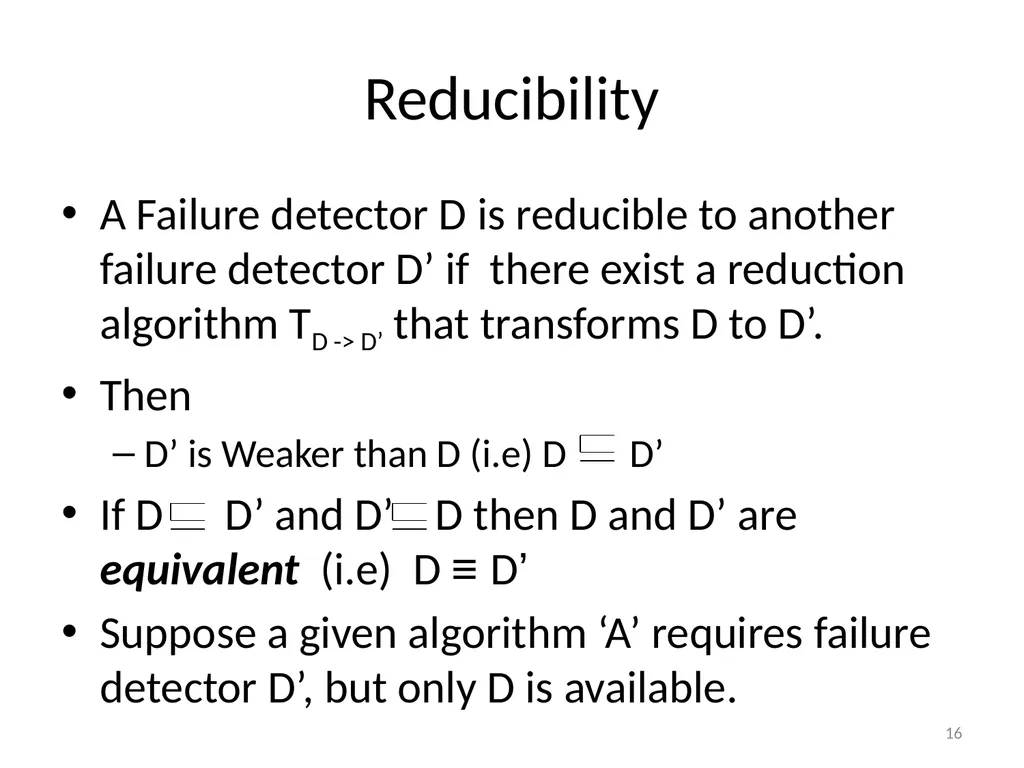
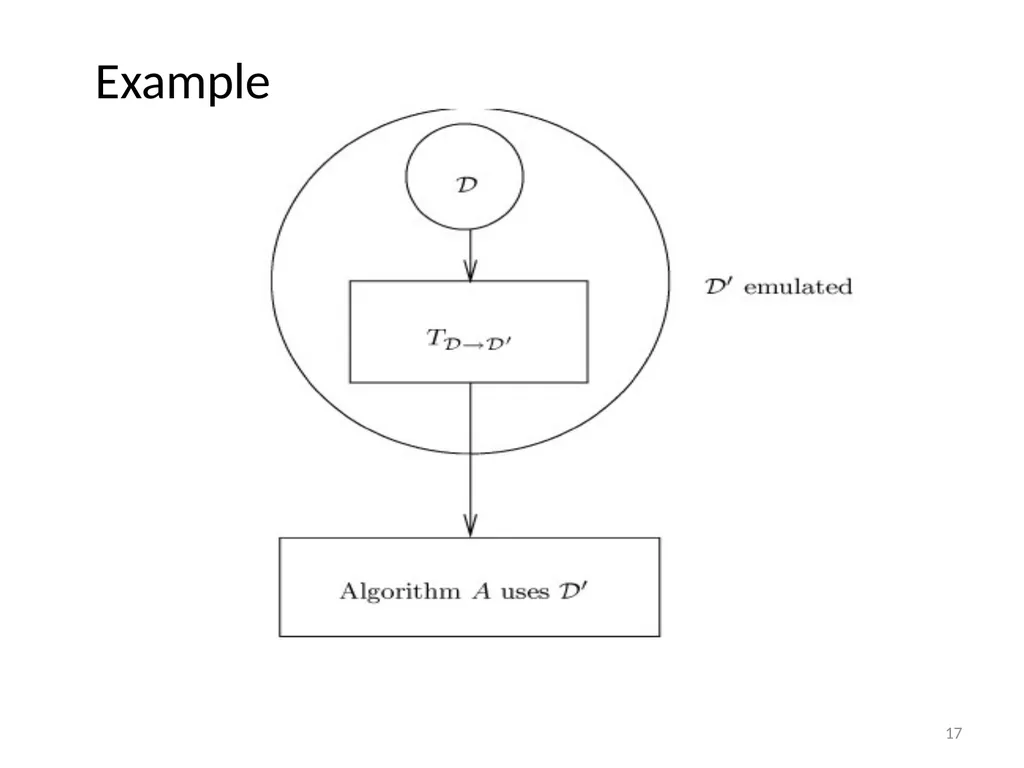
Reducibility A Failure detector D is reducible to another failure detector D’ if there exist a reduction algorithm TD -> D’ that transforms D to D’.
Then
D’ is Weaker than D (i.e) D D’
If D D’ and D’ D then D and D’ are equivalent (i.e) D ≡ D’
Suppose a given algorithm ‘A’ requires failure detector D’, but only D is available. 16<br>
Then
D’ is Weaker than D (i.e) D D’
If D D’ and D’ D then D and D’ are equivalent (i.e) D ≡ D’
Suppose a given algorithm ‘A’ requires failure detector D’, but only D is available. 16<br>
17
17 Example<br>
18
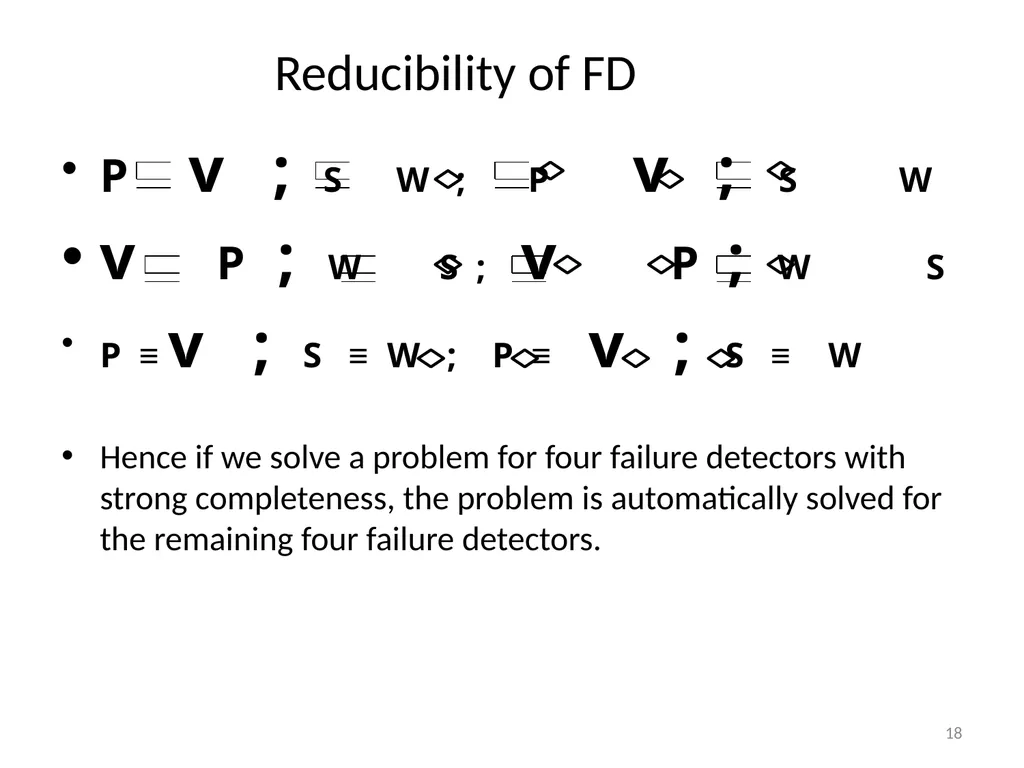
P v ; S W ; P v ; S W
v P ; W S ; v P ; W S
P ≡ v ; S ≡ W ; P ≡ v ; S ≡ W
Hence if we solve a problem for four failure detectors with strong completeness, the problem is automatically solved for the remaining four failure detectors. 18 Reducibility of FD<br>
v P ; W S ; v P ; W S
P ≡ v ; S ≡ W ; P ≡ v ; S ≡ W
Hence if we solve a problem for four failure detectors with strong completeness, the problem is automatically solved for the remaining four failure detectors. 18 Reducibility of FD<br>
19
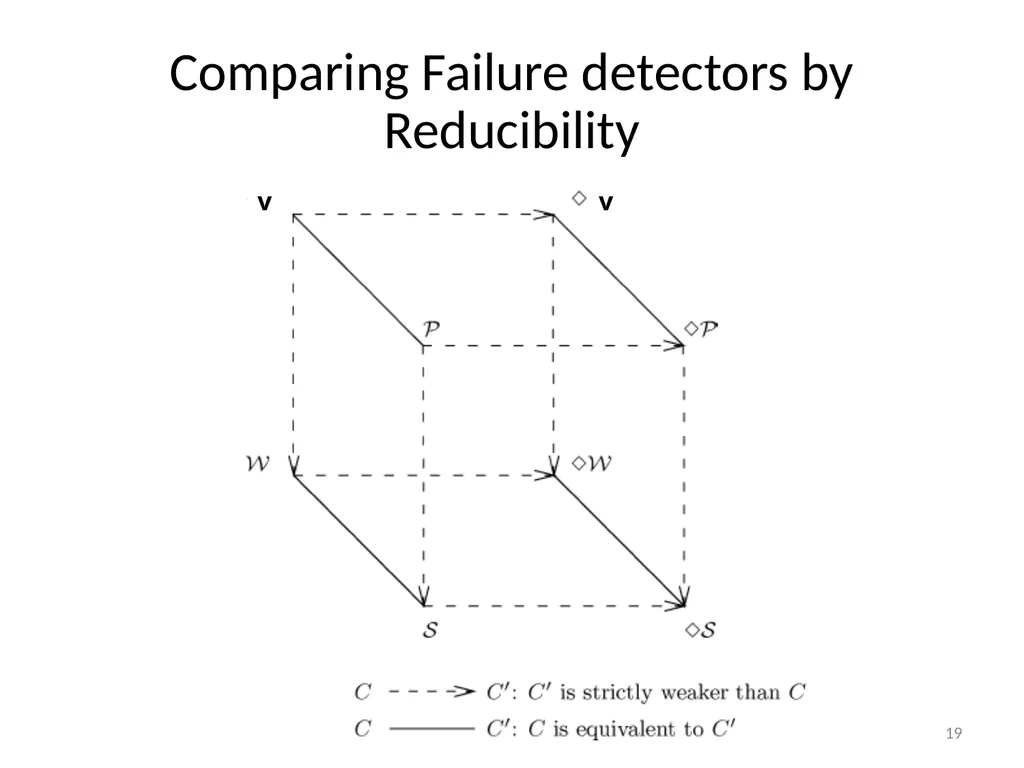
Comparing Failure detectors by Reducibility 19<br>
20
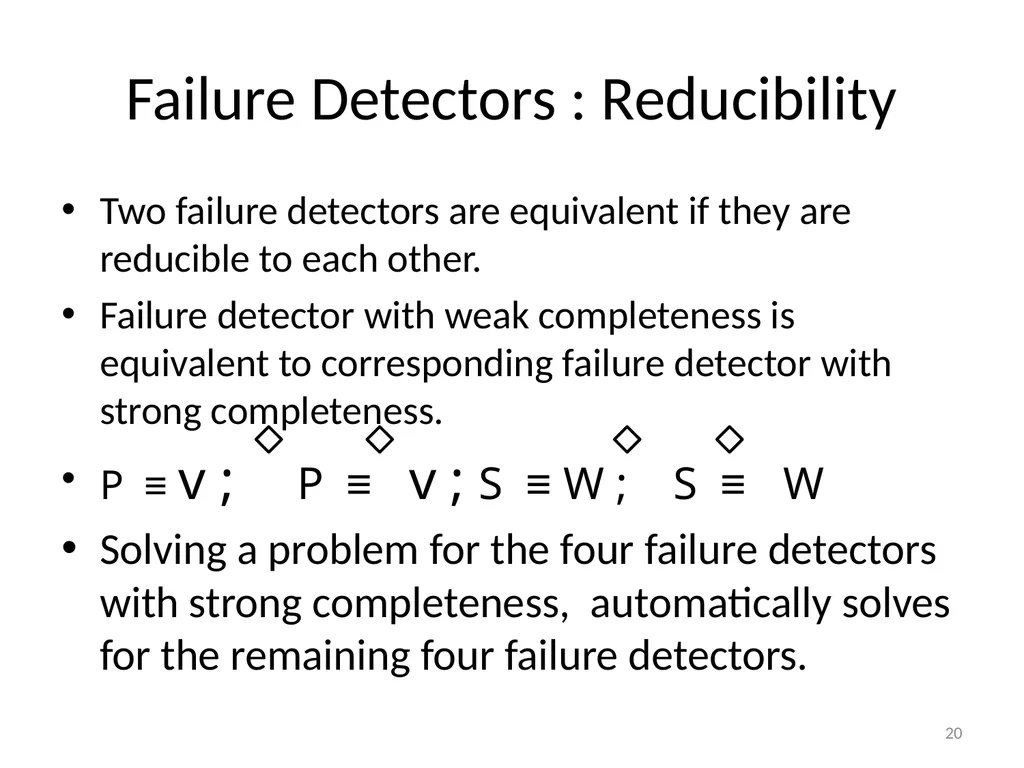
Failure Detectors : Reducibility Two failure detectors are equivalent if they are reducible to each other.
Failure detector with weak completeness is equivalent to corresponding failure detector with strong completeness.
P ≡ v ; P ≡ v ; S ≡ W ; S ≡ W
Solving a problem for the four failure detectors with strong completeness, automatically solves for the remaining four failure detectors. 20<br>
Failure detector with weak completeness is equivalent to corresponding failure detector with strong completeness.
P ≡ v ; P ≡ v ; S ≡ W ; S ≡ W
Solving a problem for the four failure detectors with strong completeness, automatically solves for the remaining four failure detectors. 20<br>
21
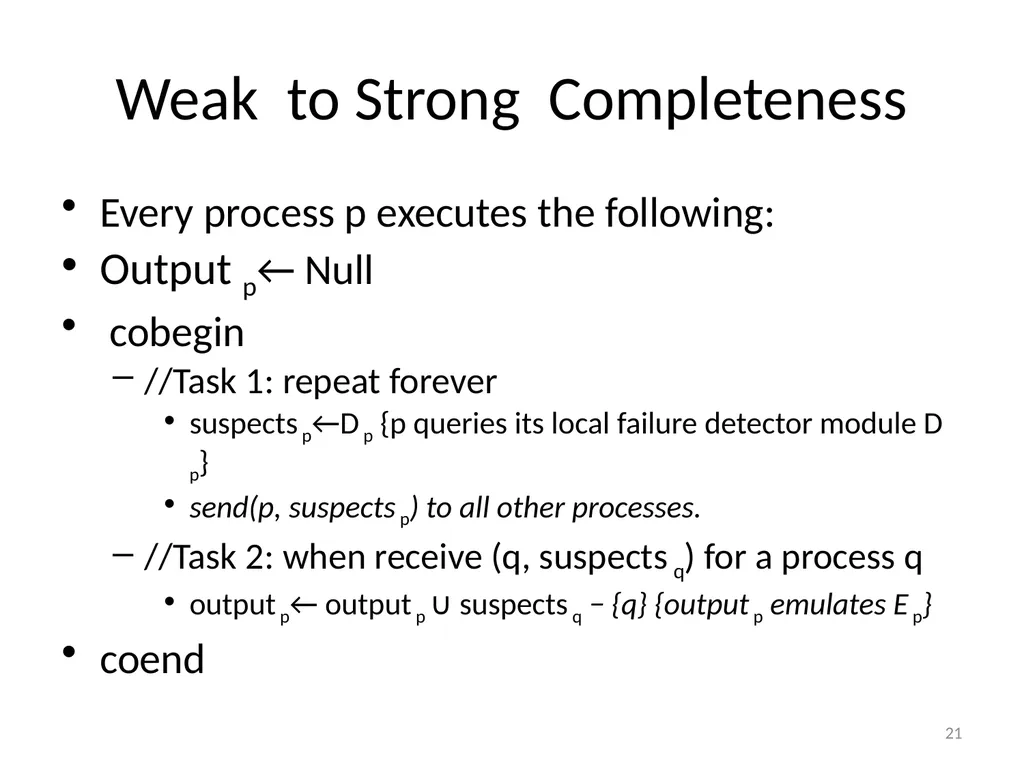
Weak to Strong Completeness Every process p executes the following:
Output p← Null
cobegin
//Task 1: repeat forever
suspects p←D p {p queries its local failure detector module D p}
send(p, suspects p) to all other processes.
//Task 2: when receive (q, suspects q) for a process q
output p← output p ∪ suspects q − {q} {output p emulates E p}
coend 21<br>
Output p← Null
cobegin
//Task 1: repeat forever
suspects p←D p {p queries its local failure detector module D p}
send(p, suspects p) to all other processes.
//Task 2: when receive (q, suspects q) for a process q
output p← output p ∪ suspects q − {q} {output p emulates E p}
coend 21<br>
22
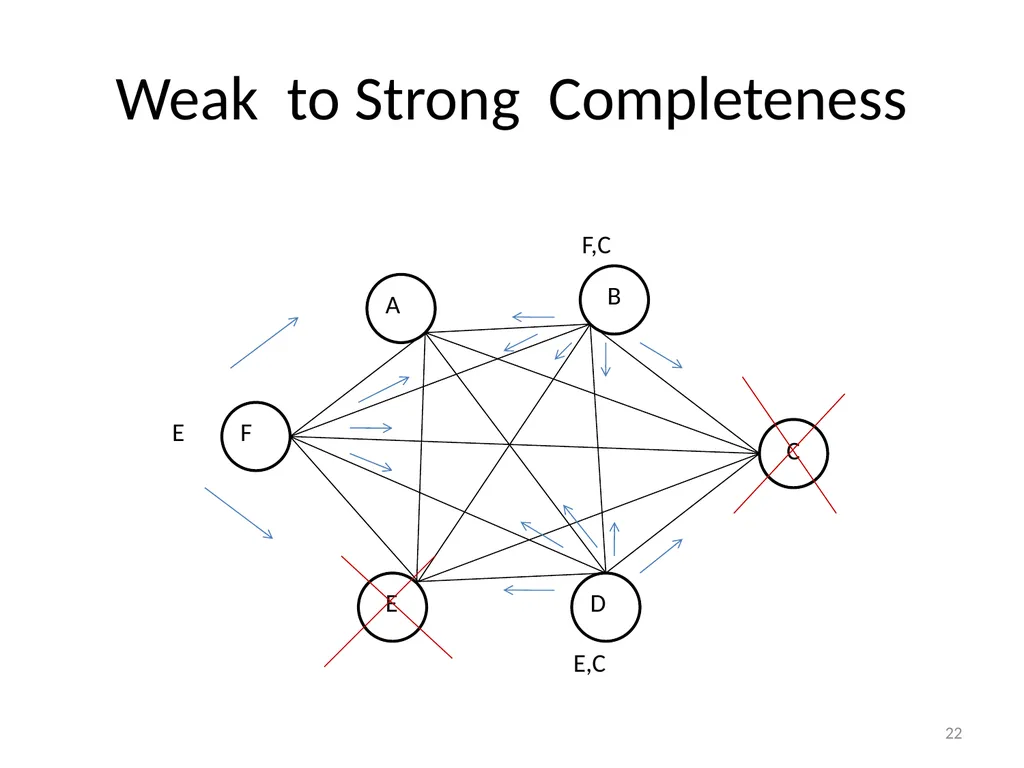
22 Weak to Strong Completeness<br>
23
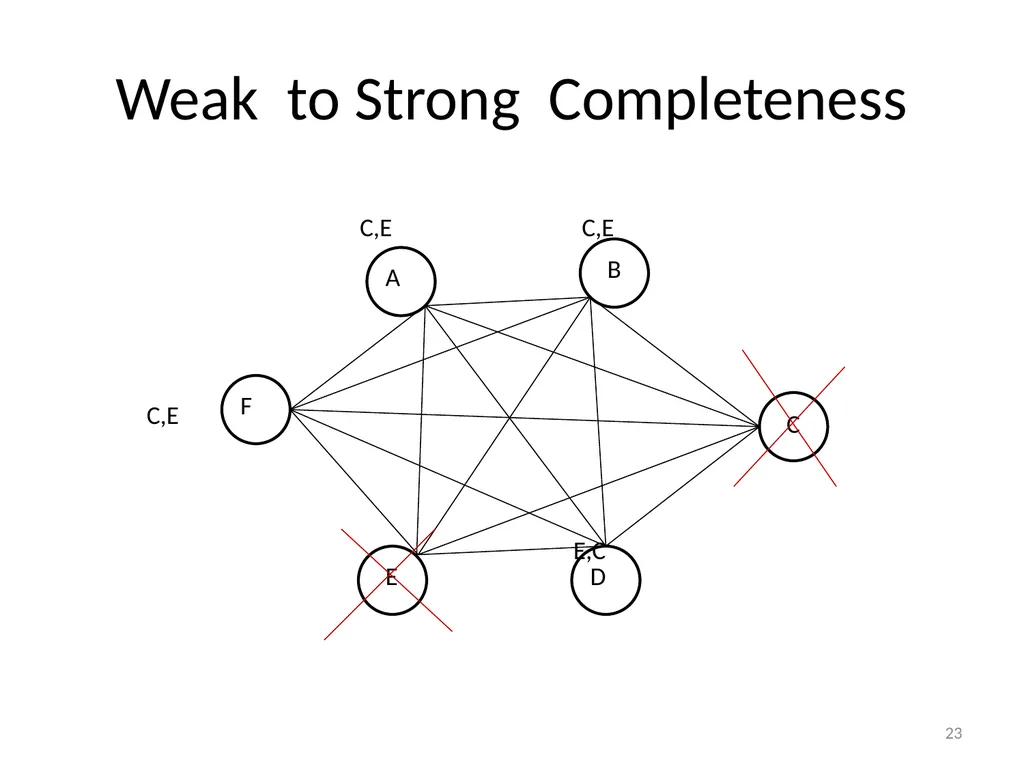
E,C 23 Weak to Strong Completeness<br>
24
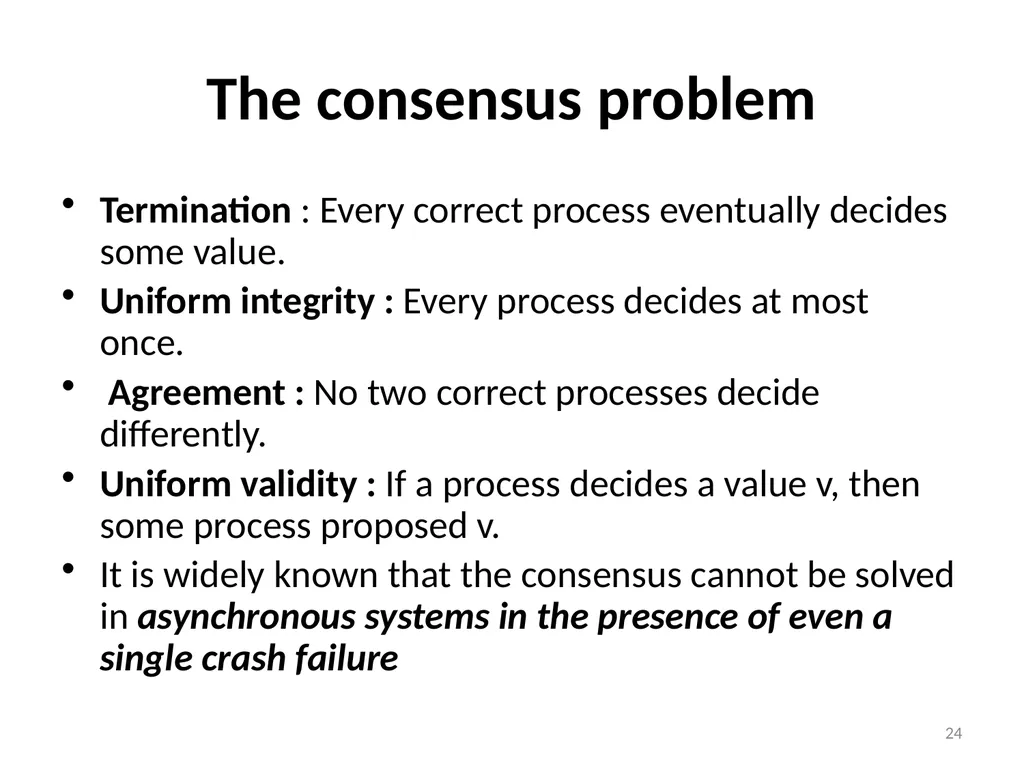
The consensus problem Termination : Every correct process eventually decides some value.
Uniform integrity : Every process decides at most once.
Agreement : No two correct processes decide differently.
Uniform validity : If a process decides a value v, then some process proposed v.
It is widely known that the consensus cannot be solved in asynchronous systems in the presence of even a single crash failure 24<br>
Uniform integrity : Every process decides at most once.
Agreement : No two correct processes decide differently.
Uniform validity : If a process decides a value v, then some process proposed v.
It is widely known that the consensus cannot be solved in asynchronous systems in the presence of even a single crash failure 24<br>
25
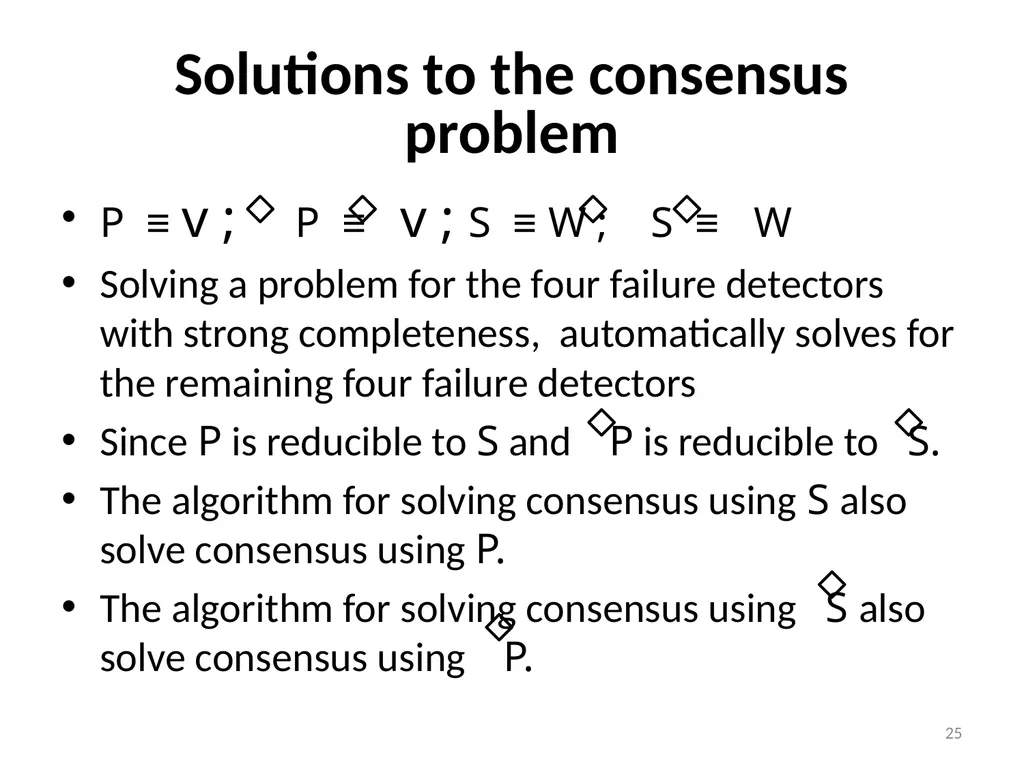
Solutions to the consensus problem P ≡ v ; P ≡ v ; S ≡ W ; S ≡ W
Solving a problem for the four failure detectors with strong completeness, automatically solves for the remaining four failure detectors
Since P is reducible to S and P is reducible to S.
The algorithm for solving consensus using S also solve consensus using P.
The algorithm for solving consensus using S also solve consensus using P. 25<br>
Solving a problem for the four failure detectors with strong completeness, automatically solves for the remaining four failure detectors
Since P is reducible to S and P is reducible to S.
The algorithm for solving consensus using S also solve consensus using P.
The algorithm for solving consensus using S also solve consensus using P. 25<br>
26
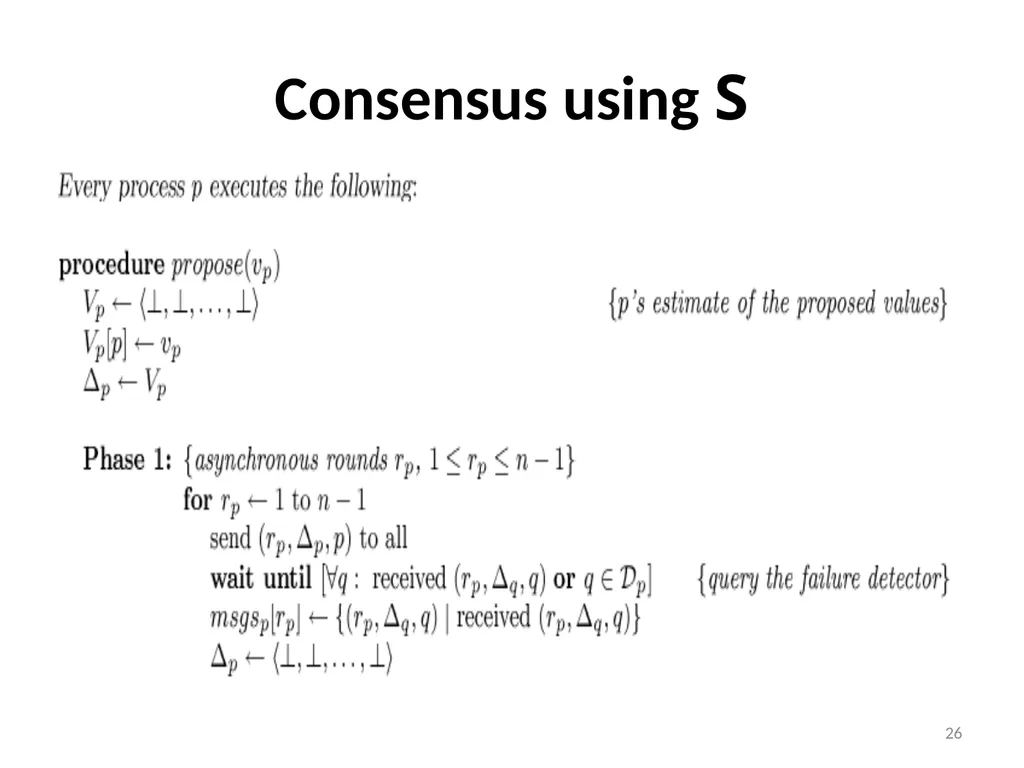
Consensus using S 26<br>
27
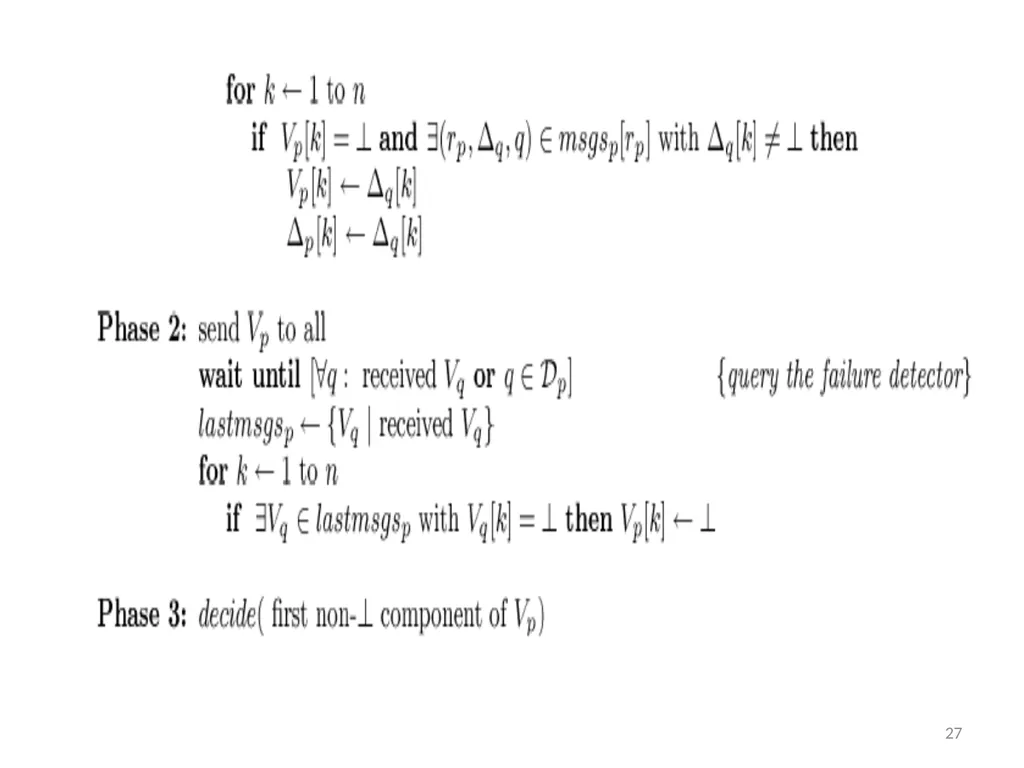
27<br>
28
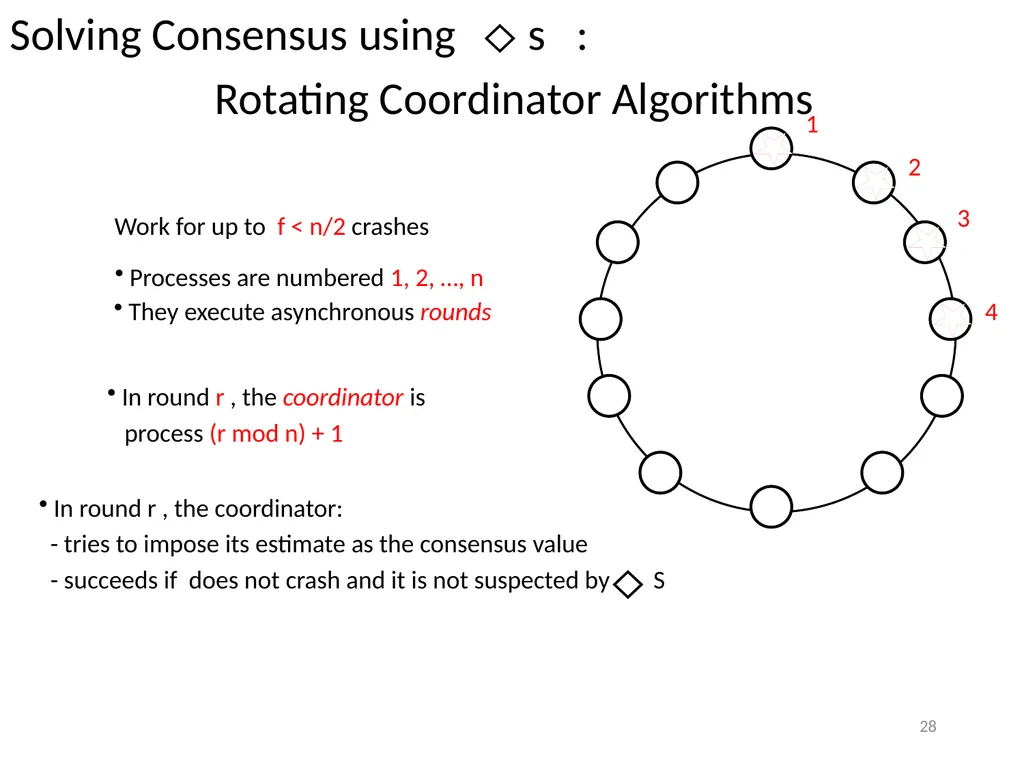
28 Work for up to f < n/2 crashes They execute asynchronous rounds In round r , the coordinator is
process (r mod n) + 1 In round r , the coordinator:
- tries to impose its estimate as the consensus value
- succeeds if does not crash and it is not suspected by S<br>
process (r mod n) + 1 In round r , the coordinator:
- tries to impose its estimate as the consensus value
- succeeds if does not crash and it is not suspected by S<br>
29
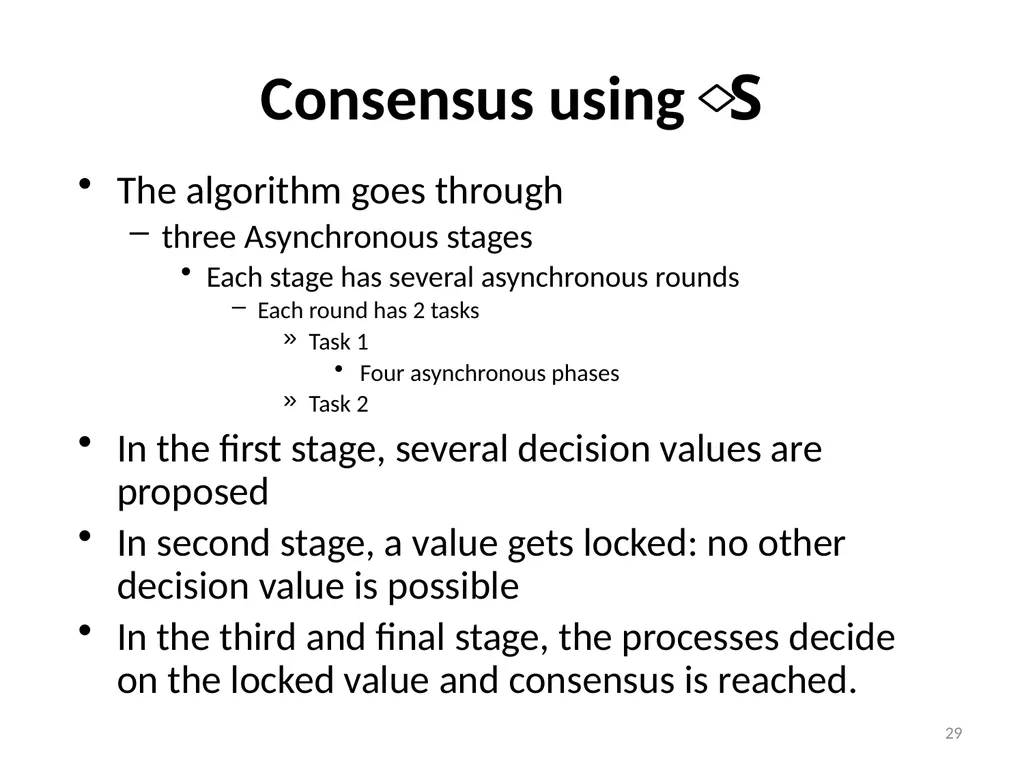
The algorithm goes through
three Asynchronous stages
Each stage has several asynchronous rounds
Each round has 2 tasks
Task 1
Four asynchronous phases
Task 2
In the first stage, several decision values are proposed
In second stage, a value gets locked: no other decision value is possible
In the third and final stage, the processes decide on the locked value and consensus is reached. 29 Consensus using S<br>
three Asynchronous stages
Each stage has several asynchronous rounds
Each round has 2 tasks
Task 1
Four asynchronous phases
Task 2
In the first stage, several decision values are proposed
In second stage, a value gets locked: no other decision value is possible
In the third and final stage, the processes decide on the locked value and consensus is reached. 29 Consensus using S<br>
30
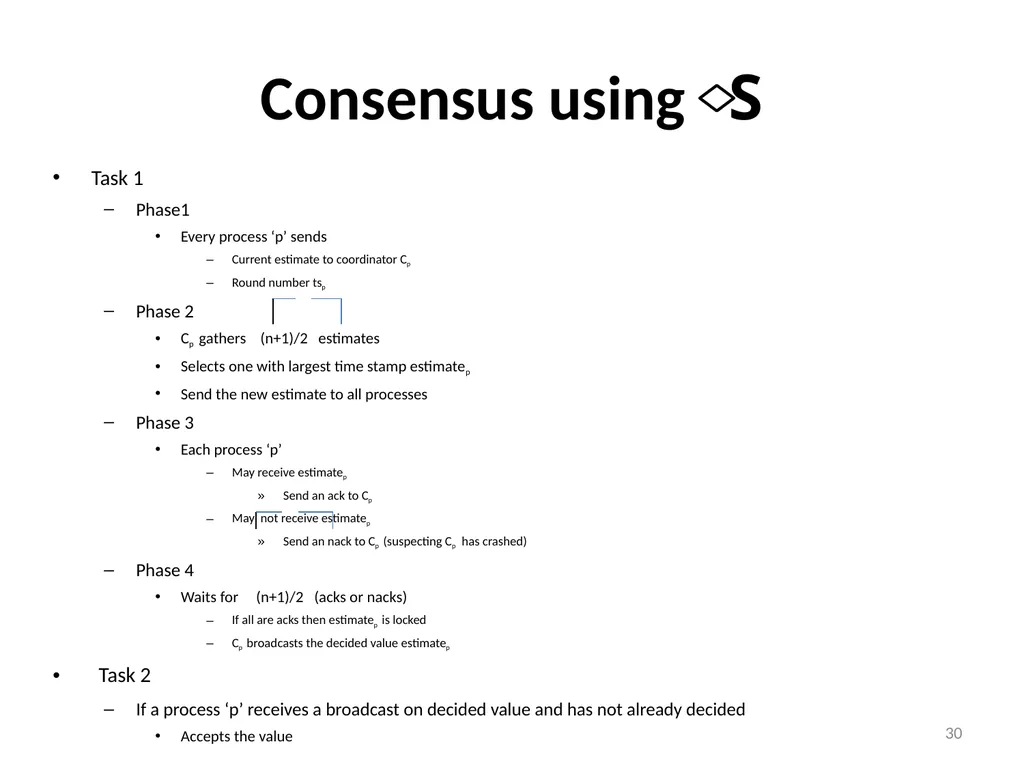
Task 1
Phase1
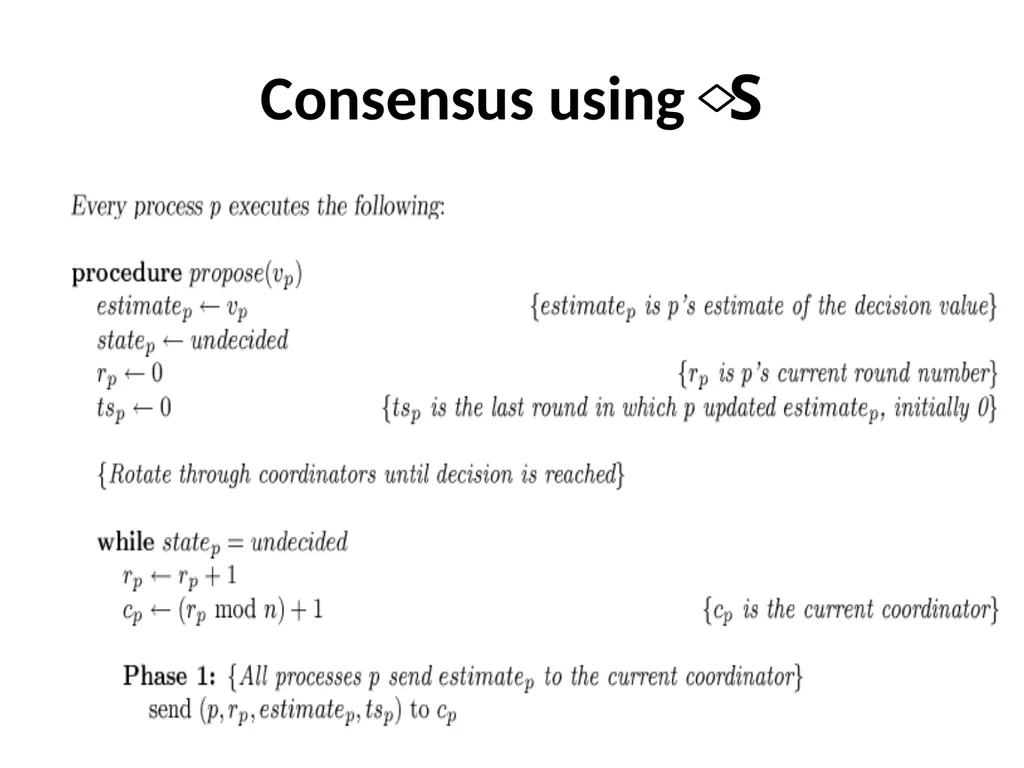
Every process ‘p’ sends
Current estimate to coordinator Cp
Round number tsp
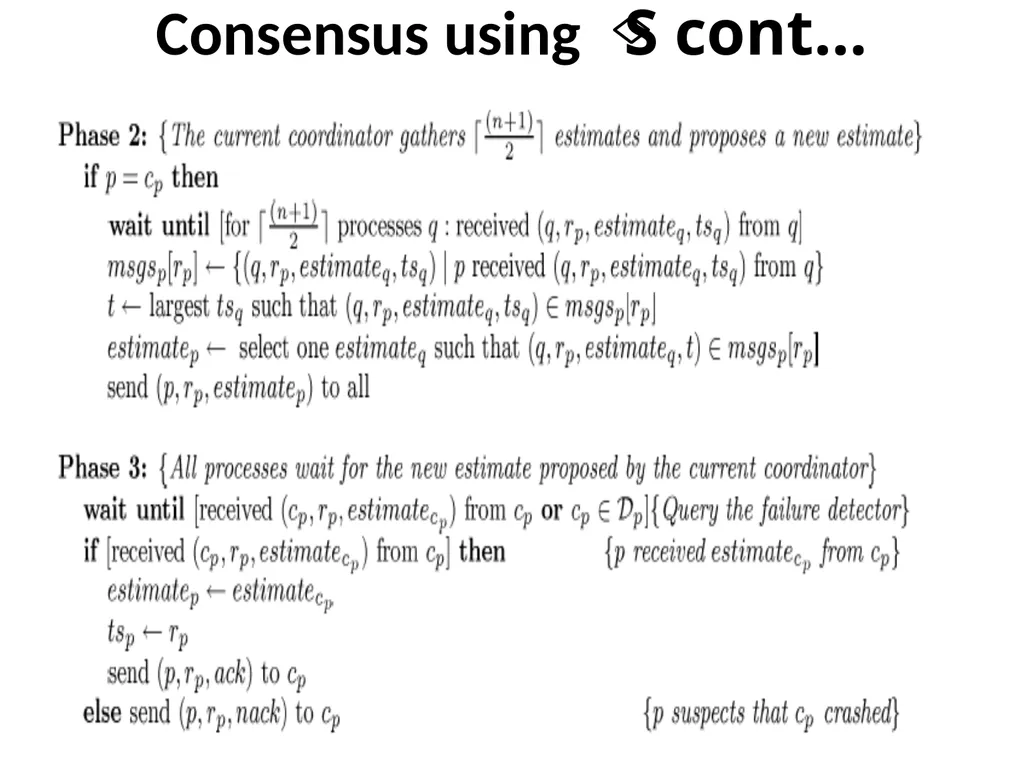
Phase 2
Cp gathers (n+1)/2 estimates
Selects one with largest time stamp estimatep
Send the new estimate to all processes
Phase 3
Each process ‘p’
May receive estimatep
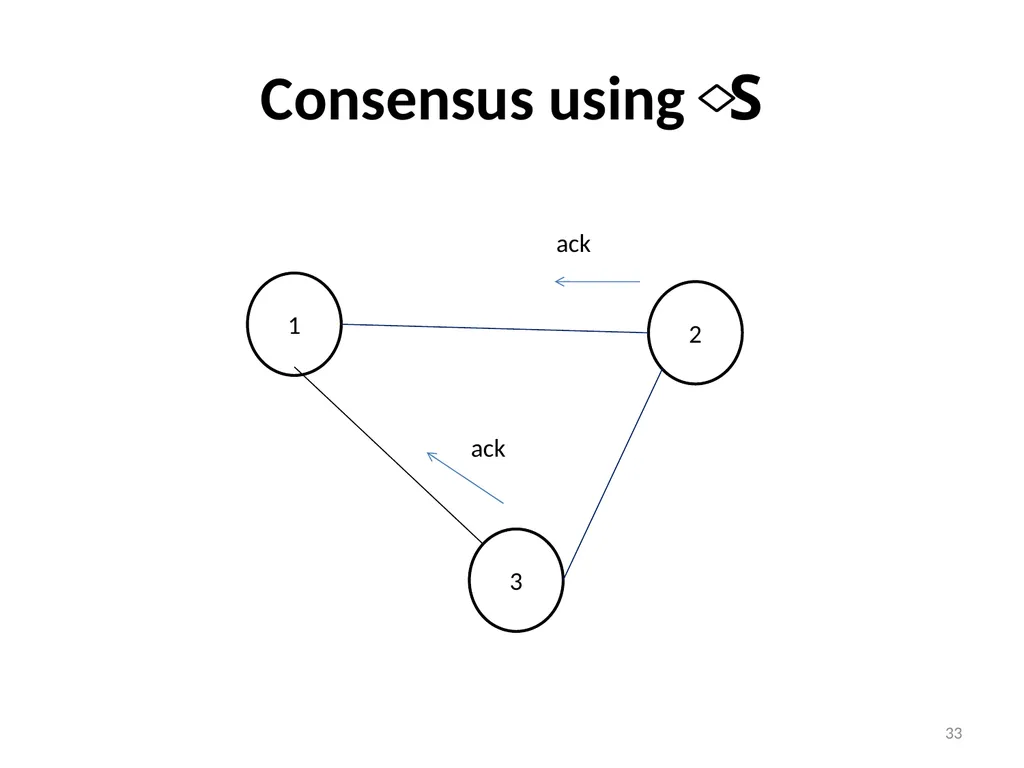
Send an ack to Cp
May not receive estimatep
Send an nack to Cp (suspecting Cp has crashed)
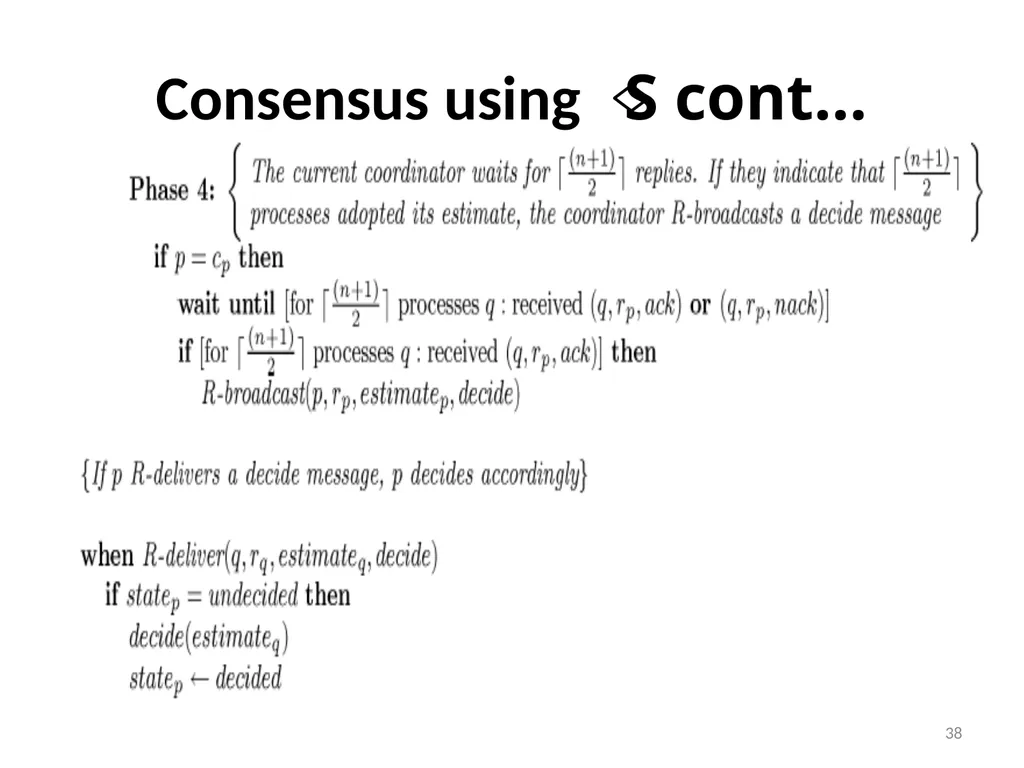
Phase 4
Waits for (n+1)/2 (acks or nacks)
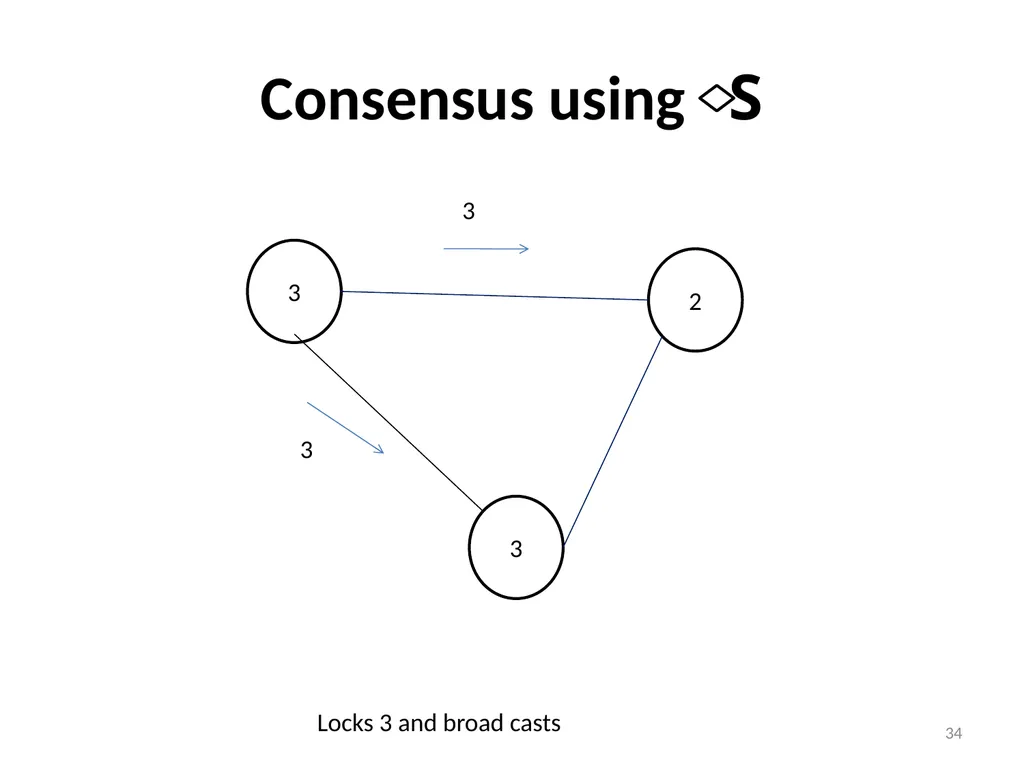
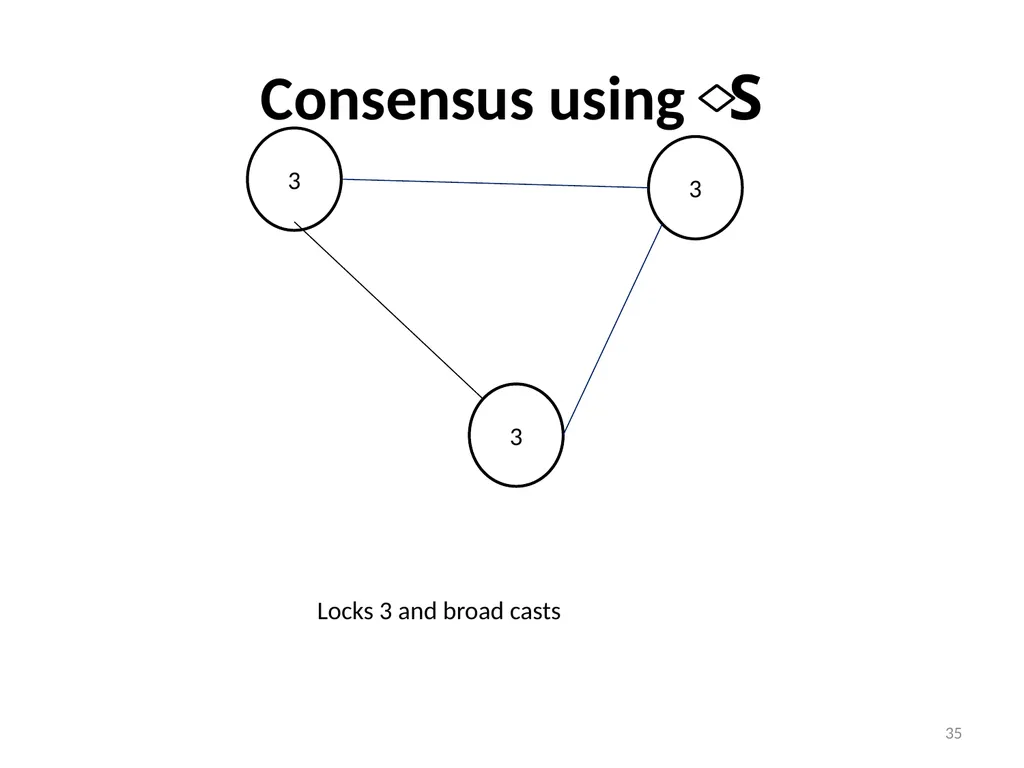
If all are acks then estimatep is locked
Cp broadcasts the decided value estimatep
Task 2
If a process ‘p’ receives a broadcast on decided value and has not already decided
Accepts the value 30 Consensus using S<br>
Phase1
Every process ‘p’ sends
Current estimate to coordinator Cp
Round number tsp
Phase 2
Cp gathers (n+1)/2 estimates
Selects one with largest time stamp estimatep
Send the new estimate to all processes
Phase 3
Each process ‘p’
May receive estimatep
Send an ack to Cp
May not receive estimatep
Send an nack to Cp (suspecting Cp has crashed)
Phase 4
Waits for (n+1)/2 (acks or nacks)
If all are acks then estimatep is locked
Cp broadcasts the decided value estimatep
Task 2
If a process ‘p’ receives a broadcast on decided value and has not already decided
Accepts the value 30 Consensus using S<br>
31
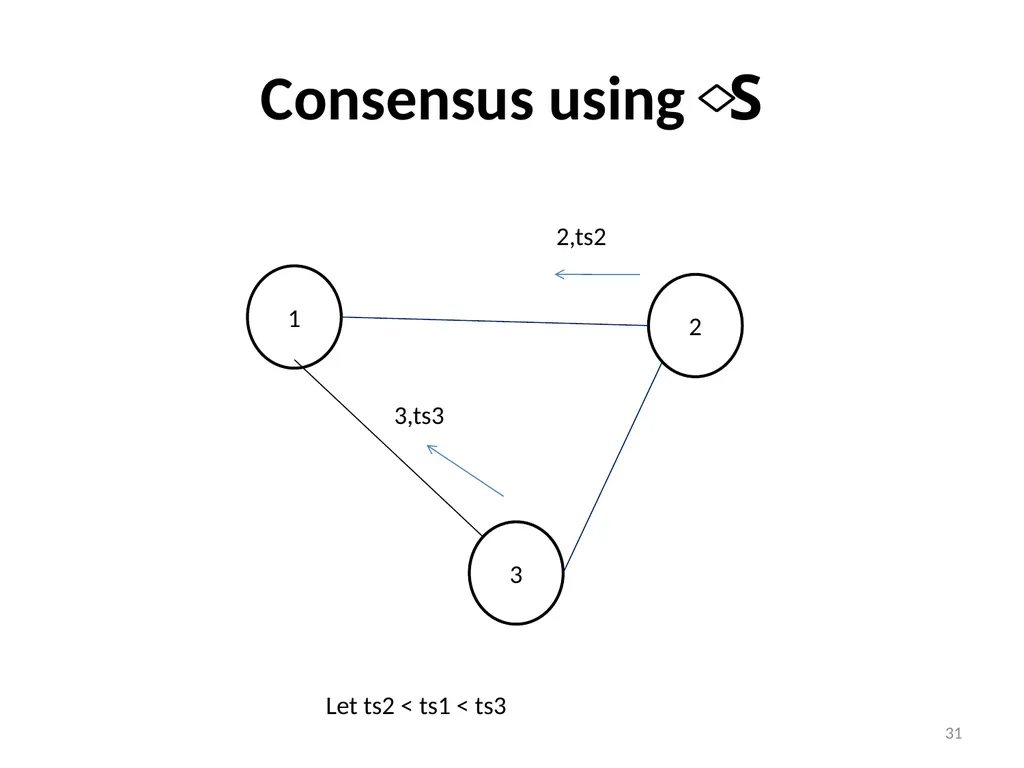
Let ts2 < ts1 < ts3 31 Consensus using S<br>
32
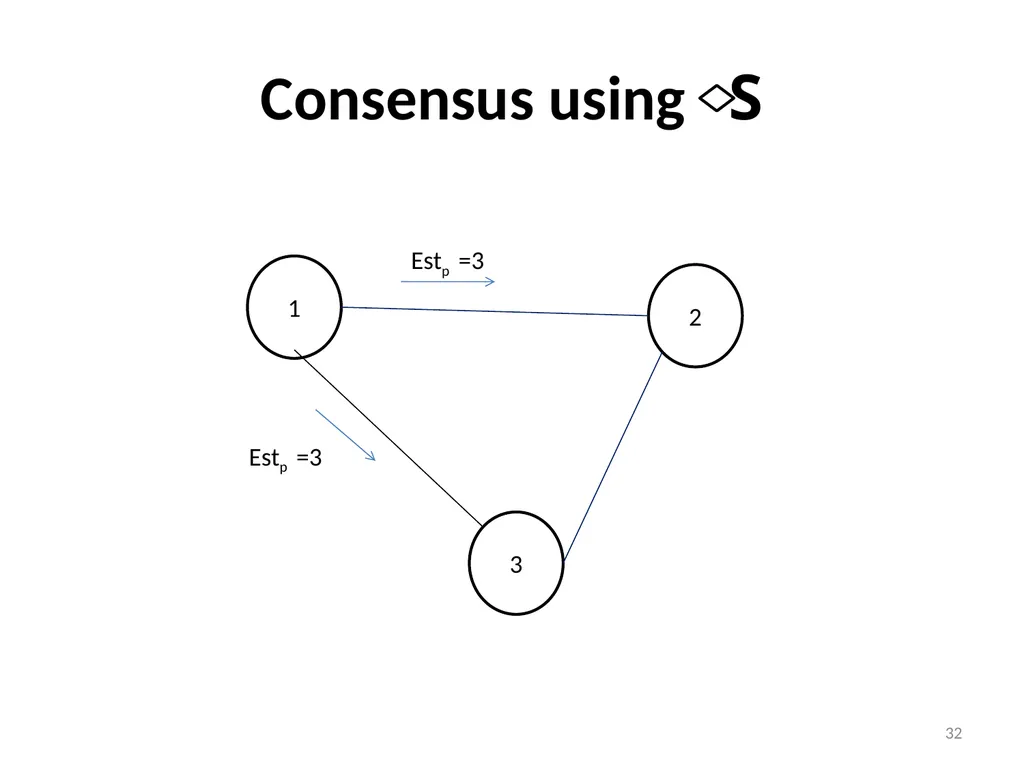
32 Consensus using S<br>
33
33 Consensus using S<br>
34
34 Consensus using S<br>
35
3 3 3 Locks 3 and broad casts 35 Consensus using S<br>
36
Consensus using S 36<br>
37
37 Consensus using S cont…<br>
38
38 Consensus using S cont…<br>
39
Atomic Broadcast Informally, atomic broadcast requires that all correct processes deliver the same set of messages in the same order (i.e., deliver the same sequence of messages).
Formally atomic broadcast can be defined as a reliable broadcast with the total order property
Chandra and Toueg showed that the result of consensus can be used to solve the problem of atomic broad cast. 39<br>
Formally atomic broadcast can be defined as a reliable broadcast with the total order property
Chandra and Toueg showed that the result of consensus can be used to solve the problem of atomic broad cast. 39<br>
40
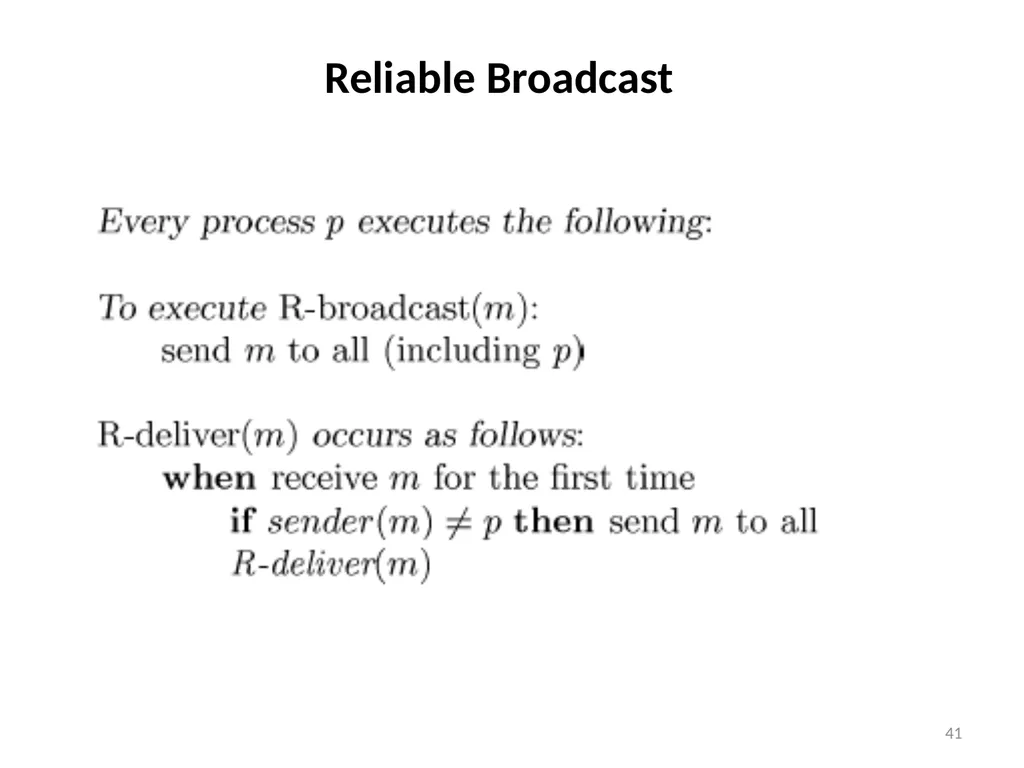
Reliable Broadcast
Validity : If the sender of a broadcast message m is non-faulty, then all correct processes eventually deliver m.
Agreement : If a correct process delivers a message m, then all correct processes deliver m.
Integrity : Each correct process delivers a message at most once.
Total Order
If two correct processes p and q deliver two messages m and m’ , then p delivers m before m’ if and only if q delivers m before m’ . 40<br>
Validity : If the sender of a broadcast message m is non-faulty, then all correct processes eventually deliver m.
Agreement : If a correct process delivers a message m, then all correct processes deliver m.
Integrity : Each correct process delivers a message at most once.
Total Order
If two correct processes p and q deliver two messages m and m’ , then p delivers m before m’ if and only if q delivers m before m’ . 40<br>
41
Reliable Broadcast 41<br>
42
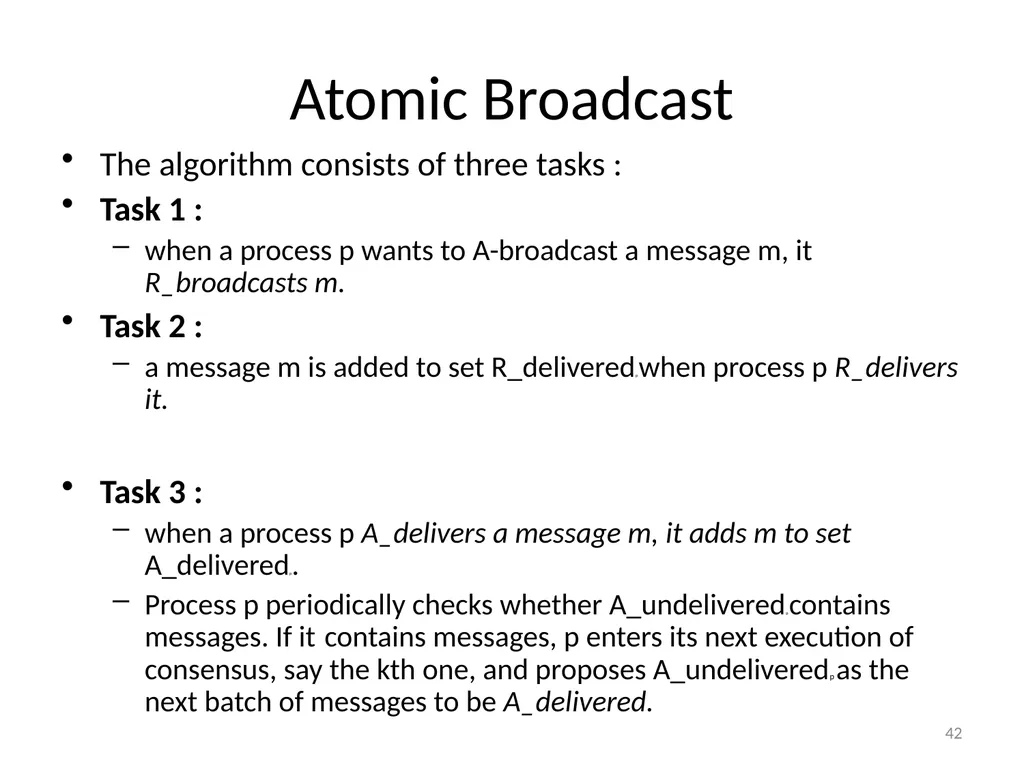
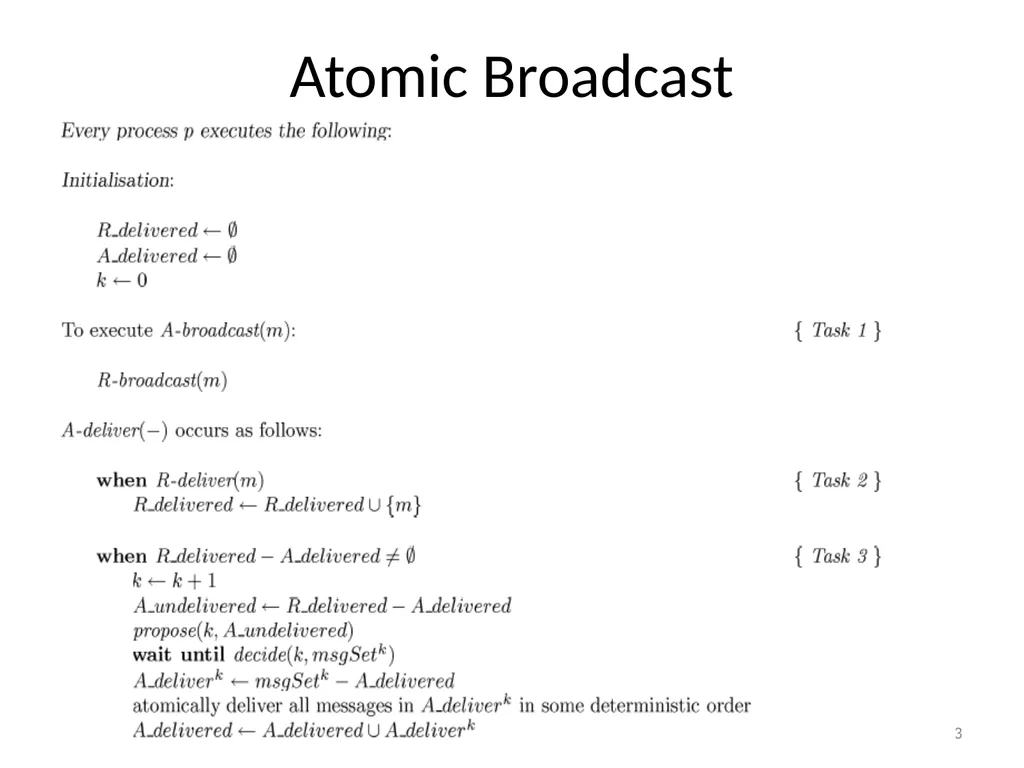
The algorithm consists of three tasks :
Task 1 :
when a process p wants to A-broadcast a message m, it R_broadcasts m.
Task 2 :
a message m is added to set R_deliveredp when process p R_delivers it.
Task 3 :
when a process p A_delivers a message m, it adds m to set A_deliveredp.
Process p periodically checks whether A_undeliveredp contains messages. If it contains messages, p enters its next execution of consensus, say the kth one, and proposes A_undeliveredp as the next batch of messages to be A_delivered. 42 Atomic Broadcast<br>
Task 1 :
when a process p wants to A-broadcast a message m, it R_broadcasts m.
Task 2 :
a message m is added to set R_deliveredp when process p R_delivers it.
Task 3 :
when a process p A_delivers a message m, it adds m to set A_deliveredp.
Process p periodically checks whether A_undeliveredp contains messages. If it contains messages, p enters its next execution of consensus, say the kth one, and proposes A_undeliveredp as the next batch of messages to be A_delivered. 42 Atomic Broadcast<br>
43
43 Atomic Broadcast<br>
44
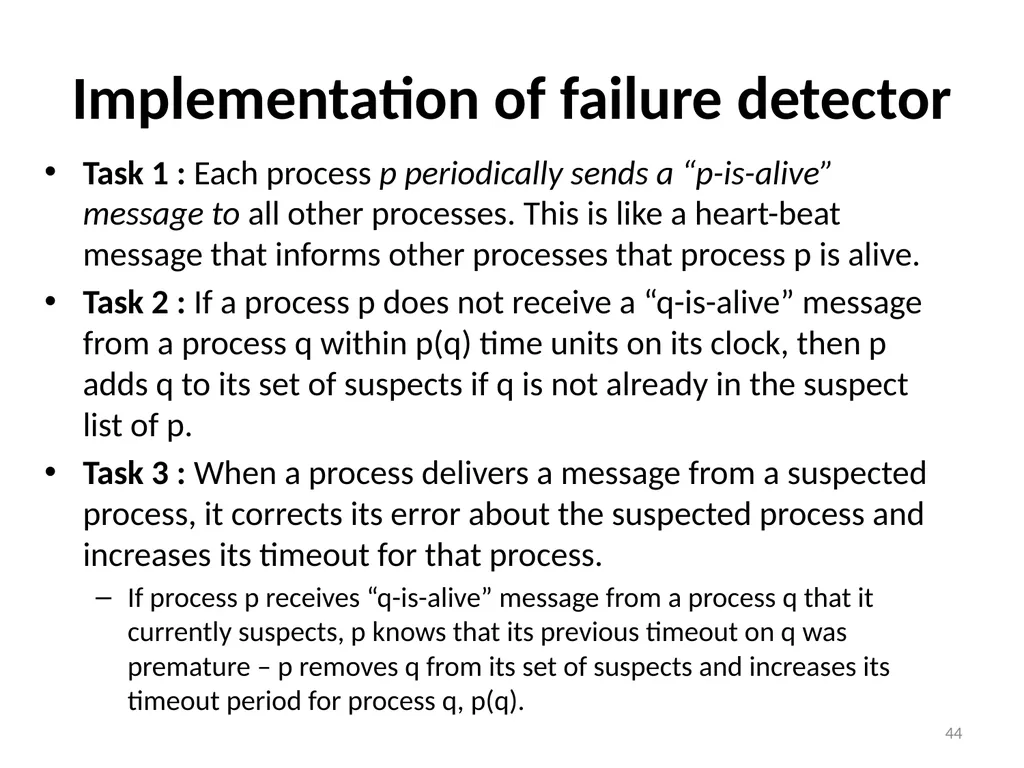
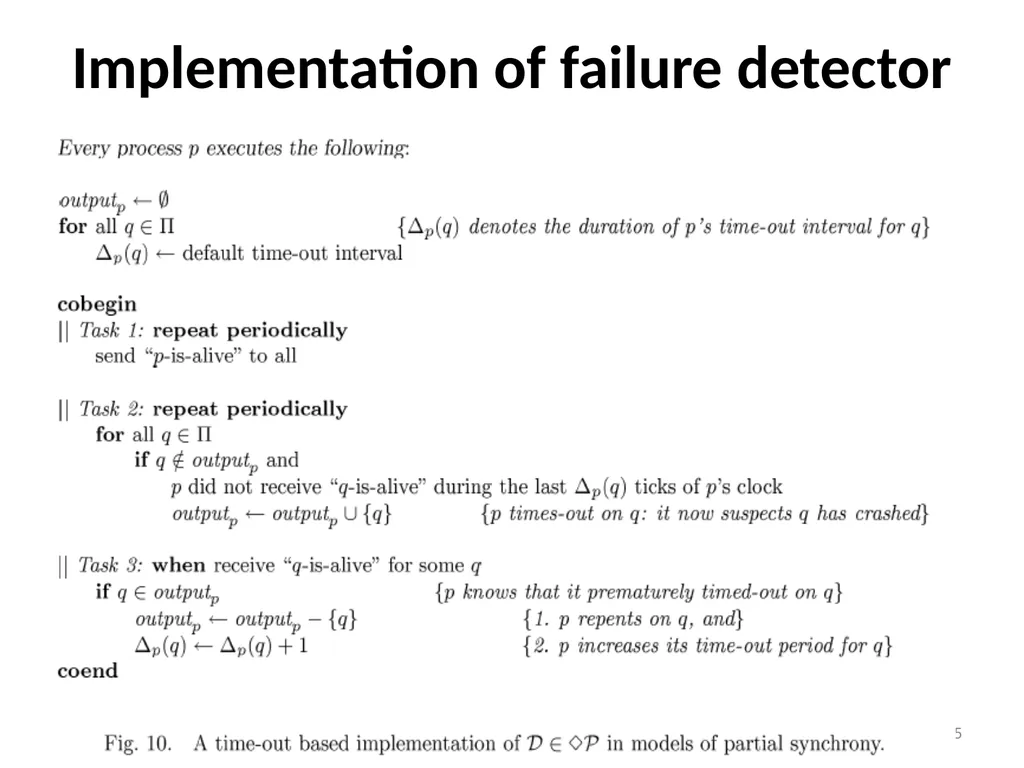
Implementation of failure detector Task 1 : Each process p periodically sends a “p-is-alive” message to all other processes. This is like a heart-beat message that informs other processes that process p is alive.
Task 2 : If a process p does not receive a “q-is-alive” message from a process q within p(q) time units on its clock, then p adds q to its set of suspects if q is not already in the suspect list of p.
Task 3 : When a process delivers a message from a suspected process, it corrects its error about the suspected process and increases its timeout for that process.
If process p receives “q-is-alive” message from a process q that it currently suspects, p knows that its previous timeout on q was premature – p removes q from its set of suspects and increases its timeout period for process q, p(q). 44<br>
Task 2 : If a process p does not receive a “q-is-alive” message from a process q within p(q) time units on its clock, then p adds q to its set of suspects if q is not already in the suspect list of p.
Task 3 : When a process delivers a message from a suspected process, it corrects its error about the suspected process and increases its timeout for that process.
If process p receives “q-is-alive” message from a process q that it currently suspects, p knows that its previous timeout on q was premature – p removes q from its set of suspects and increases its timeout period for process q, p(q). 44<br>
45
45 Implementation of failure detector<br>
46
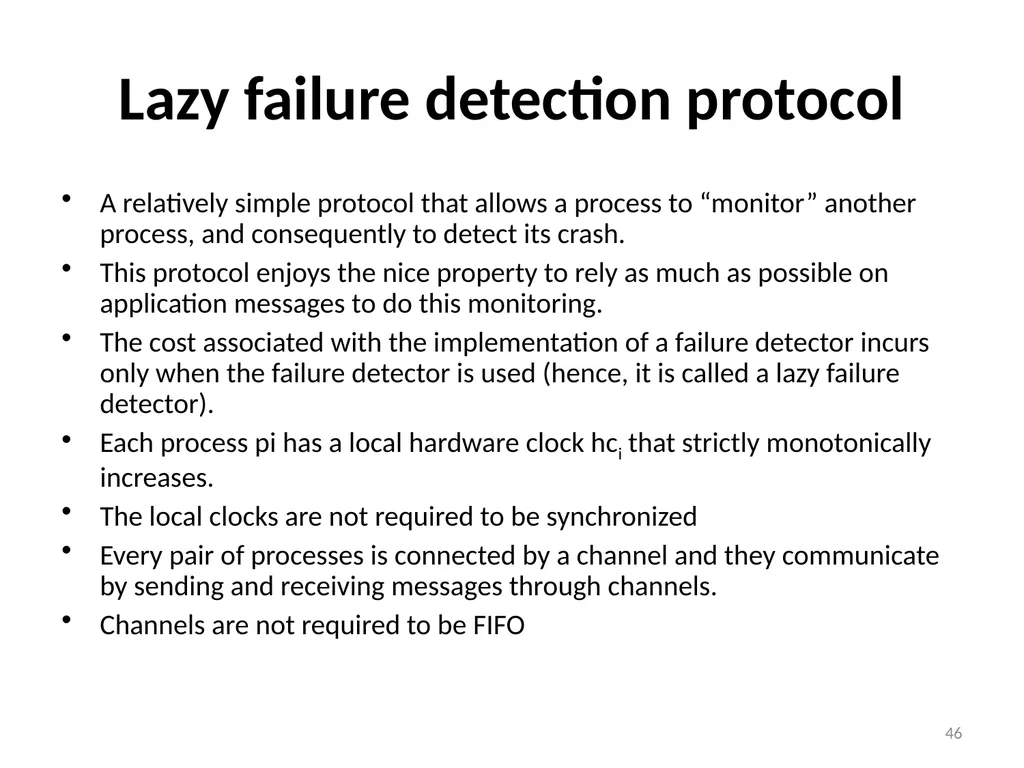
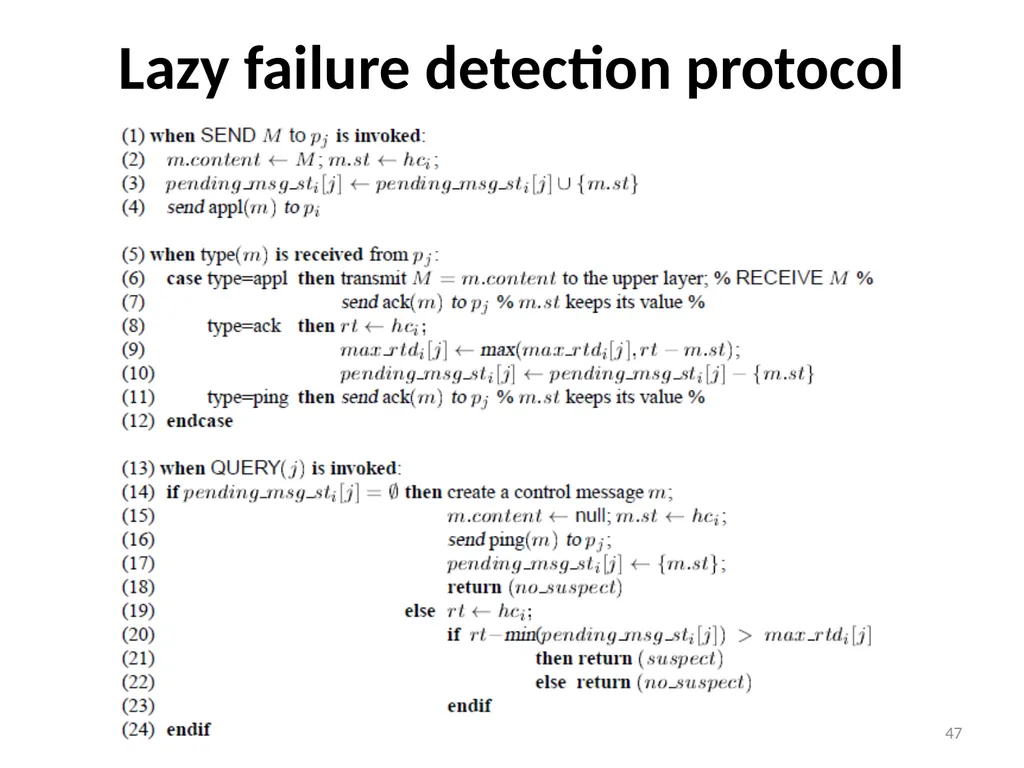
Lazy failure detection protocol A relatively simple protocol that allows a process to “monitor” another process, and consequently to detect its crash.
This protocol enjoys the nice property to rely as much as possible on application messages to do this monitoring.
The cost associated with the implementation of a failure detector incurs only when the failure detector is used (hence, it is called a lazy failure detector).
Each process pi has a local hardware clock hci that strictly monotonically increases.
The local clocks are not required to be synchronized
Every pair of processes is connected by a channel and they communicate by sending and receiving messages through channels.
Channels are not required to be FIFO 46<br>
This protocol enjoys the nice property to rely as much as possible on application messages to do this monitoring.
The cost associated with the implementation of a failure detector incurs only when the failure detector is used (hence, it is called a lazy failure detector).
Each process pi has a local hardware clock hci that strictly monotonically increases.
The local clocks are not required to be synchronized
Every pair of processes is connected by a channel and they communicate by sending and receiving messages through channels.
Channels are not required to be FIFO 46<br>
47
47 Lazy failure detection protocol<br>
48
A short introduction to failure detectors for asynchronous Distributed Systems 48<br>
49
Failure Detectors-Definition Why use FD?
Based on well defined set of Abstract concepts
Not dependant on any particular implementation
Layered approach favors design, proof and portability of protocol
Helps to solve impossible time-free asynchronous distributed system problems like the Consensus problem.
Eventually accurate failure detectors helps in designing indulgent algorithms. 49<br>
Based on well defined set of Abstract concepts
Not dependant on any particular implementation
Layered approach favors design, proof and portability of protocol
Helps to solve impossible time-free asynchronous distributed system problems like the Consensus problem.
Eventually accurate failure detectors helps in designing indulgent algorithms. 49<br>
50
Asynchronous System Models Process model
A process can fail by premature halting(crashing).
A process is correct if it does not crash else it is faulty
Computation models
FLP Crash-prone processes and reliable links
FLL Crash-prone processes and fair lossy links 50<br>
A process can fail by premature halting(crashing).
A process is correct if it does not crash else it is faulty
Computation models
FLP Crash-prone processes and reliable links
FLL Crash-prone processes and fair lossy links 50<br>
51
Asynchronous System Models Communication model
Processes communicate and synchronize by exchanging messages through links.
Reliable
Does not create or duplicate messages
Every message sent by Pi to Pj is eventually received by Pj
Fair lossy
Does not create or duplicate messages
Can lose message
Can send infinite number of messages from one process to another 51<br>
Processes communicate and synchronize by exchanging messages through links.
Reliable
Does not create or duplicate messages
Every message sent by Pi to Pj is eventually received by Pj
Fair lossy
Does not create or duplicate messages
Can lose message
Can send infinite number of messages from one process to another 51<br>
52
Consensus 52<br>
53
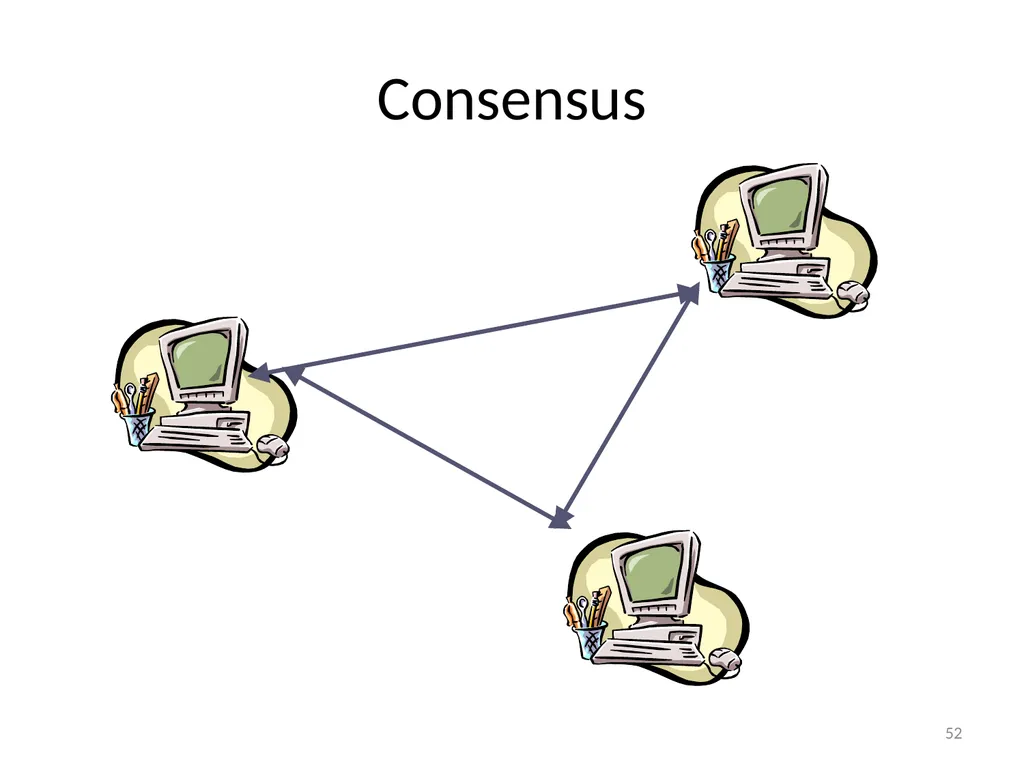
Consensus All the processes, propose a initial value and they all have to agree upon some common value proposed
Solving consensus is key to solving many problems in distributed computing (e.g., total order broadcast, atomic commit, terminating reliable broadcast) 53<br>
Solving consensus is key to solving many problems in distributed computing (e.g., total order broadcast, atomic commit, terminating reliable broadcast) 53<br>
54
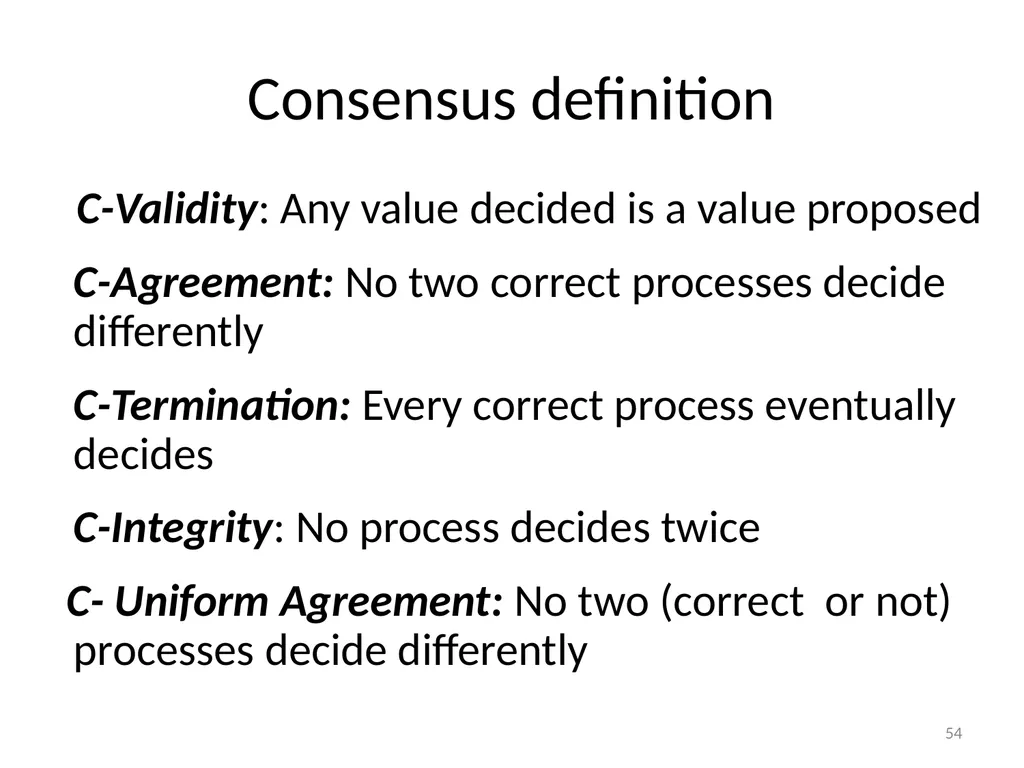
Consensus definition C-Validity: Any value decided is a value proposed
C-Agreement: No two correct processes decide differently
C-Termination: Every correct process eventually decides
C-Integrity: No process decides twice
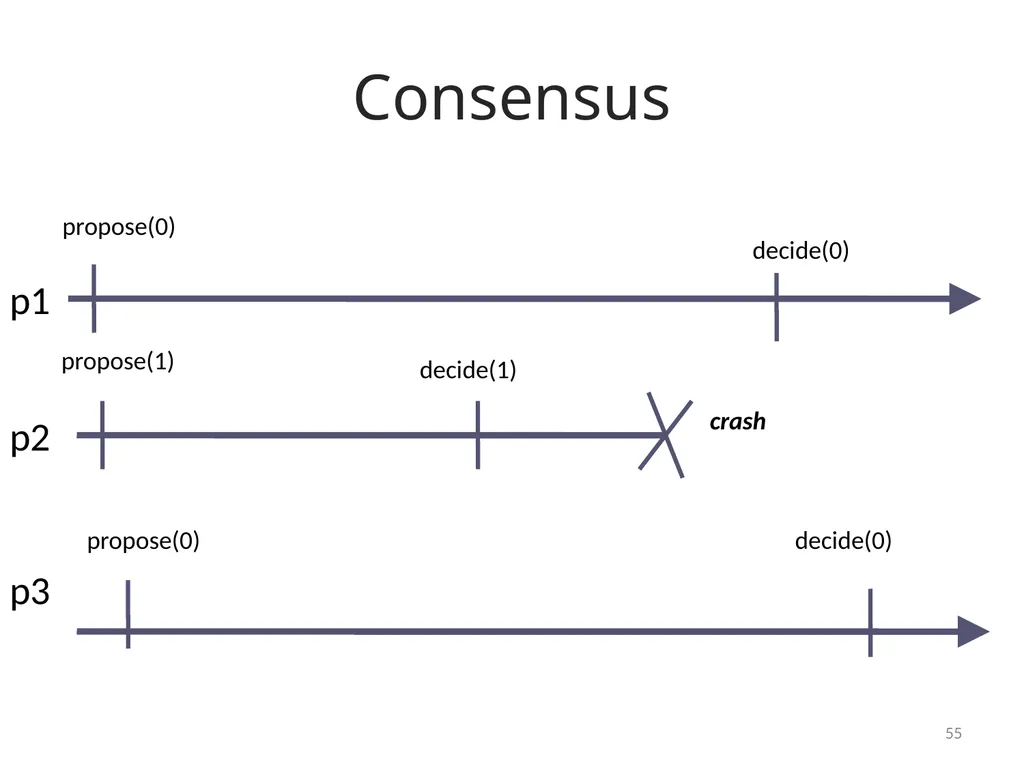
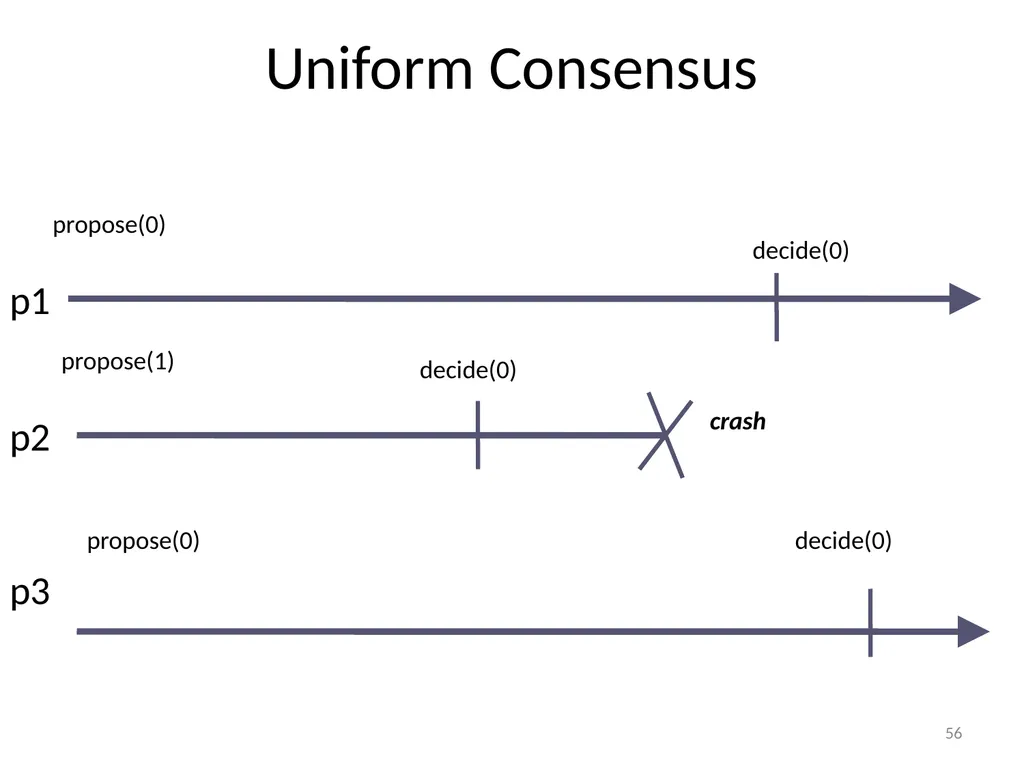
C- Uniform Agreement: No two (correct or not) processes decide differently 54<br>
C-Agreement: No two correct processes decide differently
C-Termination: Every correct process eventually decides
C-Integrity: No process decides twice
C- Uniform Agreement: No two (correct or not) processes decide differently 54<br>
55
Consensus p1 p2 p3 propose(0) decide(1) propose(1) propose(0) decide(0) crash decide(0) 55<br>
56
Uniform Consensus p1 p2 p3 propose(0) decide(0) propose(1) propose(0) decide(0) crash decide(0) 56<br>
57
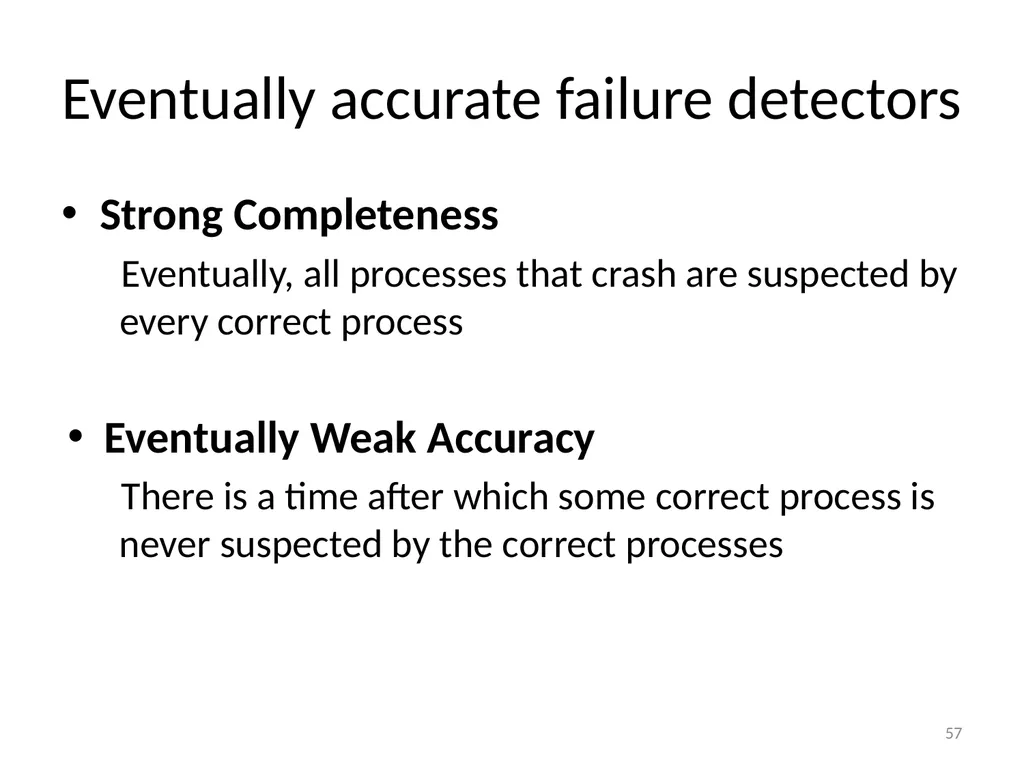
Eventually accurate failure detectors Strong Completeness
Eventually, all processes that crash are suspected by every correct process
Eventually Weak Accuracy
There is a time after which some correct process is never suspected by the correct processes 57<br>
Eventually, all processes that crash are suspected by every correct process
Eventually Weak Accuracy
There is a time after which some correct process is never suspected by the correct processes 57<br>
58
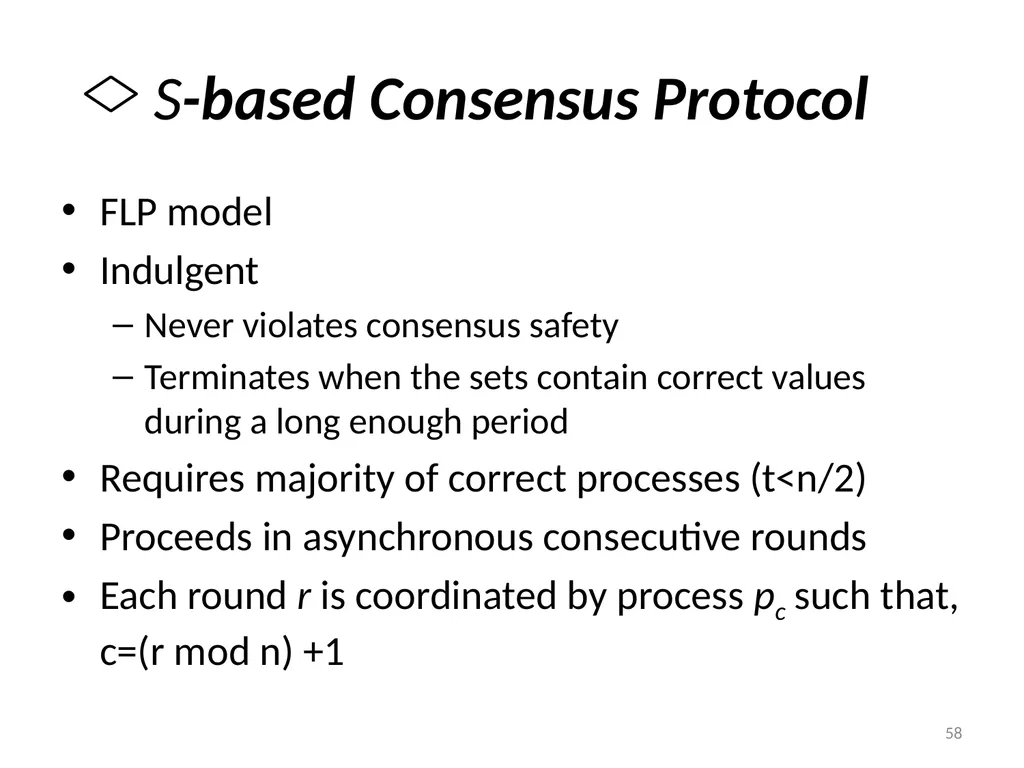
S-based Consensus Protocol FLP model
Indulgent
Never violates consensus safety
Terminates when the sets contain correct values during a long enough period
Requires majority of correct processes (t<n/2)
Proceeds in asynchronous consecutive rounds
Each round r is coordinated by process pc such that, c=(r mod n) +1 58<br>
Indulgent
Never violates consensus safety
Terminates when the sets contain correct values during a long enough period
Requires majority of correct processes (t<n/2)
Proceeds in asynchronous consecutive rounds
Each round r is coordinated by process pc such that, c=(r mod n) +1 58<br>
59
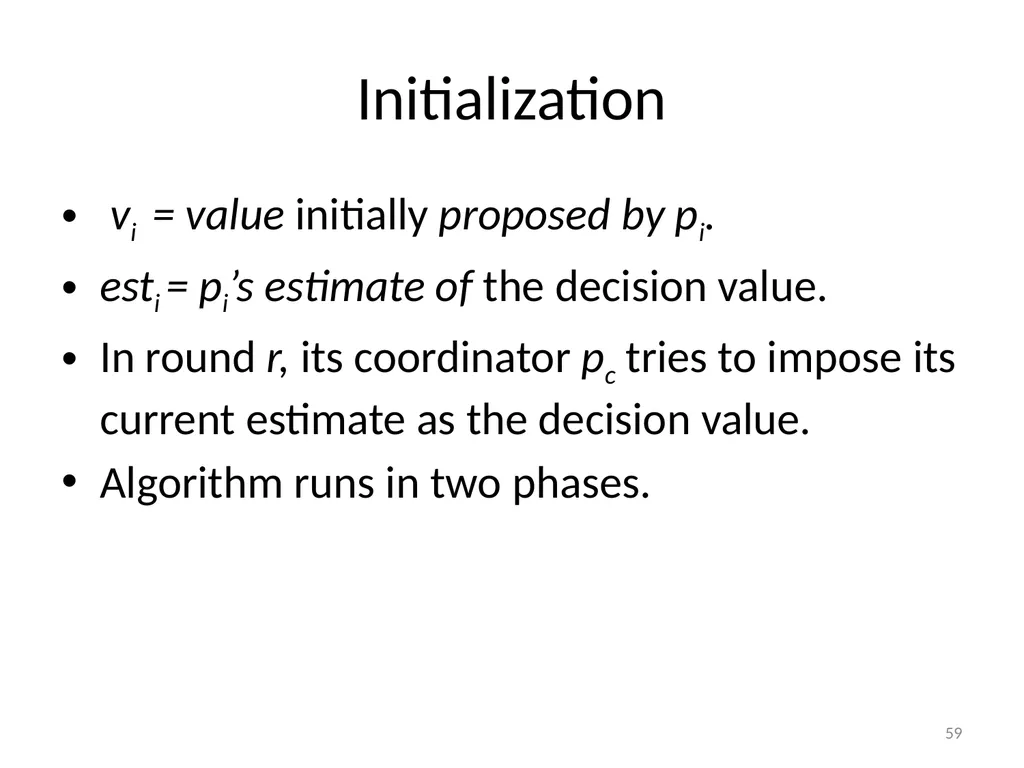
Initialization vi = value initially proposed by pi.
esti = pi’s estimate of the decision value.
In round r, its coordinator pc tries to impose its current estimate as the decision value.
Algorithm runs in two phases. 59<br>
esti = pi’s estimate of the decision value.
In round r, its coordinator pc tries to impose its current estimate as the decision value.
Algorithm runs in two phases. 59<br>
60
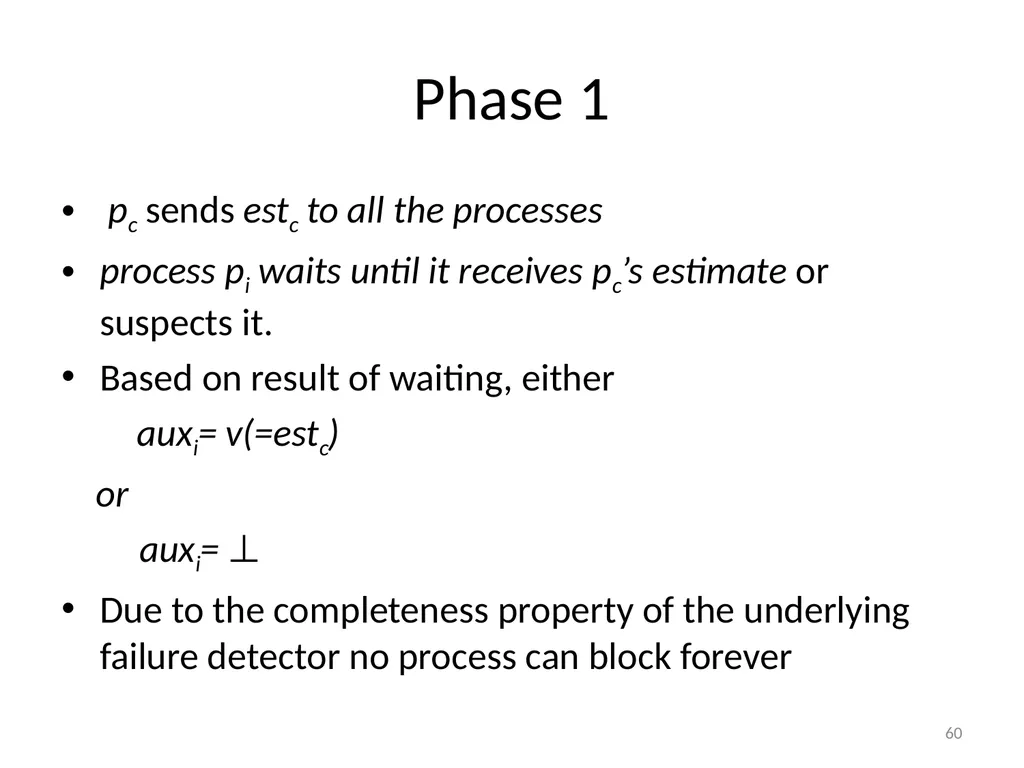
Phase 1 pc sends estc to all the processes
process pi waits until it receives pc’s estimate or suspects it.
Based on result of waiting, either
auxi= v(=estc)
or
auxi= ⊥
Due to the completeness property of the underlying failure detector no process can block forever 60<br>
process pi waits until it receives pc’s estimate or suspects it.
Based on result of waiting, either
auxi= v(=estc)
or
auxi= ⊥
Due to the completeness property of the underlying failure detector no process can block forever 60<br>
61
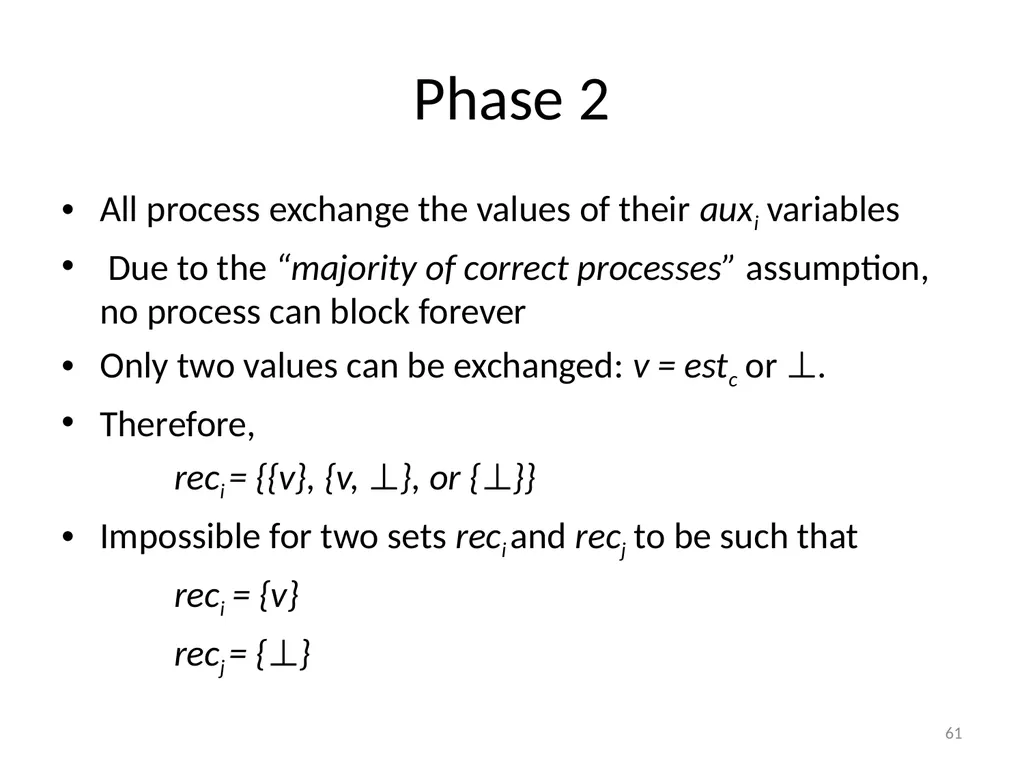
Phase 2 All process exchange the values of their auxi variables
Due to the “majority of correct processes” assumption, no process can block forever
Only two values can be exchanged: v = estc or ⊥.
Therefore,
reci = {{v}, {v, ⊥}, or {⊥}}
Impossible for two sets reci and recj to be such that
reci = {v}
recj = {⊥} 61<br>
Due to the “majority of correct processes” assumption, no process can block forever
Only two values can be exchanged: v = estc or ⊥.
Therefore,
reci = {{v}, {v, ⊥}, or {⊥}}
Impossible for two sets reci and recj to be such that
reci = {v}
recj = {⊥} 61<br>
62
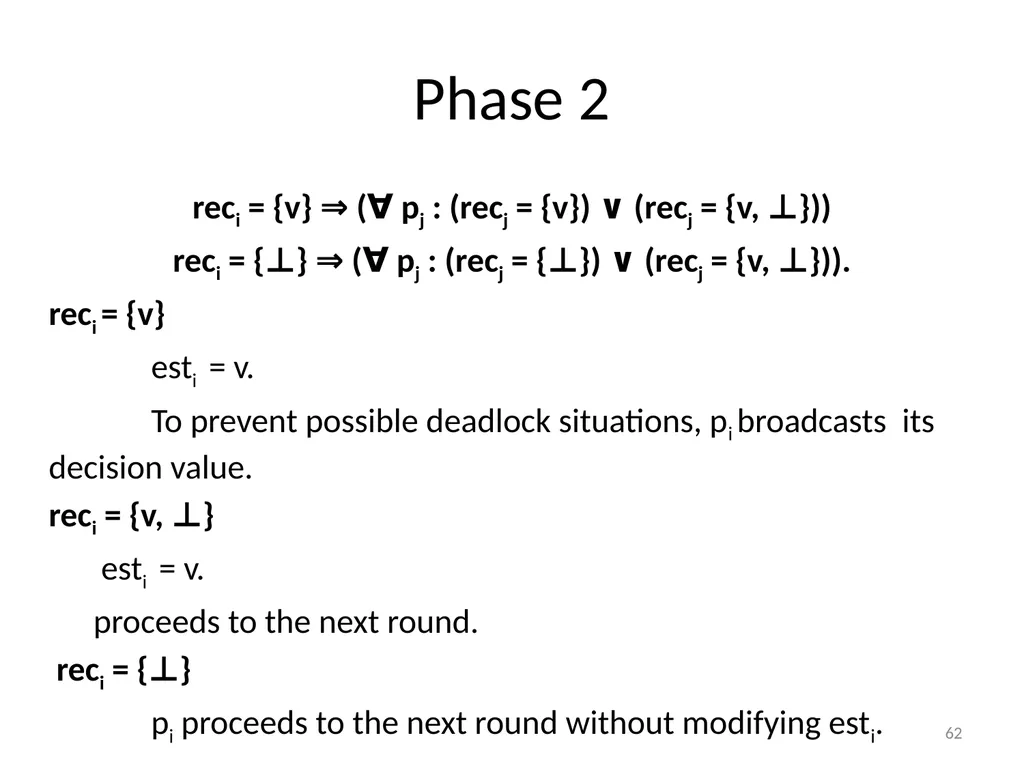
Phase 2 reci = {v} ⇒ (∀ pj : (recj = {v}) ∨ (recj = {v, ⊥}))
reci = {⊥} ⇒ (∀ pj : (recj = {⊥}) ∨ (recj = {v, ⊥})).
reci = {v}
esti = v.
To prevent possible deadlock situations, pi broadcasts its decision value.
reci = {v, ⊥}
esti = v.
proceeds to the next round.
reci = {⊥}
pi proceeds to the next round without modifying esti. 62<br>
reci = {⊥} ⇒ (∀ pj : (recj = {⊥}) ∨ (recj = {v, ⊥})).
reci = {v}
esti = v.
To prevent possible deadlock situations, pi broadcasts its decision value.
reci = {v, ⊥}
esti = v.
proceeds to the next round.
reci = {⊥}
pi proceeds to the next round without modifying esti. 62<br>
63
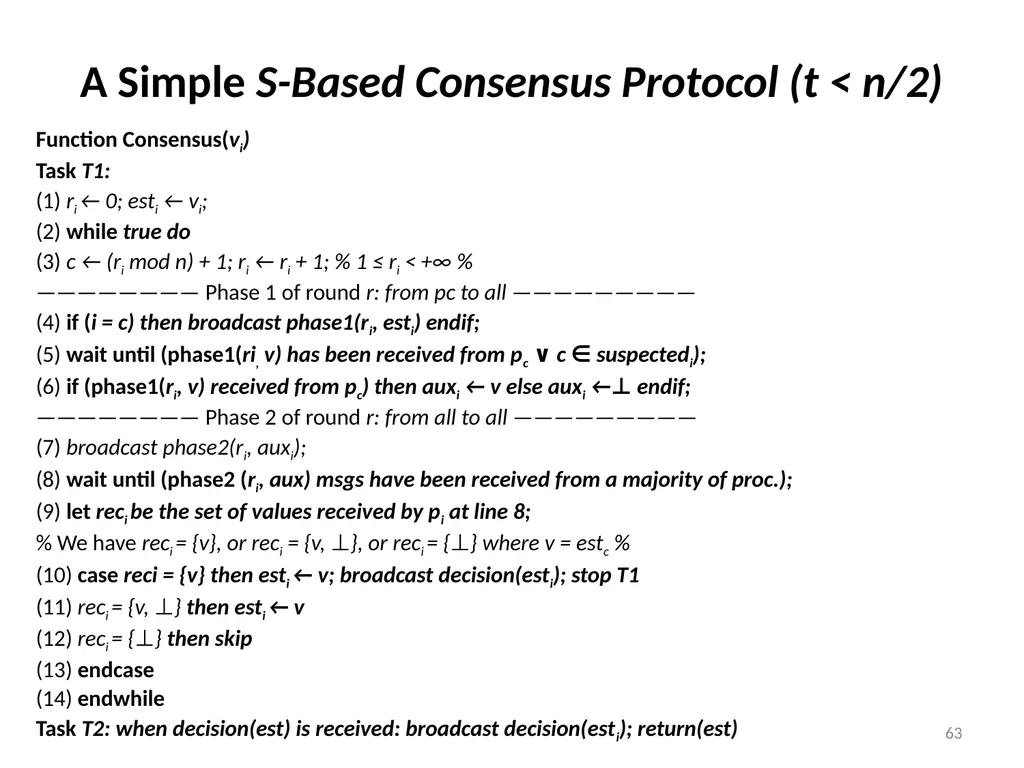
A Simple S-Based Consensus Protocol (t < n/2) Function Consensus(vi)
Task T1:
(1) ri ← 0; esti ← vi;
(2) while true do
(3) c ← (ri mod n) + 1; ri ← ri + 1; % 1 ≤ ri < +∞ %
———————— Phase 1 of round r: from pc to all —————————
(4) if (i = c) then broadcast phase1(ri, esti) endif;
(5) wait until (phase1(ri, v) has been received from pc ∨ c ∈ suspectedi);
(6) if (phase1(ri, v) received from pc) then auxi ← v else auxi ←⊥ endif;
———————— Phase 2 of round r: from all to all —————————
(7) broadcast phase2(ri, auxi);
(8) wait until (phase2 (ri, aux) msgs have been received from a majority of proc.);
(9) let reci be the set of values received by pi at line 8;
% We have reci = {v}, or reci = {v, ⊥}, or reci = {⊥} where v = estc %
(10) case reci = {v} then esti ← v; broadcast decision(esti); stop T1
(11) reci = {v, ⊥} then esti ← v
(12) reci = {⊥} then skip
(13) endcase
(14) endwhile
Task T2: when decision(est) is received: broadcast decision(esti); return(est) 63<br>
Task T1:
(1) ri ← 0; esti ← vi;
(2) while true do
(3) c ← (ri mod n) + 1; ri ← ri + 1; % 1 ≤ ri < +∞ %
———————— Phase 1 of round r: from pc to all —————————
(4) if (i = c) then broadcast phase1(ri, esti) endif;
(5) wait until (phase1(ri, v) has been received from pc ∨ c ∈ suspectedi);
(6) if (phase1(ri, v) received from pc) then auxi ← v else auxi ←⊥ endif;
———————— Phase 2 of round r: from all to all —————————
(7) broadcast phase2(ri, auxi);
(8) wait until (phase2 (ri, aux) msgs have been received from a majority of proc.);
(9) let reci be the set of values received by pi at line 8;
% We have reci = {v}, or reci = {v, ⊥}, or reci = {⊥} where v = estc %
(10) case reci = {v} then esti ← v; broadcast decision(esti); stop T1
(11) reci = {v, ⊥} then esti ← v
(12) reci = {⊥} then skip
(13) endcase
(14) endwhile
Task T2: when decision(est) is received: broadcast decision(esti); return(est) 63<br>
64
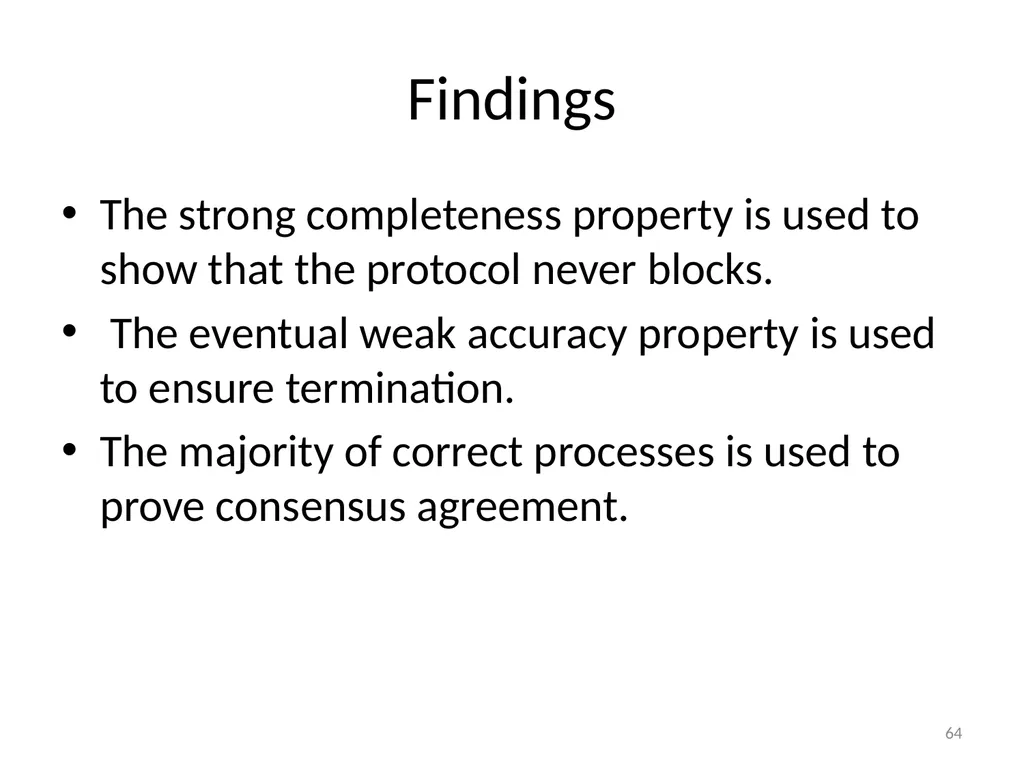
Findings The strong completeness property is used to show that the protocol never blocks.
The eventual weak accuracy property is used to ensure termination.
The majority of correct processes is used to prove consensus agreement. 64<br>
The eventual weak accuracy property is used to ensure termination.
The majority of correct processes is used to prove consensus agreement. 64<br>
65
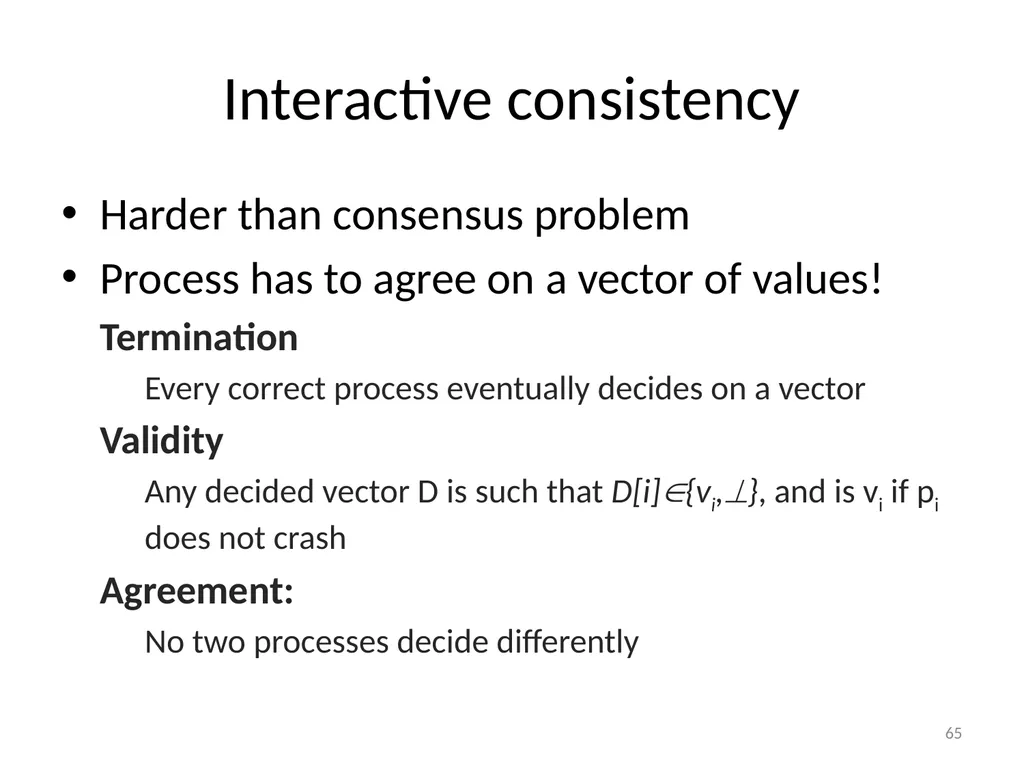
Interactive consistency Harder than consensus problem
Process has to agree on a vector of values!
Termination
Every correct process eventually decides on a vector
Validity
Any decided vector D is such that D[i]{vi,}, and is vi if pi does not crash
Agreement:
No two processes decide differently 65<br>
Process has to agree on a vector of values!
Termination
Every correct process eventually decides on a vector
Validity
Any decided vector D is such that D[i]{vi,}, and is vi if pi does not crash
Agreement:
No two processes decide differently 65<br>
66
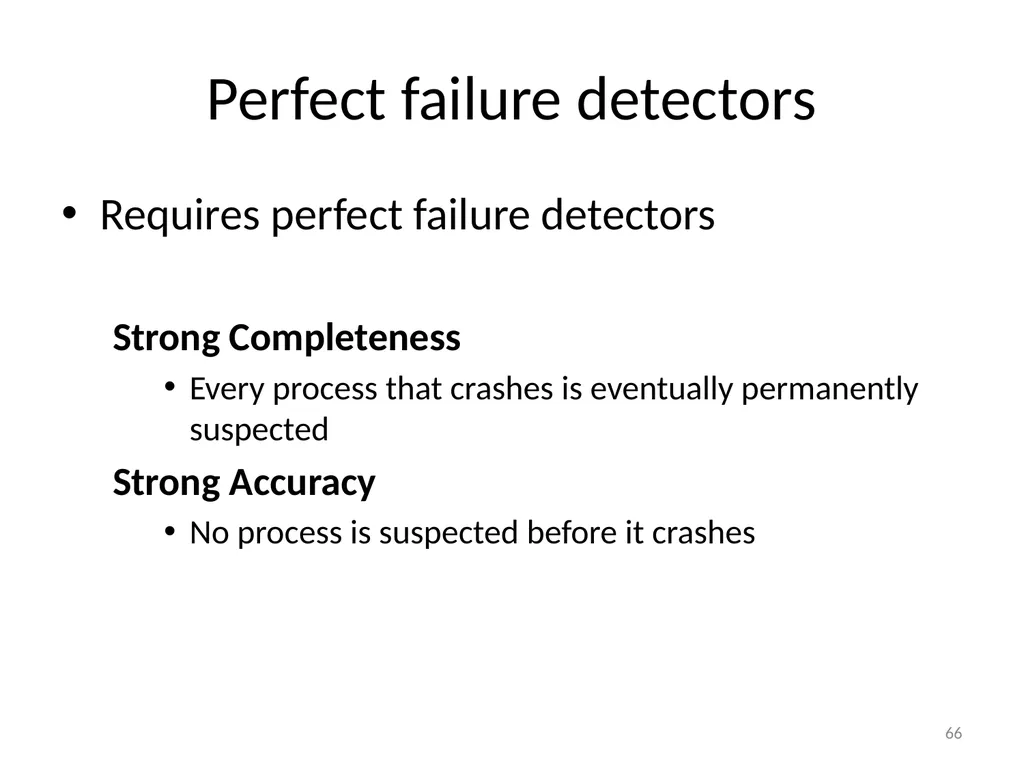
Perfect failure detectors Requires perfect failure detectors
Strong Completeness
Every process that crashes is eventually permanently suspected
Strong Accuracy
No process is suspected before it crashes 66<br>
Strong Completeness
Every process that crashes is eventually permanently suspected
Strong Accuracy
No process is suspected before it crashes 66<br>
67
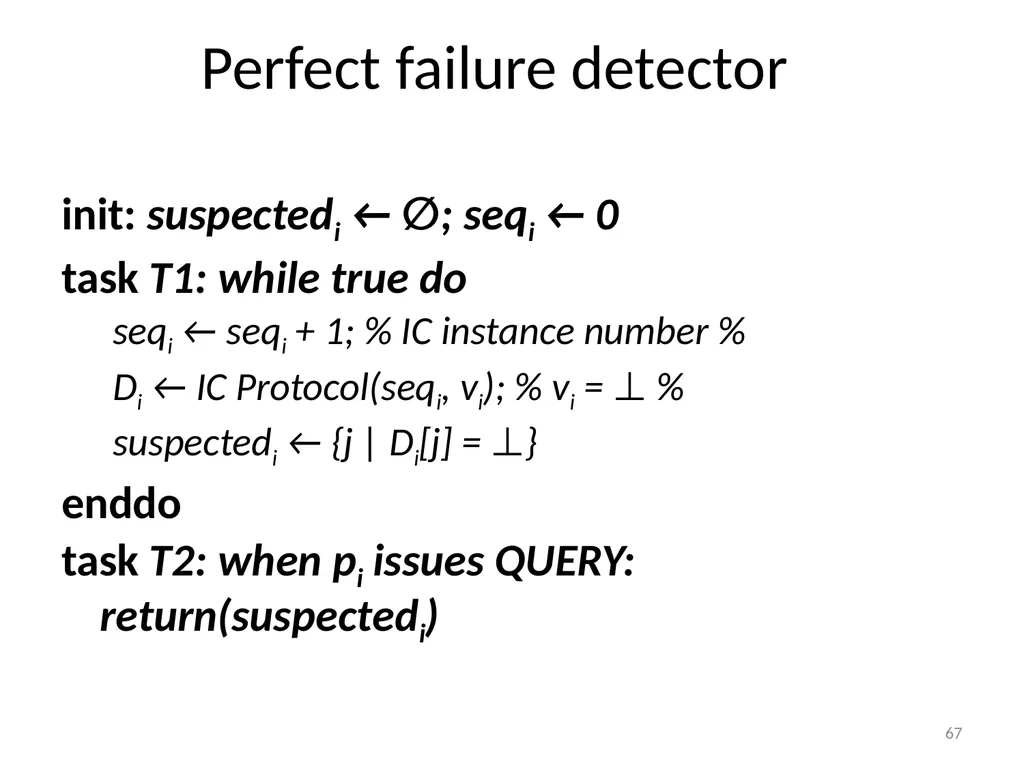
Perfect failure detector init: suspectedi ← ∅; seqi ← 0
task T1: while true do
seqi ← seqi + 1; % IC instance number %
Di ← IC Protocol(seqi, vi); % vi = ⊥ %
suspectedi ← {j | Di[j] = ⊥}
enddo
task T2: when pi issues QUERY: return(suspectedi) 67<br>
task T1: while true do
seqi ← seqi + 1; % IC instance number %
Di ← IC Protocol(seqi, vi); % vi = ⊥ %
suspectedi ← {j | Di[j] = ⊥}
enddo
task T2: when pi issues QUERY: return(suspectedi) 67<br>
68
Non-Blocking Atomic Commit Problem (NBAC) Yet another agreement problem in the world of distributed computing
Each process cast their votes (yes or no).
Non-crashed process decide on single value (commit or abort) 68<br>
Each process cast their votes (yes or no).
Non-crashed process decide on single value (commit or abort) 68<br>
69
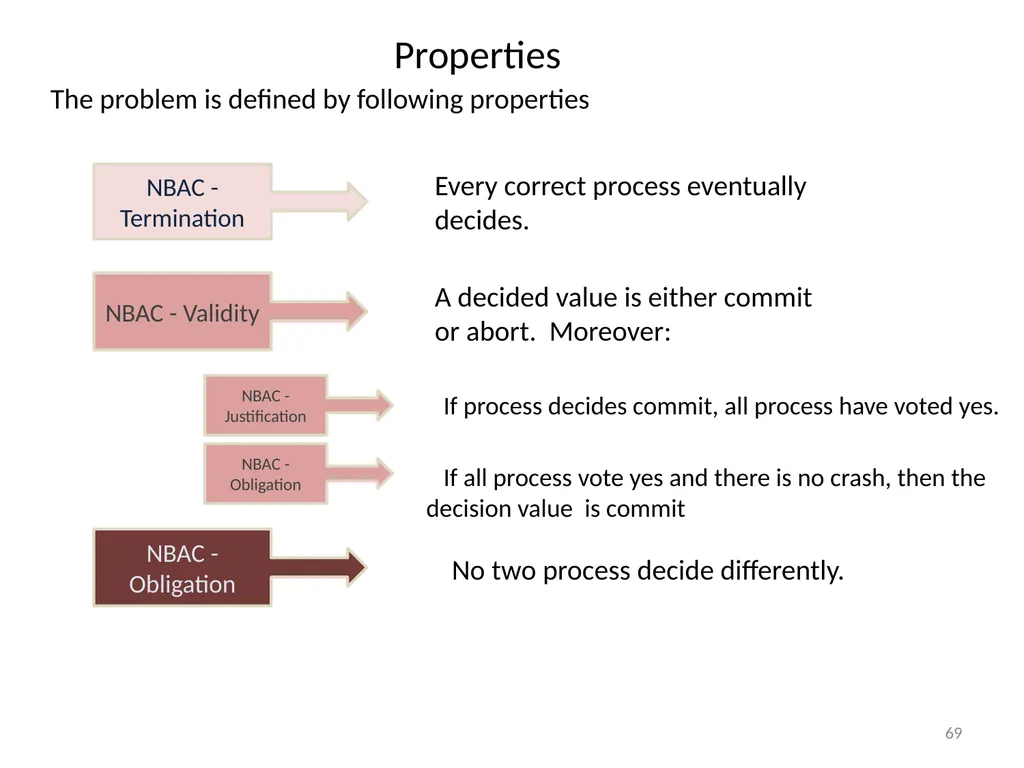
A decided value is either commit or abort. Moreover: Properties The problem is defined by following properties Every correct process eventually decides. If process decides commit, all process have voted yes.
If all process vote yes and there is no crash, then the decision value is commit No two process decide differently. NBAC -Termination NBAC - Obligation NBAC - Validity NBAC - Justification NBAC - Obligation 69<br>
If all process vote yes and there is no crash, then the decision value is commit No two process decide differently. NBAC -Termination NBAC - Obligation NBAC - Validity NBAC - Justification NBAC - Obligation 69<br>
70
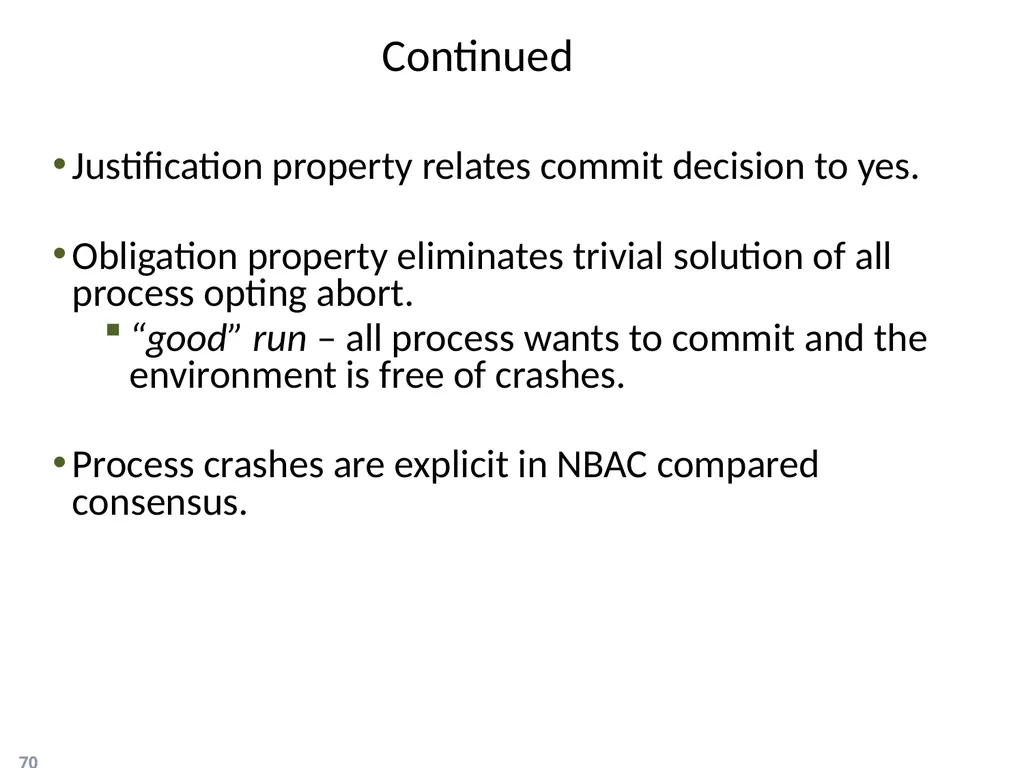
Justification property relates commit decision to yes.
Obligation property eliminates trivial solution of all process opting abort.
“good” run – all process wants to commit and the environment is free of crashes.
Process crashes are explicit in NBAC compared consensus. Continued 70<br>
Obligation property eliminates trivial solution of all process opting abort.
“good” run – all process wants to commit and the environment is free of crashes.
Process crashes are explicit in NBAC compared consensus. Continued 70<br>
71
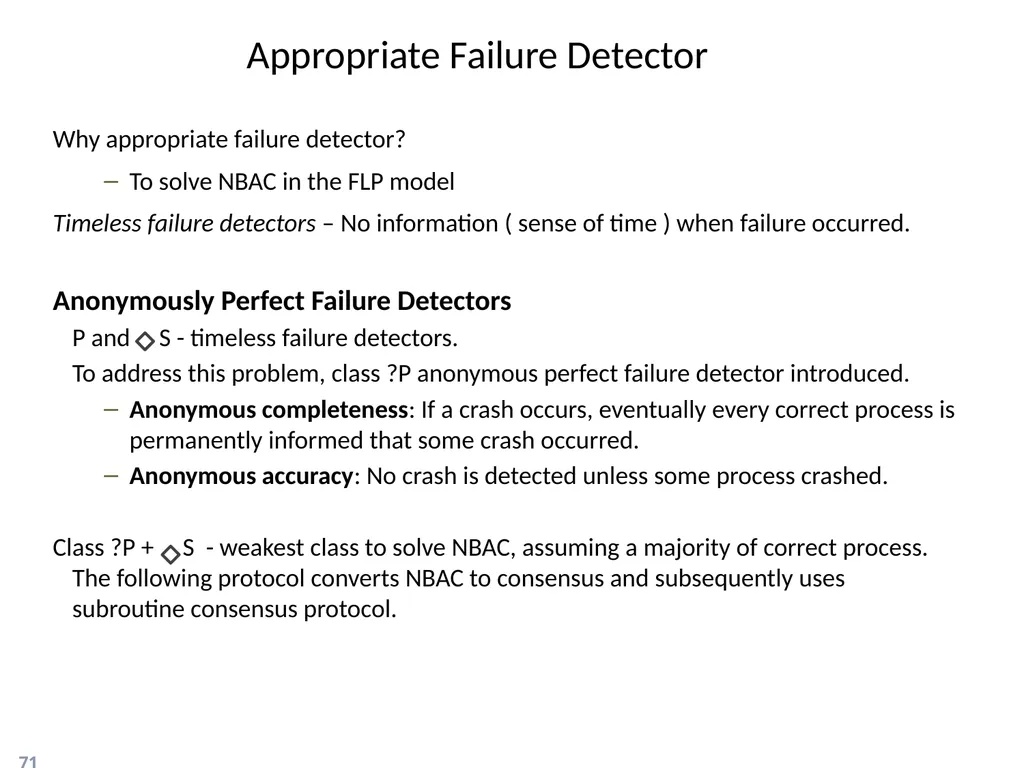
Why appropriate failure detector?
To solve NBAC in the FLP model
Timeless failure detectors – No information ( sense of time ) when failure occurred.
Anonymously Perfect Failure Detectors
P and S - timeless failure detectors.
To address this problem, class ?P anonymous perfect failure detector introduced.
Anonymous completeness: If a crash occurs, eventually every correct process is permanently informed that some crash occurred.
Anonymous accuracy: No crash is detected unless some process crashed.
Class ?P + S - weakest class to solve NBAC, assuming a majority of correct process. The following protocol converts NBAC to consensus and subsequently uses subroutine consensus protocol. Appropriate Failure Detector 71<br>
To solve NBAC in the FLP model
Timeless failure detectors – No information ( sense of time ) when failure occurred.
Anonymously Perfect Failure Detectors
P and S - timeless failure detectors.
To address this problem, class ?P anonymous perfect failure detector introduced.
Anonymous completeness: If a crash occurs, eventually every correct process is permanently informed that some crash occurred.
Anonymous accuracy: No crash is detected unless some process crashed.
Class ?P + S - weakest class to solve NBAC, assuming a majority of correct process. The following protocol converts NBAC to consensus and subsequently uses subroutine consensus protocol. Appropriate Failure Detector 71<br>
72
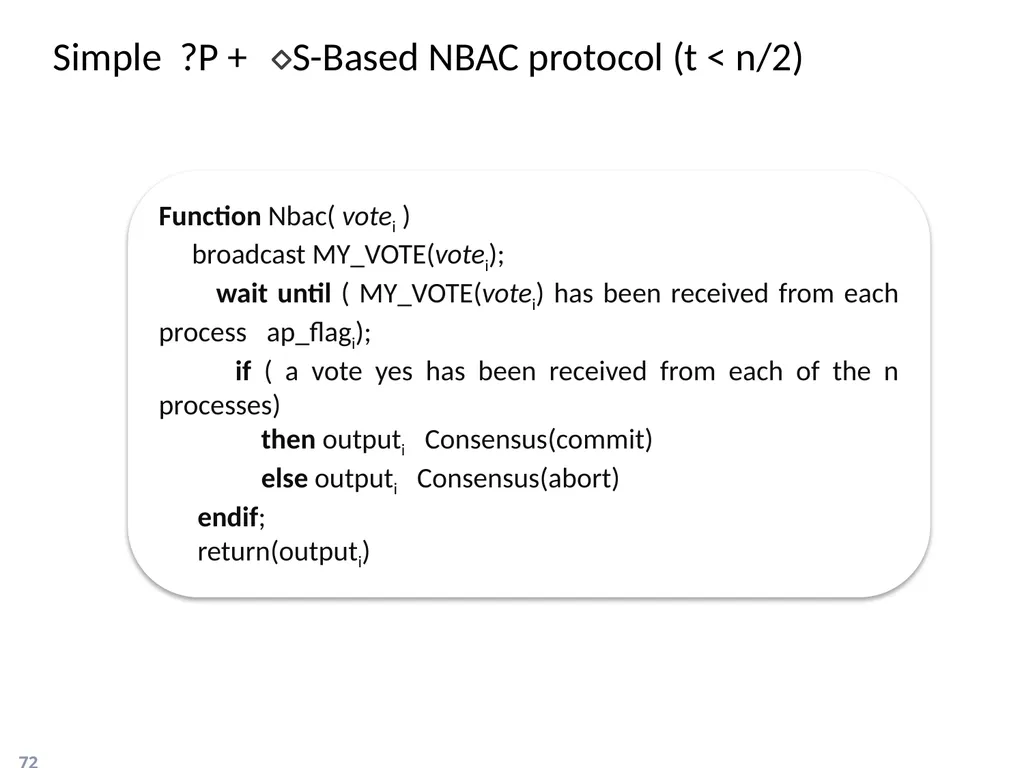
Simple ?P + S-Based NBAC protocol (t < n/2) Function Nbac( votei )
broadcast MY_VOTE(votei);
wait until ( MY_VOTE(votei) has been received from each process ap_flagi);
if ( a vote yes has been received from each of the n processes)
then outputi Consensus(commit)
else outputi Consensus(abort)
endif;
return(outputi) 72<br>
broadcast MY_VOTE(votei);
wait until ( MY_VOTE(votei) has been received from each process ap_flagi);
if ( a vote yes has been received from each of the n processes)
then outputi Consensus(commit)
else outputi Consensus(abort)
endif;
return(outputi) 72<br>
73
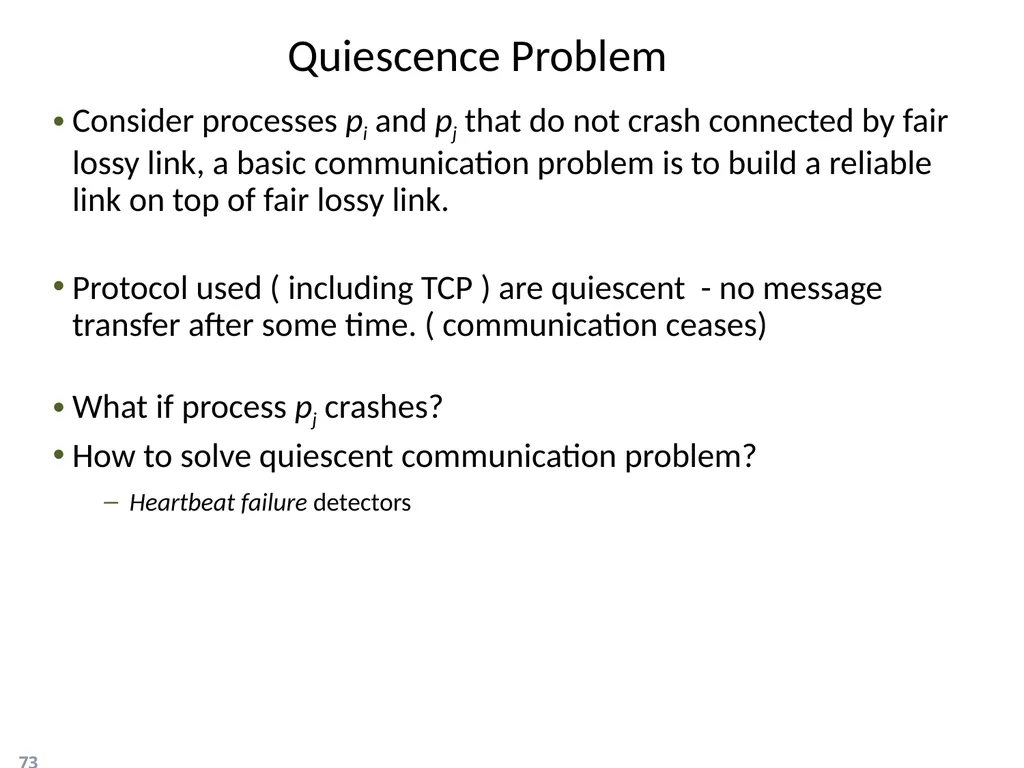
Consider processes pi and pj that do not crash connected by fair lossy link, a basic communication problem is to build a reliable link on top of fair lossy link.
Protocol used ( including TCP ) are quiescent - no message transfer after some time. ( communication ceases)
What if process pj crashes?
How to solve quiescent communication problem?
Heartbeat failure detectors Quiescence Problem 73<br>
Protocol used ( including TCP ) are quiescent - no message transfer after some time. ( communication ceases)
What if process pj crashes?
How to solve quiescent communication problem?
Heartbeat failure detectors Quiescence Problem 73<br>
74
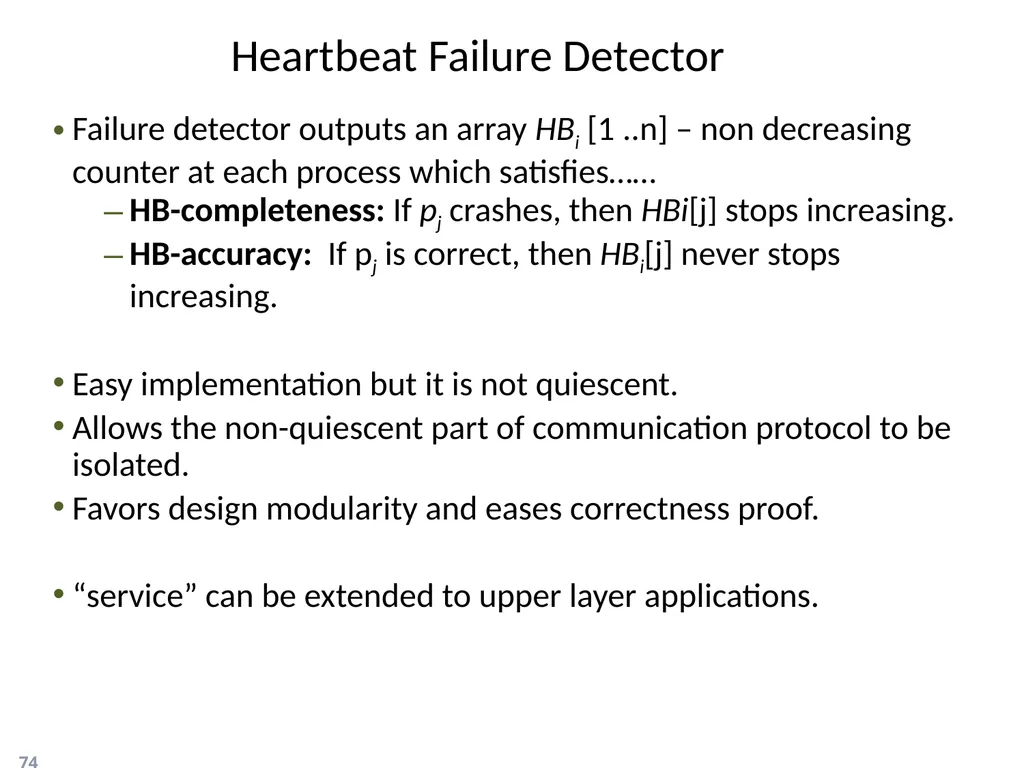
Failure detector outputs an array HBi [1 ..n] – non decreasing counter at each process which satisfies……
HB-completeness: If pj crashes, then HBi[j] stops increasing.
HB-accuracy: If pj is correct, then HBi[j] never stops increasing.
Easy implementation but it is not quiescent.
Allows the non-quiescent part of communication protocol to be isolated.
Favors design modularity and eases correctness proof.
“service” can be extended to upper layer applications. Heartbeat Failure Detector 74<br>
HB-completeness: If pj crashes, then HBi[j] stops increasing.
HB-accuracy: If pj is correct, then HBi[j] never stops increasing.
Easy implementation but it is not quiescent.
Allows the non-quiescent part of communication protocol to be isolated.
Favors design modularity and eases correctness proof.
“service” can be extended to upper layer applications. Heartbeat Failure Detector 74<br>
75
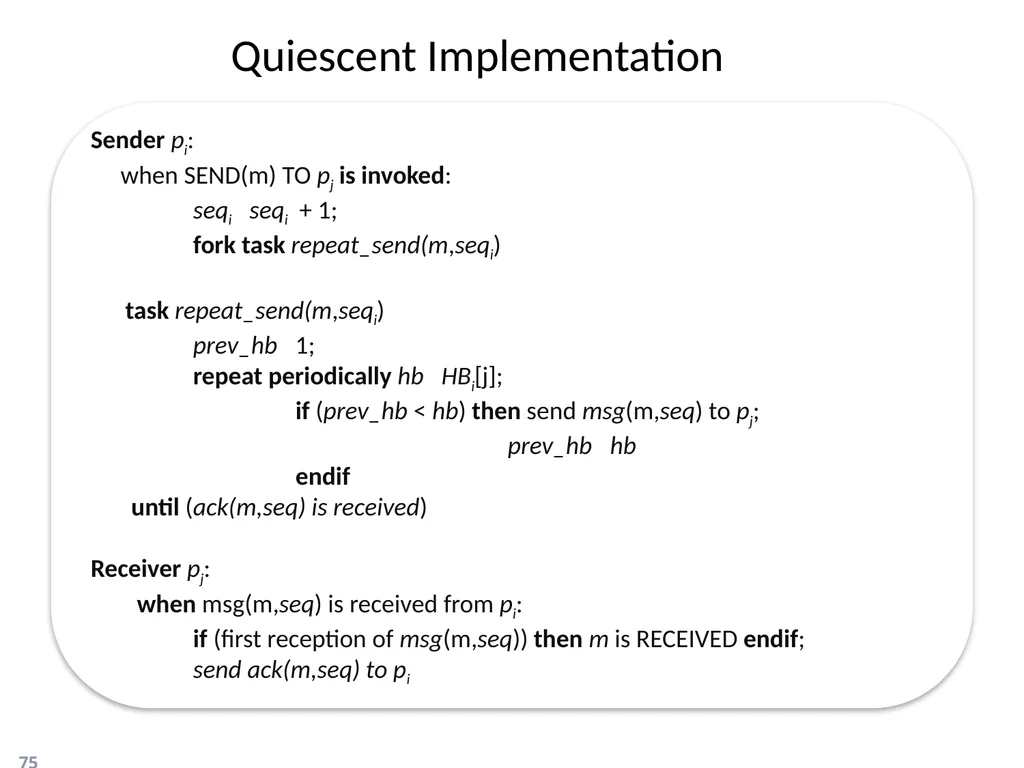
Quiescent Implementation Sender pi:
when SEND(m) TO pj is invoked:
seqi seqi + 1;
fork task repeat_send(m,seqi)
task repeat_send(m,seqi)
prev_hb 1;
repeat periodically hb HBi[j];
if (prev_hb < hb) then send msg(m,seq) to pj;
prev_hb hb
endif
until (ack(m,seq) is received)
Receiver pj:
when msg(m,seq) is received from pi:
if (first reception of msg(m,seq)) then m is RECEIVED endif;
send ack(m,seq) to pi 75<br>
when SEND(m) TO pj is invoked:
seqi seqi + 1;
fork task repeat_send(m,seqi)
task repeat_send(m,seqi)
prev_hb 1;
repeat periodically hb HBi[j];
if (prev_hb < hb) then send msg(m,seq) to pj;
prev_hb hb
endif
until (ack(m,seq) is received)
Receiver pj:
when msg(m,seq) is received from pi:
if (first reception of msg(m,seq)) then m is RECEIVED endif;
send ack(m,seq) to pi 75<br>
76
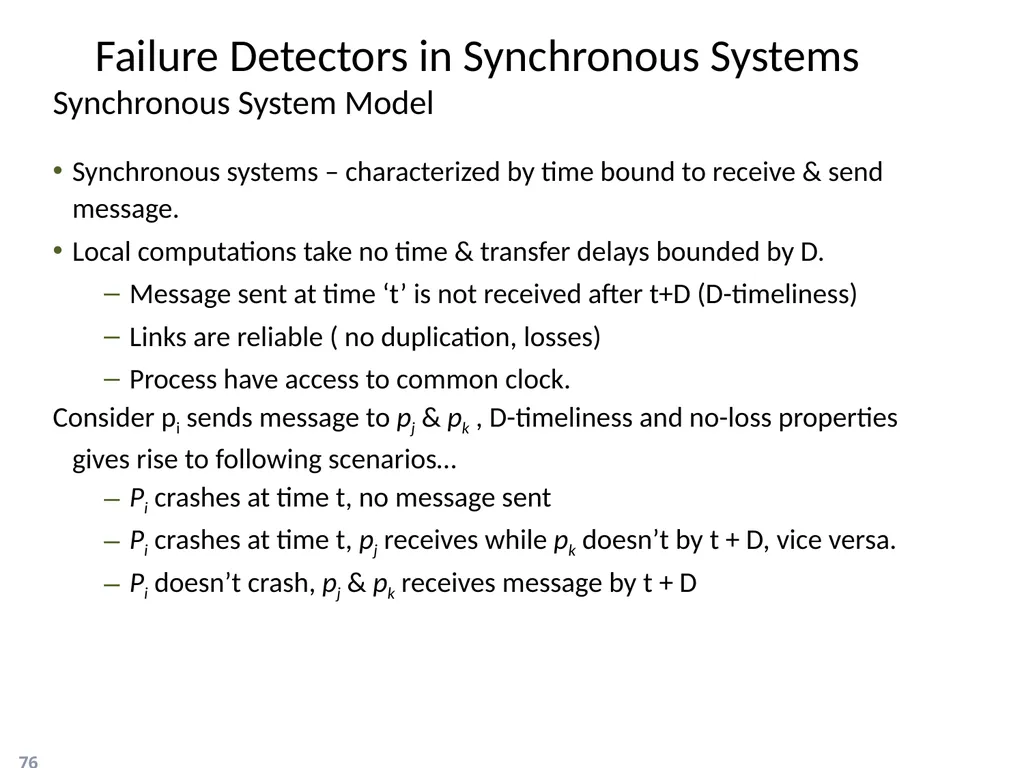
Synchronous systems – characterized by time bound to receive & send message.
Local computations take no time & transfer delays bounded by D.
Message sent at time ‘t’ is not received after t+D (D-timeliness)
Links are reliable ( no duplication, losses)
Process have access to common clock.
Consider pi sends message to pj & pk , D-timeliness and no-loss properties gives rise to following scenarios…
Pi crashes at time t, no message sent
Pi crashes at time t, pj receives while pk doesn’t by t + D, vice versa.
Pi doesn’t crash, pj & pk receives message by t + D Synchronous System Model Failure Detectors in Synchronous Systems 76<br>
Local computations take no time & transfer delays bounded by D.
Message sent at time ‘t’ is not received after t+D (D-timeliness)
Links are reliable ( no duplication, losses)
Process have access to common clock.
Consider pi sends message to pj & pk , D-timeliness and no-loss properties gives rise to following scenarios…
Pi crashes at time t, no message sent
Pi crashes at time t, pj receives while pk doesn’t by t + D, vice versa.
Pi doesn’t crash, pj & pk receives message by t + D Synchronous System Model Failure Detectors in Synchronous Systems 76<br>
77
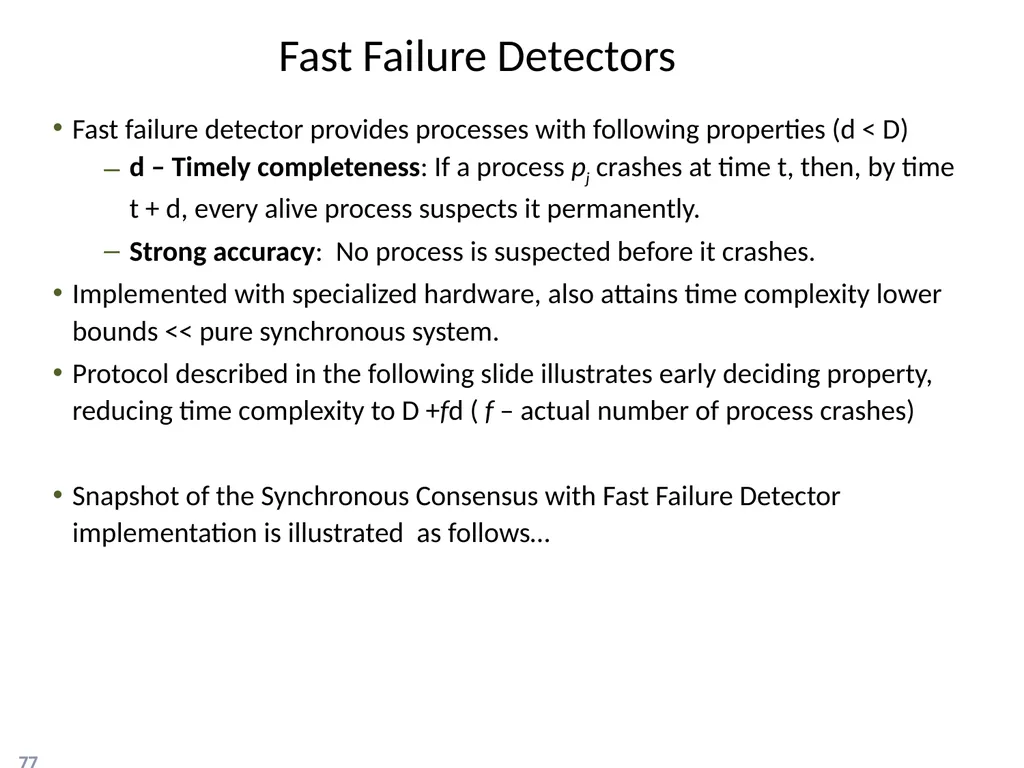
Fast failure detector provides processes with following properties (d < D)
d – Timely completeness: If a process pj crashes at time t, then, by time t + d, every alive process suspects it permanently.
Strong accuracy: No process is suspected before it crashes.
Implemented with specialized hardware, also attains time complexity lower bounds << pure synchronous system.
Protocol described in the following slide illustrates early deciding property, reducing time complexity to D +fd ( f – actual number of process crashes)
Snapshot of the Synchronous Consensus with Fast Failure Detector implementation is illustrated as follows… Fast Failure Detectors 77<br>
d – Timely completeness: If a process pj crashes at time t, then, by time t + d, every alive process suspects it permanently.
Strong accuracy: No process is suspected before it crashes.
Implemented with specialized hardware, also attains time complexity lower bounds << pure synchronous system.
Protocol described in the following slide illustrates early deciding property, reducing time complexity to D +fd ( f – actual number of process crashes)
Snapshot of the Synchronous Consensus with Fast Failure Detector implementation is illustrated as follows… Fast Failure Detectors 77<br>
78
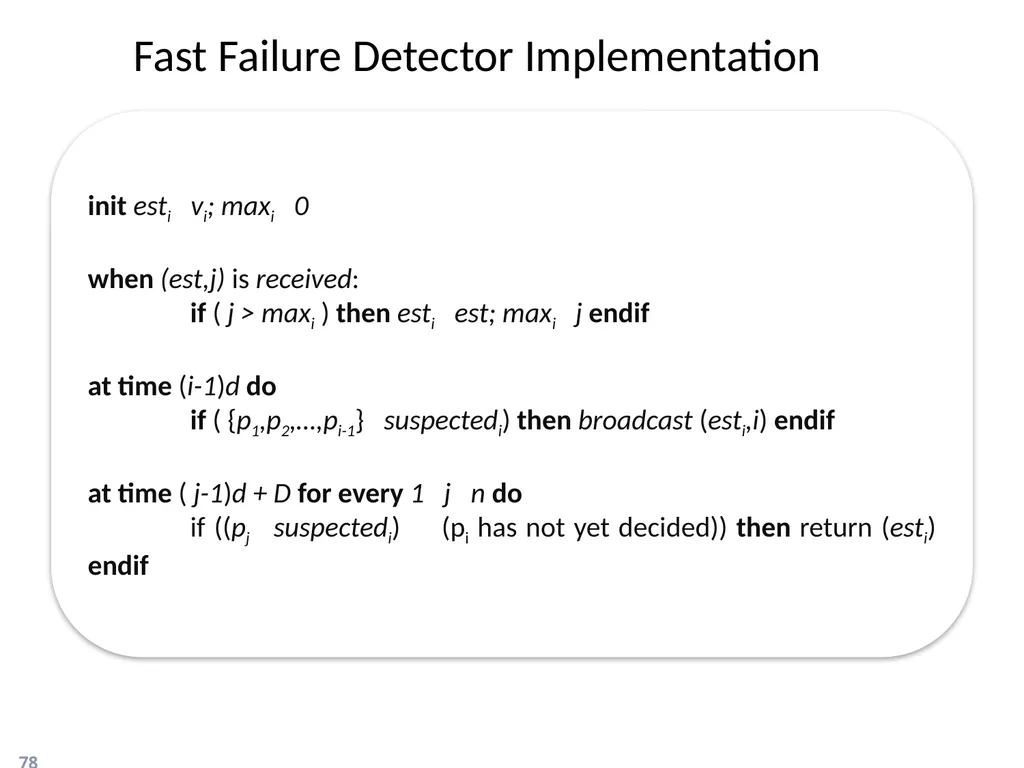
Fast Failure Detector Implementation init esti vi; maxi 0
when (est,j) is received:
if ( j > maxi ) then esti est; maxi j endif
at time (i-1)d do
if ( {p1,p2,…,pi-1} suspectedi) then broadcast (esti,i) endif
at time ( j-1)d + D for every 1 j n do
if ((pj suspectedi) (pi has not yet decided)) then return (esti) endif 78<br>
when (est,j) is received:
if ( j > maxi ) then esti est; maxi j endif
at time (i-1)d do
if ( {p1,p2,…,pi-1} suspectedi) then broadcast (esti,i) endif
at time ( j-1)d + D for every 1 j n do
if ((pj suspectedi) (pi has not yet decided)) then return (esti) endif 78<br>
79
Thank You 79<br>