
From Compliance to Programmatic Accessibility:
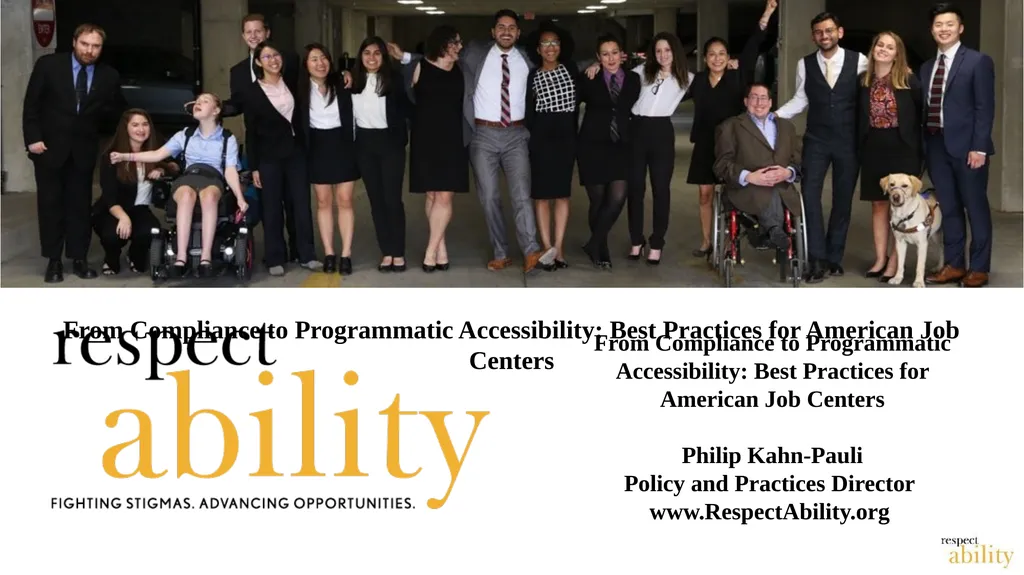




Description: From Compliance to Programmatic Accessibility: Best Practices for American Job Centers From Compliance to Programmatic Accessibility: Best Practices for American Job Centers Philip Kahn-Pauli Policy and Practices Director
Related Topics
Download Presentation
"From Compliance to Programmatic Accessibility:" is the property of its rightful owner. Permission is granted to download and print the materials on this website for personal, non-commercial use only, and to display it on your personal computer provided you do not modify the materials and that you retain all copyright notices contained in the materials. By downloading content from our website, you accept the terms of this agreement.
Presentation Transcript
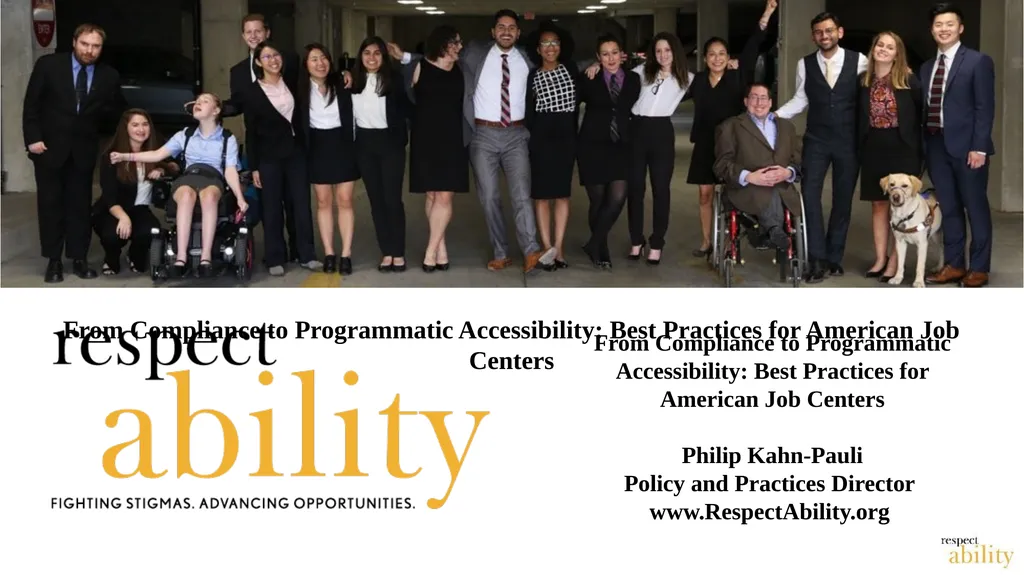
slide1. From Compliance to Programmatic Accessibility: Best Practices for American Job Centers From Compliance to Programmatic Accessibility: Best Practices for American Job Centers
Philip Kahn-Pauli
Policy and Practices Director
www.RespectAbility.org<br>
slide2. Meet our Speaker – Philip Kahn-Pauli Philip Kahn-Pauli is the Policy and Practices Director of RespectAbility, a nonprofit organization fighting stigmas and advancing opportunities so people with disabilities can fully participate in all aspects of the community. He educates leaders at the federal and state level about best practices to expand opportunities for people with disabilities. Kahn-Pauli coordinated the development and distribution of the People with Disabilities at Work resource guide, the Finding a Job as a Person With a Disability in Los Angeles Toolkit, and numerous other resources for jobseekers with disabilities as well as policymakers. He frequently organizes accessible webinars on best practices, which are attended by workforce boards, agencies, VR, disability organizations, public officials, artists and more – reaching a national audience of more than 2,000. Kahn-Pauli also speaks at national and regional conferences for workforce boards, agencies and professionals.<br>
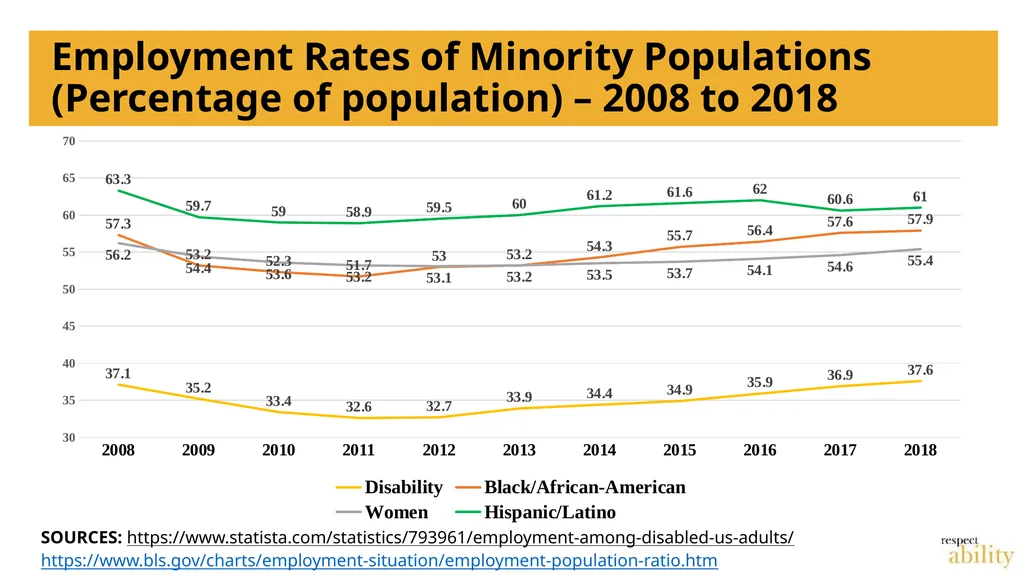
slide3. Employment Rates of Minority Populations (Percentage of population) – 2008 to 2018 SOURCES: https://www.statista.com/statistics/793961/employment-among-disabled-us-adults/ https://www.bls.gov/charts/employment-situation/employment-population-ratio.htm<br>
slide4. Unemployment Rates for PWDs in 2020 Source: https://www.stlouisfed.org/on-the-economy/2021/november/current-labor-market-workers-disability<br>
slide5. Rebound in the Employment-to-Pop Ratio for Vulnerable Groups during the Recovery Source: https://www.stlouisfed.org/on-the-economy/2021/november/current-labor-market-workers-disability<br>
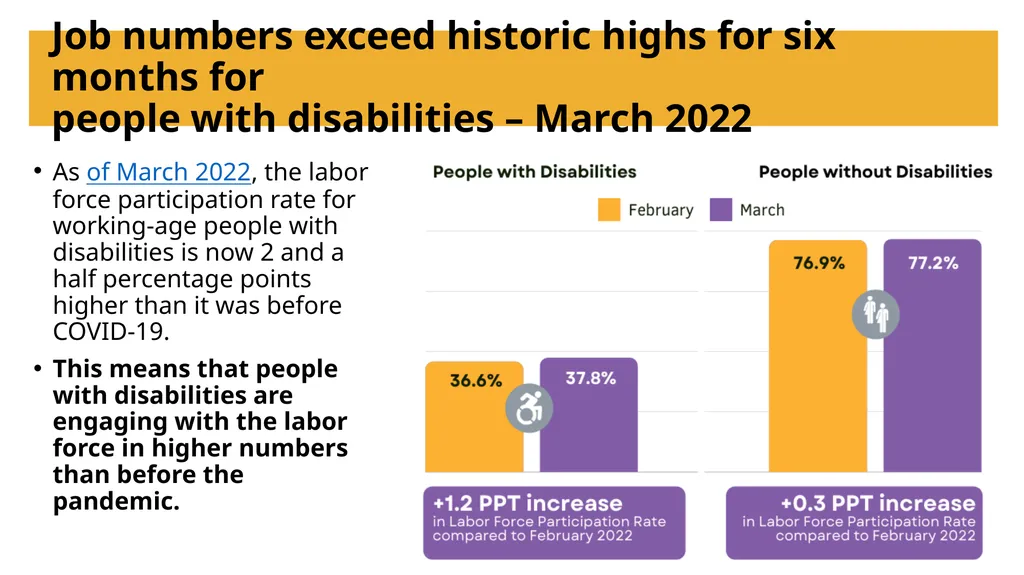
slide6. Job numbers exceed historic highs for six months for people with disabilities – March 2022 As of March 2022, the labor force participation rate for working-age people with disabilities is now 2 and a half percentage points higher than it was before COVID-19.
This means that people with disabilities are engaging with the labor force in higher numbers than before the pandemic.<br>
slide7. Advancing Opportunities There could be as many as 400,000 Americans with disabilities looking for new opportunities to earn an income and become independent.<br>
slide8. Improving Accessibility in AJCs There are 5 key dimensions for maximizing the ability of American Job Centers (AJC)s to serve jobseekers with disabilities.
Those dimensions are:
Physical Accessibility
Communications Accessibility
Programmatic Accessibility
Stakeholder Engagement
Employer Education<br>
slide9. Context – WIOA Implementation & AJC Accessibility As WIOA was being implemented, the US Department of Labor's (DOL) Chief Evaluation Office (CEO) contracted with IMPAQ International and its partners, the Burton Blatt Institute (BBI) and Universal Designers and Consultants (UD&C), to measure the accessibility of American Job Centers (AJC) for people with disabilities.
BBI and UD&C’s research identified key areas of improvement and growth for AJCs to better supporting jobseekers with disabilities.
Source: Evaluating the Accessibility of American Job Centers for People with Disabilities: Final Report https://impaqint.com/work/project-reports/evaluating-accessibility-american-job-centers-people-disabilities-final-report<br>
slide10. Tip #1 – Physical Accessibility Most AJCs are physically accessible, i.e. have wheelchair ramps, automatic doors, or have designated accessible bathrooms. That’s great!
However, nationwide, approximately 8% are not yet physically accessible.
For AJC staff and leaders:
Make a plan to review your physical accessibility annually.
Review what counts as “Architectural Barriers” under the ADA: https://www.ada.gov/reachingout/barrier.html#:~:text=Architectural%20Barriers&text=Architectural%20barriers%20are%20physical%20features,or%20services%20that%20are%20offered.
Connect with local experts on physical accessibility and ADA compliance: https://disability.lacity.org/resources<br>
slide11. Tip # 2 – Communications Accessibility The ADA requires that title II entities (State and local governments) and communicate effectively with people who have communication disabilities. More details here: https://www.ada.gov/effective-comm.htm
Most AJCs report “limited budgets and limited staff training and knowledge as obstacles to providing key elements of communications accessibility.”
For AJC staff and leaders:
Consult and engage with your local disability community, for example: Directory of Centers for Independent Living and Associations http://bit.ly/11CJWsE
Identify community resources to provide ASL interpretation, CART services, or transcription services, for example: Registry of Interpreters for the Deaf, Inc. http://bit.ly/1O891n6
Practice Respectful, People-First Language. https://askearn.org/page/people-first-language
Use Multimodal Communications, for example: have a plan about how to handle face-to-face communication, preparing written/print materials, and make your website fully accessible! https://www.ada.gov/websites2.htm
More ideas here: https://www.naccho.org/uploads/downloadable-resources/HDfactsheet_accessiblecomms-Oct2016.pdf<br>
slide12. Tip #3 – Programmatic Accessibility Per the DOL: “Programmatic accessibility is the domain where the biggest changes are needed to improve accessibility of the workforce system.” > Nationwide, “only 37%” of AJCs are programmatically accessible.
For AJC staff and leaders:
Awareness and Training – every staffer who has contact with customers must understand what it means to be “programmatically accessible” – Access training resources from organizations like RespectAbility https://www.respectability.org/speakers-bureau/ and others.
Staffing – Identify a staff member or team leader with responsibility for learning about accessibility and hold them accountable for working on these issues. https://www.peatworks.org/digital-accessibility-toolkits/staff-training-resources/accessibility-staff-training-for-specific-roles/
Benefit Counseling – Access and understand how to help jobseekers with disabilities navigate benefits questions and available resources: https://choosework.ssa.gov/library/fact-sheet-benefits-counseling-and-the-path-to-employment / https://apse.org/wp-content/uploads/2014/01/Benefits-Counseling-Guide-.pdf
Collaboration – AJCCs that are working to improve their accessibility and services need to work together to share resources and solutions.<br>
slide13. Tip #4 – Stakeholder Engagement At many AJCs, “staff reported that people with disabilities rarely contact the center” and “very few do targeted outreach to reach the disability community.”
Per DOL: “People with disabilities can bring valuable knowledge and first-hand experience to AJC’s efforts to maximize accessibility. Few AJCs make a point of actively involving people with disabilities in the ongoing work of making the AJCs more accessible.”
For AJC staff and leaders:
Make a plan to reach out and communicate with local disability community organizations, centers for independent living (CILs) or regional centers.
Consider budgeting stipends for self-advocates with disabilities to review accessibility issues at your AJCC.
Hold community stakeholder events to collaboratively develop solutions and plans of action.<br>
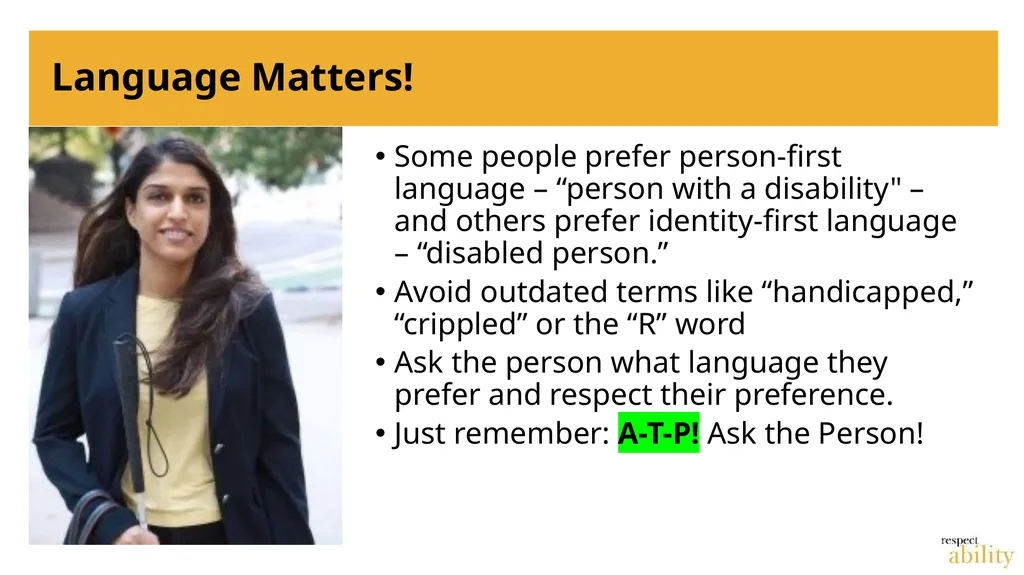
slide14. Language Matters! Some people prefer person-first language – “person with a disability" – and others prefer identity-first language – “disabled person.”
Avoid outdated terms like “handicapped,” “crippled” or the “R” word
Ask the person what language they prefer and respect their preference.
Just remember: A-T-P! Ask the Person!<br>
slide15. Tip #5 – Employer Engagement Much of the work that AJCs do is to understand the labor force needs of local employers and job sectors. This extends to supporting employers who
For AJC staff and leaders:
Connect and collaborate with business engagement specialists from the California Department of Rehabilitation (DOR).
Review LMI and reach out to local employers about their priorities around Diversity, Equity and Inclusion (DEI).
Ensure that employers that recruit and hire jobseekers with disabilities are connected to resources about accommodations and inclusive recruitment strategies.<br>
slide16. Benefits of Hiring People with Disabilities Followed 140 US companies from 2015-2018
45 Inclusion Champions, 95 peer companies Over four years, the Champions who embraced the talent of workers with disabilities vastly outperformed their peers. They had:
2X higher income
30% higher economic profit margin
Up to 30% less staff turnover Read the full study online! * Study completed by Accenture, Disability:IN and the American Association of People with Disabilities<br>
slide17. Accommodations Resources Job Accommodation
Network: AskJAN.org JAN is the leading source of free, expert and confidential guidance on workplace accommodations and disability employment issues.
Working toward practical solutions that benefit both employer and employee, JAN helps people with disabilities enhance their employability, and shows employers how to capitalize on the value and talent that people with disabilities add to the workplace.
Recent JAN activities and areas of focus include: JAN Workplace Accommodation Toolkit, JAN Just-In-Time Training Modules, Workplace Accommodations: Low Cost, High Impact<br>
slide18. Employer Resources Employer Assistance and Resource Network on Disability Inclusion (EARN) (EARN) helps employers recruit, hire, retain and advance people with disabilities.
EARN also maintains a website, AskEARN.org, which provides information on: recruiting and hiring; retention and advancement; laws and regulations; creating an accessible and welcoming workplace; and federal contractor requirements.
Other Resources:
Primer on Disability Inclusion
Business Strategies that Work: A Framework for Disability Inclusion
Small Business & Disability: Steps to Success
Fact Sheet on Self-Identification of Disability<br>
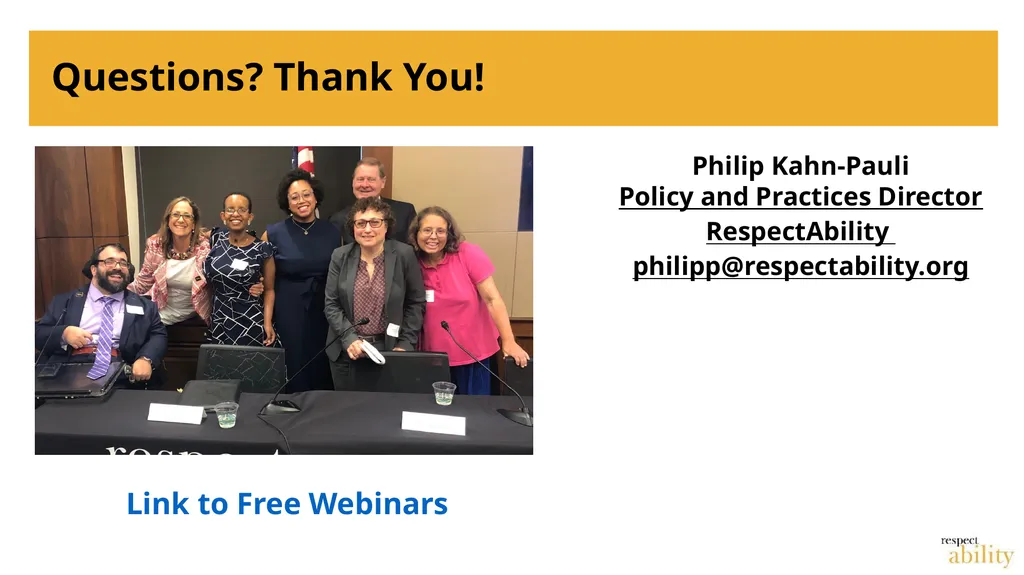
slide19. Questions? Thank You! Link to Free Webinars Philip Kahn-Pauli
Policy and Practices Director
RespectAbility
philipp@respectability.org<br>
Philip Kahn-Pauli
Policy and Practices Director
www.RespectAbility.org<br>
slide2. Meet our Speaker – Philip Kahn-Pauli Philip Kahn-Pauli is the Policy and Practices Director of RespectAbility, a nonprofit organization fighting stigmas and advancing opportunities so people with disabilities can fully participate in all aspects of the community. He educates leaders at the federal and state level about best practices to expand opportunities for people with disabilities. Kahn-Pauli coordinated the development and distribution of the People with Disabilities at Work resource guide, the Finding a Job as a Person With a Disability in Los Angeles Toolkit, and numerous other resources for jobseekers with disabilities as well as policymakers. He frequently organizes accessible webinars on best practices, which are attended by workforce boards, agencies, VR, disability organizations, public officials, artists and more – reaching a national audience of more than 2,000. Kahn-Pauli also speaks at national and regional conferences for workforce boards, agencies and professionals.<br>
slide3. Employment Rates of Minority Populations (Percentage of population) – 2008 to 2018 SOURCES: https://www.statista.com/statistics/793961/employment-among-disabled-us-adults/ https://www.bls.gov/charts/employment-situation/employment-population-ratio.htm<br>
slide4. Unemployment Rates for PWDs in 2020 Source: https://www.stlouisfed.org/on-the-economy/2021/november/current-labor-market-workers-disability<br>
slide5. Rebound in the Employment-to-Pop Ratio for Vulnerable Groups during the Recovery Source: https://www.stlouisfed.org/on-the-economy/2021/november/current-labor-market-workers-disability<br>
slide6. Job numbers exceed historic highs for six months for people with disabilities – March 2022 As of March 2022, the labor force participation rate for working-age people with disabilities is now 2 and a half percentage points higher than it was before COVID-19.
This means that people with disabilities are engaging with the labor force in higher numbers than before the pandemic.<br>
slide7. Advancing Opportunities There could be as many as 400,000 Americans with disabilities looking for new opportunities to earn an income and become independent.<br>
slide8. Improving Accessibility in AJCs There are 5 key dimensions for maximizing the ability of American Job Centers (AJC)s to serve jobseekers with disabilities.
Those dimensions are:
Physical Accessibility
Communications Accessibility
Programmatic Accessibility
Stakeholder Engagement
Employer Education<br>
slide9. Context – WIOA Implementation & AJC Accessibility As WIOA was being implemented, the US Department of Labor's (DOL) Chief Evaluation Office (CEO) contracted with IMPAQ International and its partners, the Burton Blatt Institute (BBI) and Universal Designers and Consultants (UD&C), to measure the accessibility of American Job Centers (AJC) for people with disabilities.
BBI and UD&C’s research identified key areas of improvement and growth for AJCs to better supporting jobseekers with disabilities.
Source: Evaluating the Accessibility of American Job Centers for People with Disabilities: Final Report https://impaqint.com/work/project-reports/evaluating-accessibility-american-job-centers-people-disabilities-final-report<br>
slide10. Tip #1 – Physical Accessibility Most AJCs are physically accessible, i.e. have wheelchair ramps, automatic doors, or have designated accessible bathrooms. That’s great!
However, nationwide, approximately 8% are not yet physically accessible.
For AJC staff and leaders:
Make a plan to review your physical accessibility annually.
Review what counts as “Architectural Barriers” under the ADA: https://www.ada.gov/reachingout/barrier.html#:~:text=Architectural%20Barriers&text=Architectural%20barriers%20are%20physical%20features,or%20services%20that%20are%20offered.
Connect with local experts on physical accessibility and ADA compliance: https://disability.lacity.org/resources<br>
slide11. Tip # 2 – Communications Accessibility The ADA requires that title II entities (State and local governments) and communicate effectively with people who have communication disabilities. More details here: https://www.ada.gov/effective-comm.htm
Most AJCs report “limited budgets and limited staff training and knowledge as obstacles to providing key elements of communications accessibility.”
For AJC staff and leaders:
Consult and engage with your local disability community, for example: Directory of Centers for Independent Living and Associations http://bit.ly/11CJWsE
Identify community resources to provide ASL interpretation, CART services, or transcription services, for example: Registry of Interpreters for the Deaf, Inc. http://bit.ly/1O891n6
Practice Respectful, People-First Language. https://askearn.org/page/people-first-language
Use Multimodal Communications, for example: have a plan about how to handle face-to-face communication, preparing written/print materials, and make your website fully accessible! https://www.ada.gov/websites2.htm
More ideas here: https://www.naccho.org/uploads/downloadable-resources/HDfactsheet_accessiblecomms-Oct2016.pdf<br>
slide12. Tip #3 – Programmatic Accessibility Per the DOL: “Programmatic accessibility is the domain where the biggest changes are needed to improve accessibility of the workforce system.” > Nationwide, “only 37%” of AJCs are programmatically accessible.
For AJC staff and leaders:
Awareness and Training – every staffer who has contact with customers must understand what it means to be “programmatically accessible” – Access training resources from organizations like RespectAbility https://www.respectability.org/speakers-bureau/ and others.
Staffing – Identify a staff member or team leader with responsibility for learning about accessibility and hold them accountable for working on these issues. https://www.peatworks.org/digital-accessibility-toolkits/staff-training-resources/accessibility-staff-training-for-specific-roles/
Benefit Counseling – Access and understand how to help jobseekers with disabilities navigate benefits questions and available resources: https://choosework.ssa.gov/library/fact-sheet-benefits-counseling-and-the-path-to-employment / https://apse.org/wp-content/uploads/2014/01/Benefits-Counseling-Guide-.pdf
Collaboration – AJCCs that are working to improve their accessibility and services need to work together to share resources and solutions.<br>
slide13. Tip #4 – Stakeholder Engagement At many AJCs, “staff reported that people with disabilities rarely contact the center” and “very few do targeted outreach to reach the disability community.”
Per DOL: “People with disabilities can bring valuable knowledge and first-hand experience to AJC’s efforts to maximize accessibility. Few AJCs make a point of actively involving people with disabilities in the ongoing work of making the AJCs more accessible.”
For AJC staff and leaders:
Make a plan to reach out and communicate with local disability community organizations, centers for independent living (CILs) or regional centers.
Consider budgeting stipends for self-advocates with disabilities to review accessibility issues at your AJCC.
Hold community stakeholder events to collaboratively develop solutions and plans of action.<br>
slide14. Language Matters! Some people prefer person-first language – “person with a disability" – and others prefer identity-first language – “disabled person.”
Avoid outdated terms like “handicapped,” “crippled” or the “R” word
Ask the person what language they prefer and respect their preference.
Just remember: A-T-P! Ask the Person!<br>
slide15. Tip #5 – Employer Engagement Much of the work that AJCs do is to understand the labor force needs of local employers and job sectors. This extends to supporting employers who
For AJC staff and leaders:
Connect and collaborate with business engagement specialists from the California Department of Rehabilitation (DOR).
Review LMI and reach out to local employers about their priorities around Diversity, Equity and Inclusion (DEI).
Ensure that employers that recruit and hire jobseekers with disabilities are connected to resources about accommodations and inclusive recruitment strategies.<br>
slide16. Benefits of Hiring People with Disabilities Followed 140 US companies from 2015-2018
45 Inclusion Champions, 95 peer companies Over four years, the Champions who embraced the talent of workers with disabilities vastly outperformed their peers. They had:
2X higher income
30% higher economic profit margin
Up to 30% less staff turnover Read the full study online! * Study completed by Accenture, Disability:IN and the American Association of People with Disabilities<br>
slide17. Accommodations Resources Job Accommodation
Network: AskJAN.org JAN is the leading source of free, expert and confidential guidance on workplace accommodations and disability employment issues.
Working toward practical solutions that benefit both employer and employee, JAN helps people with disabilities enhance their employability, and shows employers how to capitalize on the value and talent that people with disabilities add to the workplace.
Recent JAN activities and areas of focus include: JAN Workplace Accommodation Toolkit, JAN Just-In-Time Training Modules, Workplace Accommodations: Low Cost, High Impact<br>
slide18. Employer Resources Employer Assistance and Resource Network on Disability Inclusion (EARN) (EARN) helps employers recruit, hire, retain and advance people with disabilities.
EARN also maintains a website, AskEARN.org, which provides information on: recruiting and hiring; retention and advancement; laws and regulations; creating an accessible and welcoming workplace; and federal contractor requirements.
Other Resources:
Primer on Disability Inclusion
Business Strategies that Work: A Framework for Disability Inclusion
Small Business & Disability: Steps to Success
Fact Sheet on Self-Identification of Disability<br>
slide19. Questions? Thank You! Link to Free Webinars Philip Kahn-Pauli
Policy and Practices Director
RespectAbility
philipp@respectability.org<br>