
Gender and social inclusion: Taking practical
CP
Published · 23 slides · 0 views
1 / 1



Description
Gender and social inclusion: Taking practical measures to deliver work inclusively In this module you will learn Key operational measures that will ensure inclusivity of diverse peoples talents and needs once work is underway Some
Related Topics
Share
Embed code
Download this presentation From Below
"Gender and social inclusion: Taking practical" is the property of its rightful owner. Permission is granted to download and print the materials on this website for personal, non-commercial use only, and to display it on your personal computer provided you do not modify the materials and that you retain all copyright notices contained in the materials. By downloading content from our website, you accept the terms of this agreement.
Presentation Transcript
01
Gender and social inclusion:
Taking practical measures to deliver work inclusively<br>
02
In this module you will learn Key operational measures that will ensure inclusivity of diverse people’s talents and needs once work is underway
Some operational guidelines for inclusion can be set and enforced in project or programme teams.
Some guidelines are owned by/set by institutions.
They include:
•Target- and indicator-driven operational measures (quantitative)
•‘Work culture’ issues (qualitative)
•Policies and mechanisms for addressing discrimination, grievance on the job or in the course of project work<br>
Some operational guidelines for inclusion can be set and enforced in project or programme teams.
Some guidelines are owned by/set by institutions.
They include:
•Target- and indicator-driven operational measures (quantitative)
•‘Work culture’ issues (qualitative)
•Policies and mechanisms for addressing discrimination, grievance on the job or in the course of project work<br>
03
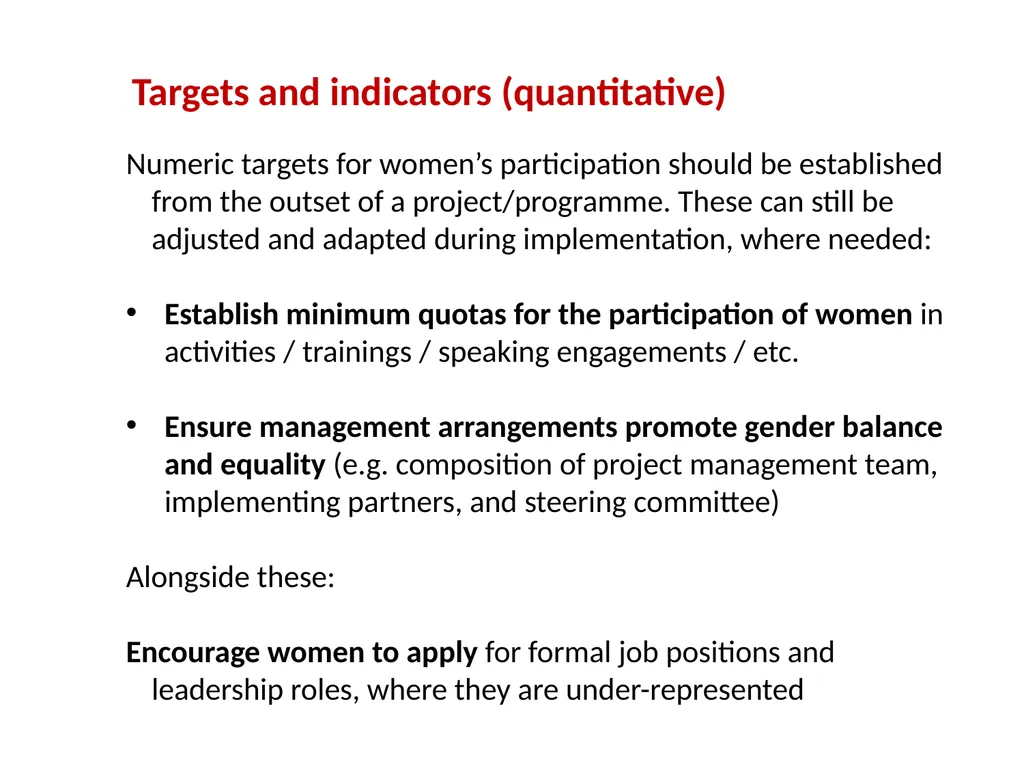
Targets and indicators (quantitative) Numeric targets for women’s participation should be established from the outset of a project/programme. These can still be adjusted and adapted during implementation, where needed:
Establish minimum quotas for the participation of women in activities / trainings / speaking engagements / etc.
Ensure management arrangements promote gender balance and equality (e.g. composition of project management team, implementing partners, and steering committee)
Alongside these:
Encourage women to apply for formal job positions and leadership roles, where they are under-represented<br>
Establish minimum quotas for the participation of women in activities / trainings / speaking engagements / etc.
Ensure management arrangements promote gender balance and equality (e.g. composition of project management team, implementing partners, and steering committee)
Alongside these:
Encourage women to apply for formal job positions and leadership roles, where they are under-represented<br>
04
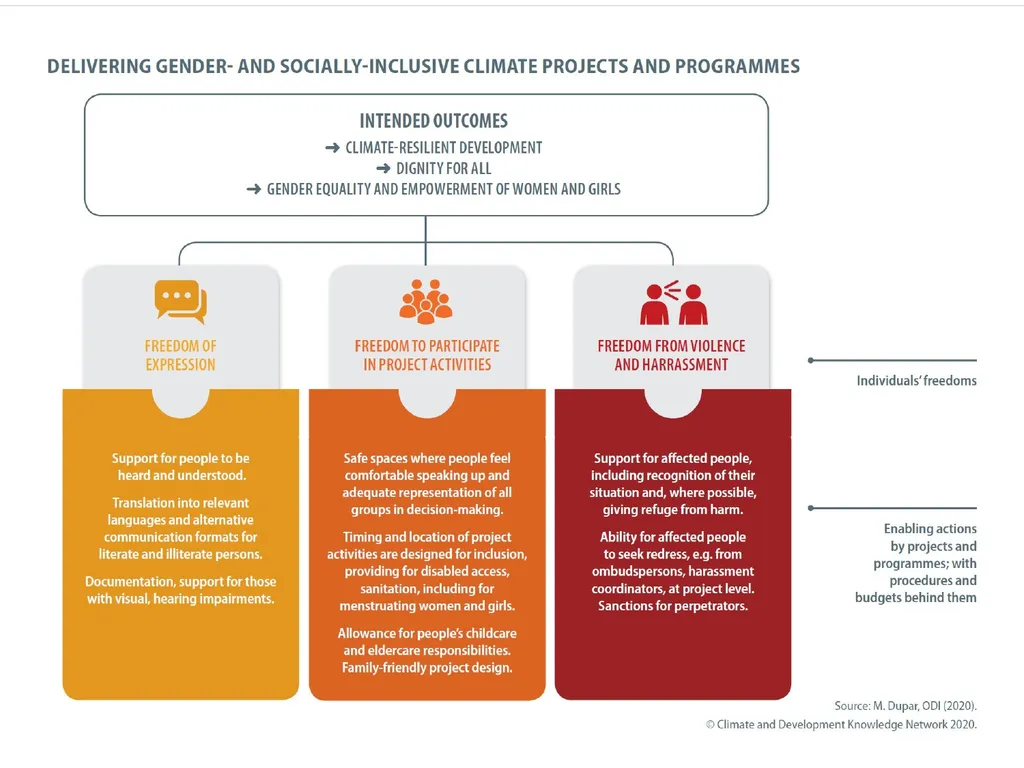
Work and organisational cultural issues (qualitative) The working culture or ethos of a project is vital.
The commitment of the project to ‘dignity for all’ and ‘equality for and empowerment of women and girls’ cannot just be on paper but should be infused in everyday working practices.<br>
The commitment of the project to ‘dignity for all’ and ‘equality for and empowerment of women and girls’ cannot just be on paper but should be infused in everyday working practices.<br>
05
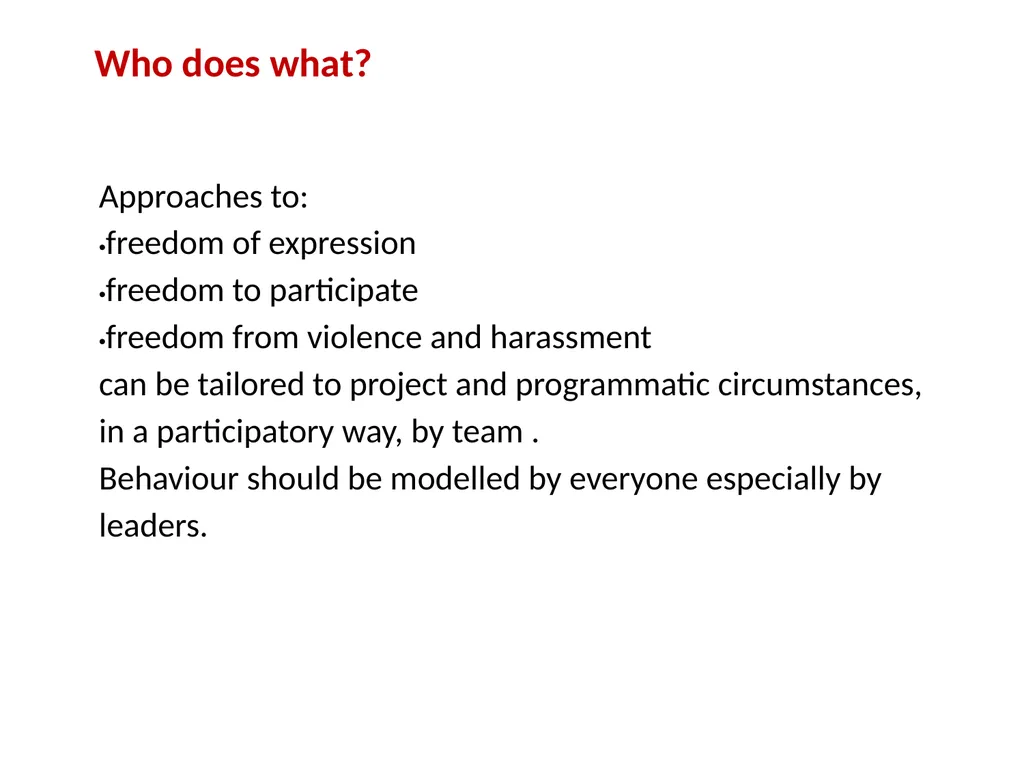
Who does what? Approaches to:
•freedom of expression
•freedom to participate
•freedom from violence and harassment
can be tailored to project and programmatic circumstances, in a participatory way, by team .
Behaviour should be modelled by everyone especially by leaders.<br>
•freedom of expression
•freedom to participate
•freedom from violence and harassment
can be tailored to project and programmatic circumstances, in a participatory way, by team .
Behaviour should be modelled by everyone especially by leaders.<br>
06
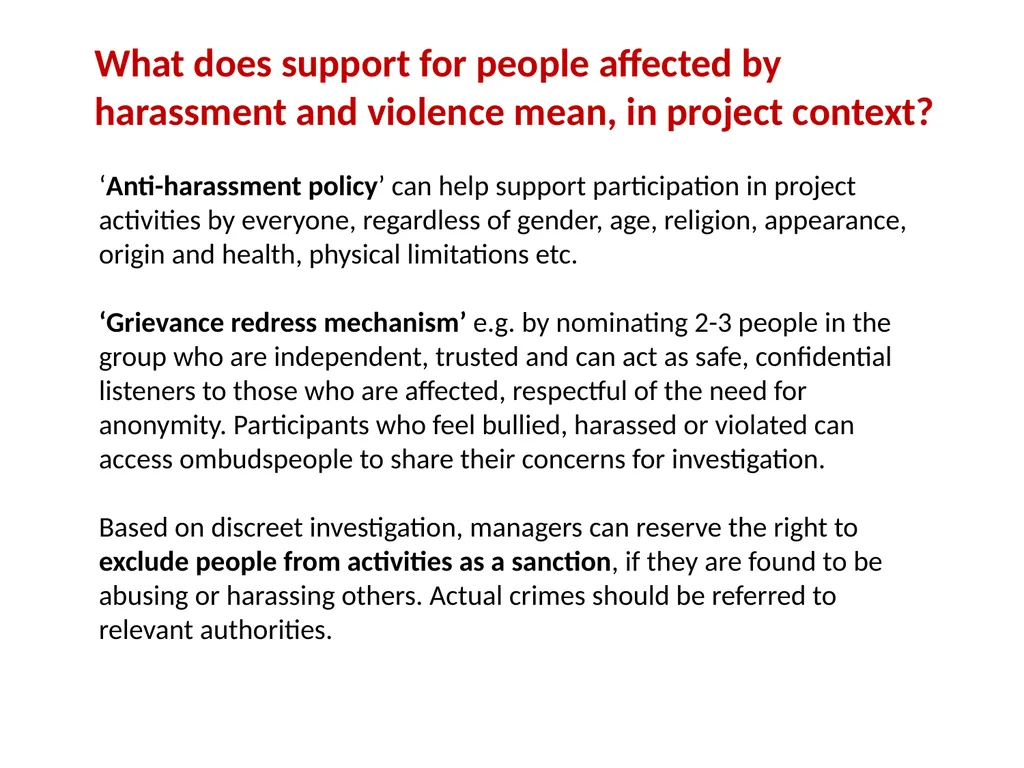
What does support for people affected by harassment and violence mean, in project context? ‘Anti-harassment policy’ can help support participation in project activities by everyone, regardless of gender, age, religion, appearance, origin and health, physical limitations etc.
‘Grievance redress mechanism’ e.g. by nominating 2-3 people in the group who are independent, trusted and can act as safe, confidential listeners to those who are affected, respectful of the need for anonymity. Participants who feel bullied, harassed or violated can access ombudspeople to share their concerns for investigation.
Based on discreet investigation, managers can reserve the right to exclude people from activities as a sanction, if they are found to be abusing or harassing others. Actual crimes should be referred to relevant authorities.<br>
‘Grievance redress mechanism’ e.g. by nominating 2-3 people in the group who are independent, trusted and can act as safe, confidential listeners to those who are affected, respectful of the need for anonymity. Participants who feel bullied, harassed or violated can access ombudspeople to share their concerns for investigation.
Based on discreet investigation, managers can reserve the right to exclude people from activities as a sanction, if they are found to be abusing or harassing others. Actual crimes should be referred to relevant authorities.<br>
07
Game instructions
(v1) Make pairs or groups of three.
Each group has a set of cards, face down in a pile.
Each player should have an answer sheet.
Take it in turns to draw one card from the central pile.
When it’s your turn and you draw a card, read the GESI action described on your card and tell your partner/group whether:
(1) ‘yes’ this is an action you are already taking in your climate project or programme; or you have an idea of how to take this action – if it’s a ‘yes’ then write the action on your answer sheet and keep the card! OR
(2) ‘no’, you are not taking this action in your project and you cannot think of any way to do so – if it’s a ‘no’ then put the card back at the bottom of the pile.
As soon as someone accumulates three cards, representing actions they are already taking or could take, then they shout ‘bingo!’ and draw the game to a close for the entire room.
Now, tell everyone which actions you are taking or going to take for GESI. Keep your answer sheet as your own ‘commitment’.<br>
Each group has a set of cards, face down in a pile.
Each player should have an answer sheet.
Take it in turns to draw one card from the central pile.
When it’s your turn and you draw a card, read the GESI action described on your card and tell your partner/group whether:
(1) ‘yes’ this is an action you are already taking in your climate project or programme; or you have an idea of how to take this action – if it’s a ‘yes’ then write the action on your answer sheet and keep the card! OR
(2) ‘no’, you are not taking this action in your project and you cannot think of any way to do so – if it’s a ‘no’ then put the card back at the bottom of the pile.
As soon as someone accumulates three cards, representing actions they are already taking or could take, then they shout ‘bingo!’ and draw the game to a close for the entire room.
Now, tell everyone which actions you are taking or going to take for GESI. Keep your answer sheet as your own ‘commitment’.<br>
08
Game instructions
(v2) Make pairs or groups of three.
Each group has a set of cards, face down in a pile.
Take it in turns to draw one card from the central pile.
When it’s your turn and you draw a card, read the GESI action described on your card and tell your partner/group whether:
(1) ‘yes’ this is an action you are already taking in your climate project or programme; or you have an idea of how to take this action – if it’s a ‘yes’ then write the action on your ‘leaf’ and run to put it on the ‘commitment tree’! OR
(2) ‘no’, you are not taking this action in your project and you cannot think of any way to do so – if it’s a ‘no’ then put the card back at the bottom of the pile.
As soon as someone accumulates three cards, representing actions they are already taking or could take, then they shout ‘bingo!’ and draw the game to a close for the entire room.
Now, tell everyone which actions you are taking or going to take for GESI.
Everyone add their leaves to the commitment tree, and let’s discuss what’s there and what’s missing – and why.<br>
Each group has a set of cards, face down in a pile.
Take it in turns to draw one card from the central pile.
When it’s your turn and you draw a card, read the GESI action described on your card and tell your partner/group whether:
(1) ‘yes’ this is an action you are already taking in your climate project or programme; or you have an idea of how to take this action – if it’s a ‘yes’ then write the action on your ‘leaf’ and run to put it on the ‘commitment tree’! OR
(2) ‘no’, you are not taking this action in your project and you cannot think of any way to do so – if it’s a ‘no’ then put the card back at the bottom of the pile.
As soon as someone accumulates three cards, representing actions they are already taking or could take, then they shout ‘bingo!’ and draw the game to a close for the entire room.
Now, tell everyone which actions you are taking or going to take for GESI.
Everyone add their leaves to the commitment tree, and let’s discuss what’s there and what’s missing – and why.<br>
09
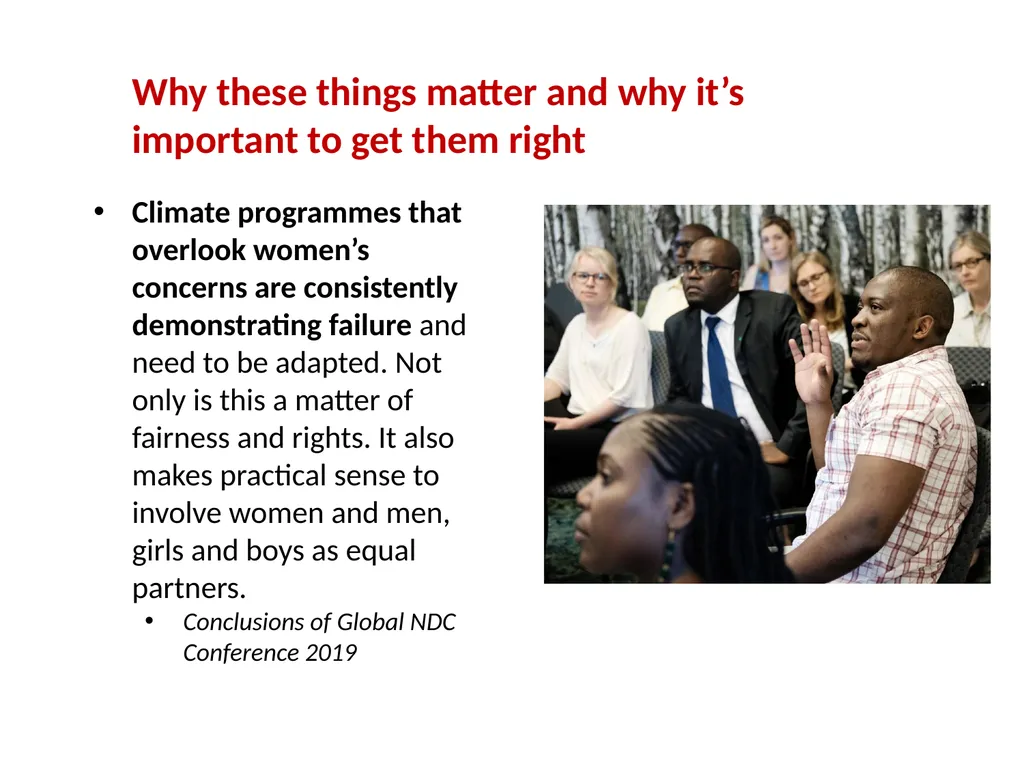
Why these things matter and why it’s important to get them right Climate programmes that overlook women’s concerns are consistently demonstrating failure and need to be adapted. Not only is this a matter of fairness and rights. It also makes practical sense to involve women and men, girls and boys as equal partners.
Conclusions of Global NDC Conference 2019<br>
Conclusions of Global NDC Conference 2019<br>
10
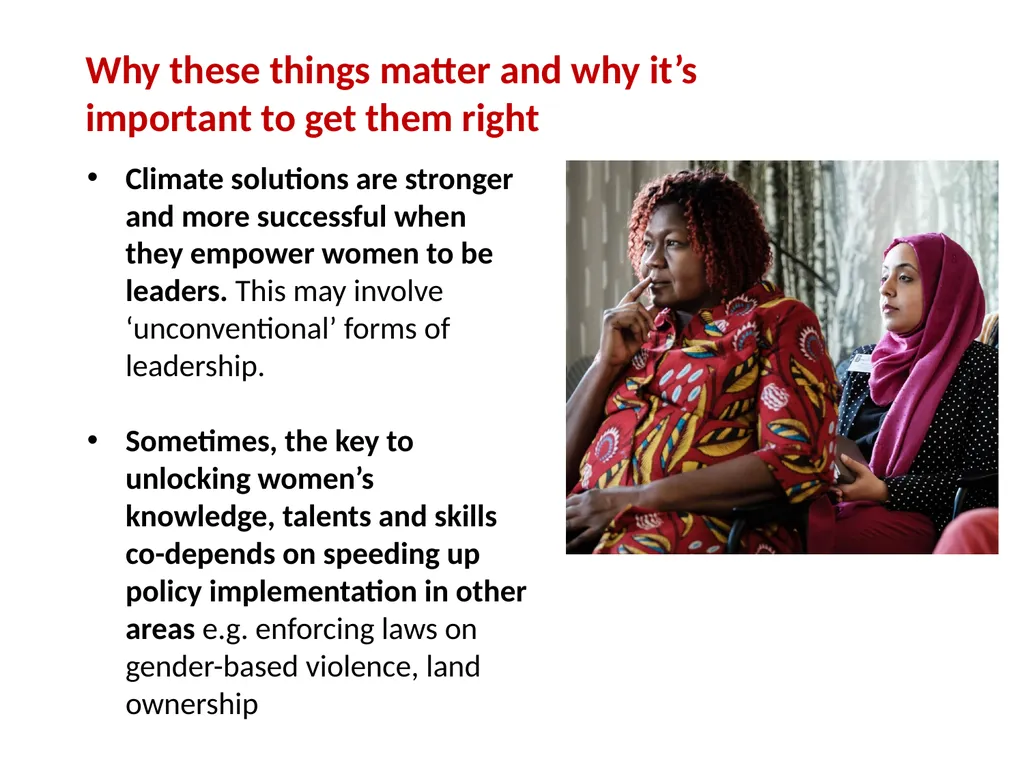
Climate solutions are stronger and more successful when they empower women to be leaders. This may involve ‘unconventional’ forms of leadership.
Sometimes, the key to unlocking women’s knowledge, talents and skills co-depends on speeding up policy implementation in other areas e.g. enforcing laws on gender-based violence, land ownership Why these things matter and why it’s important to get them right<br>
Sometimes, the key to unlocking women’s knowledge, talents and skills co-depends on speeding up policy implementation in other areas e.g. enforcing laws on gender-based violence, land ownership Why these things matter and why it’s important to get them right<br>
11
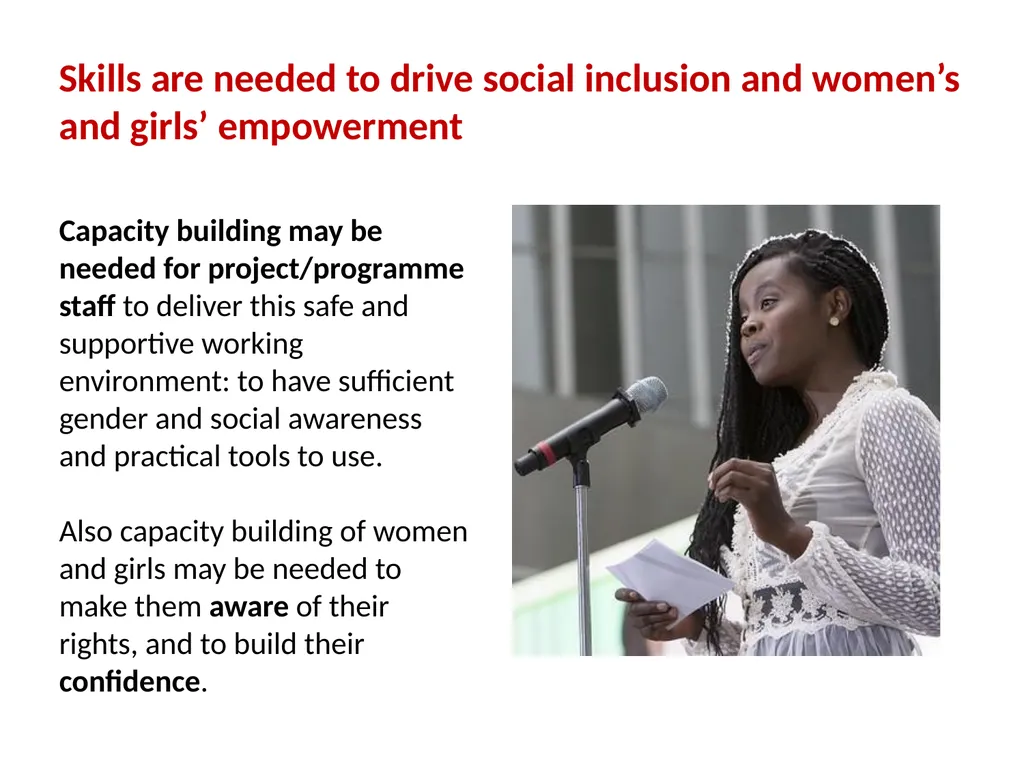
Skills are needed to drive social inclusion and women’s and girls’ empowerment Capacity building may be needed for project/programme staff to deliver this safe and supportive working environment: to have sufficient gender and social awareness and practical tools to use.
Also capacity building of women and girls may be needed to make them aware of their rights, and to build their confidence.<br>
Also capacity building of women and girls may be needed to make them aware of their rights, and to build their confidence.<br>
12
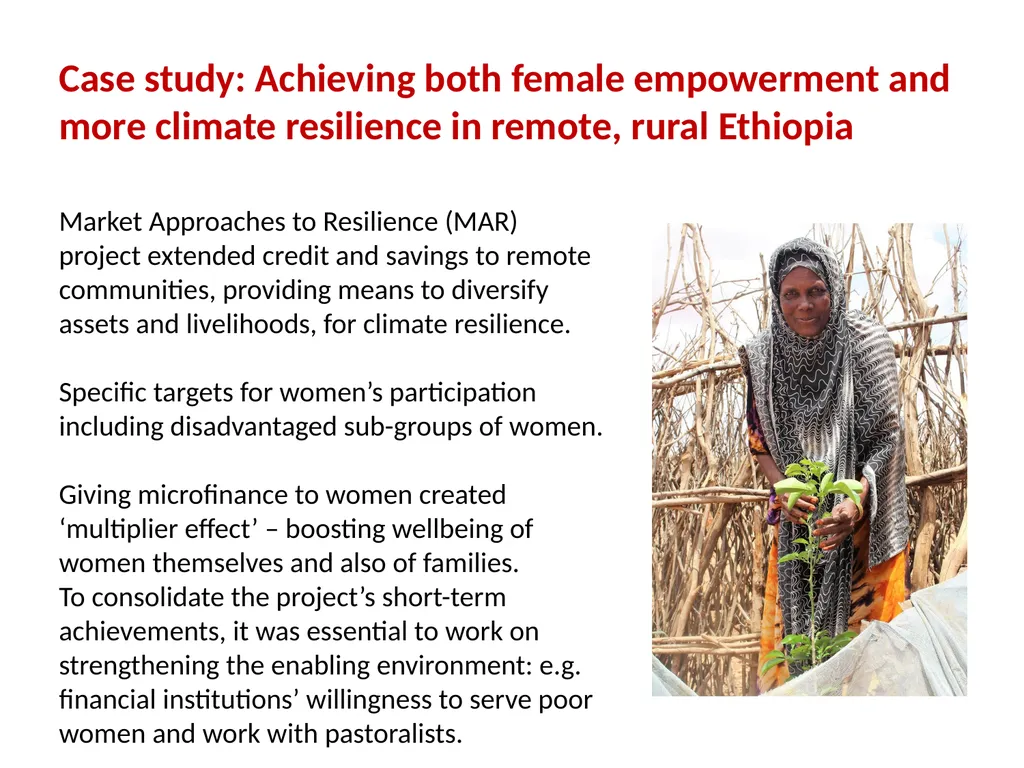
Case study: Achieving both female empowerment and more climate resilience in remote, rural Ethiopia Market Approaches to Resilience (MAR) project extended credit and savings to remote communities, providing means to diversify assets and livelihoods, for climate resilience.
Specific targets for women’s participation including disadvantaged sub-groups of women.
Giving microfinance to women created ‘multiplier effect’ – boosting wellbeing of women themselves and also of families.
To consolidate the project’s short-term achievements, it was essential to work on strengthening the enabling environment: e.g. financial institutions’ willingness to serve poor women and work with pastoralists.<br>
Specific targets for women’s participation including disadvantaged sub-groups of women.
Giving microfinance to women created ‘multiplier effect’ – boosting wellbeing of women themselves and also of families.
To consolidate the project’s short-term achievements, it was essential to work on strengthening the enabling environment: e.g. financial institutions’ willingness to serve poor women and work with pastoralists.<br>
13
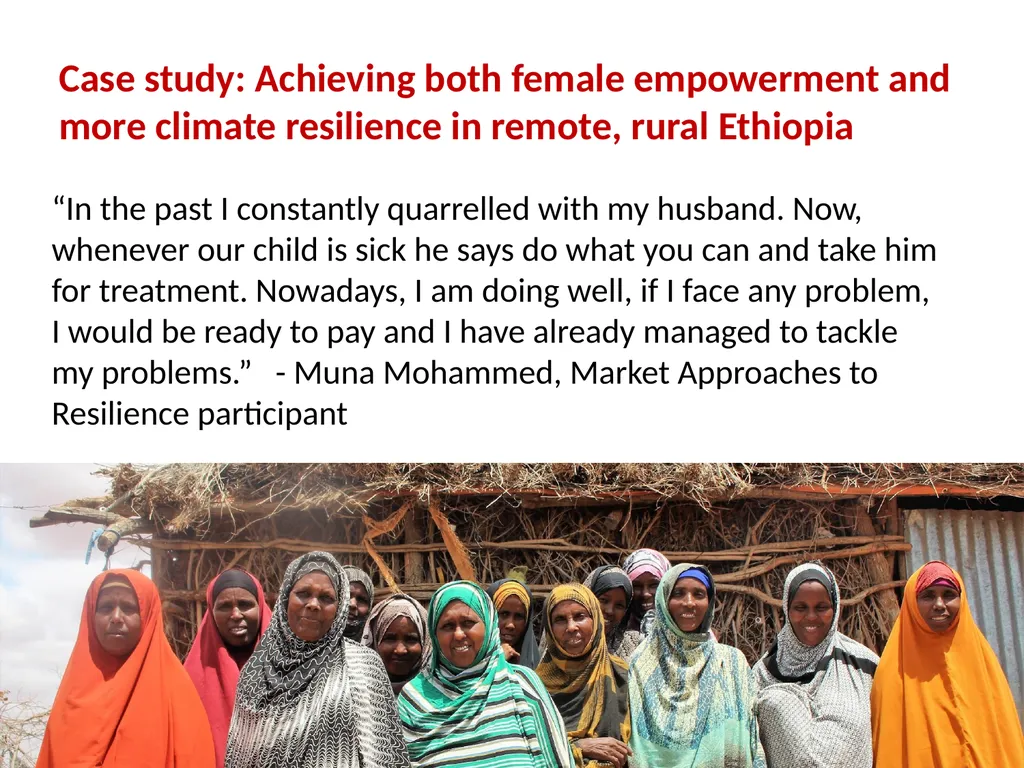
Case study: Achieving both female empowerment and more climate resilience in remote, rural Ethiopia “In the past I constantly quarrelled with my husband. Now, whenever our child is sick he says do what you can and take him for treatment. Nowadays, I am doing well, if I face any problem, I would be ready to pay and I have already managed to tackle my problems.” - Muna Mohammed, Market Approaches to Resilience participant<br>
14
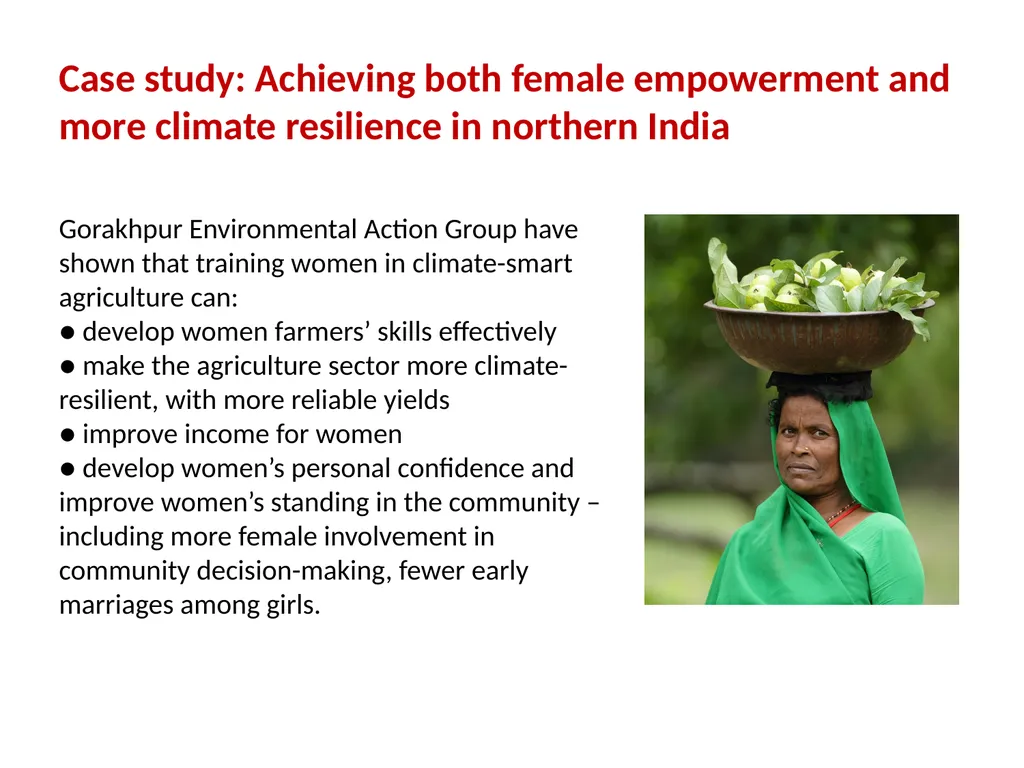
Case study: Achieving both female empowerment and more climate resilience in northern India Gorakhpur Environmental Action Group have shown that training women in climate-smart
agriculture can:
● develop women farmers’ skills effectively
● make the agriculture sector more climate-resilient, with more reliable yields
● improve income for women
● develop women’s personal confidence and improve women’s standing in the community – including more female involvement in community decision-making, fewer early marriages among girls.<br>
agriculture can:
● develop women farmers’ skills effectively
● make the agriculture sector more climate-resilient, with more reliable yields
● improve income for women
● develop women’s personal confidence and improve women’s standing in the community – including more female involvement in community decision-making, fewer early marriages among girls.<br>
15
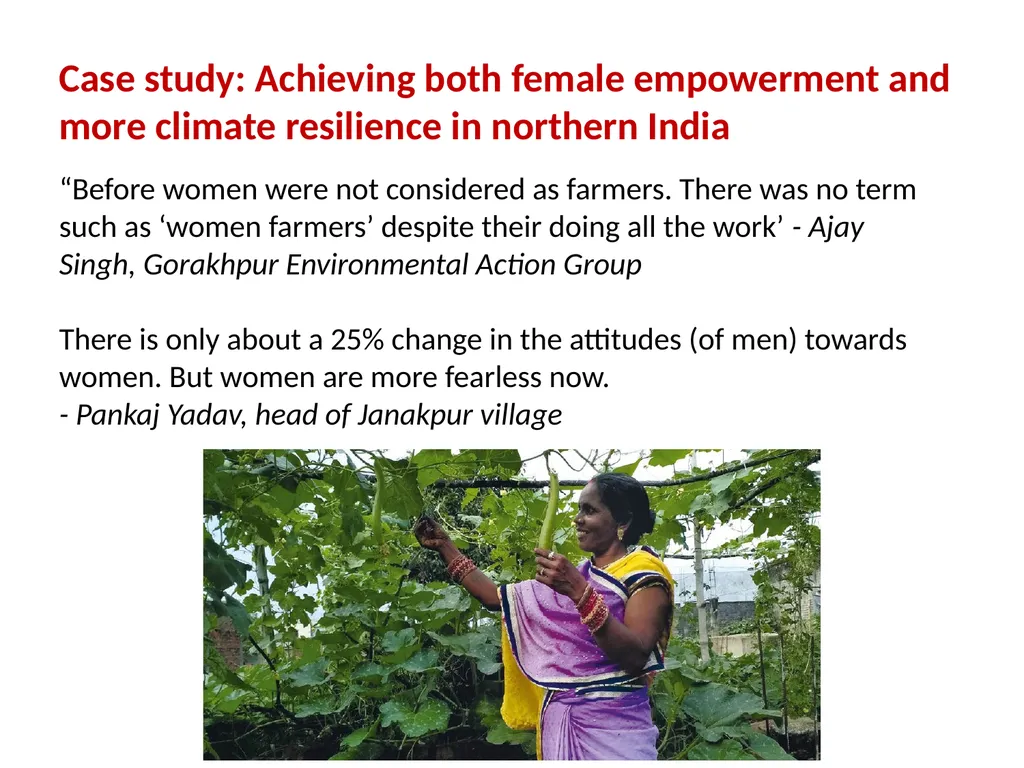
Case study: Achieving both female empowerment and more climate resilience in northern India “Before women were not considered as farmers. There was no term such as ‘women farmers’ despite their doing all the work’ - Ajay Singh, Gorakhpur Environmental Action Group
There is only about a 25% change in the attitudes (of men) towards women. But women are more fearless now.
- Pankaj Yadav, head of Janakpur village<br>
There is only about a 25% change in the attitudes (of men) towards women. But women are more fearless now.
- Pankaj Yadav, head of Janakpur village<br>
16
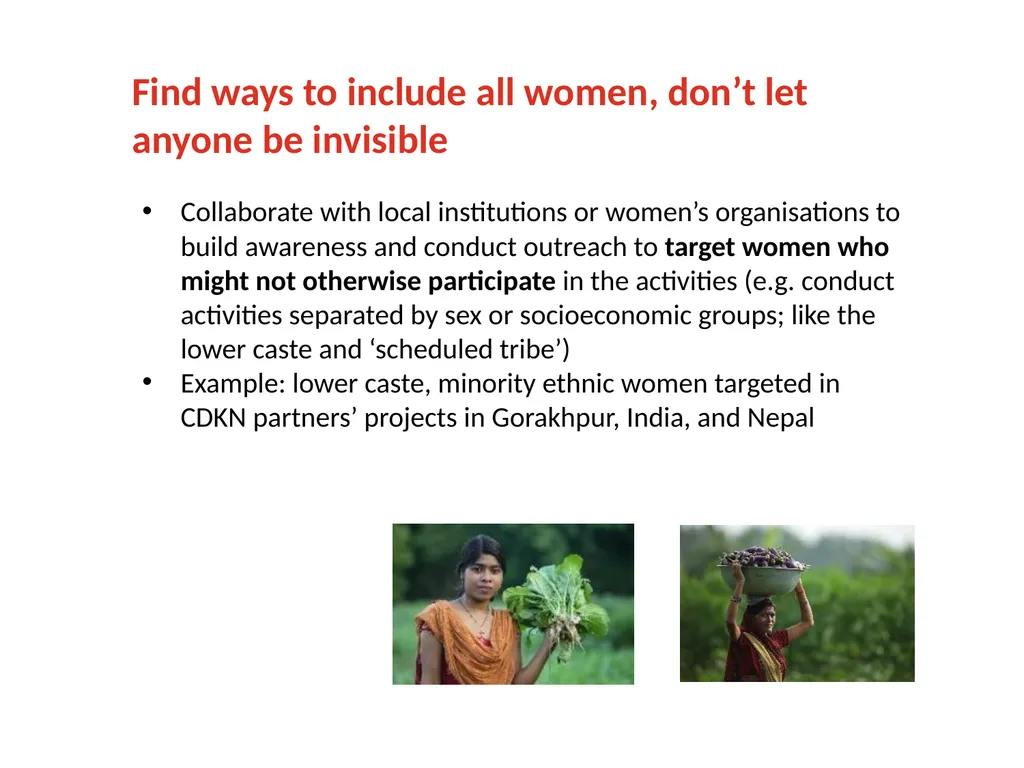
Find ways to include all women, don’t let anyone be invisible Collaborate with local institutions or women’s organisations to build awareness and conduct outreach to target women who might not otherwise participate in the activities (e.g. conduct activities separated by sex or socioeconomic groups; like the lower caste and ‘scheduled tribe’)
Example: lower caste, minority ethnic women targeted in CDKN partners’ projects in Gorakhpur, India, and Nepal<br>
Example: lower caste, minority ethnic women targeted in CDKN partners’ projects in Gorakhpur, India, and Nepal<br>
17
If you don’t get things right at first, you can still adapt and improve along the way Key lesson learned from CDKN research in India, Peru and Kenya:
Optimal to plan for gender- and socially-inclusive delivery from beginning but don’t give up if it’s hard to achieve. Adaptive management along the way is possible. E.g. Take new initiatives to involve women in leadership positions.
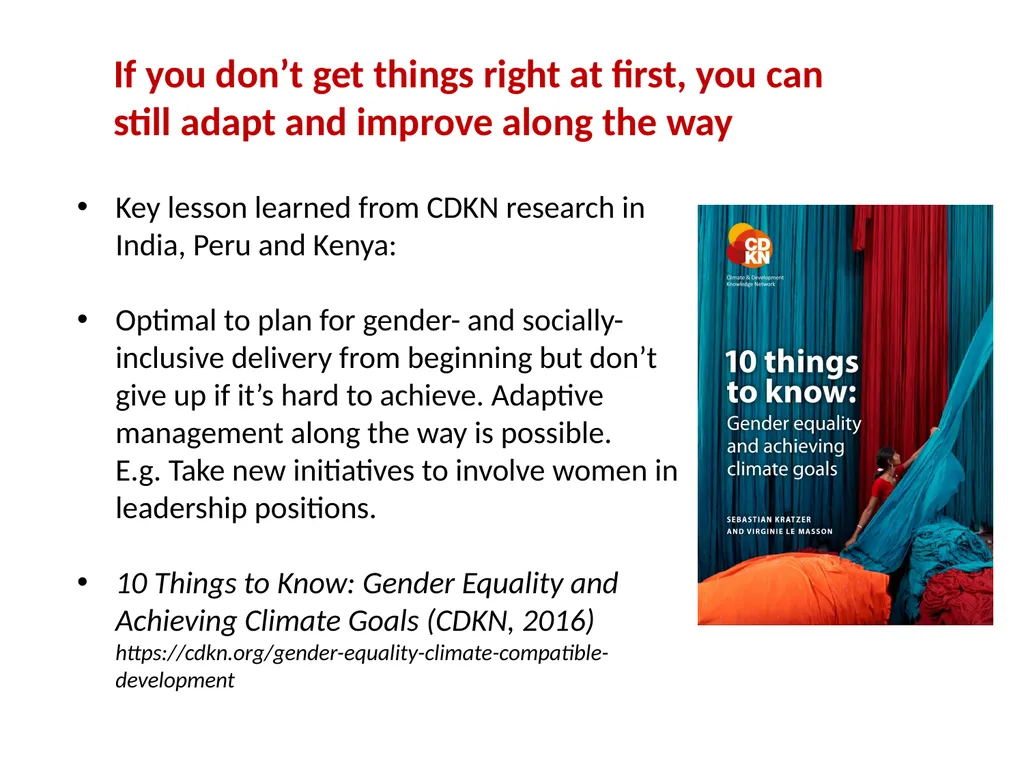
10 Things to Know: Gender Equality and Achieving Climate Goals (CDKN, 2016) https://cdkn.org/gender-equality-climate-compatible-development<br>
Optimal to plan for gender- and socially-inclusive delivery from beginning but don’t give up if it’s hard to achieve. Adaptive management along the way is possible. E.g. Take new initiatives to involve women in leadership positions.
10 Things to Know: Gender Equality and Achieving Climate Goals (CDKN, 2016) https://cdkn.org/gender-equality-climate-compatible-development<br>
18
@cdknetwork www.cdkn.org<br>