
History 1997 Programmatic Agreement on Protection

Description: History 1997 Programmatic Agreement on Protection of Historic Properties During Emergency Response Under the National Oil and Hazardous Substances Pollution Contingency Plan FOSC is responsible for ensuring that historic properties are
Related Topics
Download Presentation
"History 1997 Programmatic Agreement on Protection" is the property of its rightful owner. Permission is granted to download and print the materials on this website for personal, non-commercial use only, and to display it on your personal computer provided you do not modify the materials and that you retain all copyright notices contained in the materials. By downloading content from our website, you accept the terms of this agreement.
Presentation Transcript
slide1. History 1997 Programmatic Agreement on Protection of Historic Properties During Emergency Response Under the National Oil and Hazardous Substances Pollution Contingency Plan
FOSC is responsible for ensuring that historic properties are appropriately considered in planning and during emergency response
Planning
Identify historic properties
Develop strategies
Response
Consult with States/Tribes
Assess
Make decisions
Historic Property Specialist<br>
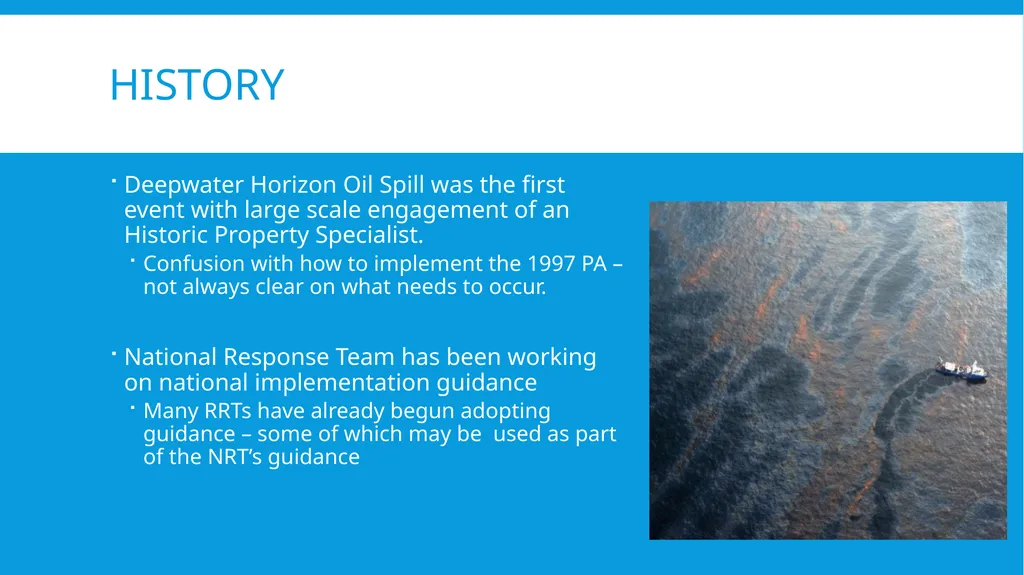
slide2. History Deepwater Horizon Oil Spill was the first event with large scale engagement of an Historic Property Specialist.
Confusion with how to implement the 1997 PA – not always clear on what needs to occur.
National Response Team has been working on national implementation guidance
Many RRTs have already begun adopting guidance – some of which may be used as part of the NRT’s guidance<br>
slide3. COMPLIANCE GUIDE FOR NATIONAL HISTORIC PRESERVATION ACT DURING EMERGENCY RESPONSE (ER) What is it?
Guidance to ensure compliance with the National Historic Preservation Act and the 1997 Programmatic Agreement occurs during a response
Who is it for?
Federal On-Scene Coordinator
State Historic Preservation Offices
Tribal Historic Preservation Offices/Tribal Representatives
Historic Property Specialist
Why do we need this?
To provide clear instruction on how to work through the 1997 PA<br>
slide4. Important Concepts Categorical Exclusions
Early and often consultation/coordination with SHPOs and Tribes
Use of forms and templates to guide Federal On-Scene Coordinator
Information to provide HPS/SHPO/Tribes
Action Checklist for HPS
Language for use in IAP when historic properties are discovered
Decisions/Action Taken Documentation Forms
Provides an option for a Federal On-Scene Coordinator to take action that would adversely affect historic properties
Historic Property Specialist<br>
slide5. What is a Historic Property Specialist? Can be activated by a Federal On-Scene Coordinator when a spill does not meet a categorical exclusion, or at the request of a SHPO/THPO/Tribe due to determination that historic properties are at risk or likelihood of risk
Responsible for helping the FOSC meet their Section 106 legal obligations
Must meet Secretary of the Interior Standards
Provide recommendations or alternatives that may minimize or avoid an adverse affect on an historic property.<br>
slide6. Communication with SHPOs Questions about the timing of consultation and when that will occur as part of a response?
How adverse effects to historic properties will be dealt with
Request for maps and other materials when being notified of a spill or response actions
Should guidance only be limited to ground-disturbing activities? Are all of the categorical exclusions listed in the 97 PA relevant for our region (e.g. Tidal shorelines exposed to aggressive wave action resulting in erosion and sediment reworking<br>
slide7. Next Steps Continue to work with SHPOs/Tribes in the Region to ensure relationships are in place before a spill occurs
Potential exercise(s) to examine how the guidance document performs in a simulated response?
Identify resources within the region to serve as HPS for response operations.
Bring DOI developed course to train individuals to serve as HPS<br>
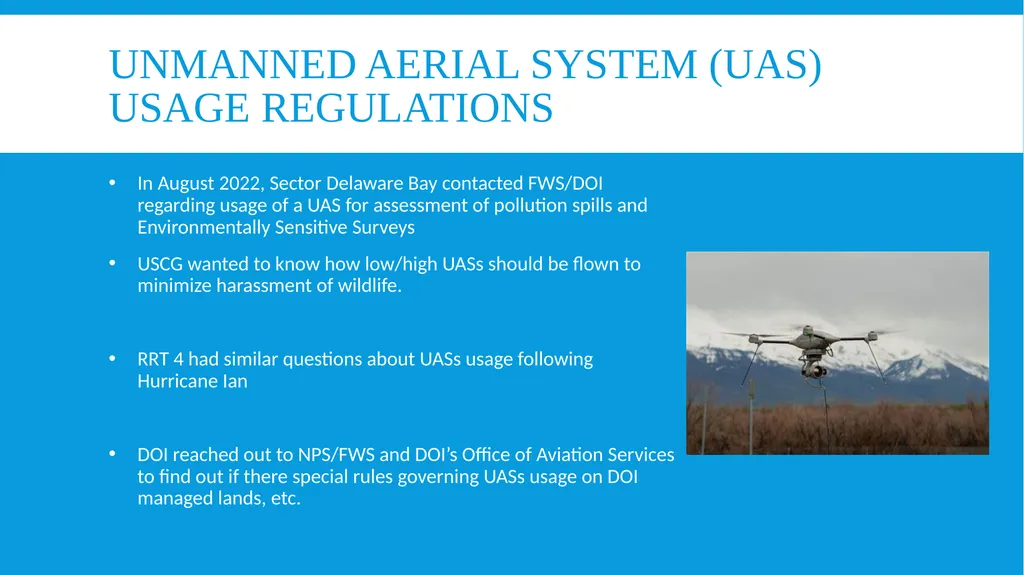
slide8. Unmanned Aerial System (UAS) Usage Regulations In August 2022, Sector Delaware Bay contacted FWS/DOI regarding usage of a UAS for assessment of pollution spills and Environmentally Sensitive Surveys
USCG wanted to know how low/high UASs should be flown to minimize harassment of wildlife.
RRT 4 had similar questions about UASs usage following Hurricane Ian
DOI reached out to NPS/FWS and DOI’s Office of Aviation Services to find out if there special rules governing UASs usage on DOI managed lands, etc.<br>
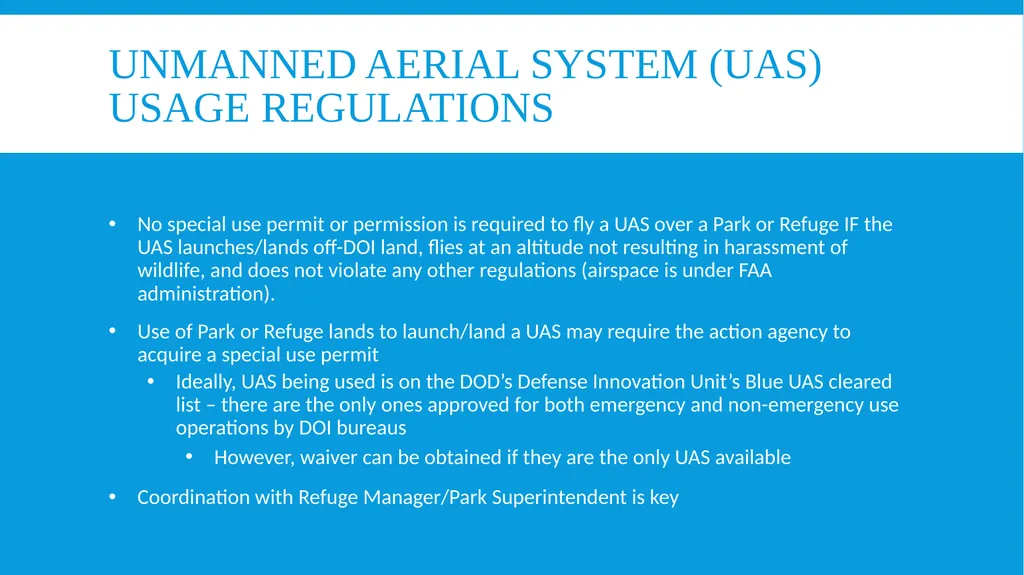
slide9. Unmanned Aerial System (UAS) Usage Regulations No special use permit or permission is required to fly a UAS over a Park or Refuge IF the UAS launches/lands off-DOI land, flies at an altitude not resulting in harassment of wildlife, and does not violate any other regulations (airspace is under FAA administration).
Use of Park or Refuge lands to launch/land a UAS may require the action agency to acquire a special use permit
Ideally, UAS being used is on the DOD’s Defense Innovation Unit’s Blue UAS cleared list – there are the only ones approved for both emergency and non-emergency use operations by DOI bureaus
However, waiver can be obtained if they are the only UAS available
Coordination with Refuge Manager/Park Superintendent is key<br>
slide10. Unmanned Aerial System (UAS) Usage Regulations Are there other agencies that require special use permits or other requirements to use UASs?
Should RRT guidance on use of UASs be prepared?
Should we explore a MOA/MOU between USCG/EPA and Regional DOI bureaus focused on use of UASs?<br>
slide11. CNRDA Appendices in the RCP Appendix 3-C 1997 Interagency Agreement on ESA
Appendix 9-E RRT3 NAGPRA Plan of Action Checklist [Reserved]
Appendix 10 National Resource Damage Assessment (NRDA) [Reserved]<br>
FOSC is responsible for ensuring that historic properties are appropriately considered in planning and during emergency response
Planning
Identify historic properties
Develop strategies
Response
Consult with States/Tribes
Assess
Make decisions
Historic Property Specialist<br>
slide2. History Deepwater Horizon Oil Spill was the first event with large scale engagement of an Historic Property Specialist.
Confusion with how to implement the 1997 PA – not always clear on what needs to occur.
National Response Team has been working on national implementation guidance
Many RRTs have already begun adopting guidance – some of which may be used as part of the NRT’s guidance<br>
slide3. COMPLIANCE GUIDE FOR NATIONAL HISTORIC PRESERVATION ACT DURING EMERGENCY RESPONSE (ER) What is it?
Guidance to ensure compliance with the National Historic Preservation Act and the 1997 Programmatic Agreement occurs during a response
Who is it for?
Federal On-Scene Coordinator
State Historic Preservation Offices
Tribal Historic Preservation Offices/Tribal Representatives
Historic Property Specialist
Why do we need this?
To provide clear instruction on how to work through the 1997 PA<br>
slide4. Important Concepts Categorical Exclusions
Early and often consultation/coordination with SHPOs and Tribes
Use of forms and templates to guide Federal On-Scene Coordinator
Information to provide HPS/SHPO/Tribes
Action Checklist for HPS
Language for use in IAP when historic properties are discovered
Decisions/Action Taken Documentation Forms
Provides an option for a Federal On-Scene Coordinator to take action that would adversely affect historic properties
Historic Property Specialist<br>
slide5. What is a Historic Property Specialist? Can be activated by a Federal On-Scene Coordinator when a spill does not meet a categorical exclusion, or at the request of a SHPO/THPO/Tribe due to determination that historic properties are at risk or likelihood of risk
Responsible for helping the FOSC meet their Section 106 legal obligations
Must meet Secretary of the Interior Standards
Provide recommendations or alternatives that may minimize or avoid an adverse affect on an historic property.<br>
slide6. Communication with SHPOs Questions about the timing of consultation and when that will occur as part of a response?
How adverse effects to historic properties will be dealt with
Request for maps and other materials when being notified of a spill or response actions
Should guidance only be limited to ground-disturbing activities? Are all of the categorical exclusions listed in the 97 PA relevant for our region (e.g. Tidal shorelines exposed to aggressive wave action resulting in erosion and sediment reworking<br>
slide7. Next Steps Continue to work with SHPOs/Tribes in the Region to ensure relationships are in place before a spill occurs
Potential exercise(s) to examine how the guidance document performs in a simulated response?
Identify resources within the region to serve as HPS for response operations.
Bring DOI developed course to train individuals to serve as HPS<br>
slide8. Unmanned Aerial System (UAS) Usage Regulations In August 2022, Sector Delaware Bay contacted FWS/DOI regarding usage of a UAS for assessment of pollution spills and Environmentally Sensitive Surveys
USCG wanted to know how low/high UASs should be flown to minimize harassment of wildlife.
RRT 4 had similar questions about UASs usage following Hurricane Ian
DOI reached out to NPS/FWS and DOI’s Office of Aviation Services to find out if there special rules governing UASs usage on DOI managed lands, etc.<br>
slide9. Unmanned Aerial System (UAS) Usage Regulations No special use permit or permission is required to fly a UAS over a Park or Refuge IF the UAS launches/lands off-DOI land, flies at an altitude not resulting in harassment of wildlife, and does not violate any other regulations (airspace is under FAA administration).
Use of Park or Refuge lands to launch/land a UAS may require the action agency to acquire a special use permit
Ideally, UAS being used is on the DOD’s Defense Innovation Unit’s Blue UAS cleared list – there are the only ones approved for both emergency and non-emergency use operations by DOI bureaus
However, waiver can be obtained if they are the only UAS available
Coordination with Refuge Manager/Park Superintendent is key<br>
slide10. Unmanned Aerial System (UAS) Usage Regulations Are there other agencies that require special use permits or other requirements to use UASs?
Should RRT guidance on use of UASs be prepared?
Should we explore a MOA/MOU between USCG/EPA and Regional DOI bureaus focused on use of UASs?<br>
slide11. CNRDA Appendices in the RCP Appendix 3-C 1997 Interagency Agreement on ESA
Appendix 9-E RRT3 NAGPRA Plan of Action Checklist [Reserved]
Appendix 10 National Resource Damage Assessment (NRDA) [Reserved]<br>