
Human Communication & Interpersonal Com Dr.



Description: Human Communication Interpersonal Com Dr. Carroll COM 415 reading quiz! Yay! TWO QUESTIONS: 1. Chapter 18 breaks up human communication into two traditions, areas, fields of study. What are these two areas? HINT: One has been associated
Related Topics
Download Presentation
"Human Communication & Interpersonal Com Dr." is the property of its rightful owner. Permission is granted to download and print the materials on this website for personal, non-commercial use only, and to display it on your personal computer provided you do not modify the materials and that you retain all copyright notices contained in the materials. By downloading content from our website, you accept the terms of this agreement.
Presentation Transcript
slide1. Human Communication
& Interpersonal Com Dr. Carroll | COM 415<br>
slide2. reading quiz! Yay! TWO QUESTIONS:
1. Chapter 18 breaks up human communication into two traditions, areas, fields of study. What are these two areas?
HINT: One has been associated with Western cultures, the other with Eastern cultures, broadly understood.
2. Who is the ‘father’ of the Western orientation?
HINT: He’s the only dude mentioned in the chapter.<br>
slide3. HUMAN COMMUNICATION Speech | Rhetoric | Persuasion
Relationships | Social Transactions | Co-orientation
Western: Rhetorical, the individual
Eastern: Relational, the collective
Reactions?<br>
slide4. HUMAN COMMUNICATION Aristotle, 4th century BCE
Rhetoric
Three Principles of Rhetoric (persuasion or social influence)
Argumentation based on probabilities
Persuasion depends on what an audience believes to be true
Adapting to an audience
Rhetoric as an amoral tool<br>
slide5. HUMAN COMMUNICATION NCA (1909)
Speech
Theater
Speech pathology
Interpersonal/small group
Organizational
Intercultural
Political | Health
Family | Gender
Interpersonal communication<br>
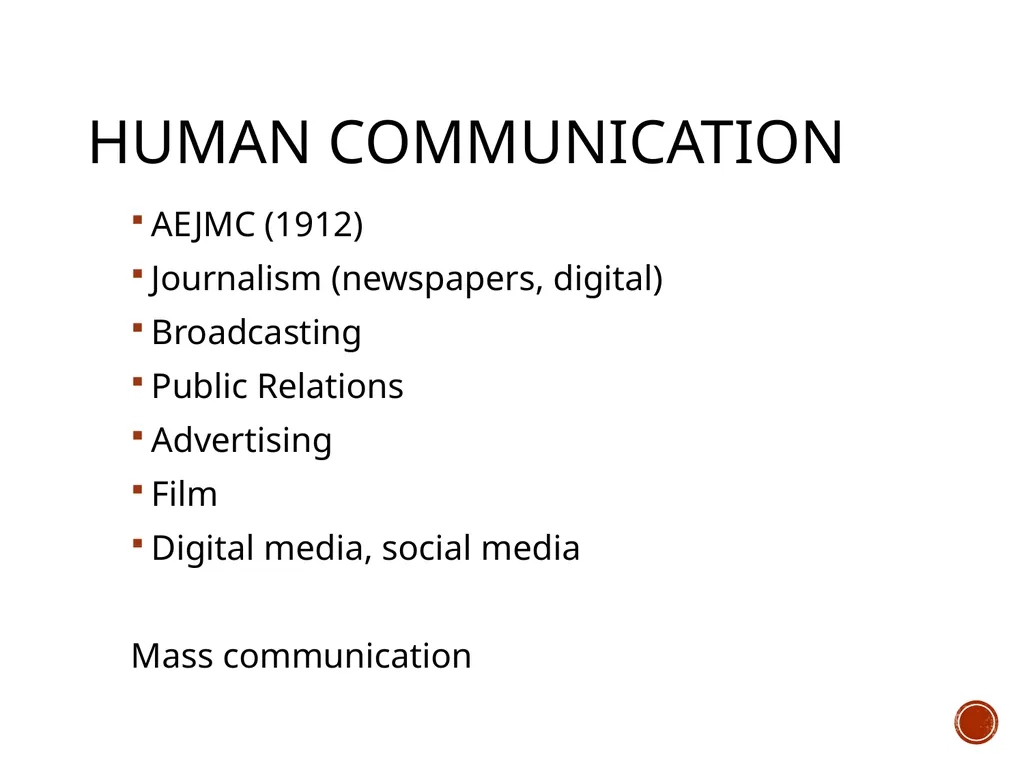
slide6. HUMAN COMMUNICATION AEJMC (1912)
Journalism (newspapers, digital)
Broadcasting
Public Relations
Advertising
Film
Digital media, social media
Mass communication<br>
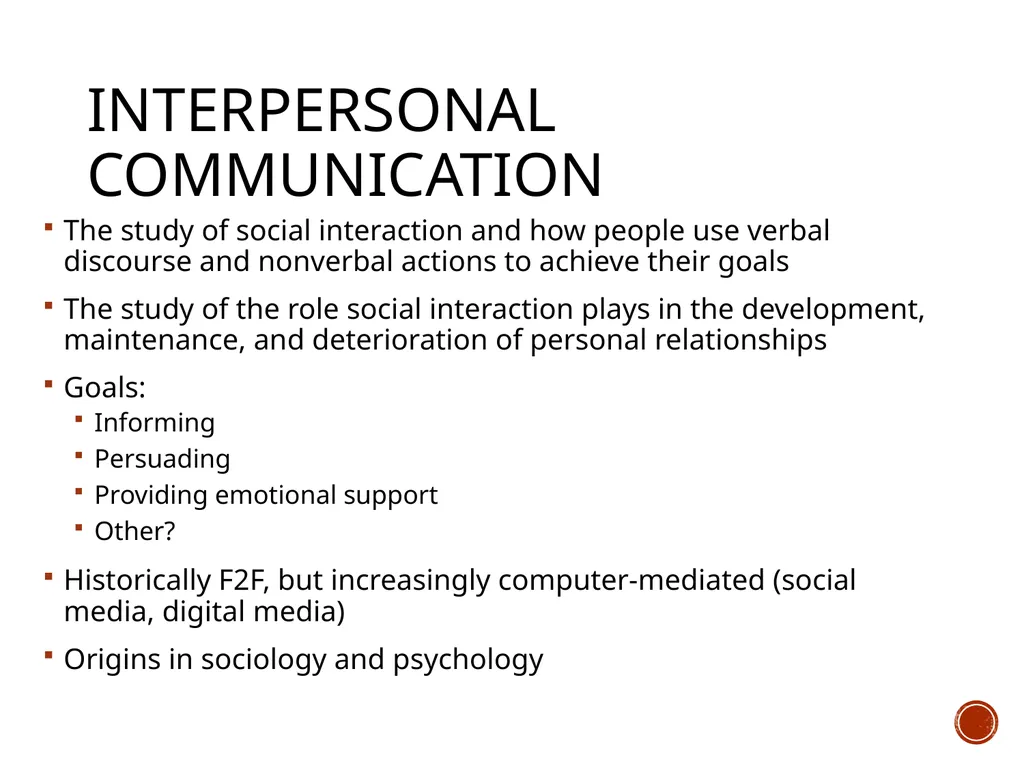
slide7. Interpersonal communication The study of social interaction and how people use verbal discourse and nonverbal actions to achieve their goals
The study of the role social interaction plays in the development, maintenance, and deterioration of personal relationships
Goals:
Informing
Persuading
Providing emotional support
Other?
Historically F2F, but increasingly computer-mediated (social media, digital media)
Origins in sociology and psychology<br>
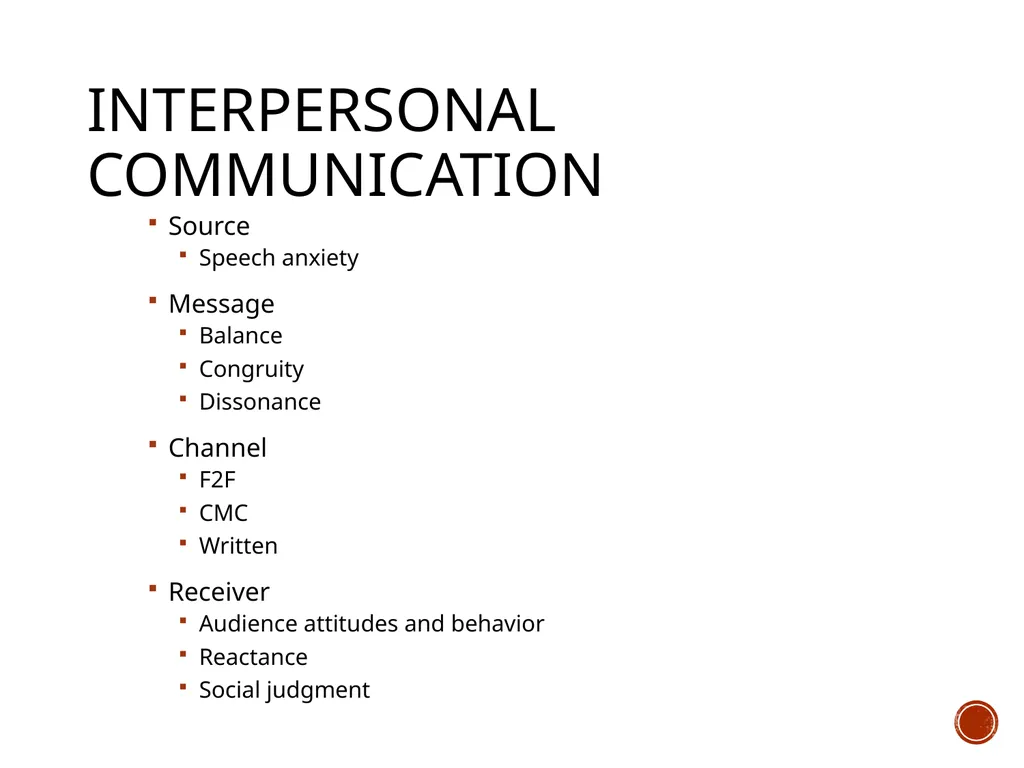
slide8. Interpersonal communication Source
Speech anxiety
Message
Balance
Congruity
Dissonance
Channel
F2F
CMC
Written
Receiver
Audience attitudes and behavior
Reactance
Social judgment<br>
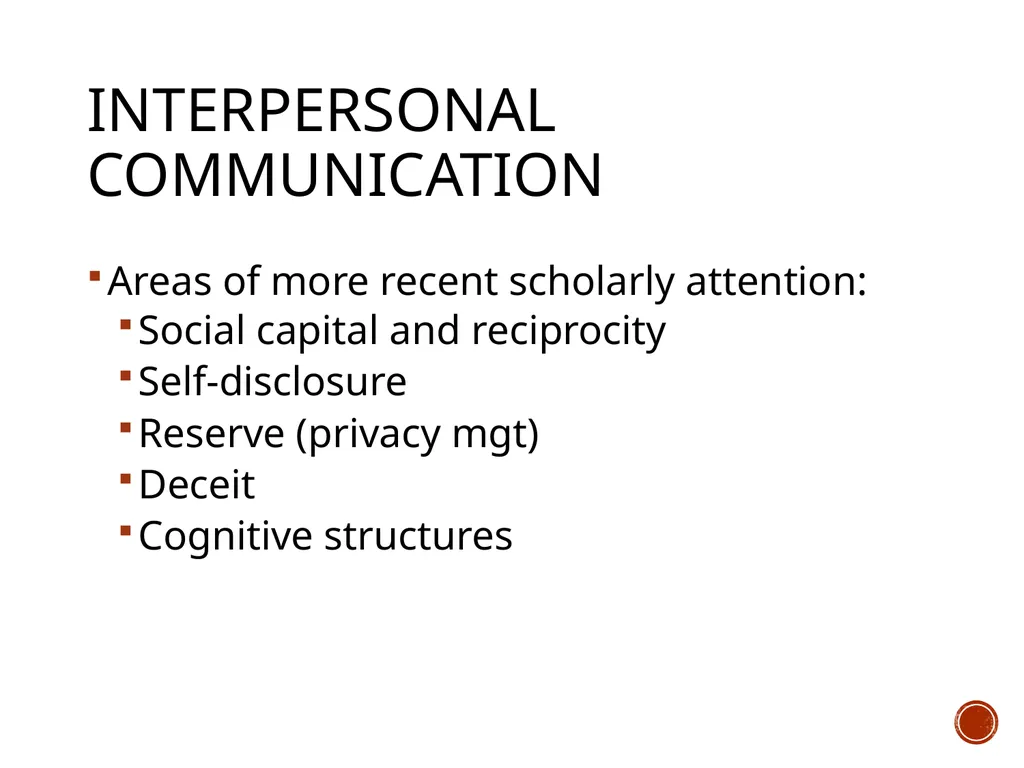
slide9. Interpersonal communication Areas of more recent scholarly attention:
Social capital and reciprocity
Self-disclosure
Reserve (privacy mgt)
Deceit
Cognitive structures<br>
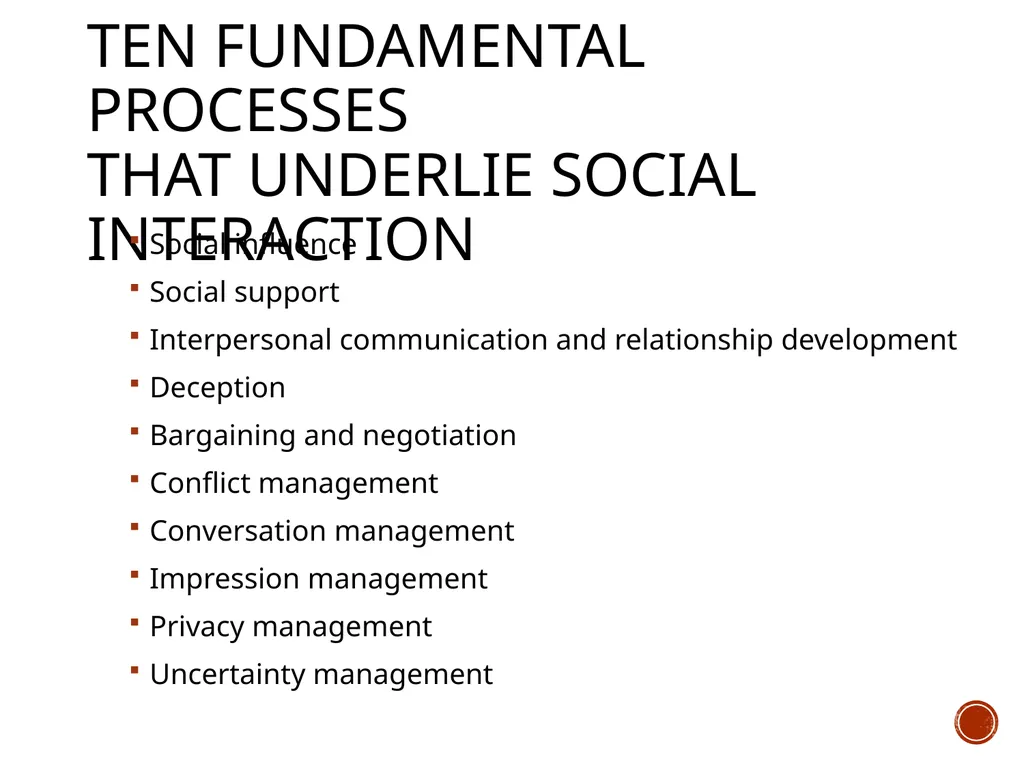
slide10. Ten fundamental processes that underlie social interaction Social influence
Social support
Interpersonal communication and relationship development
Deception
Bargaining and negotiation
Conflict management
Conversation management
Impression management
Privacy management
Uncertainty management<br>
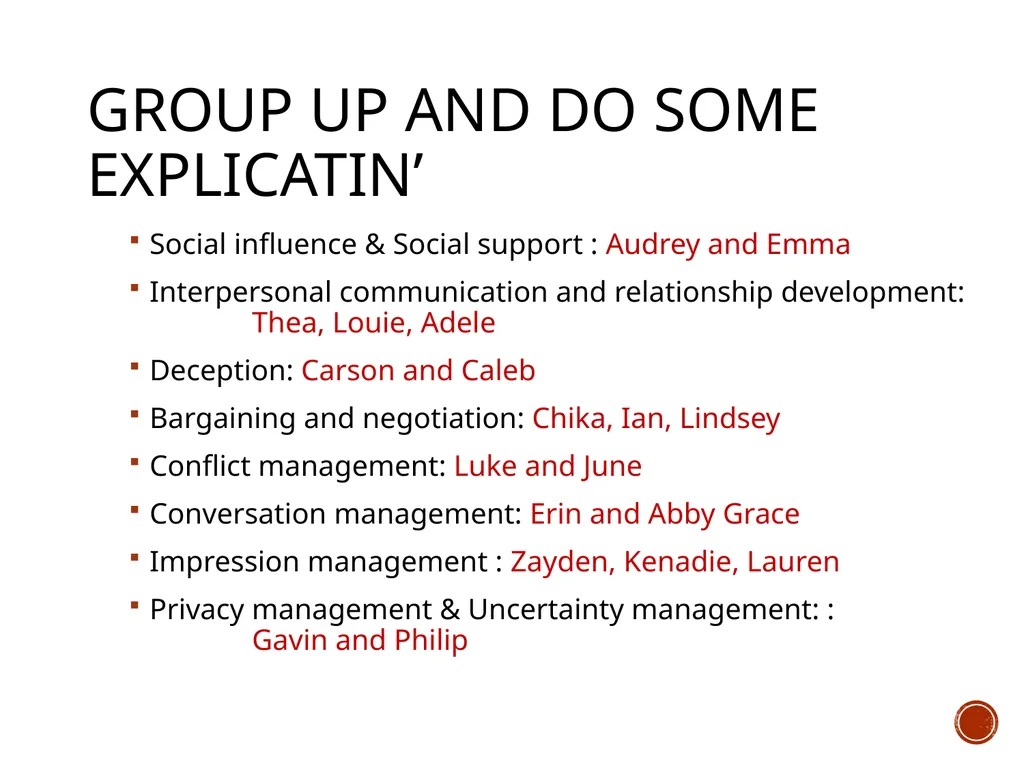
slide11. Group up and Do some explicatin’ Social influence & Social support : Audrey and Emma
Interpersonal communication and relationship development: Thea, Louie, Adele
Deception: Carson and Caleb
Bargaining and negotiation: Chika, Ian, Lindsey
Conflict management: Luke and June
Conversation management: Erin and Abby Grace
Impression management : Zayden, Kenadie, Lauren
Privacy management & Uncertainty management: : Gavin and Philip<br>
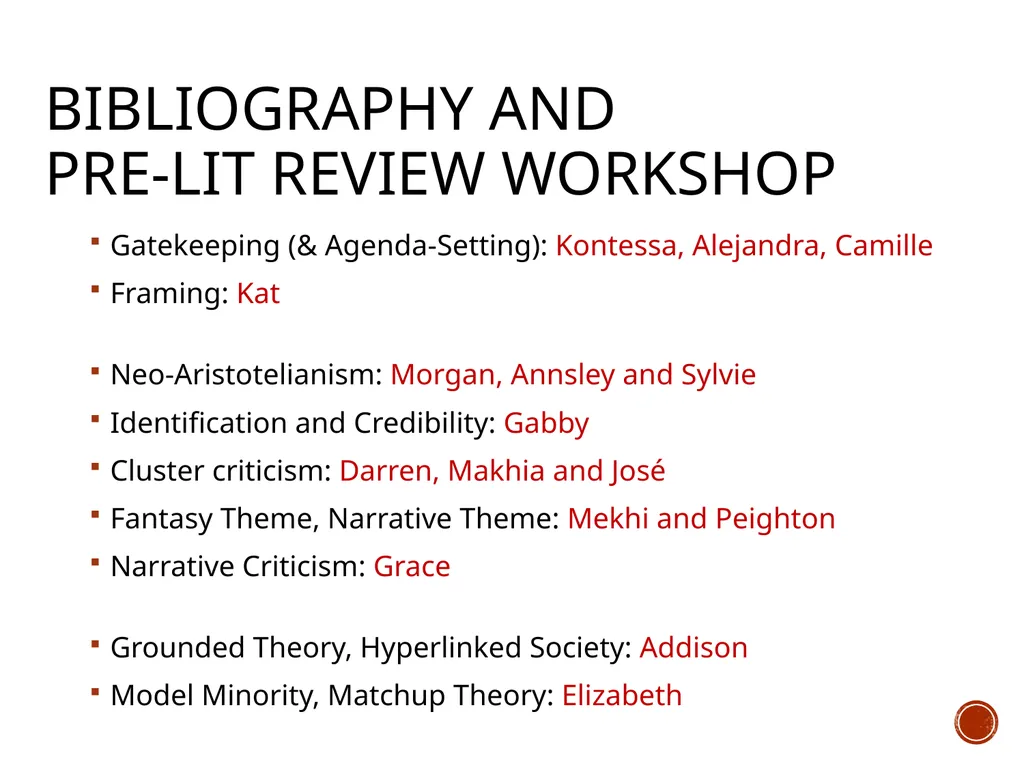
slide12. Bibliography and Pre-lit review workshop Gatekeeping (& Agenda-Setting): Kontessa, Alejandra, Camille
Framing: Kat
Neo-Aristotelianism: Morgan, Annsley and Sylvie
Identification and Credibility: Gabby
Cluster criticism: Darren, Makhia and José
Fantasy Theme, Narrative Theme: Mekhi and Peighton
Narrative Criticism: Grace
Grounded Theory, Hyperlinked Society: Addison
Model Minority, Matchup Theory: Elizabeth<br>
slide13. next Chapters 19 & 20
Rhetorical Criticism & Persuasion<br>
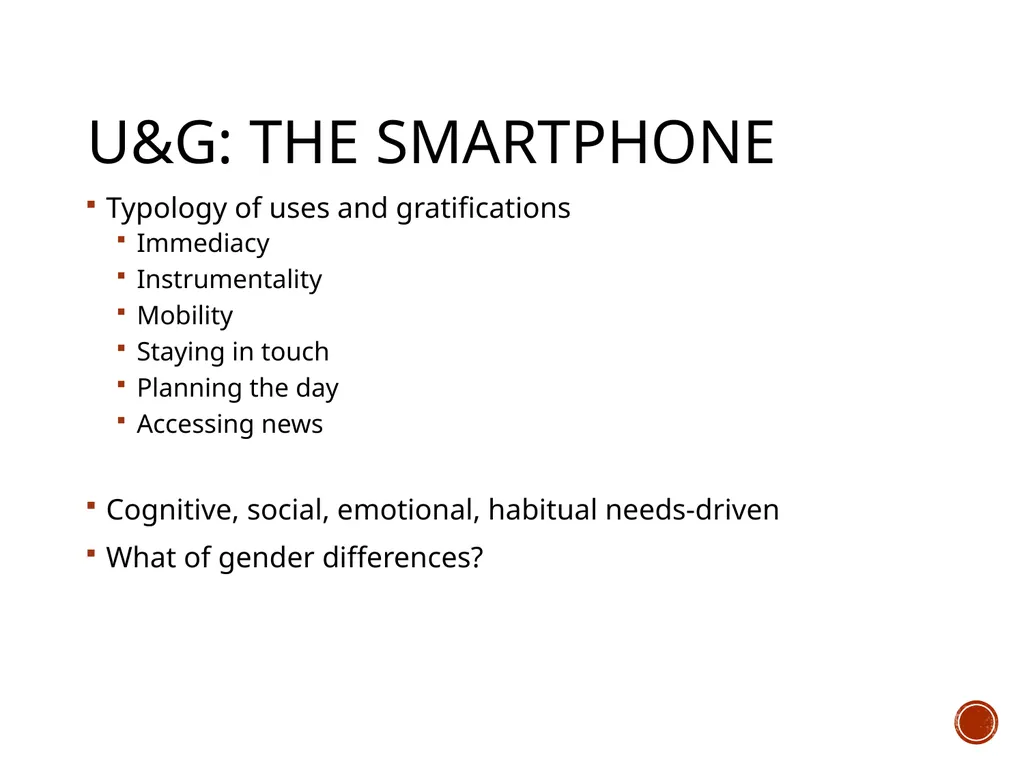
slide14. U&G: The Smartphone Typology of uses and gratifications
Immediacy
Instrumentality
Mobility
Staying in touch
Planning the day
Accessing news
Cognitive, social, emotional, habitual needs-driven
What of gender differences?<br>
slide15. Opportunities for research Photo tagging
Music applications
AI
Co-viewing
Convenience
Social capital
Attention spans
Audience sub-sets, like health patients
Second screens
What can you think of?<br>
slide16. Your turn Using pages 147-9, group up to devise a U&G study that looks at some contemporary phenomenon
AI-generated ‘influencers’
Quizzes and puzzles, such as Wordle, Immaculate Grid
TikTok videos of . . . Fill in this blank
Other<br>
slide2. reading quiz! Yay! TWO QUESTIONS:
1. Chapter 18 breaks up human communication into two traditions, areas, fields of study. What are these two areas?
HINT: One has been associated with Western cultures, the other with Eastern cultures, broadly understood.
2. Who is the ‘father’ of the Western orientation?
HINT: He’s the only dude mentioned in the chapter.<br>
slide3. HUMAN COMMUNICATION Speech | Rhetoric | Persuasion
Relationships | Social Transactions | Co-orientation
Western: Rhetorical, the individual
Eastern: Relational, the collective
Reactions?<br>
slide4. HUMAN COMMUNICATION Aristotle, 4th century BCE
Rhetoric
Three Principles of Rhetoric (persuasion or social influence)
Argumentation based on probabilities
Persuasion depends on what an audience believes to be true
Adapting to an audience
Rhetoric as an amoral tool<br>
slide5. HUMAN COMMUNICATION NCA (1909)
Speech
Theater
Speech pathology
Interpersonal/small group
Organizational
Intercultural
Political | Health
Family | Gender
Interpersonal communication<br>
slide6. HUMAN COMMUNICATION AEJMC (1912)
Journalism (newspapers, digital)
Broadcasting
Public Relations
Advertising
Film
Digital media, social media
Mass communication<br>
slide7. Interpersonal communication The study of social interaction and how people use verbal discourse and nonverbal actions to achieve their goals
The study of the role social interaction plays in the development, maintenance, and deterioration of personal relationships
Goals:
Informing
Persuading
Providing emotional support
Other?
Historically F2F, but increasingly computer-mediated (social media, digital media)
Origins in sociology and psychology<br>
slide8. Interpersonal communication Source
Speech anxiety
Message
Balance
Congruity
Dissonance
Channel
F2F
CMC
Written
Receiver
Audience attitudes and behavior
Reactance
Social judgment<br>
slide9. Interpersonal communication Areas of more recent scholarly attention:
Social capital and reciprocity
Self-disclosure
Reserve (privacy mgt)
Deceit
Cognitive structures<br>
slide10. Ten fundamental processes that underlie social interaction Social influence
Social support
Interpersonal communication and relationship development
Deception
Bargaining and negotiation
Conflict management
Conversation management
Impression management
Privacy management
Uncertainty management<br>
slide11. Group up and Do some explicatin’ Social influence & Social support : Audrey and Emma
Interpersonal communication and relationship development: Thea, Louie, Adele
Deception: Carson and Caleb
Bargaining and negotiation: Chika, Ian, Lindsey
Conflict management: Luke and June
Conversation management: Erin and Abby Grace
Impression management : Zayden, Kenadie, Lauren
Privacy management & Uncertainty management: : Gavin and Philip<br>
slide12. Bibliography and Pre-lit review workshop Gatekeeping (& Agenda-Setting): Kontessa, Alejandra, Camille
Framing: Kat
Neo-Aristotelianism: Morgan, Annsley and Sylvie
Identification and Credibility: Gabby
Cluster criticism: Darren, Makhia and José
Fantasy Theme, Narrative Theme: Mekhi and Peighton
Narrative Criticism: Grace
Grounded Theory, Hyperlinked Society: Addison
Model Minority, Matchup Theory: Elizabeth<br>
slide13. next Chapters 19 & 20
Rhetorical Criticism & Persuasion<br>
slide14. U&G: The Smartphone Typology of uses and gratifications
Immediacy
Instrumentality
Mobility
Staying in touch
Planning the day
Accessing news
Cognitive, social, emotional, habitual needs-driven
What of gender differences?<br>
slide15. Opportunities for research Photo tagging
Music applications
AI
Co-viewing
Convenience
Social capital
Attention spans
Audience sub-sets, like health patients
Second screens
What can you think of?<br>
slide16. Your turn Using pages 147-9, group up to devise a U&G study that looks at some contemporary phenomenon
AI-generated ‘influencers’
Quizzes and puzzles, such as Wordle, Immaculate Grid
TikTok videos of . . . Fill in this blank
Other<br>