
International Team Management: Cultural Context
LV
Published · 36 slides · 0 views

1 / 1


Description
International Team Management: Cultural Context Angers, France Summer 2019 What is Culture? Culture is the pervasive and shared beliefs, norms, values and symbols that guide the everyday life of a group. Cultural norms: both prescribe and
Related Topics
Share
Embed code
Download this presentation From Below
"International Team Management: Cultural Context" is the property of its rightful owner. Permission is granted to download and print the materials on this website for personal, non-commercial use only, and to display it on your personal computer provided you do not modify the materials and that you retain all copyright notices contained in the materials. By downloading content from our website, you accept the terms of this agreement.
Presentation Transcript
01
International Team Management:
Cultural Context Angers, France
Summer 2019<br>
Summer 2019<br>
02
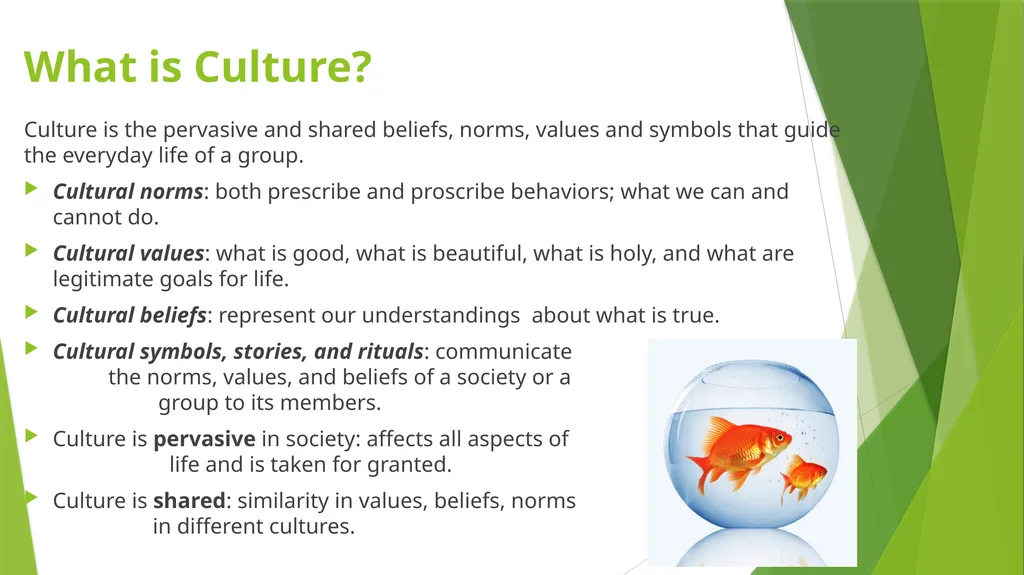
What is Culture? Culture is the pervasive and shared beliefs, norms, values and symbols that guide the everyday life of a group.
Cultural norms: both prescribe and proscribe behaviors; what we can and cannot do.
Cultural values: what is good, what is beautiful, what is holy, and what are legitimate goals for life.
Cultural beliefs: represent our understandings about what is true.
Cultural symbols, stories, and rituals: communicate the norms, values, and beliefs of a society or a group to its members.
Culture is pervasive in society: affects all aspects of life and is taken for granted.
Culture is shared: similarity in values, beliefs, norms in different cultures.<br>
Cultural norms: both prescribe and proscribe behaviors; what we can and cannot do.
Cultural values: what is good, what is beautiful, what is holy, and what are legitimate goals for life.
Cultural beliefs: represent our understandings about what is true.
Cultural symbols, stories, and rituals: communicate the norms, values, and beliefs of a society or a group to its members.
Culture is pervasive in society: affects all aspects of life and is taken for granted.
Culture is shared: similarity in values, beliefs, norms in different cultures.<br>
03
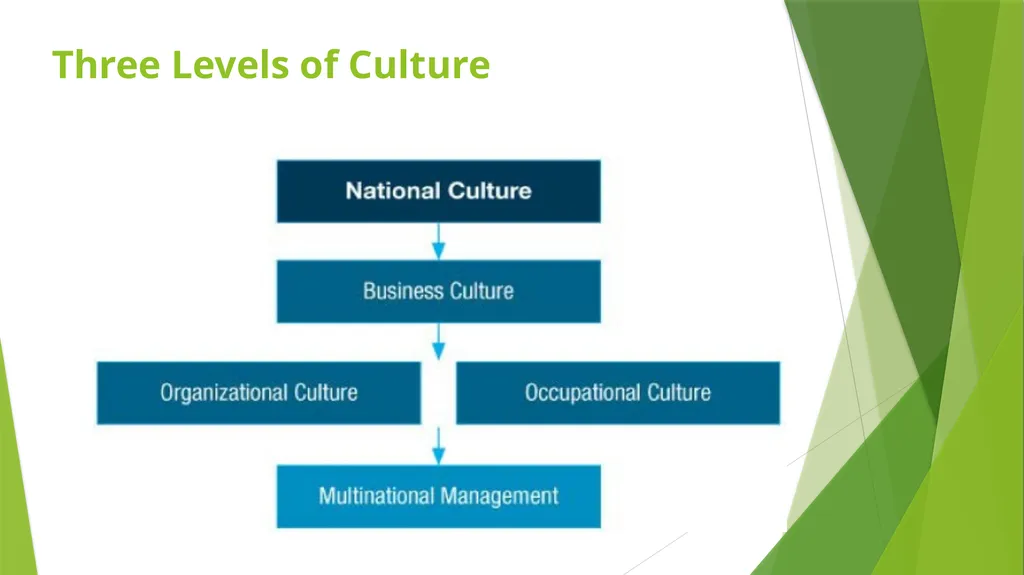
Three Levels of Culture<br>
04
Levels of Culture National / Societal culture: the dominant culture within the political boundaries of the nation-state. There may be subcultures within the national culture.
Business culture: norms, values, and beliefs that pertain to all aspects of doing business in a culture. Influences work life and acceptable ways to conduct business in a society.
Organizational culture: the set of important understandings (often unstated) that members of an organization share.
Occupational culture: the norms, values, beliefs, and expected ways of behaving for people in the same occupational group (regardless of employer).<br>
Business culture: norms, values, and beliefs that pertain to all aspects of doing business in a culture. Influences work life and acceptable ways to conduct business in a society.
Organizational culture: the set of important understandings (often unstated) that members of an organization share.
Occupational culture: the norms, values, beliefs, and expected ways of behaving for people in the same occupational group (regardless of employer).<br>
05
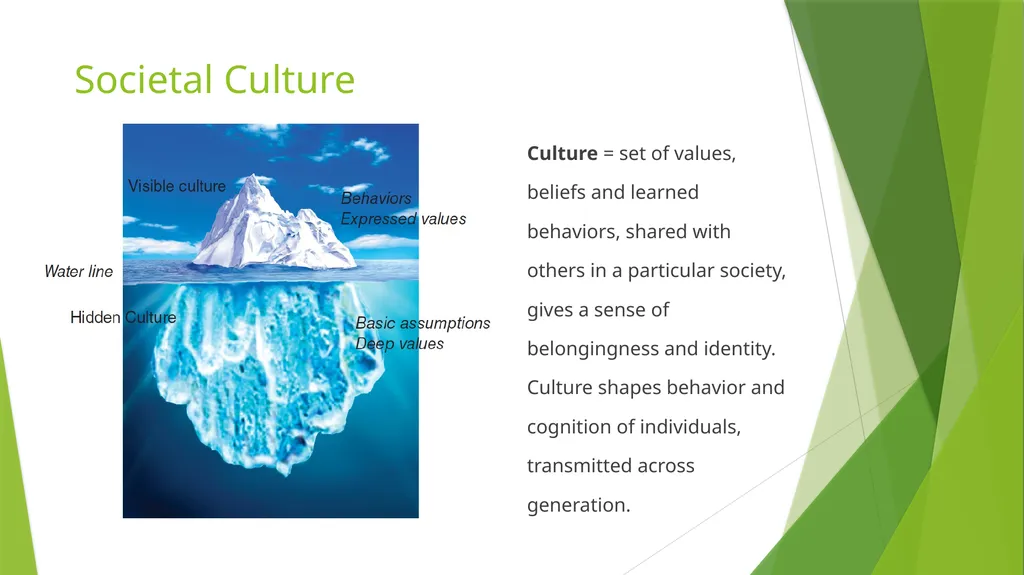
5 Societal Culture Culture = set of values, beliefs and learned behaviors, shared with others in a particular society, gives a sense of belongingness and identity. Culture shapes behavior and cognition of individuals, transmitted across generation.<br>
06
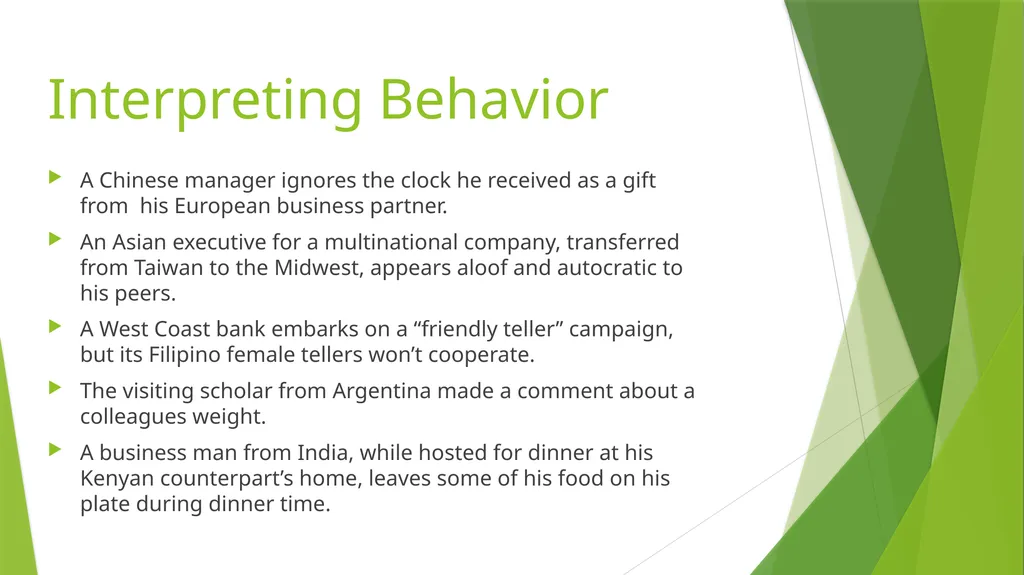
Interpreting Behavior A Chinese manager ignores the clock he received as a gift from his European business partner.
An Asian executive for a multinational company, transferred from Taiwan to the Midwest, appears aloof and autocratic to his peers.
A West Coast bank embarks on a “friendly teller” campaign, but its Filipino female tellers won’t cooperate.
The visiting scholar from Argentina made a comment about a colleagues weight.
A business man from India, while hosted for dinner at his Kenyan counterpart’s home, leaves some of his food on his plate during dinner time.<br>
An Asian executive for a multinational company, transferred from Taiwan to the Midwest, appears aloof and autocratic to his peers.
A West Coast bank embarks on a “friendly teller” campaign, but its Filipino female tellers won’t cooperate.
The visiting scholar from Argentina made a comment about a colleagues weight.
A business man from India, while hosted for dinner at his Kenyan counterpart’s home, leaves some of his food on his plate during dinner time.<br>
07
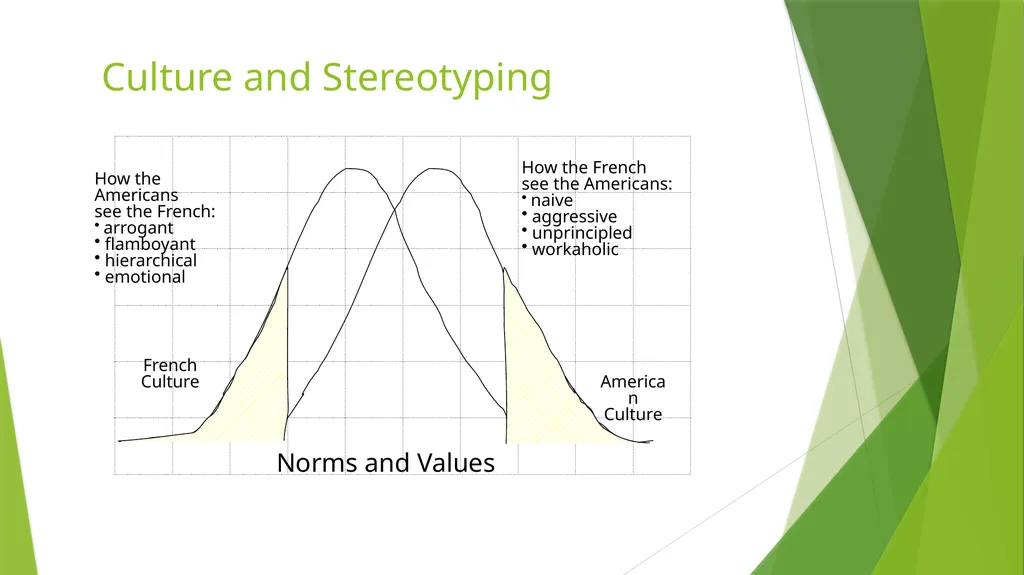
Culture and Stereotyping Norms and Values French Culture American Culture How the Americans
see the French:
arrogant
flamboyant
hierarchical
emotional How the French see the Americans:
naive
aggressive
unprincipled
workaholic<br>
see the French:
arrogant
flamboyant
hierarchical
emotional How the French see the Americans:
naive
aggressive
unprincipled
workaholic<br>
08
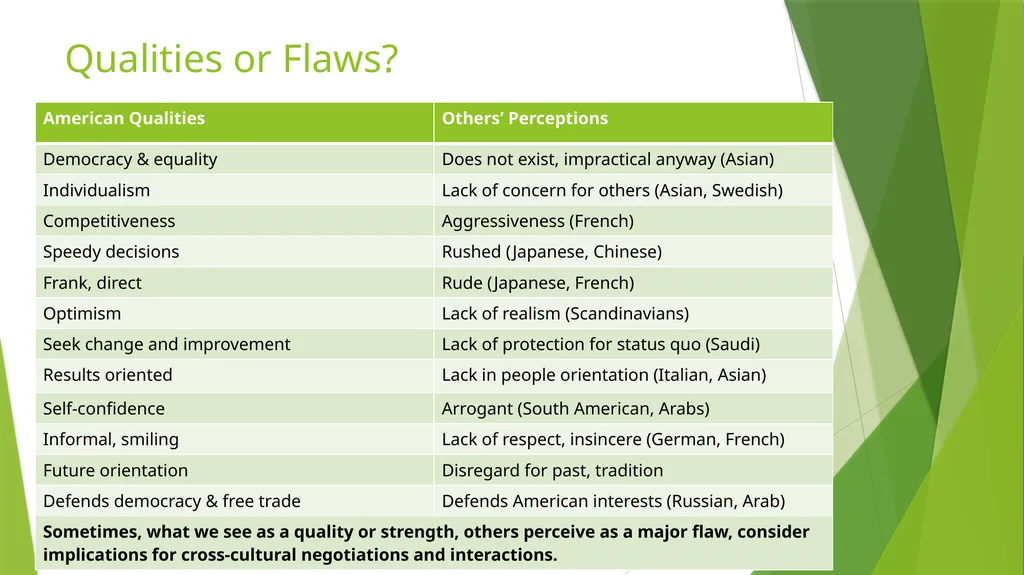
Qualities or Flaws?<br>
09
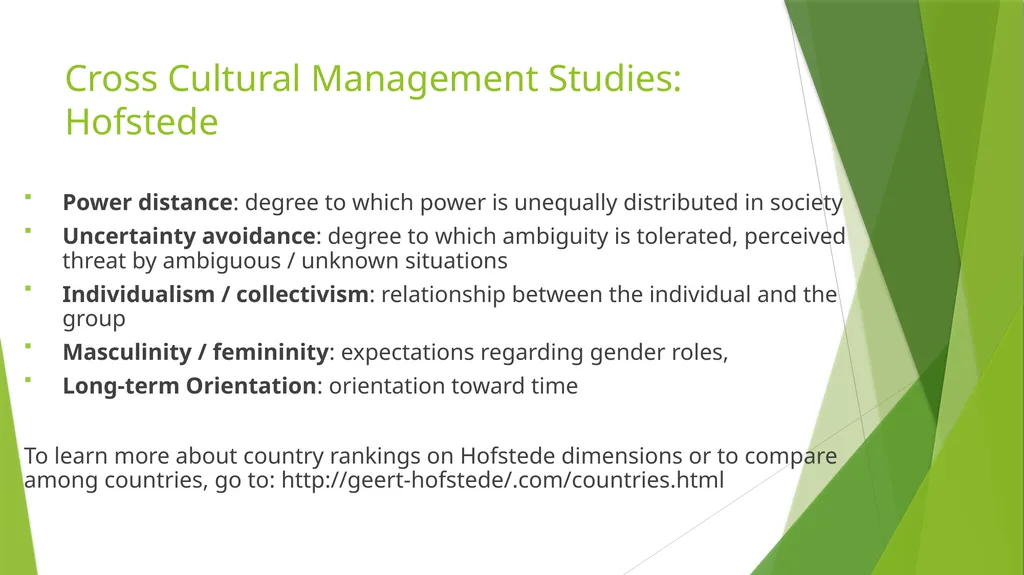
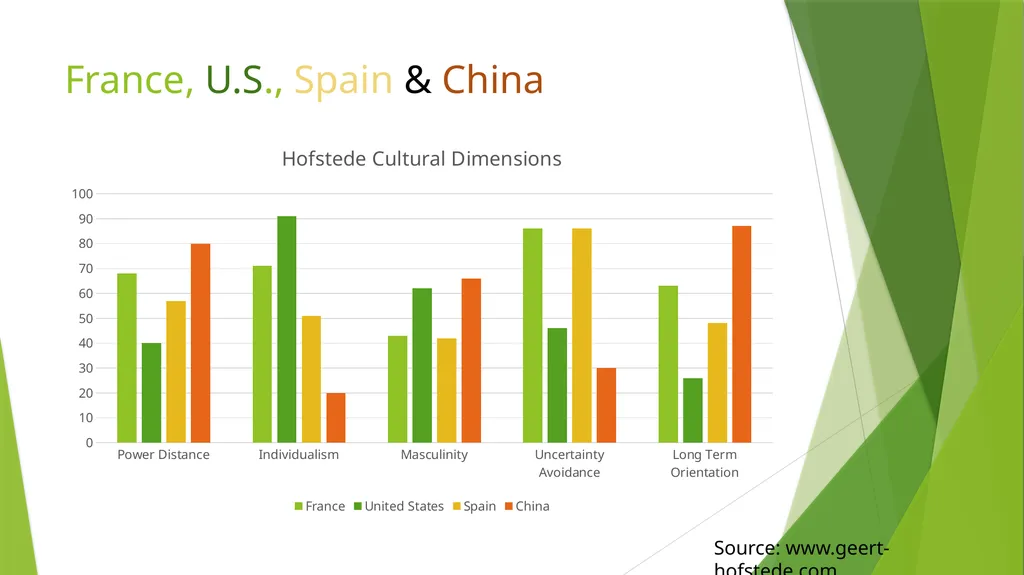
9 Cross Cultural Management Studies: Hofstede Power distance: degree to which power is unequally distributed in society
Uncertainty avoidance: degree to which ambiguity is tolerated, perceived threat by ambiguous / unknown situations
Individualism / collectivism: relationship between the individual and the group
Masculinity / femininity: expectations regarding gender roles,
Long-term Orientation: orientation toward time
To learn more about country rankings on Hofstede dimensions or to compare among countries, go to: http://geert-hofstede/.com/countries.html<br>
Uncertainty avoidance: degree to which ambiguity is tolerated, perceived threat by ambiguous / unknown situations
Individualism / collectivism: relationship between the individual and the group
Masculinity / femininity: expectations regarding gender roles,
Long-term Orientation: orientation toward time
To learn more about country rankings on Hofstede dimensions or to compare among countries, go to: http://geert-hofstede/.com/countries.html<br>
10
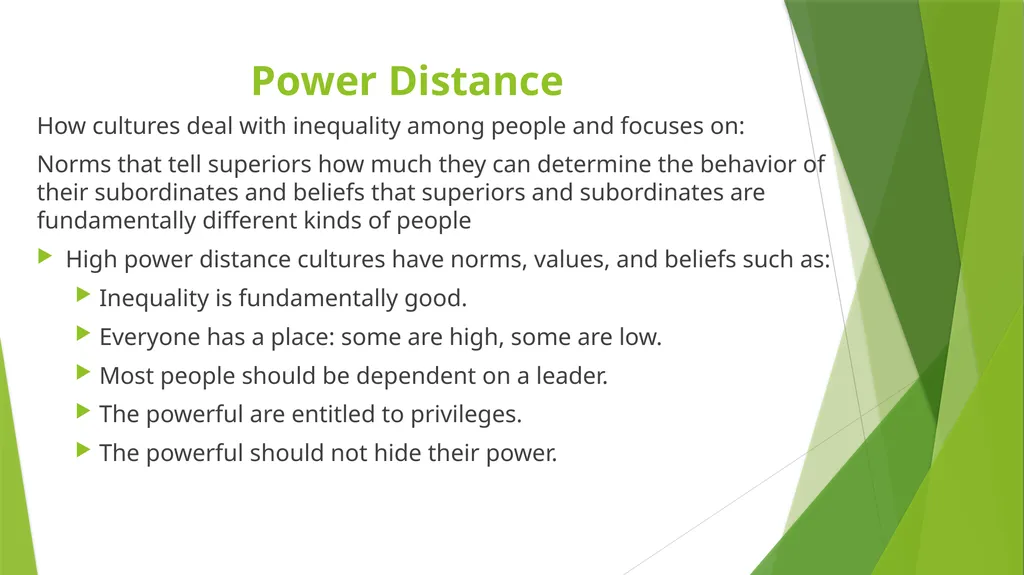
Power Distance How cultures deal with inequality among people and focuses on:
Norms that tell superiors how much they can determine the behavior of their subordinates and beliefs that superiors and subordinates are fundamentally different kinds of people
High power distance cultures have norms, values, and beliefs such as:
Inequality is fundamentally good.
Everyone has a place: some are high, some are low.
Most people should be dependent on a leader.
The powerful are entitled to privileges.
The powerful should not hide their power.<br>
Norms that tell superiors how much they can determine the behavior of their subordinates and beliefs that superiors and subordinates are fundamentally different kinds of people
High power distance cultures have norms, values, and beliefs such as:
Inequality is fundamentally good.
Everyone has a place: some are high, some are low.
Most people should be dependent on a leader.
The powerful are entitled to privileges.
The powerful should not hide their power.<br>
11
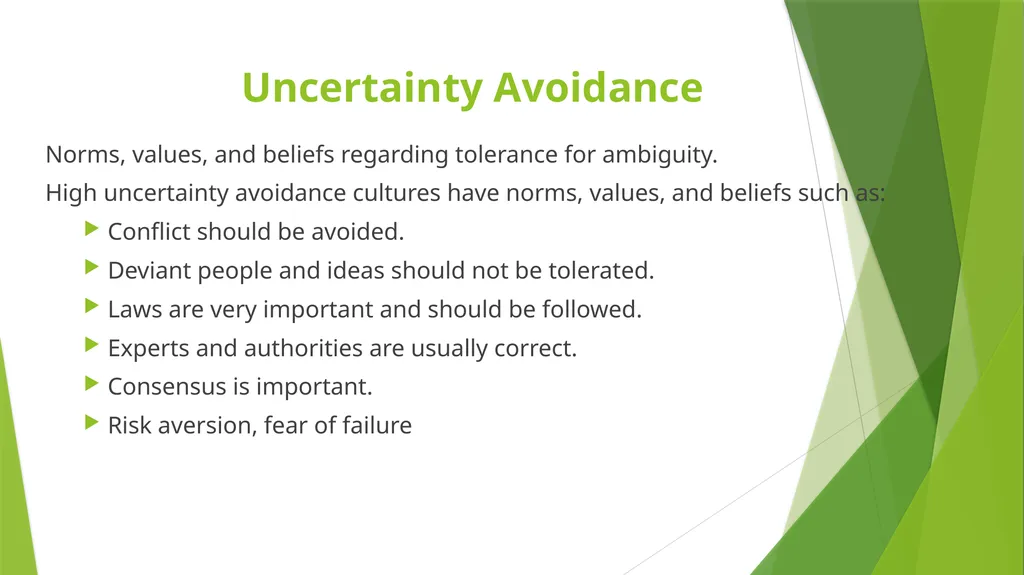
Uncertainty Avoidance Norms, values, and beliefs regarding tolerance for ambiguity.
High uncertainty avoidance cultures have norms, values, and beliefs such as:
Conflict should be avoided.
Deviant people and ideas should not be tolerated.
Laws are very important and should be followed.
Experts and authorities are usually correct.
Consensus is important.
Risk aversion, fear of failure<br>
High uncertainty avoidance cultures have norms, values, and beliefs such as:
Conflict should be avoided.
Deviant people and ideas should not be tolerated.
Laws are very important and should be followed.
Experts and authorities are usually correct.
Consensus is important.
Risk aversion, fear of failure<br>
12
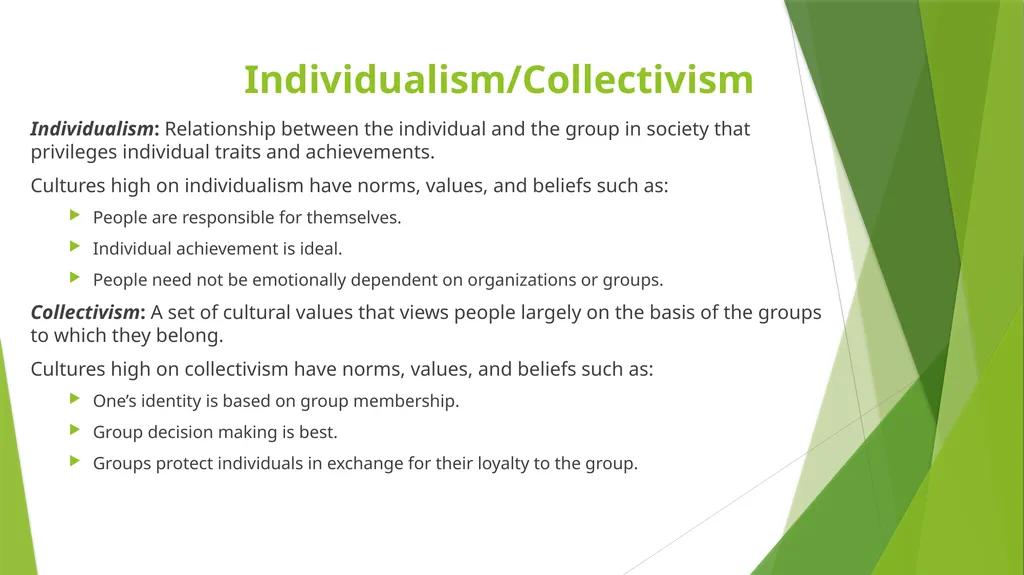
Individualism/Collectivism Individualism: Relationship between the individual and the group in society that privileges individual traits and achievements.
Cultures high on individualism have norms, values, and beliefs such as:
People are responsible for themselves.
Individual achievement is ideal.
People need not be emotionally dependent on organizations or groups.
Collectivism: A set of cultural values that views people largely on the basis of the groups to which they belong.
Cultures high on collectivism have norms, values, and beliefs such as:
One’s identity is based on group membership.
Group decision making is best.
Groups protect individuals in exchange for their loyalty to the group.<br>
Cultures high on individualism have norms, values, and beliefs such as:
People are responsible for themselves.
Individual achievement is ideal.
People need not be emotionally dependent on organizations or groups.
Collectivism: A set of cultural values that views people largely on the basis of the groups to which they belong.
Cultures high on collectivism have norms, values, and beliefs such as:
One’s identity is based on group membership.
Group decision making is best.
Groups protect individuals in exchange for their loyalty to the group.<br>
13
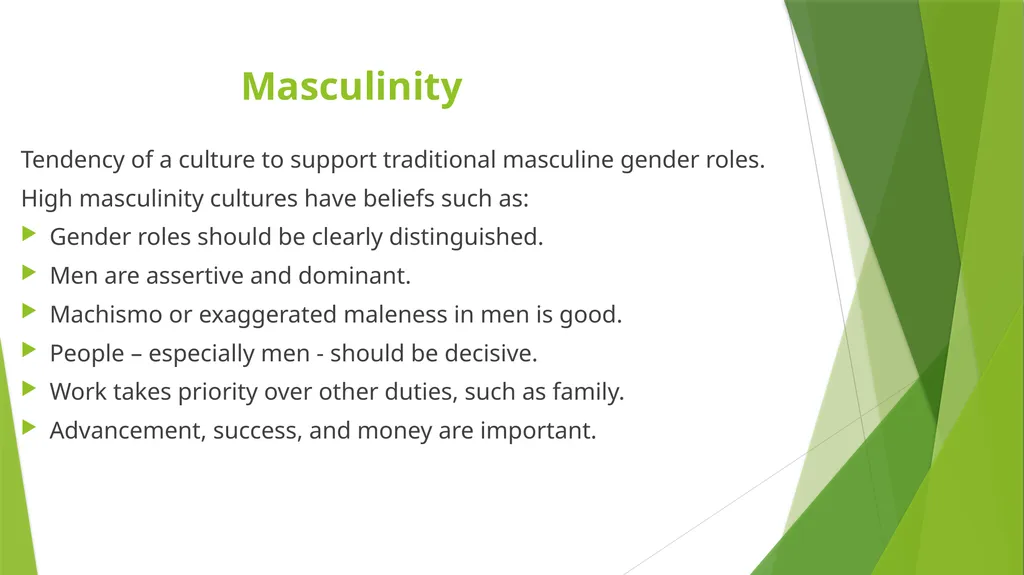
Masculinity Tendency of a culture to support traditional masculine gender roles.
High masculinity cultures have beliefs such as:
Gender roles should be clearly distinguished.
Men are assertive and dominant.
Machismo or exaggerated maleness in men is good.
People – especially men - should be decisive.
Work takes priority over other duties, such as family.
Advancement, success, and money are important.<br>
High masculinity cultures have beliefs such as:
Gender roles should be clearly distinguished.
Men are assertive and dominant.
Machismo or exaggerated maleness in men is good.
People – especially men - should be decisive.
Work takes priority over other duties, such as family.
Advancement, success, and money are important.<br>
14
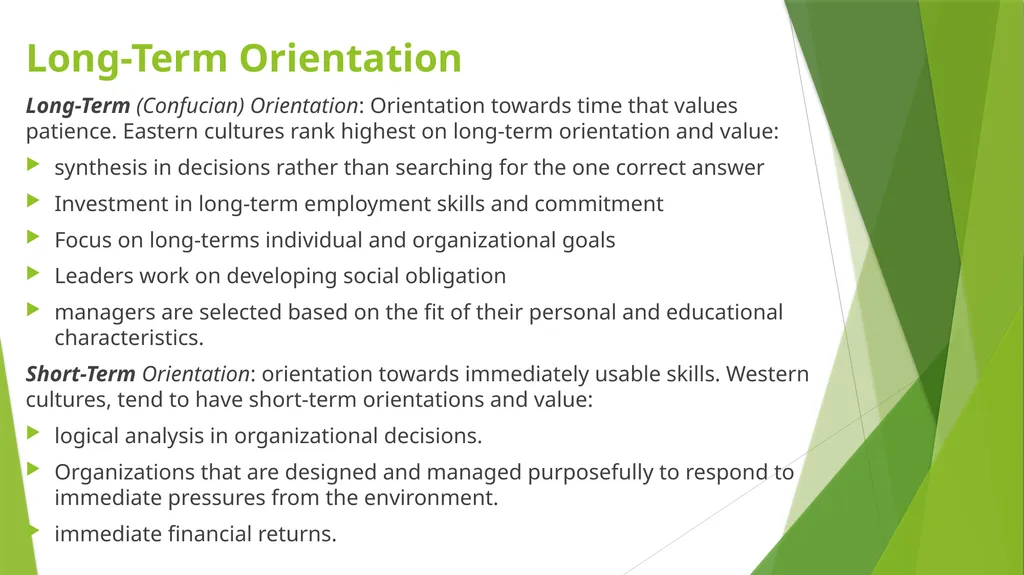
Long-Term Orientation Long-Term (Confucian) Orientation: Orientation towards time that values patience. Eastern cultures rank highest on long-term orientation and value:
synthesis in decisions rather than searching for the one correct answer
Investment in long-term employment skills and commitment
Focus on long-terms individual and organizational goals
Leaders work on developing social obligation
managers are selected based on the fit of their personal and educational characteristics.
Short-Term Orientation: orientation towards immediately usable skills. Western cultures, tend to have short-term orientations and value:
logical analysis in organizational decisions.
Organizations that are designed and managed purposefully to respond to immediate pressures from the environment.
immediate financial returns.
See Exhibit 2.7 (p. 40) for managerial implications<br>
synthesis in decisions rather than searching for the one correct answer
Investment in long-term employment skills and commitment
Focus on long-terms individual and organizational goals
Leaders work on developing social obligation
managers are selected based on the fit of their personal and educational characteristics.
Short-Term Orientation: orientation towards immediately usable skills. Western cultures, tend to have short-term orientations and value:
logical analysis in organizational decisions.
Organizations that are designed and managed purposefully to respond to immediate pressures from the environment.
immediate financial returns.
See Exhibit 2.7 (p. 40) for managerial implications<br>
15
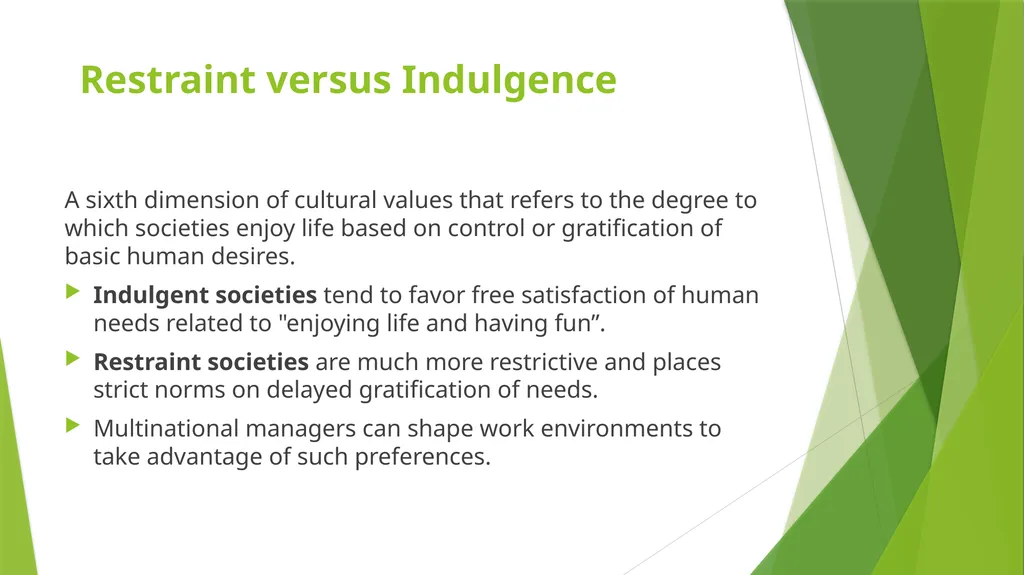
Restraint versus Indulgence A sixth dimension of cultural values that refers to the degree to which societies enjoy life based on control or gratification of basic human desires.
Indulgent societies tend to favor free satisfaction of human needs related to "enjoying life and having fun”.
Restraint societies are much more restrictive and places strict norms on delayed gratification of needs.
Multinational managers can shape work environments to take advantage of such preferences.<br>
Indulgent societies tend to favor free satisfaction of human needs related to "enjoying life and having fun”.
Restraint societies are much more restrictive and places strict norms on delayed gratification of needs.
Multinational managers can shape work environments to take advantage of such preferences.<br>
16
France, U.S., Spain & China Source: www.geert-hofstede.com<br>
17
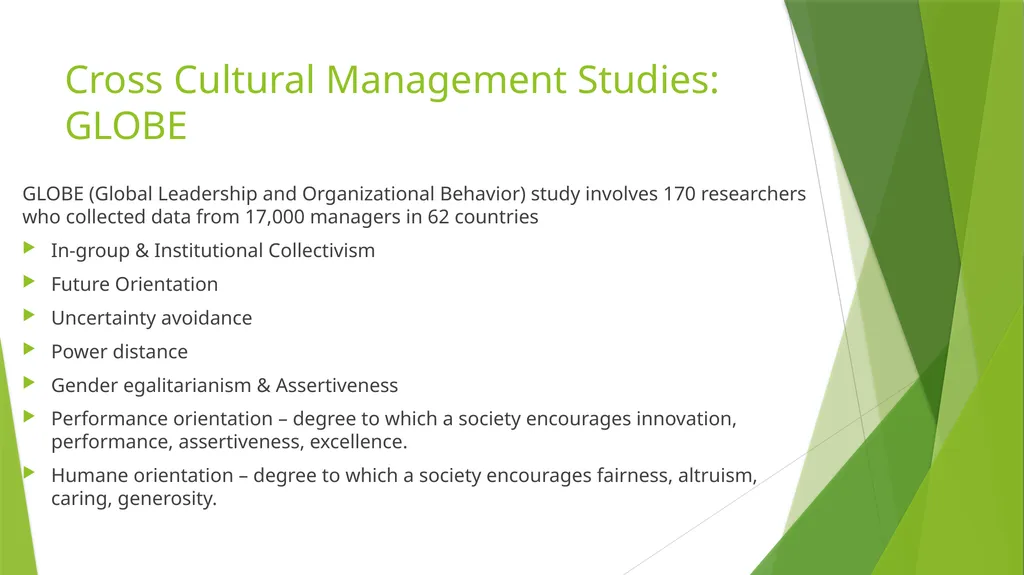
Cross Cultural Management Studies: GLOBE GLOBE (Global Leadership and Organizational Behavior) study involves 170 researchers who collected data from 17,000 managers in 62 countries
In-group & Institutional Collectivism
Future Orientation
Uncertainty avoidance
Power distance
Gender egalitarianism & Assertiveness
Performance orientation – degree to which a society encourages innovation, performance, assertiveness, excellence.
Humane orientation – degree to which a society encourages fairness, altruism, caring, generosity. 17<br>
In-group & Institutional Collectivism
Future Orientation
Uncertainty avoidance
Power distance
Gender egalitarianism & Assertiveness
Performance orientation – degree to which a society encourages innovation, performance, assertiveness, excellence.
Humane orientation – degree to which a society encourages fairness, altruism, caring, generosity. 17<br>
18
GLOBE National Culture Framework 7 of 9 dimensions of GLOBE are similar to Hofstede
GLOBE’s 2 Unique dimensions:
Performance Orientation refers to the degree to which the society encourages societal members to innovate, to improve performance, and to strive for excellence (E.g., the US and Singapore have high scores while Russia and Greece have low scores on the dimension).
Humane Orientation is an indication of the extent to which individuals are expected to be fair, altruistic, caring, and generous. In such cultures, the need for belongingness and affiliation is emphasized more than material possessions, self-fulfillment, and pleasure. Less humane-oriented societies are more likely to value self-interest and self-gratification. (E.g., Malaysia and Egypt have high humane orientation scores, while France and Germany have low scores).<br>
GLOBE’s 2 Unique dimensions:
Performance Orientation refers to the degree to which the society encourages societal members to innovate, to improve performance, and to strive for excellence (E.g., the US and Singapore have high scores while Russia and Greece have low scores on the dimension).
Humane Orientation is an indication of the extent to which individuals are expected to be fair, altruistic, caring, and generous. In such cultures, the need for belongingness and affiliation is emphasized more than material possessions, self-fulfillment, and pleasure. Less humane-oriented societies are more likely to value self-interest and self-gratification. (E.g., Malaysia and Egypt have high humane orientation scores, while France and Germany have low scores).<br>
19
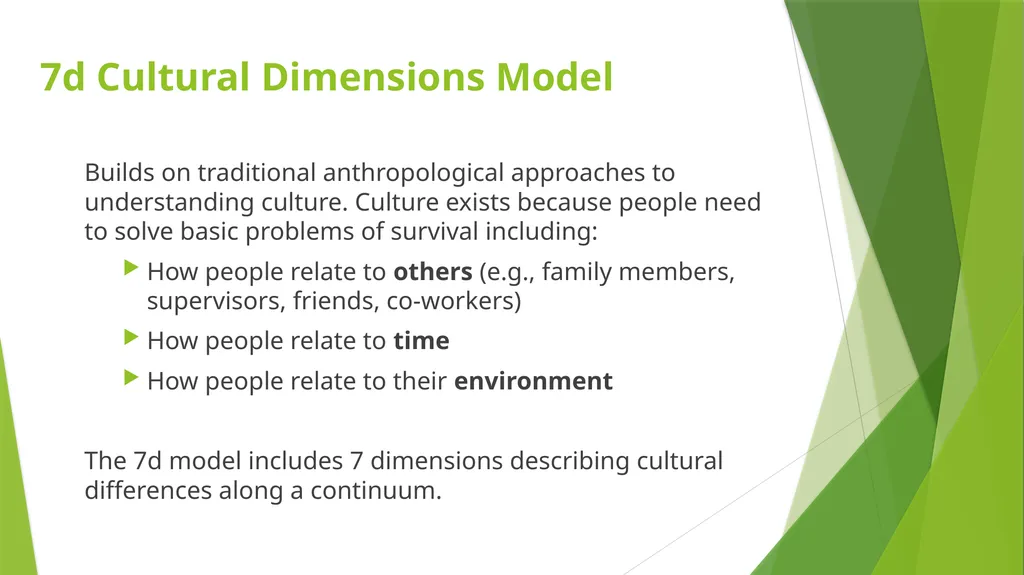
7d Cultural Dimensions Model Builds on traditional anthropological approaches to understanding culture. Culture exists because people need to solve basic problems of survival including:
How people relate to others (e.g., family members, supervisors, friends, co-workers)
How people relate to time
How people relate to their environment
The 7d model includes 7 dimensions describing cultural differences along a continuum.<br>
How people relate to others (e.g., family members, supervisors, friends, co-workers)
How people relate to time
How people relate to their environment
The 7d model includes 7 dimensions describing cultural differences along a continuum.<br>
20
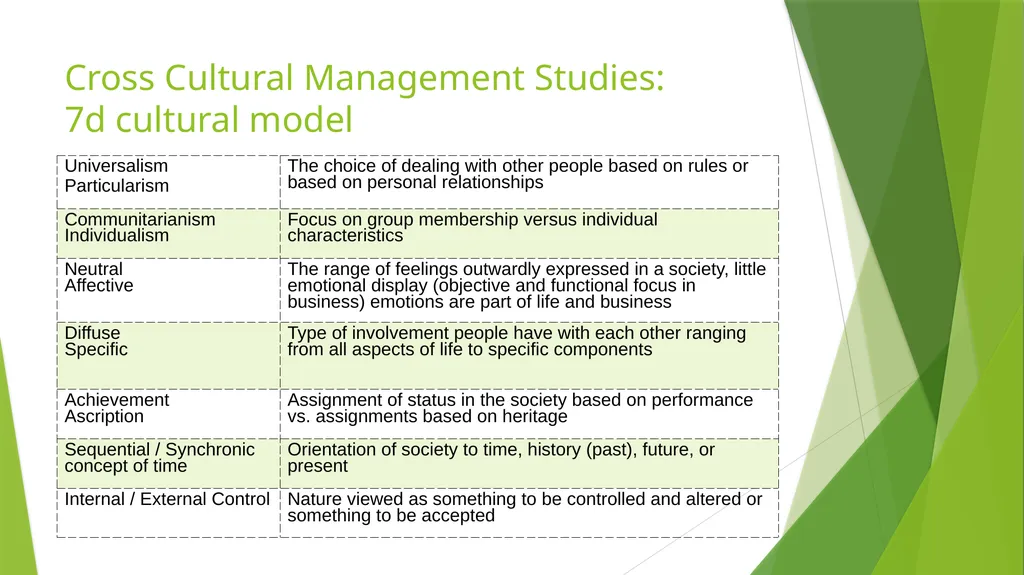
Cross Cultural Management Studies:
7d cultural model 20<br>
21
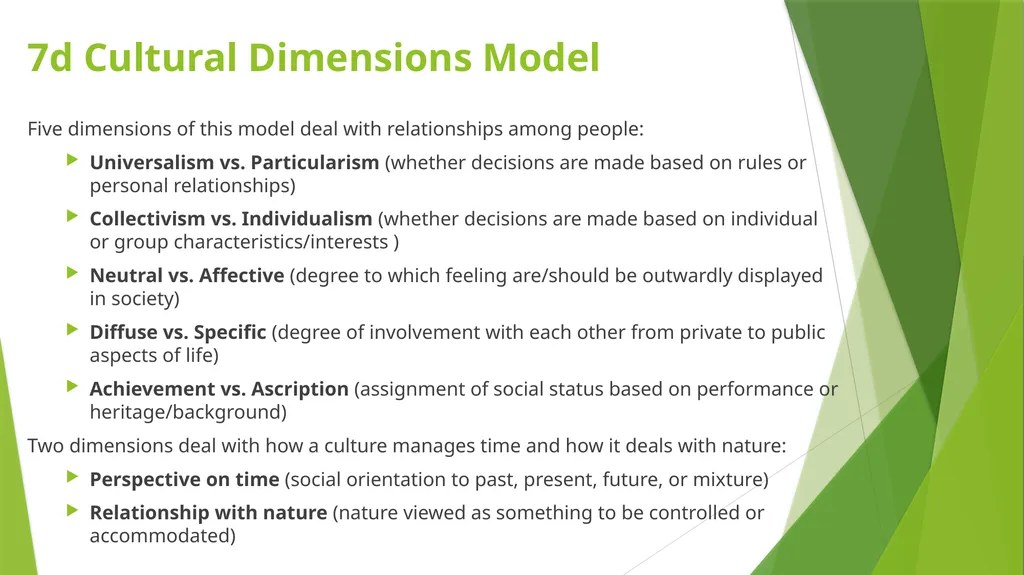
7d Cultural Dimensions Model Five dimensions of this model deal with relationships among people:
Universalism vs. Particularism (whether decisions are made based on rules or personal relationships)
Collectivism vs. Individualism (whether decisions are made based on individual or group characteristics/interests )
Neutral vs. Affective (degree to which feeling are/should be outwardly displayed in society)
Diffuse vs. Specific (degree of involvement with each other from private to public aspects of life)
Achievement vs. Ascription (assignment of social status based on performance or heritage/background)
Two dimensions deal with how a culture manages time and how it deals with nature:
Perspective on time (social orientation to past, present, future, or mixture)
Relationship with nature (nature viewed as something to be controlled or accommodated)<br>
Universalism vs. Particularism (whether decisions are made based on rules or personal relationships)
Collectivism vs. Individualism (whether decisions are made based on individual or group characteristics/interests )
Neutral vs. Affective (degree to which feeling are/should be outwardly displayed in society)
Diffuse vs. Specific (degree of involvement with each other from private to public aspects of life)
Achievement vs. Ascription (assignment of social status based on performance or heritage/background)
Two dimensions deal with how a culture manages time and how it deals with nature:
Perspective on time (social orientation to past, present, future, or mixture)
Relationship with nature (nature viewed as something to be controlled or accommodated)<br>
22
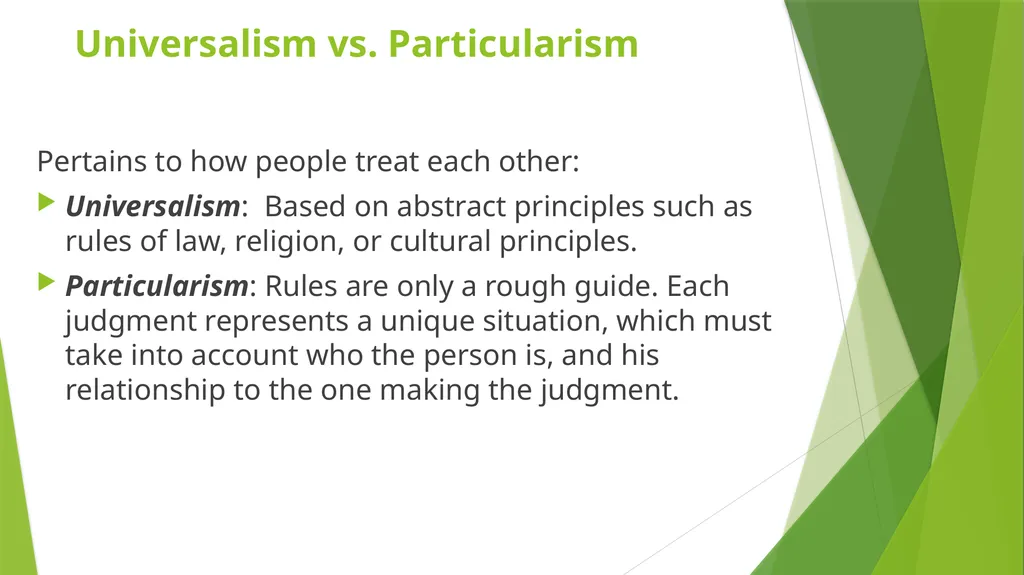
Universalism vs. Particularism Pertains to how people treat each other:
Universalism: Based on abstract principles such as rules of law, religion, or cultural principles.
Particularism: Rules are only a rough guide. Each judgment represents a unique situation, which must take into account who the person is, and his relationship to the one making the judgment.<br>
Universalism: Based on abstract principles such as rules of law, religion, or cultural principles.
Particularism: Rules are only a rough guide. Each judgment represents a unique situation, which must take into account who the person is, and his relationship to the one making the judgment.<br>
23
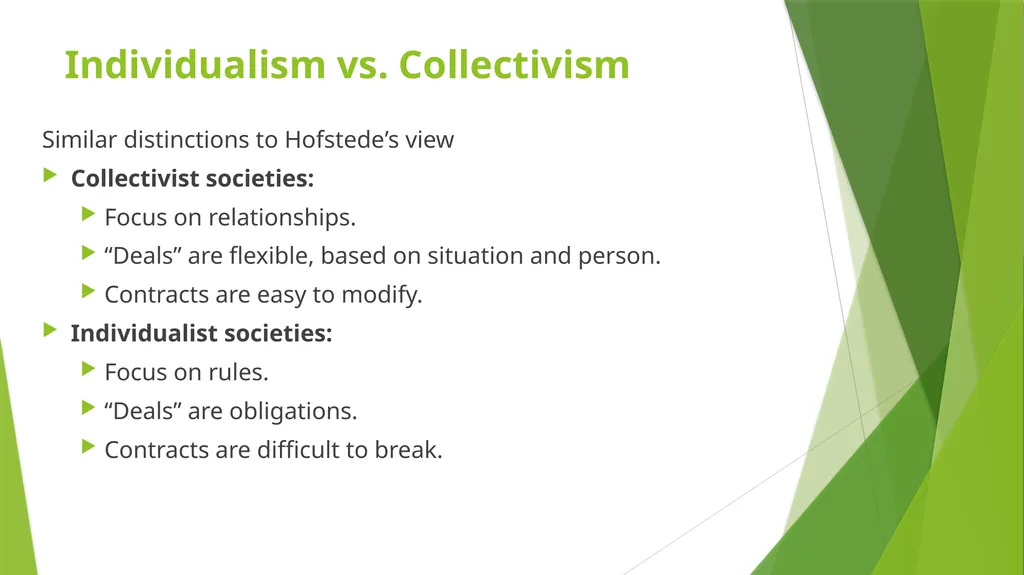
Individualism vs. Collectivism Similar distinctions to Hofstede’s view
Collectivist societies:
Focus on relationships.
“Deals” are flexible, based on situation and person.
Contracts are easy to modify.
Individualist societies:
Focus on rules.
“Deals” are obligations.
Contracts are difficult to break.<br>
Collectivist societies:
Focus on relationships.
“Deals” are flexible, based on situation and person.
Contracts are easy to modify.
Individualist societies:
Focus on rules.
“Deals” are obligations.
Contracts are difficult to break.<br>
24
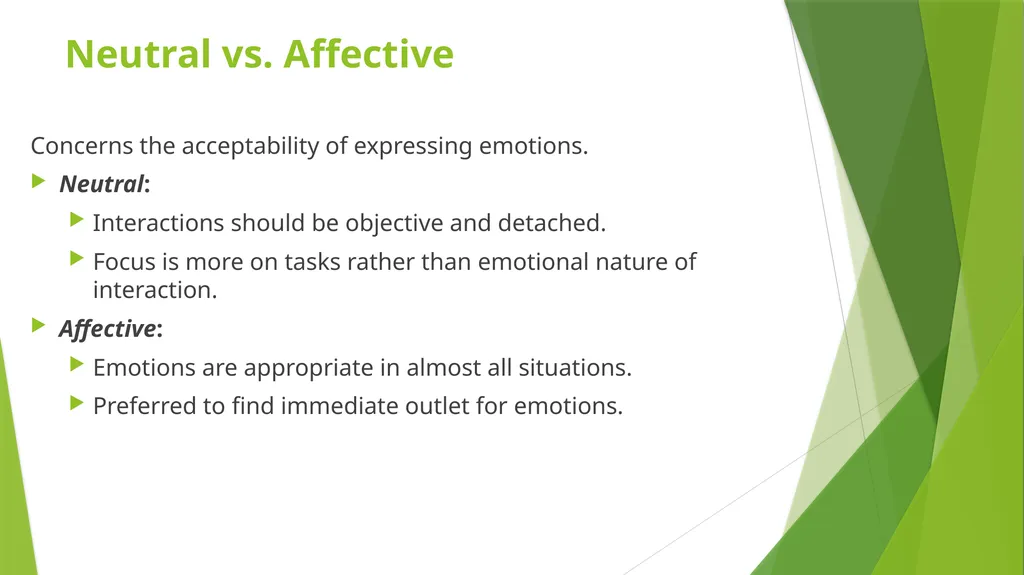
Neutral vs. Affective Concerns the acceptability of expressing emotions.
Neutral:
Interactions should be objective and detached.
Focus is more on tasks rather than emotional nature of interaction.
Affective:
Emotions are appropriate in almost all situations.
Preferred to find immediate outlet for emotions.<br>
Neutral:
Interactions should be objective and detached.
Focus is more on tasks rather than emotional nature of interaction.
Affective:
Emotions are appropriate in almost all situations.
Preferred to find immediate outlet for emotions.<br>
25
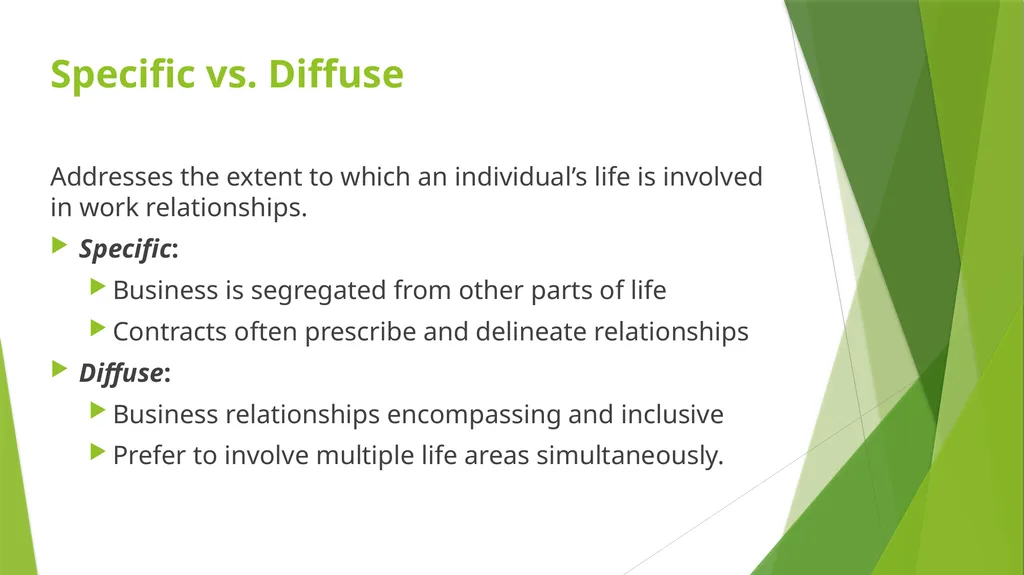
Specific vs. Diffuse Addresses the extent to which an individual’s life is involved in work relationships.
Specific:
Business is segregated from other parts of life
Contracts often prescribe and delineate relationships
Diffuse:
Business relationships encompassing and inclusive
Prefer to involve multiple life areas simultaneously.<br>
Specific:
Business is segregated from other parts of life
Contracts often prescribe and delineate relationships
Diffuse:
Business relationships encompassing and inclusive
Prefer to involve multiple life areas simultaneously.<br>
26
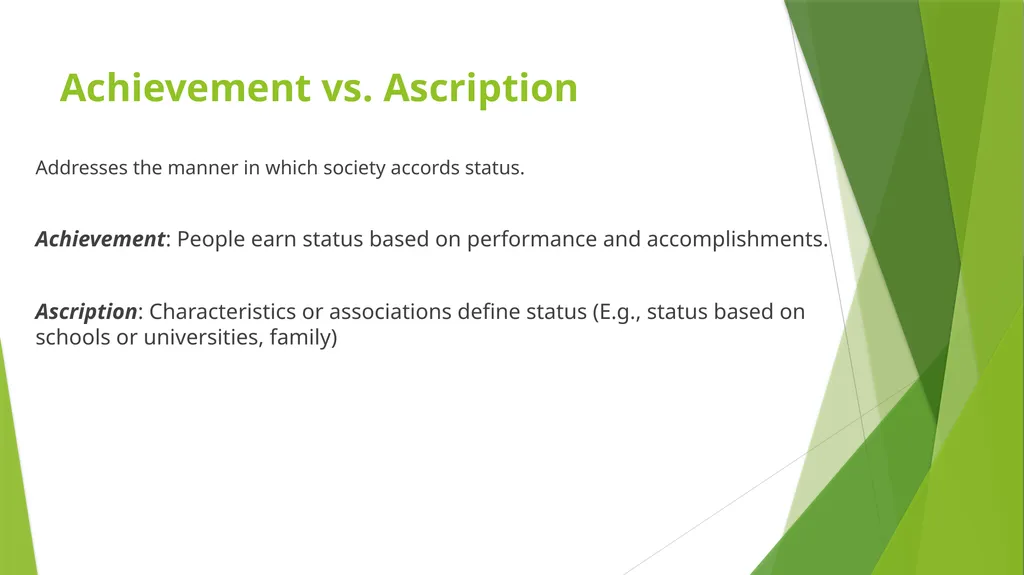
Achievement vs. Ascription Addresses the manner in which society accords status.
Achievement: People earn status based on performance and accomplishments.
Ascription: Characteristics or associations define status (E.g., status based on schools or universities, family)<br>
Achievement: People earn status based on performance and accomplishments.
Ascription: Characteristics or associations define status (E.g., status based on schools or universities, family)<br>
27
Time Orientation How cultures deal with the past, present and future.
Future-oriented societies (such as the U.S.) consider organizational change as necessary and beneficial. Believe a static organization is a dying organization.
Past-oriented societies assume that life is predetermined based on traditions or will of God.
Revere stability and are suspicious of change.<br>
Future-oriented societies (such as the U.S.) consider organizational change as necessary and beneficial. Believe a static organization is a dying organization.
Past-oriented societies assume that life is predetermined based on traditions or will of God.
Revere stability and are suspicious of change.<br>
28
Internal vs. External Control Concerned with beliefs regarding control of one’s fate
Reflects how people interact with the environment (Does nature dominate us or do we dominate nature?)
In societies where people have an internal control perspective, (e.g., dominate nature), managers are more proactive and believe situations can be changed.<br>
Reflects how people interact with the environment (Does nature dominate us or do we dominate nature?)
In societies where people have an internal control perspective, (e.g., dominate nature), managers are more proactive and believe situations can be changed.<br>
29
Cross-Cultural Communication Context (high vs. low)
Communication style (direct vs. indirect; formal vs. informal)
Non-verbals (facial expressions, hand gestures, eye contact)
Proxemics and touch
Interpreters
Corporate language<br>
Communication style (direct vs. indirect; formal vs. informal)
Non-verbals (facial expressions, hand gestures, eye contact)
Proxemics and touch
Interpreters
Corporate language<br>
30
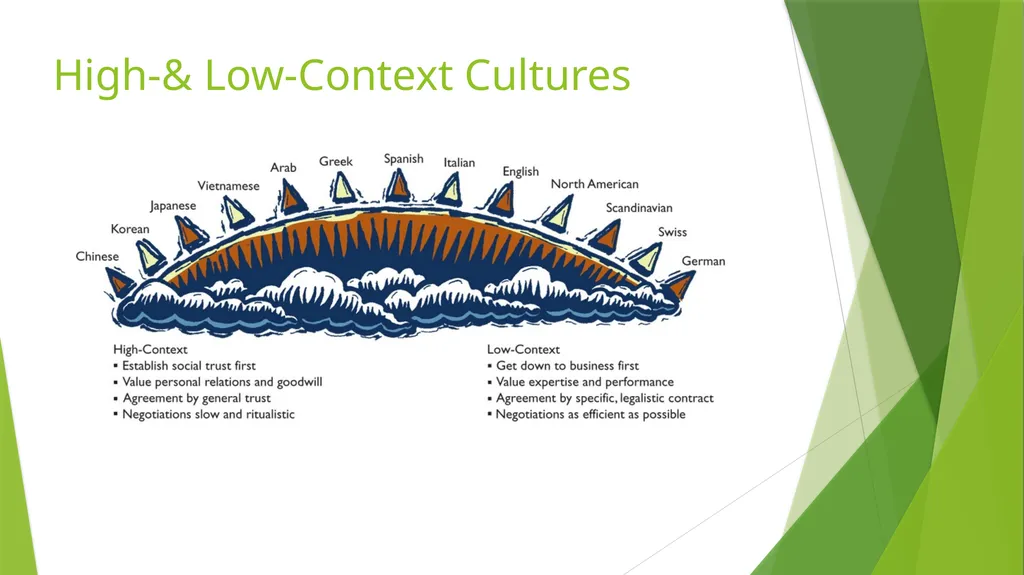
High-& Low-Context Cultures<br>
31
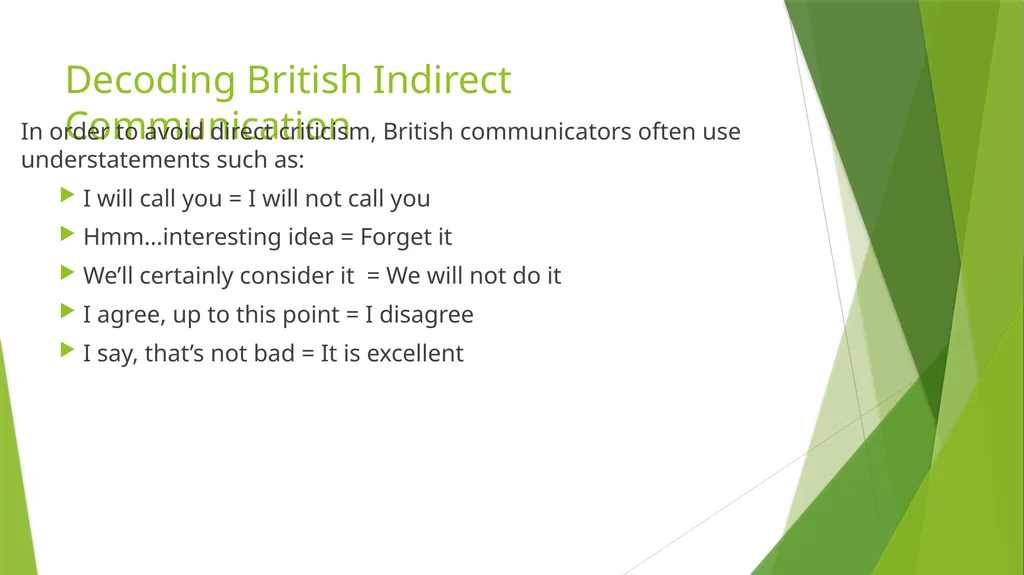
Decoding British Indirect Communication In order to avoid direct criticism, British communicators often use understatements such as:
I will call you = I will not call you
Hmm…interesting idea = Forget it
We’ll certainly consider it = We will not do it
I agree, up to this point = I disagree
I say, that’s not bad = It is excellent<br>
I will call you = I will not call you
Hmm…interesting idea = Forget it
We’ll certainly consider it = We will not do it
I agree, up to this point = I disagree
I say, that’s not bad = It is excellent<br>
32
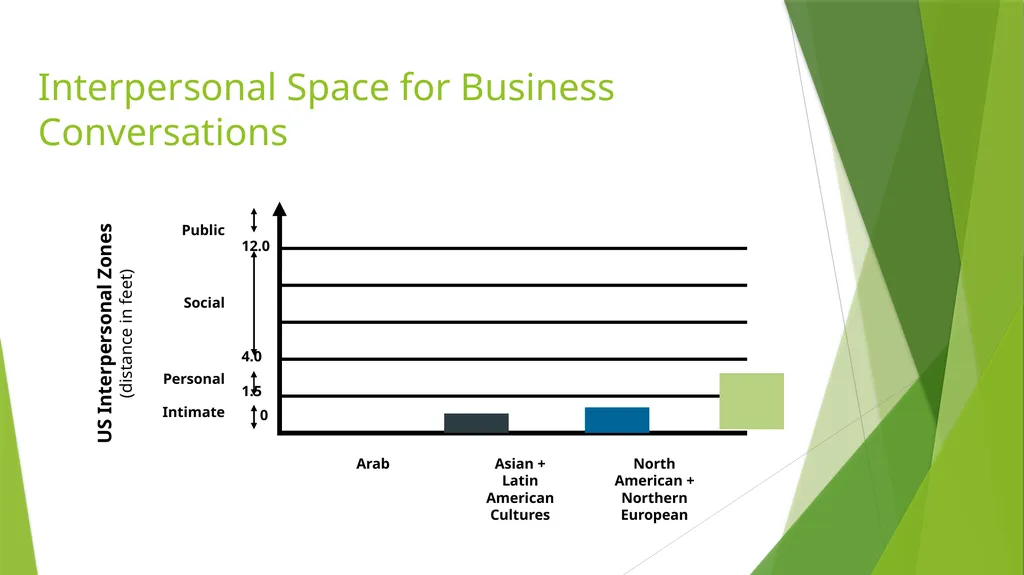
Interpersonal Space for Business Conversations 12.0
4.0
1.5
0 US Interpersonal Zones (distance in feet) Public
Social
Personal
Intimate Arab Asian + Latin American Cultures North American + Northern European<br>
4.0
1.5
0 US Interpersonal Zones (distance in feet) Public
Social
Personal
Intimate Arab Asian + Latin American Cultures North American + Northern European<br>
33
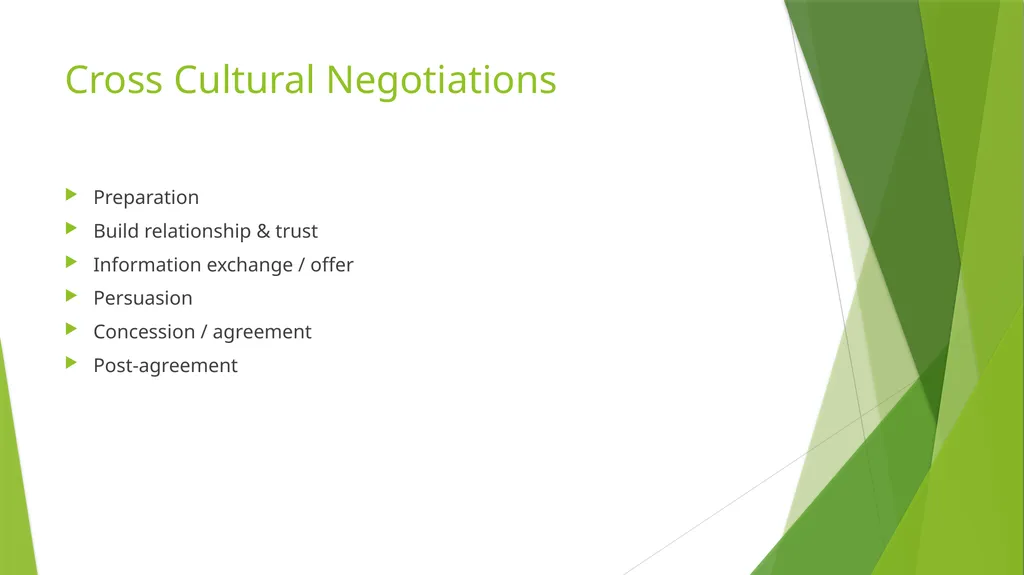
Cross Cultural Negotiations Preparation
Build relationship & trust
Information exchange / offer
Persuasion
Concession / agreement
Post-agreement<br>
Build relationship & trust
Information exchange / offer
Persuasion
Concession / agreement
Post-agreement<br>
34
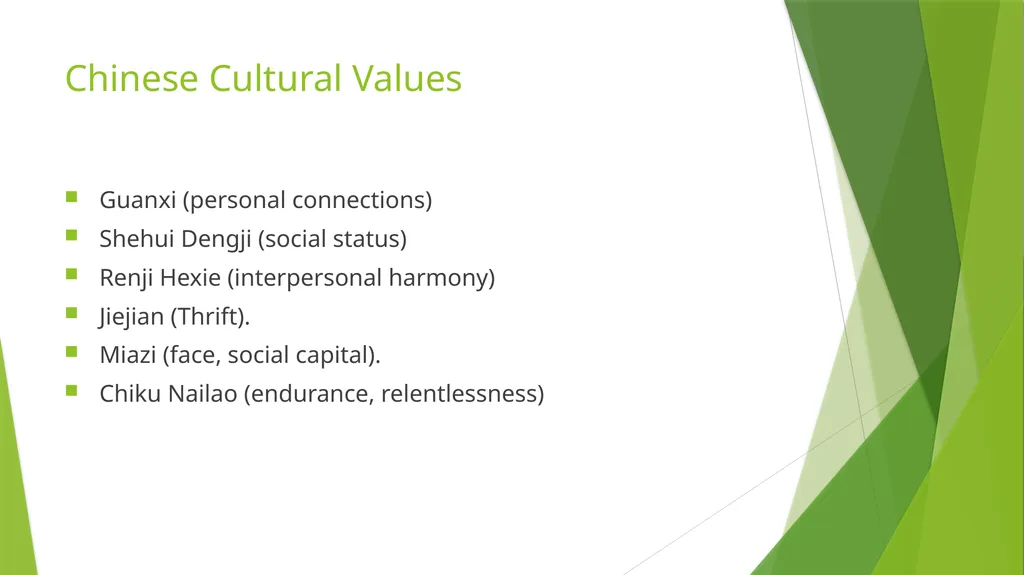
Chinese Cultural Values Guanxi (personal connections)
Shehui Dengji (social status)
Renji Hexie (interpersonal harmony)
Jiejian (Thrift).
Miazi (face, social capital).
Chiku Nailao (endurance, relentlessness)<br>
Shehui Dengji (social status)
Renji Hexie (interpersonal harmony)
Jiejian (Thrift).
Miazi (face, social capital).
Chiku Nailao (endurance, relentlessness)<br>
35
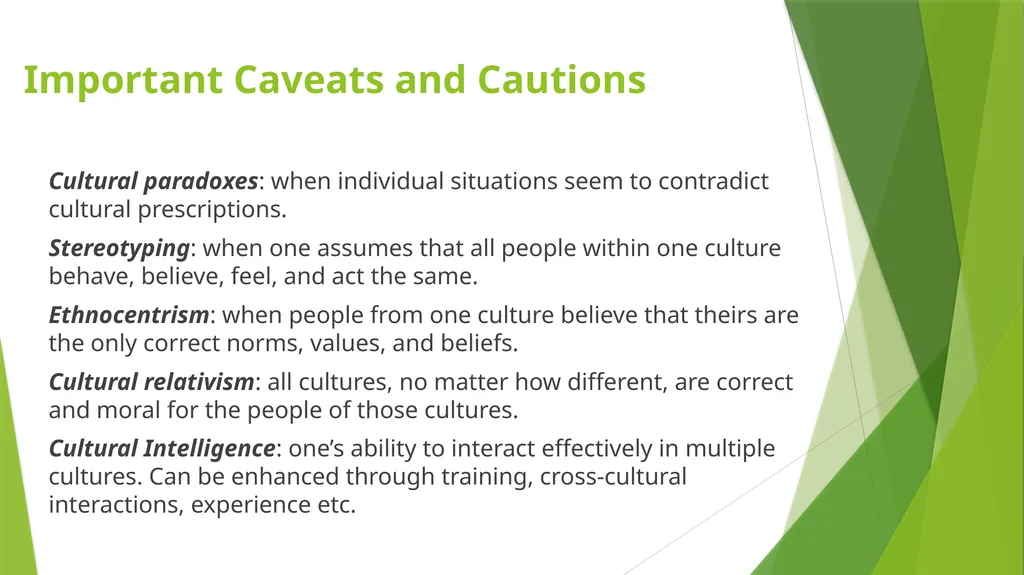
Important Caveats and Cautions Cultural paradoxes: when individual situations seem to contradict cultural prescriptions.
Stereotyping: when one assumes that all people within one culture behave, believe, feel, and act the same.
Ethnocentrism: when people from one culture believe that theirs are the only correct norms, values, and beliefs.
Cultural relativism: all cultures, no matter how different, are correct and moral for the people of those cultures.
Cultural Intelligence: one’s ability to interact effectively in multiple cultures. Can be enhanced through training, cross-cultural interactions, experience etc.<br>
Stereotyping: when one assumes that all people within one culture behave, believe, feel, and act the same.
Ethnocentrism: when people from one culture believe that theirs are the only correct norms, values, and beliefs.
Cultural relativism: all cultures, no matter how different, are correct and moral for the people of those cultures.
Cultural Intelligence: one’s ability to interact effectively in multiple cultures. Can be enhanced through training, cross-cultural interactions, experience etc.<br>
36
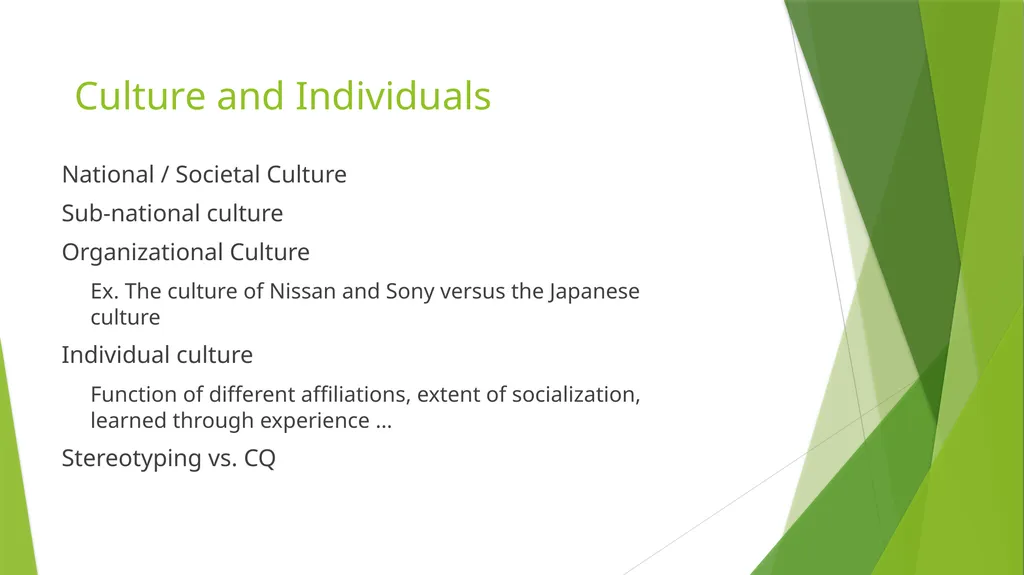
Culture and Individuals National / Societal Culture
Sub-national culture
Organizational Culture
Ex. The culture of Nissan and Sony versus the Japanese culture
Individual culture
Function of different affiliations, extent of socialization, learned through experience …
Stereotyping vs. CQ<br>
Sub-national culture
Organizational Culture
Ex. The culture of Nissan and Sony versus the Japanese culture
Individual culture
Function of different affiliations, extent of socialization, learned through experience …
Stereotyping vs. CQ<br>