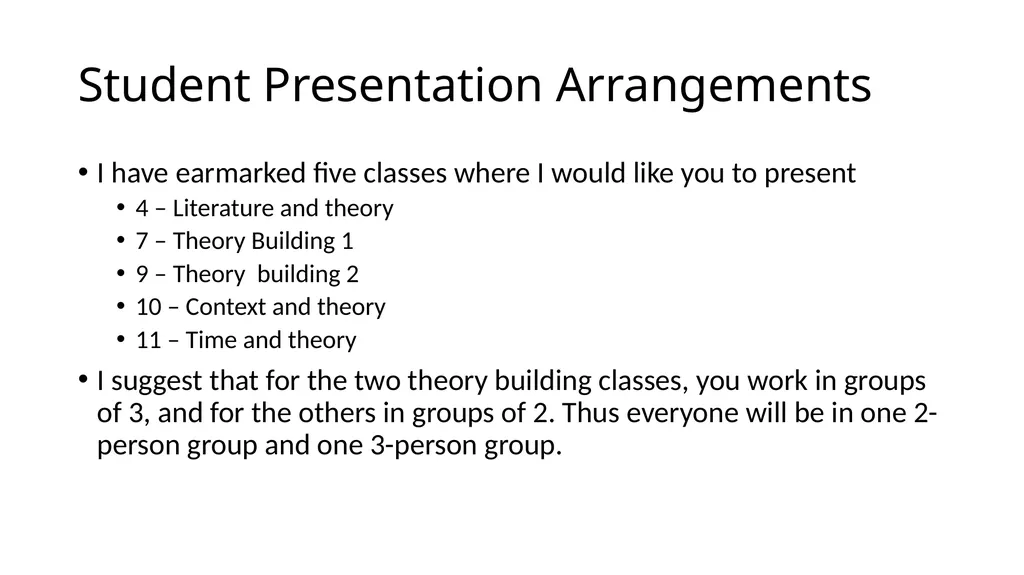
IS8014 Theory Qualitative IS Research II: Foundations of Theory Development Student Presentation Arrangements I have earmarked five classes where I would like you to present 4 Literature and theory 7 Theory Building 1 9 Theory
"IS8014 Theory & Qualitative IS Research II:" is the property of its rightful owner. Permission is granted to
download and print the materials on this website for personal, non-commercial use only, and to display it
on your personal computer provided you do not modify the materials and that you retain all copyright
notices contained in the materials. By downloading content from our website, you accept the terms of this
agreement.
Presentation Transcript
01
IS8014 Theory & Qualitative IS Research II: Foundations of Theory Development<br>
02
Student Presentation Arrangements I have earmarked five classes where I would like you to present
4 – Literature and theory
7 – Theory Building 1
9 – Theory building 2
10 – Context and theory
11 – Time and theory
I suggest that for the two theory building classes, you work in groups of 3, and for the others in groups of 2. Thus everyone will be in one 2-person group and one 3-person group.<br>
03
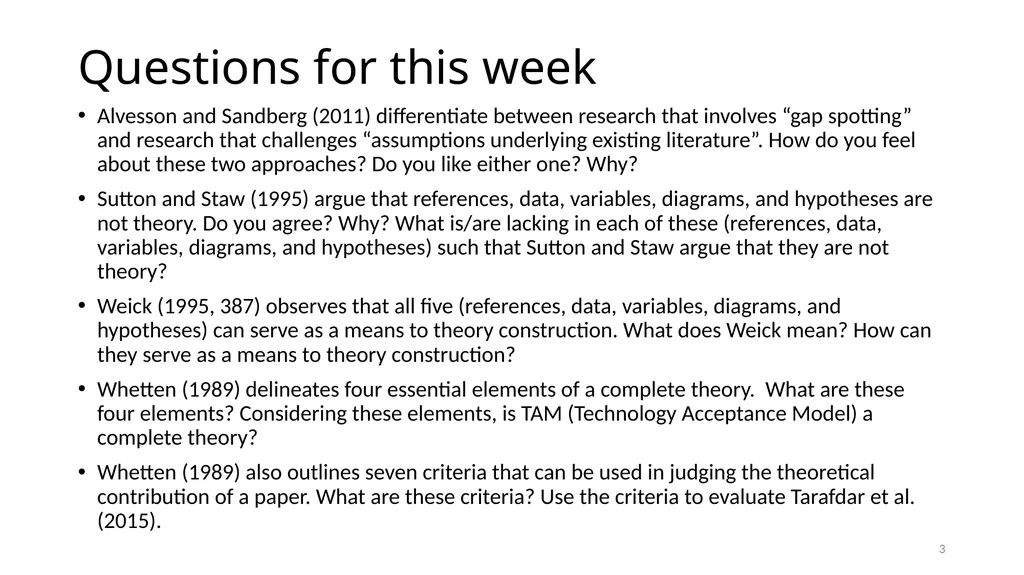
Questions for this week Alvesson and Sandberg (2011) differentiate between research that involves “gap spotting” and research that challenges “assumptions underlying existing literature”. How do you feel about these two approaches? Do you like either one? Why?
Sutton and Staw (1995) argue that references, data, variables, diagrams, and hypotheses are not theory. Do you agree? Why? What is/are lacking in each of these (references, data, variables, diagrams, and hypotheses) such that Sutton and Staw argue that they are not theory?
Weick (1995, 387) observes that all five (references, data, variables, diagrams, and hypotheses) can serve as a means to theory construction. What does Weick mean? How can they serve as a means to theory construction?
Whetten (1989) delineates four essential elements of a complete theory. What are these four elements? Considering these elements, is TAM (Technology Acceptance Model) a complete theory?
Whetten (1989) also outlines seven criteria that can be used in judging the theoretical contribution of a paper. What are these criteria? Use the criteria to evaluate Tarafdar et al. (2015). 3<br>
04
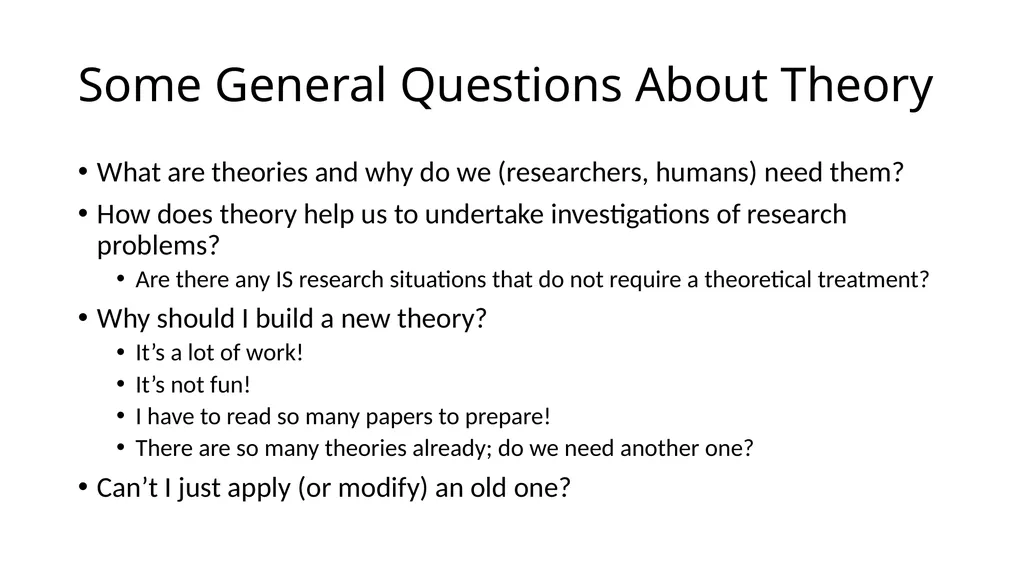
Some General Questions About Theory What are theories and why do we (researchers, humans) need them?
How does theory help us to undertake investigations of research problems?
Are there any IS research situations that do not require a theoretical treatment?
Why should I build a new theory?
It’s a lot of work!
It’s not fun!
I have to read so many papers to prepare!
There are so many theories already; do we need another one?
Can’t I just apply (or modify) an old one?<br>
05
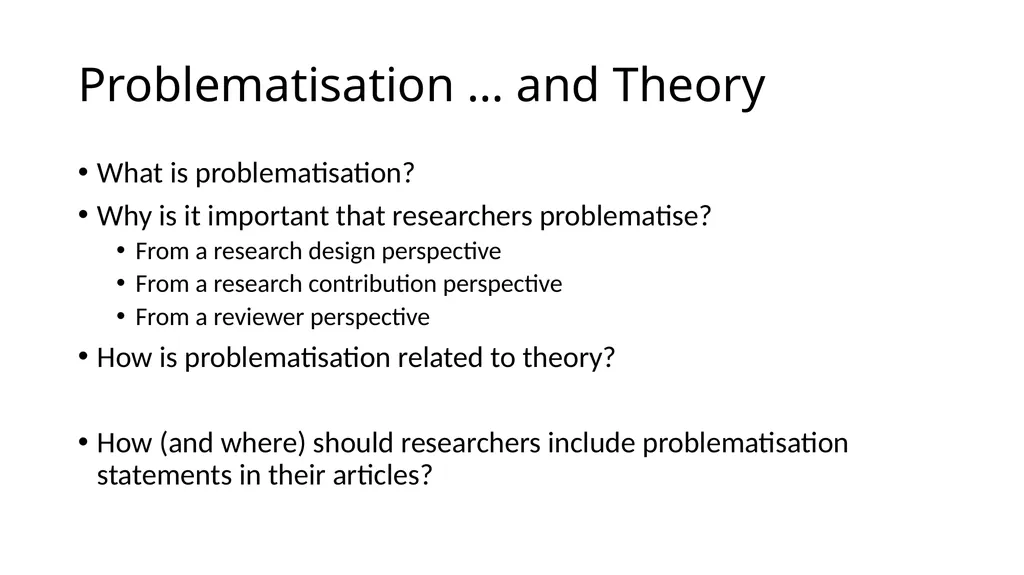
Problematisation … and Theory What is problematisation?
Why is it important that researchers problematise?
From a research design perspective
From a research contribution perspective
From a reviewer perspective
How is problematisation related to theory?
How (and where) should researchers include problematisation statements in their articles?<br>
06
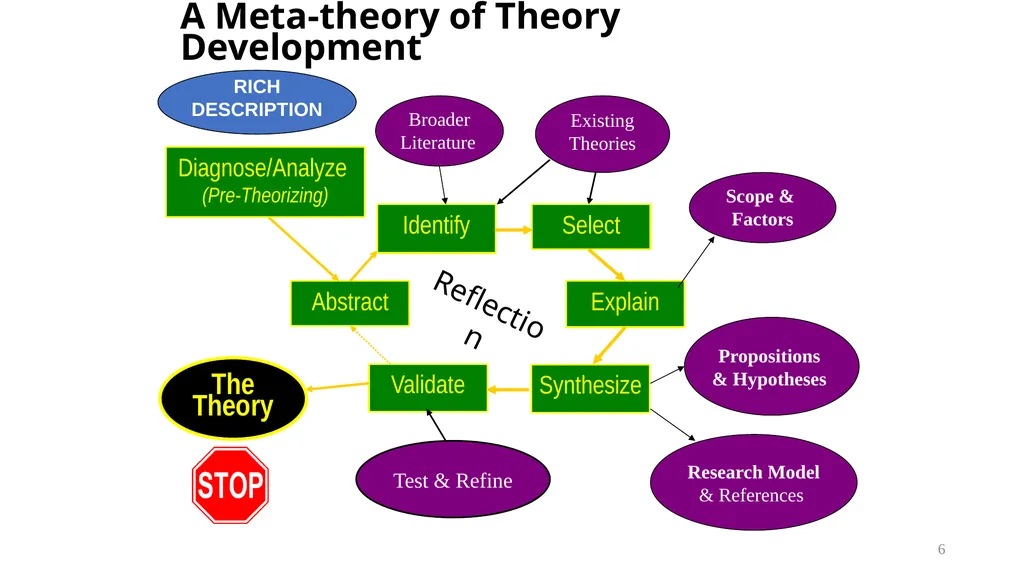
6 A Meta-theory of Theory Development Broader Literature Identify Explain Existing Theories Synthesize Abstract Validate Scope & Factors Propositions
& Hypotheses Test & Refine Research Model & References The Theory Select Reflection RICH DESCRIPTION Diagnose/Analyze
(Pre-Theorizing)<br>
07
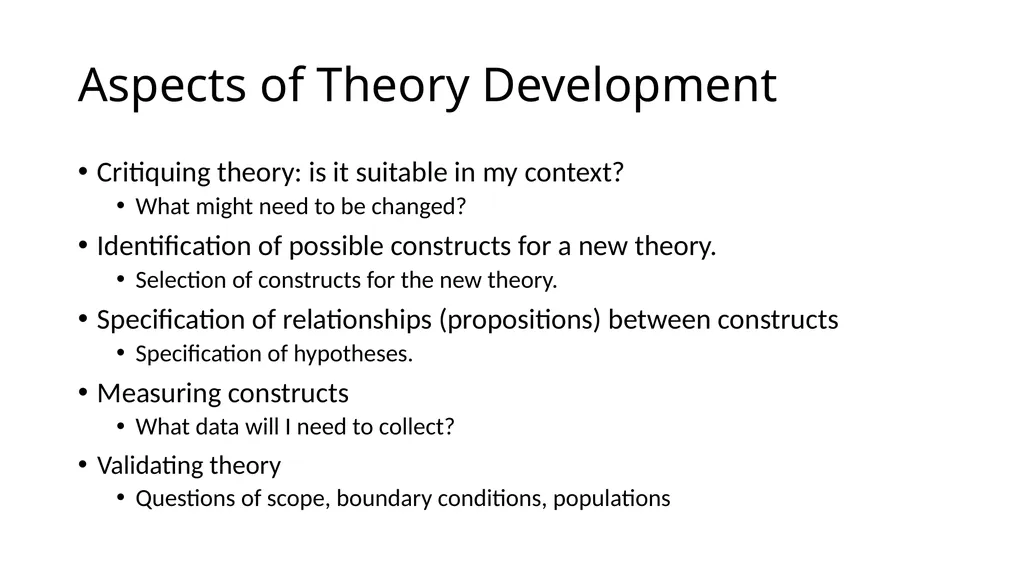
Aspects of Theory Development Critiquing theory: is it suitable in my context?
What might need to be changed?
Identification of possible constructs for a new theory.
Selection of constructs for the new theory.
Specification of relationships (propositions) between constructs
Specification of hypotheses.
Measuring constructs
What data will I need to collect?
Validating theory
Questions of scope, boundary conditions, populations<br>
08
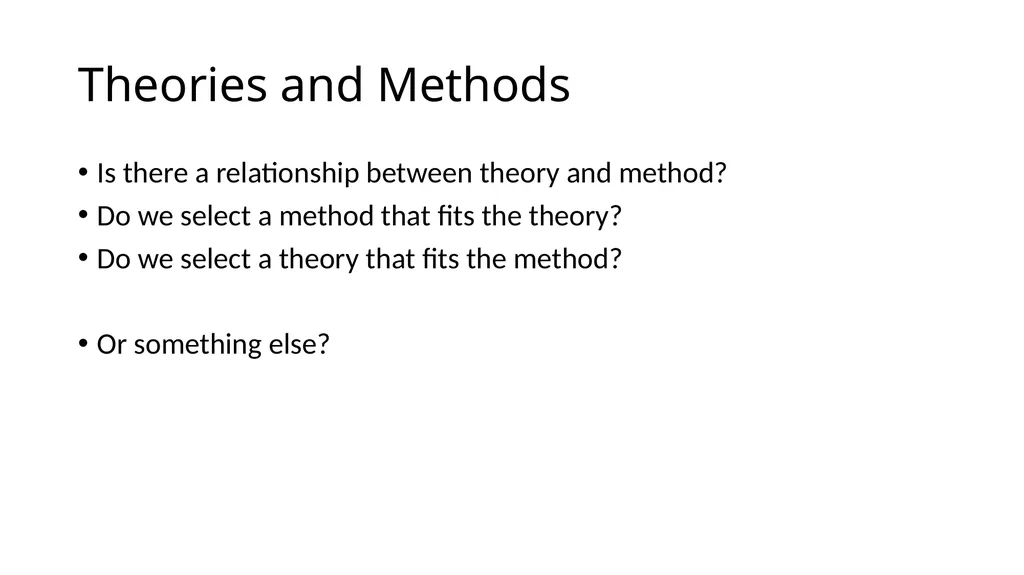
Theories and Methods Is there a relationship between theory and method?
Do we select a method that fits the theory?
Do we select a theory that fits the method?
Or something else?<br>
09
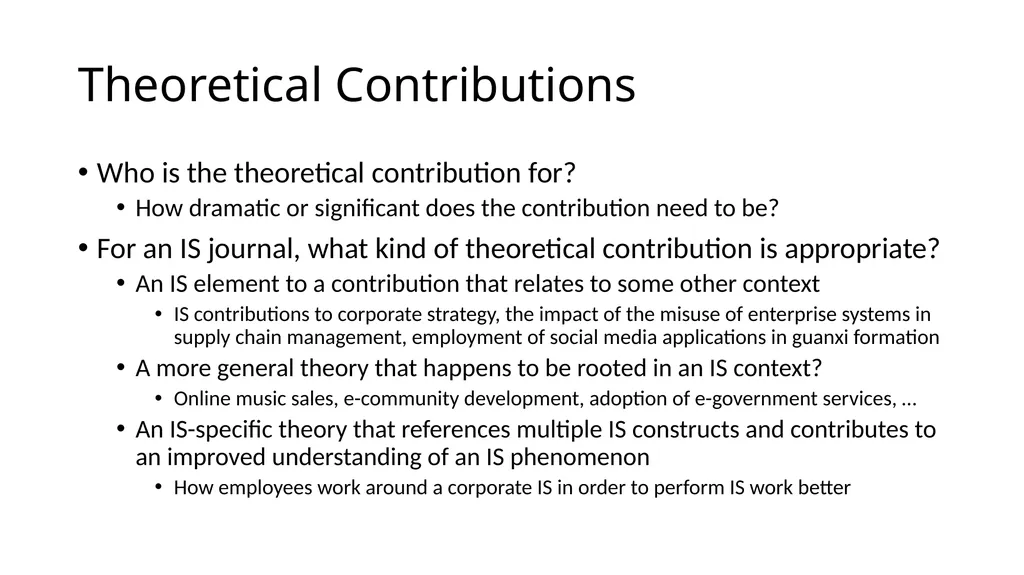
Theoretical Contributions Who is the theoretical contribution for?
How dramatic or significant does the contribution need to be?
For an IS journal, what kind of theoretical contribution is appropriate?
An IS element to a contribution that relates to some other context
IS contributions to corporate strategy, the impact of the misuse of enterprise systems in supply chain management, employment of social media applications in guanxi formation
A more general theory that happens to be rooted in an IS context?
Online music sales, e-community development, adoption of e-government services, …
An IS-specific theory that references multiple IS constructs and contributes to an improved understanding of an IS phenomenon
How employees work around a corporate IS in order to perform IS work better<br>
10
The Nature of Generalisation What is generalisation? Why is it important?
What are the different ways in which research can be generalised?
What are the limitations / boundaries to generalisation?<br>
11
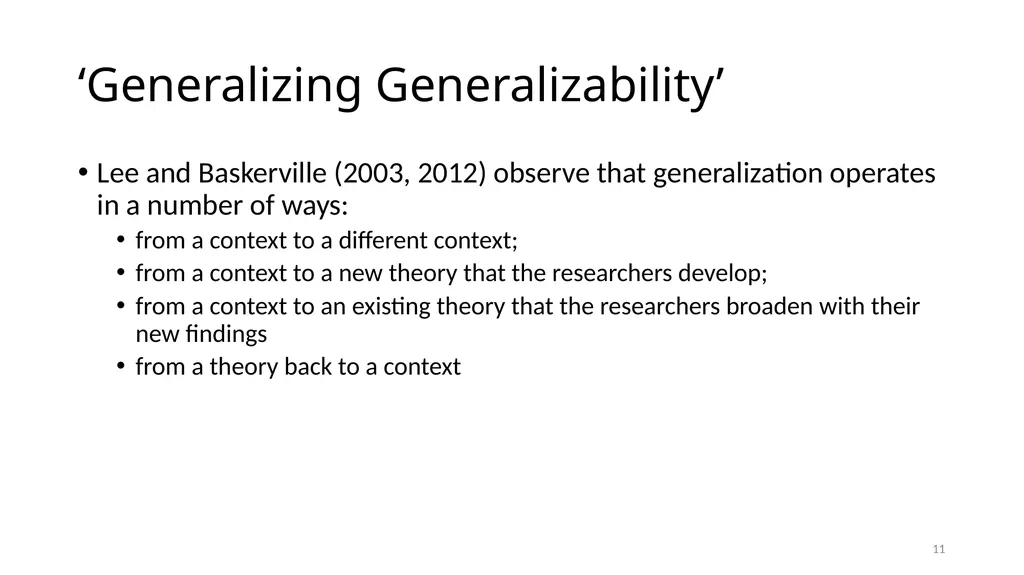
‘Generalizing Generalizability’ Lee and Baskerville (2003, 2012) observe that generalization operates in a number of ways:
from a context to a different context;
from a context to a new theory that the researchers develop;
from a context to an existing theory that the researchers broaden with their new findings
from a theory back to a context 11<br>
12
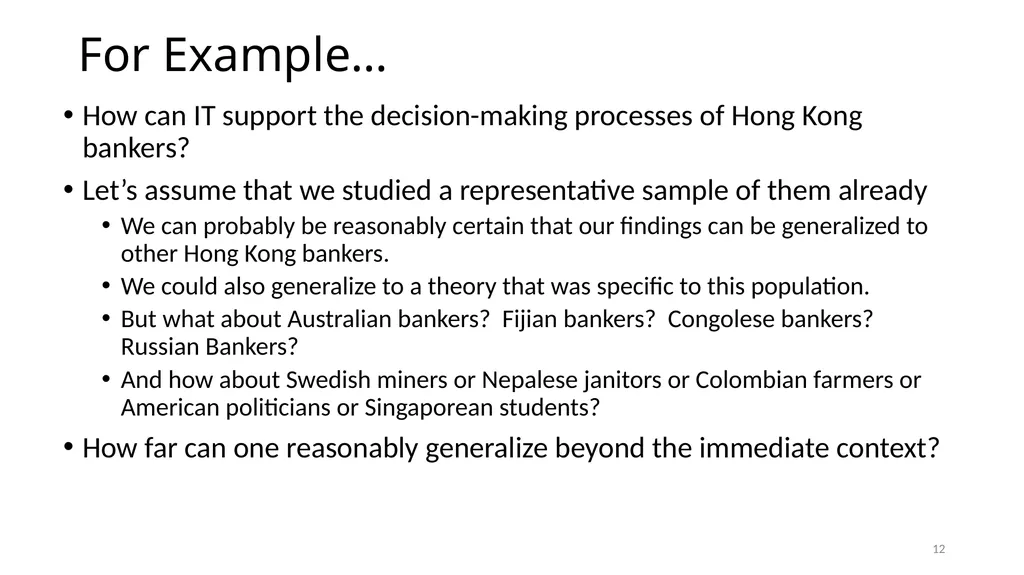
For Example… How can IT support the decision-making processes of Hong Kong bankers?
Let’s assume that we studied a representative sample of them already
We can probably be reasonably certain that our findings can be generalized to other Hong Kong bankers.
We could also generalize to a theory that was specific to this population.
But what about Australian bankers? Fijian bankers? Congolese bankers? Russian Bankers?
And how about Swedish miners or Nepalese janitors or Colombian farmers or American politicians or Singaporean students?
How far can one reasonably generalize beyond the immediate context? 12<br>
13
Readings for Next Week Barley, S. R. (2006) When I Write My Masterpiece: Thoughts on What Makes a Paper Interesting, Academy of Management Journal 49, 1, 16-20.
Bødker, M., Gimpel, G. and Hedman, J. (2014) Time-out/Time-in: The Dynamics of Everyday Experiential Computing Devices, Information Systems Journal, 24, 2, 143-166.
Malaurent, J. and Karanasios, S. (2019) Learning from Workaround Practices: The Challenge of Enterprise System Implementations in Multinational Corporations, Information Systems Journal 30, 4, 639-663.
Sarker, S., Xiao, X., Beaulieu, T. and Lee, A.S. (2018) Learning from first-generation qualitative approaches in the IS discipline: An evolutionary view and some implications for authors and evaluators – Part I and Part II, Journal of the AIS 19, 8, 752-774 and 19, 9, 909-923.
Wong, L.H.M. and Davison, R.M. (2018) Knowledge Sharing in a Global Logistics Provider: An Action Research Project, Information & Management 55, 5, 547-557.<br>
14
Questions for Next Week (Papers 2, 3 & 5) How did the authors motivate each paper? Are the papers interesting?
Does the motivation make sense to you? How could you have motivated it differently? Was the problematisation effective, and effectively communicated to readers?
What was the role of theory in each paper? Does the theory fit the research problem?
What are the most difficult aspects of these two papers for you as a reader? Why?<br>