
Jacques Derrida (1930 – 2004) Publications, some
JO
Published · 13 slides · 0 views
1 / 1
Description
Jacques Derrida (1930 2004) Publications, some translations: Of Grammatology, 1976 (1967) Writing and Difference, 1978 (1967) Margins of Philosophy, 1982 (1972) The Other Heading: Reflections on Todays Europe, 1992 Specters of Marx: The
Related Topics
Share
Embed code
Download this presentation From Below
"Jacques Derrida (1930 – 2004) Publications, some" is the property of its rightful owner. Permission is granted to download and print the materials on this website for personal, non-commercial use only, and to display it on your personal computer provided you do not modify the materials and that you retain all copyright notices contained in the materials. By downloading content from our website, you accept the terms of this agreement.
Presentation Transcript
01
Jacques Derrida (1930 – 2004)
Publications, some translations:
Of Grammatology, 1976 (1967)
Writing and Difference, 1978 (1967)
Margins of Philosophy, 1982 (1972)
The Other Heading: Reflections on Today's Europe, 1992
Specters of Marx: The State of the Debt, the Work of Mourning, and the New International, 1994 (1993)
Points...: Interviews 1974-1994, 1995 (1992)
Politics of Friendship, 1997 (1994)
Adieu: To Emmanuel Levinas, 1999 (1997)
Of Hospitality, 2000 (1997)
On Cosmopolitanism and Forgiveness, 2001 (1997)
Negotiations: Interventions and Interviews, 1971–2001, 2002
Philosophy in a Time of Terror: Dialogues with Jürgen Habermas and Jacques Derrida, with Jürgen Habermas, 2003 (2002)
Rogues: Two Essays on Reason, 2004 (2003)
The Animal That Therefore I Am,, 2008 (2006)
The Beast and the Sovereign, 2009, 2011 (2008, 2010)<br>
Publications, some translations:
Of Grammatology, 1976 (1967)
Writing and Difference, 1978 (1967)
Margins of Philosophy, 1982 (1972)
The Other Heading: Reflections on Today's Europe, 1992
Specters of Marx: The State of the Debt, the Work of Mourning, and the New International, 1994 (1993)
Points...: Interviews 1974-1994, 1995 (1992)
Politics of Friendship, 1997 (1994)
Adieu: To Emmanuel Levinas, 1999 (1997)
Of Hospitality, 2000 (1997)
On Cosmopolitanism and Forgiveness, 2001 (1997)
Negotiations: Interventions and Interviews, 1971–2001, 2002
Philosophy in a Time of Terror: Dialogues with Jürgen Habermas and Jacques Derrida, with Jürgen Habermas, 2003 (2002)
Rogues: Two Essays on Reason, 2004 (2003)
The Animal That Therefore I Am,, 2008 (2006)
The Beast and the Sovereign, 2009, 2011 (2008, 2010)<br>
02
Derrida: political philosophy • deconstruction
- deconstruction as the name of Derrida’s approach to philosophical (and other) questions
- found throughout Derrida’s writings
- a variation, not a singular methodology
- Derrida, roughly: an attempt at doing full justice to truth
- rigorous thinking
- Derrida’s style
• the political and political themes and questions
- appear throughout Derrida’s writings
- becomes a more central focus of Derrida’s concerns from the 1990’s forward
- deconstruction often focuses on limits, e.g. the justification and act of making distinctions
- a series of political themes reflected upon by Derrida: the definition of the people as unit of politics, independence, sovereignty, hospitality, cosmopolitanism, democracy, friends and enemies, terrorism etc.
=> systematic elaborations on specific political themes, no political philosophy understood as a system)
• normativity?
- the limits of deconstruction
- deconstruction entails normative elements: emancipation, justice, democracy
“what remains irreducible to any deconstruction, what remains as undeconstructible as the possibility itself of deconstruction is, perhaps, a certain experience of the emancipatory promise … an idea of justice – which we distinguish from law or right or even from human rights – and an idea of democracy – which we distinguish from its current concept and from its determined predicates today” (Spectres of Marx, p. 59)<br>
- deconstruction as the name of Derrida’s approach to philosophical (and other) questions
- found throughout Derrida’s writings
- a variation, not a singular methodology
- Derrida, roughly: an attempt at doing full justice to truth
- rigorous thinking
- Derrida’s style
• the political and political themes and questions
- appear throughout Derrida’s writings
- becomes a more central focus of Derrida’s concerns from the 1990’s forward
- deconstruction often focuses on limits, e.g. the justification and act of making distinctions
- a series of political themes reflected upon by Derrida: the definition of the people as unit of politics, independence, sovereignty, hospitality, cosmopolitanism, democracy, friends and enemies, terrorism etc.
=> systematic elaborations on specific political themes, no political philosophy understood as a system)
• normativity?
- the limits of deconstruction
- deconstruction entails normative elements: emancipation, justice, democracy
“what remains irreducible to any deconstruction, what remains as undeconstructible as the possibility itself of deconstruction is, perhaps, a certain experience of the emancipatory promise … an idea of justice – which we distinguish from law or right or even from human rights – and an idea of democracy – which we distinguish from its current concept and from its determined predicates today” (Spectres of Marx, p. 59)<br>
03
Derrida on ethics and politics • meta-ethical reflections
- what is ethics, what are ethics and politics, what is the borderline between ethics and politics
- in a first move, deconstruction shows us the complexity of and the different possibilities available in relation to these issues
• level 1: ethics and politics as parallel/similar in kind:
- the double demand inherent in ethics and politics alike
- both reflective modes of dealing with questions of good and right
vs. doctrine (a series of obligations)
- both are appeals to act
• first demand: urgency
- if something is considered good or right, it must be realized immediately!
- a delay in realising an imperative may be considered bad or wrong
- act now!
• second demand: sufficient knowledge
- in order to choose the best possible course of action one needs a full knowledge about the situation
=> not to act before certainty has been reached (otherwise the act may be bad or wrong)
• aporia (a non-road)/paradox: act immediately in order to be ethical, but only on the basis of a sufficient knowledge of the situation
? => to act is by necessity always to interrupt this process of ethical reflection
=> no act may ever fully fulfil an ethical demand<br>
- what is ethics, what are ethics and politics, what is the borderline between ethics and politics
- in a first move, deconstruction shows us the complexity of and the different possibilities available in relation to these issues
• level 1: ethics and politics as parallel/similar in kind:
- the double demand inherent in ethics and politics alike
- both reflective modes of dealing with questions of good and right
vs. doctrine (a series of obligations)
- both are appeals to act
• first demand: urgency
- if something is considered good or right, it must be realized immediately!
- a delay in realising an imperative may be considered bad or wrong
- act now!
• second demand: sufficient knowledge
- in order to choose the best possible course of action one needs a full knowledge about the situation
=> not to act before certainty has been reached (otherwise the act may be bad or wrong)
• aporia (a non-road)/paradox: act immediately in order to be ethical, but only on the basis of a sufficient knowledge of the situation
? => to act is by necessity always to interrupt this process of ethical reflection
=> no act may ever fully fulfil an ethical demand<br>
04
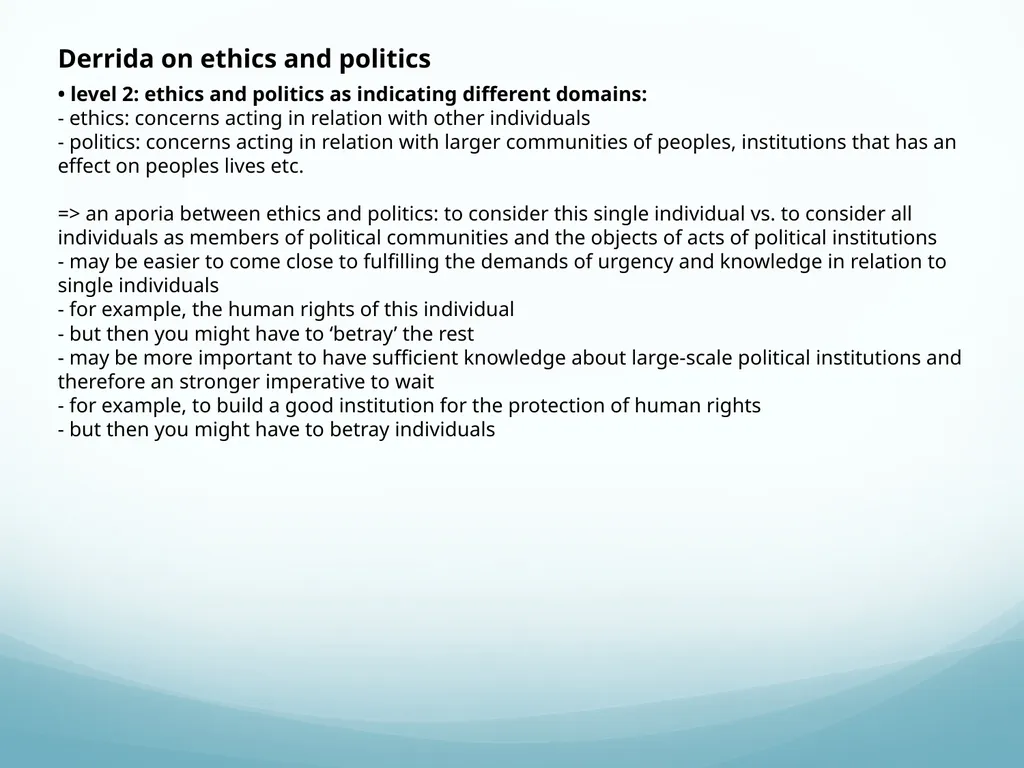
Derrida on ethics and politics • level 2: ethics and politics as indicating different domains:
- ethics: concerns acting in relation with other individuals
- politics: concerns acting in relation with larger communities of peoples, institutions that has an effect on peoples lives etc.
=> an aporia between ethics and politics: to consider this single individual vs. to consider all individuals as members of political communities and the objects of acts of political institutions
- may be easier to come close to fulfilling the demands of urgency and knowledge in relation to single individuals
- for example, the human rights of this individual
- but then you might have to ‘betray’ the rest
- may be more important to have sufficient knowledge about large-scale political institutions and therefore an stronger imperative to wait
- for example, to build a good institution for the protection of human rights
- but then you might have to betray individuals<br>
- ethics: concerns acting in relation with other individuals
- politics: concerns acting in relation with larger communities of peoples, institutions that has an effect on peoples lives etc.
=> an aporia between ethics and politics: to consider this single individual vs. to consider all individuals as members of political communities and the objects of acts of political institutions
- may be easier to come close to fulfilling the demands of urgency and knowledge in relation to single individuals
- for example, the human rights of this individual
- but then you might have to ‘betray’ the rest
- may be more important to have sufficient knowledge about large-scale political institutions and therefore an stronger imperative to wait
- for example, to build a good institution for the protection of human rights
- but then you might have to betray individuals<br>
05
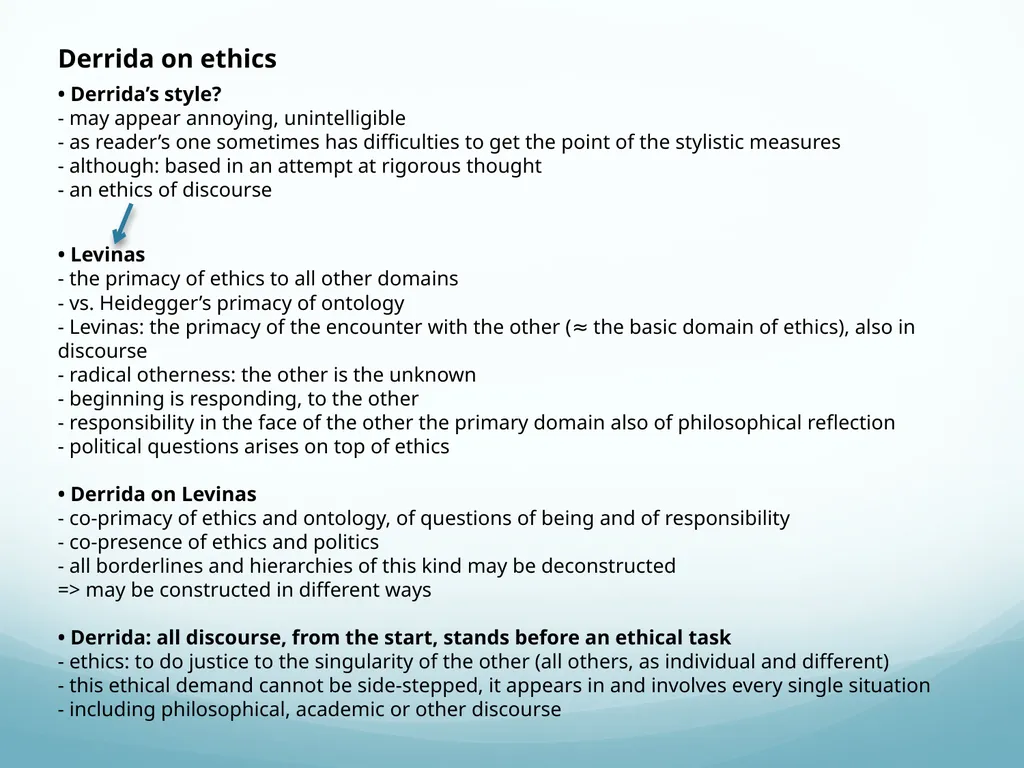
Derrida on ethics • Derrida’s style?
- may appear annoying, unintelligible
- as reader’s one sometimes has difficulties to get the point of the stylistic measures
- although: based in an attempt at rigorous thought
- an ethics of discourse • Levinas
- the primacy of ethics to all other domains
- vs. Heidegger’s primacy of ontology
- Levinas: the primacy of the encounter with the other (≈ the basic domain of ethics), also in discourse
- radical otherness: the other is the unknown
- beginning is responding, to the other
- responsibility in the face of the other the primary domain also of philosophical reflection
- political questions arises on top of ethics
• Derrida on Levinas
- co-primacy of ethics and ontology, of questions of being and of responsibility
- co-presence of ethics and politics
- all borderlines and hierarchies of this kind may be deconstructed
=> may be constructed in different ways
• Derrida: all discourse, from the start, stands before an ethical task
- ethics: to do justice to the singularity of the other (all others, as individual and different)
- this ethical demand cannot be side-stepped, it appears in and involves every single situation
- including philosophical, academic or other discourse<br>
- may appear annoying, unintelligible
- as reader’s one sometimes has difficulties to get the point of the stylistic measures
- although: based in an attempt at rigorous thought
- an ethics of discourse • Levinas
- the primacy of ethics to all other domains
- vs. Heidegger’s primacy of ontology
- Levinas: the primacy of the encounter with the other (≈ the basic domain of ethics), also in discourse
- radical otherness: the other is the unknown
- beginning is responding, to the other
- responsibility in the face of the other the primary domain also of philosophical reflection
- political questions arises on top of ethics
• Derrida on Levinas
- co-primacy of ethics and ontology, of questions of being and of responsibility
- co-presence of ethics and politics
- all borderlines and hierarchies of this kind may be deconstructed
=> may be constructed in different ways
• Derrida: all discourse, from the start, stands before an ethical task
- ethics: to do justice to the singularity of the other (all others, as individual and different)
- this ethical demand cannot be side-stepped, it appears in and involves every single situation
- including philosophical, academic or other discourse<br>
06
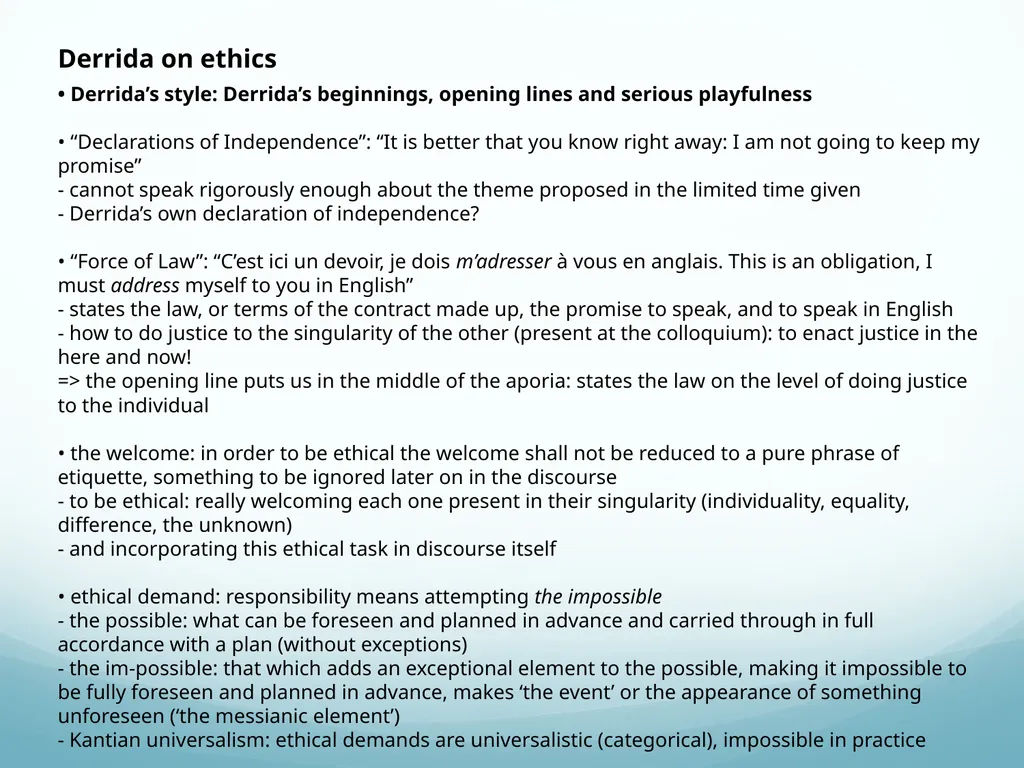
Derrida on ethics • Derrida’s style: Derrida’s beginnings, opening lines and serious playfulness
• “Declarations of Independence”: “It is better that you know right away: I am not going to keep my promise”
- cannot speak rigorously enough about the theme proposed in the limited time given
- Derrida’s own declaration of independence?
• “Force of Law”: “C’est ici un devoir, je dois m’adresser à vous en anglais. This is an obligation, I must address myself to you in English”
- states the law, or terms of the contract made up, the promise to speak, and to speak in English
- how to do justice to the singularity of the other (present at the colloquium): to enact justice in the here and now!
=> the opening line puts us in the middle of the aporia: states the law on the level of doing justice to the individual
• the welcome: in order to be ethical the welcome shall not be reduced to a pure phrase of etiquette, something to be ignored later on in the discourse
- to be ethical: really welcoming each one present in their singularity (individuality, equality, difference, the unknown)
- and incorporating this ethical task in discourse itself
• ethical demand: responsibility means attempting the impossible
- the possible: what can be foreseen and planned in advance and carried through in full accordance with a plan (without exceptions)
- the im-possible: that which adds an exceptional element to the possible, making it impossible to be fully foreseen and planned in advance, makes ‘the event’ or the appearance of something unforeseen (‘the messianic element’)
- Kantian universalism: ethical demands are universalistic (categorical), impossible in practice<br>
• “Declarations of Independence”: “It is better that you know right away: I am not going to keep my promise”
- cannot speak rigorously enough about the theme proposed in the limited time given
- Derrida’s own declaration of independence?
• “Force of Law”: “C’est ici un devoir, je dois m’adresser à vous en anglais. This is an obligation, I must address myself to you in English”
- states the law, or terms of the contract made up, the promise to speak, and to speak in English
- how to do justice to the singularity of the other (present at the colloquium): to enact justice in the here and now!
=> the opening line puts us in the middle of the aporia: states the law on the level of doing justice to the individual
• the welcome: in order to be ethical the welcome shall not be reduced to a pure phrase of etiquette, something to be ignored later on in the discourse
- to be ethical: really welcoming each one present in their singularity (individuality, equality, difference, the unknown)
- and incorporating this ethical task in discourse itself
• ethical demand: responsibility means attempting the impossible
- the possible: what can be foreseen and planned in advance and carried through in full accordance with a plan (without exceptions)
- the im-possible: that which adds an exceptional element to the possible, making it impossible to be fully foreseen and planned in advance, makes ‘the event’ or the appearance of something unforeseen (‘the messianic element’)
- Kantian universalism: ethical demands are universalistic (categorical), impossible in practice<br>
07
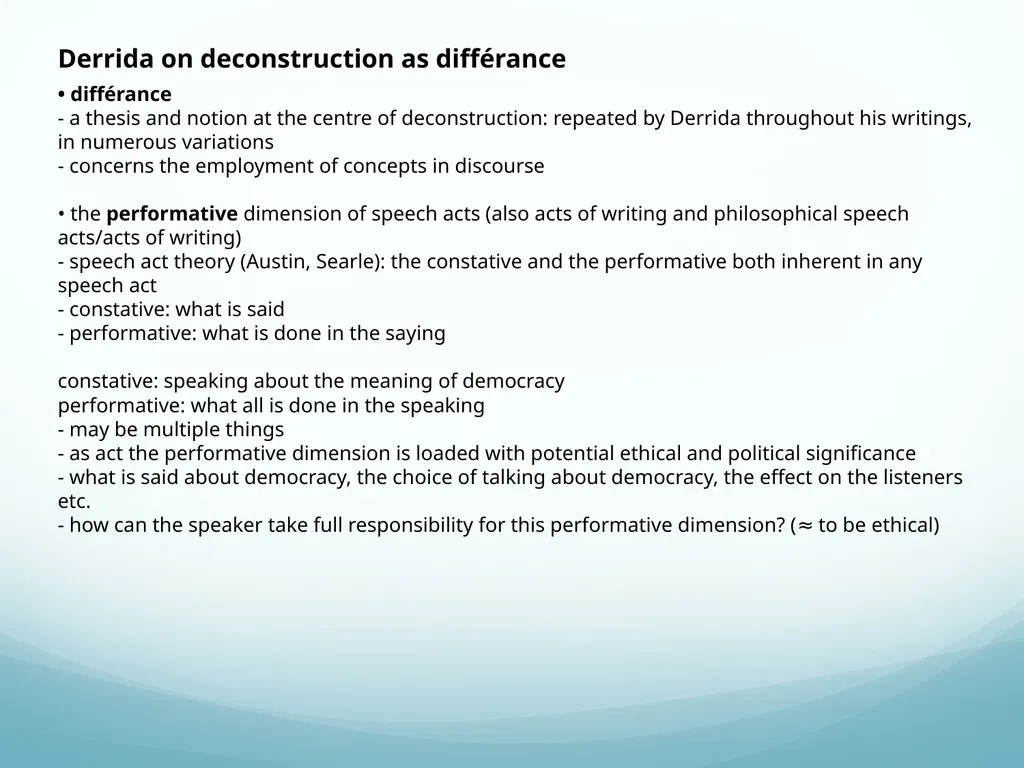
Derrida on deconstruction as différance • différance
- a thesis and notion at the centre of deconstruction: repeated by Derrida throughout his writings, in numerous variations
- concerns the employment of concepts in discourse
• the performative dimension of speech acts (also acts of writing and philosophical speech acts/acts of writing)
- speech act theory (Austin, Searle): the constative and the performative both inherent in any speech act
- constative: what is said
- performative: what is done in the saying
constative: speaking about the meaning of democracy
performative: what all is done in the speaking
- may be multiple things
- as act the performative dimension is loaded with potential ethical and political significance
- what is said about democracy, the choice of talking about democracy, the effect on the listeners etc.
- how can the speaker take full responsibility for this performative dimension? (≈ to be ethical)<br>
- a thesis and notion at the centre of deconstruction: repeated by Derrida throughout his writings, in numerous variations
- concerns the employment of concepts in discourse
• the performative dimension of speech acts (also acts of writing and philosophical speech acts/acts of writing)
- speech act theory (Austin, Searle): the constative and the performative both inherent in any speech act
- constative: what is said
- performative: what is done in the saying
constative: speaking about the meaning of democracy
performative: what all is done in the speaking
- may be multiple things
- as act the performative dimension is loaded with potential ethical and political significance
- what is said about democracy, the choice of talking about democracy, the effect on the listeners etc.
- how can the speaker take full responsibility for this performative dimension? (≈ to be ethical)<br>
08
Derrida on deconstruction as différance • différance
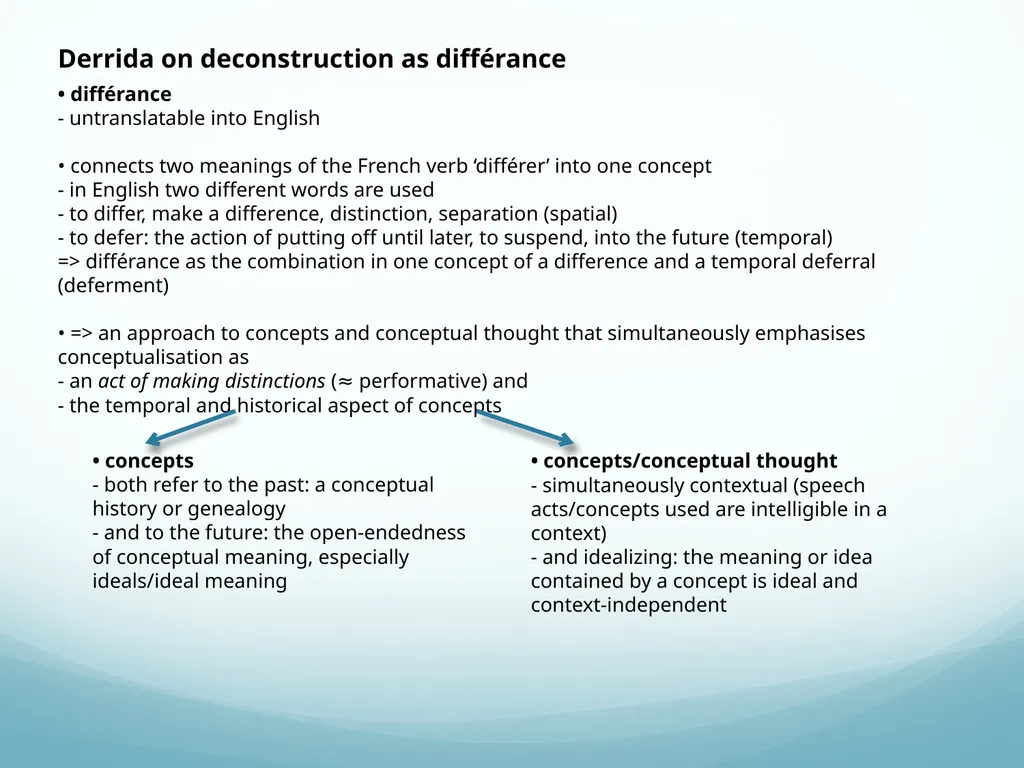
- untranslatable into English
• connects two meanings of the French verb ‘différer’ into one concept
- in English two different words are used
- to differ, make a difference, distinction, separation (spatial)
- to defer: the action of putting off until later, to suspend, into the future (temporal)
=> différance as the combination in one concept of a difference and a temporal deferral (deferment)
• => an approach to concepts and conceptual thought that simultaneously emphasises conceptualisation as
- an act of making distinctions (≈ performative) and
- the temporal and historical aspect of concepts • concepts
- both refer to the past: a conceptual history or genealogy
- and to the future: the open-endedness of conceptual meaning, especially ideals/ideal meaning • concepts/conceptual thought
- simultaneously contextual (speech acts/concepts used are intelligible in a context)
- and idealizing: the meaning or idea contained by a concept is ideal and context-independent<br>
- untranslatable into English
• connects two meanings of the French verb ‘différer’ into one concept
- in English two different words are used
- to differ, make a difference, distinction, separation (spatial)
- to defer: the action of putting off until later, to suspend, into the future (temporal)
=> différance as the combination in one concept of a difference and a temporal deferral (deferment)
• => an approach to concepts and conceptual thought that simultaneously emphasises conceptualisation as
- an act of making distinctions (≈ performative) and
- the temporal and historical aspect of concepts • concepts
- both refer to the past: a conceptual history or genealogy
- and to the future: the open-endedness of conceptual meaning, especially ideals/ideal meaning • concepts/conceptual thought
- simultaneously contextual (speech acts/concepts used are intelligible in a context)
- and idealizing: the meaning or idea contained by a concept is ideal and context-independent<br>
09
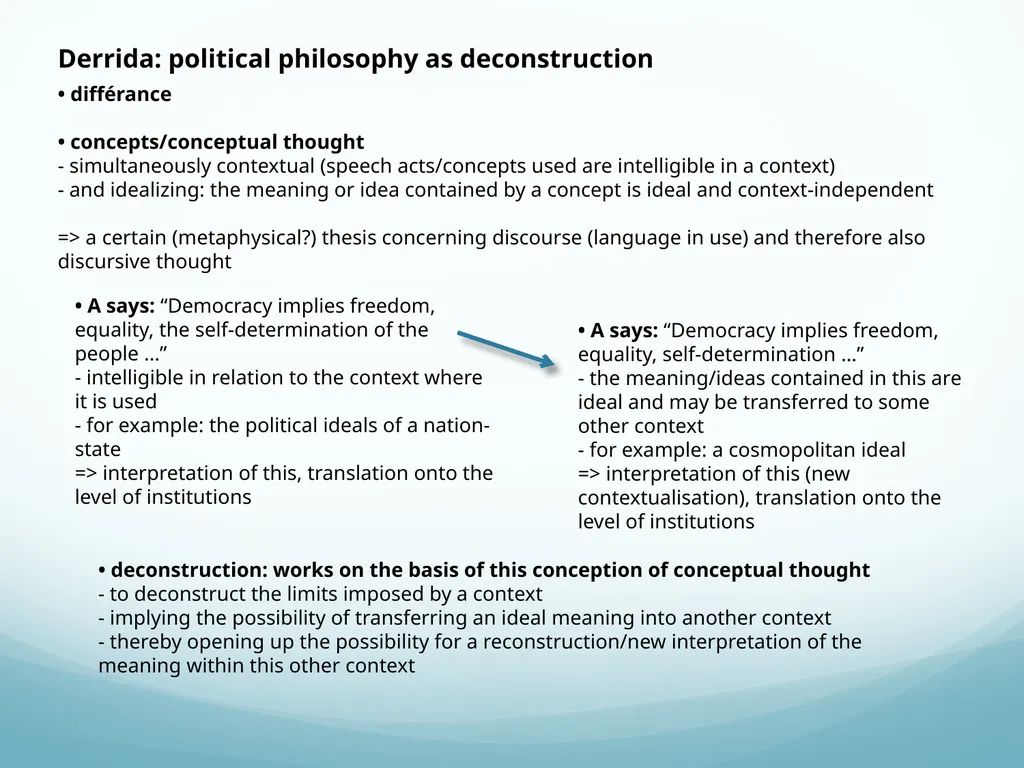
Derrida: political philosophy as deconstruction • différance
• concepts/conceptual thought
- simultaneously contextual (speech acts/concepts used are intelligible in a context)
- and idealizing: the meaning or idea contained by a concept is ideal and context-independent
=> a certain (metaphysical?) thesis concerning discourse (language in use) and therefore also discursive thought • A says: “Democracy implies freedom, equality, the self-determination of the people …”
- intelligible in relation to the context where it is used
- for example: the political ideals of a nation-state
=> interpretation of this, translation onto the level of institutions • A says: “Democracy implies freedom, equality, self-determination …”
- the meaning/ideas contained in this are ideal and may be transferred to some other context
- for example: a cosmopolitan ideal
=> interpretation of this (new contextualisation), translation onto the level of institutions • deconstruction: works on the basis of this conception of conceptual thought
- to deconstruct the limits imposed by a context
- implying the possibility of transferring an ideal meaning into another context
- thereby opening up the possibility for a reconstruction/new interpretation of the meaning within this other context<br>
• concepts/conceptual thought
- simultaneously contextual (speech acts/concepts used are intelligible in a context)
- and idealizing: the meaning or idea contained by a concept is ideal and context-independent
=> a certain (metaphysical?) thesis concerning discourse (language in use) and therefore also discursive thought • A says: “Democracy implies freedom, equality, the self-determination of the people …”
- intelligible in relation to the context where it is used
- for example: the political ideals of a nation-state
=> interpretation of this, translation onto the level of institutions • A says: “Democracy implies freedom, equality, self-determination …”
- the meaning/ideas contained in this are ideal and may be transferred to some other context
- for example: a cosmopolitan ideal
=> interpretation of this (new contextualisation), translation onto the level of institutions • deconstruction: works on the basis of this conception of conceptual thought
- to deconstruct the limits imposed by a context
- implying the possibility of transferring an ideal meaning into another context
- thereby opening up the possibility for a reconstruction/new interpretation of the meaning within this other context<br>
10
Derrida: political philosophy as deconstruction • différance
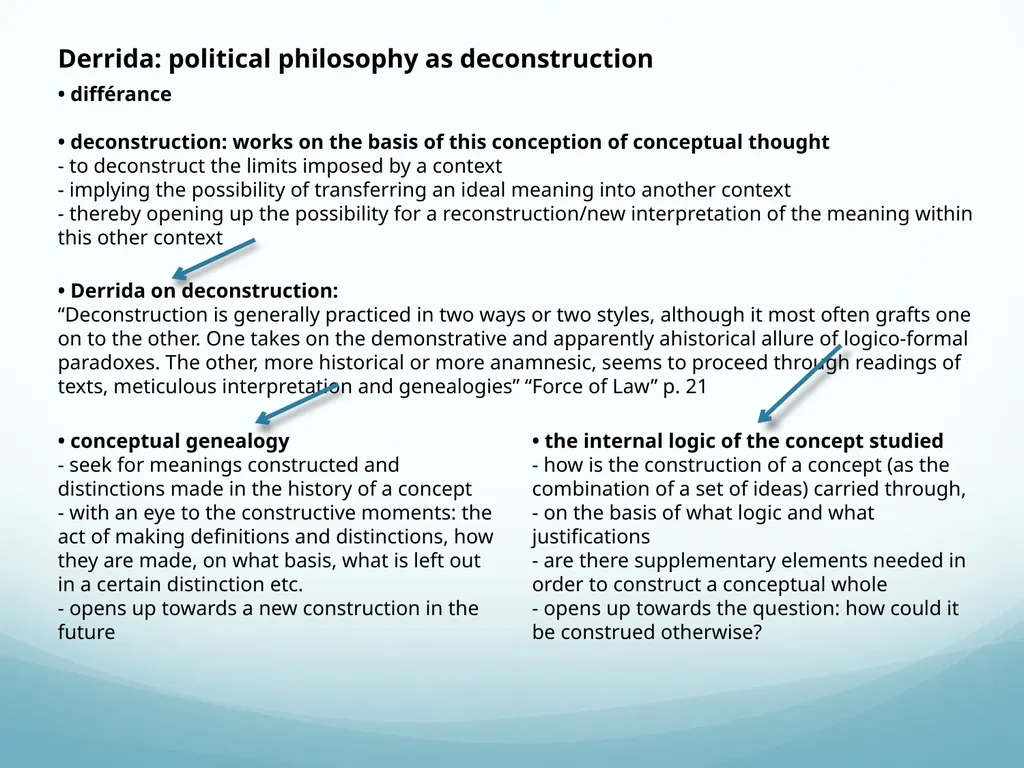
• deconstruction: works on the basis of this conception of conceptual thought
- to deconstruct the limits imposed by a context
- implying the possibility of transferring an ideal meaning into another context
- thereby opening up the possibility for a reconstruction/new interpretation of the meaning within this other context • Derrida on deconstruction:
“Deconstruction is generally practiced in two ways or two styles, although it most often grafts one on to the other. One takes on the demonstrative and apparently ahistorical allure of logico-formal paradoxes. The other, more historical or more anamnesic, seems to proceed through readings of texts, meticulous interpretation and genealogies” “Force of Law” p. 21 • conceptual genealogy
- seek for meanings constructed and distinctions made in the history of a concept
- with an eye to the constructive moments: the act of making definitions and distinctions, how they are made, on what basis, what is left out in a certain distinction etc.
- opens up towards a new construction in the future • the internal logic of the concept studied
- how is the construction of a concept (as the combination of a set of ideas) carried through,
- on the basis of what logic and what justifications
- are there supplementary elements needed in order to construct a conceptual whole
- opens up towards the question: how could it be construed otherwise?<br>
• deconstruction: works on the basis of this conception of conceptual thought
- to deconstruct the limits imposed by a context
- implying the possibility of transferring an ideal meaning into another context
- thereby opening up the possibility for a reconstruction/new interpretation of the meaning within this other context • Derrida on deconstruction:
“Deconstruction is generally practiced in two ways or two styles, although it most often grafts one on to the other. One takes on the demonstrative and apparently ahistorical allure of logico-formal paradoxes. The other, more historical or more anamnesic, seems to proceed through readings of texts, meticulous interpretation and genealogies” “Force of Law” p. 21 • conceptual genealogy
- seek for meanings constructed and distinctions made in the history of a concept
- with an eye to the constructive moments: the act of making definitions and distinctions, how they are made, on what basis, what is left out in a certain distinction etc.
- opens up towards a new construction in the future • the internal logic of the concept studied
- how is the construction of a concept (as the combination of a set of ideas) carried through,
- on the basis of what logic and what justifications
- are there supplementary elements needed in order to construct a conceptual whole
- opens up towards the question: how could it be construed otherwise?<br>
11
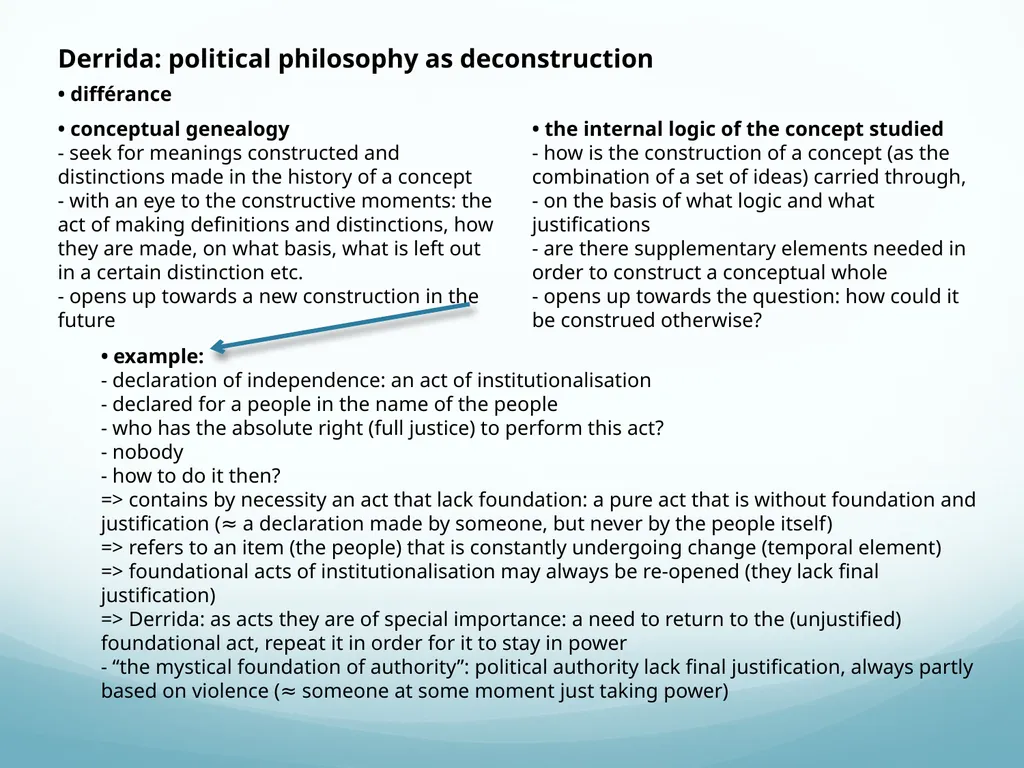
Derrida: political philosophy as deconstruction • différance • conceptual genealogy
- seek for meanings constructed and distinctions made in the history of a concept
- with an eye to the constructive moments: the act of making definitions and distinctions, how they are made, on what basis, what is left out in a certain distinction etc.
- opens up towards a new construction in the future • the internal logic of the concept studied
- how is the construction of a concept (as the combination of a set of ideas) carried through,
- on the basis of what logic and what justifications
- are there supplementary elements needed in order to construct a conceptual whole
- opens up towards the question: how could it be construed otherwise? • example:
- declaration of independence: an act of institutionalisation
- declared for a people in the name of the people
- who has the absolute right (full justice) to perform this act?
- nobody
- how to do it then?
=> contains by necessity an act that lack foundation: a pure act that is without foundation and justification (≈ a declaration made by someone, but never by the people itself)
=> refers to an item (the people) that is constantly undergoing change (temporal element)
=> foundational acts of institutionalisation may always be re-opened (they lack final justification)
=> Derrida: as acts they are of special importance: a need to return to the (unjustified) foundational act, repeat it in order for it to stay in power
- “the mystical foundation of authority”: political authority lack final justification, always partly based on violence (≈ someone at some moment just taking power)<br>
- seek for meanings constructed and distinctions made in the history of a concept
- with an eye to the constructive moments: the act of making definitions and distinctions, how they are made, on what basis, what is left out in a certain distinction etc.
- opens up towards a new construction in the future • the internal logic of the concept studied
- how is the construction of a concept (as the combination of a set of ideas) carried through,
- on the basis of what logic and what justifications
- are there supplementary elements needed in order to construct a conceptual whole
- opens up towards the question: how could it be construed otherwise? • example:
- declaration of independence: an act of institutionalisation
- declared for a people in the name of the people
- who has the absolute right (full justice) to perform this act?
- nobody
- how to do it then?
=> contains by necessity an act that lack foundation: a pure act that is without foundation and justification (≈ a declaration made by someone, but never by the people itself)
=> refers to an item (the people) that is constantly undergoing change (temporal element)
=> foundational acts of institutionalisation may always be re-opened (they lack final justification)
=> Derrida: as acts they are of special importance: a need to return to the (unjustified) foundational act, repeat it in order for it to stay in power
- “the mystical foundation of authority”: political authority lack final justification, always partly based on violence (≈ someone at some moment just taking power)<br>
12
Derrida: political philosophy as deconstruction • what is that, what is achieved?
- controversial issue: just empty, unintelligible talk vs. the re-opening of a more truthful perspective on the complexity of issues (doing a fuller justice to truth?)
- in addition: critiques of Derrida that takes him seriously (actually reads and understands his claims)
• ontology and responsibility
- being is inheritance: “All the questions on the subject of being or of what is to be (or not to be) are questions of inheritance” (Spectres of Marx, p. 54)
- roughly then, everything that remains from the past
- an inheritance is always heterogeneous/non-identical: “An inheritance is never gathered together, it is never one with itself. Its presumed unity, if there is one, can consist only in the injunction to reaffirm by choosing… one must filter, sift, criticize, one must sort out several different possibles that inhabit the same injunction” (Spectres of Marx, p. 169)
[- Derrida’s joke in relation with Marx: ontology is hauntology (French: hauntologie, ghost-ology)
- a ghost: an appearance in a bodily form of someone already dead
- Marx: several ghosts of Marx appear in the present (≈ the heritage of Marx appears to us in different interpretations)]
- to reaffirm by choosing ≈ to assume responsibility, to interrupt the present in the name of the future
- for example: which spectre of Marx should be reaffirmed in the present, which spectre would constitute assuming responsibility?
- “one always begins by responding”
- the response, the act is oriented towards the future, the unknown
=> a radical demand to act, to assume responsibility for the future<br>
- controversial issue: just empty, unintelligible talk vs. the re-opening of a more truthful perspective on the complexity of issues (doing a fuller justice to truth?)
- in addition: critiques of Derrida that takes him seriously (actually reads and understands his claims)
• ontology and responsibility
- being is inheritance: “All the questions on the subject of being or of what is to be (or not to be) are questions of inheritance” (Spectres of Marx, p. 54)
- roughly then, everything that remains from the past
- an inheritance is always heterogeneous/non-identical: “An inheritance is never gathered together, it is never one with itself. Its presumed unity, if there is one, can consist only in the injunction to reaffirm by choosing… one must filter, sift, criticize, one must sort out several different possibles that inhabit the same injunction” (Spectres of Marx, p. 169)
[- Derrida’s joke in relation with Marx: ontology is hauntology (French: hauntologie, ghost-ology)
- a ghost: an appearance in a bodily form of someone already dead
- Marx: several ghosts of Marx appear in the present (≈ the heritage of Marx appears to us in different interpretations)]
- to reaffirm by choosing ≈ to assume responsibility, to interrupt the present in the name of the future
- for example: which spectre of Marx should be reaffirmed in the present, which spectre would constitute assuming responsibility?
- “one always begins by responding”
- the response, the act is oriented towards the future, the unknown
=> a radical demand to act, to assume responsibility for the future<br>
13
Derrida: political philosophy as deconstruction • what can be achieved?
• justice?
- justice ≈ perhaps roughly (KK’s formulation): to do justice to each and everyone in their singularity, radical individuality
- at every moment forever
- to respect, to understand, to affirm etc.
=> impossible
=> the demand of justice can never be closed by any single act or constitution of society
• democracy
- democracy ≈ perhaps roughly (KK’s formulation): the freedom, equality and participation of all in the formation of the will of all that would do justice to all in their singularity, at all times and forever
=> can only exist in the form of a promise, a to-come (French: avenir)
=> a never-ending process of democracy-to-come<br>
• justice?
- justice ≈ perhaps roughly (KK’s formulation): to do justice to each and everyone in their singularity, radical individuality
- at every moment forever
- to respect, to understand, to affirm etc.
=> impossible
=> the demand of justice can never be closed by any single act or constitution of society
• democracy
- democracy ≈ perhaps roughly (KK’s formulation): the freedom, equality and participation of all in the formation of the will of all that would do justice to all in their singularity, at all times and forever
=> can only exist in the form of a promise, a to-come (French: avenir)
=> a never-ending process of democracy-to-come<br>