
Key Components of OBE and Accreditation - Vision,
CB
Published · 61 slides · 0 views

1 / 1

Description
Key Components of OBE and Accreditation - Vision, Mission, Program Educational Objectives, Graduate Attributes and Program Outcomes. By Dr. R.V. Ranganath BMS College of Engineering, Bangalore-19 rvranganath.civbmsce.ac.in Outcomes Based
Related Topics
Share
Embed code
Download this presentation From Below
"Key Components of OBE and Accreditation - Vision," is the property of its rightful owner. Permission is granted to download and print the materials on this website for personal, non-commercial use only, and to display it on your personal computer provided you do not modify the materials and that you retain all copyright notices contained in the materials. By downloading content from our website, you accept the terms of this agreement.
Presentation Transcript
01
Key Components of OBE and Accreditation
- Vision, Mission, Program Educational Objectives, Graduate Attributes and Program Outcomes. By
Dr. R.V. Ranganath
BMS College of Engineering, Bangalore-19
rvranganath.civ@bmsce.ac.in<br>
Dr. R.V. Ranganath
BMS College of Engineering, Bangalore-19
rvranganath.civ@bmsce.ac.in<br>
02
Outcomes Based Education Outcomes based education (OBE) is a process that involves the restructuring of curriculum, assessment and reporting practices in education to reflect the achievement of high order learning and mastery rather than the accumulation of course credits” (Tucker, 2004).
(http://www.slideshare.net/jellai09/obe-approaches?from_action=save)<br>
(http://www.slideshare.net/jellai09/obe-approaches?from_action=save)<br>
03
Why Outcome Based Accreditation Globalization has brought in a clear shift from education as transmission of expert knowledge to education as building learner competencies including learning to learn and life long learning.
That means focus will have to be on
Understanding fundamentals very well, and learning new skills/competencies that would enable individuals to cope with the demands of the rapidly changing workplace.
Prepare global engineers who will have to solve problems and shoulder challenges which are not even known today!!<br>
That means focus will have to be on
Understanding fundamentals very well, and learning new skills/competencies that would enable individuals to cope with the demands of the rapidly changing workplace.
Prepare global engineers who will have to solve problems and shoulder challenges which are not even known today!!<br>
04
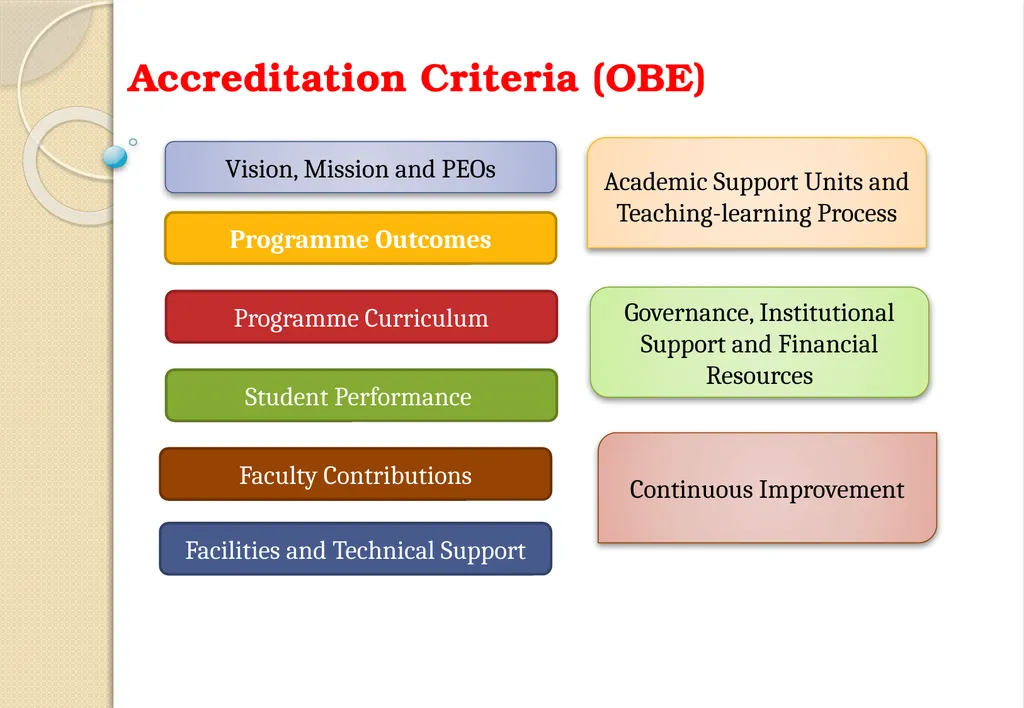
Accreditation Criteria (OBE) Vision, Mission and PEOs Programme Outcomes Student Performance Programme Curriculum Faculty Contributions Facilities and Technical Support Academic Support Units and Teaching-learning Process Governance, Institutional Support and Financial Resources Continuous Improvement<br>
05
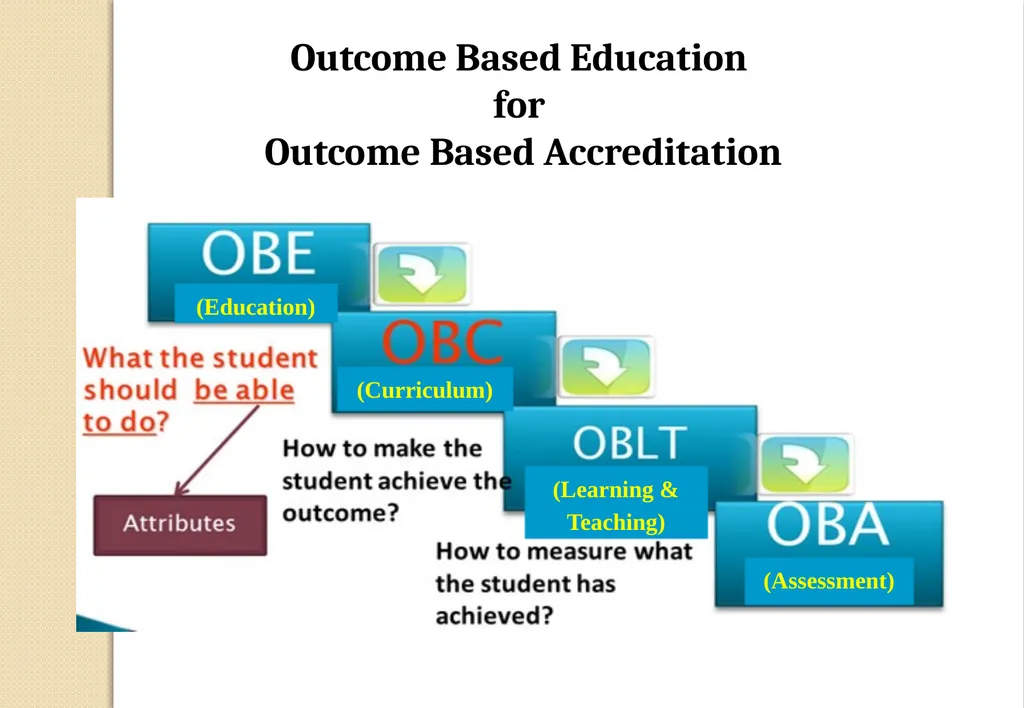
Outcome Based Education
for
Outcome Based Accreditation<br>
for
Outcome Based Accreditation<br>
06
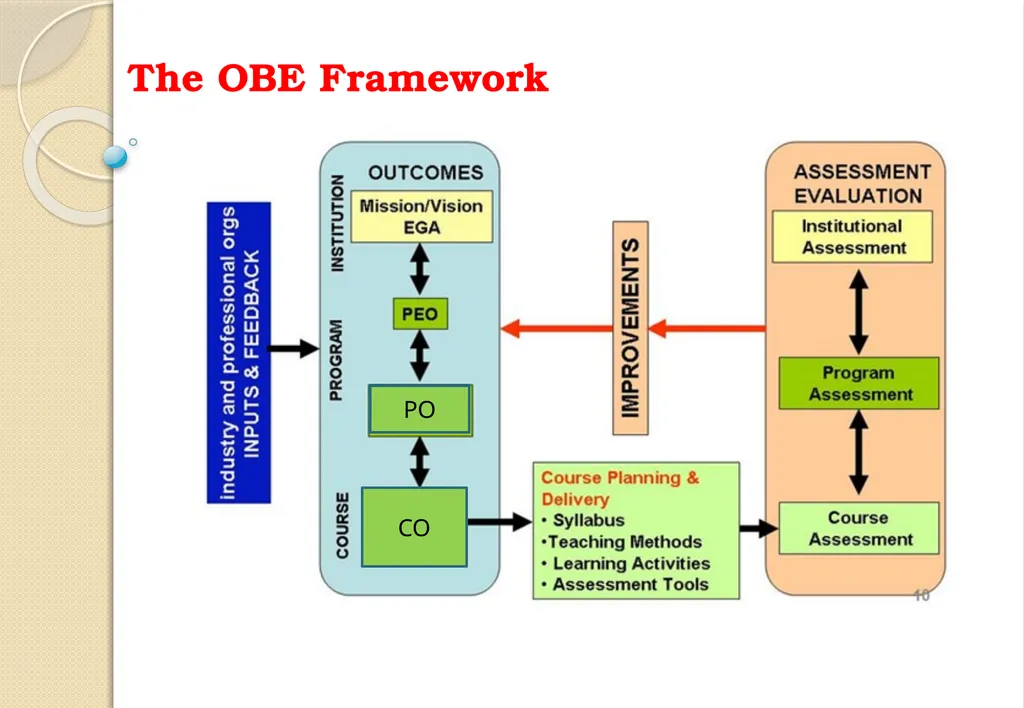
The OBE Framework PO CO<br>
07
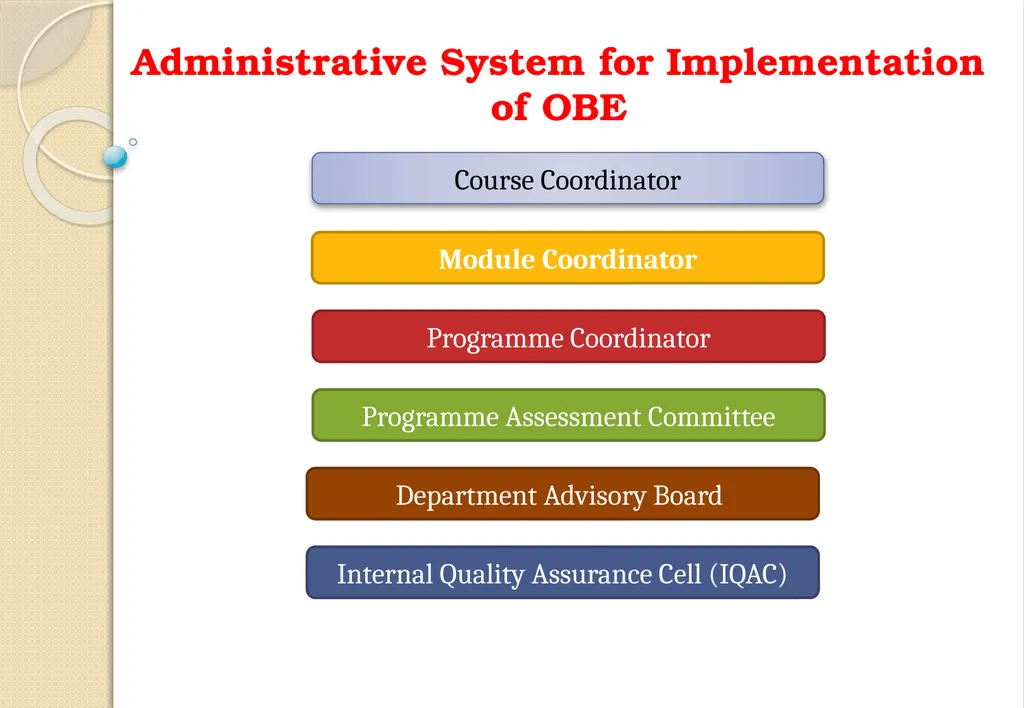
Administrative System for Implementation of OBE Course Coordinator Module Coordinator Programme Assessment Committee Programme Coordinator Department Advisory Board Internal Quality Assurance Cell (IQAC)<br>
08
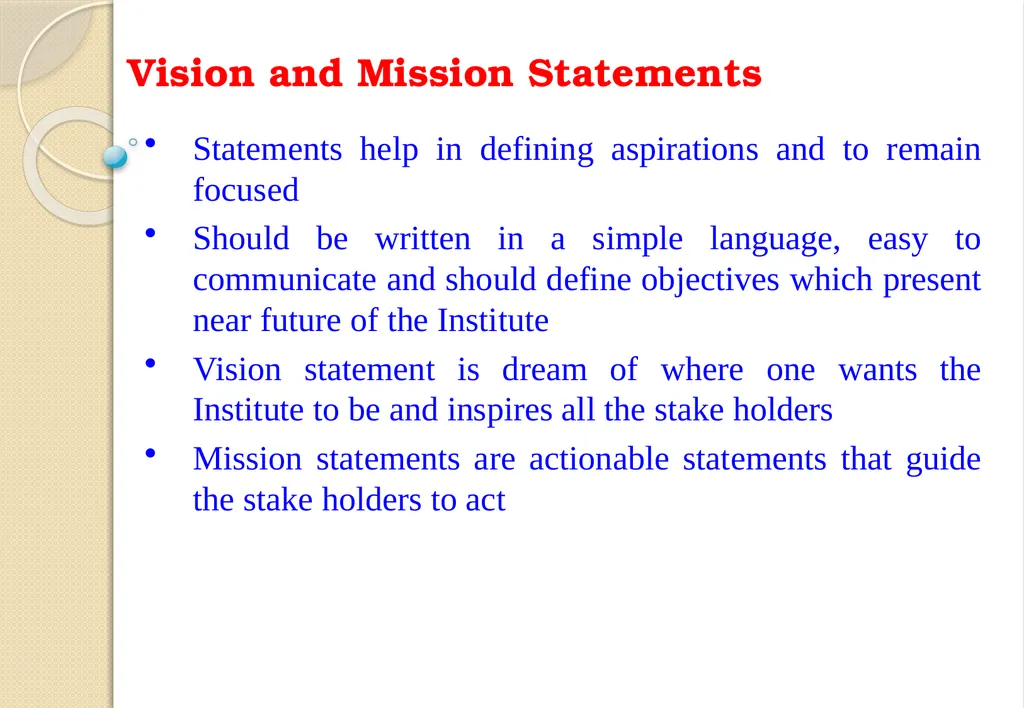
Vision and Mission Statements Statements help in defining aspirations and to remain focused
Should be written in a simple language, easy to communicate and should define objectives which present near future of the Institute
Vision statement is dream of where one wants the Institute to be and inspires all the stake holders
Mission statements are actionable statements that guide the stake holders to act<br>
Should be written in a simple language, easy to communicate and should define objectives which present near future of the Institute
Vision statement is dream of where one wants the Institute to be and inspires all the stake holders
Mission statements are actionable statements that guide the stake holders to act<br>
09
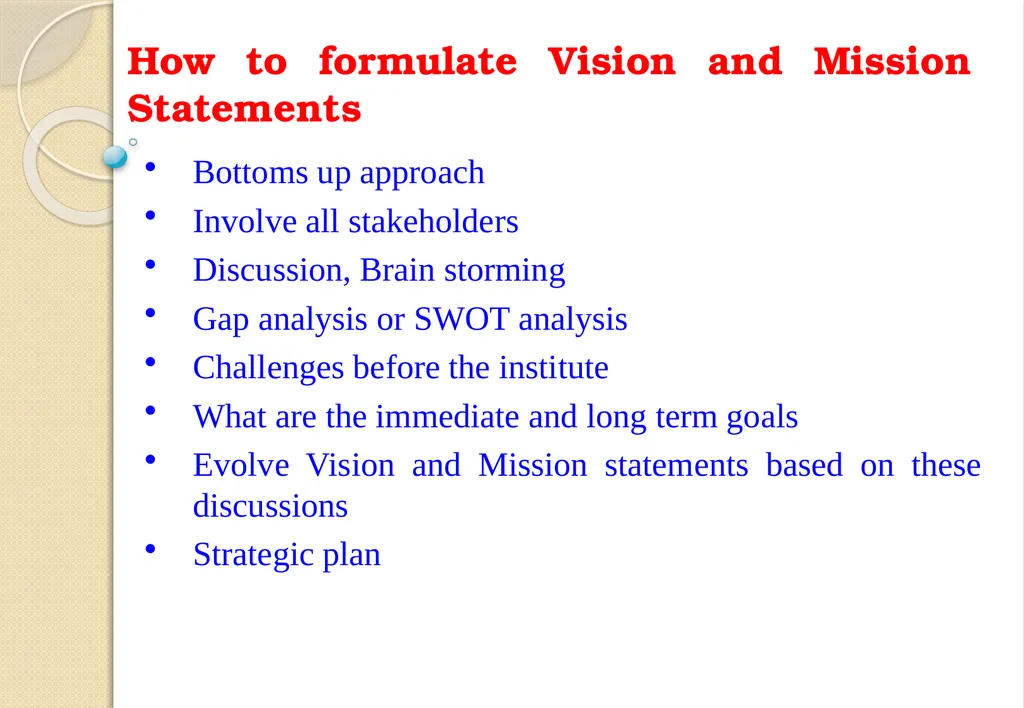
How to formulate Vision and Mission Statements Bottoms up approach
Involve all stakeholders
Discussion, Brain storming
Gap analysis or SWOT analysis
Challenges before the institute
What are the immediate and long term goals
Evolve Vision and Mission statements based on these discussions
Strategic plan<br>
Involve all stakeholders
Discussion, Brain storming
Gap analysis or SWOT analysis
Challenges before the institute
What are the immediate and long term goals
Evolve Vision and Mission statements based on these discussions
Strategic plan<br>
10
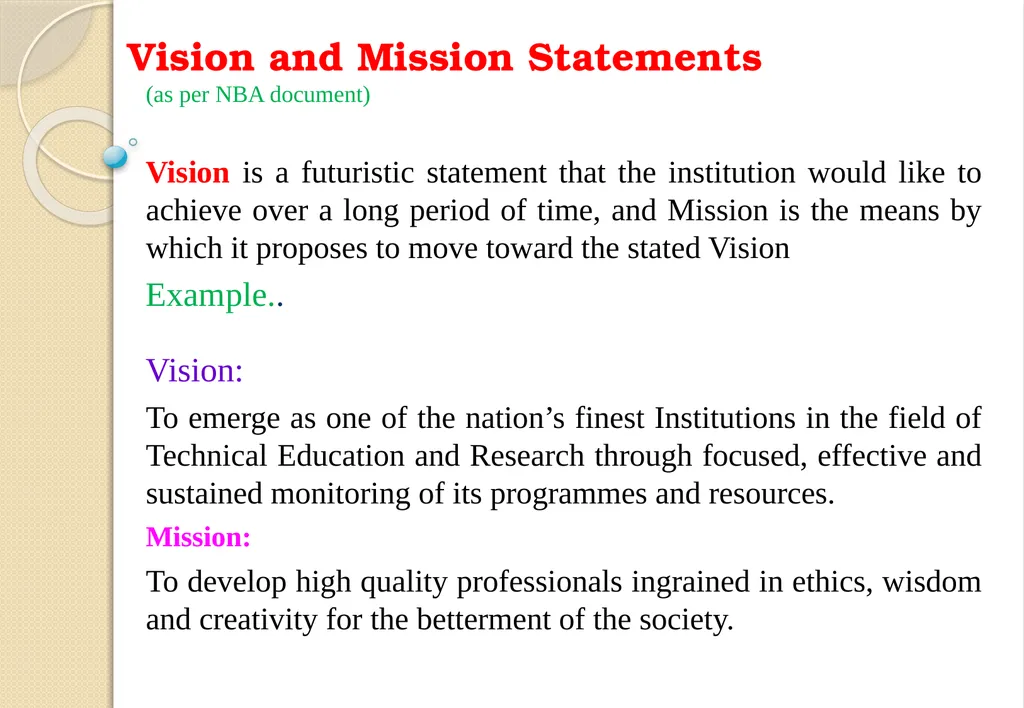
Vision and Mission Statements (as per NBA document)
Vision is a futuristic statement that the institution would like to achieve over a long period of time, and Mission is the means by which it proposes to move toward the stated Vision
Example..
Vision:
To emerge as one of the nation’s finest Institutions in the field of Technical Education and Research through focused, effective and sustained monitoring of its programmes and resources.
Mission:
To develop high quality professionals ingrained in ethics, wisdom and creativity for the betterment of the society.<br>
Vision is a futuristic statement that the institution would like to achieve over a long period of time, and Mission is the means by which it proposes to move toward the stated Vision
Example..
Vision:
To emerge as one of the nation’s finest Institutions in the field of Technical Education and Research through focused, effective and sustained monitoring of its programmes and resources.
Mission:
To develop high quality professionals ingrained in ethics, wisdom and creativity for the betterment of the society.<br>
11
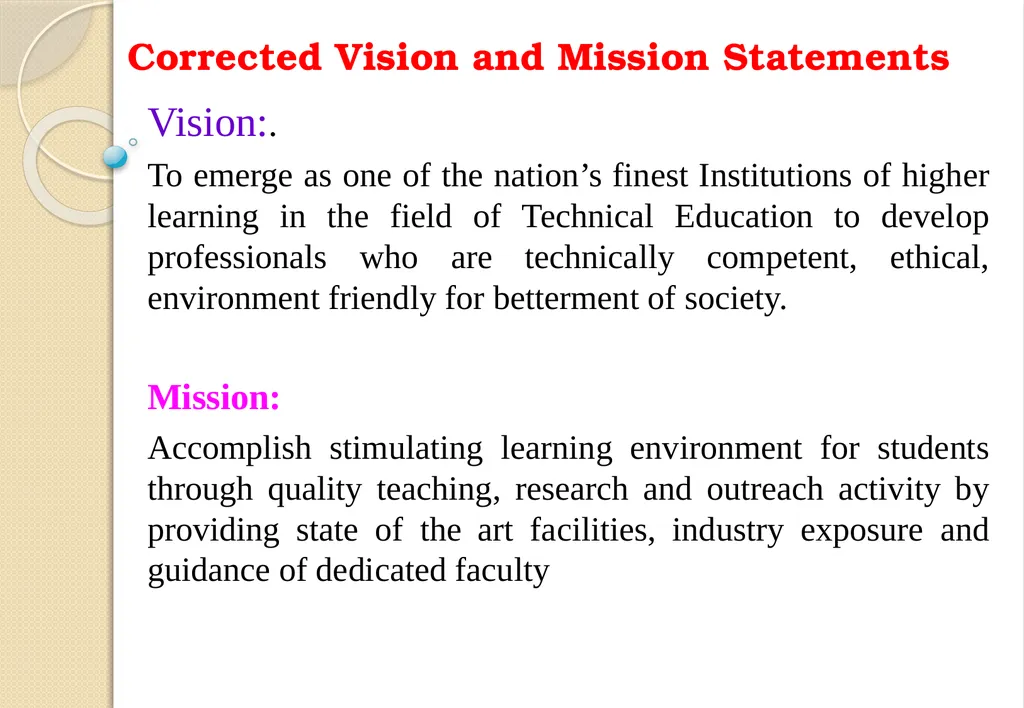
Corrected Vision and Mission Statements Vision:.
To emerge as one of the nation’s finest Institutions of higher learning in the field of Technical Education to develop professionals who are technically competent, ethical, environment friendly for betterment of society.
Mission:
Accomplish stimulating learning environment for students through quality teaching, research and outreach activity by providing state of the art facilities, industry exposure and guidance of dedicated faculty<br>
To emerge as one of the nation’s finest Institutions of higher learning in the field of Technical Education to develop professionals who are technically competent, ethical, environment friendly for betterment of society.
Mission:
Accomplish stimulating learning environment for students through quality teaching, research and outreach activity by providing state of the art facilities, industry exposure and guidance of dedicated faculty<br>
12
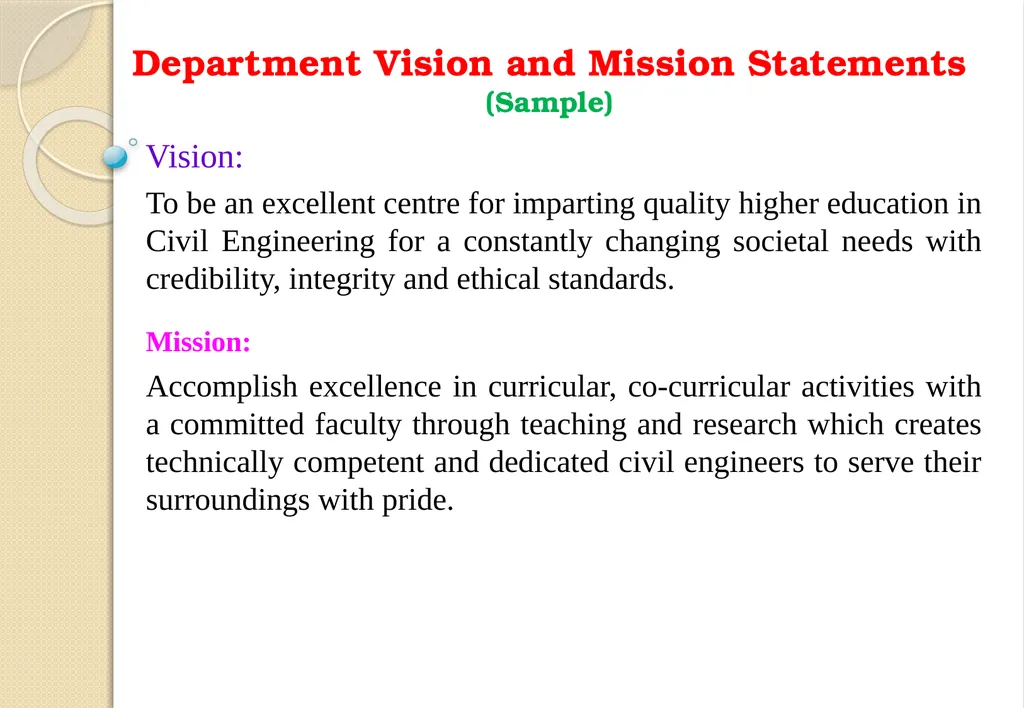
Department Vision and Mission Statements (Sample) Vision:
To be an excellent centre for imparting quality higher education in Civil Engineering for a constantly changing societal needs with credibility, integrity and ethical standards.
Mission:
Accomplish excellence in curricular, co-curricular activities with a committed faculty through teaching and research which creates technically competent and dedicated civil engineers to serve their surroundings with pride.<br>
To be an excellent centre for imparting quality higher education in Civil Engineering for a constantly changing societal needs with credibility, integrity and ethical standards.
Mission:
Accomplish excellence in curricular, co-curricular activities with a committed faculty through teaching and research which creates technically competent and dedicated civil engineers to serve their surroundings with pride.<br>
13
Program Educational Objective-PEO The educational objectives of an engineering degree program are the statements that describe the expected achievements of graduates in their career, and also in particular, what the graduates are expected to perform and achieve during the first few years after graduation.
The PEOs, may be guided by global and local needs, vision of the Institution, long term goals etc.
For defining the PEOs the faculty members of the program must continuously work with all
Stakeholders: Local Employers, Industry, Students and the Alumni<br>
The PEOs, may be guided by global and local needs, vision of the Institution, long term goals etc.
For defining the PEOs the faculty members of the program must continuously work with all
Stakeholders: Local Employers, Industry, Students and the Alumni<br>
14
PEOs (Samples) PEO1:
Graduate will compete on a global platform to pursue their professional career in Electrical Engineering and allied disciplines.
PEO2:
Graduates will pursue higher education and/or engage in continuous up gradation of their professional skills.
PEO3:
Graduate will communicate effectively and will demonstrate professional behaviour while working in diverse team.
PEO4:
Graduates will demonstrate concern for society and environment.<br>
Graduate will compete on a global platform to pursue their professional career in Electrical Engineering and allied disciplines.
PEO2:
Graduates will pursue higher education and/or engage in continuous up gradation of their professional skills.
PEO3:
Graduate will communicate effectively and will demonstrate professional behaviour while working in diverse team.
PEO4:
Graduates will demonstrate concern for society and environment.<br>
15
(Samples 2 - Civil Engineering) PEO1:
Practice civil engineering in construction industry, public sector undertaking and as an entrepreneur for successful professional career.
PEO2:
Pursue higher education for professional development
PEO3:
Exhibit leadership qualities with demonstrable attributes in lifelong learning to contribute to the societal needs.<br>
Practice civil engineering in construction industry, public sector undertaking and as an entrepreneur for successful professional career.
PEO2:
Pursue higher education for professional development
PEO3:
Exhibit leadership qualities with demonstrable attributes in lifelong learning to contribute to the societal needs.<br>
16
Processes for PEOs Feedback format for collecting data from stakeholders
A process by which PEOs are created and reviewed periodically
A process to evaluate to what extent PEOs are attained
Review, Mid correction, and Continuous Quality Improvement<br>
A process by which PEOs are created and reviewed periodically
A process to evaluate to what extent PEOs are attained
Review, Mid correction, and Continuous Quality Improvement<br>
17
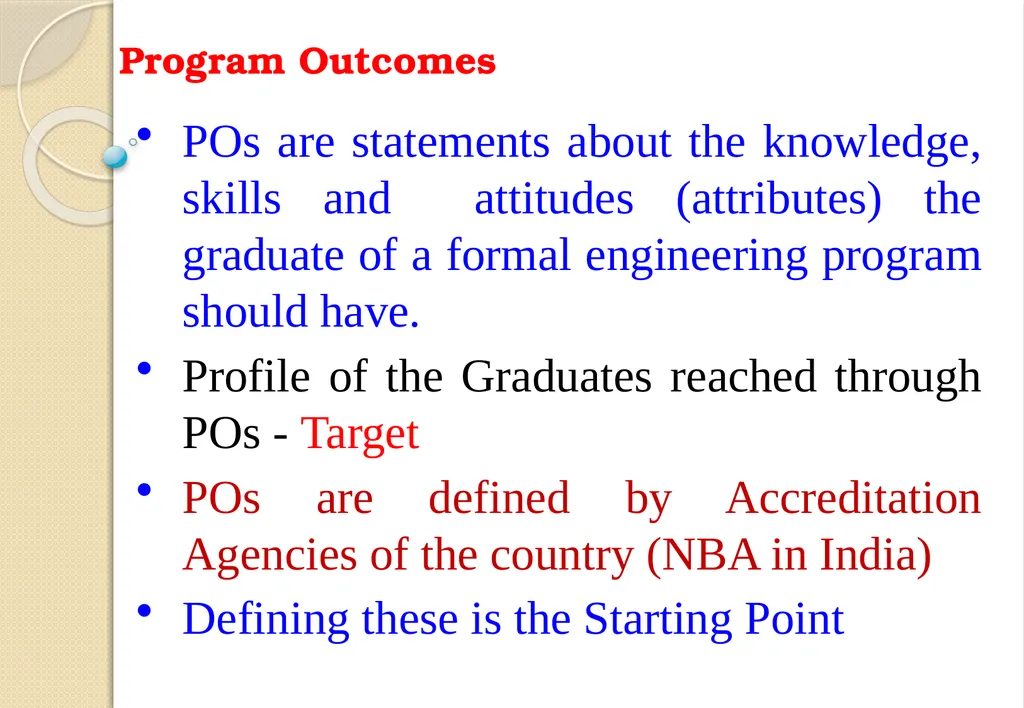
Program Outcomes POs are statements about the knowledge, skills and attitudes (attributes) the graduate of a formal engineering program should have.
Profile of the Graduates reached through POs - Target
POs are defined by Accreditation Agencies of the country (NBA in India)
Defining these is the Starting Point<br>
Profile of the Graduates reached through POs - Target
POs are defined by Accreditation Agencies of the country (NBA in India)
Defining these is the Starting Point<br>
18
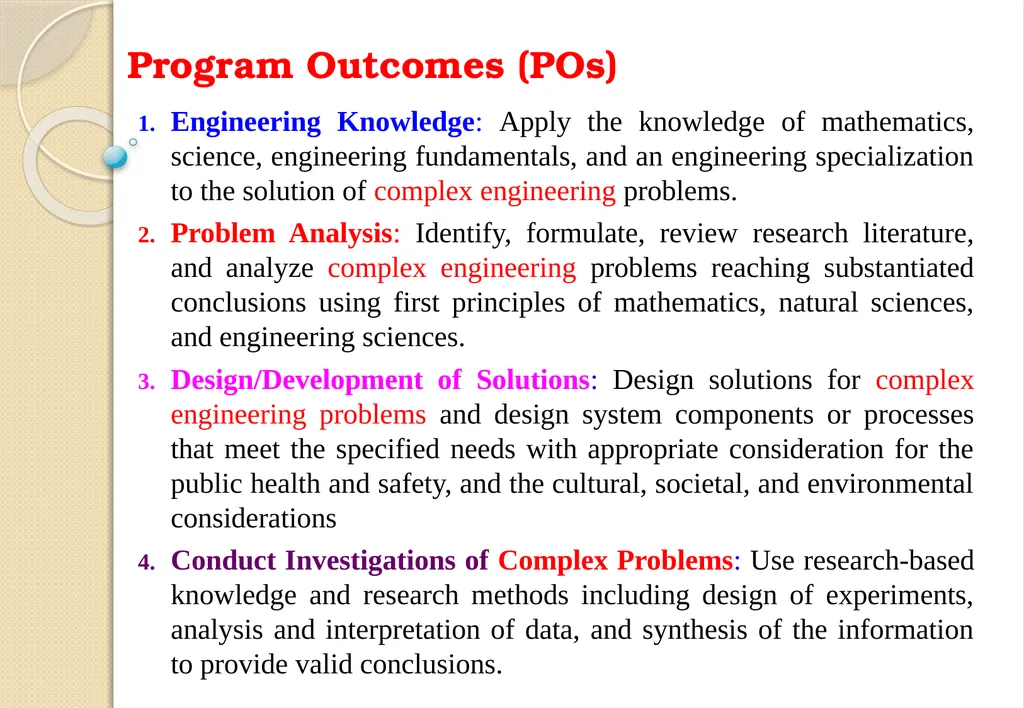
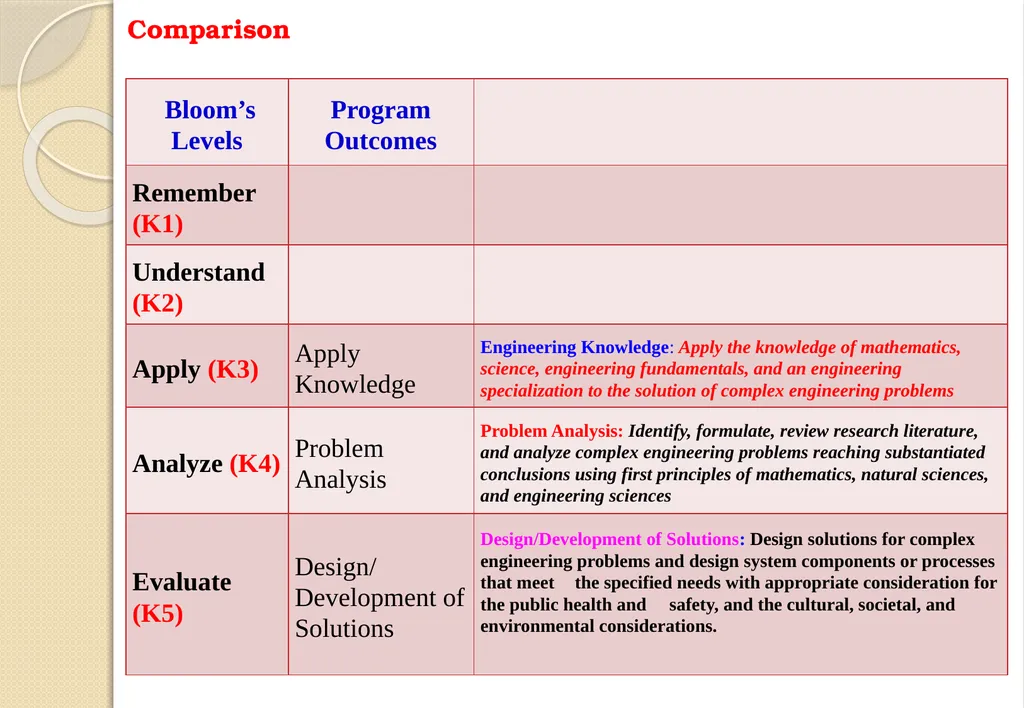
Program Outcomes (POs) Engineering Knowledge: Apply the knowledge of mathematics, science, engineering fundamentals, and an engineering specialization to the solution of complex engineering problems.
Problem Analysis: Identify, formulate, review research literature, and analyze complex engineering problems reaching substantiated conclusions using first principles of mathematics, natural sciences, and engineering sciences.
Design/Development of Solutions: Design solutions for complex engineering problems and design system components or processes that meet the specified needs with appropriate consideration for the public health and safety, and the cultural, societal, and environmental considerations
Conduct Investigations of Complex Problems: Use research-based knowledge and research methods including design of experiments, analysis and interpretation of data, and synthesis of the information to provide valid conclusions.<br>
Problem Analysis: Identify, formulate, review research literature, and analyze complex engineering problems reaching substantiated conclusions using first principles of mathematics, natural sciences, and engineering sciences.
Design/Development of Solutions: Design solutions for complex engineering problems and design system components or processes that meet the specified needs with appropriate consideration for the public health and safety, and the cultural, societal, and environmental considerations
Conduct Investigations of Complex Problems: Use research-based knowledge and research methods including design of experiments, analysis and interpretation of data, and synthesis of the information to provide valid conclusions.<br>
19
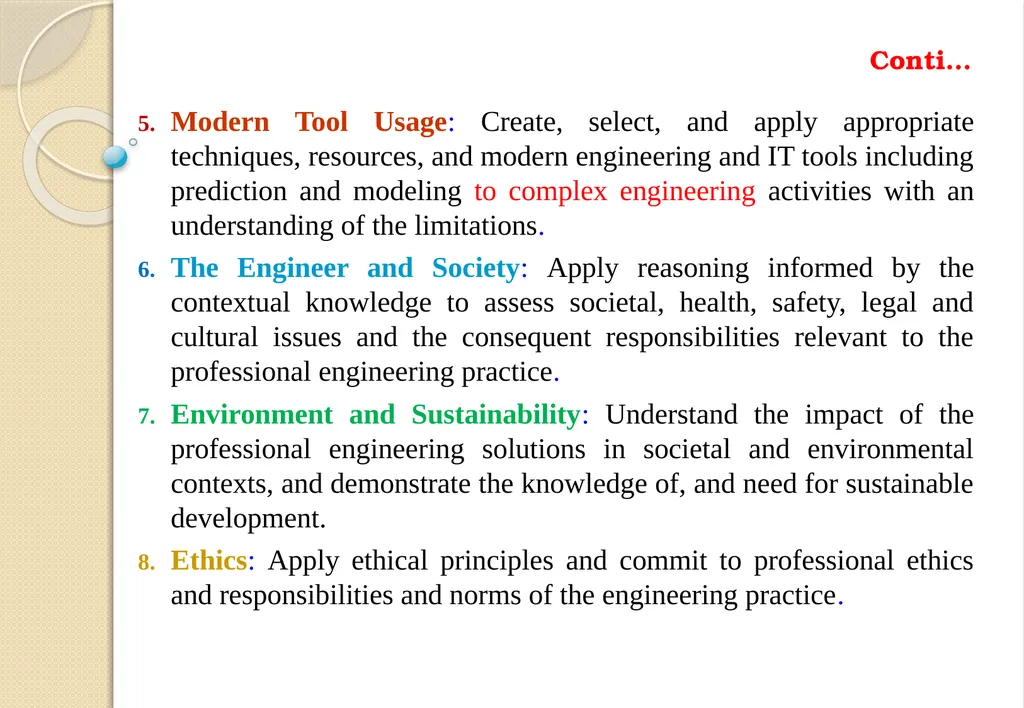
Conti… Modern Tool Usage: Create, select, and apply appropriate techniques, resources, and modern engineering and IT tools including prediction and modeling to complex engineering activities with an understanding of the limitations.
The Engineer and Society: Apply reasoning informed by the contextual knowledge to assess societal, health, safety, legal and cultural issues and the consequent responsibilities relevant to the professional engineering practice.
Environment and Sustainability: Understand the impact of the professional engineering solutions in societal and environmental contexts, and demonstrate the knowledge of, and need for sustainable development.
Ethics: Apply ethical principles and commit to professional ethics and responsibilities and norms of the engineering practice.<br>
The Engineer and Society: Apply reasoning informed by the contextual knowledge to assess societal, health, safety, legal and cultural issues and the consequent responsibilities relevant to the professional engineering practice.
Environment and Sustainability: Understand the impact of the professional engineering solutions in societal and environmental contexts, and demonstrate the knowledge of, and need for sustainable development.
Ethics: Apply ethical principles and commit to professional ethics and responsibilities and norms of the engineering practice.<br>
20
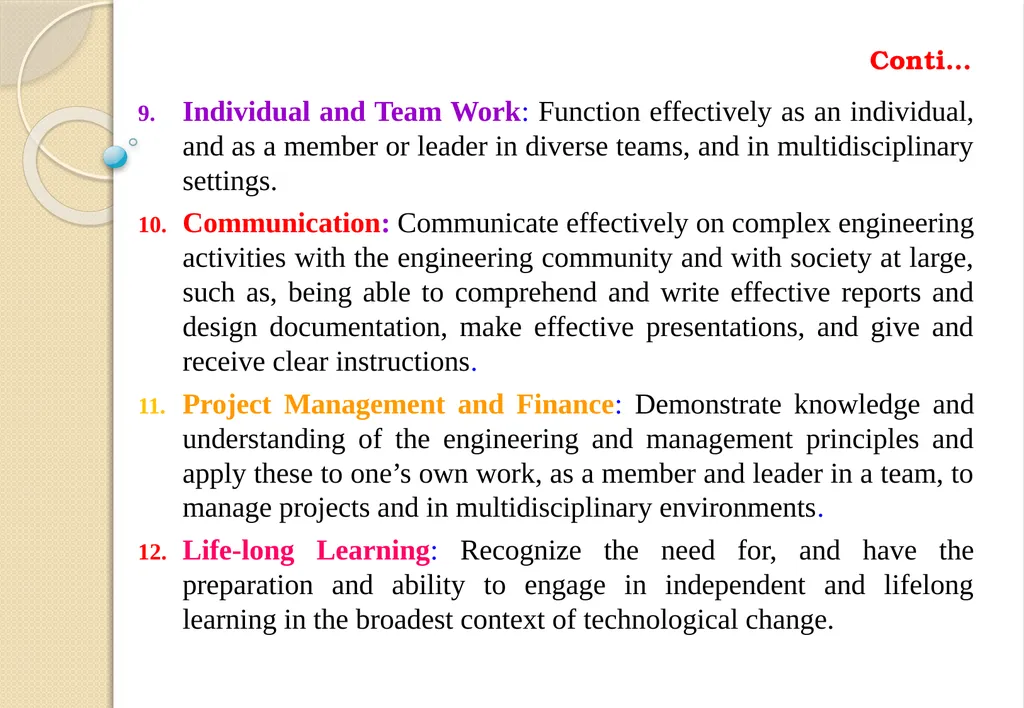
Conti… Individual and Team Work: Function effectively as an individual, and as a member or leader in diverse teams, and in multidisciplinary settings.
Communication: Communicate effectively on complex engineering activities with the engineering community and with society at large, such as, being able to comprehend and write effective reports and design documentation, make effective presentations, and give and receive clear instructions.
Project Management and Finance: Demonstrate knowledge and understanding of the engineering and management principles and apply these to one’s own work, as a member and leader in a team, to manage projects and in multidisciplinary environments.
Life-long Learning: Recognize the need for, and have the preparation and ability to engage in independent and lifelong learning in the broadest context of technological change.<br>
Communication: Communicate effectively on complex engineering activities with the engineering community and with society at large, such as, being able to comprehend and write effective reports and design documentation, make effective presentations, and give and receive clear instructions.
Project Management and Finance: Demonstrate knowledge and understanding of the engineering and management principles and apply these to one’s own work, as a member and leader in a team, to manage projects and in multidisciplinary environments.
Life-long Learning: Recognize the need for, and have the preparation and ability to engage in independent and lifelong learning in the broadest context of technological change.<br>
21
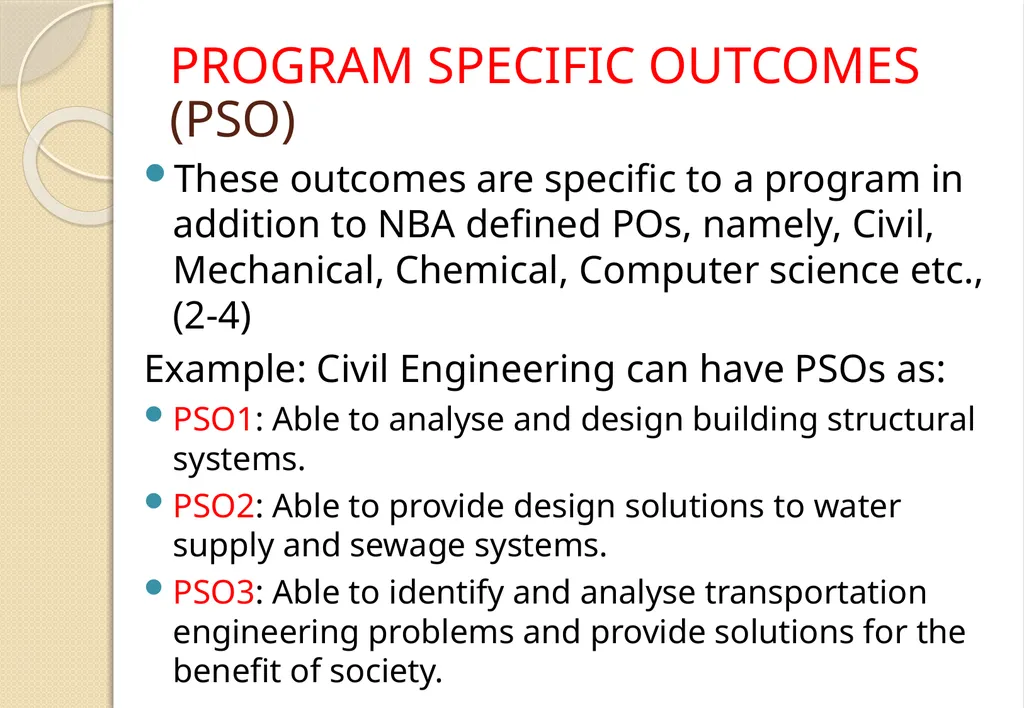
PROGRAM SPECIFIC OUTCOMES (PSO) These outcomes are specific to a program in addition to NBA defined POs, namely, Civil, Mechanical, Chemical, Computer science etc.,(2-4)
Example: Civil Engineering can have PSOs as:
PSO1: Able to analyse and design building structural systems.
PSO2: Able to provide design solutions to water supply and sewage systems.
PSO3: Able to identify and analyse transportation engineering problems and provide solutions for the benefit of society.<br>
Example: Civil Engineering can have PSOs as:
PSO1: Able to analyse and design building structural systems.
PSO2: Able to provide design solutions to water supply and sewage systems.
PSO3: Able to identify and analyse transportation engineering problems and provide solutions for the benefit of society.<br>
22
Why the NBA's POs are What they are? Source: NBA learning resources<br>
23
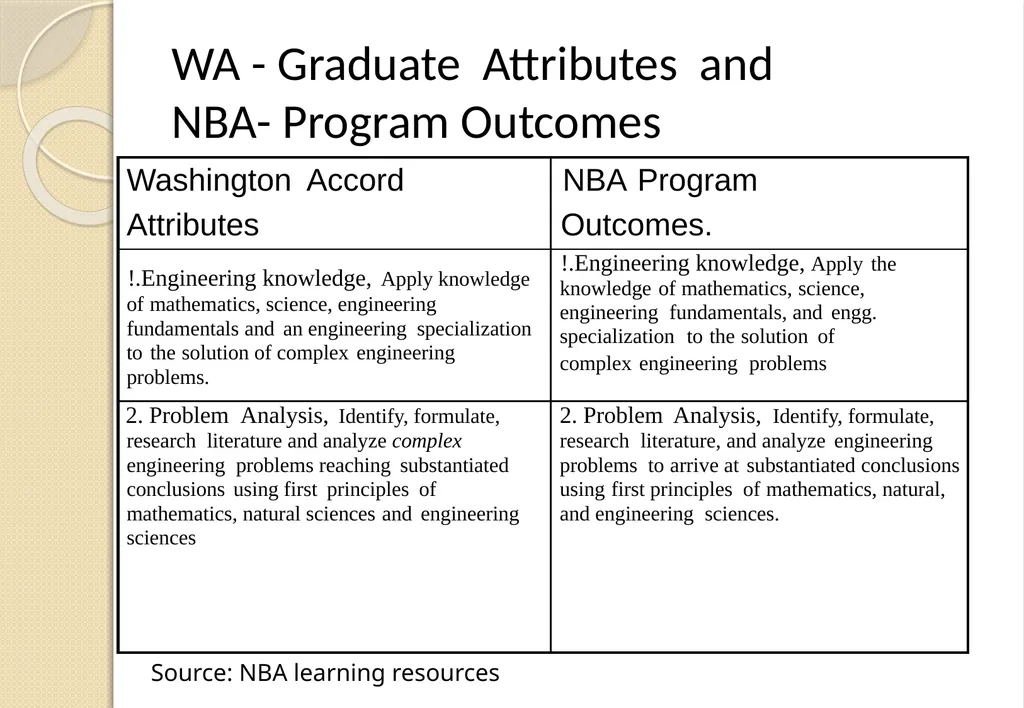
WA - Graduate Attributes and
NBA- Program Outcomes Source: NBA learning resources<br>
NBA- Program Outcomes Source: NBA learning resources<br>
24
Attainment of PO1 to P05<br>
25
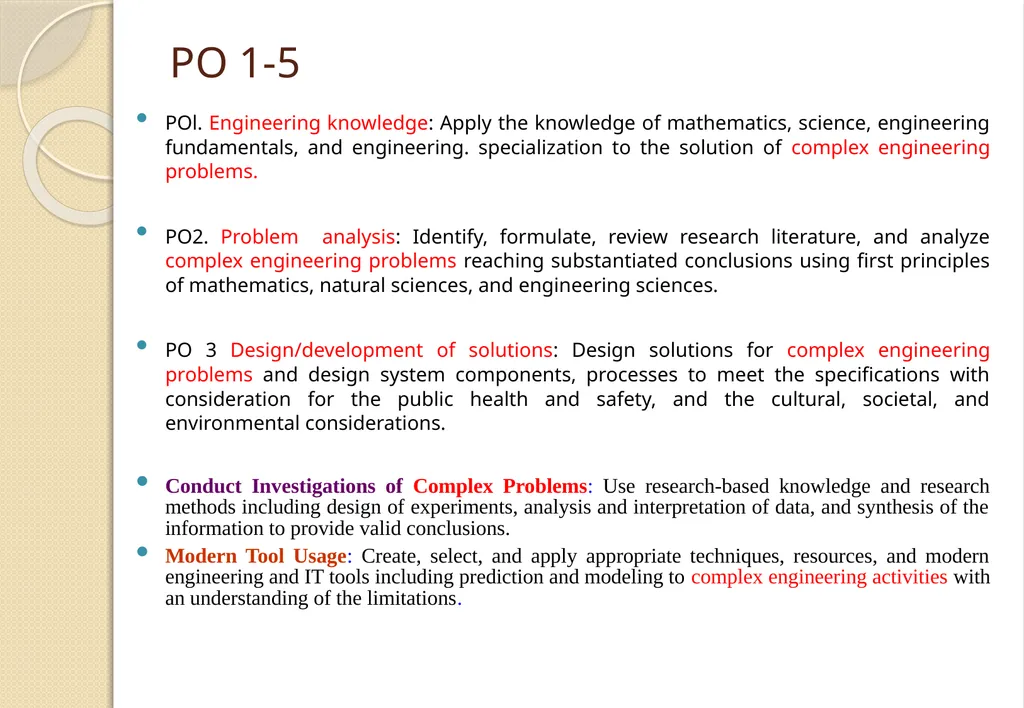
PO 1-5 POl. Engineering knowledge: Apply the knowledge of mathematics, science, engineering fundamentals, and engineering. specialization to the solution of complex engineering problems.
PO2. Problem analysis: Identify, formulate, review research literature, and analyze complex engineering problems reaching substantiated conclusions using first principles of mathematics, natural sciences, and engineering sciences.
PO 3 Design/development of solutions: Design solutions for complex engineering problems and design system components, processes to meet the specifications with consideration for the public health and safety, and the cultural, societal, and environmental considerations.
Conduct Investigations of Complex Problems: Use research-based knowledge and research methods including design of experiments, analysis and interpretation of data, and synthesis of the information to provide valid conclusions.
Modern Tool Usage: Create, select, and apply appropriate techniques, resources, and modern engineering and IT tools including prediction and modeling to complex engineering activities with an understanding of the limitations.<br>
PO2. Problem analysis: Identify, formulate, review research literature, and analyze complex engineering problems reaching substantiated conclusions using first principles of mathematics, natural sciences, and engineering sciences.
PO 3 Design/development of solutions: Design solutions for complex engineering problems and design system components, processes to meet the specifications with consideration for the public health and safety, and the cultural, societal, and environmental considerations.
Conduct Investigations of Complex Problems: Use research-based knowledge and research methods including design of experiments, analysis and interpretation of data, and synthesis of the information to provide valid conclusions.
Modern Tool Usage: Create, select, and apply appropriate techniques, resources, and modern engineering and IT tools including prediction and modeling to complex engineering activities with an understanding of the limitations.<br>
26
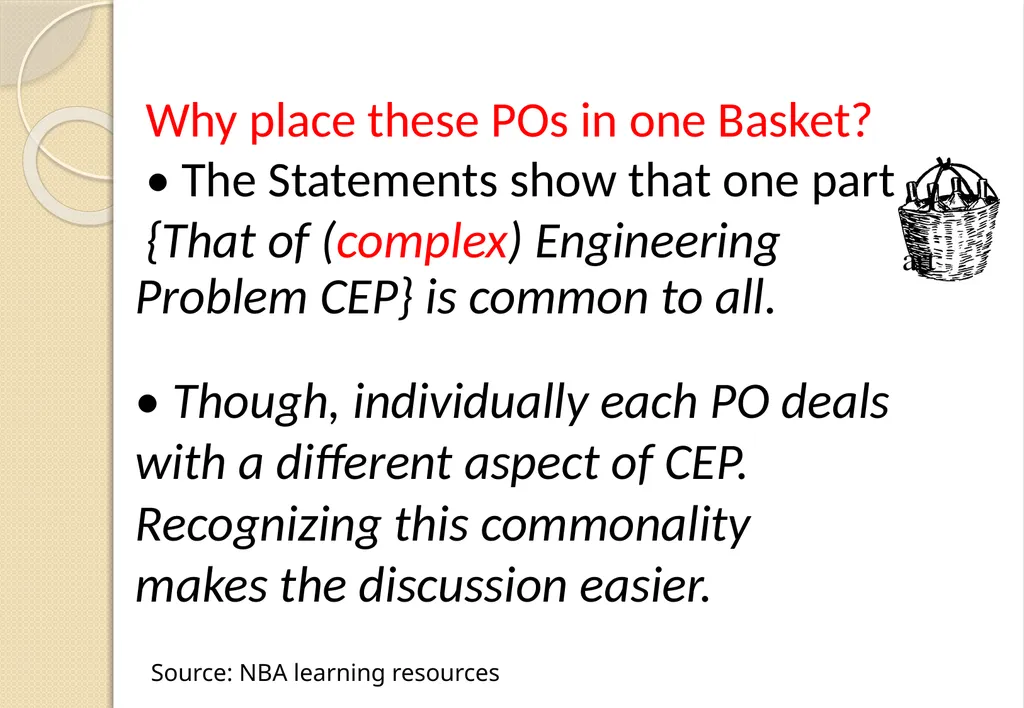
Why place these POs in one Basket?
• The Statements show that one part
{That of (complex) Engineering Problem CEP} is common to all.
• Though, individually each PO deals with a different aspect of CEP. Recognizing this commonality
makes the discussion easier. Source: NBA learning resources<br>
• The Statements show that one part
{That of (complex) Engineering Problem CEP} is common to all.
• Though, individually each PO deals with a different aspect of CEP. Recognizing this commonality
makes the discussion easier. Source: NBA learning resources<br>
27
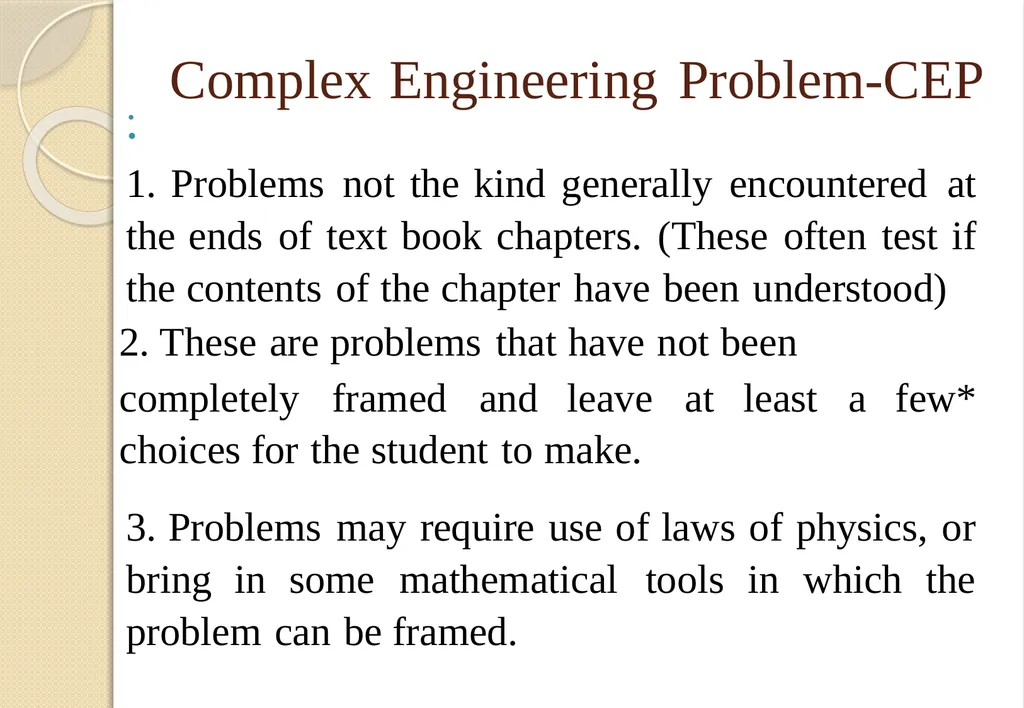
Complex Engineering Problem-CEP 1. Problems not the kind generally encountered at the ends of text book chapters. (These often test if the contents of the chapter have been understood)
2. These are problems that have not been
completely framed and leave at least a few* choices for the student to make.
3. Problems may require use of laws of physics, or bring in some mathematical tools in which the problem can be framed.<br>
2. These are problems that have not been
completely framed and leave at least a few* choices for the student to make.
3. Problems may require use of laws of physics, or bring in some mathematical tools in which the problem can be framed.<br>
28
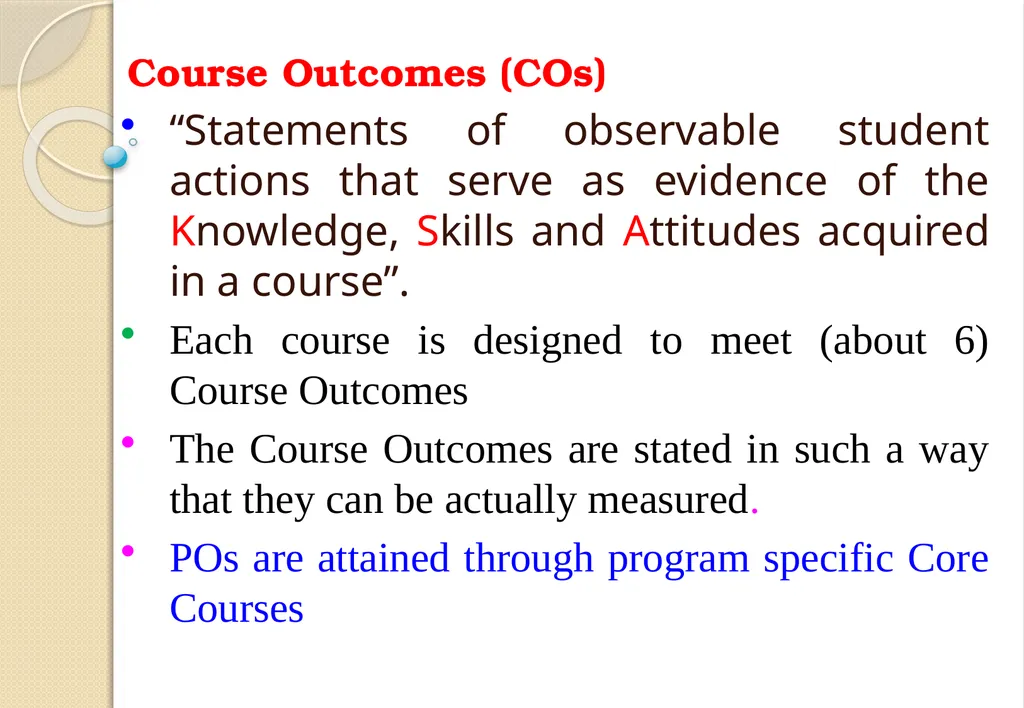
Course Outcomes (COs) “Statements of observable student actions that serve as evidence of the Knowledge, Skills and Attitudes acquired in a course”.
Each course is designed to meet (about 6) Course Outcomes
The Course Outcomes are stated in such a way that they can be actually measured.
POs are attained through program specific Core Courses<br>
Each course is designed to meet (about 6) Course Outcomes
The Course Outcomes are stated in such a way that they can be actually measured.
POs are attained through program specific Core Courses<br>
29
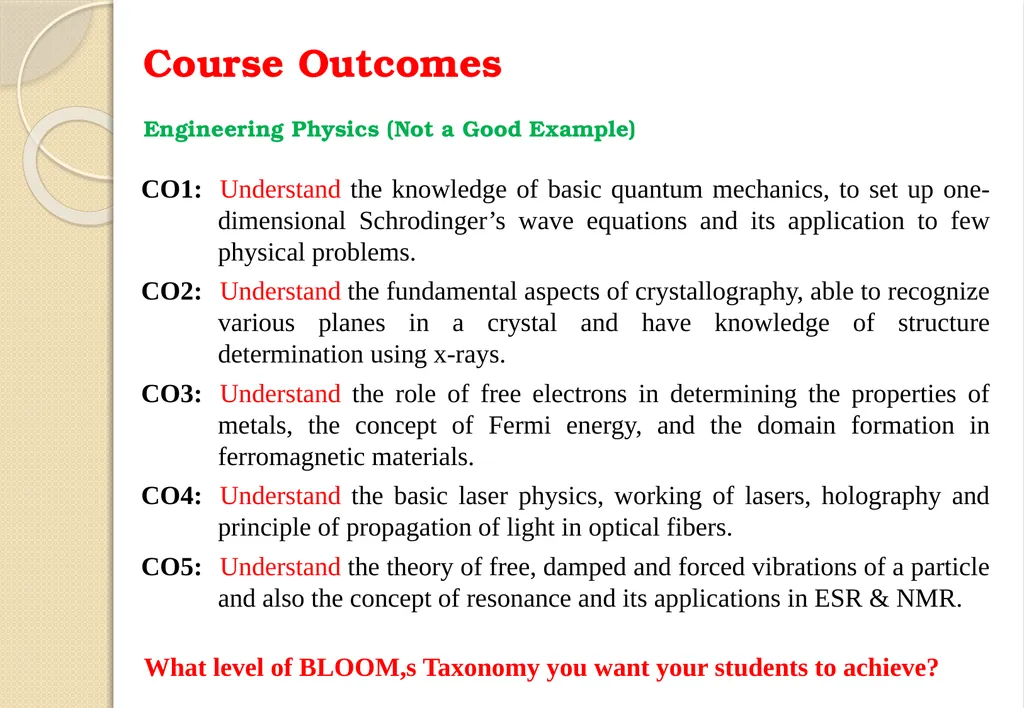
Course Outcomes Engineering Physics (Not a Good Example)
CO1: Understand the knowledge of basic quantum mechanics, to set up one-dimensional Schrodinger’s wave equations and its application to few physical problems.
CO2: Understand the fundamental aspects of crystallography, able to recognize various planes in a crystal and have knowledge of structure determination using x-rays.
CO3: Understand the role of free electrons in determining the properties of metals, the concept of Fermi energy, and the domain formation in ferromagnetic materials.
CO4: Understand the basic laser physics, working of lasers, holography and principle of propagation of light in optical fibers.
CO5: Understand the theory of free, damped and forced vibrations of a particle and also the concept of resonance and its applications in ESR & NMR.
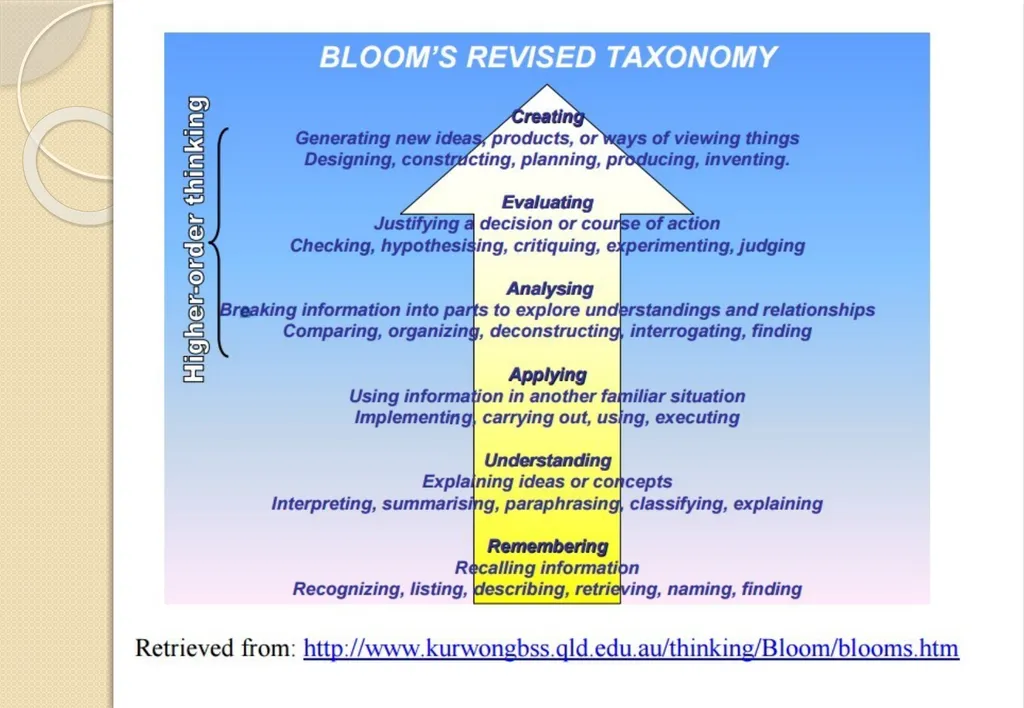
What level of BLOOM,s Taxonomy you want your students to achieve?<br>
CO1: Understand the knowledge of basic quantum mechanics, to set up one-dimensional Schrodinger’s wave equations and its application to few physical problems.
CO2: Understand the fundamental aspects of crystallography, able to recognize various planes in a crystal and have knowledge of structure determination using x-rays.
CO3: Understand the role of free electrons in determining the properties of metals, the concept of Fermi energy, and the domain formation in ferromagnetic materials.
CO4: Understand the basic laser physics, working of lasers, holography and principle of propagation of light in optical fibers.
CO5: Understand the theory of free, damped and forced vibrations of a particle and also the concept of resonance and its applications in ESR & NMR.
What level of BLOOM,s Taxonomy you want your students to achieve?<br>
30
Comparison<br>
31
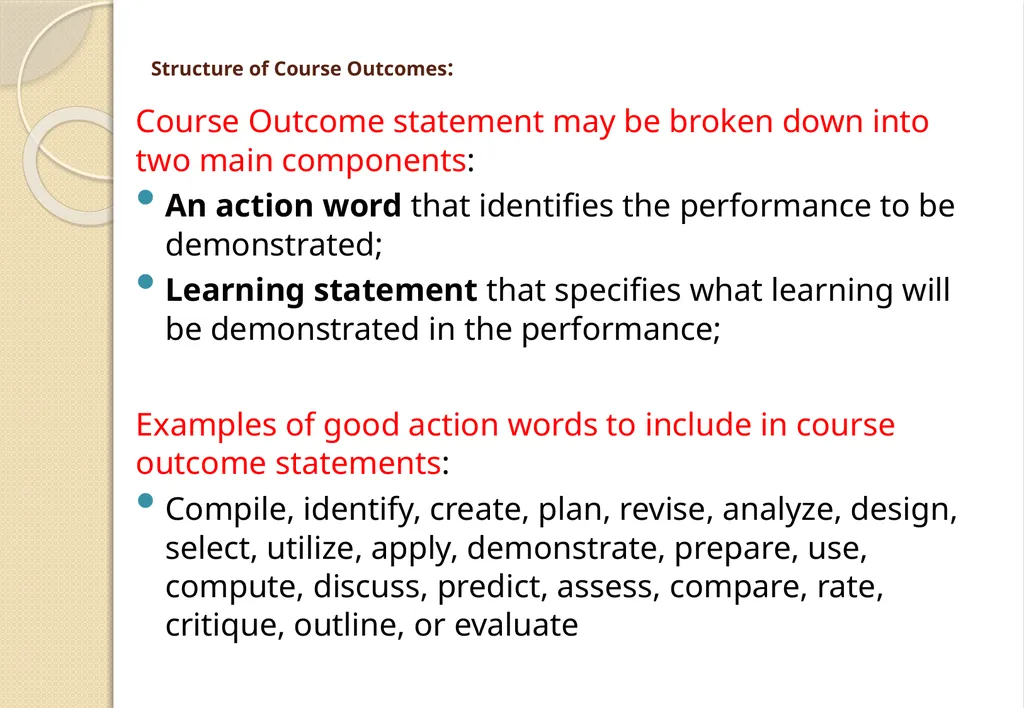
Structure of Course Outcomes: Course Outcome statement may be broken down into two main components:
An action word that identifies the performance to be demonstrated;
Learning statement that specifies what learning will be demonstrated in the performance;
Examples of good action words to include in course outcome statements:
Compile, identify, create, plan, revise, analyze, design, select, utilize, apply, demonstrate, prepare, use, compute, discuss, predict, assess, compare, rate, critique, outline, or evaluate<br>
An action word that identifies the performance to be demonstrated;
Learning statement that specifies what learning will be demonstrated in the performance;
Examples of good action words to include in course outcome statements:
Compile, identify, create, plan, revise, analyze, design, select, utilize, apply, demonstrate, prepare, use, compute, discuss, predict, assess, compare, rate, critique, outline, or evaluate<br>
32
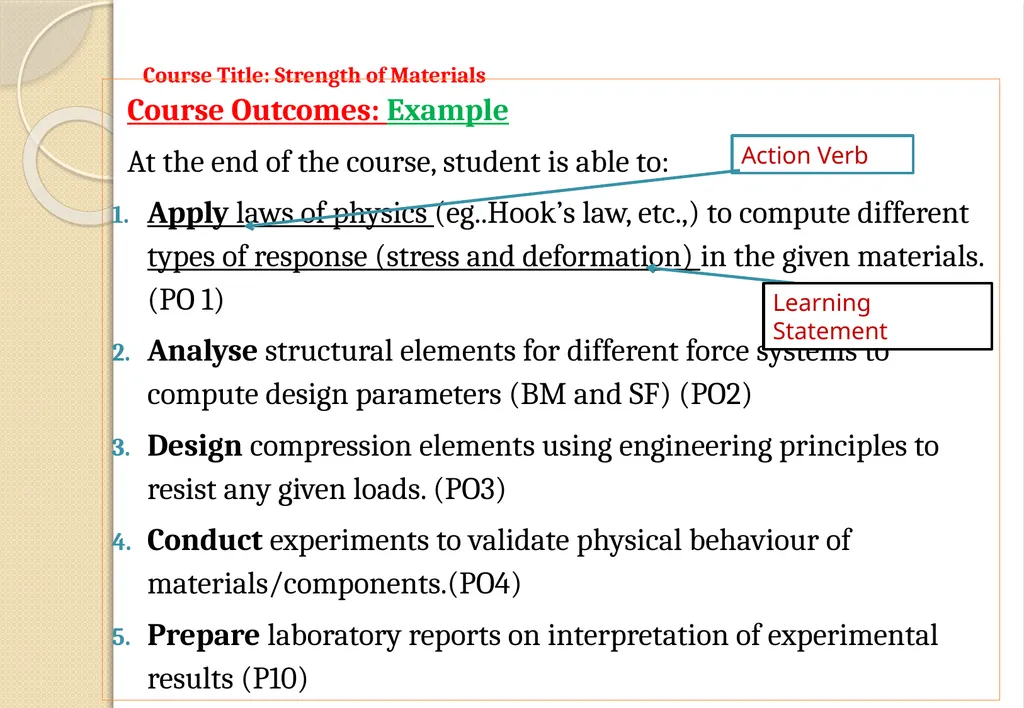
Course Title: Strength of Materials Course Outcomes: Example
At the end of the course, student is able to:
Apply laws of physics (eg..Hook’s law, etc.,) to compute different types of response (stress and deformation) in the given materials. (PO 1)
Analyse structural elements for different force systems to compute design parameters (BM and SF) (PO2)
Design compression elements using engineering principles to resist any given loads. (PO3)
Conduct experiments to validate physical behaviour of materials/components.(PO4)
Prepare laboratory reports on interpretation of experimental results (P10) Action Verb Learning Statement<br>
At the end of the course, student is able to:
Apply laws of physics (eg..Hook’s law, etc.,) to compute different types of response (stress and deformation) in the given materials. (PO 1)
Analyse structural elements for different force systems to compute design parameters (BM and SF) (PO2)
Design compression elements using engineering principles to resist any given loads. (PO3)
Conduct experiments to validate physical behaviour of materials/components.(PO4)
Prepare laboratory reports on interpretation of experimental results (P10) Action Verb Learning Statement<br>
33
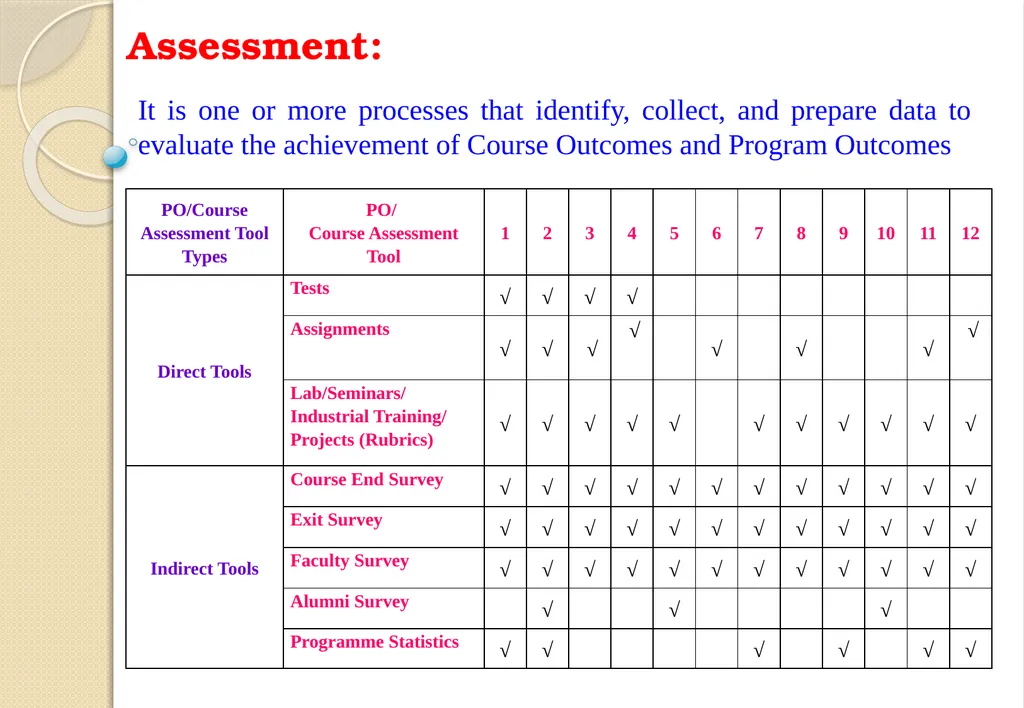
It is one or more processes that identify, collect, and prepare data to evaluate the achievement of Course Outcomes and Program Outcomes Assessment:<br>
34
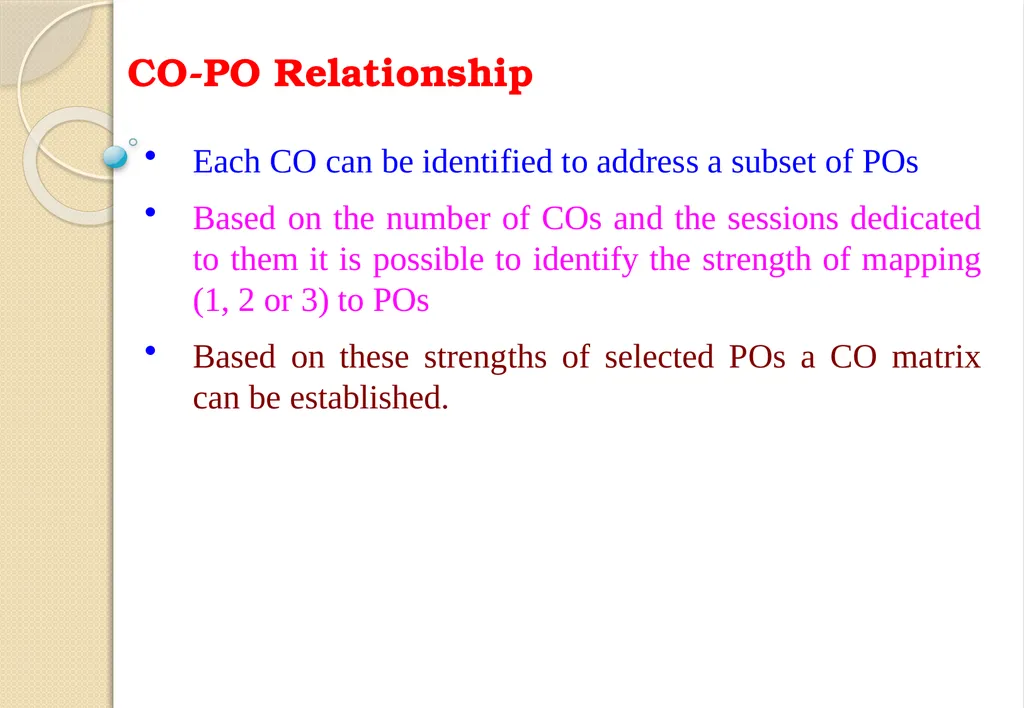
CO-PO Relationship Each CO can be identified to address a subset of POs
Based on the number of COs and the sessions dedicated to them it is possible to identify the strength of mapping (1, 2 or 3) to POs
Based on these strengths of selected POs a CO matrix can be established.<br>
Based on the number of COs and the sessions dedicated to them it is possible to identify the strength of mapping (1, 2 or 3) to POs
Based on these strengths of selected POs a CO matrix can be established.<br>
35
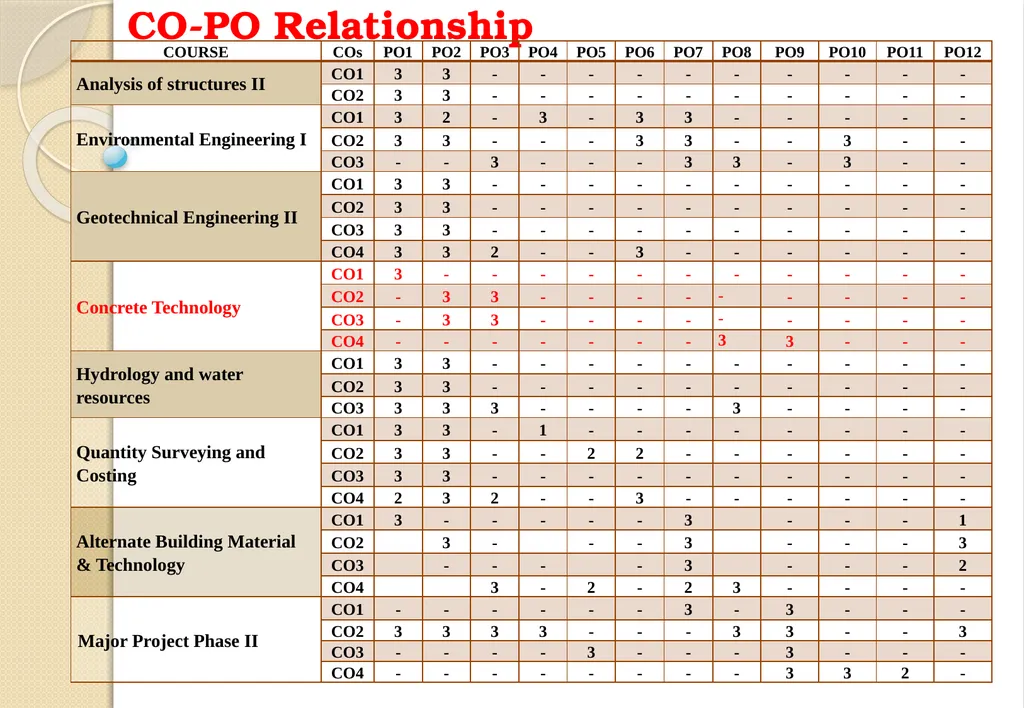
CO-PO Relationship<br>
36
Alignment of Assessment to COs and hence to POs…Example.<br>
37
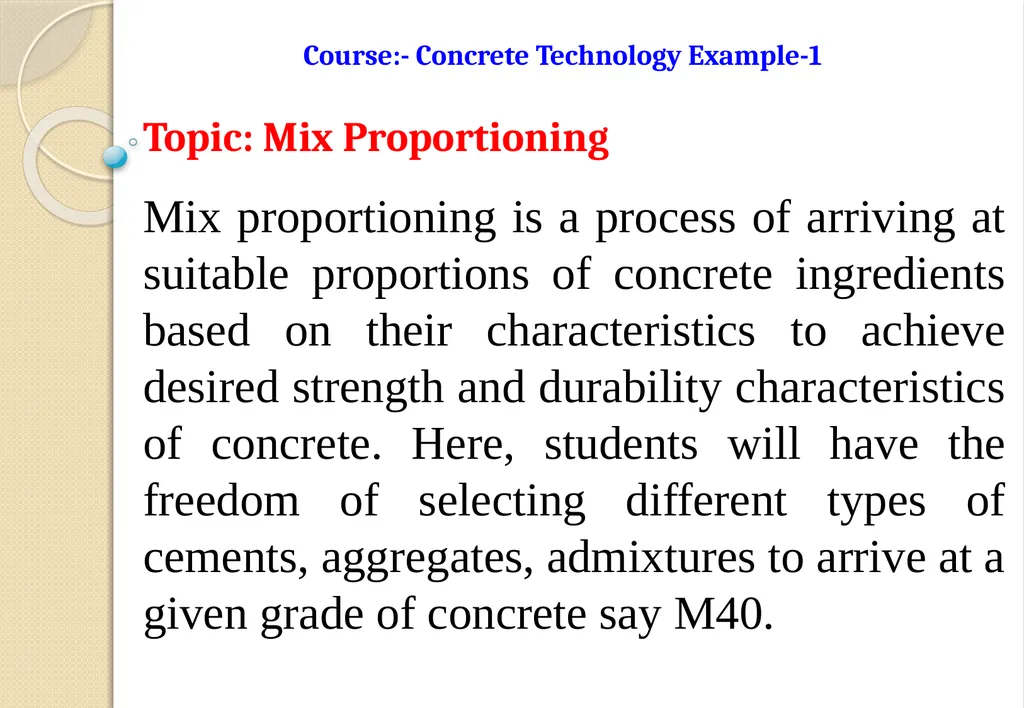
Course:- Concrete Technology Example-1 Topic: Mix Proportioning Mix proportioning is a process of arriving at suitable proportions of concrete ingredients based on their characteristics to achieve desired strength and durability characteristics of concrete. Here, students will have the freedom of selecting different types of cements, aggregates, admixtures to arrive at a given grade of concrete say M40.<br>
38
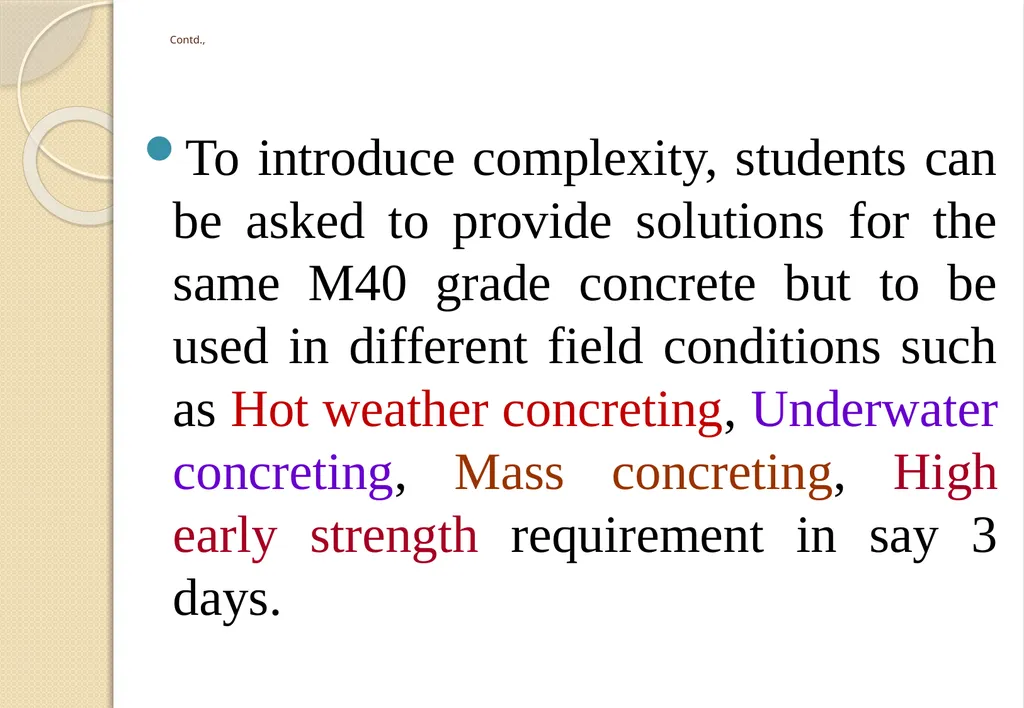
Contd., To introduce complexity, students can be asked to provide solutions for the same M40 grade concrete but to be used in different field conditions such as Hot weather concreting, Underwater concreting, Mass concreting, High early strength requirement in say 3 days.<br>
39
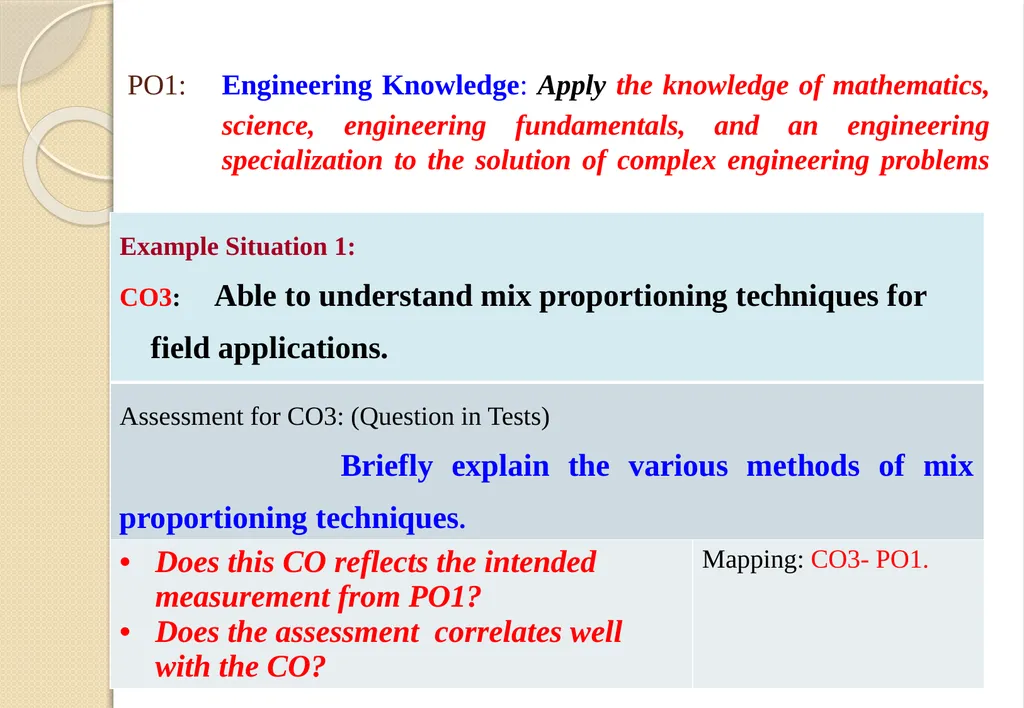
PO1: Engineering Knowledge: Apply the knowledge of mathematics, science, engineering fundamentals, and an engineering specialization to the solution of complex engineering problems<br>
40
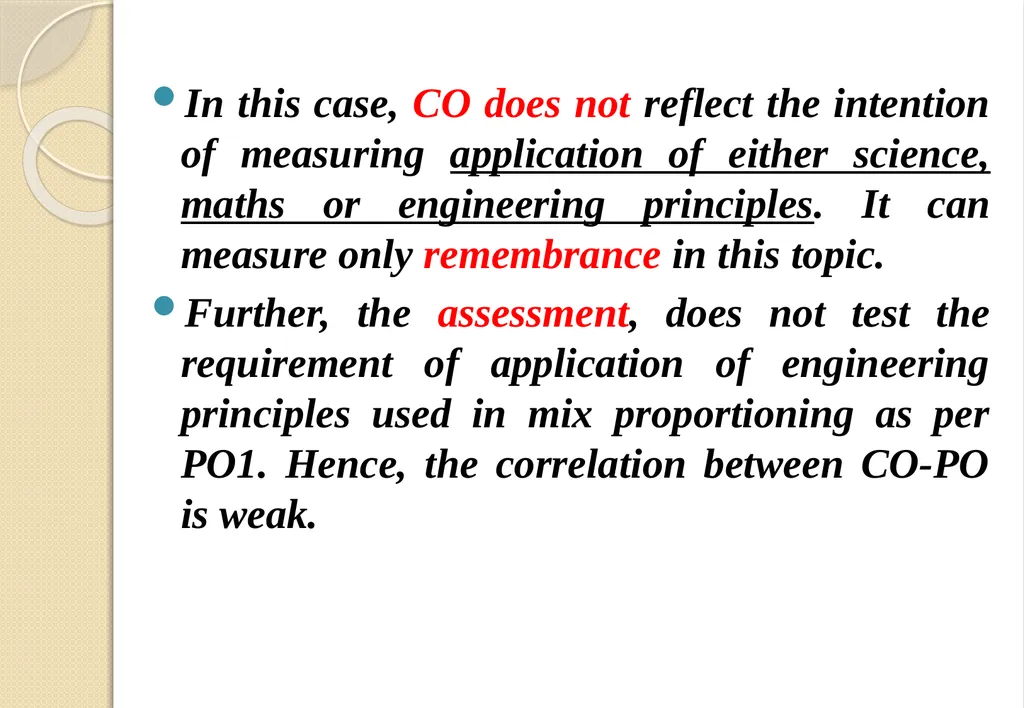
In this case, CO does not reflect the intention of measuring application of either science, maths or engineering principles. It can measure only remembrance in this topic.
Further, the assessment, does not test the requirement of application of engineering principles used in mix proportioning as per PO1. Hence, the correlation between CO-PO is weak.<br>
Further, the assessment, does not test the requirement of application of engineering principles used in mix proportioning as per PO1. Hence, the correlation between CO-PO is weak.<br>
41
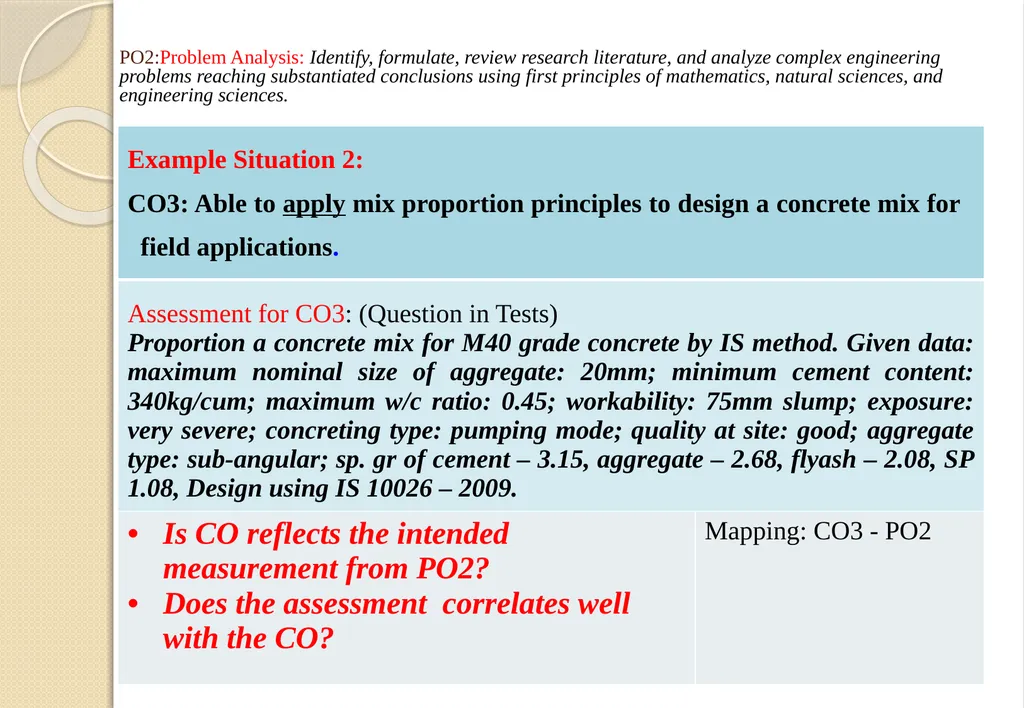
PO2:Problem Analysis: Identify, formulate, review research literature, and analyze complex engineering problems reaching substantiated conclusions using first principles of mathematics, natural sciences, and engineering sciences.<br>
42
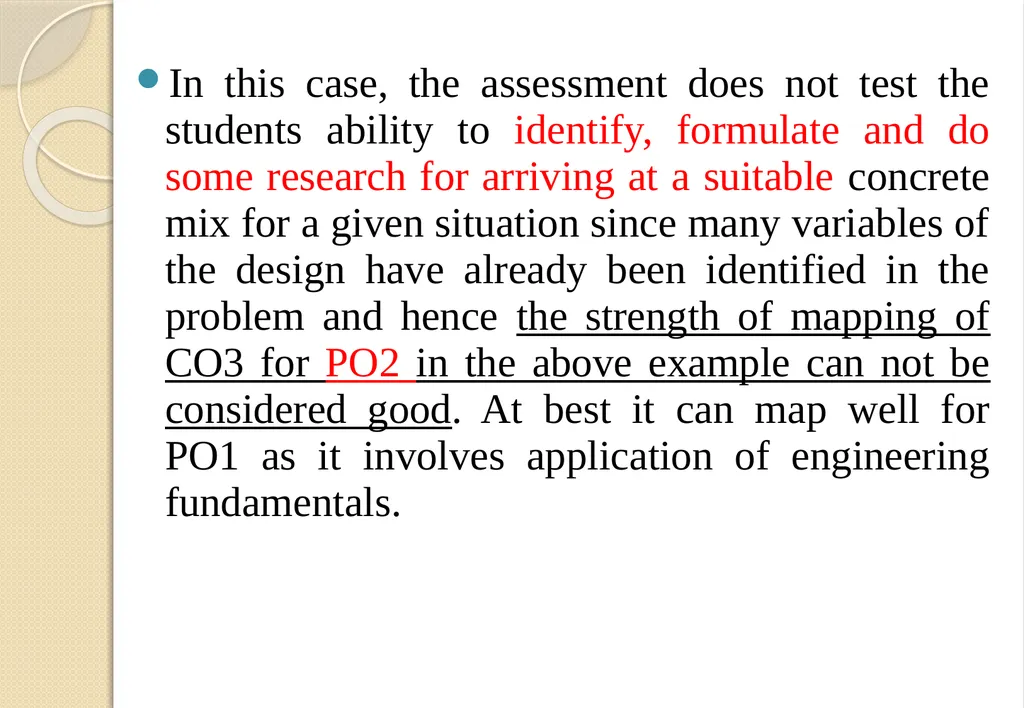
In this case, the assessment does not test the students ability to identify, formulate and do some research for arriving at a suitable concrete mix for a given situation since many variables of the design have already been identified in the problem and hence the strength of mapping of CO3 for PO2 in the above example can not be considered good. At best it can map well for PO1 as it involves application of engineering fundamentals.<br>
43
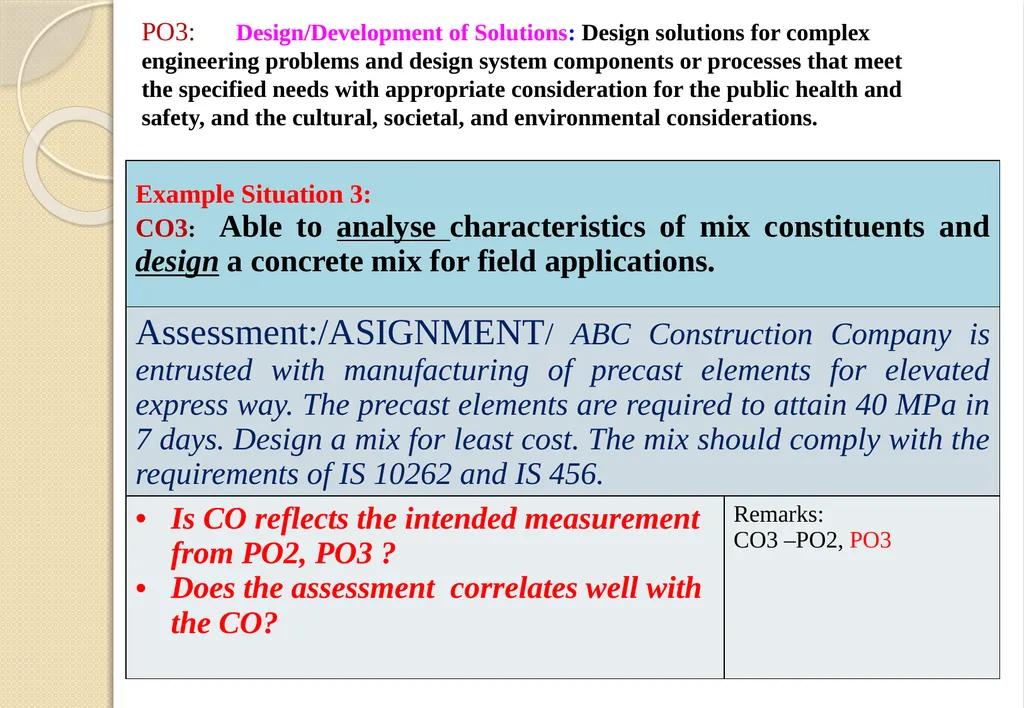
PO3: Design/Development of Solutions: Design solutions for complex engineering problems and design system components or processes that meet the specified needs with appropriate consideration for the public health and safety, and the cultural, societal, and environmental considerations.<br>
44
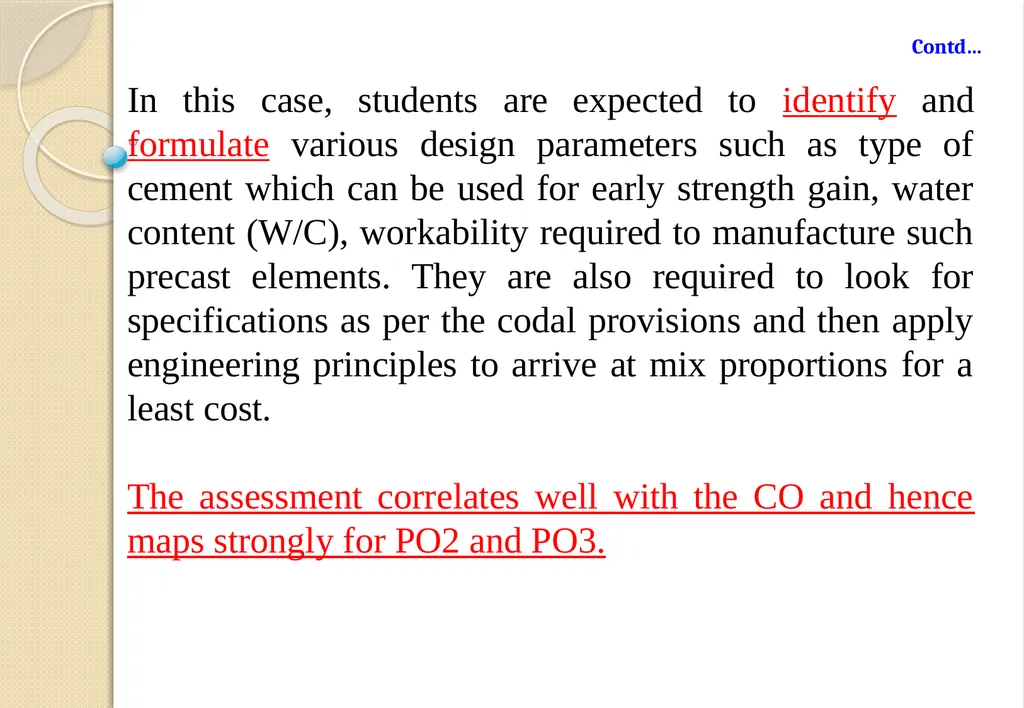
Contd… In this case, students are expected to identify and formulate various design parameters such as type of cement which can be used for early strength gain, water content (W/C), workability required to manufacture such precast elements. They are also required to look for specifications as per the codal provisions and then apply engineering principles to arrive at mix proportions for a least cost.
The assessment correlates well with the CO and hence maps strongly for PO2 and PO3.<br>
The assessment correlates well with the CO and hence maps strongly for PO2 and PO3.<br>
45
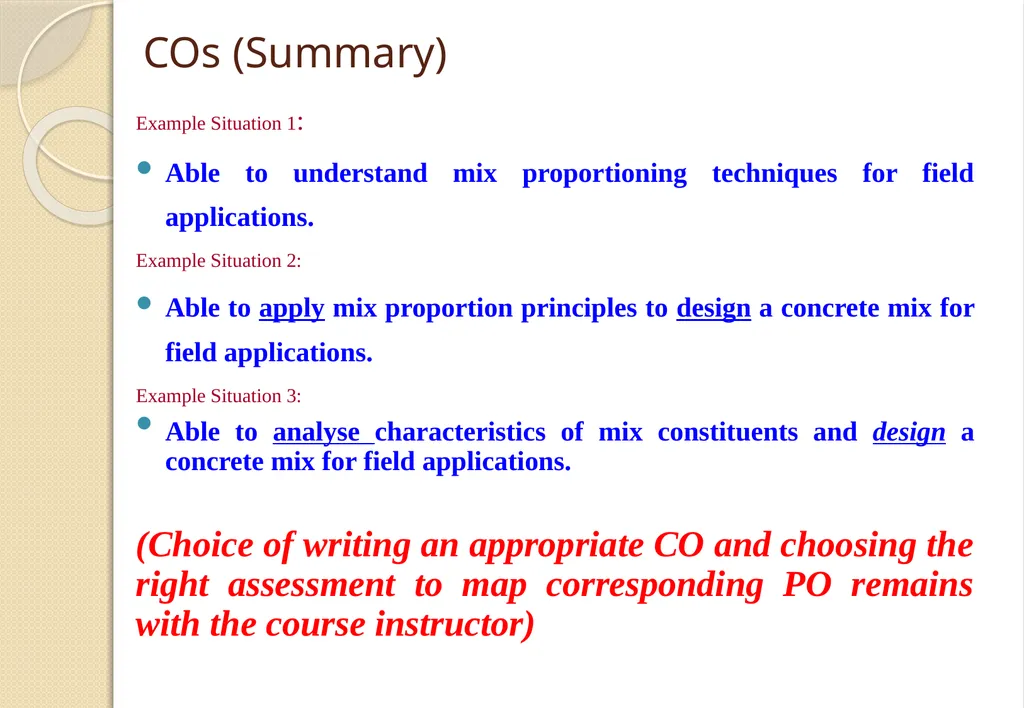
COs (Summary) Example Situation 1:
Able to understand mix proportioning techniques for field applications.
Example Situation 2:
Able to apply mix proportion principles to design a concrete mix for field applications.
Example Situation 3:
Able to analyse characteristics of mix constituents and design a concrete mix for field applications.
(Choice of writing an appropriate CO and choosing the right assessment to map corresponding PO remains with the course instructor)<br>
Able to understand mix proportioning techniques for field applications.
Example Situation 2:
Able to apply mix proportion principles to design a concrete mix for field applications.
Example Situation 3:
Able to analyse characteristics of mix constituents and design a concrete mix for field applications.
(Choice of writing an appropriate CO and choosing the right assessment to map corresponding PO remains with the course instructor)<br>
46
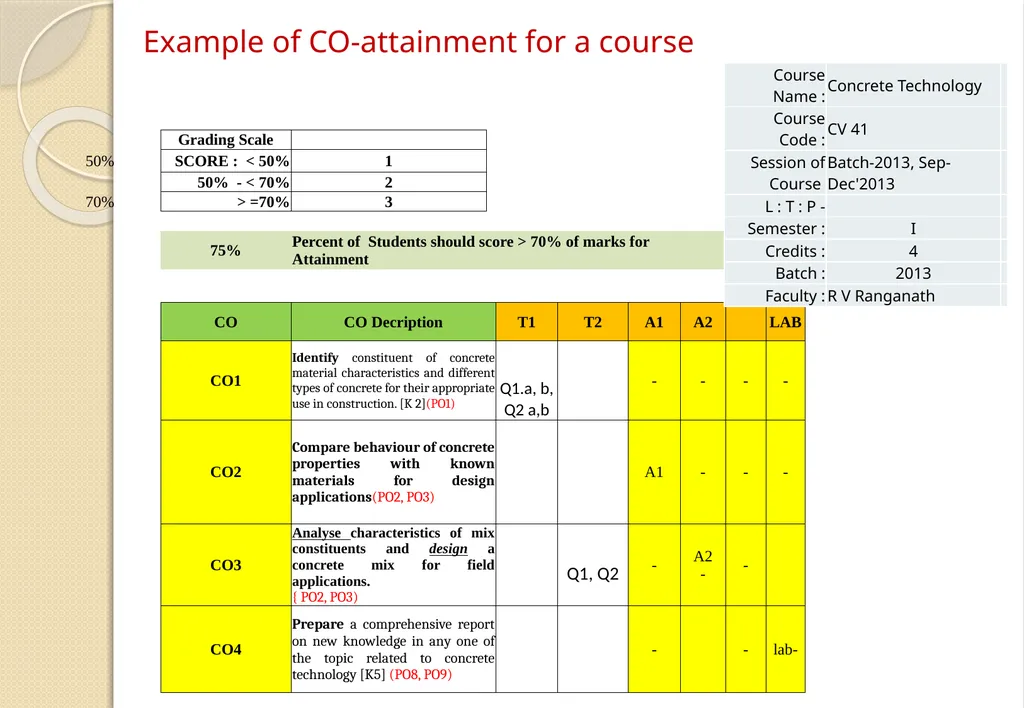
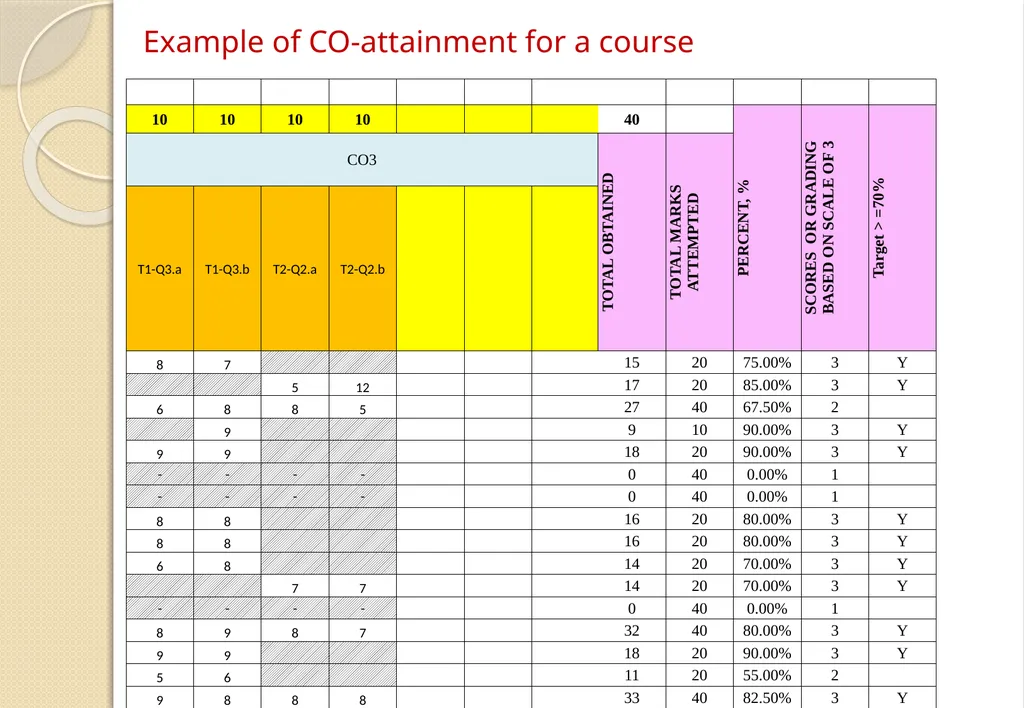
Example of CO-attainment for a course<br>
47
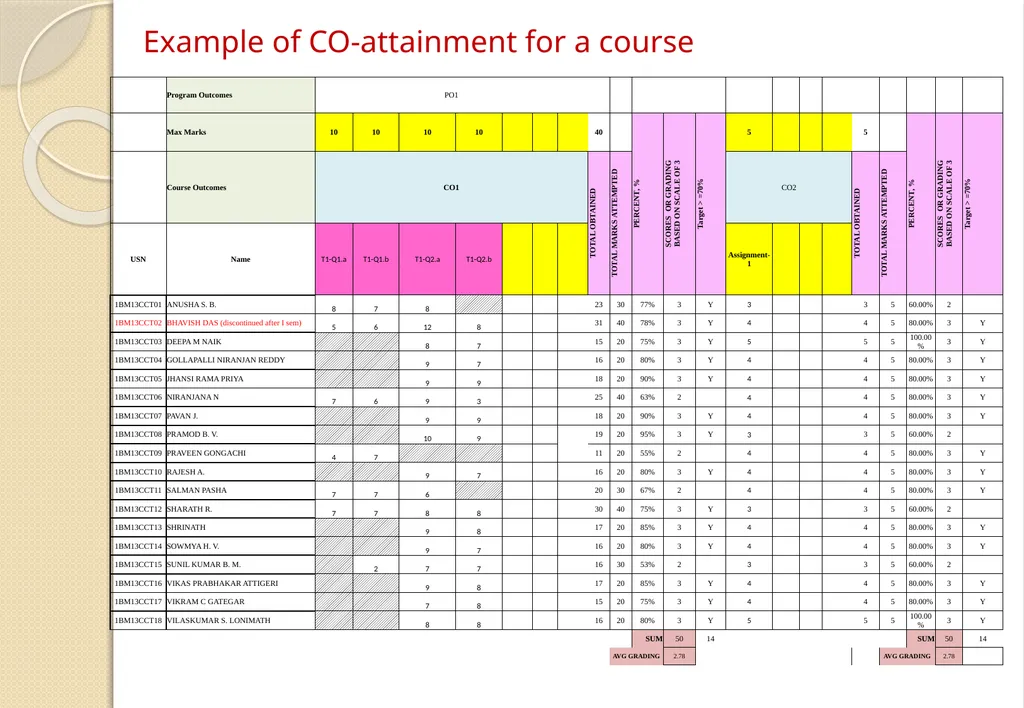
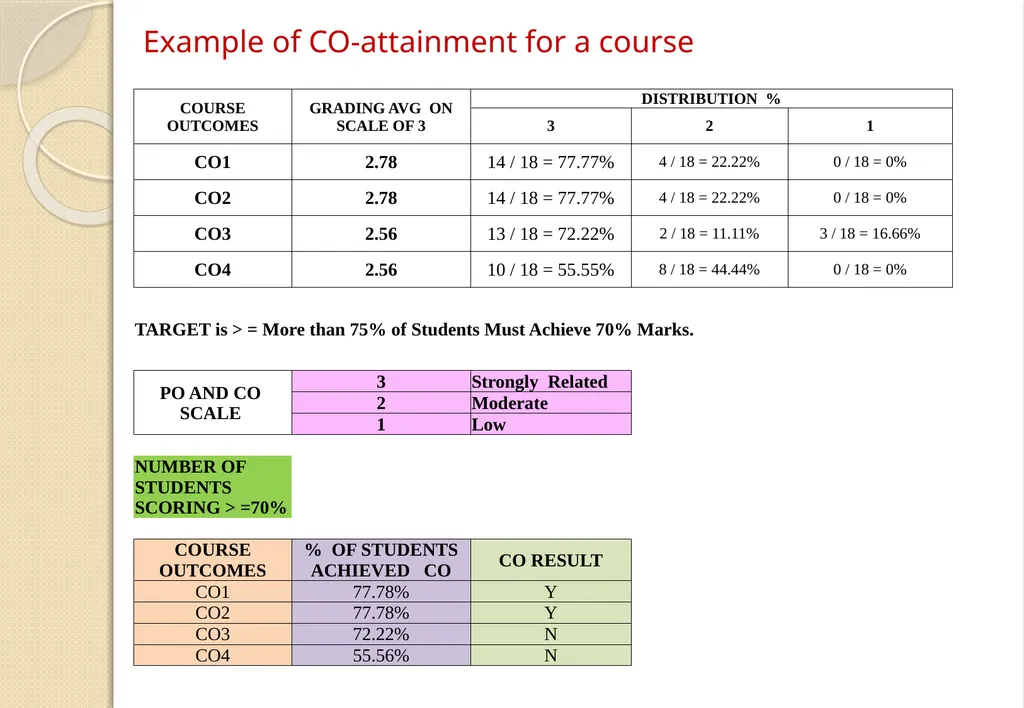
Example of CO-attainment for a course<br>
48
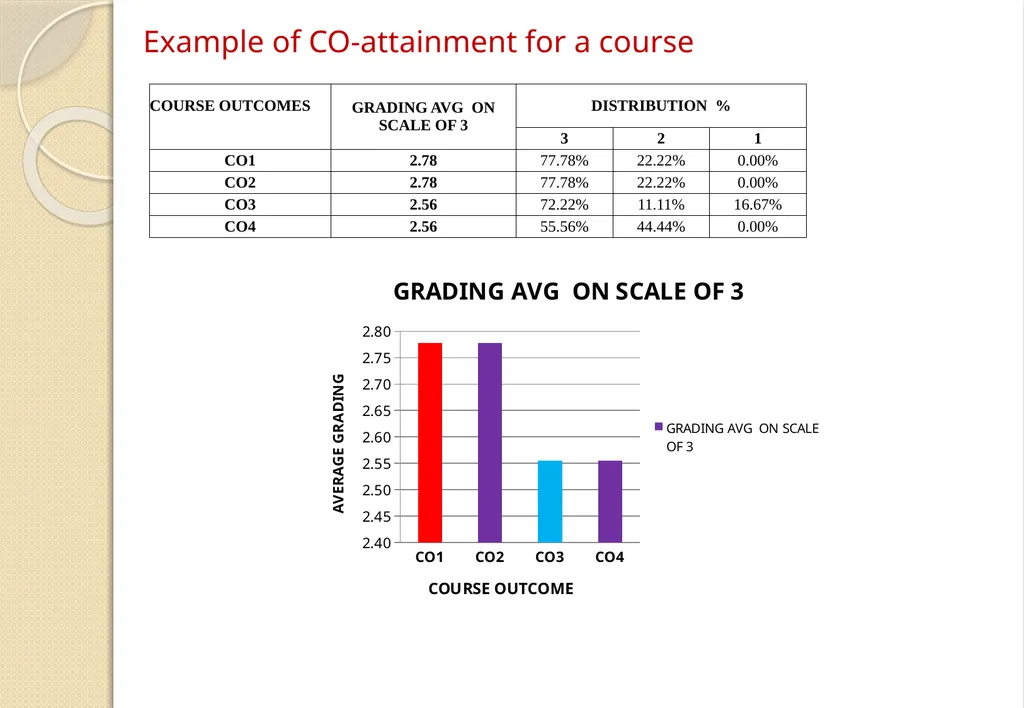
Example of CO-attainment for a course<br>
49
Example of CO-attainment for a course<br>
50
Example of CO-attainment for a course<br>
51
CO Attainment The assessments should be in alignment with the COs
Question paper should be so set to assess all COs
The average marks obtained in assessments against items for each CO will indicate the CO attainment.
Instructors can set targets for each CO of his/her course.
Attainment gaps can therefore be identified.
Instructor can plan to reduce the attainment gaps or enhance attainment targets.<br>
Question paper should be so set to assess all COs
The average marks obtained in assessments against items for each CO will indicate the CO attainment.
Instructors can set targets for each CO of his/her course.
Attainment gaps can therefore be identified.
Instructor can plan to reduce the attainment gaps or enhance attainment targets.<br>
52
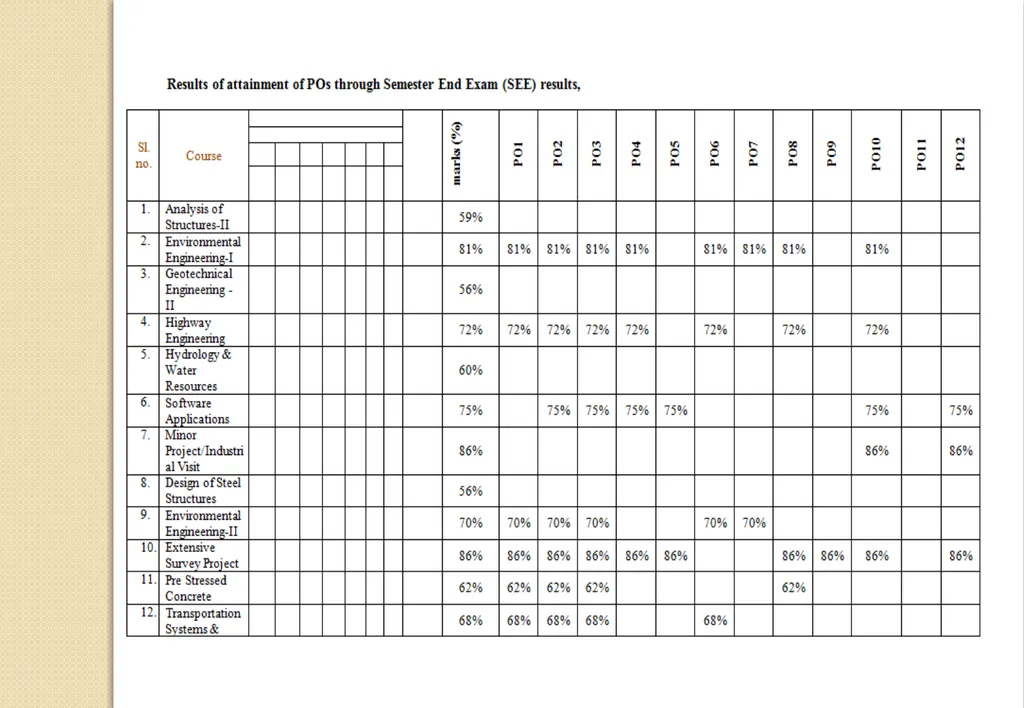
PO Attainment – Example..<br>
53
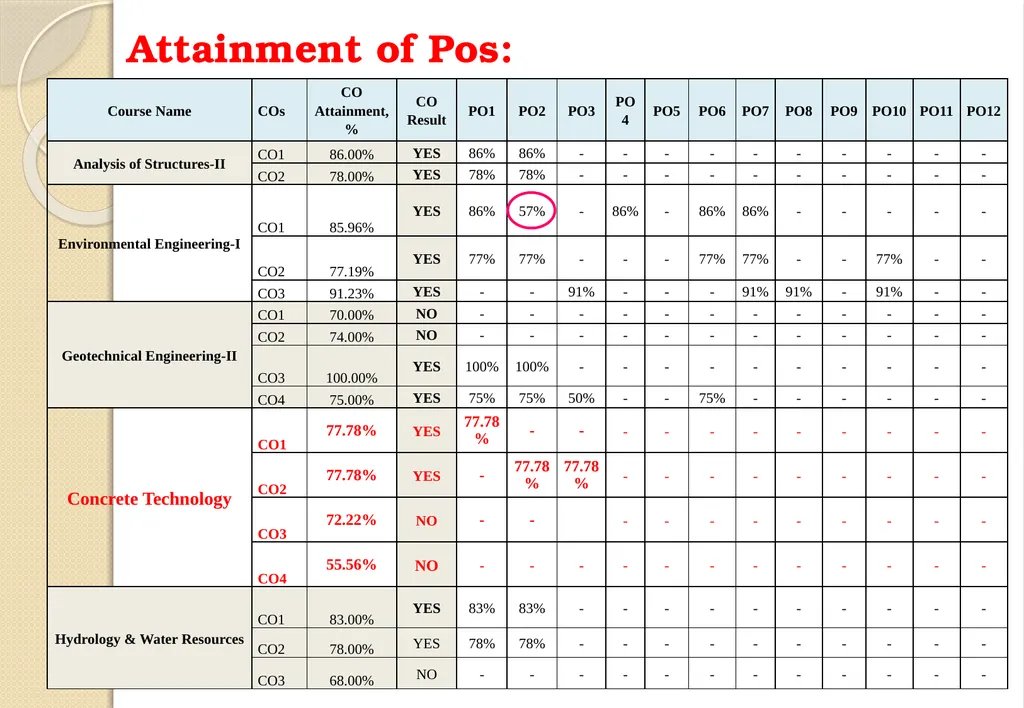
Attainment of Pos:<br>
54
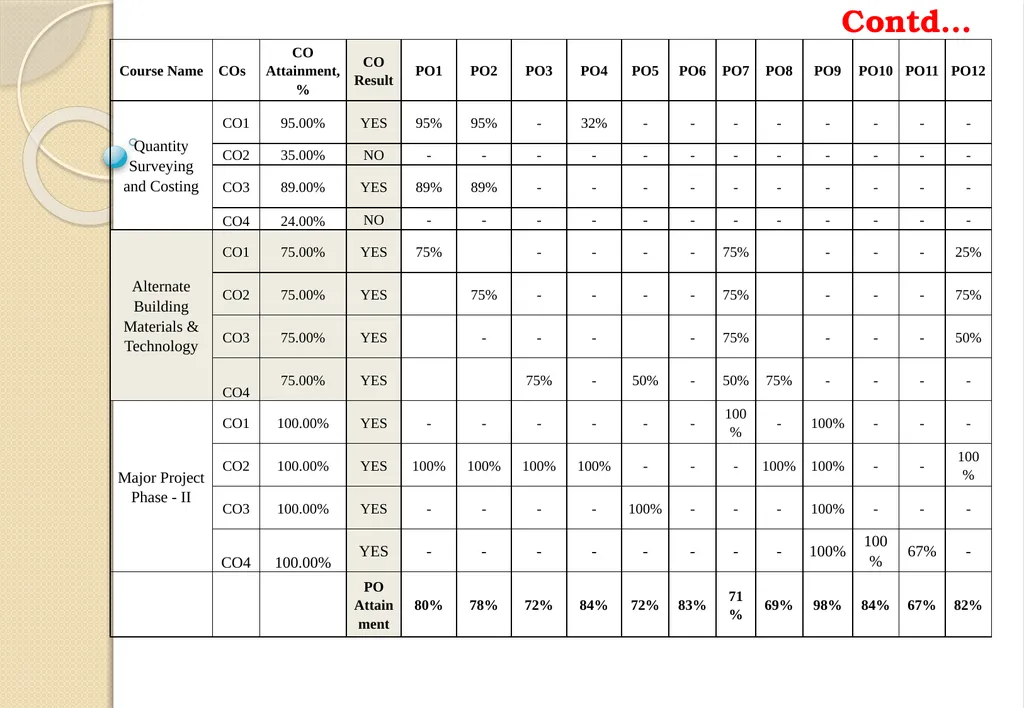
Contd…<br>
55
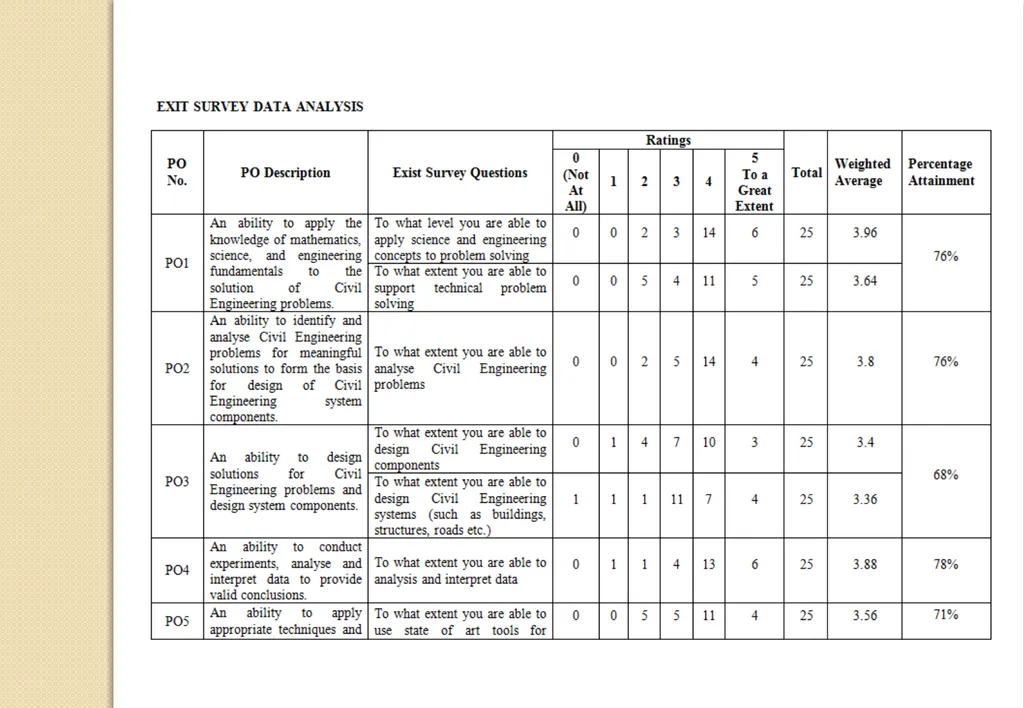
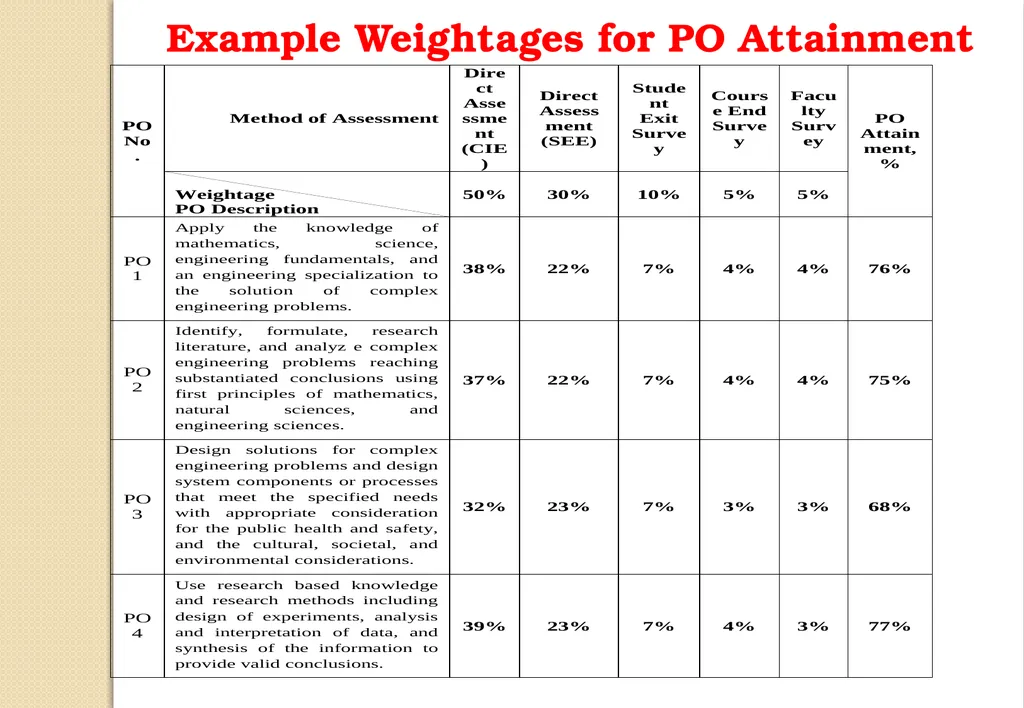
Example Weightages for PO Attainment<br>
56
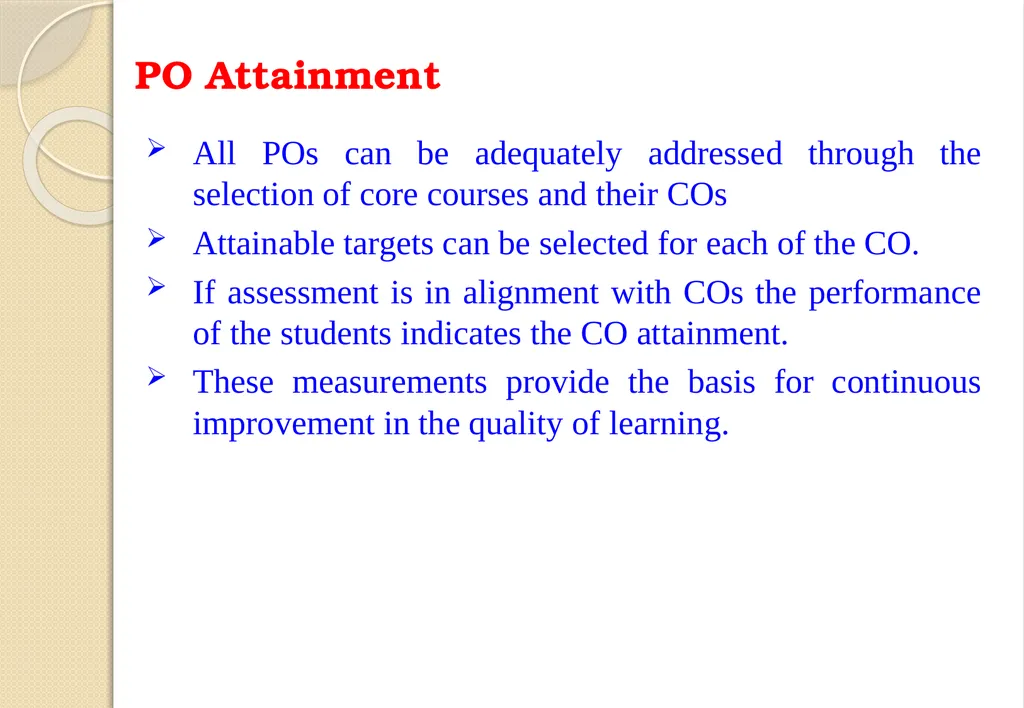
PO Attainment All POs can be adequately addressed through the selection of core courses and their COs
Attainable targets can be selected for each of the CO.
If assessment is in alignment with COs the performance of the students indicates the CO attainment.
These measurements provide the basis for continuous improvement in the quality of learning.<br>
Attainable targets can be selected for each of the CO.
If assessment is in alignment with COs the performance of the students indicates the CO attainment.
These measurements provide the basis for continuous improvement in the quality of learning.<br>
57
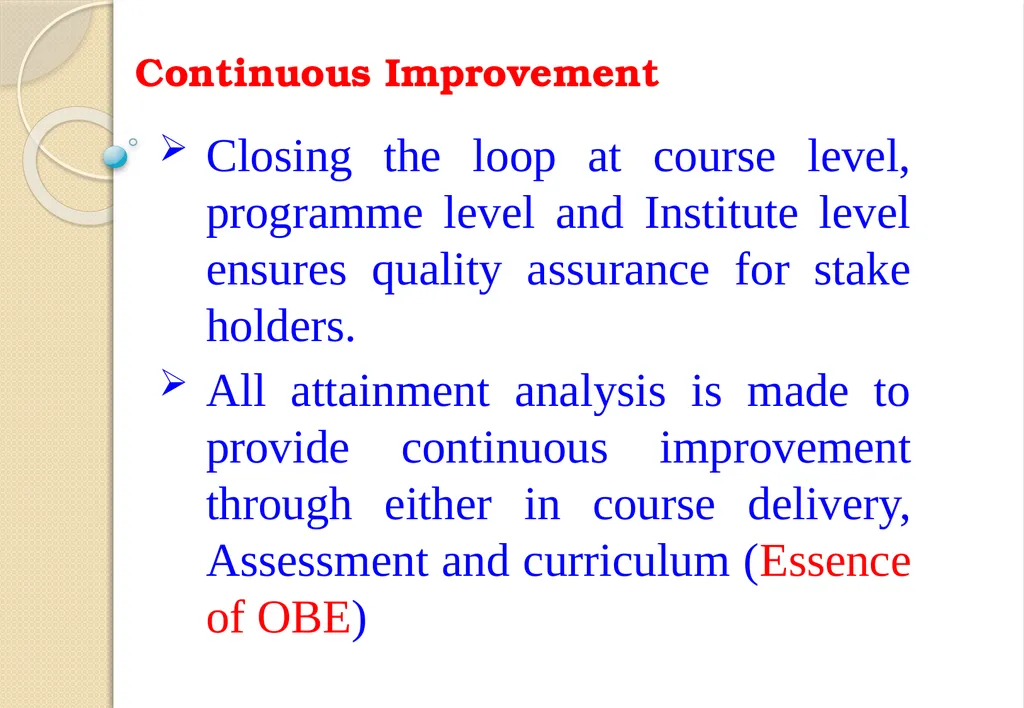
Continuous Improvement Closing the loop at course level, programme level and Institute level ensures quality assurance for stake holders.
All attainment analysis is made to provide continuous improvement through either in course delivery, Assessment and curriculum (Essence of OBE)<br>
All attainment analysis is made to provide continuous improvement through either in course delivery, Assessment and curriculum (Essence of OBE)<br>
58
THANK YOU 61<br>