Key Times and Full Centre Supervision For invigilators What are we covering today? What are Key Times? Why are Key Times important? Our Key Times information What is Full Centre Supervision? Full Centre Supervision staffing Full Centre
"Key Times and Full Centre Supervision For" is the property of its rightful owner. Permission is granted to
download and print the materials on this website for personal, non-commercial use only, and to display it
on your personal computer provided you do not modify the materials and that you retain all copyright
notices contained in the materials. By downloading content from our website, you accept the terms of this
agreement.
Presentation Transcript
01
Key Times and Full Centre Supervision For invigilators<br>
02
What are we covering today? What are Key Times?
Why are Key Times important?
Our Key Times information
What is Full Centre Supervision?
Full Centre Supervision staffing
Full Centre Supervision regulations
Key differences between Full Centre Supervision and exam conditions
Test your knowledge
Summary<br>
03
Cambridge Handbook www.cambridgeinternational.org/eoguide Key Times and Full Centre Supervision section Cambridge Handbook<br>
04
What are Key Times? Key Times are a defined time when candidates must be in the exam or under Full Centre Supervision. www.cambridgeinternational.org/keytimes Cambridge sets Key Times for different time zones to keep exams secure across the world.<br>
05
Why are Key Times important? Key Times stop confidential exam information from being shared:
with our candidates before their exams, or
by our candidates after their exams. Key Times make sure exams stay secure until everyone in the world has completed them. If a candidate finishes early and wants to leave the room before the Key Time, they need to be kept under Full Centre Supervision until the Key Time has passed.<br>
06
Our Key Times information We follow the Key Times set by Cambridge based on our centre’s location
We have morning and afternoon exam sessions and there is a Key Time for each one:
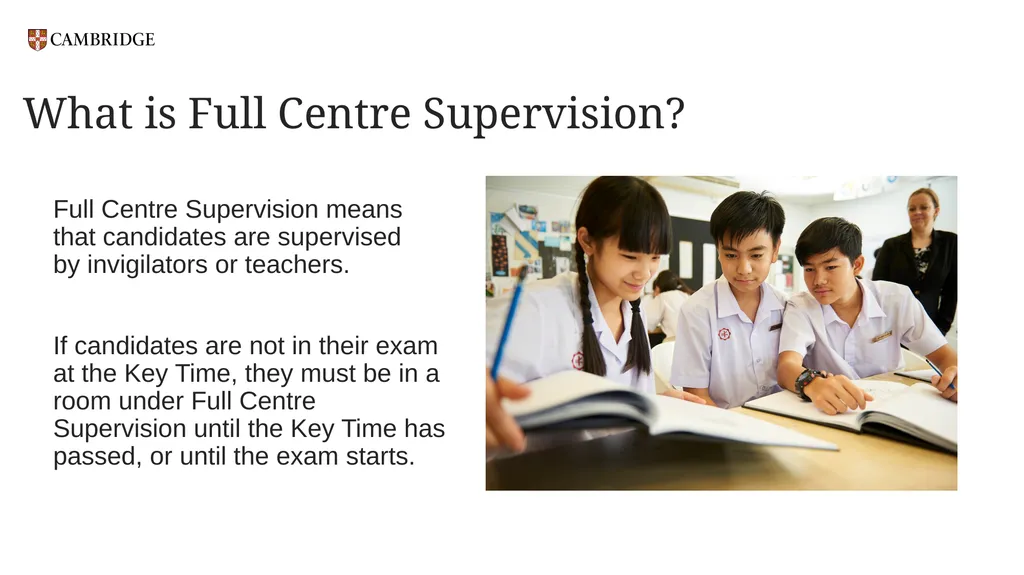
What is Full Centre Supervision? Full Centre Supervision means that candidates are supervised by invigilators or teachers. If candidates are not in their exam at the Key Time, they must be in a room under Full Centre Supervision until the Key Time has passed, or until the exam starts.<br>
08
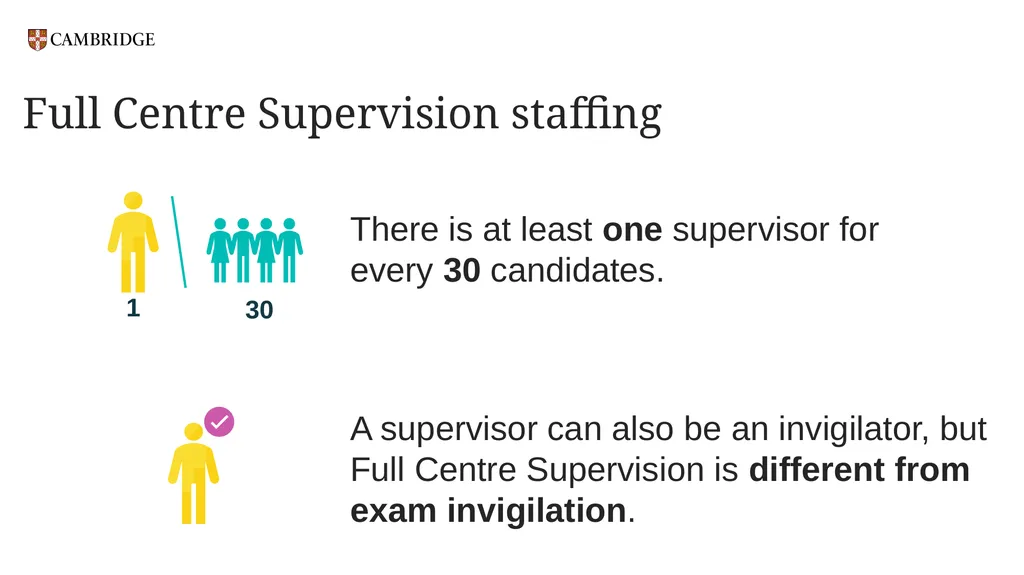
Full Centre Supervision staffing 30 There is at least one supervisor for every 30 candidates. 1 A supervisor can also be an invigilator, but Full Centre Supervision is different from exam invigilation.<br>
09
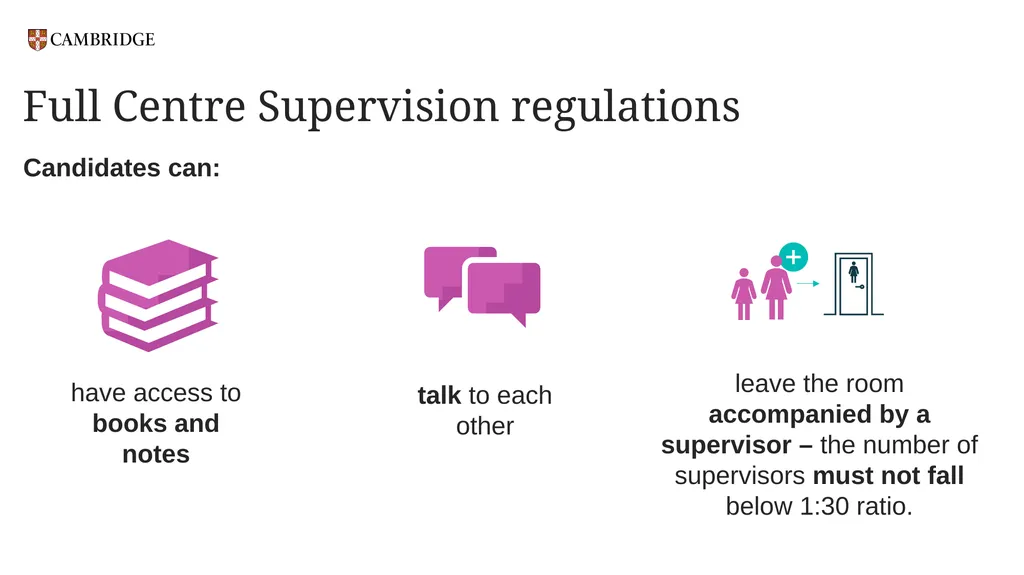
Full Centre Supervision regulations Candidates can: have access to books and notes talk to each other leave the room accompanied by a supervisor – the number of supervisors must not fall below 1:30 ratio.<br>
10
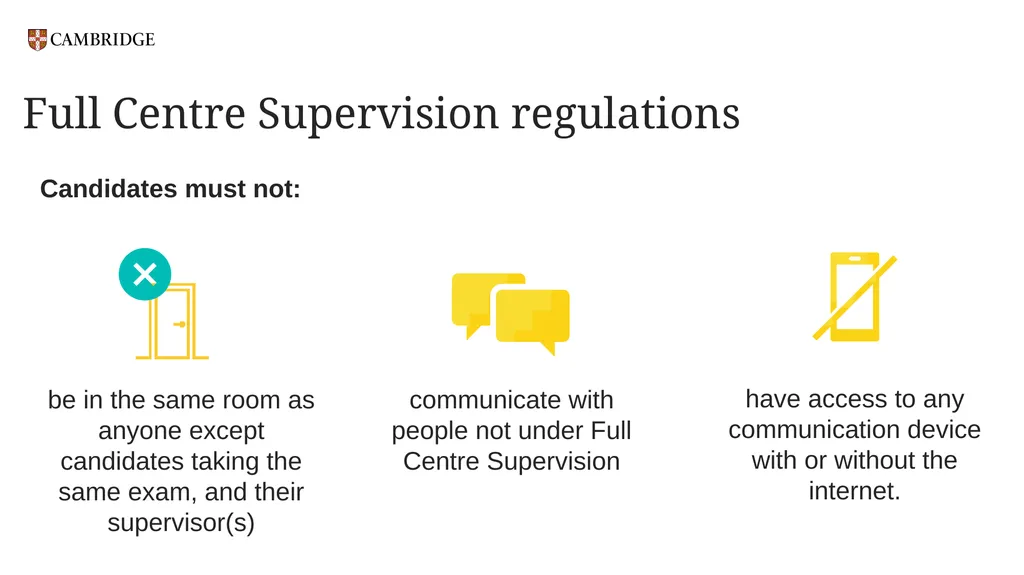
Full Centre Supervision regulations Candidates must not: communicate with people not under Full Centre Supervision have access to any communication device with or without the internet. be in the same room as anyone except candidates taking the same exam, and their supervisor(s)<br>
11
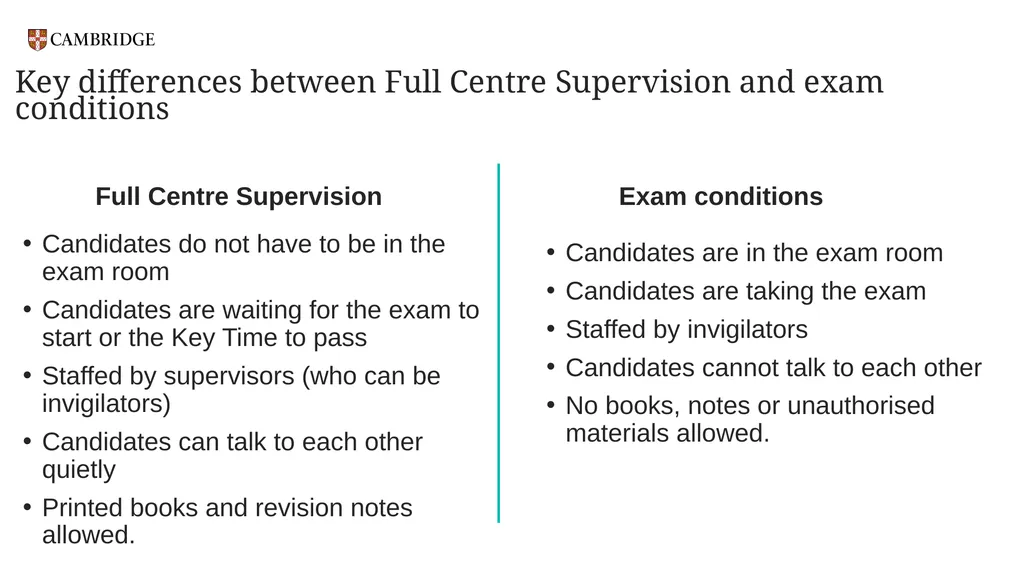
Key differences between Full Centre Supervision and exam conditions Candidates do not have to be in the exam room
Candidates are waiting for the exam to start or the Key Time to pass
Staffed by supervisors (who can be invigilators)
Candidates can talk to each other quietly
Printed books and revision notes allowed. Candidates are in the exam room
Candidates are taking the exam
Staffed by invigilators
Candidates cannot talk to each other
No books, notes or unauthorised materials allowed. Full Centre Supervision Exam conditions<br>
12
Test your knowledge Q1: What is a Key Time?
The earliest time candidates can start their exam.
The time when all scripts must be returned to Cambridge.
A defined time when candidates must be in the exam or under Full Centre Supervision.
The time the exam ends.
Q2: True or false – A candidate who finishes the exam early can leave before the Key Time if they don’t discuss the paper.<br>
13
Test your knowledge Q3: What is Full Centre Supervision?
When candidates revise together before an exam without supervision.
When candidates are not in their exam at the Key Time, they must be supervised until the Key Time has passed, or the exam starts.
When candidates cannot leave the centre until everyone has finished the exam.
When candidates are left alone in the exam room between exams.<br>
14
Test your knowledge Q4: During Full Centre Supervision, candidates must not:
Read revision notes.
Be in the same room as other candidates.
Talk to other candidates.
Have access to communication devices.
Q5: Which of these is allowed during Full Centre Supervision but not in exam conditions?
Mobile phone.
Printed books and notes.
Online revision apps.
Laptop.<br>
15
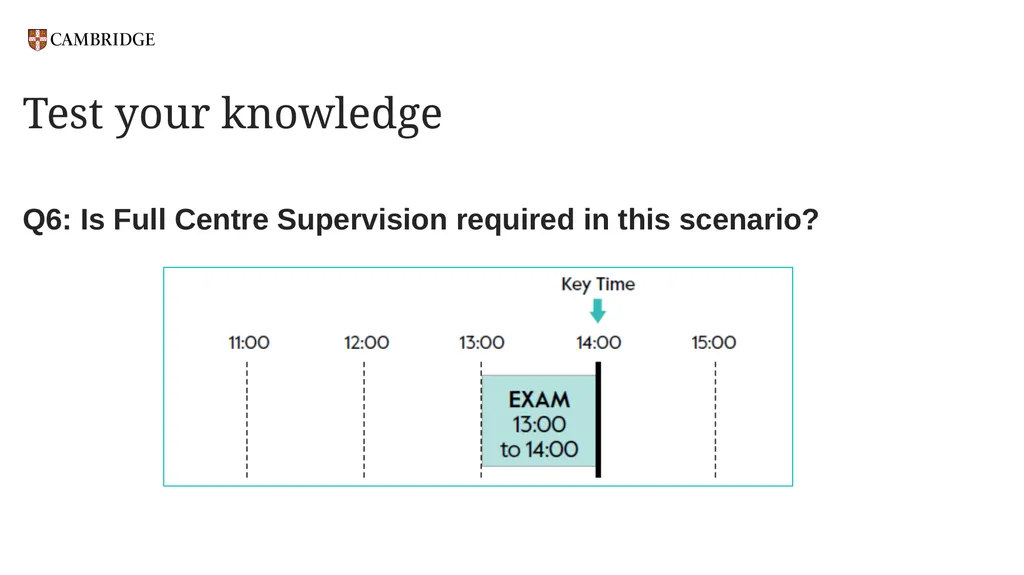
Test your knowledge Q6: Is Full Centre Supervision required in this scenario?<br>
16
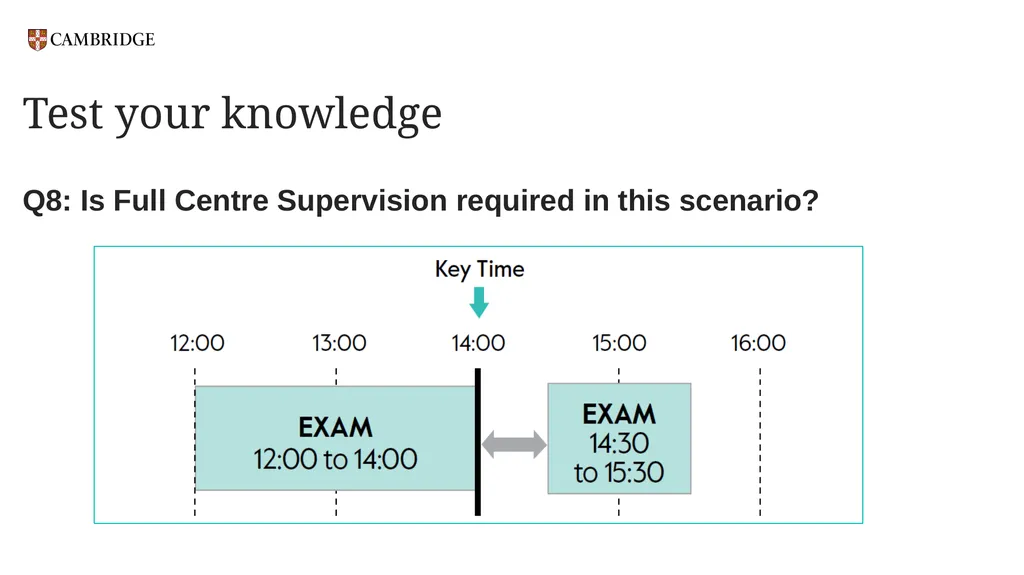
Test your knowledge Q7: Is Full Centre Supervision required in this scenario?<br>
17
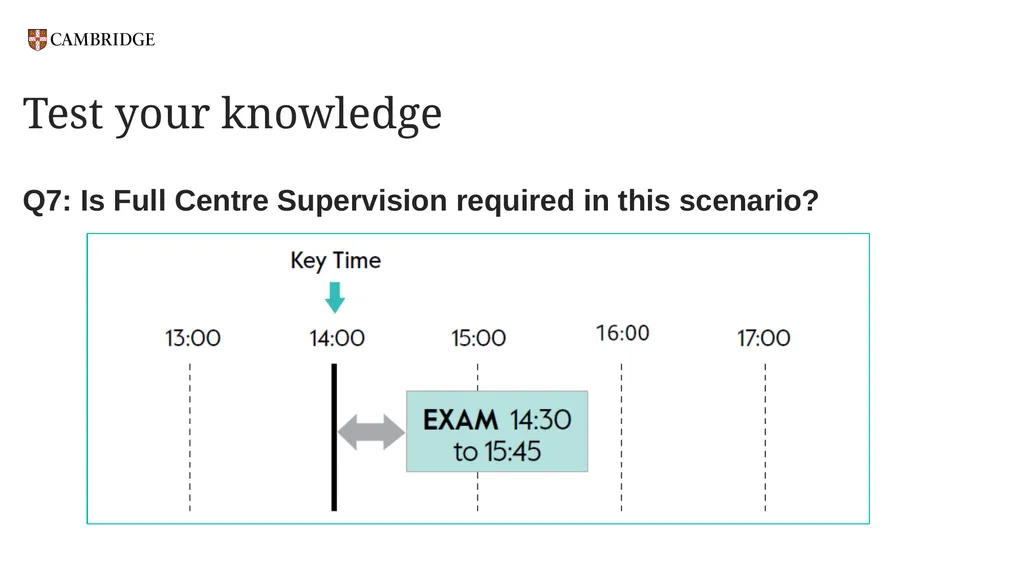
Test your knowledge Q8: Is Full Centre Supervision required in this scenario?<br>
18
Answers Q1: C. A defined time when candidates must be in the exam or under Full Centre Supervision.
Q2: False – Candidates who finish early must stay under Full Centre Supervision until the Key Time has passed.
Q3: B. When candidates are not in their exam at the Key Time, they must be supervised until the Key Time has passed, or the exam starts.
Q4: D. Have access to communication devices.
Q5: B. Printed books and notes.<br>
19
Answers Q6: The exam finishes at the Key Time, so candidates can leave the exam room after the exam and do not need Full Centre Supervision.
Q7: Full Centre Supervision is required because the exam starts after the Key Time. Therefore, it is possible that candidates in another part of the world have already taken the exam and could pass on information. Candidates must be supervised from 14:00 until the exam starts. After the exam, they do not need supervision.<br>
20
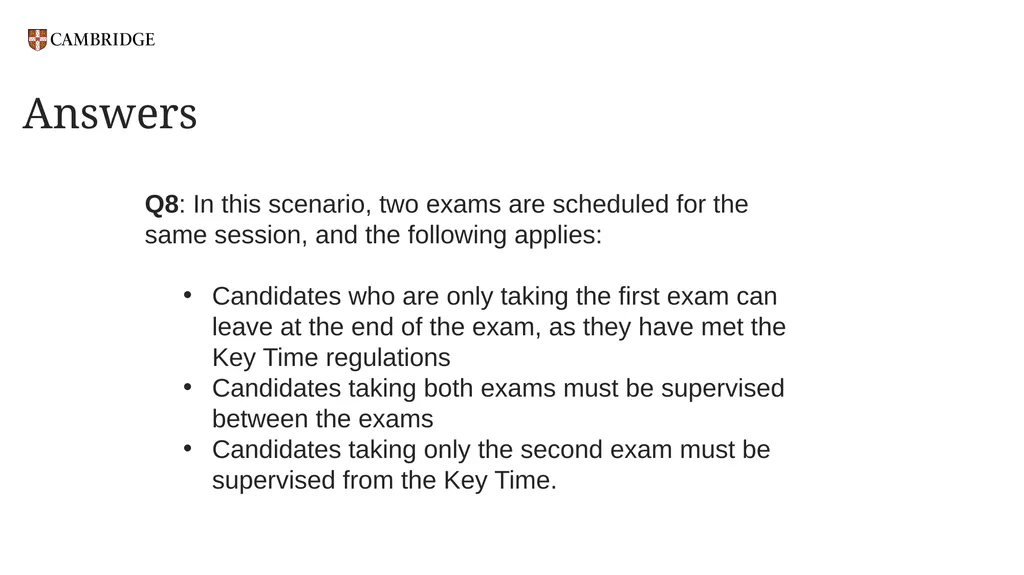
Answers Q8: In this scenario, two exams are scheduled for the same session, and the following applies:
Candidates who are only taking the first exam can leave at the end of the exam, as they have met the Key Time regulations
Candidates taking both exams must be supervised between the exams
Candidates taking only the second exam must be supervised from the Key Time.<br>
21
Key Times and Full Centre Supervision: A summary You are responsible for following the Key Times and Full Centre Supervision section of the Cambridge Handbook
Key Times help keep exams secure by preventing confidential exam information from being shared
If candidates are not in the exam at the Key Time, they must be in a room under Full Centre Supervision<br>
22
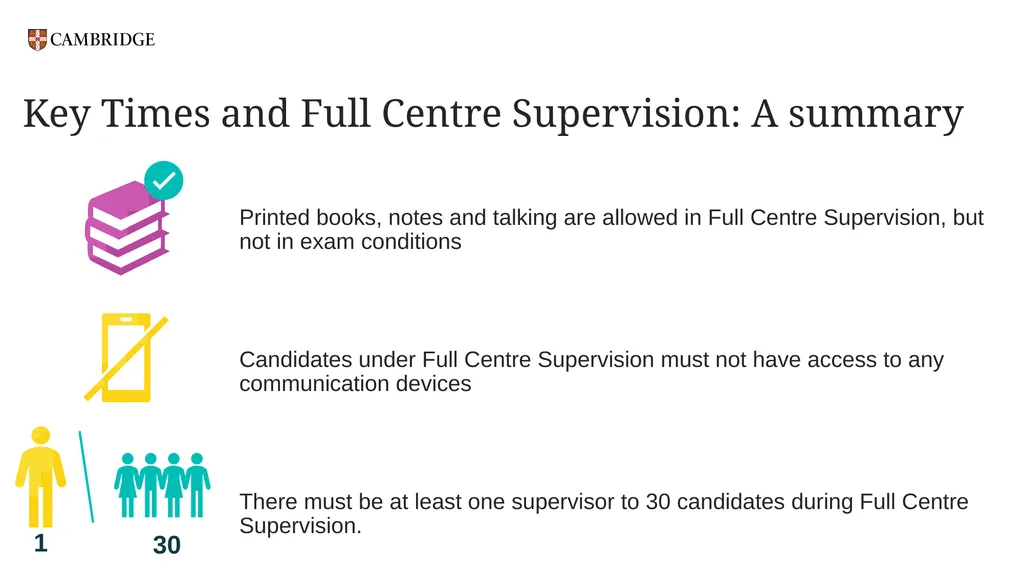
Key Times and Full Centre Supervision: A summary Printed books, notes and talking are allowed in Full Centre Supervision, but not in exam conditions
Candidates under Full Centre Supervision must not have access to any communication devices
There must be at least one supervisor to 30 candidates during Full Centre Supervision. 30 1<br>