
Key Topics Ch: 1 - 4 © 2015 Cengage Learning
CP
Published · 49 slides · 0 views
1 / 1


Description
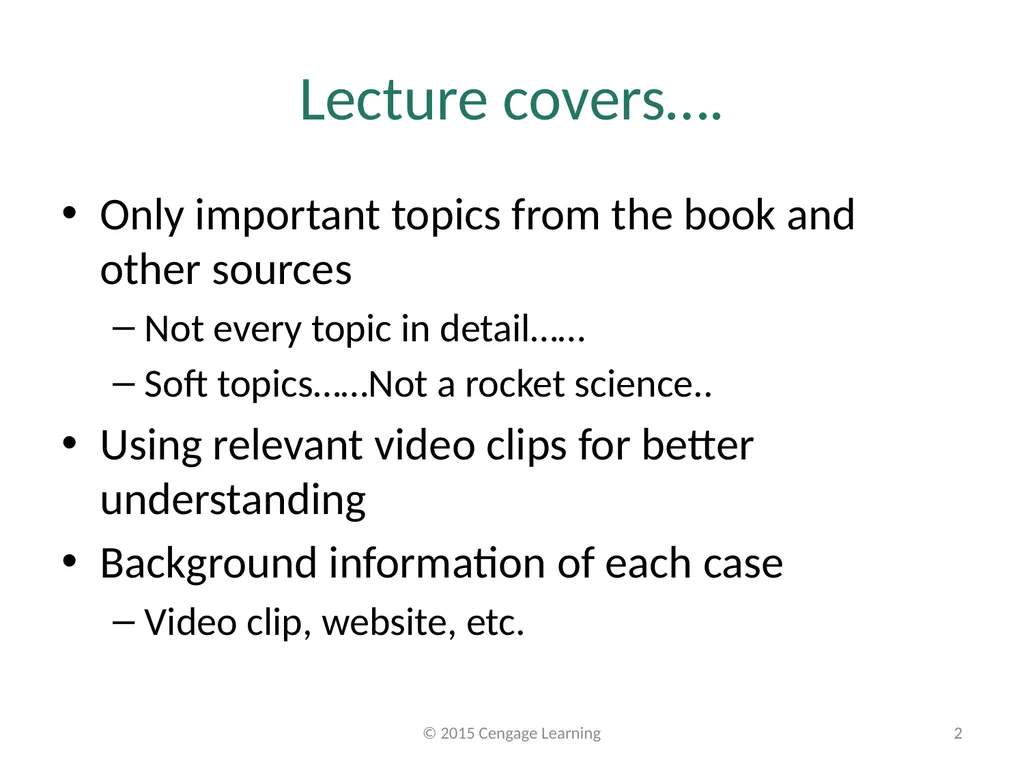
Key Topics Ch: 1 - 4 2015 Cengage Learning 1 Lecture covers. Only important topics from the book and other sources Not every topic in detail Soft topicsNot a rocket science.. Using relevant video clips for better understanding
Related Topics
Share
Embed code
Download this presentation From Below
"Key Topics Ch: 1 - 4 © 2015 Cengage Learning" is the property of its rightful owner. Permission is granted to download and print the materials on this website for personal, non-commercial use only, and to display it on your personal computer provided you do not modify the materials and that you retain all copyright notices contained in the materials. By downloading content from our website, you accept the terms of this agreement.
Presentation Transcript
01
Key Topics
Ch: 1 - 4 © 2015 Cengage Learning 1<br>
02
Lecture covers…. Only important topics from the book and other sources
Not every topic in detail……
Soft topics……Not a rocket science..
Using relevant video clips for better understanding
Background information of each case
Video clip, website, etc. © 2015 Cengage Learning 2<br>
Not every topic in detail……
Soft topics……Not a rocket science..
Using relevant video clips for better understanding
Background information of each case
Video clip, website, etc. © 2015 Cengage Learning 2<br>
03
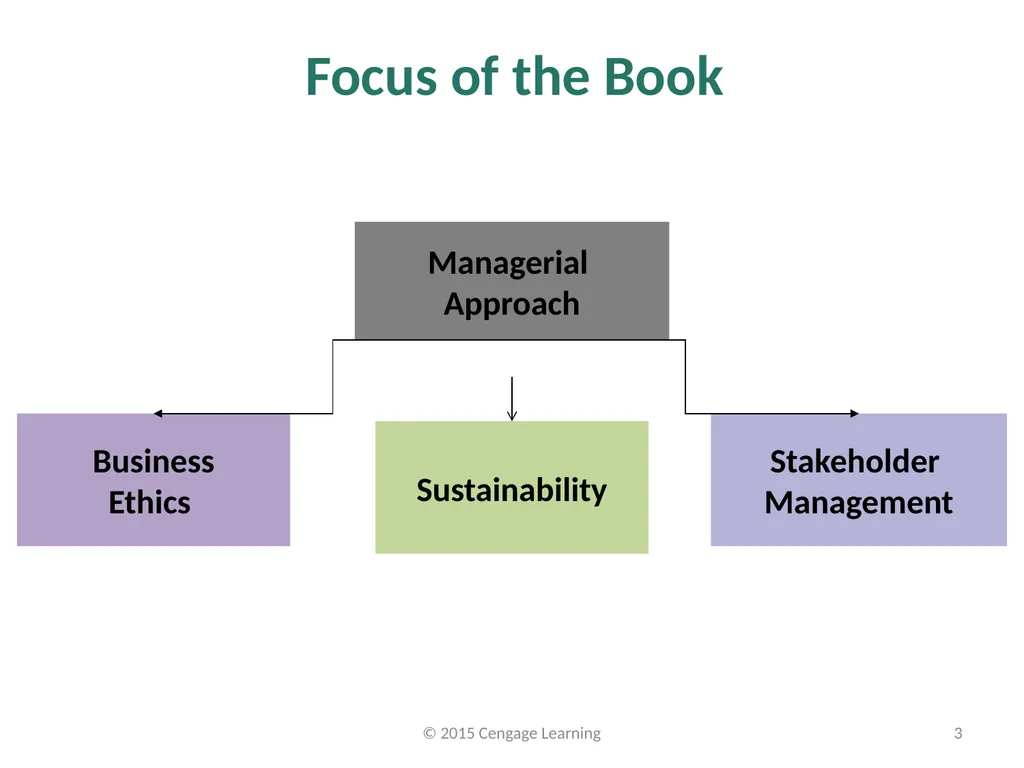
Focus of the Book Sustainability © 2015 Cengage Learning 3<br>
04
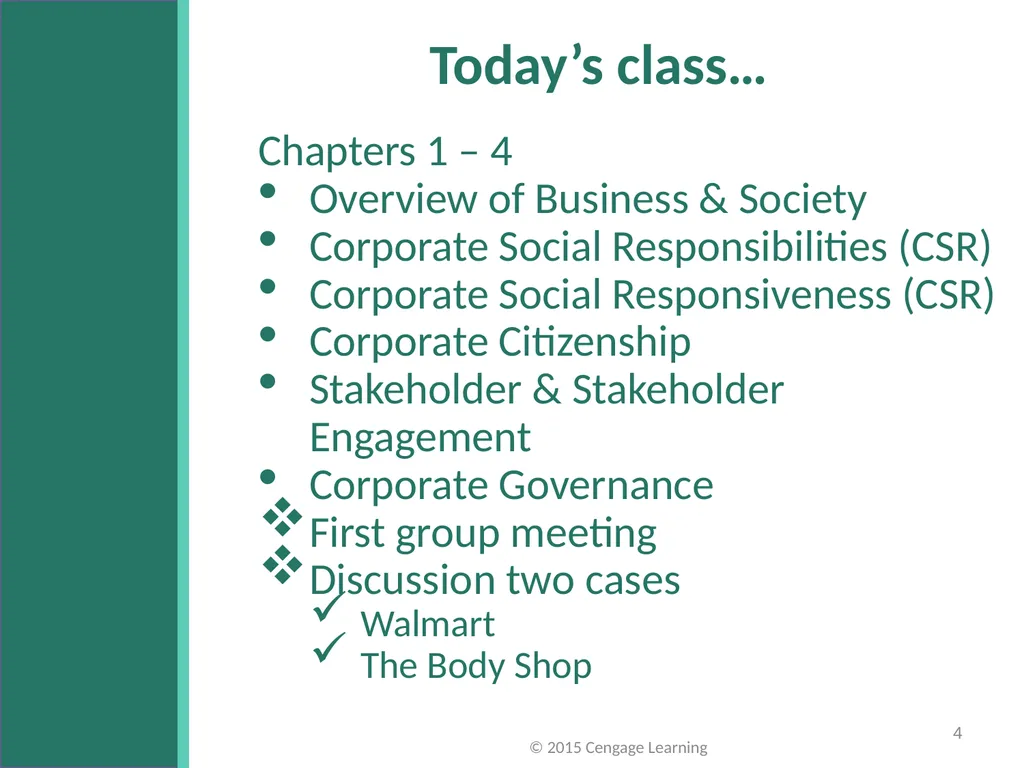
Today’s class… Chapters 1 – 4
Overview of Business & Society
Corporate Social Responsibilities (CSR)
Corporate Social Responsiveness (CSR)
Corporate Citizenship
Stakeholder & Stakeholder Engagement
Corporate Governance
First group meeting
Discussion two cases
Walmart
The Body Shop © 2015 Cengage Learning 4<br>
Overview of Business & Society
Corporate Social Responsibilities (CSR)
Corporate Social Responsiveness (CSR)
Corporate Citizenship
Stakeholder & Stakeholder Engagement
Corporate Governance
First group meeting
Discussion two cases
Walmart
The Body Shop © 2015 Cengage Learning 4<br>
05
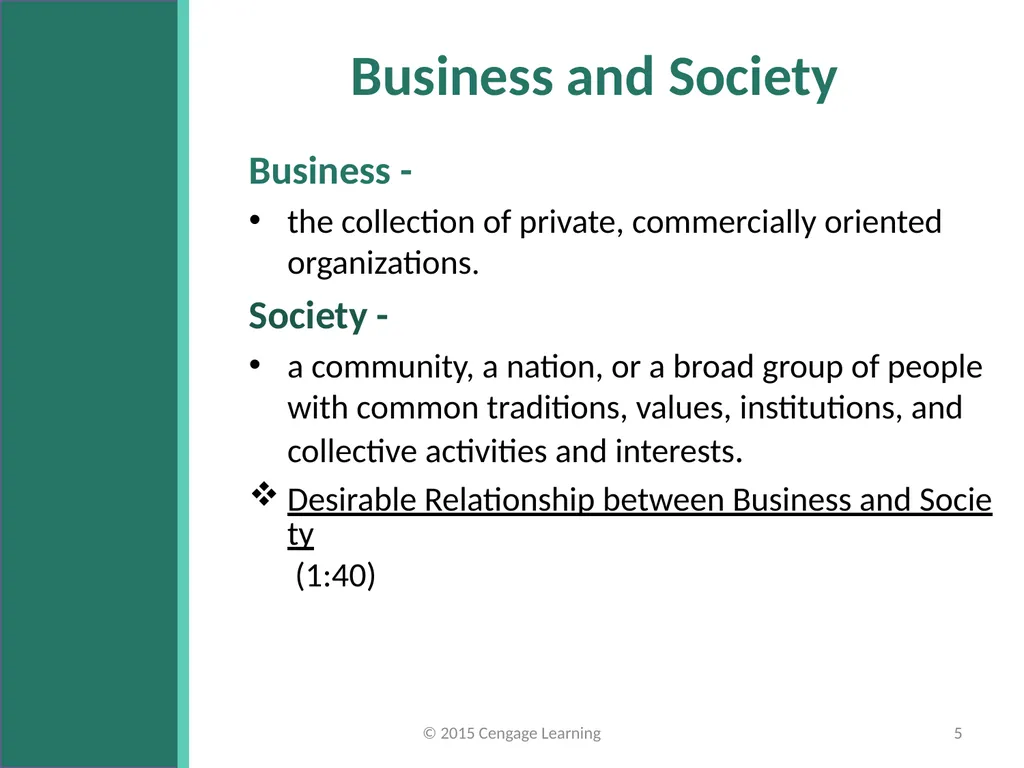
Business and Society Business -
the collection of private, commercially oriented organizations.
Society -
a community, a nation, or a broad group of people with common traditions, values, institutions, and collective activities and interests.
Desirable Relationship between Business and Society (1:40) © 2015 Cengage Learning 5<br>
the collection of private, commercially oriented organizations.
Society -
a community, a nation, or a broad group of people with common traditions, values, institutions, and collective activities and interests.
Desirable Relationship between Business and Society (1:40) © 2015 Cengage Learning 5<br>
06
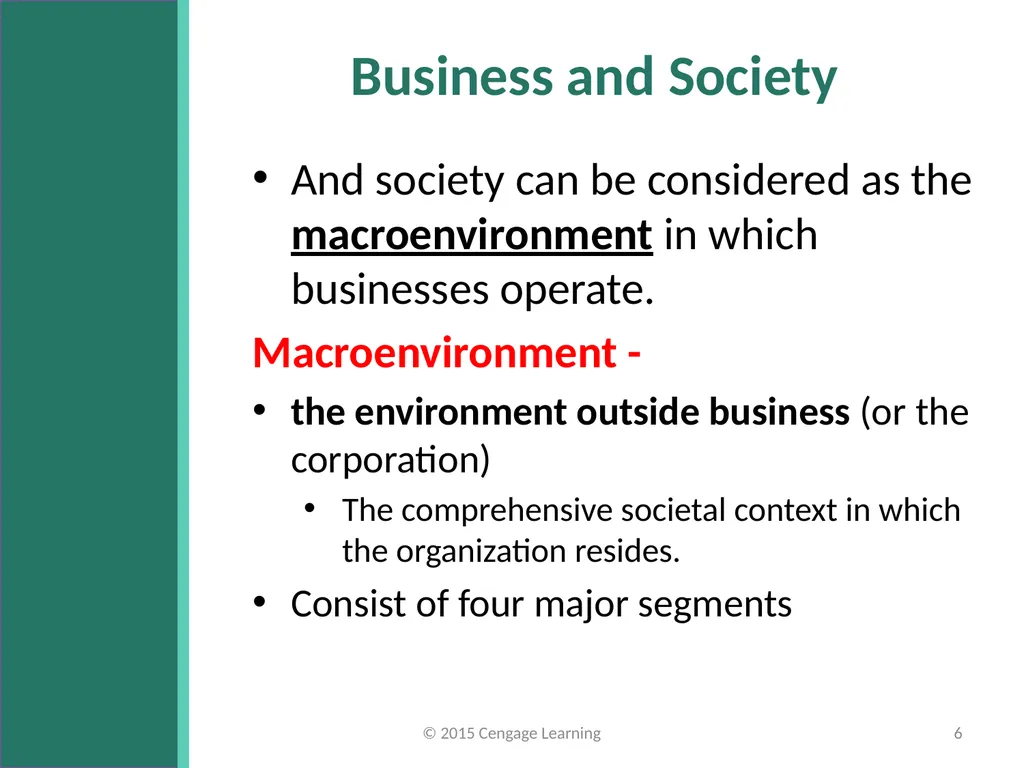
Business and Society And society can be considered as the macroenvironment in which businesses operate.
Macroenvironment -
the environment outside business (or the corporation)
The comprehensive societal context in which the organization resides.
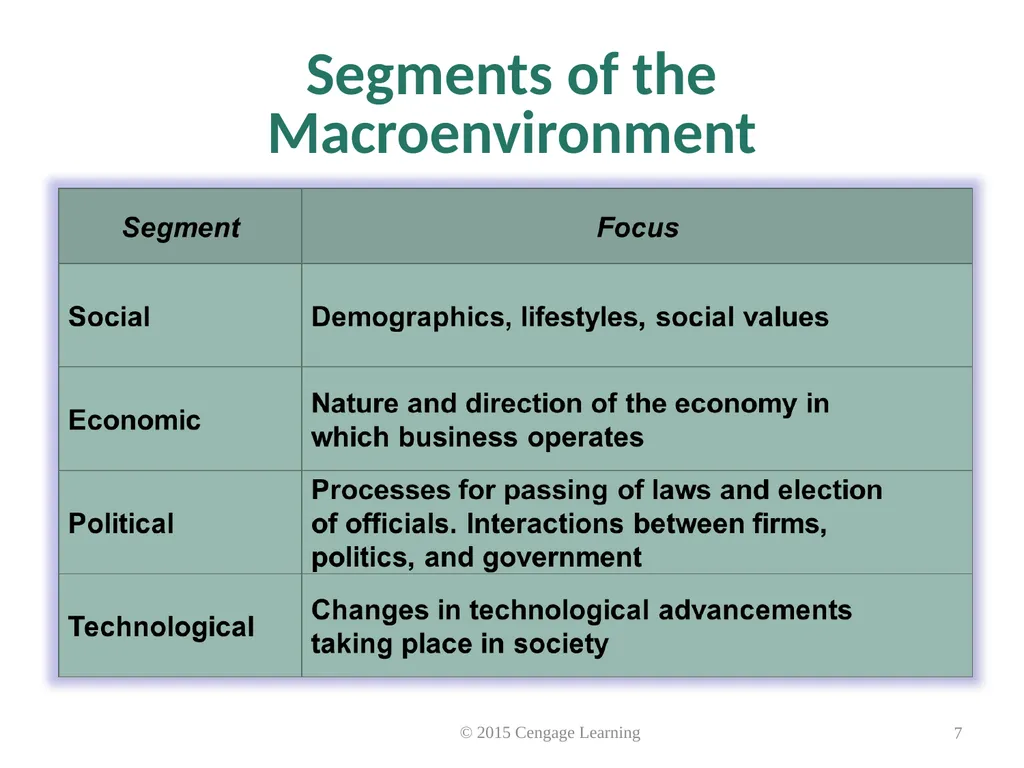
Consist of four major segments © 2015 Cengage Learning 6<br>
Macroenvironment -
the environment outside business (or the corporation)
The comprehensive societal context in which the organization resides.
Consist of four major segments © 2015 Cengage Learning 6<br>
07
Segments of the Macroenvironment © 2015 Cengage Learning 7<br>
08
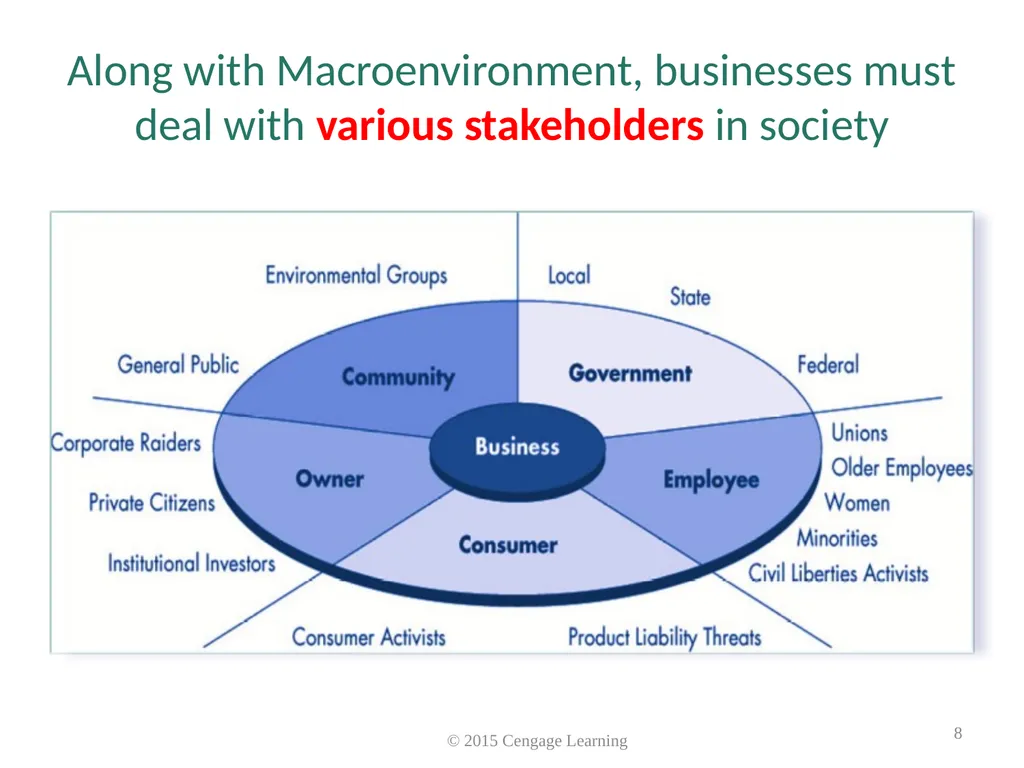
Along with Macroenvironment, businesses must deal with various stakeholders in society © 2015 Cengage Learning 8<br>
09
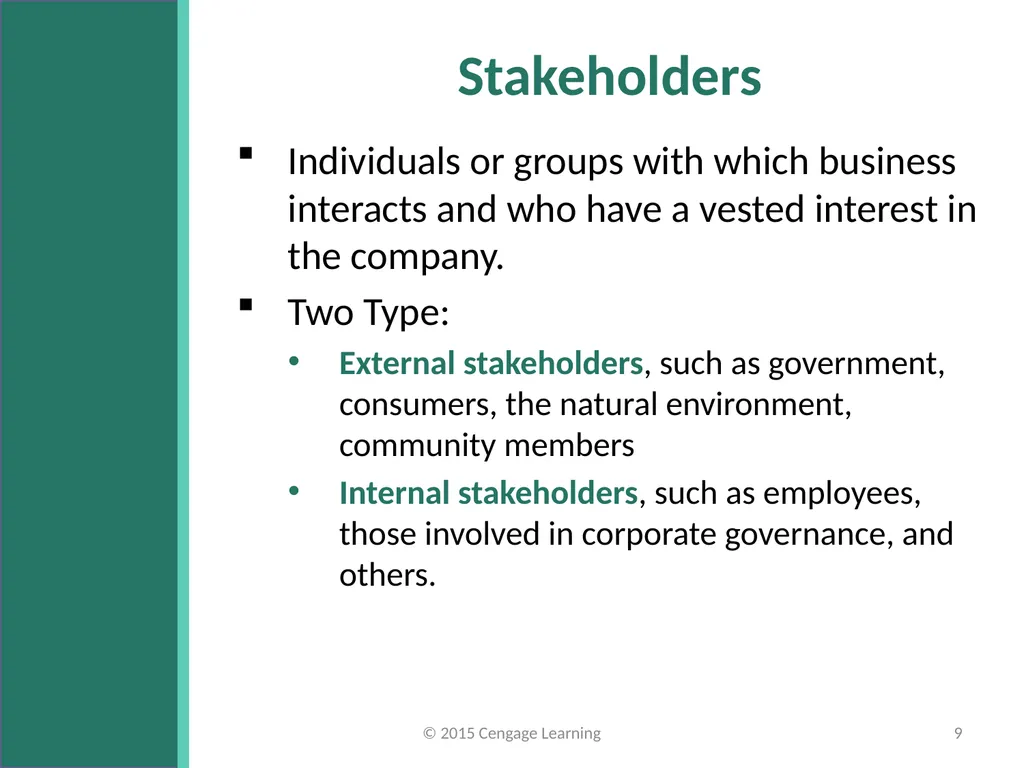
Stakeholders Individuals or groups with which business interacts and who have a vested interest in the company.
Two Type:
External stakeholders, such as government, consumers, the natural environment, community members
Internal stakeholders, such as employees, those involved in corporate governance, and others. © 2015 Cengage Learning 9<br>
Two Type:
External stakeholders, such as government, consumers, the natural environment, community members
Internal stakeholders, such as employees, those involved in corporate governance, and others. © 2015 Cengage Learning 9<br>
10
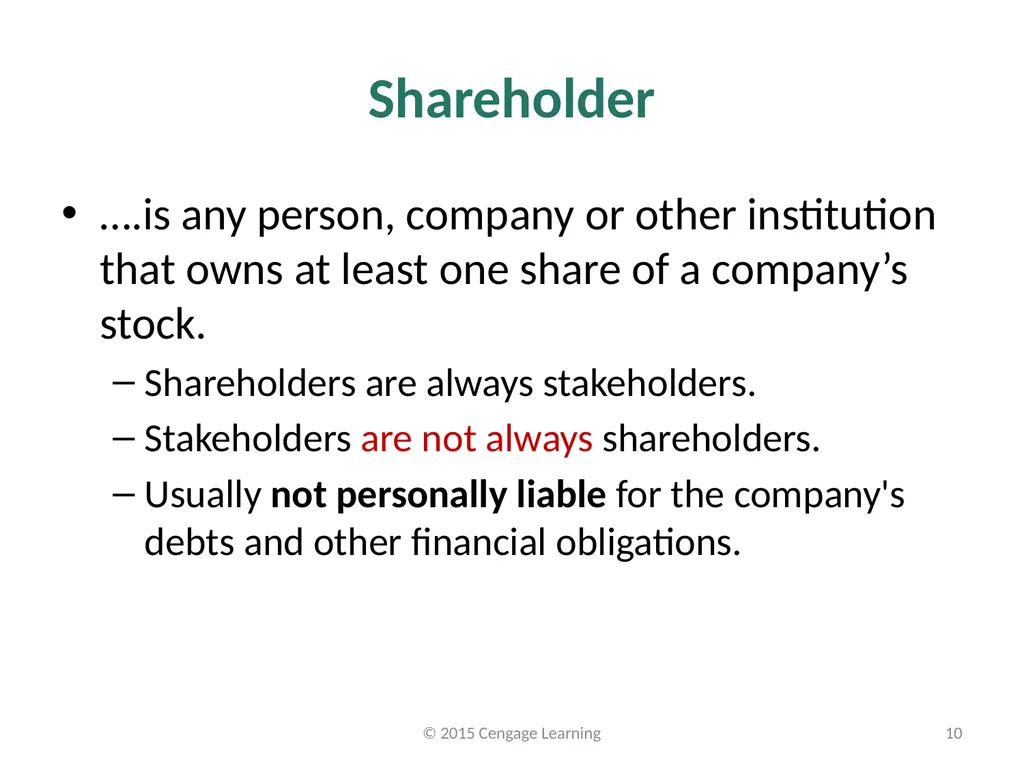
Shareholder ….is any person, company or other institution that owns at least one share of a company’s stock.
Shareholders are always stakeholders.
Stakeholders are not always shareholders.
Usually not personally liable for the company's debts and other financial obligations. © 2015 Cengage Learning 10<br>
Shareholders are always stakeholders.
Stakeholders are not always shareholders.
Usually not personally liable for the company's debts and other financial obligations. © 2015 Cengage Learning 10<br>
11
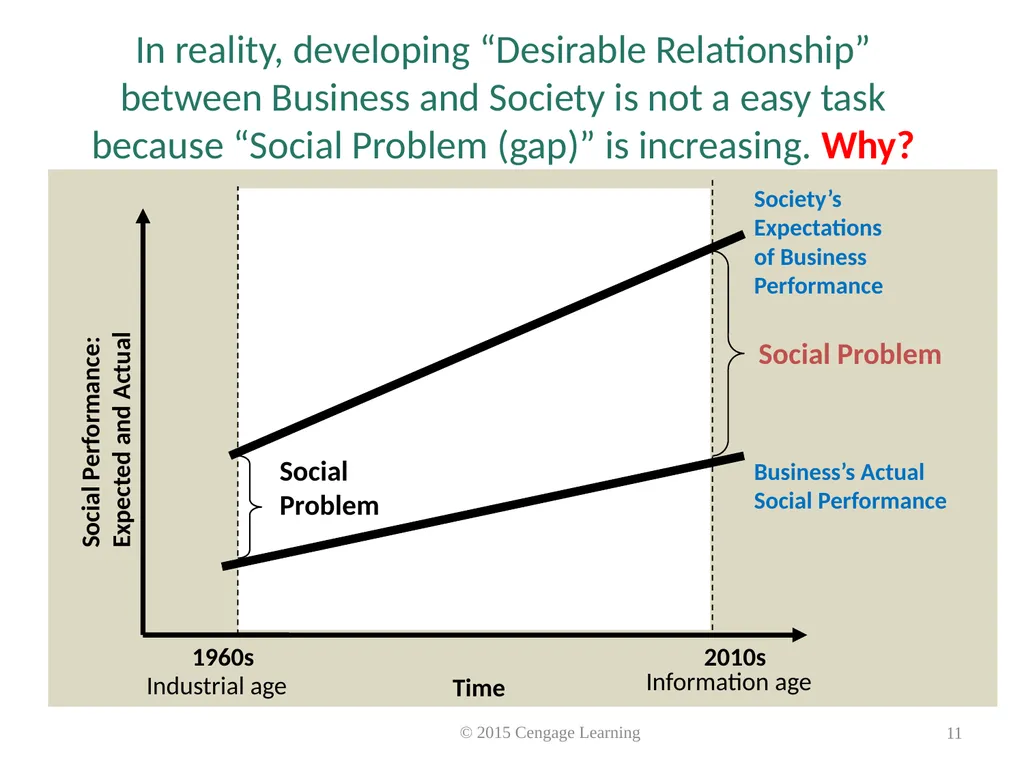
In reality, developing “Desirable Relationship” between Business and Society is not a easy task because “Social Problem (gap)” is increasing. Why? © 2015 Cengage Learning 11 Industrial age Information age<br>
12
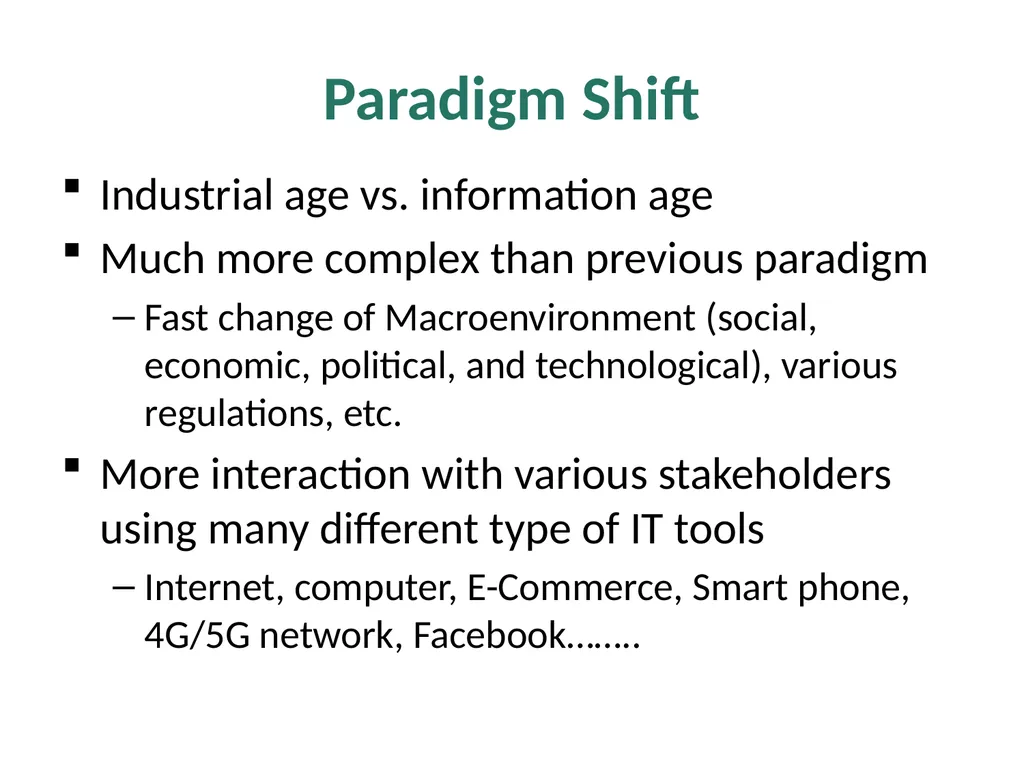
Industrial age vs. information age
Much more complex than previous paradigm
Fast change of Macroenvironment (social, economic, political, and technological), various regulations, etc.
More interaction with various stakeholders using many different type of IT tools
Internet, computer, E-Commerce, Smart phone, 4G/5G network, Facebook…….. Paradigm Shift<br>
Much more complex than previous paradigm
Fast change of Macroenvironment (social, economic, political, and technological), various regulations, etc.
More interaction with various stakeholders using many different type of IT tools
Internet, computer, E-Commerce, Smart phone, 4G/5G network, Facebook…….. Paradigm Shift<br>
13
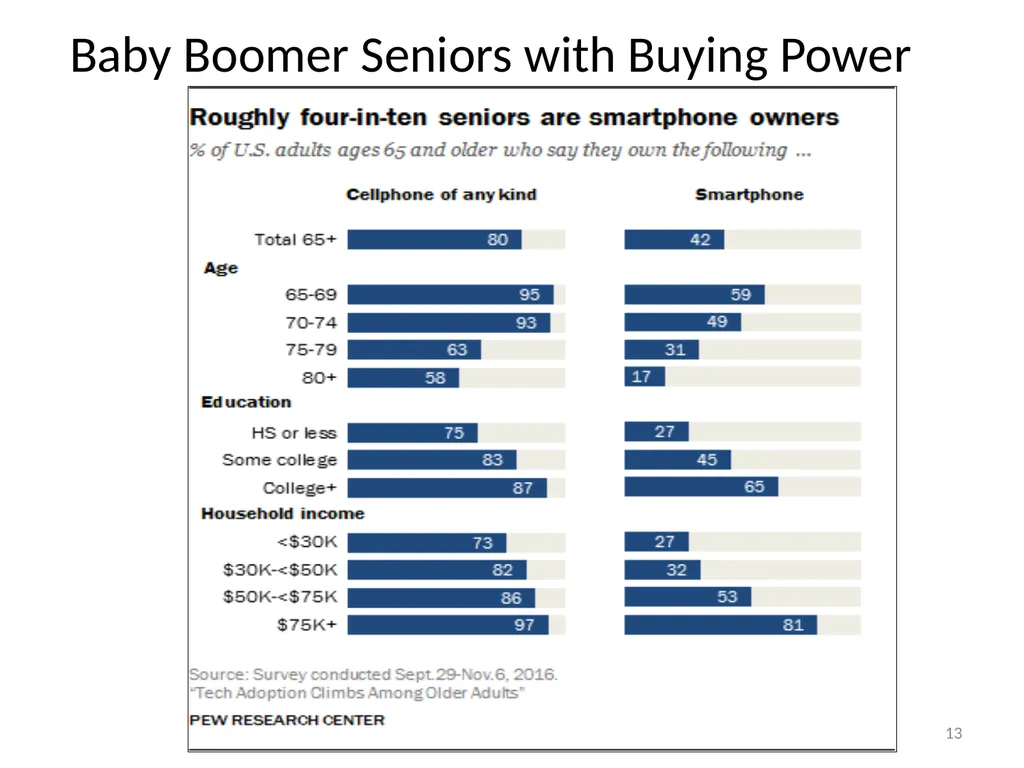
© 2015 Cengage Learning 13 Baby Boomer Seniors with Buying Power<br>
14
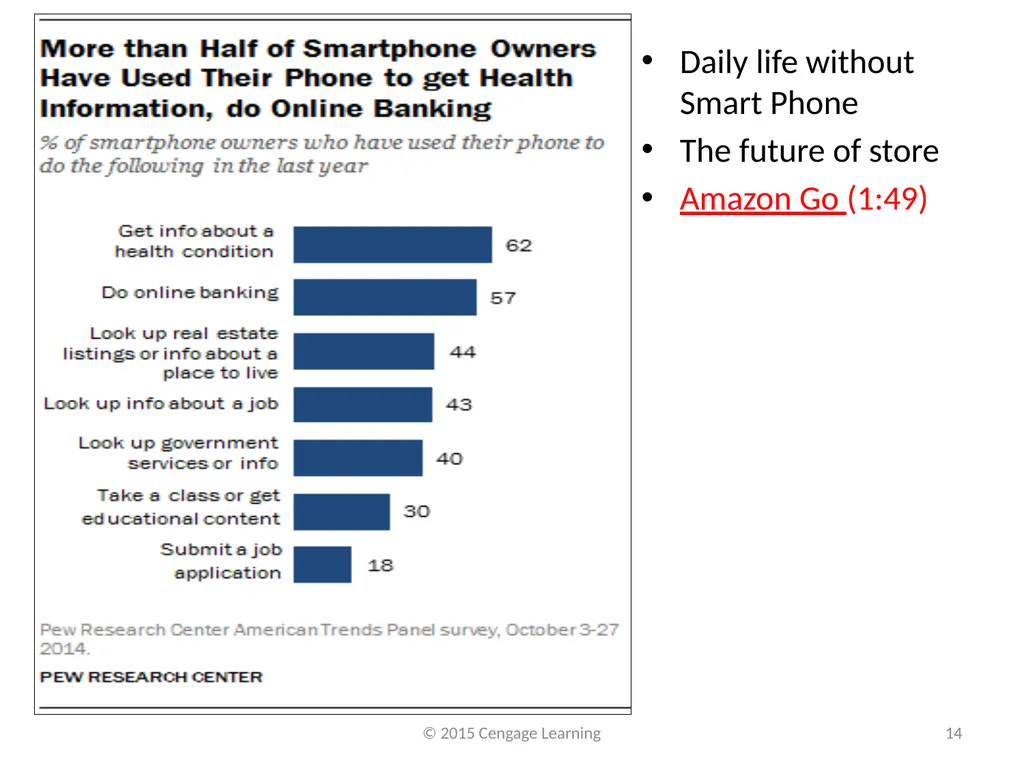
© 2015 Cengage Learning 14 Daily life without Smart Phone
The future of store
Amazon Go (1:49)<br>
The future of store
Amazon Go (1:49)<br>
15
What is Corporate Social Responsibilities (CSR)? refers to business practices involving initiatives that benefit society
What is CSR? (2:00)
From giving away a portion of a company's proceeds to charity, to implementing "greener" business operations.
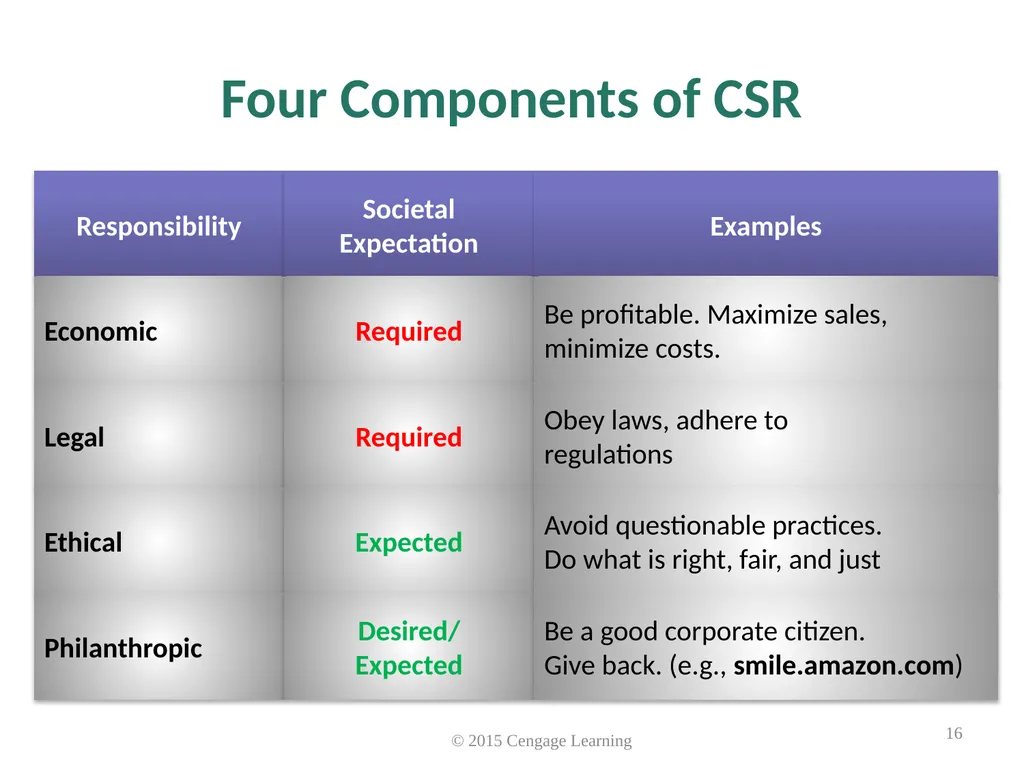
Four components (or responsibilities) of CSR © 2015 Cengage Learning 15<br>
What is CSR? (2:00)
From giving away a portion of a company's proceeds to charity, to implementing "greener" business operations.
Four components (or responsibilities) of CSR © 2015 Cengage Learning 15<br>
16
Four Components of CSR © 2015 Cengage Learning 16<br>
17
Economic Responsibility It is at the bottom, because it is the foundation upon which all others rest.
No profit no business no CSR
Example: Several companies in both the automotive (e.g., Oldsmobile) and airline (e.g, AA in 2011 and exit 2013) industries struggled to meet their economic responsibilities and landed in bankruptcy as a result. © 2015 Cengage Learning 17<br>
No profit no business no CSR
Example: Several companies in both the automotive (e.g., Oldsmobile) and airline (e.g, AA in 2011 and exit 2013) industries struggled to meet their economic responsibilities and landed in bankruptcy as a result. © 2015 Cengage Learning 17<br>
18
Legal Responsibility Society requires corporations to follow the law.
Law codified ethics
Enron example of legal responsibility
Collapsed because of dishonest and unfair reporting of financial operations mainly by executives.
Enron Scandal (4:48)
Many employees (including suppliers) lost their job.
Arthur Andersen (best accounting consulting firm in the world until 2001) © 2015 Cengage Learning 18<br>
Law codified ethics
Enron example of legal responsibility
Collapsed because of dishonest and unfair reporting of financial operations mainly by executives.
Enron Scandal (4:48)
Many employees (including suppliers) lost their job.
Arthur Andersen (best accounting consulting firm in the world until 2001) © 2015 Cengage Learning 18<br>
19
Ethical Responsibility Society expects ethical behavior of companies.
Growing phenomenon because of information availability on the Internet (e.g., SNS)
Two-sides
Negative-side: Even though this expectation is violated, companies still can survive.
Positive-side: companies may find themselves recognized for their ethical activities (e.g., Starbucks).
Pay premium price (exceed market price)
Funded health center & farm schools © 2015 Cengage Learning 19<br>
Growing phenomenon because of information availability on the Internet (e.g., SNS)
Two-sides
Negative-side: Even though this expectation is violated, companies still can survive.
Positive-side: companies may find themselves recognized for their ethical activities (e.g., Starbucks).
Pay premium price (exceed market price)
Funded health center & farm schools © 2015 Cengage Learning 19<br>
20
Philanthropic Responsibility Stands to be a good corporate citizen and improve the quality of life for the society.
usually, corporations in developed countries.
Ethics in Practice, page 43
Toms: shoe company
www.toms.com
Known as a company that would match every pair of shoes purchased with a pair of new shoes given to a child in need © 2015 Cengage Learning 20<br>
usually, corporations in developed countries.
Ethics in Practice, page 43
Toms: shoe company
www.toms.com
Known as a company that would match every pair of shoes purchased with a pair of new shoes given to a child in need © 2015 Cengage Learning 20<br>
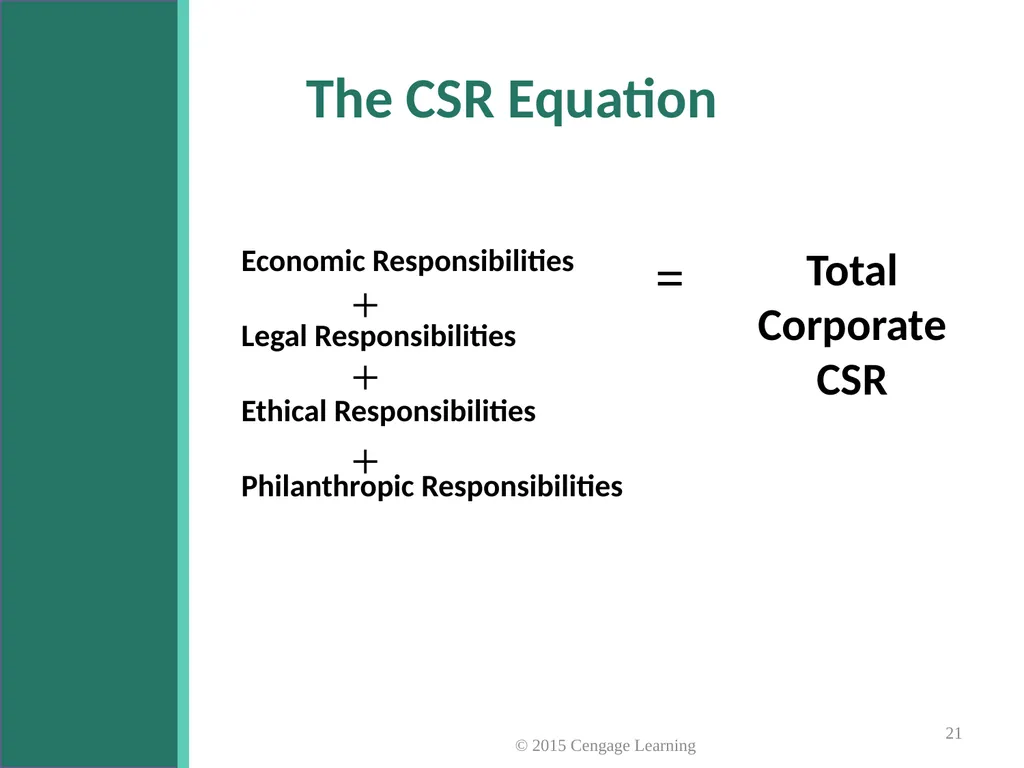
21
The CSR Equation © 2015 Cengage Learning 21 Economic Responsibilities
Legal Responsibilities
Ethical Responsibilities
Philanthropic Responsibilities Total Corporate CSR = + + +<br>
Legal Responsibilities
Ethical Responsibilities
Philanthropic Responsibilities Total Corporate CSR = + + +<br>
22
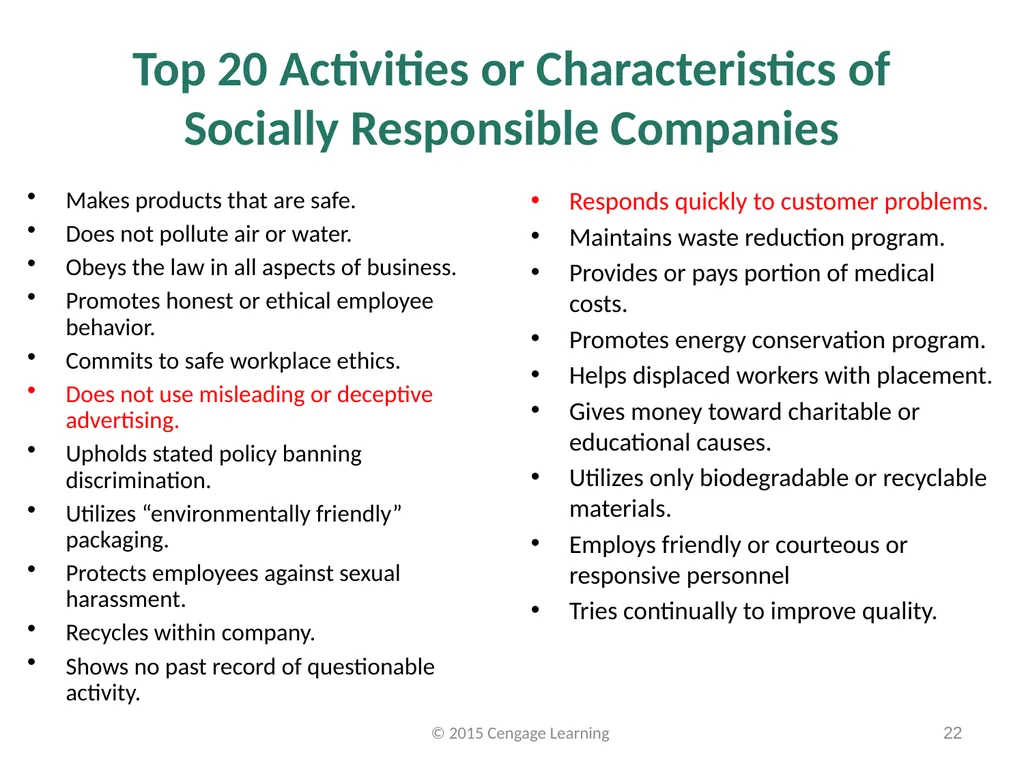
Top 20 Activities or Characteristics of
Socially Responsible Companies Makes products that are safe.
Does not pollute air or water.
Obeys the law in all aspects of business.
Promotes honest or ethical employee behavior.
Commits to safe workplace ethics.
Does not use misleading or deceptive advertising.
Upholds stated policy banning discrimination.
Utilizes “environmentally friendly” packaging.
Protects employees against sexual harassment.
Recycles within company.
Shows no past record of questionable activity. Responds quickly to customer problems.
Maintains waste reduction program.
Provides or pays portion of medical costs.
Promotes energy conservation program.
Helps displaced workers with placement.
Gives money toward charitable or educational causes.
Utilizes only biodegradable or recyclable materials.
Employs friendly or courteous or responsive personnel
Tries continually to improve quality. © 2015 Cengage Learning 22<br>
Does not pollute air or water.
Obeys the law in all aspects of business.
Promotes honest or ethical employee behavior.
Commits to safe workplace ethics.
Does not use misleading or deceptive advertising.
Upholds stated policy banning discrimination.
Utilizes “environmentally friendly” packaging.
Protects employees against sexual harassment.
Recycles within company.
Shows no past record of questionable activity. Responds quickly to customer problems.
Maintains waste reduction program.
Provides or pays portion of medical costs.
Promotes energy conservation program.
Helps displaced workers with placement.
Gives money toward charitable or educational causes.
Utilizes only biodegradable or recyclable materials.
Employs friendly or courteous or responsive personnel
Tries continually to improve quality. © 2015 Cengage Learning 22<br>
23
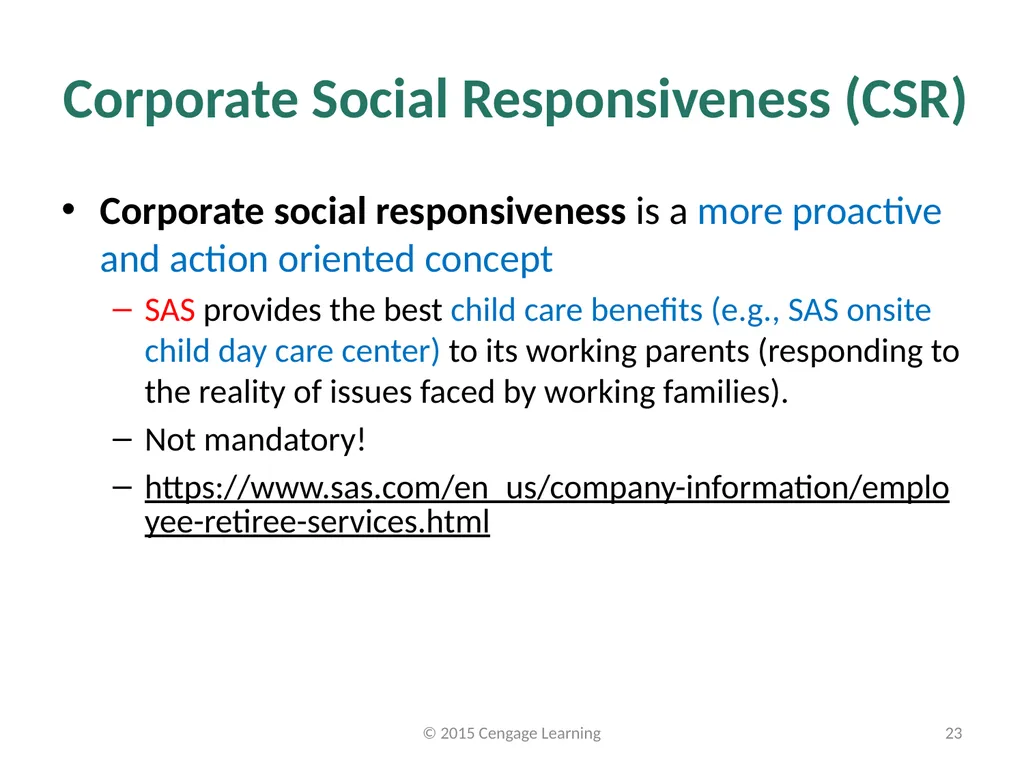
Corporate Social Responsiveness (CSR) Corporate social responsiveness is a more proactive and action oriented concept
SAS provides the best child care benefits (e.g., SAS onsite child day care center) to its working parents (responding to the reality of issues faced by working families).
Not mandatory!
https://www.sas.com/en_us/company-information/employee-retiree-services.html © 2015 Cengage Learning 23<br>
SAS provides the best child care benefits (e.g., SAS onsite child day care center) to its working parents (responding to the reality of issues faced by working families).
Not mandatory!
https://www.sas.com/en_us/company-information/employee-retiree-services.html © 2015 Cengage Learning 23<br>
24
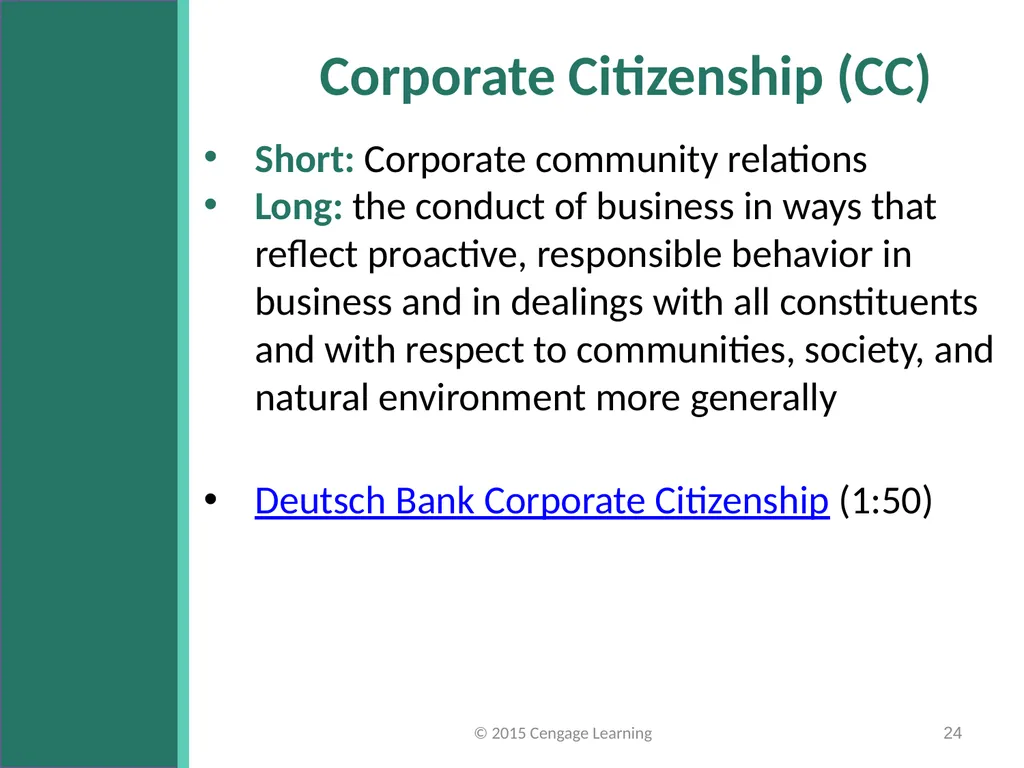
Corporate Citizenship (CC) Short: Corporate community relations
Long: the conduct of business in ways that reflect proactive, responsible behavior in business and in dealings with all constituents and with respect to communities, society, and natural environment more generally
Deutsch Bank Corporate Citizenship (1:50) © 2015 Cengage Learning 24<br>
Long: the conduct of business in ways that reflect proactive, responsible behavior in business and in dealings with all constituents and with respect to communities, society, and natural environment more generally
Deutsch Bank Corporate Citizenship (1:50) © 2015 Cengage Learning 24<br>
25
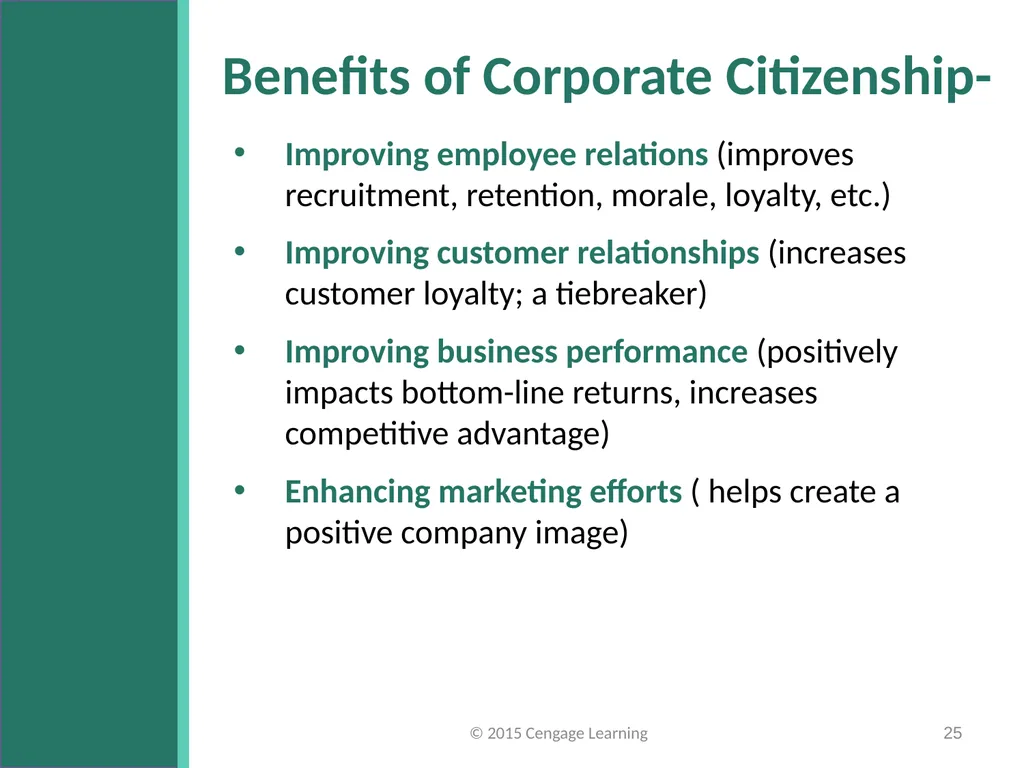
Benefits of Corporate Citizenship- Improving employee relations (improves recruitment, retention, morale, loyalty, etc.)
Improving customer relationships (increases customer loyalty; a tiebreaker)
Improving business performance (positively impacts bottom-line returns, increases competitive advantage)
Enhancing marketing efforts ( helps create a positive company image) © 2015 Cengage Learning 25<br>
Improving customer relationships (increases customer loyalty; a tiebreaker)
Improving business performance (positively impacts bottom-line returns, increases competitive advantage)
Enhancing marketing efforts ( helps create a positive company image) © 2015 Cengage Learning 25<br>
26
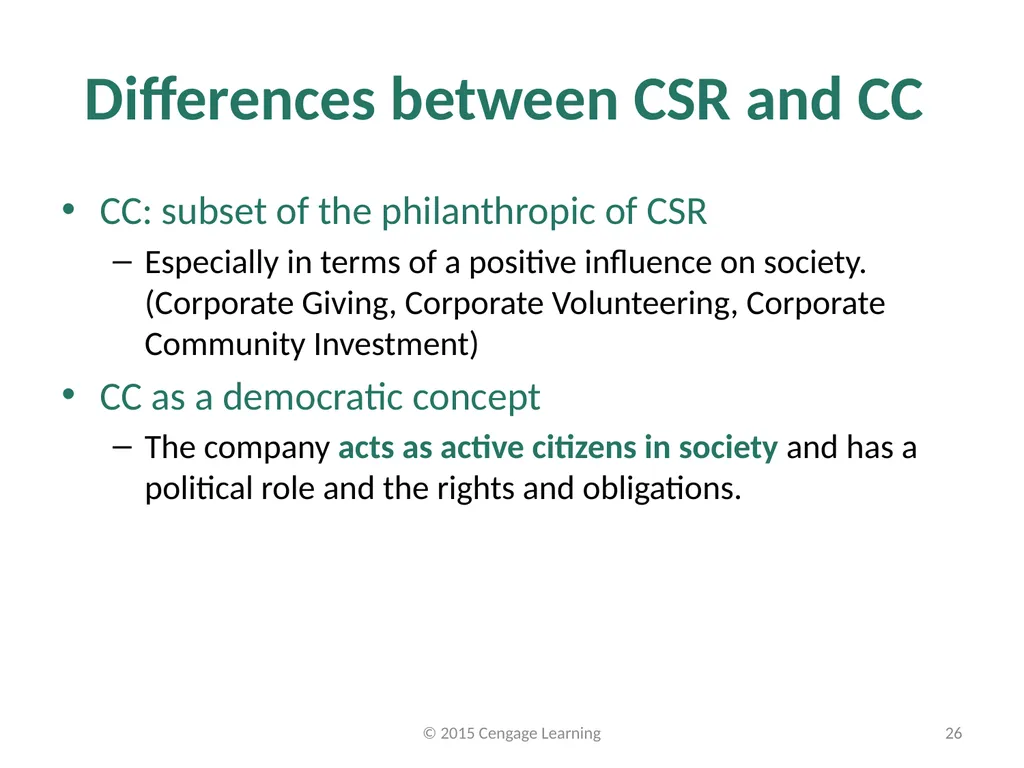
Differences between CSR and CC CC: subset of the philanthropic of CSR
Especially in terms of a positive influence on society. (Corporate Giving, Corporate Volunteering, Corporate Community Investment)
CC as a democratic concept
The company acts as active citizens in society and has a political role and the rights and obligations. © 2015 Cengage Learning 26<br>
Especially in terms of a positive influence on society. (Corporate Giving, Corporate Volunteering, Corporate Community Investment)
CC as a democratic concept
The company acts as active citizens in society and has a political role and the rights and obligations. © 2015 Cengage Learning 26<br>
27
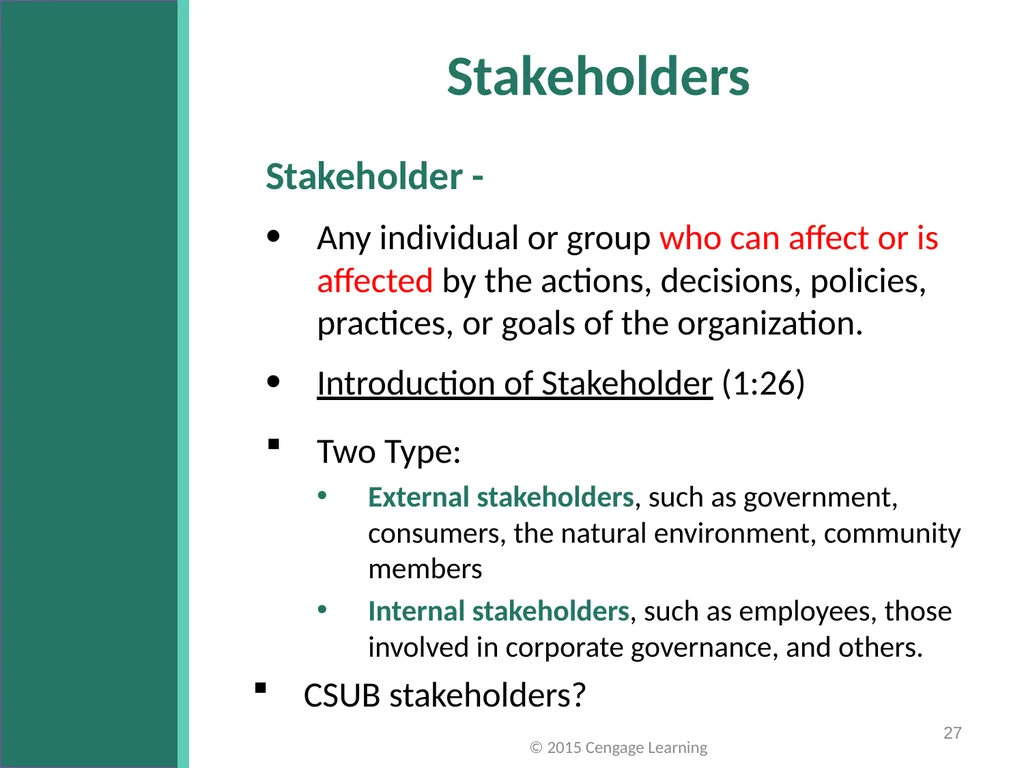
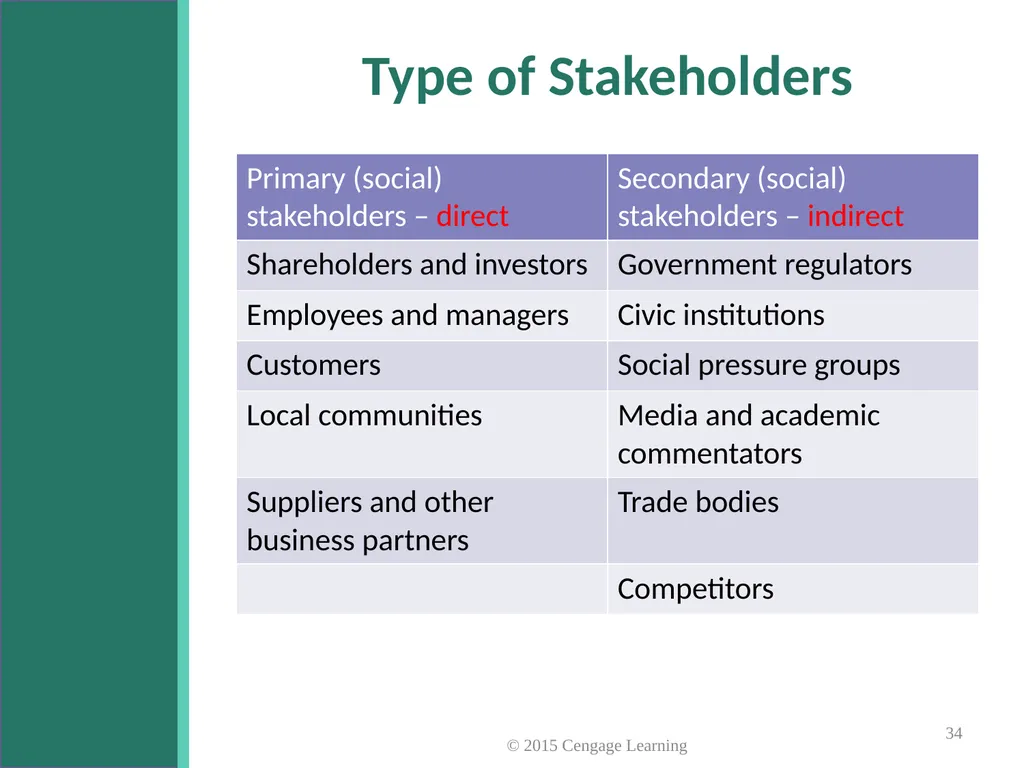
Stakeholders Stakeholder -
Any individual or group who can affect or is affected by the actions, decisions, policies, practices, or goals of the organization.
Introduction of Stakeholder (1:26)
Two Type:
External stakeholders, such as government, consumers, the natural environment, community members
Internal stakeholders, such as employees, those involved in corporate governance, and others.
CSUB stakeholders? © 2015 Cengage Learning 27<br>
Any individual or group who can affect or is affected by the actions, decisions, policies, practices, or goals of the organization.
Introduction of Stakeholder (1:26)
Two Type:
External stakeholders, such as government, consumers, the natural environment, community members
Internal stakeholders, such as employees, those involved in corporate governance, and others.
CSUB stakeholders? © 2015 Cengage Learning 27<br>
28
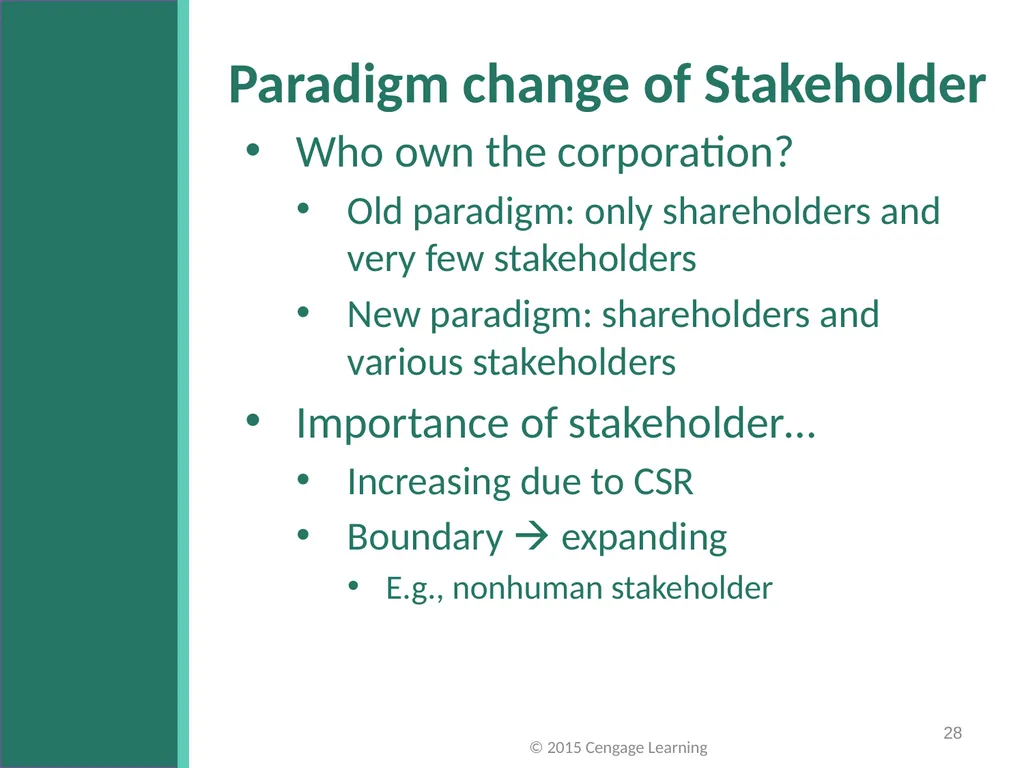
Paradigm change of Stakeholder Who own the corporation?
Old paradigm: only shareholders and very few stakeholders
New paradigm: shareholders and various stakeholders
Importance of stakeholder…
Increasing due to CSR
Boundary expanding
E.g., nonhuman stakeholder © 2015 Cengage Learning 28<br>
Old paradigm: only shareholders and very few stakeholders
New paradigm: shareholders and various stakeholders
Importance of stakeholder…
Increasing due to CSR
Boundary expanding
E.g., nonhuman stakeholder © 2015 Cengage Learning 28<br>
29
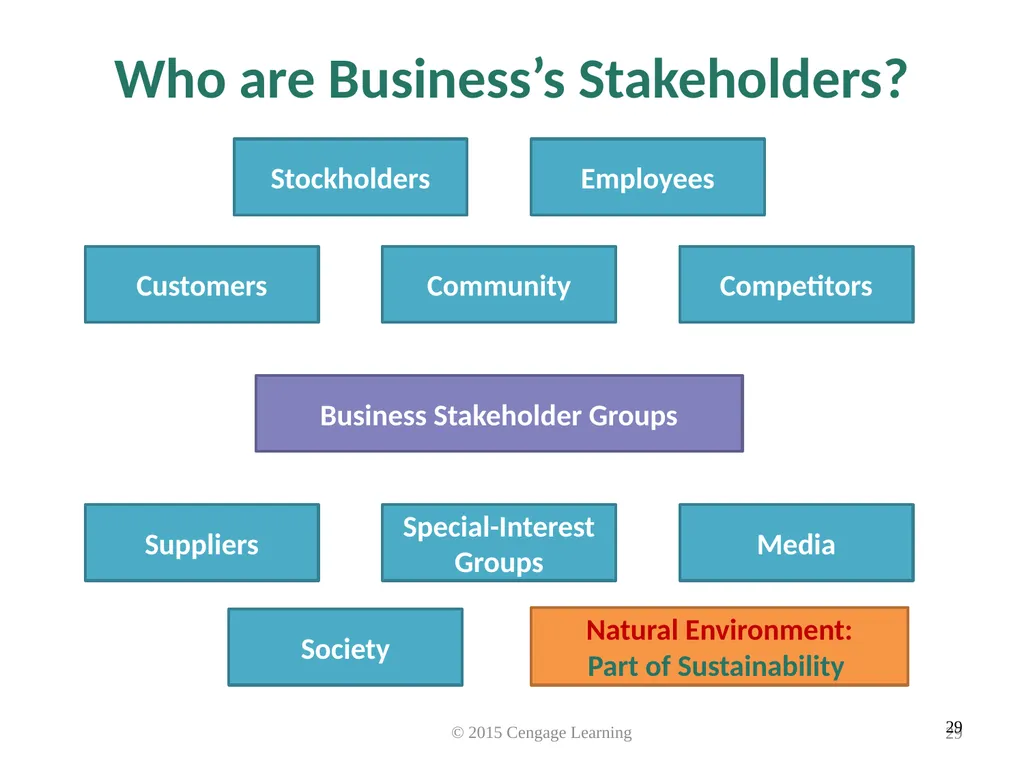
Who are Business’s Stakeholders? © 2015 Cengage Learning 29 29<br>
30
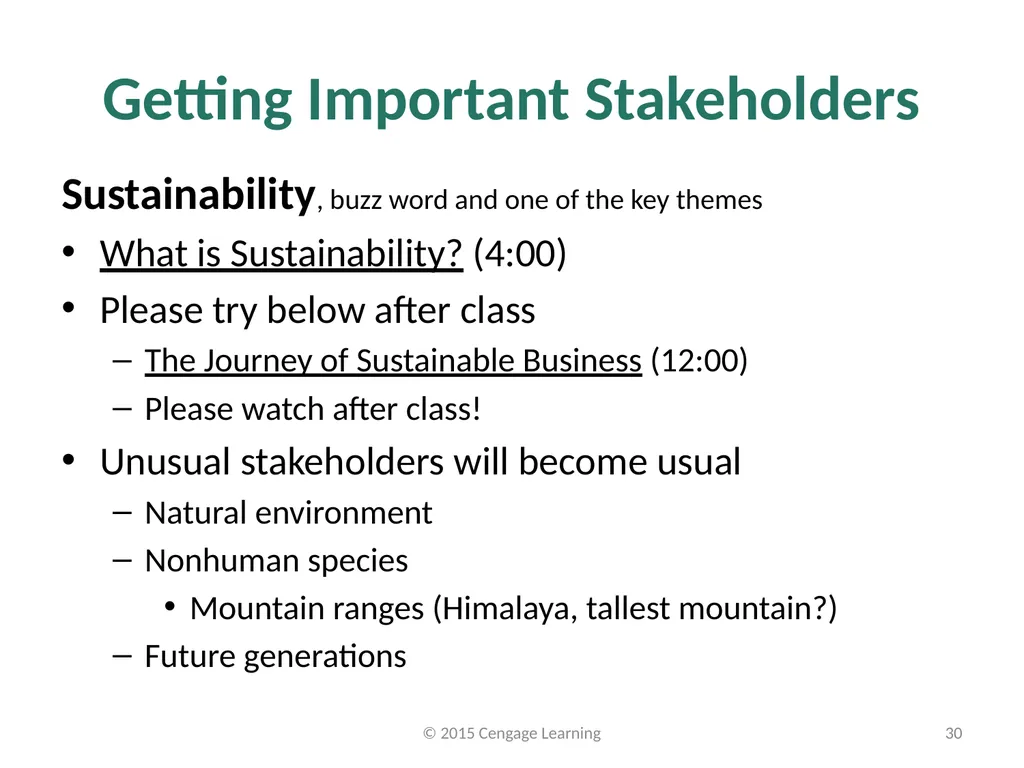
Getting Important Stakeholders Sustainability, buzz word and one of the key themes
What is Sustainability? (4:00)
Please try below after class
The Journey of Sustainable Business (12:00)
Please watch after class!
Unusual stakeholders will become usual
Natural environment
Nonhuman species
Mountain ranges (Himalaya, tallest mountain?)
Future generations © 2015 Cengage Learning 30<br>
What is Sustainability? (4:00)
Please try below after class
The Journey of Sustainable Business (12:00)
Please watch after class!
Unusual stakeholders will become usual
Natural environment
Nonhuman species
Mountain ranges (Himalaya, tallest mountain?)
Future generations © 2015 Cengage Learning 30<br>
31
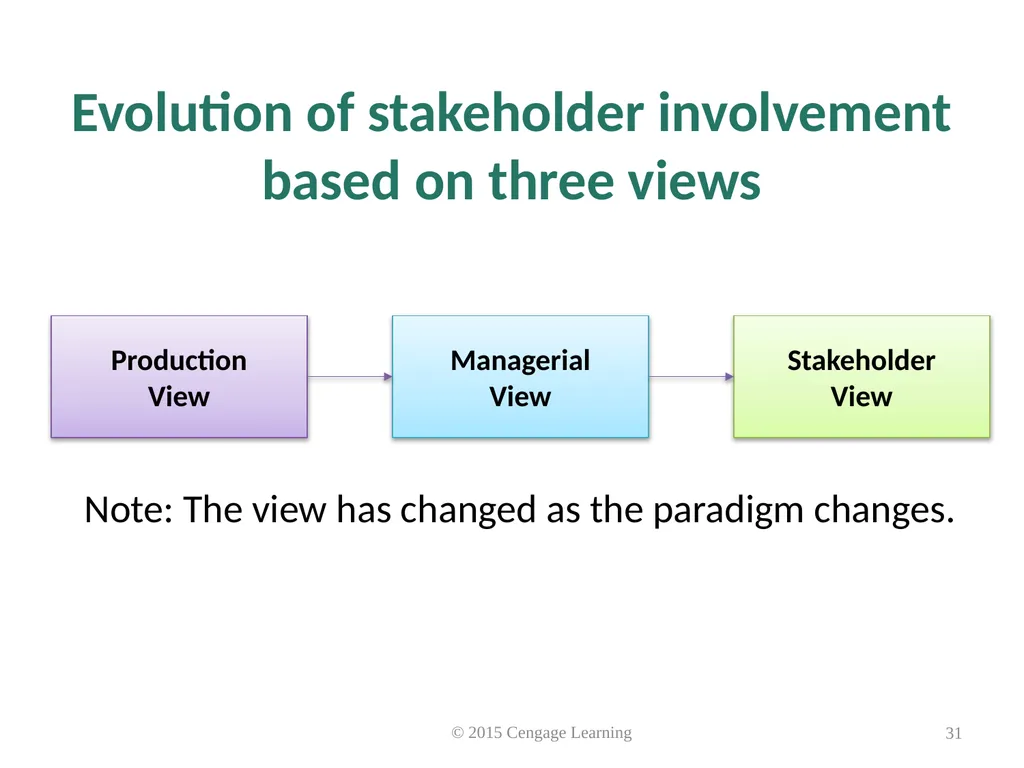
Evolution of stakeholder involvement
based on three views © 2015 Cengage Learning 31 Note: The view has changed as the paradigm changes.<br>
32
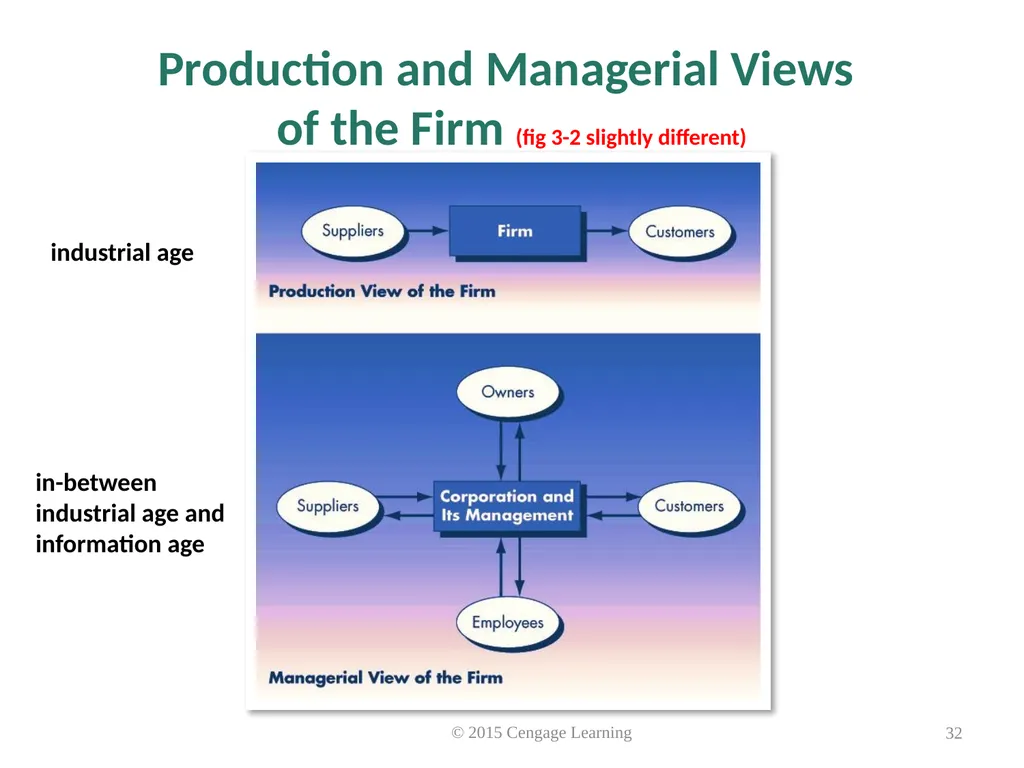
Production and Managerial Views
of the Firm (fig 3-2 slightly different) © 2015 Cengage Learning 32 industrial age in-between industrial age and information age<br>
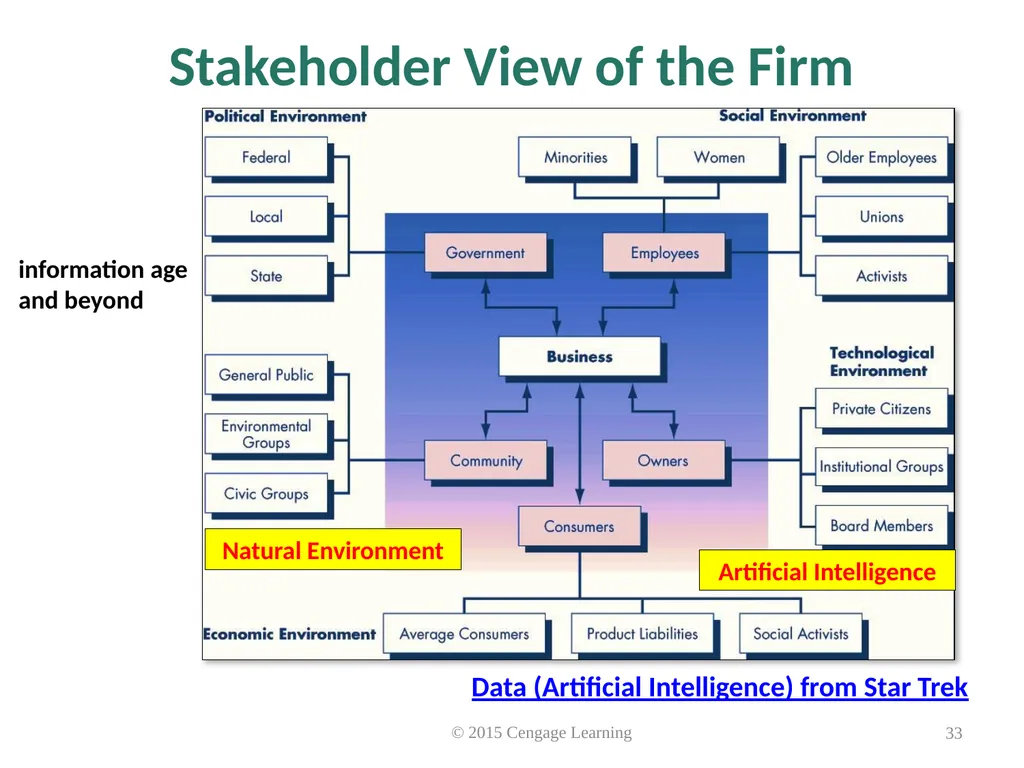
33
Stakeholder View of the Firm © 2015 Cengage Learning 33 information age and beyond Natural Environment Artificial Intelligence Data (Artificial Intelligence) from Star Trek<br>
34
Type of Stakeholders © 2015 Cengage Learning 34<br>
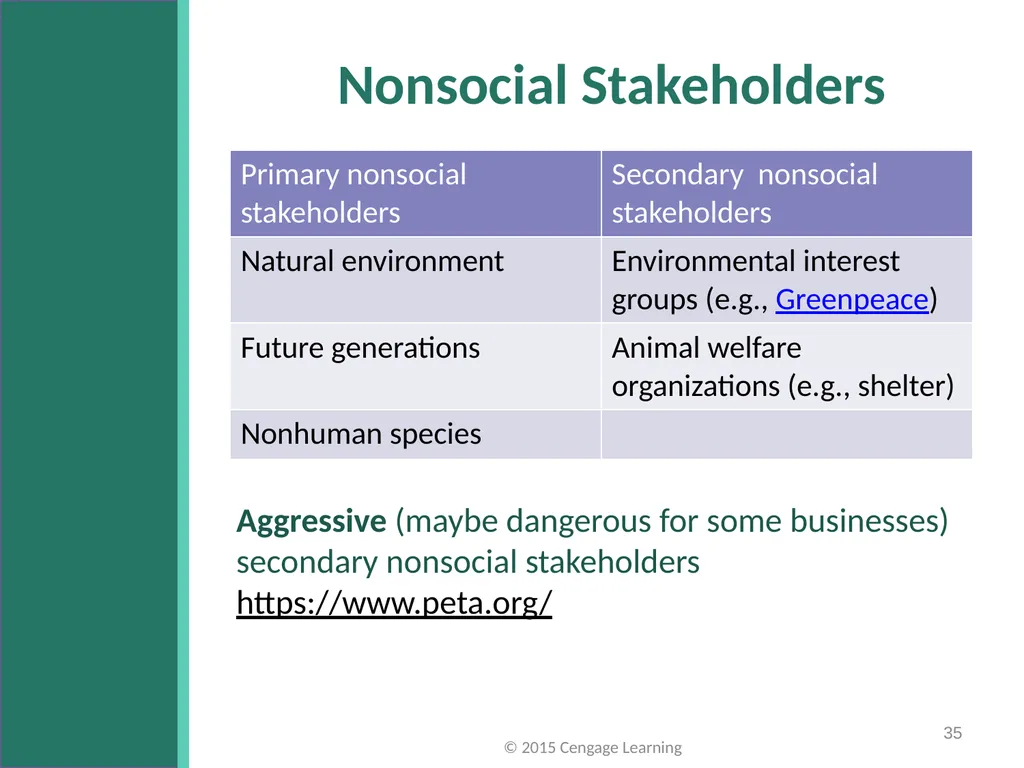
35
Nonsocial Stakeholders © 2015 Cengage Learning 35 Aggressive (maybe dangerous for some businesses) secondary nonsocial stakeholders
https://www.peta.org/<br>
https://www.peta.org/<br>
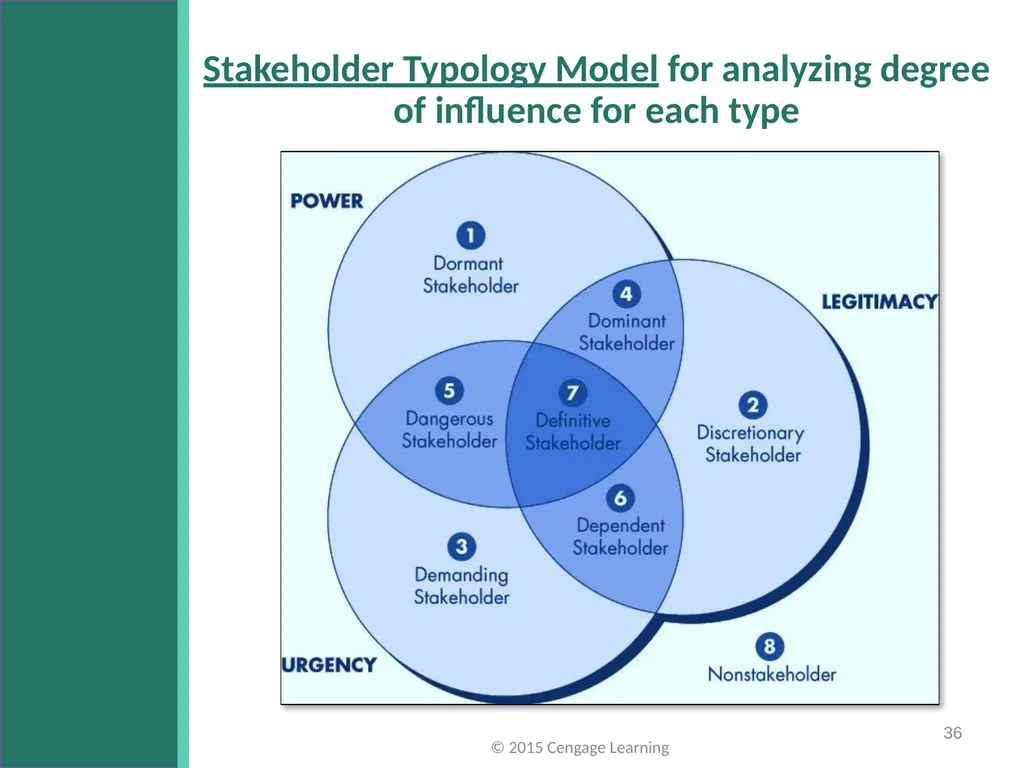
36
Stakeholder Typology Model for analyzing degree of influence for each type © 2015 Cengage Learning 36<br>
37
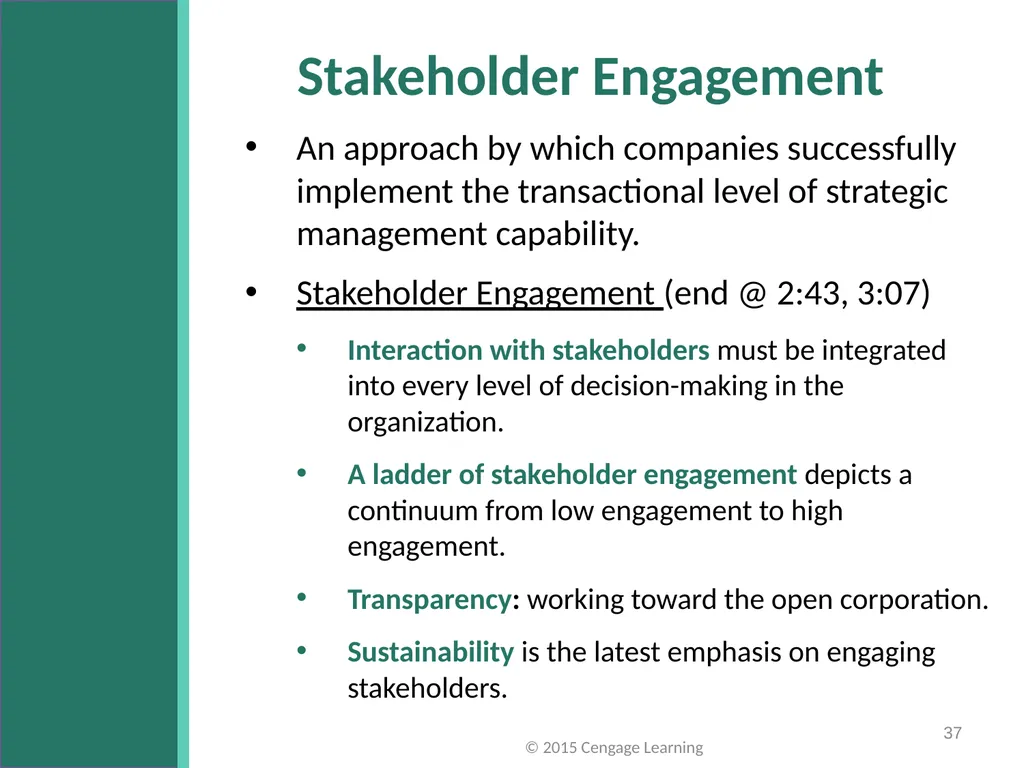
Stakeholder Engagement An approach by which companies successfully implement the transactional level of strategic management capability.
Stakeholder Engagement (end @ 2:43, 3:07)
Interaction with stakeholders must be integrated into every level of decision-making in the organization.
A ladder of stakeholder engagement depicts a continuum from low engagement to high engagement.
Transparency: working toward the open corporation.
Sustainability is the latest emphasis on engaging stakeholders. © 2015 Cengage Learning 37<br>
Stakeholder Engagement (end @ 2:43, 3:07)
Interaction with stakeholders must be integrated into every level of decision-making in the organization.
A ladder of stakeholder engagement depicts a continuum from low engagement to high engagement.
Transparency: working toward the open corporation.
Sustainability is the latest emphasis on engaging stakeholders. © 2015 Cengage Learning 37<br>
38
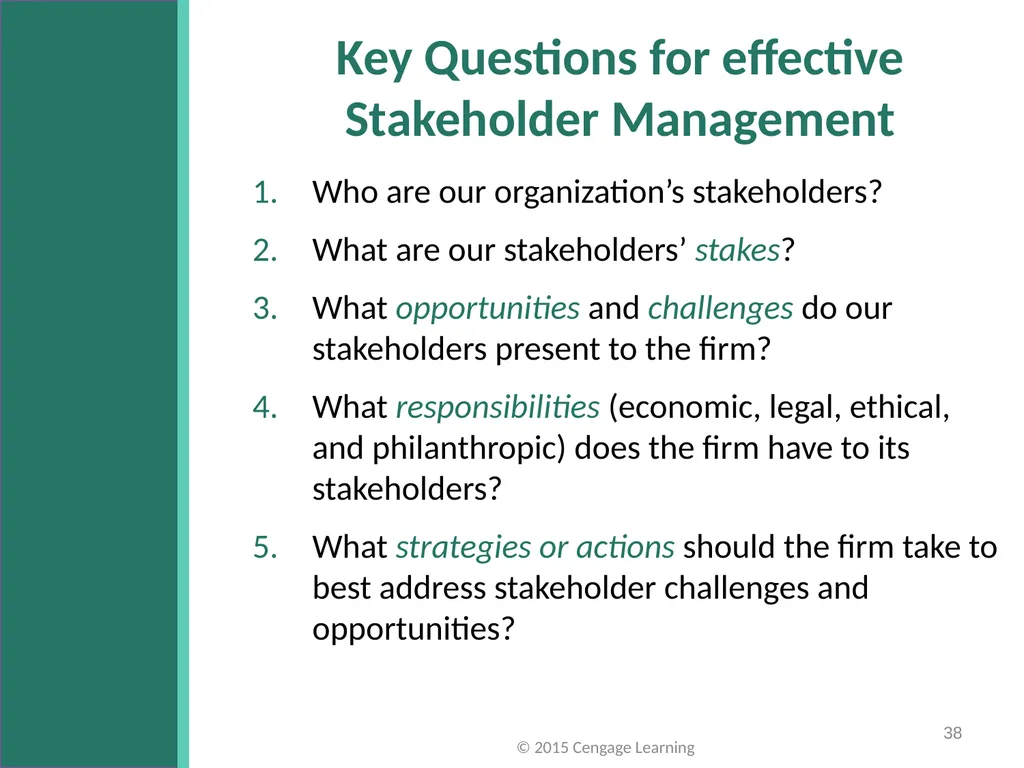
Key Questions for effective
Stakeholder Management Who are our organization’s stakeholders?
What are our stakeholders’ stakes?
What opportunities and challenges do our stakeholders present to the firm?
What responsibilities (economic, legal, ethical, and philanthropic) does the firm have to its stakeholders?
What strategies or actions should the firm take to best address stakeholder challenges and opportunities? © 2015 Cengage Learning 38<br>
What are our stakeholders’ stakes?
What opportunities and challenges do our stakeholders present to the firm?
What responsibilities (economic, legal, ethical, and philanthropic) does the firm have to its stakeholders?
What strategies or actions should the firm take to best address stakeholder challenges and opportunities? © 2015 Cengage Learning 38<br>
39
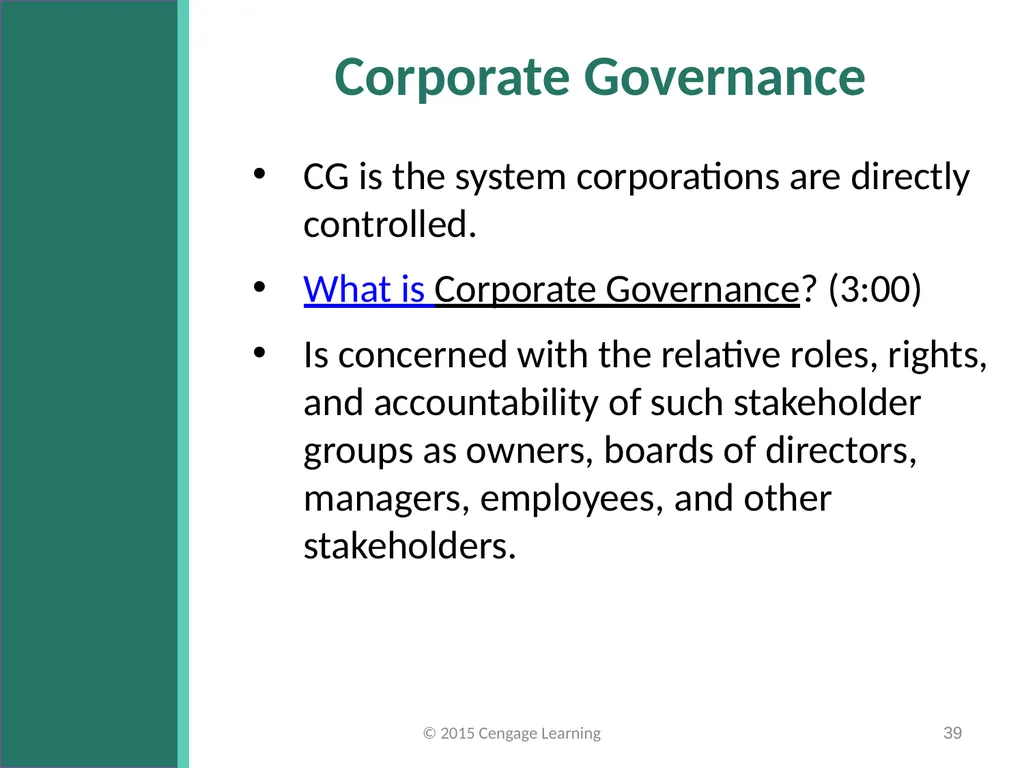
Corporate Governance CG is the system corporations are directly controlled.
What is Corporate Governance? (3:00)
Is concerned with the relative roles, rights, and accountability of such stakeholder groups as owners, boards of directors, managers, employees, and other stakeholders. © 2015 Cengage Learning 39<br>
What is Corporate Governance? (3:00)
Is concerned with the relative roles, rights, and accountability of such stakeholder groups as owners, boards of directors, managers, employees, and other stakeholders. © 2015 Cengage Learning 39<br>
40
The Corporation’s
Hierarchy of Authority © 2015 Cengage Learning 40 Issued by the state - allow right to exist. So, not a major group in a corporation<br>
41
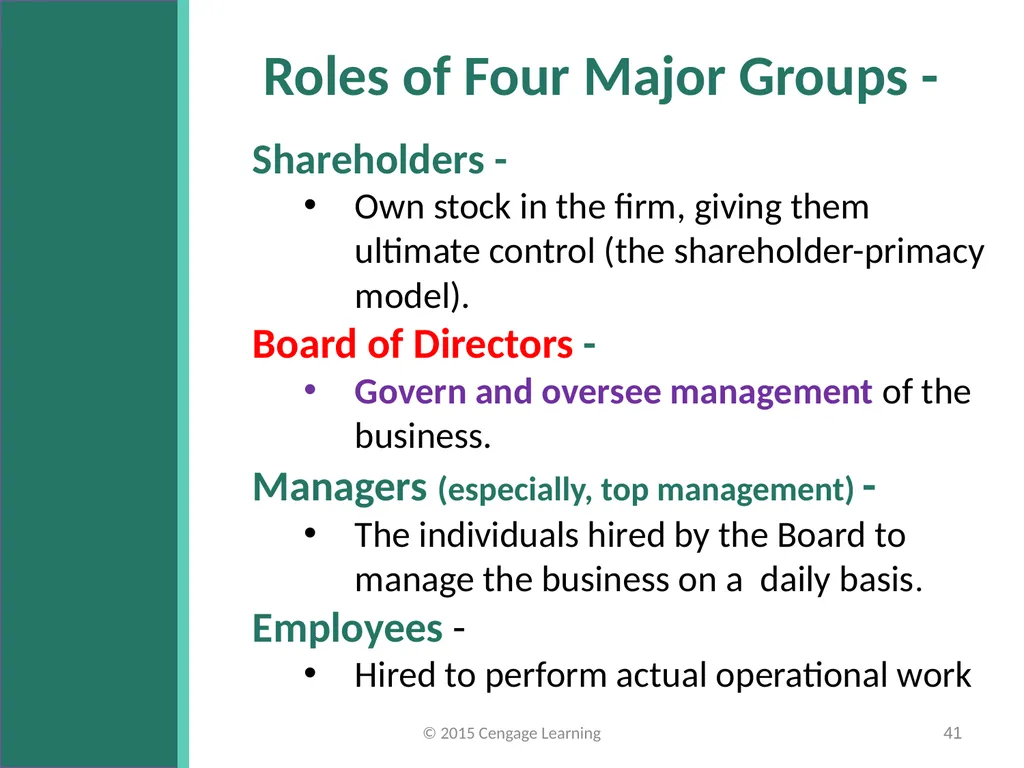
Roles of Four Major Groups - Shareholders -
Own stock in the firm, giving them ultimate control (the shareholder-primacy model).
Board of Directors -
Govern and oversee management of the business.
Managers (especially, top management) -
The individuals hired by the Board to manage the business on a daily basis.
Employees -
Hired to perform actual operational work © 2015 Cengage Learning 41<br>
Own stock in the firm, giving them ultimate control (the shareholder-primacy model).
Board of Directors -
Govern and oversee management of the business.
Managers (especially, top management) -
The individuals hired by the Board to manage the business on a daily basis.
Employees -
Hired to perform actual operational work © 2015 Cengage Learning 41<br>
42
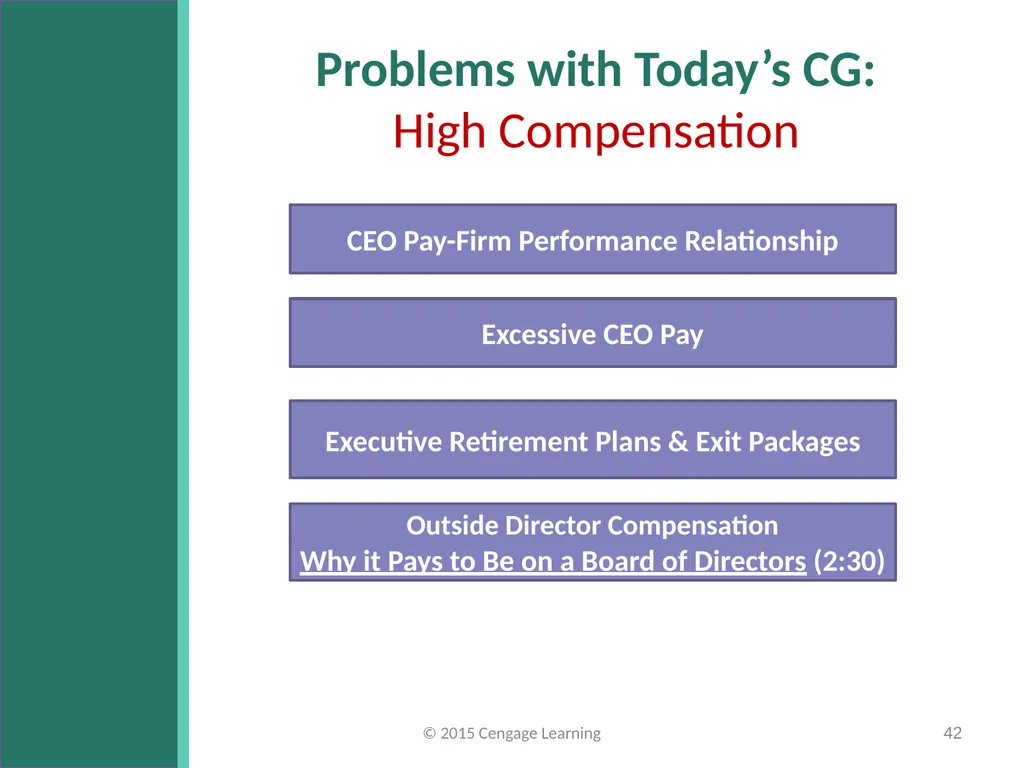
Problems with Today’s CG:
High Compensation © 2015 Cengage Learning 42 Excessive CEO Pay Outside Director Compensation
Why it Pays to Be on a Board of Directors (2:30)<br>
Why it Pays to Be on a Board of Directors (2:30)<br>
43
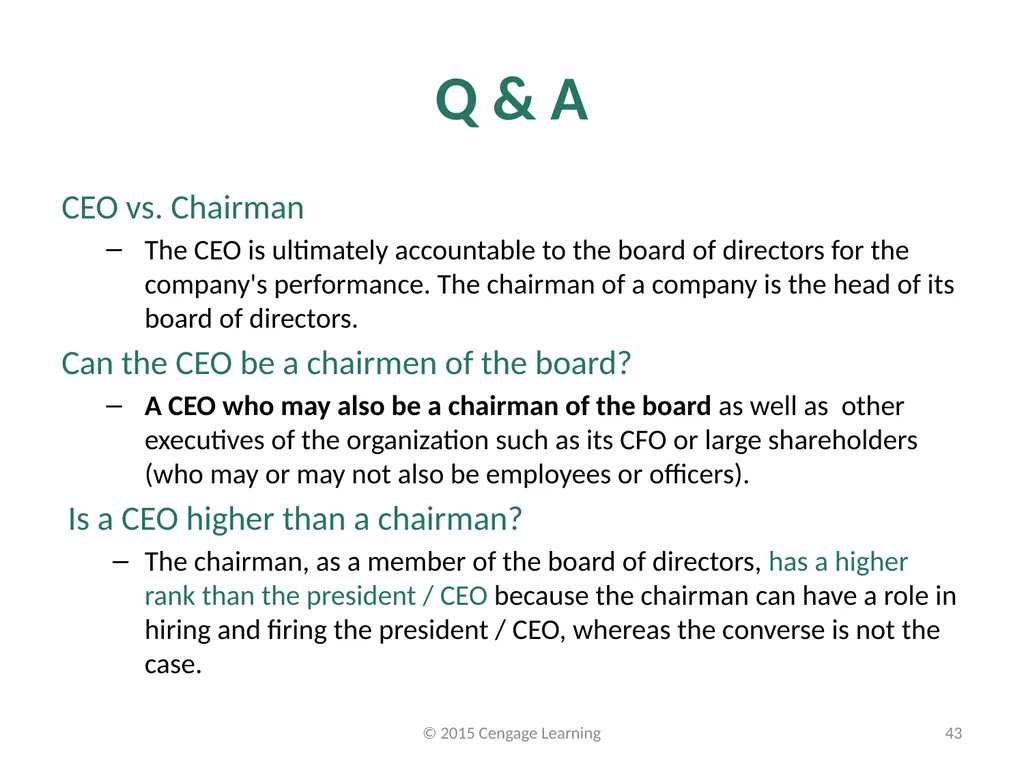
Q & A CEO vs. Chairman
The CEO is ultimately accountable to the board of directors for the company's performance. The chairman of a company is the head of its board of directors.
Can the CEO be a chairmen of the board?
A CEO who may also be a chairman of the board as well as other executives of the organization such as its CFO or large shareholders (who may or may not also be employees or officers).
Is a CEO higher than a chairman?
The chairman, as a member of the board of directors, has a higher rank than the president / CEO because the chairman can have a role in hiring and firing the president / CEO, whereas the converse is not the case. © 2015 Cengage Learning 43<br>
The CEO is ultimately accountable to the board of directors for the company's performance. The chairman of a company is the head of its board of directors.
Can the CEO be a chairmen of the board?
A CEO who may also be a chairman of the board as well as other executives of the organization such as its CFO or large shareholders (who may or may not also be employees or officers).
Is a CEO higher than a chairman?
The chairman, as a member of the board of directors, has a higher rank than the president / CEO because the chairman can have a role in hiring and firing the president / CEO, whereas the converse is not the case. © 2015 Cengage Learning 43<br>
44
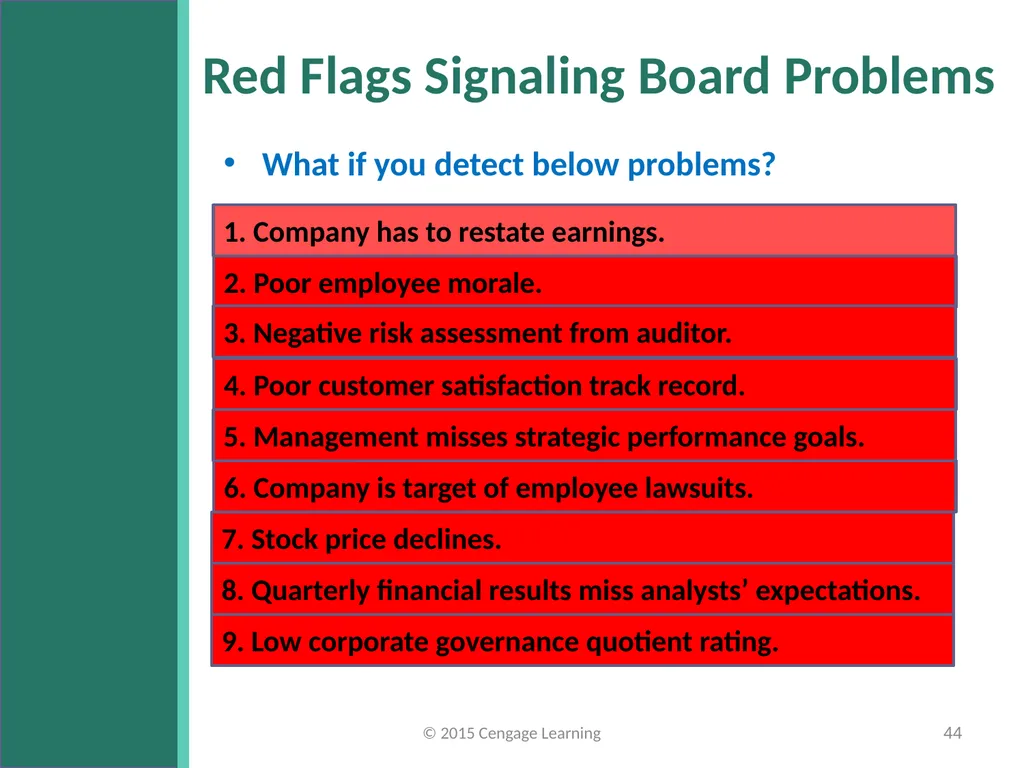
Red Flags Signaling Board Problems What if you detect below problems? © 2015 Cengage Learning 44 2. Poor employee morale. 1. Company has to restate earnings. 3. Negative risk assessment from auditor. 4. Poor customer satisfaction track record. 5. Management misses strategic performance goals. 6. Company is target of employee lawsuits. 7. Stock price declines. 8. Quarterly financial results miss analysts’ expectations. 9. Low corporate governance quotient rating.<br>
45
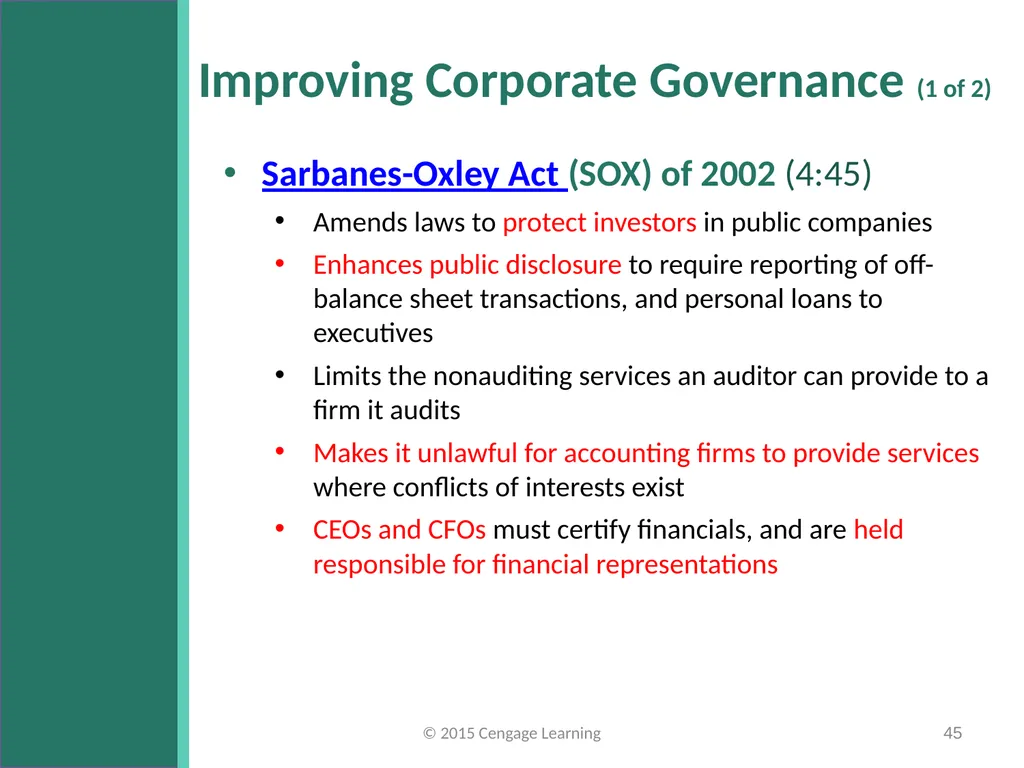
Improving Corporate Governance (1 of 2) Sarbanes-Oxley Act (SOX) of 2002 (4:45)
Amends laws to protect investors in public companies
Enhances public disclosure to require reporting of off-balance sheet transactions, and personal loans to executives
Limits the nonauditing services an auditor can provide to a firm it audits
Makes it unlawful for accounting firms to provide services where conflicts of interests exist
CEOs and CFOs must certify financials, and are held responsible for financial representations © 2015 Cengage Learning 45<br>
Amends laws to protect investors in public companies
Enhances public disclosure to require reporting of off-balance sheet transactions, and personal loans to executives
Limits the nonauditing services an auditor can provide to a firm it audits
Makes it unlawful for accounting firms to provide services where conflicts of interests exist
CEOs and CFOs must certify financials, and are held responsible for financial representations © 2015 Cengage Learning 45<br>
46
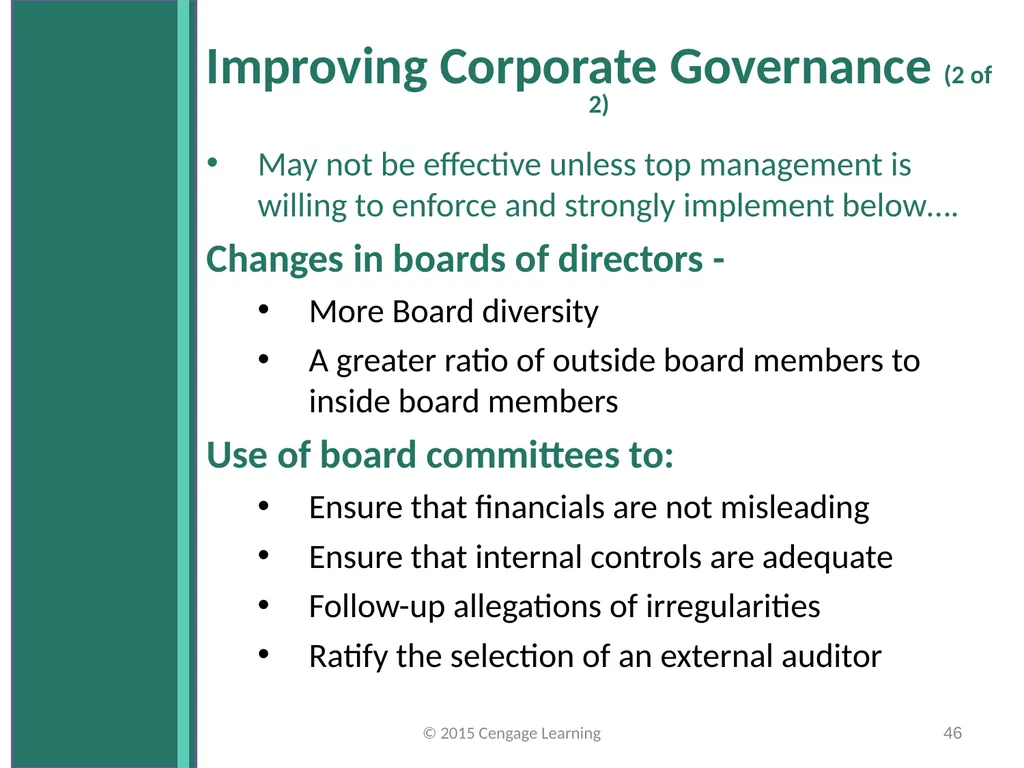
Improving Corporate Governance (2 of 2) May not be effective unless top management is willing to enforce and strongly implement below….
Changes in boards of directors -
More Board diversity
A greater ratio of outside board members to inside board members
Use of board committees to:
Ensure that financials are not misleading
Ensure that internal controls are adequate
Follow-up allegations of irregularities
Ratify the selection of an external auditor © 2015 Cengage Learning 46<br>
Changes in boards of directors -
More Board diversity
A greater ratio of outside board members to inside board members
Use of board committees to:
Ensure that financials are not misleading
Ensure that internal controls are adequate
Follow-up allegations of irregularities
Ratify the selection of an external auditor © 2015 Cengage Learning 46<br>
47
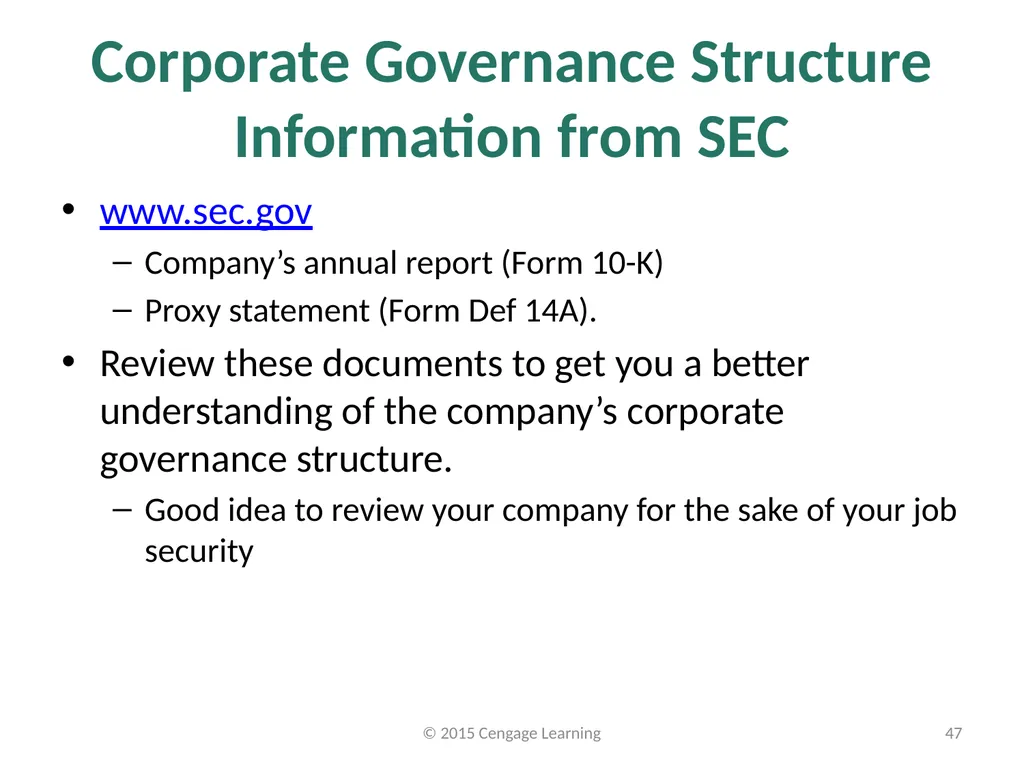
Corporate Governance Structure Information from SEC www.sec.gov
Company’s annual report (Form 10-K)
Proxy statement (Form Def 14A).
Review these documents to get you a better understanding of the company’s corporate governance structure.
Good idea to review your company for the sake of your job security © 2015 Cengage Learning 47<br>
Company’s annual report (Form 10-K)
Proxy statement (Form Def 14A).
Review these documents to get you a better understanding of the company’s corporate governance structure.
Good idea to review your company for the sake of your job security © 2015 Cengage Learning 47<br>
48
Walmart Answer questions the textbook
Overview of the Walmart Case: How Powerful (or ethical) Is Walmart? (3:40)
After class,
CSR by Walmart in 2013 (2:36)
Walmart Mexico Scandal (2:27) © 2015 Cengage Learning 48<br>
Overview of the Walmart Case: How Powerful (or ethical) Is Walmart? (3:40)
After class,
CSR by Walmart in 2013 (2:36)
Walmart Mexico Scandal (2:27) © 2015 Cengage Learning 48<br>
49
The Body Shop Enrich Not Exploit (0:50)
Shows identity of corporation
Anita Roddick passed away unexpectedly in 2007.
Review the company website
Review categories under “Our Commitment” at the bottom of the web page
Vs. Bath & Body Works © 2015 Cengage Learning 49<br>
Shows identity of corporation
Anita Roddick passed away unexpectedly in 2007.
Review the company website
Review categories under “Our Commitment” at the bottom of the web page
Vs. Bath & Body Works © 2015 Cengage Learning 49<br>