
Lecture 2 Introduction to Acids and Bases Quiz
TA
Published · 45 slides · 0 views

1 / 1
Description
Lecture 2 Introduction to Acids and Bases Quiz Schedule Quiz 1 is tomorrow during your noon quiz section. The quiz will cover the Monday and Tuesday week 1 assignments. The even numbered assigned Zumdahl problems from these two homework
Related Topics
Share
Embed code
Download this presentation From Below
"Lecture 2 Introduction to Acids and Bases Quiz" is the property of its rightful owner. Permission is granted to download and print the materials on this website for personal, non-commercial use only, and to display it on your personal computer provided you do not modify the materials and that you retain all copyright notices contained in the materials. By downloading content from our website, you accept the terms of this agreement.
Presentation Transcript
01
Lecture 2 Introduction to Acids and Bases<br>
02
Quiz Schedule Quiz 1 is tomorrow during your noon quiz section. The quiz will cover the Monday and Tuesday week 1 assignments. The even numbered assigned Zumdahl problems from these two homework sets will be checked during the noon quiz section tomorrow. As always, answers to the Review questions are not required.
Quiz 2 is Monday, June 19 and it will concentrate on the Wednesday and Thursday week 1 assignments. Homework from these two assignments will be checked on June 19 during quiz section.<br>
Quiz 2 is Monday, June 19 and it will concentrate on the Wednesday and Thursday week 1 assignments. Homework from these two assignments will be checked on June 19 during quiz section.<br>
03
Lecture 2 Introduction to Acids and Bases<br>
04
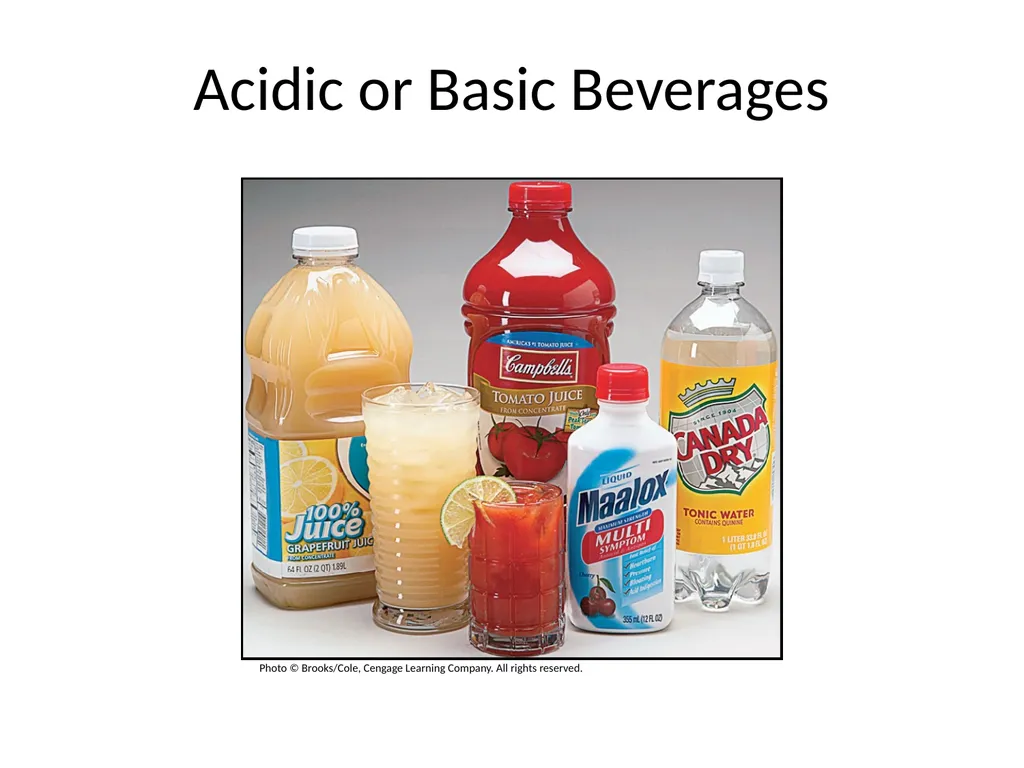
Acidic or Basic Beverages Photo © Brooks/Cole, Cengage Learning Company. All rights reserved.<br>
05
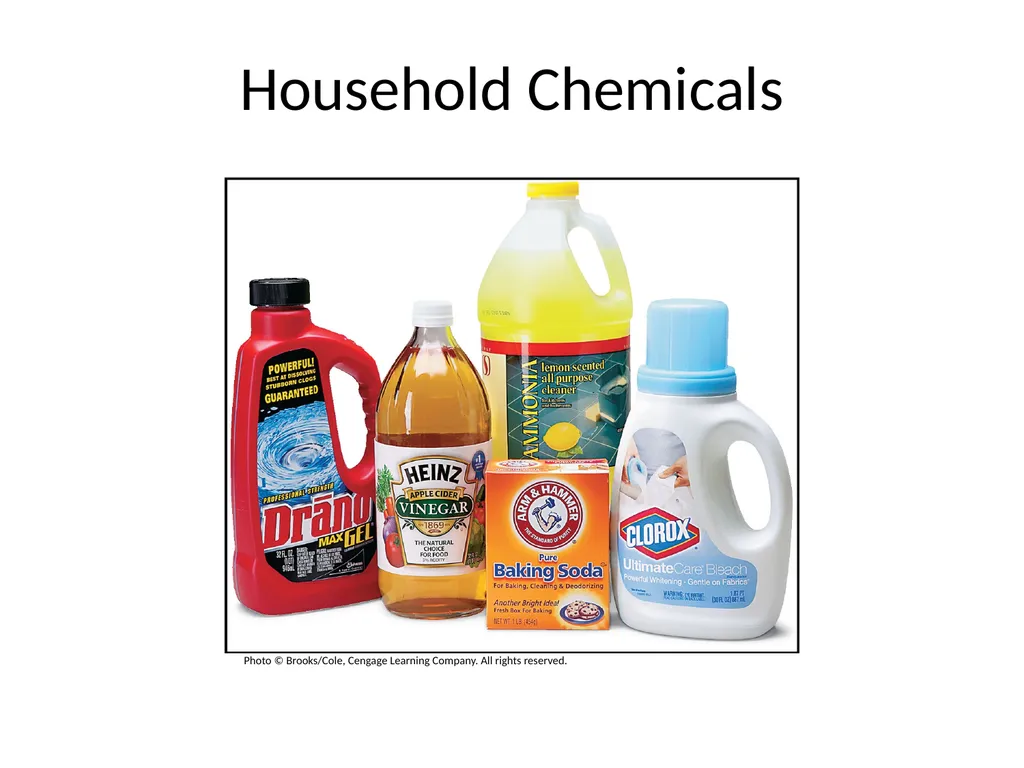
Household Chemicals Photo © Brooks/Cole, Cengage Learning Company. All rights reserved.<br>
06
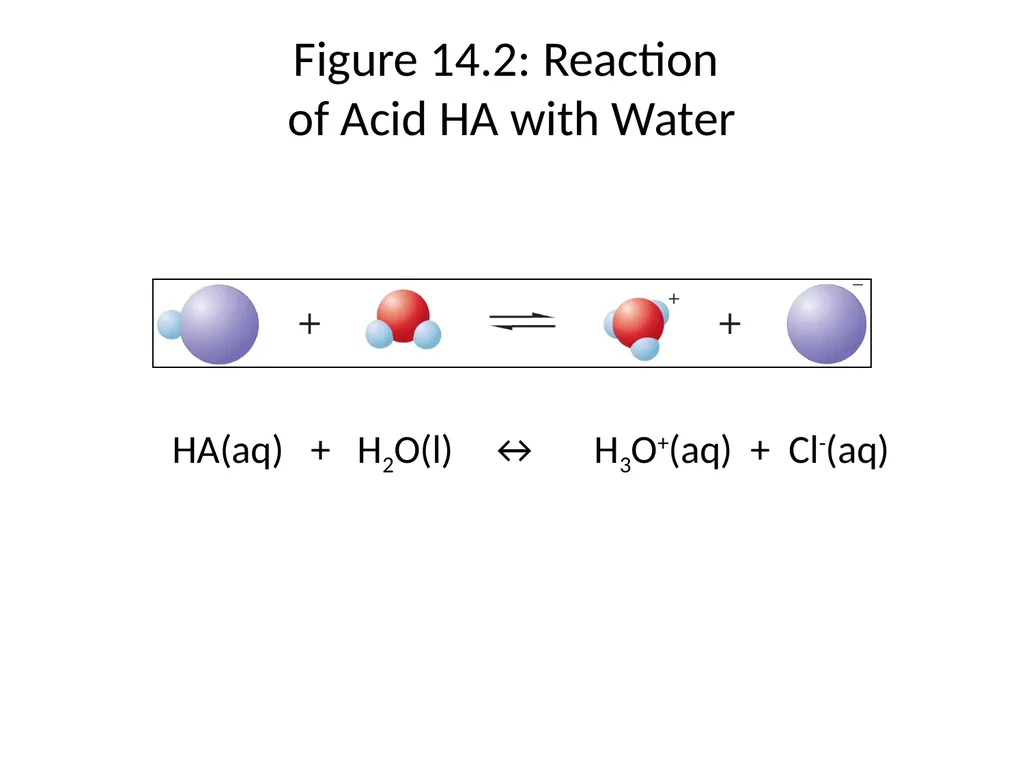
Figure 14.2: Reaction
of Acid HA with Water HA(aq) + H2O(l) ↔ H3O+(aq) + Cl-(aq)<br>
07
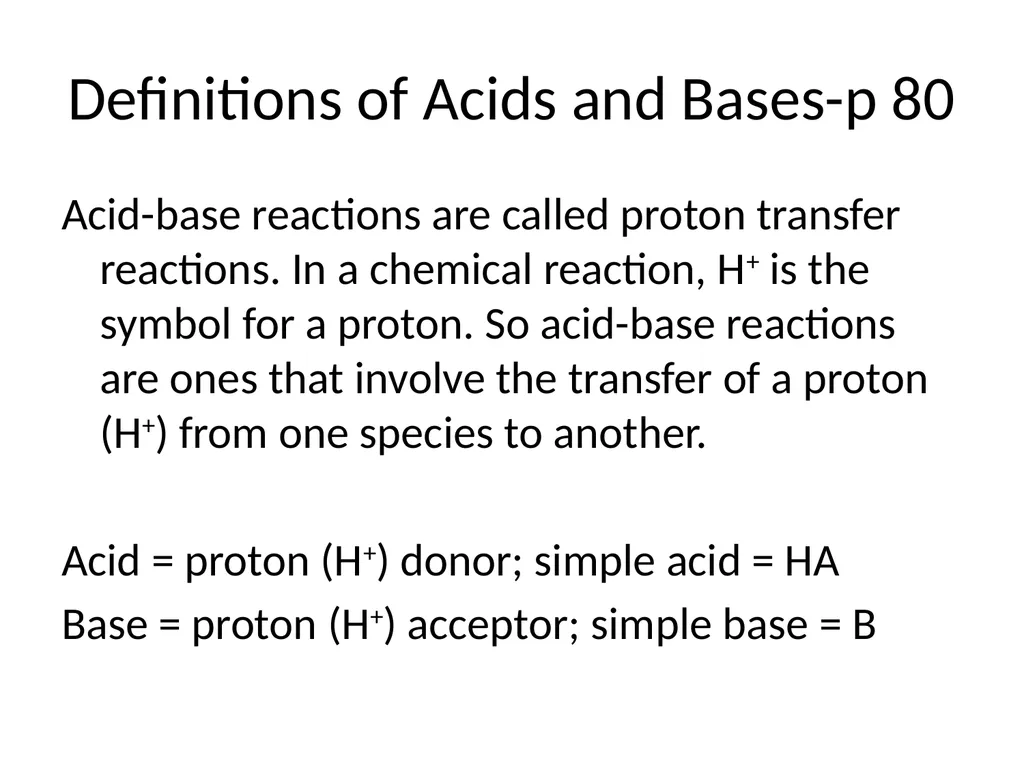
Definitions of Acids and Bases-p 80 Acid-base reactions are called proton transfer reactions. In a chemical reaction, H+ is the symbol for a proton. So acid-base reactions are ones that involve the transfer of a proton (H+) from one species to another.
Acid = proton (H+) donor; simple acid = HA
Base = proton (H+) acceptor; simple base = B<br>
Acid = proton (H+) donor; simple acid = HA
Base = proton (H+) acceptor; simple base = B<br>
08
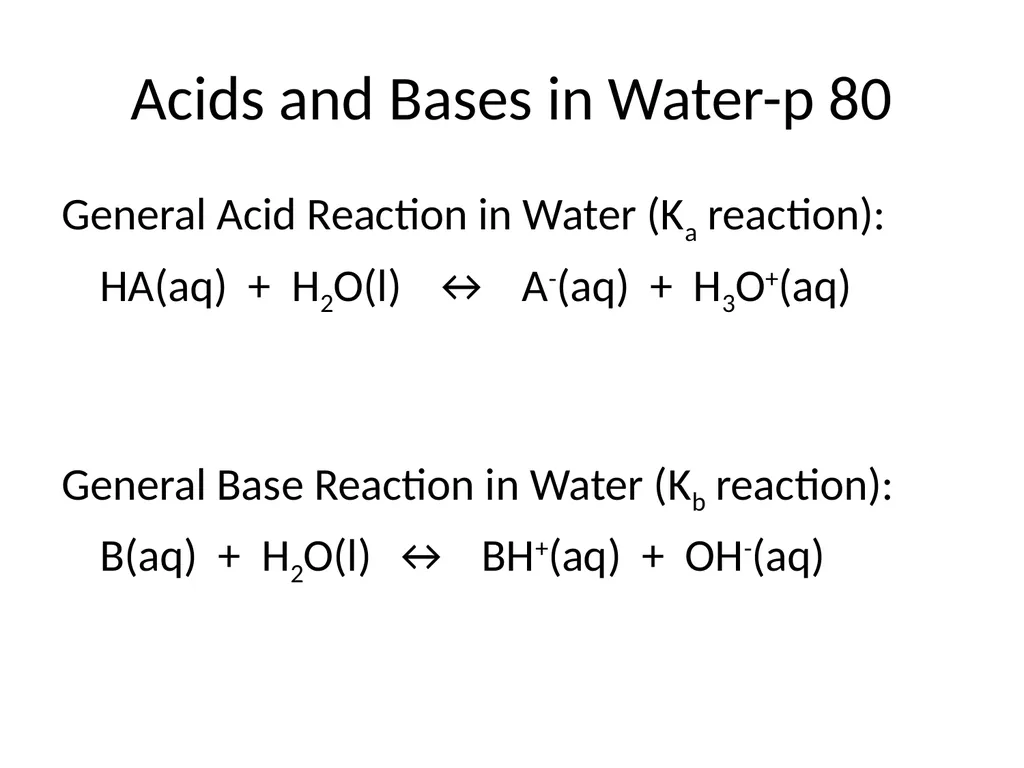
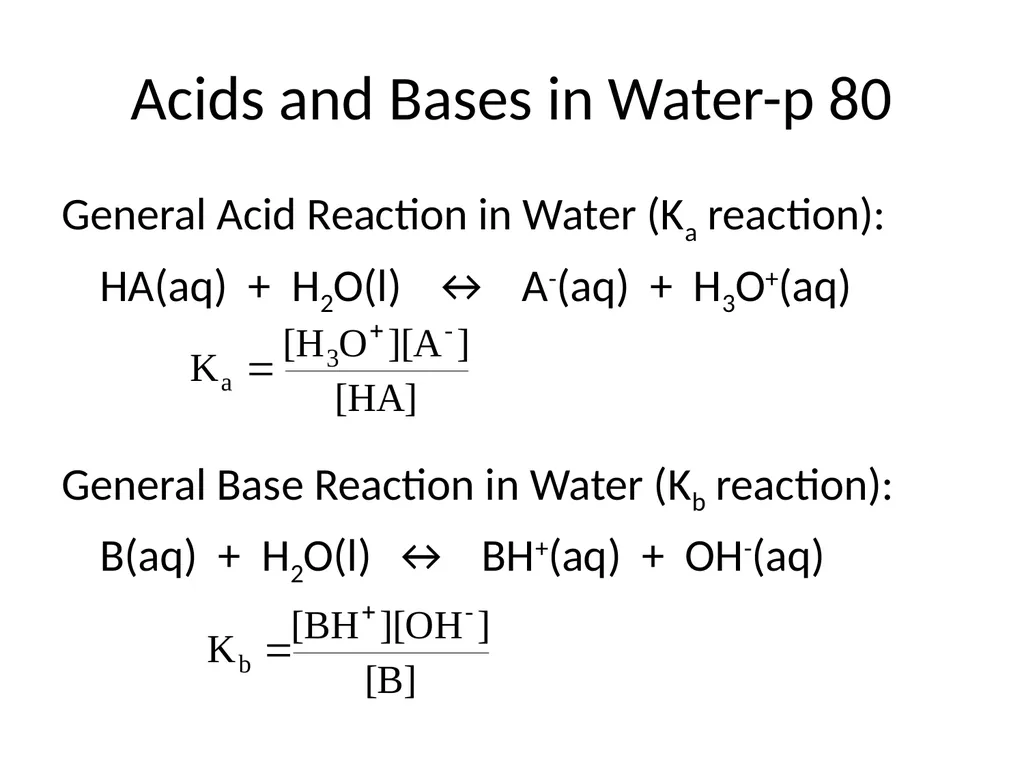
Acids and Bases in Water-p 80 General Acid Reaction in Water (Ka reaction):
HA(aq) + H2O(l) ↔ A-(aq) + H3O+(aq)
General Base Reaction in Water (Kb reaction):
B(aq) + H2O(l) ↔ BH+(aq) + OH-(aq)<br>
HA(aq) + H2O(l) ↔ A-(aq) + H3O+(aq)
General Base Reaction in Water (Kb reaction):
B(aq) + H2O(l) ↔ BH+(aq) + OH-(aq)<br>
09
Acids and Bases in Water-p 80 General Acid Reaction in Water (Ka reaction):
HA(aq) + H2O(l) ↔ A-(aq) + H3O+(aq)
General Base Reaction in Water (Kb reaction):
B(aq) + H2O(l) ↔ BH+(aq) + OH-(aq)<br>
HA(aq) + H2O(l) ↔ A-(aq) + H3O+(aq)
General Base Reaction in Water (Kb reaction):
B(aq) + H2O(l) ↔ BH+(aq) + OH-(aq)<br>
10
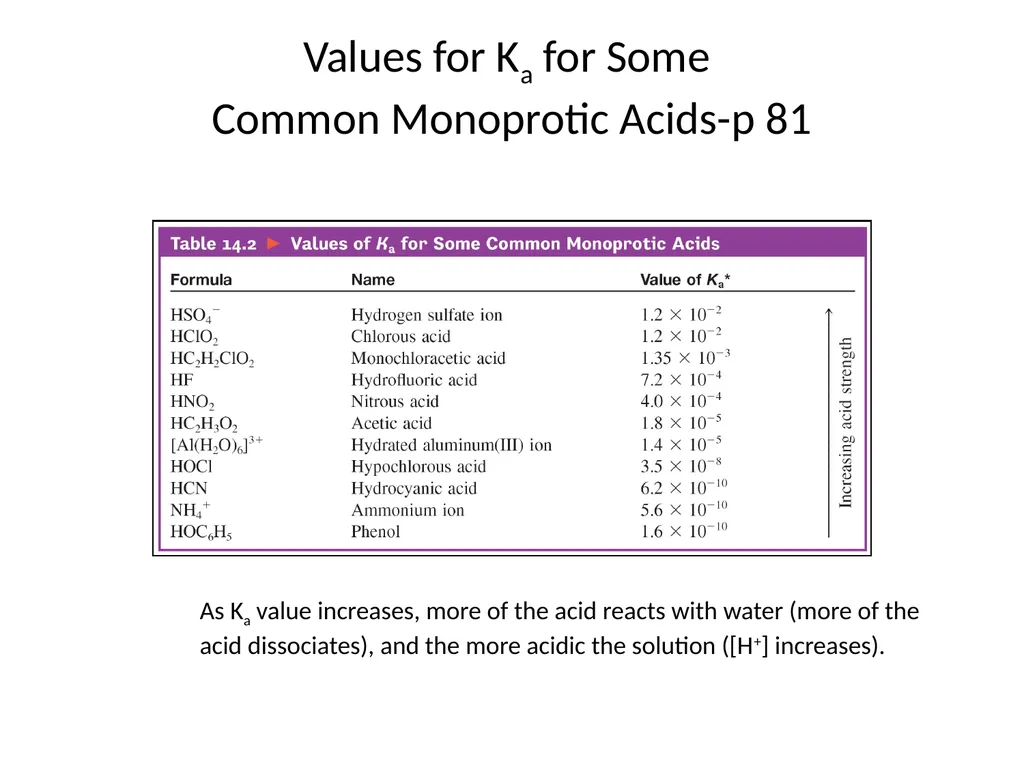
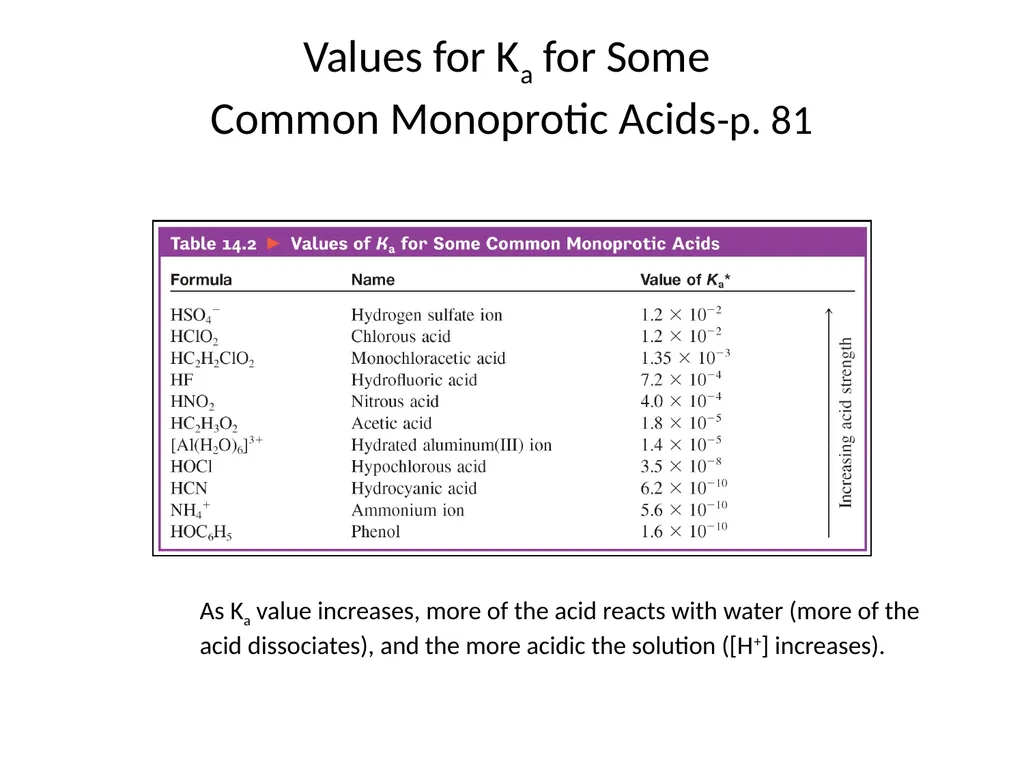
Values for Ka for Some
Common Monoprotic Acids-p 81 As Ka value increases, more of the acid reacts with water (more of the
acid dissociates), and the more acidic the solution ([H+] increases).<br>
acid dissociates), and the more acidic the solution ([H+] increases).<br>
11
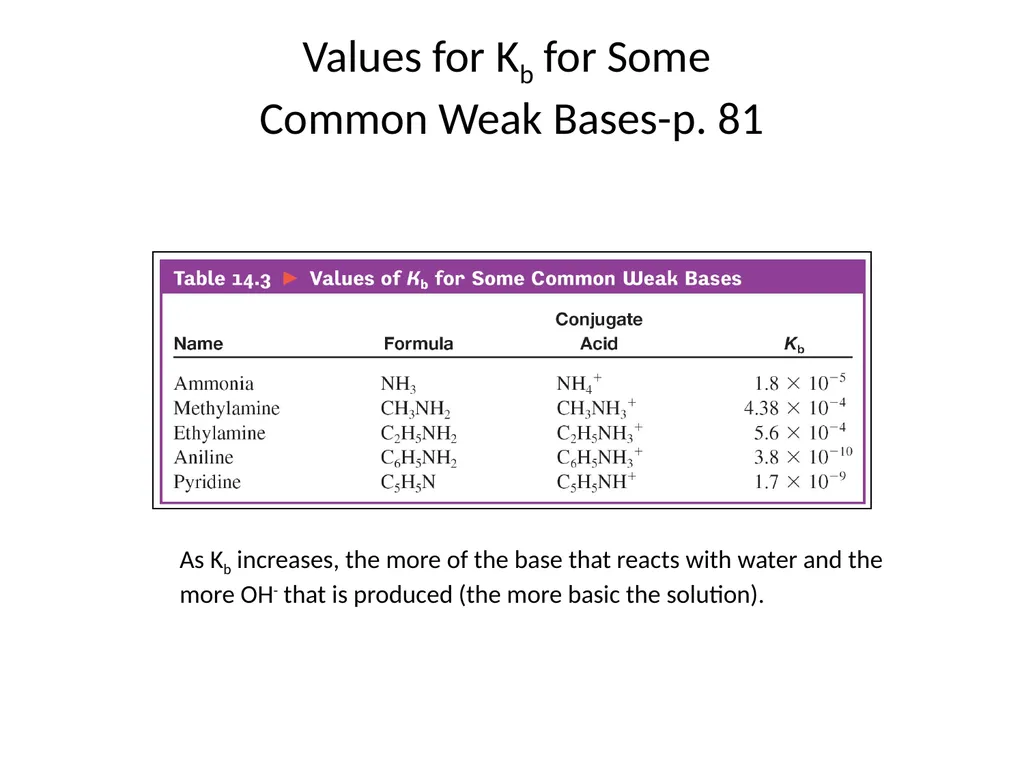
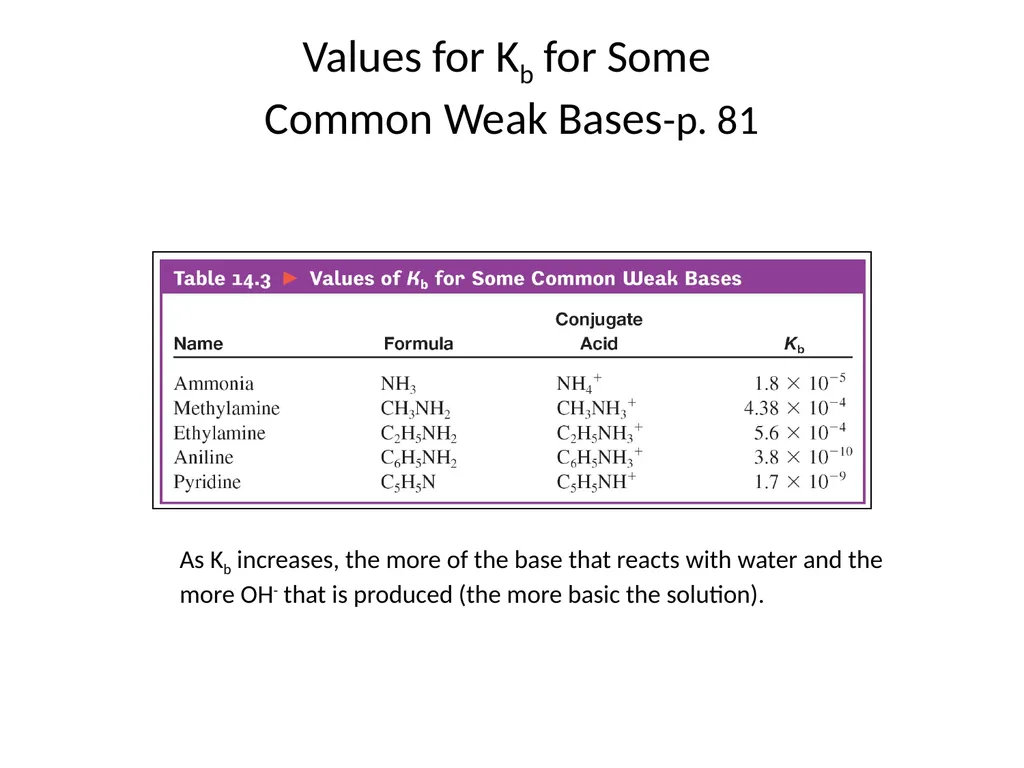
Values for Kb for Some
Common Weak Bases-p. 81 As Kb increases, the more of the base that reacts with water and the
more OH- that is produced (the more basic the solution).<br>
more OH- that is produced (the more basic the solution).<br>
12
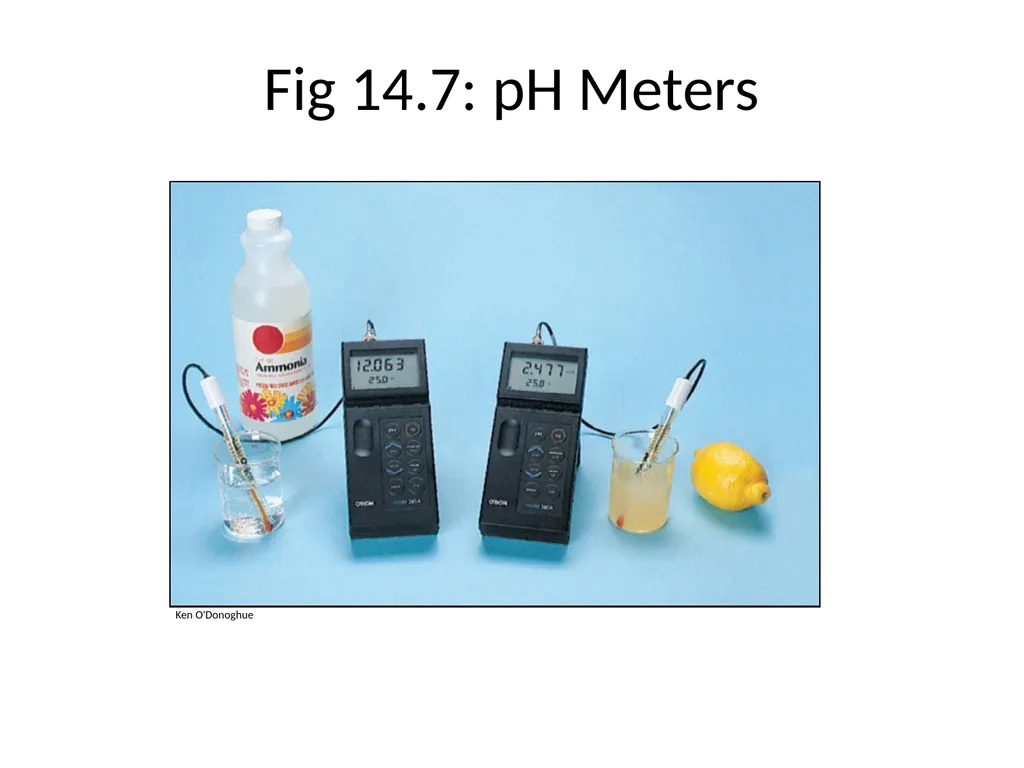
Fig 14.7: pH Meters Ken O'Donoghue<br>
13
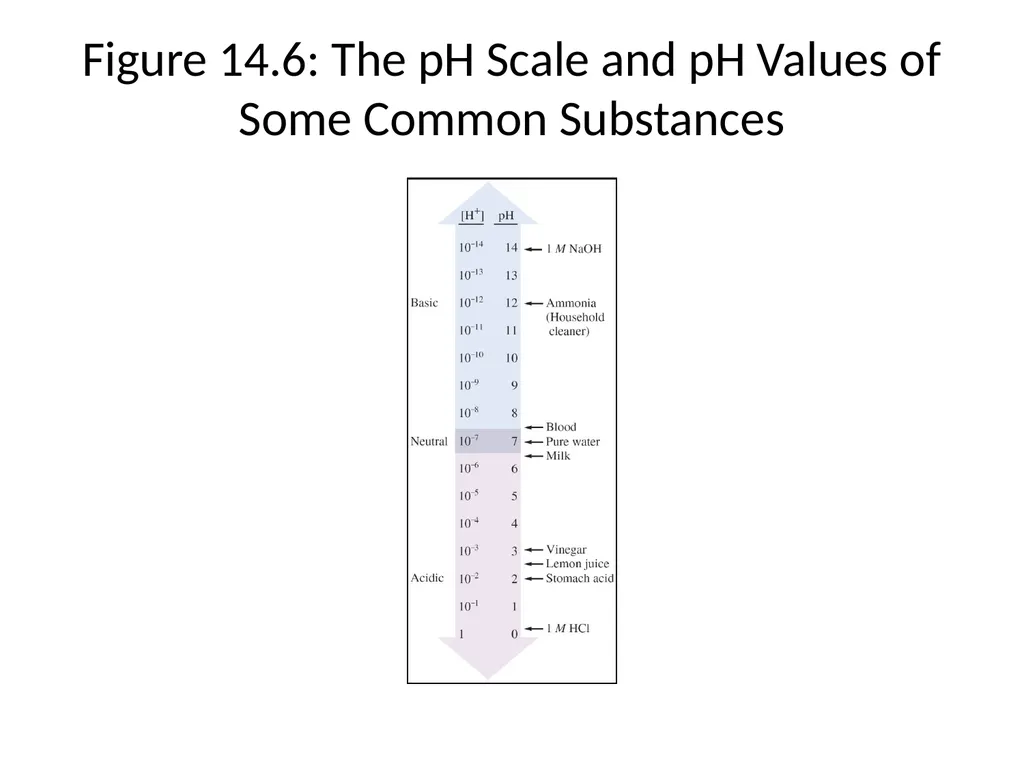
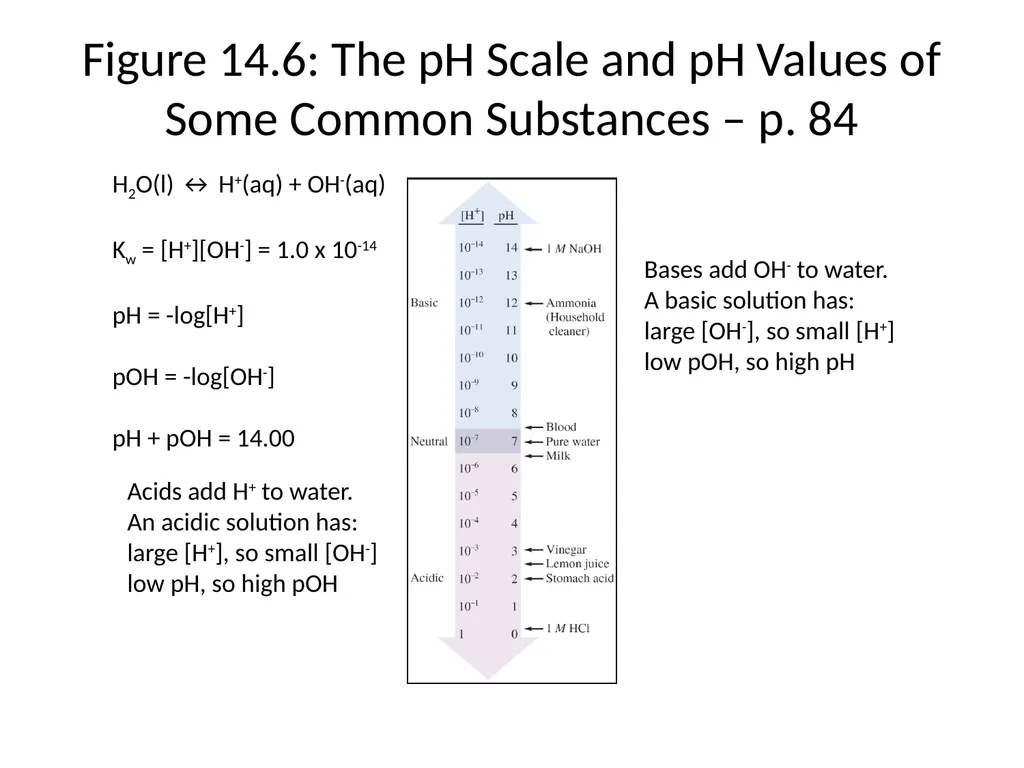
Figure 14.6: The pH Scale and pH Values of Some Common Substances<br>
14
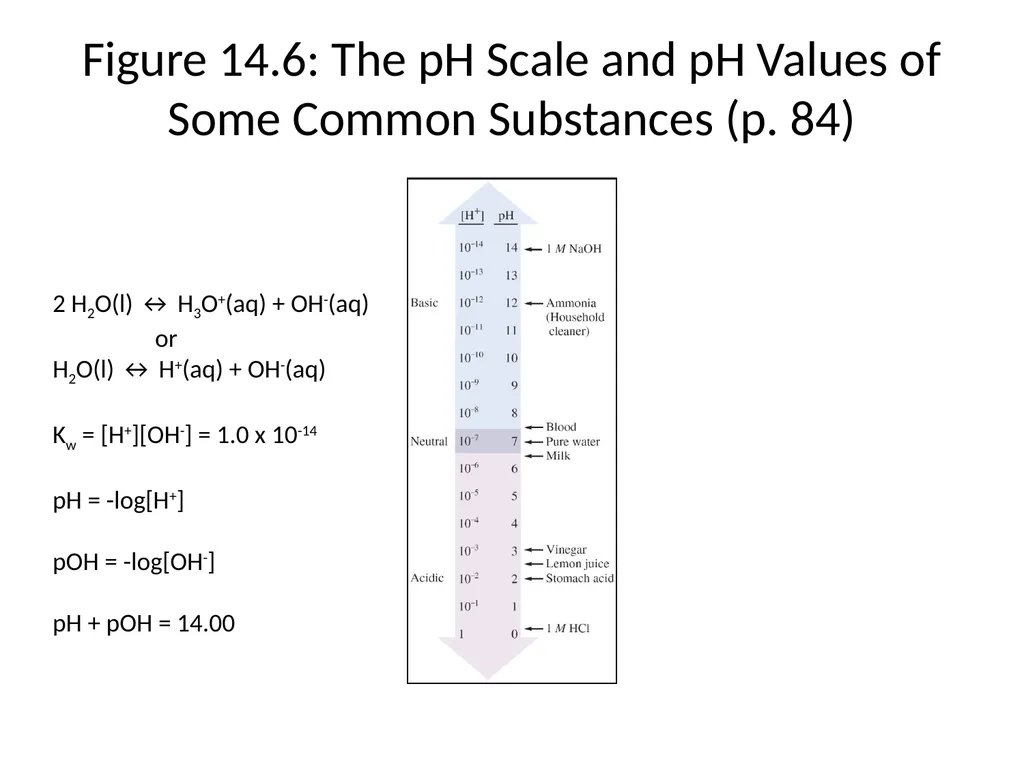
Figure 14.6: The pH Scale and pH Values of Some Common Substances (p. 84) 2 H2O(l) ↔ H3O+(aq) + OH-(aq)
or
H2O(l) ↔ H+(aq) + OH-(aq)
Kw = [H+][OH-] = 1.0 x 10⁻¹⁴
pH = -log[H+]
pOH = -log[OH-]
pH + pOH = 14.00<br>
or
H2O(l) ↔ H+(aq) + OH-(aq)
Kw = [H+][OH-] = 1.0 x 10⁻¹⁴
pH = -log[H+]
pOH = -log[OH-]
pH + pOH = 14.00<br>
15
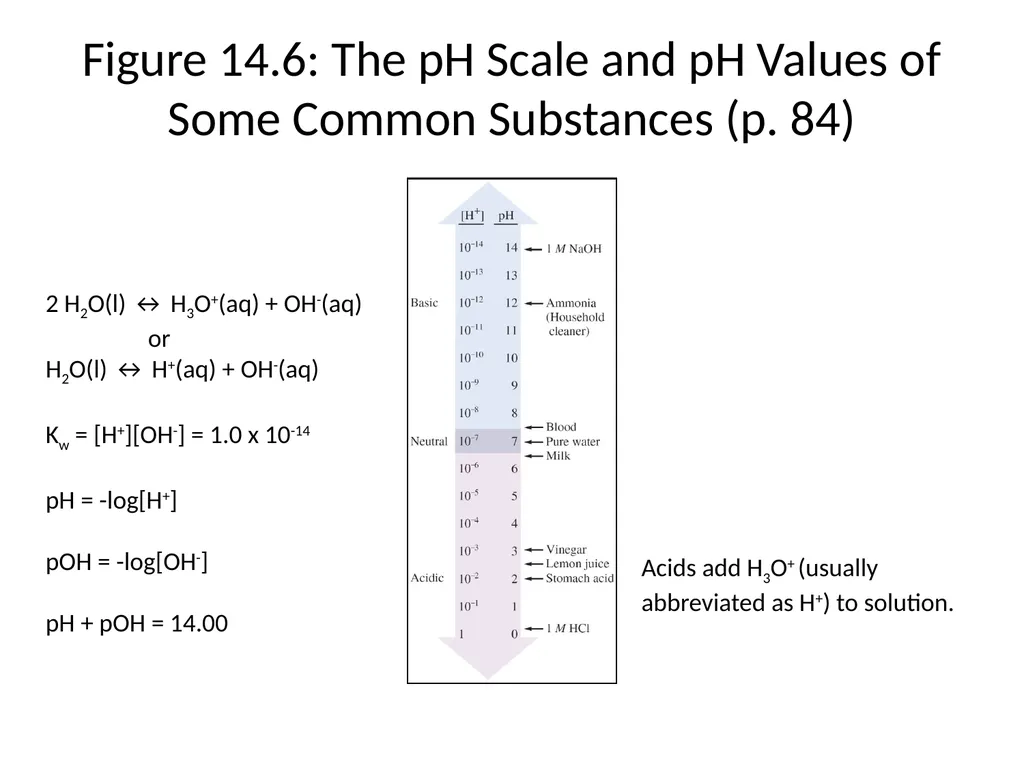
Figure 14.6: The pH Scale and pH Values of Some Common Substances (p. 84) Acids add H3O+ (usually abbreviated as H+) to solution. 2 H2O(l) ↔ H3O+(aq) + OH-(aq)
or
H2O(l) ↔ H+(aq) + OH-(aq)
Kw = [H+][OH-] = 1.0 x 10⁻¹⁴
pH = -log[H+]
pOH = -log[OH-]
pH + pOH = 14.00<br>
or
H2O(l) ↔ H+(aq) + OH-(aq)
Kw = [H+][OH-] = 1.0 x 10⁻¹⁴
pH = -log[H+]
pOH = -log[OH-]
pH + pOH = 14.00<br>
16
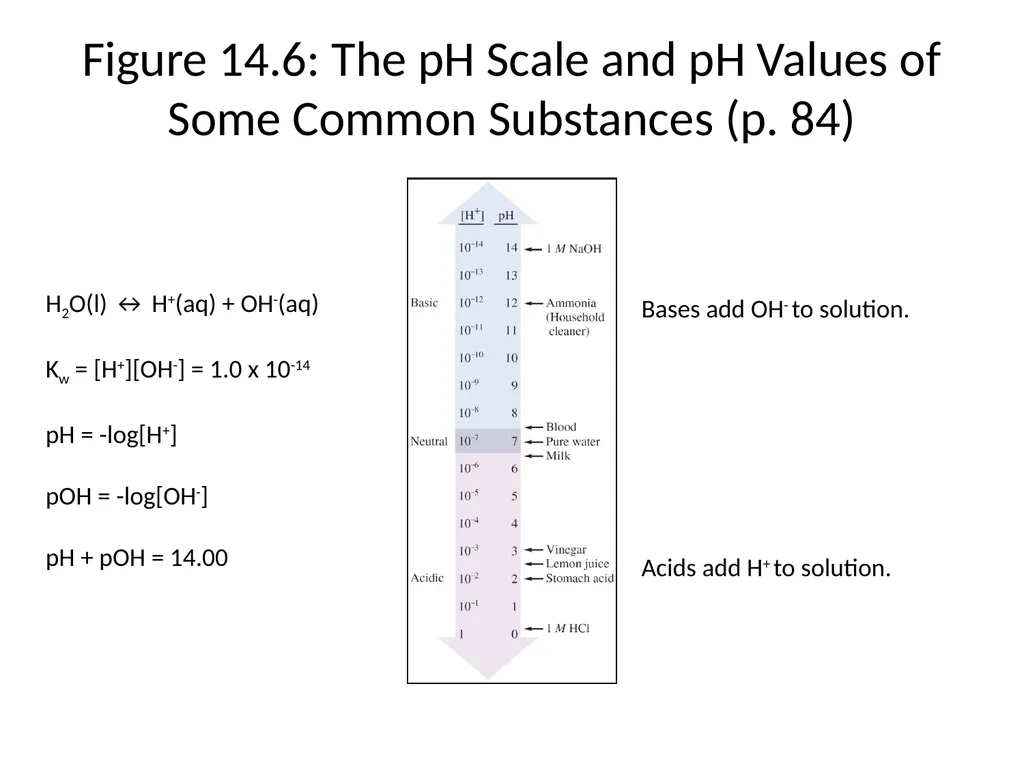
Figure 14.6: The pH Scale and pH Values of Some Common Substances (p. 84) Acids add H+ to solution. H2O(l) ↔ H+(aq) + OH-(aq)
Kw = [H+][OH-] = 1.0 x 10⁻¹⁴
pH = -log[H+]
pOH = -log[OH-]
pH + pOH = 14.00 Bases add OH- to solution.<br>
Kw = [H+][OH-] = 1.0 x 10⁻¹⁴
pH = -log[H+]
pOH = -log[OH-]
pH + pOH = 14.00 Bases add OH- to solution.<br>
17
Figure 14.6: The pH Scale and pH Values of Some Common Substances – p. 84 H2O(l) ↔ H+(aq) + OH-(aq)
Kw = [H+][OH-] = 1.0 x 10⁻¹⁴
pH = -log[H+]
pOH = -log[OH-]
pH + pOH = 14.00 Acids add H+ to water.
An acidic solution has:
large [H+], so small [OH-]
low pH, so high pOH Bases add OH- to water.
A basic solution has:
large [OH-], so small [H+]
low pOH, so high pH<br>
Kw = [H+][OH-] = 1.0 x 10⁻¹⁴
pH = -log[H+]
pOH = -log[OH-]
pH + pOH = 14.00 Acids add H+ to water.
An acidic solution has:
large [H+], so small [OH-]
low pH, so high pOH Bases add OH- to water.
A basic solution has:
large [OH-], so small [H+]
low pOH, so high pH<br>
18
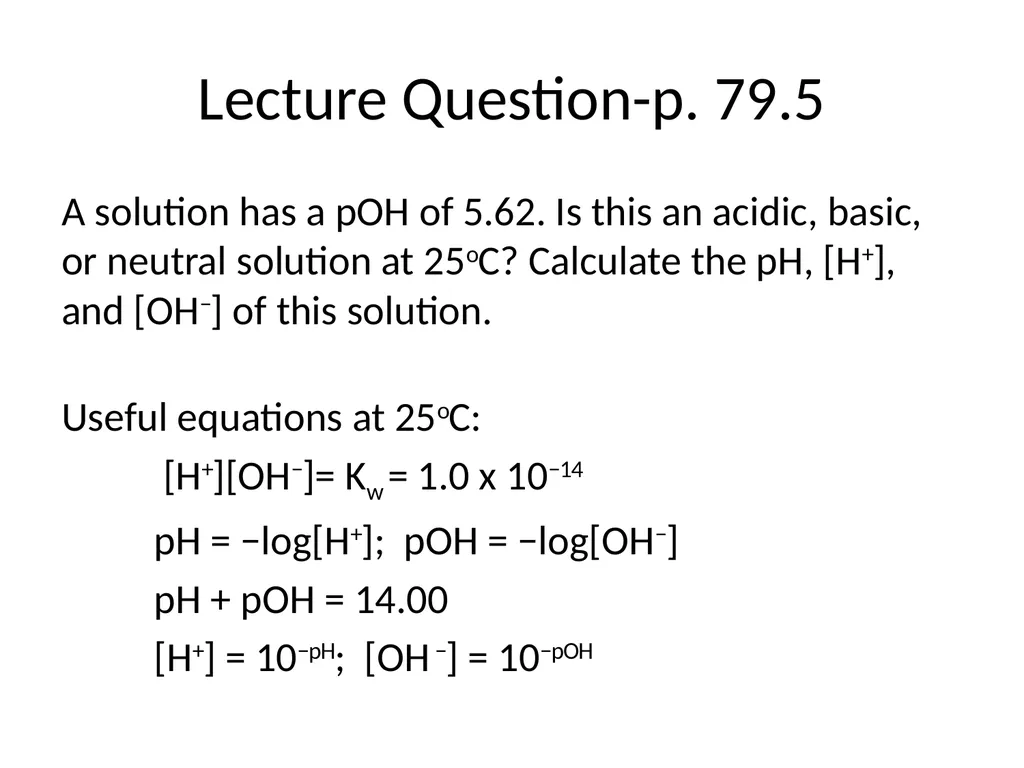
Lecture Question-p. 79.5 A solution has a pOH of 5.62. Is this an acidic, basic, or neutral solution at 25oC? Calculate the pH, [H+], and [OH−] of this solution.
Useful equations at 25oC:
[H+][OH−]= Kw = 1.0 x 10⁻¹⁴
pH = −log[H+]; pOH = −log[OH−]
pH + pOH = 14.00
[H+] = 10−pH; [OH −] = 10−pOH<br>
Useful equations at 25oC:
[H+][OH−]= Kw = 1.0 x 10⁻¹⁴
pH = −log[H+]; pOH = −log[OH−]
pH + pOH = 14.00
[H+] = 10−pH; [OH −] = 10−pOH<br>
19
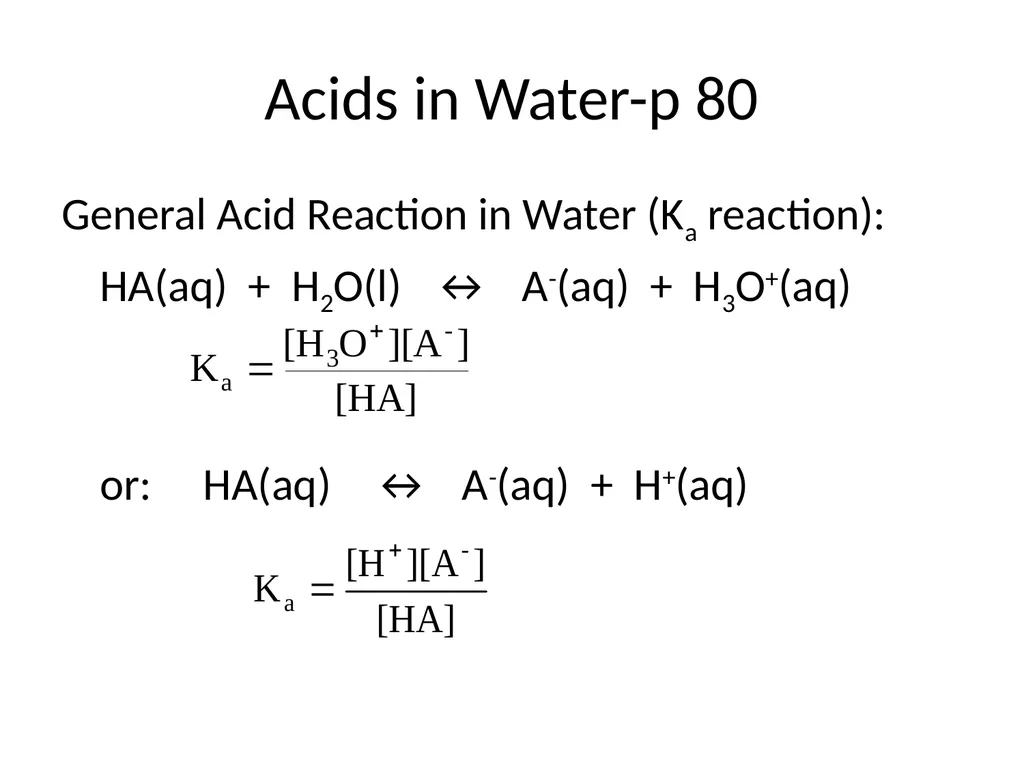
Acids in Water-p 80 General Acid Reaction in Water (Ka reaction):
HA(aq) + H2O(l) ↔ A-(aq) + H3O+(aq)
or: HA(aq) ↔ A-(aq) + H+(aq)<br>
HA(aq) + H2O(l) ↔ A-(aq) + H3O+(aq)
or: HA(aq) ↔ A-(aq) + H+(aq)<br>
20
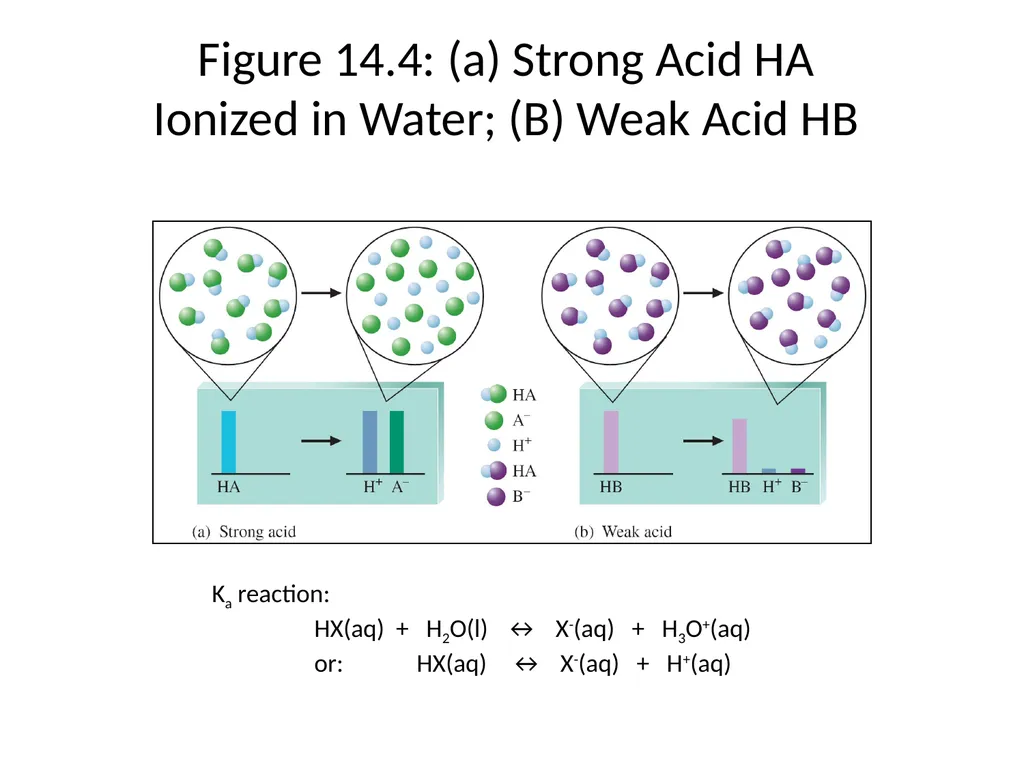
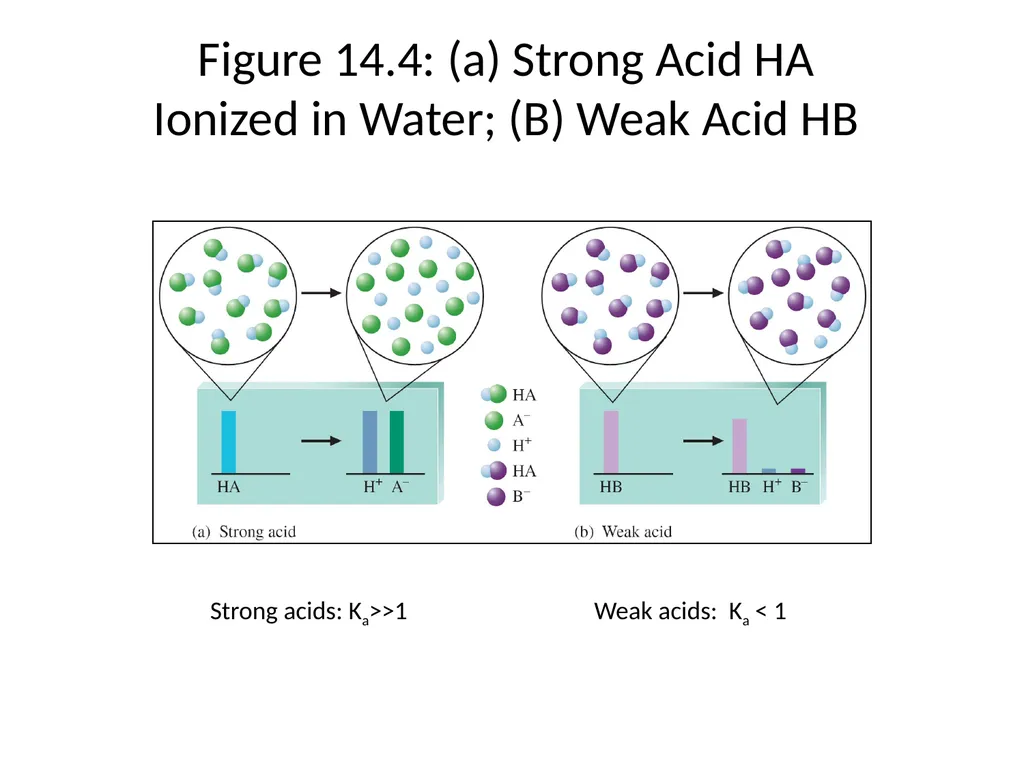
Figure 14.4: (a) Strong Acid HA
Ionized in Water; (B) Weak Acid HB Ka reaction:
HX(aq) + H2O(l) ↔ X-(aq) + H3O+(aq)
or: HX(aq) ↔ X-(aq) + H+(aq)<br>
HX(aq) + H2O(l) ↔ X-(aq) + H3O+(aq)
or: HX(aq) ↔ X-(aq) + H+(aq)<br>
21
Strong Acids Characteristics (p. 82) -Are great at what they do (great at donating protons, H+)
-At equilibrium, 99.99% of the strong acid has reacted with water (has dissociated). For simplicity, we will assume strong acids are 100% reacted (dissociated) in water.
-Strong acids have Ka values which are very, very large (Ka >> 1); at equilibrium, strong acids have mostly products present.
-Memorize the strong acids (HCl, HBr, HI, HNO3, HClO4, and H2SO4)<br>
-At equilibrium, 99.99% of the strong acid has reacted with water (has dissociated). For simplicity, we will assume strong acids are 100% reacted (dissociated) in water.
-Strong acids have Ka values which are very, very large (Ka >> 1); at equilibrium, strong acids have mostly products present.
-Memorize the strong acids (HCl, HBr, HI, HNO3, HClO4, and H2SO4)<br>
22
Figure 14.4: (a) Strong Acid HA
Ionized in Water; (B) Weak Acid HB Strong acids: Ka>>1 Weak acids: Ka < 1<br>
23
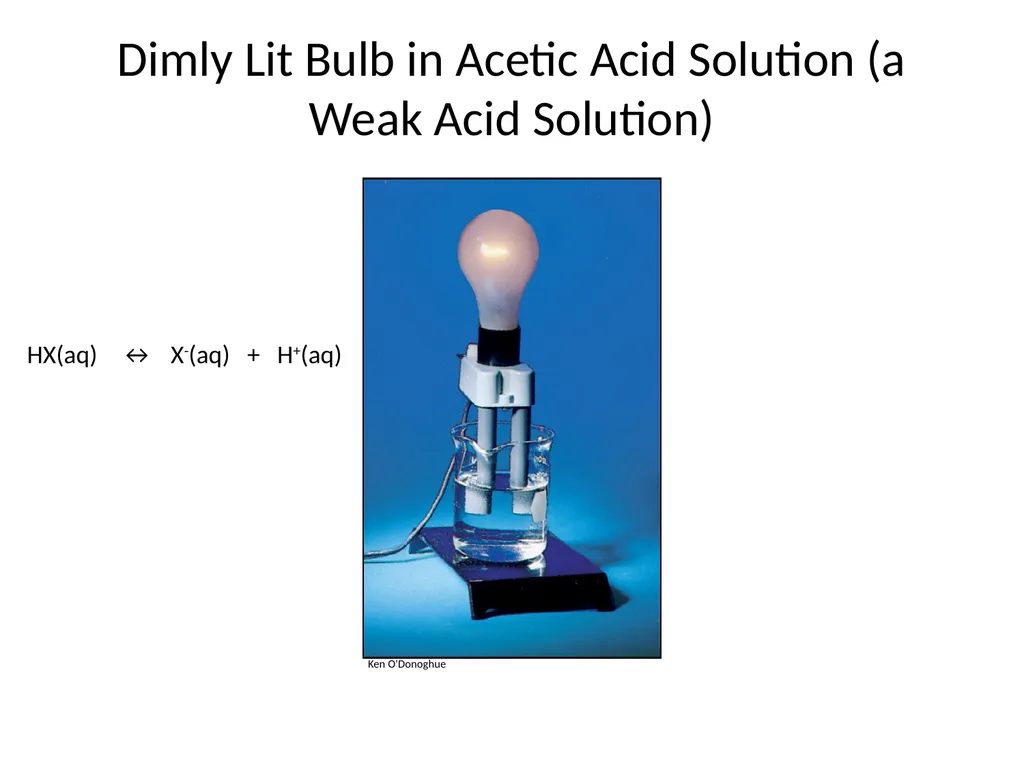
Dimly Lit Bulb in Acetic Acid Solution (a Weak Acid Solution) Ken O'Donoghue HX(aq) ↔ X-(aq) + H+(aq)<br>
24
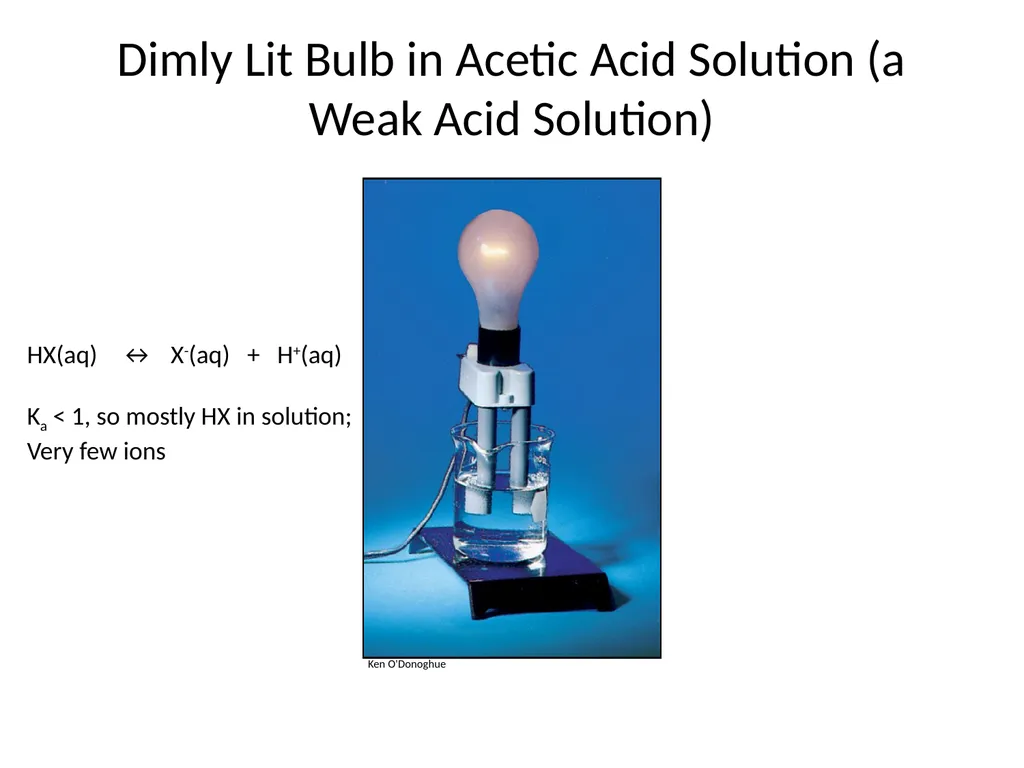
Dimly Lit Bulb in Acetic Acid Solution (a Weak Acid Solution) Ken O'Donoghue HX(aq) ↔ X-(aq) + H+(aq)
Ka < 1, so mostly HX in solution;
Very few ions<br>
Ka < 1, so mostly HX in solution;
Very few ions<br>
25
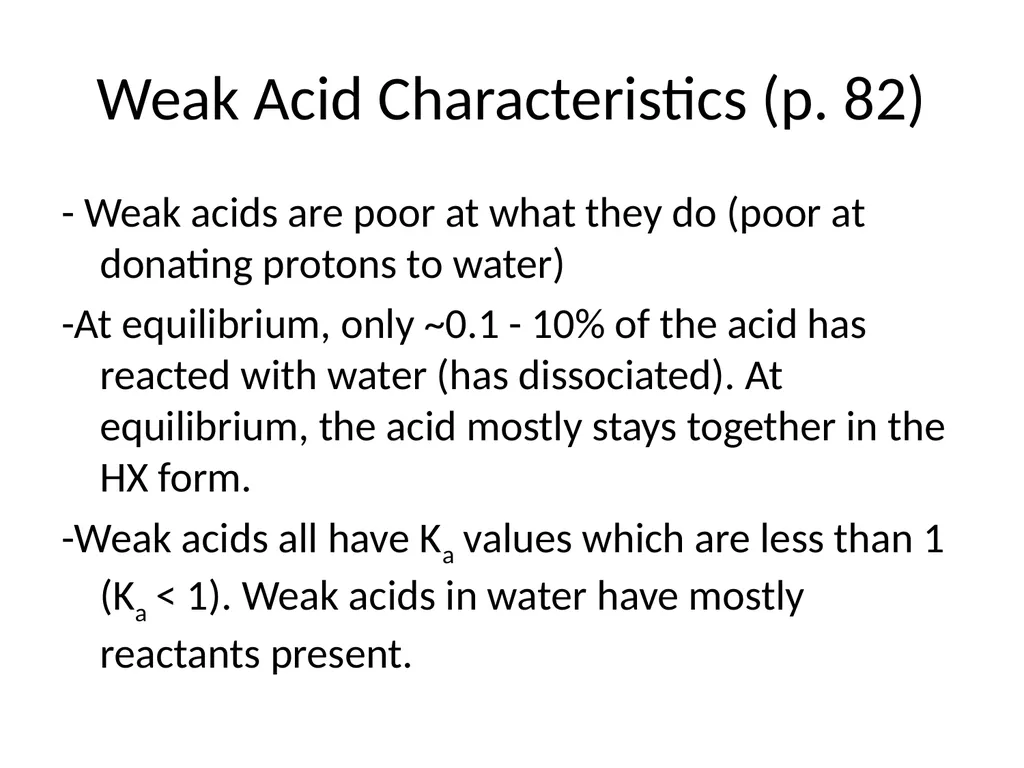
Weak Acid Characteristics (p. 82) - Weak acids are poor at what they do (poor at donating protons to water)
-At equilibrium, only ~0.1 - 10% of the acid has reacted with water (has dissociated). At equilibrium, the acid mostly stays together in the HX form.
-Weak acids all have Ka values which are less than 1 (Ka < 1). Weak acids in water have mostly reactants present.<br>
-At equilibrium, only ~0.1 - 10% of the acid has reacted with water (has dissociated). At equilibrium, the acid mostly stays together in the HX form.
-Weak acids all have Ka values which are less than 1 (Ka < 1). Weak acids in water have mostly reactants present.<br>
26
Recognizing Weak Acids-p. 82 There are millions of weak acids. How do you recognize weak acids?<br>
27
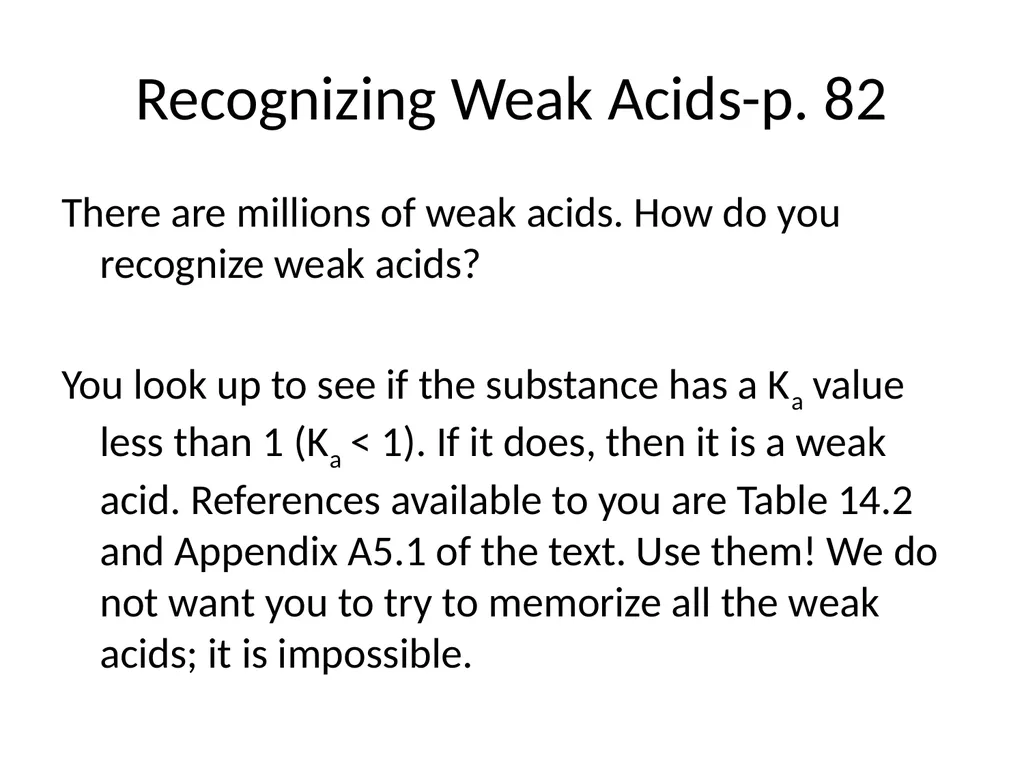
Recognizing Weak Acids-p. 82 There are millions of weak acids. How do you recognize weak acids?
You look up to see if the substance has a Ka value less than 1 (Ka < 1). If it does, then it is a weak acid. References available to you are Table 14.2 and Appendix A5.1 of the text. Use them! We do not want you to try to memorize all the weak acids; it is impossible.<br>
You look up to see if the substance has a Ka value less than 1 (Ka < 1). If it does, then it is a weak acid. References available to you are Table 14.2 and Appendix A5.1 of the text. Use them! We do not want you to try to memorize all the weak acids; it is impossible.<br>
28
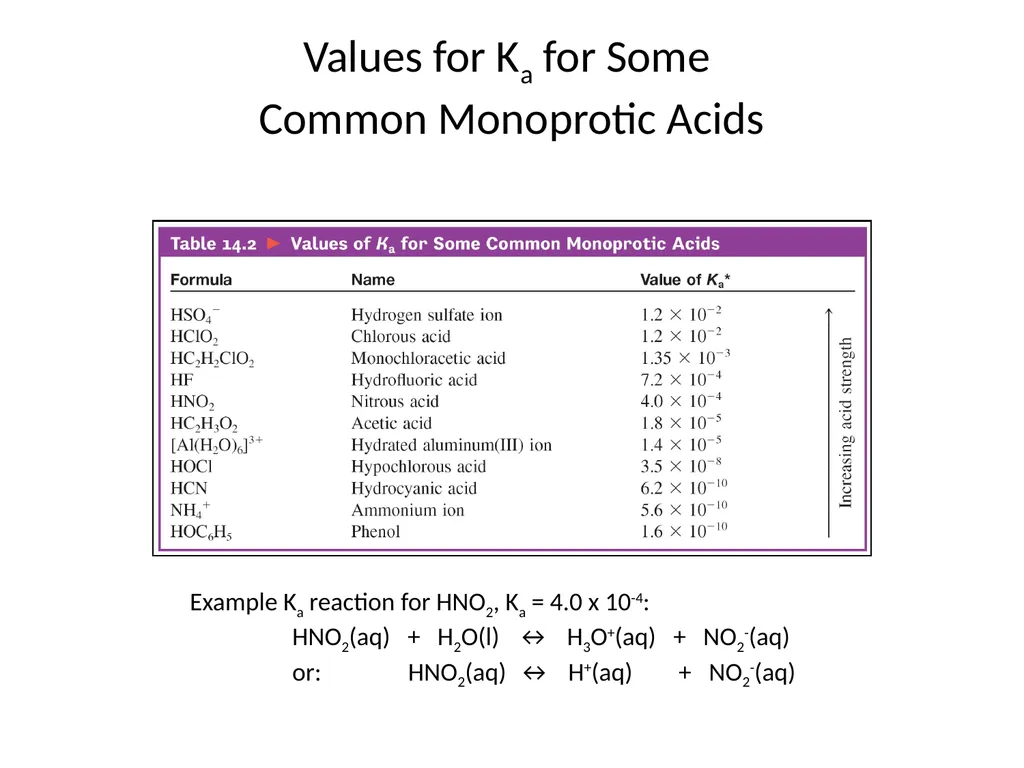
Values for Ka for Some
Common Monoprotic Acids Example Ka reaction for HNO2, Ka = 4.0 x 10⁻⁴:
HNO2(aq) + H2O(l) ↔ H3O+(aq) + NO2-(aq)
or: HNO2(aq) ↔ H+(aq) + NO2-(aq)<br>
HNO2(aq) + H2O(l) ↔ H3O+(aq) + NO2-(aq)
or: HNO2(aq) ↔ H+(aq) + NO2-(aq)<br>
29
Values for Ka for Some
Common Monoprotic Acids-p. 81 As Ka value increases, more of the acid reacts with water (more of the
acid dissociates), and the more acidic the solution ([H+] increases).<br>
acid dissociates), and the more acidic the solution ([H+] increases).<br>
30
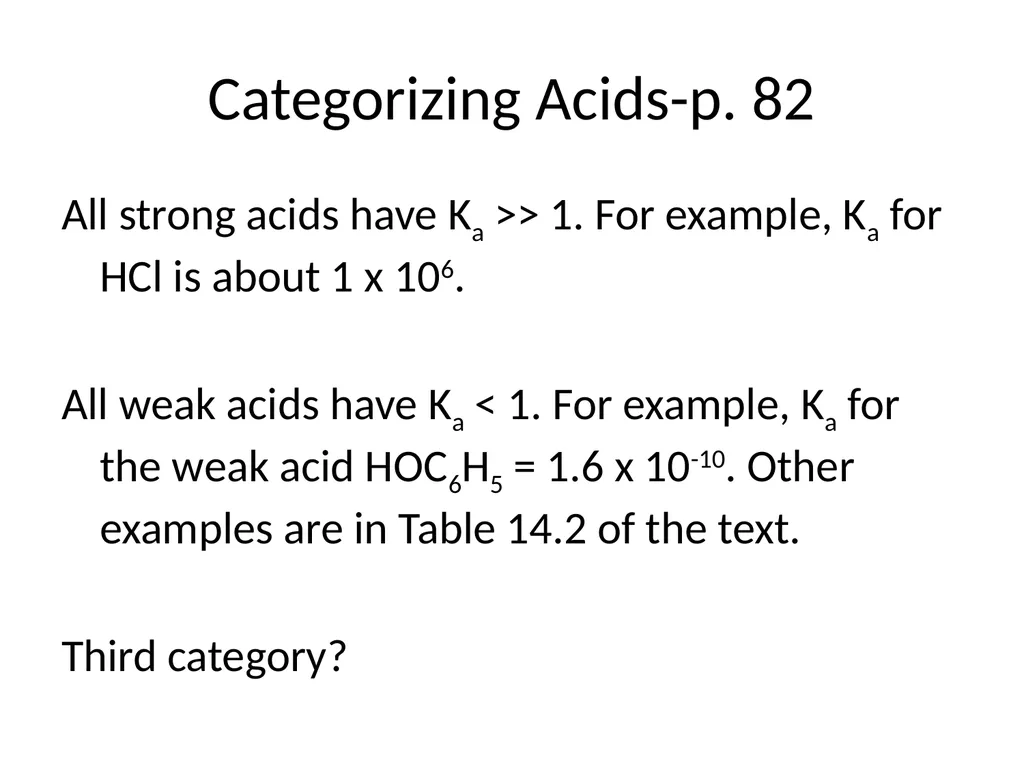
Categorizing Acids-p. 82 All strong acids have Ka >> 1. For example, Ka for HCl is about 1 x 10⁶.
All weak acids have Ka < 1. For example, Ka for the weak acid HOC6H5 = 1.6 x 10⁻¹⁰. Other examples are in Table 14.2 of the text.
Third category?<br>
All weak acids have Ka < 1. For example, Ka for the weak acid HOC6H5 = 1.6 x 10⁻¹⁰. Other examples are in Table 14.2 of the text.
Third category?<br>
31
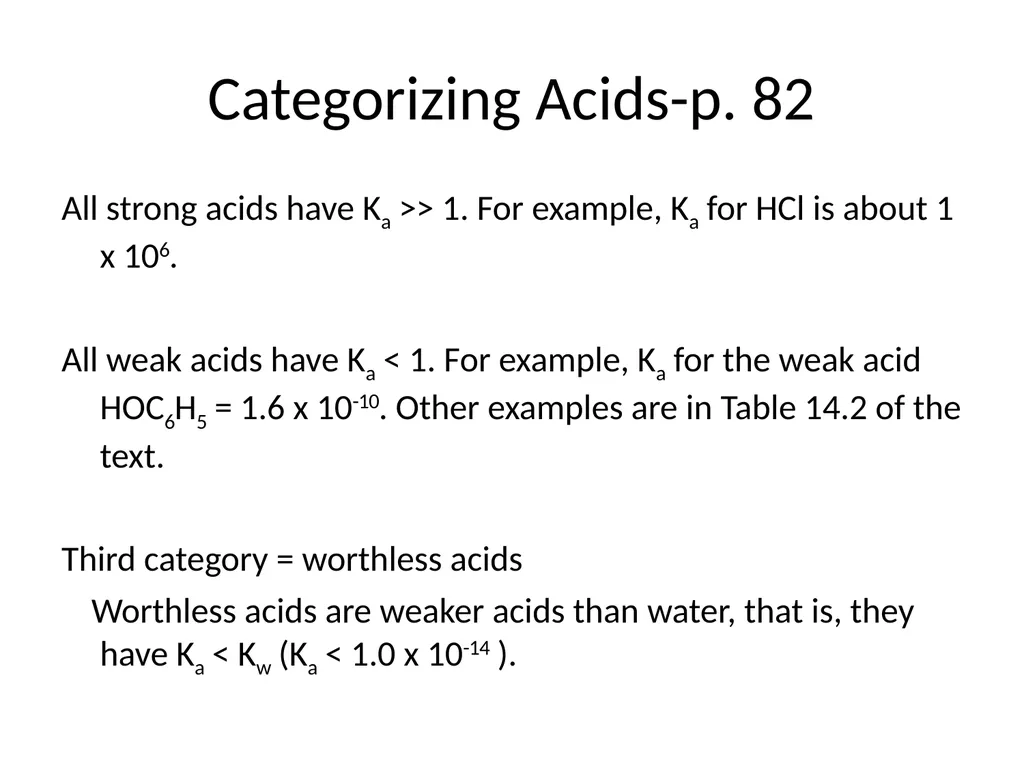
Categorizing Acids-p. 82 All strong acids have Ka >> 1. For example, Ka for HCl is about 1 x 10⁶.
All weak acids have Ka < 1. For example, Ka for the weak acid HOC6H5 = 1.6 x 10⁻¹⁰. Other examples are in Table 14.2 of the text.
Third category = worthless acids
Worthless acids are weaker acids than water, that is, they have Ka < Kw (Ka < 1.0 x 10⁻¹⁴ ).<br>
All weak acids have Ka < 1. For example, Ka for the weak acid HOC6H5 = 1.6 x 10⁻¹⁰. Other examples are in Table 14.2 of the text.
Third category = worthless acids
Worthless acids are weaker acids than water, that is, they have Ka < Kw (Ka < 1.0 x 10⁻¹⁴ ).<br>
32
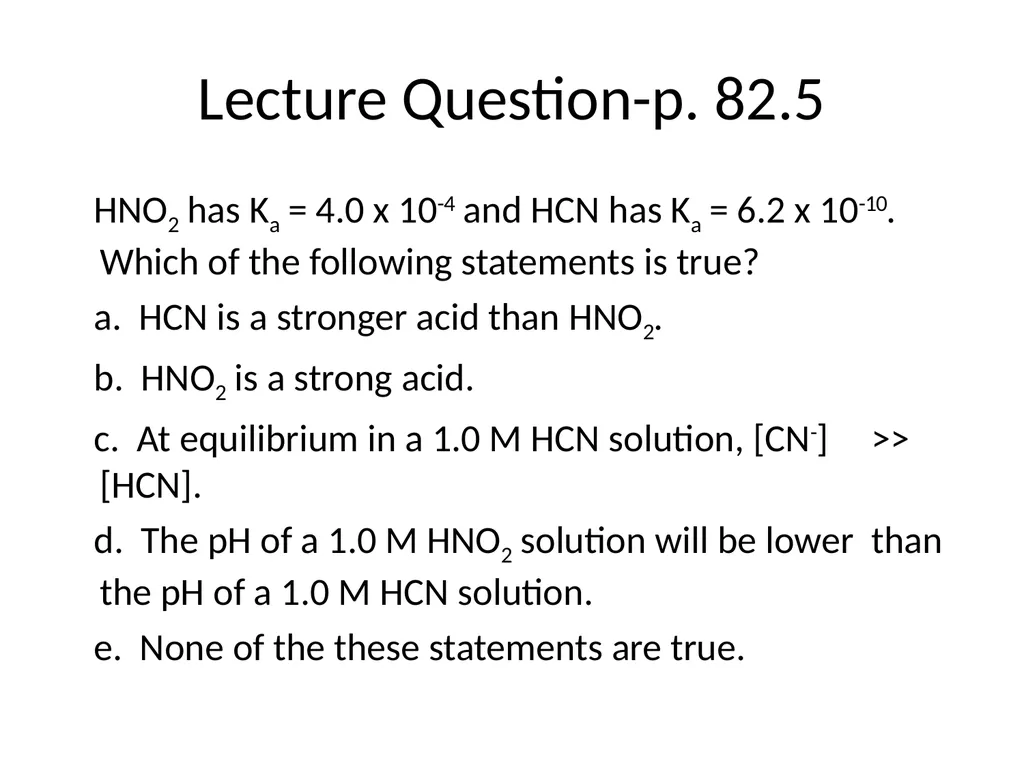
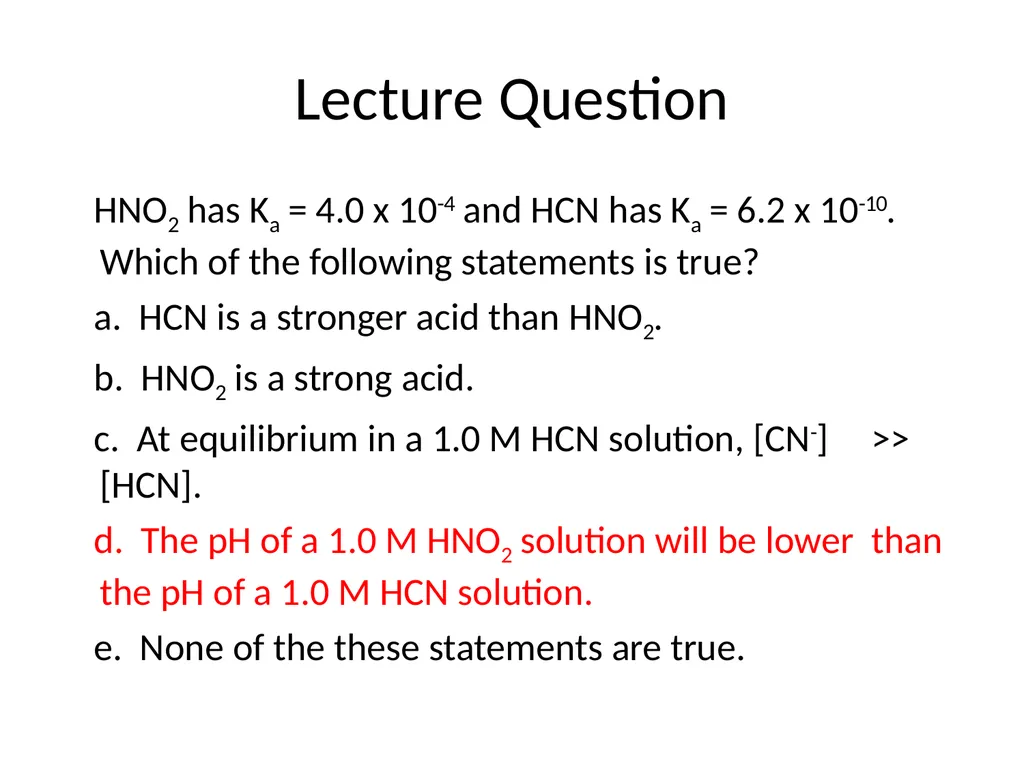
Lecture Question-p. 82.5 HNO2 has Ka = 4.0 x 10⁻⁴ and HCN has Ka = 6.2 x 10⁻¹⁰. Which of the following statements is true?
a. HCN is a stronger acid than HNO2.
b. HNO2 is a strong acid.
c. At equilibrium in a 1.0 M HCN solution, [CN-] >> [HCN].
d. The pH of a 1.0 M HNO2 solution will be lower than the pH of a 1.0 M HCN solution.
e. None of the these statements are true.<br>
a. HCN is a stronger acid than HNO2.
b. HNO2 is a strong acid.
c. At equilibrium in a 1.0 M HCN solution, [CN-] >> [HCN].
d. The pH of a 1.0 M HNO2 solution will be lower than the pH of a 1.0 M HCN solution.
e. None of the these statements are true.<br>
33
Lecture Question HNO2 has Ka = 4.0 x 10⁻⁴ and HCN has Ka = 6.2 x 10⁻¹⁰. Which of the following statements is true?
a. HCN is a stronger acid than HNO2.
b. HNO2 is a strong acid.
c. At equilibrium in a 1.0 M HCN solution, [CN-] >> [HCN].
d. The pH of a 1.0 M HNO2 solution will be lower than the pH of a 1.0 M HCN solution.
e. None of the these statements are true.<br>
a. HCN is a stronger acid than HNO2.
b. HNO2 is a strong acid.
c. At equilibrium in a 1.0 M HCN solution, [CN-] >> [HCN].
d. The pH of a 1.0 M HNO2 solution will be lower than the pH of a 1.0 M HCN solution.
e. None of the these statements are true.<br>
34
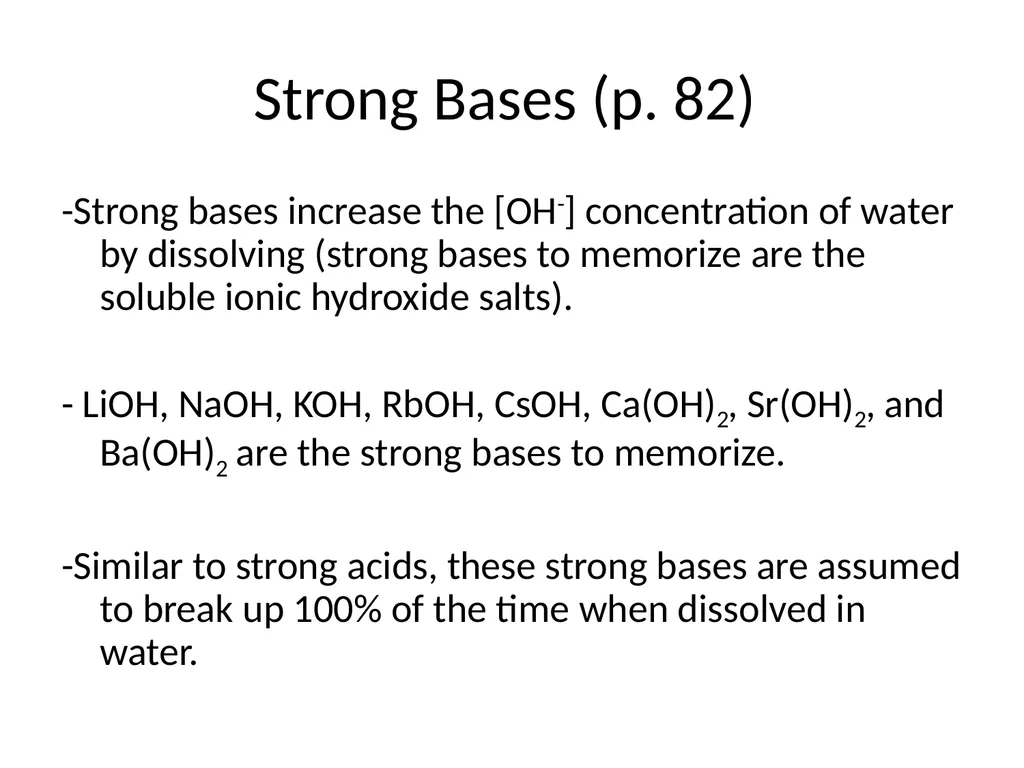
Strong Bases (p. 82) -Strong bases increase the [OH-] concentration of water by dissolving (strong bases to memorize are the soluble ionic hydroxide salts).
- LiOH, NaOH, KOH, RbOH, CsOH, Ca(OH)2, Sr(OH)2, and Ba(OH)2 are the strong bases to memorize.
-Similar to strong acids, these strong bases are assumed to break up 100% of the time when dissolved in water.<br>
- LiOH, NaOH, KOH, RbOH, CsOH, Ca(OH)2, Sr(OH)2, and Ba(OH)2 are the strong bases to memorize.
-Similar to strong acids, these strong bases are assumed to break up 100% of the time when dissolved in water.<br>
35
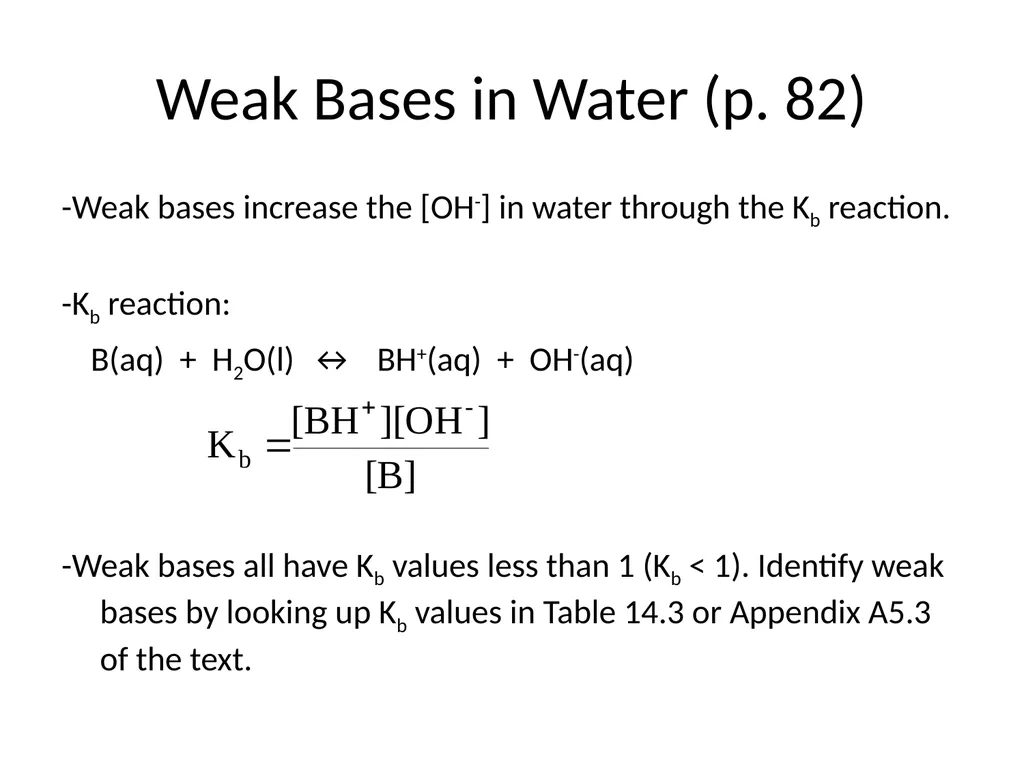
Weak Bases in Water (p. 82) -Weak bases increase the [OH-] in water through the Kb reaction.
-Kb reaction:
B(aq) + H2O(l) ↔ BH+(aq) + OH-(aq)
-Weak bases all have Kb values less than 1 (Kb < 1). Identify weak bases by looking up Kb values in Table 14.3 or Appendix A5.3 of the text.<br>
-Kb reaction:
B(aq) + H2O(l) ↔ BH+(aq) + OH-(aq)
-Weak bases all have Kb values less than 1 (Kb < 1). Identify weak bases by looking up Kb values in Table 14.3 or Appendix A5.3 of the text.<br>
36
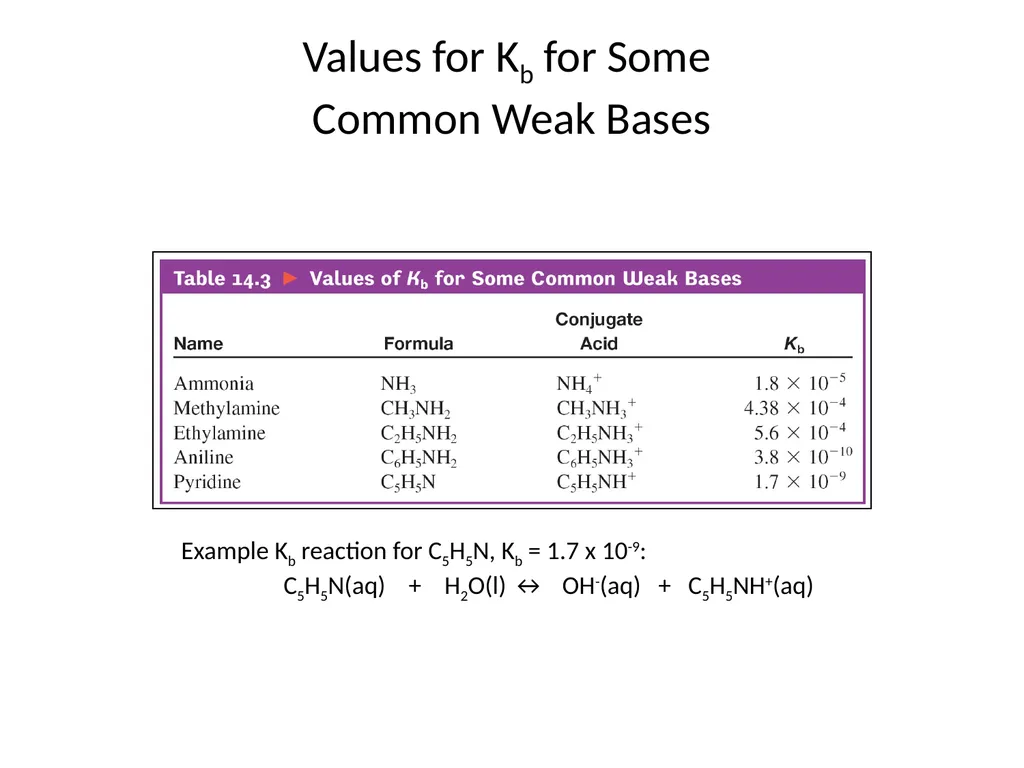
Values for Kb for Some
Common Weak Bases Example Kb reaction for C5H5N, Kb = 1.7 x 10⁻⁹:
C5H5N(aq) + H2O(l) ↔ OH-(aq) + C5H5NH+(aq)<br>
C5H5N(aq) + H2O(l) ↔ OH-(aq) + C5H5NH+(aq)<br>
37
Values for Kb for Some
Common Weak Bases-p. 81 As Kb increases, the more of the base that reacts with water and the
more OH- that is produced (the more basic the solution).<br>
more OH- that is produced (the more basic the solution).<br>
38
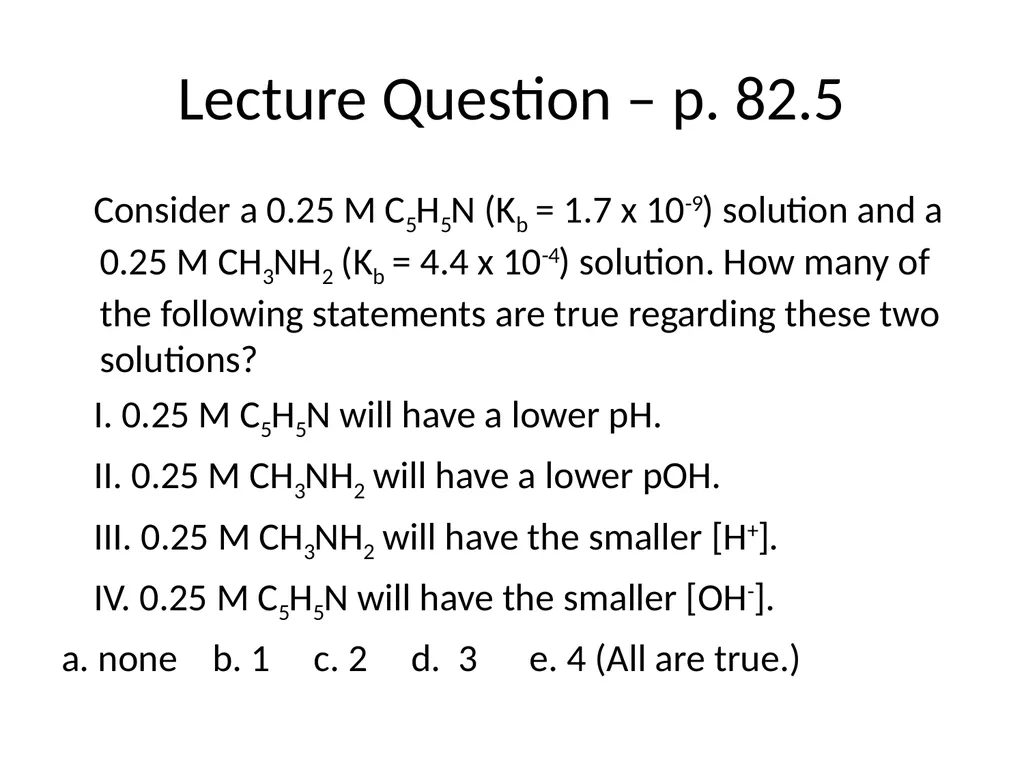
Lecture Question – p. 82.5 Consider a 0.25 M C5H5N (Kb = 1.7 x 10⁻⁹) solution and a 0.25 M CH3NH2 (Kb = 4.4 x 10⁻⁴) solution. How many of the following statements are true regarding these two solutions?
I. 0.25 M C5H5N will have a lower pH.
II. 0.25 M CH3NH2 will have a lower pOH.
III. 0.25 M CH3NH2 will have the smaller [H+].
IV. 0.25 M C5H5N will have the smaller [OH-].
a. none b. 1 c. 2 d. 3 e. 4 (All are true.)<br>
I. 0.25 M C5H5N will have a lower pH.
II. 0.25 M CH3NH2 will have a lower pOH.
III. 0.25 M CH3NH2 will have the smaller [H+].
IV. 0.25 M C5H5N will have the smaller [OH-].
a. none b. 1 c. 2 d. 3 e. 4 (All are true.)<br>
39
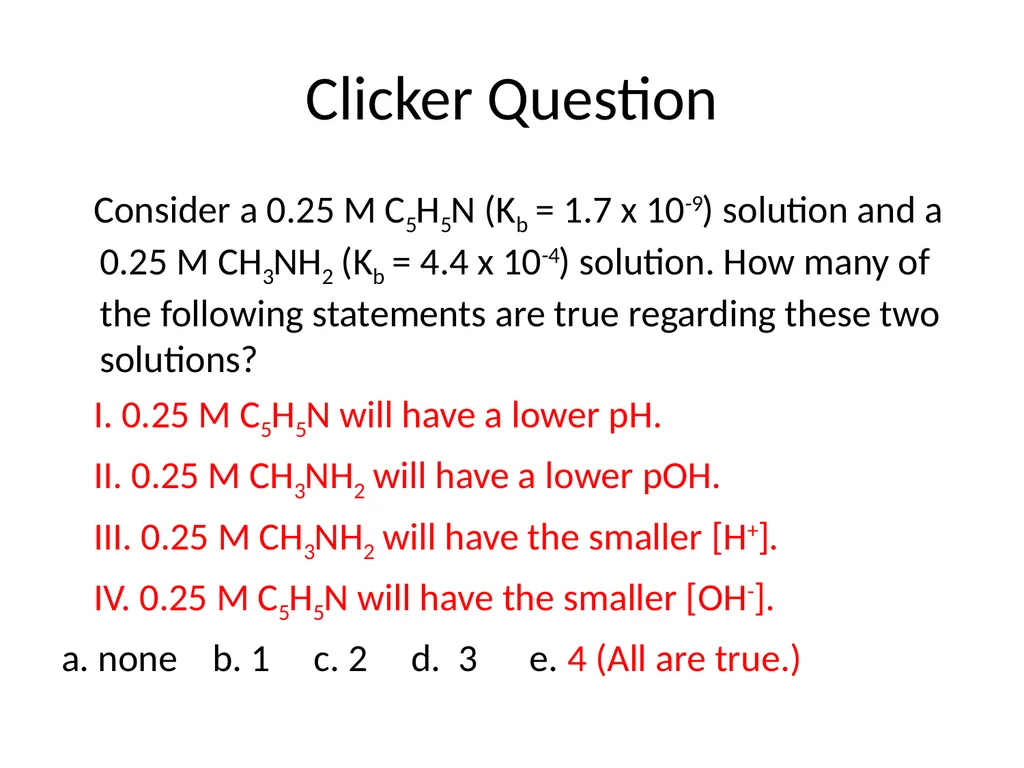
Clicker Question Consider a 0.25 M C5H5N (Kb = 1.7 x 10⁻⁹) solution and a 0.25 M CH3NH2 (Kb = 4.4 x 10⁻⁴) solution. How many of the following statements are true regarding these two solutions?
I. 0.25 M C5H5N will have a lower pH.
II. 0.25 M CH3NH2 will have a lower pOH.
III. 0.25 M CH3NH2 will have the smaller [H+].
IV. 0.25 M C5H5N will have the smaller [OH-].
a. none b. 1 c. 2 d. 3 e. 4 (All are true.)<br>
I. 0.25 M C5H5N will have a lower pH.
II. 0.25 M CH3NH2 will have a lower pOH.
III. 0.25 M CH3NH2 will have the smaller [H+].
IV. 0.25 M C5H5N will have the smaller [OH-].
a. none b. 1 c. 2 d. 3 e. 4 (All are true.)<br>
40
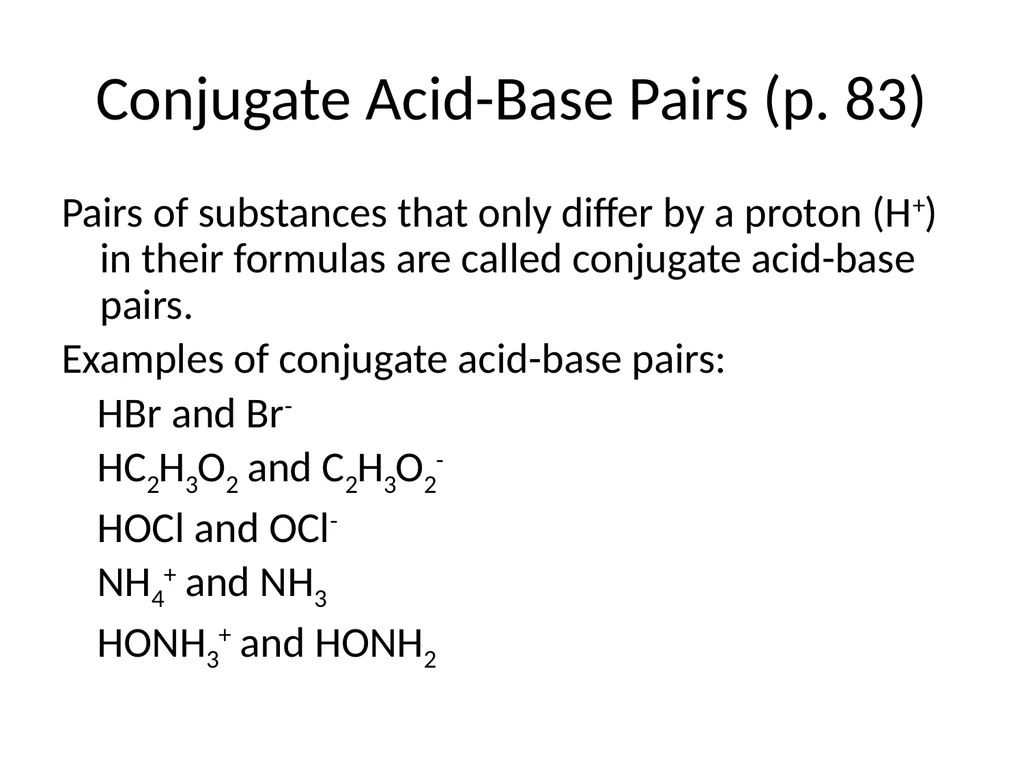
Conjugate Acid-Base Pairs (p. 83) Pairs of substances that only differ by a proton (H+) in their formulas are called conjugate acid-base pairs.
Examples of conjugate acid-base pairs:
HBr and Br-
HC2H3O2 and C2H3O2-
HOCl and OCl-
NH4+ and NH3
HONH3+ and HONH2<br>
Examples of conjugate acid-base pairs:
HBr and Br-
HC2H3O2 and C2H3O2-
HOCl and OCl-
NH4+ and NH3
HONH3+ and HONH2<br>
41
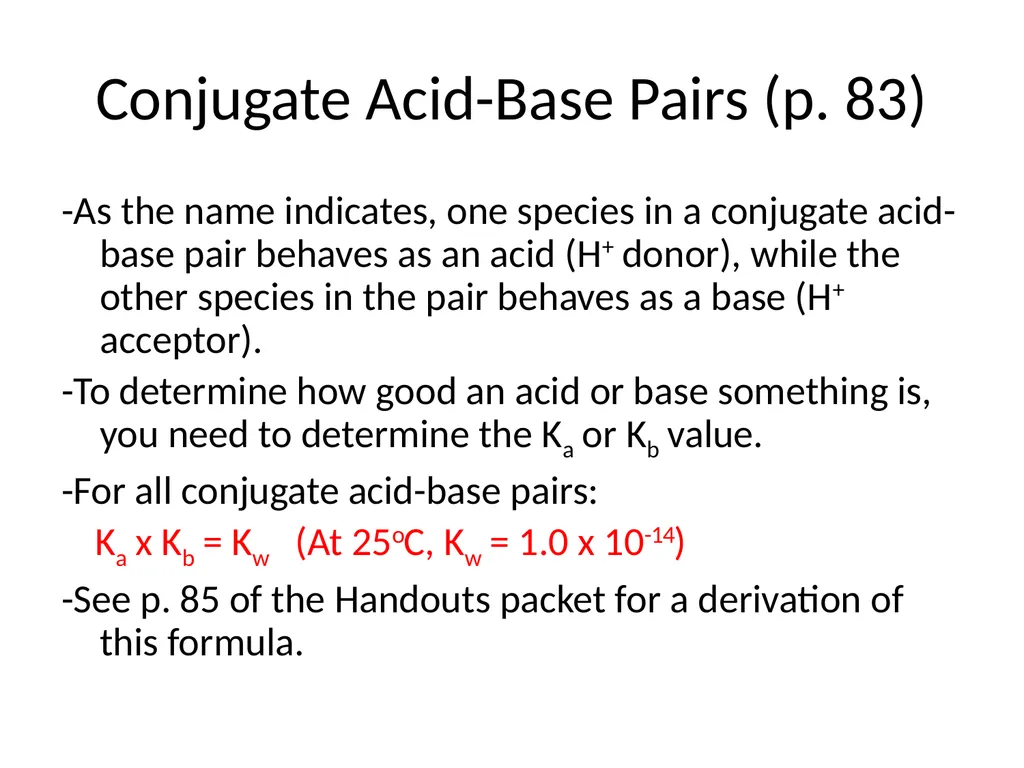
Conjugate Acid-Base Pairs (p. 83) -As the name indicates, one species in a conjugate acid-base pair behaves as an acid (H+ donor), while the other species in the pair behaves as a base (H+ acceptor).
-To determine how good an acid or base something is, you need to determine the Ka or Kb value.
-For all conjugate acid-base pairs:
Ka x Kb = Kw (At 25oC, Kw = 1.0 x 10⁻¹⁴)
-See p. 85 of the Handouts packet for a derivation of this formula.<br>
-To determine how good an acid or base something is, you need to determine the Ka or Kb value.
-For all conjugate acid-base pairs:
Ka x Kb = Kw (At 25oC, Kw = 1.0 x 10⁻¹⁴)
-See p. 85 of the Handouts packet for a derivation of this formula.<br>
42
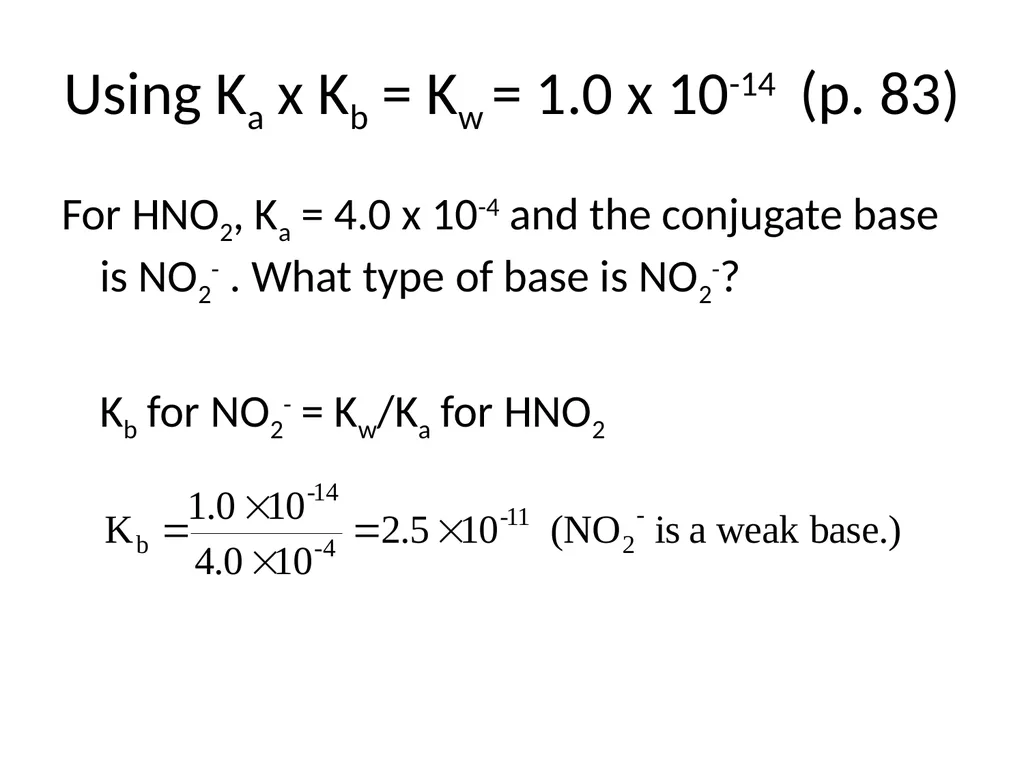
Using Ka x Kb = Kw = 1.0 x 10⁻¹⁴ (p. 83) For HNO2, Ka = 4.0 x 10⁻⁴ and the conjugate base is NO2- . What type of base is NO2-?
Kb for NO2- = Kw/Ka for HNO2<br>
Kb for NO2- = Kw/Ka for HNO2<br>
43
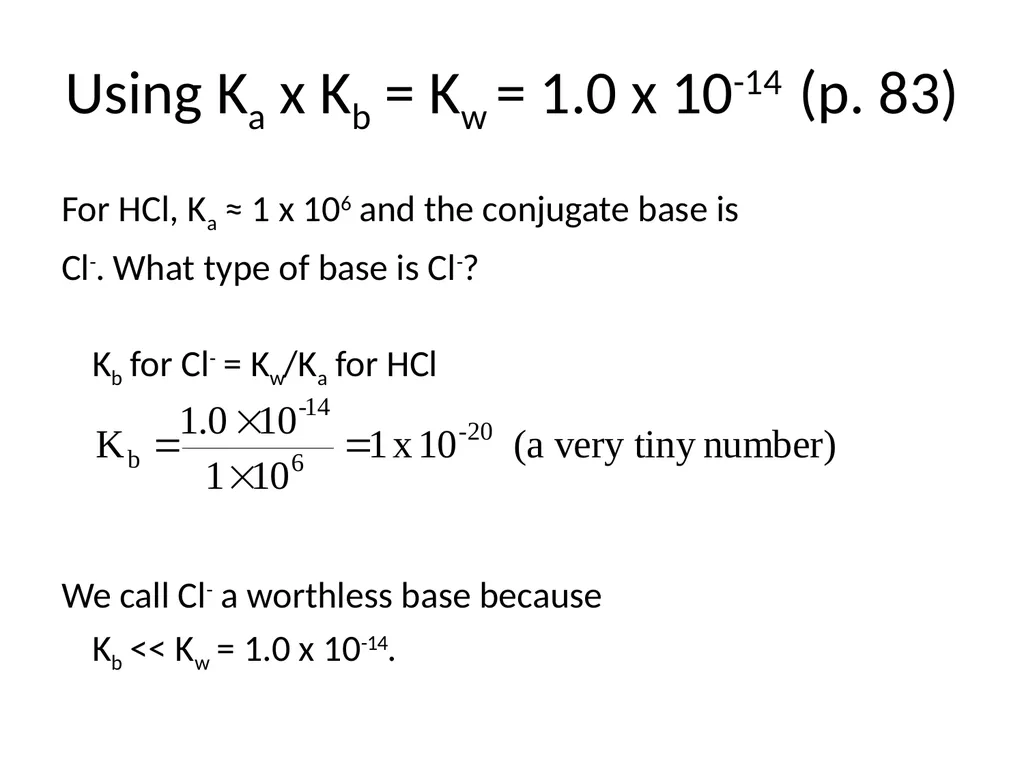
Using Ka x Kb = Kw = 1.0 x 10⁻¹⁴ (p. 83) For HCl, Ka ≈ 1 x 10⁶ and the conjugate base is
Cl-. What type of base is Cl-?
Kb for Cl- = Kw/Ka for HCl
We call Cl- a worthless base because
Kb << Kw = 1.0 x 10⁻¹⁴.<br>
Cl-. What type of base is Cl-?
Kb for Cl- = Kw/Ka for HCl
We call Cl- a worthless base because
Kb << Kw = 1.0 x 10⁻¹⁴.<br>
44
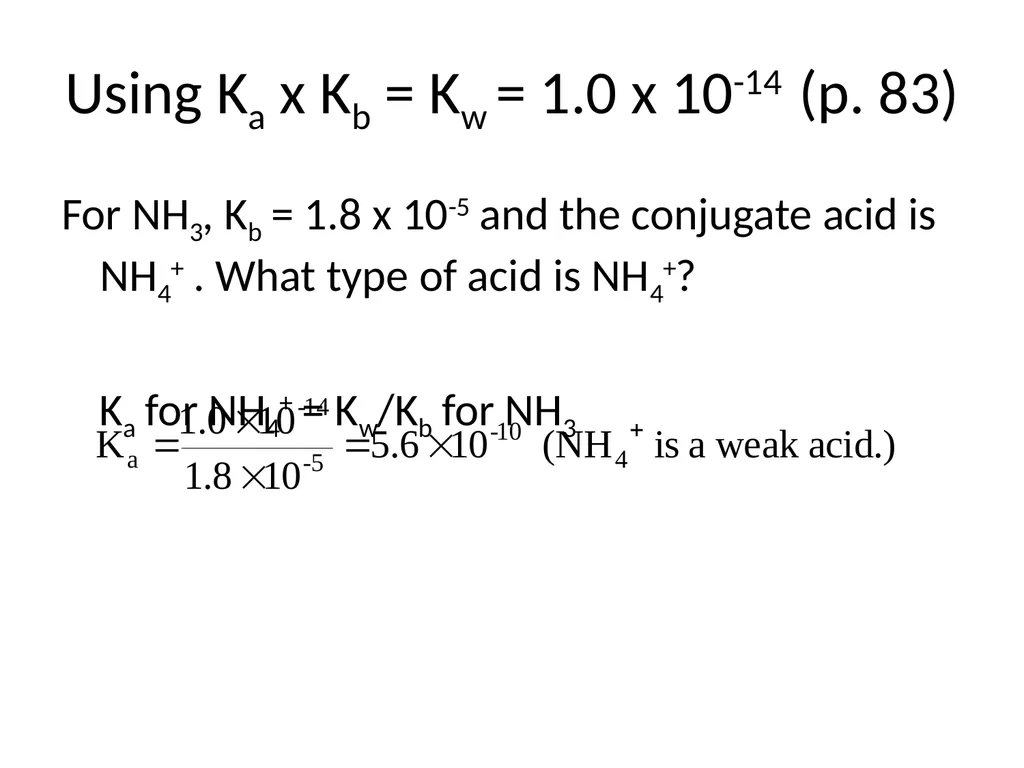
Using Ka x Kb = Kw = 1.0 x 10⁻¹⁴ (p. 83) For NH3, Kb = 1.8 x 10⁻⁵ and the conjugate acid is NH4+ . What type of acid is NH4+?
Ka for NH4+ = Kw/Kb for NH3<br>
Ka for NH4+ = Kw/Kb for NH3<br>
45
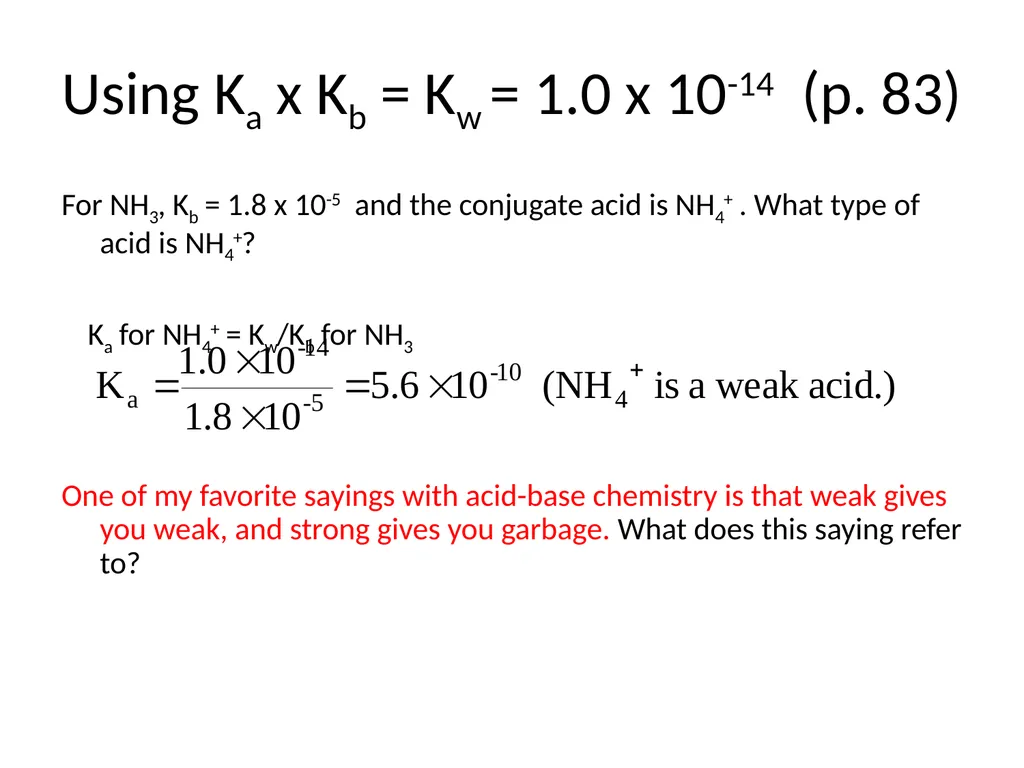
Using Ka x Kb = Kw = 1.0 x 10⁻¹⁴ (p. 83) For NH3, Kb = 1.8 x 10⁻⁵ and the conjugate acid is NH4+ . What type of acid is NH4+?
Ka for NH4+ = Kw/Kb for NH3
One of my favorite sayings with acid-base chemistry is that weak gives you weak, and strong gives you garbage. What does this saying refer to?<br>
Ka for NH4+ = Kw/Kb for NH3
One of my favorite sayings with acid-base chemistry is that weak gives you weak, and strong gives you garbage. What does this saying refer to?<br>