Linguistics For 2nd Course PPT1 -Some Characteristics of Human Language: 1. Language is sound 2. Language is systematic 3. Language is a system of systems 4. Language is meaningful 5. Language is linear 6. Language is arbitrary 7. Language
"Linguistics For 2nd Course PPT1 -Some" is the property of its rightful owner. Permission is granted to
download and print the materials on this website for personal, non-commercial use only, and to display it
on your personal computer provided you do not modify the materials and that you retain all copyright
notices contained in the materials. By downloading content from our website, you accept the terms of this
agreement.
Presentation Transcript
01
Linguistics For 2nd Course PPT1<br>
02
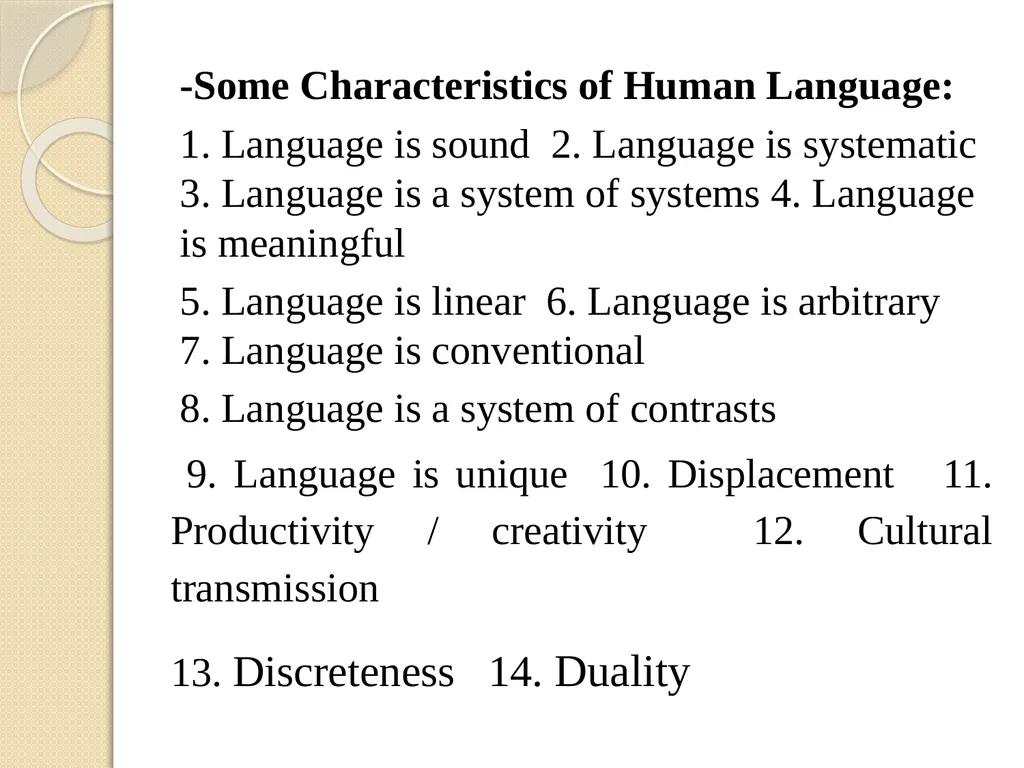
-Some Characteristics of Human Language:
1. Language is sound 2. Language is systematic 3. Language is a system of systems 4. Language is meaningful
5. Language is linear 6. Language is arbitrary 7. Language is conventional
8. Language is a system of contrasts
9. Language is unique 10. Displacement 11. Productivity / creativity 12. Cultural transmission
13. Discreteness 14. Duality<br>
03
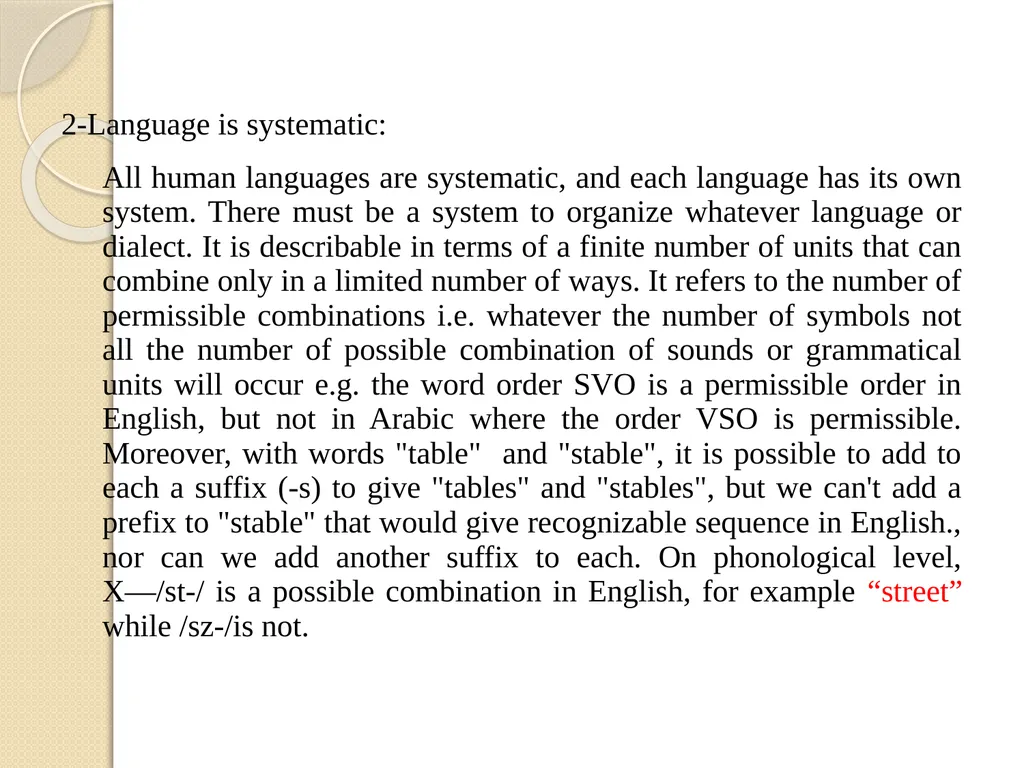
2-Language is systematic:
All human languages are systematic, and each language has its own system. There must be a system to organize whatever language or dialect. It is describable in terms of a finite number of units that can combine only in a limited number of ways. It refers to the number of permissible combinations i.e. whatever the number of symbols not all the number of possible combination of sounds or grammatical units will occur e.g. the word order SVO is a permissible order in English, but not in Arabic where the order VSO is permissible. Moreover, with words "table" and "stable", it is possible to add to each a suffix (-s) to give "tables" and "stables", but we can't add a prefix to "stable" that would give recognizable sequence in English., nor can we add another suffix to each. On phonological level, X—/st-/ is a possible combination in English, for example “street” while /sz-/is not.<br>
04
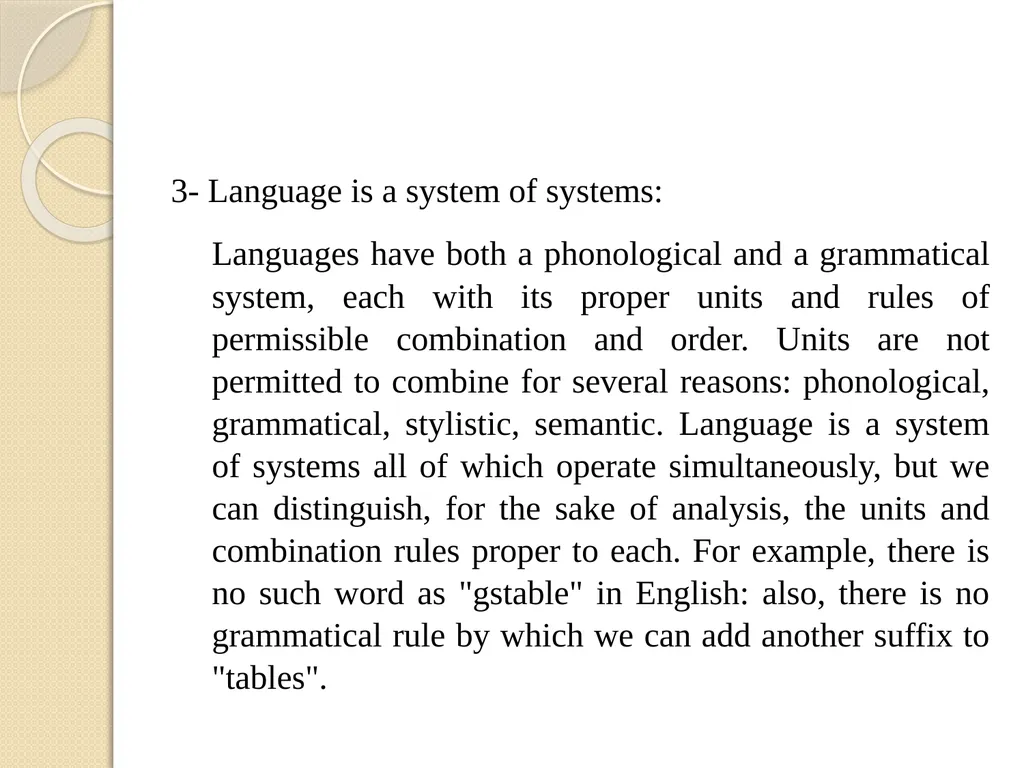
3- Language is a system of systems:
Languages have both a phonological and a grammatical system, each with its proper units and rules of permissible combination and order. Units are not permitted to combine for several reasons: phonological, grammatical, stylistic, semantic. Language is a system of systems all of which operate simultaneously, but we can distinguish, for the sake of analysis, the units and combination rules proper to each. For example, there is no such word as "gstable" in English: also, there is no grammatical rule by which we can add another suffix to "tables".<br>
05
4- Language is meaningful:
The sounds produced in speech are connected with almost every fact of human life and communication. There is, in fact, a relationship between the kinds of sounds speakers of various languages make and their environment. It is through the learning of language that a child becomes an active member of the community. Moreover, the leaders in a society preserve and advance their leadership through their ability to communicate with people via the use of language.<br>
06
5-Language is linear:
A fundamental feature of a spoken language is that it is linear, since the sounds of language are produced by successive movements of the speech organs. Speech is linear in terms of time. We can represent language by using separate symbols for each sound and arranging the symbols in a linear succession that parallels the order in which the sounds are produced. For example, in spoken language linearity is realized in terms of time. Consequently, when we say "cup", for instance, first we pronounce /k/ then /ᴧ/ and finally /p/, one follows the order. In writing, linearity is realized in terms of space or distance, i.e. in writing "cup" we start from left to right, writing one letter after the other.<br>