
LONG-DISTANCE ENDURANCE RIDING PLAN • PREPARE •
PT
Published · 29 slides · 0 views
1 / 1

Description
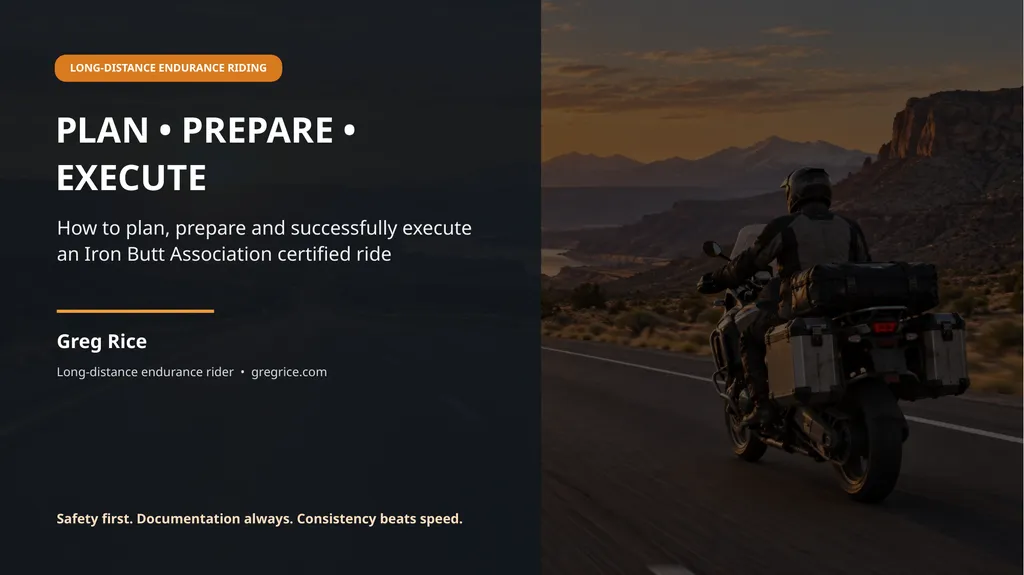
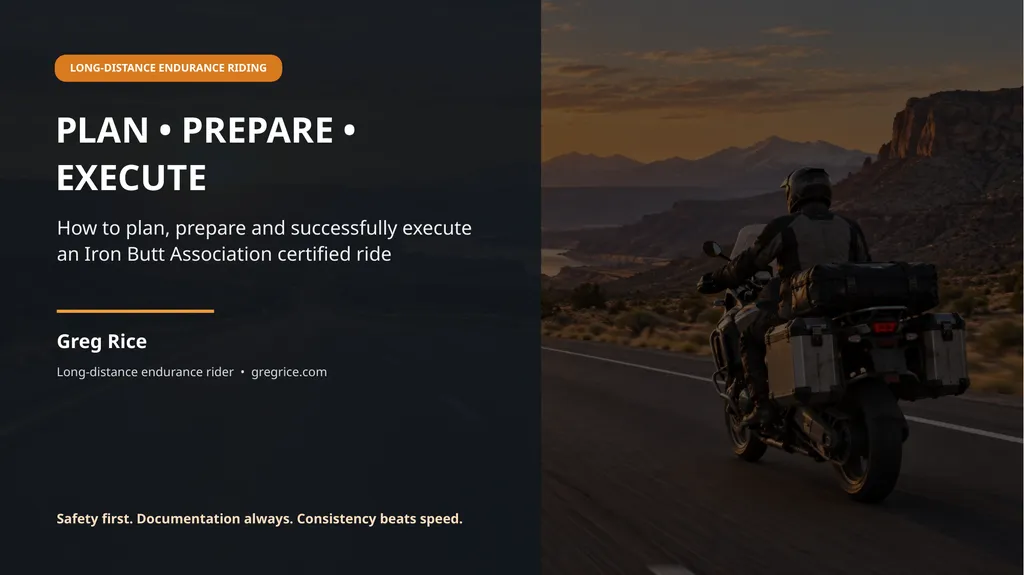
LONG-DISTANCE ENDURANCE RIDING PLAN PREPARE EXECUTE How to plan, prepare and successfully execute an Iron Butt Association certified ride Greg Rice Long-distance endurance rider gregrice.com Safety first. Documentation always.
Related Topics
Share
Embed code
Download this presentation From Below
"LONG-DISTANCE ENDURANCE RIDING PLAN • PREPARE •" is the property of its rightful owner. Permission is granted to download and print the materials on this website for personal, non-commercial use only, and to display it on your personal computer provided you do not modify the materials and that you retain all copyright notices contained in the materials. By downloading content from our website, you accept the terms of this agreement.
Presentation Transcript
01
LONG-DISTANCE ENDURANCE RIDING PLAN • PREPARE • EXECUTE How to plan, prepare and successfully execute an Iron Butt Association certified ride Greg Rice Long-distance endurance rider • gregrice.com Safety first. Documentation always. Consistency beats speed.<br>
02
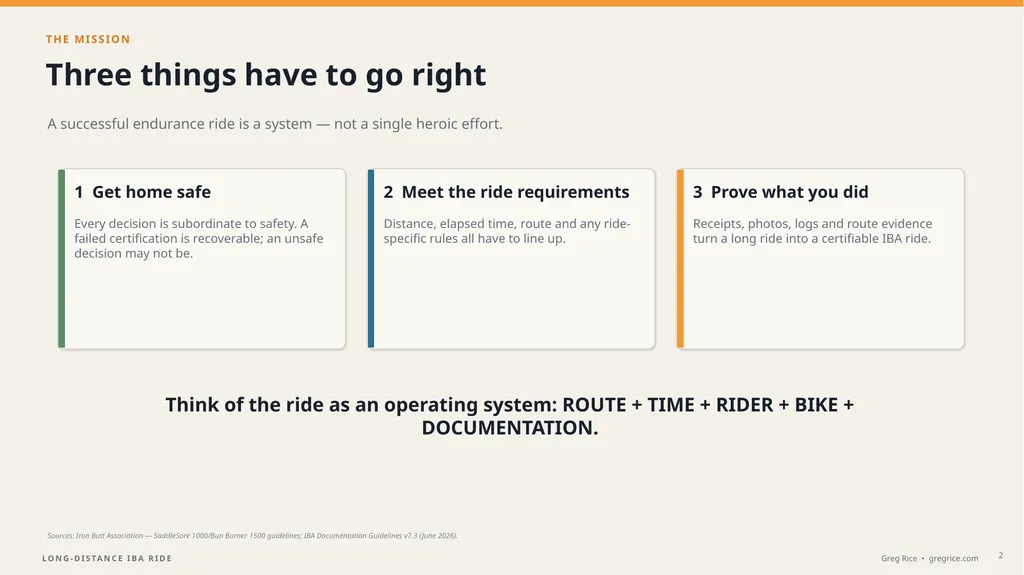
THE MISSION Three things have to go right A successful endurance ride is a system — not a single heroic effort. 1 Get home safe Every decision is subordinate to safety. A failed certification is recoverable; an unsafe decision may not be. 2 Meet the ride requirements Distance, elapsed time, route and any ride-specific rules all have to line up. 3 Prove what you did Receipts, photos, logs and route evidence turn a long ride into a certifiable IBA ride. Think of the ride as an operating system: ROUTE + TIME + RIDER + BIKE + DOCUMENTATION. Sources: Iron Butt Association — SaddleSore 1000/Bun Burner 1500 guidelines; IBA Documentation Guidelines v7.3 (June 2026). 2<br>
03
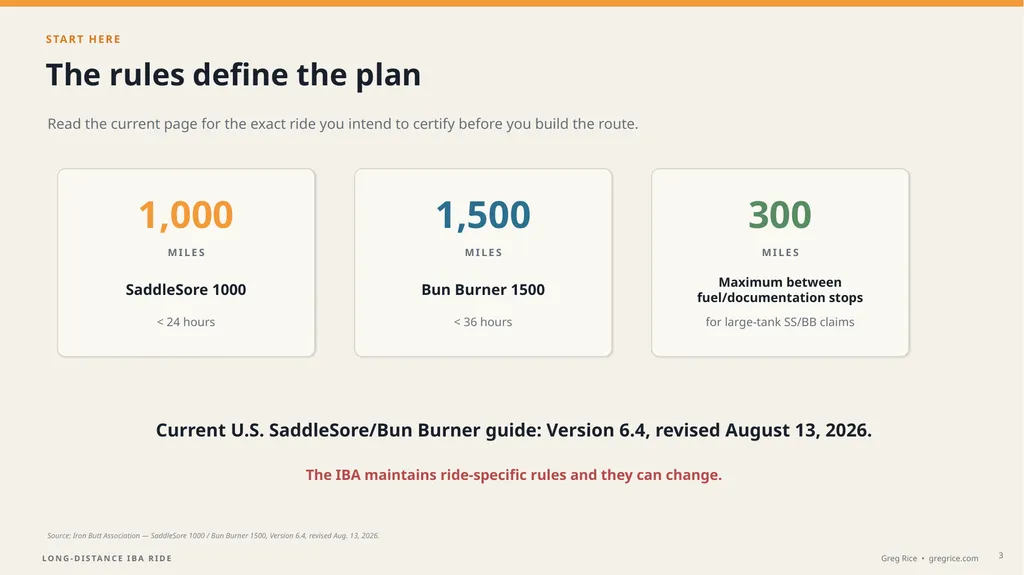
START HERE The rules define the plan Read the current page for the exact ride you intend to certify before you build the route. 1,000 MILES SaddleSore 1000 < 24 hours 1,500 MILES Bun Burner 1500 < 36 hours 300 MILES Maximum between fuel/documentation stops for large-tank SS/BB claims Current U.S. SaddleSore/Bun Burner guide: Version 6.4, revised August 13, 2026. The IBA maintains ride-specific rules and they can change. Source: Iron Butt Association — SaddleSore 1000 / Bun Burner 1500, Version 6.4, revised Aug. 13, 2026. 3<br>
04
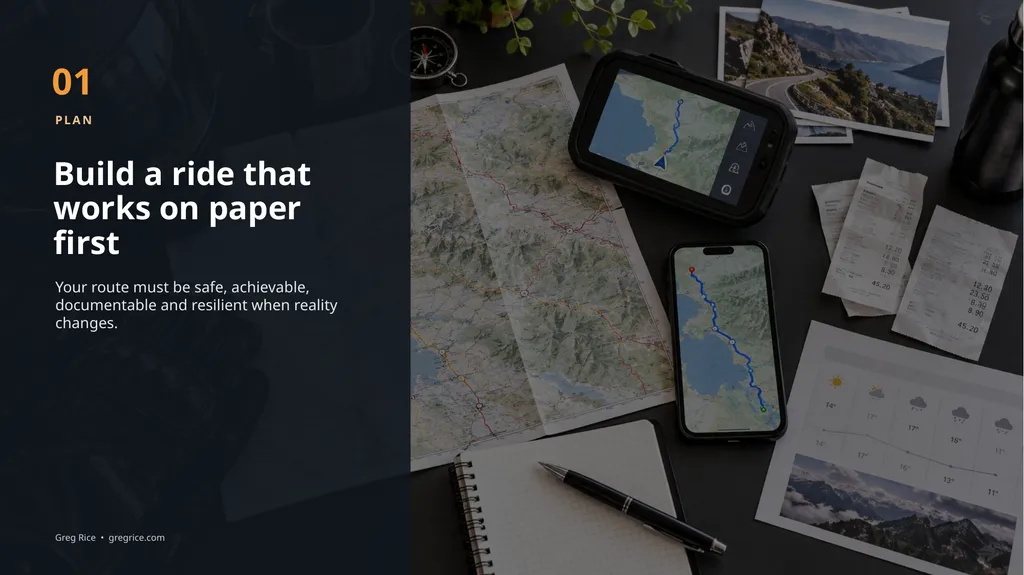
01 PLAN Build a ride that works on paper first Your route must be safe, achievable, documentable and resilient when reality changes. Greg Rice • gregrice.com<br>
05
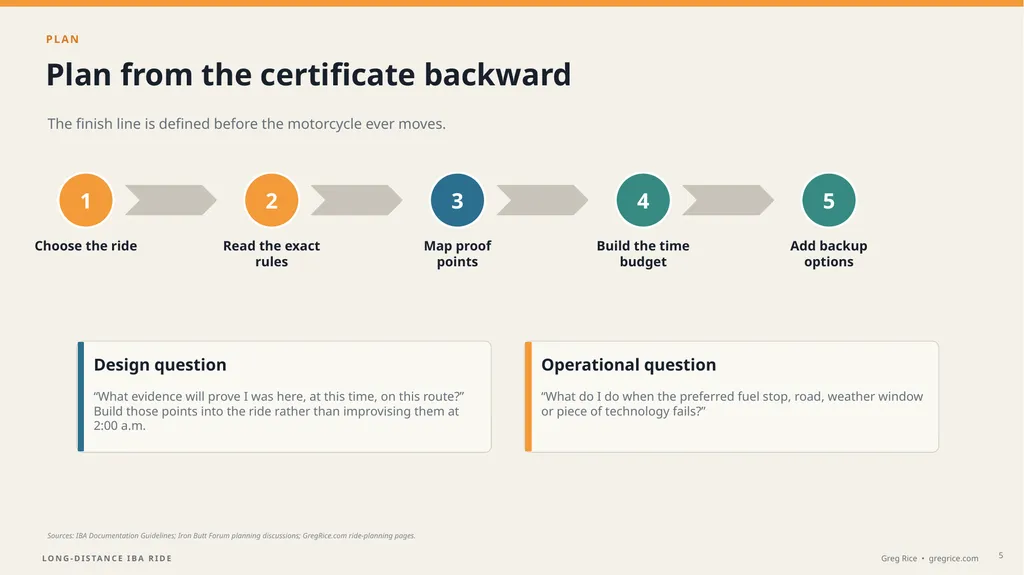
PLAN Plan from the certificate backward The finish line is defined before the motorcycle ever moves. 1 Choose the ride 2 Read the exact rules 3 Map proof points 4 Build the time budget 5 Add backup options Design question “What evidence will prove I was here, at this time, on this route?” Build those points into the ride rather than improvising them at 2:00 a.m. Operational question “What do I do when the preferred fuel stop, road, weather window or piece of technology fails?” Sources: IBA Documentation Guidelines; Iron Butt Forum planning discussions; GregRice.com ride-planning pages. 5<br>
06
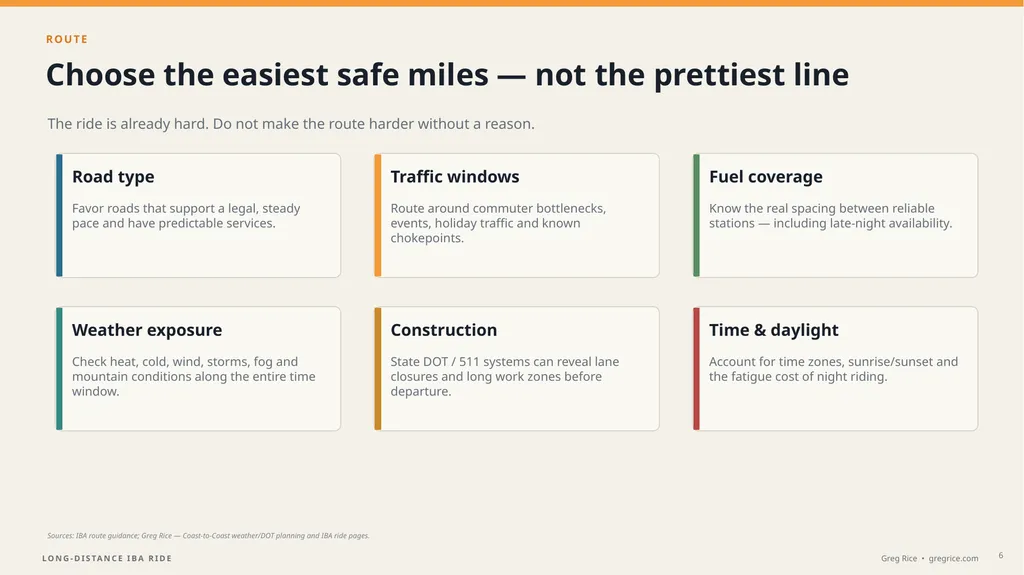
ROUTE Choose the easiest safe miles — not the prettiest line The ride is already hard. Do not make the route harder without a reason. Road type Favor roads that support a legal, steady pace and have predictable services. Traffic windows Route around commuter bottlenecks, events, holiday traffic and known chokepoints. Fuel coverage Know the real spacing between reliable stations — including late-night availability. Weather exposure Check heat, cold, wind, storms, fog and mountain conditions along the entire time window. Construction State DOT / 511 systems can reveal lane closures and long work zones before departure. Time & daylight Account for time zones, sunrise/sunset and the fatigue cost of night riding. Sources: IBA route guidance; Greg Rice — Coast-to-Coast weather/DOT planning and IBA ride pages. 6<br>
07
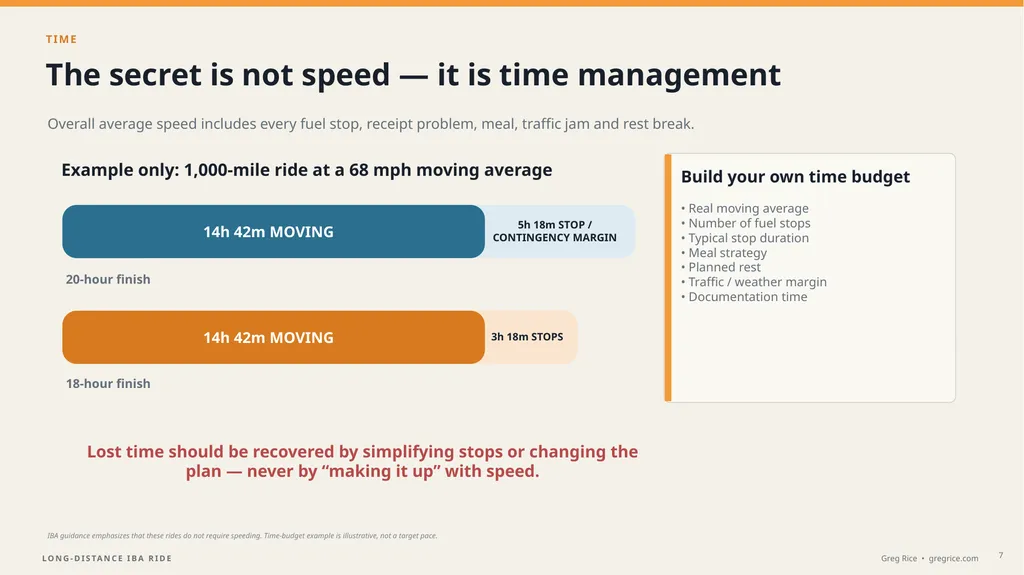
TIME The secret is not speed — it is time management Overall average speed includes every fuel stop, receipt problem, meal, traffic jam and rest break. Example only: 1,000-mile ride at a 68 mph moving average 14h 42m MOVING 5h 18m STOP / CONTINGENCY MARGIN 20-hour finish 14h 42m MOVING 3h 18m STOPS 18-hour finish Build your own time budget • Real moving average
• Number of fuel stops
• Typical stop duration
• Meal strategy
• Planned rest
• Traffic / weather margin
• Documentation time Lost time should be recovered by simplifying stops or changing the plan — never by “making it up” with speed. IBA guidance emphasizes that these rides do not require speeding. Time-budget example is illustrative, not a target pace. 7<br>
• Number of fuel stops
• Typical stop duration
• Meal strategy
• Planned rest
• Traffic / weather margin
• Documentation time Lost time should be recovered by simplifying stops or changing the plan — never by “making it up” with speed. IBA guidance emphasizes that these rides do not require speeding. Time-budget example is illustrative, not a target pace. 7<br>
08
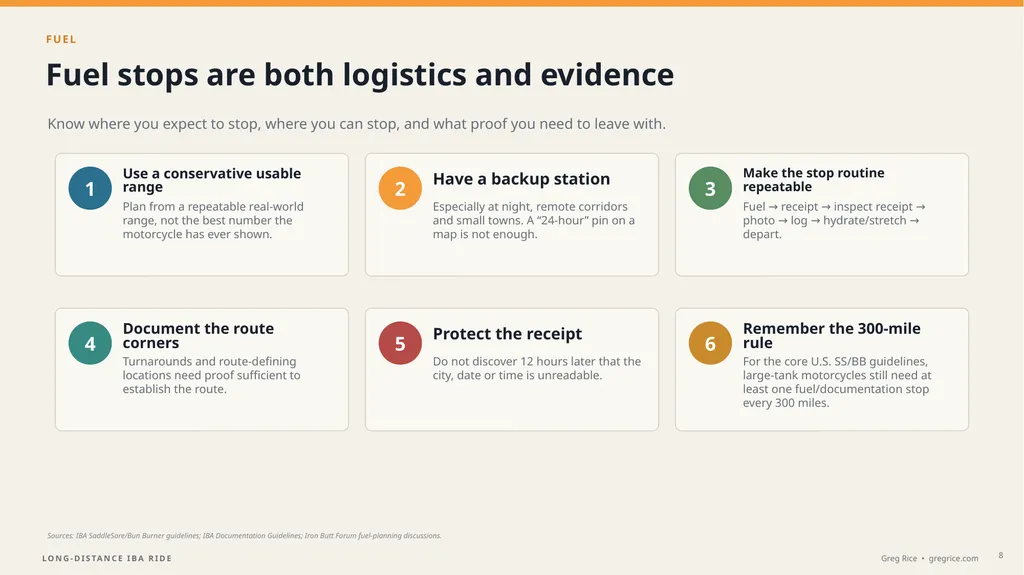
FUEL Fuel stops are both logistics and evidence Know where you expect to stop, where you can stop, and what proof you need to leave with. 1 Use a conservative usable range Plan from a repeatable real-world range, not the best number the motorcycle has ever shown. 2 Have a backup station Especially at night, remote corridors and small towns. A “24-hour” pin on a map is not enough. 3 Make the stop routine repeatable Fuel → receipt → inspect receipt → photo → log → hydrate/stretch → depart. 4 Document the route corners Turnarounds and route-defining locations need proof sufficient to establish the route. 5 Protect the receipt Do not discover 12 hours later that the city, date or time is unreadable. 6 Remember the 300-mile rule For the core U.S. SS/BB guidelines, large-tank motorcycles still need at least one fuel/documentation stop every 300 miles. Sources: IBA SaddleSore/Bun Burner guidelines; IBA Documentation Guidelines; Iron Butt Forum fuel-planning discussions. 8<br>
09
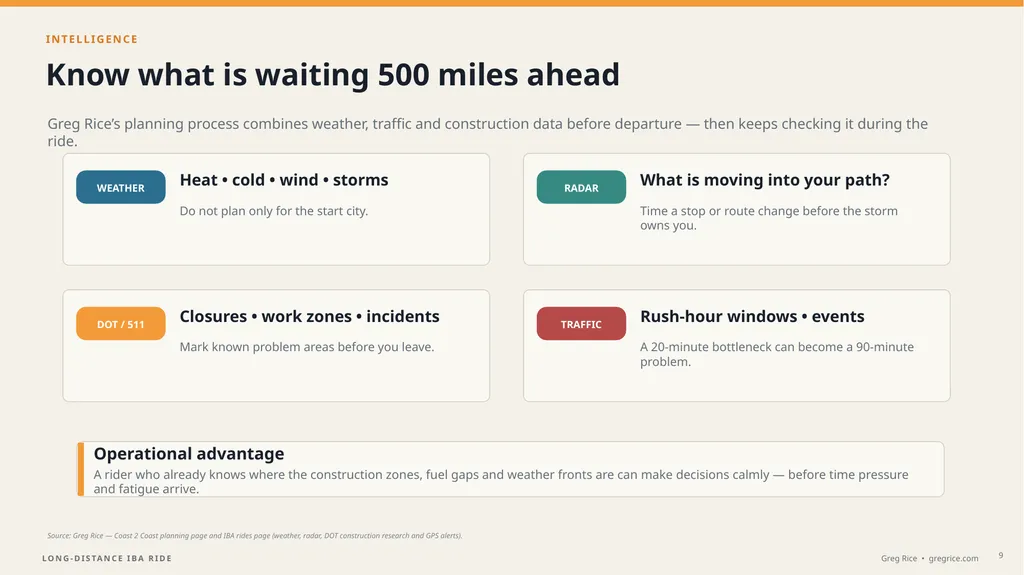
INTELLIGENCE Know what is waiting 500 miles ahead Greg Rice’s planning process combines weather, traffic and construction data before departure — then keeps checking it during the ride. WEATHER Heat • cold • wind • storms Do not plan only for the start city. RADAR What is moving into your path? Time a stop or route change before the storm owns you. DOT / 511 Closures • work zones • incidents Mark known problem areas before you leave. TRAFFIC Rush-hour windows • events A 20-minute bottleneck can become a 90-minute problem. Operational advantage A rider who already knows where the construction zones, fuel gaps and weather fronts are can make decisions calmly — before time pressure and fatigue arrive. Source: Greg Rice — Coast 2 Coast planning page and IBA rides page (weather, radar, DOT construction research and GPS alerts). 9<br>
10
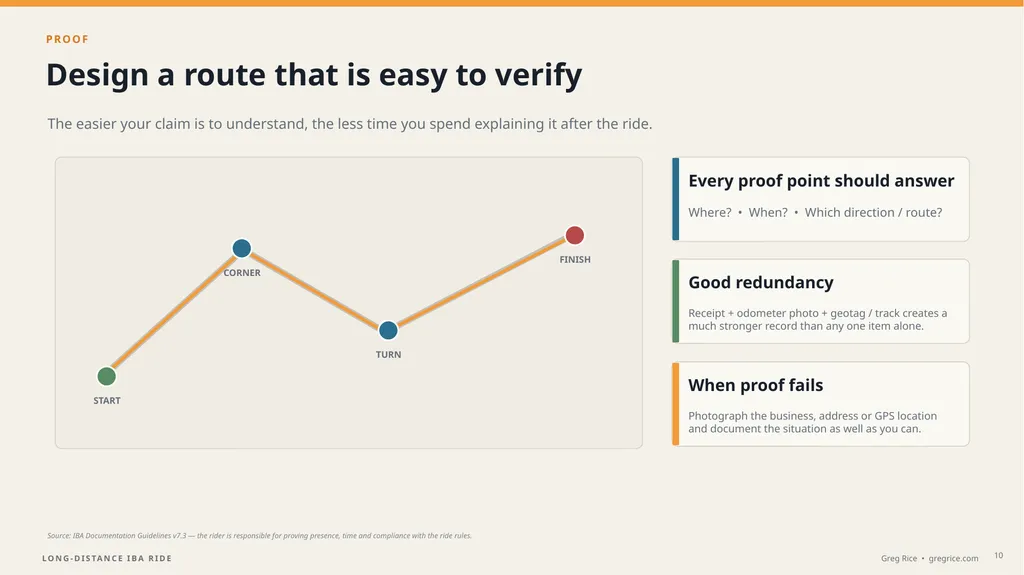
PROOF Design a route that is easy to verify The easier your claim is to understand, the less time you spend explaining it after the ride. START CORNER TURN FINISH Every proof point should answer Where? • When? • Which direction / route? Good redundancy Receipt + odometer photo + geotag / track creates a much stronger record than any one item alone. When proof fails Photograph the business, address or GPS location and document the situation as well as you can. Source: IBA Documentation Guidelines v7.3 — the rider is responsible for proving presence, time and compliance with the ride rules. 10<br>
11
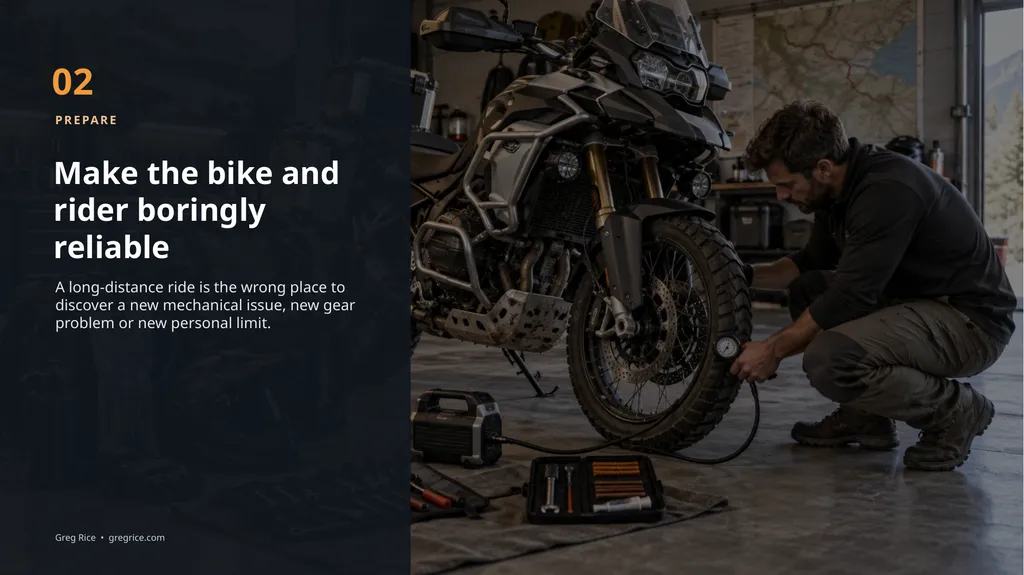
02 PREPARE Make the bike and rider boringly reliable A long-distance ride is the wrong place to discover a new mechanical issue, new gear problem or new personal limit. Greg Rice • gregrice.com<br>
12
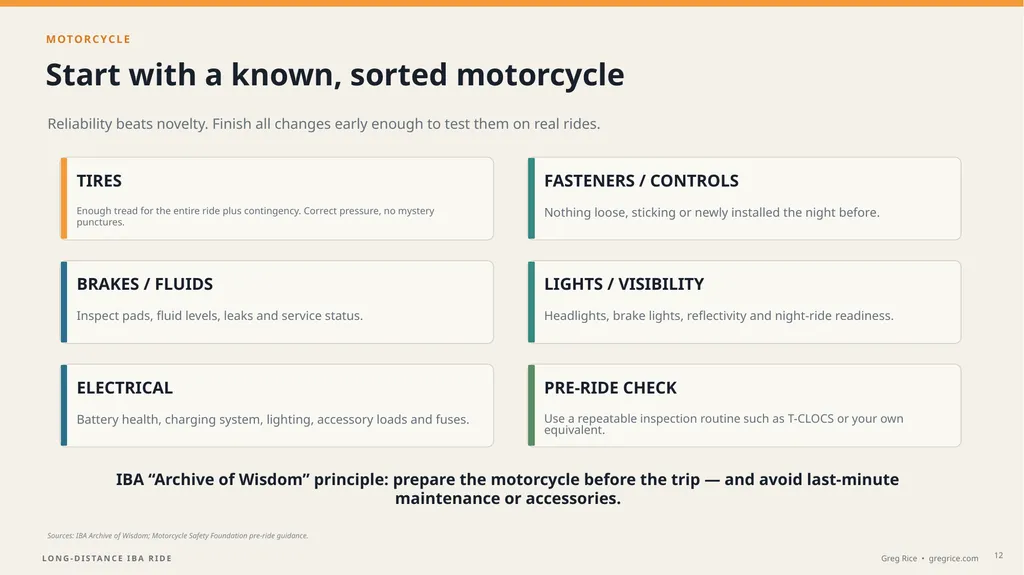
MOTORCYCLE Start with a known, sorted motorcycle Reliability beats novelty. Finish all changes early enough to test them on real rides. TIRES Enough tread for the entire ride plus contingency. Correct pressure, no mystery punctures. BRAKES / FLUIDS Inspect pads, fluid levels, leaks and service status. ELECTRICAL Battery health, charging system, lighting, accessory loads and fuses. FASTENERS / CONTROLS Nothing loose, sticking or newly installed the night before. LIGHTS / VISIBILITY Headlights, brake lights, reflectivity and night-ride readiness. PRE-RIDE CHECK Use a repeatable inspection routine such as T-CLOCS or your own equivalent. IBA “Archive of Wisdom” principle: prepare the motorcycle before the trip — and avoid last-minute maintenance or accessories. Sources: IBA Archive of Wisdom; Motorcycle Safety Foundation pre-ride guidance. 12<br>
13
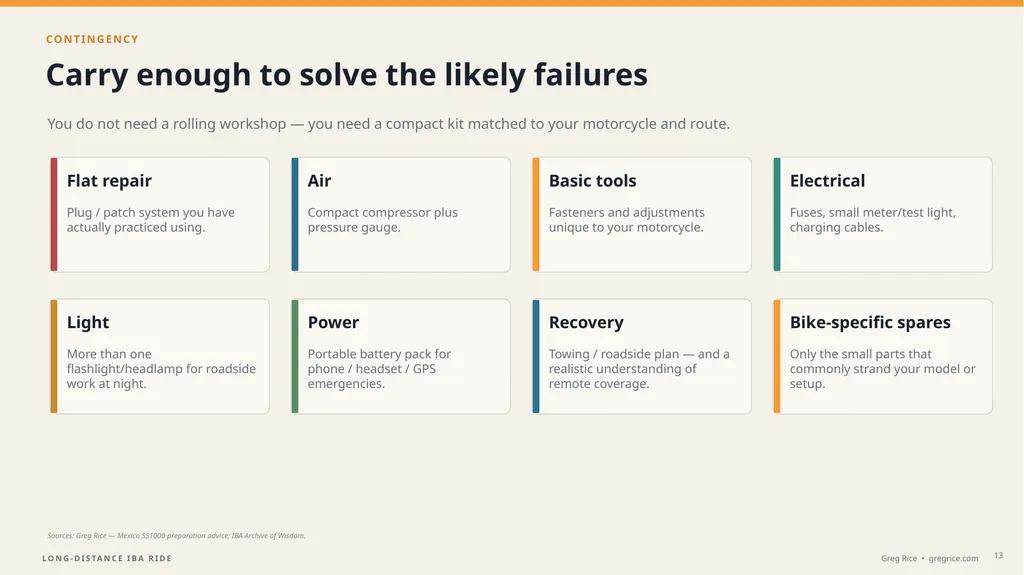
CONTINGENCY Carry enough to solve the likely failures You do not need a rolling workshop — you need a compact kit matched to your motorcycle and route. Flat repair Plug / patch system you have actually practiced using. Air Compact compressor plus pressure gauge. Basic tools Fasteners and adjustments unique to your motorcycle. Electrical Fuses, small meter/test light, charging cables. Light More than one flashlight/headlamp for roadside work at night. Power Portable battery pack for phone / headset / GPS emergencies. Recovery Towing / roadside plan — and a realistic understanding of remote coverage. Bike-specific spares Only the small parts that commonly strand your model or setup. Sources: Greg Rice — Mexico SS1000 preparation advice; IBA Archive of Wisdom. 13<br>
14
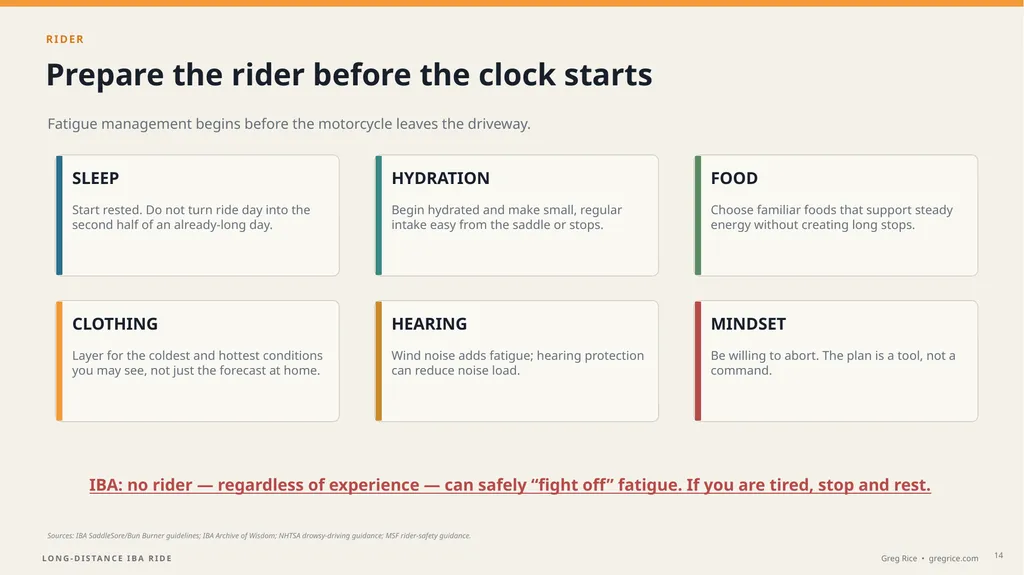
RIDER Prepare the rider before the clock starts Fatigue management begins before the motorcycle leaves the driveway. SLEEP Start rested. Do not turn ride day into the second half of an already-long day. HYDRATION Begin hydrated and make small, regular intake easy from the saddle or stops. FOOD Choose familiar foods that support steady energy without creating long stops. CLOTHING Layer for the coldest and hottest conditions you may see, not just the forecast at home. HEARING Wind noise adds fatigue; hearing protection can reduce noise load. MINDSET Be willing to abort. The plan is a tool, not a command. IBA: no rider — regardless of experience — can safely “fight off” fatigue. If you are tired, stop and rest. Sources: IBA SaddleSore/Bun Burner guidelines; IBA Archive of Wisdom; NHTSA drowsy-driving guidance; MSF rider-safety guidance. 14<br>
15
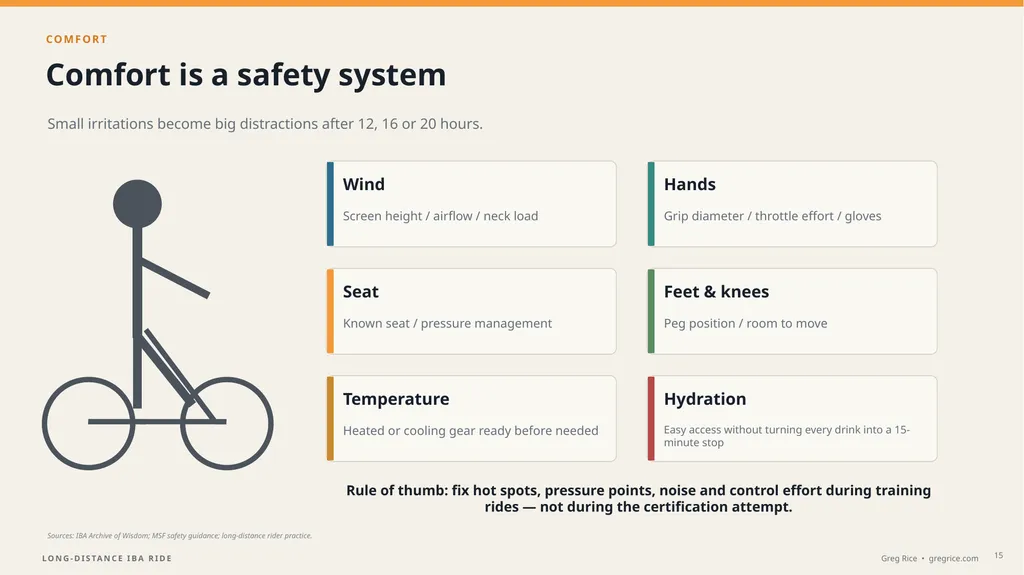
COMFORT Comfort is a safety system Small irritations become big distractions after 12, 16 or 20 hours. Wind Screen height / airflow / neck load Hands Grip diameter / throttle effort / gloves Seat Known seat / pressure management Feet & knees Peg position / room to move Temperature Heated or cooling gear ready before needed Hydration Easy access without turning every drink into a 15-minute stop Rule of thumb: fix hot spots, pressure points, noise and control effort during training rides — not during the certification attempt. Sources: IBA Archive of Wisdom; MSF safety guidance; long-distance rider practice. 15<br>
16
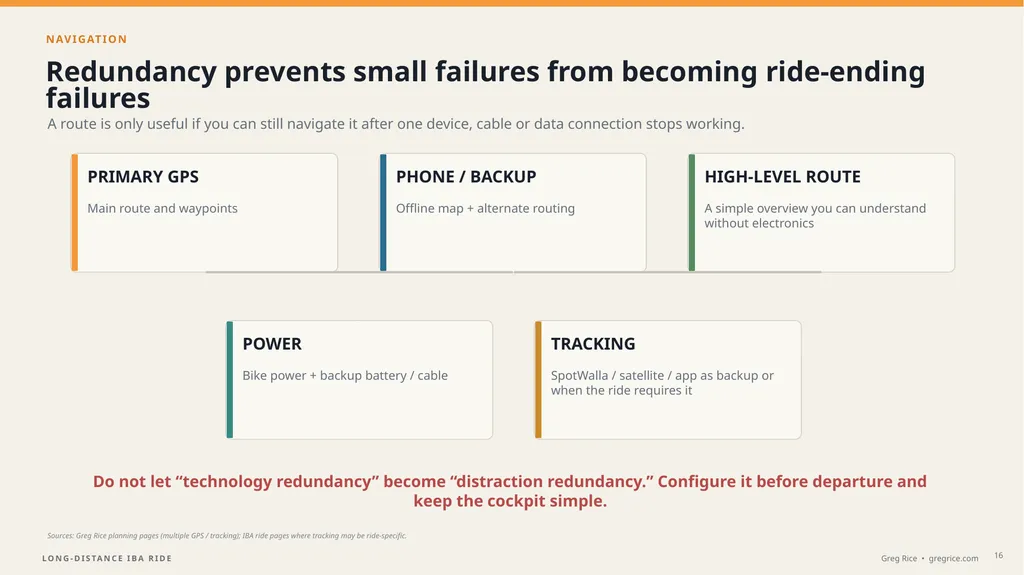
NAVIGATION Redundancy prevents small failures from becoming ride-ending failures A route is only useful if you can still navigate it after one device, cable or data connection stops working. PRIMARY GPS Main route and waypoints PHONE / BACKUP Offline map + alternate routing HIGH-LEVEL ROUTE A simple overview you can understand without electronics POWER Bike power + backup battery / cable TRACKING SpotWalla / satellite / app as backup or when the ride requires it Do not let “technology redundancy” become “distraction redundancy.” Configure it before departure and keep the cockpit simple. Sources: Greg Rice planning pages (multiple GPS / tracking); IBA ride pages where tracking may be ride-specific. 16<br>
17
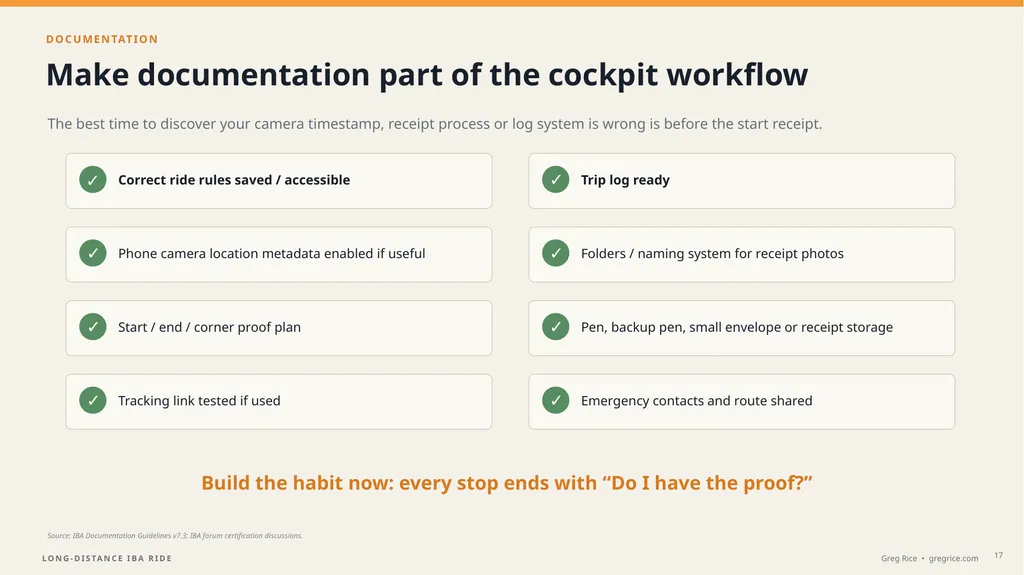
DOCUMENTATION Make documentation part of the cockpit workflow The best time to discover your camera timestamp, receipt process or log system is wrong is before the start receipt. ✓ Correct ride rules saved / accessible ✓ Trip log ready ✓ Phone camera location metadata enabled if useful ✓ Folders / naming system for receipt photos ✓ Start / end / corner proof plan ✓ Pen, backup pen, small envelope or receipt storage ✓ Tracking link tested if used ✓ Emergency contacts and route shared Build the habit now: every stop ends with “Do I have the proof?” Source: IBA Documentation Guidelines v7.3; IBA forum certification discussions. 17<br>
18
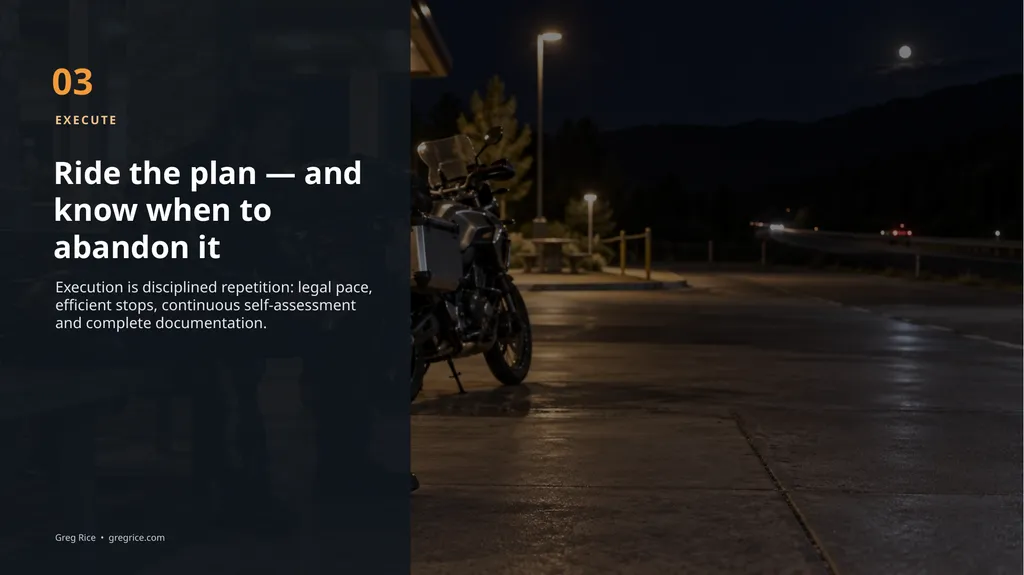
03 EXECUTE Ride the plan — and know when to abandon it Execution is disciplined repetition: legal pace, efficient stops, continuous self-assessment and complete documentation. Greg Rice • gregrice.com<br>
19
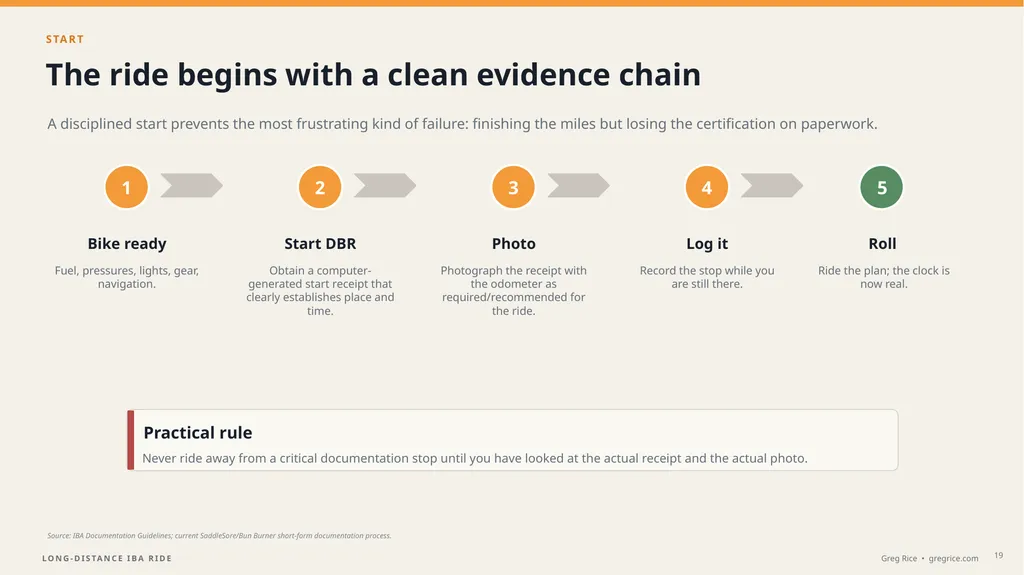
START The ride begins with a clean evidence chain A disciplined start prevents the most frustrating kind of failure: finishing the miles but losing the certification on paperwork. 1 Bike ready Fuel, pressures, lights, gear, navigation. 2 Start DBR Obtain a computer-generated start receipt that clearly establishes place and time. 3 Photo Photograph the receipt with the odometer as required/recommended for the ride. 4 Log it Record the stop while you are still there. 5 Roll Ride the plan; the clock is now real. Practical rule Never ride away from a critical documentation stop until you have looked at the actual receipt and the actual photo. Source: IBA Documentation Guidelines; current SaddleSore/Bun Burner short-form documentation process. 19<br>
20
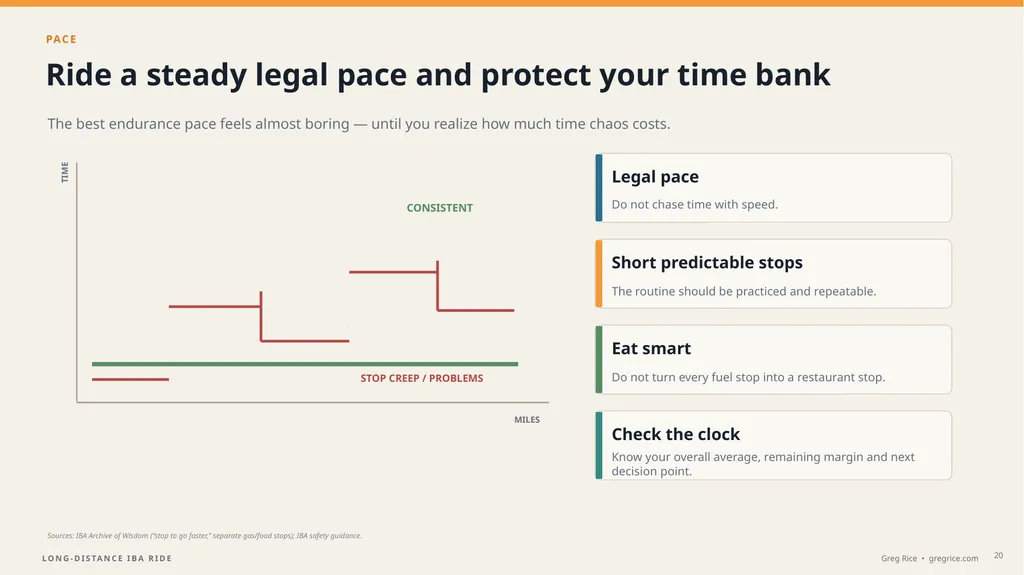
PACE Ride a steady legal pace and protect your time bank The best endurance pace feels almost boring — until you realize how much time chaos costs. TIME MILES CONSISTENT STOP CREEP / PROBLEMS Legal pace Do not chase time with speed. Short predictable stops The routine should be practiced and repeatable. Eat smart Do not turn every fuel stop into a restaurant stop. Check the clock Know your overall average, remaining margin and next decision point. Sources: IBA Archive of Wisdom (“stop to go faster,” separate gas/food stops); IBA safety guidance. 20<br>
21
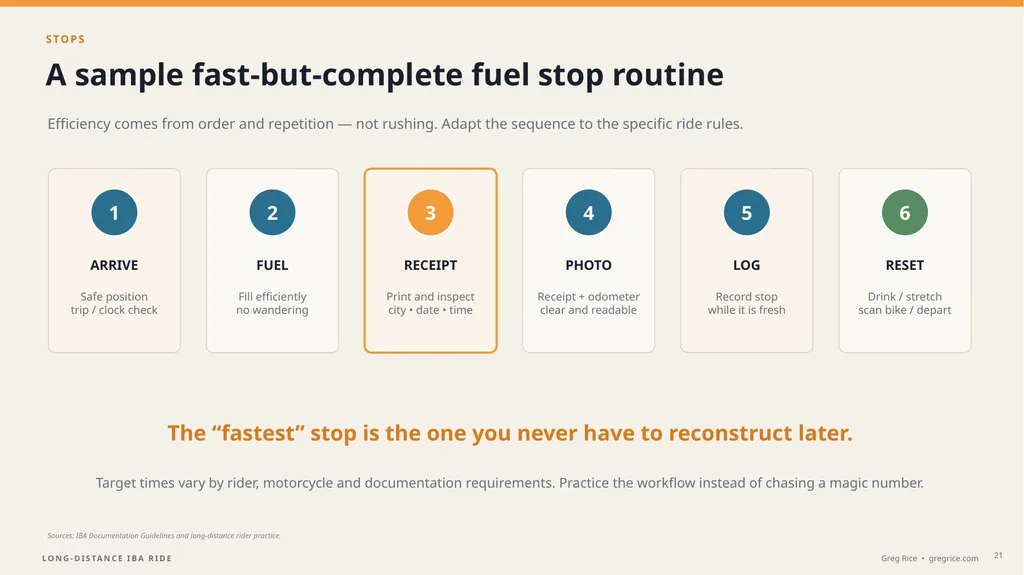
STOPS A sample fast-but-complete fuel stop routine Efficiency comes from order and repetition — not rushing. Adapt the sequence to the specific ride rules. 1 ARRIVE Safe position
trip / clock check 2 FUEL Fill efficiently
no wandering 3 RECEIPT Print and inspect
city • date • time 4 PHOTO Receipt + odometer
clear and readable 5 LOG Record stop
while it is fresh 6 RESET Drink / stretch
scan bike / depart The “fastest” stop is the one you never have to reconstruct later. Target times vary by rider, motorcycle and documentation requirements. Practice the workflow instead of chasing a magic number. Sources: IBA Documentation Guidelines and long-distance rider practice. 21<br>
trip / clock check 2 FUEL Fill efficiently
no wandering 3 RECEIPT Print and inspect
city • date • time 4 PHOTO Receipt + odometer
clear and readable 5 LOG Record stop
while it is fresh 6 RESET Drink / stretch
scan bike / depart The “fastest” stop is the one you never have to reconstruct later. Target times vary by rider, motorcycle and documentation requirements. Practice the workflow instead of chasing a magic number. Sources: IBA Documentation Guidelines and long-distance rider practice. 21<br>
22
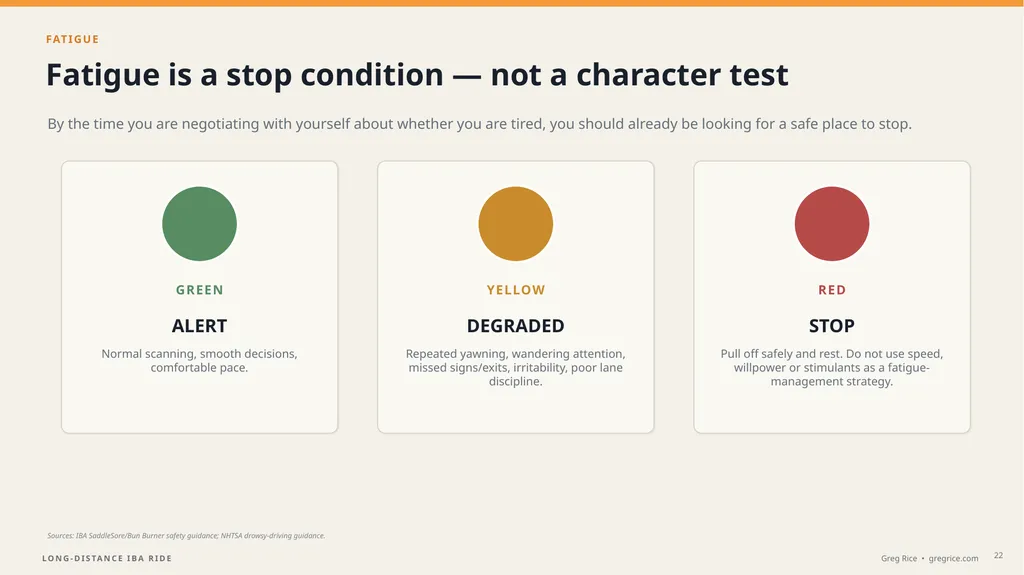
FATIGUE Fatigue is a stop condition — not a character test By the time you are negotiating with yourself about whether you are tired, you should already be looking for a safe place to stop. GREEN ALERT Normal scanning, smooth decisions, comfortable pace. YELLOW DEGRADED Repeated yawning, wandering attention, missed signs/exits, irritability, poor lane discipline. RED STOP Pull off safely and rest. Do not use speed, willpower or stimulants as a fatigue-management strategy. Sources: IBA SaddleSore/Bun Burner safety guidance; NHTSA drowsy-driving guidance. 22<br>
23
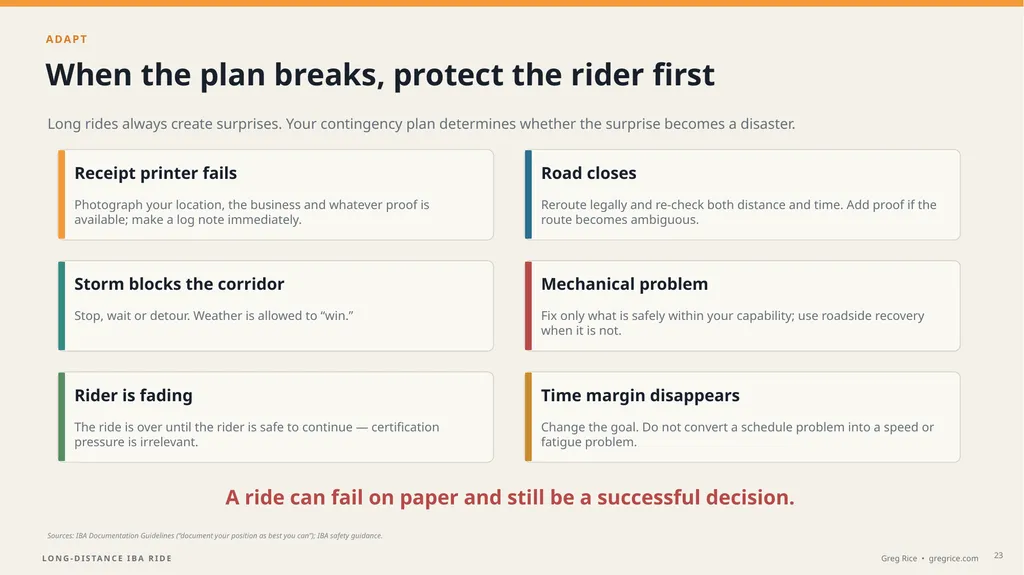
ADAPT When the plan breaks, protect the rider first Long rides always create surprises. Your contingency plan determines whether the surprise becomes a disaster. Receipt printer fails Photograph your location, the business and whatever proof is available; make a log note immediately. Road closes Reroute legally and re-check both distance and time. Add proof if the route becomes ambiguous. Storm blocks the corridor Stop, wait or detour. Weather is allowed to “win.” Mechanical problem Fix only what is safely within your capability; use roadside recovery when it is not. Rider is fading The ride is over until the rider is safe to continue — certification pressure is irrelevant. Time margin disappears Change the goal. Do not convert a schedule problem into a speed or fatigue problem. A ride can fail on paper and still be a successful decision. Sources: IBA Documentation Guidelines (“document your position as best you can”); IBA safety guidance. 23<br>
24
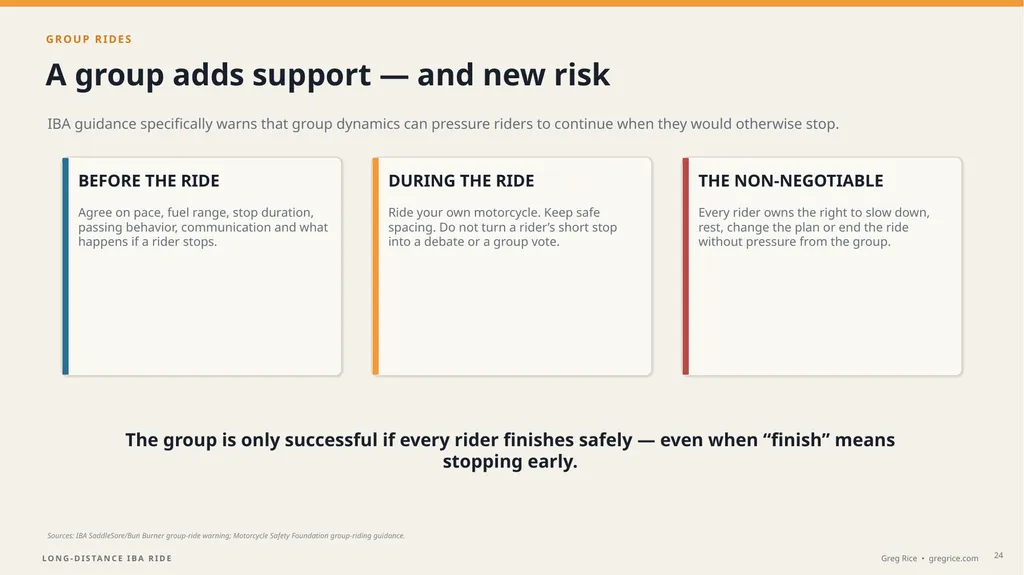
GROUP RIDES A group adds support — and new risk IBA guidance specifically warns that group dynamics can pressure riders to continue when they would otherwise stop. BEFORE THE RIDE Agree on pace, fuel range, stop duration, passing behavior, communication and what happens if a rider stops. DURING THE RIDE Ride your own motorcycle. Keep safe spacing. Do not turn a rider’s short stop into a debate or a group vote. THE NON-NEGOTIABLE Every rider owns the right to slow down, rest, change the plan or end the ride without pressure from the group. The group is only successful if every rider finishes safely — even when “finish” means stopping early. Sources: IBA SaddleSore/Bun Burner group-ride warning; Motorcycle Safety Foundation group-riding guidance. 24<br>
25
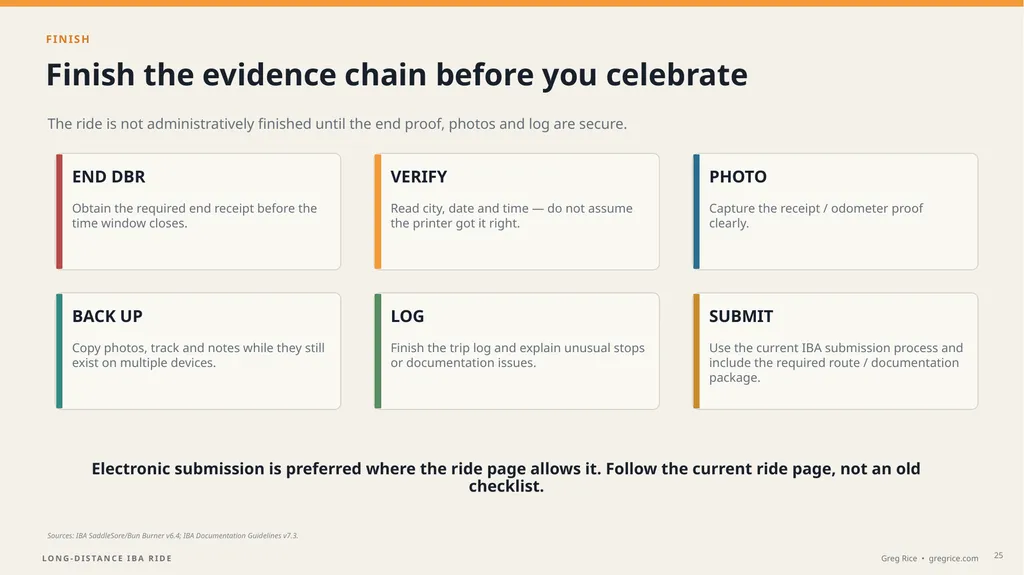
FINISH Finish the evidence chain before you celebrate The ride is not administratively finished until the end proof, photos and log are secure. END DBR Obtain the required end receipt before the time window closes. VERIFY Read city, date and time — do not assume the printer got it right. PHOTO Capture the receipt / odometer proof clearly. BACK UP Copy photos, track and notes while they still exist on multiple devices. LOG Finish the trip log and explain unusual stops or documentation issues. SUBMIT Use the current IBA submission process and include the required route / documentation package. Electronic submission is preferred where the ride page allows it. Follow the current ride page, not an old checklist. Sources: IBA SaddleSore/Bun Burner v6.4; IBA Documentation Guidelines v7.3. 25<br>
26
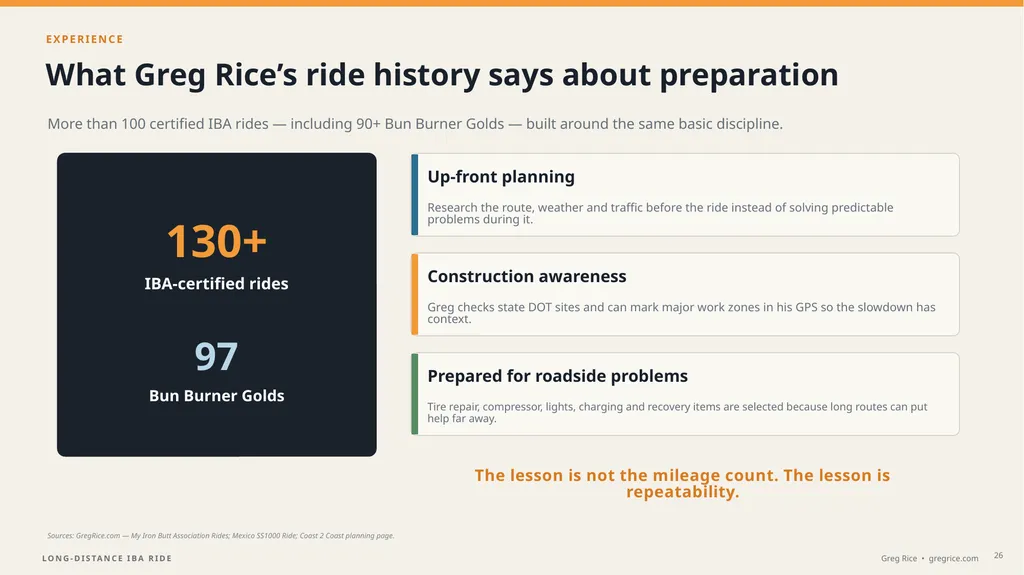
EXPERIENCE What Greg Rice’s ride history says about preparation More than 100 certified IBA rides — including 90+ Bun Burner Golds — built around the same basic discipline. 130+ IBA-certified rides 97 Bun Burner Golds Up-front planning Research the route, weather and traffic before the ride instead of solving predictable problems during it. Construction awareness Greg checks state DOT sites and can mark major work zones in his GPS so the slowdown has context. Prepared for roadside problems Tire repair, compressor, lights, charging and recovery items are selected because long routes can put help far away. The lesson is not the mileage count. The lesson is repeatability. Sources: GregRice.com — My Iron Butt Association Rides; Mexico SS1000 Ride; Coast 2 Coast planning page. 26<br>
27
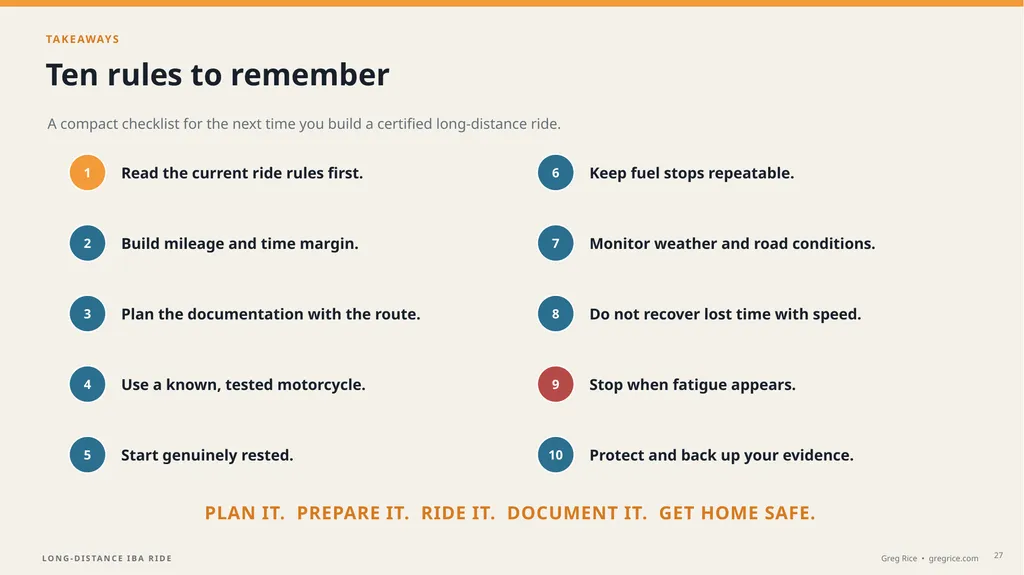
TAKEAWAYS Ten rules to remember A compact checklist for the next time you build a certified long-distance ride. 1 Read the current ride rules first. 2 Build mileage and time margin. 3 Plan the documentation with the route. 4 Use a known, tested motorcycle. 5 Start genuinely rested. 6 Keep fuel stops repeatable. 7 Monitor weather and road conditions. 8 Do not recover lost time with speed. 9 Stop when fatigue appears. 10 Protect and back up your evidence. PLAN IT. PREPARE IT. RIDE IT. DOCUMENT IT. GET HOME SAFE. 27<br>
28
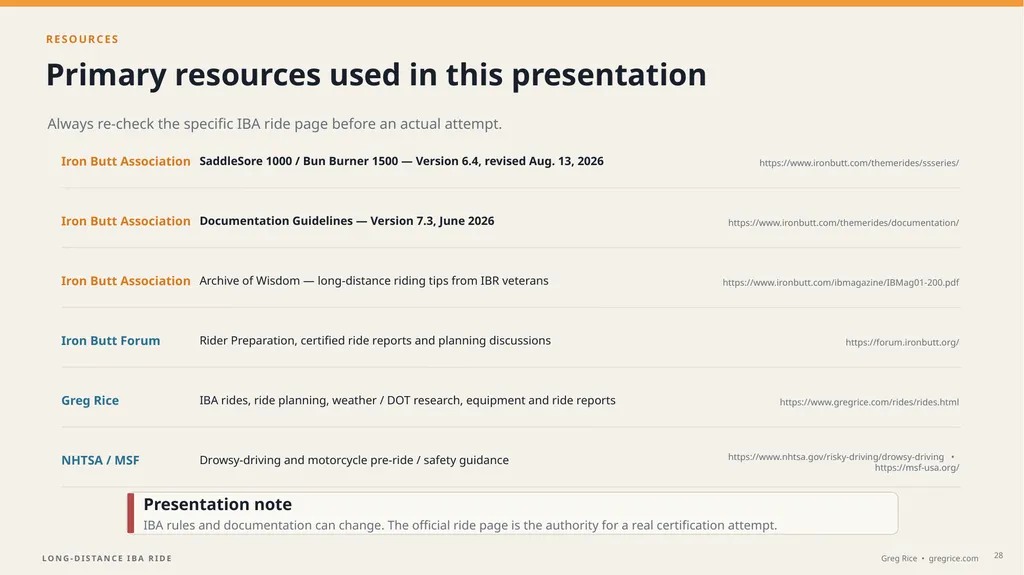
RESOURCES Primary resources used in this presentation Always re-check the specific IBA ride page before an actual attempt. Iron Butt Association SaddleSore 1000 / Bun Burner 1500 — Version 6.4, revised Aug. 13, 2026 https://www.ironbutt.com/themerides/ssseries/ Iron Butt Association Documentation Guidelines — Version 7.3, June 2026 https://www.ironbutt.com/themerides/documentation/ Iron Butt Association Archive of Wisdom — long-distance riding tips from IBR veterans https://www.ironbutt.com/ibmagazine/IBMag01-200.pdf Iron Butt Forum Rider Preparation, certified ride reports and planning discussions https://forum.ironbutt.org/ Greg Rice IBA rides, ride planning, weather / DOT research, equipment and ride reports https://www.gregrice.com/rides/rides.html NHTSA / MSF Drowsy-driving and motorcycle pre-ride / safety guidance https://www.nhtsa.gov/risky-driving/drowsy-driving • https://msf-usa.org/ Presentation note IBA rules and documentation can change. The official ride page is the authority for a real certification attempt. 28<br>
29
THE BEST LONG-DISTANCE RIDE
ENDS WITH YOU HOME SAFE. Questions / discussion Greg Rice • gregrice.com Plan it. Prepare it. Execute it. Document it.<br>
ENDS WITH YOU HOME SAFE. Questions / discussion Greg Rice • gregrice.com Plan it. Prepare it. Execute it. Document it.<br>