
Massive Open Online Courses (MOOCs): How Do They
CM
Published · 53 slides · 0 views
1 / 1
Description
Massive Open Online Courses (MOOCs): How Do They Work? (Reflections from Personal Experience) Dan Grossman Department of Computer Science Engineering University of Washington ATLAS Speaker Series Univ. Colorado Boulder September 9, 2013
Related Topics
Share
Embed code
Download this presentation From Below
"Massive Open Online Courses (MOOCs): How Do They" is the property of its rightful owner. Permission is granted to download and print the materials on this website for personal, non-commercial use only, and to display it on your personal computer provided you do not modify the materials and that you retain all copyright notices contained in the materials. By downloading content from our website, you accept the terms of this agreement.
Presentation Transcript
01
Massive Open Online Courses (MOOCs):
How Do They Work?
(Reflections from Personal Experience)
Dan Grossman
Department of Computer Science & Engineering
University of Washington
ATLAS Speaker Series
Univ. Colorado Boulder
September 9, 2013<br>
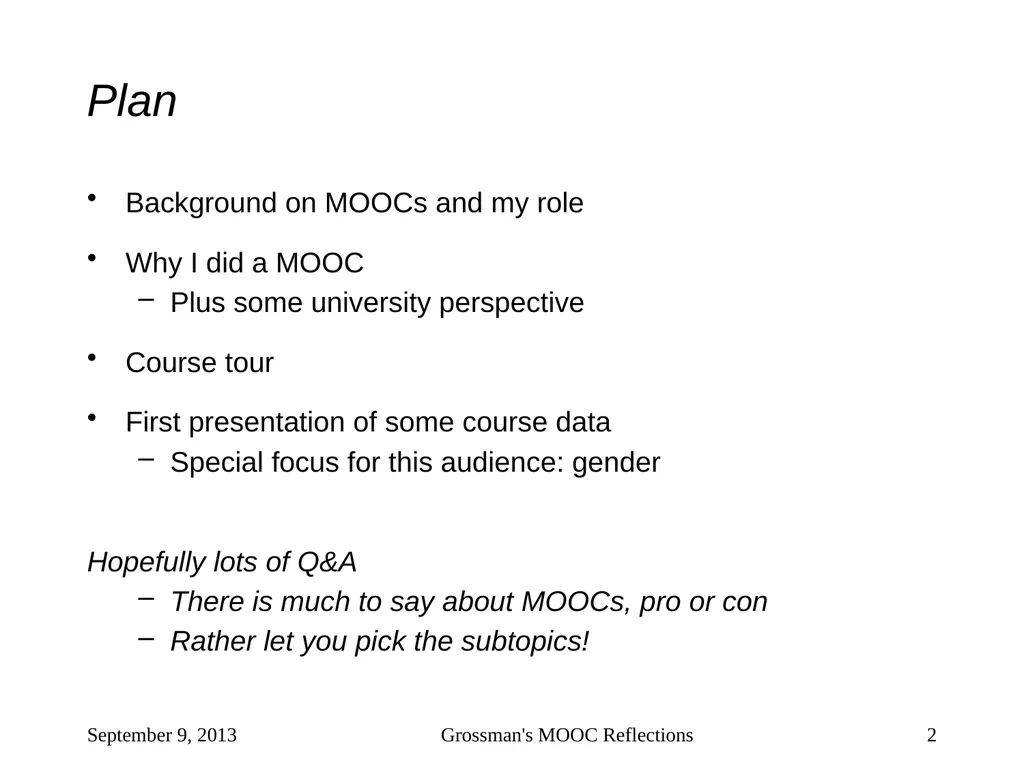
02
Plan Background on MOOCs and my role
Why I did a MOOC
Plus some university perspective
Course tour
First presentation of some course data
Special focus for this audience: gender
Hopefully lots of Q&A
There is much to say about MOOCs, pro or con
Rather let you pick the subtopics! September 9, 2013 2 Grossman's MOOC Reflections<br>
Why I did a MOOC
Plus some university perspective
Course tour
First presentation of some course data
Special focus for this audience: gender
Hopefully lots of Q&A
There is much to say about MOOCs, pro or con
Rather let you pick the subtopics! September 9, 2013 2 Grossman's MOOC Reflections<br>
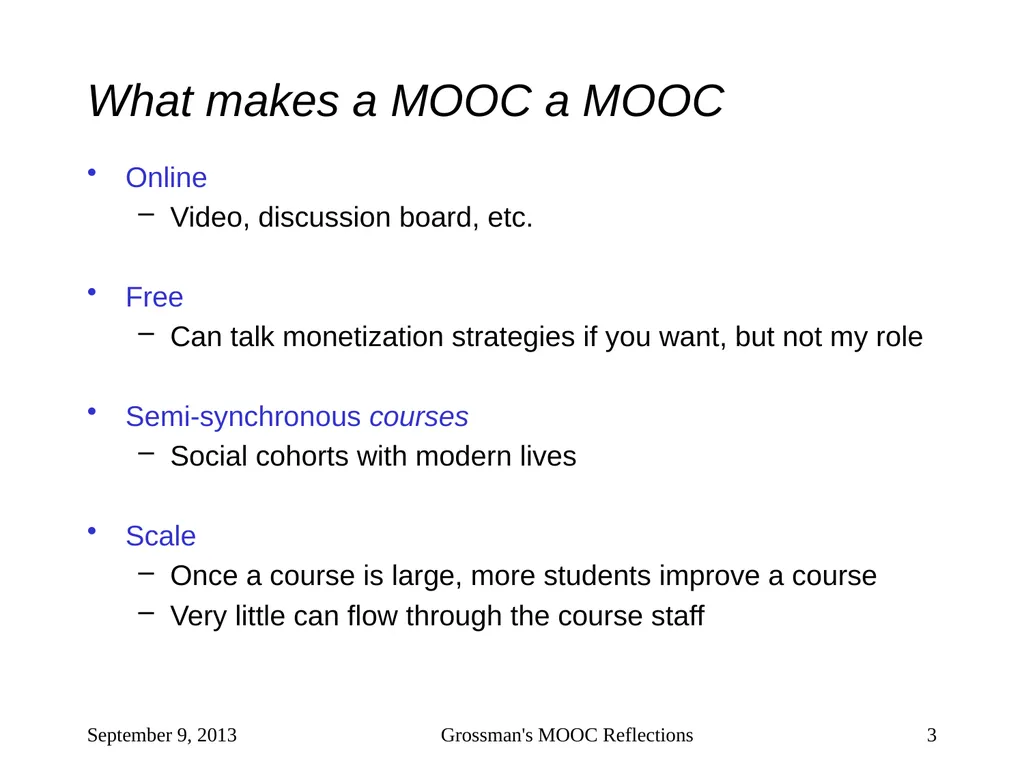
03
What makes a MOOC a MOOC Online
Video, discussion board, etc.
Free
Can talk monetization strategies if you want, but not my role
Semi-synchronous courses
Social cohorts with modern lives
Scale
Once a course is large, more students improve a course
Very little can flow through the course staff September 9, 2013 Grossman's MOOC Reflections 3<br>
Video, discussion board, etc.
Free
Can talk monetization strategies if you want, but not my role
Semi-synchronous courses
Social cohorts with modern lives
Scale
Once a course is large, more students improve a course
Very little can flow through the course staff September 9, 2013 Grossman's MOOC Reflections 3<br>
04
Recent history 2 years ago (!):
3 CS MOOCs from Stanford go viral, hit mass media, etc.
(Also Khan Academy, Code Academy, cMOOCs, …)
<1.5 years ago:
Coursera, Udacity, EdX, …
UW partners with Coursera (later, EdX too)
Coursera today: > 4M users, > 60 universities, > 400 courses
Everybody talking about it
Academia, from presidents on down
Much of the software industry
Friends, strangers, my parents, … September 9, 2013 4 Grossman's MOOC Reflections<br>
3 CS MOOCs from Stanford go viral, hit mass media, etc.
(Also Khan Academy, Code Academy, cMOOCs, …)
<1.5 years ago:
Coursera, Udacity, EdX, …
UW partners with Coursera (later, EdX too)
Coursera today: > 4M users, > 60 universities, > 400 courses
Everybody talking about it
Academia, from presidents on down
Much of the software industry
Friends, strangers, my parents, … September 9, 2013 4 Grossman's MOOC Reflections<br>
05
My role Instructor: Programming Languages, Jan-Mar 2013
Sophomore-level majors-only class in a very competitive major
A challenging course made available to all
Coordinated department effort: 5 courses in 2013
Instructors plus cadre of nimble TAs
Interactions with Coursera
Meeting with various UW entities about the path forward
Department was first-mover, separate from other UW courses
Now I know the Provost’s Office September 9, 2013 Grossman's MOOC Reflections 5<br>
Sophomore-level majors-only class in a very competitive major
A challenging course made available to all
Coordinated department effort: 5 courses in 2013
Instructors plus cadre of nimble TAs
Interactions with Coursera
Meeting with various UW entities about the path forward
Department was first-mover, separate from other UW courses
Now I know the Provost’s Office September 9, 2013 Grossman's MOOC Reflections 5<br>
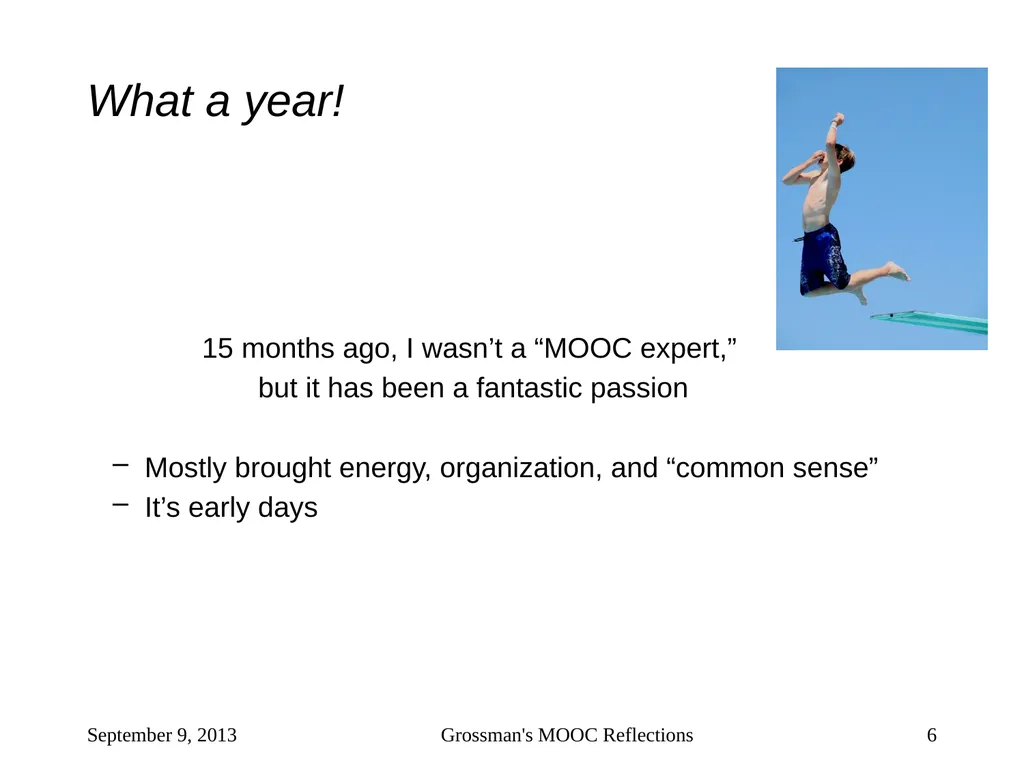
06
What a year! 15 months ago, I wasn’t a “MOOC expert,”
but it has been a fantastic passion
Mostly brought energy, organization, and “common sense”
It’s early days September 9, 2013 6 Grossman's MOOC Reflections<br>
but it has been a fantastic passion
Mostly brought energy, organization, and “common sense”
It’s early days September 9, 2013 6 Grossman's MOOC Reflections<br>
07
Plan Background on MOOCs and my role
Why I did a MOOC
Plus a little on university perspective
Course tour
First presentation of some course data
Special focus for this audience: gender September 9, 2013 7 Grossman's MOOC Reflections<br>
Why I did a MOOC
Plus a little on university perspective
Course tour
First presentation of some course data
Special focus for this audience: gender September 9, 2013 7 Grossman's MOOC Reflections<br>
08
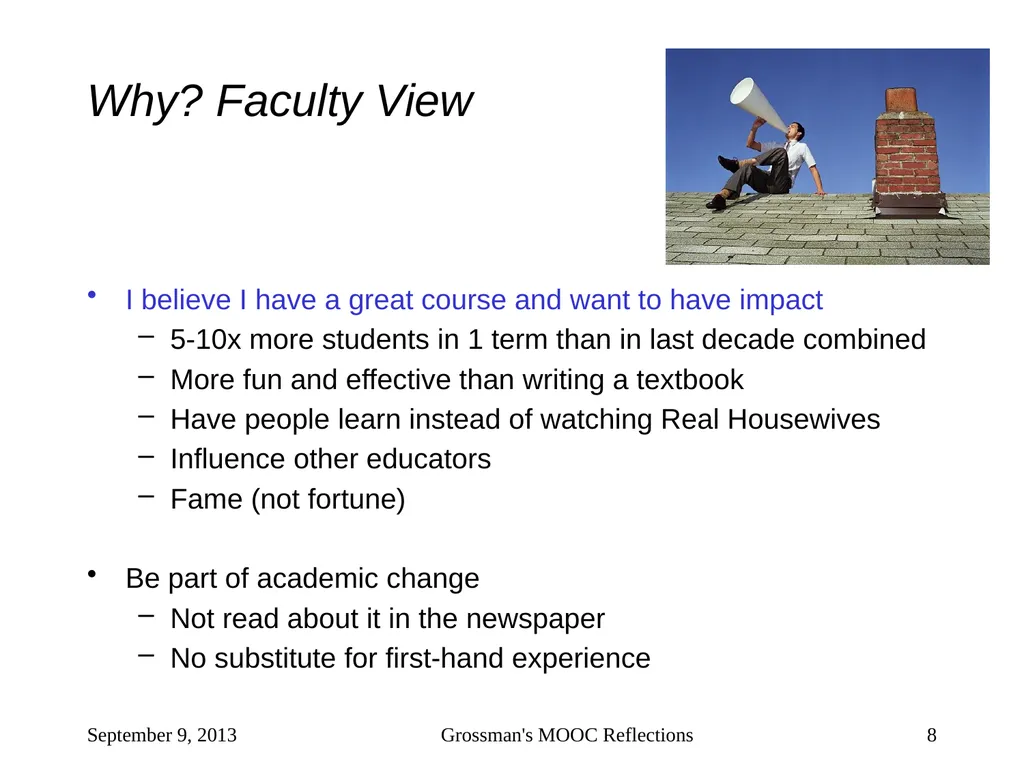
Why? Faculty View I believe I have a great course and want to have impact
5-10x more students in 1 term than in last decade combined
More fun and effective than writing a textbook
Have people learn instead of watching Real Housewives
Influence other educators
Fame (not fortune)
Be part of academic change
Not read about it in the newspaper
No substitute for first-hand experience September 9, 2013 8 Grossman's MOOC Reflections<br>
5-10x more students in 1 term than in last decade combined
More fun and effective than writing a textbook
Have people learn instead of watching Real Housewives
Influence other educators
Fame (not fortune)
Be part of academic change
Not read about it in the newspaper
No substitute for first-hand experience September 9, 2013 8 Grossman's MOOC Reflections<br>
09
Why? Department View Can have amazing impact
Scalable, worldwide leaders in computing education
MOOCs might [not] change how universities work in N years
Gain experience
Improve and leverage reputation
Feedback to improve conventional courses
New modalities (e.g., video, peer assessment)
Massive data
Yes, it costs money, but remarkably little
Cost is time September 9, 2013 Grossman's MOOC Reflections 9<br>
Scalable, worldwide leaders in computing education
MOOCs might [not] change how universities work in N years
Gain experience
Improve and leverage reputation
Feedback to improve conventional courses
New modalities (e.g., video, peer assessment)
Massive data
Yes, it costs money, but remarkably little
Cost is time September 9, 2013 Grossman's MOOC Reflections 9<br>
10
Two Comparisons Compared to conventional courses
Same or better: Homeworks, lectures
Unclear: Study groups
Worse: Design projects, exams, mentoring, …
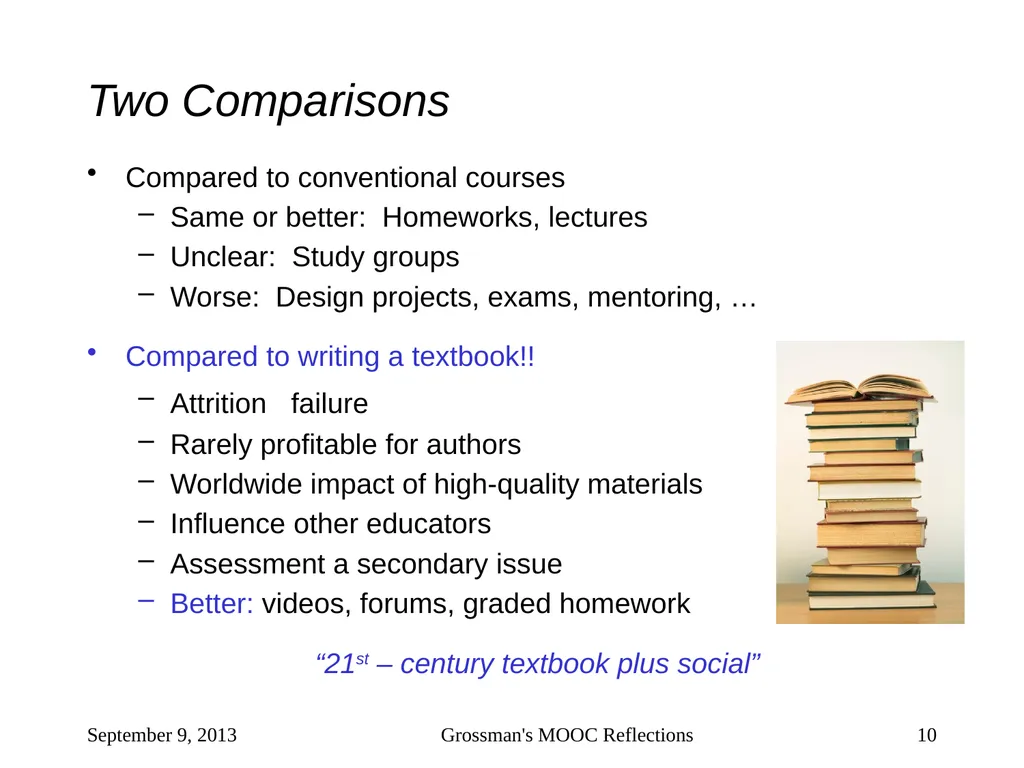
Compared to writing a textbook!!
Attrition failure
Rarely profitable for authors
Worldwide impact of high-quality materials
Influence other educators
Assessment a secondary issue
Better: videos, forums, graded homework
“21st – century textbook plus social” September 9, 2013 10 Grossman's MOOC Reflections<br>
Same or better: Homeworks, lectures
Unclear: Study groups
Worse: Design projects, exams, mentoring, …
Compared to writing a textbook!!
Attrition failure
Rarely profitable for authors
Worldwide impact of high-quality materials
Influence other educators
Assessment a secondary issue
Better: videos, forums, graded homework
“21st – century textbook plus social” September 9, 2013 10 Grossman's MOOC Reflections<br>
11
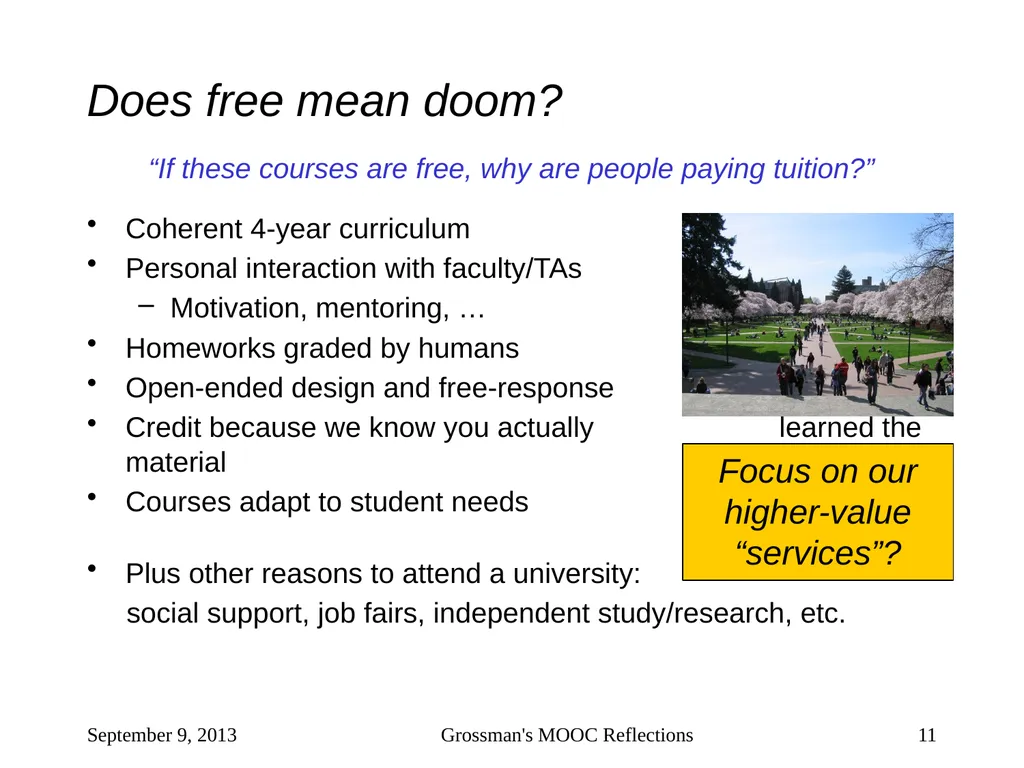
Does free mean doom? “If these courses are free, why are people paying tuition?”
Coherent 4-year curriculum
Personal interaction with faculty/TAs
Motivation, mentoring, …
Homeworks graded by humans
Open-ended design and free-response questions
Credit because we know you actually learned the material
Courses adapt to student needs
Plus other reasons to attend a university:
social support, job fairs, independent study/research, etc. September 9, 2013 Grossman's MOOC Reflections 11 Focus on our higher-value “services”?<br>
Coherent 4-year curriculum
Personal interaction with faculty/TAs
Motivation, mentoring, …
Homeworks graded by humans
Open-ended design and free-response questions
Credit because we know you actually learned the material
Courses adapt to student needs
Plus other reasons to attend a university:
social support, job fairs, independent study/research, etc. September 9, 2013 Grossman's MOOC Reflections 11 Focus on our higher-value “services”?<br>
12
Perspective It is plausible MOOCs will destroy universities as we know them (!)
Big changes can happen quickly
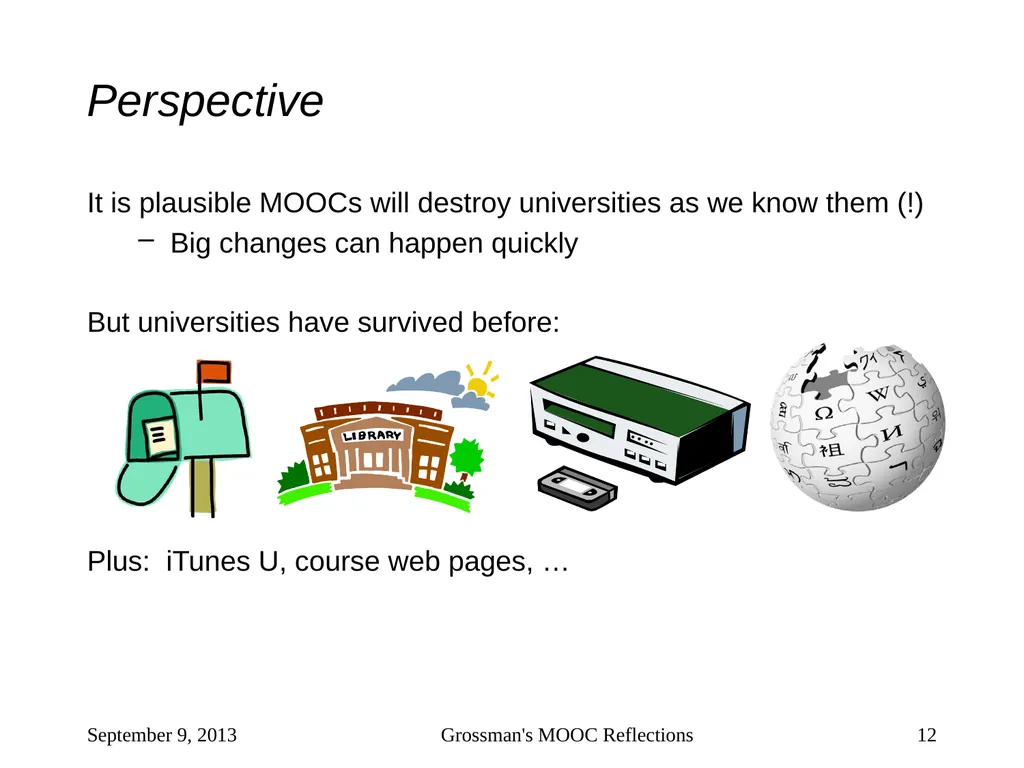
But universities have survived before:
Plus: iTunes U, course web pages, … September 9, 2013 12 Grossman's MOOC Reflections<br>
Big changes can happen quickly
But universities have survived before:
Plus: iTunes U, course web pages, … September 9, 2013 12 Grossman's MOOC Reflections<br>
13
Plan Background on MOOCs and my role
Why I did a MOOC
Plus a little on university perspective
Course tour
First presentation of some course data
Special focus for this audience: gender September 9, 2013 13 Grossman's MOOC Reflections<br>
Why I did a MOOC
Plus a little on university perspective
Course tour
First presentation of some course data
Special focus for this audience: gender September 9, 2013 13 Grossman's MOOC Reflections<br>
14
The course My favorite teaching assignment
Taught 5 times over 9 years before making a MOOC
Already developed lecture materials, reading notes, homeworks, …
A popular course
Comes after two programming courses
Majors only September 9, 2013 14 Grossman's MOOC Reflections<br>
Taught 5 times over 9 years before making a MOOC
Already developed lecture materials, reading notes, homeworks, …
A popular course
Comes after two programming courses
Majors only September 9, 2013 14 Grossman's MOOC Reflections<br>
15
Some details 10 weeks
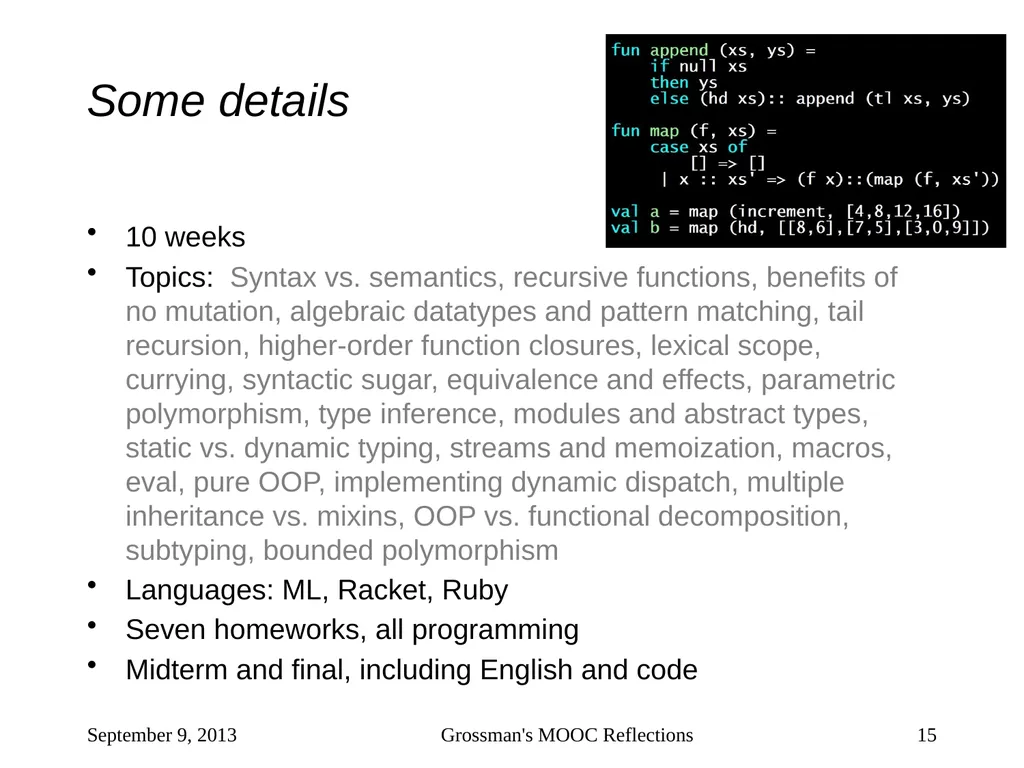
Topics: Syntax vs. semantics, recursive functions, benefits of no mutation, algebraic datatypes and pattern matching, tail recursion, higher-order function closures, lexical scope, currying, syntactic sugar, equivalence and effects, parametric polymorphism, type inference, modules and abstract types, static vs. dynamic typing, streams and memoization, macros, eval, pure OOP, implementing dynamic dispatch, multiple inheritance vs. mixins, OOP vs. functional decomposition, subtyping, bounded polymorphism
Languages: ML, Racket, Ruby
Seven homeworks, all programming
Midterm and final, including English and code September 9, 2013 15 Grossman's MOOC Reflections<br>
Topics: Syntax vs. semantics, recursive functions, benefits of no mutation, algebraic datatypes and pattern matching, tail recursion, higher-order function closures, lexical scope, currying, syntactic sugar, equivalence and effects, parametric polymorphism, type inference, modules and abstract types, static vs. dynamic typing, streams and memoization, macros, eval, pure OOP, implementing dynamic dispatch, multiple inheritance vs. mixins, OOP vs. functional decomposition, subtyping, bounded polymorphism
Languages: ML, Racket, Ruby
Seven homeworks, all programming
Midterm and final, including English and code September 9, 2013 15 Grossman's MOOC Reflections<br>
16
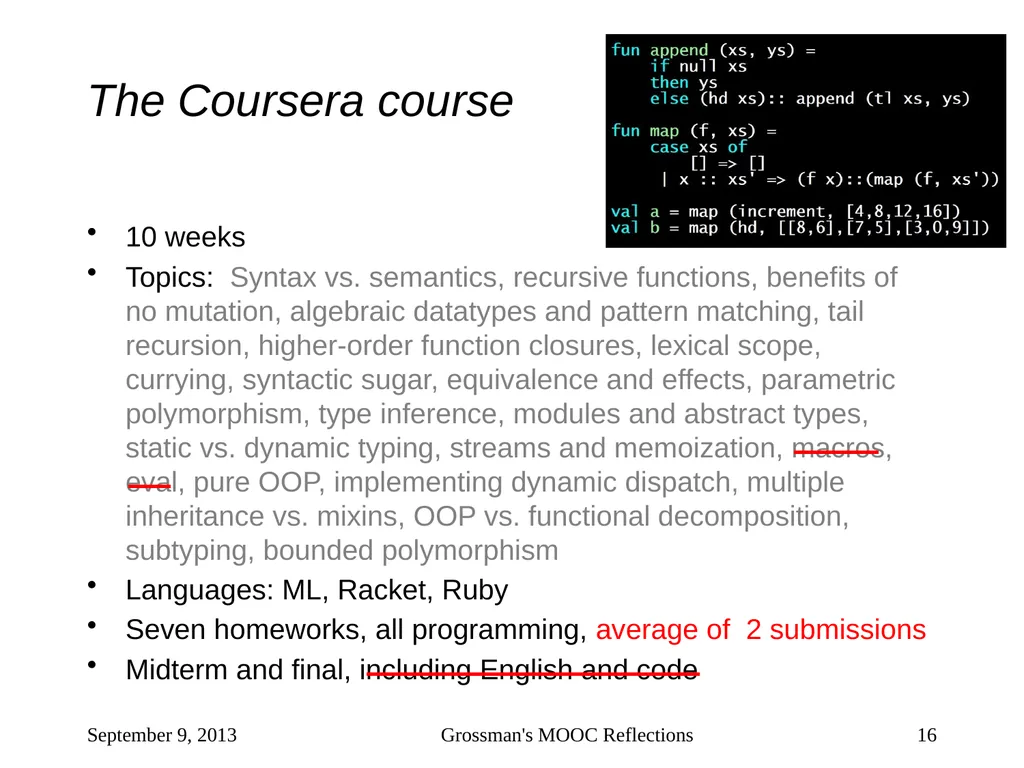
The Coursera course 10 weeks
Topics: Syntax vs. semantics, recursive functions, benefits of no mutation, algebraic datatypes and pattern matching, tail recursion, higher-order function closures, lexical scope, currying, syntactic sugar, equivalence and effects, parametric polymorphism, type inference, modules and abstract types, static vs. dynamic typing, streams and memoization, macros, eval, pure OOP, implementing dynamic dispatch, multiple inheritance vs. mixins, OOP vs. functional decomposition, subtyping, bounded polymorphism
Languages: ML, Racket, Ruby
Seven homeworks, all programming, average of 2 submissions
Midterm and final, including English and code September 9, 2013 16 Grossman's MOOC Reflections<br>
Topics: Syntax vs. semantics, recursive functions, benefits of no mutation, algebraic datatypes and pattern matching, tail recursion, higher-order function closures, lexical scope, currying, syntactic sugar, equivalence and effects, parametric polymorphism, type inference, modules and abstract types, static vs. dynamic typing, streams and memoization, macros, eval, pure OOP, implementing dynamic dispatch, multiple inheritance vs. mixins, OOP vs. functional decomposition, subtyping, bounded polymorphism
Languages: ML, Racket, Ruby
Seven homeworks, all programming, average of 2 submissions
Midterm and final, including English and code September 9, 2013 16 Grossman's MOOC Reflections<br>
17
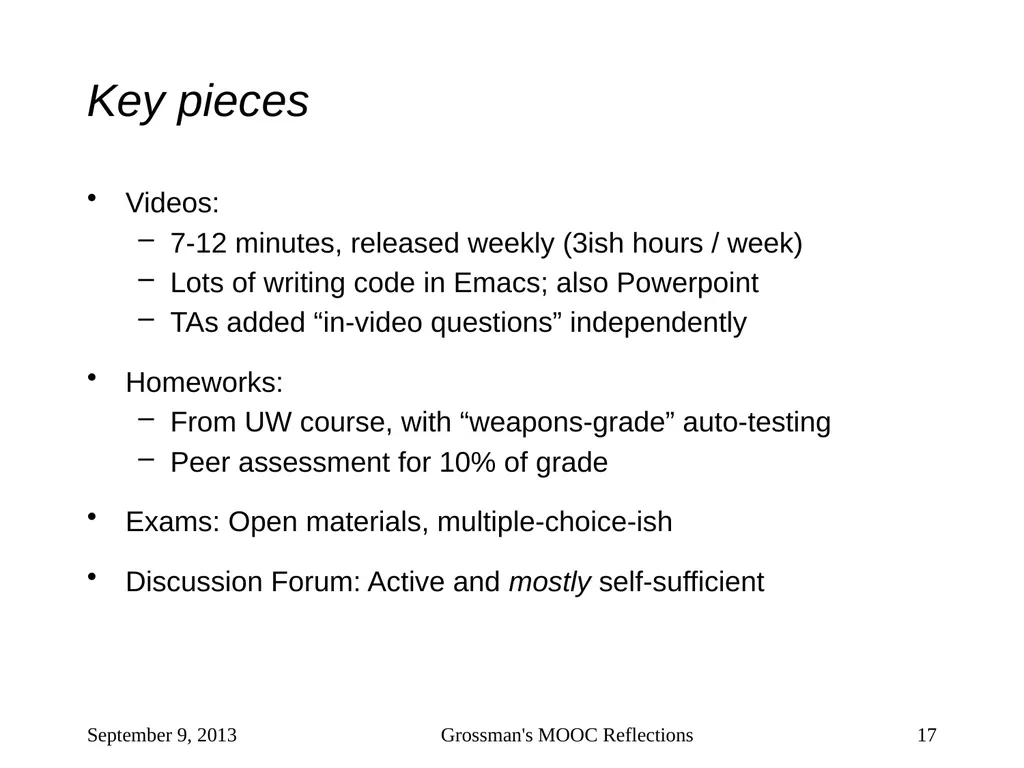
Key pieces Videos:
7-12 minutes, released weekly (3ish hours / week)
Lots of writing code in Emacs; also Powerpoint
TAs added “in-video questions” independently
Homeworks:
From UW course, with “weapons-grade” auto-testing
Peer assessment for 10% of grade
Exams: Open materials, multiple-choice-ish
Discussion Forum: Active and mostly self-sufficient September 9, 2013 17 Grossman's MOOC Reflections<br>
7-12 minutes, released weekly (3ish hours / week)
Lots of writing code in Emacs; also Powerpoint
TAs added “in-video questions” independently
Homeworks:
From UW course, with “weapons-grade” auto-testing
Peer assessment for 10% of grade
Exams: Open materials, multiple-choice-ish
Discussion Forum: Active and mostly self-sufficient September 9, 2013 17 Grossman's MOOC Reflections<br>
18
Video demo September 9, 2013 18 Grossman's MOOC Reflections<br>
19
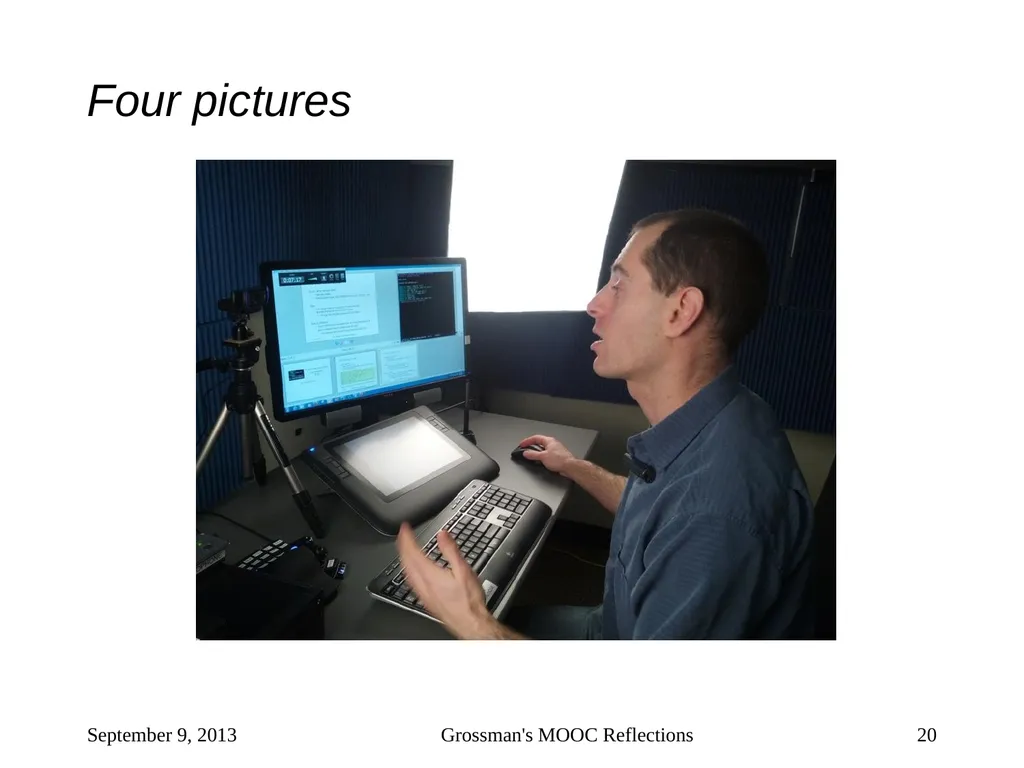
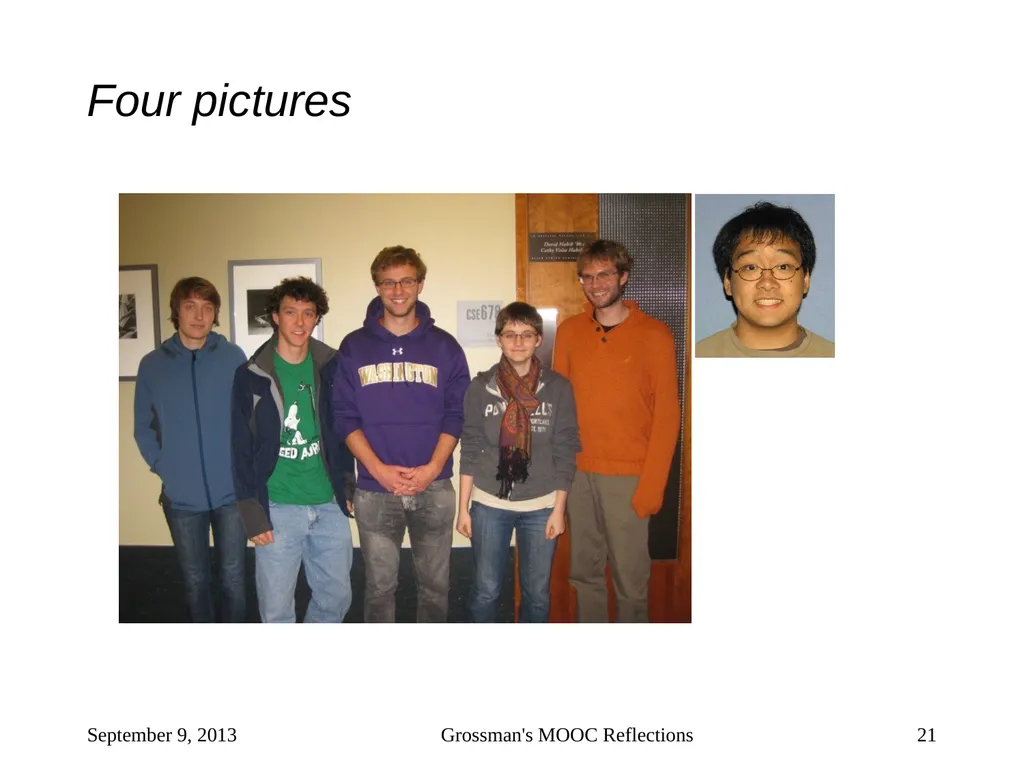
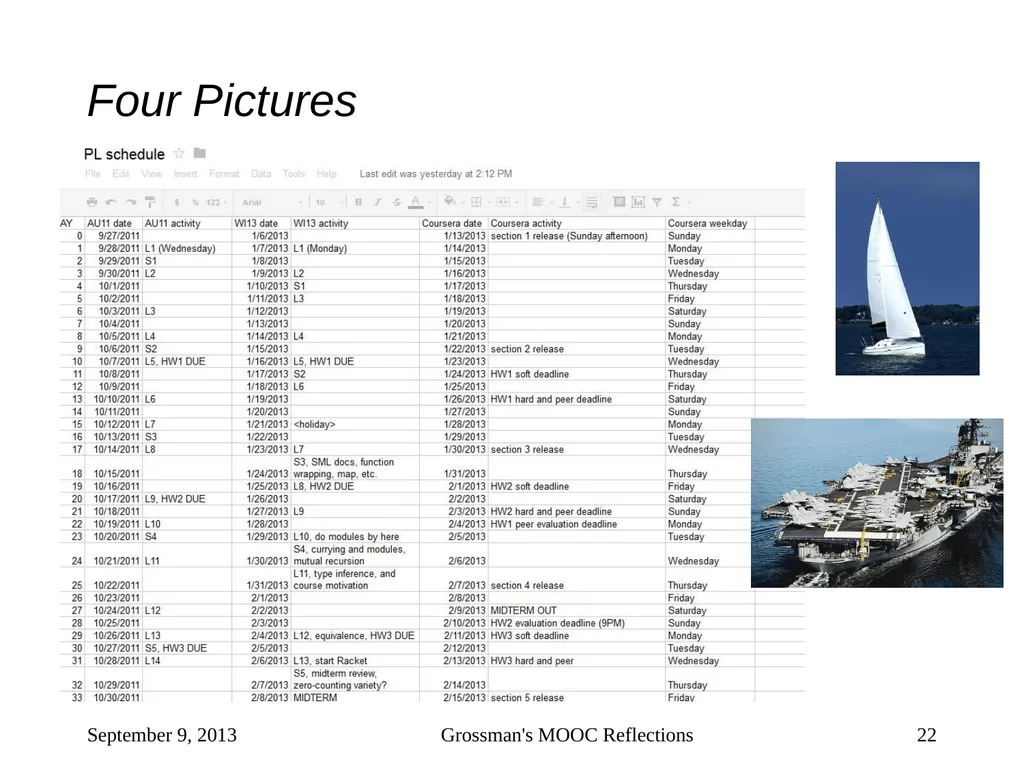
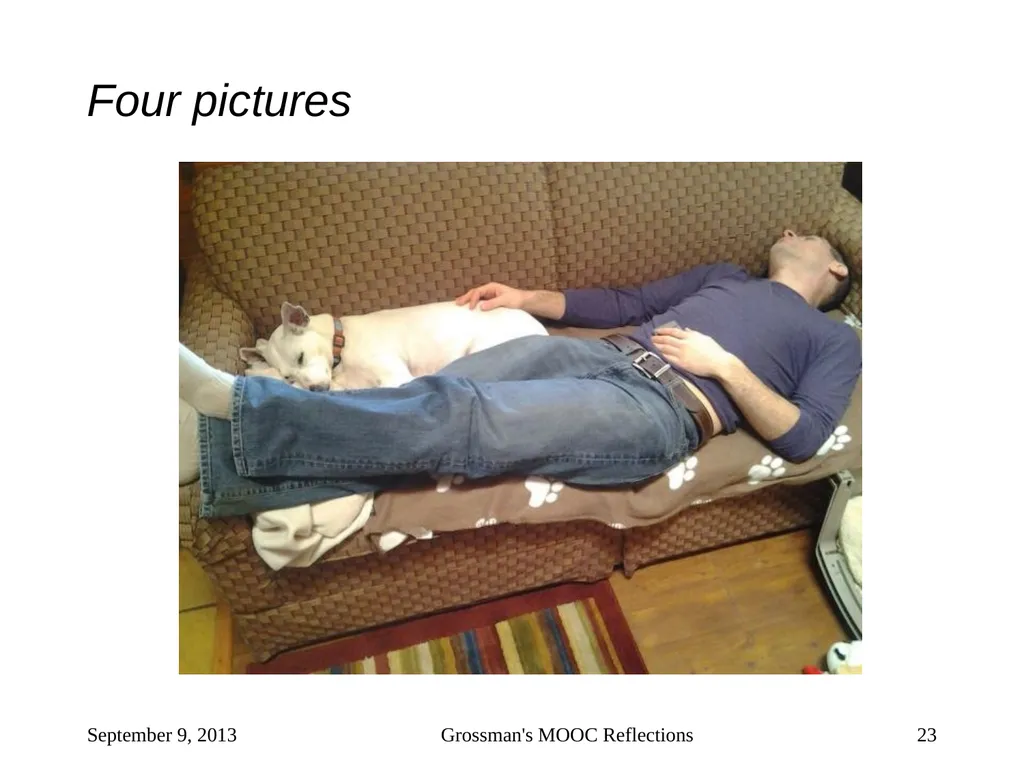
How did we do it? Compared to many institutions, we did it ad hoc
With lots of advance preparation
And lots of stress
A behind-the-scenes look in four pictures… September 9, 2013 19 Grossman's MOOC Reflections<br>
With lots of advance preparation
And lots of stress
A behind-the-scenes look in four pictures… September 9, 2013 19 Grossman's MOOC Reflections<br>
20
Four pictures September 9, 2013 20 Grossman's MOOC Reflections<br>
21
Four pictures September 9, 2013 21 Grossman's MOOC Reflections<br>
22
Four Pictures September 9, 2013 22 Grossman's MOOC Reflections<br>
23
Four pictures September 9, 2013 23 Grossman's MOOC Reflections<br>
24
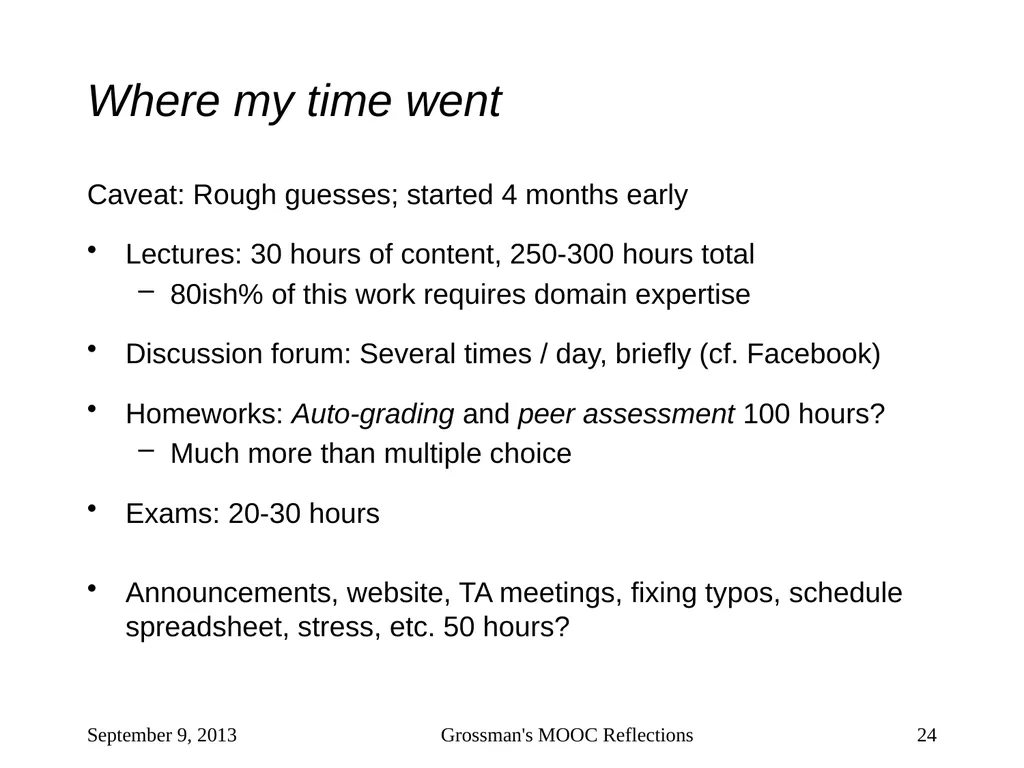
Where my time went Caveat: Rough guesses; started 4 months early
Lectures: 30 hours of content, 250-300 hours total
80ish% of this work requires domain expertise
Discussion forum: Several times / day, briefly (cf. Facebook)
Homeworks: Auto-grading and peer assessment 100 hours?
Much more than multiple choice
Exams: 20-30 hours
Announcements, website, TA meetings, fixing typos, schedule spreadsheet, stress, etc. 50 hours? September 9, 2013 24 Grossman's MOOC Reflections<br>
Lectures: 30 hours of content, 250-300 hours total
80ish% of this work requires domain expertise
Discussion forum: Several times / day, briefly (cf. Facebook)
Homeworks: Auto-grading and peer assessment 100 hours?
Much more than multiple choice
Exams: 20-30 hours
Announcements, website, TA meetings, fixing typos, schedule spreadsheet, stress, etc. 50 hours? September 9, 2013 24 Grossman's MOOC Reflections<br>
25
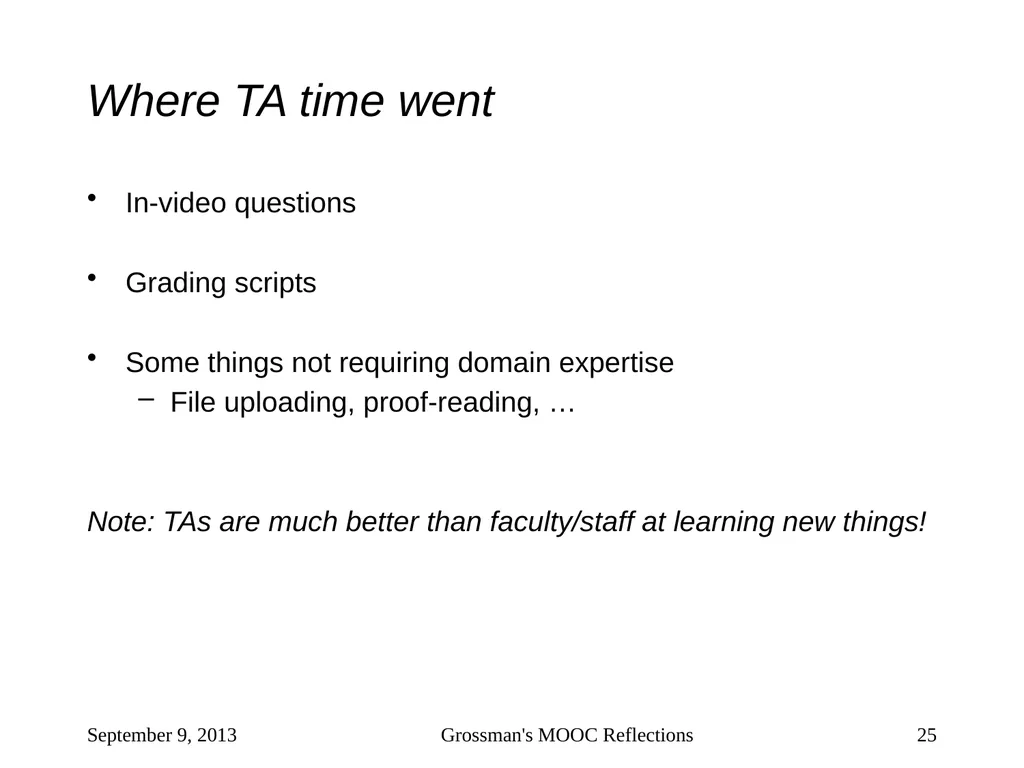
Where TA time went In-video questions
Grading scripts
Some things not requiring domain expertise
File uploading, proof-reading, …
Note: TAs are much better than faculty/staff at learning new things! September 9, 2013 25 Grossman's MOOC Reflections<br>
Grading scripts
Some things not requiring domain expertise
File uploading, proof-reading, …
Note: TAs are much better than faculty/staff at learning new things! September 9, 2013 25 Grossman's MOOC Reflections<br>
26
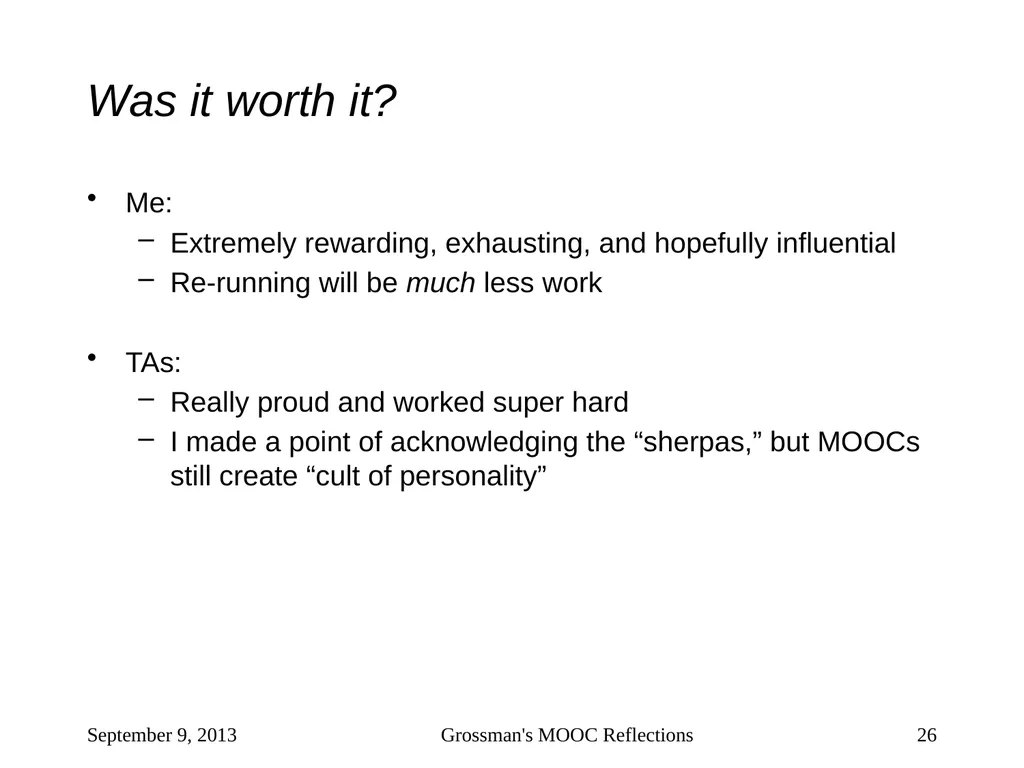
Was it worth it? Me:
Extremely rewarding, exhausting, and hopefully influential
Re-running will be much less work
TAs:
Really proud and worked super hard
I made a point of acknowledging the “sherpas,” but MOOCs still create “cult of personality” September 9, 2013 26 Grossman's MOOC Reflections<br>
Extremely rewarding, exhausting, and hopefully influential
Re-running will be much less work
TAs:
Really proud and worked super hard
I made a point of acknowledging the “sherpas,” but MOOCs still create “cult of personality” September 9, 2013 26 Grossman's MOOC Reflections<br>
27
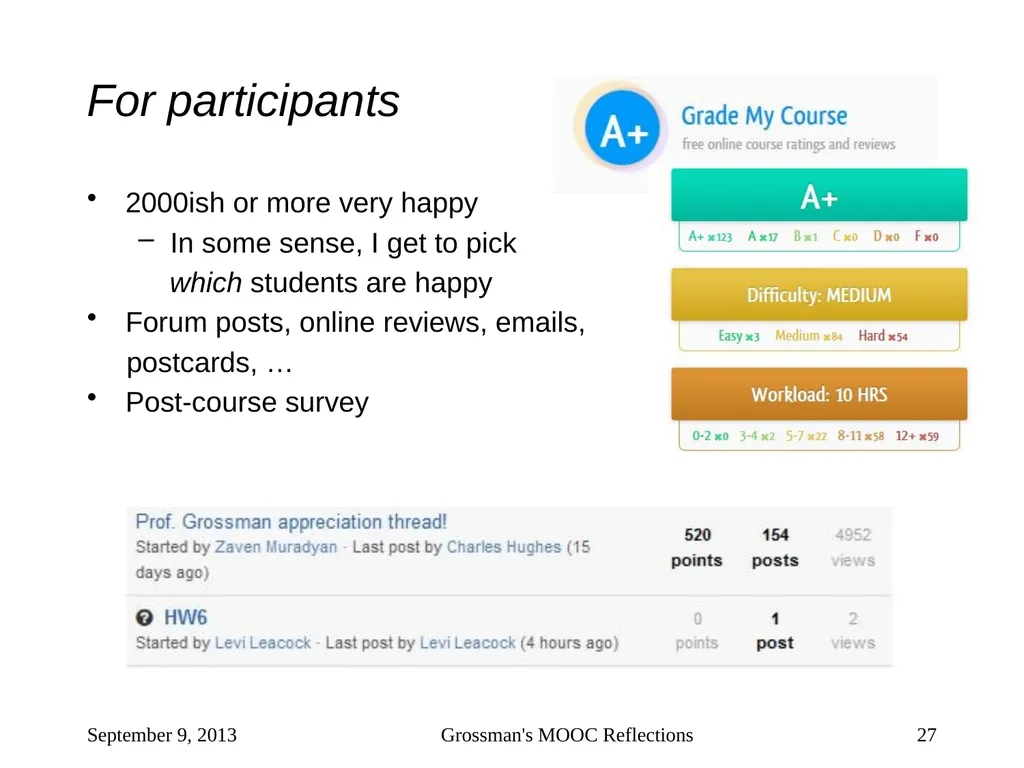
For participants 2000ish or more very happy
In some sense, I get to pick
which students are happy
Forum posts, online reviews, emails,
postcards, …
Post-course survey September 9, 2013 27 Grossman's MOOC Reflections<br>
In some sense, I get to pick
which students are happy
Forum posts, online reviews, emails,
postcards, …
Post-course survey September 9, 2013 27 Grossman's MOOC Reflections<br>
28
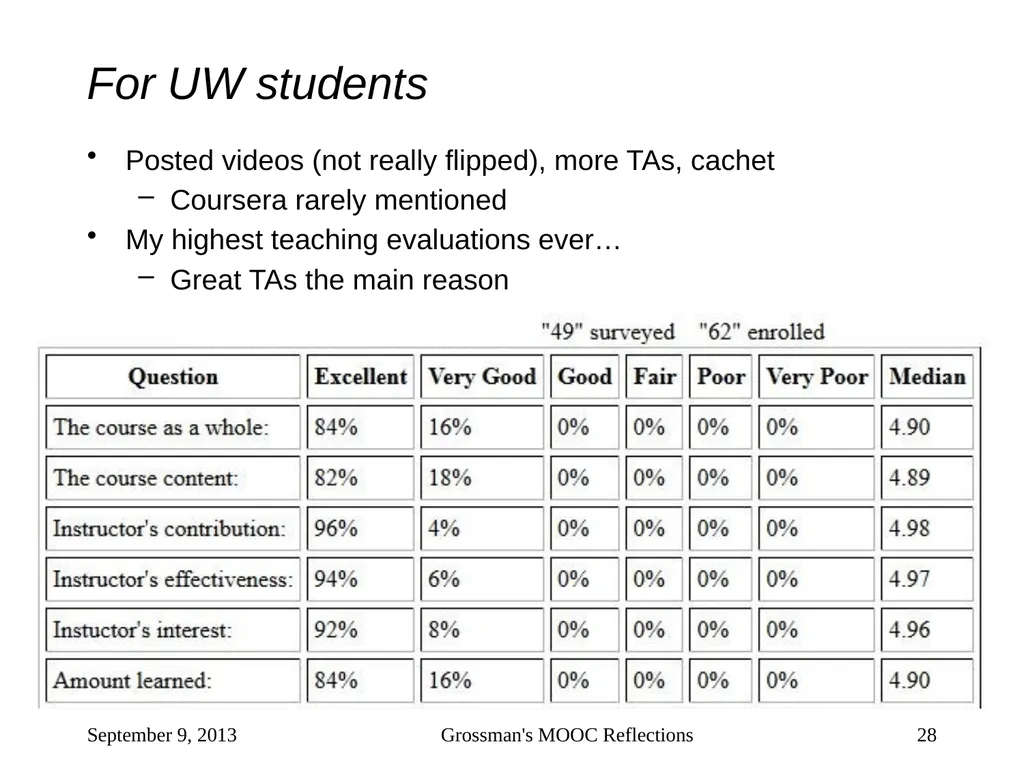
For UW students Posted videos (not really flipped), more TAs, cachet
Coursera rarely mentioned
My highest teaching evaluations ever…
Great TAs the main reason September 9, 2013 28 Grossman's MOOC Reflections<br>
Coursera rarely mentioned
My highest teaching evaluations ever…
Great TAs the main reason September 9, 2013 28 Grossman's MOOC Reflections<br>
29
Plan Background on MOOCs and my role
Why I did a MOOC
Plus a little on university perspective
Course tour
First presentation of some course data
Special focus for this audience: gender September 9, 2013 29 Grossman's MOOC Reflections<br>
Why I did a MOOC
Plus a little on university perspective
Course tour
First presentation of some course data
Special focus for this audience: gender September 9, 2013 29 Grossman's MOOC Reflections<br>
30
Preliminary data Recently completed first informal data analysis
Things I wanted to know
Caveats abound
Three parts:
Completion rates
Demographics: Country, Age, Background
Demographics: Gender September 9, 2013 30 Grossman's MOOC Reflections<br>
Things I wanted to know
Caveats abound
Three parts:
Completion rates
Demographics: Country, Age, Background
Demographics: Gender September 9, 2013 30 Grossman's MOOC Reflections<br>
31
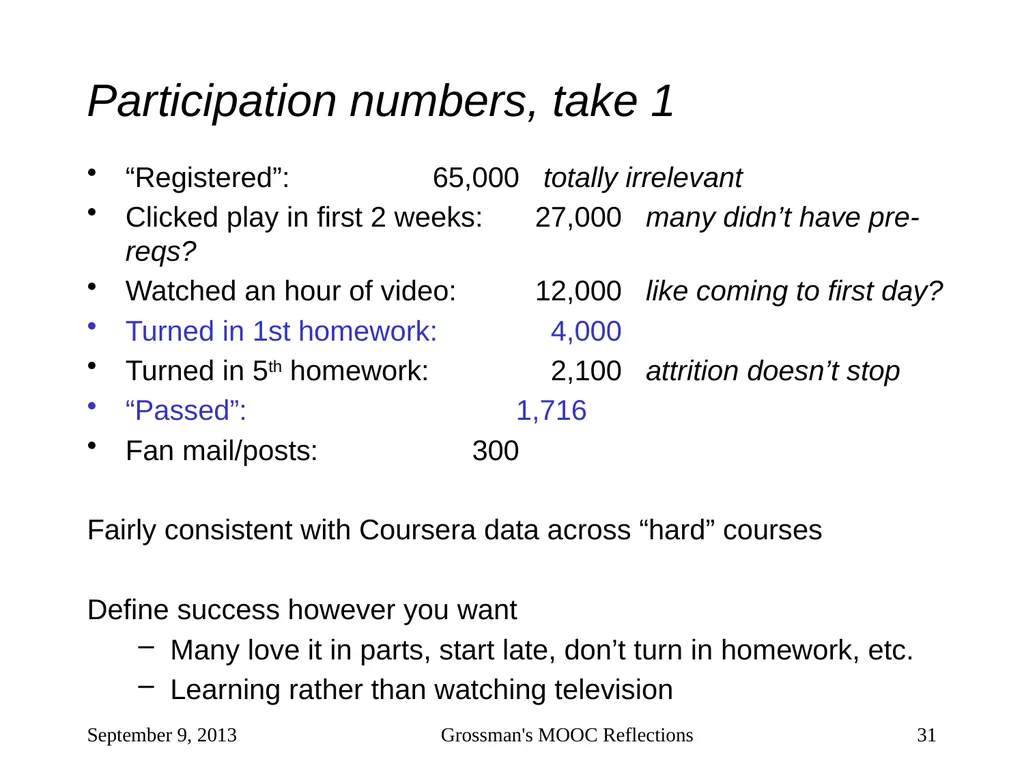
Participation numbers, take 1 “Registered”: 65,000 totally irrelevant
Clicked play in first 2 weeks: 27,000 many didn’t have pre-reqs?
Watched an hour of video: 12,000 like coming to first day?
Turned in 1st homework: 4,000
Turned in 5th homework: 2,100 attrition doesn’t stop
“Passed”: 1,716
Fan mail/posts: 300
Fairly consistent with Coursera data across “hard” courses
Define success however you want
Many love it in parts, start late, don’t turn in homework, etc.
Learning rather than watching television September 9, 2013 31 Grossman's MOOC Reflections<br>
Clicked play in first 2 weeks: 27,000 many didn’t have pre-reqs?
Watched an hour of video: 12,000 like coming to first day?
Turned in 1st homework: 4,000
Turned in 5th homework: 2,100 attrition doesn’t stop
“Passed”: 1,716
Fan mail/posts: 300
Fairly consistent with Coursera data across “hard” courses
Define success however you want
Many love it in parts, start late, don’t turn in homework, etc.
Learning rather than watching television September 9, 2013 31 Grossman's MOOC Reflections<br>
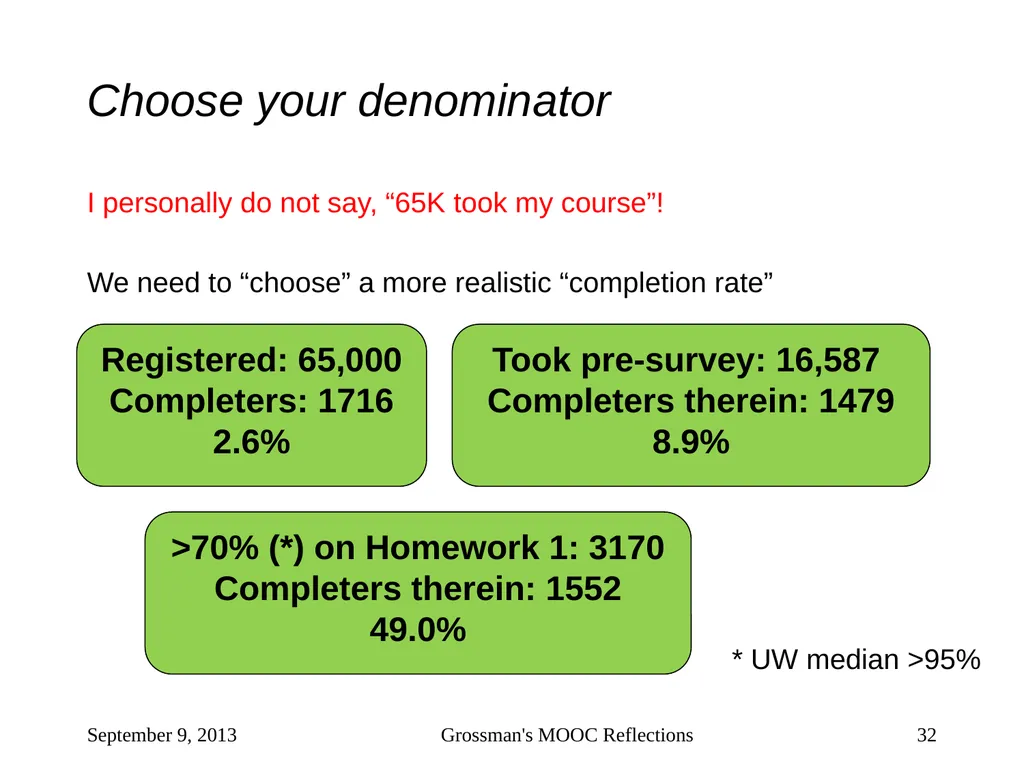
32
Choose your denominator I personally do not say, “65K took my course”!
We need to “choose” a more realistic “completion rate” September 9, 2013 32 Grossman's MOOC Reflections Registered: 65,000
Completers: 1716 2.6% Took pre-survey: 16,587
Completers therein: 1479
8.9% >70% (*) on Homework 1: 3170
Completers therein: 1552
49.0% * UW median >95%<br>
We need to “choose” a more realistic “completion rate” September 9, 2013 32 Grossman's MOOC Reflections Registered: 65,000
Completers: 1716 2.6% Took pre-survey: 16,587
Completers therein: 1479
8.9% >70% (*) on Homework 1: 3170
Completers therein: 1552
49.0% * UW median >95%<br>
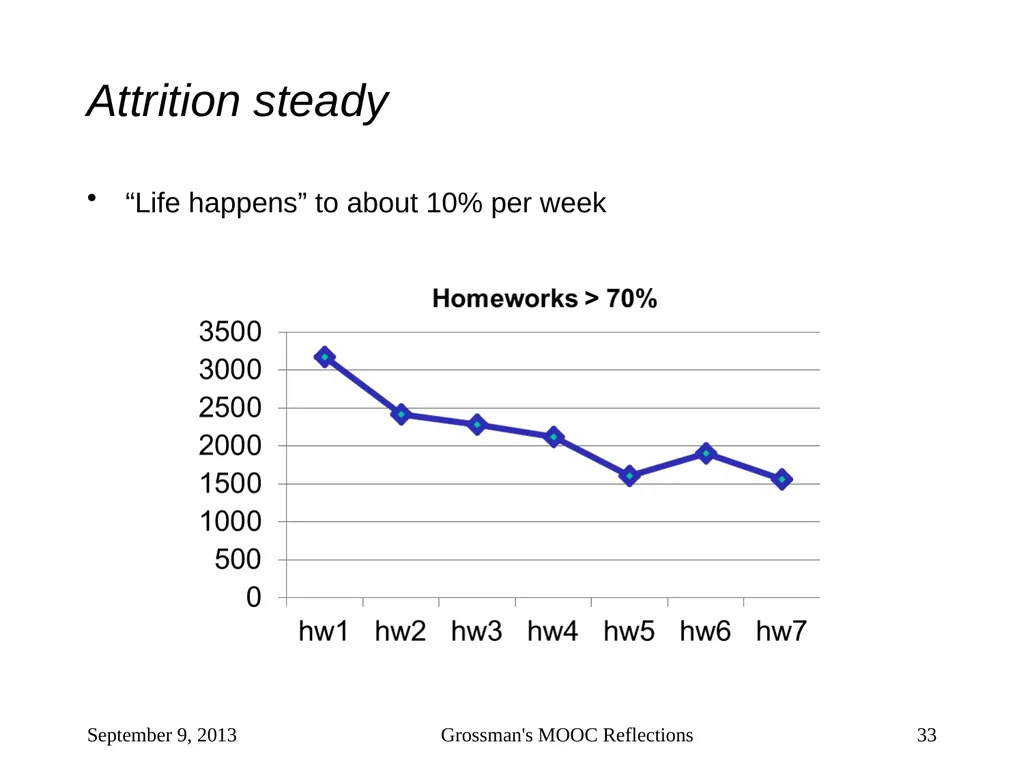
33
Attrition steady “Life happens” to about 10% per week September 9, 2013 33 Grossman's MOOC Reflections<br>
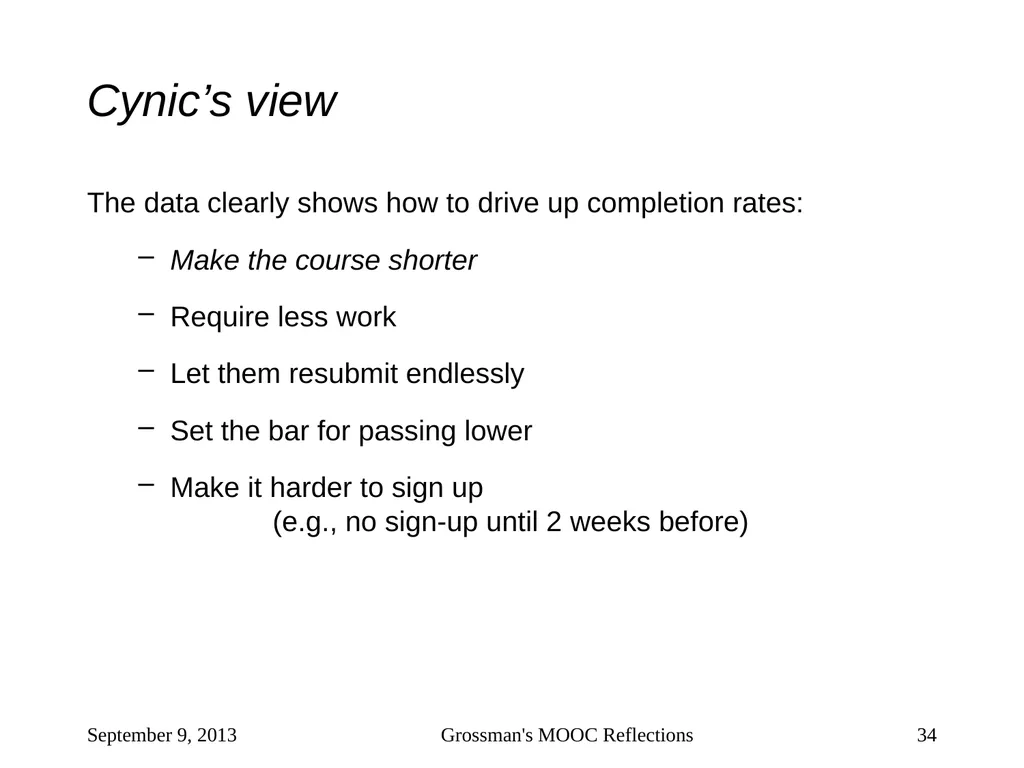
34
Cynic’s view The data clearly shows how to drive up completion rates:
Make the course shorter
Require less work
Let them resubmit endlessly
Set the bar for passing lower
Make it harder to sign up (e.g., no sign-up until 2 weeks before) September 9, 2013 34 Grossman's MOOC Reflections<br>
Make the course shorter
Require less work
Let them resubmit endlessly
Set the bar for passing lower
Make it harder to sign up (e.g., no sign-up until 2 weeks before) September 9, 2013 34 Grossman's MOOC Reflections<br>
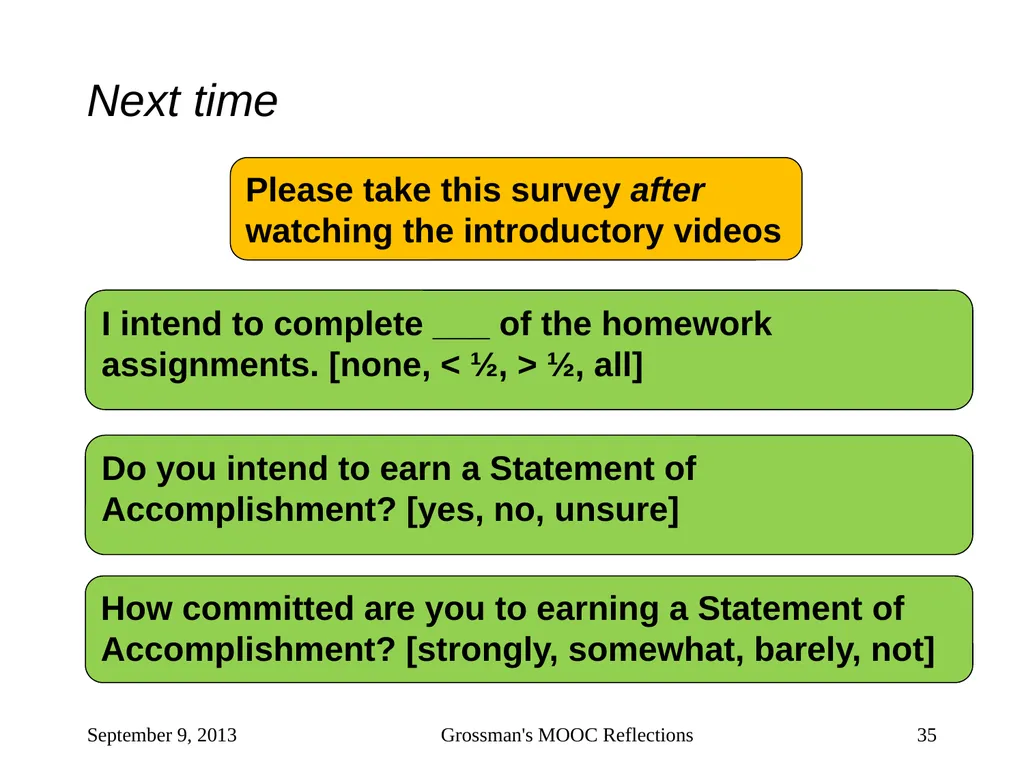
35
Next time September 9, 2013 35 Grossman's MOOC Reflections Please take this survey after watching the introductory videos I intend to complete ___ of the homework assignments. [none, < ½, > ½, all] How committed are you to earning a Statement of Accomplishment? [strongly, somewhat, barely, not] Do you intend to earn a Statement of Accomplishment? [yes, no, unsure]<br>
36
Preliminary data Recently completed first, informal data analysis
Questions I personally had
Caveats abound
Three parts:
Completion rates
Demographics: Country, Age, Background
Demographics: Gender September 9, 2013 36 Grossman's MOOC Reflections<br>
Questions I personally had
Caveats abound
Three parts:
Completion rates
Demographics: Country, Age, Background
Demographics: Gender September 9, 2013 36 Grossman's MOOC Reflections<br>
37
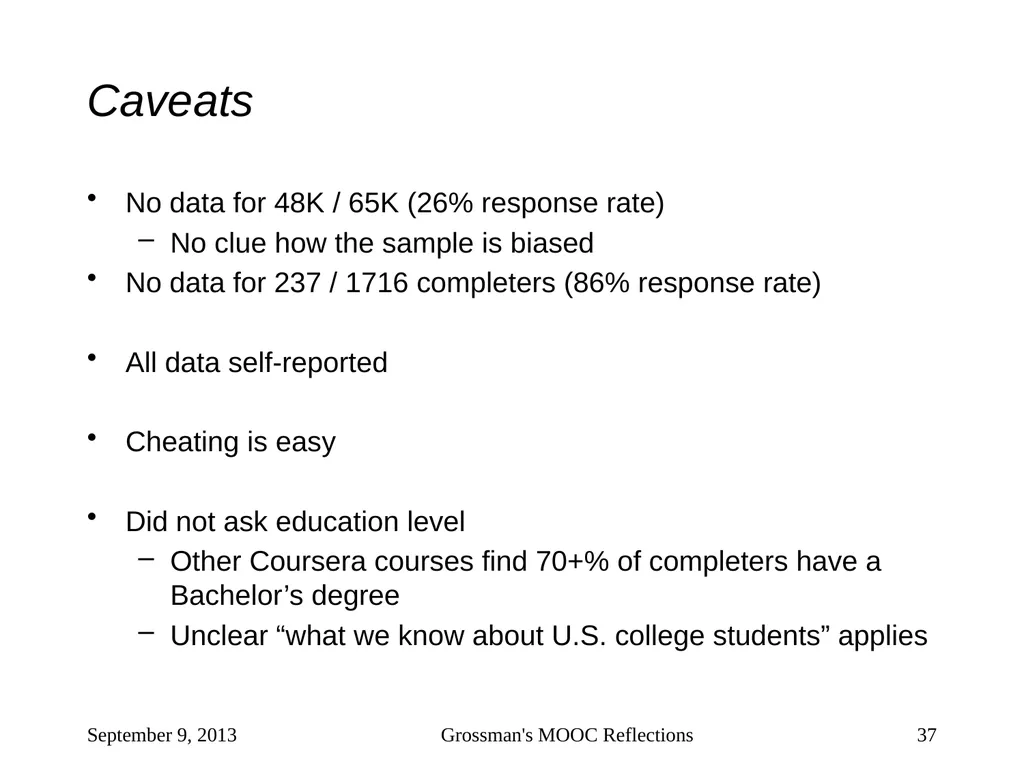
Caveats No data for 48K / 65K (26% response rate)
No clue how the sample is biased
No data for 237 / 1716 completers (86% response rate)
All data self-reported
Cheating is easy
Did not ask education level
Other Coursera courses find 70+% of completers have a Bachelor’s degree
Unclear “what we know about U.S. college students” applies September 9, 2013 37 Grossman's MOOC Reflections<br>
No clue how the sample is biased
No data for 237 / 1716 completers (86% response rate)
All data self-reported
Cheating is easy
Did not ask education level
Other Coursera courses find 70+% of completers have a Bachelor’s degree
Unclear “what we know about U.S. college students” applies September 9, 2013 37 Grossman's MOOC Reflections<br>
38
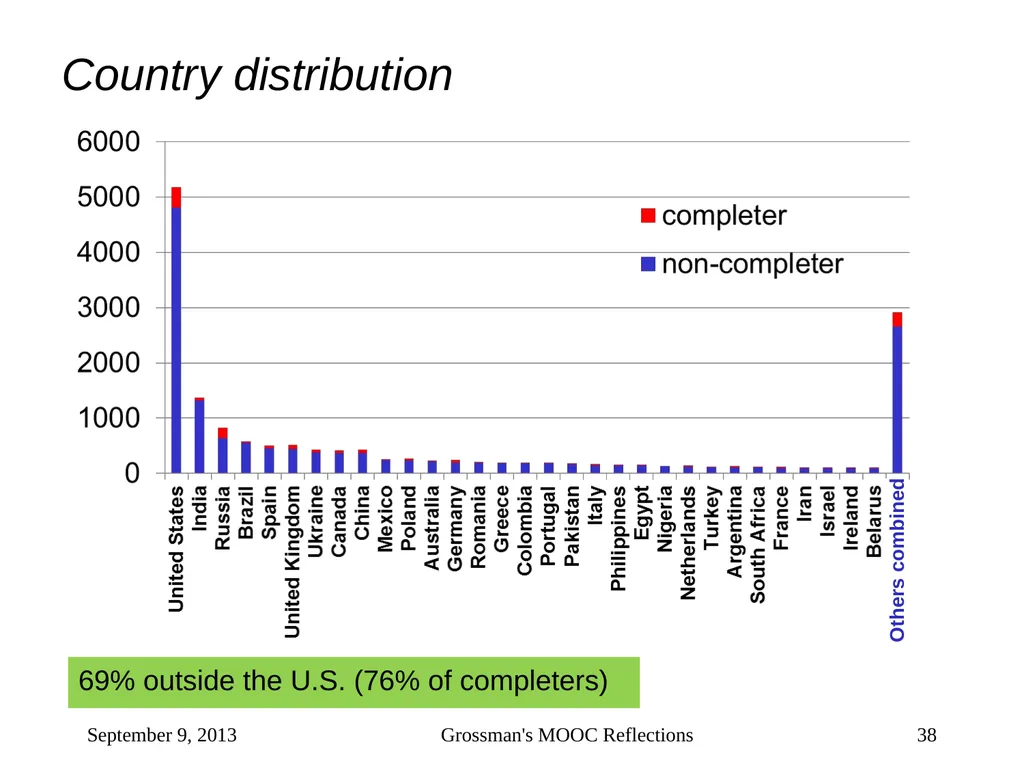
Country distribution 69% outside the U.S. (76% of completers) September 9, 2013 38 Grossman's MOOC Reflections<br>
39
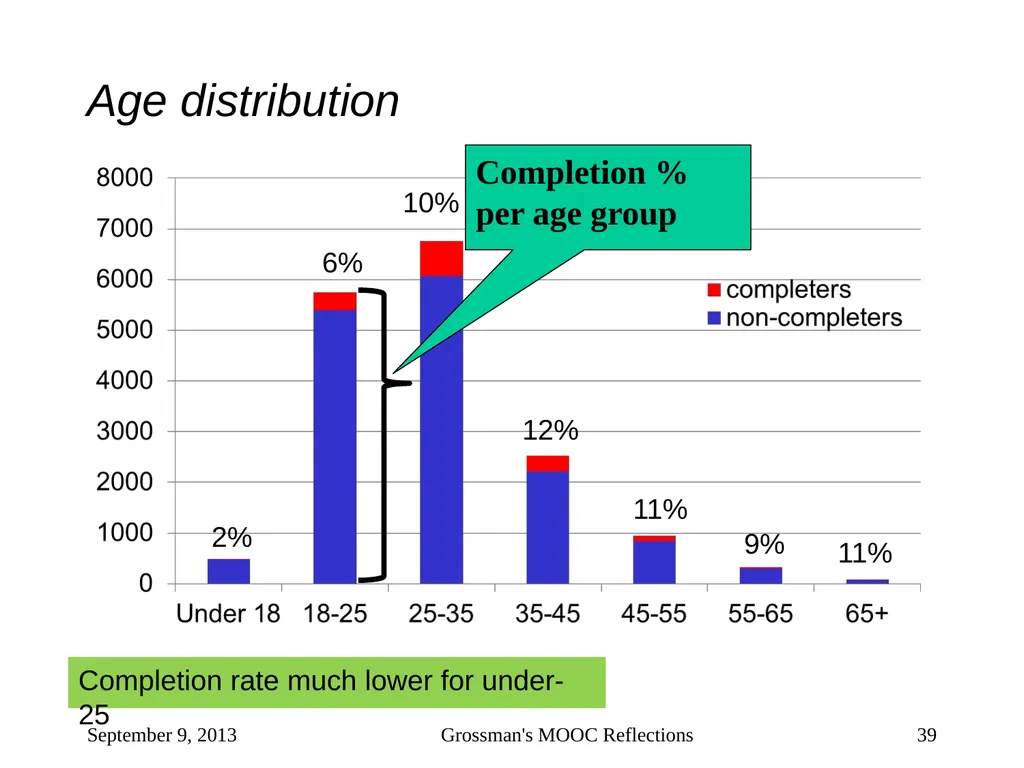
Age distribution September 9, 2013 39 Grossman's MOOC Reflections 10% 12% 11% 9% 11% 6% 2% Completion rate much lower for under-25 Completion % per age group<br>
40
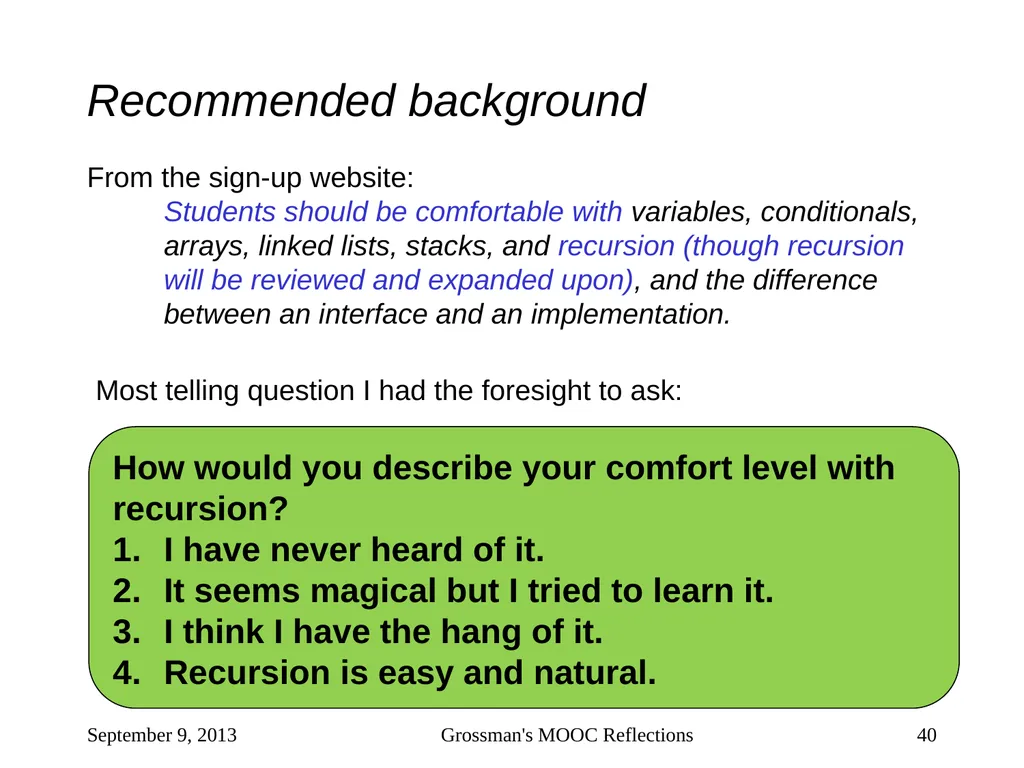
Recommended background Most telling question I had the foresight to ask: September 9, 2013 40 Grossman's MOOC Reflections How would you describe your comfort level with recursion?
I have never heard of it.
It seems magical but I tried to learn it.
I think I have the hang of it.
Recursion is easy and natural. From the sign-up website: Students should be comfortable with variables, conditionals, arrays, linked lists, stacks, and recursion (though recursion will be reviewed and expanded upon), and the difference between an interface and an implementation.<br>
I have never heard of it.
It seems magical but I tried to learn it.
I think I have the hang of it.
Recursion is easy and natural. From the sign-up website: Students should be comfortable with variables, conditionals, arrays, linked lists, stacks, and recursion (though recursion will be reviewed and expanded upon), and the difference between an interface and an implementation.<br>
41
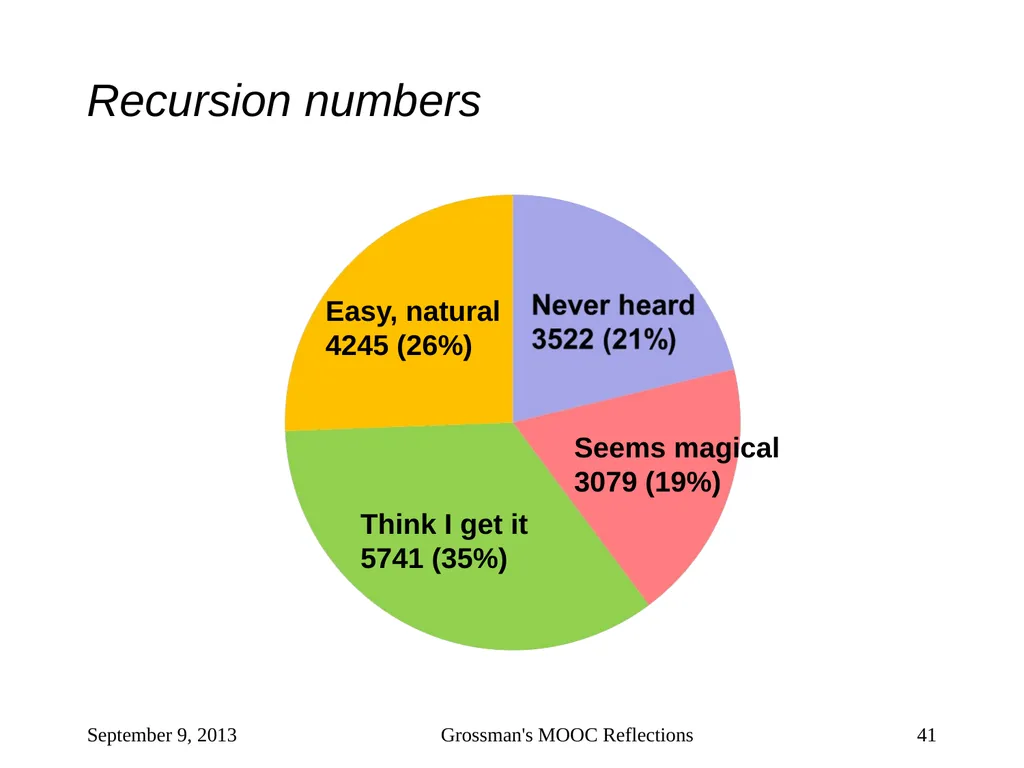
Recursion numbers September 9, 2013 41 Grossman's MOOC Reflections Seems magical
3079 (19%) Think I get it
5741 (35%) Easy, natural
4245 (26%)<br>
3079 (19%) Think I get it
5741 (35%) Easy, natural
4245 (26%)<br>
42
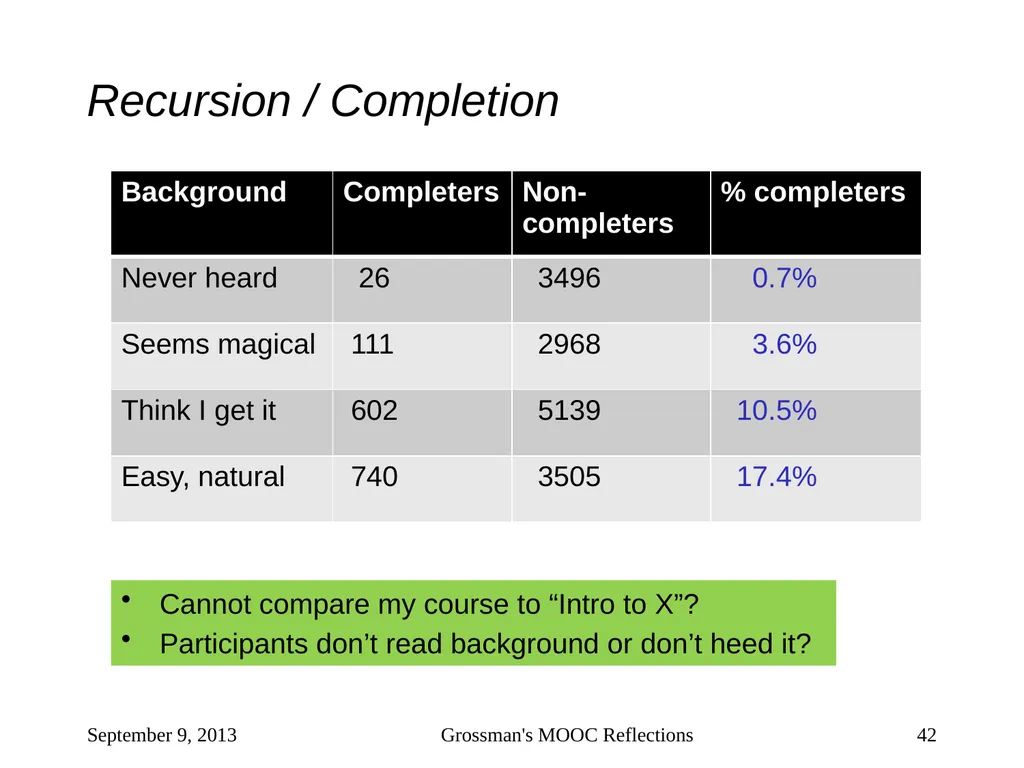
Recursion / Completion September 9, 2013 42 Grossman's MOOC Reflections Cannot compare my course to “Intro to X”?
Participants don’t read background or don’t heed it?<br>
Participants don’t read background or don’t heed it?<br>
43
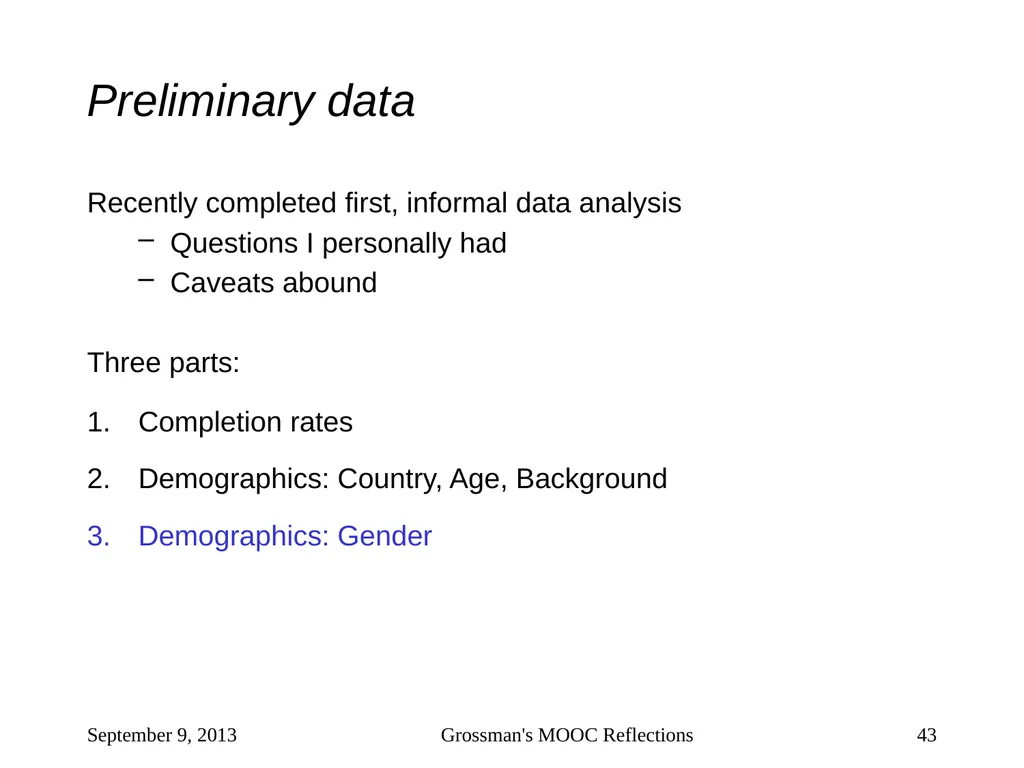
Preliminary data Recently completed first, informal data analysis
Questions I personally had
Caveats abound
Three parts:
Completion rates
Demographics: Country, Age, Background
Demographics: Gender September 9, 2013 43 Grossman's MOOC Reflections<br>
Questions I personally had
Caveats abound
Three parts:
Completion rates
Demographics: Country, Age, Background
Demographics: Gender September 9, 2013 43 Grossman's MOOC Reflections<br>
44
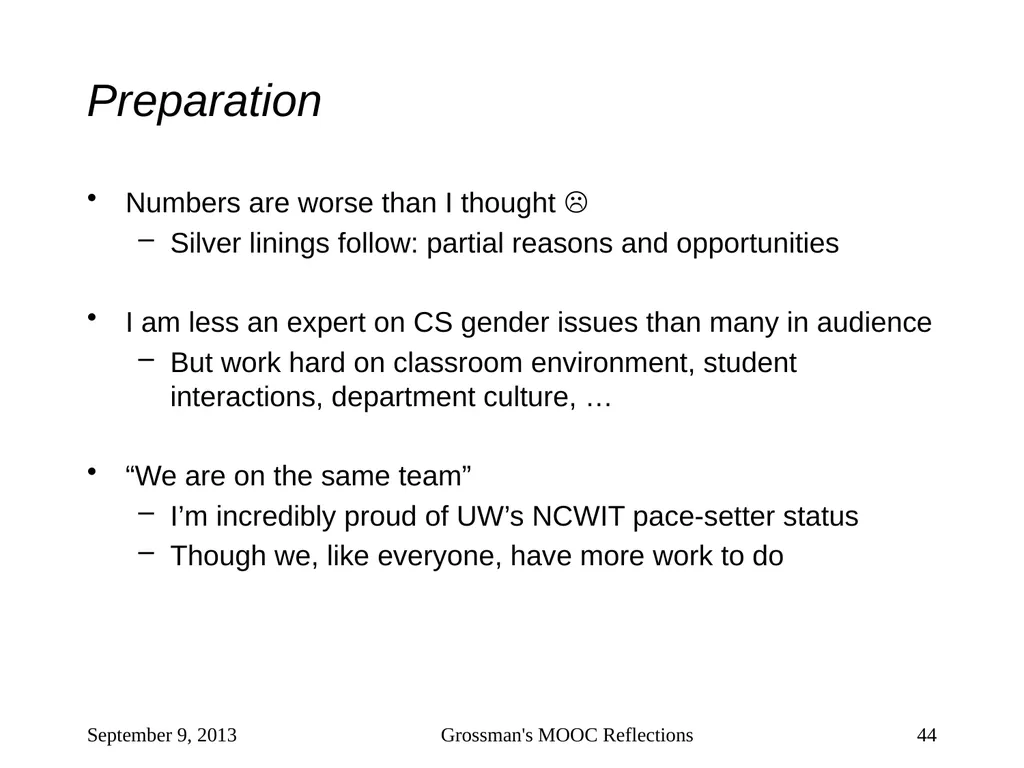
Preparation Numbers are worse than I thought
Silver linings follow: partial reasons and opportunities
I am less an expert on CS gender issues than many in audience
But work hard on classroom environment, student interactions, department culture, …
“We are on the same team”
I’m incredibly proud of UW’s NCWIT pace-setter status
Though we, like everyone, have more work to do September 9, 2013 44 Grossman's MOOC Reflections<br>
Silver linings follow: partial reasons and opportunities
I am less an expert on CS gender issues than many in audience
But work hard on classroom environment, student interactions, department culture, …
“We are on the same team”
I’m incredibly proud of UW’s NCWIT pace-setter status
Though we, like everyone, have more work to do September 9, 2013 44 Grossman's MOOC Reflections<br>
45
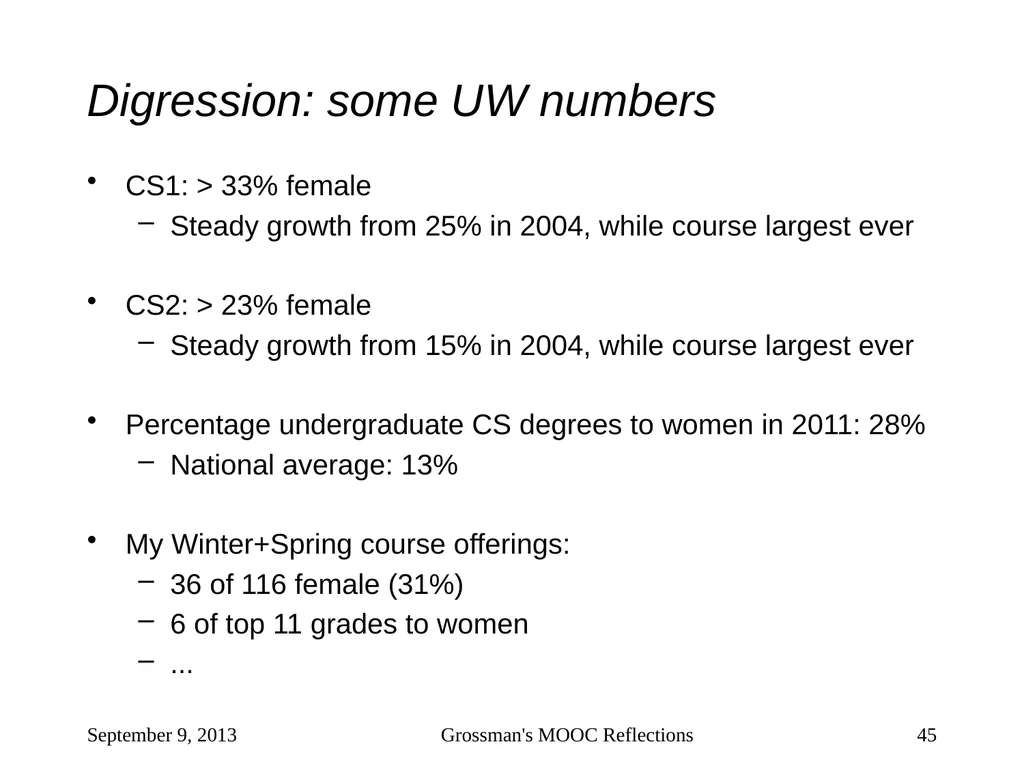
Digression: some UW numbers CS1: > 33% female
Steady growth from 25% in 2004, while course largest ever
CS2: > 23% female
Steady growth from 15% in 2004, while course largest ever
Percentage undergraduate CS degrees to women in 2011: 28%
National average: 13%
My Winter+Spring course offerings:
36 of 116 female (31%)
6 of top 11 grades to women
... September 9, 2013 45 Grossman's MOOC Reflections<br>
Steady growth from 25% in 2004, while course largest ever
CS2: > 23% female
Steady growth from 15% in 2004, while course largest ever
Percentage undergraduate CS degrees to women in 2011: 28%
National average: 13%
My Winter+Spring course offerings:
36 of 116 female (31%)
6 of top 11 grades to women
... September 9, 2013 45 Grossman's MOOC Reflections<br>
46
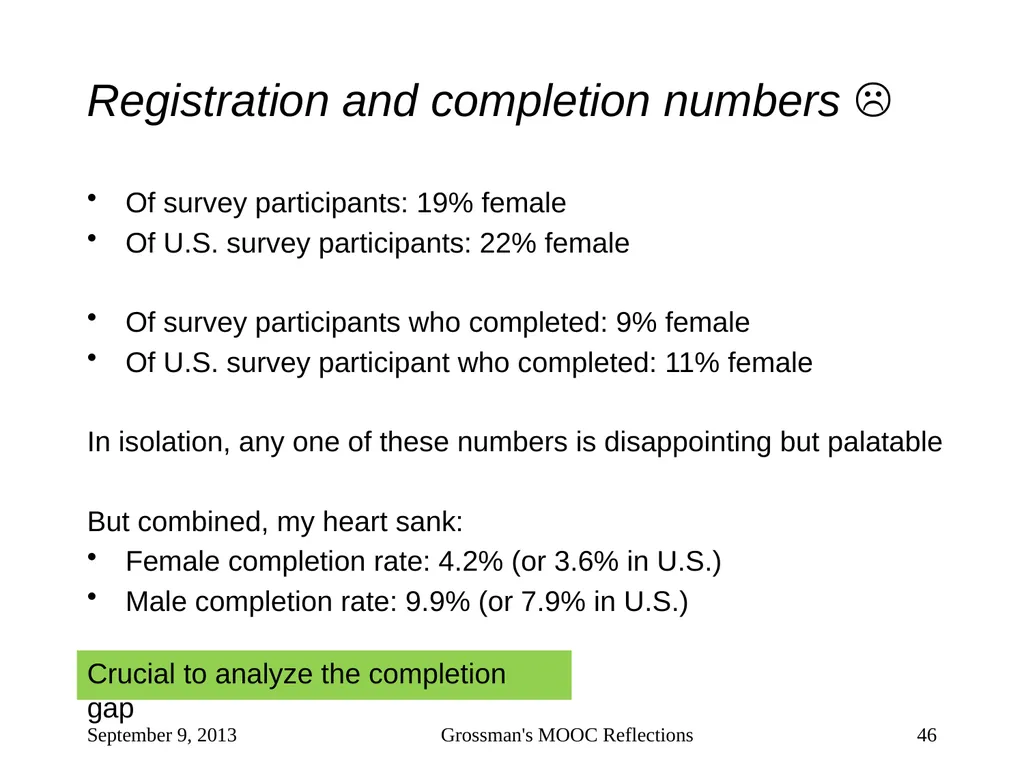
Registration and completion numbers Of survey participants: 19% female
Of U.S. survey participants: 22% female
Of survey participants who completed: 9% female
Of U.S. survey participant who completed: 11% female
In isolation, any one of these numbers is disappointing but palatable
But combined, my heart sank:
Female completion rate: 4.2% (or 3.6% in U.S.)
Male completion rate: 9.9% (or 7.9% in U.S.) September 9, 2013 46 Grossman's MOOC Reflections Crucial to analyze the completion gap<br>
Of U.S. survey participants: 22% female
Of survey participants who completed: 9% female
Of U.S. survey participant who completed: 11% female
In isolation, any one of these numbers is disappointing but palatable
But combined, my heart sank:
Female completion rate: 4.2% (or 3.6% in U.S.)
Male completion rate: 9.9% (or 7.9% in U.S.) September 9, 2013 46 Grossman's MOOC Reflections Crucial to analyze the completion gap<br>
47
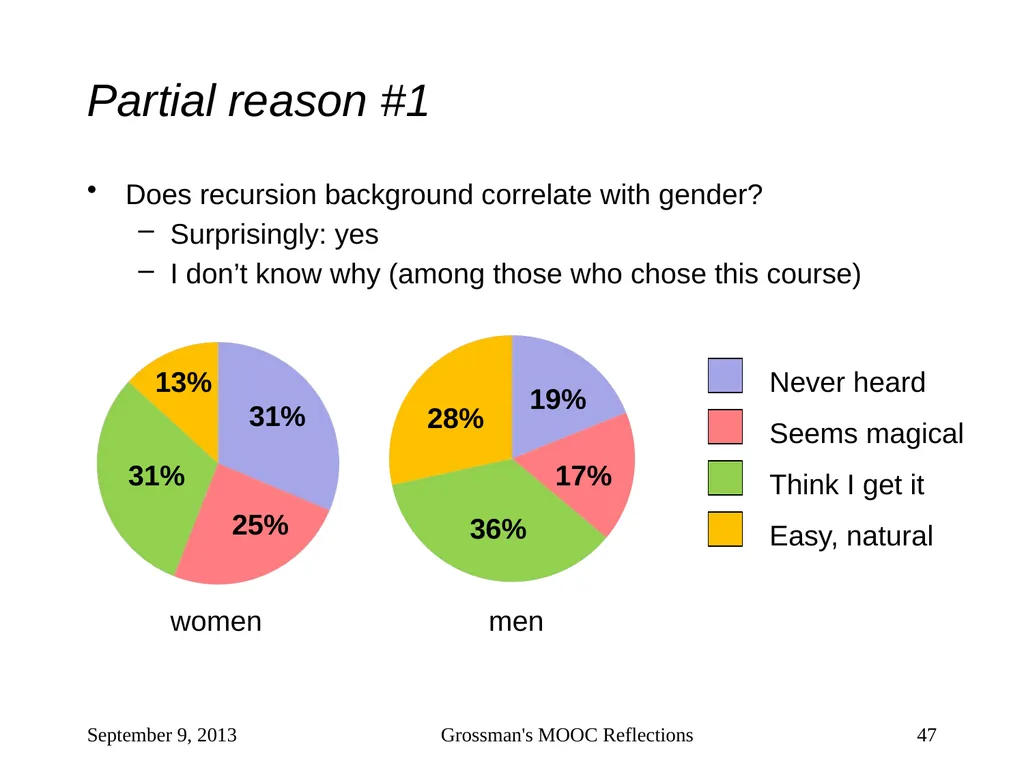
Partial reason #1 Does recursion background correlate with gender?
Surprisingly: yes
I don’t know why (among those who chose this course) September 9, 2013 47 Grossman's MOOC Reflections Never heard
Seems magical
Think I get it
Easy, natural<br>
Surprisingly: yes
I don’t know why (among those who chose this course) September 9, 2013 47 Grossman's MOOC Reflections Never heard
Seems magical
Think I get it
Easy, natural<br>
48
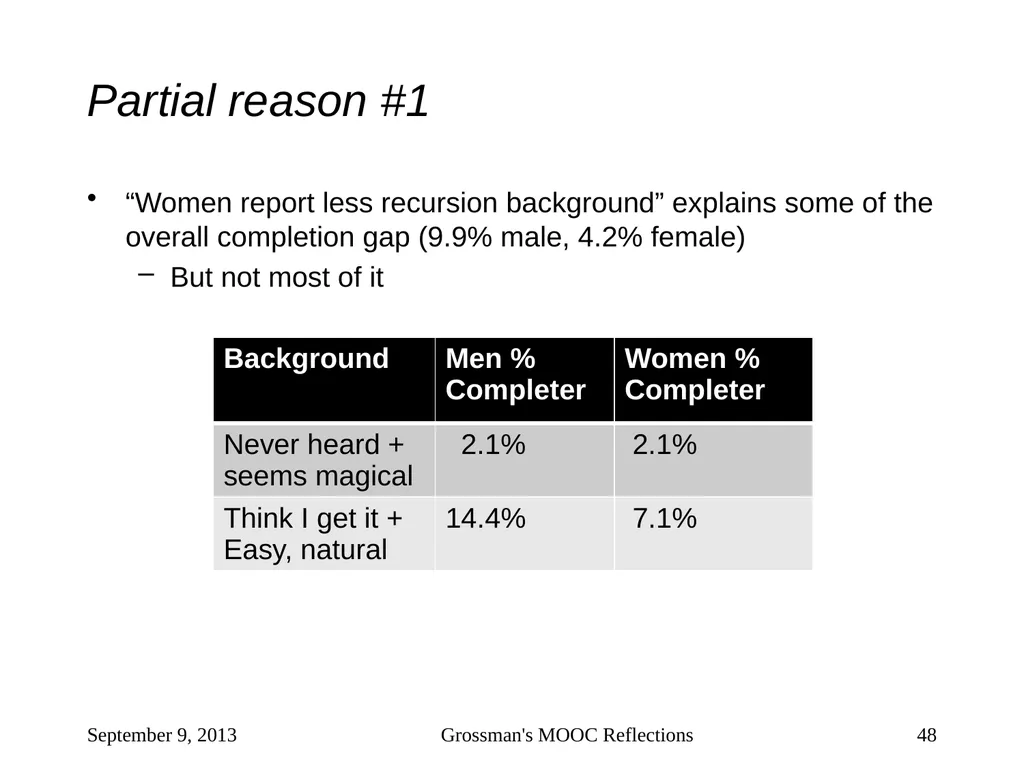
Partial reason #1 “Women report less recursion background” explains some of the overall completion gap (9.9% male, 4.2% female)
But not most of it September 9, 2013 48 Grossman's MOOC Reflections<br>
But not most of it September 9, 2013 48 Grossman's MOOC Reflections<br>
49
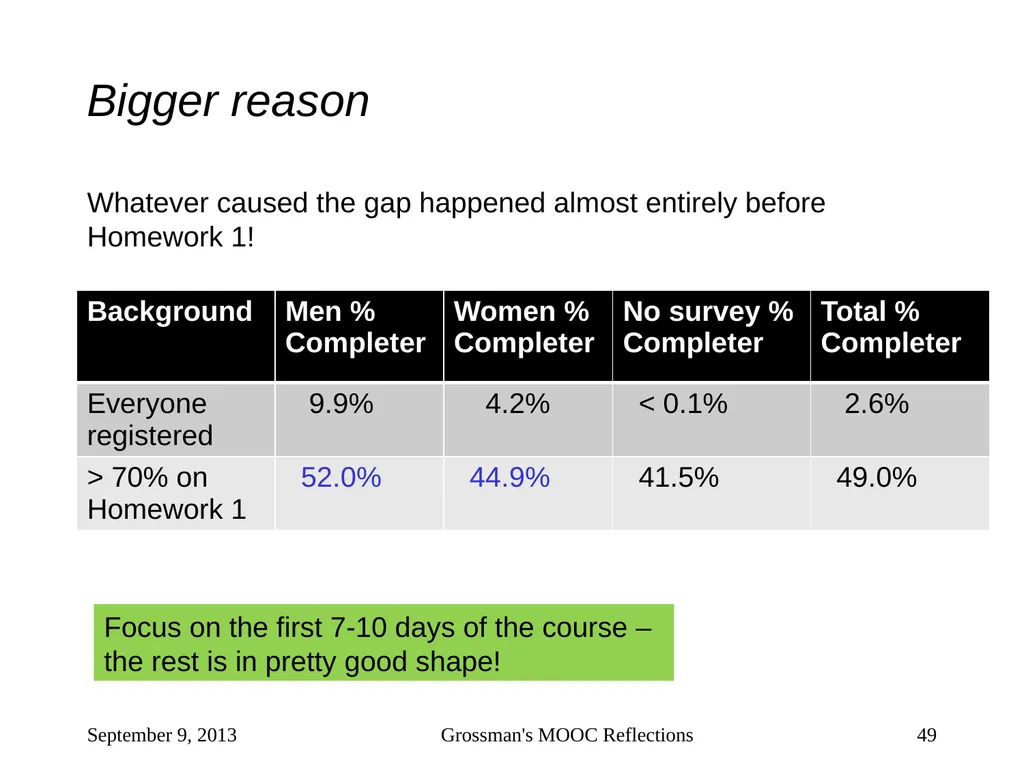
Bigger reason Whatever caused the gap happened almost entirely before Homework 1! September 9, 2013 49 Grossman's MOOC Reflections Focus on the first 7-10 days of the course – the rest is in pretty good shape!<br>
50
Opportunities Data was easy to collect for [almost] free
Much more data we haven’t even looked at
MOOCs could provide distributed cohorts, mentors, on-ramps, your-idea-here, …
MOOCs are not entrenched in legacy decisions
MOOCs are an attractive target (more impact per course)
MOOCs are great for re-training
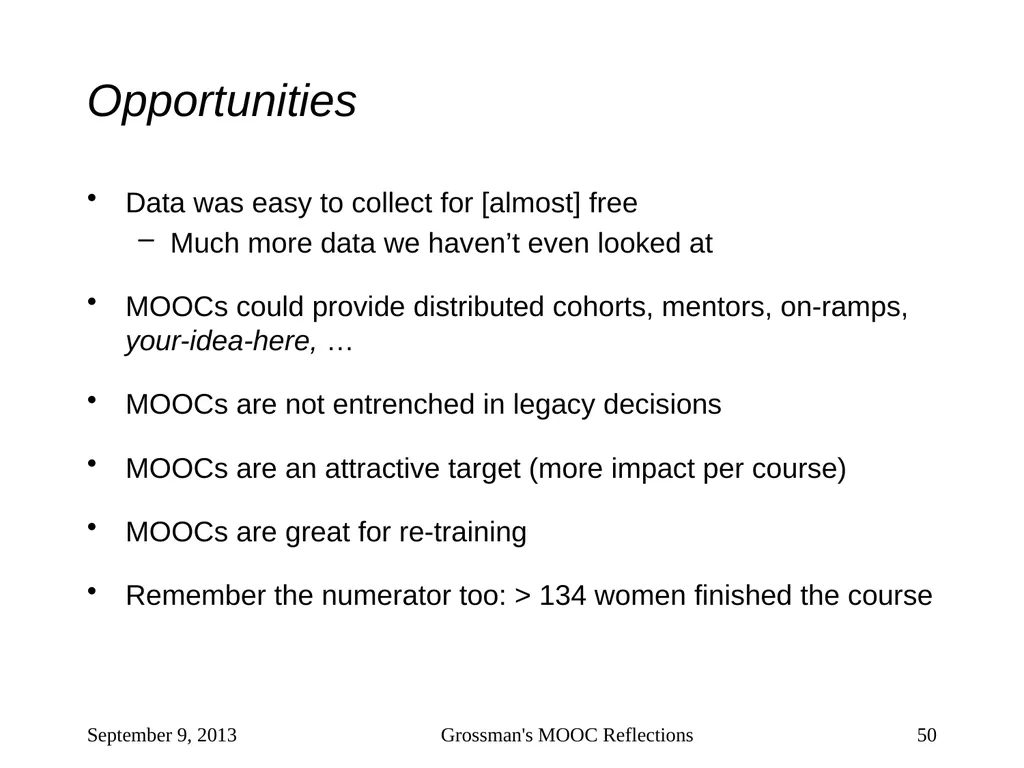
Remember the numerator too: > 134 women finished the course September 9, 2013 50 Grossman's MOOC Reflections<br>
Much more data we haven’t even looked at
MOOCs could provide distributed cohorts, mentors, on-ramps, your-idea-here, …
MOOCs are not entrenched in legacy decisions
MOOCs are an attractive target (more impact per course)
MOOCs are great for re-training
Remember the numerator too: > 134 women finished the course September 9, 2013 50 Grossman's MOOC Reflections<br>
51
Conclusions
Personal opinion: MOOCs are more fantastic than terrible… September 9, 2013 51 Grossman's MOOC Reflections<br>
Personal opinion: MOOCs are more fantastic than terrible… September 9, 2013 51 Grossman's MOOC Reflections<br>
52
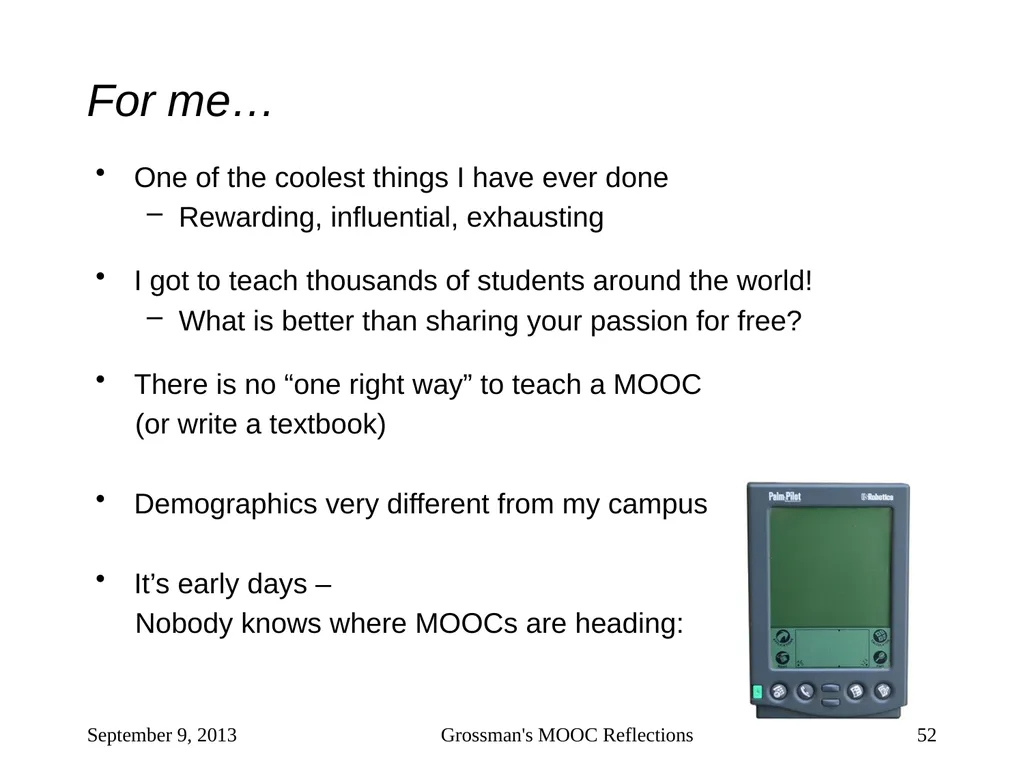
For me… One of the coolest things I have ever done
Rewarding, influential, exhausting
I got to teach thousands of students around the world!
What is better than sharing your passion for free?
There is no “one right way” to teach a MOOC
(or write a textbook)
Demographics very different from my campus
It’s early days –
Nobody knows where MOOCs are heading: September 9, 2013 52 Grossman's MOOC Reflections<br>
Rewarding, influential, exhausting
I got to teach thousands of students around the world!
What is better than sharing your passion for free?
There is no “one right way” to teach a MOOC
(or write a textbook)
Demographics very different from my campus
It’s early days –
Nobody knows where MOOCs are heading: September 9, 2013 52 Grossman's MOOC Reflections<br>
53
Thanks http://homes.cs.washington.edu/~djg/
https://www.coursera.org/course/proglang
[next offering begins early October] September 9, 2013 53 Grossman's MOOC Reflections<br>
https://www.coursera.org/course/proglang
[next offering begins early October] September 9, 2013 53 Grossman's MOOC Reflections<br>