"Mathematics N5 www.futuremanagers.com Module 1:" is the property of its rightful owner. Permission is granted to
download and print the materials on this website for personal, non-commercial use only, and to display it
on your personal computer provided you do not modify the materials and that you retain all copyright
notices contained in the materials. By downloading content from our website, you accept the terms of this
agreement.
Presentation Transcript
01
Mathematics
N5<br>
02
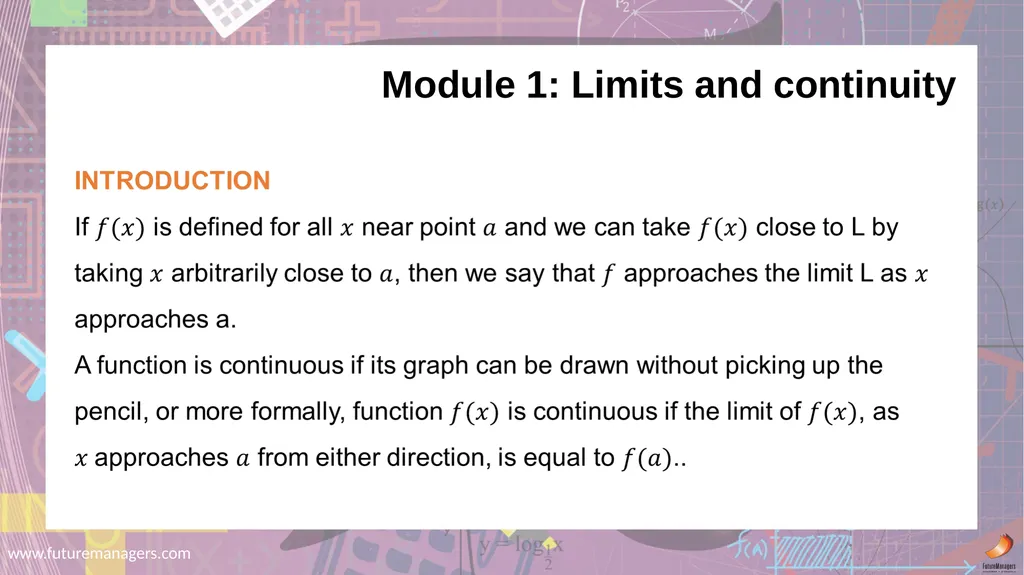
www.futuremanagers.com Module 1: Limits and continuity<br>
03
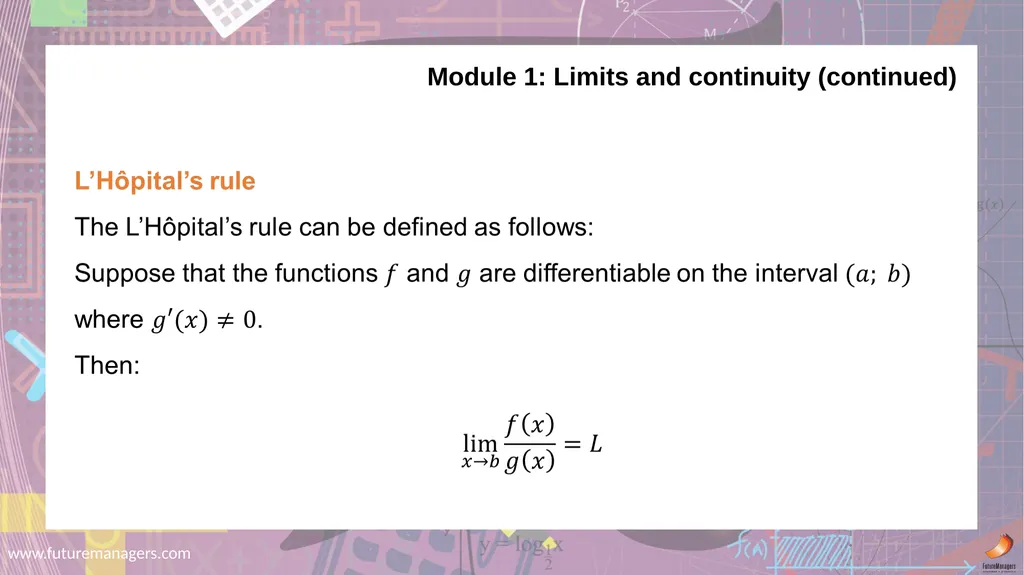
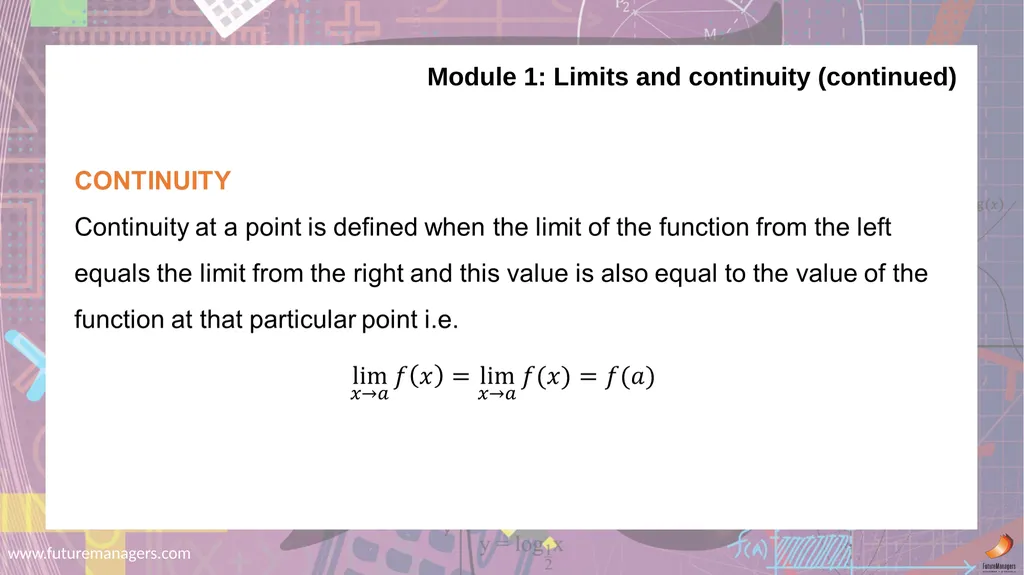
www.futuremanagers.com Module 1: Limits and continuity (continued)<br>
04
www.futuremanagers.com Module 1: Limits and continuity (continued)<br>
05
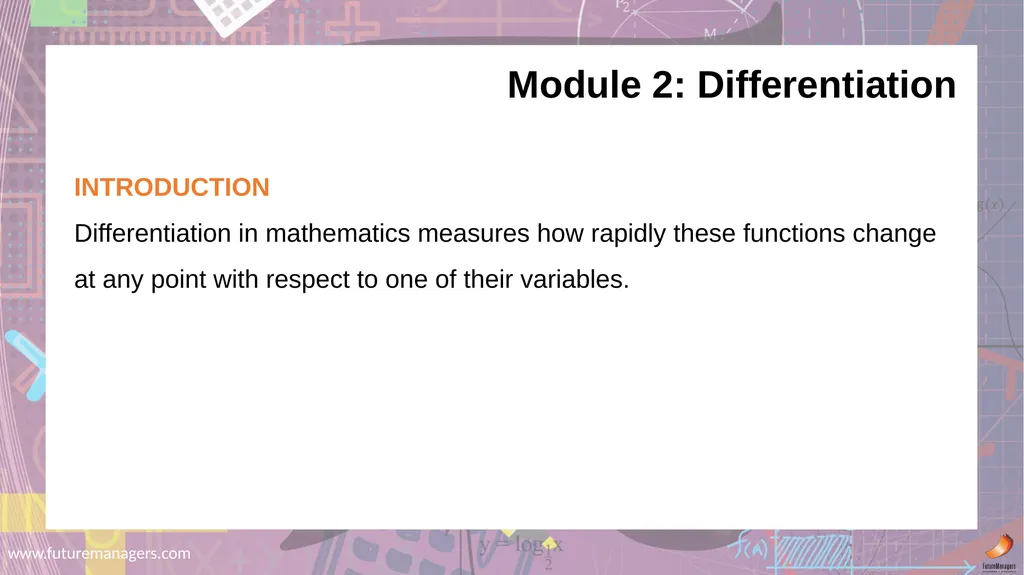
www.futuremanagers.com INTRODUCTION
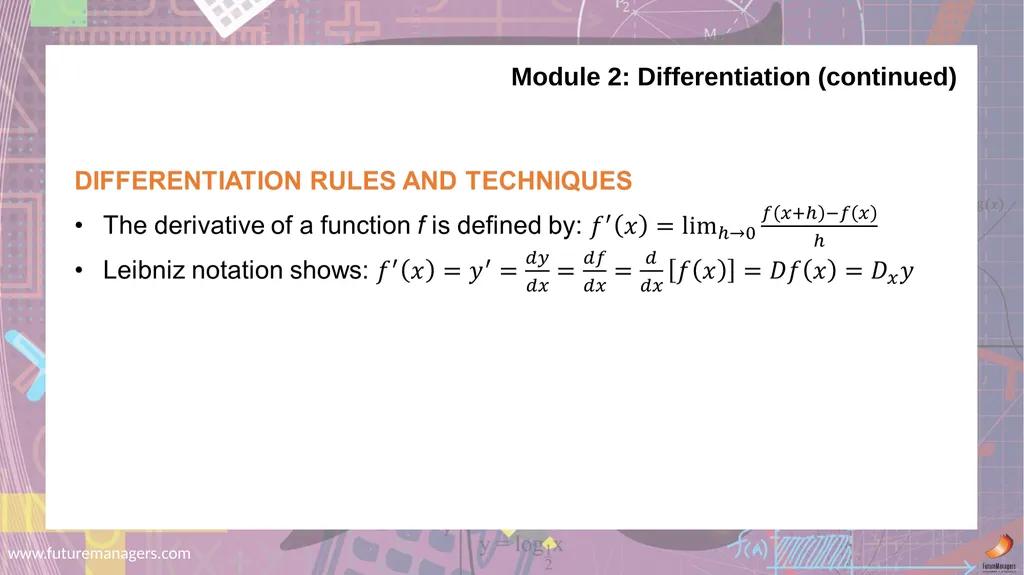
Differentiation in mathematics measures how rapidly these functions change at any point with respect to one of their variables. Module 2: Differentiation<br>
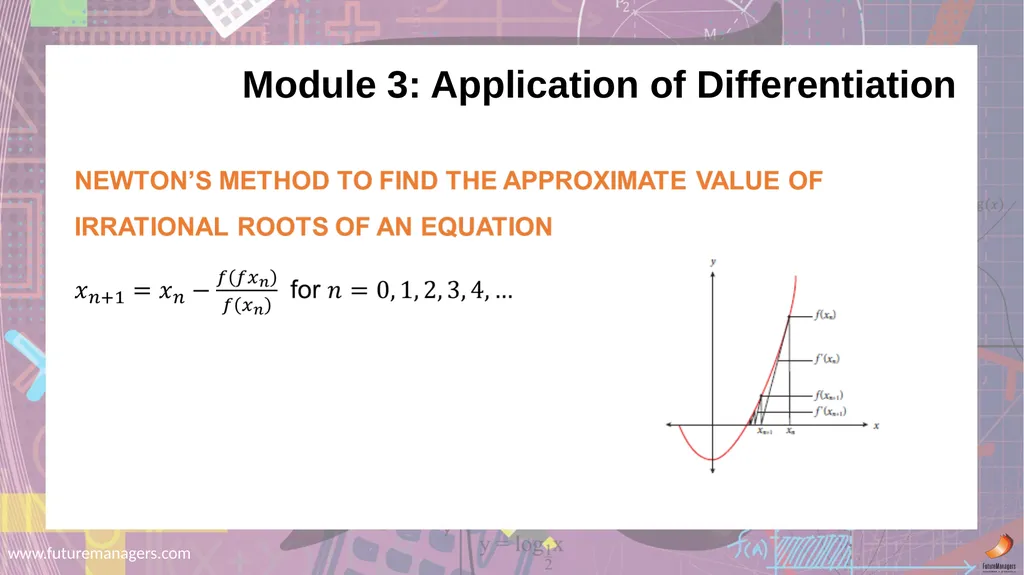
www.futuremanagers.com Module 3: Application of Differentiation<br>
08
www.futuremanagers.com Module 3: Application of Differentiation (continued) MAXIMA AND MINIMA
The maxima and minima (which are the plurals of maximum and minimum respectively) of a given function, which are collectively known as extrema, are the smallest and largest values of a function either in an interval or for the entire domain.<br>
09
www.futuremanagers.com Module 3: Application of Differentiation (continued) CONCAVITY AND INFLECTION POINT
Concavity refers to the inward-curving or hollow object.
Inflection point refers to a point of a curve at which a change in the direction of the curve occurs.<br>
10
www.futuremanagers.com Module 3: Application of Differentiation (continued) APPLICATION OF THE RATES OF CHANGE AND RELATED RATES
Related rates problems can be solved by using the following procedure:
Define all the symbols you want to use in answering the question.
Write down all the relevant equations between the different variables.
Differentiate equations to reflect relationship to time and rates of change.
State the desired variable in terms of known variables.
Substitute values into the equation and simplify.
Restate the answer in words to indicate the final result.<br>
11
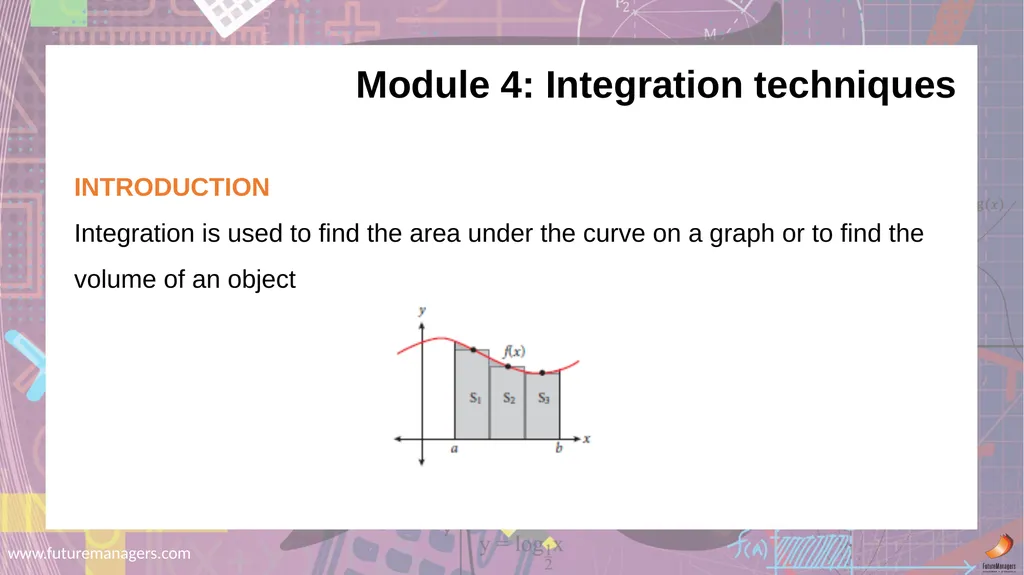
www.futuremanagers.com INTRODUCTION
Integration is used to find the area under the curve on a graph or to find the volume of an object Module 4: Integration techniques<br>
12
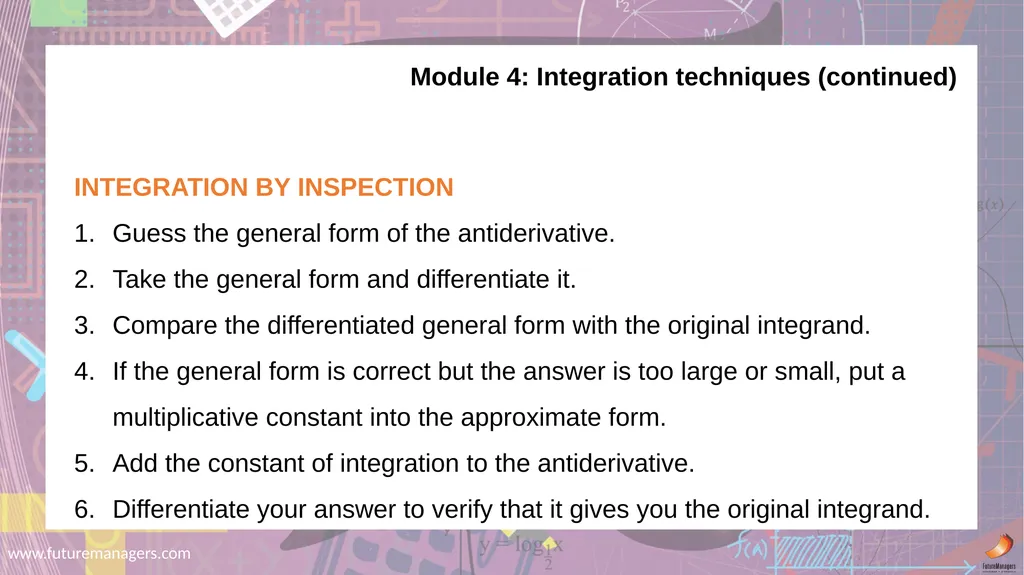
www.futuremanagers.com Module 4: Integration techniques (continued) INTEGRATION BY INSPECTION
Guess the general form of the antiderivative.
Take the general form and differentiate it.
Compare the differentiated general form with the original integrand.
If the general form is correct but the answer is too large or small, put a multiplicative constant into the approximate form.
Add the constant of integration to the antiderivative.
Differentiate your answer to verify that it gives you the original integrand.<br>
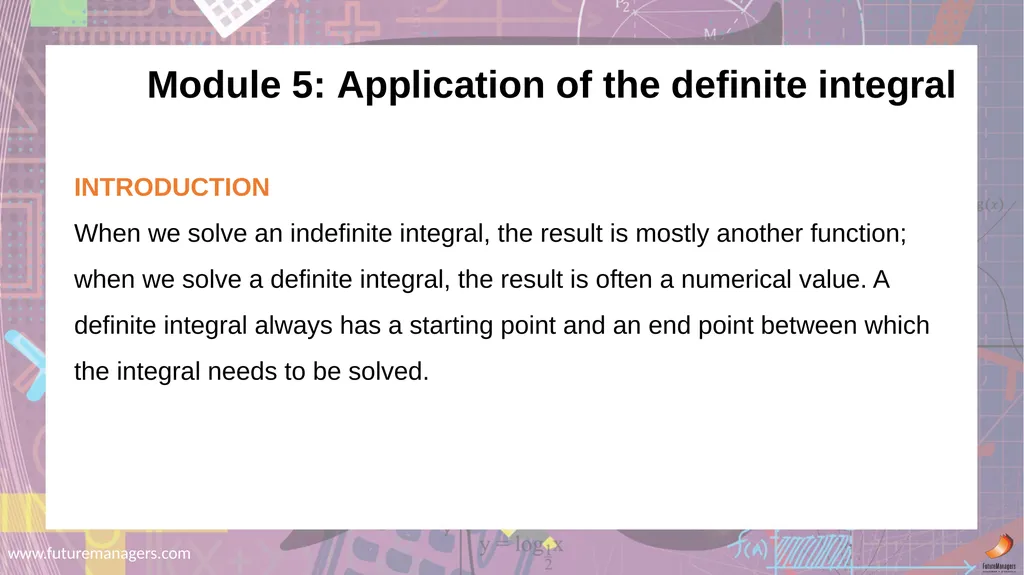
www.futuremanagers.com INTRODUCTION
When we solve an indefinite integral, the result is mostly another function; when we solve a definite integral, the result is often a numerical value. A definite integral always has a starting point and an end point between which the integral needs to be solved. Module 5: Application of the definite integral<br>
16
www.futuremanagers.com Module 5: Application of the definite integral (continued) SOLVING THE DEFINITE INTEGRAL
To determine a definite integral, we can integrate the function as before. Then we substitute the endpoint value into the independent variable of the integrate and subtract the integrate where the independent variable has been substituted with the start point value.<br>
17
www.futuremanagers.com Module 5: Application of the definite integral (continued) AREAS
Whenever we want to calculate the area for a given interval of a function, we can use a definite integral.<br>
18
www.futuremanagers.com Module 5: Application of the definite integral (continued) VOLUMES OF SOLIDS AND REVOLUTION
Volume is the amount of space that a substance or object occupies limited by boundaries on all its sides. Many solids have a circular cross-section in a plane perpendicular to some axis. These solids are referred to as solids of revolution because they are generated by rotating a region 360° about an axis.<br>
19
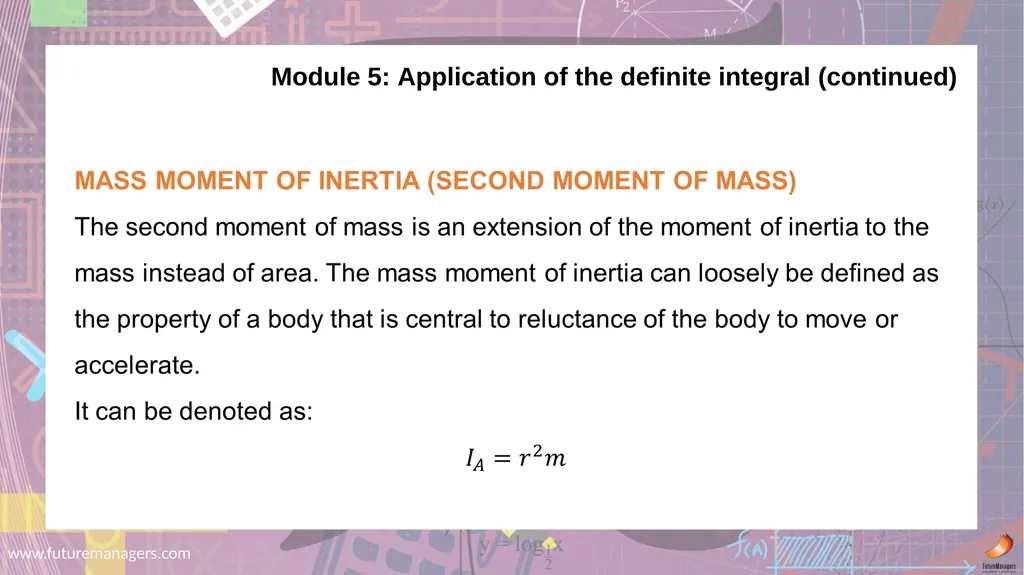
www.futuremanagers.com Module 5: Application of the definite integral (continued) SECOND MOMENT OF AREA
The second moment of area also known as the moment of inertia of the plane area or the area moment of inertia is the geometric property of an area showing the points distributed randomly along a given axis. The second moment of area is determined with respect to an axis of rotation.<br>
20
www.futuremanagers.com Module 5: Application of the definite integral (continued)<br>