04
Maths anxiety … ...is like an invisible monster, a grim reality for a� significant proportion of learners
… is acquired
...is disabling
...has been written about since 1950s
...now affects large numbers of people
...causes reduced or backwards progression
...can be addressed<br>
05
Maths anxiety … ...can be considered a psychological safe-guarding issue!<br>
06
Results of maths anxiety “A feeling of tension, apprehension, or fear that interferes with maths performance” (Ashcraft, 2002)
that results in:
negative attitudes & motivation towards maths
avoidance
lower grades
negative self-perceptions
impact on working memory
http://www.mccc.edu/~jenningh/Courses/documents/math_anxiety.pdf<br>
07
An emotional handbrake You might find it helpful to think of maths anxiety as an “emotional handbrake” on learning mathematics – a handbrake that affects a large minority of our staff and students.<br>
08
The problem Although learners are naturally curious
fear is learned; maths anxiety is contagious
things that cause fear become avoided
vicious cycle
combined with fixed mindsets: � “I am not a maths person”
self-fulfilling prophecy<br>
09
Some brain facts we need as educators As a survival strategy the brain seeks to distinguish challenge from threat to well-being or survival
The brain doesn’t distinguish between physical and social threats, such as being left behind or humiliated or shouted at
Previous threats are remembered – survival strategy
When the brain (sub-consciously) perceives a threat, it initially responds by fight or flight mode<br>
10
Student experience [the teacher] would make you stand in front of everyone, and then she would just be, like, “You’re not good, you don’t understand, you’re stupid.” (Halima)
I always felt like I was stupid … Starting maths this year it still gives me chills …‘Cos even now, you know, that fear of saying ‘Oh I don’t get it! I still don’t get it!’ is still there. (Nina)
Molly’s father would grasp her neck in frustration when she didn’t get it.<br>
11
Not stupid but panicking Panic is temporary
To build resilience, learners need to understand this state is temporary. (Seligman)
Need “anxiety-safe” learning<br>
12
Psychological safety requires … Relatedness
Autonomy
Competence
…including competence to self-safeguard
Ryan and Deci (2017)<br>
13
Competence to self-safeguard … …can be achieved using four tools:
growth zone model
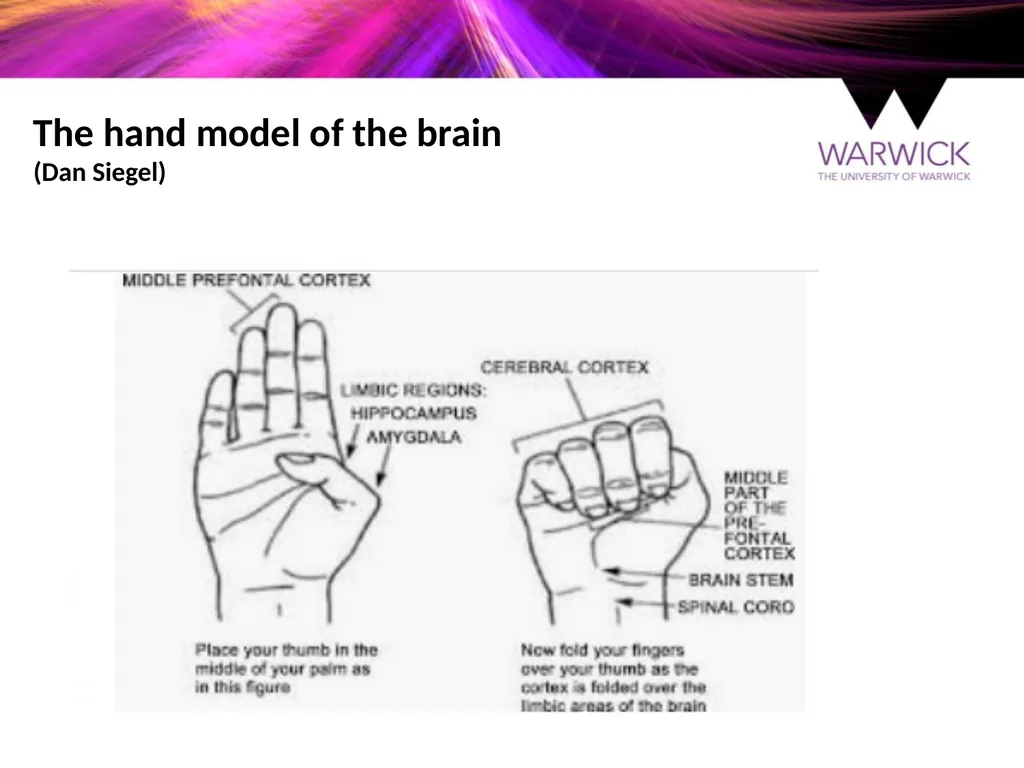
hand model of brain
triggering relaxation response
the ladder model
Shared between teacher and students, the tools help improve dialogue, awareness, and apt responses to reduce maths anxiety.<br>
14
The growth zone model a means to safeguard the mathematical wellbeing of those involved in learning or supporting maths…<br>
15
The growth zone model: �green zone Cruising in the comfort zone can build self-confidence & provide opportunities for practice & automaticity.<br>
16
The growth zone model: �amber zone New learning happens in the growth zone where learners experience challenge with sufficient safe-guarding – it should be safe to make mistakes, get stuck, require support, find activities tiring.<br>
17
The growth zone model: �red zone The danger zone is where what is being asked is not within the learner’s reach yet, even with support, and mathematical well-being is under threat.
Stress increases to the point of flight, fight or freeze; little or no useful learning takes place.<br>
18
The hand model of the brain �(Dan Siegel)<br>
19
The hand model of the brain Key message: the brain can’t panic and think effectively at the same time
Dan Siegel explaining his model:
https://www.youtube.com/watch?v=gm9CIJ74Oxw
Maths resilience version:
https://www.youtube.com/watch?v=7zW8w9kuu6E&t=7s<br>
20
The growth zone model �in action a means to help learners understand and articulate their feelings when they are learning mathematics...
Read about it in action:
https://www.mathsontoast.org.uk/how-talking-about-maths-suddenly-became-easier/<br>
21
Using the growth zone model Accept feeling of stupidity in red zone as temporary
How to get out of the red zone?
Building experience of being in and extending the amber/growth zone<br>
22
Getting out of the red zone Relaxation response (Benson 2000)
Rest and digest
5/7 breathing
Focus on 5 things you can hear
Go for a walk
Has anyone met mindfulness?
Don’t try to do maths whilst your brain is focused on the “maths monster”!
…<br>
23
Building the amber/growth zone Ask questions
Try a simpler example
Support each other
Recruit help
Use the Internet
Expect to get stuck
Expect to make mistakes
Use rough work
Take time
...<br>
24
The ladder model “I need
another
rung”<br>
25
Mathematical resilience confidence + persistence + perseverance
(Williams, 2014, based on Seligman)
growth mindset + inclusion + agency + resources (Johnston-Wilder and Lee, 2013)
what it takes to stay longer in the mathematical growth zone ...<br>
26
Tools in practice Building a shared language for mathematical safeguarding
Red means stop talking and listen! This practice takes a while to develop as a teacher!
Some teachers give each learner a copy of the GZM to use with a coin as a marker
Some teachers give learners opportunity to write their own words for the feelings in each zone
How would you use the tools?<br>
27
We can tackle the very real, invisible maths monster, together … …building awareness, developing a shared language for mathematical safeguarding, enabling learner autonomy, encouraging learning communities that don’t leave people behind, building growth mindsets …<br>
28
Further reading The tools:
https://www.scirp.org/journal/paperabs.aspx?paperid=102510
At home:
https://www.scirp.org/journal/paperinformation.aspx?paperid=55378
With a PhD student:
https://www.scirp.org/journal/paperinformation.aspx?paperid=85398
1 to 1 with an adult:
https://www.scirp.org/journal/paperinformation.aspx?paperid=112110
In class:
Para and Johnston-Wilder (submitted) Addressing Mathematics Anxiety: a case study in a High School in Brazil – copy available from author
Background:
Siegel D (2011) Mindsight: The New Science of Personal Transformation
Benson H (2000) The Relaxation Response<br>