MATTER AND MATERIALS Session 1 Things to talk
Description: MATTER AND MATERIALS Session 1 Things to talk about What happens when we warm up ice? Thinking about particles (like a chemist). Bringing in the energy connection. The wonderful water molecule. Understanding physical and chemical change. Do
Related Topics
Download Presentation
"MATTER AND MATERIALS Session 1 Things to talk" is the property of its rightful owner. Permission is granted to download and print the materials on this website for personal, non-commercial use only, and to display it on your personal computer provided you do not modify the materials and that you retain all copyright notices contained in the materials. By downloading content from our website, you accept the terms of this agreement.
Presentation Transcript
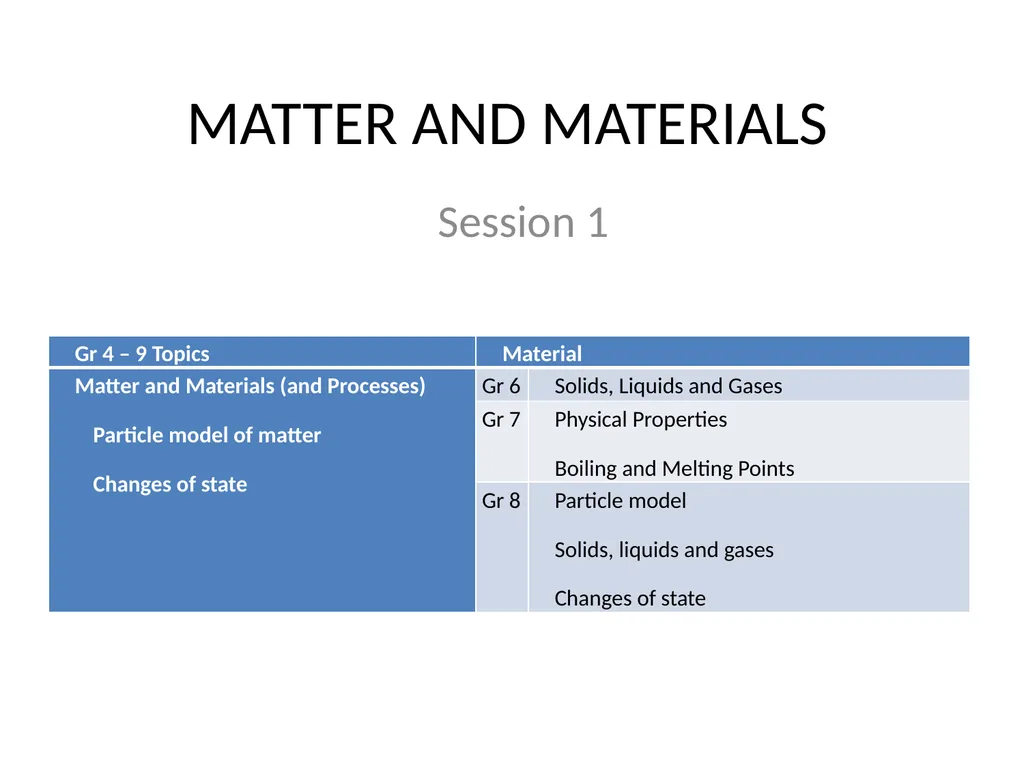
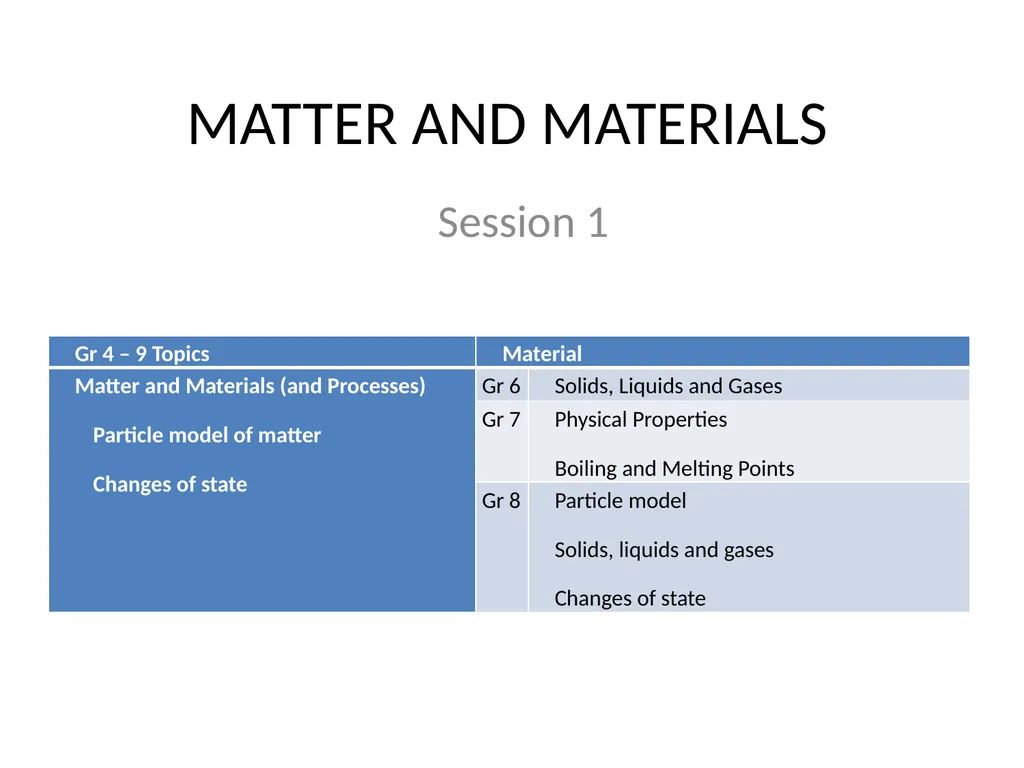
slide1. MATTER AND MATERIALS Session 1<br>
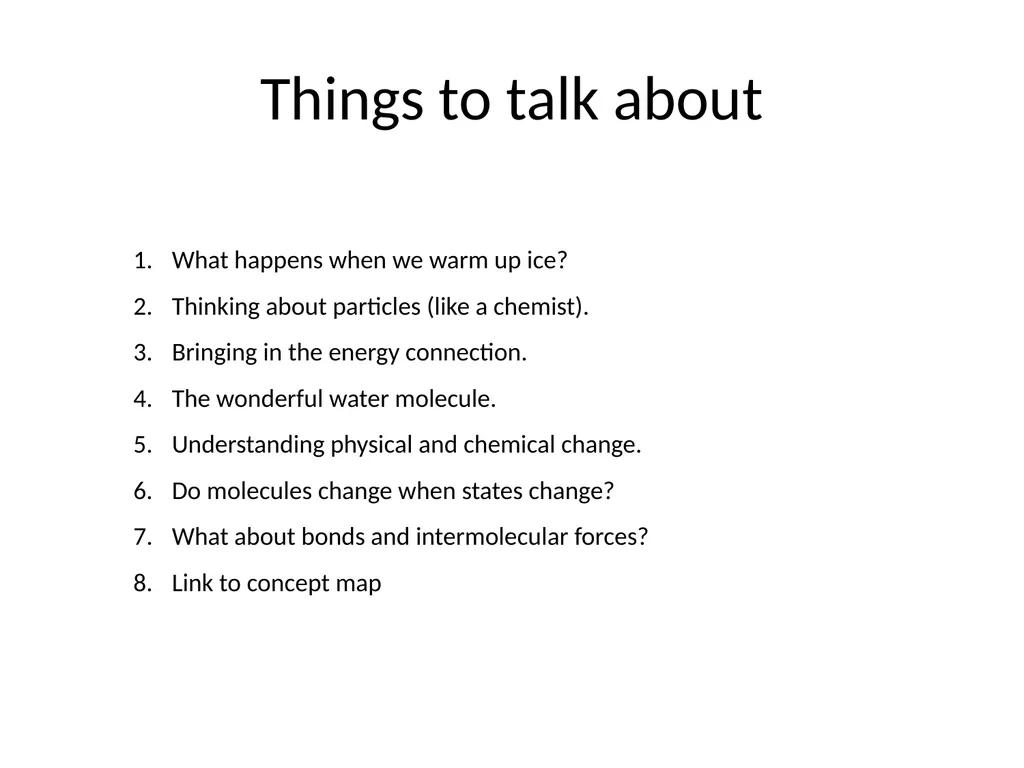
slide2. Things to talk about What happens when we warm up ice?
Thinking about particles (like a chemist).
Bringing in the energy connection.
The wonderful water molecule.
Understanding physical and chemical change.
Do molecules change when states change?
What about bonds and intermolecular forces?
Link to concept map<br>
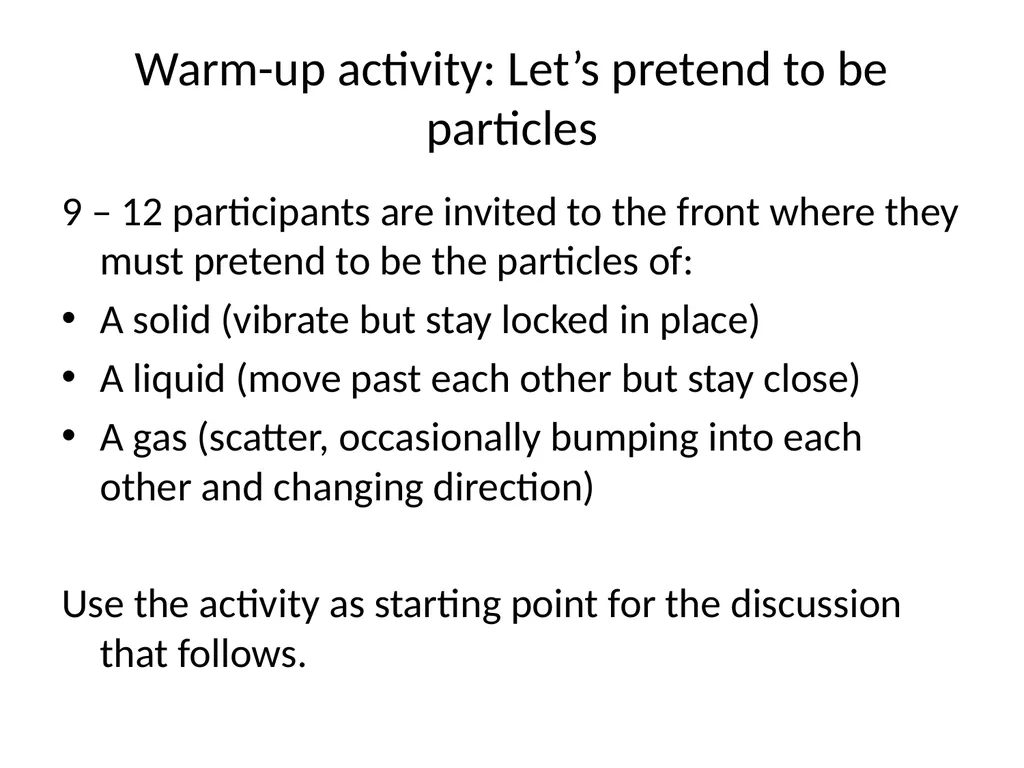
slide3. Warm-up activity: Let’s pretend to be particles 9 – 12 participants are invited to the front where they must pretend to be the particles of:
A solid (vibrate but stay locked in place)
A liquid (move past each other but stay close)
A gas (scatter, occasionally bumping into each other and changing direction)
Use the activity as starting point for the discussion that follows.<br>
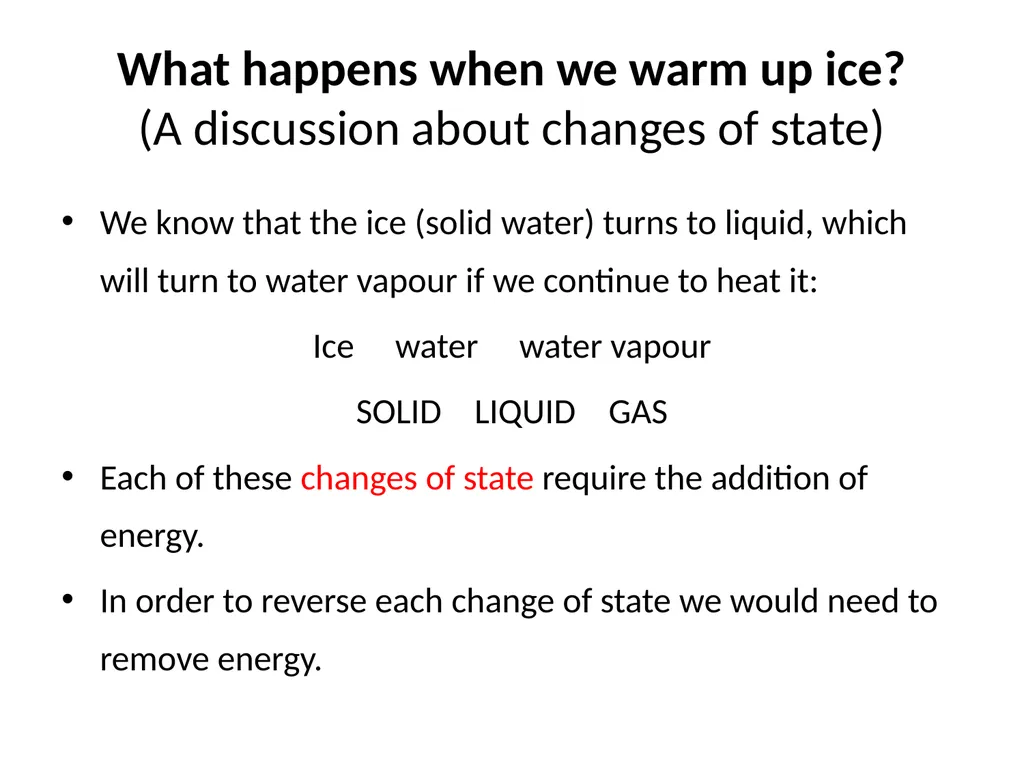
slide4. What happens when we warm up ice?(A discussion about changes of state) We know that the ice (solid water) turns to liquid, which will turn to water vapour if we continue to heat it:
Ice water water vapour
SOLID LIQUID GAS
Each of these changes of state require the addition of energy.
In order to reverse each change of state we would need to remove energy.<br>
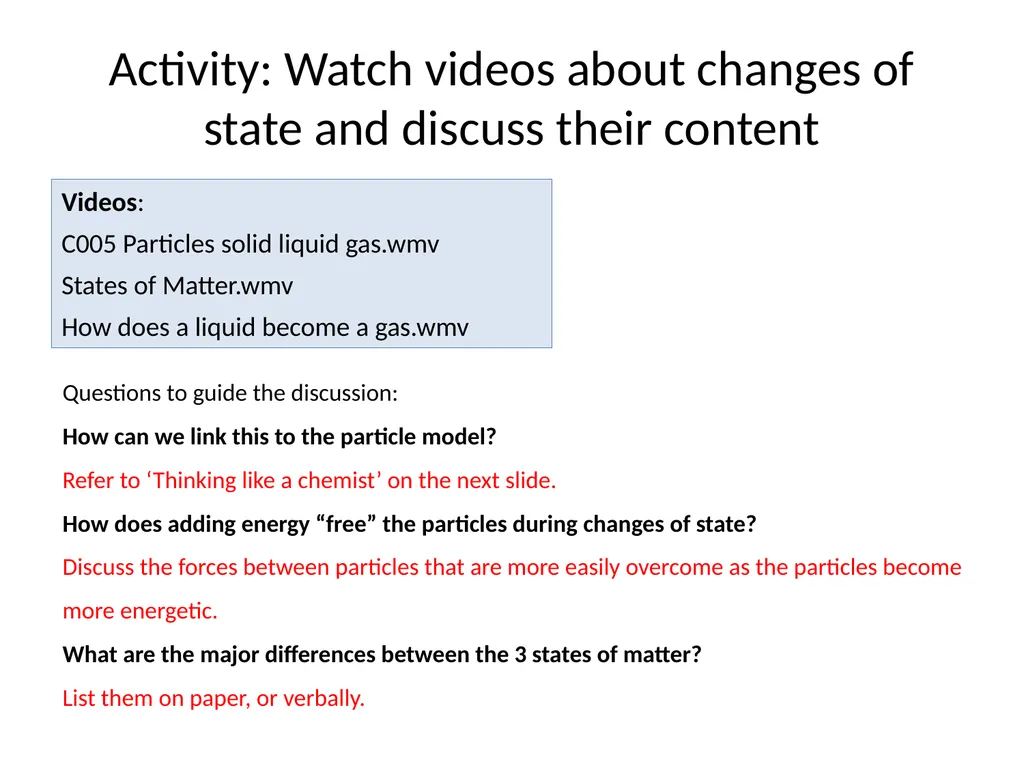
slide5. Activity: Watch videos about changes of state and discuss their content Videos:
C005 Particles solid liquid gas.wmv
States of Matter.wmv
How does a liquid become a gas.wmv Questions to guide the discussion:
How can we link this to the particle model?
Refer to ‘Thinking like a chemist’ on the next slide.
How does adding energy “free” the particles during changes of state?
Discuss the forces between particles that are more easily overcome as the particles become more energetic.
What are the major differences between the 3 states of matter?
List them on paper, or verbally.<br>
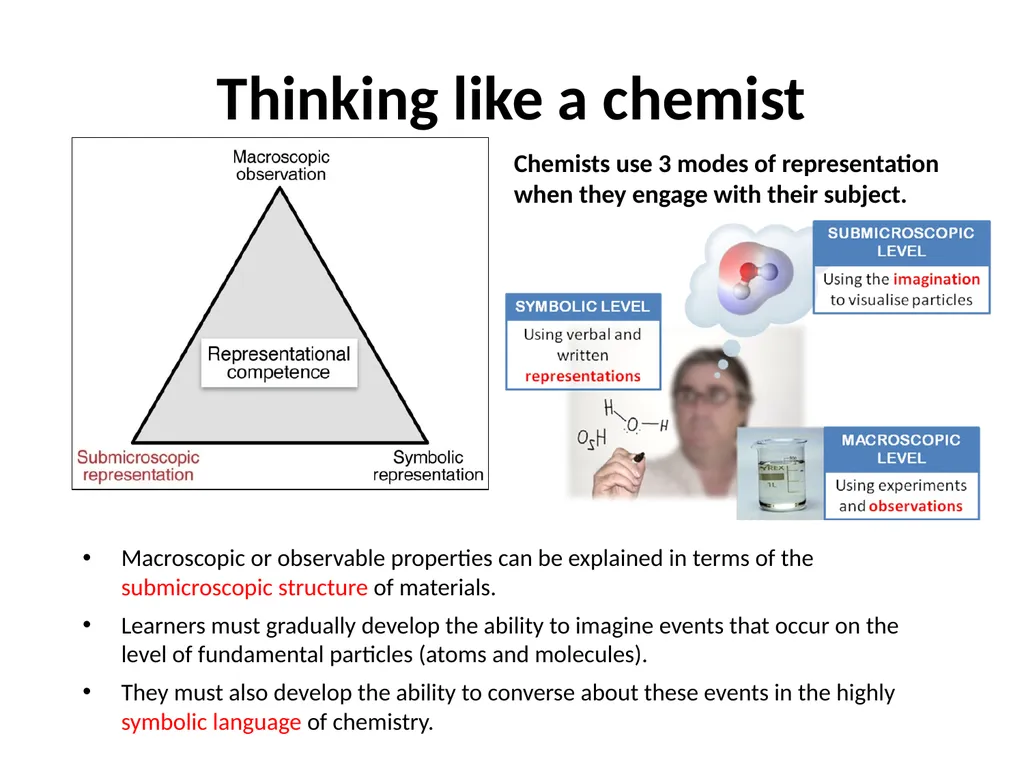
slide6. Chemists use 3 modes of representation when they engage with their subject. Thinking like a chemist Macroscopic or observable properties can be explained in terms of the submicroscopic structure of materials.
Learners must gradually develop the ability to imagine events that occur on the level of fundamental particles (atoms and molecules).
They must also develop the ability to converse about these events in the highly symbolic language of chemistry.<br>
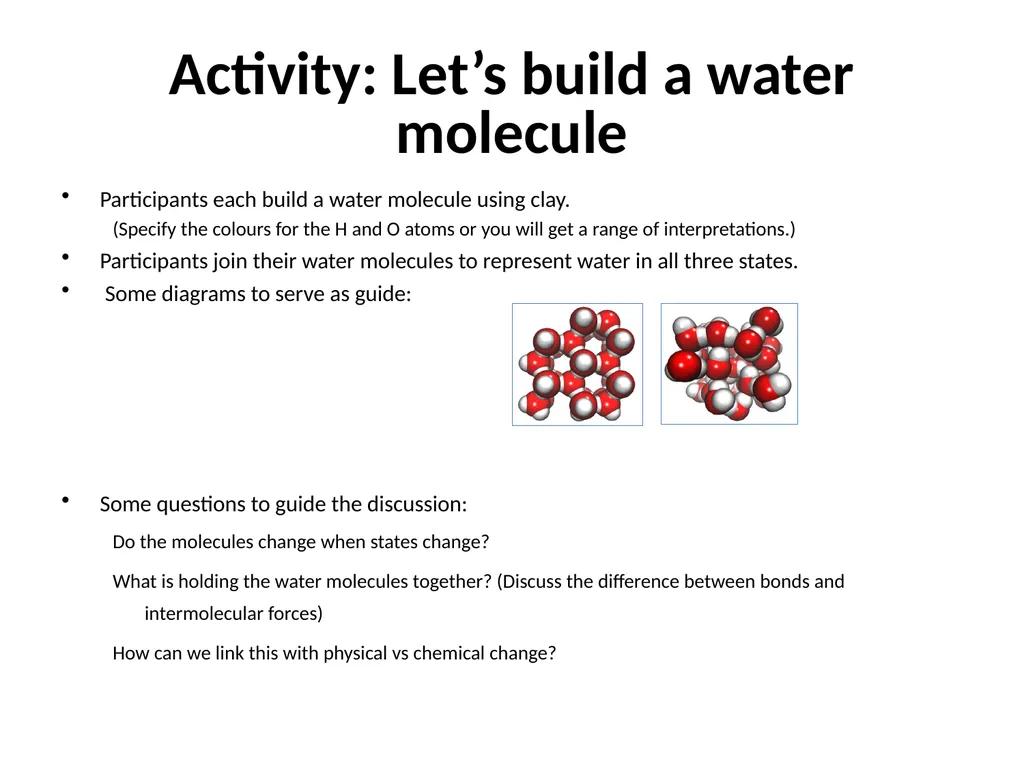
slide7. Activity: Let’s build a water molecule Participants each build a water molecule using clay.
(Specify the colours for the H and O atoms or you will get a range of interpretations.)
Participants join their water molecules to represent water in all three states.
Some diagrams to serve as guide:
Some questions to guide the discussion:
Do the molecules change when states change?
What is holding the water molecules together? (Discuss the difference between bonds and intermolecular forces)
How can we link this with physical vs chemical change?<br>
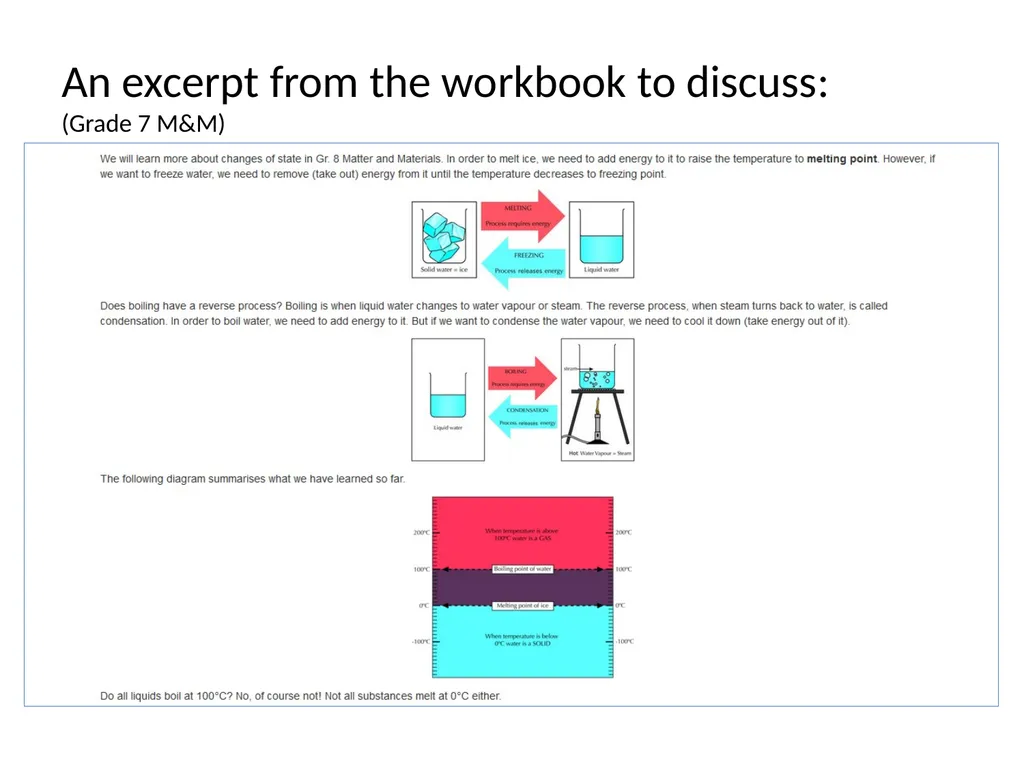
slide8. An excerpt from the workbook to discuss:(Grade 7 M&M)<br>
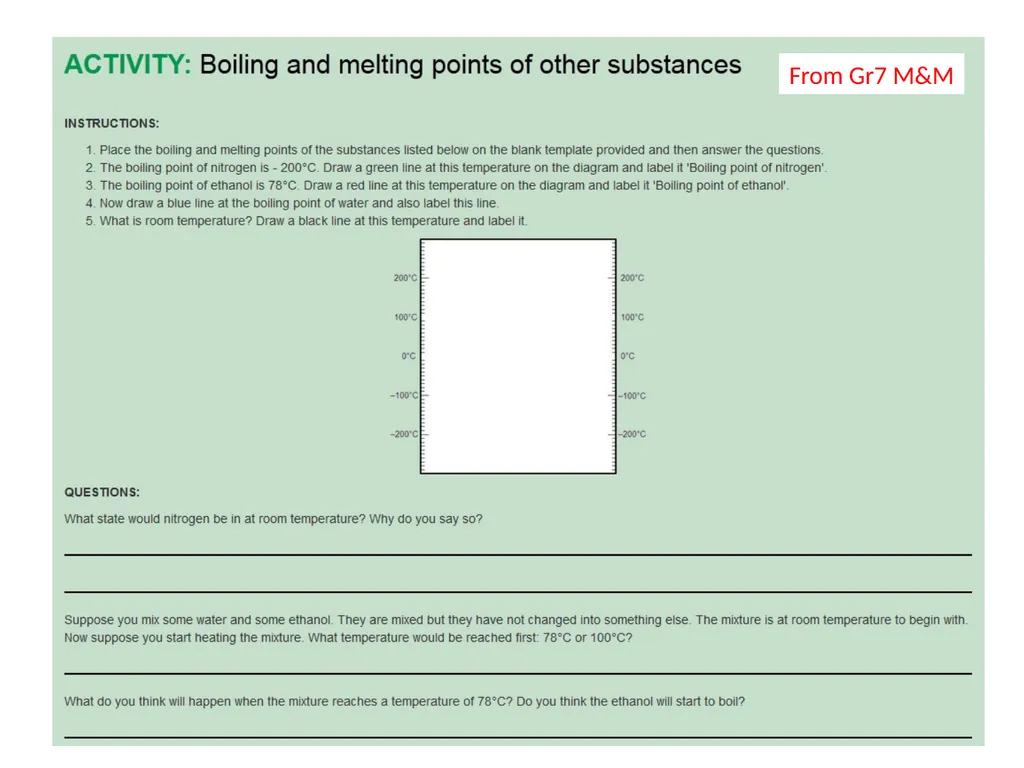
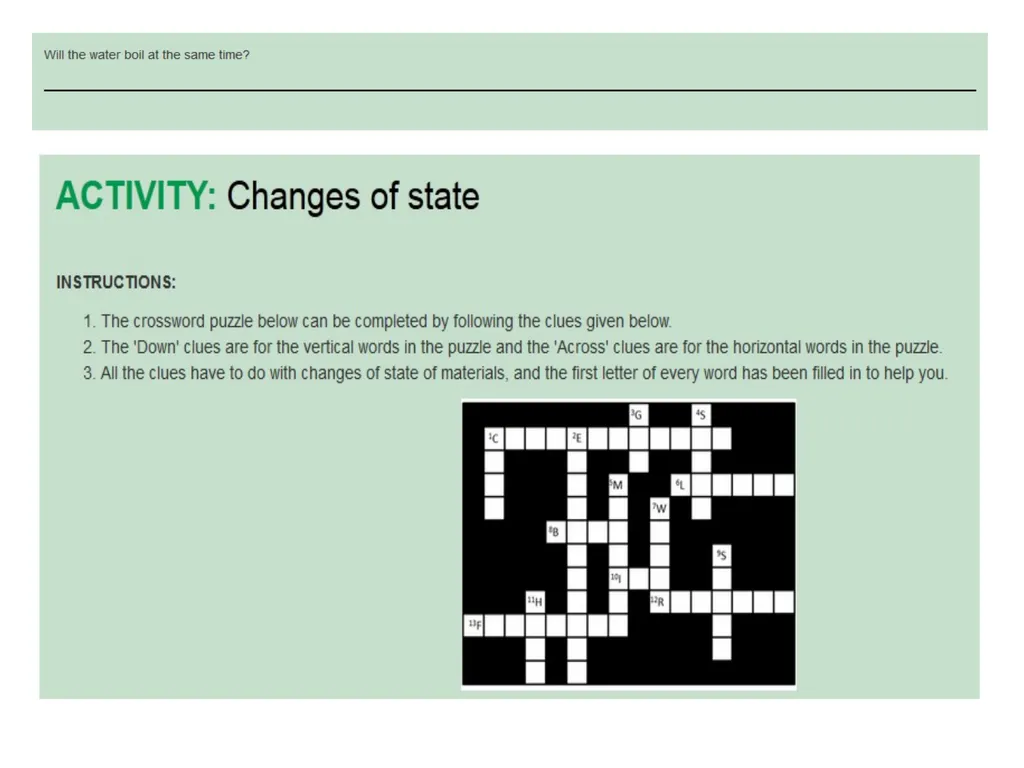
slide9. From Gr7 M&M<br>
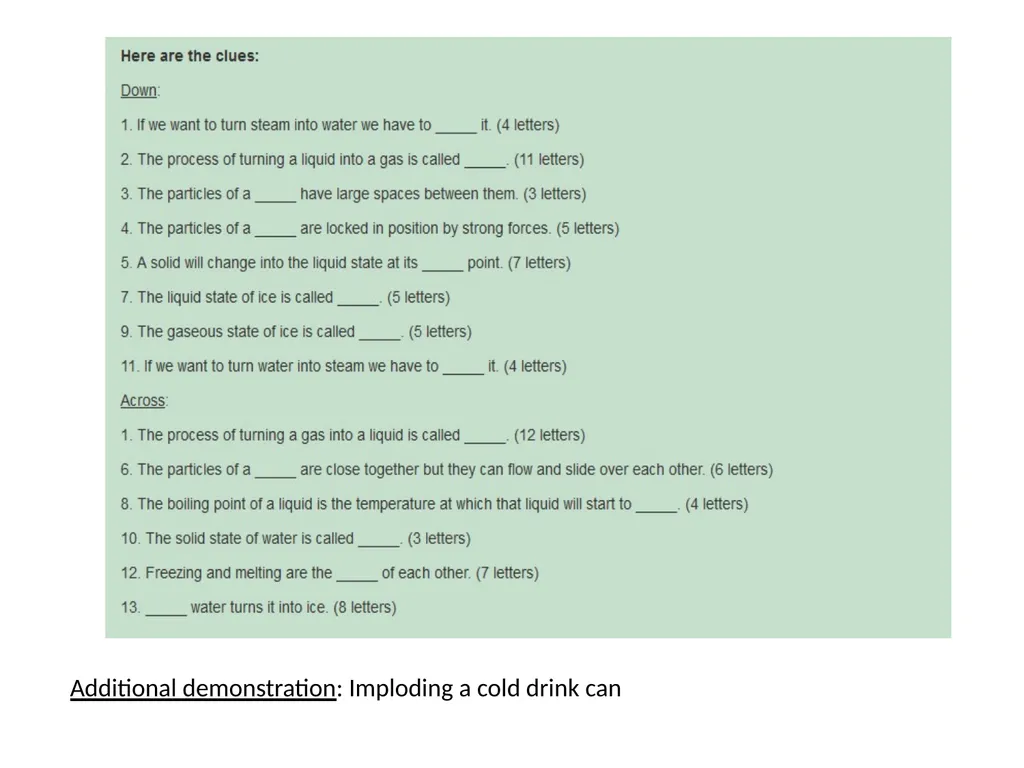
slide11. Additional demonstration: Imploding a cold drink can<br>
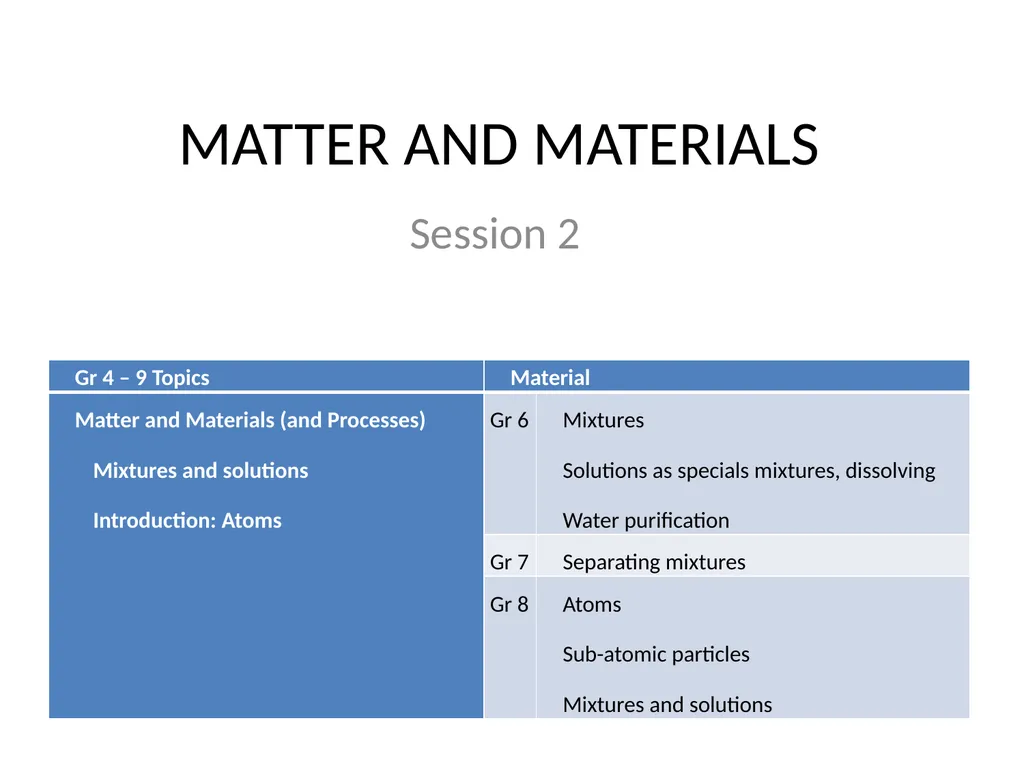
slide12. MATTER AND MATERIALS Session 2<br>
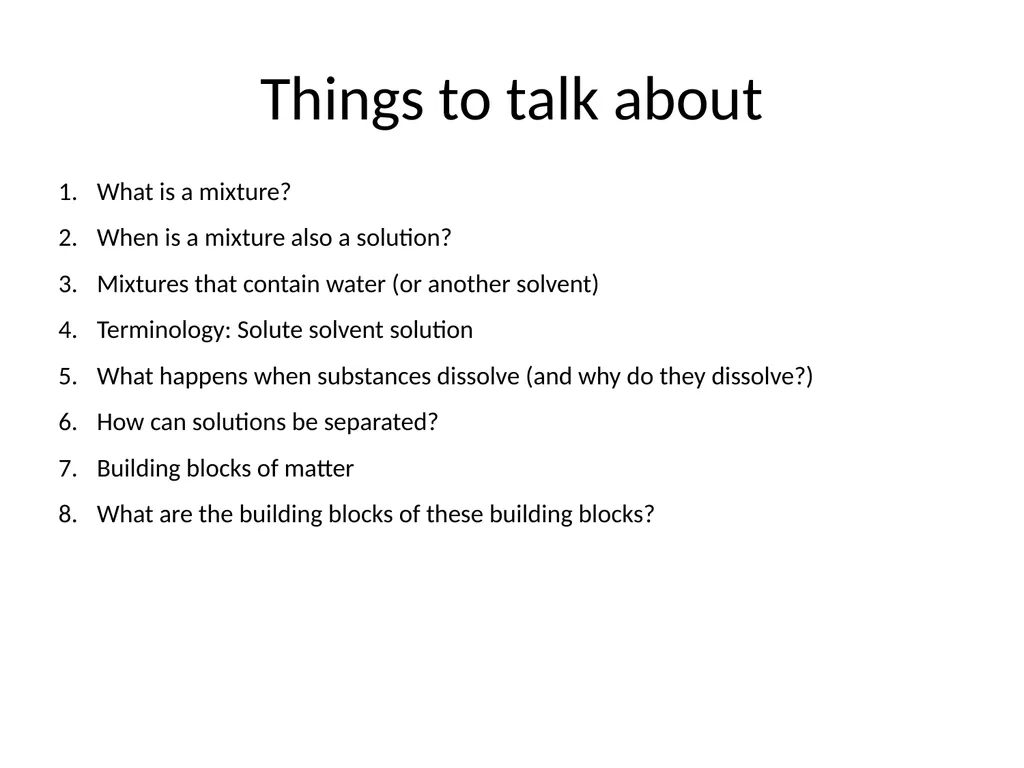
slide13. Things to talk about What is a mixture?
When is a mixture also a solution?
Mixtures that contain water (or another solvent)
Terminology: Solute solvent solution
What happens when substances dissolve (and why do they dissolve?)
How can solutions be separated?
Building blocks of matter
What are the building blocks of these building blocks?<br>
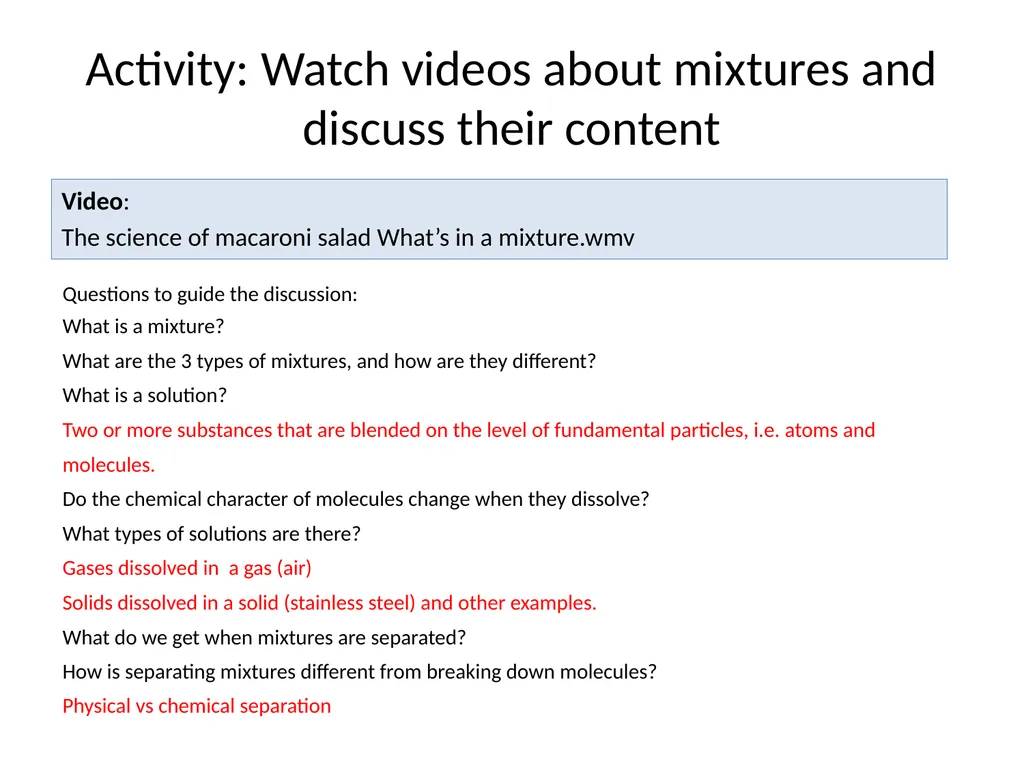
slide14. Activity: Watch videos about mixtures and discuss their content Video:
The science of macaroni salad What’s in a mixture.wmv Questions to guide the discussion:
What is a mixture?
What are the 3 types of mixtures, and how are they different?
What is a solution?
Two or more substances that are blended on the level of fundamental particles, i.e. atoms and molecules.
Do the chemical character of molecules change when they dissolve?
What types of solutions are there?
Gases dissolved in a gas (air)
Solids dissolved in a solid (stainless steel) and other examples.
What do we get when mixtures are separated?
How is separating mixtures different from breaking down molecules?
Physical vs chemical separation<br>
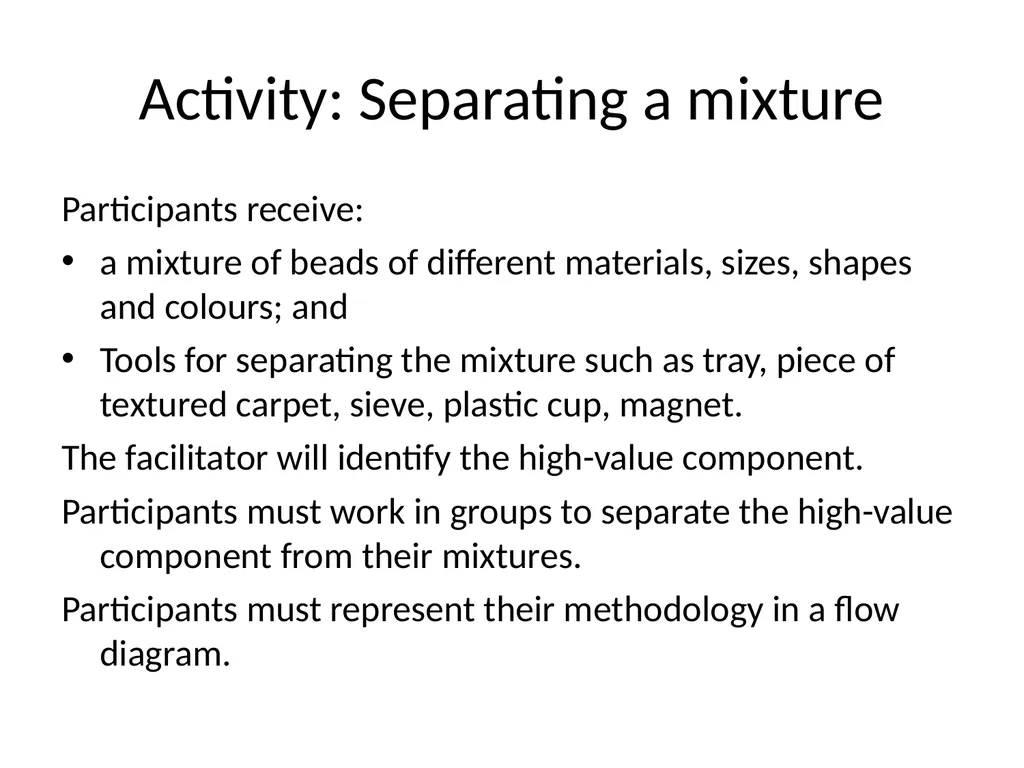
slide15. Activity: Separating a mixture Participants receive:
a mixture of beads of different materials, sizes, shapes and colours; and
Tools for separating the mixture such as tray, piece of textured carpet, sieve, plastic cup, magnet.
The facilitator will identify the high-value component.
Participants must work in groups to separate the high-value component from their mixtures.
Participants must represent their methodology in a flow diagram.<br>
slide16. Video:
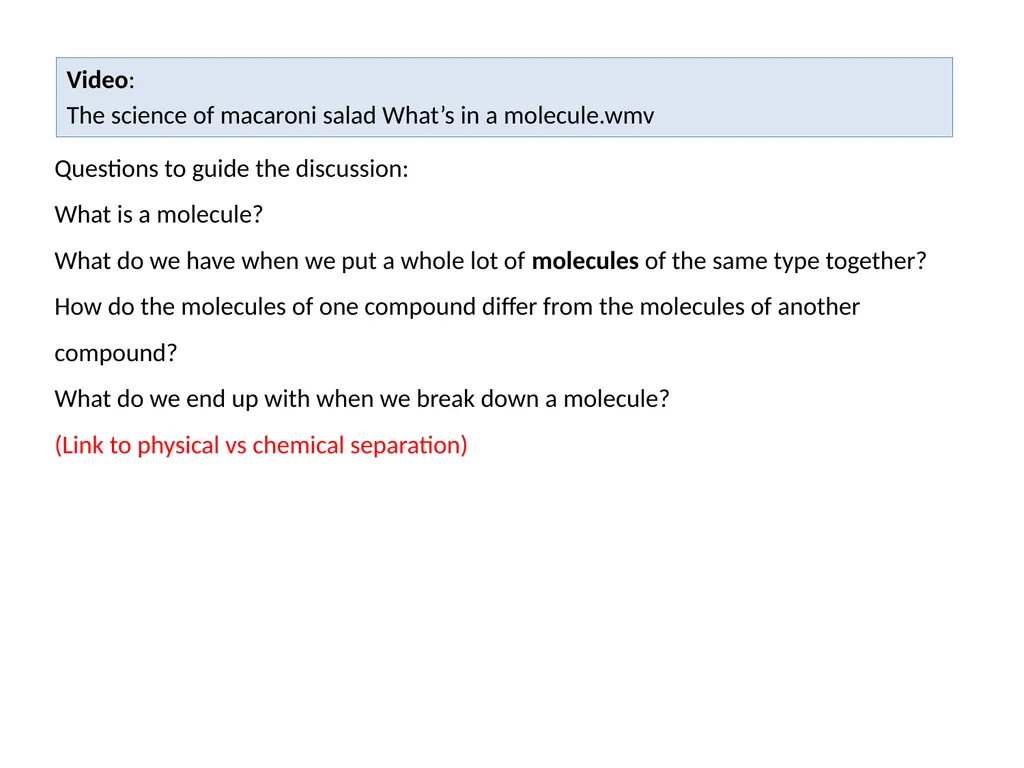
The science of macaroni salad What’s in a molecule.wmv Questions to guide the discussion:
What is a molecule?
What do we have when we put a whole lot of molecules of the same type together?
How do the molecules of one compound differ from the molecules of another compound?
What do we end up with when we break down a molecule?
(Link to physical vs chemical separation)<br>
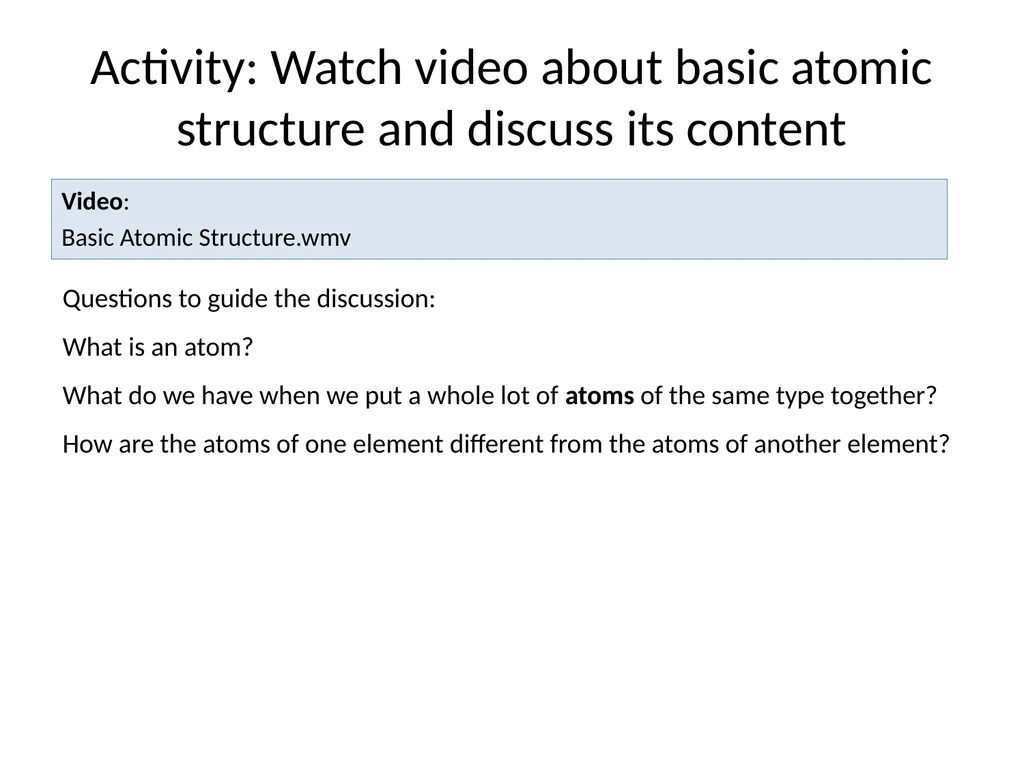
slide17. Activity: Watch video about basic atomic structure and discuss its content Video:
Basic Atomic Structure.wmv Questions to guide the discussion:
What is an atom?
What do we have when we put a whole lot of atoms of the same type together?
How are the atoms of one element different from the atoms of another element?<br>
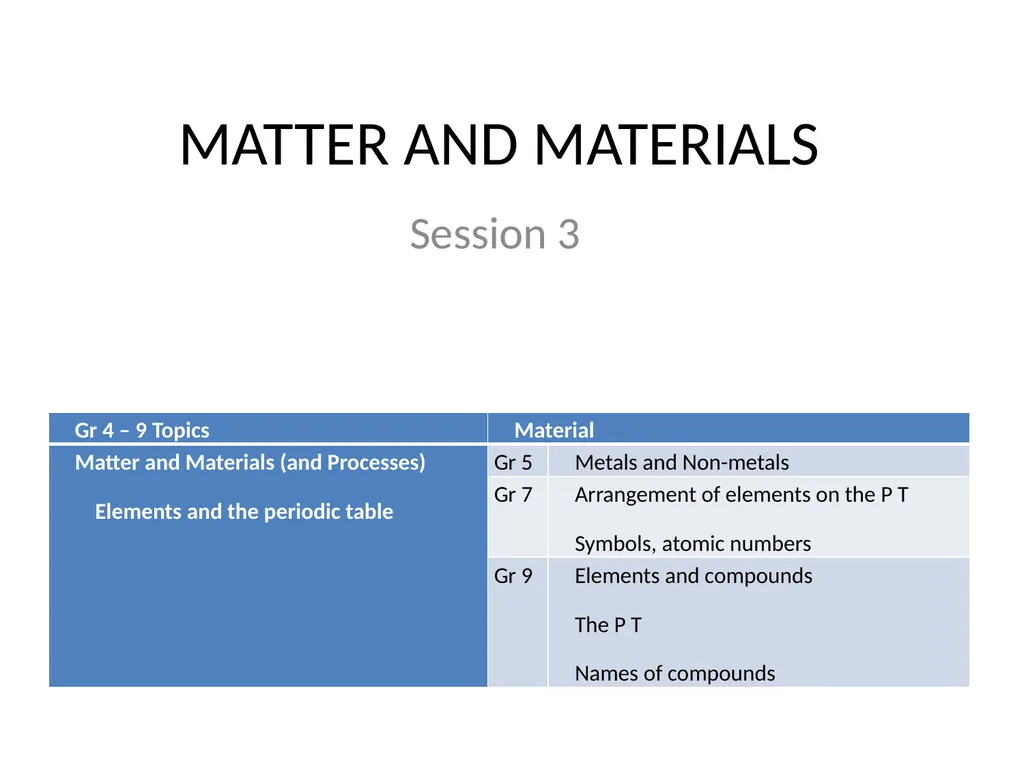
slide19. MATTER AND MATERIALS Session 3<br>
slide20. Things to talk about So we have different kinds of atoms. Now what?
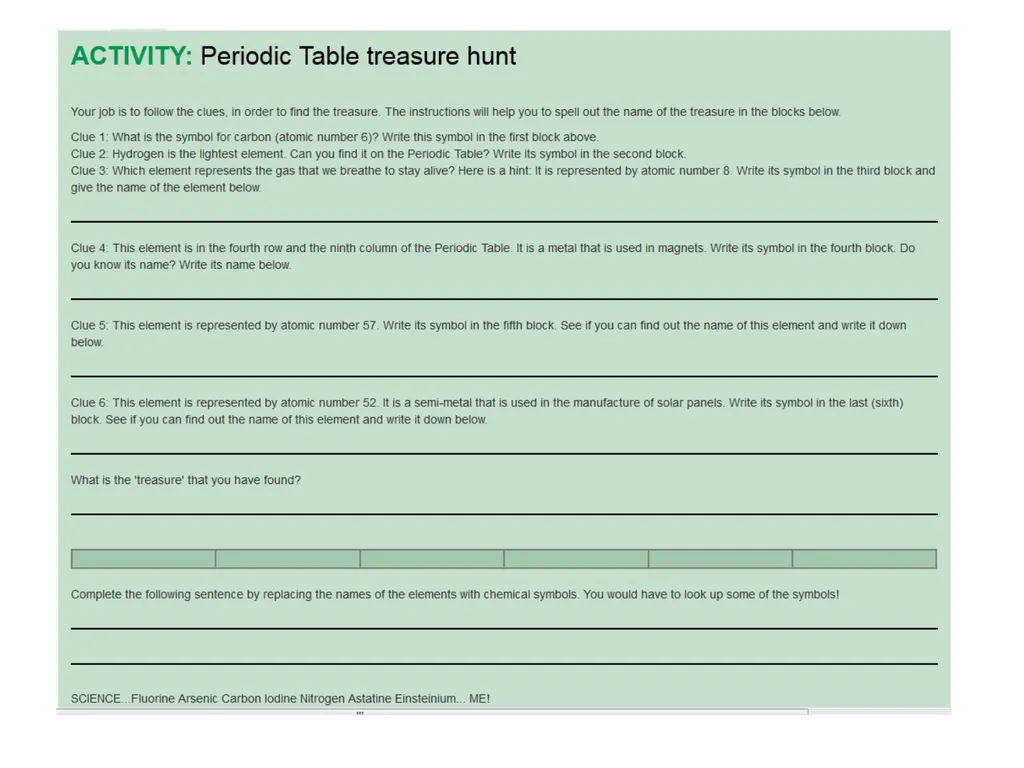
How do we distinguish between different kinds of atoms? (Names, symbols, atomic numbers, placement on the Periodic Table).
What is so special about the periodic table?
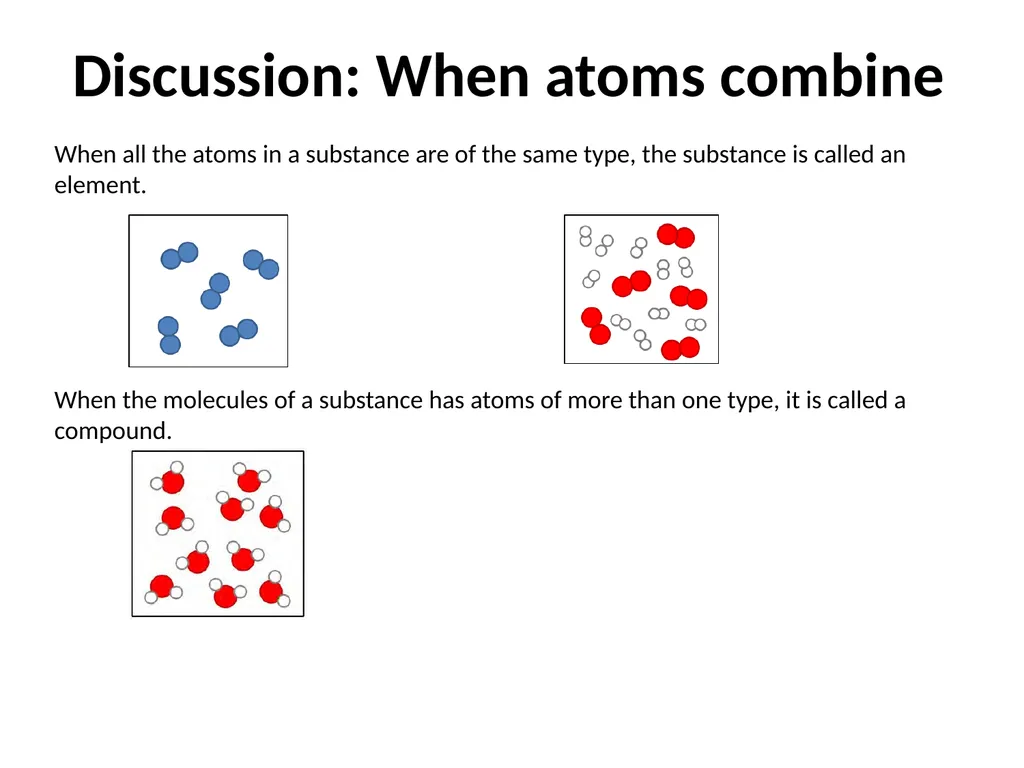
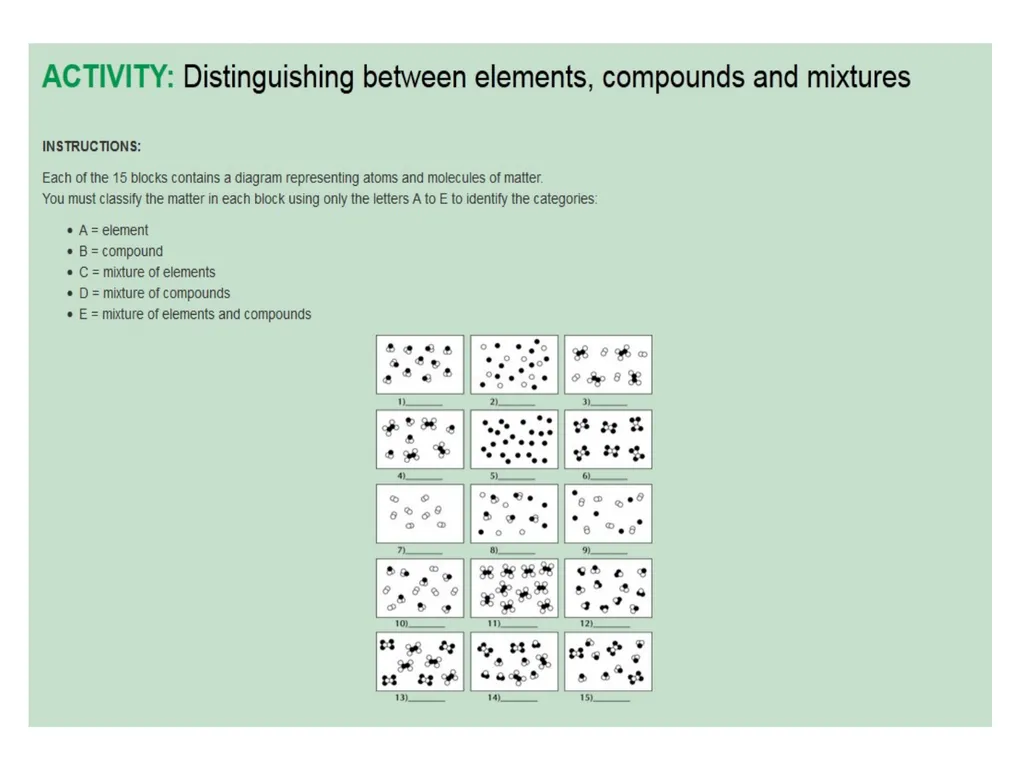
When all the atoms in a substance are of the same type.
When a substance has atoms of more than one type.
When we have to start putting elements together.<br>
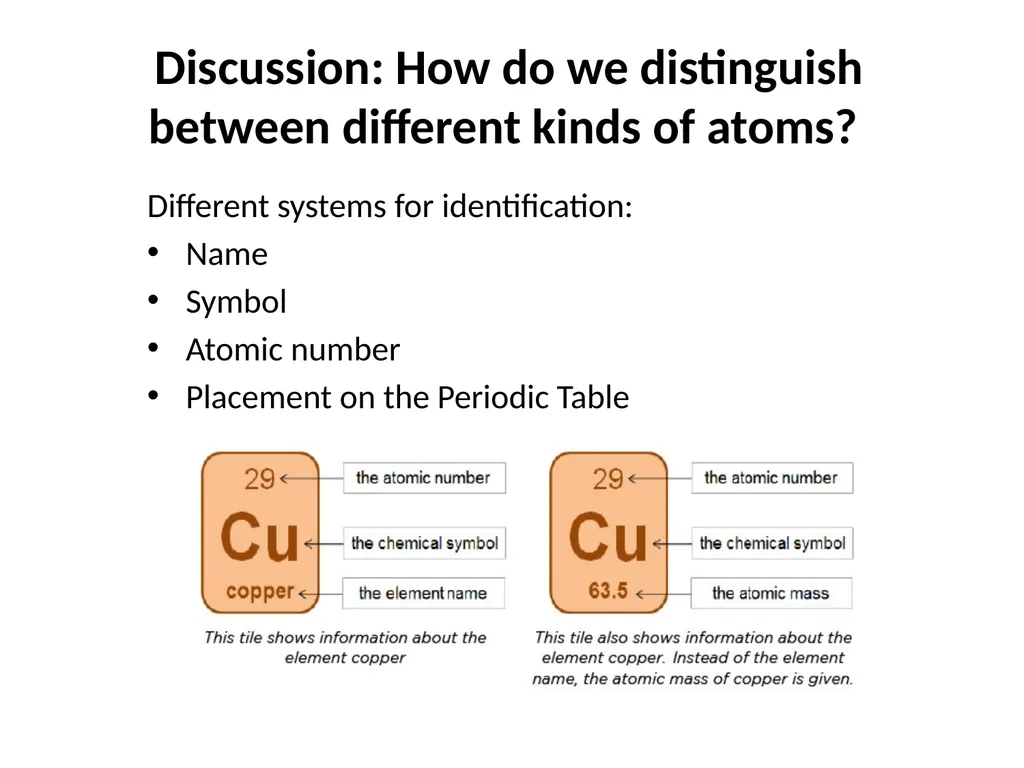
slide21. Discussion: How do we distinguish between different kinds of atoms? Different systems for identification:
Name
Symbol
Atomic number
Placement on the Periodic Table<br>
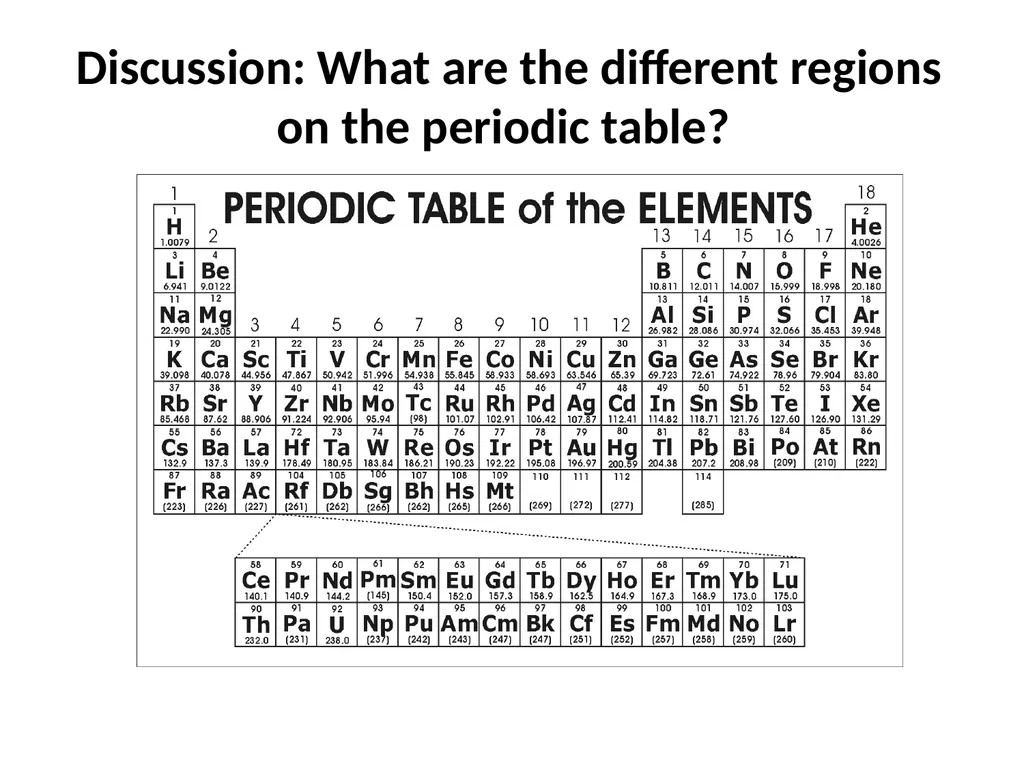
slide22. Discussion: What are the different regions on the periodic table?<br>
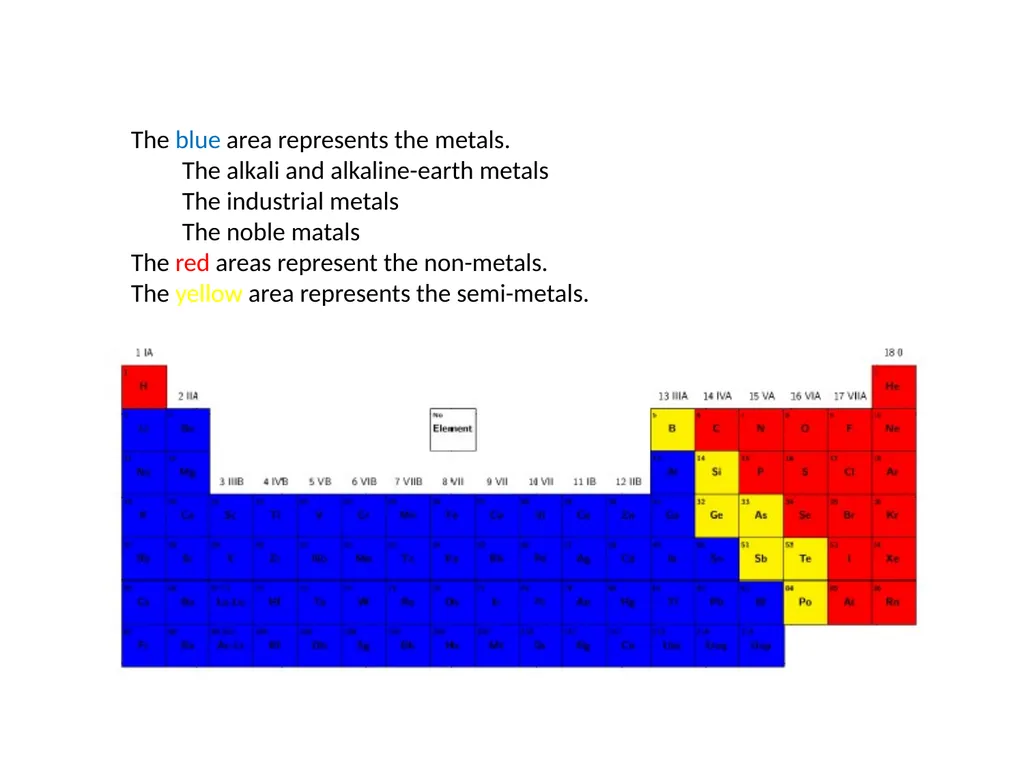
slide23. The blue area represents the metals.
The alkali and alkaline-earth metals
The industrial metals
The noble matals
The red areas represent the non-metals.
The yellow area represents the semi-metals.<br>
slide25. When all the atoms in a substance are of the same type, the substance is called an element.
When the molecules of a substance has atoms of more than one type, it is called a compound. Discussion: When atoms combine<br>
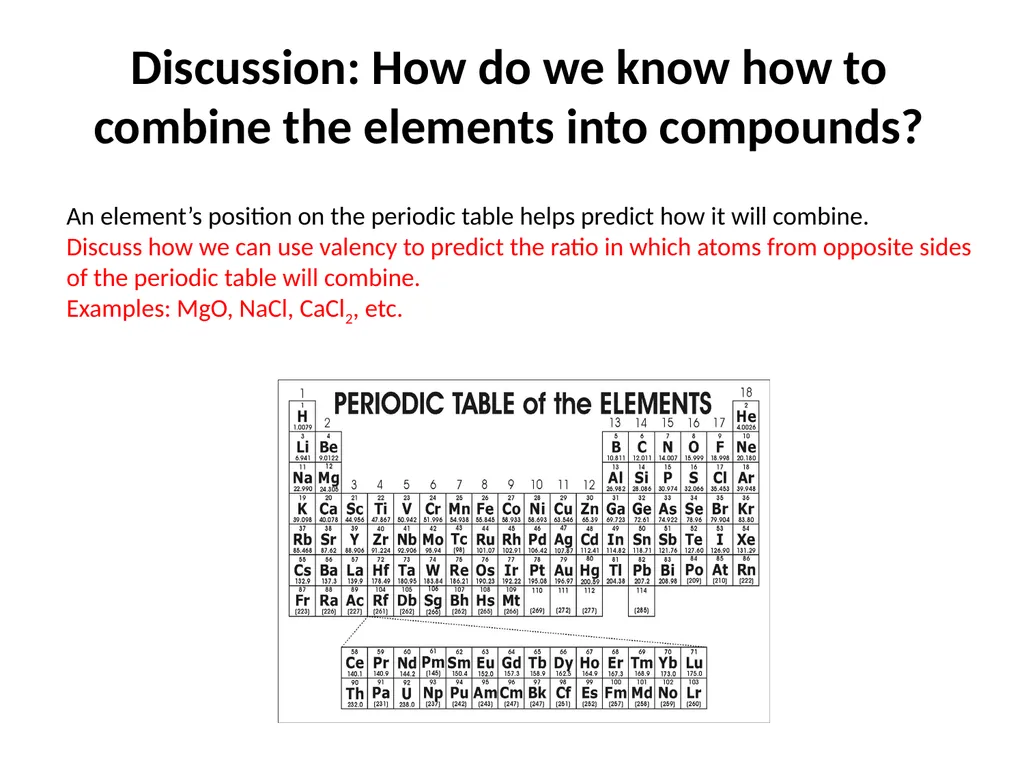
slide27. An element’s position on the periodic table helps predict how it will combine.
Discuss how we can use valency to predict the ratio in which atoms from opposite sides of the periodic table will combine.
Examples: MgO, NaCl, CaCl2, etc. Discussion: How do we know how to combine the elements into compounds?<br>
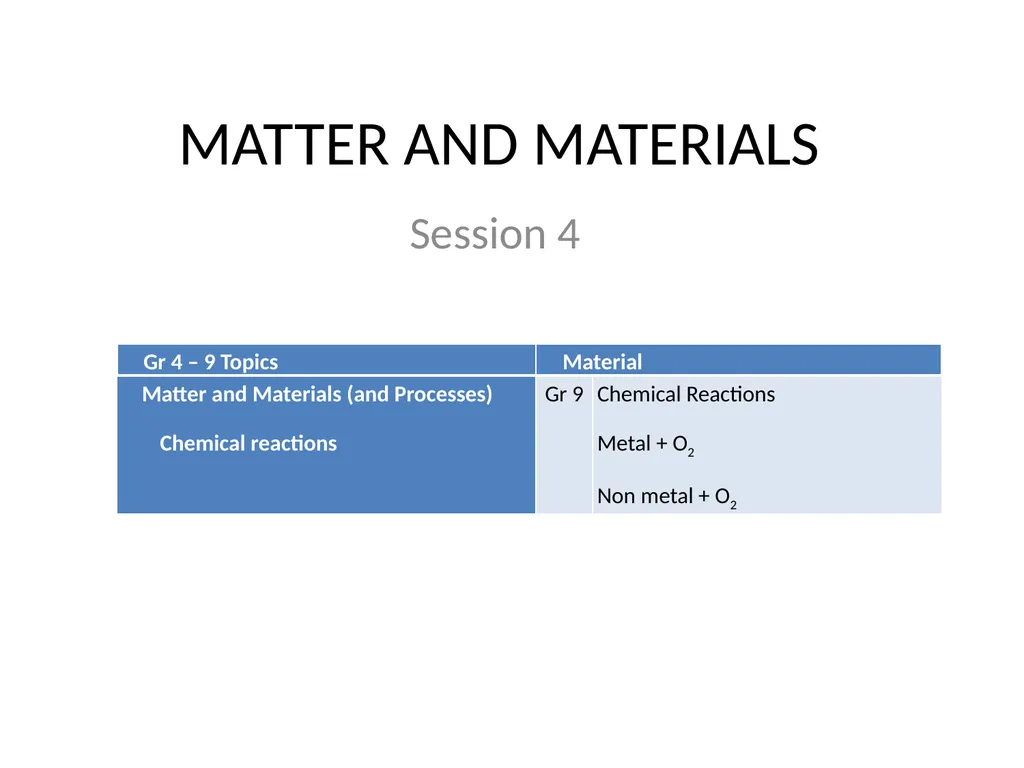
slide28. MATTER AND MATERIALS Session 4<br>
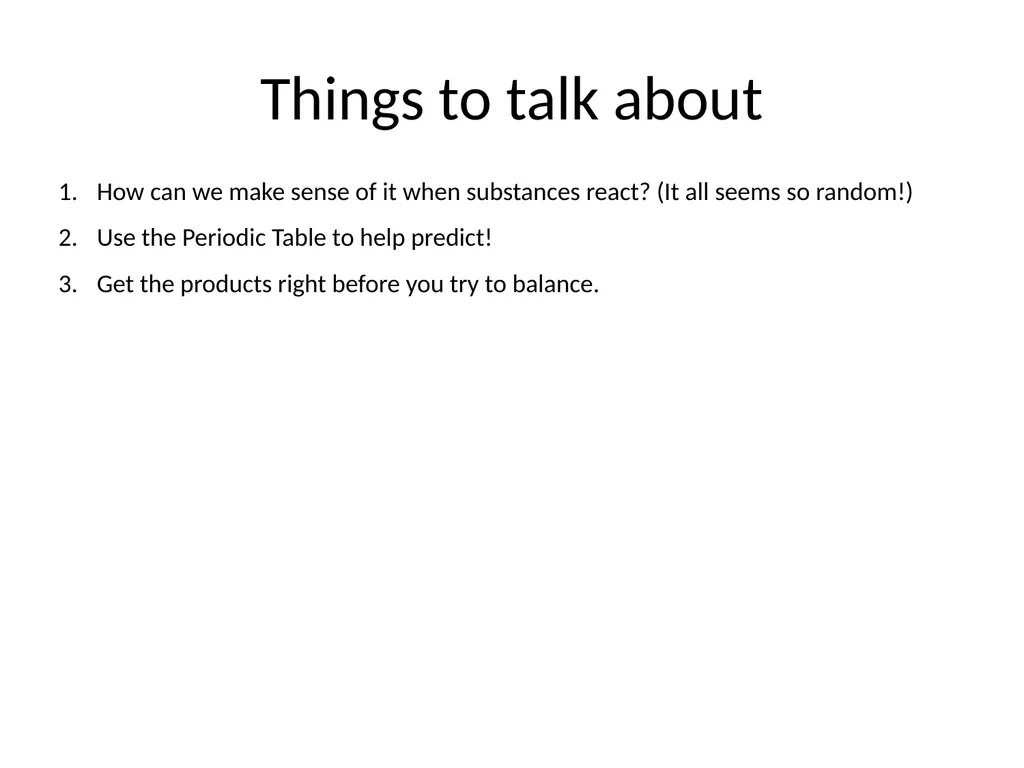
slide29. Things to talk about How can we make sense of it when substances react? (It all seems so random!)
Use the Periodic Table to help predict!
Get the products right before you try to balance.<br>
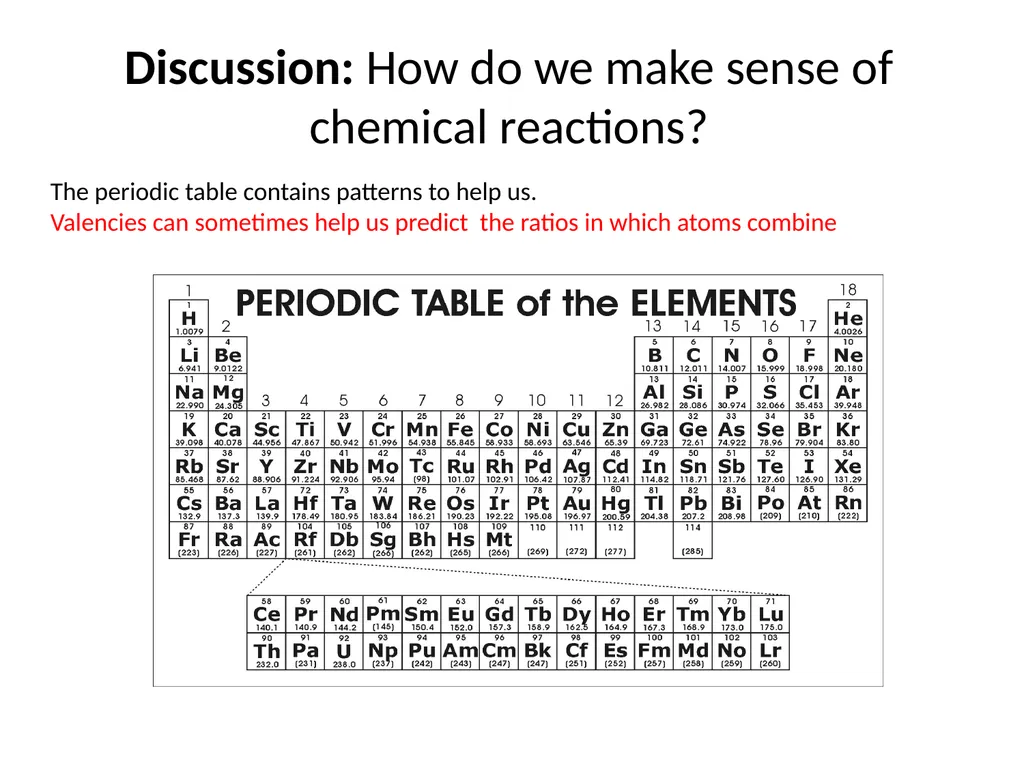
slide30. The periodic table contains patterns to help us.
Valencies can sometimes help us predict the ratios in which atoms combine Discussion: How do we make sense of chemical reactions?<br>
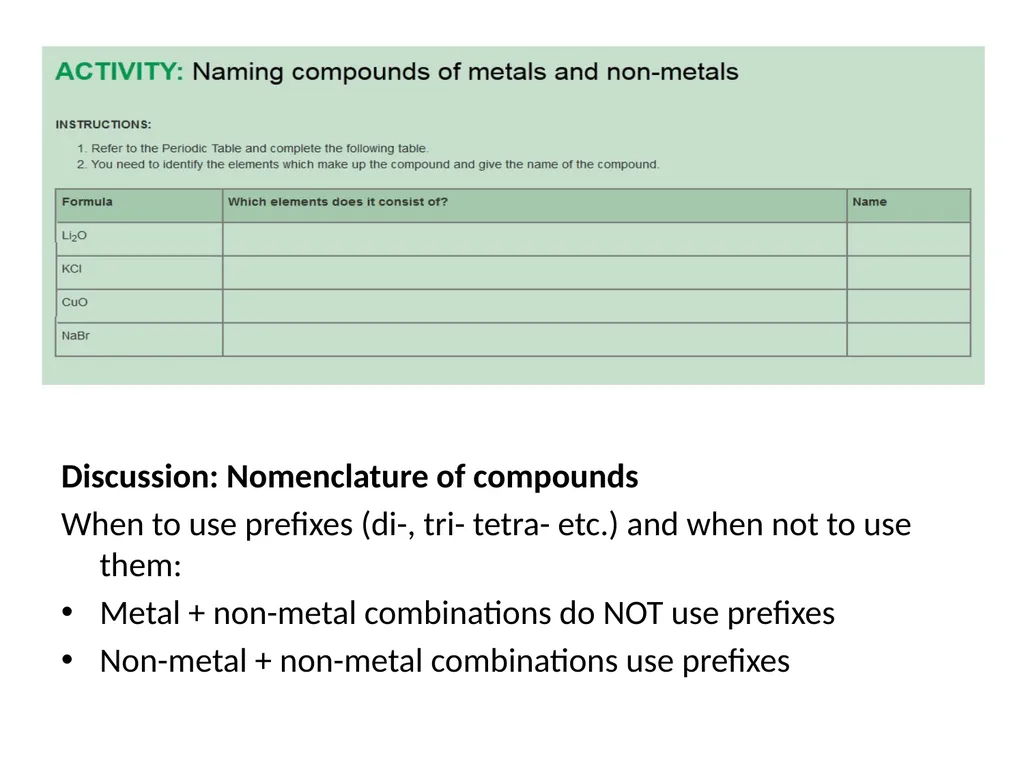
slide31. Discussion: Nomenclature of compounds
When to use prefixes (di-, tri- tetra- etc.) and when not to use them:
Metal + non-metal combinations do NOT use prefixes
Non-metal + non-metal combinations use prefixes<br>
slide32. Activity: Reactions of metals with O2<br>
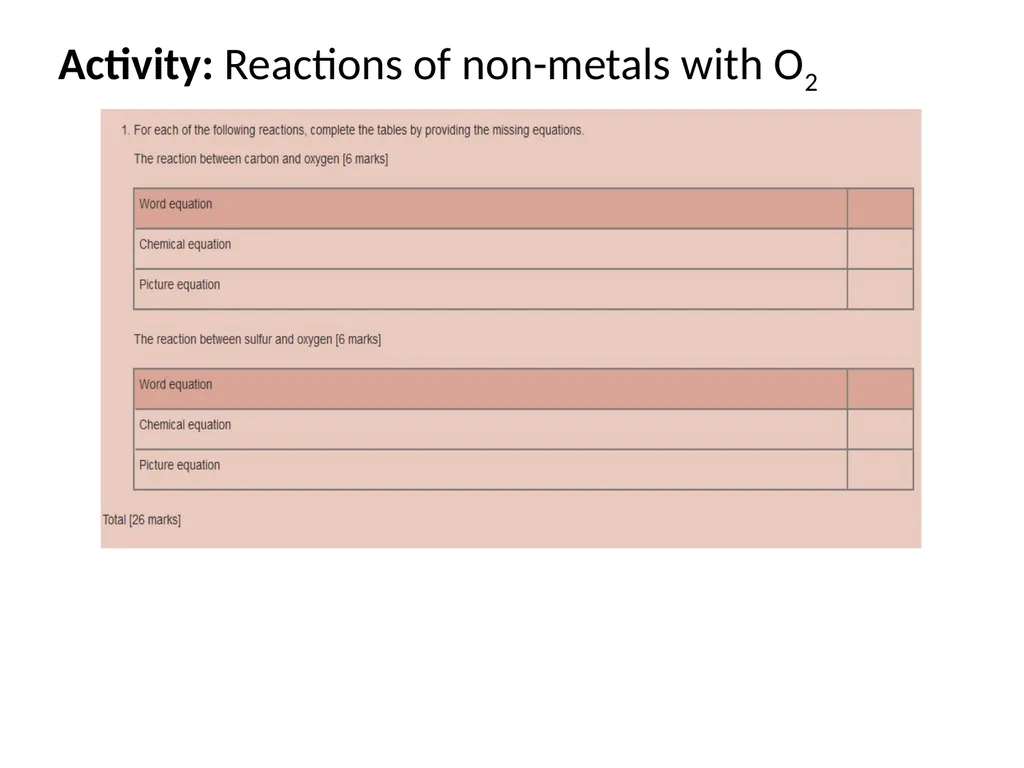
slide33. Activity: Reactions of non-metals with O2<br>
slide34. Activity: Watch two videos demonstrating how to balance equations. Videos:
(Get from Rene Toerien)<br>
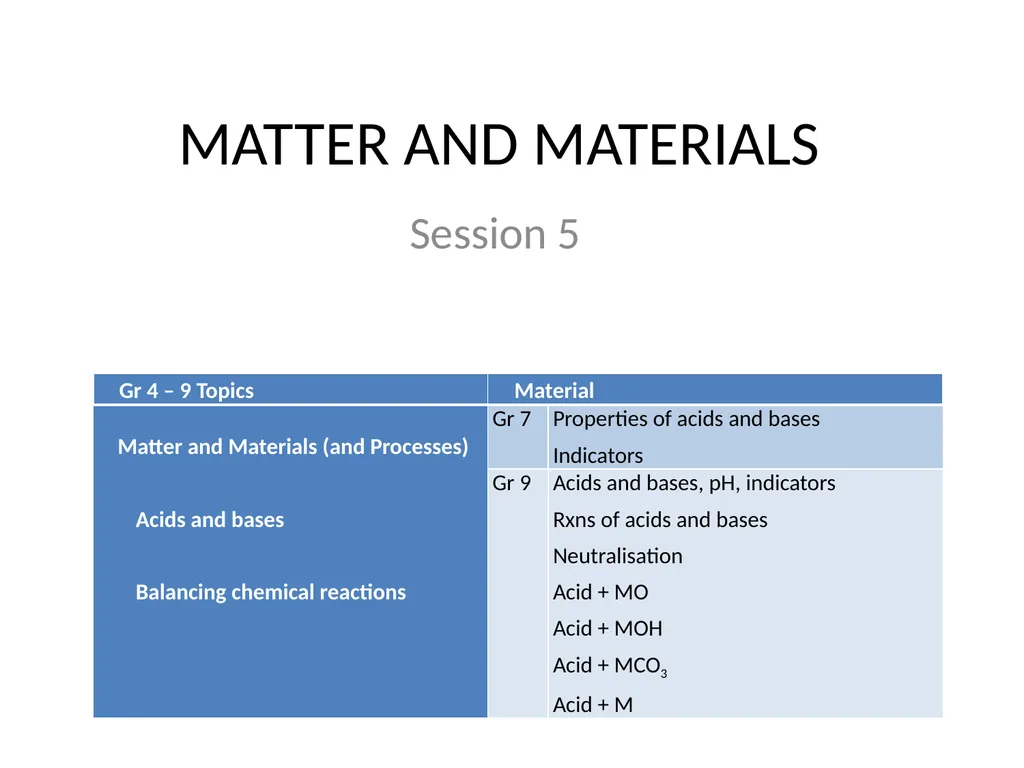
slide35. MATTER AND MATERIALS Session 5<br>
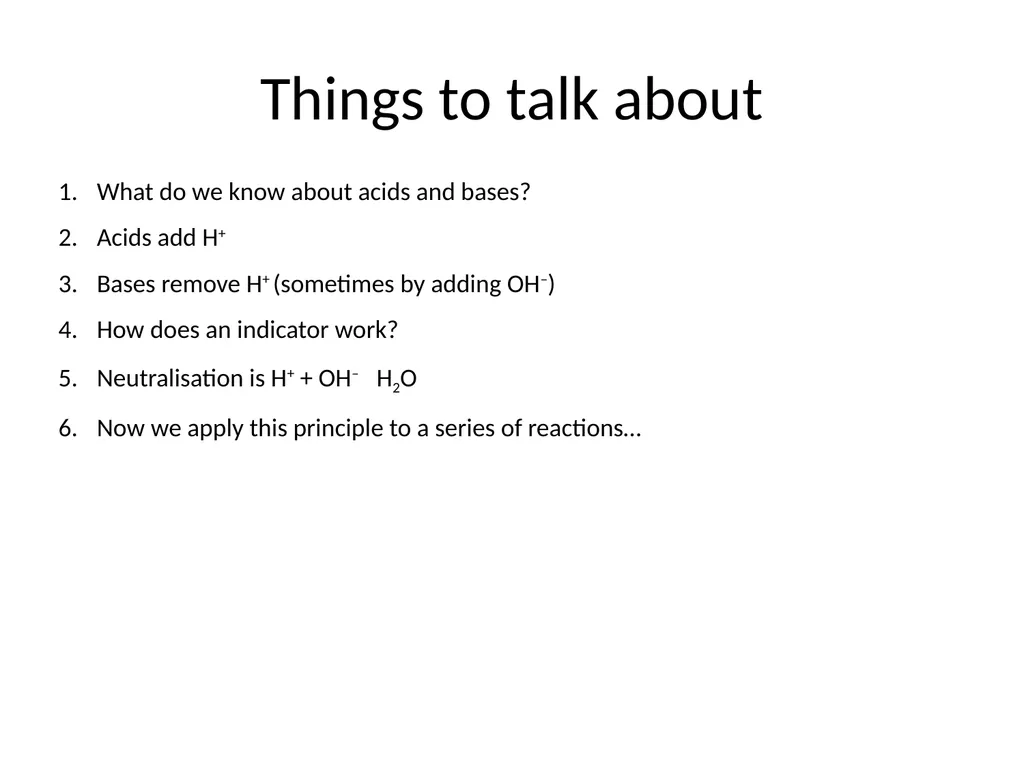
slide36. Things to talk about What do we know about acids and bases?
Acids add H+
Bases remove H+ (sometimes by adding OH–)
How does an indicator work?
Neutralisation is H+ + OH– H2O
Now we apply this principle to a series of reactions…<br>
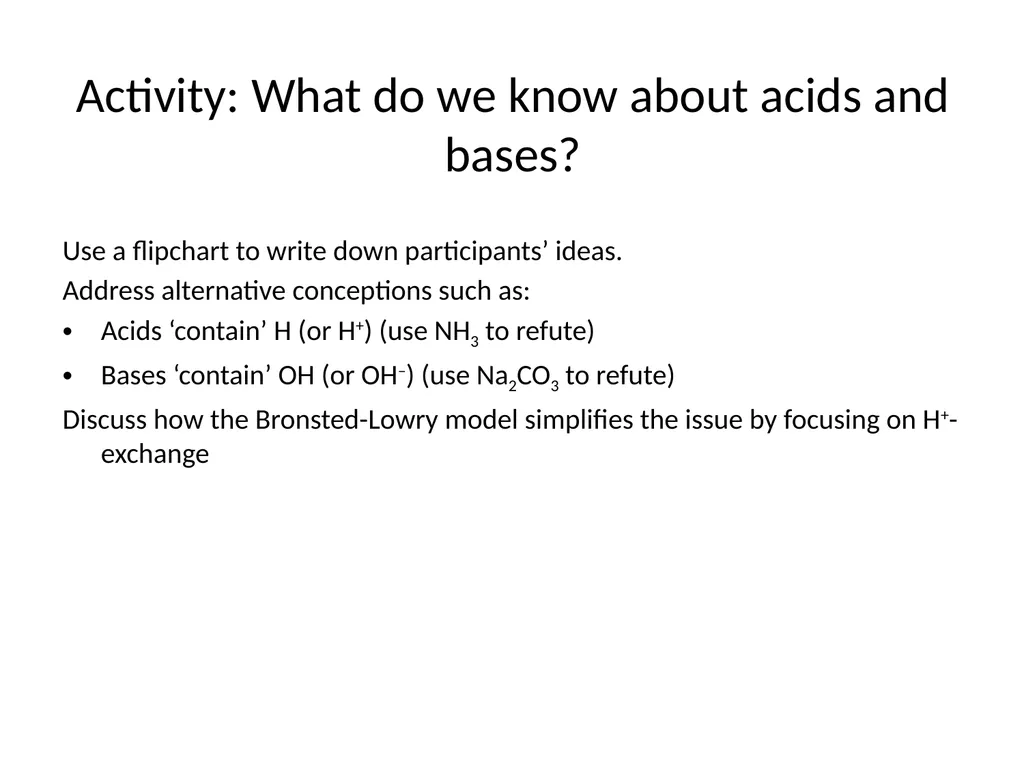
slide37. Activity: What do we know about acids and bases? Use a flipchart to write down participants’ ideas.
Address alternative conceptions such as:
Acids ‘contain’ H (or H+) (use NH3 to refute)
Bases ‘contain’ OH (or OH–) (use Na2CO3 to refute)
Discuss how the Bronsted-Lowry model simplifies the issue by focusing on H+-exchange<br>
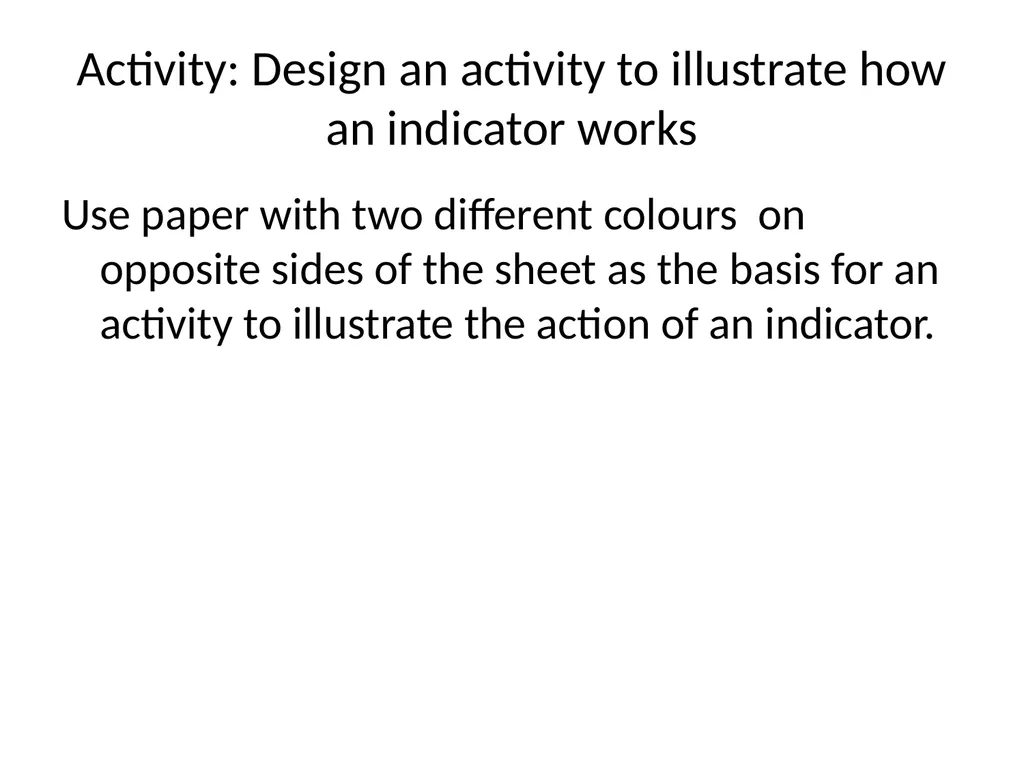
slide38. Activity: Design an activity to illustrate how an indicator works Use paper with two different colours on opposite sides of the sheet as the basis for an activity to illustrate the action of an indicator.<br>
slide39. The reaction H+ + OH– H2O is the driving force behind acid-base reactions<br>
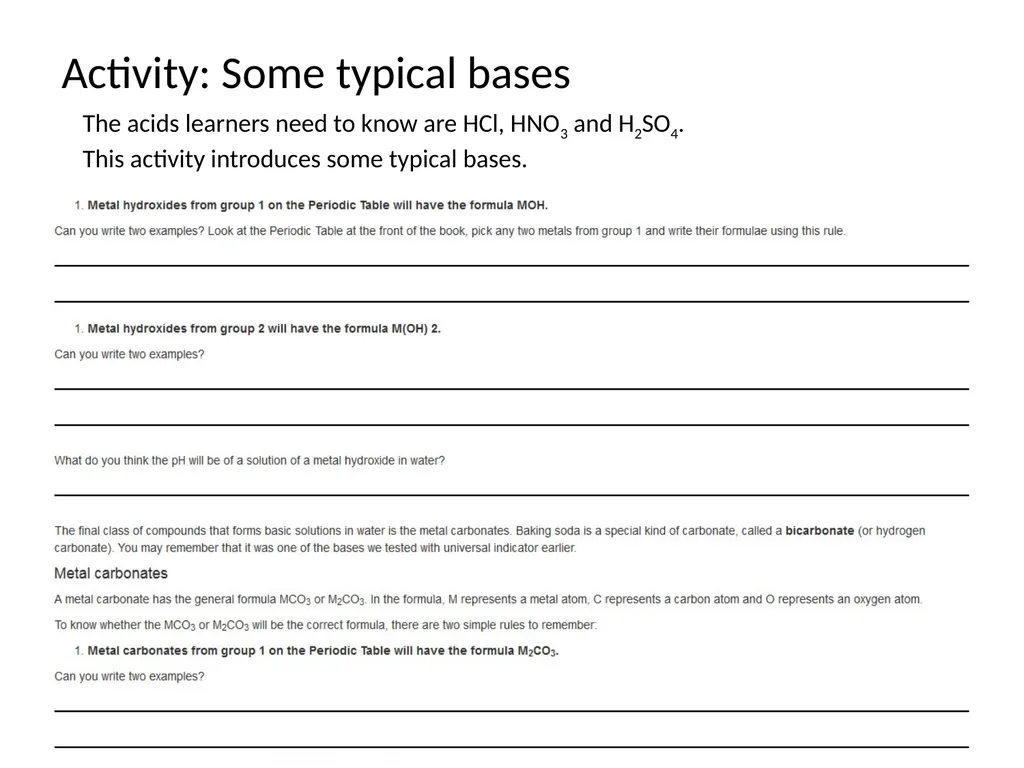
slide40. Activity: Some typical bases The acids learners need to know are HCl, HNO3 and H2SO4.
This activity introduces some typical bases.<br>
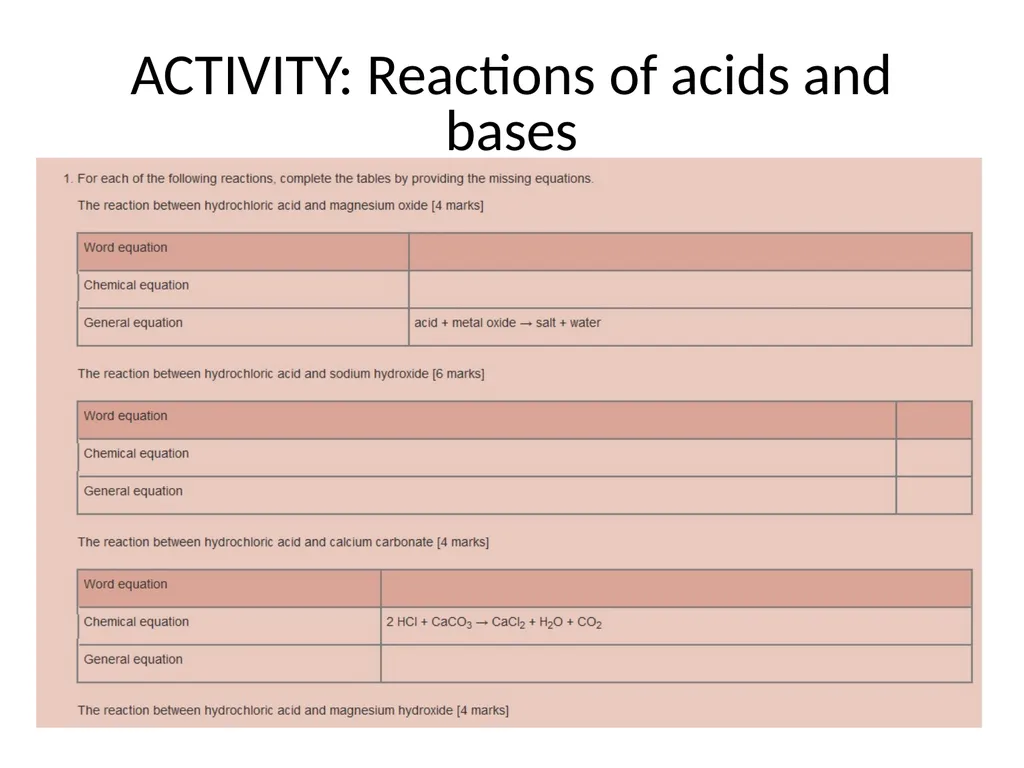
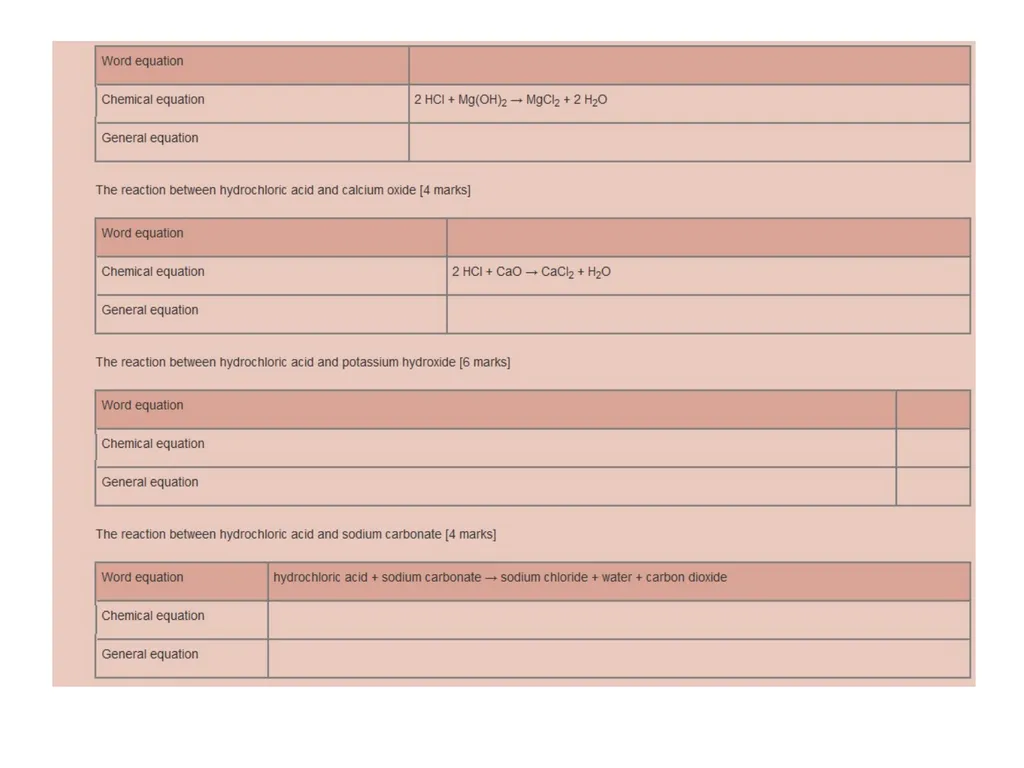
slide41. ACTIVITY: Reactions of acids and bases<br>

slide2. Things to talk about What happens when we warm up ice?
Thinking about particles (like a chemist).
Bringing in the energy connection.
The wonderful water molecule.
Understanding physical and chemical change.
Do molecules change when states change?
What about bonds and intermolecular forces?
Link to concept map<br>
slide3. Warm-up activity: Let’s pretend to be particles 9 – 12 participants are invited to the front where they must pretend to be the particles of:
A solid (vibrate but stay locked in place)
A liquid (move past each other but stay close)
A gas (scatter, occasionally bumping into each other and changing direction)
Use the activity as starting point for the discussion that follows.<br>
slide4. What happens when we warm up ice?(A discussion about changes of state) We know that the ice (solid water) turns to liquid, which will turn to water vapour if we continue to heat it:
Ice water water vapour
SOLID LIQUID GAS
Each of these changes of state require the addition of energy.
In order to reverse each change of state we would need to remove energy.<br>
slide5. Activity: Watch videos about changes of state and discuss their content Videos:
C005 Particles solid liquid gas.wmv
States of Matter.wmv
How does a liquid become a gas.wmv Questions to guide the discussion:
How can we link this to the particle model?
Refer to ‘Thinking like a chemist’ on the next slide.
How does adding energy “free” the particles during changes of state?
Discuss the forces between particles that are more easily overcome as the particles become more energetic.
What are the major differences between the 3 states of matter?
List them on paper, or verbally.<br>
slide6. Chemists use 3 modes of representation when they engage with their subject. Thinking like a chemist Macroscopic or observable properties can be explained in terms of the submicroscopic structure of materials.
Learners must gradually develop the ability to imagine events that occur on the level of fundamental particles (atoms and molecules).
They must also develop the ability to converse about these events in the highly symbolic language of chemistry.<br>
slide7. Activity: Let’s build a water molecule Participants each build a water molecule using clay.
(Specify the colours for the H and O atoms or you will get a range of interpretations.)
Participants join their water molecules to represent water in all three states.
Some diagrams to serve as guide:
Some questions to guide the discussion:
Do the molecules change when states change?
What is holding the water molecules together? (Discuss the difference between bonds and intermolecular forces)
How can we link this with physical vs chemical change?<br>
slide8. An excerpt from the workbook to discuss:(Grade 7 M&M)<br>
slide9. From Gr7 M&M<br>
slide11. Additional demonstration: Imploding a cold drink can<br>
slide12. MATTER AND MATERIALS Session 2<br>
slide13. Things to talk about What is a mixture?
When is a mixture also a solution?
Mixtures that contain water (or another solvent)
Terminology: Solute solvent solution
What happens when substances dissolve (and why do they dissolve?)
How can solutions be separated?
Building blocks of matter
What are the building blocks of these building blocks?<br>
slide14. Activity: Watch videos about mixtures and discuss their content Video:
The science of macaroni salad What’s in a mixture.wmv Questions to guide the discussion:
What is a mixture?
What are the 3 types of mixtures, and how are they different?
What is a solution?
Two or more substances that are blended on the level of fundamental particles, i.e. atoms and molecules.
Do the chemical character of molecules change when they dissolve?
What types of solutions are there?
Gases dissolved in a gas (air)
Solids dissolved in a solid (stainless steel) and other examples.
What do we get when mixtures are separated?
How is separating mixtures different from breaking down molecules?
Physical vs chemical separation<br>
slide15. Activity: Separating a mixture Participants receive:
a mixture of beads of different materials, sizes, shapes and colours; and
Tools for separating the mixture such as tray, piece of textured carpet, sieve, plastic cup, magnet.
The facilitator will identify the high-value component.
Participants must work in groups to separate the high-value component from their mixtures.
Participants must represent their methodology in a flow diagram.<br>
slide16. Video:
The science of macaroni salad What’s in a molecule.wmv Questions to guide the discussion:
What is a molecule?
What do we have when we put a whole lot of molecules of the same type together?
How do the molecules of one compound differ from the molecules of another compound?
What do we end up with when we break down a molecule?
(Link to physical vs chemical separation)<br>
slide17. Activity: Watch video about basic atomic structure and discuss its content Video:
Basic Atomic Structure.wmv Questions to guide the discussion:
What is an atom?
What do we have when we put a whole lot of atoms of the same type together?
How are the atoms of one element different from the atoms of another element?<br>
slide19. MATTER AND MATERIALS Session 3<br>
slide20. Things to talk about So we have different kinds of atoms. Now what?
How do we distinguish between different kinds of atoms? (Names, symbols, atomic numbers, placement on the Periodic Table).
What is so special about the periodic table?
When all the atoms in a substance are of the same type.
When a substance has atoms of more than one type.
When we have to start putting elements together.<br>
slide21. Discussion: How do we distinguish between different kinds of atoms? Different systems for identification:
Name
Symbol
Atomic number
Placement on the Periodic Table<br>
slide22. Discussion: What are the different regions on the periodic table?<br>
slide23. The blue area represents the metals.
The alkali and alkaline-earth metals
The industrial metals
The noble matals
The red areas represent the non-metals.
The yellow area represents the semi-metals.<br>
slide25. When all the atoms in a substance are of the same type, the substance is called an element.
When the molecules of a substance has atoms of more than one type, it is called a compound. Discussion: When atoms combine<br>
slide27. An element’s position on the periodic table helps predict how it will combine.
Discuss how we can use valency to predict the ratio in which atoms from opposite sides of the periodic table will combine.
Examples: MgO, NaCl, CaCl2, etc. Discussion: How do we know how to combine the elements into compounds?<br>
slide28. MATTER AND MATERIALS Session 4<br>
slide29. Things to talk about How can we make sense of it when substances react? (It all seems so random!)
Use the Periodic Table to help predict!
Get the products right before you try to balance.<br>
slide30. The periodic table contains patterns to help us.
Valencies can sometimes help us predict the ratios in which atoms combine Discussion: How do we make sense of chemical reactions?<br>
slide31. Discussion: Nomenclature of compounds
When to use prefixes (di-, tri- tetra- etc.) and when not to use them:
Metal + non-metal combinations do NOT use prefixes
Non-metal + non-metal combinations use prefixes<br>
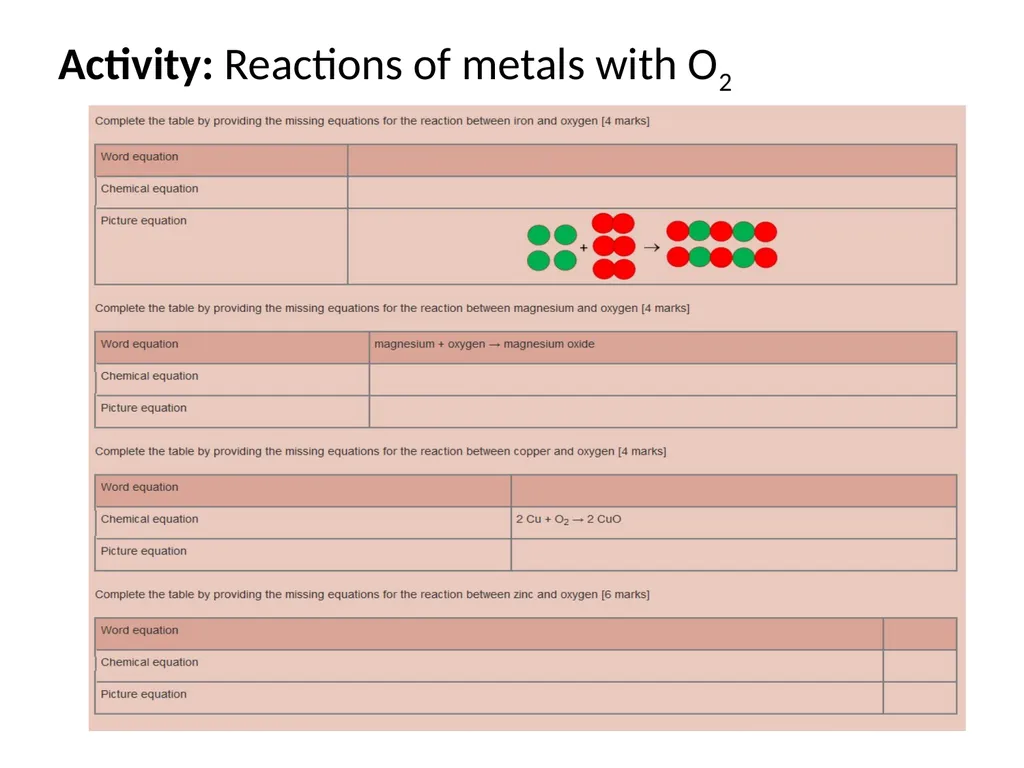
slide32. Activity: Reactions of metals with O2<br>
slide33. Activity: Reactions of non-metals with O2<br>
slide34. Activity: Watch two videos demonstrating how to balance equations. Videos:
(Get from Rene Toerien)<br>
slide35. MATTER AND MATERIALS Session 5<br>
slide36. Things to talk about What do we know about acids and bases?
Acids add H+
Bases remove H+ (sometimes by adding OH–)
How does an indicator work?
Neutralisation is H+ + OH– H2O
Now we apply this principle to a series of reactions…<br>
slide37. Activity: What do we know about acids and bases? Use a flipchart to write down participants’ ideas.
Address alternative conceptions such as:
Acids ‘contain’ H (or H+) (use NH3 to refute)
Bases ‘contain’ OH (or OH–) (use Na2CO3 to refute)
Discuss how the Bronsted-Lowry model simplifies the issue by focusing on H+-exchange<br>
slide38. Activity: Design an activity to illustrate how an indicator works Use paper with two different colours on opposite sides of the sheet as the basis for an activity to illustrate the action of an indicator.<br>
slide39. The reaction H+ + OH– H2O is the driving force behind acid-base reactions<br>
slide40. Activity: Some typical bases The acids learners need to know are HCl, HNO3 and H2SO4.
This activity introduces some typical bases.<br>
slide41. ACTIVITY: Reactions of acids and bases<br>