
Mental Wellbeing in Care Home settings A
AM
Published · 60 slides · 0 views

1 / 1








Description
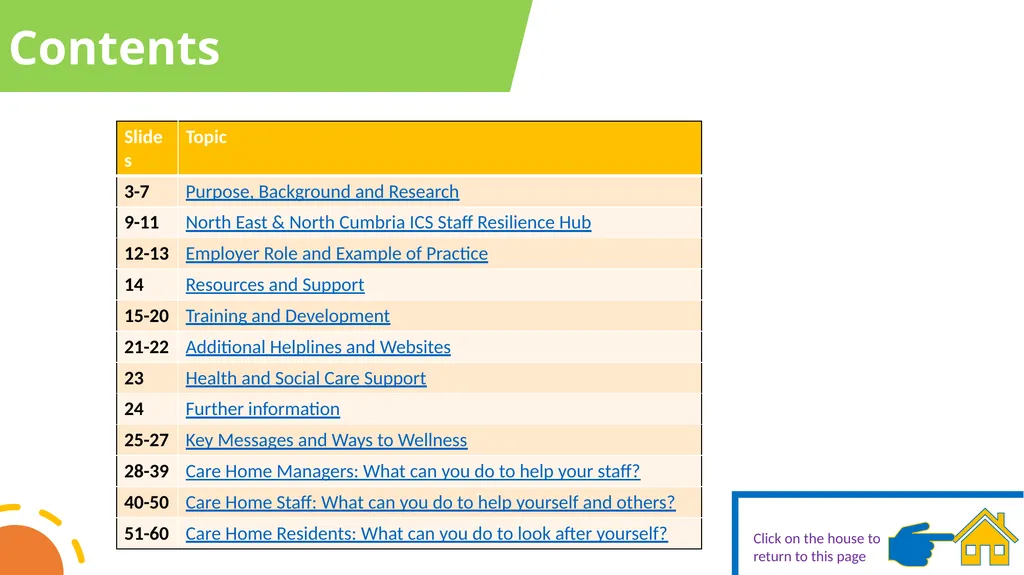
Mental Wellbeing in Care Home settings A supplementary briefing to support existing local guidance and to provide a consistency of support offer across the region, for Care Home staff and residents Contents Click on the house to return to
Related Topics
Share
Embed code
Download this presentation From Below
"Mental Wellbeing in Care Home settings A" is the property of its rightful owner. Permission is granted to download and print the materials on this website for personal, non-commercial use only, and to display it on your personal computer provided you do not modify the materials and that you retain all copyright notices contained in the materials. By downloading content from our website, you accept the terms of this agreement.
Presentation Transcript
01
Mental Wellbeing
in Care Home settings A supplementary briefing to support existing local guidance and to provide a consistency of support offer across the region, for Care Home staff and residents…<br>
02
Contents Click on the house to return to this page<br>
03
The Covid-19 pandemic has placed considerable pressures on the care home system resulting in concerns raised about the short and long- term effects of mental health and wellbeing of both staff and residents.
Looking after your mental wellbeing, how we think, feel and behave and developing emotional resilience can reduce the stress in our lives during the Covid-19 pandemic this is more important than ever before. Purpose & Background<br>
Looking after your mental wellbeing, how we think, feel and behave and developing emotional resilience can reduce the stress in our lives during the Covid-19 pandemic this is more important than ever before. Purpose & Background<br>
04
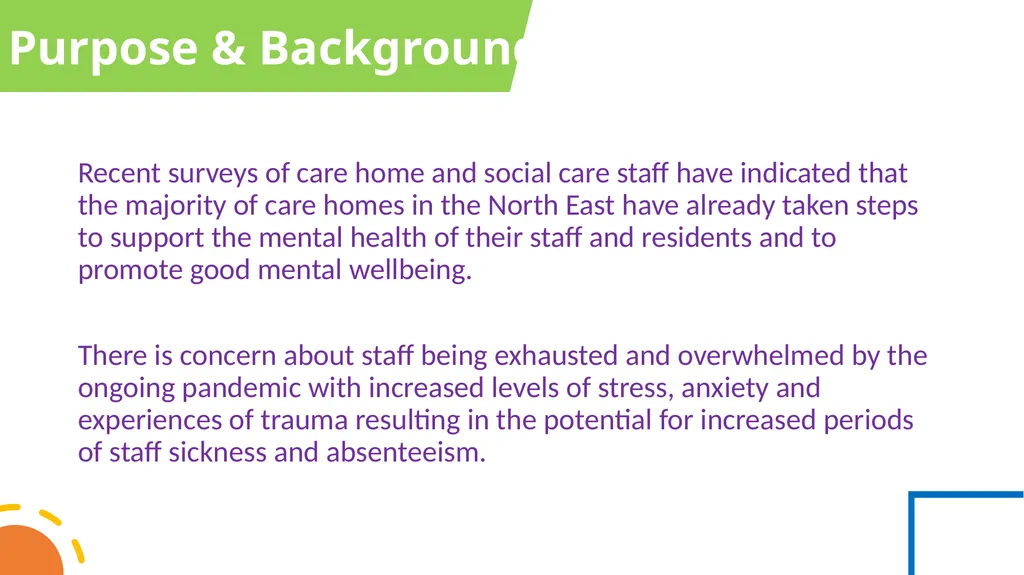
Recent surveys of care home and social care staff have indicated that the majority of care homes in the North East have already taken steps to support the mental health of their staff and residents and to promote good mental wellbeing.
There is concern about staff being exhausted and overwhelmed by the ongoing pandemic with increased levels of stress, anxiety and experiences of trauma resulting in the potential for increased periods of staff sickness and absenteeism. Purpose & Background<br>
There is concern about staff being exhausted and overwhelmed by the ongoing pandemic with increased levels of stress, anxiety and experiences of trauma resulting in the potential for increased periods of staff sickness and absenteeism. Purpose & Background<br>
05
A recent survey of care home staff and residents reported that… Staff were experiencing
Anxiety about managing an outbreak
Bereavement and grief
Long hours and a lack of break
Uncertainty and stress
The physical and emotional effect of wearing PPE all shift.<br>
Anxiety about managing an outbreak
Bereavement and grief
Long hours and a lack of break
Uncertainty and stress
The physical and emotional effect of wearing PPE all shift.<br>
06
A recent survey of care home staff and residents reported that… Residents were experiencing
Grief, fear and confusion about change to routine
Stress and anxiety
Uncertainty and fear
Missing family and friends
Negative impact of staff wearing PPE.<br>
Grief, fear and confusion about change to routine
Stress and anxiety
Uncertainty and fear
Missing family and friends
Negative impact of staff wearing PPE.<br>
07
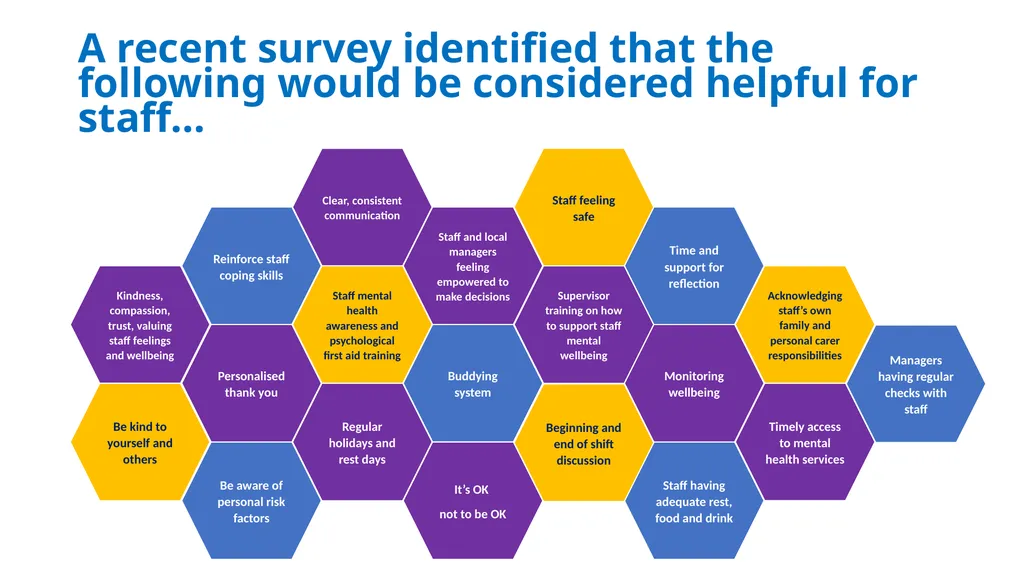
A recent survey identified that the following would be considered helpful for staff… Managers having regular checks with staff Reinforce staff coping skills Clear, consistent communication Staff and local managers feeling empowered to make decisions Supervisor training on how to support staff mental wellbeing Kindness, compassion, trust, valuing staff feelings and wellbeing Staff having adequate rest, food and drink Regular holidays and rest days Beginning and end of shift discussion Buddying system Be kind to yourself and others It’s OK
not to be OK Be aware of personal risk factors Monitoring wellbeing Personalised thank you Staff mental health awareness and psychological first aid training Timely access to mental health services Time and support for reflection Acknowledging staff’s own family and personal carer responsibilities Staff feeling safe<br>
not to be OK Be aware of personal risk factors Monitoring wellbeing Personalised thank you Staff mental health awareness and psychological first aid training Timely access to mental health services Time and support for reflection Acknowledging staff’s own family and personal carer responsibilities Staff feeling safe<br>
08
Mental Wellbeing: How to Help The next set of slides highlight accessible mental wellbeing support services, resources and training opportunities<br>
09
North East & North Cumbria ICS
Staff Resilience Hub
Helping our carers to keep on caring The new North East and North Cumbria Staff Wellbeing Hub brings together and builds on the existing support offers from individual organisations across the region. Our Hub team will ensure that all health and care staff who need support can quickly and confidentially access the best advice and treatment.
The confidential helpline is staffed by expert NHS psychological practitioners, who know what it is like to work through the pressures and difficulties of the Covid-19 pandemic. It is open to all NHS staff and our health and care sector partners.<br>
The confidential helpline is staffed by expert NHS psychological practitioners, who know what it is like to work through the pressures and difficulties of the Covid-19 pandemic. It is open to all NHS staff and our health and care sector partners.<br>
10
The confidential helpline is staffed by expert NHS psychological practitioners, who know what it is like to work through the pressures and difficulties of the Covid-19 pandemic. It is open to all NHS staff and our health and care sector partners.
The Hub team can offer a range of physical and psychological wellbeing support, including:
Navigating existing local support offers to find the right one for you
Access to experience therapists and evidence-based treatments
Support and coaching for managers
Trauma-informed approaches
Group and individual support
Someone to listen, support and advise North East & North Cumbria ICS Staff Resilience Hub<br>
The Hub team can offer a range of physical and psychological wellbeing support, including:
Navigating existing local support offers to find the right one for you
Access to experience therapists and evidence-based treatments
Support and coaching for managers
Trauma-informed approaches
Group and individual support
Someone to listen, support and advise North East & North Cumbria ICS Staff Resilience Hub<br>
11
There is strength in asking for help.
Call us seven days a week including bank holidays from 7am – 9pm
Call 0191 223 2030
Therapists are available between 12-6pm Monday to Friday, if you call outside these hours and need to speak to a therapist, helpline staff will arrange for a therapist to call you back at the soonest suitable time.
You can also try monitoring your own wellbeing by using a diary at www.mypersonalwellbeing.co.uk
For more information on the hub, please email necsu.nencicsmentalhealth@nhs.net<br>
Call us seven days a week including bank holidays from 7am – 9pm
Call 0191 223 2030
Therapists are available between 12-6pm Monday to Friday, if you call outside these hours and need to speak to a therapist, helpline staff will arrange for a therapist to call you back at the soonest suitable time.
You can also try monitoring your own wellbeing by using a diary at www.mypersonalwellbeing.co.uk
For more information on the hub, please email necsu.nencicsmentalhealth@nhs.net<br>
12
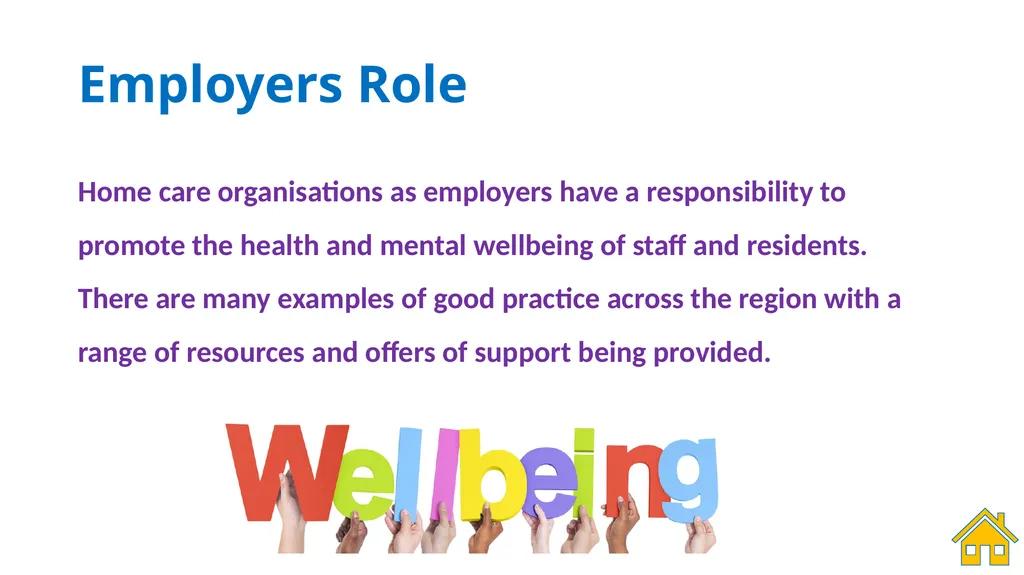
Employers Role Home care organisations as employers have a responsibility to promote the health and mental wellbeing of staff and residents. There are many examples of good practice across the region with a range of resources and offers of support being provided.<br>
13
“I have provided the staff with information about the Peninsula Employee Assistance Programme (click to view) which offers a 24 hour confidential helpline to support staff through any of life's issues or problems, covering stress and anxiety, work advice, relationship advice, gambling issues, alcohol and drug issues, legal information, financial wellbeing, counselling, family issues, childcare support, medical information and consumer issues. The details for this scheme are displayed on our notice board for staff to have easy access to. There are also details of 12 websites offering wellbeing resources and links to live you tube videos to support and assist staff look after some of the issues they may be encountering during the pandemic”.
Gateshead Care Home Example of practice<br>
Gateshead Care Home Example of practice<br>
14
Resources & Support Mental Health for employer’s toolkit
For tips and advice on looking after mental health and mental wellbeing in the workplace, go to the Mental Health for employer’s toolkit developed by Princes Responsible Community Network and Public Health England 2019.
Mental Health at Work
Provides a range of help and advice for looking after the mental wellbeing of staff.
Mind for better Mental Health
Mind, the national mental health charity, provides a range of mental health support resources. Whether you're an employee worried about your own or a colleague's mental health, a company looking for a charity partner, or an HR professional interested in improving mental wellbeing in your organisation. (Click on headings for more information)<br>
For tips and advice on looking after mental health and mental wellbeing in the workplace, go to the Mental Health for employer’s toolkit developed by Princes Responsible Community Network and Public Health England 2019.
Mental Health at Work
Provides a range of help and advice for looking after the mental wellbeing of staff.
Mind for better Mental Health
Mind, the national mental health charity, provides a range of mental health support resources. Whether you're an employee worried about your own or a colleague's mental health, a company looking for a charity partner, or an HR professional interested in improving mental wellbeing in your organisation. (Click on headings for more information)<br>
15
Training & Development
Key Skills to look after yourself and others Mind for better Mental Health – Mental Health at Work E-Learning
Mental Health Awareness at Work is an introductory course suitable for all employees. Provides a basic understanding of mental health and mental well-being.
Public Health England - Psychological First Aid in Emergencies Training for
Frontline Staff and Volunteers
Free online psychological first aid training from Public Health England (PHE) available to frontline staff and volunteers. Training will equip staff to provide support and recognise people at risk of distress. Follows globally recommended model for supporting people during emergencies, tailored to the specific challenges of coronavirus (COVID-19). (Click on headings for more information)<br>
Mental Health Awareness at Work is an introductory course suitable for all employees. Provides a basic understanding of mental health and mental well-being.
Public Health England - Psychological First Aid in Emergencies Training for
Frontline Staff and Volunteers
Free online psychological first aid training from Public Health England (PHE) available to frontline staff and volunteers. Training will equip staff to provide support and recognise people at risk of distress. Follows globally recommended model for supporting people during emergencies, tailored to the specific challenges of coronavirus (COVID-19). (Click on headings for more information)<br>
16
Training & Development
Key Skills to look after yourself and others Mental Health First Aid England - Mental Health First Aid
Mental Health First Aid (MHFA) England offers a variety of training for employers across the UK. This two- day workplace course will qualify you as a Mental Health First Aider.
Skills for Care – Building Resilience in the Workforce
Skills for Care have developed a useful resource for adult social care workers offering practical guidance on how to develop resilience within the workforce.
Developing resilience of the people you work with, protecting their mental and physical health is essential to retaining staff and helps them consistently deliver quality care. (Click on headings for more information)<br>
Mental Health First Aid (MHFA) England offers a variety of training for employers across the UK. This two- day workplace course will qualify you as a Mental Health First Aider.
Skills for Care – Building Resilience in the Workforce
Skills for Care have developed a useful resource for adult social care workers offering practical guidance on how to develop resilience within the workforce.
Developing resilience of the people you work with, protecting their mental and physical health is essential to retaining staff and helps them consistently deliver quality care. (Click on headings for more information)<br>
17
Training & Development
Key Skills to look after yourself and others Beyond Coaching - Resilience Tool Kit
Beyond Coaching offer a free online Resilience toolkit for all NHS employees & Key Workers.
“Resilience is the ability to adapt effectively in the face of adversity, trauma, tragedy, threats or significant sources of stress and anxiety, whether this be in your personal or professional life. Individuals with strong resilience are able to “bounce back” from difficult experiences and keep moving forward.” (Click on headings for more information)<br>
Beyond Coaching offer a free online Resilience toolkit for all NHS employees & Key Workers.
“Resilience is the ability to adapt effectively in the face of adversity, trauma, tragedy, threats or significant sources of stress and anxiety, whether this be in your personal or professional life. Individuals with strong resilience are able to “bounce back” from difficult experiences and keep moving forward.” (Click on headings for more information)<br>
18
Training & Development
Key Skills to look after yourself and others Resilience, Mind and Rhythm – Developing Emotional Resilience course
Developing Emotional Resilience course is designed for health care workers. A module specifically for social care staff is expected to be added in the future. The course aims to increase your ability to cope with life’s daily challenges during the COVID-19 pandemic. It is made up of a series of lectures, quizzes and practical activities to help staff cope with pressures and stresses that are especially heightened at this time. (Click on headings for more information)<br>
Developing Emotional Resilience course is designed for health care workers. A module specifically for social care staff is expected to be added in the future. The course aims to increase your ability to cope with life’s daily challenges during the COVID-19 pandemic. It is made up of a series of lectures, quizzes and practical activities to help staff cope with pressures and stresses that are especially heightened at this time. (Click on headings for more information)<br>
19
Training & Development
Key Skills to look after yourself and others Mindfulness – Covid-19 resource pack
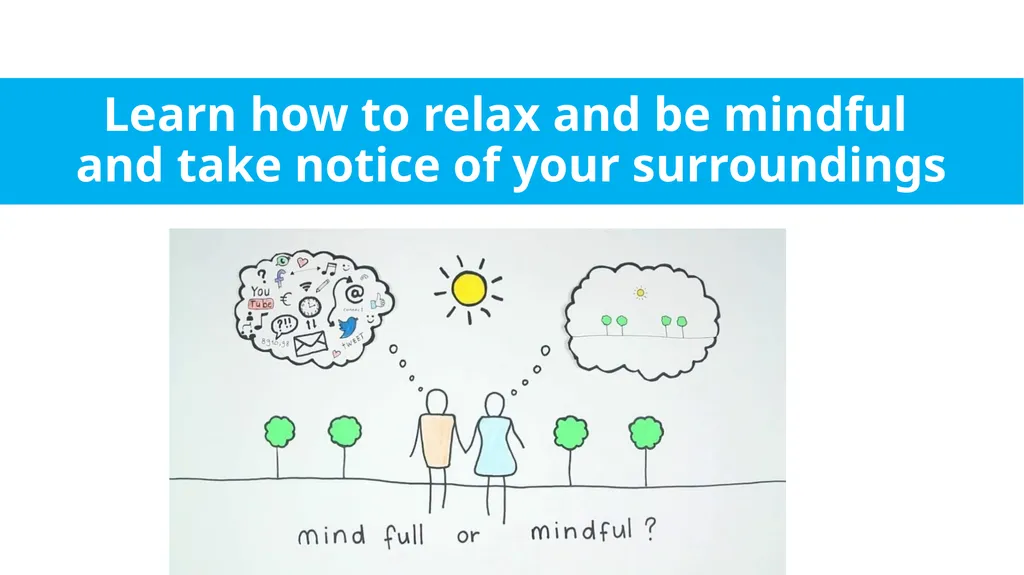
Practicing mindfulness is paying more attention to the present moment; to your own thoughts and feelings, and to the world around you. Being more ‘in the now’ instead of focusing or worrying about the future or the past can improve your mental wellbeing.
The Mindfulness Initiative offer specialist advice and guidance and have developed a Covid-19 resource pack. (Click on headings for more information)<br>
Practicing mindfulness is paying more attention to the present moment; to your own thoughts and feelings, and to the world around you. Being more ‘in the now’ instead of focusing or worrying about the future or the past can improve your mental wellbeing.
The Mindfulness Initiative offer specialist advice and guidance and have developed a Covid-19 resource pack. (Click on headings for more information)<br>
20
Training & Development
Key Skills to look after yourself and others Self-care Psychology – The 5 Pillars of Protection framework
Self-Care Psychology developed “The 5 Pillars of Protection” which is a framework for protecting practitioners at risk of professional trauma and fatigue. Including: Awareness, Supervision, Peer support, Self-care and Trauma informed.
Zero Suicide Alliance – 20 minute training course
An in-depth suicide prevention training session which aims to give you the life-saving skills and confidence to help someone who may be considering suicide. (Click on headings for more information)<br>
Self-Care Psychology developed “The 5 Pillars of Protection” which is a framework for protecting practitioners at risk of professional trauma and fatigue. Including: Awareness, Supervision, Peer support, Self-care and Trauma informed.
Zero Suicide Alliance – 20 minute training course
An in-depth suicide prevention training session which aims to give you the life-saving skills and confidence to help someone who may be considering suicide. (Click on headings for more information)<br>
21
Additional Helplines & Websites NHS Every Mind Matters
Having good mental health helps us relax more, achieve more and enjoy our lives more. This site provides expert advice and practical tips to help you look after your mental health and wellbeing.
Listening Ear
Bereavement support service offers a range of support for people who have experienced grief and loss through bereavement. Specific Covid-19 resources available.
Phone: 0800 048 5224
Samaritans
Support for essential staff 24/7.
Phone: 01226 116123 or 0300 131 7000 (Click on headings for more information)<br>
Having good mental health helps us relax more, achieve more and enjoy our lives more. This site provides expert advice and practical tips to help you look after your mental health and wellbeing.
Listening Ear
Bereavement support service offers a range of support for people who have experienced grief and loss through bereavement. Specific Covid-19 resources available.
Phone: 0800 048 5224
Samaritans
Support for essential staff 24/7.
Phone: 01226 116123 or 0300 131 7000 (Click on headings for more information)<br>
22
Additional Helplines & Websites Shout
Commissioned by NHS England to support health and social care staff. A 24/7 text service for health and social care staff, on the frontline fighting Covid-19.
Text: FRONTLINE to 85258 for a text chat
Home Care Insight – Advice for care workers managing mental health during
Covid-19
This article from trade magazine Home Care Insight breaks down the key information from the World Health Organisation for care workers, including all the relevant tips and advice for your profession.
MIND – Coronavirus: Coping as a Key Worker
Information for managing stress and anxiety as a key worker, as well as additional advice for managing your mental wellbeing during Covid-19 (Click on headings for more information)<br>
Commissioned by NHS England to support health and social care staff. A 24/7 text service for health and social care staff, on the frontline fighting Covid-19.
Text: FRONTLINE to 85258 for a text chat
Home Care Insight – Advice for care workers managing mental health during
Covid-19
This article from trade magazine Home Care Insight breaks down the key information from the World Health Organisation for care workers, including all the relevant tips and advice for your profession.
MIND – Coronavirus: Coping as a Key Worker
Information for managing stress and anxiety as a key worker, as well as additional advice for managing your mental wellbeing during Covid-19 (Click on headings for more information)<br>
23
Health & Social Care Support
Useful links Our NHS People support directory
Reduce stress, anxiety and depression
https://www.hse.gov.uk/stress/mental-health.htm (Click on text for more information)<br>
Reduce stress, anxiety and depression
https://www.hse.gov.uk/stress/mental-health.htm (Click on text for more information)<br>
24
In addition… The Department of Health and Social Care has a Care Workforce COVID-19 app, providing health and social care workers with practical information and health and wellbeing support.
The Queen's Nursing Institute's offers a listening service, providing emotional support to registered nurses working in the community.
Open Change has visual resources about coronavirus for health and social care workers, looking at stress, coping and resilience, difficult conversations, and care homes.
King's Health Partners has a collection of staff health and wellbeing resources for coronavirus.
The Care Workers Charity provides financial support for people working in the care sector. (Click on yellow text for more information)<br>
The Queen's Nursing Institute's offers a listening service, providing emotional support to registered nurses working in the community.
Open Change has visual resources about coronavirus for health and social care workers, looking at stress, coping and resilience, difficult conversations, and care homes.
King's Health Partners has a collection of staff health and wellbeing resources for coronavirus.
The Care Workers Charity provides financial support for people working in the care sector. (Click on yellow text for more information)<br>
25
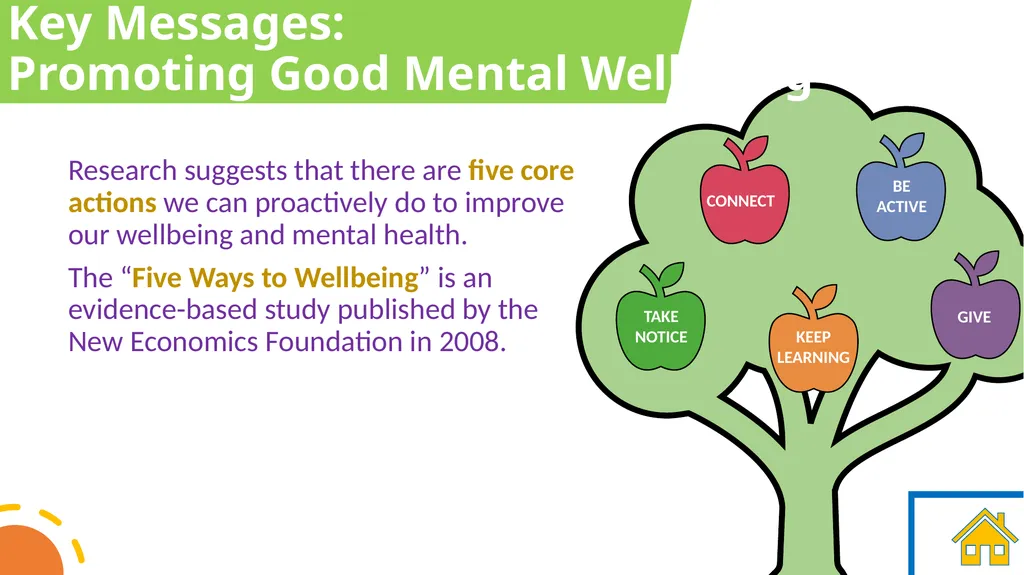
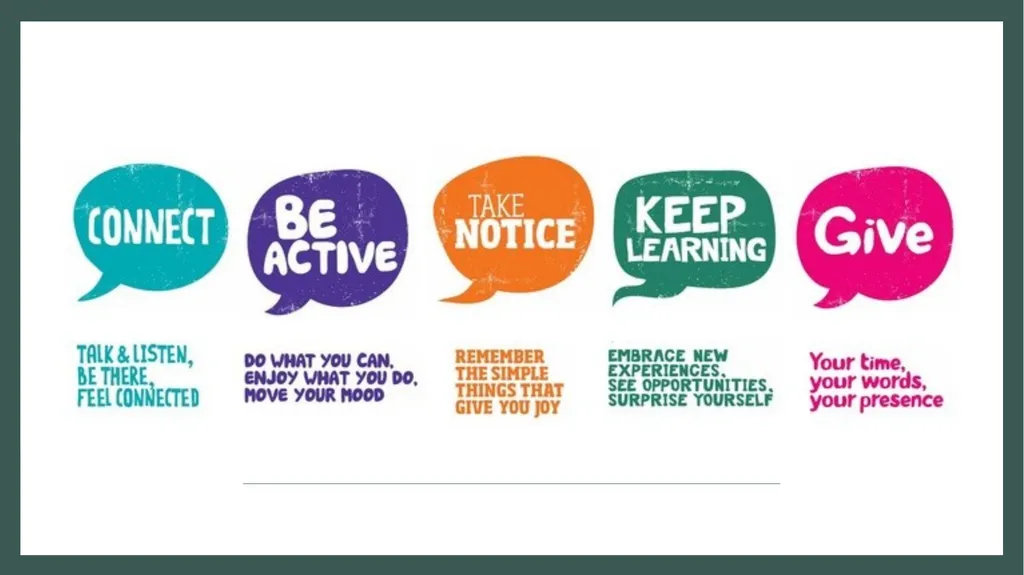
Research suggests that there are five core actions we can proactively do to improve our wellbeing and mental health.
The “Five Ways to Wellbeing” is an evidence-based study published by the New Economics Foundation in 2008. Key Messages: Promoting Good Mental Wellbeing<br>
The “Five Ways to Wellbeing” is an evidence-based study published by the New Economics Foundation in 2008. Key Messages: Promoting Good Mental Wellbeing<br>
26
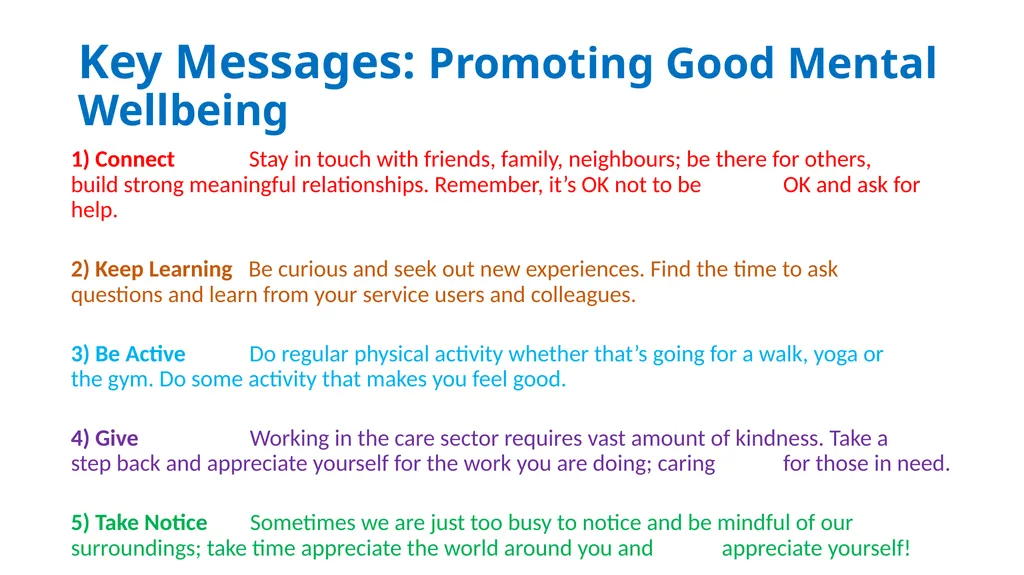
Key Messages: Promoting Good Mental Wellbeing 1) Connect Stay in touch with friends, family, neighbours; be there for others, build strong meaningful relationships. Remember, it’s OK not to be OK and ask for help.
2) Keep Learning Be curious and seek out new experiences. Find the time to ask questions and learn from your service users and colleagues.
3) Be Active Do regular physical activity whether that’s going for a walk, yoga or the gym. Do some activity that makes you feel good.
4) Give Working in the care sector requires vast amount of kindness. Take a step back and appreciate yourself for the work you are doing; caring for those in need.
5) Take Notice Sometimes we are just too busy to notice and be mindful of our surroundings; take time appreciate the world around you and appreciate yourself!<br>
2) Keep Learning Be curious and seek out new experiences. Find the time to ask questions and learn from your service users and colleagues.
3) Be Active Do regular physical activity whether that’s going for a walk, yoga or the gym. Do some activity that makes you feel good.
4) Give Working in the care sector requires vast amount of kindness. Take a step back and appreciate yourself for the work you are doing; caring for those in need.
5) Take Notice Sometimes we are just too busy to notice and be mindful of our surroundings; take time appreciate the world around you and appreciate yourself!<br>
27
Key Messages: Promoting Good Mental Wellbeing Good mental wellbeing doesn’t mean that you will never experience situations you find difficult. But it does mean that you might have resilience to cope when things get tough…<br>
28
Care Home Managers
What can you do to help your staff? Health Education England asked a group of international experts who offered the following advice…<br>
29
Skilling up normal principles apply Staff may feel particularly vulnerable at being asked to undertake things that they do not feel trained to do, or that they no longer feel skilled to undertake
It is important to provide training, support, ongoing supervision, feedback on practical skills
Students who have been redeployed or had their training interrupted may experience additional stress or anxiety about this move. They may worry about the tasks they are facing
Enable these people particularly to ‘buddy up' with an experienced team member and try to offer<br>
It is important to provide training, support, ongoing supervision, feedback on practical skills
Students who have been redeployed or had their training interrupted may experience additional stress or anxiety about this move. They may worry about the tasks they are facing
Enable these people particularly to ‘buddy up' with an experienced team member and try to offer<br>
30
Skilling up normal principles apply Help them to map their new experiences on to their original programmes of study, so that all learning makes more sense
Encourage them to use reflective journals or other methods of documenting their time
‘Fresh eyes’ can sometimes be most useful in seeing what was missed by others; encourage them to openly question for everyone’s benefit<br>
Encourage them to use reflective journals or other methods of documenting their time
‘Fresh eyes’ can sometimes be most useful in seeing what was missed by others; encourage them to openly question for everyone’s benefit<br>
31
Principled and value based good leadership High quality leadership is hugely important: be a good role model and follow the principles you are suggesting to your staff
This means honesty, fairness and transparency about the challenges and ambiguities staff are facing, along with:
Good supervision
Access to proper equipment
Time for rest breaks & Quiet rooms
Peer support within teams
Allowing for questions from colleagues
Be aware of staff who may be more vulnerable (e.g. with pre-existing medical or mental disorders) and find appropriate solutions for them<br>
This means honesty, fairness and transparency about the challenges and ambiguities staff are facing, along with:
Good supervision
Access to proper equipment
Time for rest breaks & Quiet rooms
Peer support within teams
Allowing for questions from colleagues
Be aware of staff who may be more vulnerable (e.g. with pre-existing medical or mental disorders) and find appropriate solutions for them<br>
32
Structured Operational Debriefing These are routine ways to relieve the build-up of stress during a shift by sharing at its end and learning from each other. This sharing has to be blame-free, iterative, reflective, kind and supportive. It cascades and influences compassion and attitudes to each other and residents.
Ensure staff do not feel compelled to talk about personal experiences they do not feel ready to talk about
It is necessary to have other mechanisms to reach out to those who do not immediately participate (or even more worryingly, refuse to participate) in offers of support or processes intended to support mental wellbeing
We are not superheroes. We need to be looked after too. That is a top priority so that we can carry on effectively in our role or service<br>
Ensure staff do not feel compelled to talk about personal experiences they do not feel ready to talk about
It is necessary to have other mechanisms to reach out to those who do not immediately participate (or even more worryingly, refuse to participate) in offers of support or processes intended to support mental wellbeing
We are not superheroes. We need to be looked after too. That is a top priority so that we can carry on effectively in our role or service<br>
33
Moral Distress and Moral Injury Moral injury: conflict between your moral code and the decisions that you and others have had to take. This is a well-recognised risk when difficult decisions have to be made under pressure
Moral injury can result in persistent guilt, shame, self-disgust or disillusion with the team and the task
Moral injury can make a person much more vulnerable to mental health problems
Team leaders need to help their staff with these dilemmas. E.G. Operational team debriefing, team buddies.
Some staff may have additional needs. Support should be considered along the usual pathways for the organisation, locally and using national support services
Learning from experiences means that at times decisions or policies may need to be reviewed<br>
Moral injury can result in persistent guilt, shame, self-disgust or disillusion with the team and the task
Moral injury can make a person much more vulnerable to mental health problems
Team leaders need to help their staff with these dilemmas. E.G. Operational team debriefing, team buddies.
Some staff may have additional needs. Support should be considered along the usual pathways for the organisation, locally and using national support services
Learning from experiences means that at times decisions or policies may need to be reviewed<br>
34
Advice from those who have faced this pandemic Encourage staff not to hesitate to ask you or your institution for help
Encourage them to call friends or family – it helps to avoid them feeling isolated inside a closed environment
Ensure you and your staff have breaks during the day: you will be more useful if you’re well rested than if you are too tired
Think about putting into place rotations between high stress duties and lower stress duties
Think about working in pairs, between junior and senior professionals. This facilitates support and management of stress
Make use of existing support mechanisms in your organisation<br>
Encourage them to call friends or family – it helps to avoid them feeling isolated inside a closed environment
Ensure you and your staff have breaks during the day: you will be more useful if you’re well rested than if you are too tired
Think about putting into place rotations between high stress duties and lower stress duties
Think about working in pairs, between junior and senior professionals. This facilitates support and management of stress
Make use of existing support mechanisms in your organisation<br>
35
Having the right physical resources in place supports
psychological safety The correct PPE in plentiful supply
Adequate rest breaks
Good quality food available
Assisting with maintaining contact virtually with loved ones
Psychological safety within teams has been shown to reduce errors
Emotional support does not stand in place of physical needs and resources<br>
Adequate rest breaks
Good quality food available
Assisting with maintaining contact virtually with loved ones
Psychological safety within teams has been shown to reduce errors
Emotional support does not stand in place of physical needs and resources<br>
36
Staff need to look after their basic physical needs Stay hydrated, eat and have toilet breaks
If it gets too hot, tell others and take a short break
Beware exhaustion:- constant awareness and vigilance regarding infection control is a pressure.
Be aware that masks etc can rub the skin and distract; use a barrier cream on cleansed skin
Be aware communication difficulty with PPE – staff will need to be able to communicate with colleagues and residents – remember residents may also feel overwhelmed<br>
If it gets too hot, tell others and take a short break
Beware exhaustion:- constant awareness and vigilance regarding infection control is a pressure.
Be aware that masks etc can rub the skin and distract; use a barrier cream on cleansed skin
Be aware communication difficulty with PPE – staff will need to be able to communicate with colleagues and residents – remember residents may also feel overwhelmed<br>
37
Stigma: Social Care Workers may face stigma Social care workers can be affected by both self-critical and external stigma related to the COVID-19 virus and its impact, such as:
Self-stigma about voicing their needs and fears
Managers can help by empathising, pointing out that stigma is unsurprising, if distressing within the COVID-19 situation, and highlighting camaraderie at work
Others’ fear of contact with those treating patients with COVID-19<br>
Self-stigma about voicing their needs and fears
Managers can help by empathising, pointing out that stigma is unsurprising, if distressing within the COVID-19 situation, and highlighting camaraderie at work
Others’ fear of contact with those treating patients with COVID-19<br>
38
Home, Work and Redeployment Potential trauma plays out across more than one aspect of staff members’ lives. Work, home and friendships may be affected over time
Set up a system for staff to feedback on management initiatives so that concerns can be raised and responded to rapidly in a visible way
If staff are being moved away from their home area, or cannot go home because of a fear for their loved ones, this can exacerbate guilt at not being at home to support their families<br>
Set up a system for staff to feedback on management initiatives so that concerns can be raised and responded to rapidly in a visible way
If staff are being moved away from their home area, or cannot go home because of a fear for their loved ones, this can exacerbate guilt at not being at home to support their families<br>
39
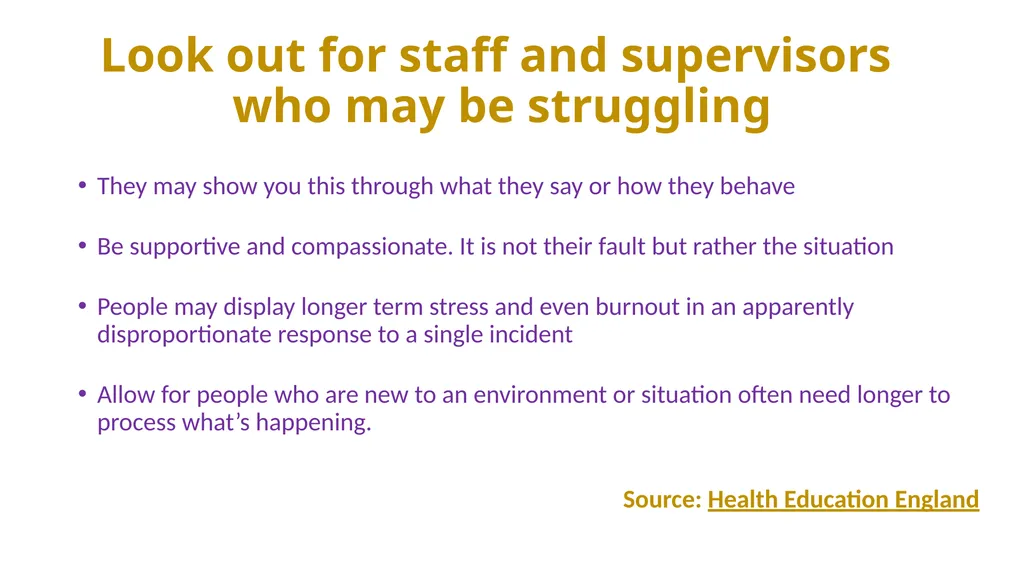
Look out for staff and supervisors
who may be struggling They may show you this through what they say or how they behave
Be supportive and compassionate. It is not their fault but rather the situation
People may display longer term stress and even burnout in an apparently disproportionate response to a single incident
Allow for people who are new to an environment or situation often need longer to process what’s happening.
Source: Health Education England<br>
Be supportive and compassionate. It is not their fault but rather the situation
People may display longer term stress and even burnout in an apparently disproportionate response to a single incident
Allow for people who are new to an environment or situation often need longer to process what’s happening.
Source: Health Education England<br>
40
Care Home Staff
What can you do to help yourself and others Health Education England asked a group of international experts who offered the following advice…<br>
41
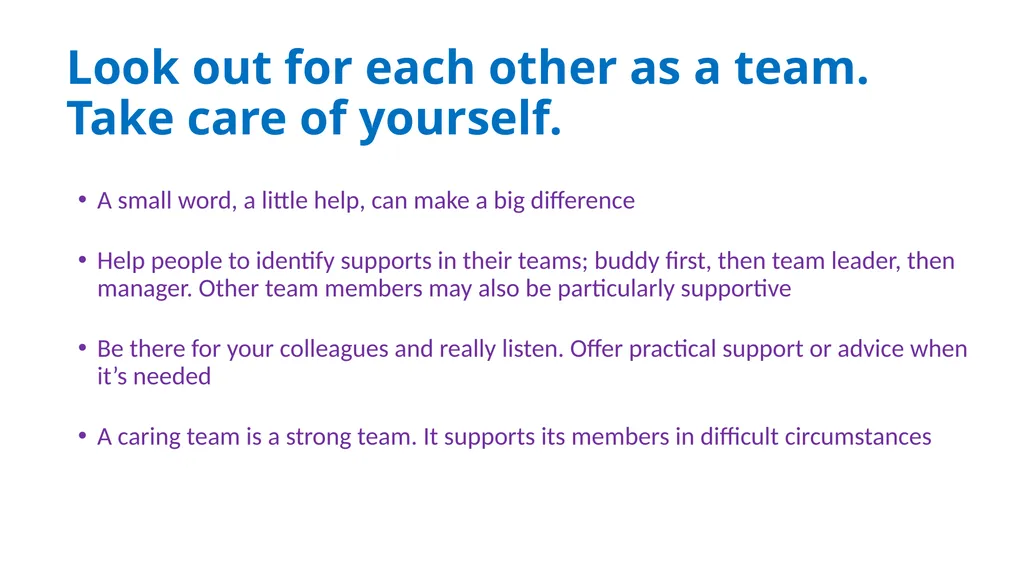
Look out for each other as a team.
Take care of yourself. A small word, a little help, can make a big difference
Help people to identify supports in their teams; buddy first, then team leader, then manager. Other team members may also be particularly supportive
Be there for your colleagues and really listen. Offer practical support or advice when it’s needed
A caring team is a strong team. It supports its members in difficult circumstances<br>
Help people to identify supports in their teams; buddy first, then team leader, then manager. Other team members may also be particularly supportive
Be there for your colleagues and really listen. Offer practical support or advice when it’s needed
A caring team is a strong team. It supports its members in difficult circumstances<br>
42
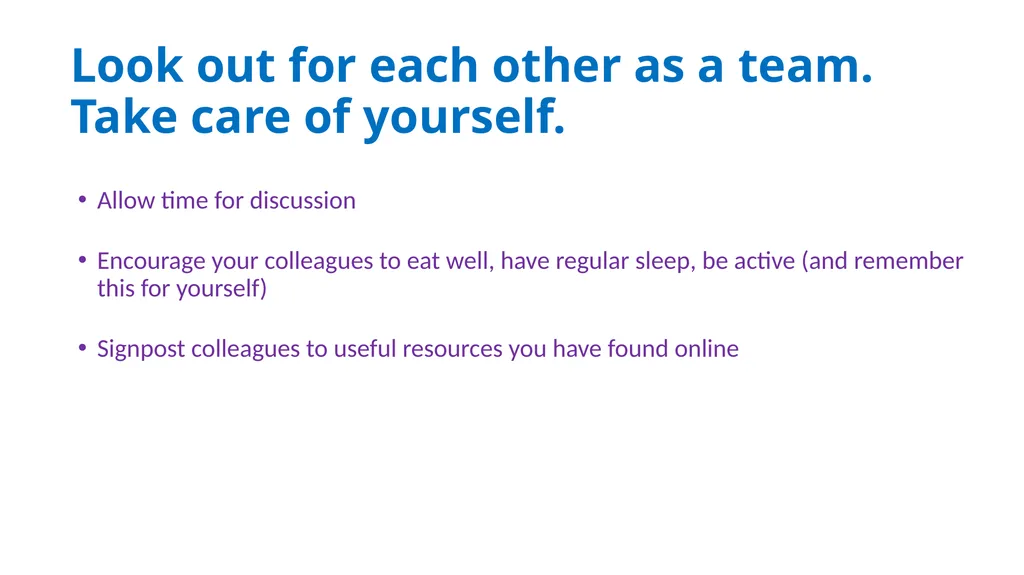
Look out for each other as a team.
Take care of yourself. Allow time for discussion
Encourage your colleagues to eat well, have regular sleep, be active (and remember this for yourself)
Signpost colleagues to useful resources you have found online<br>
Encourage your colleagues to eat well, have regular sleep, be active (and remember this for yourself)
Signpost colleagues to useful resources you have found online<br>
43
Ask others how they are Genuine interest really helps, it's real ‘social scaffolding’
Don’t approach others as having a problem that you have to fix<br>
Don’t approach others as having a problem that you have to fix<br>
44
Listen carefully first, speak second People sometimes just need to tell you their story, to be heard, to be validated
For others - they are processing stressful experiences by speaking them out loud<br>
For others - they are processing stressful experiences by speaking them out loud<br>
45
One antidote to stress is kindness Acts of kindness ripple across teams, services and changes whole working environment<br>
46
This is a long haul, not a sprint
Pace Yourself Do not start sprinting, this is a marathon
If you feel useless when you are off duty or can’t help, remember that it’s a bit like being part of a large sports-team – there are people waiting on the bench and they are just as crucial for team performance<br>
If you feel useless when you are off duty or can’t help, remember that it’s a bit like being part of a large sports-team – there are people waiting on the bench and they are just as crucial for team performance<br>
47
Make daily time to check in with each other
Be proud of yourselves Identify the positives - those who are getting better, as well as upsetting events
Accept the situation, remember your real skills and capabilities
Remember you have had to make really difficult decisions. You have done what anyone else in the same situation, with the same qualification as you, might well have done<br>
Accept the situation, remember your real skills and capabilities
Remember you have had to make really difficult decisions. You have done what anyone else in the same situation, with the same qualification as you, might well have done<br>
48
Everyone should have regular short periods of
Rest and Recovery Discuss whether these periods should be spent quietly, shared with a buddy
Look for moments every day, where you connect with someone, share something, promote peer support or enjoy something with a colleague<br>
Look for moments every day, where you connect with someone, share something, promote peer support or enjoy something with a colleague<br>
49
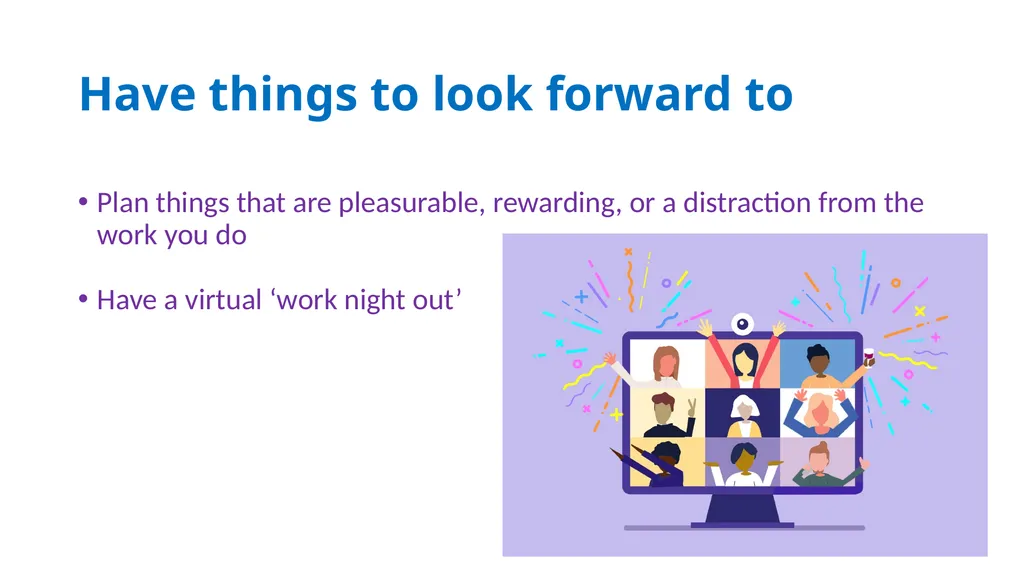
Have things to look forward to Plan things that are pleasurable, rewarding, or a distraction from the work you do
Have a virtual ‘work night out’<br>
Have a virtual ‘work night out’<br>
50
Look after yourself -You cannot look after others
if you neglect yourself Make time to do something for yourself every day. This may of course be with your friends and family. You have spent so much of your day looking after other people
Make yourself a warm drink, be together, watch tv; exercise if you can. Your organisation should provide you with information about how to care for yourself during this time
Don’t be afraid to ask for help if you are struggling. Lots of people will be feeling the same
If you are receiving help from a mental health service. You should seek to maintain contact and ensure you continue to take any prescribed medication.
Source: Health Education England<br>
Make yourself a warm drink, be together, watch tv; exercise if you can. Your organisation should provide you with information about how to care for yourself during this time
Don’t be afraid to ask for help if you are struggling. Lots of people will be feeling the same
If you are receiving help from a mental health service. You should seek to maintain contact and ensure you continue to take any prescribed medication.
Source: Health Education England<br>
51
Care Home Residents
What can you do to look after yourselves? Based upon:
The 5 ways to wellbeing, New Economics Foundation 2009<br>
The 5 ways to wellbeing, New Economics Foundation 2009<br>
52
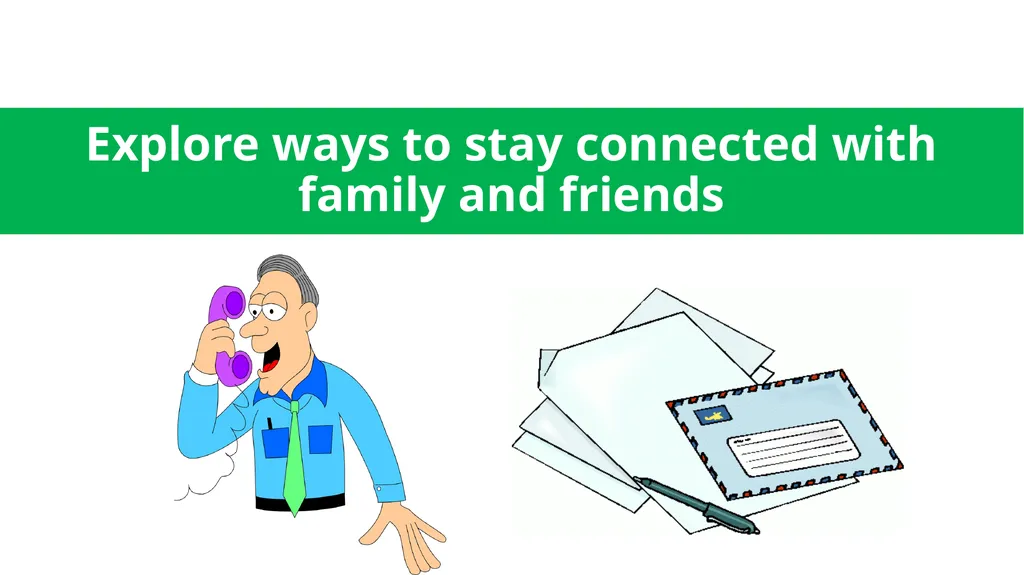
Explore ways to stay connected with family and friends<br>
53
Keep smiling and talking about how you are feeling<br>
54
It is OK to feel anxious and worried<br>
55
Be kind and patient with yourself and each other<br>
56
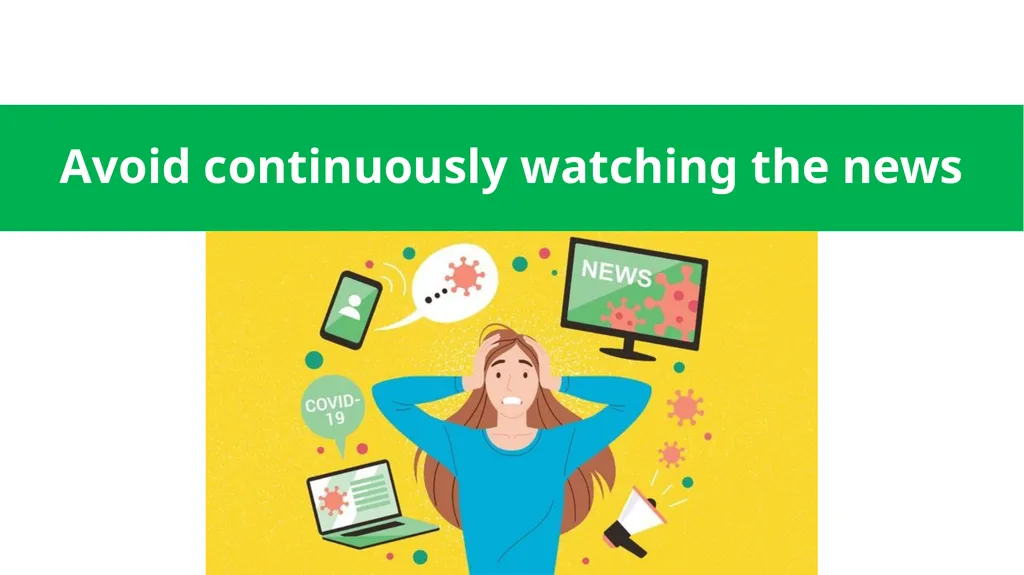
Avoid continuously watching the news<br>
57
Learn how to relax and be mindful
and take notice of your surroundings<br>
58
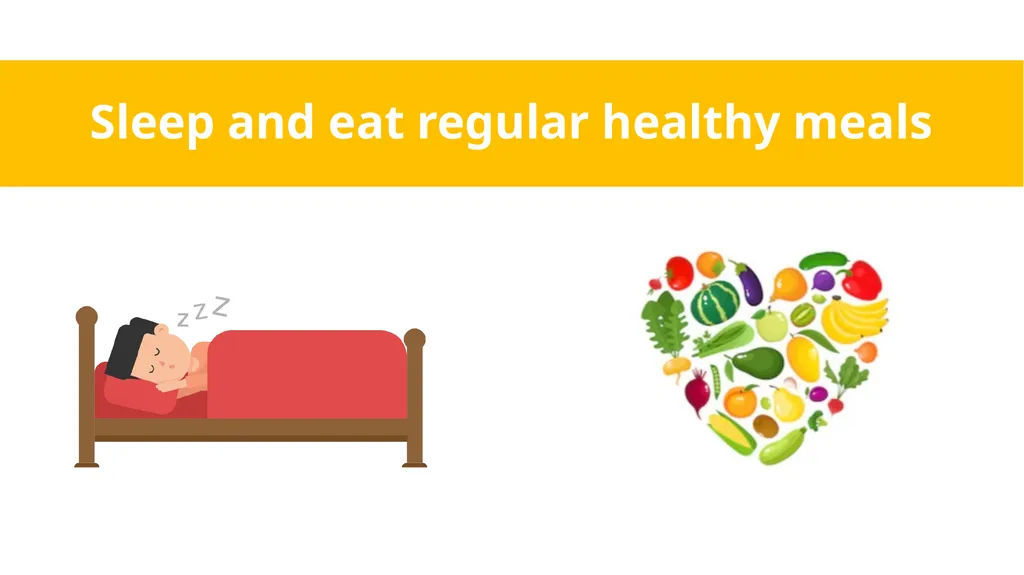
Sleep and eat regular healthy meals<br>
59
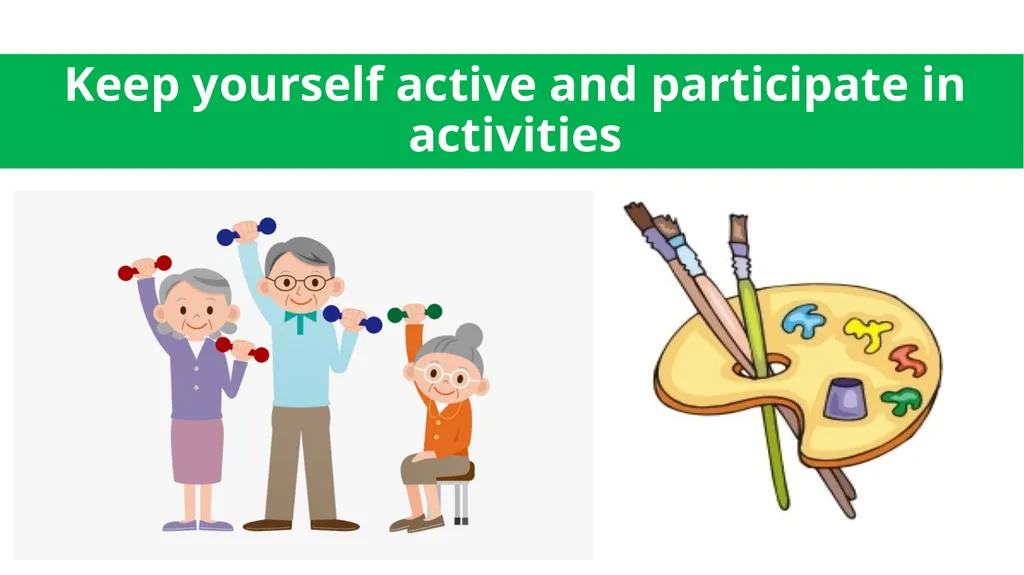
Keep yourself active and participate in activities<br>