
Module 1 Concepts in disaster risk reduction and
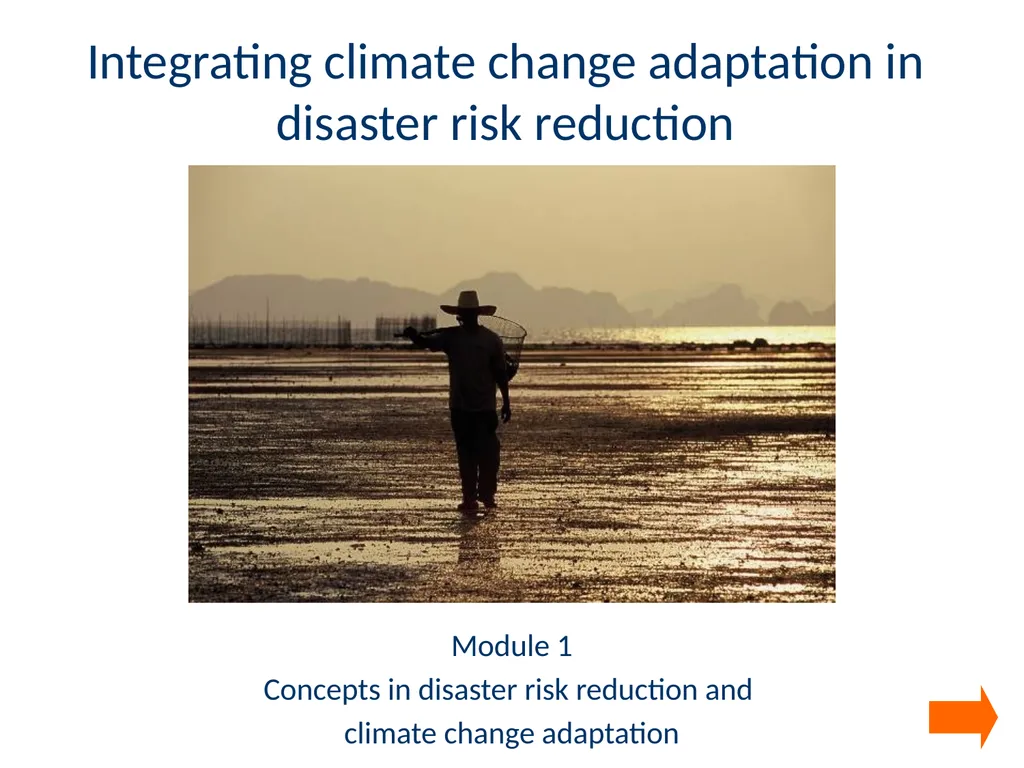
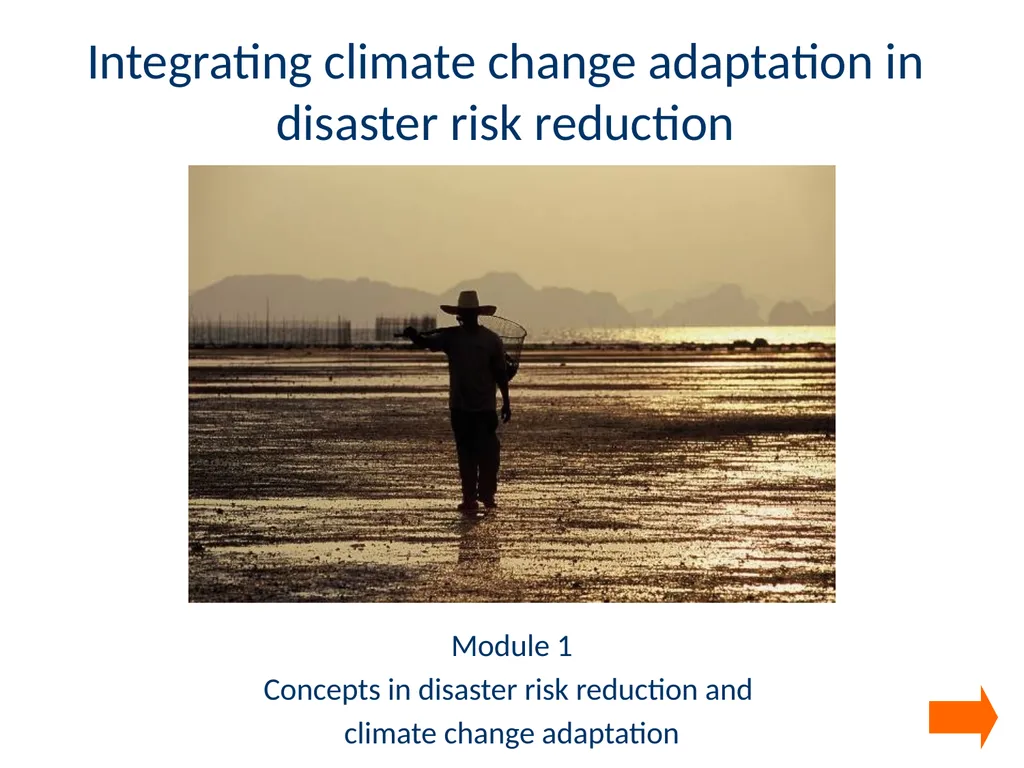
Description: Module 1 Concepts in disaster risk reduction and climate change adaptation Integrating climate change adaptation in disaster risk reduction Welcome to e-Learning on integrating climate change adaptation in disaster risk reduction! This
Related Topics
Download Presentation
"Module 1 Concepts in disaster risk reduction and" is the property of its rightful owner. Permission is granted to download and print the materials on this website for personal, non-commercial use only, and to display it on your personal computer provided you do not modify the materials and that you retain all copyright notices contained in the materials. By downloading content from our website, you accept the terms of this agreement.
Presentation Transcript
slide1. Module 1
Concepts in disaster risk reduction and
climate change adaptation Integrating climate change adaptation in disaster risk reduction<br>
slide2. Welcome to e-Learning on integrating climate change adaptation in disaster risk reduction! This module is part of an e-Learning package on integrating climate change adaptation in disaster risk reduction.
The package includes five modules:
Concepts in disaster risk reduction and climate change adaptation
Understanding vulnerability
Introduction to disaster risk reduction
Introduction to climate change adaptation
Guiding principles for integrating adaptation in disaster risk reduction
We recommend that you work through the modules in the specified order.
To access the other e-Learning modules, please visit the:
e-Learning Center - Integrating climate change adaptation in disaster risk reduction
NOTE: You will need a user name and password to access the e-Learning Center.
If you do not have an account, please contact: MinervaSupport@care.ca<br>
slide3. Who are the e-Learning modules for?
How were they developed? The e-Learning modules are designed for disaster risk reduction (DRR) practitioners. This includes practitioners within CARE, as well as our civil society and government partner organizations.
They were developed by Raks Thai Foundation and CARE, with significant inputs from CARE experts on climate change adaptation and disaster risk reduction, and most importantly from practitioners engaged in DRR initiatives in Country Offices across the Asia Pacific Region, as well as in Raks Thai Foundation.
Practitioner perspectives were gathered through two workshops. An initial workshop was conducted to develop the overall framework and brainstorm on key content. In the second workshop, the draft modules were tested and feedback was gathered. The current version reflects inputs from both workshops.
The modules reflect CARE’s current thinking on integrating adaptation in DRR initiatives. They should be considered as working versions. Our approach will be tested and refined as we develop more experience in this area.
Please send any feedback on these modules to Bruce Ravesloot:
ravesloot@careclimatechange.org<br>
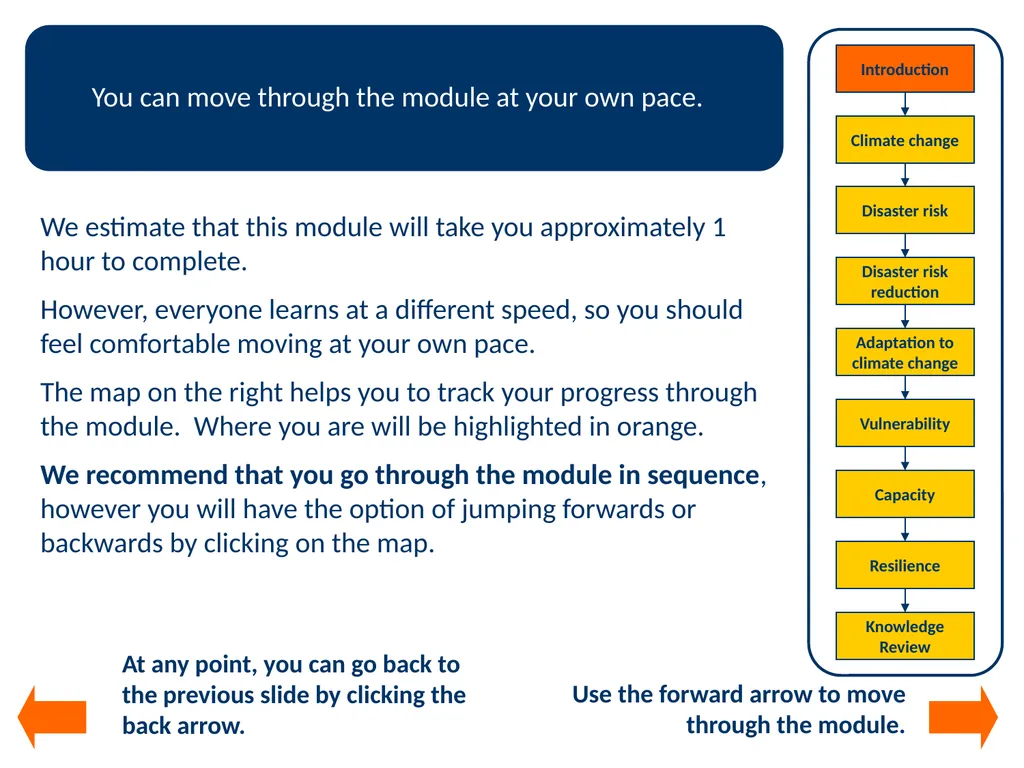
slide4. You can move through the module at your own pace. We estimate that this module will take you approximately 1 hour to complete.
However, everyone learns at a different speed, so you should feel comfortable moving at your own pace.
The map on the right helps you to track your progress through the module. Where you are will be highlighted in orange.
We recommend that you go through the module in sequence, however you will have the option of jumping forwards or backwards by clicking on the map. At any point, you can go back to the previous slide by clicking the back arrow. Use the forward arrow to move through the module. Introduction Adaptation to climate change Vulnerability Knowledge Review Capacity Climate change Disaster risk Disaster risk reduction Resilience<br>
slide5. Throughout the module, you’ll find links to
key definitions and documents. This e-Learning module is designed to be as clear and user-friendly as possible. So, as we introduce different concepts, we’ll use simple language and examples to promote understanding.
However, we will also provide links to ‘official’ definitions for those who prefer this approach, as well as to documents that provide a more comprehensive overview.
Any time you see underlined text in the module, you can click to access the official definition.
Links to documents will be indicated by an orange box:
Clicking on the document boxes will take you to an external website, so you’ll need to be online to access these documents.
Are you ready?
Then let’s get started! Name of Document<br>
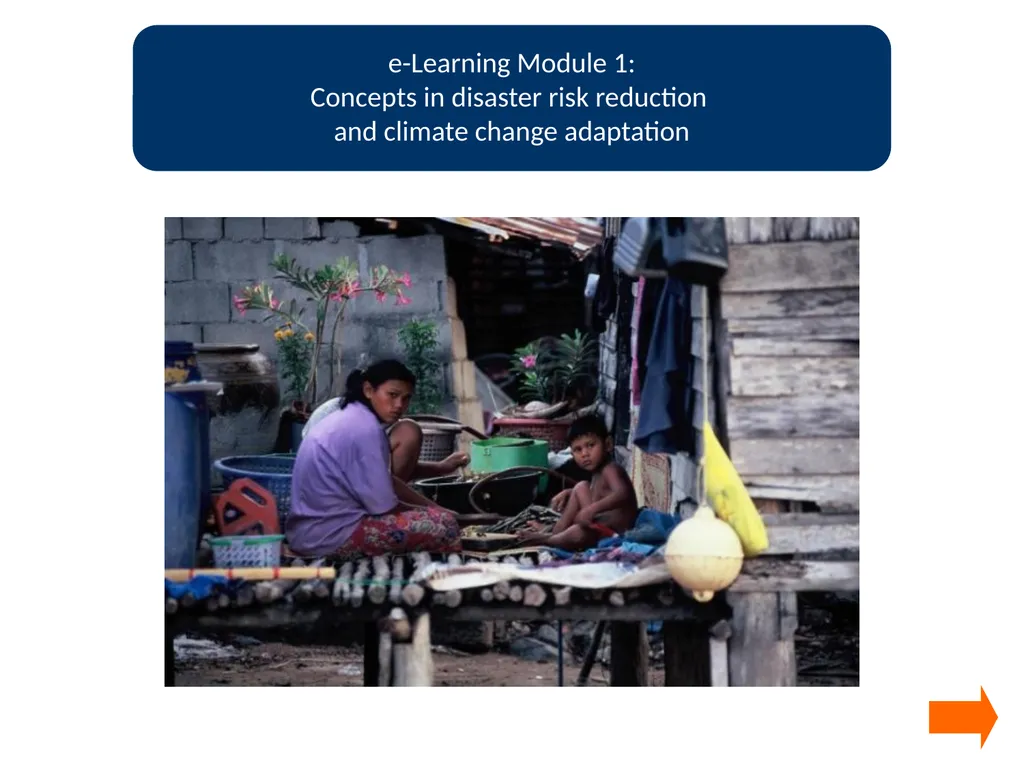
slide6. e-Learning Module 1:
Concepts in disaster risk reduction
and climate change adaptation<br>
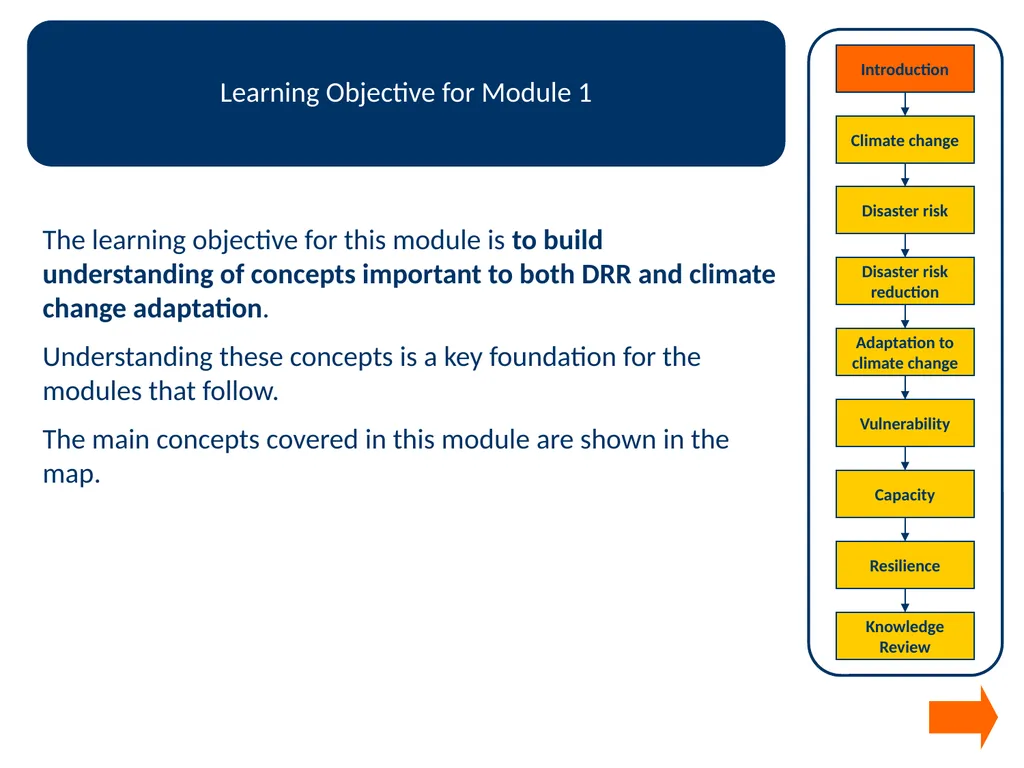
slide7. Learning Objective for Module 1 The learning objective for this module is to build understanding of concepts important to both DRR and climate change adaptation.
Understanding these concepts is a key foundation for the modules that follow.
The main concepts covered in this module are shown in the map. Introduction Adaptation to climate change Vulnerability Knowledge Review Capacity Climate change Disaster risk Disaster risk reduction Resilience<br>
slide8. What is climate change? Climate change is the term we use to describe a long-term change in the climate, occurring due to natural variability or as a result of human activity.
It’s important to understand the distinction between the weather and the climate:
Weather is the conditions you experience (rain, humidity, temperature). Weather can change on a timeline of minutes, hours, days or seasons.
Climate is the average weather over the longer term. Introduction Adaptation to climate change Vulnerability Knowledge Review Capacity Climate change Disaster risk Disaster risk reduction Resilience When we talk about climate change, we are talking about changes in the average weather over a timeline of decades or more.<br>
slide9. Why is climate change happening? There is broad scientific consensus that the climate change we are experiencing now is the result of human activities, not natural climate variability.
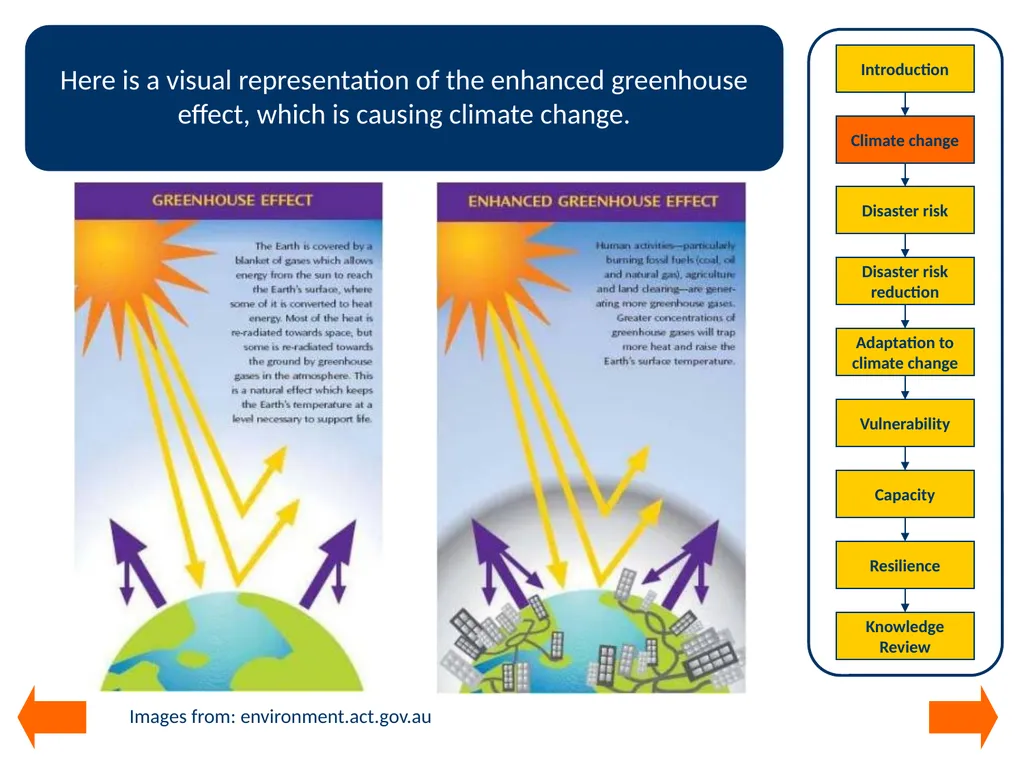
The changes are caused by an increase in greenhouse gas concentrations in the atmosphere.
Greenhouse gases include carbon dioxide and methane. They occur naturally in the atmosphere and they are important to maintaining the earth’s temperature.
However, in recent decades, with increasing industrialization, human activities are releasing large amounts of greenhouse gases into the atmosphere, which is causing an overall increase in the earth’s average temperature. Introduction Adaptation to climate change Vulnerability Knowledge Review Capacity Climate change Disaster risk Disaster risk reduction Resilience<br>
slide10. Here is a visual representation of the enhanced greenhouse effect, which is causing climate change. Images from: environment.act.gov.au Introduction Adaptation to climate change Vulnerability Knowledge Review Capacity Climate change Disaster risk Disaster risk reduction Resilience<br>
slide11. So the earth is getting warmer.
Why is this such a bad thing? While the overall changes in the earth’s average temperature may seem small, there are two major concerns.
The first is the rate of change – the global average temperature is rising faster than at any other time in the history of human civilization. This means it is very difficult to predict how the global climate system will react. A lot of scientists are working very hard to come up with models for future climate scenarios, but we are facing an unprecedented situation.
The second major concern is that a small change in average global temperature has major consequences, including rising sea levels, changing temperature and rainfall patterns and an increase in the frequency and intensity of extreme weather events.
The bottom line is that climate change is happening and it's happening now. It's not a distant phenomenon that will happen in some unknown future. Climate in Peril:
A popular guide to the latest IPCC reports Introduction Adaptation to climate change Vulnerability Knowledge Review Capacity Climate change Disaster risk Disaster risk reduction Resilience<br>
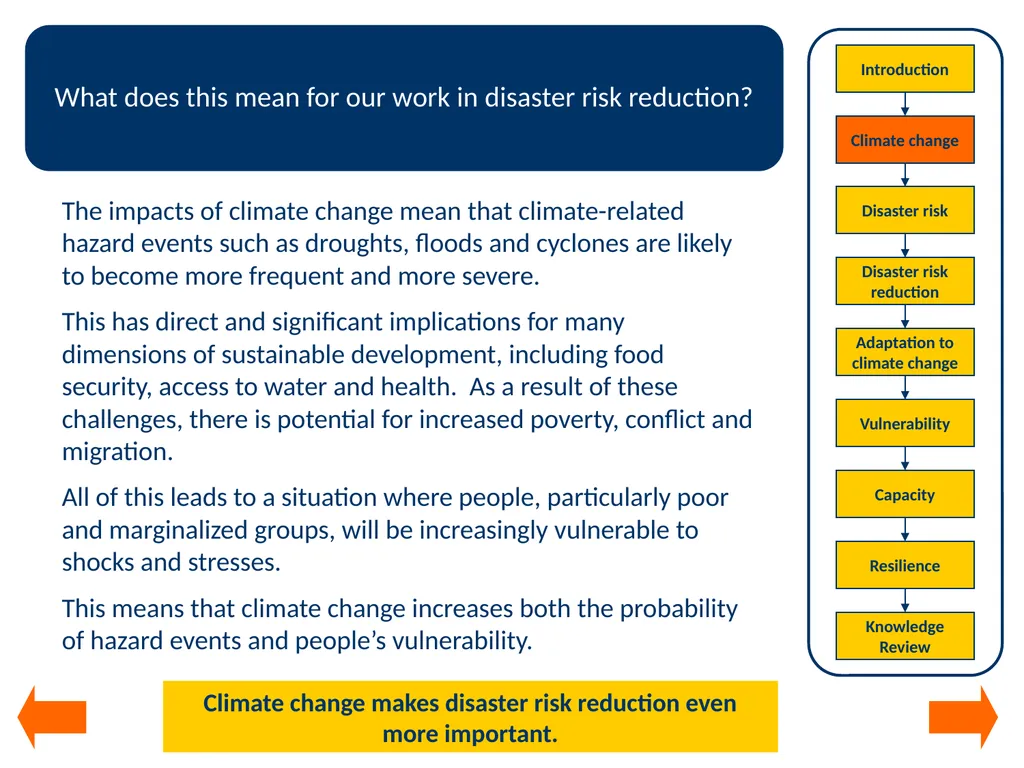
slide12. What does this mean for our work in disaster risk reduction? The impacts of climate change mean that climate-related hazard events such as droughts, floods and cyclones are likely to become more frequent and more severe.
This has direct and significant implications for many dimensions of sustainable development, including food security, access to water and health. As a result of these challenges, there is potential for increased poverty, conflict and migration.
All of this leads to a situation where people, particularly poor and marginalized groups, will be increasingly vulnerable to shocks and stresses.
This means that climate change increases both the probability of hazard events and people’s vulnerability. Climate change makes disaster risk reduction even more important. Introduction Adaptation to climate change Vulnerability Knowledge Review Capacity Climate change Disaster risk Disaster risk reduction Resilience<br>
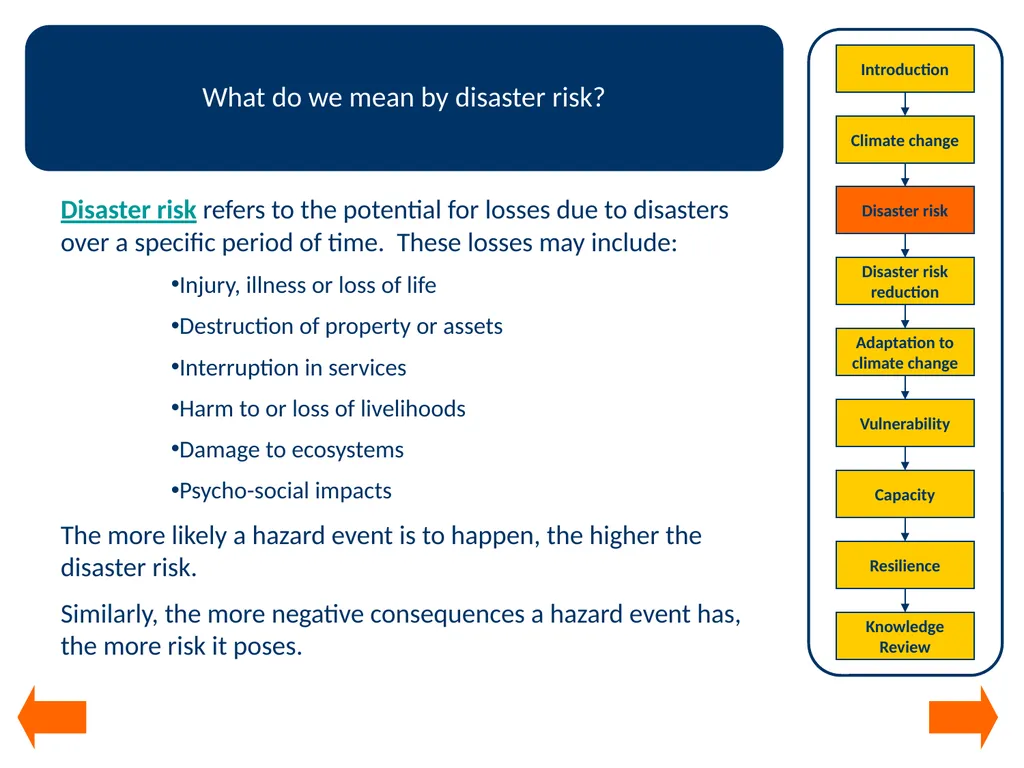
slide13. What do we mean by disaster risk? Disaster risk refers to the potential for losses due to disasters over a specific period of time. These losses may include:
Injury, illness or loss of life
Destruction of property or assets
Interruption in services
Harm to or loss of livelihoods
Damage to ecosystems
Psycho-social impacts
The more likely a hazard event is to happen, the higher the disaster risk.
Similarly, the more negative consequences a hazard event has, the more risk it poses. Introduction Adaptation to climate change Vulnerability Knowledge Review Capacity Climate change Disaster risk Disaster risk reduction Resilience<br>
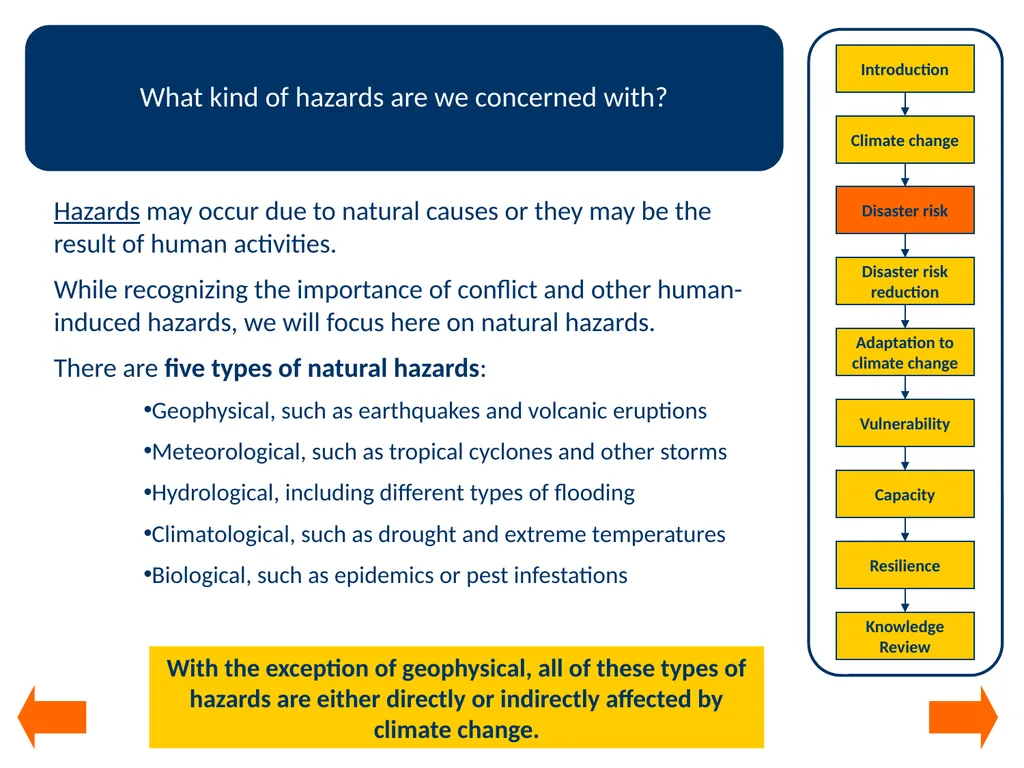
slide14. What kind of hazards are we concerned with? Hazards may occur due to natural causes or they may be the result of human activities.
While recognizing the importance of conflict and other human-induced hazards, we will focus here on natural hazards.
There are five types of natural hazards:
Geophysical, such as earthquakes and volcanic eruptions
Meteorological, such as tropical cyclones and other storms
Hydrological, including different types of flooding
Climatological, such as drought and extreme temperatures
Biological, such as epidemics or pest infestations With the exception of geophysical, all of these types of hazards are either directly or indirectly affected by climate change. Introduction Adaptation to climate change Vulnerability Knowledge Review Capacity Climate change Disaster risk Disaster risk reduction Resilience<br>
slide15. Let’s consider disaster risk reduction,
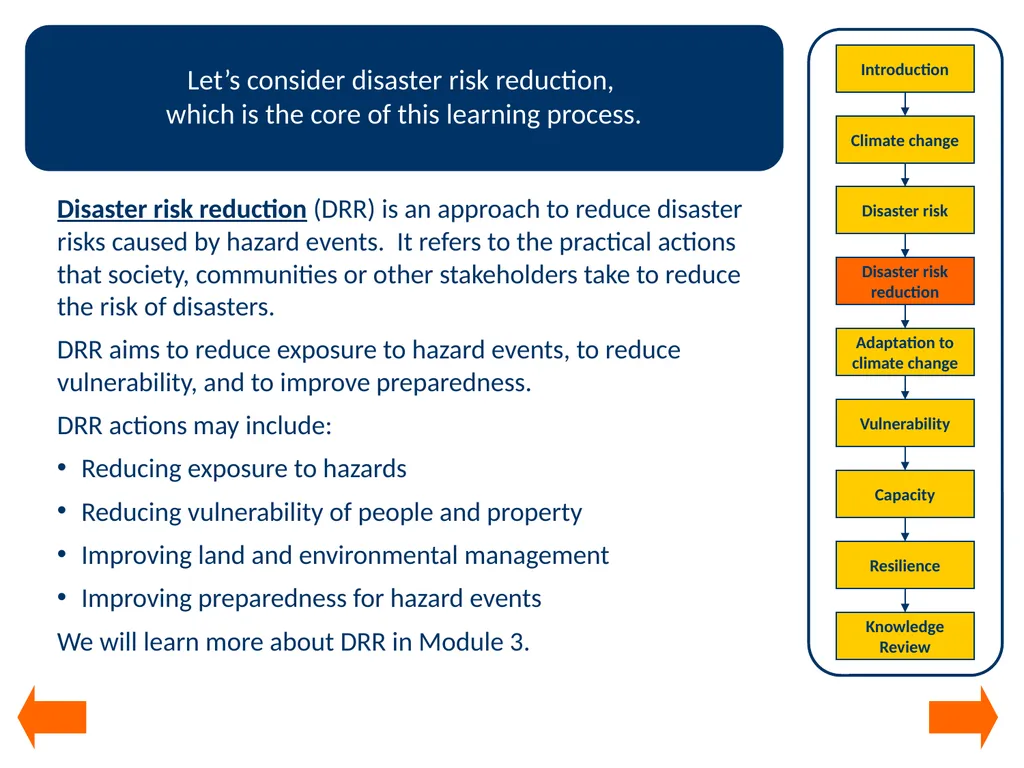
which is the core of this learning process. Disaster risk reduction (DRR) is an approach to reduce disaster risks caused by hazard events. It refers to the practical actions that society, communities or other stakeholders take to reduce the risk of disasters.
DRR aims to reduce exposure to hazard events, to reduce vulnerability, and to improve preparedness.
DRR actions may include:
Reducing exposure to hazards
Reducing vulnerability of people and property
Improving land and environmental management
Improving preparedness for hazard events
We will learn more about DRR in Module 3. Introduction Adaptation to climate change Vulnerability Knowledge Review Capacity Climate change Disaster risk Disaster risk reduction Resilience<br>
slide16. So disaster risk REDUCTION is an approach to reducing disaster risks.
Where does disaster risk MANAGEMENT fit in? Disaster risk management (DRM) is a strategic approach to managing all types of disaster risks.
DRM looks at disasters from the perspective of organizations – governments, NGOs or communities – and provides a framework and strategy for managing the risk of disasters.
A disaster risk management policy, plan or strategy describes HOW a particular organization will deal with disasters - before, during and after a disaster occurs.
In the CARE context, Emergency Preparedness Plans are one approach to DRM. We also work with local and national governments and other stakeholders to support the development of DRM plans. Introduction Adaptation to climate change Vulnerability Knowledge Review Capacity Climate change Disaster risk Disaster risk reduction Resilience<br>
slide17. Let’s look at an example to make this relationship clearer. A local government authority has a disaster risk management plan. This plan outlines how the authority will deal with disasters, including how it will prepare for and respond to hazards. It also describes how the authority will work with others, including higher levels of government, NGOs and community-based organizations.
As part of the preparedness component of the plan, the authority identifies disaster risk reduction actions that may be implemented by the authority, by local NGOs or by the communities governed by the authority.
We’ll look at DRR in more detail in Module 3. Introduction Adaptation to climate change Vulnerability Knowledge Review Capacity Climate change Disaster risk Disaster risk reduction Resilience<br>
slide18. Now that we’ve got a good grasp of DRR concepts,
let’s consider adaptation to climate change. Adaptation to climate change is a process of reducing vulnerability to the current and future impacts of climate change.
The negative impacts of climate change exhibit themselves as hazards. However, in some cases, climate change impacts may also present opportunities, and so adaptation can also involve taking advantage of these opportunities.
Unfortunately, in vulnerable communities in developing countries, the impacts of climate change are largely negative.
This means that adaptation is often about managing the impacts of hazards.
We’ll discuss climate change adaptation in more detail in Module 4. Introduction Adaptation to climate change Vulnerability Knowledge Review Capacity Climate change Disaster risk Disaster risk reduction Resilience<br>
slide19. If both adaptation and DRR are about managing hazards,
are they the same thing? There are a lot of synergies between DRR and adaptation, but they have different entry points.
DRR addresses all types of hazards, and focuses on reducing the risk of disaster caused by hazard events.
Adaptation is focused on climate-related hazards. This includes events such as droughts, floods and cyclones. It also includes changing conditions, such as changes in temperature over time or shifts in the timing of the rainy season.
We’ll explore the synergies and differences between adaptation and DRR in more detail in Module 5. REFLECTION
What kinds of hazards affect the communities you work with?
Are they climate-related? Introduction Adaptation to climate change Vulnerability Knowledge Review Capacity Climate change Disaster risk Disaster risk reduction Resilience<br>
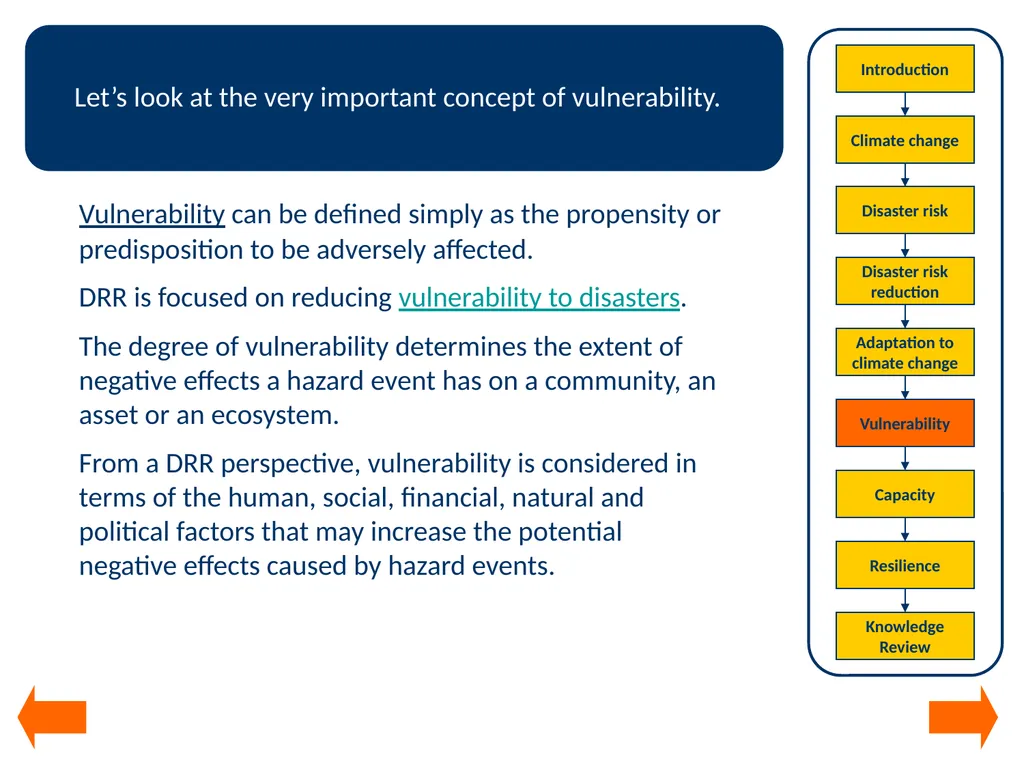
slide20. Let’s look at the very important concept of vulnerability. Vulnerability can be defined simply as the propensity or predisposition to be adversely affected.
DRR is focused on reducing vulnerability to disasters.
The degree of vulnerability determines the extent of negative effects a hazard event has on a community, an asset or an ecosystem.
From a DRR perspective, vulnerability is considered in terms of the human, social, financial, natural and political factors that may increase the potential negative effects caused by hazard events. Introduction Adaptation to climate change Vulnerability Knowledge Review Capacity Climate change Disaster risk Disaster risk reduction Resilience<br>
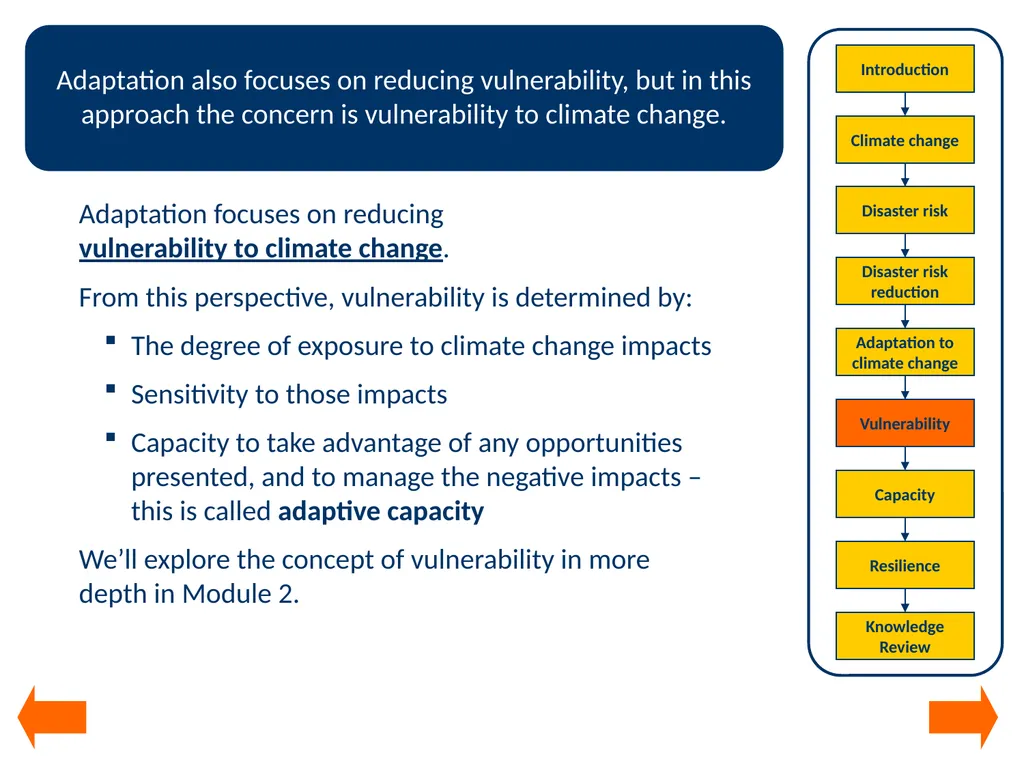
slide21. Adaptation also focuses on reducing vulnerability, but in this approach the concern is vulnerability to climate change. Adaptation focuses on reducing vulnerability to climate change.
From this perspective, vulnerability is determined by:
The degree of exposure to climate change impacts
Sensitivity to those impacts
Capacity to take advantage of any opportunities presented, and to manage the negative impacts – this is called adaptive capacity
We’ll explore the concept of vulnerability in more depth in Module 2. Introduction Adaptation to climate change Vulnerability Knowledge Review Capacity Climate change Disaster risk Disaster risk reduction Resilience<br>
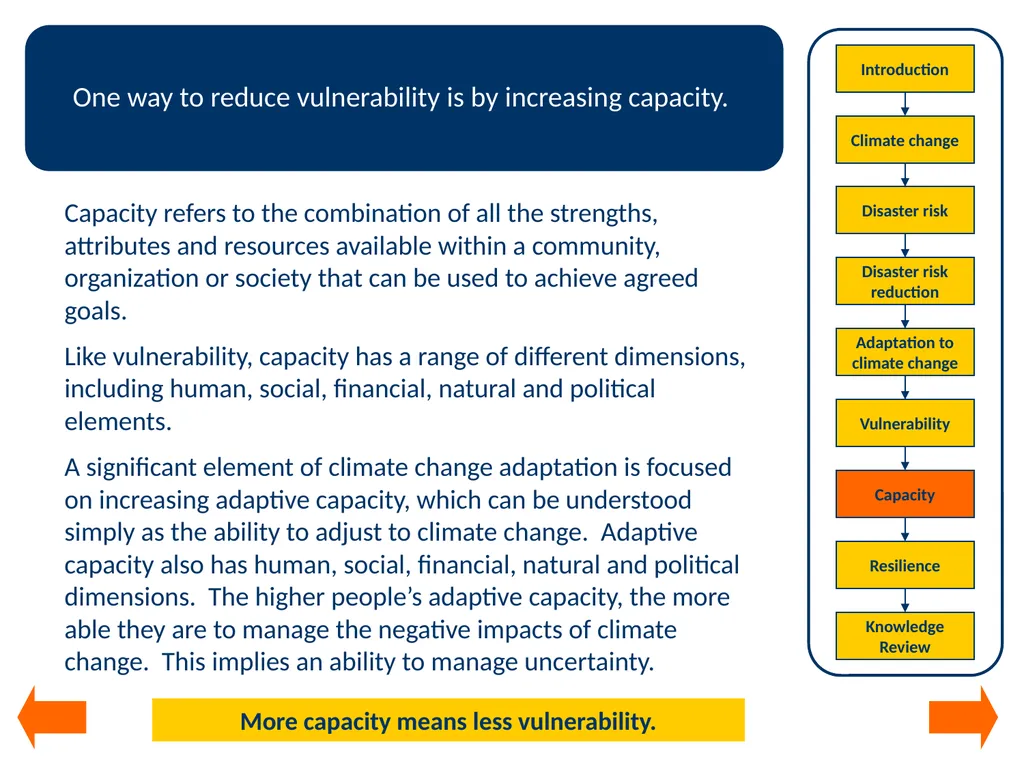
slide22. One way to reduce vulnerability is by increasing capacity. Capacity refers to the combination of all the strengths, attributes and resources available within a community, organization or society that can be used to achieve agreed goals.
Like vulnerability, capacity has a range of different dimensions, including human, social, financial, natural and political elements.
A significant element of climate change adaptation is focused on increasing adaptive capacity, which can be understood simply as the ability to adjust to climate change. Adaptive capacity also has human, social, financial, natural and political dimensions. The higher people’s adaptive capacity, the more able they are to manage the negative impacts of climate change. This implies an ability to manage uncertainty. More capacity means less vulnerability. Introduction Adaptation to climate change Vulnerability Knowledge Review Capacity Climate change Disaster risk Disaster risk reduction Resilience<br>
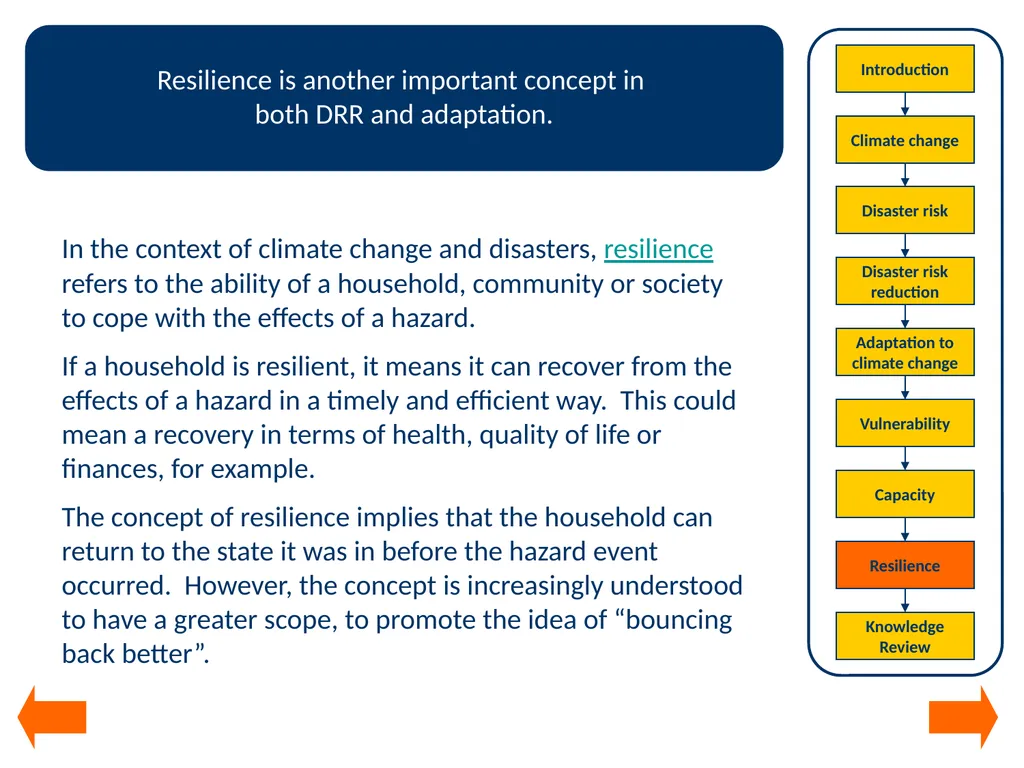
slide23. Resilience is another important concept in
both DRR and adaptation. In the context of climate change and disasters, resilience refers to the ability of a household, community or society to cope with the effects of a hazard.
If a household is resilient, it means it can recover from the effects of a hazard in a timely and efficient way. This could mean a recovery in terms of health, quality of life or finances, for example.
The concept of resilience implies that the household can return to the state it was in before the hazard event occurred. However, the concept is increasingly understood to have a greater scope, to promote the idea of “bouncing back better”. Introduction Adaptation to climate change Vulnerability Knowledge Review Capacity Climate change Disaster risk Disaster risk reduction Resilience<br>
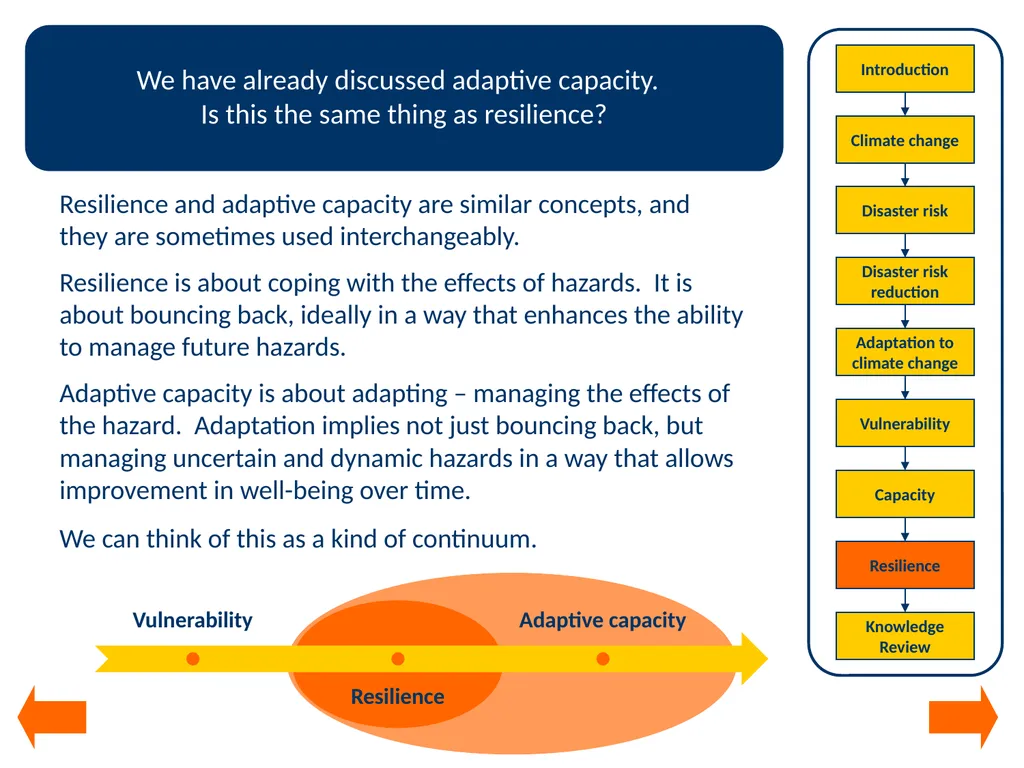
slide24. We have already discussed adaptive capacity.
Is this the same thing as resilience? Resilience and adaptive capacity are similar concepts, and they are sometimes used interchangeably.
Resilience is about coping with the effects of hazards. It is about bouncing back, ideally in a way that enhances the ability to manage future hazards.
Adaptive capacity is about adapting – managing the effects of the hazard. Adaptation implies not just bouncing back, but managing uncertain and dynamic hazards in a way that allows improvement in well-being over time.
We can think of this as a kind of continuum. Introduction Adaptation to climate change Vulnerability Knowledge Review Capacity Climate change Disaster risk Disaster risk reduction Resilience<br>
slide25. Let’s review the key learning points for this module. Climate change makes disaster risk reduction even more important.
With the exception of geophysical hazards, climate change affects all types of natural hazards.
Vulnerability to climate change and disasters:
Depends on exposure to hazards.
Is determined by human, social, physical, natural, political and financial factors.
Varies within communities and even within households.
More capacity means less vulnerability. Introduction Adaptation to climate change Vulnerability Knowledge Review Capacity Climate change Disaster risk Disaster risk reduction Resilience<br>
slide26. Ready to review your knowledge? In this module, we’ve explored a number of important concepts and the relationships between them.
Next, you’ll have a chance to review your knowledge before moving on to the next module.
Ready?
If you feel you’re ready for the knowledge review, click on the forward arrow.
Not quite there yet?
If you’d like to go through any of the concepts again before moving on to the knowledge review, click on the appropriate box in the map. Introduction Adaptation to climate change Vulnerability Knowledge Review Capacity Climate change Disaster risk Disaster risk reduction Resilience<br>
slide27. Knowledge Review
Question 1 Are adaptation and disaster risk reduction the same thing? YES,
they are the same thing Click on the appropriate box to indicate your answer. NO,
they are similar, but there are important differences I’m still not clear on how they fit together Introduction Adaptation to climate change Vulnerability Knowledge Review Capacity Climate change Disaster risk Disaster risk reduction Resilience<br>
slide28. Knowledge Review
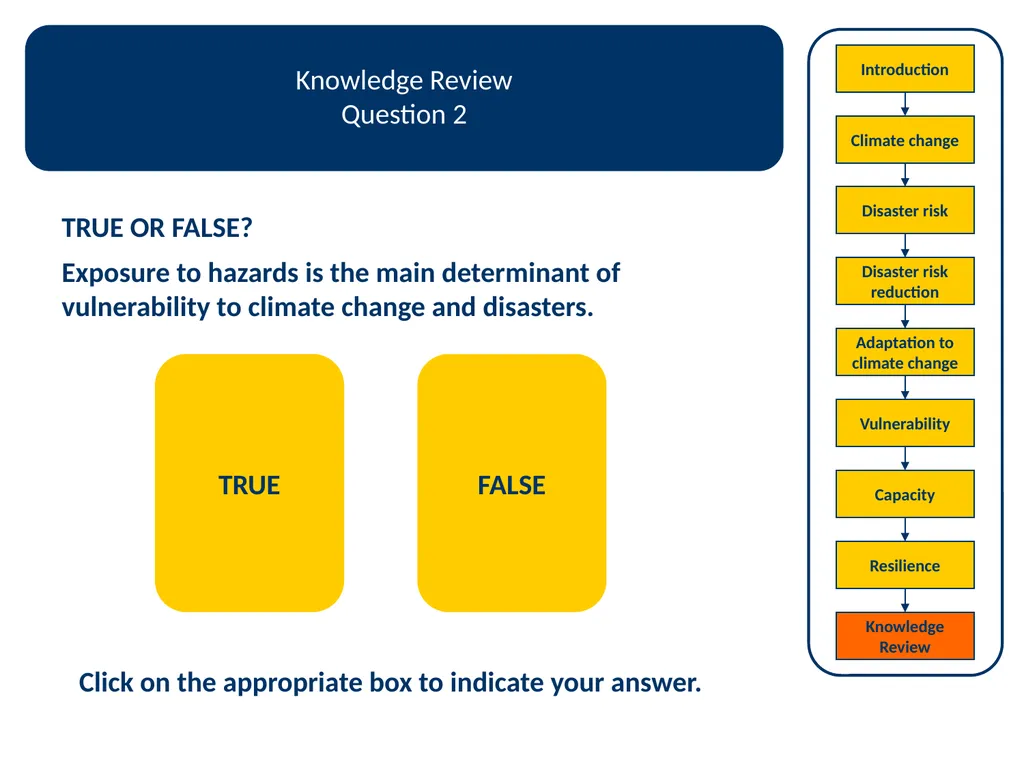
Question 2 TRUE OR FALSE?
Exposure to hazards is the main determinant of vulnerability to climate change and disasters. TRUE Click on the appropriate box to indicate your answer. FALSE Introduction Adaptation to climate change Vulnerability Knowledge Review Capacity Climate change Disaster risk Disaster risk reduction Resilience<br>
slide29. Congratulations! You’ve completed Module 1. We hope that you have found this to be a useful learning experience.
To access the other e-Learning modules, please visit the:
e-Learning Center - Integrating climate change adaptation in disaster risk reduction
NOTE: You will need a user name and password to access the e-Learning Center.
If you do not have an account, please contact: MinervaSupport@care.ca
Thank you for your participation!
You can exit the module by pressing the Esc key.<br>
slide31. Definitions
Climate Change Climate change refers to a change in the state of the climate that can be identified (e.g., by using statistical tests) by changes in the mean and/or the variability of its properties, and that persists for an extended period, typically decades or longer.
Climate change may be due to natural internal processes or external forcings, or to persistent anthropogenic changes in the composition of the atmosphere or in land use.
From:
Intergovernmental Panel on Climate Change (IPCC) (2007). Fourth Assessment Report, Annex II: Glossary.
http://www.ipcc.ch/publications_and_data/ar4/syr/en/annexessglossary-a-d.html Click on the arrow to go back to the e-Learning module.<br>
slide32. Definitions
Disaster Risk The potential disaster losses, in lives, health status, livelihoods, assets and services, which could occur to a particular community or a society over some specified future time period.
From:
United Nations International Strategy for Disaster Reduction (UNISDR) (2009). Terminology on Disaster Risk Reduction.
http://unisdr.org/files/7817_UNISDRTerminologyEnglish.pdf Click on the arrow to go back to the e-Learning module.<br>
slide33. Definitions
Hazard A dangerous phenomenon, substance, human activity or condition that may cause loss of life, injury or other health impacts, property damage, loss of livelihoods and services, social and economic disruption, or environmental damage.
From:
United Nations International Strategy for Disaster Reduction (UNISDR) (2009). Terminology on Disaster Risk Reduction.
http://unisdr.org/files/7817_UNISDRTerminologyEnglish.pdf Click on the arrow to go back to the e-Learning module.<br>
slide34. Definitions
Disaster risk reduction The concept and practice of reducing disaster risks through systematic efforts to analyze and manage the causal factors of disasters, including through reduced exposure to hazards, lessened vulnerability of people and property, wise management of land and the environment, and improved preparedness for adverse events.
From:
United Nations International Strategy for Disaster Reduction (UNISDR) (2009). Terminology on Disaster Risk Reduction.
http://unisdr.org/files/7817_UNISDRTerminologyEnglish.pdf Click on the arrow to go back to the e-Learning module.<br>
slide35. Definitions
Disaster risk management The systematic process of using administrative directives, organizations, and operational skills and capacities to implement strategies, policies and improved coping capacities in order to lessen the adverse impacts of hazards and the possibility of disaster.
From:
United Nations International Strategy for Disaster Reduction (UNISDR) (2009). Terminology on Disaster Risk Reduction.
http://unisdr.org/files/7817_UNISDRTerminologyEnglish.pdf Click on the arrow to go back to the e-Learning module.<br>
slide36. Definitions
Adaptation to climate change Initiatives and measures to reduce the vulnerability of natural and human systems against actual or expected climate change effects.
Various types of adaptation exist, e.g. anticipatory and reactive, private and public, and autonomous and planned.
From:
Intergovernmental Panel on Climate Change (IPCC) (2007). Fourth Assessment Report, Annex II: Glossary.
http://www.ipcc.ch/publications_and_data/ar4/syr/en/annexessglossary-a-d.html Click on the arrow to go back to the e-Learning module.<br>
slide37. Definitions
Vulnerability The propensity or predisposition to be adversely affected.
From:
Intergovernmental Panel on Climate Change (IPCC) (2011). Managing the Risks of Extreme Events and Disasters to Advance Climate Change Adaptation: A Special Report of Working Group I and Working Group II to the Intergovernmental Panel on Climate Change.
http://ipcc-wg2.gov/SREX/images/uploads/SREX-SPM_Approved-HiRes_opt.pdf Click on the arrow to go back to the e-Learning module.<br>
slide38. Definitions
Vulnerability to disasters The characteristics and circumstances of a community, system or asset that make it susceptible to the damaging effects of a hazard.
From:
United Nations International Strategy for Disaster Reduction (UNISDR) (2009). Terminology on Disaster Risk Reduction.
http://unisdr.org/files/7817_UNISDRTerminologyEnglish.pdf Click on the arrow to go back to the e-Learning module.<br>
slide39. Definitions
Vulnerability to climate change Click on the arrow to go back to the e-Learning module. Vulnerability is the degree to which a system is susceptible to, and unable to cope with, adverse effects of climate change, including climate variability and extremes.
Vulnerability is a function of the character, magnitude, and rate of climate change and variation to which a system is exposed, its sensitivity, and its adaptive capacity.
From:
Intergovernmental Panel on Climate Change (IPCC) (2007). Fourth Assessment Report, Annex II: Glossary.
http://www.ipcc.ch/publications_and_data/ar4/syr/en/annexessglossary-a-d.html<br>
slide40. Definitions
Resilience The ability of a system, community or society exposed to hazards to resist, absorb, accommodate to and recover from the effects of a hazard in a timely and efficient manner, including through the preservation and restoration of its essential basic structures and functions.
From:
United Nations International Strategy for Disaster Reduction (UNISDR) (2009). Terminology on Disaster Risk Reduction.
http://unisdr.org/files/7817_UNISDRTerminologyEnglish.pdf Click on the arrow to go back to the e-Learning module.<br>
slide41. Knowledge Review
Question 1 Are adaptation and disaster risk reduction the same thing? YES,
they are the same thing Sorry!
While there are a lot of synergies between adaptation and disaster risk reduction, they are not the same thing.
Remember that they deal with different types of hazards: adaptation is focused on climate-related hazards, while DRR addresses all hazards, including geophysical hazards.
We’ll explore the other differences, as well as the synergies, in Module 2. Click on the orange box to go back to the Knowledge Review. Introduction Adaptation to climate change Vulnerability Capacity Climate change Disaster risk Disaster risk reduction Resilience Knowledge Review<br>
slide42. Knowledge Review
Question 1 Are adaptation and disaster risk reduction the same thing? NO,
they are similar, but there are important differences You’re right!
While there are a lot of synergies between adaptation and disaster risk reduction, they are not the same thing. One key difference is the types of hazards they deal with.
We’ll explore the other differences, as well as the synergies, in Module 2. Click on the orange box to go back to the Knowledge Review. Introduction Adaptation to climate change Vulnerability Knowledge Review Capacity Climate change Disaster risk Disaster risk reduction Resilience<br>
slide43. Knowledge Review
Question 1 Are adaptation and disaster risk reduction the same thing? I’m still not clear on how they fit together Don’t worry!
There are a lot of synergies between adaptation and disaster risk reduction, but they are not the same thing. One key difference is the types of hazards they deal with.
We’ll further explore the differences, as well as the synergies, in Module 2. Click on the orange box to go back to the Knowledge Review. Introduction Adaptation to climate change Vulnerability Knowledge Review Capacity Climate change Disaster risk Disaster risk reduction Resilience<br>
slide44. Knowledge Review
Question 2 TRUE OR FALSE?
Exposure to hazards is the main determinant of vulnerability to climate change and disasters. TRUE Click on the orange box to return to the Knowledge Review. Sorry!
Exposure is one important determinant of vulnerability to climate change and disasters, but it is not the main determinant.
Human, social, physical, natural, political and financial factors are also very important in determining vulnerability.
We’ll explore vulnerability in more depth in Part 2 of this module. Introduction Adaptation to climate change Vulnerability Knowledge Review Capacity Climate change Disaster risk Disaster risk reduction Resilience<br>
slide45. Knowledge Review
Question 2 TRUE OR FALSE?
Exposure to hazards is the main determinant of vulnerability to climate change and disasters. FALSE Click on the orange box to return to the Knowledge Review. You’re right!
Exposure is one important determinant of vulnerability to climate change and disasters, but it is not the main determinant.
Human, social, physical, natural, political and financial factors are also very important in determining vulnerability.
We’ll explore vulnerability in more depth in Part 2 of this module. Introduction Adaptation to climate change Vulnerability Knowledge Review Capacity Climate change Disaster risk Disaster risk reduction Resilience<br>
Concepts in disaster risk reduction and
climate change adaptation Integrating climate change adaptation in disaster risk reduction<br>
slide2. Welcome to e-Learning on integrating climate change adaptation in disaster risk reduction! This module is part of an e-Learning package on integrating climate change adaptation in disaster risk reduction.
The package includes five modules:
Concepts in disaster risk reduction and climate change adaptation
Understanding vulnerability
Introduction to disaster risk reduction
Introduction to climate change adaptation
Guiding principles for integrating adaptation in disaster risk reduction
We recommend that you work through the modules in the specified order.
To access the other e-Learning modules, please visit the:
e-Learning Center - Integrating climate change adaptation in disaster risk reduction
NOTE: You will need a user name and password to access the e-Learning Center.
If you do not have an account, please contact: MinervaSupport@care.ca<br>
slide3. Who are the e-Learning modules for?
How were they developed? The e-Learning modules are designed for disaster risk reduction (DRR) practitioners. This includes practitioners within CARE, as well as our civil society and government partner organizations.
They were developed by Raks Thai Foundation and CARE, with significant inputs from CARE experts on climate change adaptation and disaster risk reduction, and most importantly from practitioners engaged in DRR initiatives in Country Offices across the Asia Pacific Region, as well as in Raks Thai Foundation.
Practitioner perspectives were gathered through two workshops. An initial workshop was conducted to develop the overall framework and brainstorm on key content. In the second workshop, the draft modules were tested and feedback was gathered. The current version reflects inputs from both workshops.
The modules reflect CARE’s current thinking on integrating adaptation in DRR initiatives. They should be considered as working versions. Our approach will be tested and refined as we develop more experience in this area.
Please send any feedback on these modules to Bruce Ravesloot:
ravesloot@careclimatechange.org<br>
slide4. You can move through the module at your own pace. We estimate that this module will take you approximately 1 hour to complete.
However, everyone learns at a different speed, so you should feel comfortable moving at your own pace.
The map on the right helps you to track your progress through the module. Where you are will be highlighted in orange.
We recommend that you go through the module in sequence, however you will have the option of jumping forwards or backwards by clicking on the map. At any point, you can go back to the previous slide by clicking the back arrow. Use the forward arrow to move through the module. Introduction Adaptation to climate change Vulnerability Knowledge Review Capacity Climate change Disaster risk Disaster risk reduction Resilience<br>
slide5. Throughout the module, you’ll find links to
key definitions and documents. This e-Learning module is designed to be as clear and user-friendly as possible. So, as we introduce different concepts, we’ll use simple language and examples to promote understanding.
However, we will also provide links to ‘official’ definitions for those who prefer this approach, as well as to documents that provide a more comprehensive overview.
Any time you see underlined text in the module, you can click to access the official definition.
Links to documents will be indicated by an orange box:
Clicking on the document boxes will take you to an external website, so you’ll need to be online to access these documents.
Are you ready?
Then let’s get started! Name of Document<br>
slide6. e-Learning Module 1:
Concepts in disaster risk reduction
and climate change adaptation<br>
slide7. Learning Objective for Module 1 The learning objective for this module is to build understanding of concepts important to both DRR and climate change adaptation.
Understanding these concepts is a key foundation for the modules that follow.
The main concepts covered in this module are shown in the map. Introduction Adaptation to climate change Vulnerability Knowledge Review Capacity Climate change Disaster risk Disaster risk reduction Resilience<br>
slide8. What is climate change? Climate change is the term we use to describe a long-term change in the climate, occurring due to natural variability or as a result of human activity.
It’s important to understand the distinction between the weather and the climate:
Weather is the conditions you experience (rain, humidity, temperature). Weather can change on a timeline of minutes, hours, days or seasons.
Climate is the average weather over the longer term. Introduction Adaptation to climate change Vulnerability Knowledge Review Capacity Climate change Disaster risk Disaster risk reduction Resilience When we talk about climate change, we are talking about changes in the average weather over a timeline of decades or more.<br>
slide9. Why is climate change happening? There is broad scientific consensus that the climate change we are experiencing now is the result of human activities, not natural climate variability.
The changes are caused by an increase in greenhouse gas concentrations in the atmosphere.
Greenhouse gases include carbon dioxide and methane. They occur naturally in the atmosphere and they are important to maintaining the earth’s temperature.
However, in recent decades, with increasing industrialization, human activities are releasing large amounts of greenhouse gases into the atmosphere, which is causing an overall increase in the earth’s average temperature. Introduction Adaptation to climate change Vulnerability Knowledge Review Capacity Climate change Disaster risk Disaster risk reduction Resilience<br>
slide10. Here is a visual representation of the enhanced greenhouse effect, which is causing climate change. Images from: environment.act.gov.au Introduction Adaptation to climate change Vulnerability Knowledge Review Capacity Climate change Disaster risk Disaster risk reduction Resilience<br>
slide11. So the earth is getting warmer.
Why is this such a bad thing? While the overall changes in the earth’s average temperature may seem small, there are two major concerns.
The first is the rate of change – the global average temperature is rising faster than at any other time in the history of human civilization. This means it is very difficult to predict how the global climate system will react. A lot of scientists are working very hard to come up with models for future climate scenarios, but we are facing an unprecedented situation.
The second major concern is that a small change in average global temperature has major consequences, including rising sea levels, changing temperature and rainfall patterns and an increase in the frequency and intensity of extreme weather events.
The bottom line is that climate change is happening and it's happening now. It's not a distant phenomenon that will happen in some unknown future. Climate in Peril:
A popular guide to the latest IPCC reports Introduction Adaptation to climate change Vulnerability Knowledge Review Capacity Climate change Disaster risk Disaster risk reduction Resilience<br>
slide12. What does this mean for our work in disaster risk reduction? The impacts of climate change mean that climate-related hazard events such as droughts, floods and cyclones are likely to become more frequent and more severe.
This has direct and significant implications for many dimensions of sustainable development, including food security, access to water and health. As a result of these challenges, there is potential for increased poverty, conflict and migration.
All of this leads to a situation where people, particularly poor and marginalized groups, will be increasingly vulnerable to shocks and stresses.
This means that climate change increases both the probability of hazard events and people’s vulnerability. Climate change makes disaster risk reduction even more important. Introduction Adaptation to climate change Vulnerability Knowledge Review Capacity Climate change Disaster risk Disaster risk reduction Resilience<br>
slide13. What do we mean by disaster risk? Disaster risk refers to the potential for losses due to disasters over a specific period of time. These losses may include:
Injury, illness or loss of life
Destruction of property or assets
Interruption in services
Harm to or loss of livelihoods
Damage to ecosystems
Psycho-social impacts
The more likely a hazard event is to happen, the higher the disaster risk.
Similarly, the more negative consequences a hazard event has, the more risk it poses. Introduction Adaptation to climate change Vulnerability Knowledge Review Capacity Climate change Disaster risk Disaster risk reduction Resilience<br>
slide14. What kind of hazards are we concerned with? Hazards may occur due to natural causes or they may be the result of human activities.
While recognizing the importance of conflict and other human-induced hazards, we will focus here on natural hazards.
There are five types of natural hazards:
Geophysical, such as earthquakes and volcanic eruptions
Meteorological, such as tropical cyclones and other storms
Hydrological, including different types of flooding
Climatological, such as drought and extreme temperatures
Biological, such as epidemics or pest infestations With the exception of geophysical, all of these types of hazards are either directly or indirectly affected by climate change. Introduction Adaptation to climate change Vulnerability Knowledge Review Capacity Climate change Disaster risk Disaster risk reduction Resilience<br>
slide15. Let’s consider disaster risk reduction,
which is the core of this learning process. Disaster risk reduction (DRR) is an approach to reduce disaster risks caused by hazard events. It refers to the practical actions that society, communities or other stakeholders take to reduce the risk of disasters.
DRR aims to reduce exposure to hazard events, to reduce vulnerability, and to improve preparedness.
DRR actions may include:
Reducing exposure to hazards
Reducing vulnerability of people and property
Improving land and environmental management
Improving preparedness for hazard events
We will learn more about DRR in Module 3. Introduction Adaptation to climate change Vulnerability Knowledge Review Capacity Climate change Disaster risk Disaster risk reduction Resilience<br>
slide16. So disaster risk REDUCTION is an approach to reducing disaster risks.
Where does disaster risk MANAGEMENT fit in? Disaster risk management (DRM) is a strategic approach to managing all types of disaster risks.
DRM looks at disasters from the perspective of organizations – governments, NGOs or communities – and provides a framework and strategy for managing the risk of disasters.
A disaster risk management policy, plan or strategy describes HOW a particular organization will deal with disasters - before, during and after a disaster occurs.
In the CARE context, Emergency Preparedness Plans are one approach to DRM. We also work with local and national governments and other stakeholders to support the development of DRM plans. Introduction Adaptation to climate change Vulnerability Knowledge Review Capacity Climate change Disaster risk Disaster risk reduction Resilience<br>
slide17. Let’s look at an example to make this relationship clearer. A local government authority has a disaster risk management plan. This plan outlines how the authority will deal with disasters, including how it will prepare for and respond to hazards. It also describes how the authority will work with others, including higher levels of government, NGOs and community-based organizations.
As part of the preparedness component of the plan, the authority identifies disaster risk reduction actions that may be implemented by the authority, by local NGOs or by the communities governed by the authority.
We’ll look at DRR in more detail in Module 3. Introduction Adaptation to climate change Vulnerability Knowledge Review Capacity Climate change Disaster risk Disaster risk reduction Resilience<br>
slide18. Now that we’ve got a good grasp of DRR concepts,
let’s consider adaptation to climate change. Adaptation to climate change is a process of reducing vulnerability to the current and future impacts of climate change.
The negative impacts of climate change exhibit themselves as hazards. However, in some cases, climate change impacts may also present opportunities, and so adaptation can also involve taking advantage of these opportunities.
Unfortunately, in vulnerable communities in developing countries, the impacts of climate change are largely negative.
This means that adaptation is often about managing the impacts of hazards.
We’ll discuss climate change adaptation in more detail in Module 4. Introduction Adaptation to climate change Vulnerability Knowledge Review Capacity Climate change Disaster risk Disaster risk reduction Resilience<br>
slide19. If both adaptation and DRR are about managing hazards,
are they the same thing? There are a lot of synergies between DRR and adaptation, but they have different entry points.
DRR addresses all types of hazards, and focuses on reducing the risk of disaster caused by hazard events.
Adaptation is focused on climate-related hazards. This includes events such as droughts, floods and cyclones. It also includes changing conditions, such as changes in temperature over time or shifts in the timing of the rainy season.
We’ll explore the synergies and differences between adaptation and DRR in more detail in Module 5. REFLECTION
What kinds of hazards affect the communities you work with?
Are they climate-related? Introduction Adaptation to climate change Vulnerability Knowledge Review Capacity Climate change Disaster risk Disaster risk reduction Resilience<br>
slide20. Let’s look at the very important concept of vulnerability. Vulnerability can be defined simply as the propensity or predisposition to be adversely affected.
DRR is focused on reducing vulnerability to disasters.
The degree of vulnerability determines the extent of negative effects a hazard event has on a community, an asset or an ecosystem.
From a DRR perspective, vulnerability is considered in terms of the human, social, financial, natural and political factors that may increase the potential negative effects caused by hazard events. Introduction Adaptation to climate change Vulnerability Knowledge Review Capacity Climate change Disaster risk Disaster risk reduction Resilience<br>
slide21. Adaptation also focuses on reducing vulnerability, but in this approach the concern is vulnerability to climate change. Adaptation focuses on reducing vulnerability to climate change.
From this perspective, vulnerability is determined by:
The degree of exposure to climate change impacts
Sensitivity to those impacts
Capacity to take advantage of any opportunities presented, and to manage the negative impacts – this is called adaptive capacity
We’ll explore the concept of vulnerability in more depth in Module 2. Introduction Adaptation to climate change Vulnerability Knowledge Review Capacity Climate change Disaster risk Disaster risk reduction Resilience<br>
slide22. One way to reduce vulnerability is by increasing capacity. Capacity refers to the combination of all the strengths, attributes and resources available within a community, organization or society that can be used to achieve agreed goals.
Like vulnerability, capacity has a range of different dimensions, including human, social, financial, natural and political elements.
A significant element of climate change adaptation is focused on increasing adaptive capacity, which can be understood simply as the ability to adjust to climate change. Adaptive capacity also has human, social, financial, natural and political dimensions. The higher people’s adaptive capacity, the more able they are to manage the negative impacts of climate change. This implies an ability to manage uncertainty. More capacity means less vulnerability. Introduction Adaptation to climate change Vulnerability Knowledge Review Capacity Climate change Disaster risk Disaster risk reduction Resilience<br>
slide23. Resilience is another important concept in
both DRR and adaptation. In the context of climate change and disasters, resilience refers to the ability of a household, community or society to cope with the effects of a hazard.
If a household is resilient, it means it can recover from the effects of a hazard in a timely and efficient way. This could mean a recovery in terms of health, quality of life or finances, for example.
The concept of resilience implies that the household can return to the state it was in before the hazard event occurred. However, the concept is increasingly understood to have a greater scope, to promote the idea of “bouncing back better”. Introduction Adaptation to climate change Vulnerability Knowledge Review Capacity Climate change Disaster risk Disaster risk reduction Resilience<br>
slide24. We have already discussed adaptive capacity.
Is this the same thing as resilience? Resilience and adaptive capacity are similar concepts, and they are sometimes used interchangeably.
Resilience is about coping with the effects of hazards. It is about bouncing back, ideally in a way that enhances the ability to manage future hazards.
Adaptive capacity is about adapting – managing the effects of the hazard. Adaptation implies not just bouncing back, but managing uncertain and dynamic hazards in a way that allows improvement in well-being over time.
We can think of this as a kind of continuum. Introduction Adaptation to climate change Vulnerability Knowledge Review Capacity Climate change Disaster risk Disaster risk reduction Resilience<br>
slide25. Let’s review the key learning points for this module. Climate change makes disaster risk reduction even more important.
With the exception of geophysical hazards, climate change affects all types of natural hazards.
Vulnerability to climate change and disasters:
Depends on exposure to hazards.
Is determined by human, social, physical, natural, political and financial factors.
Varies within communities and even within households.
More capacity means less vulnerability. Introduction Adaptation to climate change Vulnerability Knowledge Review Capacity Climate change Disaster risk Disaster risk reduction Resilience<br>
slide26. Ready to review your knowledge? In this module, we’ve explored a number of important concepts and the relationships between them.
Next, you’ll have a chance to review your knowledge before moving on to the next module.
Ready?
If you feel you’re ready for the knowledge review, click on the forward arrow.
Not quite there yet?
If you’d like to go through any of the concepts again before moving on to the knowledge review, click on the appropriate box in the map. Introduction Adaptation to climate change Vulnerability Knowledge Review Capacity Climate change Disaster risk Disaster risk reduction Resilience<br>
slide27. Knowledge Review
Question 1 Are adaptation and disaster risk reduction the same thing? YES,
they are the same thing Click on the appropriate box to indicate your answer. NO,
they are similar, but there are important differences I’m still not clear on how they fit together Introduction Adaptation to climate change Vulnerability Knowledge Review Capacity Climate change Disaster risk Disaster risk reduction Resilience<br>
slide28. Knowledge Review
Question 2 TRUE OR FALSE?
Exposure to hazards is the main determinant of vulnerability to climate change and disasters. TRUE Click on the appropriate box to indicate your answer. FALSE Introduction Adaptation to climate change Vulnerability Knowledge Review Capacity Climate change Disaster risk Disaster risk reduction Resilience<br>
slide29. Congratulations! You’ve completed Module 1. We hope that you have found this to be a useful learning experience.
To access the other e-Learning modules, please visit the:
e-Learning Center - Integrating climate change adaptation in disaster risk reduction
NOTE: You will need a user name and password to access the e-Learning Center.
If you do not have an account, please contact: MinervaSupport@care.ca
Thank you for your participation!
You can exit the module by pressing the Esc key.<br>
slide31. Definitions
Climate Change Climate change refers to a change in the state of the climate that can be identified (e.g., by using statistical tests) by changes in the mean and/or the variability of its properties, and that persists for an extended period, typically decades or longer.
Climate change may be due to natural internal processes or external forcings, or to persistent anthropogenic changes in the composition of the atmosphere or in land use.
From:
Intergovernmental Panel on Climate Change (IPCC) (2007). Fourth Assessment Report, Annex II: Glossary.
http://www.ipcc.ch/publications_and_data/ar4/syr/en/annexessglossary-a-d.html Click on the arrow to go back to the e-Learning module.<br>
slide32. Definitions
Disaster Risk The potential disaster losses, in lives, health status, livelihoods, assets and services, which could occur to a particular community or a society over some specified future time period.
From:
United Nations International Strategy for Disaster Reduction (UNISDR) (2009). Terminology on Disaster Risk Reduction.
http://unisdr.org/files/7817_UNISDRTerminologyEnglish.pdf Click on the arrow to go back to the e-Learning module.<br>
slide33. Definitions
Hazard A dangerous phenomenon, substance, human activity or condition that may cause loss of life, injury or other health impacts, property damage, loss of livelihoods and services, social and economic disruption, or environmental damage.
From:
United Nations International Strategy for Disaster Reduction (UNISDR) (2009). Terminology on Disaster Risk Reduction.
http://unisdr.org/files/7817_UNISDRTerminologyEnglish.pdf Click on the arrow to go back to the e-Learning module.<br>
slide34. Definitions
Disaster risk reduction The concept and practice of reducing disaster risks through systematic efforts to analyze and manage the causal factors of disasters, including through reduced exposure to hazards, lessened vulnerability of people and property, wise management of land and the environment, and improved preparedness for adverse events.
From:
United Nations International Strategy for Disaster Reduction (UNISDR) (2009). Terminology on Disaster Risk Reduction.
http://unisdr.org/files/7817_UNISDRTerminologyEnglish.pdf Click on the arrow to go back to the e-Learning module.<br>
slide35. Definitions
Disaster risk management The systematic process of using administrative directives, organizations, and operational skills and capacities to implement strategies, policies and improved coping capacities in order to lessen the adverse impacts of hazards and the possibility of disaster.
From:
United Nations International Strategy for Disaster Reduction (UNISDR) (2009). Terminology on Disaster Risk Reduction.
http://unisdr.org/files/7817_UNISDRTerminologyEnglish.pdf Click on the arrow to go back to the e-Learning module.<br>
slide36. Definitions
Adaptation to climate change Initiatives and measures to reduce the vulnerability of natural and human systems against actual or expected climate change effects.
Various types of adaptation exist, e.g. anticipatory and reactive, private and public, and autonomous and planned.
From:
Intergovernmental Panel on Climate Change (IPCC) (2007). Fourth Assessment Report, Annex II: Glossary.
http://www.ipcc.ch/publications_and_data/ar4/syr/en/annexessglossary-a-d.html Click on the arrow to go back to the e-Learning module.<br>
slide37. Definitions
Vulnerability The propensity or predisposition to be adversely affected.
From:
Intergovernmental Panel on Climate Change (IPCC) (2011). Managing the Risks of Extreme Events and Disasters to Advance Climate Change Adaptation: A Special Report of Working Group I and Working Group II to the Intergovernmental Panel on Climate Change.
http://ipcc-wg2.gov/SREX/images/uploads/SREX-SPM_Approved-HiRes_opt.pdf Click on the arrow to go back to the e-Learning module.<br>
slide38. Definitions
Vulnerability to disasters The characteristics and circumstances of a community, system or asset that make it susceptible to the damaging effects of a hazard.
From:
United Nations International Strategy for Disaster Reduction (UNISDR) (2009). Terminology on Disaster Risk Reduction.
http://unisdr.org/files/7817_UNISDRTerminologyEnglish.pdf Click on the arrow to go back to the e-Learning module.<br>
slide39. Definitions
Vulnerability to climate change Click on the arrow to go back to the e-Learning module. Vulnerability is the degree to which a system is susceptible to, and unable to cope with, adverse effects of climate change, including climate variability and extremes.
Vulnerability is a function of the character, magnitude, and rate of climate change and variation to which a system is exposed, its sensitivity, and its adaptive capacity.
From:
Intergovernmental Panel on Climate Change (IPCC) (2007). Fourth Assessment Report, Annex II: Glossary.
http://www.ipcc.ch/publications_and_data/ar4/syr/en/annexessglossary-a-d.html<br>
slide40. Definitions
Resilience The ability of a system, community or society exposed to hazards to resist, absorb, accommodate to and recover from the effects of a hazard in a timely and efficient manner, including through the preservation and restoration of its essential basic structures and functions.
From:
United Nations International Strategy for Disaster Reduction (UNISDR) (2009). Terminology on Disaster Risk Reduction.
http://unisdr.org/files/7817_UNISDRTerminologyEnglish.pdf Click on the arrow to go back to the e-Learning module.<br>
slide41. Knowledge Review
Question 1 Are adaptation and disaster risk reduction the same thing? YES,
they are the same thing Sorry!
While there are a lot of synergies between adaptation and disaster risk reduction, they are not the same thing.
Remember that they deal with different types of hazards: adaptation is focused on climate-related hazards, while DRR addresses all hazards, including geophysical hazards.
We’ll explore the other differences, as well as the synergies, in Module 2. Click on the orange box to go back to the Knowledge Review. Introduction Adaptation to climate change Vulnerability Capacity Climate change Disaster risk Disaster risk reduction Resilience Knowledge Review<br>
slide42. Knowledge Review
Question 1 Are adaptation and disaster risk reduction the same thing? NO,
they are similar, but there are important differences You’re right!
While there are a lot of synergies between adaptation and disaster risk reduction, they are not the same thing. One key difference is the types of hazards they deal with.
We’ll explore the other differences, as well as the synergies, in Module 2. Click on the orange box to go back to the Knowledge Review. Introduction Adaptation to climate change Vulnerability Knowledge Review Capacity Climate change Disaster risk Disaster risk reduction Resilience<br>
slide43. Knowledge Review
Question 1 Are adaptation and disaster risk reduction the same thing? I’m still not clear on how they fit together Don’t worry!
There are a lot of synergies between adaptation and disaster risk reduction, but they are not the same thing. One key difference is the types of hazards they deal with.
We’ll further explore the differences, as well as the synergies, in Module 2. Click on the orange box to go back to the Knowledge Review. Introduction Adaptation to climate change Vulnerability Knowledge Review Capacity Climate change Disaster risk Disaster risk reduction Resilience<br>
slide44. Knowledge Review
Question 2 TRUE OR FALSE?
Exposure to hazards is the main determinant of vulnerability to climate change and disasters. TRUE Click on the orange box to return to the Knowledge Review. Sorry!
Exposure is one important determinant of vulnerability to climate change and disasters, but it is not the main determinant.
Human, social, physical, natural, political and financial factors are also very important in determining vulnerability.
We’ll explore vulnerability in more depth in Part 2 of this module. Introduction Adaptation to climate change Vulnerability Knowledge Review Capacity Climate change Disaster risk Disaster risk reduction Resilience<br>
slide45. Knowledge Review
Question 2 TRUE OR FALSE?
Exposure to hazards is the main determinant of vulnerability to climate change and disasters. FALSE Click on the orange box to return to the Knowledge Review. You’re right!
Exposure is one important determinant of vulnerability to climate change and disasters, but it is not the main determinant.
Human, social, physical, natural, political and financial factors are also very important in determining vulnerability.
We’ll explore vulnerability in more depth in Part 2 of this module. Introduction Adaptation to climate change Vulnerability Knowledge Review Capacity Climate change Disaster risk Disaster risk reduction Resilience<br>