
My Portion Forever Psalm 73 My Portion Forever
CS
Published · 48 slides · 0 views

1 / 1


Description
My Portion Forever Psalm 73 My Portion Forever Introduction My Portion Forever Introduction One of the questions the Bible deals with repeatedly is, Why do bad things happen to good people? One of todays headlines: Thefts from nursing
Related Topics
Share
Embed code
Download this presentation From Below
"My Portion Forever Psalm 73 My Portion Forever" is the property of its rightful owner. Permission is granted to download and print the materials on this website for personal, non-commercial use only, and to display it on your personal computer provided you do not modify the materials and that you retain all copyright notices contained in the materials. By downloading content from our website, you accept the terms of this agreement.
Presentation Transcript
01
My Portion Forever Psalm 73<br>
02
My Portion Forever Introduction<br>
03
My Portion Forever Introduction One of the questions the Bible deals with repeatedly is, “Why do bad things happen to good people?”
One of today’s headlines: “Thefts from nursing home trust funds target the elderly.”
We looked at this question in the book of Job and it comes up in several of the Psalms.<br>
One of today’s headlines: “Thefts from nursing home trust funds target the elderly.”
We looked at this question in the book of Job and it comes up in several of the Psalms.<br>
04
My Portion Forever Introduction There is another side to the same question.
“Why do the wicked sometimes have it so good?”
Another example: “Notorious Mexican drug lord 'El Chapo' escapes from jail (again)”
This question bothered the psalmist Asaph.<br>
“Why do the wicked sometimes have it so good?”
Another example: “Notorious Mexican drug lord 'El Chapo' escapes from jail (again)”
This question bothered the psalmist Asaph.<br>
05
Psalm 73 Outline<br>
06
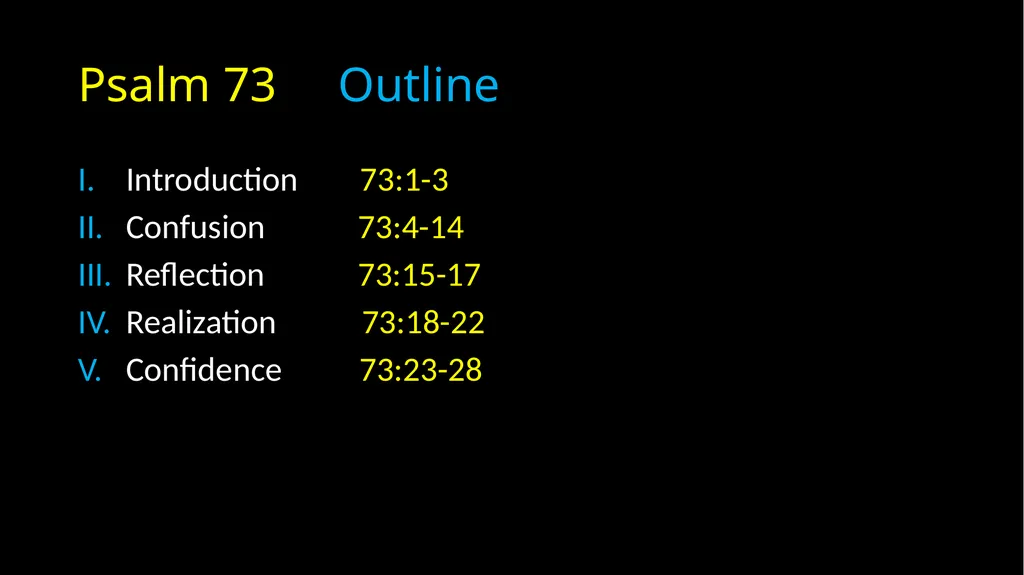
Psalm 73 Outline Introduction 73:1-3
Confusion 73:4-14
Reflection 73:15-17
Realization 73:18-22
Confidence 73:23-28<br>
Confusion 73:4-14
Reflection 73:15-17
Realization 73:18-22
Confidence 73:23-28<br>
07
I. Introduction 73:1-3<br>
08
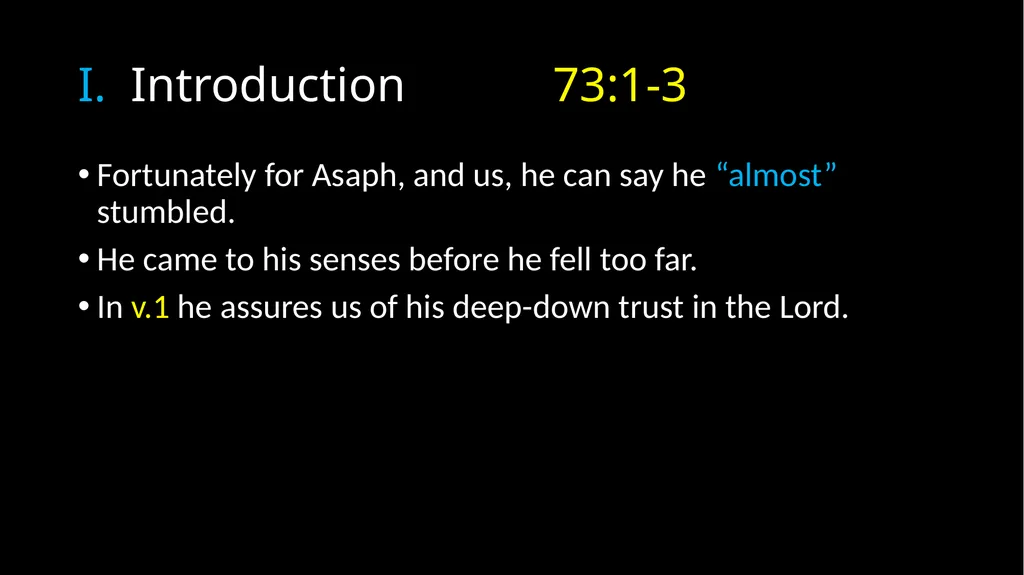
I. Introduction 73:1-3 Fortunately for Asaph, and us, he can say he “almost” stumbled.
He came to his senses before he fell too far.
In v.1 he assures us of his deep-down trust in the Lord.<br>
He came to his senses before he fell too far.
In v.1 he assures us of his deep-down trust in the Lord.<br>
09
I. Introduction 73:1-3 Asaph still states the problem.
It’s bad enough that Asaph was envious. Most people never like to admit that much.
What’s worse is the object of his envy – the arrogant and wicked.<br>
It’s bad enough that Asaph was envious. Most people never like to admit that much.
What’s worse is the object of his envy – the arrogant and wicked.<br>
10
II. Confusion 73:4-14<br>
11
II. Confusion 73:4-14 Asaph elaborates.
He’s been taking in all the latest news.
He’s been reading the Hollywood gossip.
He’s been considering Who’s Who on Wall Street.<br>
He’s been taking in all the latest news.
He’s been reading the Hollywood gossip.
He’s been considering Who’s Who on Wall Street.<br>
12
II. Confusion 73:4-14 73:4-14 He’s now thinking,
“I realize life isn’t fair, but this is getting totally ridiculous. When is it ever going to stop?”<br>
“I realize life isn’t fair, but this is getting totally ridiculous. When is it ever going to stop?”<br>
13
II. Confusion 73:4-14 73:4-14 Asaph lived in a world much like ours, where the godless seem to get what they want.
Rebellion is now so common, it’s revolutionary not to rebel.<br>
Rebellion is now so common, it’s revolutionary not to rebel.<br>
14
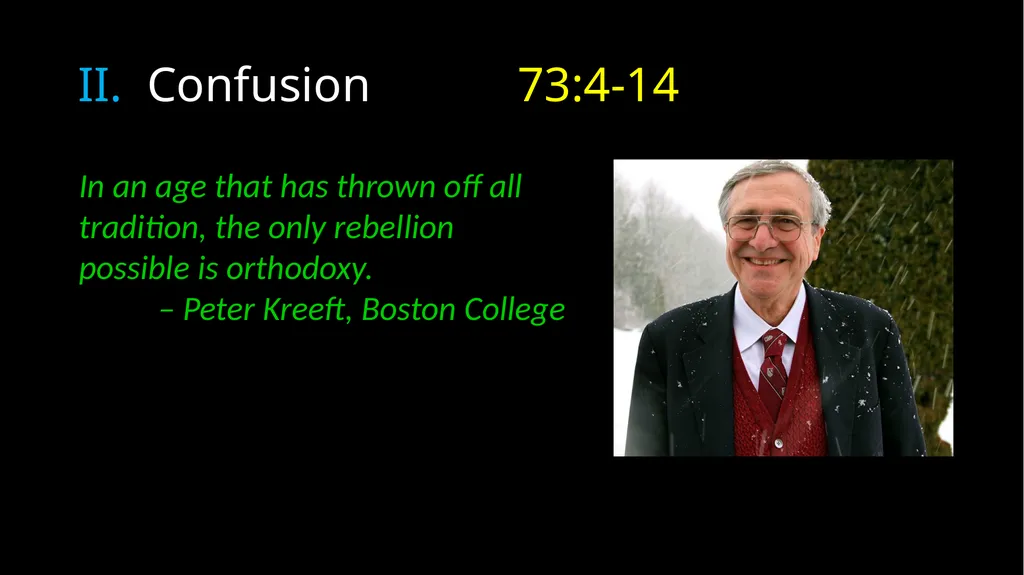
II. Confusion 73:4-14 In an age that has thrown off all tradition, the only rebellion possible is orthodoxy.
– Peter Kreeft, Boston College<br>
– Peter Kreeft, Boston College<br>
15
III. Reflection 73:15-17<br>
16
III. Reflection 73:15-17 Asaph stops short of embracing his observations.
He realizes, as a leader of God’s people, that can’t give in to such depressing thoughts.<br>
He realizes, as a leader of God’s people, that can’t give in to such depressing thoughts.<br>
17
III. Reflection 73:15-17 Sometimes it is simply our responsibility not to give in to certain trains of thought.
It might be part of the example we need to set.
It might be part of the way we need to influence others.<br>
It might be part of the example we need to set.
It might be part of the way we need to influence others.<br>
18
III. Reflection 73:15-17 When Asaph entered the sanctuary to worship, his head began to get clearer.
It was there that he came to his senses.<br>
It was there that he came to his senses.<br>
19
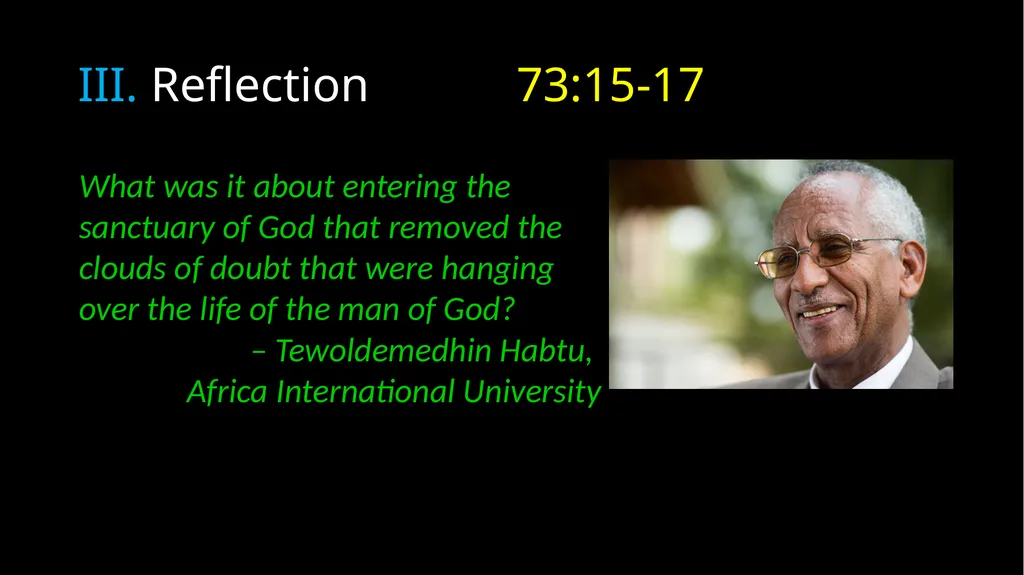
III. Reflection 73:15-17 What was it about entering the sanctuary of God that removed the clouds of doubt that were hanging over the life of the man of God?
– Tewoldemedhin Habtu, Africa International University<br>
– Tewoldemedhin Habtu, Africa International University<br>
20
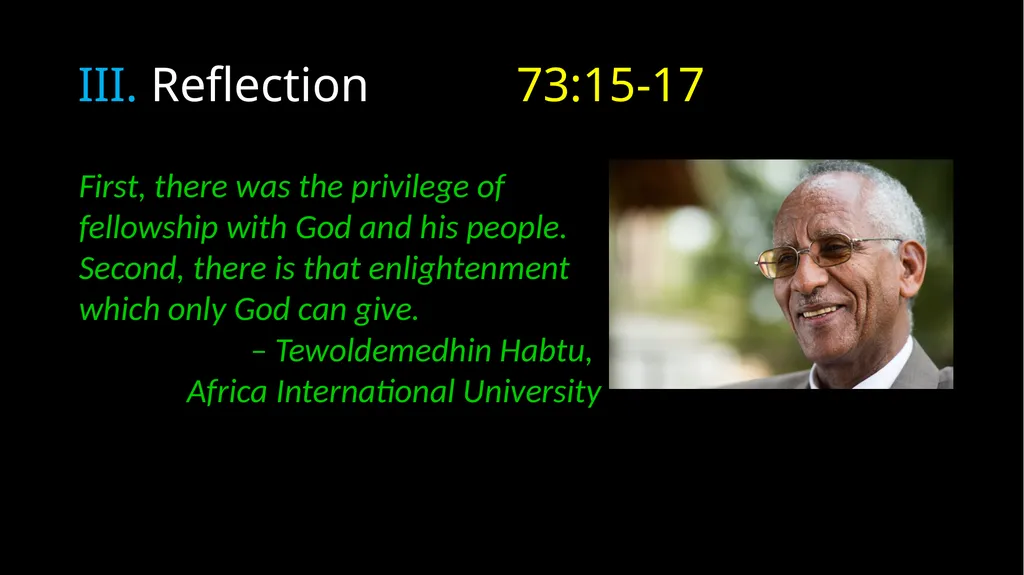
III. Reflection 73:15-17 First, there was the privilege of fellowship with God and his people.
Second, there is that enlightenment which only God can give.
– Tewoldemedhin Habtu, Africa International University<br>
Second, there is that enlightenment which only God can give.
– Tewoldemedhin Habtu, Africa International University<br>
21
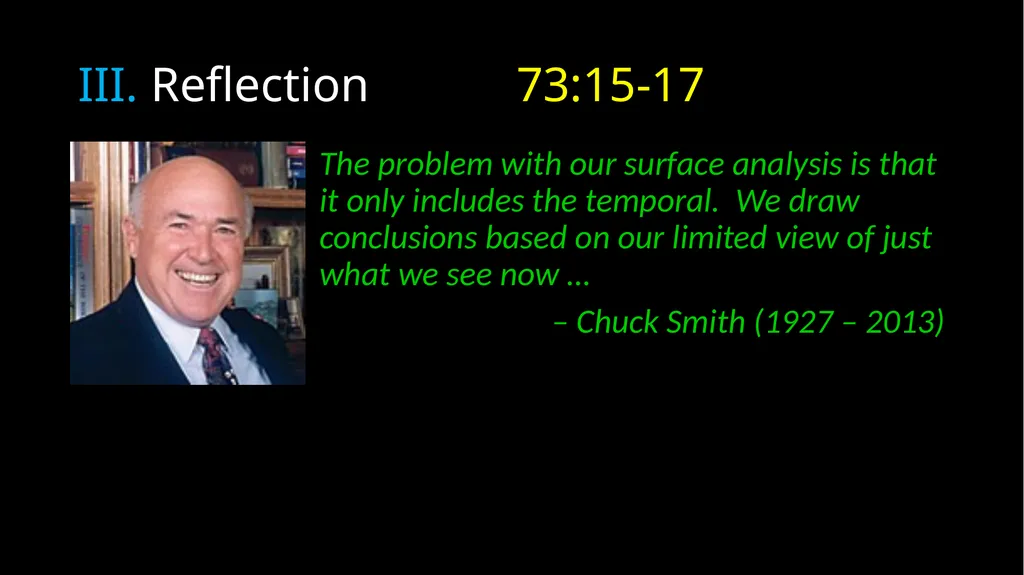
III. Reflection 73:15-17 The problem with our surface analysis is that it only includes the temporal. We draw conclusions based on our limited view of just what we see now …
– Chuck Smith (1927 – 2013)<br>
– Chuck Smith (1927 – 2013)<br>
22
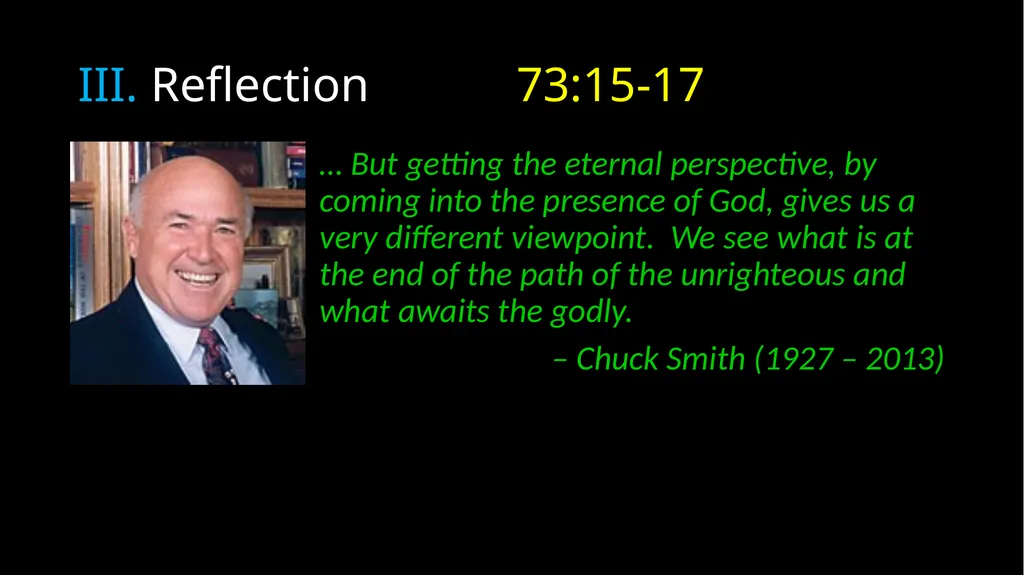
III. Reflection 73:15-17 … But getting the eternal perspective, by coming into the presence of God, gives us a very different viewpoint. We see what is at the end of the path of the unrighteous and what awaits the godly.
– Chuck Smith (1927 – 2013)<br>
– Chuck Smith (1927 – 2013)<br>
23
III. Reflection 73:15-17 Corporate worship is a useful habit.
Jesus attended the synagogue every week.
Luke 4:16 (ESV) And he came to Nazareth, where he had been brought up. And as was his custom, he went to the synagogue on the Sabbath day …<br>
Jesus attended the synagogue every week.
Luke 4:16 (ESV) And he came to Nazareth, where he had been brought up. And as was his custom, he went to the synagogue on the Sabbath day …<br>
24
IV. Realization 73:18-22<br>
25
IV. Realization 73:18-22 Asaph realizes that his envy, resentment and doubt were all kind of stupid.
He wasn’t taking a long enough view.<br>
He wasn’t taking a long enough view.<br>
26
IV. Realization 73:18-22 In Luke 12:15-21, Jesus told a story of a prosperous-but-short-sighted man.<br>
27
IV. Realization 73:18-22 Luke 12:15-21 (ESV) 15 And he said to them, “Take care, and be on your guard against all covetousness, for one’s life does not consist in the abundance of his possessions.”<br>
28
IV. Realization 73:18-22 Luke 12:15-21 (ESV) 16 And he told them a parable, saying, “The land of a rich man produced plentifully, 17 and he thought to himself, ‘What shall I do, for I have nowhere to store my crops?’ 18 And he said, ‘I will do this: I will tear down my barns and build larger ones, and there I will store all my grain and my goods. 19 And I will say to my soul, “Soul, you have ample goods laid up for many years; relax, eat, drink, be merry.” ’<br>
29
IV. Realization 73:18-22 Luke 12:15-21 (ESV) 20 But God said to him, ‘Fool! This night your soul is required of you, and the things you have prepared, whose will they be?’ 21 So is the one who lays up treasure for himself and is not rich toward God.”<br>
30
IV. Realization 73:18-22 Jesus agrees with Asaph.
In answer to the question, “Why do the wicked prosper?” Asaph and Jesus both respond that ultimately they don’t.
Their prosperity is temporary.
Their prosperity is ultimately an illusion.<br>
In answer to the question, “Why do the wicked prosper?” Asaph and Jesus both respond that ultimately they don’t.
Their prosperity is temporary.
Their prosperity is ultimately an illusion.<br>
31
V. Confidence 73:23-28<br>
32
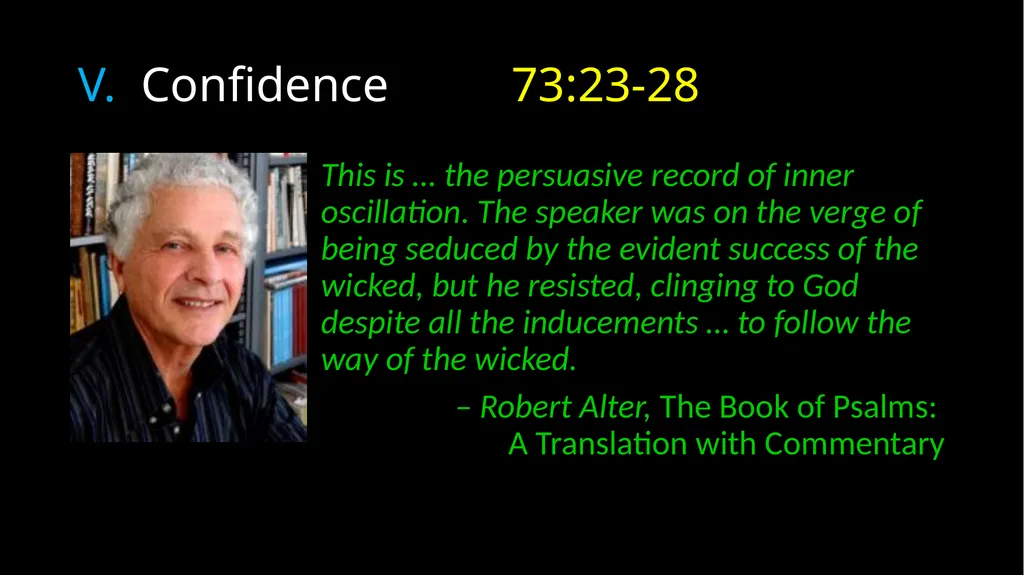
V. Confidence 73:23-28 This is … the persuasive record of inner oscillation. The speaker was on the verge of being seduced by the evident success of the wicked, but he resisted, clinging to God despite all the inducements … to follow the way of the wicked.
– Robert Alter, The Book of Psalms: A Translation with Commentary<br>
– Robert Alter, The Book of Psalms: A Translation with Commentary<br>
33
V. Confidence 73:23-28 Jesus told another relevant story – one of a rich man and a poor beggar named Lazarus.
We find it in Luke 16:19-31.<br>
We find it in Luke 16:19-31.<br>
34
V. Confidence 73:23-28 Luke 16:19-31 (ESV) 19 “There was a rich man who was clothed in purple and fine linen and who feasted sumptuously every day. 20 And at his gate was laid a poor man named Lazarus, covered with sores, 21 who desired to be fed with what fell from the rich man’s table. Moreover, even the dogs came and licked his sores. 22 The poor man died and was carried by the angels to Abraham’s side. The rich man also died and was buried,<br>
35
V. Confidence 73:23-28 Luke 16:19-31 (ESV) 23 and in Hades, being in torment, he lifted up his eyes and saw Abraham far off and Lazarus at his side. 24 And he called out, ‘Father Abraham, have mercy on me, and send Lazarus to dip the end of his finger in water and cool my tongue, for I am in anguish in this flame.’ 25 But Abraham said, ‘Child, remember that you in your lifetime received your good things, and Lazarus in like manner bad things; but now he is comforted here, and you are in anguish.<br>
36
V. Confidence 73:23-28 Luke 16:19-31 (ESV) 26 And besides all this, between us and you a great chasm has been fixed, in order that those who would pass from here to you may not be able, and none may cross from there to us.’ 27 And he said, ‘Then I beg you, father, to send him to my father’s house— 28 for I have five brothers—so that he may warn them, lest they also come into this place of torment.’<br>
37
V. Confidence 73:23-28 Luke 16:19-31 (ESV) 29 But Abraham said, ‘They have Moses and the Prophets; let them hear them.’ 30 And he said, ‘No, father Abraham, but if someone goes to them from the dead, they will repent.’ 31 He said to him, ‘If they do not hear Moses and the Prophets, neither will they be convinced if someone should rise from the dead.’ ”<br>
38
V. Confidence 73:23-28 Again, Jesus agrees with Asaph.
In answer to the question, “Why do the wicked prosper?” Asaph and Jesus both respond that ultimately they don’t.
Their prosperity is temporary.
Their prosperity is ultimately an illusion.<br>
In answer to the question, “Why do the wicked prosper?” Asaph and Jesus both respond that ultimately they don’t.
Their prosperity is temporary.
Their prosperity is ultimately an illusion.<br>
39
V. Confidence 73:23-28 And if we wonder, “Why do the righteous suffer?”
Asaph and Jesus both respond that ultimately they don’t.
Their suffering is temporary.
Their suffering is, at most, confined to this world.<br>
Asaph and Jesus both respond that ultimately they don’t.
Their suffering is temporary.
Their suffering is, at most, confined to this world.<br>
40
V. Confidence 73:23-28 2 Corinthians 4:17-18 (ESV) 17 For this light momentary affliction is preparing for us an eternal weight of glory beyond all comparison, 18 as we look not to the things that are seen but to the things that are unseen. For the things that are seen are transient, but the things that are unseen are eternal.<br>
41
My Portion Forever Conclusion<br>
42
My Portion Forever Conclusion One of the questions the Bible deals with repeatedly is, “Why do bad things happen to good people?”
The other side to that same question is, “Why do the wicked sometimes have it so good?”
This is the question that bothered the psalmist Asaph.<br>
The other side to that same question is, “Why do the wicked sometimes have it so good?”
This is the question that bothered the psalmist Asaph.<br>
43
My Portion Forever Conclusion “Why do the wicked prosper?” Asaph and Jesus both respond that ultimately they don’t.
Their prosperity is temporary.
Their prosperity is ultimately an illusion.<br>
Their prosperity is temporary.
Their prosperity is ultimately an illusion.<br>
44
My Portion Forever Conclusion “Why do the righteous suffer?”
Asaph and Jesus both respond that ultimately they don’t.
Their suffering is temporary.
Their suffering is, at most, confined to this world.<br>
Asaph and Jesus both respond that ultimately they don’t.
Their suffering is temporary.
Their suffering is, at most, confined to this world.<br>
45
My Portion Forever Conclusion The sufferings of Christ are the ultimate example of the sufferings of the righteous.
His sufferings achieve victory over sin and death.
His victory gives us free access to the presence of God.<br>
His sufferings achieve victory over sin and death.
His victory gives us free access to the presence of God.<br>
46
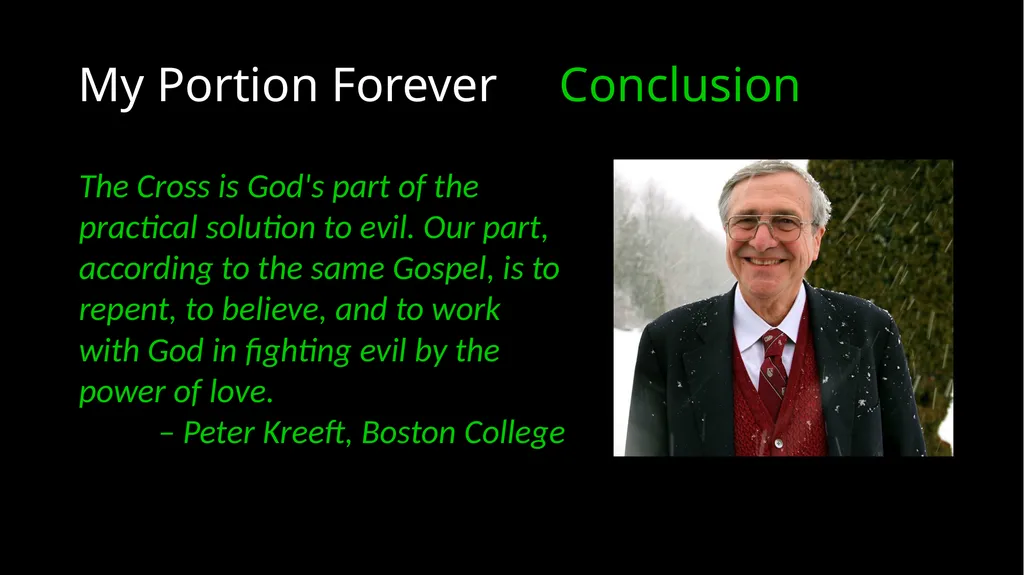
My Portion Forever Conclusion The Cross is God's part of the practical solution to evil. Our part, according to the same Gospel, is to repent, to believe, and to work with God in fighting evil by the power of love.
– Peter Kreeft, Boston College<br>
– Peter Kreeft, Boston College<br>
47
My Portion Forever Conclusion The godly can err in their thinking – and be tempted by incorrect thoughts.
This happened to Asaph – for a little while.
Then he came to his senses.<br>
This happened to Asaph – for a little while.
Then he came to his senses.<br>
48
My Portion Forever Conclusion When we are tempted we can listen to Asaph and come to our senses too.
Read Psalm 73:25-26 one last time.<br>
Read Psalm 73:25-26 one last time.<br>