Next generation and Extended sequencing Working group (NEW) for measles and rubella and the NEW working group Alberto Severini National Microbiology Laboratory Public Health Agency of Canada alberto.severiniphac-aspc.gc.ca Accelerating
"Next generation and Extended sequencing Working" is the property of its rightful owner. Permission is granted to
download and print the materials on this website for personal, non-commercial use only, and to display it
on your personal computer provided you do not modify the materials and that you retain all copyright
notices contained in the materials. By downloading content from our website, you accept the terms of this
agreement.
Presentation Transcript
01
Next generation and Extended sequencing Working group (NEW) for measles and rubella and the NEW working group Alberto Severini
National Microbiology Laboratory
Public Health Agency of Canada
alberto.severini@phac-aspc.gc.ca Accelerating Progress towards Measles and Rubella Elimination, WHO Geneva, June 21-23, 2016<br>
02
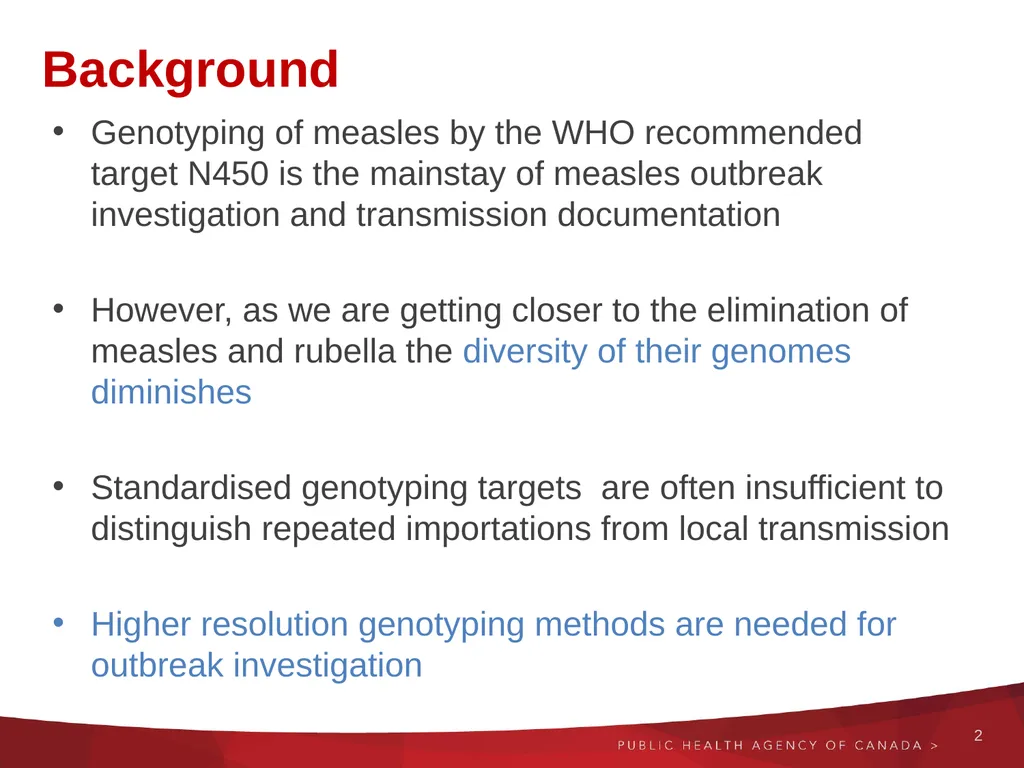
Background Genotyping of measles by the WHO recommended target N450 is the mainstay of measles outbreak investigation and transmission documentation
However, as we are getting closer to the elimination of measles and rubella the diversity of their genomes diminishes
Standardised genotyping targets are often insufficient to distinguish repeated importations from local transmission
Higher resolution genotyping methods are needed for outbreak investigation 2<br>
03
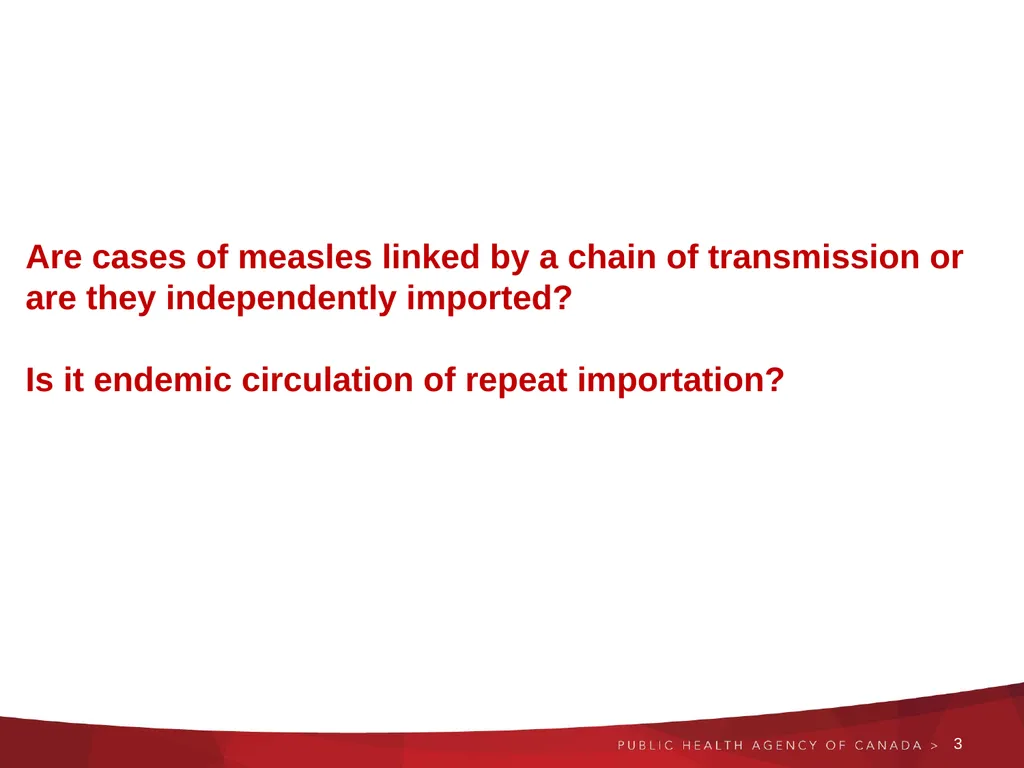
Are cases of measles linked by a chain of transmission or are they independently imported? Is it endemic circulation of repeat importation? 3<br>
04
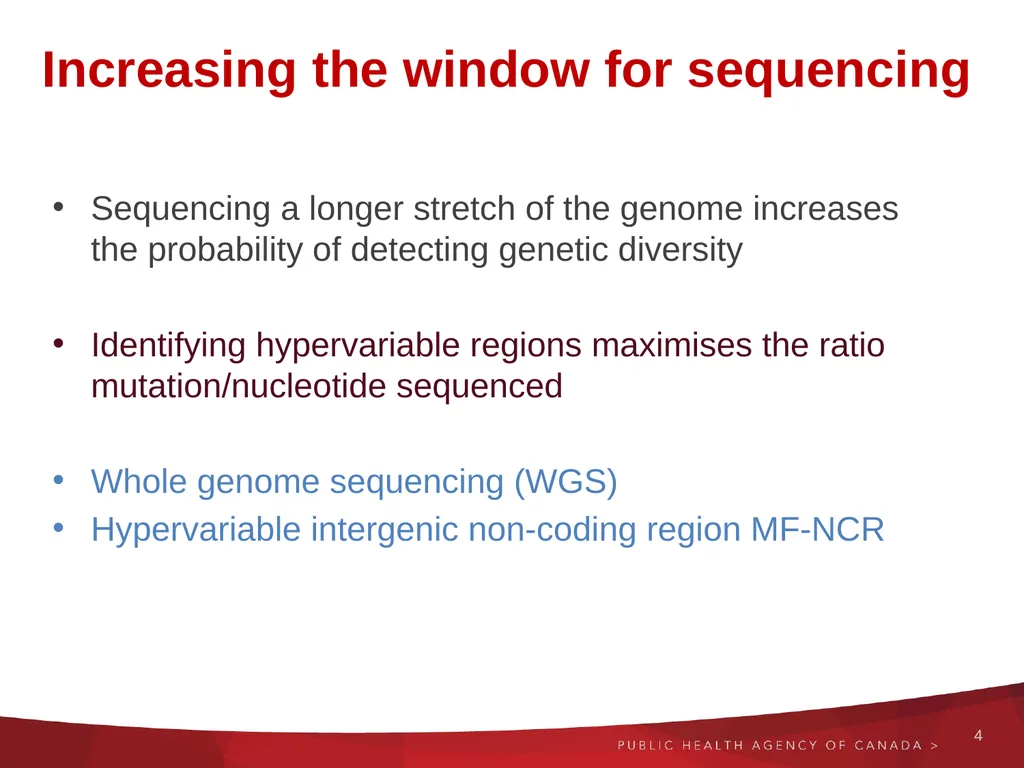
Increasing the window for sequencing Sequencing a longer stretch of the genome increases the probability of detecting genetic diversity
Identifying hypervariable regions maximises the ratio mutation/nucleotide sequenced
Whole genome sequencing (WGS)
Hypervariable intergenic non-coding region MF-NCR 4<br>
05
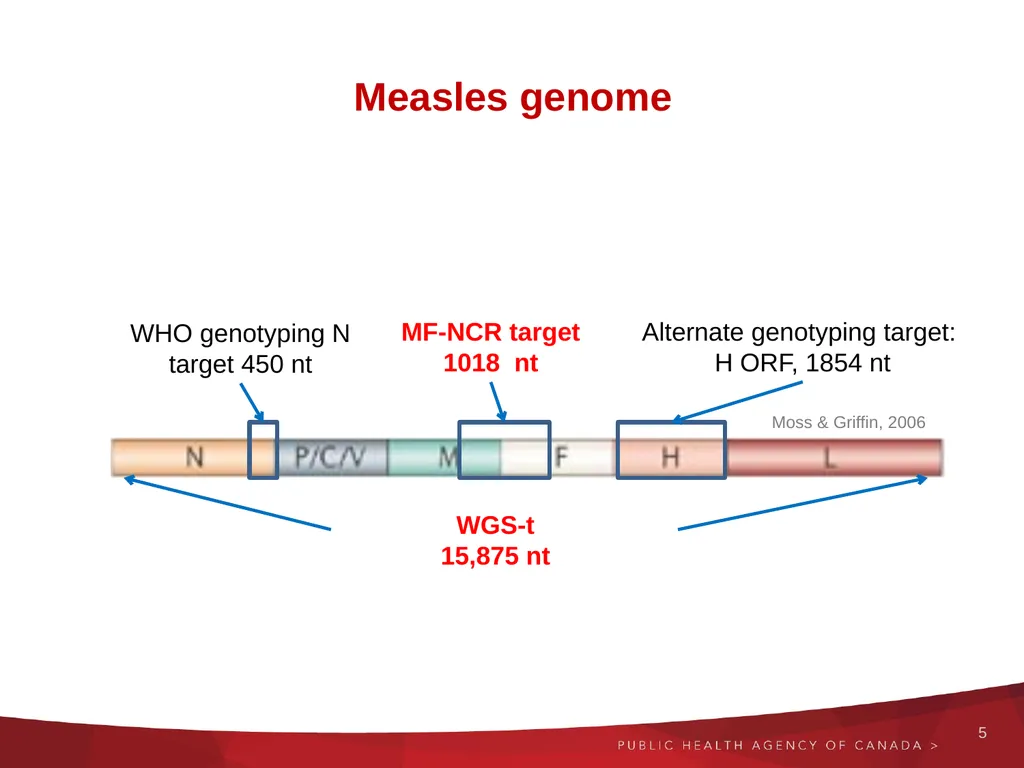
Measles genome 5 Moss & Griffin, 2006 WHO genotyping N target 450 nt Alternate genotyping target:
H ORF, 1854 nt MF-NCR target
1018 nt WGS-t
15,875 nt<br>
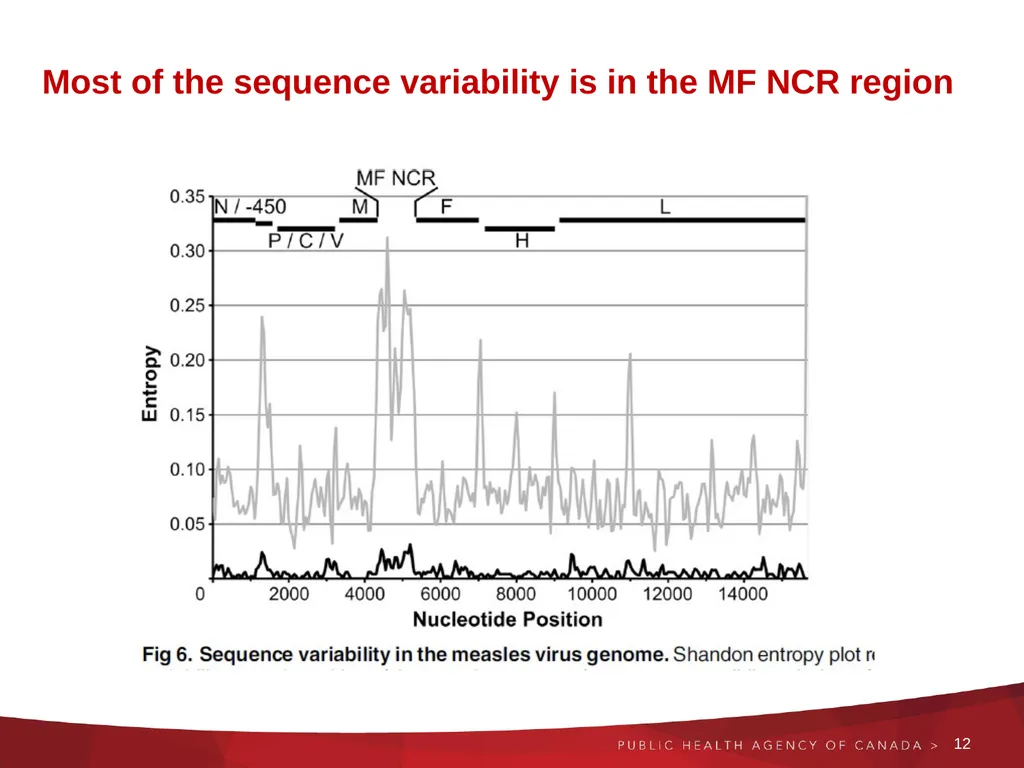
Most of the sequence variability is in the MF NCR region 12<br>
13
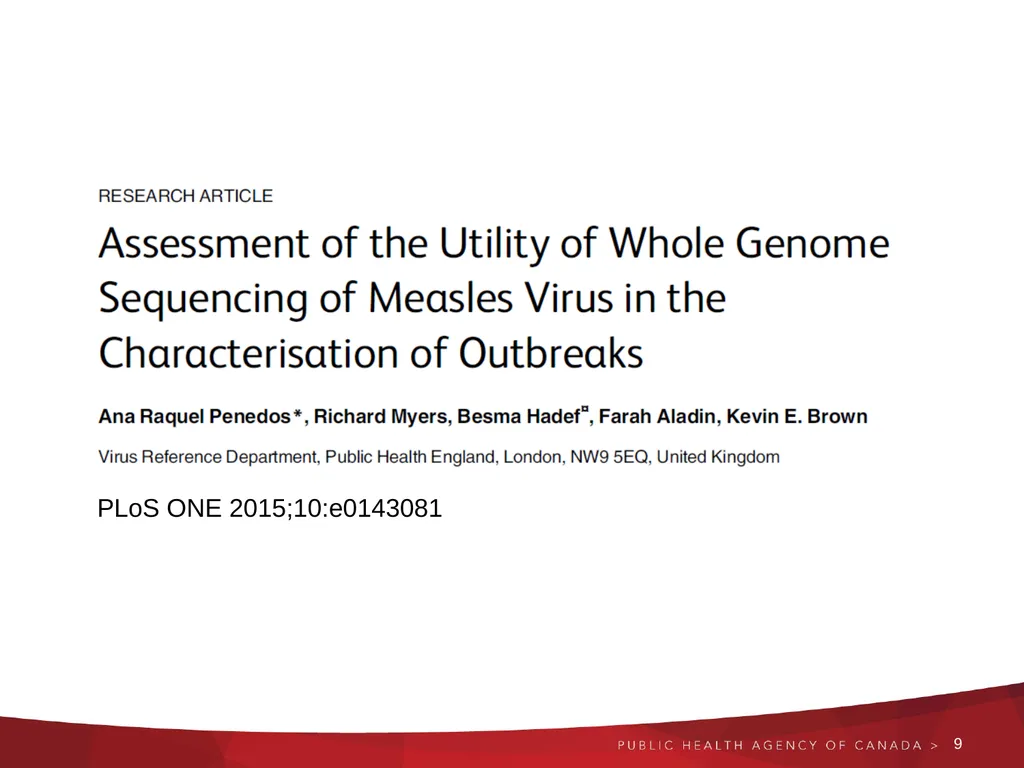
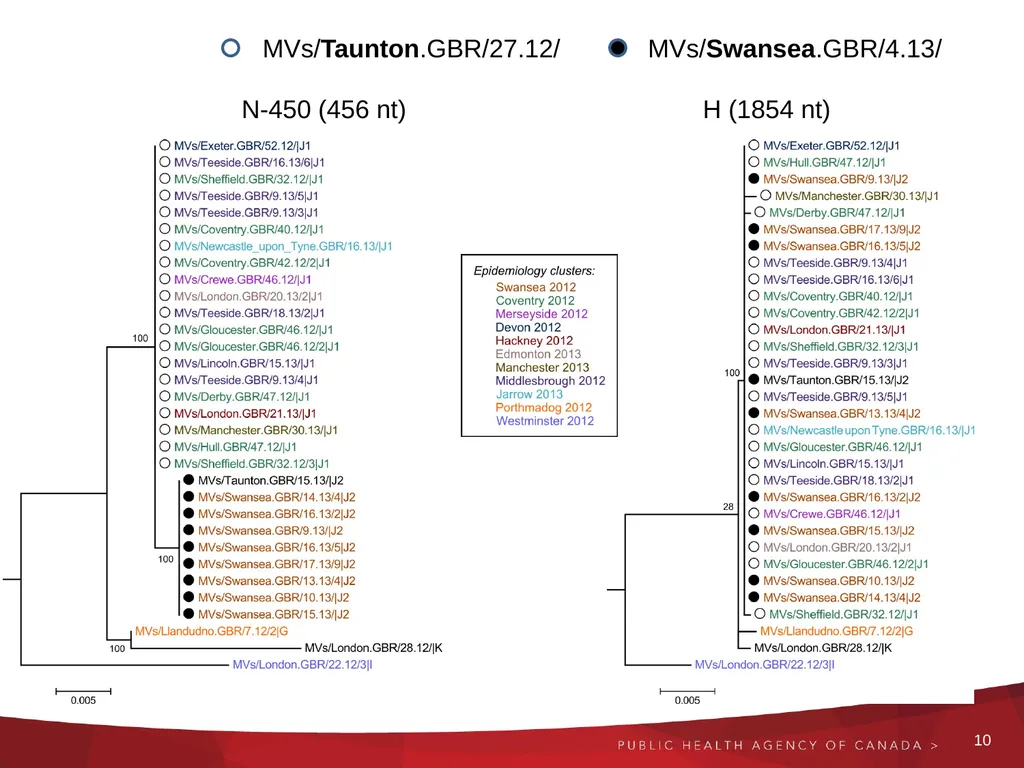
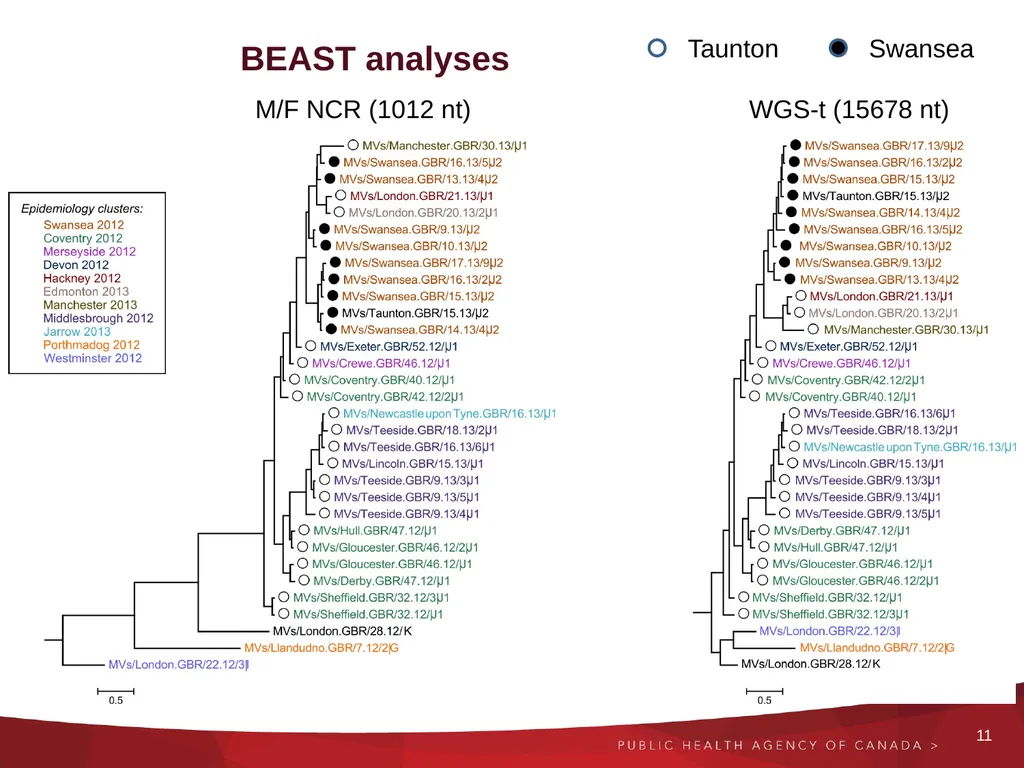
Conclusions – Quebec and England outbreaks Whole genome sequencing resolves the chain of transmission of this outbreak
Sequencing of the MF –NCR region is a good surrogate for WGS<br>
14
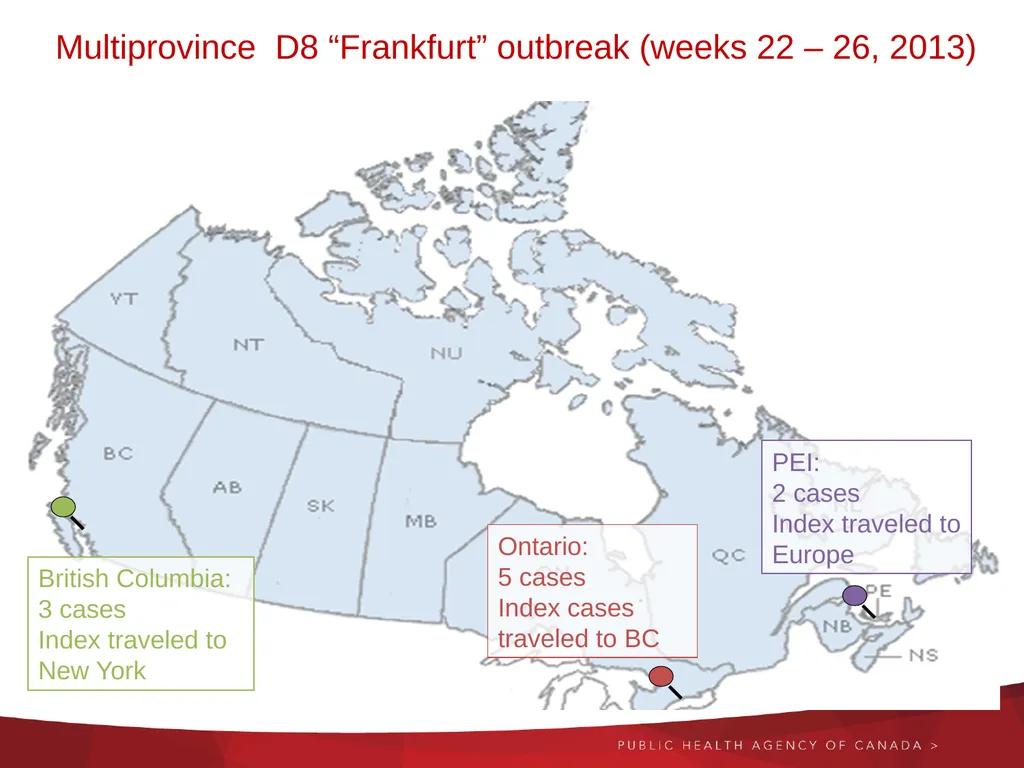
Multiprovince D8 “Frankfurt” outbreak (weeks 22 – 26, 2013) PEI:
2 cases
Index traveled to Europe Ontario:
5 cases
Index cases traveled to BC British Columbia:
3 cases
Index traveled to New York<br>
15
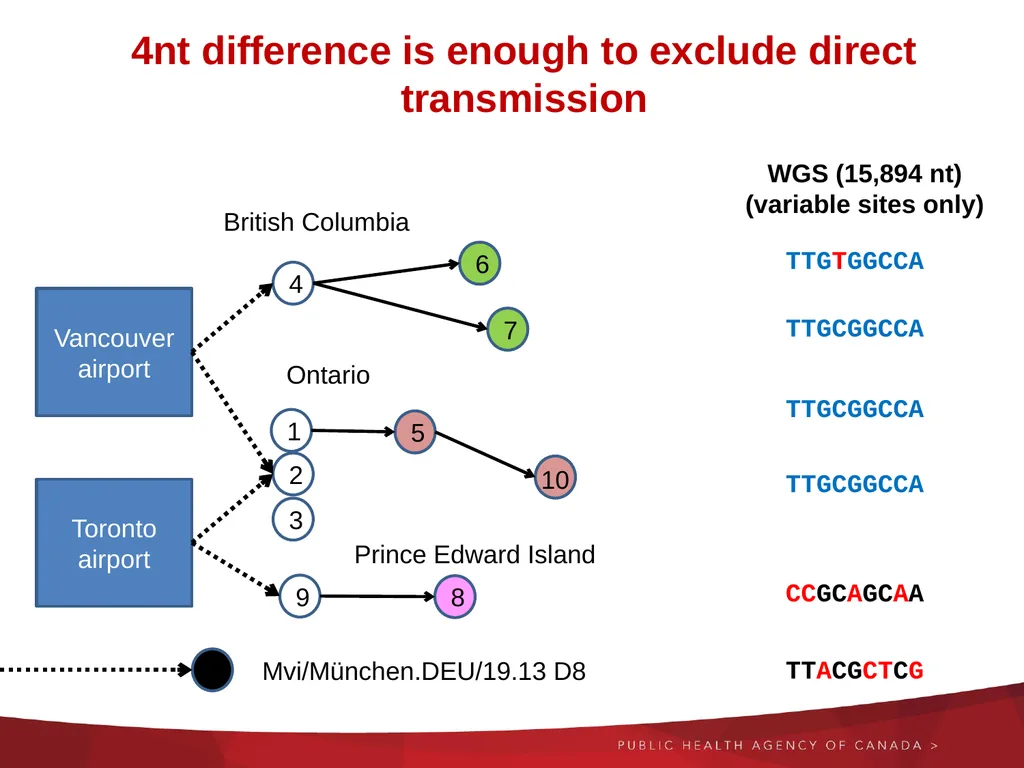
4nt difference is enough to exclude direct transmission 1 2 3 5 4 6 7 9 8 Vancouver airport Toronto airport British Columbia Ontario Prince Edward Island Mvi/München.DEU/19.13 D8 10 TTACGCTCG TTGCGGCCA TTGCGGCCA TTGTGGCCA TTGCGGCCA CCGCAGCAA WGS (15,894 nt)
(variable sites only)<br>
16
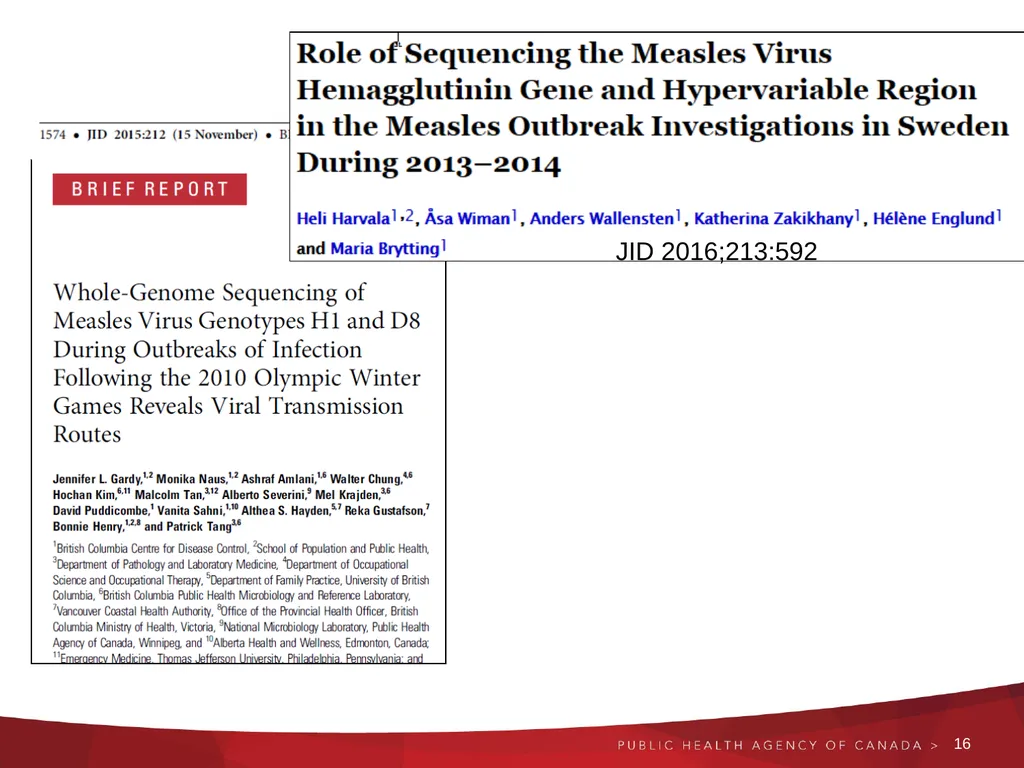
16 JID 2016;213:592<br>
17
Rubella whole genome and extended sequencing Nucleotide heterogeneity along the entire genome
NSP SP 20-nt sliding window; 48 complete RV genomes Nucleotide variability C E2 E1 p150 p90 3’ Overall genetic distance: 0.057
Hypervariable region (HVR): 0.115
Genotyping window for wild type rubella virus: 8731 – 9469 (p-distance = 0.061) Genotyping
window Hypervariable region<br>
18
Evidence for Association between Rubella and Granulomas in Children with PID Previous study
RA27/3 RV vaccine strain was the only virus sequence found in granuloma biopsies by NGS
(Bodemera C. et al, Clin Microbiol Infect, 2014)
Current study
7 out of 14 PID cases were positive for RV antigen by IHC
RV positive PIDs were largely T cell defects
(Perelygina, Plotkin, Russo, Hautala, Bonilla, Ochs, Joshi, Routes, Patel, Wehr, Icenogle, and Sullivan. Rubella Persistence in epidermal keratinocytes and M2 macrophages in patients with primary immunodeficiencies. The Journal of Allergy and Clinical Immunology, In Press)
Sequence done by classic methods, but comparison with rubella virus sequences from other persistent infections, recently derived by NGS, was possible.<br>
19
19 NEW met in Berlin on March 16-17, 2016
We discussed the available data and their utility in measles and rubella outbreak investigation
We developed a set of recommendations for GRMLN
We developed a set of standards for obtaining and depositing measles sequences The Next generation and Extended sequencing Working group (NEW) for measles and rubella<br>
20
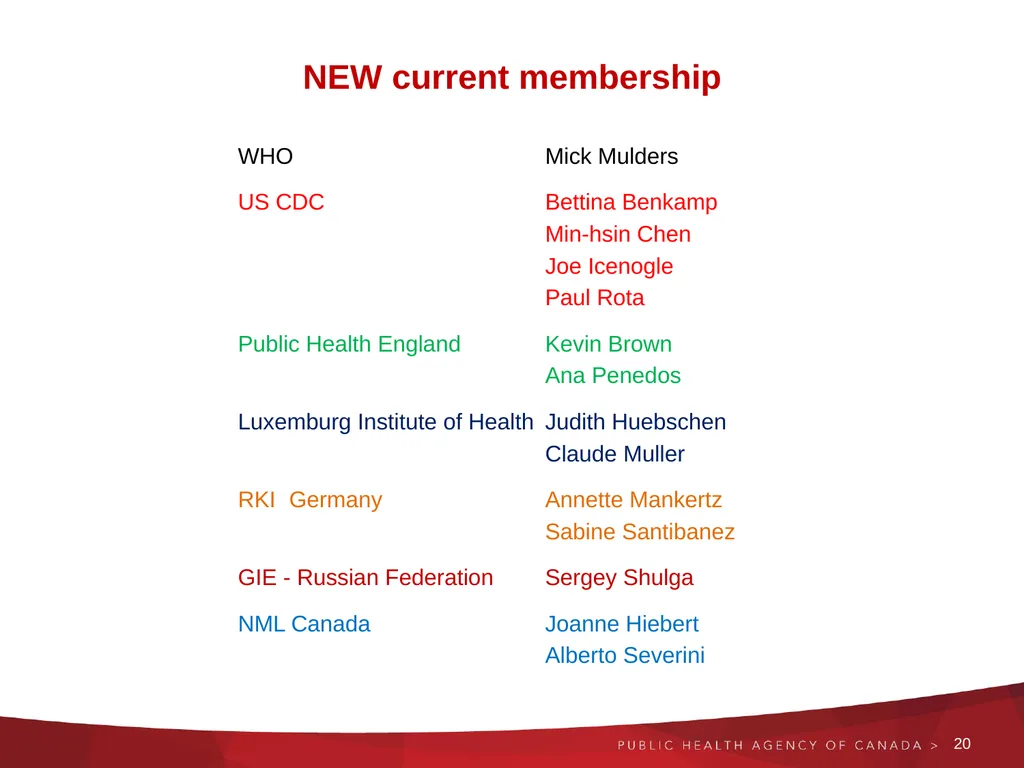
NEW current membership WHO Mick Mulders
US CDC Bettina Benkamp
Min-hsin Chen
Joe Icenogle
Paul Rota
Public Health England Kevin Brown
Ana Penedos
Luxemburg Institute of Health Judith Huebschen
Claude Muller
RKI Germany Annette Mankertz
Sabine Santibanez
GIE - Russian Federation Sergey Shulga
NML Canada Joanne Hiebert
Alberto Severini 20<br>
21
Utility 21 Extended and WGS are not meant to replace standard genotyping by N-450 for measles and 739 from the E1 gene for rubella
WGS or sequencing of the MF-NCR region of measles has proven its utility in low incidence setting, when standard genotyping fails
Extensive and uniform sampling of outbreaks, plus a prior knowledge of related sequences, are needed to make the results interpretable
It is recommended to obtain as many measles and rubella genomic sequences as possible to develop a database that will aid in outbreak investigations<br>
22
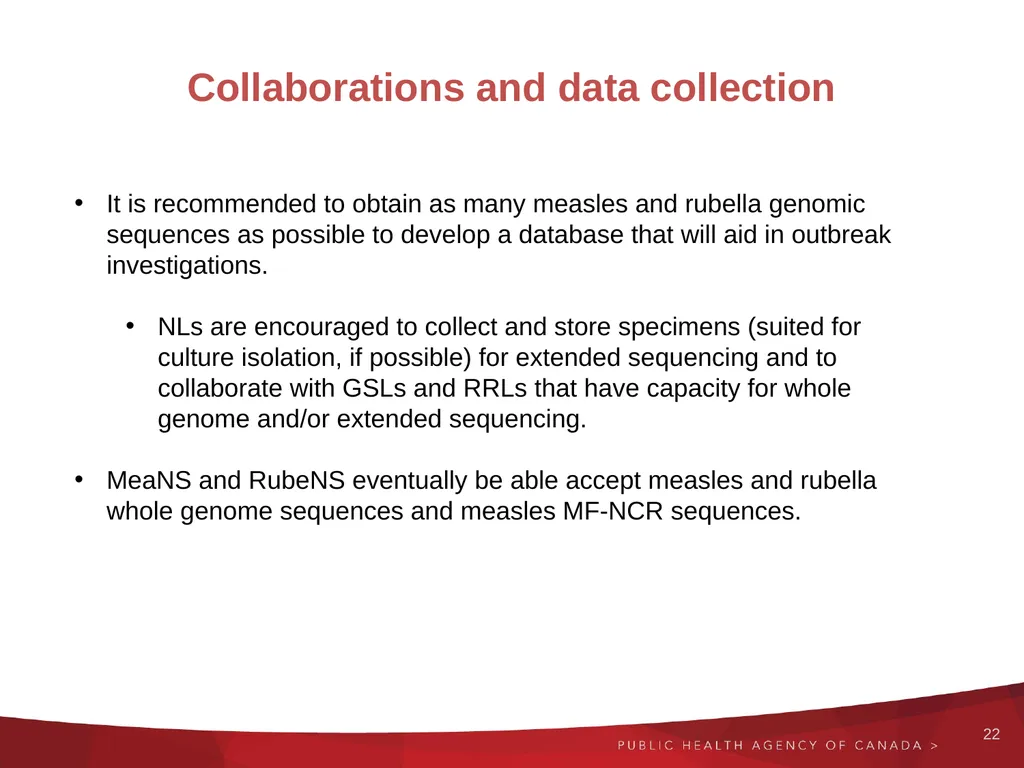
Collaborations and data collection 22 It is recommended to obtain as many measles and rubella genomic sequences as possible to develop a database that will aid in outbreak investigations.
NLs are encouraged to collect and store specimens (suited for culture isolation, if possible) for extended sequencing and to collaborate with GSLs and RRLs that have capacity for whole genome and/or extended sequencing.
MeaNS and RubeNS eventually be able accept measles and rubella whole genome sequences and measles MF-NCR sequences.<br>
23
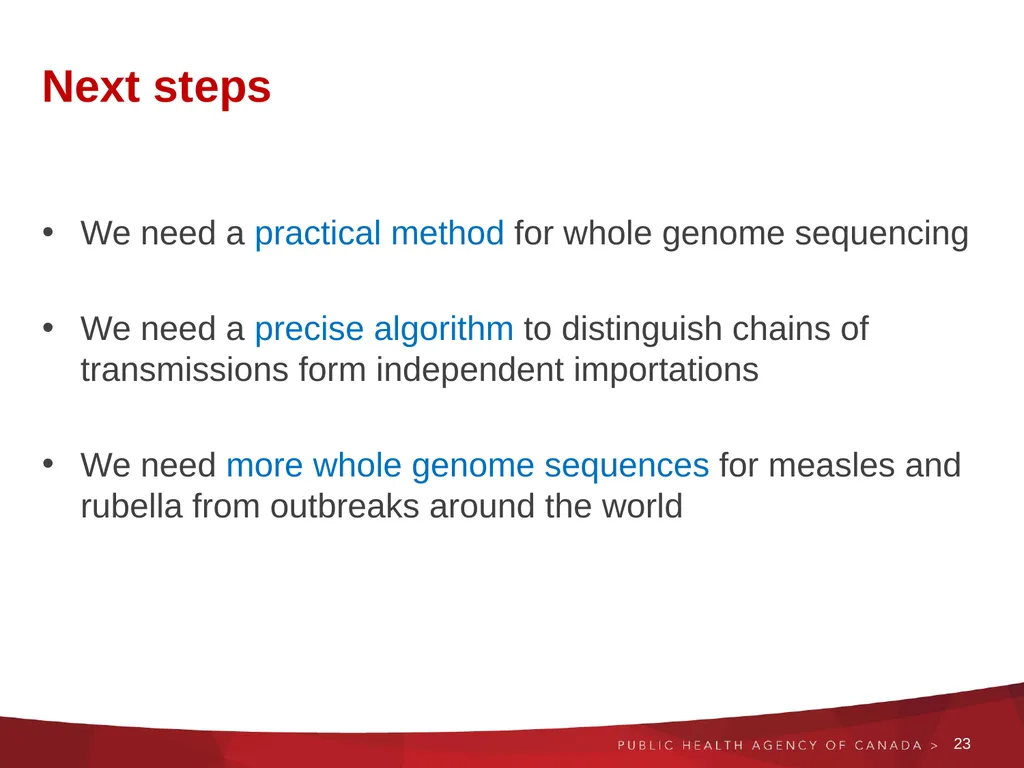
Next steps We need a practical method for whole genome sequencing
We need a precise algorithm to distinguish chains of transmissions form independent importations
We need more whole genome sequences for measles and rubella from outbreaks around the world 23<br>
24
Acknowledgements NEW working group
Ana Penedos measles WGS
Kevin Brown
Min-hsin Chen rubella WGS
Joe Icenogle
And all the members 24 NML Canada
Helene Schulz
Robyn Thorington
Shaun Tyler DNA core<br>