
Nucleic Acid Structure Many thanks to Dave Bevan

Description: Nucleic Acid Structure Many thanks to Dave Bevan for providing some of the material for this lecture. The Central Dogma Graphical Representation of inherent bonding properties of DNA Travelling Salesman Problem In early 1994, Adleman put
Related Topics
Download Presentation
"Nucleic Acid Structure Many thanks to Dave Bevan" is the property of its rightful owner. Permission is granted to download and print the materials on this website for personal, non-commercial use only, and to display it on your personal computer provided you do not modify the materials and that you retain all copyright notices contained in the materials. By downloading content from our website, you accept the terms of this agreement.
Presentation Transcript
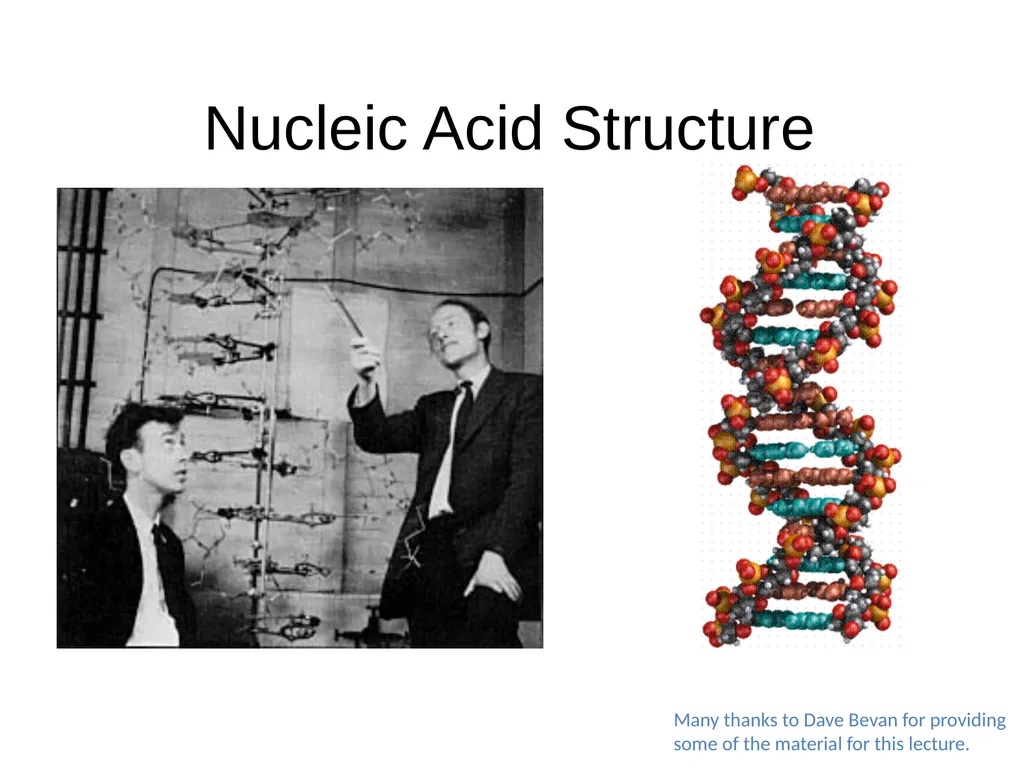
slide1. Nucleic Acid Structure Many thanks to Dave Bevan for providing
some of the material for this lecture.<br>
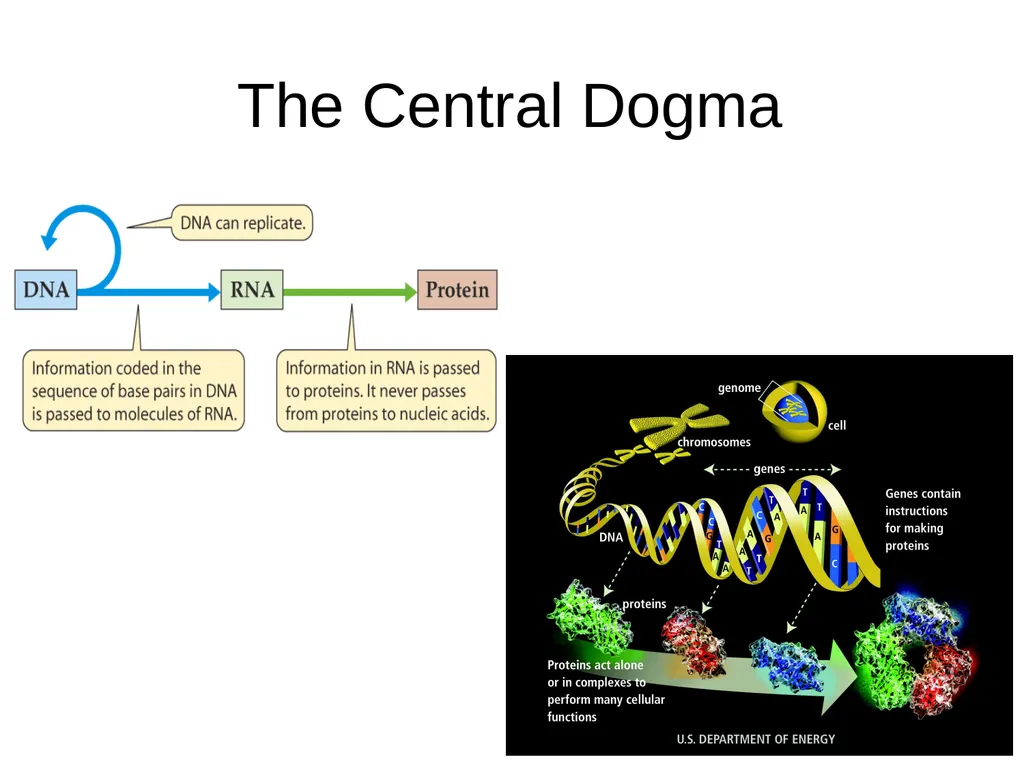
slide2. The Central Dogma<br>
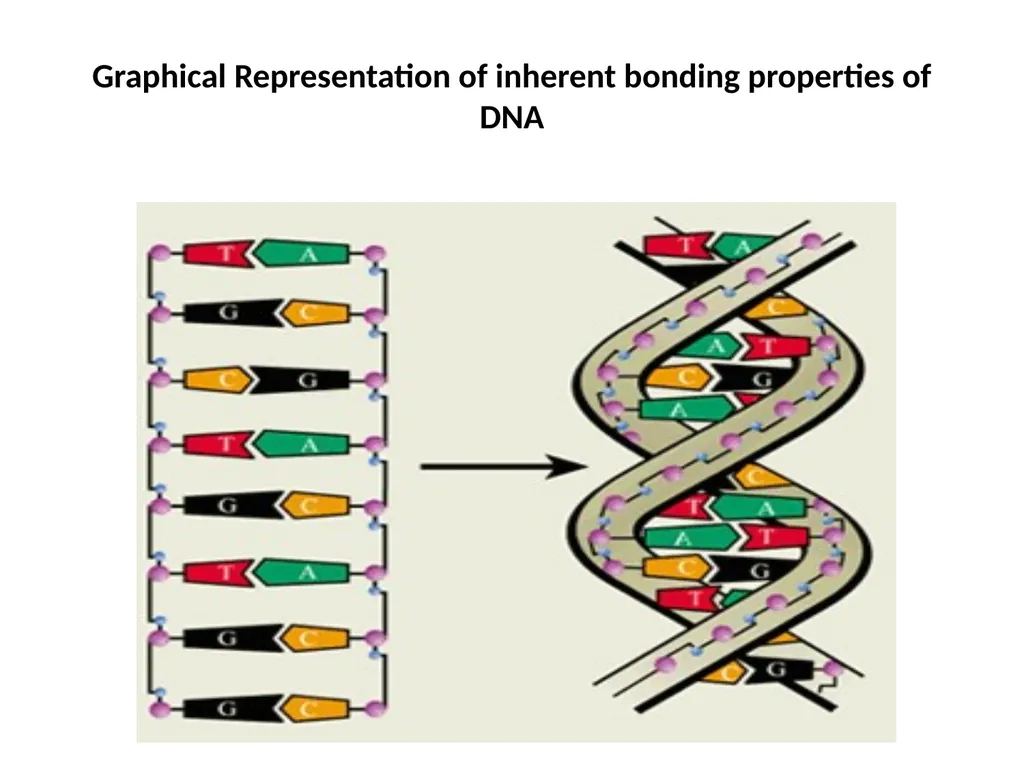
slide3. Graphical Representation of inherent bonding properties of DNA<br>
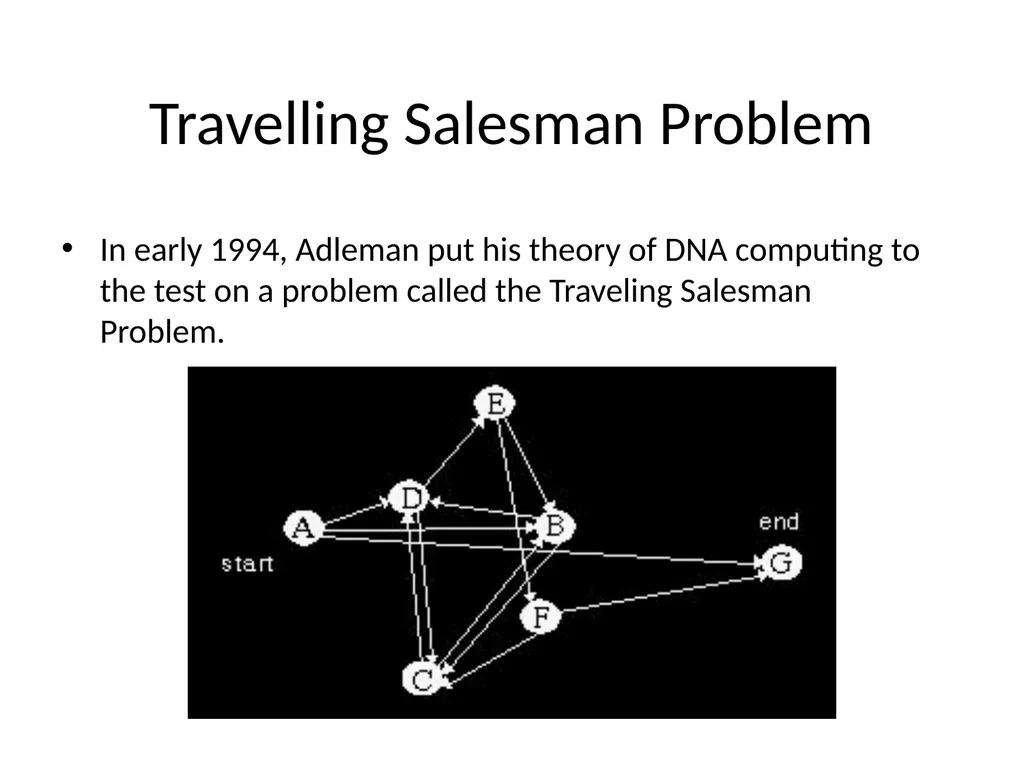
slide4. Travelling Salesman Problem In early 1994, Adleman put his theory of DNA computing to the test on a problem called the Traveling Salesman Problem.<br>
slide5. Travelling Salesman Problem Only need to keep those paths that exhibit the following properties:
The path must start at city A and end at city G.
Of those paths, the correct paths must pass through all 7 cities at least once.
The final path must contain each city in turn.<br>
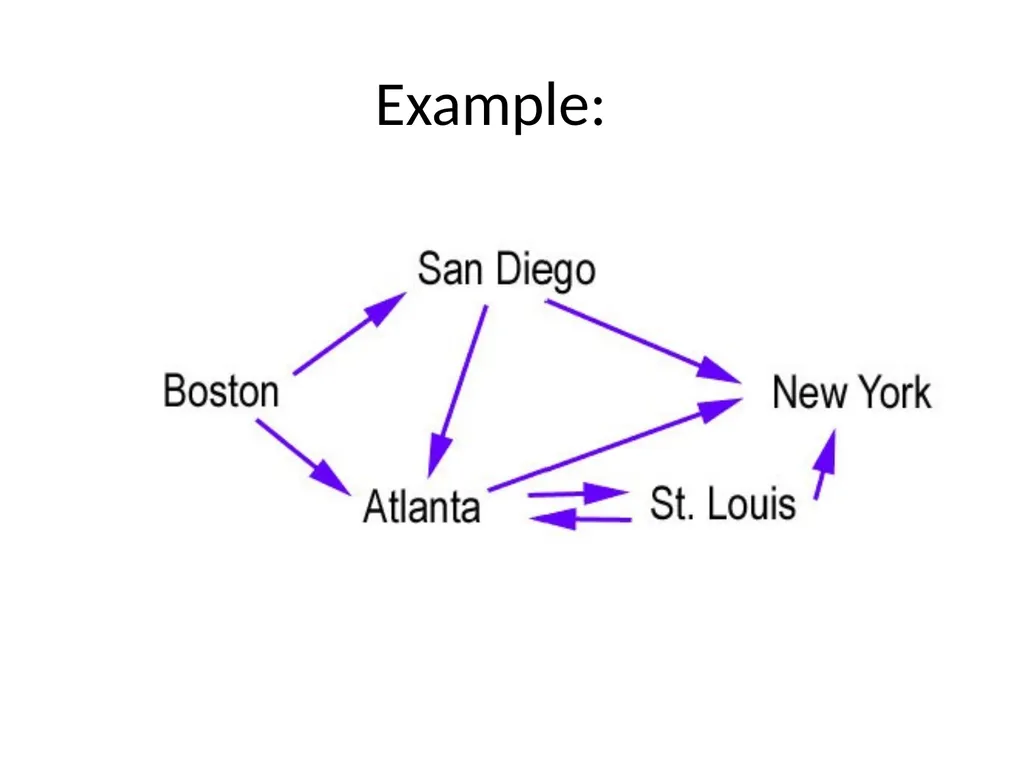
slide6. Example:<br>
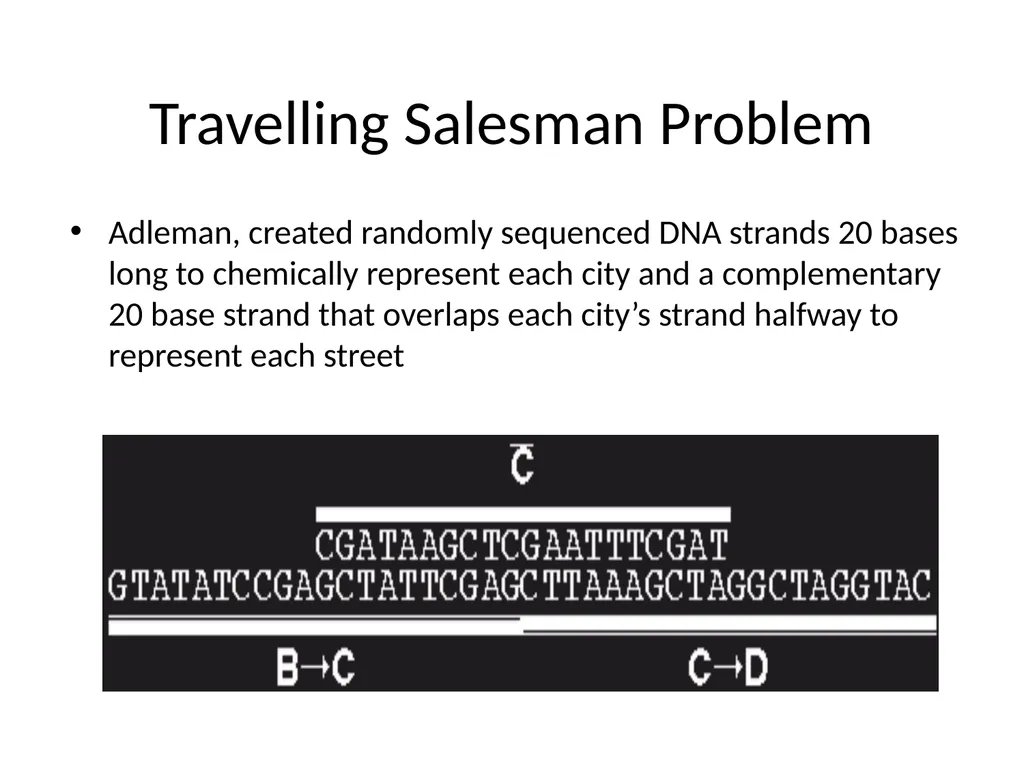
slide7. Travelling Salesman Problem Adleman, created randomly sequenced DNA strands 20 bases long to chemically represent each city and a complementary 20 base strand that overlaps each city’s strand halfway to represent each street<br>
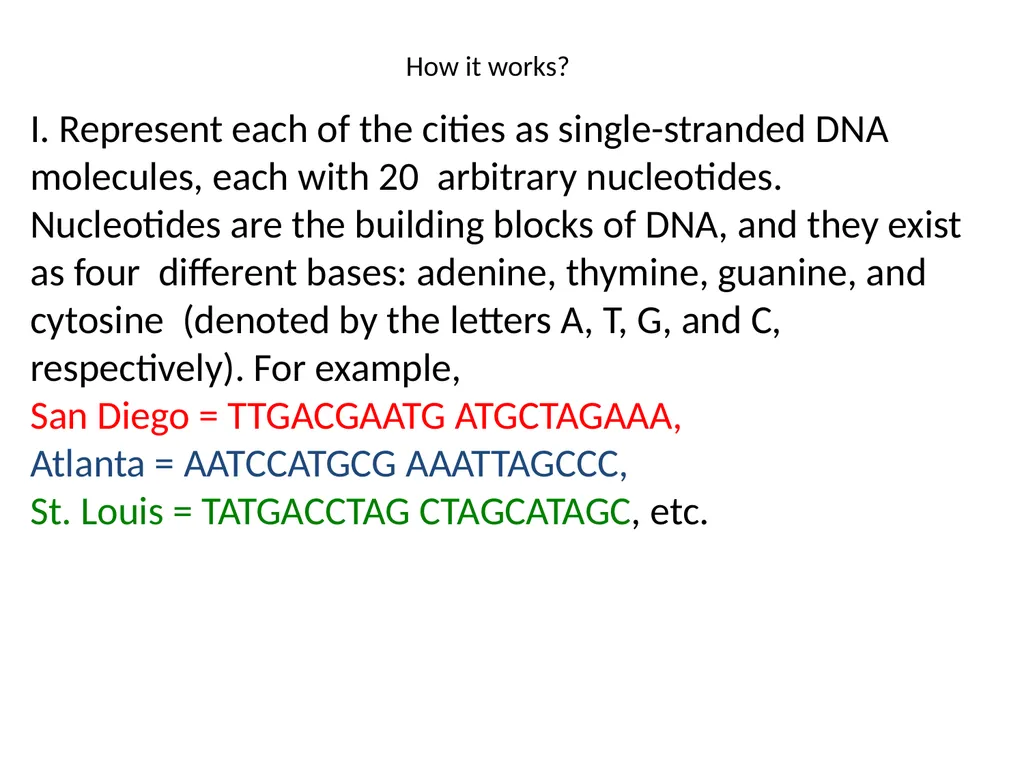
slide8. How it works? I. Represent each of the cities as single-stranded DNA molecules, each with 20 arbitrary nucleotides. Nucleotides are the building blocks of DNA, and they exist as four different bases: adenine, thymine, guanine, and cytosine (denoted by the letters A, T, G, and C, respectively). For example,
San Diego = TTGACGAATG ATGCTAGAAA,
Atlanta = AATCCATGCG AAATTAGCCC,
St. Louis = TATGACCTAG CTAGCATAGC, etc.<br>
slide9. How it works? II. Assign flight names for all the possible flight paths, combining the last 10 nucleotides of the departure city with the first ten nucleotides of the arrival city. For example, a flight leaving St. Louis and arriving in Atlanta would be denoted as
CTAGCATAGC AATCCATGCG. If this encounters the complement of the Atlanta city name
(TTAGGTACGC TTTAATCGGG) in solution, the segment coding AATCCATGCG will hydrogen bond to the segment coding TTAGGTACGC, leading to CTAGCATAGC AATCCATGCG
||||||||||
TTAGGTACGC TTTAATCGGG
This structure can in turn bond to a flight leaving from Atlanta, and so on.<br>
slide10. How it works? III. First synthesize DNA strands representing all cities and flight
connections. Using DNA ligase, which “glues” DNA molecules together, allow the DNA strands to combine and form all possible itineraries.
Make sure there is enough copies of each DNA molecule to ensure that all flight plans could form.
Use polymerase chain reaction (PCR) to make multiple copies of only those itineraries with the correct departure and arrival destination.
Select only those of the right length that contain the the sequence for the start and end cities.<br>
slide11. Potential Advantages of a DNA Computer Parallel Computing- DNA computers are massively parallel.
Adleman’s experiment performed at a rate of 100 teraflops, or 100 trillion floating point operations per second. By comparison, NEC Corporation’s Earth Simulator, the world’s fastest supercomputer, operates at approximately 36 teraflops.
Incredibly light weight- With only 1 LB of DNA you have more computing power than all the computers ever made.
Low power- The only power needed is to keep DNA from denaturing.
Medical applications: a computer to identify given disease at each cell and launch a cell-specific cure.<br>
slide2. The Central Dogma<br>
slide3. Graphical Representation of inherent bonding properties of DNA<br>
slide4. Travelling Salesman Problem In early 1994, Adleman put his theory of DNA computing to the test on a problem called the Traveling Salesman Problem.<br>
slide5. Travelling Salesman Problem Only need to keep those paths that exhibit the following properties:
The path must start at city A and end at city G.
Of those paths, the correct paths must pass through all 7 cities at least once.
The final path must contain each city in turn.<br>
slide6. Example:<br>
slide7. Travelling Salesman Problem Adleman, created randomly sequenced DNA strands 20 bases long to chemically represent each city and a complementary 20 base strand that overlaps each city’s strand halfway to represent each street<br>
slide8. How it works? I. Represent each of the cities as single-stranded DNA molecules, each with 20 arbitrary nucleotides. Nucleotides are the building blocks of DNA, and they exist as four different bases: adenine, thymine, guanine, and cytosine (denoted by the letters A, T, G, and C, respectively). For example,
San Diego = TTGACGAATG ATGCTAGAAA,
Atlanta = AATCCATGCG AAATTAGCCC,
St. Louis = TATGACCTAG CTAGCATAGC, etc.<br>
slide9. How it works? II. Assign flight names for all the possible flight paths, combining the last 10 nucleotides of the departure city with the first ten nucleotides of the arrival city. For example, a flight leaving St. Louis and arriving in Atlanta would be denoted as
CTAGCATAGC AATCCATGCG. If this encounters the complement of the Atlanta city name
(TTAGGTACGC TTTAATCGGG) in solution, the segment coding AATCCATGCG will hydrogen bond to the segment coding TTAGGTACGC, leading to CTAGCATAGC AATCCATGCG
||||||||||
TTAGGTACGC TTTAATCGGG
This structure can in turn bond to a flight leaving from Atlanta, and so on.<br>
slide10. How it works? III. First synthesize DNA strands representing all cities and flight
connections. Using DNA ligase, which “glues” DNA molecules together, allow the DNA strands to combine and form all possible itineraries.
Make sure there is enough copies of each DNA molecule to ensure that all flight plans could form.
Use polymerase chain reaction (PCR) to make multiple copies of only those itineraries with the correct departure and arrival destination.
Select only those of the right length that contain the the sequence for the start and end cities.<br>
slide11. Potential Advantages of a DNA Computer Parallel Computing- DNA computers are massively parallel.
Adleman’s experiment performed at a rate of 100 teraflops, or 100 trillion floating point operations per second. By comparison, NEC Corporation’s Earth Simulator, the world’s fastest supercomputer, operates at approximately 36 teraflops.
Incredibly light weight- With only 1 LB of DNA you have more computing power than all the computers ever made.
Low power- The only power needed is to keep DNA from denaturing.
Medical applications: a computer to identify given disease at each cell and launch a cell-specific cure.<br>