October 2023 Underground service strike avoidance Service Strikes - Introduction A significant proportion of our utility, building and transport infrastructure is buried underground, including around 4 million kilometres of pipes,
"October 2023 Underground service strike avoidance" is the property of its rightful owner. Permission is granted to
download and print the materials on this website for personal, non-commercial use only, and to display it
on your personal computer provided you do not modify the materials and that you retain all copyright
notices contained in the materials. By downloading content from our website, you accept the terms of this
agreement.
Presentation Transcript
01
October 2023 Underground service strike avoidance<br>
02
Service Strikes - Introduction A significant proportion of our utility, building and transport infrastructure is buried underground, including around 4 million kilometres of pipes, electricity and telecoms cables, and sewers.
It is estimated that a hole is dug every seven seconds to access these pipes and cables for repairs, upgrades and installations. This busy and usually unseen environment suffers from an estimated 60,000 accidental strikes per year, leading to injury, project delays, and disruption to traffic and local economies
The total direct and indirect costs of these accidental strikes are estimated to be £2.4 billion a year
Remember – Most people THINK they can dig a hole!<br>
03
Utility Strike Avoidance Working Group Common Intent document Utility strikes continue to be one of the biggest health and safety hazards in our industry. Across the highways industry, there can be as many as one utility strike per day on average. Whilst these incidents caused disruption to work and to the public, more importantly they all had the potential to cause serious injury or death to the operatives involved. The most significant incidents have tragically resulted in fatalities and life changing injuries.
Routinely, the root cause of these incidents includes poor quality or inaccurate information about buried service locations, little or no consideration of diversion during design development, lack of consistency of safe working practices across the industry and inadequate or inconsistent control measures on site. This webpage is designed to provide information and relevant training material in all phases of work to ensure we avoid striking all manner of services.<br>
04
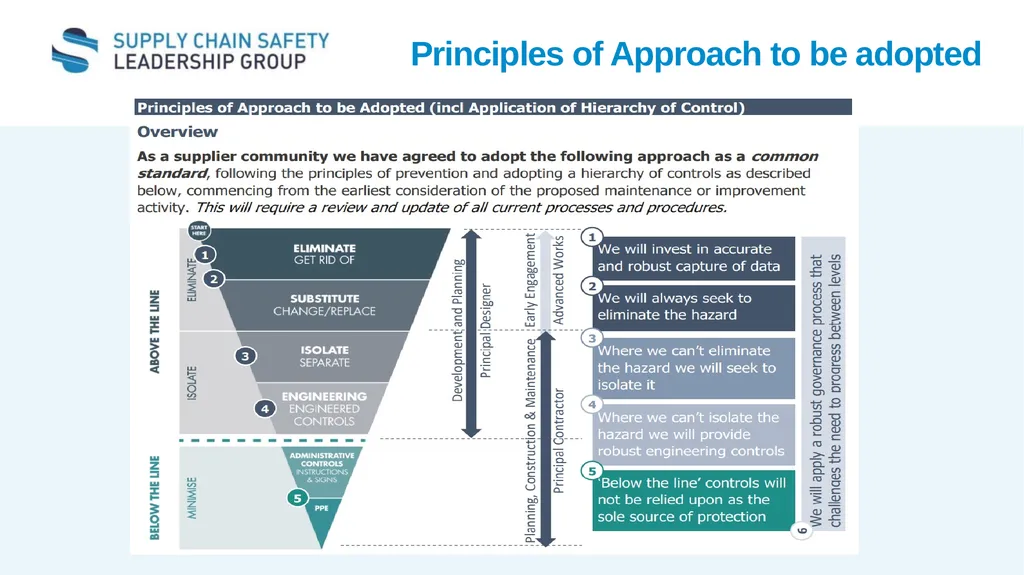
Principles of Approach to be adopted<br>
05
National Highways performance 5 Target Current performance (August 23) Still quite a way to go to achieving the national highways target of - 0.15<br>
06
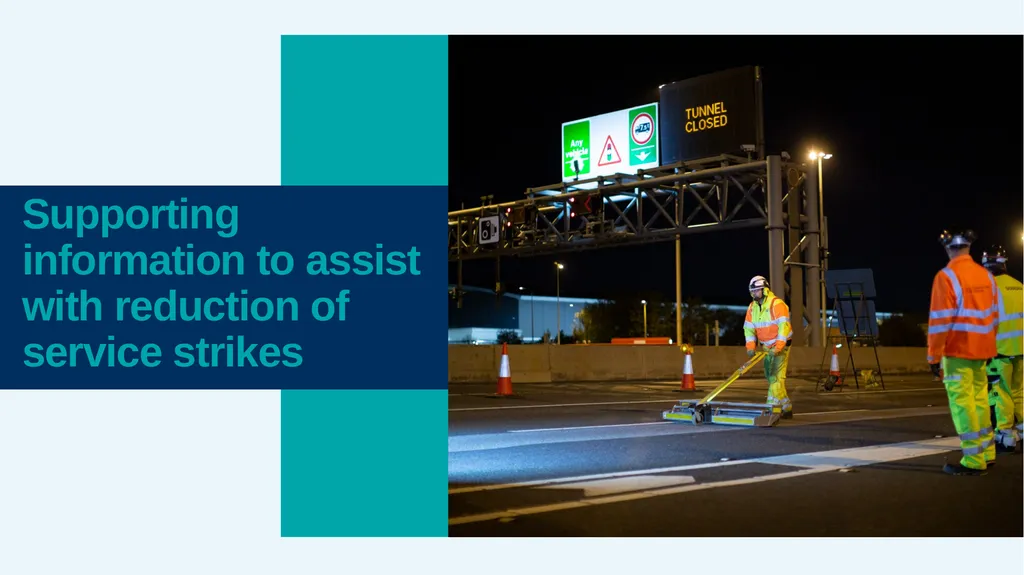
Supporting information to assist with reduction of service strikes<br>
07
Raising the Bar # 9 Utility Avoidance - Version 6 – March 2023 Minimum Exclusion zones for Underground Utilities<br>
08
HSG 47 – Avoiding danger from underground services Health and safety executive guidance It explains the three basic elements of a safe system of work during excavation:
■ Planning the work
■ Locating and identifying buried services
■ Safe excavation
The guidance is divided into four chapters:
■ Identifying and managing the dangers;
■ Planning the work;
■ Detecting, identifying and marking underground services;
■ Safe excavation.<br>
09
HSG 47 – Avoiding danger from underground services Health and safety executive guidance Identifying and managing the dangers Planning the work Identify clearly the extent of the work area and find out what underground services are within the area before considering whether they are likely to be disturbed:
Obtain service drawings from utilities companies and other organisations with relevant information about the site.
Survey the site to identify the services and other underground structures. Record the location of any services
Review/assess the planned work to avoid disturbing services where possible.
Allow sufficient time and provide sufficient resource to do the work safely
Emergency work still requires planning and assessment of the risks arising from the work. A precautionary approach must be taken when breaking ground.<br>
10
HSG 47 – Avoiding danger from underground services Health and safety executive guidance Detecting, identifying and marking underground services Safe excavation Locate the services identified at the planning stage survey as being in the work area.
Make sure those involved in detecting and identifying services are competent in the proper use of survey tools and detecting devices as well as reading/interpreting plans.
Once detected, identify and mark the services and confirm their status – ie whether electricity cables are live, whether gas pipes are pressurised – and then record their location. Determine the method or technique for excavating near underground services before work starts, taking account of:
the nature and scope of the work.
the type, position and status of underground services.
the ground conditions.
site constraints.
Provide those doing the work with a written plan, including information about the location and nature of underground services. They should be competent, provided with PPE and work equipment, and allowed sufficient time. Identified services should be carefully exposed and clearly marked.
A permit system may be appropriate for particularly hazardous work. This will involve written authorisation by a responsible person, identifying the work to be done and the precautions to be taken. A permit system needs suitable supervision and monitoring.
Backfilling of excavations must properly support and protect the underground services. Concrete must not be used to encase services when backfilling. If an underground service suffers damage during the excavation or subsequent work, inform the owner/operator.<br>
11
Video examples<br>
12
Case Studies<br>
13
Case studies NH Schemes Case study 1
NH YNE Community:
Utility Strike – BT service struck during cold milling (Planing) of the carriageway.
Service specification is 600mm (MIN) Depth – in carriageway
BT service was only 45mm deep
Area did not receive ground penetrating radar survey due to resurfacing only being to 70mm depth – contractor safe system of work states 150mm depth and above will be surveyed
Service checked in nearest chamber at 575mm – from leaving the chamber the service has sharply risen to 45mm depth
Conclusion:
Service was damaged because it was not laid at the correct depth. Statutory drawings were on site, GPR, CAT scans and visual checks were carried out and after review it would have been difficult to avoid contact with the cable due to its unforeseen depth
Recommendation:
GPR Survey to be carried out to all areas on the Network where planing/excavation works are to be carried out regardless of depth. Case Study 2
NH YNE ASC contract:
11KVA Cable damaged by kerbstone within excavation – mechanical excavator pulled kerbstone which subsequently caught the 11-thousand-volt cable and damaged it.
Service drawings had been consulted which showed 2 cables present
There were actually 5 cables present.
All practices were complied with, CATR scan, trial holes and identification of cables
As the excavator operator was drawing in his bucket, it caught an old piece of kerb which then pulled cable causing the damage
Conclusion:
Service was damaged because it was struck by kerbstone located within made-up ground
Recommendation:
Ensure all mechanical excavation is adequately controlled by banks person<br>
14
Case studies – HSG47 Aftermath of a gas utility strike<br>
15
Summary Underground service strikes can cause fatalities and life changing injuries
Far too many service strikes occur – for many different reasons
It is imperative that ALL aspects of breaking ground are adequately controlled
Ensuring competency of individuals involved in the work is hugely important
Correct levels of adequate training AND refresher training should be in place
Service Drawings are indicative ONLY
A strong, robust Safe System of Work (SSOW) MUST be in place, understood AND followed by all involved in the work - this should be regularly audited for compliance<br>
16
Links to relevant information: Home (highwayssafetyhub.com)
Utility Strike Avoidance Group (highwayssafetyhub.com)
Performance Reports (highwayssafetyhub.com)
Raising The Bar Guidance (highwayssafetyhub.com)
Avoiding danger from underground services - HSG47 (hse.gov.uk)