
Organisational behaviour Organisational behaviour
KL
Published · 12 slides · 0 views

1 / 1
Description
Organisational behaviour Organisational behaviour Organisational behaviour is concerned with peoples thoughts, feelings, emotions and actions in setting up a work. Understanding an individual behaviour is in itself a challenge, but
Related Topics
Share
Embed code
Download this presentation From Below
"Organisational behaviour Organisational behaviour" is the property of its rightful owner. Permission is granted to download and print the materials on this website for personal, non-commercial use only, and to display it on your personal computer provided you do not modify the materials and that you retain all copyright notices contained in the materials. By downloading content from our website, you accept the terms of this agreement.
Presentation Transcript
01
Organisational behaviour<br>
02
Organisational behaviour Organisational behaviour is concerned with people's thoughts, feelings, emotions and actions in setting up a work. Understanding an individual behaviour is in itself a challenge, but understanding group behaviour in an organisational environment is a monumental managerial task.
As Nadler and Tushman put it, "Understanding one individual's behaviour is challenging in and of itself; understanding a group that is made up of different individuals and comprehending the many relationships among those individuals is even more complex.<br>
As Nadler and Tushman put it, "Understanding one individual's behaviour is challenging in and of itself; understanding a group that is made up of different individuals and comprehending the many relationships among those individuals is even more complex.<br>
03
Ultimately, the organisation's work gets done through people, individually or collectively, on their, own or in collaboration with technology. Therefore, the management of organisational behaviour is central to the management task—a task that involves the capacity to "understand" the behaviour patterns of individuals, groups and organisations, to ‘‘predict’" what behavioural responses will be elicited by various managerial actions and finally to use this understanding and these predictions to achieve "control".
Organization: It is a group of people who are collected to work for a common goal with collective efforts. Organization works through two concepts i.e coordination and delegation among its group members. Delegation is necessary to allocate group members with equal work according to their capability, and coordination is required to achieve organizational goal with precision.
Behavior: It is a verbal or physical response shown by a person as a consequence of the impact of his/her surroundings. Individual Behavior varies in accordance with their mental reactivity to particular circumstances because of their deeply imbibed morals and value system.
Organizational Behaviour: - is concerned with people’s thought, feelings, emotions and action in settling up a work. Organisational behaviour can then be defined as: "The study of human behaviour in organisational settings, the interface between human behaviour and the organisational context, and the organisation itself.“ It is the study and application of knowledge about how people as individual and as groups acts within organizations.<br>
Organization: It is a group of people who are collected to work for a common goal with collective efforts. Organization works through two concepts i.e coordination and delegation among its group members. Delegation is necessary to allocate group members with equal work according to their capability, and coordination is required to achieve organizational goal with precision.
Behavior: It is a verbal or physical response shown by a person as a consequence of the impact of his/her surroundings. Individual Behavior varies in accordance with their mental reactivity to particular circumstances because of their deeply imbibed morals and value system.
Organizational Behaviour: - is concerned with people’s thought, feelings, emotions and action in settling up a work. Organisational behaviour can then be defined as: "The study of human behaviour in organisational settings, the interface between human behaviour and the organisational context, and the organisation itself.“ It is the study and application of knowledge about how people as individual and as groups acts within organizations.<br>
04
Elements of organizational behavior The key elements in the organisational behaviour are people,, structure, technology and the environment in which the organisation operates.
People: People make up the internal and social system of the organisation. They consist of individuals and groups. The groups may be big or small; formal or informal; official or unofficial. Groups are dynamic and they work in the organisation to achieve their objectives.
Structure: Structure defines the formal relationships of the people in organisations. Different people in the organisation are performing different type of jobs and they need to be (elated in some structural way so that their work can be effectively co-ordinated.
Technology: Technology such as machines and work processes provide the resources with which people work and affects the tasks that they perform. The technology used has a significant influence on working relationships. It allows people to do more and work better but it also restricts' people in various ways.
Environment: All organisations operate within an external environment. It is the part of a larger system that contains many other elements such as government, family and other organisations. All of these mutually influence each other in a complex system that creates a context for a group of people.<br>
People: People make up the internal and social system of the organisation. They consist of individuals and groups. The groups may be big or small; formal or informal; official or unofficial. Groups are dynamic and they work in the organisation to achieve their objectives.
Structure: Structure defines the formal relationships of the people in organisations. Different people in the organisation are performing different type of jobs and they need to be (elated in some structural way so that their work can be effectively co-ordinated.
Technology: Technology such as machines and work processes provide the resources with which people work and affects the tasks that they perform. The technology used has a significant influence on working relationships. It allows people to do more and work better but it also restricts' people in various ways.
Environment: All organisations operate within an external environment. It is the part of a larger system that contains many other elements such as government, family and other organisations. All of these mutually influence each other in a complex system that creates a context for a group of people.<br>
05
Nature of organizational behaviour: A Separate Field of Study and Not a Discipline Only:
By definition, a discipline is an accepted science that is based on a theoretical foundation. But, O.B. has a multi- interdisciplinary orientation and is, thus, not based on a specific theoretical background. Therefore, it is better reasonable to call O.B. a separate field of study rather than a discipline only.
An Interdisciplinary Approach:
Organizational behaviour is essentially an interdisciplinary approach to study human behaviour at work. It tries to integrate the relevant knowledge drawn from related disciplines like psychology, sociology and anthropology to make them applicable for studying and analysing organizational behaviour.
An Applied Science:
The very nature of O.B. is applied. What O.B. basically does is the application of various researches to solve the organizational problems related to human behaviour. The basic line of difference between pure science and O.B. is that while the former concentrates of fundamental researches, the latter concentrates on applied researches. O.B. involves both applied research and its application in organizational analysis. Hence, O.B. can be called both science as well as art.
A Normative Science:
Organizational Behaviour is a normative science also. While the positive science discusses only cause effect relationship, O.B. prescribes how the findings of applied researches can be applied to socially accepted organizational goals. Thus, O.B. deals with what is accepted by individuals and society engaged in an organization. Yes, it is not that O.B. is not normative at all. In fact, O.B. is normative as well that is well underscored by the proliferation of management theories.<br>
By definition, a discipline is an accepted science that is based on a theoretical foundation. But, O.B. has a multi- interdisciplinary orientation and is, thus, not based on a specific theoretical background. Therefore, it is better reasonable to call O.B. a separate field of study rather than a discipline only.
An Interdisciplinary Approach:
Organizational behaviour is essentially an interdisciplinary approach to study human behaviour at work. It tries to integrate the relevant knowledge drawn from related disciplines like psychology, sociology and anthropology to make them applicable for studying and analysing organizational behaviour.
An Applied Science:
The very nature of O.B. is applied. What O.B. basically does is the application of various researches to solve the organizational problems related to human behaviour. The basic line of difference between pure science and O.B. is that while the former concentrates of fundamental researches, the latter concentrates on applied researches. O.B. involves both applied research and its application in organizational analysis. Hence, O.B. can be called both science as well as art.
A Normative Science:
Organizational Behaviour is a normative science also. While the positive science discusses only cause effect relationship, O.B. prescribes how the findings of applied researches can be applied to socially accepted organizational goals. Thus, O.B. deals with what is accepted by individuals and society engaged in an organization. Yes, it is not that O.B. is not normative at all. In fact, O.B. is normative as well that is well underscored by the proliferation of management theories.<br>
06
Nature of organizational behaviour: A Humanistic and Optimistic Approach:
Organizational Behaviour applies humanistic approach towards people working in the organization. It, deals with the thinking and feeling of human beings. O.B. is based on the belief that people have an innate desire to be independent, creative and productive. It also realizes that people working in the organization can and will actualise these potentials if they are given proper conditions and environment. Environment affects performance or workers working in an organization.
A Total System Approach:
The system approach is one that integrates all the variables, affecting organizational functioning. The systems approach has been developed by the behavioural scientists to analyze human behaviour in view of his/her socio-psychological framework. Man’s socio- psychological framework makes man a complex one and the systems approach tries to study his/her complexity and find solution to it.<br>
Organizational Behaviour applies humanistic approach towards people working in the organization. It, deals with the thinking and feeling of human beings. O.B. is based on the belief that people have an innate desire to be independent, creative and productive. It also realizes that people working in the organization can and will actualise these potentials if they are given proper conditions and environment. Environment affects performance or workers working in an organization.
A Total System Approach:
The system approach is one that integrates all the variables, affecting organizational functioning. The systems approach has been developed by the behavioural scientists to analyze human behaviour in view of his/her socio-psychological framework. Man’s socio- psychological framework makes man a complex one and the systems approach tries to study his/her complexity and find solution to it.<br>
07
Scope of Organizational Behaviour: Impact of personality on performance
Employee motivation
Leadership
How to create effective teams and groups
Study of different organizational structures
Individual behavior, attitude and learning
Perception
Design and development of effective organization
Job design
Impact of culture on organizational behavior
Management of change
Management of conflict and stress
Organizational development
Organizational culture
Transactional analysis
Group behavior, power and politics
Job design
Study of emotions<br>
Employee motivation
Leadership
How to create effective teams and groups
Study of different organizational structures
Individual behavior, attitude and learning
Perception
Design and development of effective organization
Job design
Impact of culture on organizational behavior
Management of change
Management of conflict and stress
Organizational development
Organizational culture
Transactional analysis
Group behavior, power and politics
Job design
Study of emotions<br>
08
The field of the organizational behavior does not depend upon deductions based on gut feelings but attempts to gather information regarding an issue in a scientific manner under controlled conditions. It uses information and interprets the findings so that the behavior of an individual and group can be canalized as desired.
Large number of psychologists, social scientists and academicians has carried out research on various issues related to organization behavior. Employee performance and job satisfaction are determinants of accomplishment of individual and organizational goals.
Organizations have been set up to fulfill needs of the people. In today’s competitive world, the organizations have to be growth-oriented. This is possible when productivity is ensured with respect to quantity of product to be produced with zero error quality. Employee absenteeism and turnover has a negative impact on productivity.
Employee who absents frequently cannot contribute towards productivity and growth of the organization. In the same manner, employee turnover causes increased cost of production. Job satisfaction is a major factor to analyze performance of an individual towards his work. Satisfied workers are productive workers who contribute towards building an appropriate work culture in an organization.
Organizations are composed of number of individuals working independently or collectively in teams, and number of such teams makes a department and number of such departments makes an organization. It is a formal structure and all departments have to function in a coordinated manner to achieve the organizational objective.
It is therefore important for all employees to possess a positive attitude towards work. They need to function in congenial atmosphere and accomplish assigned goals. It is also important for managers to develop an appropriate work culture. Use of authority, delegation of certain powers to subordinates, division of labor, efficient communication.
Benchmarking, re-engineering, job re-design and empowerment are some of the important factors so that an organization can function as well-oiled machine. This is not only applicable to manufacturing organizations but also to service and social organizations<br>
Large number of psychologists, social scientists and academicians has carried out research on various issues related to organization behavior. Employee performance and job satisfaction are determinants of accomplishment of individual and organizational goals.
Organizations have been set up to fulfill needs of the people. In today’s competitive world, the organizations have to be growth-oriented. This is possible when productivity is ensured with respect to quantity of product to be produced with zero error quality. Employee absenteeism and turnover has a negative impact on productivity.
Employee who absents frequently cannot contribute towards productivity and growth of the organization. In the same manner, employee turnover causes increased cost of production. Job satisfaction is a major factor to analyze performance of an individual towards his work. Satisfied workers are productive workers who contribute towards building an appropriate work culture in an organization.
Organizations are composed of number of individuals working independently or collectively in teams, and number of such teams makes a department and number of such departments makes an organization. It is a formal structure and all departments have to function in a coordinated manner to achieve the organizational objective.
It is therefore important for all employees to possess a positive attitude towards work. They need to function in congenial atmosphere and accomplish assigned goals. It is also important for managers to develop an appropriate work culture. Use of authority, delegation of certain powers to subordinates, division of labor, efficient communication.
Benchmarking, re-engineering, job re-design and empowerment are some of the important factors so that an organization can function as well-oiled machine. This is not only applicable to manufacturing organizations but also to service and social organizations<br>
09
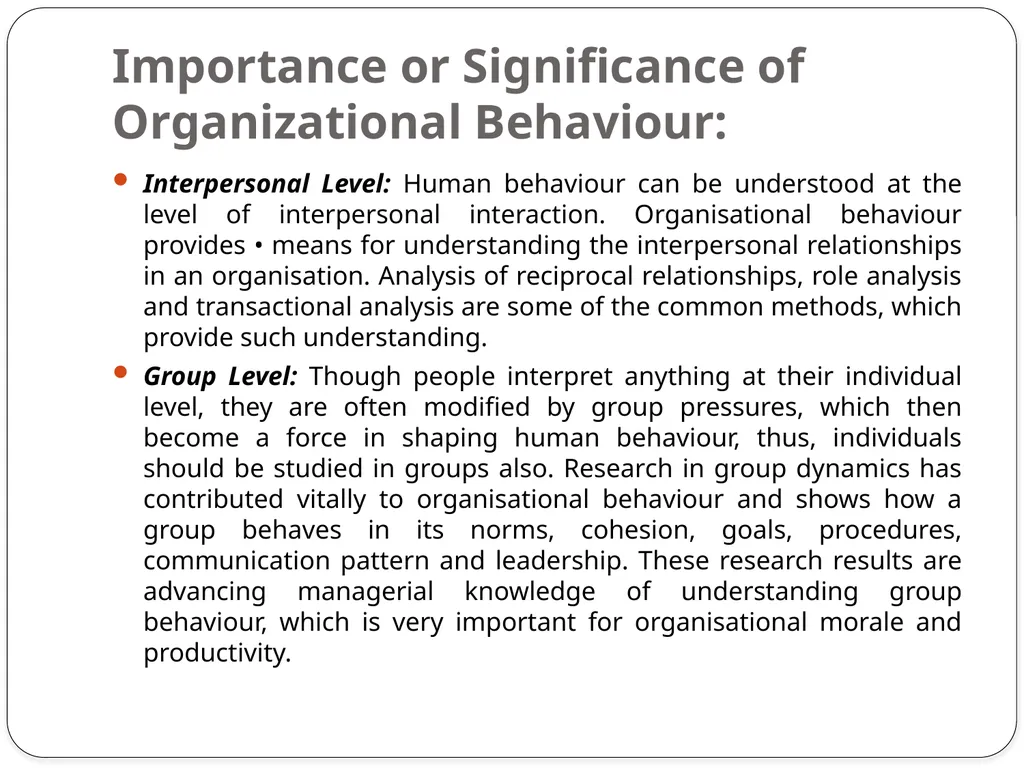
Importance or Significance of Organizational Behaviour: Interpersonal Level: Human behaviour can be understood at the level of interpersonal interaction. Organisational behaviour provides • means for understanding the interpersonal relationships in an organisation. Analysis of reciprocal relationships, role analysis and transactional analysis are some of the common methods, which provide such understanding.
Group Level: Though people interpret anything at their individual level, they are often modified by group pressures, which then become a force in shaping human behaviour, thus, individuals should be studied in groups also. Research in group dynamics has contributed vitally to organisational behaviour and shows how a group behaves in its norms, cohesion, goals, procedures, communication pattern and leadership. These research results are advancing managerial knowledge of understanding group behaviour, which is very important for organisational morale and productivity.<br>
Group Level: Though people interpret anything at their individual level, they are often modified by group pressures, which then become a force in shaping human behaviour, thus, individuals should be studied in groups also. Research in group dynamics has contributed vitally to organisational behaviour and shows how a group behaves in its norms, cohesion, goals, procedures, communication pattern and leadership. These research results are advancing managerial knowledge of understanding group behaviour, which is very important for organisational morale and productivity.<br>
10
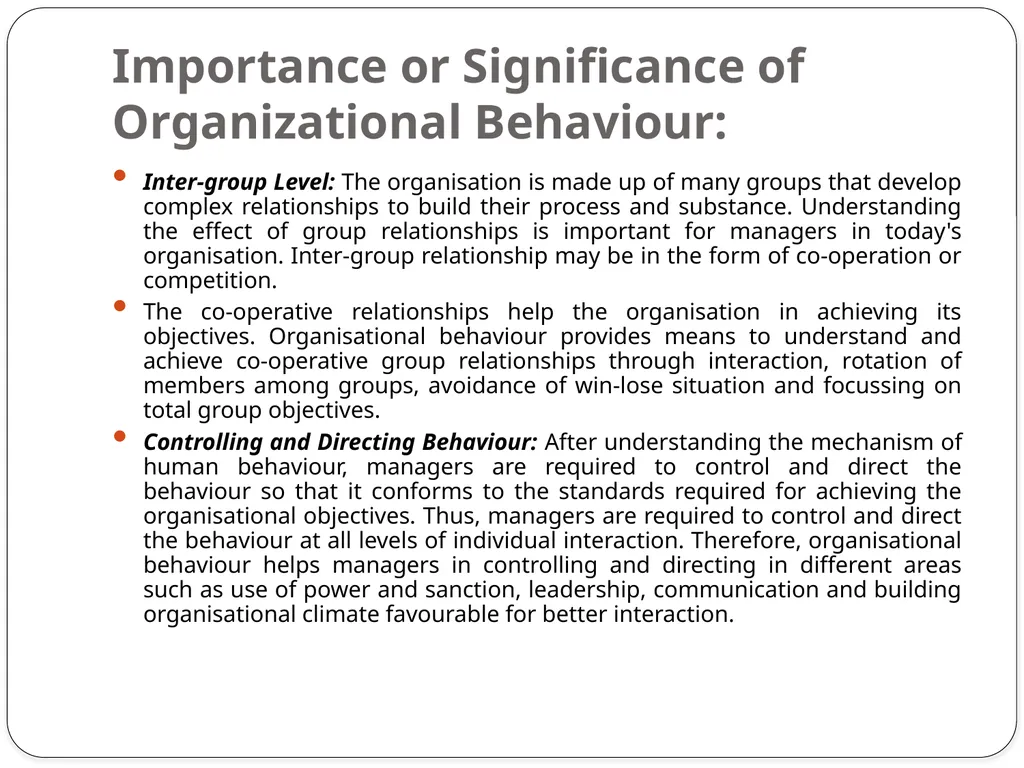
Importance or Significance of Organizational Behaviour: Inter-group Level: The organisation is made up of many groups that develop complex relationships to build their process and substance. Understanding the effect of group relationships is important for managers in today's organisation. Inter-group relationship may be in the form of co-operation or competition.
The co-operative relationships help the organisation in achieving its objectives. Organisational behaviour provides means to understand and achieve co-operative group relationships through interaction, rotation of members among groups, avoidance of win-lose situation and focussing on total group objectives.
Controlling and Directing Behaviour: After understanding the mechanism of human behaviour, managers are required to control and direct the behaviour so that it conforms to the standards required for achieving the organisational objectives. Thus, managers are required to control and direct the behaviour at all levels of individual interaction. Therefore, organisational behaviour helps managers in controlling and directing in different areas such as use of power and sanction, leadership, communication and building organisational climate favourable for better interaction.<br>
The co-operative relationships help the organisation in achieving its objectives. Organisational behaviour provides means to understand and achieve co-operative group relationships through interaction, rotation of members among groups, avoidance of win-lose situation and focussing on total group objectives.
Controlling and Directing Behaviour: After understanding the mechanism of human behaviour, managers are required to control and direct the behaviour so that it conforms to the standards required for achieving the organisational objectives. Thus, managers are required to control and direct the behaviour at all levels of individual interaction. Therefore, organisational behaviour helps managers in controlling and directing in different areas such as use of power and sanction, leadership, communication and building organisational climate favourable for better interaction.<br>
11
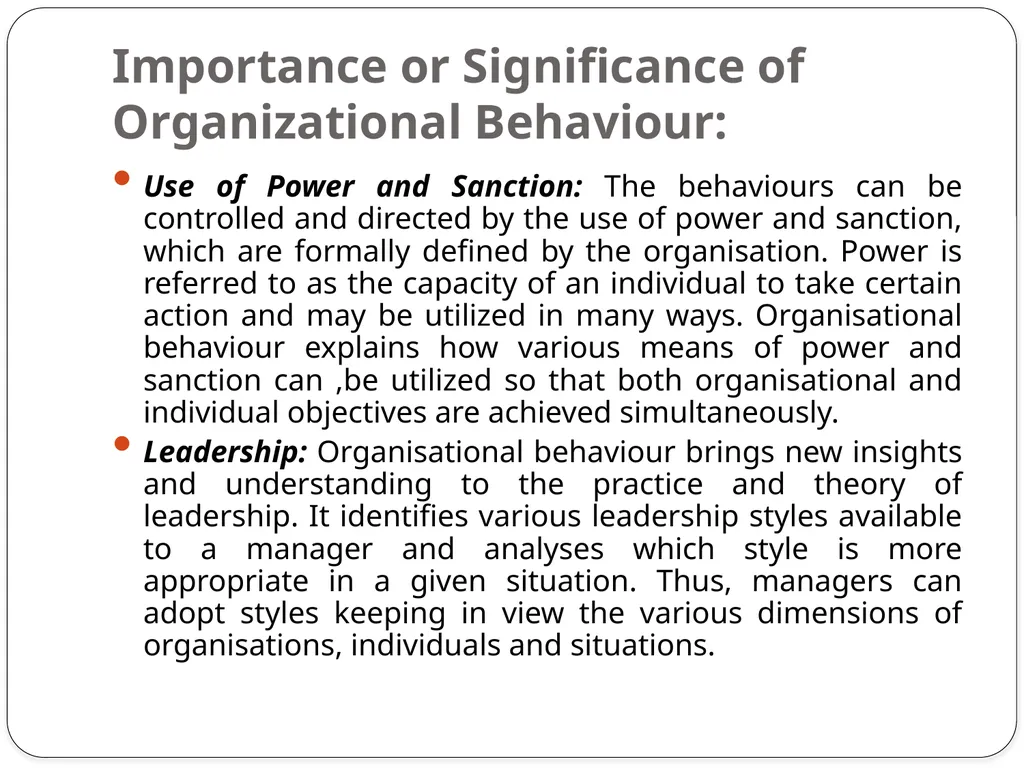
Importance or Significance of Organizational Behaviour: Use of Power and Sanction: The behaviours can be controlled and directed by the use of power and sanction, which are formally defined by the organisation. Power is referred to as the capacity of an individual to take certain action and may be utilized in many ways. Organisational behaviour explains how various means of power and sanction can ,be utilized so that both organisational and individual objectives are achieved simultaneously.
Leadership: Organisational behaviour brings new insights and understanding to the practice and theory of leadership. It identifies various leadership styles available to a manager and analyses which style is more appropriate in a given situation. Thus, managers can adopt styles keeping in view the various dimensions of organisations, individuals and situations.<br>
Leadership: Organisational behaviour brings new insights and understanding to the practice and theory of leadership. It identifies various leadership styles available to a manager and analyses which style is more appropriate in a given situation. Thus, managers can adopt styles keeping in view the various dimensions of organisations, individuals and situations.<br>
12
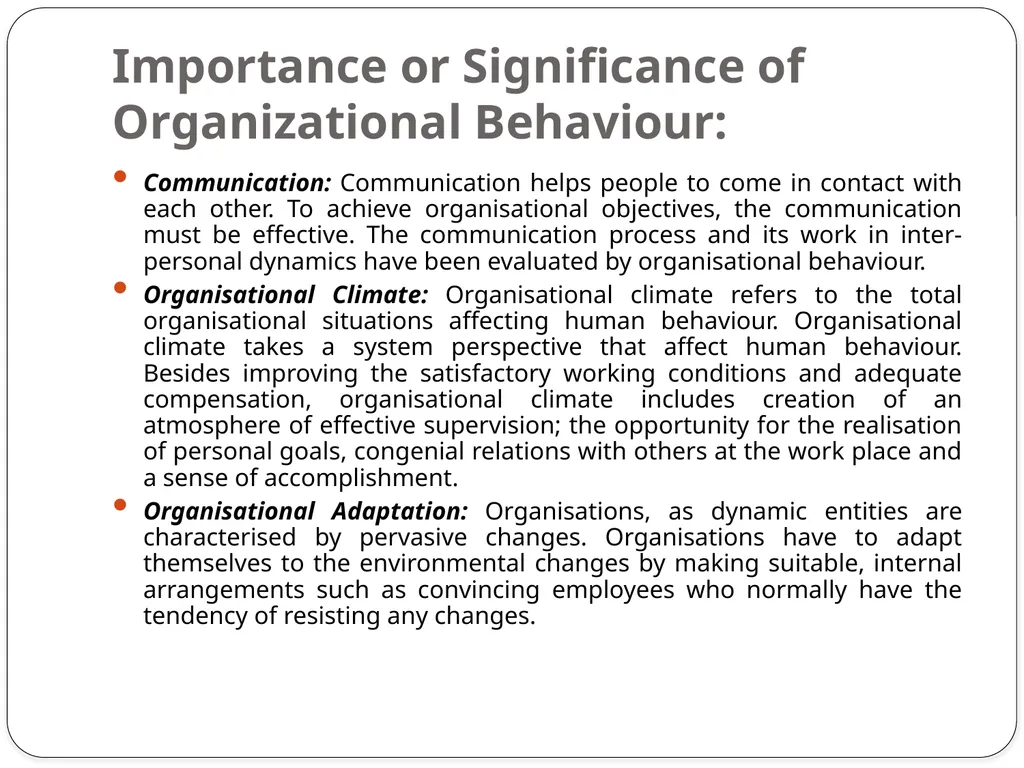
Importance or Significance of Organizational Behaviour: Communication: Communication helps people to come in contact with each other. To achieve organisational objectives, the communication must be effective. The communication process and its work in inter-personal dynamics have been evaluated by organisational behaviour.
Organisational Climate: Organisational climate refers to the total organisational situations affecting human behaviour. Organisational climate takes a system perspective that affect human behaviour. Besides improving the satisfactory working conditions and adequate compensation, organisational climate includes creation of an atmosphere of effective supervision; the opportunity for the realisation of personal goals, congenial relations with others at the work place and a sense of accomplishment.
Organisational Adaptation: Organisations, as dynamic entities are characterised by pervasive changes. Organisations have to adapt themselves to the environmental changes by making suitable, internal arrangements such as convincing employees who normally have the tendency of resisting any changes.<br>
Organisational Climate: Organisational climate refers to the total organisational situations affecting human behaviour. Organisational climate takes a system perspective that affect human behaviour. Besides improving the satisfactory working conditions and adequate compensation, organisational climate includes creation of an atmosphere of effective supervision; the opportunity for the realisation of personal goals, congenial relations with others at the work place and a sense of accomplishment.
Organisational Adaptation: Organisations, as dynamic entities are characterised by pervasive changes. Organisations have to adapt themselves to the environmental changes by making suitable, internal arrangements such as convincing employees who normally have the tendency of resisting any changes.<br>