
Organizational Behavior Eighteenth Edition, Global
TF
Published · 26 slides · 0 views
1 / 1
Description
Organizational Behavior Eighteenth Edition, Global Edition Chapter 3 Attitudes and Job Satisfaction Copyright 2019 Pearson Education, Ltd. All Rights Reserved. Learning Objectives 3.1 Contrast the three components of an attitude. 3.2
Related Topics
Share
Embed code
Download this presentation From Below
"Organizational Behavior Eighteenth Edition, Global" is the property of its rightful owner. Permission is granted to download and print the materials on this website for personal, non-commercial use only, and to display it on your personal computer provided you do not modify the materials and that you retain all copyright notices contained in the materials. By downloading content from our website, you accept the terms of this agreement.
Presentation Transcript
01
Organizational Behavior Eighteenth Edition, Global Edition Chapter 3 Attitudes and Job Satisfaction Copyright © 2019 Pearson Education, Ltd. All Rights Reserved.<br>
02
Learning Objectives 3.1 Contrast the three components of an attitude.
3.2 Summarize the relationship between attitudes and behavior.
3.3 Compare the major job attitudes.
3.4 Define job satisfaction.
3.5 Summarize the main causes of job satisfaction.
3.6 Identify three outcomes of job satisfaction.
3.7 Identify four employee responses to dissatisfaction.<br>
3.2 Summarize the relationship between attitudes and behavior.
3.3 Compare the major job attitudes.
3.4 Define job satisfaction.
3.5 Summarize the main causes of job satisfaction.
3.6 Identify three outcomes of job satisfaction.
3.7 Identify four employee responses to dissatisfaction.<br>
03
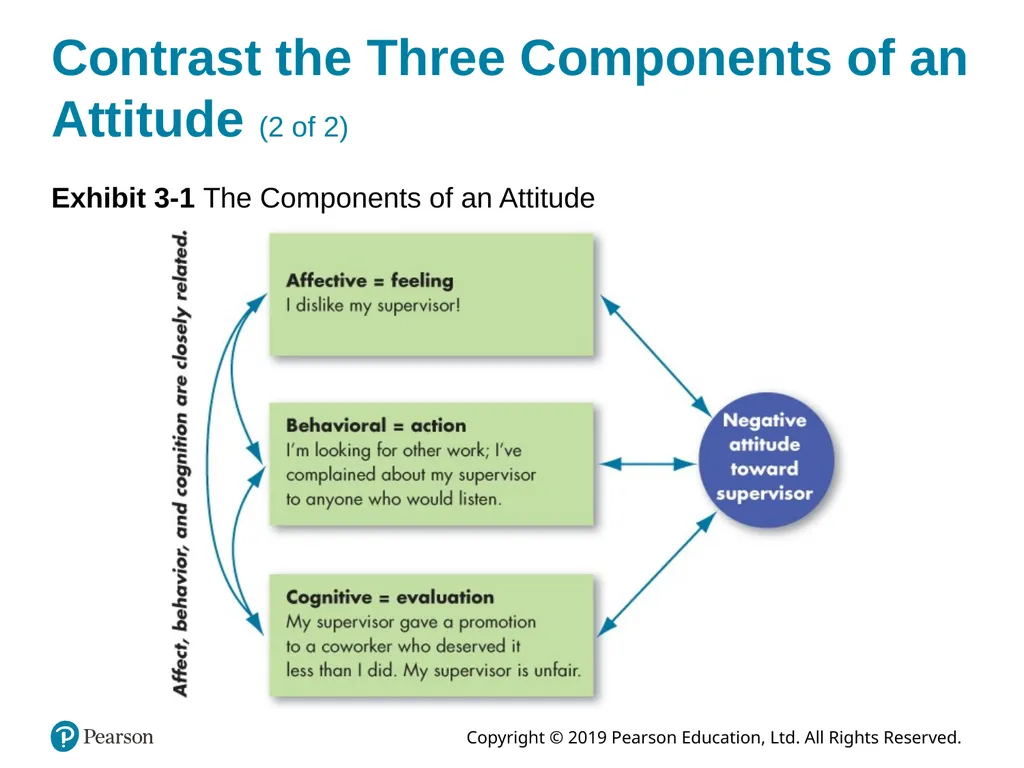
Contrast the Three Components of an Attitude (1 of 2) When your mother says: “You have an attitude!” is that good or bad?
Attitudes are evaluative statements—either favorable or unfavorable—about objects, people, or events.
They reflect how we feel about something.
In this unit we will be looking at the head, heart and hands.<br>
Attitudes are evaluative statements—either favorable or unfavorable—about objects, people, or events.
They reflect how we feel about something.
In this unit we will be looking at the head, heart and hands.<br>
04
Contrast the Three Components of an Attitude (2 of 2) Exhibit 3-1 The Components of an Attitude<br>
05
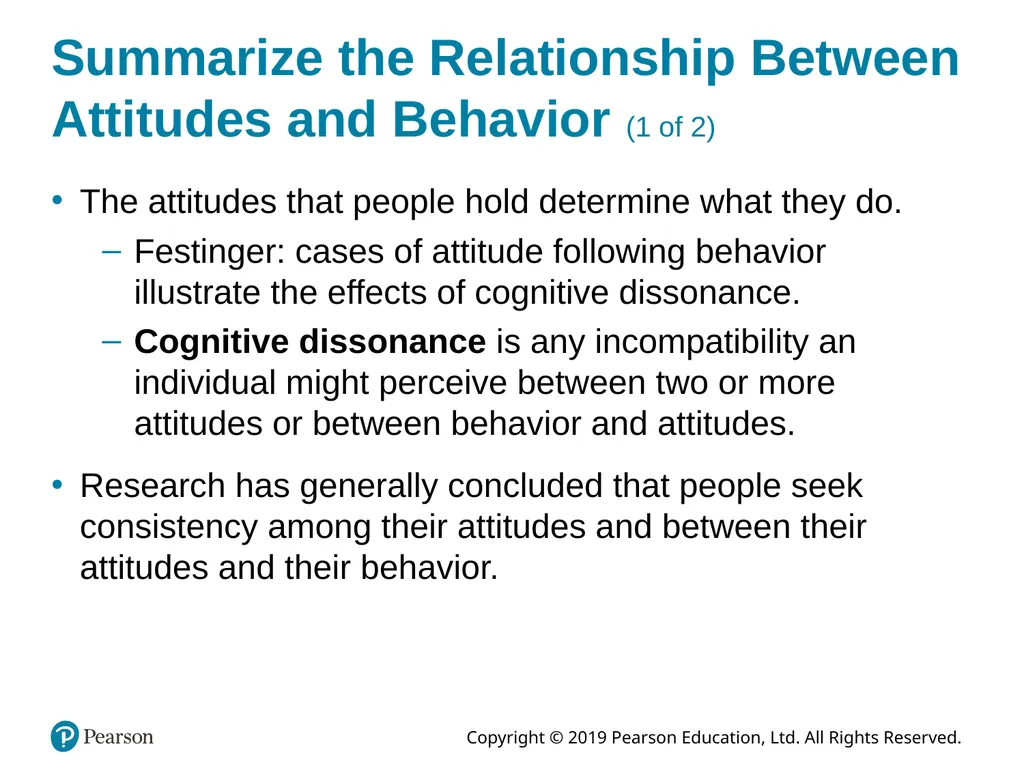
Summarize the Relationship Between Attitudes and Behavior (1 of 2) The attitudes that people hold determine what they do.
Festinger: cases of attitude following behavior illustrate the effects of cognitive dissonance.
Cognitive dissonance is any incompatibility an individual might perceive between two or more attitudes or between behavior and attitudes.
Research has generally concluded that people seek consistency among their attitudes and between their attitudes and their behavior.<br>
Festinger: cases of attitude following behavior illustrate the effects of cognitive dissonance.
Cognitive dissonance is any incompatibility an individual might perceive between two or more attitudes or between behavior and attitudes.
Research has generally concluded that people seek consistency among their attitudes and between their attitudes and their behavior.<br>
06
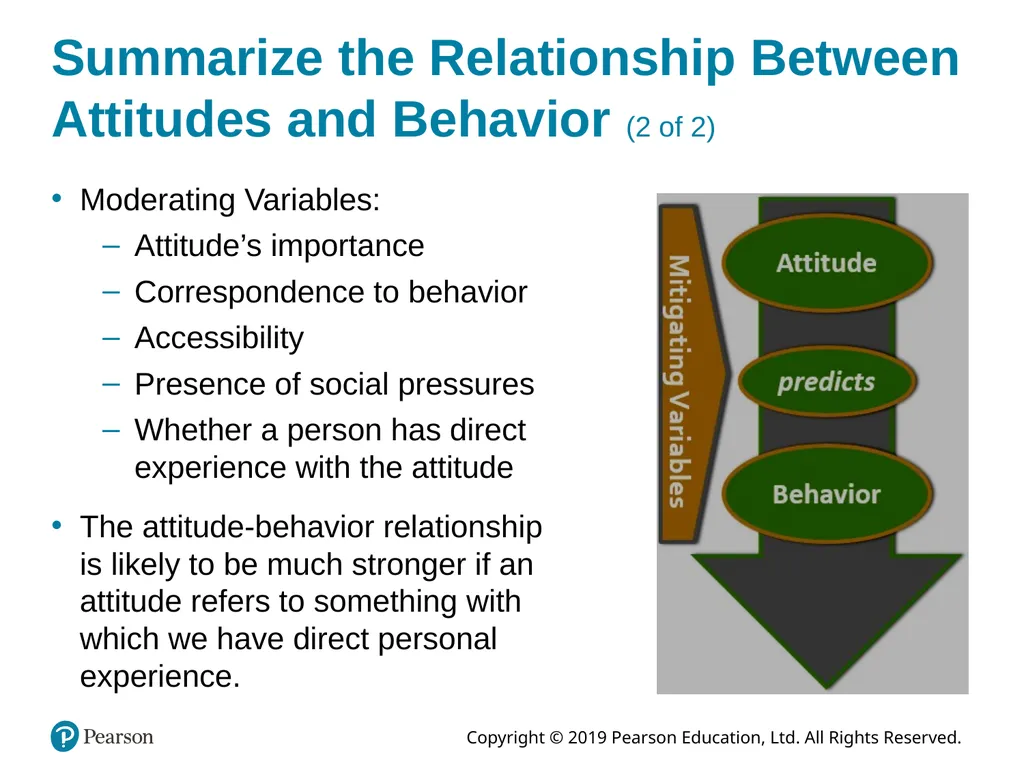
Summarize the Relationship Between Attitudes and Behavior (2 of 2) Moderating Variables:
Attitude’s importance
Correspondence to behavior
Accessibility
Presence of social pressures
Whether a person has direct experience with the attitude
The attitude-behavior relationship is likely to be much stronger if an attitude refers to something with which we have direct personal experience.<br>
Attitude’s importance
Correspondence to behavior
Accessibility
Presence of social pressures
Whether a person has direct experience with the attitude
The attitude-behavior relationship is likely to be much stronger if an attitude refers to something with which we have direct personal experience.<br>
07
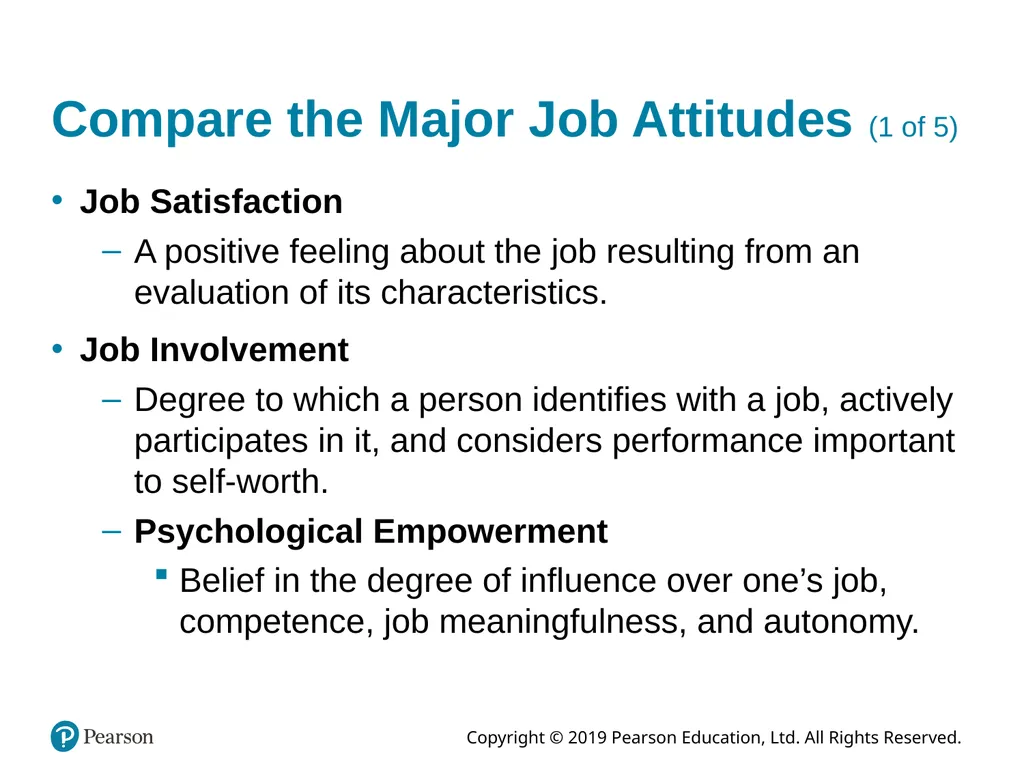
Compare the Major Job Attitudes (1 of 5) Job Satisfaction
A positive feeling about the job resulting from an evaluation of its characteristics.
Job Involvement
Degree to which a person identifies with a job, actively participates in it, and considers performance important to self-worth.
Psychological Empowerment
Belief in the degree of influence over one’s job, competence, job meaningfulness, and autonomy.<br>
A positive feeling about the job resulting from an evaluation of its characteristics.
Job Involvement
Degree to which a person identifies with a job, actively participates in it, and considers performance important to self-worth.
Psychological Empowerment
Belief in the degree of influence over one’s job, competence, job meaningfulness, and autonomy.<br>
08
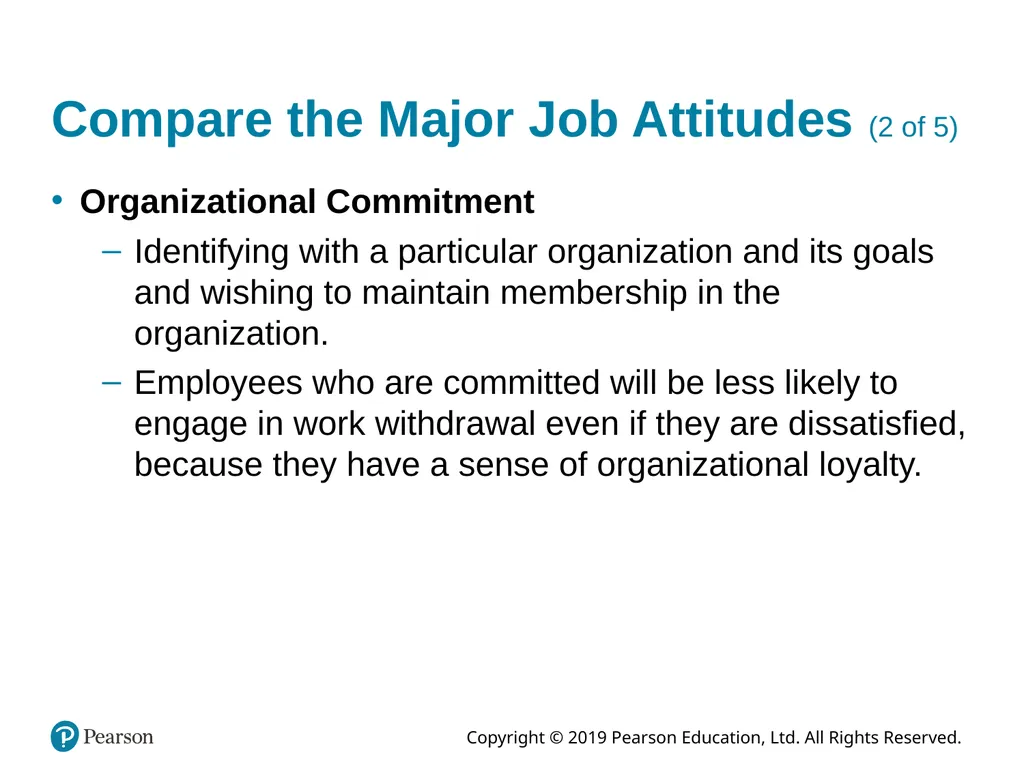
Compare the Major Job Attitudes (2 of 5) Organizational Commitment
Identifying with a particular organization and its goals and wishing to maintain membership in the organization.
Employees who are committed will be less likely to engage in work withdrawal even if they are dissatisfied, because they have a sense of organizational loyalty.<br>
Identifying with a particular organization and its goals and wishing to maintain membership in the organization.
Employees who are committed will be less likely to engage in work withdrawal even if they are dissatisfied, because they have a sense of organizational loyalty.<br>
09
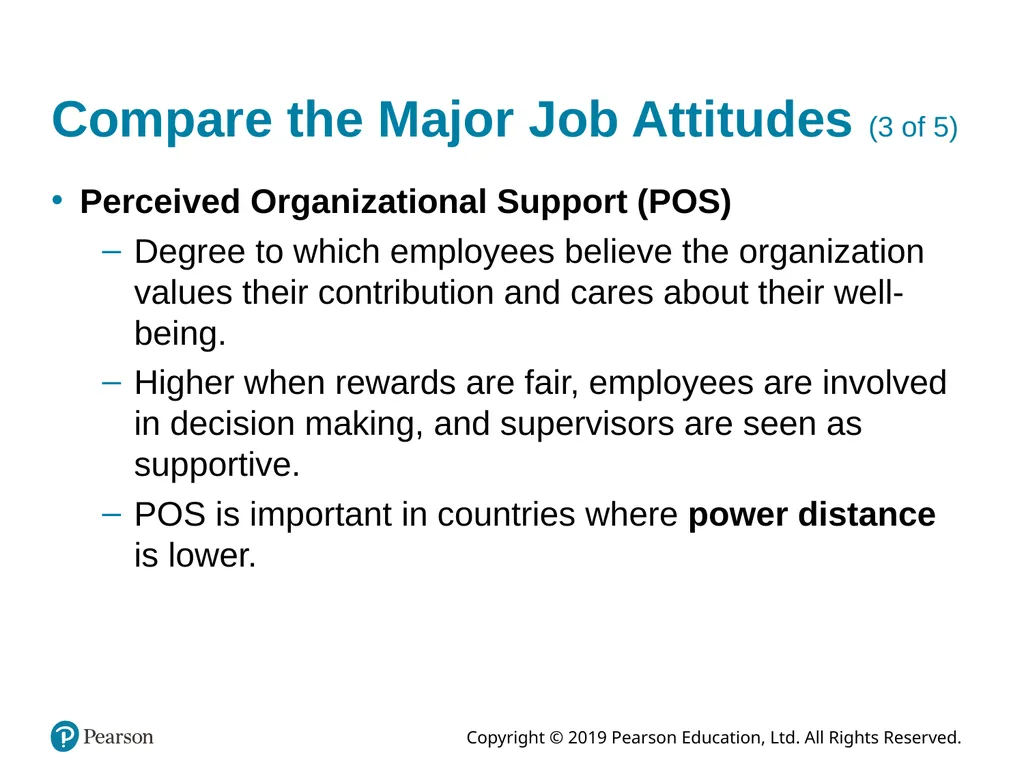
Compare the Major Job Attitudes (3 of 5) Perceived Organizational Support (POS)
Degree to which employees believe the organization values their contribution and cares about their well-being.
Higher when rewards are fair, employees are involved in decision making, and supervisors are seen as supportive.
POS is important in countries where power distance is lower.<br>
Degree to which employees believe the organization values their contribution and cares about their well-being.
Higher when rewards are fair, employees are involved in decision making, and supervisors are seen as supportive.
POS is important in countries where power distance is lower.<br>
10
Compare the Major Job Attitudes (4 of 5) Employee Engagement
The individual’s involvement with, satisfaction with, and enthusiasm for the work.
Engaged employees are passionate about their work and company.<br>
The individual’s involvement with, satisfaction with, and enthusiasm for the work.
Engaged employees are passionate about their work and company.<br>
11
Compare the Major Job Attitudes (5 of 5) Are these job attitudes really all that distinct?
No, these attitudes are highly related; and while there is some distinction, there is also a lot of overlap that may cause confusion.<br>
No, these attitudes are highly related; and while there is some distinction, there is also a lot of overlap that may cause confusion.<br>
12
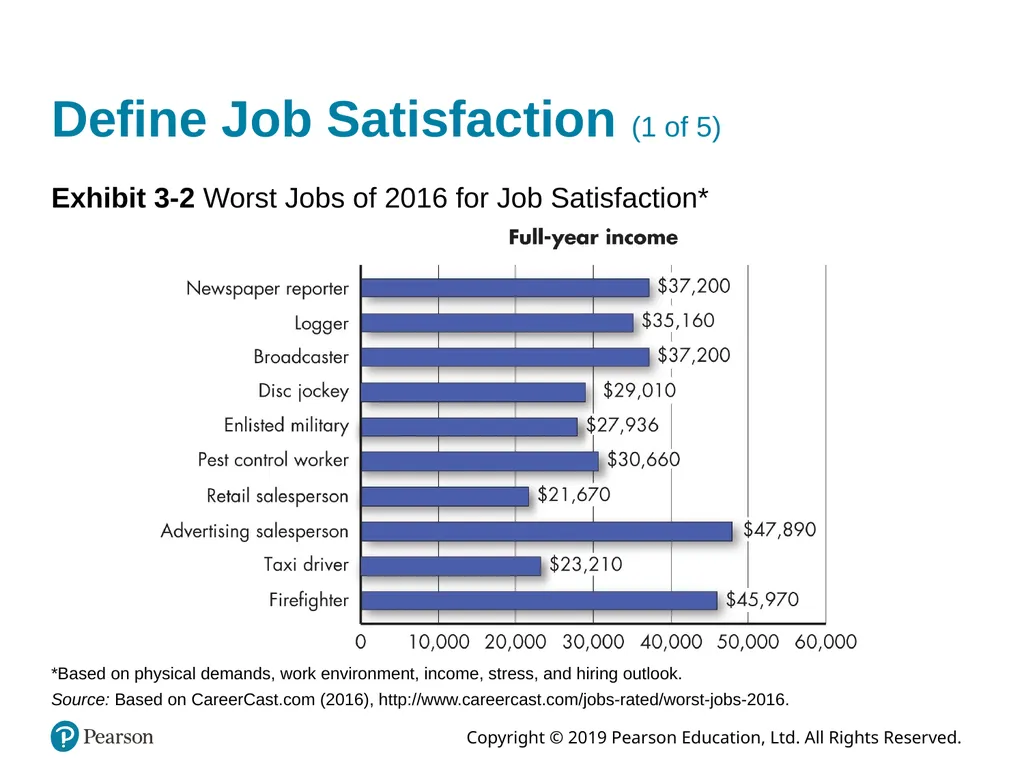
Define Job Satisfaction (1 of 5) Exhibit 3-2 Worst Jobs of 2016 for Job Satisfaction* *Based on physical demands, work environment, income, stress, and hiring outlook.
Source: Based on CareerCast.com (2016), http://www.careercast.com/jobs-rated/worst-jobs-2016.<br>
Source: Based on CareerCast.com (2016), http://www.careercast.com/jobs-rated/worst-jobs-2016.<br>
13
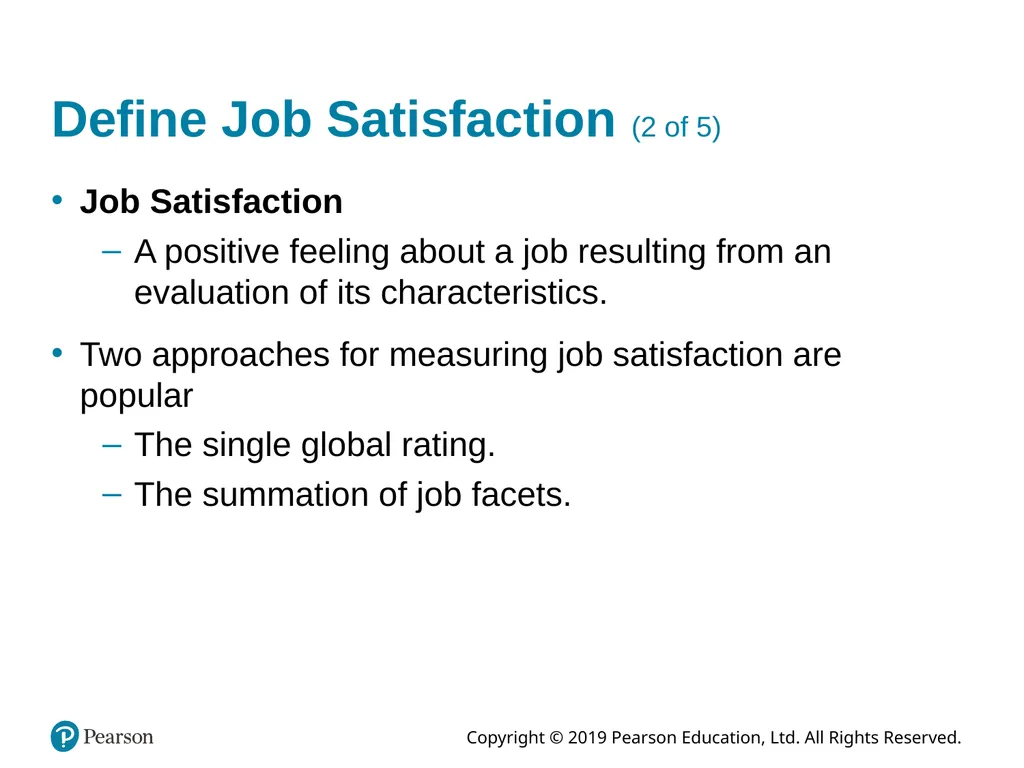
Define Job Satisfaction (2 of 5) Job Satisfaction
A positive feeling about a job resulting from an evaluation of its characteristics.
Two approaches for measuring job satisfaction are popular
The single global rating.
The summation of job facets.<br>
A positive feeling about a job resulting from an evaluation of its characteristics.
Two approaches for measuring job satisfaction are popular
The single global rating.
The summation of job facets.<br>
14
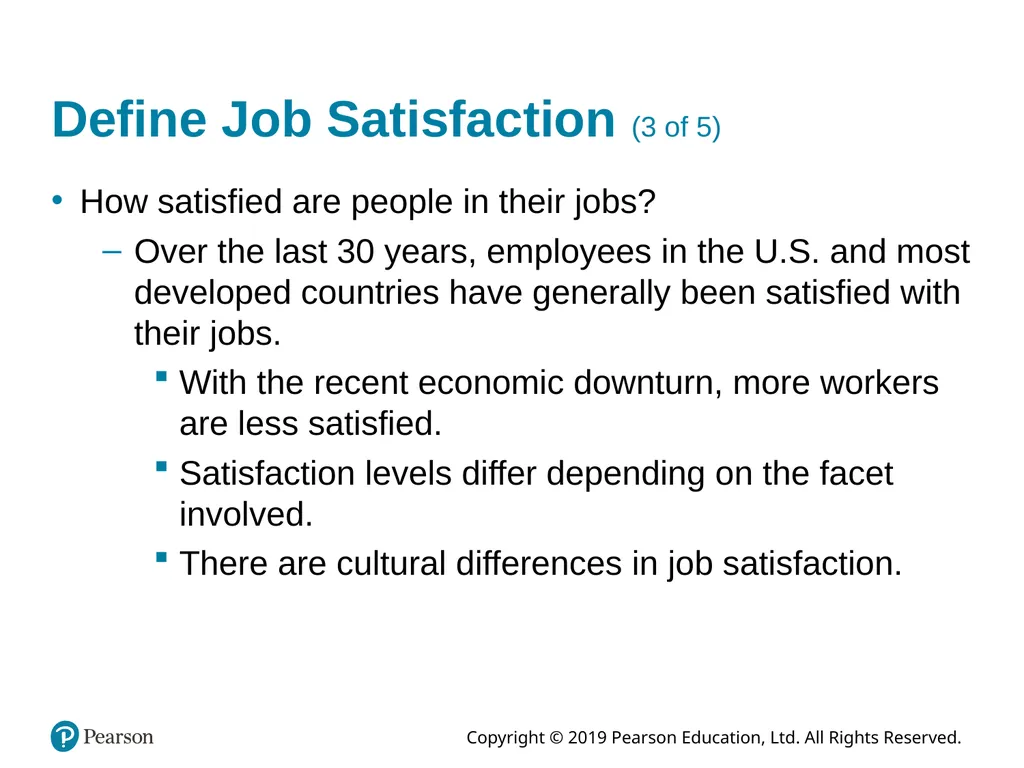
Define Job Satisfaction (3 of 5) How satisfied are people in their jobs?
Over the last 30 years, employees in the U.S. and most developed countries have generally been satisfied with their jobs.
With the recent economic downturn, more workers are less satisfied.
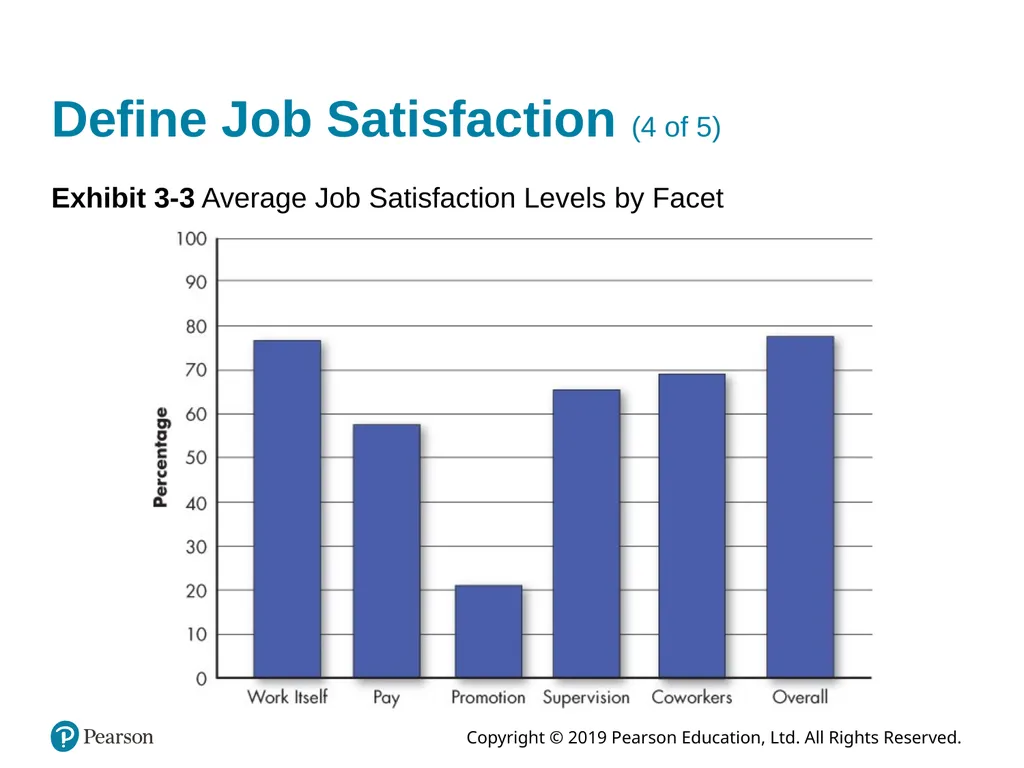
Satisfaction levels differ depending on the facet involved.
There are cultural differences in job satisfaction.<br>
Over the last 30 years, employees in the U.S. and most developed countries have generally been satisfied with their jobs.
With the recent economic downturn, more workers are less satisfied.
Satisfaction levels differ depending on the facet involved.
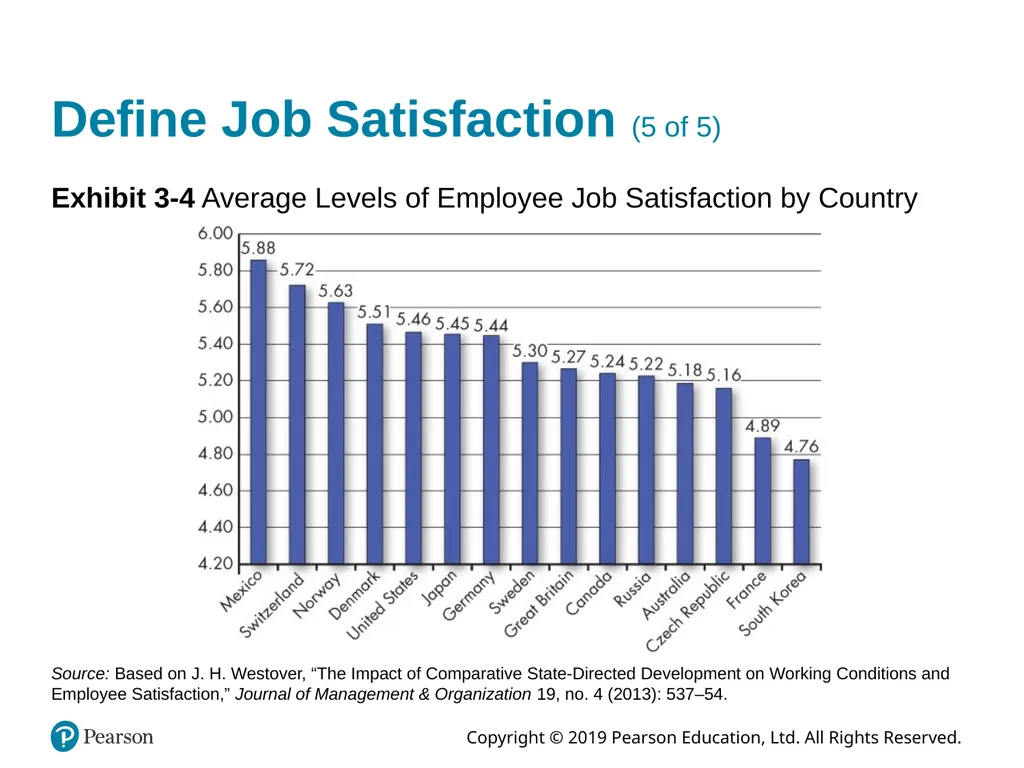
There are cultural differences in job satisfaction.<br>
15
Define Job Satisfaction (4 of 5) Exhibit 3-3 Average Job Satisfaction Levels by Facet<br>
16
Define Job Satisfaction (5 of 5) Exhibit 3-4 Average Levels of Employee Job Satisfaction by Country Source: Based on J. H. Westover, “The Impact of Comparative State-Directed Development on Working Conditions and Employee Satisfaction,” Journal of Management & Organization 19, no. 4 (2013): 537–54.<br>
17
Summarize the Main Causes of Job Satisfaction (1 of 3) What causes job satisfaction?
Job conditions
The intrinsic nature of the work itself, social interactions, and supervision are important predictors of satisfaction and employee well-being.
Personality
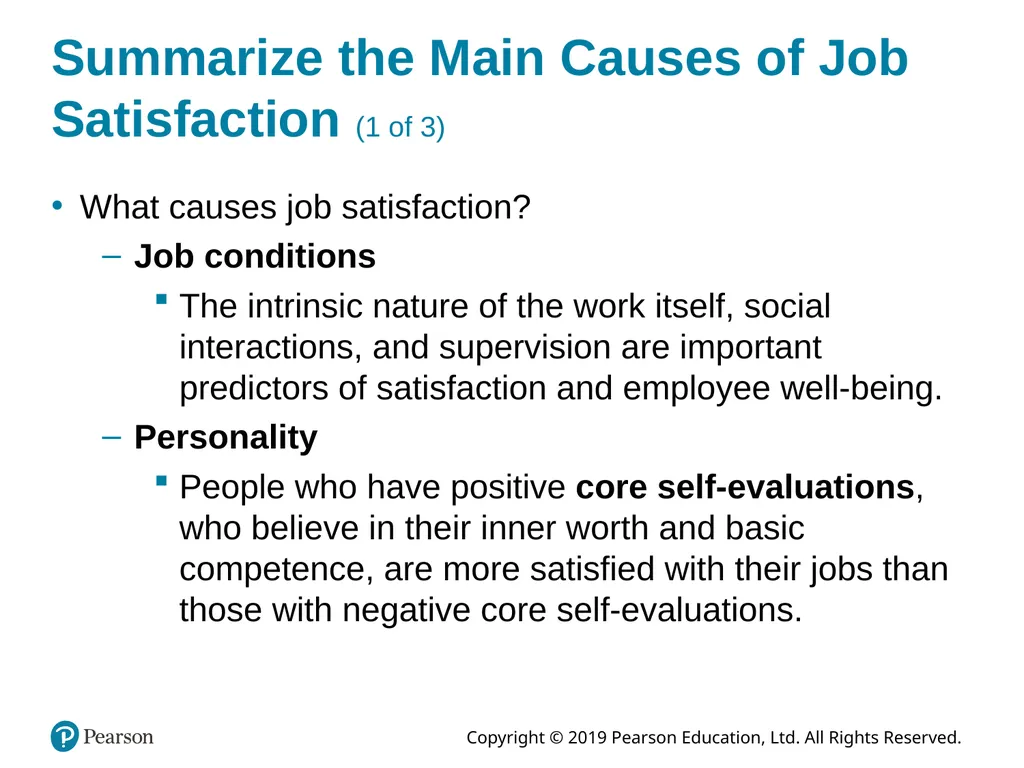
People who have positive core self-evaluations, who believe in their inner worth and basic competence, are more satisfied with their jobs than those with negative core self-evaluations.<br>
Job conditions
The intrinsic nature of the work itself, social interactions, and supervision are important predictors of satisfaction and employee well-being.
Personality
People who have positive core self-evaluations, who believe in their inner worth and basic competence, are more satisfied with their jobs than those with negative core self-evaluations.<br>
18
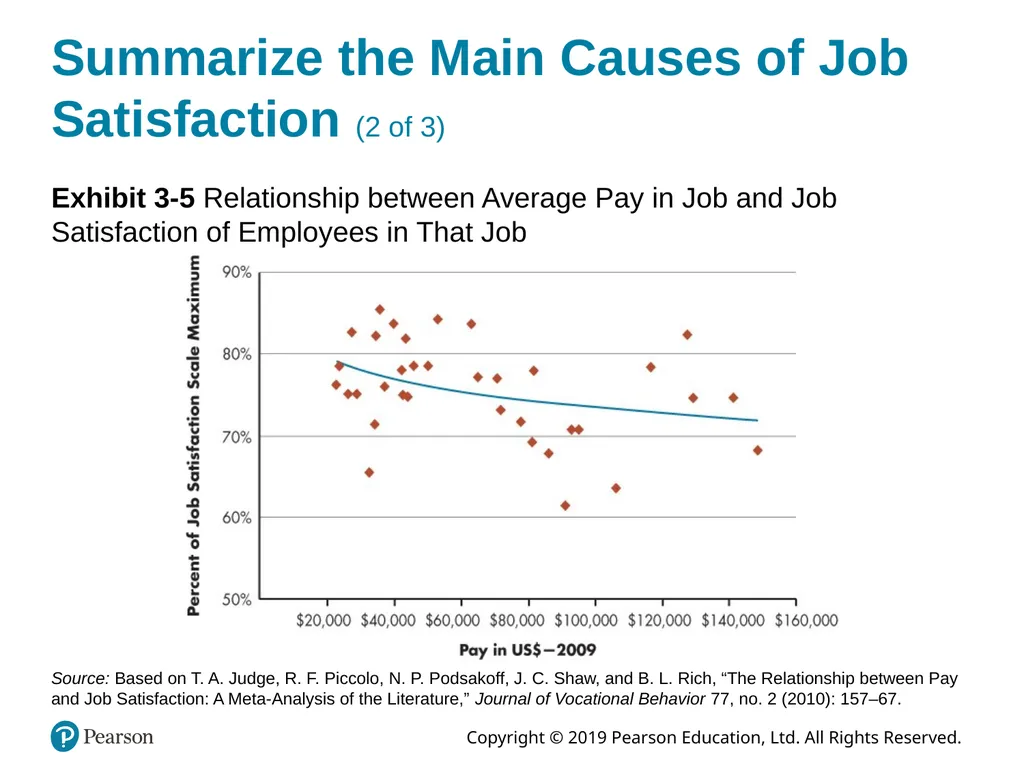
Summarize the Main Causes of Job Satisfaction (2 of 3) Exhibit 3-5 Relationship between Average Pay in Job and Job Satisfaction of Employees in That Job Source: Based on T. A. Judge, R. F. Piccolo, N. P. Podsakoff, J. C. Shaw, and B. L. Rich, “The Relationship between Pay and Job Satisfaction: A Meta-Analysis of the Literature,” Journal of Vocational Behavior 77, no. 2 (2010): 157–67.<br>
19
Summarize the Main Causes of Job Satisfaction (3 of 3) Corporate Social Responsibility (CSR)
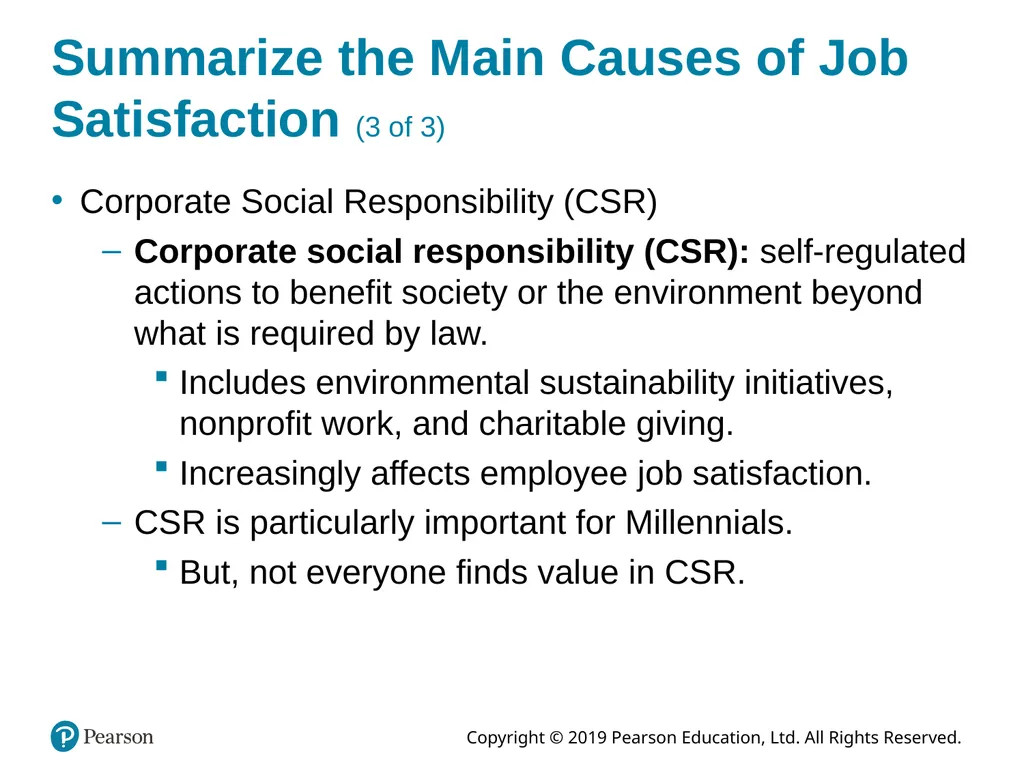
Corporate social responsibility (CSR): self-regulated actions to benefit society or the environment beyond what is required by law.
Includes environmental sustainability initiatives, nonprofit work, and charitable giving.
Increasingly affects employee job satisfaction.
CSR is particularly important for Millennials.
But, not everyone finds value in CSR.<br>
Corporate social responsibility (CSR): self-regulated actions to benefit society or the environment beyond what is required by law.
Includes environmental sustainability initiatives, nonprofit work, and charitable giving.
Increasingly affects employee job satisfaction.
CSR is particularly important for Millennials.
But, not everyone finds value in CSR.<br>
20
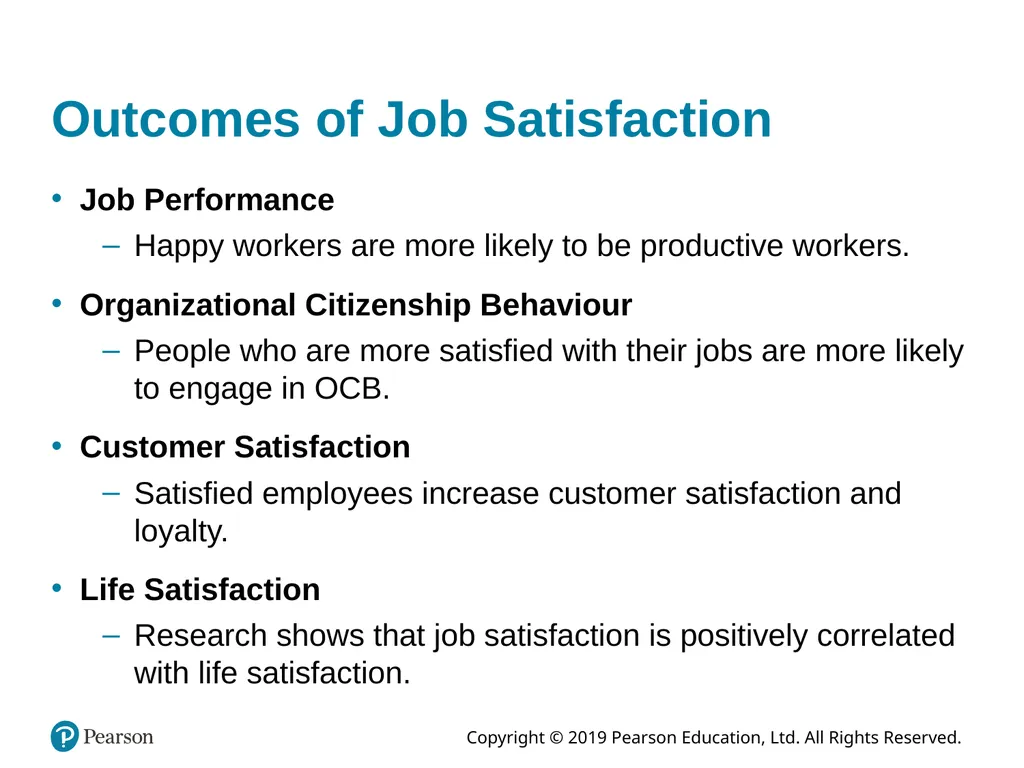
Outcomes of Job Satisfaction Job Performance
Happy workers are more likely to be productive workers.
Organizational Citizenship Behaviour
People who are more satisfied with their jobs are more likely to engage in OCB.
Customer Satisfaction
Satisfied employees increase customer satisfaction and loyalty.
Life Satisfaction
Research shows that job satisfaction is positively correlated with life satisfaction.<br>
Happy workers are more likely to be productive workers.
Organizational Citizenship Behaviour
People who are more satisfied with their jobs are more likely to engage in OCB.
Customer Satisfaction
Satisfied employees increase customer satisfaction and loyalty.
Life Satisfaction
Research shows that job satisfaction is positively correlated with life satisfaction.<br>
21
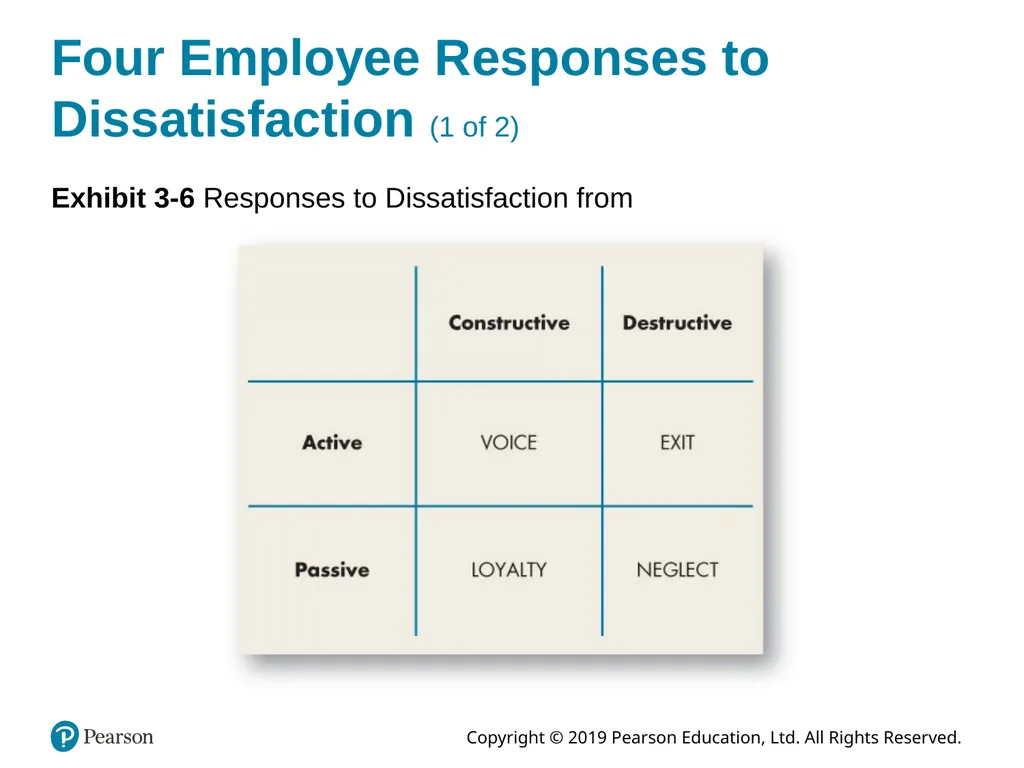
Four Employee Responses to Dissatisfaction (1 of 2) Exhibit 3-6 Responses to Dissatisfaction from<br>
22
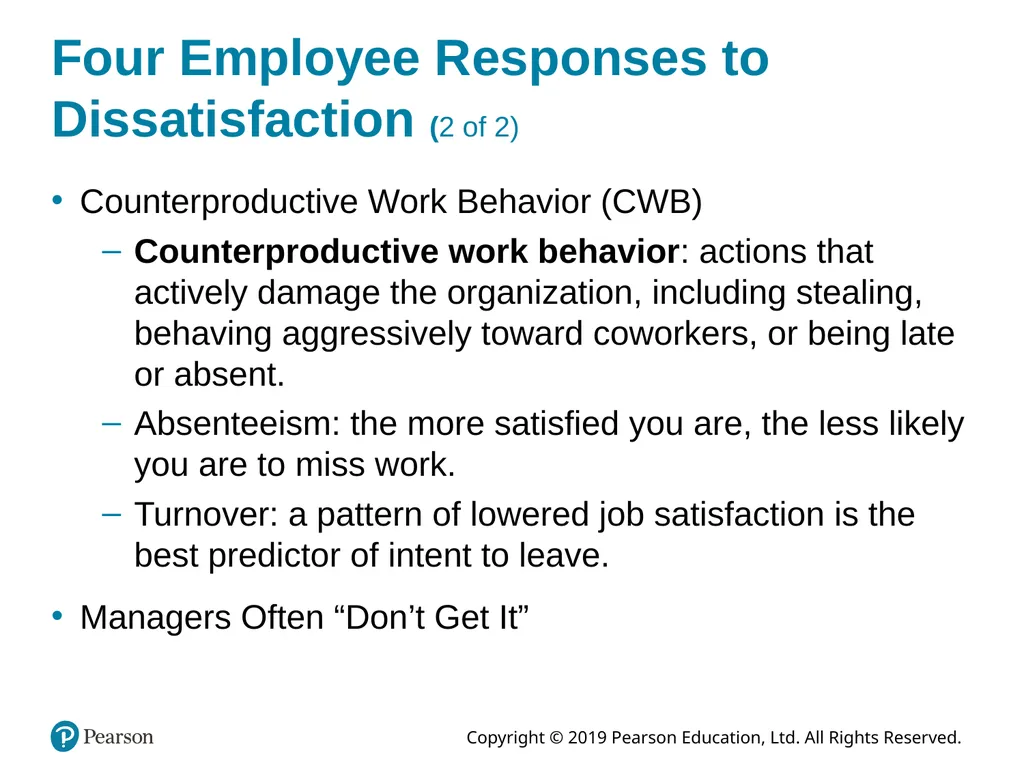
Four Employee Responses to Dissatisfaction (2 of 2) Counterproductive Work Behavior (CWB)
Counterproductive work behavior: actions that actively damage the organization, including stealing, behaving aggressively toward coworkers, or being late or absent.
Absenteeism: the more satisfied you are, the less likely you are to miss work.
Turnover: a pattern of lowered job satisfaction is the best predictor of intent to leave.
Managers Often “Don’t Get It”<br>
Counterproductive work behavior: actions that actively damage the organization, including stealing, behaving aggressively toward coworkers, or being late or absent.
Absenteeism: the more satisfied you are, the less likely you are to miss work.
Turnover: a pattern of lowered job satisfaction is the best predictor of intent to leave.
Managers Often “Don’t Get It”<br>
23
Implications for Managers (1 of 2) Of the major job attitudes – job satisfaction, job involvement, organizational commitment, perceived organizational support (POS), and employee engagement – remember that an employee’s job satisfaction level is the best single predictor of behavior.
Pay attention to your employees’ job satisfaction levels as determinants of their performance, turnover, absenteeism, and withdrawal behaviors.<br>
Pay attention to your employees’ job satisfaction levels as determinants of their performance, turnover, absenteeism, and withdrawal behaviors.<br>
24
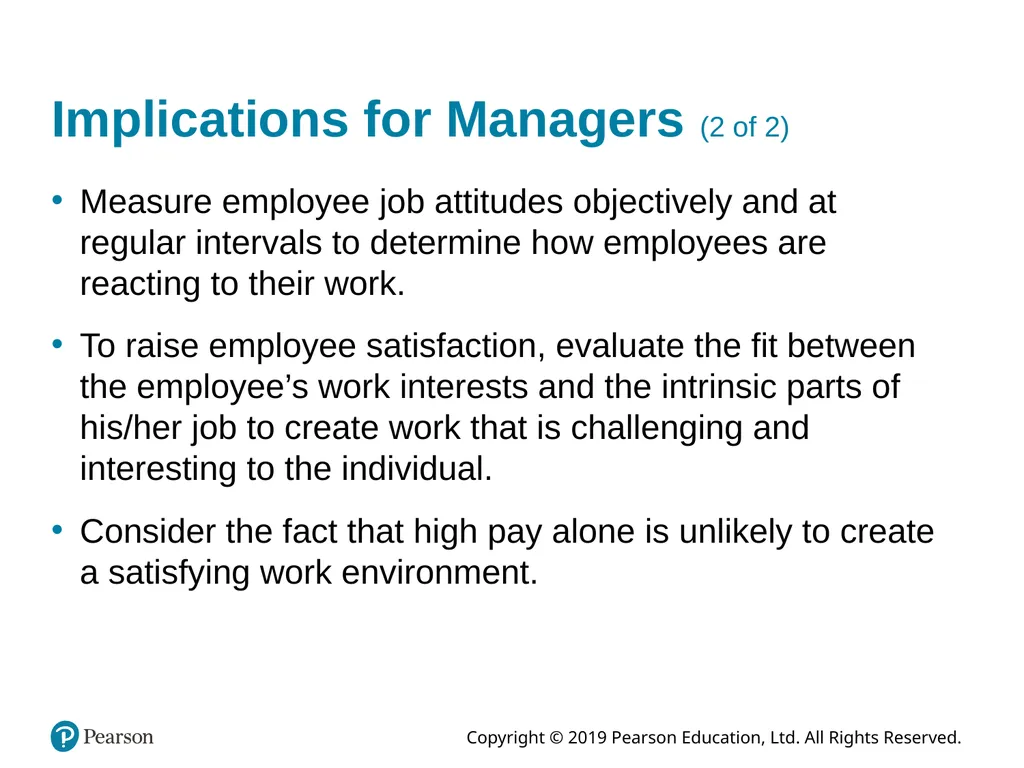
Implications for Managers (2 of 2) Measure employee job attitudes objectively and at regular intervals to determine how employees are reacting to their work.
To raise employee satisfaction, evaluate the fit between the employee’s work interests and the intrinsic parts of his/her job to create work that is challenging and interesting to the individual.
Consider the fact that high pay alone is unlikely to create a satisfying work environment.<br>
To raise employee satisfaction, evaluate the fit between the employee’s work interests and the intrinsic parts of his/her job to create work that is challenging and interesting to the individual.
Consider the fact that high pay alone is unlikely to create a satisfying work environment.<br>
25
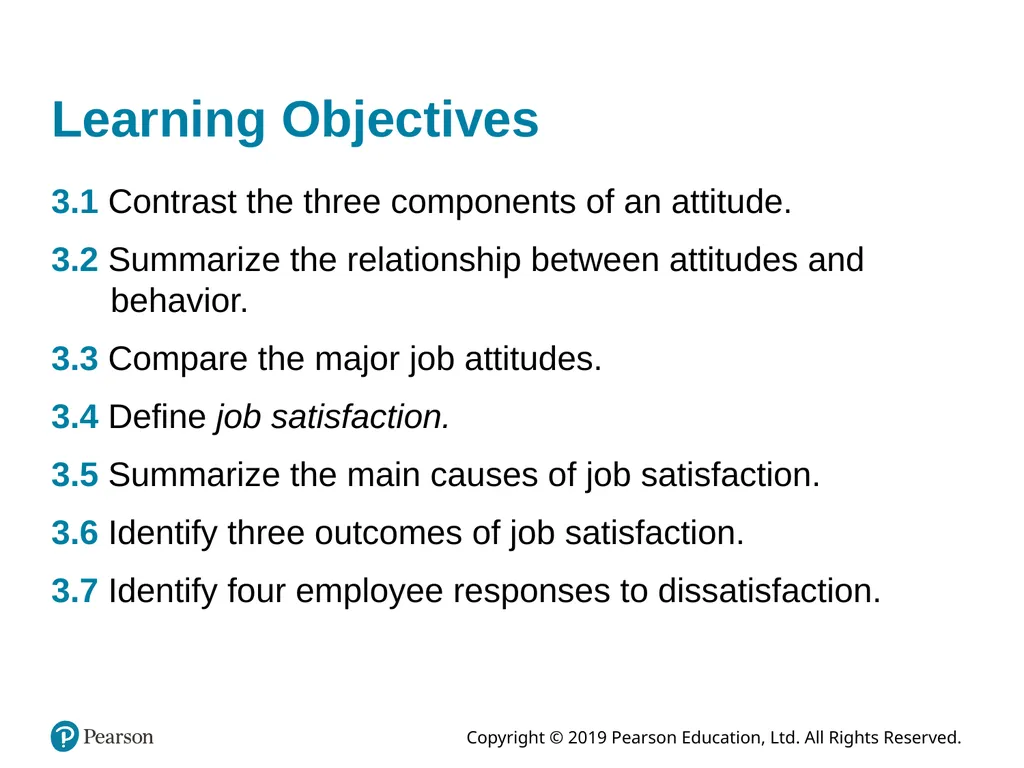
Learning Objectives 3.1 Contrast the three components of an attitude.
3.2 Summarize the relationship between attitudes and behavior.
3.3 Compare the major job attitudes.
3.4 Define job satisfaction.
3.5 Summarize the main causes of job satisfaction.
3.6 Identify three outcomes of job satisfaction.
3.7 Identify four employee responses to dissatisfaction.<br>
3.2 Summarize the relationship between attitudes and behavior.
3.3 Compare the major job attitudes.
3.4 Define job satisfaction.
3.5 Summarize the main causes of job satisfaction.
3.6 Identify three outcomes of job satisfaction.
3.7 Identify four employee responses to dissatisfaction.<br>
26
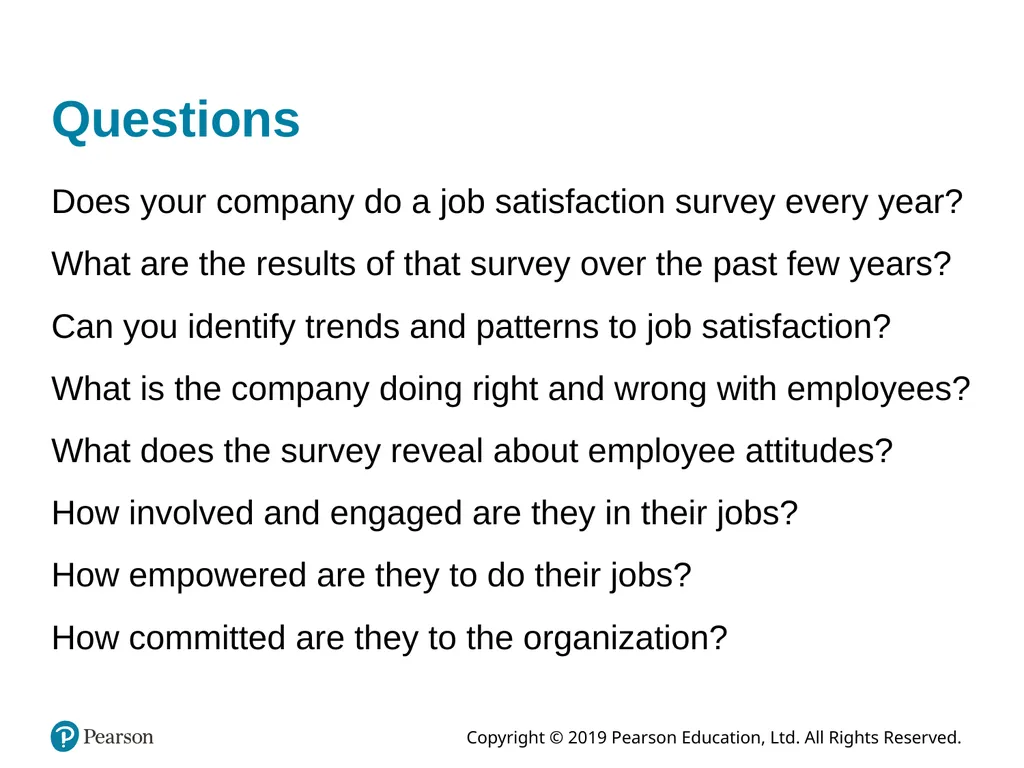
Questions Does your company do a job satisfaction survey every year?
What are the results of that survey over the past few years?
Can you identify trends and patterns to job satisfaction?
What is the company doing right and wrong with employees?
What does the survey reveal about employee attitudes?
How involved and engaged are they in their jobs?
How empowered are they to do their jobs?
How committed are they to the organization?<br>
What are the results of that survey over the past few years?
Can you identify trends and patterns to job satisfaction?
What is the company doing right and wrong with employees?
What does the survey reveal about employee attitudes?
How involved and engaged are they in their jobs?
How empowered are they to do their jobs?
How committed are they to the organization?<br>