Pavlov’s Classical Conditioning: The Theory of
Description: Pavlovs Classical Conditioning: The Theory of Classical Conditioning was put forward by Ivan P. Pavlov (1849-1936). The term conditioning refers to the modification of natural response. Classical conditioning may be defined as a process
Related Topics
Download Presentation
"Pavlov’s Classical Conditioning: The Theory of" is the property of its rightful owner. Permission is granted to download and print the materials on this website for personal, non-commercial use only, and to display it on your personal computer provided you do not modify the materials and that you retain all copyright notices contained in the materials. By downloading content from our website, you accept the terms of this agreement.
Presentation Transcript
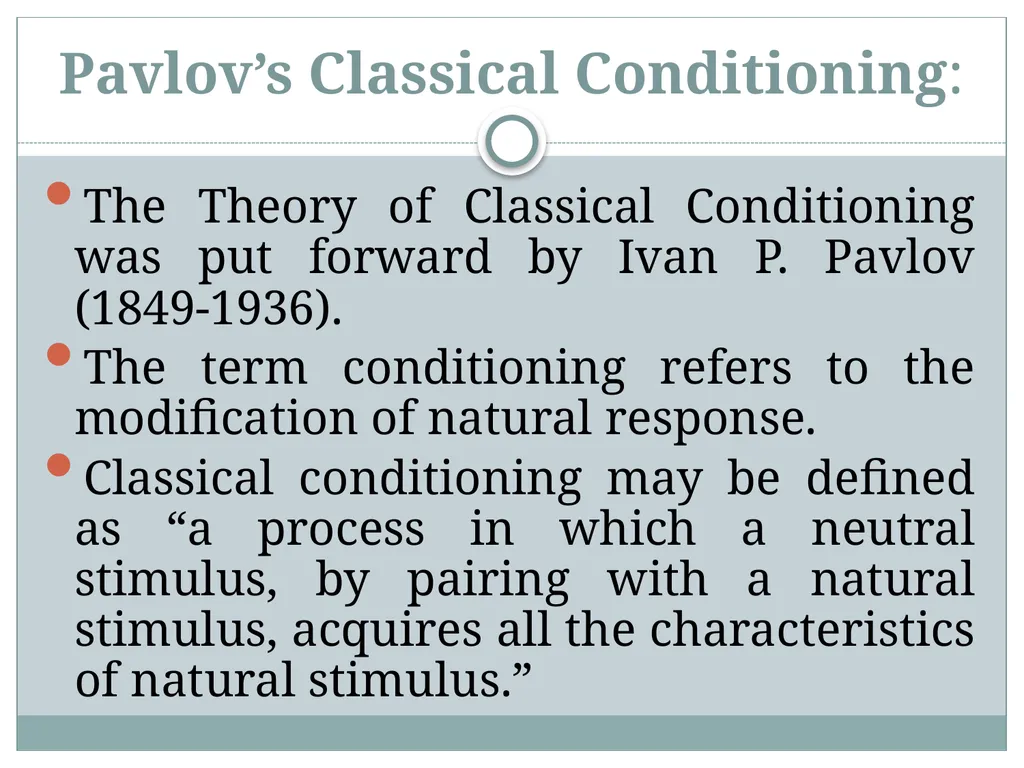
slide1. Pavlov’s Classical Conditioning: The Theory of Classical Conditioning was put forward by Ivan P. Pavlov (1849-1936).
The term conditioning refers to the modification of natural response.
Classical conditioning may be defined as “a process in which a neutral stimulus, by pairing with a natural stimulus, acquires all the characteristics of natural stimulus.”<br>
slide2. Pavlov’s Experiment: The first element is a natural stimulus, technically known as Unconditioned Stimulus (US) i.e. food.
US results in a natural response called the Unconditioned Response (UR).
The third element is the artificial stimulus i.e. the ringing of the bell which is technically known as Conditioned Stimulus (CS).
The fourth element is the chain of the conditioning process. One learns to produce behaviour in the form of Conditioned Response (CR) to Conditioned Stimulus (CS).<br>
slide3. Educational Implications: Pavlov’s experimental work of classical conditioning is regarded as a landmark contribution to the field of Educational Psychology. He brought a revolution in the field of Psychology. The principles of classical conditioning can be used in different areas of classroom teaching-learning process as follows:<br>
slide4. Learning through conditioning 1) A child learns through conditioning. The principles of classical conditioning are used to teach alphabets and four fundamental principles of arithmetic by using some concrete material. For example, ‘A’ is associated with apple, counting is taught with the help of beads etc.<br>
slide5. Learning language 2) A child can learn language with the help of classical conditioning. He learns to call his father ‘daddy’, his mother ‘mummy’, and his dog ‘kitty’ through the process of conditioning i.e. stimulus-response association and substitution.<br>
slide6. Developing good habits 3) Principles of classical conditioning can be used for developing good habits in children such as cleanliness, respect for elders, punctuality etc. Bad habits too can be eliminated through conditioning.<br>
slide7. Reward and Punishment 4) Theory of reward and punishment is based on classical conditioning i.e. bad deeds should be associated with punishment and good one with relevant reward and praise. It should be kept in mind that reward and punishment should be given at the right time.<br>
slide8. Developing attitudes, values, beliefs 5) Classical conditioning should be used to develop favourable or unfavourable attitudes, values, beliefs, sentiments and habits towards learning, teacher and the school.<br>
slide9. Progress of culture and civilization 6) The theory of classical conditioning is very useful for the progress of culture and civilization. With the help of this theory, the child is able to learn many things in his early age.<br>
slide10. Adjustment with environment 7) The theory of classical conditioning is very useful for an individual for adjustment with the environment.<br>
slide11. THANK
YOU<br>
The term conditioning refers to the modification of natural response.
Classical conditioning may be defined as “a process in which a neutral stimulus, by pairing with a natural stimulus, acquires all the characteristics of natural stimulus.”<br>
slide2. Pavlov’s Experiment: The first element is a natural stimulus, technically known as Unconditioned Stimulus (US) i.e. food.
US results in a natural response called the Unconditioned Response (UR).
The third element is the artificial stimulus i.e. the ringing of the bell which is technically known as Conditioned Stimulus (CS).
The fourth element is the chain of the conditioning process. One learns to produce behaviour in the form of Conditioned Response (CR) to Conditioned Stimulus (CS).<br>
slide3. Educational Implications: Pavlov’s experimental work of classical conditioning is regarded as a landmark contribution to the field of Educational Psychology. He brought a revolution in the field of Psychology. The principles of classical conditioning can be used in different areas of classroom teaching-learning process as follows:<br>
slide4. Learning through conditioning 1) A child learns through conditioning. The principles of classical conditioning are used to teach alphabets and four fundamental principles of arithmetic by using some concrete material. For example, ‘A’ is associated with apple, counting is taught with the help of beads etc.<br>
slide5. Learning language 2) A child can learn language with the help of classical conditioning. He learns to call his father ‘daddy’, his mother ‘mummy’, and his dog ‘kitty’ through the process of conditioning i.e. stimulus-response association and substitution.<br>
slide6. Developing good habits 3) Principles of classical conditioning can be used for developing good habits in children such as cleanliness, respect for elders, punctuality etc. Bad habits too can be eliminated through conditioning.<br>
slide7. Reward and Punishment 4) Theory of reward and punishment is based on classical conditioning i.e. bad deeds should be associated with punishment and good one with relevant reward and praise. It should be kept in mind that reward and punishment should be given at the right time.<br>
slide8. Developing attitudes, values, beliefs 5) Classical conditioning should be used to develop favourable or unfavourable attitudes, values, beliefs, sentiments and habits towards learning, teacher and the school.<br>
slide9. Progress of culture and civilization 6) The theory of classical conditioning is very useful for the progress of culture and civilization. With the help of this theory, the child is able to learn many things in his early age.<br>
slide10. Adjustment with environment 7) The theory of classical conditioning is very useful for an individual for adjustment with the environment.<br>
slide11. THANK
YOU<br>