Phonics workshop Reception Monday 6th November 2023 What are we going to cover? Terminology Phase 2 and phase 3 sounds- examples and pronunciation Different stages of learning to read How you can support your child at home Questions End of
"Phonics workshop Reception Monday 6th November" is the property of its rightful owner. Permission is granted to
download and print the materials on this website for personal, non-commercial use only, and to display it
on your personal computer provided you do not modify the materials and that you retain all copyright
notices contained in the materials. By downloading content from our website, you accept the terms of this
agreement.
Presentation Transcript
01
Phonics workshop Reception Monday 6th November 2023<br>
02
What are we going to cover? Terminology
Phase 2 and phase 3 sounds- examples and pronunciation
Different stages of learning to read
How you can support your child at home
Questions<br>
03
End of year expectations: Comprehension ELG
- Demonstrate understanding of what has been read to them by retelling stories and narratives using their own words and recently introduced vocabulary;
- Anticipate – where appropriate – key events in stories;
- Use and understand recently introduced vocabulary during discussions about stories, non-fiction, rhymes and poems and during role-play.
Word Reading ELG
- Say a sound for each letter in the alphabet and at least 10 digraphs;
- Read words consistent with their phonic knowledge by sound-blending;
- Read aloud simple sentences and books that are consistent with their phonic knowledge, including some common exception words
Writing ELG
- Write recognisable letters, most of which are correctly formed;
- Spell words by identifying sounds in them and representing the sounds with a letter or letters;
- Write simple phrases and sentences that can be read by others.<br>
04
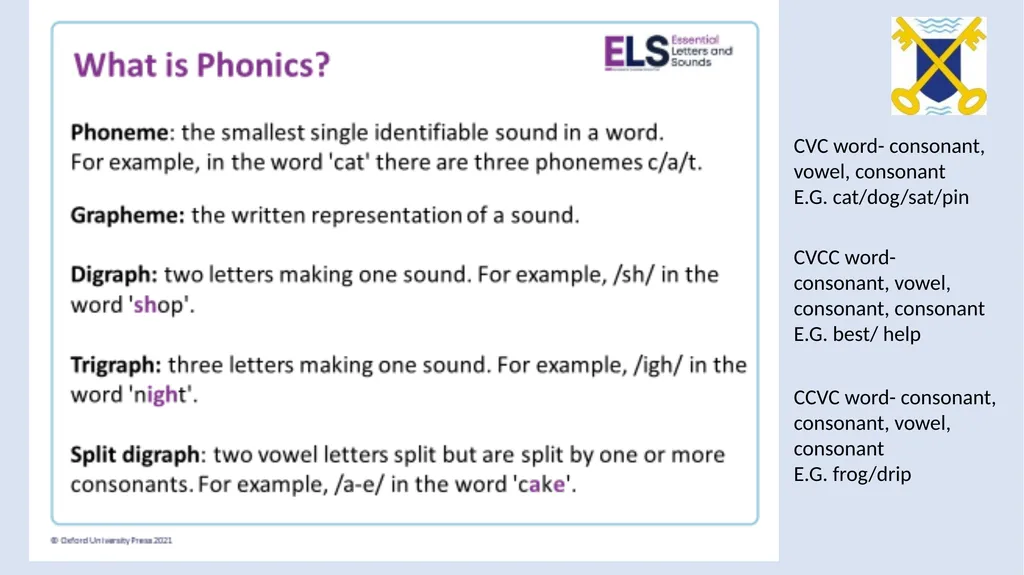
CVC word- consonant, vowel, consonant
E.G. cat/dog/sat/pin CVCC word- consonant, vowel, consonant, consonant
E.G. best/ help CCVC word- consonant, consonant, vowel, consonant
E.G. frog/drip<br>
05
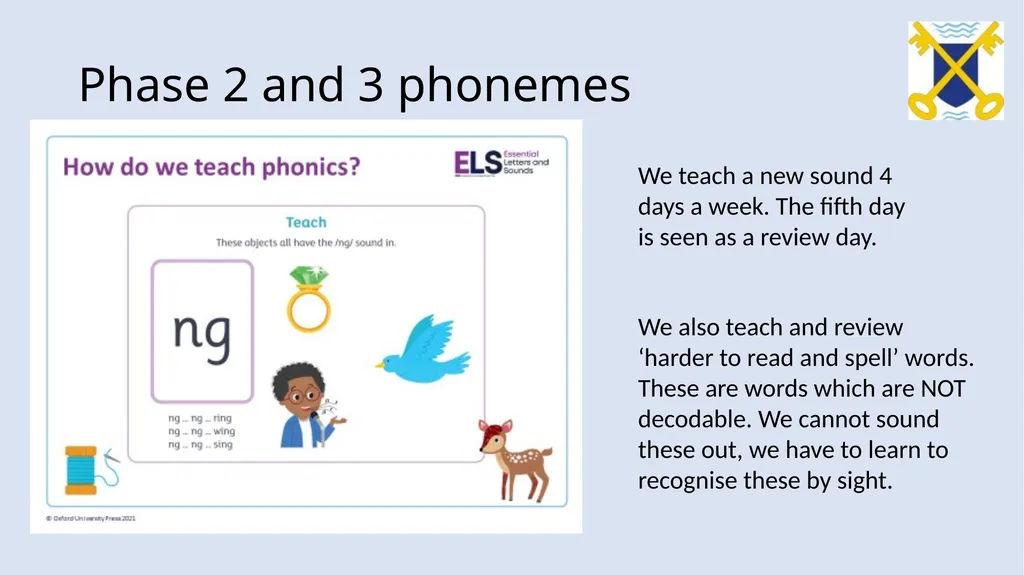
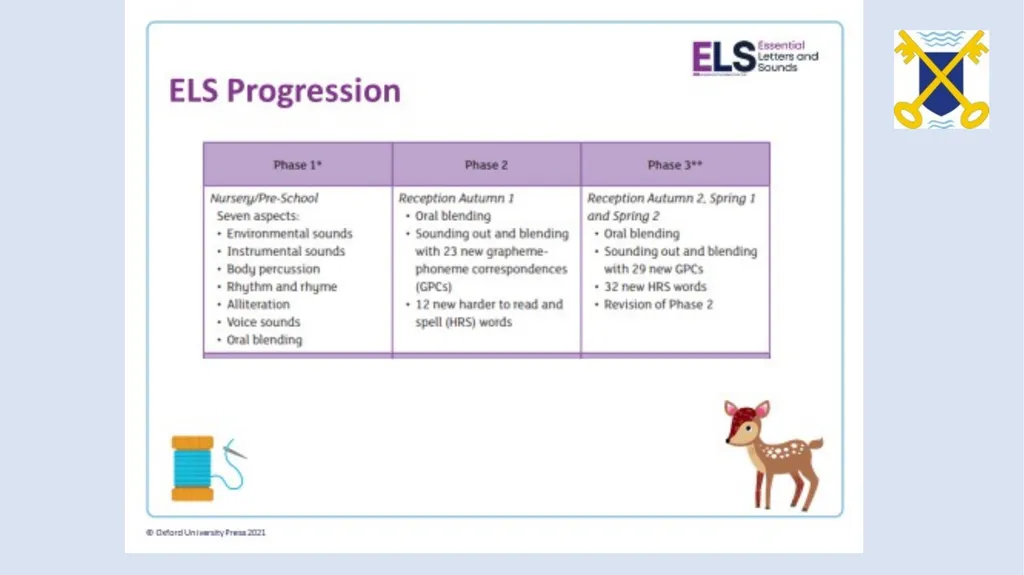
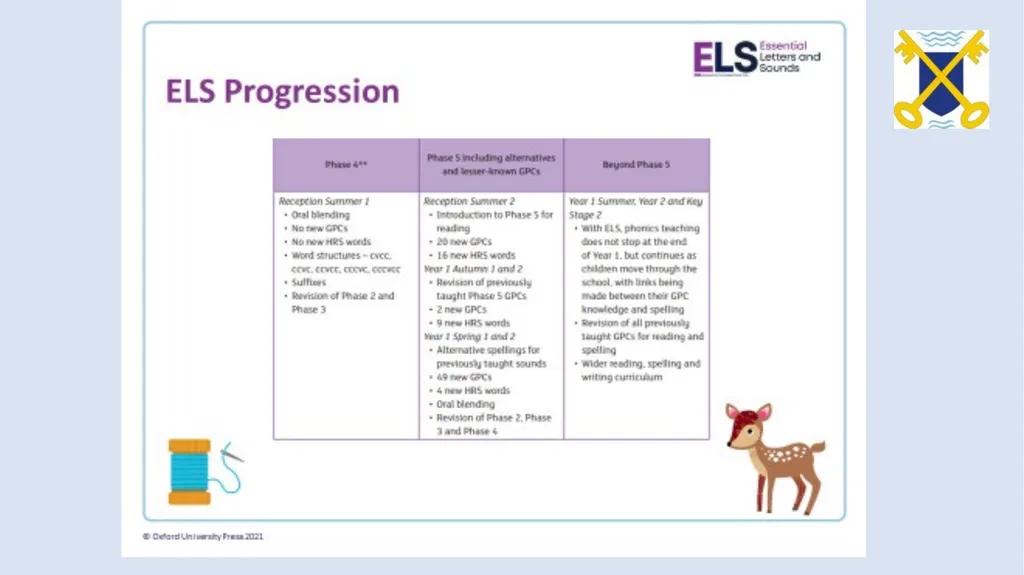
Phase 2 and 3 phonemes We teach a new sound 4 days a week. The fifth day is seen as a review day. We also teach and review ‘harder to read and spell’ words. These are words which are NOT decodable. We cannot sound these out, we have to learn to recognise these by sight.<br>
06
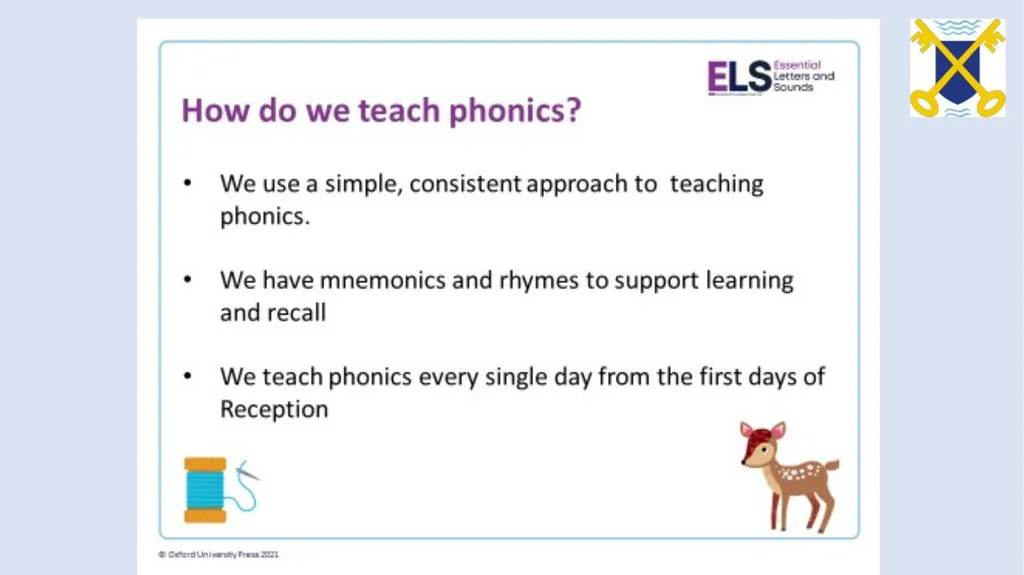
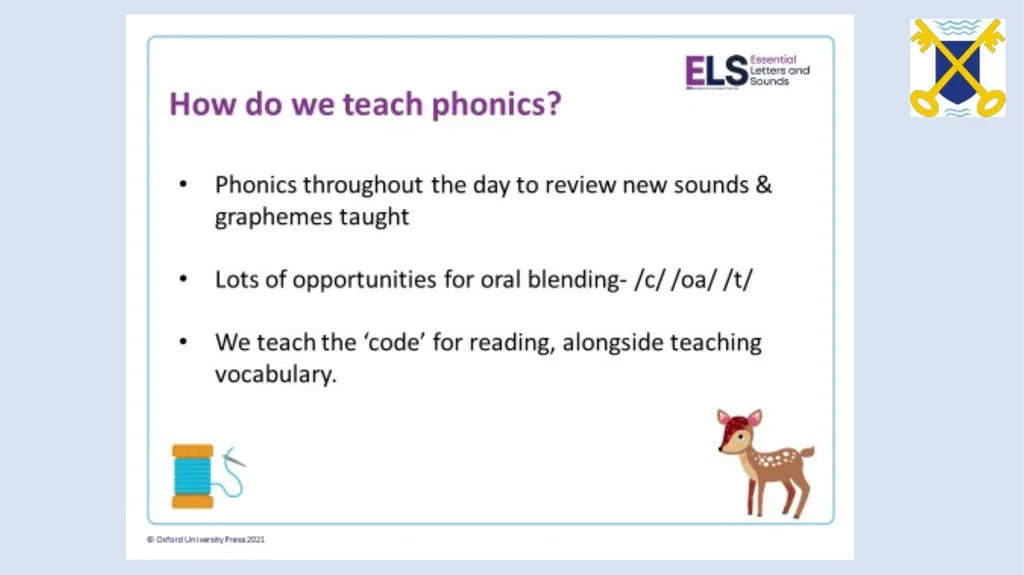
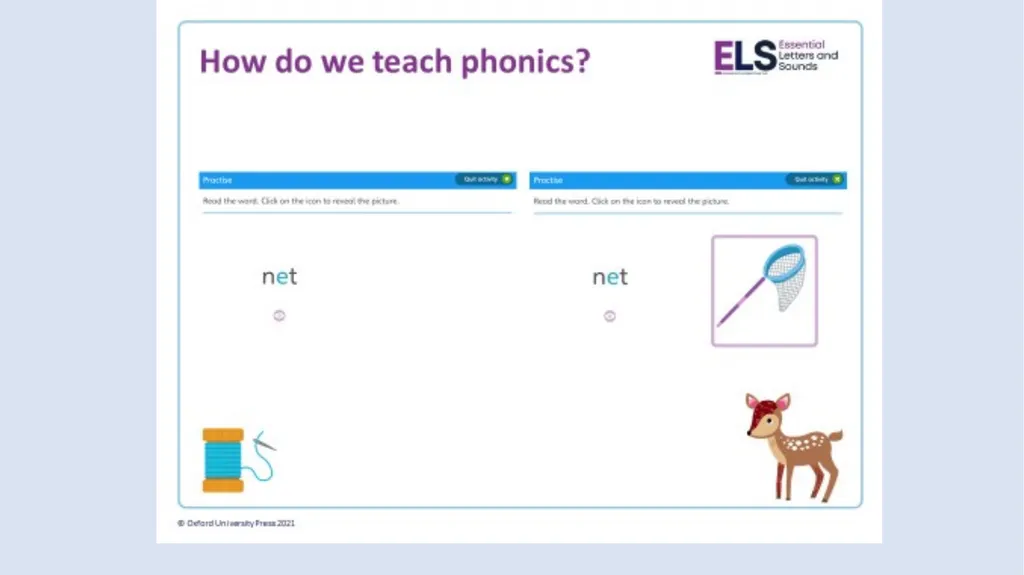
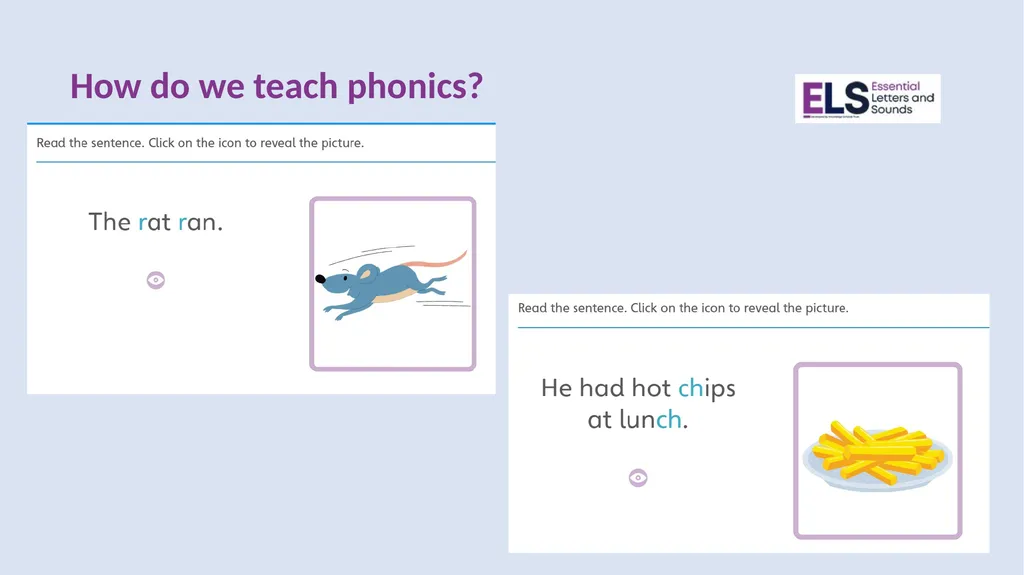
How do we teach phonics?<br>
07
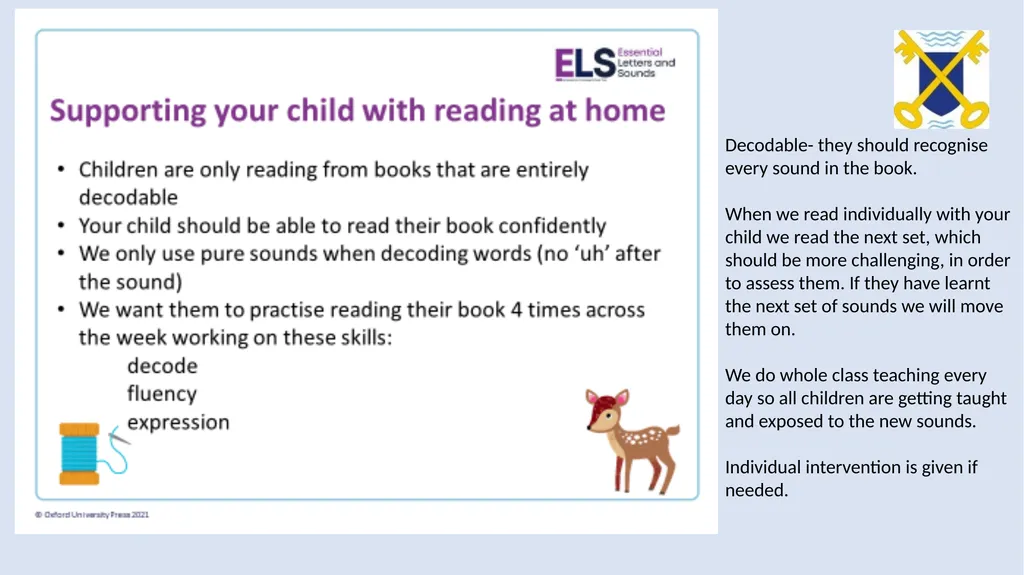
Decodable- they should recognise every sound in the book.
When we read individually with your child we read the next set, which should be more challenging, in order to assess them. If they have learnt the next set of sounds we will move them on.
We do whole class teaching every day so all children are getting taught and exposed to the new sounds.
Individual intervention is given if needed.<br>
08
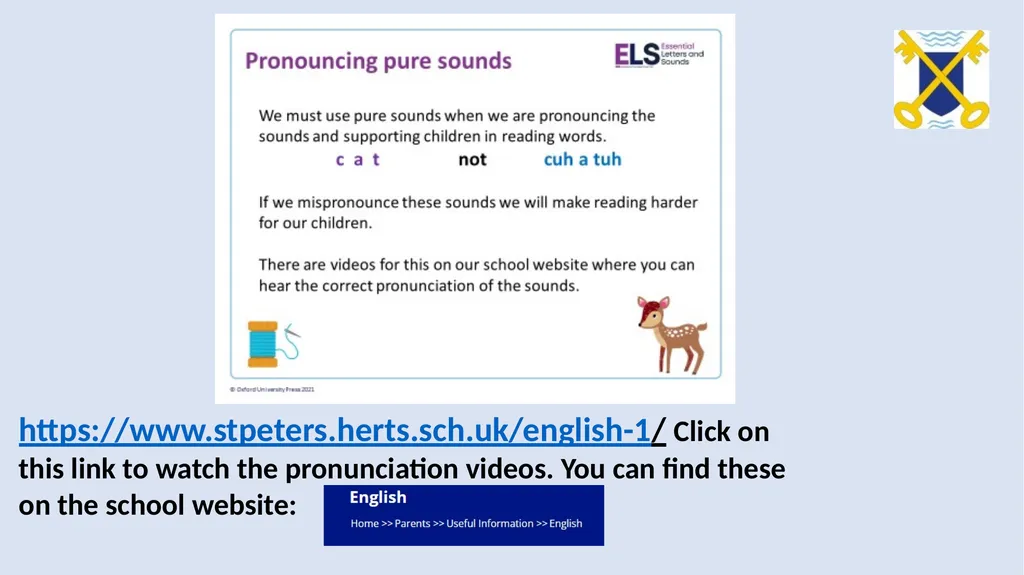
https://www.stpeters.herts.sch.uk/english-1/ Click on this link to watch the pronunciation videos. You can find these on the school website:<br>
09
How to support your child with reading: Consider which stage your child is at.
It is essential not to push your child on until they have grasped the earlier set of skills- this can lead to reluctant and demotivated readers.
Phase 1/oral blending skills are essential skills that children must have before they can read words independently.
Consider the time of day and length of time.
Promote reading for enjoyment. Comprehension and discussion is so important.<br>
10
How to support your child with reading: Stage 1: Oral blending
Option 1:
You read the story and pick a word on each page to orally sound out and blend for your child. You then say the whole word. Ask the children to repeat back with you.
Adult: c-a-t, cat, let’s do that together
Adult and child: c-a-t cat.
Option 2:
You sound out the word- they blend it together
Adult: c-a-t?
Child: cat
Point to the letters when doing this to help them make the connection between the phoneme and grapheme.
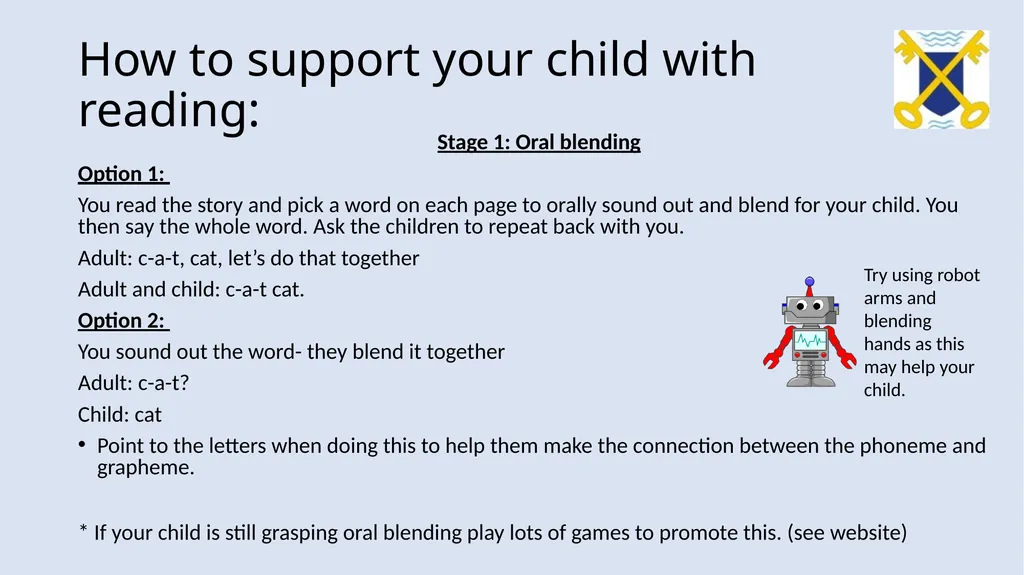
* If your child is still grasping oral blending play lots of games to promote this. (see website) Try using robot arms and blending hands as this may help your child.<br>
11
How to support your child with reading: Stage 2: Blending for reading
Option 1:
You read the story and pick an easy CVC word for your child to try and sound out. They may be able to recognise the sounds and say them but need support to blend.
Child: c-a-t tap?at?
Adult: Let’s try that together.
Adult and child repeat together: c-a-t
Adult: cat.
Option 2:
Your child recognises the sounds and can blend them together independently.
Please note if your child has just learnt to blend you may need to build up the amount of words/pages you expect them to read. This can vary depending on the book. A couple of pages is plenty at this stage. It is better to do small amounts every day to be getting regular practise at this skill.
Option 3:
Once your child is confidently blending all words in a book we can encourage them to sound out in their head and say the whole word aloud. This technique will develop their fluency. This is also a good opportunity to talk about and explore expression.<br>
12
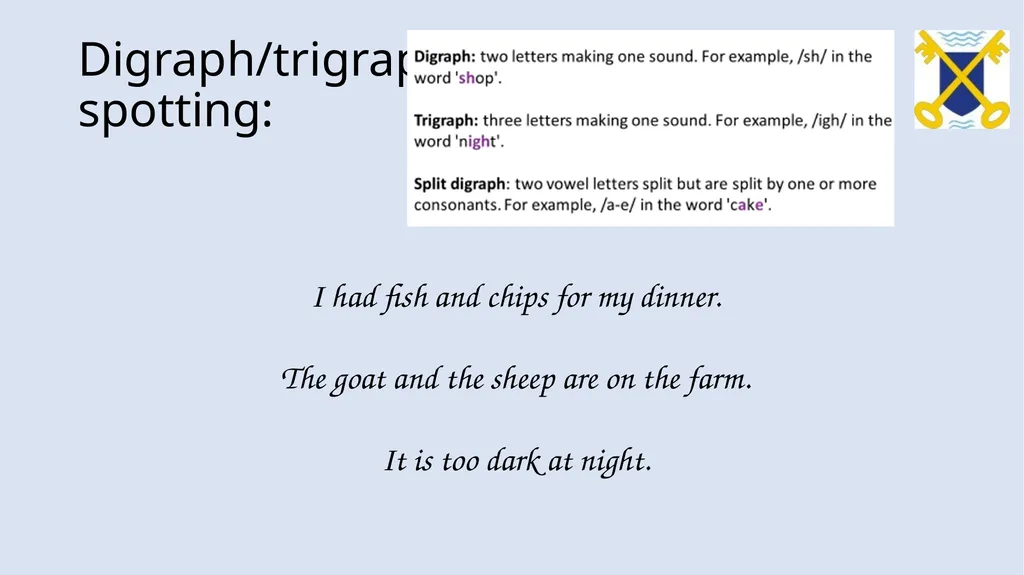
Digraph/trigraph spotting: I had fish and chips for my dinner.
The goat and the sheep are on the farm.
It is too dark at night.<br>
13
Harder to read and spell word examples:<br>
14
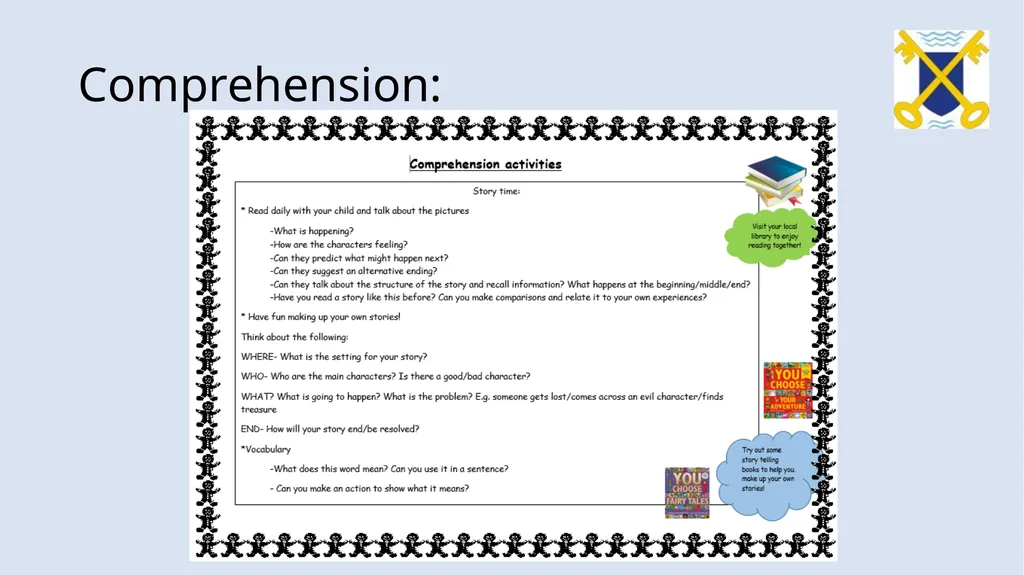
Comprehension:<br>
15
Other tips: When reading story books involve your child- can they spot any harder to read and spell words? Can they spot any of the digraphs we have learnt? Or are there any words in the book they could have a go at reading? (This makes them feel very grown up!)
Comprehension
Little and often. Aim for 3-4 times a week.
Please write in the reading record book.
Keep it fun- remember to talk about the story, characters, make predictions, suggest alternative endings.
Use the environment to promote reading: signs, shops, menu’s.<br>
We also practise saying our sentences before we write them to make sure we write the sentence we have planned and to ensure it makes sense!<br>
18
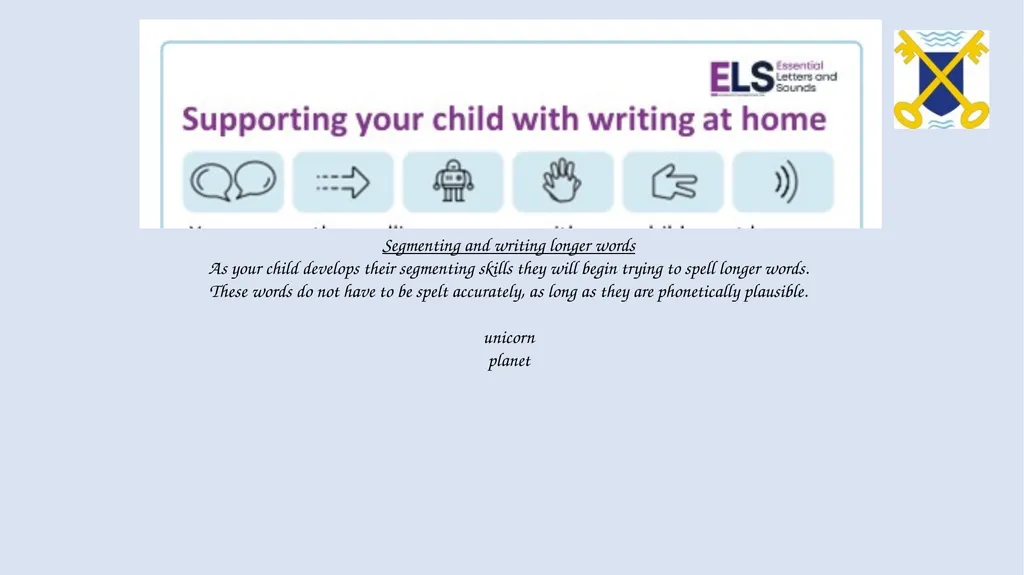
Segmenting and writing longer words
As your child develops their segmenting skills they will begin trying to spell longer words.
These words do not have to be spelt accurately, as long as they are phonetically plausible.
unicorn
planet<br>
19
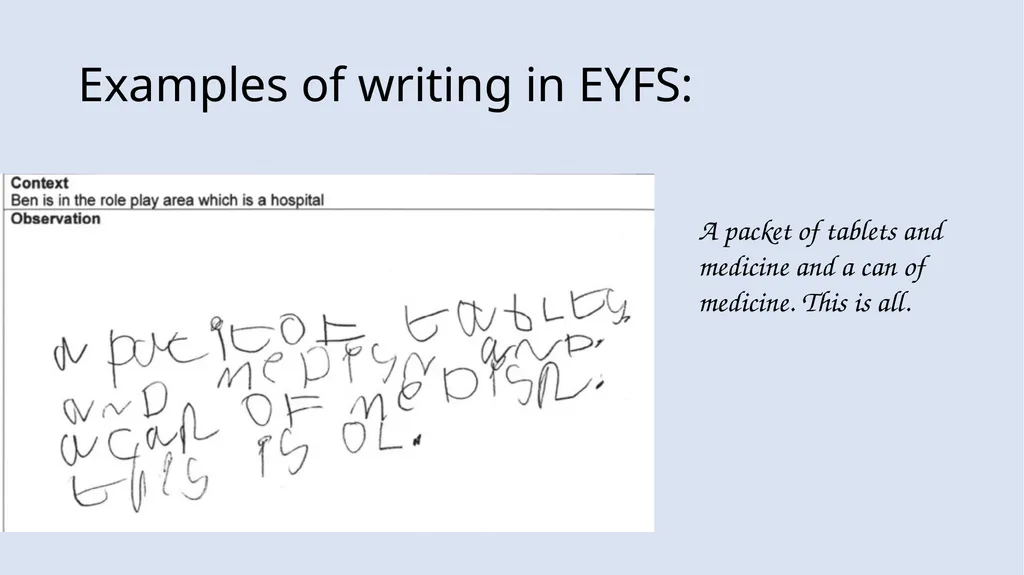
Examples of writing in EYFS: A packet of tablets and medicine and a can of medicine. This is all.<br>
20
I went to London I saw dinosaur bones I went to the museum.<br>
21
LOST Honey Bear
He is fluffy and goldish yellow. He looks old and a bit dirty with a sewn on nose.<br>
22
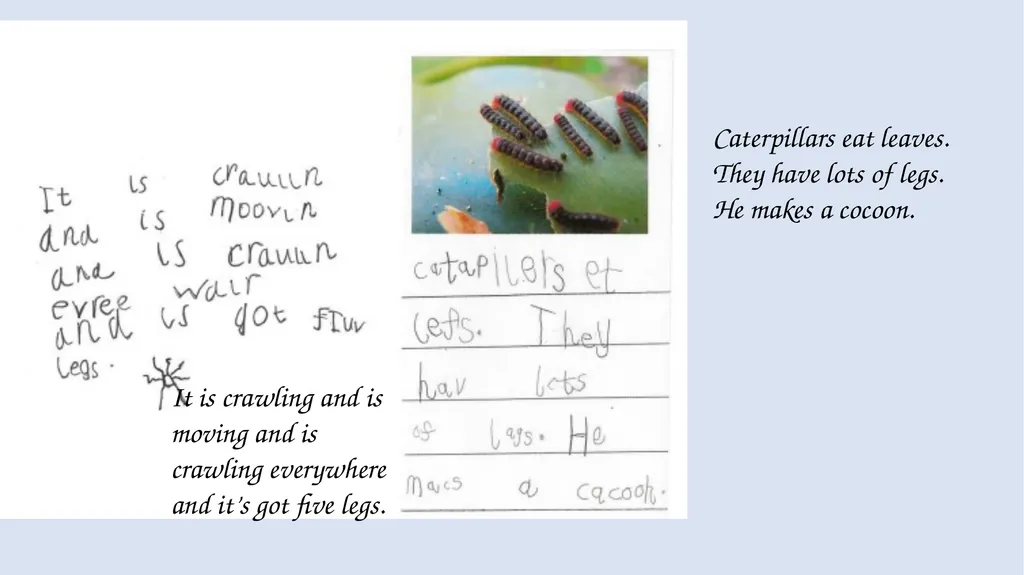
It is crawling and is moving and is crawling everywhere and it’s got five legs. Caterpillars eat leaves. They have lots of legs. He makes a cocoon.<br>
23
Resources for parents Sound cards-amazon https://www.amazon.co.uk/Essential-Letters-Sounds-Grapheme-Reception/dp/1382032919/ref=asc_df_1382032919/?tag=googshopuk-21&linkCode=df0&hvadid=606577469952&hvpos=&hvnetw=g&hvrand=6034962102326414368&hvpone=&hvptwo=&hvqmt=&hvdev=c&hvdvcmdl=&hvlocint=&hvlocphy=1006512&hvtargid=pla-1793108378283&psc=1&th=1&psc=1
Phase 3 and Phase 5 phonics sheet
Harder to Read and Spell word overview
Comprehension sheet
‘Top Tips’ page on the website
Website- ELS videos<br>