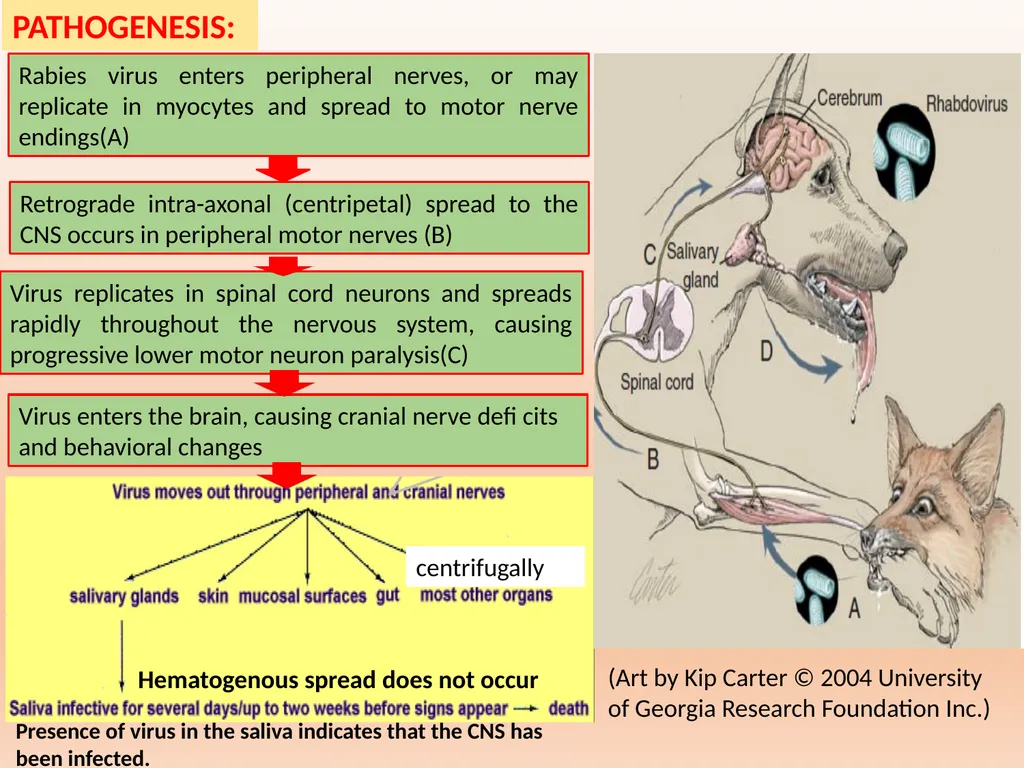
RABIES Unit-5 Anil Kumar Asst. Professor Dept. of VCC RABIES Rabies virus enters peripheral nerves, or may replicate in myocytes and spread to motor nerve endings(A) Retrograde intra-axonal (centripetal) spread to the CNS occurs in
"RABIES Unit-5 Anil Kumar Asst. Professor Dept. of" is the property of its rightful owner. Permission is granted to
download and print the materials on this website for personal, non-commercial use only, and to display it
on your personal computer provided you do not modify the materials and that you retain all copyright
notices contained in the materials. By downloading content from our website, you accept the terms of this
agreement.
Presentation Transcript
01
RABIES Unit-5 Anil Kumar
Asst. Professor
Dept. of VCC<br>
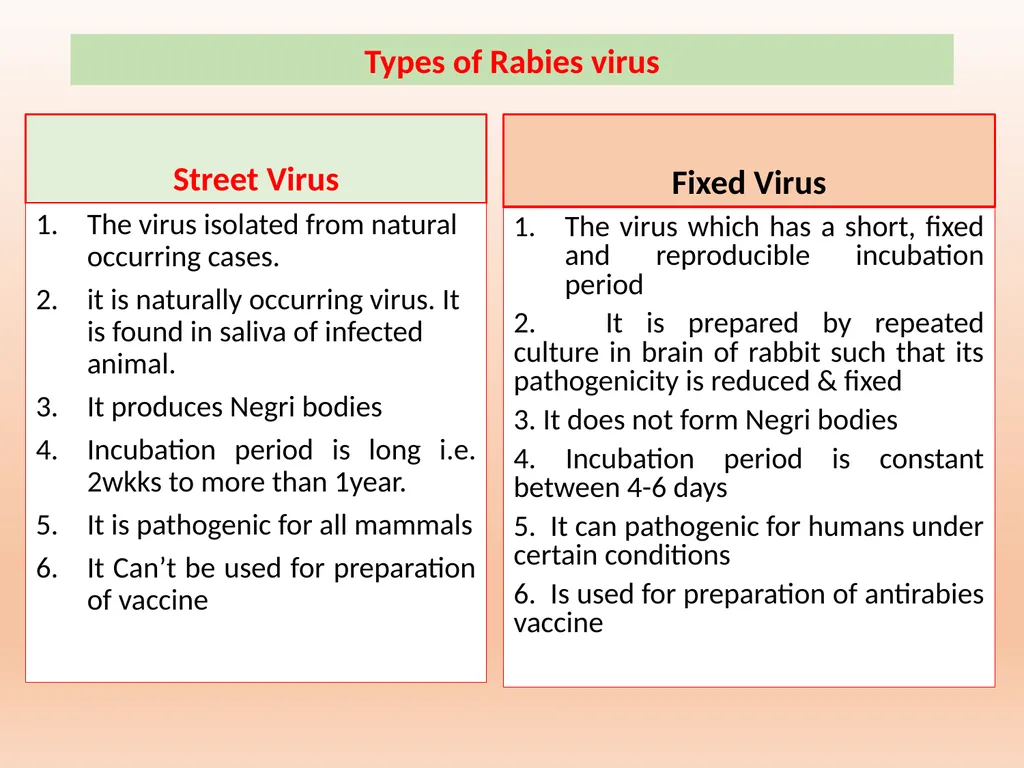
Street Virus The virus isolated from natural occurring cases.
it is naturally occurring virus. It is found in saliva of infected animal.
It produces Negri bodies
Incubation period is long i.e. 2wkks to more than 1year.
It is pathogenic for all mammals
It Can’t be used for preparation of vaccine Fixed Virus The virus which has a short, fixed and reproducible incubation period
2. It is prepared by repeated culture in brain of rabbit such that its pathogenicity is reduced & fixed
3. It does not form Negri bodies
4. Incubation period is constant between 4-6 days
5. It can pathogenic for humans under certain conditions
6. Is used for preparation of antirabies vaccine Types of Rabies virus<br>
05
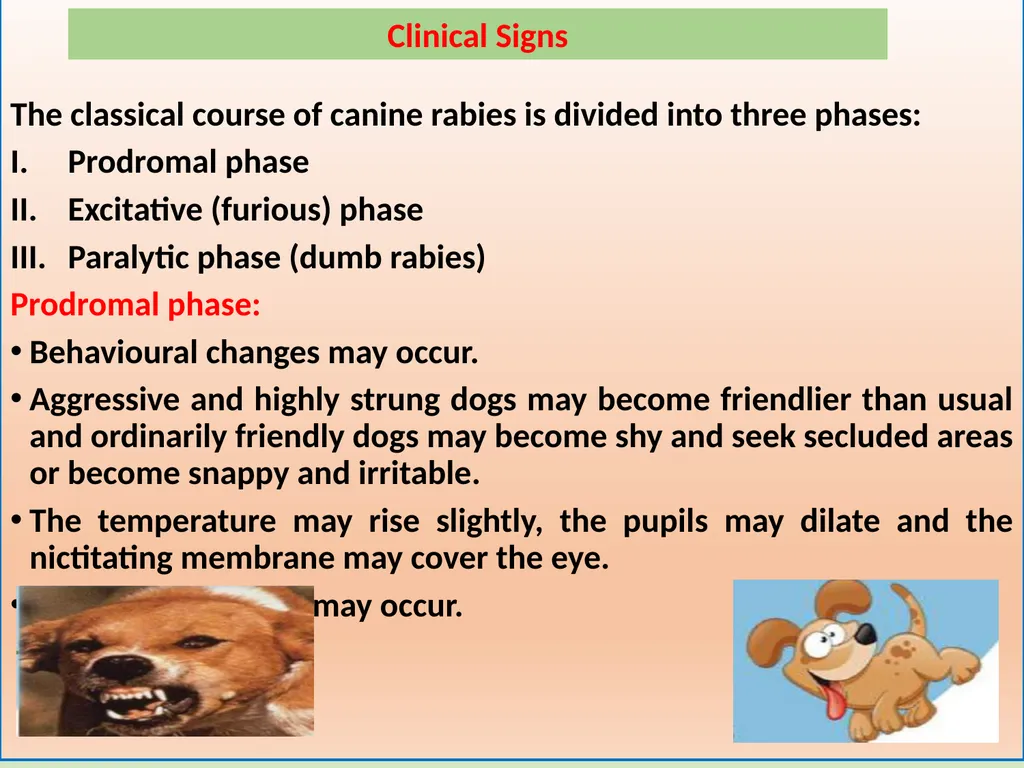
The classical course of canine rabies is divided into three phases:
Prodromal phase
Excitative (furious) phase
Paralytic phase (dumb rabies)
Prodromal phase:
Behavioural changes may occur.
Aggressive and highly strung dogs may become friendlier than usual and ordinarily friendly dogs may become shy and seek secluded areas or become snappy and irritable.
The temperature may rise slightly, the pupils may dilate and the nictitating membrane may cover the eye.
Excessive salivation may occur. Clinical Signs<br>
06
Excitative (furious) phase:
The dog becomes severely agitated and restless and sometimes develops the urge to roam. It is most dangerous at this stage because of its urge to bite anything that it encounters.
In most cases an altered phonation (a characteristic high pitched bark) develops, caused by paralysis of laryngeal muscles.
Spasms and paralysis of the pharyngeal muscles make swallowing difficult and lead to drooling.
If the dog does not die during one of the characteristic convulsive seizures the disease usually progresses to muscular incoordination, paralysis, coma and death.
The posture and expression is one of alertness and anxiety, with pupils dilated.
Noise may invite attack. Such animals lose caution and fear of people and other animals.<br>
07
The paralytic phase (dumb rabies) :
Occurs when the exitative phase is extremely short or absent.
The most characteristic sign is the "dropped jaw“ caused by paralysis of the masseter muscles. Often, choking sounds as if a bone were stuck in the throat are made and attempts to remove this "bone“
Cattle
Furious rabies can be dangerous, attacking and pursuing people and other animals.
Lactation ceases abruptly in dairy cattle.
The usual placid expression is replaced by one of alertness.
The eyes and ears follow sounds and movement.
A common clinical sign is a characteristic abnormal bellowing, which may continue intermittently until shortly before death.<br>
08
Horses and mules
Frequent distress and extreme agitation accompanied by rolling, may be interpreted as evidence of colic.
As in other species, horses may bite or strike viciously and, because of their size and strength, become unmanageable in a few hours. People have been killed outright by such animals.
These animals frequently have self-inflicted wounds.
Based on history and clinical signs
Immunofluorescence microscopy on fresh brain tissue (medulla oblongata and cerebellum ) , which allows direct visual observation of a specific antigen-antibody reaction, is the current test of choice.
Molecular testing, including real-time PCR
The WHO recommends methods for the detection of rabies virus antigens, amplicons, and antibodies DIAGNOSIS<br>
09
Management of wound
Cauterization or application of oil, turmeric etc on should be avoided
Not stitched the wound at least within 24-48 hr of injury
Tetanus toxoid and Antibiotics for wound healing.
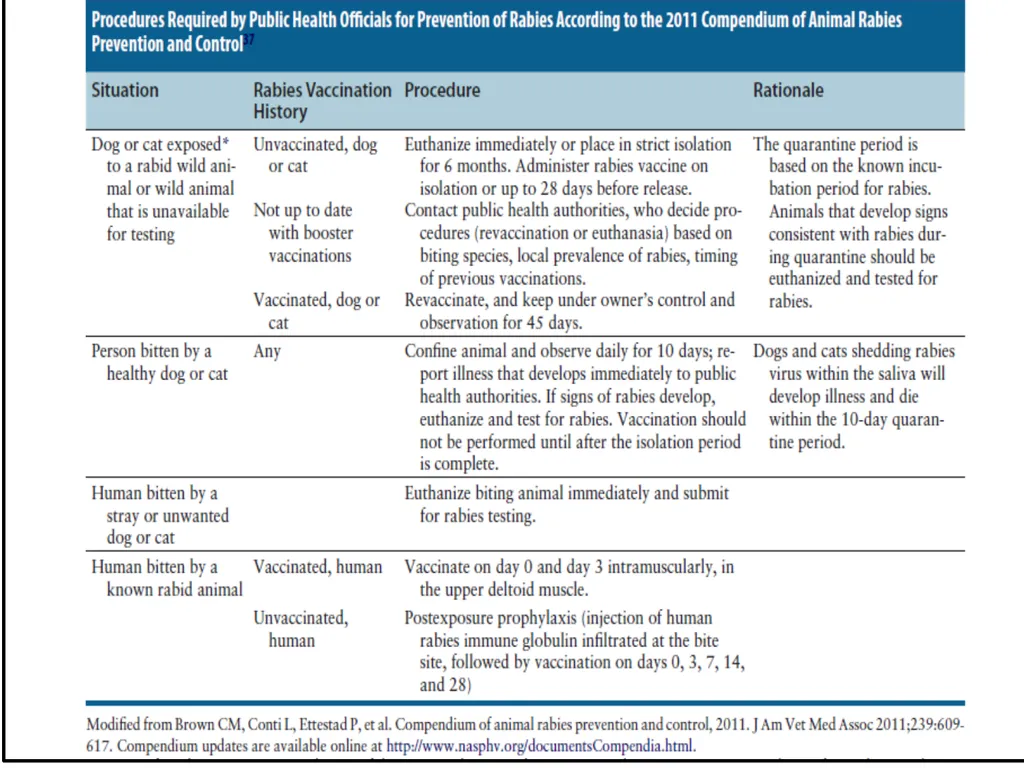
All dogs and cats should be vaccinated for rabies at 3 or 4 months of age (depending on state legislation), with a booster dose 1 year later, then every 3 years with approved inactivated vaccines, or annually with recombinant vaccines
Dogs and cats less than 1 year of age are not considered immunized until 28 days after the initial vaccination
Oral vaccinia-vectored recombinant rabies vaccines, used in wild animals such as raccoons, coyotes, and gray foxes Treatment Prevention and Control<br>
10
The modified live SAD B19 strain, the V-RG recombinant, and SAG2 vaccines
Post-exposure prophylaxis (PEP) is administered to humans after a bite from a known or suspected rabid animal.
It consists of an injection of human rabies immune globulin (H-RIG), ideally with at least half of the whole dose in the region of a bite site as soon as possible within the first 7 days of the bite, followed by vaccination by the intramuscular route on days 0, 3, 7, 14, and 28 in the upper deltoid muscle. Human Oral Vaccination of Feral and Wild Animals<br>