Representing Military Survivors of Sex Harassment
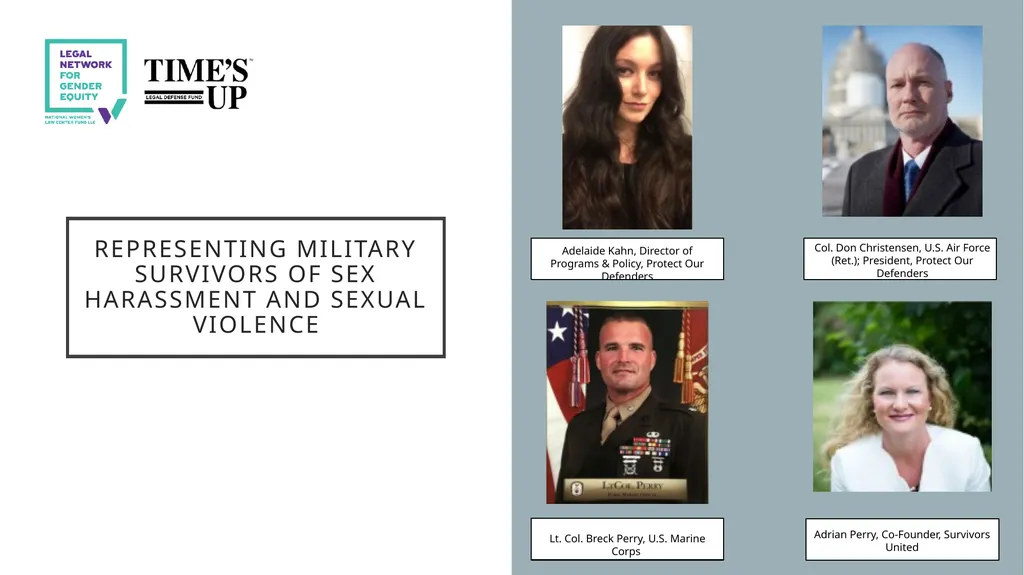
Description: Representing Military Survivors of Sex Harassment and Sexual Violence Col. Don Christensen, U.S. Air Force (Ret.); President, Protect Our Defenders Adelaide Kahn, Director of Programs Policy, Protect Our Defenders Lt. Col. Breck Perry,
Related Topics
Download Presentation
"Representing Military Survivors of Sex Harassment" is the property of its rightful owner. Permission is granted to download and print the materials on this website for personal, non-commercial use only, and to display it on your personal computer provided you do not modify the materials and that you retain all copyright notices contained in the materials. By downloading content from our website, you accept the terms of this agreement.
Presentation Transcript
slide1. Representing Military Survivors of Sex Harassment and Sexual Violence Col. Don Christensen, U.S. Air Force (Ret.); President, Protect Our Defenders Adelaide Kahn, Director of Programs & Policy, Protect Our Defenders Lt. Col. Breck Perry, U.S. Marine Corps Adrian Perry, Co-Founder, Survivors United<br>
slide2. Military Justice Authority U.S. Constitution
Appellate Courts
Uniform Code of Military Justice (UCMJ)
Articles
Punitive Articles
Military Rules of Evidence (MREs)
Based on FREs
Rules for Court Martial (Procedural Rules)<br>
slide3. Jurisdictional issues The military can exercise jurisdiction over a servicemember no matter where they are located
Joint jurisdiction
Most crimes committed by servicemembers in the U. S. and abroad fall under the jurisdiction of at least military + local civilian authorities
The survivor may report to either the civilian or military authorities, and may express preference to utilize either system, but this is rarely acknowledged.
Either military or civilians will decide to take case.
Double jeopardy does not typically apply; if one side fails to produce a conviction, the other side can proceed.<br>
slide5. How does DOD handle sexual harassment? Not very well
Estimated 50,000 servicewomen are sexually harassed every year
Only about 1,000 make a report
EO formal/informal
Command-directed Investigation (CDI)
Almost never prosecuted
Article 92 Dereliction of Duty
Article 93 Maltreatment
Article 133 Conduct Unbecoming<br>
slide6. Conviction rates for sexual assault in the military: 2019 data from the SAPRO Report<br>
slide7. How is sexual assault reported?<br>
slide8. Justice options for sexual violence<br>
slide9. The Commander Military Justice is a command tool
Commander of the accused’s authority
Pretrial restrictions on liberty including protection orders and confinement
Order investigations
Stop a case from going forward (with limits)
Prefer charges
Forward charges<br>
slide10. The Convening Authority Special command position
Vast authority and discretion
Can send a case to trial or kill it
Selects the court members (jury)
Approves plea bargains (PTAs)
Dismisses or adds charges
Authorizes appeals<br>
slide11. 3 types of courts-martial Summary
Not for officers, usually junior enlisted
30 days of confinement
No judge or jury
Special (Misdemeanor)
Usually not used for officers
Judge and jury of 4 (Judge-Alone Special)
Maximum of 1-year, Bad Conduct Discharge
General (Felony)
Article 32
Judge and jury of 8
Maximum depends on offense; up to death and/or life in prison
No Standing Courts<br>
slide12. Players Trial Counsel
Always a Judge Advocate General (JAG)
Usually inexperienced
Defense Counsel
Can be a JAG or a civilian or both
Staff Judge Advocate (SJA)
Advisor to the convening authority – quasi judicial
Not your client’s friend<br>
slide14. Players Special Victims Counsel (SVC)/Victims Legal Counsel (VLC)
JAG with confidentiality
Attorney/client relationship with victim
Advocate
Very likely inexperienced
Role in court is not settled
Limited to “ID” cardholders and DoD employees<br>
slide15. Overview of the process for allegations of sex offenders Reporting by the victim (Restricted of Unrestricted)
Investigation – required for allegations of sex offenses
Office of Special Investigations (OSI)/Criminal Investigation Division (CID)/Naval Criminal Investigative Service (NCIS)
Usually inexperienced
Local or foreign jurisdictions as well; victim has a right to request civilians prosecute case – Rules for Court Martial (RCM) 306(e)
Article 32 Hearing
Courts-martial
Appellate Courts<br>
slide16. Article 32 hearing Probable cause hearing required before a general court-martial
Presided over by a JAG (usually)
Likely not that experienced in sexual assault cases
Victim has right not to testify
Prior sworn statements can be admitted into evidence
Recommendation of hearing officer is not binding
Controlled by RCM 405
Military Rule of Evidence (MRE) 412 applies<br>
slide17. What are a military victim’s basic rights in this process?<br>
slide18. Right to be heard LRM v. Kastenberg, 72 M.J. 364 (2013)
Kastenberg made it clear that the right to be heard meant the right to be heard through counsel in relation to Article 6b rights
Right to be heard through counsel includes:
Pretrial confinement hearings
Sentencing hearings – limits on allocution rights
Clemency/parole board hearings
Enforcement of 6b rights<br>
slide19. Right to notice Right to reasonable, accurate, and timely notice:
Pretrial confinement hearing
Article 32
Court-martial
A public clemency and parole board hearing
The release or escape of the accused
Military must ensure SVC is “provided prompt and adequate notice of the scheduling of any hearing, trial, or other proceeding…in order to permit such counsel the opportunity to prepare for such proceeding.”<br>
slide20. Right to confer The reasonable right to confer with the counsel representing the Government at:
Pretrial confinement hearing
Article 32
A court-martial
Clemency/parole board proceeding
RCM 306(e)
Civilian v. military preference
RCM 705(e)(3)(B)
Plea agreements<br>
slide21. Rape shield: MRE 412 Prohibited Uses
The following evidence is not admissible in any proceeding involving an alleged sexual offense except as provided in subdivisions (b) and (c):
1) Evidence offered to prove that a victim engaged in other sexual behavior; or
2) Evidence offered to prove a victim’s sexual predisposition.<br>
slide22. MRE 412 Exceptions In a proceeding, the following evidence is admissible, if otherwise inadmissible under these rules:
(A) Evidence of specific instances of sexual behavior by the alleged victim offered to prove that a person other than the accused was the source of semen, injury, or other physical evidence;
(B) Evidence of specific instances of sexual behavior by the alleged victim with respect to the person accused of the sexual misconduct offered by the accused to prove consent or by the prosecution; and
(C) Evidence the exclusion of which would violate the constitutional rights of the accused.
Does not apply at Article 32.<br>
slide23. MRE 412 Trial Test If the military judge determines on the basis of the hearing that the evidence is relevant for a purpose under subsection (b) and that the probative value of such evidence outweighs the danger of unfair prejudice to the alleged victim's privacy, such evidence shall be admissible under this rule to the extent an order made by the military judge specifies evidence that may be offered and areas with respect to which the alleged victim may be examined or cross-examined.
Such evidence is still subject to challenge under MRE 403.<br>
slide24. Psychotherapy Records: MRE 513 General rule of privilege
A patient has a privilege to refuse to disclose and to prevent any other person from disclosing a confidential communication made between the patient and a psychotherapist or an assistant to the psychotherapist, in a case arising under the UCMJ, if such communication was made for the purpose of facilitating diagnosis or treatment of the patient's mental or emotional condition.<br>
slide25. MRE 513 Burden A party seeking production or admission of records or communications protected by the privilege must:
Show a specific factual basis demonstrating a reasonable likelihood that the records or communications would yield evidence admissible under an exception to the privilege;
Demonstrate by a preponderance of the evidence that the requested information meets one of the enumerated exceptions to the privilege;
Show that the information sought is not merely cumulative of other information available; and
Show that the party made reasonable efforts to obtain the same or substantially similar information through non-privileged sources.<br>
slide26. DISCOVERY ISSUES AND CHALLENGES<br>
slide27. Appellate courts Service Courts
Military judges
Court of Appeals for the Armed Forces (CAAF)
Civilian judges
Article III Courts?
Appellate rights?
Government appellate offices
SVC/VLC appellate offices<br>
slide28. Appellate “Rights”<br>
slide29. Recent reforms<br>
slide30. Victim Advocacy: The Perry’s Personal experience
Importance of having civilian Victim Legal Counsel
Common themes<br>
slide31. Questions?<br>
slide2. Military Justice Authority U.S. Constitution
Appellate Courts
Uniform Code of Military Justice (UCMJ)
Articles
Punitive Articles
Military Rules of Evidence (MREs)
Based on FREs
Rules for Court Martial (Procedural Rules)<br>
slide3. Jurisdictional issues The military can exercise jurisdiction over a servicemember no matter where they are located
Joint jurisdiction
Most crimes committed by servicemembers in the U. S. and abroad fall under the jurisdiction of at least military + local civilian authorities
The survivor may report to either the civilian or military authorities, and may express preference to utilize either system, but this is rarely acknowledged.
Either military or civilians will decide to take case.
Double jeopardy does not typically apply; if one side fails to produce a conviction, the other side can proceed.<br>
slide5. How does DOD handle sexual harassment? Not very well
Estimated 50,000 servicewomen are sexually harassed every year
Only about 1,000 make a report
EO formal/informal
Command-directed Investigation (CDI)
Almost never prosecuted
Article 92 Dereliction of Duty
Article 93 Maltreatment
Article 133 Conduct Unbecoming<br>
slide6. Conviction rates for sexual assault in the military: 2019 data from the SAPRO Report<br>
slide7. How is sexual assault reported?<br>
slide8. Justice options for sexual violence<br>
slide9. The Commander Military Justice is a command tool
Commander of the accused’s authority
Pretrial restrictions on liberty including protection orders and confinement
Order investigations
Stop a case from going forward (with limits)
Prefer charges
Forward charges<br>
slide10. The Convening Authority Special command position
Vast authority and discretion
Can send a case to trial or kill it
Selects the court members (jury)
Approves plea bargains (PTAs)
Dismisses or adds charges
Authorizes appeals<br>
slide11. 3 types of courts-martial Summary
Not for officers, usually junior enlisted
30 days of confinement
No judge or jury
Special (Misdemeanor)
Usually not used for officers
Judge and jury of 4 (Judge-Alone Special)
Maximum of 1-year, Bad Conduct Discharge
General (Felony)
Article 32
Judge and jury of 8
Maximum depends on offense; up to death and/or life in prison
No Standing Courts<br>
slide12. Players Trial Counsel
Always a Judge Advocate General (JAG)
Usually inexperienced
Defense Counsel
Can be a JAG or a civilian or both
Staff Judge Advocate (SJA)
Advisor to the convening authority – quasi judicial
Not your client’s friend<br>
slide14. Players Special Victims Counsel (SVC)/Victims Legal Counsel (VLC)
JAG with confidentiality
Attorney/client relationship with victim
Advocate
Very likely inexperienced
Role in court is not settled
Limited to “ID” cardholders and DoD employees<br>
slide15. Overview of the process for allegations of sex offenders Reporting by the victim (Restricted of Unrestricted)
Investigation – required for allegations of sex offenses
Office of Special Investigations (OSI)/Criminal Investigation Division (CID)/Naval Criminal Investigative Service (NCIS)
Usually inexperienced
Local or foreign jurisdictions as well; victim has a right to request civilians prosecute case – Rules for Court Martial (RCM) 306(e)
Article 32 Hearing
Courts-martial
Appellate Courts<br>
slide16. Article 32 hearing Probable cause hearing required before a general court-martial
Presided over by a JAG (usually)
Likely not that experienced in sexual assault cases
Victim has right not to testify
Prior sworn statements can be admitted into evidence
Recommendation of hearing officer is not binding
Controlled by RCM 405
Military Rule of Evidence (MRE) 412 applies<br>
slide17. What are a military victim’s basic rights in this process?<br>
slide18. Right to be heard LRM v. Kastenberg, 72 M.J. 364 (2013)
Kastenberg made it clear that the right to be heard meant the right to be heard through counsel in relation to Article 6b rights
Right to be heard through counsel includes:
Pretrial confinement hearings
Sentencing hearings – limits on allocution rights
Clemency/parole board hearings
Enforcement of 6b rights<br>
slide19. Right to notice Right to reasonable, accurate, and timely notice:
Pretrial confinement hearing
Article 32
Court-martial
A public clemency and parole board hearing
The release or escape of the accused
Military must ensure SVC is “provided prompt and adequate notice of the scheduling of any hearing, trial, or other proceeding…in order to permit such counsel the opportunity to prepare for such proceeding.”<br>
slide20. Right to confer The reasonable right to confer with the counsel representing the Government at:
Pretrial confinement hearing
Article 32
A court-martial
Clemency/parole board proceeding
RCM 306(e)
Civilian v. military preference
RCM 705(e)(3)(B)
Plea agreements<br>
slide21. Rape shield: MRE 412 Prohibited Uses
The following evidence is not admissible in any proceeding involving an alleged sexual offense except as provided in subdivisions (b) and (c):
1) Evidence offered to prove that a victim engaged in other sexual behavior; or
2) Evidence offered to prove a victim’s sexual predisposition.<br>
slide22. MRE 412 Exceptions In a proceeding, the following evidence is admissible, if otherwise inadmissible under these rules:
(A) Evidence of specific instances of sexual behavior by the alleged victim offered to prove that a person other than the accused was the source of semen, injury, or other physical evidence;
(B) Evidence of specific instances of sexual behavior by the alleged victim with respect to the person accused of the sexual misconduct offered by the accused to prove consent or by the prosecution; and
(C) Evidence the exclusion of which would violate the constitutional rights of the accused.
Does not apply at Article 32.<br>
slide23. MRE 412 Trial Test If the military judge determines on the basis of the hearing that the evidence is relevant for a purpose under subsection (b) and that the probative value of such evidence outweighs the danger of unfair prejudice to the alleged victim's privacy, such evidence shall be admissible under this rule to the extent an order made by the military judge specifies evidence that may be offered and areas with respect to which the alleged victim may be examined or cross-examined.
Such evidence is still subject to challenge under MRE 403.<br>
slide24. Psychotherapy Records: MRE 513 General rule of privilege
A patient has a privilege to refuse to disclose and to prevent any other person from disclosing a confidential communication made between the patient and a psychotherapist or an assistant to the psychotherapist, in a case arising under the UCMJ, if such communication was made for the purpose of facilitating diagnosis or treatment of the patient's mental or emotional condition.<br>
slide25. MRE 513 Burden A party seeking production or admission of records or communications protected by the privilege must:
Show a specific factual basis demonstrating a reasonable likelihood that the records or communications would yield evidence admissible under an exception to the privilege;
Demonstrate by a preponderance of the evidence that the requested information meets one of the enumerated exceptions to the privilege;
Show that the information sought is not merely cumulative of other information available; and
Show that the party made reasonable efforts to obtain the same or substantially similar information through non-privileged sources.<br>
slide26. DISCOVERY ISSUES AND CHALLENGES<br>
slide27. Appellate courts Service Courts
Military judges
Court of Appeals for the Armed Forces (CAAF)
Civilian judges
Article III Courts?
Appellate rights?
Government appellate offices
SVC/VLC appellate offices<br>
slide28. Appellate “Rights”<br>
slide29. Recent reforms<br>
slide30. Victim Advocacy: The Perry’s Personal experience
Importance of having civilian Victim Legal Counsel
Common themes<br>
slide31. Questions?<br>