
Safeguarding, Sexual misconduct and Leadership
MT
Published · 92 slides · 0 views

1 / 1
Description
Safeguarding, Sexual misconduct and Leadership workshop COUNCIL FOR INTERNATIONAL DEVELOPMENT NZ Welcome and Introductions Setting the Scene Safeguarding Safeguarding is commonly considered to be the responsibility of organisations to make
Related Topics
Share
Embed code
Download this presentation From Below
"Safeguarding, Sexual misconduct and Leadership" is the property of its rightful owner. Permission is granted to download and print the materials on this website for personal, non-commercial use only, and to display it on your personal computer provided you do not modify the materials and that you retain all copyright notices contained in the materials. By downloading content from our website, you accept the terms of this agreement.
Presentation Transcript
01
Safeguarding, Sexual misconduct and Leadership workshop
COUNCIL FOR INTERNATIONAL DEVELOPMENT NZ<br>
02
Welcome and Introductions<br>
03
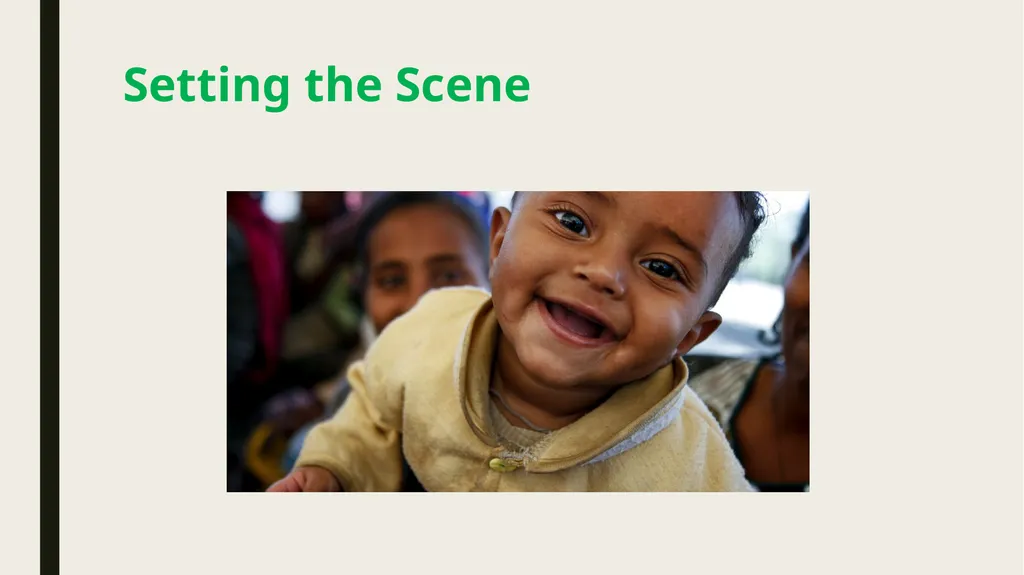
Setting the Scene<br>
04
Safeguarding Safeguarding is commonly considered to be the responsibility of organisations to make sure their staff, operations and programmes do no harm to children and vulnerable adults or expose them to abuse or exploitation.
It is, however, increasingly becoming best practice to think about how we safeguard everyone in our organisations at all times, including protecting staff from inappropriate behaviour such as bullying and harassment. (Bond UK)<br>
It is, however, increasingly becoming best practice to think about how we safeguard everyone in our organisations at all times, including protecting staff from inappropriate behaviour such as bullying and harassment. (Bond UK)<br>
05
Safeguarding It is recognised that our work places our personnel in positions of authority and trust in relation to the communities we work with, especially vulnerable adults and children.
Safeguarding includes the obligation to prevent the sexual exploitation and abuse of all who have contact with our agencies, including beneficiary communities, staff, volunteers and partner organisations.
Safeguarding is to ensure everything that lies within an organisation’s control is done to ensure the safety and wellbeing of the children and adults it works with.<br>
06
Safeguarding Translate policy into relevant and everyday practice across all functions of an organisation
Not rely on one standard or measure to safeguard children and adults against harm
Must be a system approach where each standard in fully implemented to ensure a safe organisational environment is constantly strengthened and maintained
Ensuring a positive and preventative safeguarding culture is promoted and embedded at all levels of the organisation<br>
07
Child Safeguarding Refers to the set of policies, procedures and practice employed by an organisation to ensure it is a child safe organisation.
It is the responsibility agencies have to make sure staff, operations and programs do no harm to children that come into contact (directly or indirectly) with their work.
All children who come into contact with an organisation as a result of its programs and activities must be safeguarded from deliberate or inadvertent actions and failings that place them at risk of all forms of child abuse (physical, sexual, emotional/psychological), exploitation, injury and other harm.<br>
08
Safeguarding<br>
09
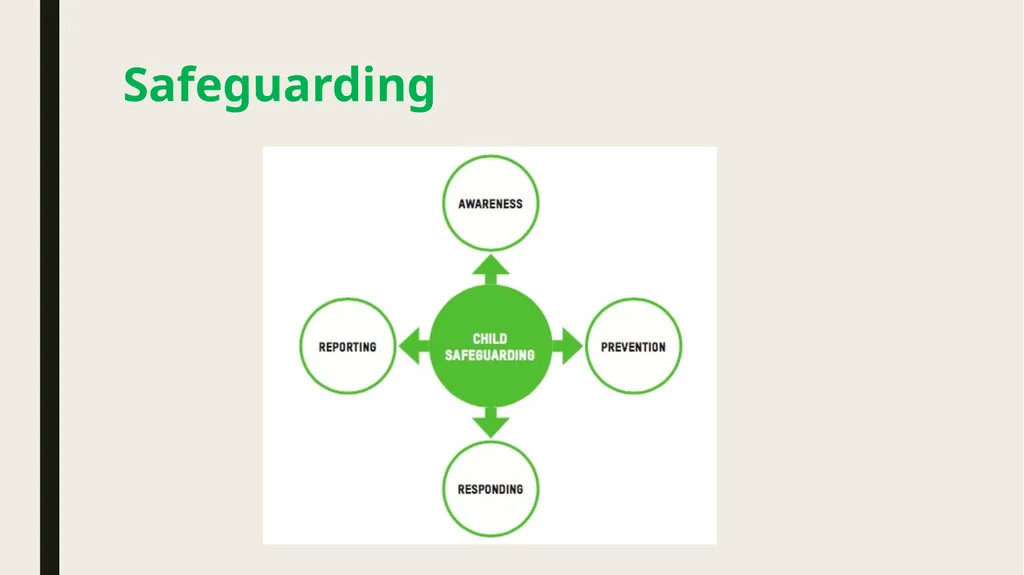
Child Safeguarding Organisations must therefore do everything it can within its control to safeguard children by:
creating awareness and accountability,
putting in place preventative child safeguarding policies and procedures,
supporting staff and partners to implement these and
immediately responding to and reporting issues that pose a risk to the safety and/or wellbeing of a child.<br>
creating awareness and accountability,
putting in place preventative child safeguarding policies and procedures,
supporting staff and partners to implement these and
immediately responding to and reporting issues that pose a risk to the safety and/or wellbeing of a child.<br>
10
Child Safeguarding An understanding of child abuse and exploitation is important in the International Development context due to the fact that organisations work with many vulnerable children and communities.
Children living in circumstances such as poverty, emergency or disaster situations, displaced communities or populations affected by conflict have a higher risk of being abused or exploited.
Most children will not speak up if someone is abusing or harming them so it is the responsibility of adults to make a report if they suspect or observe a child is being harmed. Most child survivors of sexual abuse say that they wished that an adult had acted and reported the abuse.<br>
11
Child Safeguarding Children have the right to participate in decisions that will affect them.
If a decision is taken on behalf of a child, the best interests of the child shall be the overriding guide.
Referrals should be done in consultation with child focused agencies specialising in the special needs of child survivors of sexual abuse, and who are familiar with local procedures relating to the protection of children<br>
12
Child Safeguarding Sexual exploitation and abuse by aid workers and peacekeepers is also a real and concerning phenomenon as well as those travelling to disaster affected areas:
After the 2004 Boxing Day tsunami, over 60 convicted child sex offenders left Queensland, and over 50 left New Zealand, to visit the affected areas
In Liberia in 2006, Save the Children reported high levels of abuse of girls by humanitarian agencies, some as young as eight
A 2008 study by Save the Children in Côte D’Ivoire, Sudan and Haiti, revealed that 23 humanitarian, peacekeeping and security organisations were associated with cases of child abuse (these include civil humanitarian agencies, such as those delivering food and nutritional assistance; care, education and health services; reconstruction, shelter, training and livelihood support, as well as military actors providing peace and security services)<br>
13
Child Safeguarding Child abuse and exploitation traumatises children and adversely affects their development and wellbeing. At its core, child abuse and exploitation undermines a child’s right to grow up safely.
Research clearly indicates that children who have been abused or neglected often have poorer outcomes on many indicators of health and wellbeing, including social, emotional, physical and psychological functioning. This can include:
Permanent physical damage
Developmental trauma
Anxiety
Depression
Developmental delays
Low academic achievement
Self-harming and suicidal behaviour
Aggression and acting out behaviour
Difficulties making and maintaining positive relationships
These consequences can last a lifetime and the impact on boys and girls can sometimes be different.<br>
14
Prevention of Sexual Exploitation and Abuse (SEA) SEA, or sexual misconduct, occurs against a child or an adult and can occur between people of the same or different genders. It includes situations such as:
Sexual exploitation and abuse;
Sexual harassment;
Child sexual abuse and exploitation;
Women and men sexually exploited through sex work;
Possessing, controlling, producing, distributing, obtaining or transmitting sexually exploitative images of adults or children.<br>
Sexual exploitation and abuse;
Sexual harassment;
Child sexual abuse and exploitation;
Women and men sexually exploited through sex work;
Possessing, controlling, producing, distributing, obtaining or transmitting sexually exploitative images of adults or children.<br>
15
IASC Six Core Principles Relating to Sexual Exploitation and Abuse Sexual exploitation and abuse by humanitarian workers constitute acts of gross misconduct and are therefore grounds for termination of employment.
Sexual activity with children (persons under the age of 18) is prohibited regardless of the age of majority or age of consent locally. Mistaken belief regarding the age of a child is not a defence.
Exchange of money, employment, goods, or services for sex, including sexual favours or other forms of humiliating, degrading or exploitative behaviour is prohibited. This includes exchange of assistance that is due to beneficiaries.<br>
16
IASC Six Core Principles Relating to Sexual Exploitation and Abuse Sexual relationships between humanitarian workers and beneficiaries are strongly discouraged since they are based on inherently unequal power dynamics. Such relationships undermine the credibility and integrity of humanitarian aid work.
Where a humanitarian worker develops concerns or suspicions regarding sexual abuse or exploitation by a fellow worker, whether in the same agency or not, he or she must report such concerns via established agency reporting mechanisms.
Humanitarian workers are obliged to create and maintain an environment which prevents sexual exploitation and abuse and promotes the implementation of their code of conduct. Managers at all levels have particular responsibilities to support and develop systems which maintain this environment.
See Report of the Inter-Agency Standing Committee Task Force on Protection from Sexual Exploitation and Abuse in Humanitarian Crises of 13 June 2002, Plan of Action, Section I.A.<br>
17
Sexual exploitation & abuse Issues of SEA are fundamentally about abuses of power
Situations of poverty, vulnerability and discrimination as well as power inequities between genders, between aid workers and beneficiary communities, and within organisations, create unequal power dynamics
Given differing local contexts, personnel may also be faced with a range of unfamiliar social, cultural, financial or personal settings when working or volunteering overseas
These factors result in environments where SEA can exist<br>
18
Sexual exploitation & abuse Victims in these situations are less likely to report SEA given power imbalances and reliance on aid workers to provide life supporting services
The impact of SEA on an individual’s health and wellbeing, and in particular that negative physical, mental health and social outcomes that are likely to be compounded when perpetrated by a person in authority.<br>
The impact of SEA on an individual’s health and wellbeing, and in particular that negative physical, mental health and social outcomes that are likely to be compounded when perpetrated by a person in authority.<br>
19
Victim/Survivor centred approach A failure to listen to and consider the needs of victims and survivors of SEA, will engender a response that is not only ineffective, but potentially harmful.
Ensure that all responses are developed in a manner that balances respect for due process with a survivor-centred approach in which the survivor’s wishes, safety and wellbeing remain a priority in all matters and procedures. Furthermore, all actions taken should be guided by respect for choices, wishes rights and dignity of the survivor.
Victims and survivors should demonstrably be front and centre of all efforts to tackle SEA and this means the inclusion of victim and survivor voices in policy-making processes on an ongoing basis.
In order to be meaningful, however, the victim-centred approach needs to be fully integrated across all aspects of the sector’s SEA response.<br>
20
Sexual exploitation & abuse Communities trust that the people representing INGOs will conduct themselves in a professional manner at all times and not engage in behaviour contrary to the safety or wellbeing of the children and adults they come into contact with.
Organisations need to make clear – behavior by personnel that results in SEA of a child or adult, helps facilitate SEA or where allegations of SEA are ignored by an organisation, will not be tolerated and the organisation will immediately respond and take seriously any concerns raised.<br>
Organisations need to make clear – behavior by personnel that results in SEA of a child or adult, helps facilitate SEA or where allegations of SEA are ignored by an organisation, will not be tolerated and the organisation will immediately respond and take seriously any concerns raised.<br>
21
Sexual exploitation & abuse The victims and survivors
SEA is predominantly perpetrated against women and girls, although this is not exclusively the case. Steve Reeves, the Director of Child Safeguarding at Save the Children UK told us:
Globally, it is pretty clear that girls and young women are most frequently the victims of sexual violence. We do see evidence of boys and young men being exploited sexually in the same way.
Asmita Naik, co-author of the 2002 UNHCR and Save the Children report that revealed SEA by UN and aid agency staff in West Africa, shared the findings of her research from refugee camps in Liberia, Guinea and Sierra Leone in 2001.
Victims were mainly girls aged 13 and 18 years, who reported far-reaching consequences of the abuse on their lives: pregnancies, abortions, teenage motherhood, exposure to sexually transmitted diseases and HIV/AIDS, lost educational, skills-training and employment opportunities and social exclusion. A refugee child said, “An [Aid] worker made me pregnant but now he left me and is loving to another young girl”.
She added that:
Boys were sometimes victims of sexual exploitation by male and female aid workers, but more often exploited in other ways, for instance, forced to carry out personal chores in exchange for aid supplies. One adolescent boy said, “I have no father and no mother and there are jobs that I am being made to do like washing underpants in exchange for food which I do because I have no parents. I wish I had my parents because I do not have any support and I am exposed to so much abuse
Sexual exploitation and abuse in the aid sector, International Development Committee, House of Commons UK<br>
22
Sexual exploitation & abuse The perpetrators
The exploitation and abuse is mainly perpetrated by men. Steve Reeves said:
As far as we can tell from the statistics available and the research available to us, this is abuse that is largely perpetrated by men. Although we should not discount the possibility that some women engage in sexually harmful behaviour, it is behaviour that is largely manifested by men.
This was corroborated by Helen Evans, the former Global Head of Safeguarding at Oxfam GB. The abuse that Asmita Naik documented in 2001 was also perpetrated by men:
Exploiters were men in the community with power, money and influence and included mainly local humanitarian workers extorting sex in exchange for desperately needed aid supplies (biscuits, soap, medicines, plastic sheeting etc).
Corinna Csáky, author of Save the Children’s 2008 report, ‘No One to Turn To: the under-reporting of child sexual exploitation and abuse by aid workers and peacekeepers’, told us that:
It is also very important that you note that the abusers are both foreign and national staff. Some come from overseas, but many more are local people employed by international humanitarian organisations. With the exception of peacekeeping forces, local people make up the majority of humanitarian staff. It is no surprise therefore that they make up the highest proportion of abusers. From the perspective of victims and survivors, there is no difference between the two.<br>
23
Case Study Voices from Syria, 2018 (Whole of Syria GBV Focal Point, UNFPA)
Within this annual report on gender-based violence (GBV) in Syria it was clear that sexual exploitation and abuse by aid workers, amongst others, is an entrenched feature of the life experience of women and girls in Syria in the eighth year of the conflict there.
The report also sheds light on the wider context for such abuse, for example: “With men absent, injured, killed, or unable to find employment the burden of responsibility often falls heavier on the shoulders of women and girls to maintain households. However, these additional responsibilities do not necessarily lead to greater empowerment or freedom for women. Invariably, it leads to an increase in workload and sometimes to additional abuse as men resist a perceived threat to their dominance. From aid distribution to gaining documentation, to attending school, guarding against exploitation and abuse is a constant challenge.”
More specifically, the report states that: “sexual exploitation by humanitarian workers at distributions was commonly cited by participants as a risk faced by women and girls when trying to access aid”<br>
24
Definitions Child – any person under the age of eighteen (18) years as defined by the Convention on the Rights of the Child irrespective of local country definitions of when a child reaches adulthood.
Vulnerable adults - those aged over 18 years and who identify themselves as unable to take care of themselves/ protect themselves from harm or exploitation; or who, due to their gender, mental or physical health, disability, ethnicity, religious identity, sexual orientation, economic or social status, or as a result of disasters and conflicts, are deemed to be at risk.
Survivor - A person who has SEA perpetrated against him/her or an attempt to perpetrate SEA against him/her.<br>
25
Definitions Beneficiary
The revelations about Oxfam staff using prostitutes in Haiti, highlighted that the exploitation of beneficiaries could extend beyond those who are directly receiving aid.
Mark Goldring, the now outgoing Chief Executive Officer of Oxfam GB, told the inquiry:
Oxfam used “beneficiary” to mean those in direct receipt of Oxfam assistance. In fact, the whole population of Port-au-Prince and surrounding areas, and indeed much of Haiti, were beneficiaries in the wider sense, of which they were affected by the earthquake or were living in poverty whether or not they were affected by the earthquake.
Sexual exploitation and abuse in the aid sector, International Development Committee, House of Commons UK<br>
26
Definitions Sexual Exploitation - any actual or attempted abuse of a position of vulnerability, differential power, or trust, for sexual purposes, including, but not limited to, profiting monetarily, socially or politically from the sexual exploitation of another.
Sexual Abuse - the actual or threatened physical intrusion of a sexual nature, whether by force or under unequal or coercive conditions.
The definitions for both Sexual Exploitation and Sexual Abuse are contained in the United Nations Secretary-General’s Bulletin, “Special measures for protection from sexual exploitation and sexual abuse” ST/SGB/2003/13 (9 October 2003) [hereinafter Secretary-General’s Bulletin on SEA (2003)].<br>
27
Definitions Sexual misconduct is defined as: to describe behaviour of a sexual nature which is unacceptable.
Sexual misconduct is a broad term, encompassing various types of conduct. Sexual misconduct can involve behaviour by a person of any gender, and it can occur between people of the same or different genders.<br>
Sexual misconduct is a broad term, encompassing various types of conduct. Sexual misconduct can involve behaviour by a person of any gender, and it can occur between people of the same or different genders.<br>
28
Definitions Sexual harassment - includes all conduct of a sexual or gender-determined nature at the workplace or connected to the workplace that is intended to violate the dignity of a person, or which has this effect. Sexual harassment is understood as behaviour that is unwanted in the eyes of the persons directly or indirectly affected.
This shall include in particular:
physical approaches or physical contact of a sexual nature, or sexual assault;
gestures and other nonverbal communication with sexual undertones;
comments of a sexual nature about individuals and/or their body, conduct, sex life or sexual identity;
sexually discriminatory language and humiliating remarks, including sexually explicit jokes;
requests to perform sexual activities;
showing or displaying pornographic or sexist images;
sexually motivated stalking.
GIZ policy banning sexual harassment at the workplace<br>
29
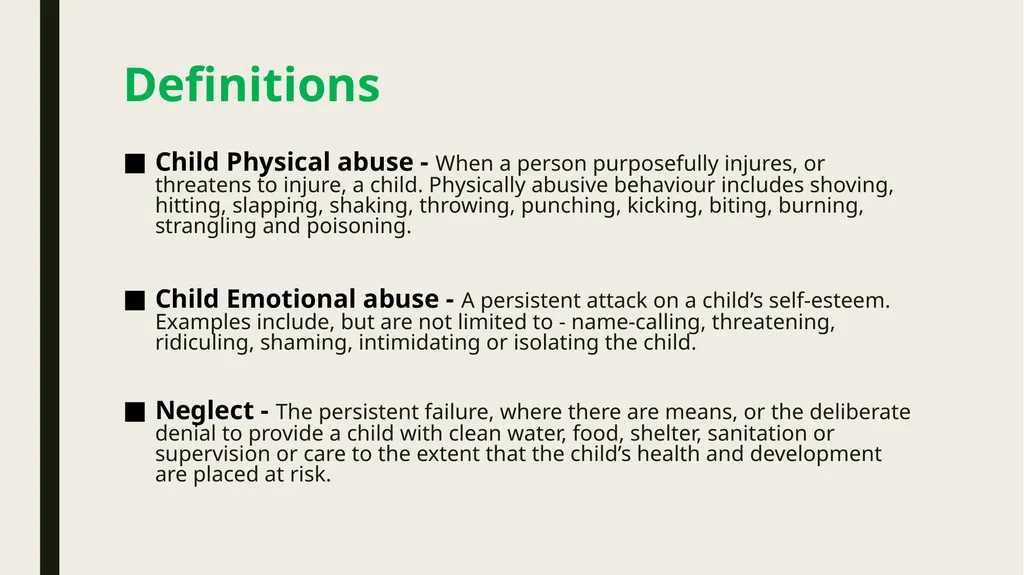
Definitions Child Physical abuse - When a person purposefully injures, or threatens to injure, a child. Physically abusive behaviour includes shoving, hitting, slapping, shaking, throwing, punching, kicking, biting, burning, strangling and poisoning.
Child Emotional abuse - A persistent attack on a child’s self-esteem. Examples include, but are not limited to - name-calling, threatening, ridiculing, shaming, intimidating or isolating the child.
Neglect - The persistent failure, where there are means, or the deliberate denial to provide a child with clean water, food, shelter, sanitation or supervision or care to the extent that the child’s health and development are placed at risk.<br>
30
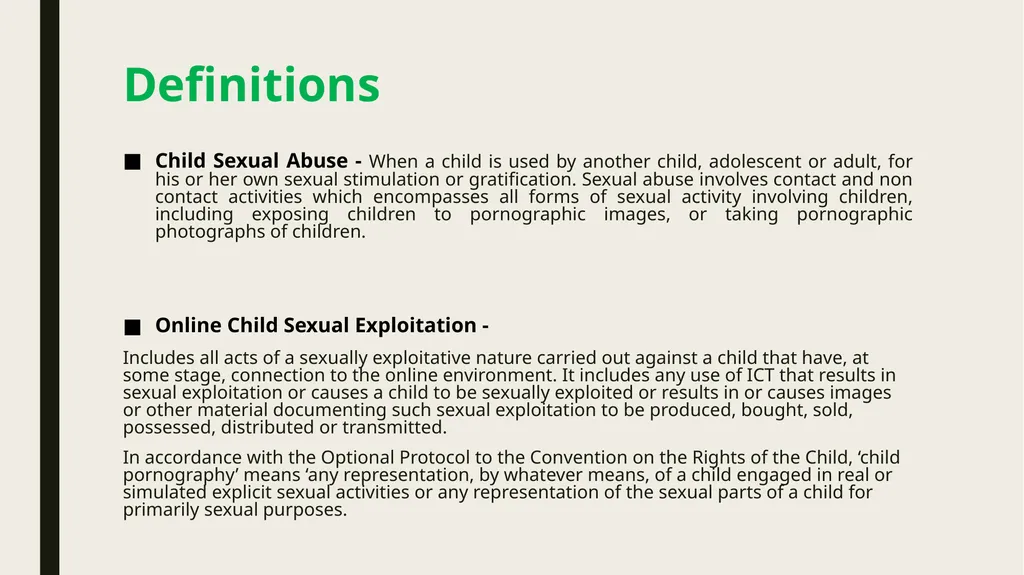
Definitions Child Sexual Abuse - When a child is used by another child, adolescent or adult, for his or her own sexual stimulation or gratification. Sexual abuse involves contact and non contact activities which encompasses all forms of sexual activity involving children, including exposing children to pornographic images, or taking pornographic photographs of children.
Online Child Sexual Exploitation -
Includes all acts of a sexually exploitative nature carried out against a child that have, at some stage, connection to the online environment. It includes any use of ICT that results in sexual exploitation or causes a child to be sexually exploited or results in or causes images or other material documenting such sexual exploitation to be produced, bought, sold, possessed, distributed or transmitted.
In accordance with the Optional Protocol to the Convention on the Rights of the Child, ‘child pornography’ means ‘any representation, by whatever means, of a child engaged in real or simulated explicit sexual activities or any representation of the sexual parts of a child for primarily sexual purposes.<br>
31
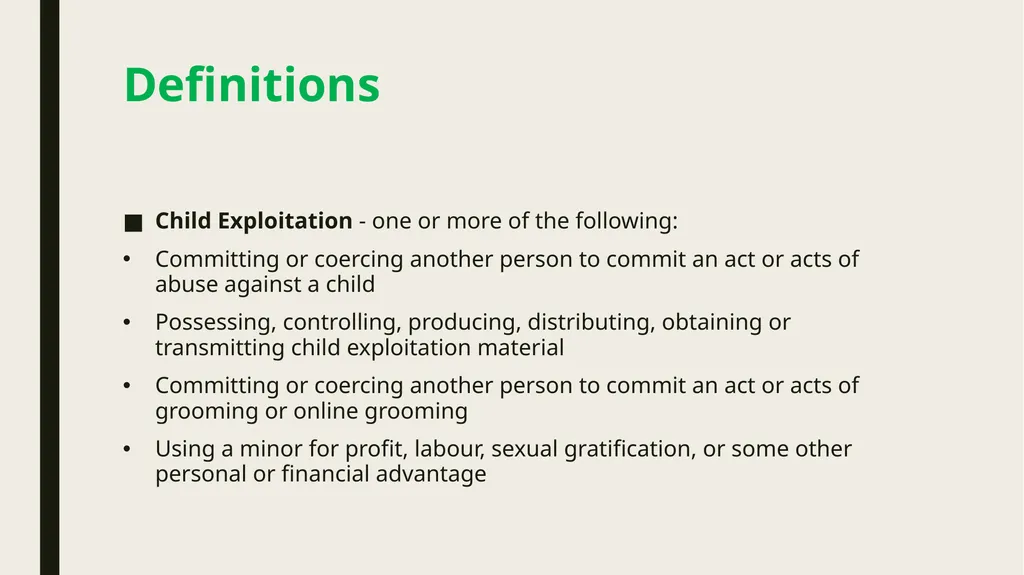
Definitions Child Exploitation - one or more of the following:
Committing or coercing another person to commit an act or acts of abuse against a child
Possessing, controlling, producing, distributing, obtaining or transmitting child exploitation material
Committing or coercing another person to commit an act or acts of grooming or online grooming
Using a minor for profit, labour, sexual gratification, or some other personal or financial advantage<br>
32
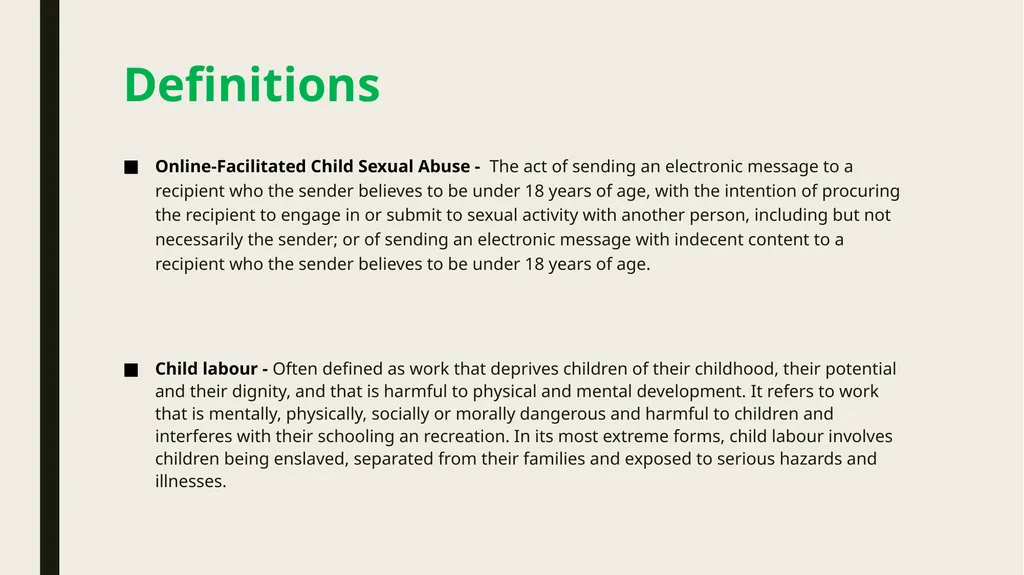
Definitions Online-Facilitated Child Sexual Abuse - The act of sending an electronic message to a recipient who the sender believes to be under 18 years of age, with the intention of procuring the recipient to engage in or submit to sexual activity with another person, including but not necessarily the sender; or of sending an electronic message with indecent content to a recipient who the sender believes to be under 18 years of age.
Child labour - Often defined as work that deprives children of their childhood, their potential and their dignity, and that is harmful to physical and mental development. It refers to work that is mentally, physically, socially or morally dangerous and harmful to children and interferes with their schooling an recreation. In its most extreme forms, child labour involves children being enslaved, separated from their families and exposed to serious hazards and illnesses.<br>
Child labour - Often defined as work that deprives children of their childhood, their potential and their dignity, and that is harmful to physical and mental development. It refers to work that is mentally, physically, socially or morally dangerous and harmful to children and interferes with their schooling an recreation. In its most extreme forms, child labour involves children being enslaved, separated from their families and exposed to serious hazards and illnesses.<br>
33
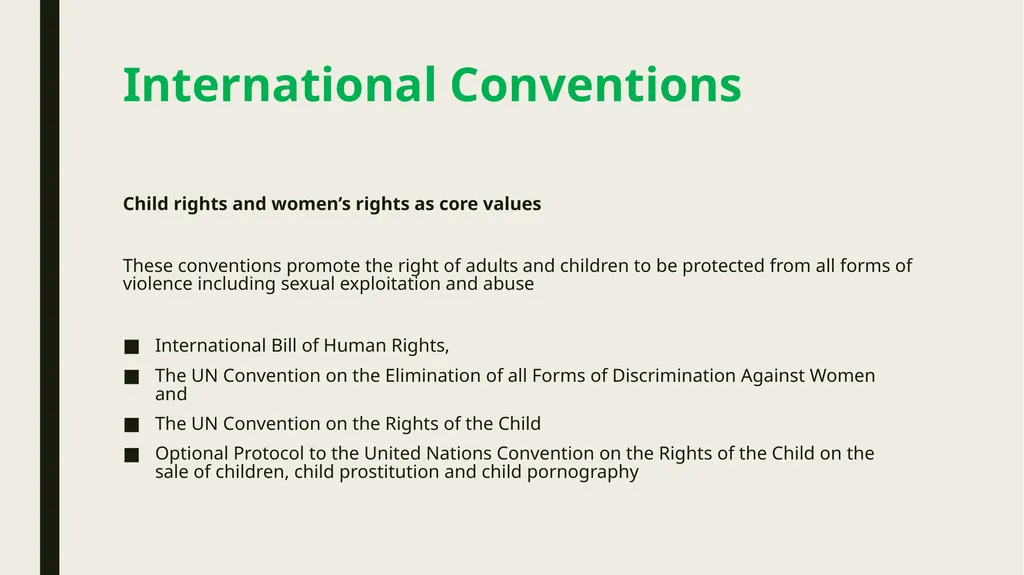
International Conventions Child rights and women’s rights as core values
These conventions promote the right of adults and children to be protected from all forms of violence including sexual exploitation and abuse
International Bill of Human Rights,
The UN Convention on the Elimination of all Forms of Discrimination Against Women and
The UN Convention on the Rights of the Child
Optional Protocol to the United Nations Convention on the Rights of the Child on the sale of children, child prostitution and child pornography<br>
34
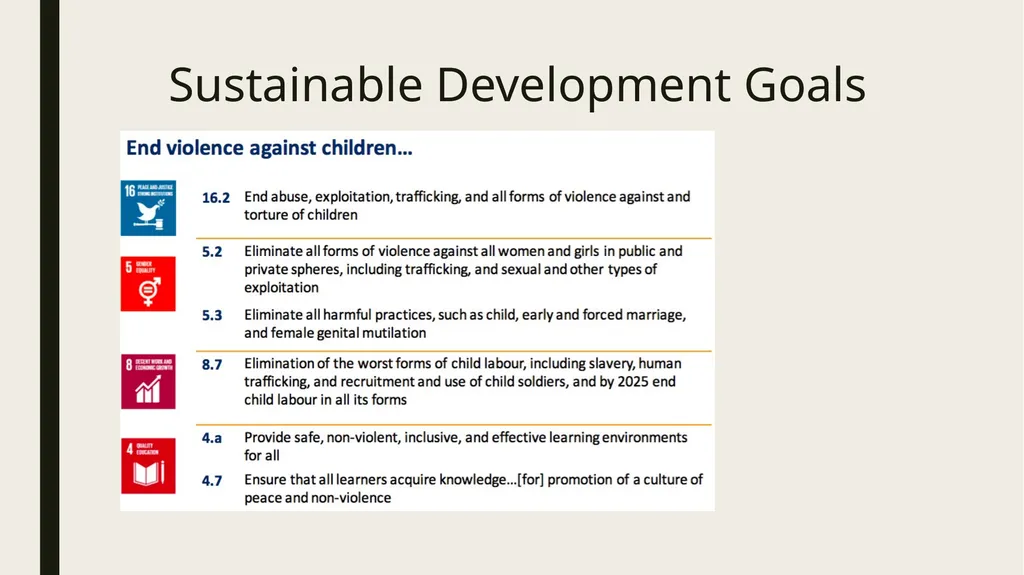
Sustainable Development Goals<br>
35
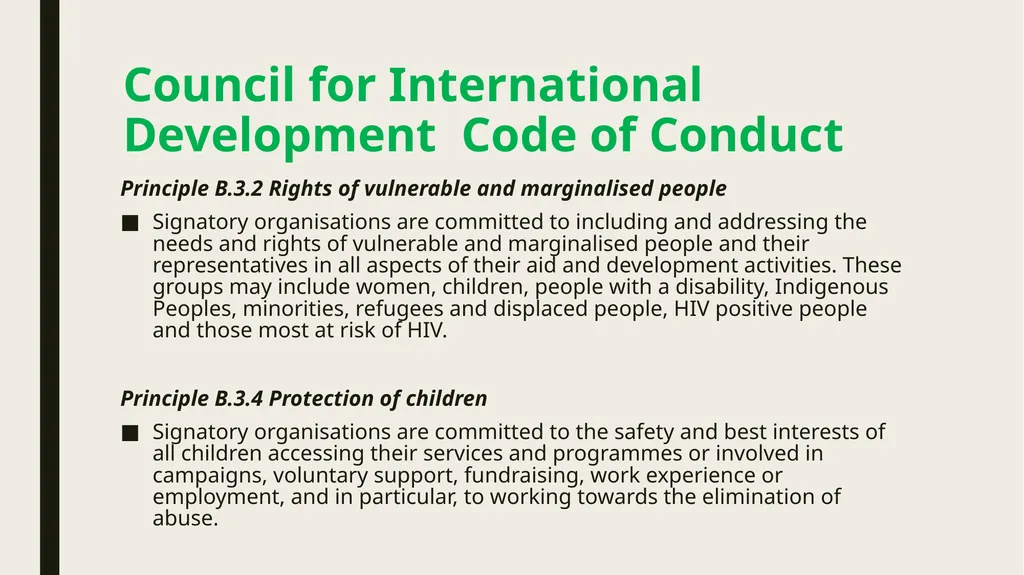
Council for International Development Code of Conduct Principle B.3.2 Rights of vulnerable and marginalised people
Signatory organisations are committed to including and addressing the needs and rights of vulnerable and marginalised people and their representatives in all aspects of their aid and development activities. These groups may include women, children, people with a disability, Indigenous Peoples, minorities, refugees and displaced people, HIV positive people and those most at risk of HIV.
Principle B.3.4 Protection of children
Signatory organisations are committed to the safety and best interests of all children accessing their services and programmes or involved in campaigns, voluntary support, fundraising, work experience or employment, and in particular, to working towards the elimination of abuse.<br>
36
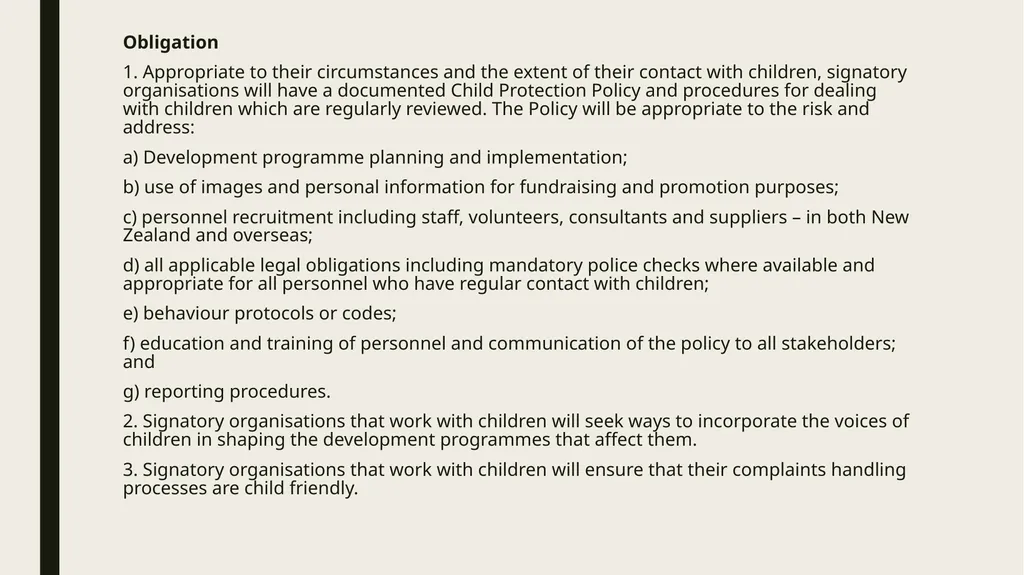
Obligation
1. Appropriate to their circumstances and the extent of their contact with children, signatory organisations will have a documented Child Protection Policy and procedures for dealing with children which are regularly reviewed. The Policy will be appropriate to the risk and address:
a) Development programme planning and implementation;
b) use of images and personal information for fundraising and promotion purposes;
c) personnel recruitment including staff, volunteers, consultants and suppliers – in both New Zealand and overseas;
d) all applicable legal obligations including mandatory police checks where available and appropriate for all personnel who have regular contact with children;
e) behaviour protocols or codes;
f) education and training of personnel and communication of the policy to all stakeholders; and
g) reporting procedures.
2. Signatory organisations that work with children will seek ways to incorporate the voices of children in shaping the development programmes that affect them.
3. Signatory organisations that work with children will ensure that their complaints handling processes are child friendly.<br>
37
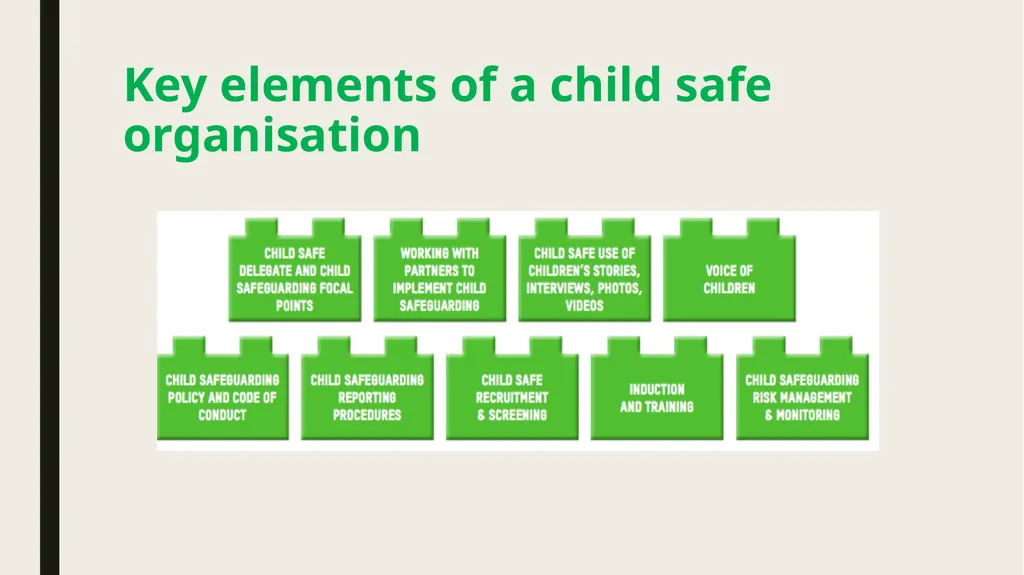
Key elements of a child safe organisation<br>
38
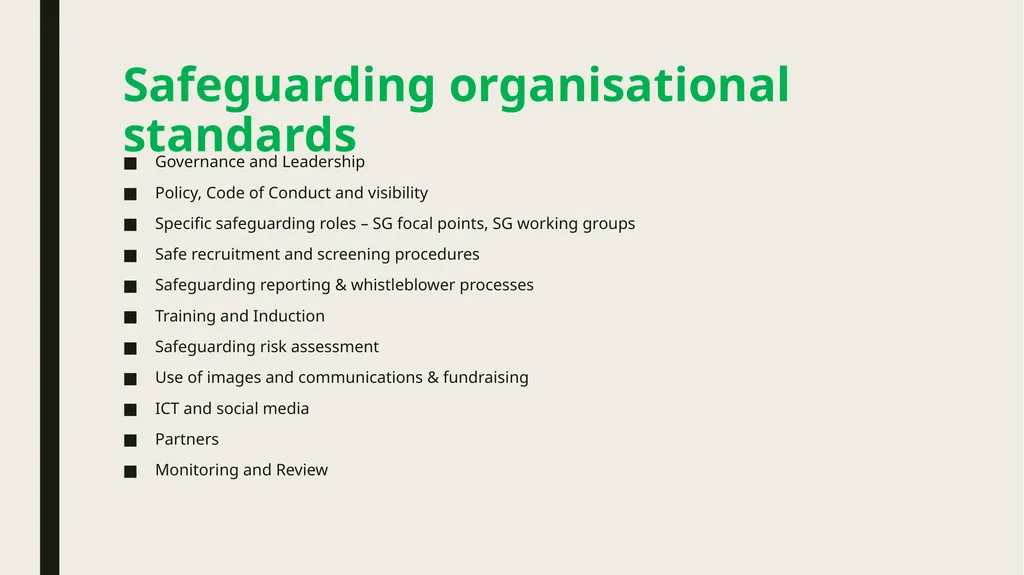
Safeguarding organisational standards Governance and Leadership
Policy, Code of Conduct and visibility
Specific safeguarding roles – SG focal points, SG working groups
Safe recruitment and screening procedures
Safeguarding reporting & whistleblower processes
Training and Induction
Safeguarding risk assessment
Use of images and communications & fundraising
ICT and social media
Partners
Monitoring and Review<br>
39
Discussion –what does a safe organisation look like? You are applying for a position in an International NGO in New Zealand.
What would you expect this NGO to have in place to be a safe organisation for children, vulnerable adults (beneficiary community) and its own staff and volunteers?
What questions would you ask about the NGO’s approach to safeguarding? What would you hope to find?<br>
What would you expect this NGO to have in place to be a safe organisation for children, vulnerable adults (beneficiary community) and its own staff and volunteers?
What questions would you ask about the NGO’s approach to safeguarding? What would you hope to find?<br>
40
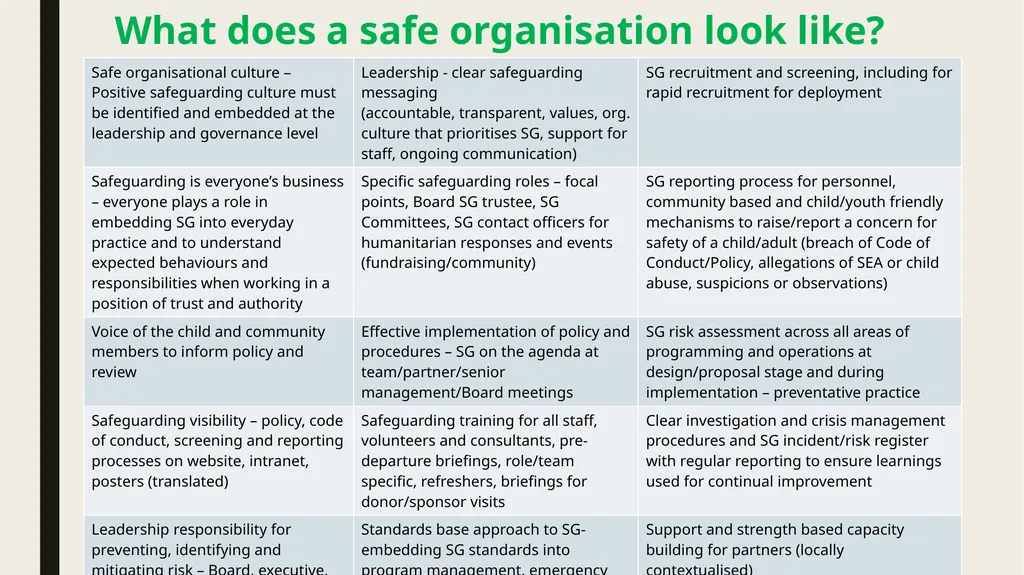
What does a safe organisation look like?<br>
41
Oxfam GB Investigation Report - Lessons 1. Organisational Culture
Need more embedding of Oxfam’s values and behaviours across the organsiation
Need more embedding of women’s rights at the heart of all we do
Code of Conduct need stronger emphasis
Humanitarian Department culture needs particular focus- are we too tolerant of weak controls in emergency situations?
Need to refresh and increase awareness training on PSEA particularly in high risk countries<br>
42
Oxfam GB Investigation Report - Lessons 2. Human Resources
Need better mechanisms for informing other Regions/affiliates/agencies of behavioural issues with staff when they move and to avoid “recycling” poor performers/problem staff
Need to ensure basic HR practices/standards are followed in all countries
While there must be clear, effective follow up and action in cases of inappropriate behavior, it is important to avoid a wider “blame culture”, but keep the emphasis on openness to learning<br>
43
Oxfam GB Investigation Report - Lessons 3. Line/Regional Management
Where weaknesses are recognised in Country Directors/country teams, need effective support and monitoring from Regional Centre (this relates to culture as well as skills/competencies)
4. Whistle Blowing
Better mechanisms needed to enable staff (especially national staff) to blow the whistle<br>
Where weaknesses are recognised in Country Directors/country teams, need effective support and monitoring from Regional Centre (this relates to culture as well as skills/competencies)
4. Whistle Blowing
Better mechanisms needed to enable staff (especially national staff) to blow the whistle<br>
44
Oxfam GB Investigation Report - Lessons 5. Audit/Investigation Process
Increase awareness across Oxfam of existence of an independent review/investigation team
Increase internal audit process to cover HR and culture more effectively
Take feedback from Haiti on investigational process/effectiveness and apply learning from this<br>
Increase awareness across Oxfam of existence of an independent review/investigation team
Increase internal audit process to cover HR and culture more effectively
Take feedback from Haiti on investigational process/effectiveness and apply learning from this<br>
45
Royal Commission – key findings The RC found that common child safe organisational risk factors included:
Unquestioning respect for authority
Lack of leadership and support for reporters
No reporting structure & mass underreporting
Environmental factors (online, closed and unsupervised spaces)
The need for a legal obligation to promote reporting
Mandatory reporter definition not extensive enough
Poor records prevents responding and identification
Must focus on whole of family approach
CALD and children with disabilities over-represented
Celibacy not direct cause but contributing factor
Source: Moores & Institute of Company Directors Australia webinar March 2018<br>
46
Royal Commission – key findings Many institutions did not have a culture where the best interest of children were the priority
The prevailing culture that ‘children should be seen and not heard’ resonated throughout residential care, religious institutions, schools and some family homes
Children's complaints of abuse were ignored and rejected, many children lost faith in adults and society’s institutions<br>
The prevailing culture that ‘children should be seen and not heard’ resonated throughout residential care, religious institutions, schools and some family homes
Children's complaints of abuse were ignored and rejected, many children lost faith in adults and society’s institutions<br>
47
Royal Commission – key findings Institutional factors that facilitated or enabled perpetrators, whatever the context, to sexually abuse children included:
Unsupervised, one-to-one access to a child, such as travelling alone with a child
Provision of intimate care to a child or an expectation of a level of physical contact
The ability to influence or control aspects of a child’s life, such as academic grades
Authority over a child, particularly in situations with significant control such as a residential setting
Spiritual or moral authority over a child
Prestige of the perpetrator, resulting in the perpetrator being afforded a higher level of trust and credibility
Opportunities to become close with a child and/or their family
Responsibility for young children such as that held by preschool carers
Specialist expertise, as in the case of medical practitioners, that enabled perpetrators to disguise sexual abuse<br>
48
Royal Commission – key findings From survivors heard in private sessions, the RC learned that:
The majority of survivors (64.3%) were male
More than half were aged between 10-14 years when they were first sexually abused
Female survivors generally reported being younger when they were first sexually abused than males
14.3% were Aboriginal and Torres Strait Islander people
4.3% had a disability at the time of the abuse
3.1% were from CALD background
93.8% were abused by a male
83.8% were abused by an adult
10.4% were in prison at the time of the private session
The average duration of child sexual abuse experienced in institutions was 2.2 years
36.3% were abused by multiple perpetrators<br>
49
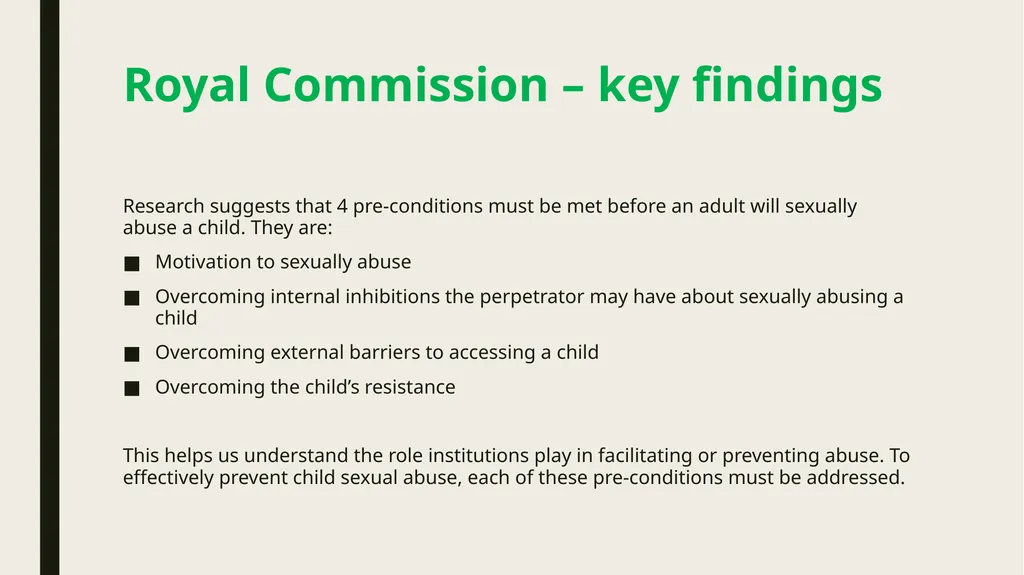
Royal Commission – key findings Research suggests that 4 pre-conditions must be met before an adult will sexually abuse a child. They are:
Motivation to sexually abuse
Overcoming internal inhibitions the perpetrator may have about sexually abusing a child
Overcoming external barriers to accessing a child
Overcoming the child’s resistance
This helps us understand the role institutions play in facilitating or preventing abuse. To effectively prevent child sexual abuse, each of these pre-conditions must be addressed.<br>
50
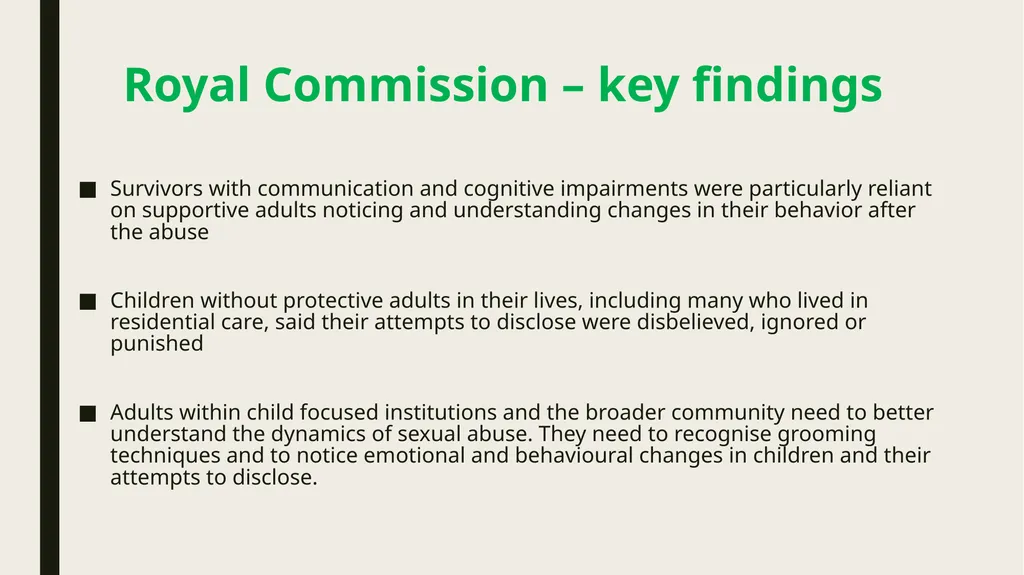
Royal Commission – key findings Survivors with communication and cognitive impairments were particularly reliant on supportive adults noticing and understanding changes in their behavior after the abuse
Children without protective adults in their lives, including many who lived in residential care, said their attempts to disclose were disbelieved, ignored or punished
Adults within child focused institutions and the broader community need to better understand the dynamics of sexual abuse. They need to recognise grooming techniques and to notice emotional and behavioural changes in children and their attempts to disclose.<br>
51
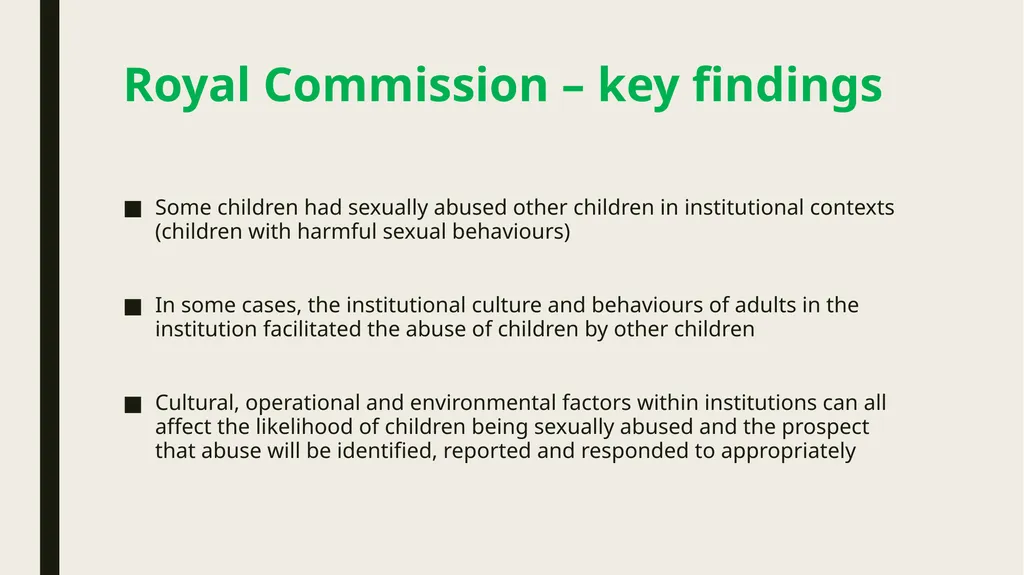
Royal Commission – key findings Some children had sexually abused other children in institutional contexts (children with harmful sexual behaviours)
In some cases, the institutional culture and behaviours of adults in the institution facilitated the abuse of children by other children
Cultural, operational and environmental factors within institutions can all affect the likelihood of children being sexually abused and the prospect that abuse will be identified, reported and responded to appropriately<br>
52
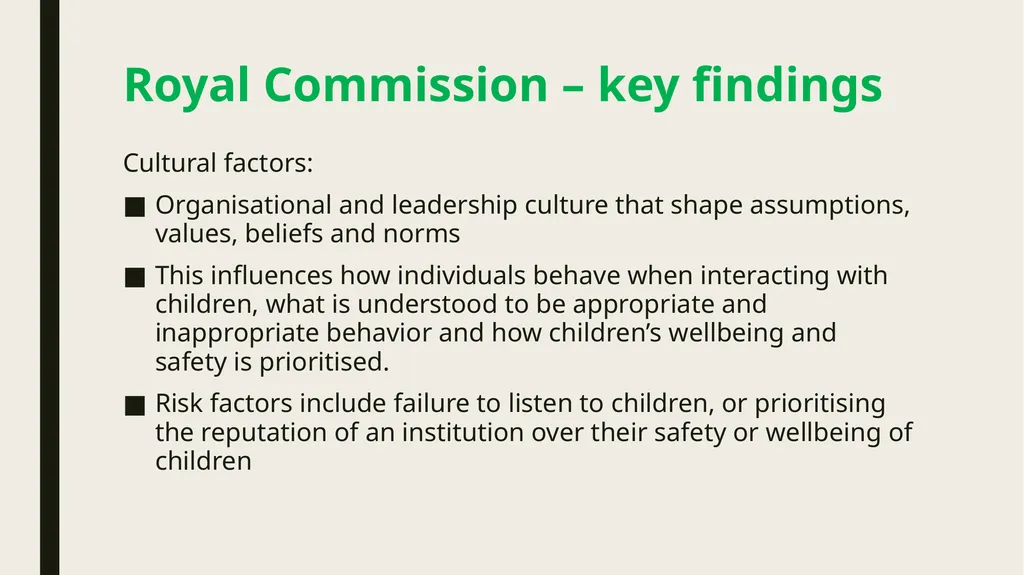
Royal Commission – key findings Cultural factors:
Organisational and leadership culture that shape assumptions, values, beliefs and norms
This influences how individuals behave when interacting with children, what is understood to be appropriate and inappropriate behavior and how children’s wellbeing and safety is prioritised.
Risk factors include failure to listen to children, or prioritising the reputation of an institution over their safety or wellbeing of children<br>
53
Royal Commission – key findings Operational factors:
Governance, internal structure and day-to-day practices
Approach to the implementation of the child safe policies and the recruitment, screening and training of staff and volunteers
Risk factors include institutional hierarchies that inhibit identification of abuse and allow perpetrators to remain in positions where abuse can occur<br>
54
Royal Commission – key findings Environmental factors:
Characteristics of physical and online spaces that enable potential adult perpetrators and children with harmful sexual behaviours to access victims
Risk factors include access to children in isolated and unsupervised locations, and the use of online environments to groom and abuse children
“Institutions may, inadvertently or otherwise, enable or create opportunities for abuse. All institutions are responsible for removing opportunity for abuse by preventing, identifying and mitigating risks and responding appropriately when abuse occurs.”
p.20 Final Report - Making institutions child safe<br>
55
Code of Conduct – Top 5 1. The Code is a supportive document for personnel. The Code provides guidance to individuals on behaviours and actions that are in the best interests of children and beneficiary communities and those that are unsafe, abusive or exploitative
2. By providing clear boundaries, the Code helps individuals avoid misunderstandings or situations where their behaviour or actions may be misinterpreted
3. The Code can be sent to applicants before an interview to send a message your organsiation is a safe organisation and deter anyone applying who intends to use their position to abuse or exploit a child or vulnerable adult
4. The boundaries in the Code help personnel identify when an individual’s behaviour may be a risk to the safety or wellbeing of a child or vulnerable adult
5. The Code can be translated and posted in offices and community locations to make everyone aware of the high standards of behaviour towards children and beneficiary communities they should expect from anyone engaged by your organisation<br>
56
Code of Conduct Winnie Byanyima, Executive Director of Oxfam International affirmed that, in her view, “the use of prostitutes in conditions of poverty, helplessness and conflict is exploitation and abuse”.
Not everyone who works in the sector agrees that the use of prostitutes constitutes sexual exploitation and abuse, although this does appear to be the growing consensus. We noted the Secretary of State’s evidence on a recent policy decision by the World Bank:
If I can give you the example of the World Bank … whether its staff should be allowed to use prostitutes in countries where that is legal. It has decided that if you work for the World Bank you cannot do that. It does not have to have a complex policy to nuance that. You cannot do it. Yes, the chief executive said there was backlash against that and her reply is a good one, which was that you had the same effect when they banned smoking in the executive offices.
It was noted that whilst Oxfam’s Code of Conduct from 2017 does explicitly ban the use of prostitutes, this was not the case in a Code of Conduct from 2012.<br>
57
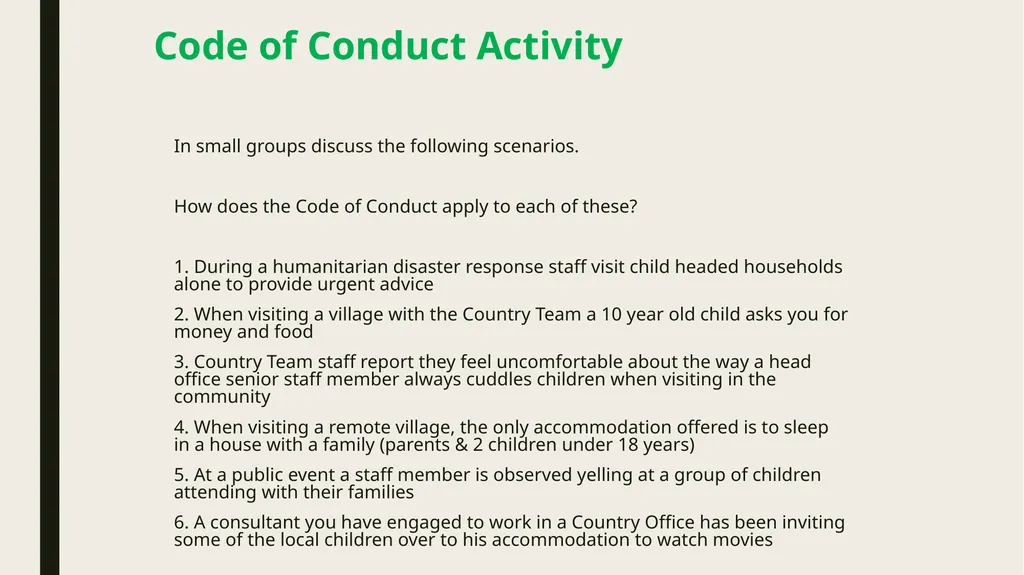
Code of Conduct Activity In small groups discuss the following scenarios.
How does the Code of Conduct apply to each of these?
1. During a humanitarian disaster response staff visit child headed households alone to provide urgent advice
2. When visiting a village with the Country Team a 10 year old child asks you for money and food
3. Country Team staff report they feel uncomfortable about the way a head office senior staff member always cuddles children when visiting in the community
4. When visiting a remote village, the only accommodation offered is to sleep in a house with a family (parents & 2 children under 18 years)
5. At a public event a staff member is observed yelling at a group of children attending with their families
6. A consultant you have engaged to work in a Country Office has been inviting some of the local children over to his accommodation to watch movies<br>
58
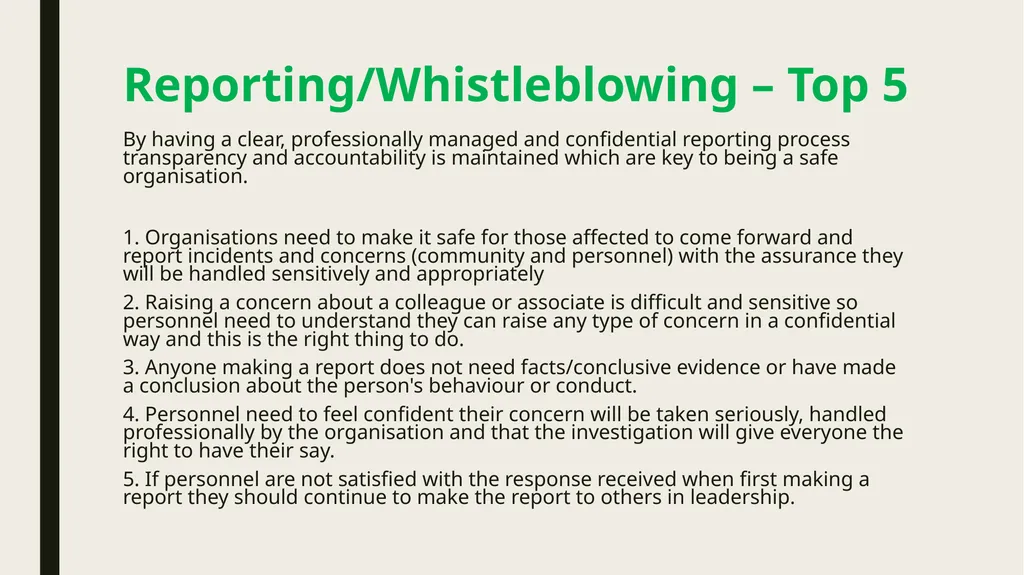
Reporting/Whistleblowing – Top 5 By having a clear, professionally managed and confidential reporting process transparency and accountability is maintained which are key to being a safe organisation.
1. Organisations need to make it safe for those affected to come forward and report incidents and concerns (community and personnel) with the assurance they will be handled sensitively and appropriately
2. Raising a concern about a colleague or associate is difficult and sensitive so personnel need to understand they can raise any type of concern in a confidential way and this is the right thing to do.
3. Anyone making a report does not need facts/conclusive evidence or have made a conclusion about the person's behaviour or conduct.
4. Personnel need to feel confident their concern will be taken seriously, handled professionally by the organisation and that the investigation will give everyone the right to have their say.
5. If personnel are not satisfied with the response received when first making a report they should continue to make the report to others in leadership.<br>
59
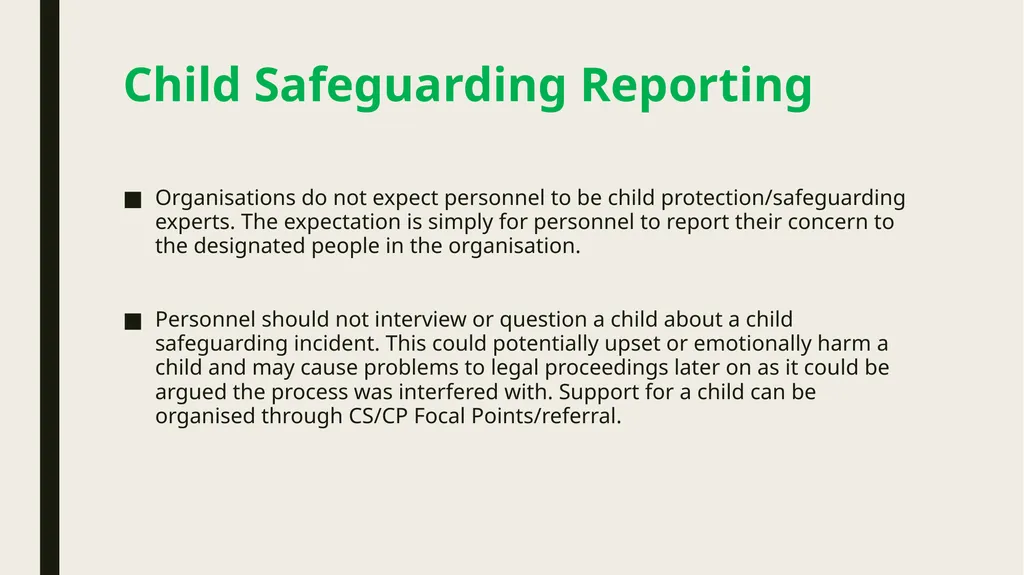
Child Safeguarding Reporting Organisations do not expect personnel to be child protection/safeguarding experts. The expectation is simply for personnel to report their concern to the designated people in the organisation.
Personnel should not interview or question a child about a child safeguarding incident. This could potentially upset or emotionally harm a child and may cause problems to legal proceedings later on as it could be argued the process was interfered with. Support for a child can be organised through CS/CP Focal Points/referral.<br>
Personnel should not interview or question a child about a child safeguarding incident. This could potentially upset or emotionally harm a child and may cause problems to legal proceedings later on as it could be argued the process was interfered with. Support for a child can be organised through CS/CP Focal Points/referral.<br>
60
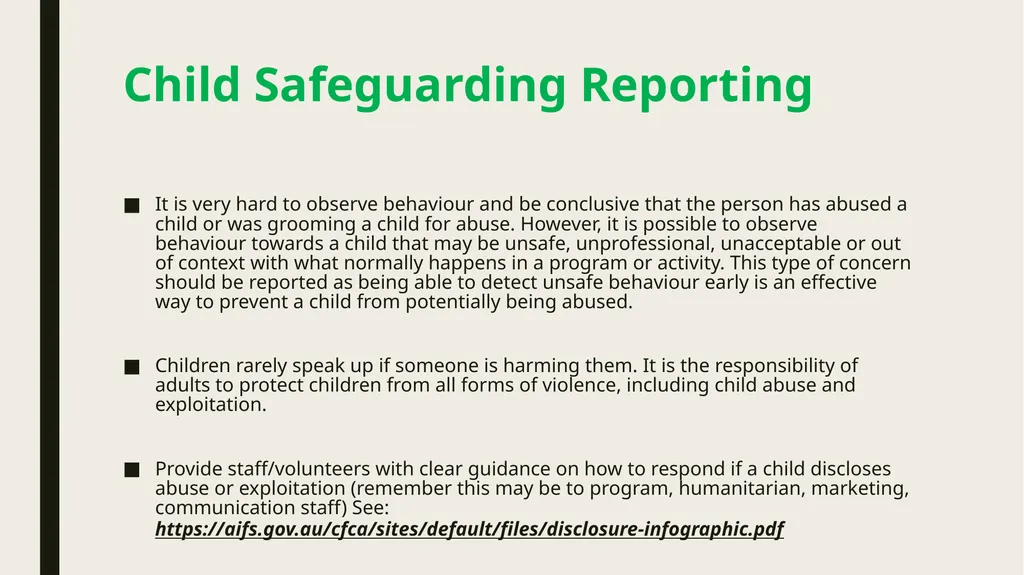
Child Safeguarding Reporting It is very hard to observe behaviour and be conclusive that the person has abused a child or was grooming a child for abuse. However, it is possible to observe behaviour towards a child that may be unsafe, unprofessional, unacceptable or out of context with what normally happens in a program or activity. This type of concern should be reported as being able to detect unsafe behaviour early is an effective way to prevent a child from potentially being abused.
Children rarely speak up if someone is harming them. It is the responsibility of adults to protect children from all forms of violence, including child abuse and exploitation.
Provide staff/volunteers with clear guidance on how to respond if a child discloses abuse or exploitation (remember this may be to program, humanitarian, marketing, communication staff) See: https://aifs.gov.au/cfca/sites/default/files/disclosure-infographic.pdf<br>
61
Safeguarding Reporting & Responding Do not wait until an allegation is substantiated – the fact that an allegation or suspicion has been raised is sufficient to commence the reporting process.
Reporting suspicion allows reports to be made when there is no actual allegation or where sexual assault may not have been witnesses and where staff observe signs that an assault may have occurred.
This is particularly important in grooming and child sexual assault cases as the type of abuse often means there will be no witnesses.
Always be guided by keeping the best interests of the child- victim centred response<br>
62
Mapping and Reporting/Referral Lists Organisations, in collaboration with local partners/offices, can map local agencies, authorities and services to report SEA or child abuse and exploitation incidents and/or services and agencies to refer children, youth and adults to receive care, support and advice.
Using a Mapping Template develop a Local Referral and Reporting List. The list should include:
local government departments (for children, youth and women and families)
Local police for reporting, investigation and prosecution of criminal offences against children and adults such as sexual abuse or exploitation offences, physical abuse, trafficking or online child sexual exploitation. Make a note on any specialised police for example police trained in handling child sexual offences or family violence matters or police trained in interviewing children.
Local health (including reproductive and sexual health services), safe housing, crisis, family violence, counselling, legal, youth agencies or services to refer children and/or families for support and advice
NGOs (local and international), professional networks etc. for advice, response and referral of reports
Local Community based groups (formal and informal) providing support to children and families (eg. Faith based, Community CP Committees, women’s services, specialised child sexual abuse services)
Assess services for safety, quality, child/youth friendly – record names and contact details, hours of operation, what each one offers, any potential risks to children/women/privacy concerns<br>
63
Working with Partners – Top 10 1. Include partners in safeguarding training sessions or provide training to partners that captures existing safeguarding strengths and provides capacity building to enhance policy and practice that is locally relevant and meaningful to the context and culture
2. Include safeguarding standards/clauses in partner agreements, terms of reference or partner contracts including an agreed mutual reporting mechanism
3. Establish a safeguarding steering committee comprising of key staff from your organisation and the partner organisation (shared knowledge opportunity and consistency of standards)
4. Support partners in implementing safe recruitment and screening procedures locally
5. Collaboratively work on safeguarding risk assessments as part of program design or humanitarian response<br>
64
Working with Partners – Top 10 6. Work with partners to map and develop a local reporting and referral list
7. Where a partner does not have a child protection/safeguarding or SEA policy or code of conduct, ask the partner to sign on to your policies as part of the agreement (translated)
8. Collaboratively develop posters, postcards, T-shirts etc. that can promote awareness of safeguarding policies and expected behaviours of personnel (local and overseas) to display in the office, program locations
9. Invite corporate/research partners to safeguarding sessions, include details in funding proposals and promote your commitment to safeguarding to donors and sponsors
10. Brief government partners on your safeguarding policies and standards<br>
65
Leadership and Governance– Top 5 Policies and Codes of Conduct must be translated into behavioural change and a positive safeguarding culture must be identified and embedded at the leadership and governance level
1. Leadership to actively employ strategies to embed an organisational culture of safeguarding across the organisation including through effective leadership arrangements such as safeguarding specific leadership/management positions and responsibility for key safeguarding messaging. This includes safeguarding being a critical part of leadership responsibility and leadership to be champions for a safe organisational culture.
2. Safeguarding responsibility for a Board member (Trustee) with responsibilities to receive regular reporting on:
the implementation and compliance with policy standards, donor requirements and legislation
safeguarding risks and incidents included in the regular risk reports/risk register from HR, Finance/Audit/Risk Management sub-committees, Quality and Safety sub-committees and CEO
Safeguarding be included as a standing agenda item for Board meetings.<br>
66
Leadership and Governance– Top 5 3. Include safeguarding monitoring KPIs in position descriptions and management include discussion around these in performance appraisals with staff that have regular contact with children and vulnerable communities (staff who travel regularly/humanitarian) or are in positions that involve working with children
4. Leadership protect and promote safeguarding as a priority focus within the organisation and apply a safeguarding risk based approach to the resourcing, development and implementation of the safeguarding strategic direction at the governance and executive levels.
5. In order to maintain safe organisational practice at a high standard, leadership should ensure internal auditing processes include an assessment of policy and standards implementation including feedback from all departments, country offices and partners.<br>
67
Leadership and Governance We are horrified at reports of “a culture of denial” in UN and humanitarian organisations when confronted with allegations of SEA. Safeguarding policies and procedures will be utterly meaningless without a transformation of organisational culture.
The leaders of aid organisations must ensure that what exists on paper is reflected in practice. This should not only be seen as a question of reiterating messages with local offices and implementing partners. Leaders cannot be complacent about the extent to which any part of the organisation is operating according to stated values, including the very top.
Trustees and management should ensure they are actively displaying ethical leadership and demonstrating zero tolerance on sexual exploitation and abuse.
Sexual exploitation and abuse in the aid sector, International Development Committee, House of Commons UK<br>
68
Humanitarian Response – Top 10 What do we *most* want to see happen to make the humanitarian system more accountable to communities we serve?
1.Experience has shown that the community- based complaint mechanism is a vital and effective component of a comprehensive response to sexual exploitation and abuse in an emergency operation.
Ensure children, and their parents/caregivers and adult beneficiaries are able to access the feedback and complaints mechanisms established for the response. Has a child friendly/community-based complaints mechanism been established? (e.g. translated poster, community meeting or radio announcement)
2. Safe recruitment of personnel including locally engaged aid workers –
pre-screened to assist with a rapid response,
register of aid workers,
referencing procedures and communication between organisations about individuals who present a safeguarding risk (ask the question as part of reference check),
all personnel to be deployed have read, understood and signed the Safeguarding Policies and Code of Conduct, attend pre-departure safeguarding briefing and are easily identifiable during the response.<br>
69
Humanitarian Response – Top 10 3. Ensure all personnel have been briefed on how to make a safeguarding incident report following the Reporting or Whistleblowing Process, when working during the response. For instance, who they should contact and how they can do this.
4. Ensure personnel have been briefed that under no circumstances should they accept unsolicited offers of help and assistance (for example individuals showing up at an emergency location and offering to be a volunteer)
5. Assign Safeguarding Focal Point/s for the response. Make sure the Safeguarding Focal Points are easily identifiable/ contactable by personnel and communities, particularly the children in contact with the humanitarian program<br>
70
Humanitarian Response – Top 10 6. Conduct an assessment of partners in contact with children/vulnerable adults for implementation of safeguarding policy and procedures If risks have been identified in relation to partner activities, ensure expectations have been communicated with partners, and assess whether they are committed to providing a safe environment.
7. Ensure links are made with cluster group activities and processes for referral such as registering unaccompanied children and providing child safe spaces.
8. Ensure contractors (security staff, cleaners, drivers, food distributors) and partners have been provided with a briefing on safeguarding standards and have details of the Safeguarding Focal Points to raise any concerns for the safety or wellbeing of a child/adult.<br>
71
Humanitarian Response – Top 10 9. Prepare media briefs to provide journalists, photographers etc. with safeguarding requirements in regard to the use of children’s/vulnerable adult’s images/stories and informed consent.
10 Report on child safeguarding performance by the end of each response, recording successes, new or emerging risks and lessons learned.<br>
10 Report on child safeguarding performance by the end of each response, recording successes, new or emerging risks and lessons learned.<br>
72
Humanitarian Response A recurring theme across the written and oral evidence is that SEA is, at its core, an abuse of power. The already imbalanced provider-beneficiary relationship can be magnified in the context of a humanitarian emergency. The British Red Cross wrote that:
The opportunity for abuses of power in humanitarian contexts is high and there is often an imbalance of power in times of crises. During humanitarian emergencies, social protection systems can be significantly weakened and disrupted.
Overall, the picture that has developed over the course of our inquiry is one of exploitation and abuse rooted in a power imbalance that is predominantly, although not exclusively, gendered, with “powerful men as gatekeepers to food, shelter and security” exploiting and abusing “women and girls because they are powerless, they are vulnerable and they are voiceless”.
Sexual exploitation and abuse in the aid sector, International Development Committee, House of Commons UK<br>
73
Safeguarding Recruitment and Selection Safeguarding recruitment and screening processes are essential to:
Enable an organisation to choose the most appropriate person for a position that involves contact with children or vulnerable populations
Strengthen the ability of an organisation to prevent access to children by those with a known history of harming children
Discourage individuals who pose an unacceptable risk to children/vulnerable adults from applying for positions<br>
74
Safeguarding Recruitment and Selection Why is this important?
Offenders may target international development organisations. This is because the status and trust they gain in communities as a representative of an INGO, provides them with the access and opportunities to be in contact with children and vulnerable populations.
An organisational safe message, will deter those individuals who may seek to work or volunteer for an organisation in order to abuse or exploit children/adults.
Offenders will also conduct their own assessments on organisations to seek out organisations that have weak safeguarding recruitment and selection procedures and therefore their behaviour can go undetected.
The process of self-selection (person choosing not to apply) is very effective and a safe message that may prevent an offender applying for a position at an organisation, is one of the key preventative steps in safeguarding recruitment and selection.<br>
75
Safeguarding Recruitment and Selection Safeguarding Recruitment and Selection is about using all the steps to put together a picture of an applicant. You cannot rely just on one step, such as a police check. Only a small minority of child sex offenders have a criminal record.
This is why the whole safeguarding recruitment and screening process is so important. By proceeding through all the steps in the process, information of concern (red flags) can appear at any stage that indicate a person may not be safe or suitable to be in contact with children/adults in community or in the workplace.<br>
This is why the whole safeguarding recruitment and screening process is so important. By proceeding through all the steps in the process, information of concern (red flags) can appear at any stage that indicate a person may not be safe or suitable to be in contact with children/adults in community or in the workplace.<br>
76
Safeguarding Recruitment and Selection It is important that people who come to work share the organisation’s values on child/women's/human rights and always acting in the best interests of children/adults
Interviews and verbal reference checks provide opportunities to understand;
a person’s motivation for wanting to work for or volunteer
past behaviours and experiences of being in contact with communities and children
any concerns from referees in terms of interactions with children/adults and values and attitudes towards children/vulnerable adults in the community or misconduct in the workplace<br>
77
Safeguarding Risk Assessment<br>
78
Safeguarding Risk Assessment Conducting a Safeguarding Risk Assessment at the design and planning phase allows programs to be designed through a safeguarding lens to identify risks to children/vulnerable adults as a result of coming into contact with or being impacted by a program or activity
By conducting a Safeguarding Risk Assessment Program teams can feel more confident about the program or activity being safe when implemented in community
You can include practical actions as part of program design and implementation planning that will greatly reduce the risk of abuse or exploitation of a child/adult during program implementation
As experts of their own programs and activities, involving teams/partners in ongoing risk assessment adapted to the local context creates a preventative approach to being a safe organisation and strengthens the effectiveness and quality of the program and activities.<br>
79
Safeguarding Risk Assessment The Risk Assessment can also includes strategies to mitigate against harm to staff, volunteers and partner staff
Organisations can implement a higher risk program or response with a safeguarding framework around the program that is informed by your risk assessment
Develop a list of existing standards/strengths and common risk factors for staff/partners to use to guide their risk assessments including risks to that may exist due to the local cultural, legal or formal/informal systems environment
By conducting a Risk assessments organisations are meeting their duty of care to their beneficiary communities, personnel, partner agencies, donors and governments
Engage staff and partner organisations staff in conducting Safeguarding Risk Assessments for programs working with more vulnerable groups of children and young people, to ensure local knowledge and context is included in program design<br>
80
Safeguarding Risk Assessment What are the risks to children/beneficiary community as a result of a program, response or activity implemented by our organisation (and/or partner)?
What factors can raise the level of risk?
Personnel (staff, volunteers, consultants, contractors)
Vulnerability of children/adults (disability, trauma/abuse, unaccompanied children, poverty, displaced)
Location (conflict/natural disaster, camp, isolated, no safe access to toilets, closed/low visibility spaces, local risk of human trafficking)
Communication/Media (local/international journalists and photographers, visitors, online contact with children, social media)
Partners (lack of resources to implement safeguarding policies and standards)
Activities (personnel visiting child headed households, women bring children to the program, transporting people, large public event)<br>
81
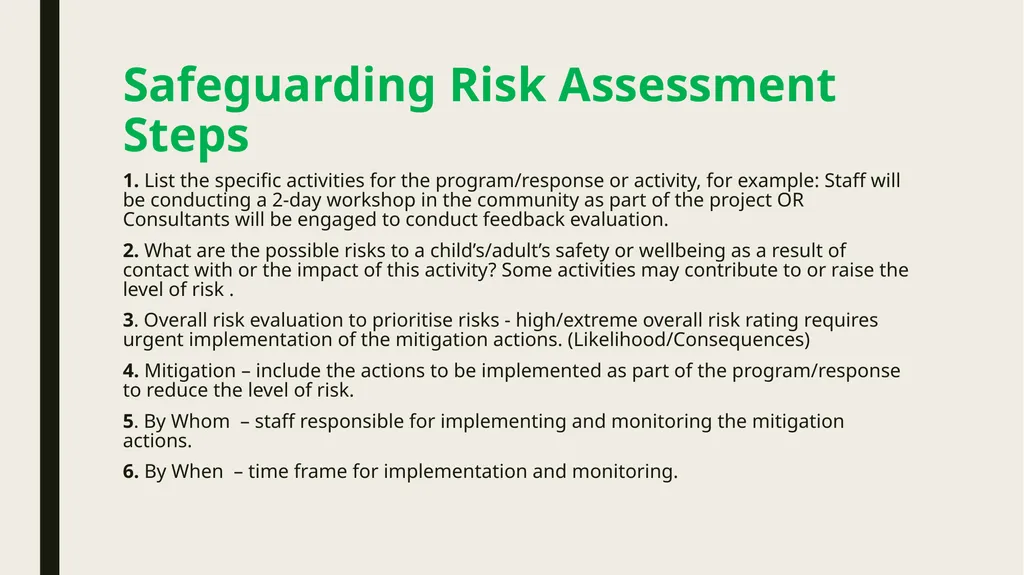
Safeguarding Risk Assessment Steps 1. List the specific activities for the program/response or activity, for example: Staff will be conducting a 2-day workshop in the community as part of the project OR Consultants will be engaged to conduct feedback evaluation.
2. What are the possible risks to a child’s/adult’s safety or wellbeing as a result of contact with or the impact of this activity? Some activities may contribute to or raise the level of risk .
3. Overall risk evaluation to prioritise risks - high/extreme overall risk rating requires urgent implementation of the mitigation actions. (Likelihood/Consequences)
4. Mitigation – include the actions to be implemented as part of the program/response to reduce the level of risk.
5. By Whom – staff responsible for implementing and monitoring the mitigation actions.
6. By When – time frame for implementation and monitoring.<br>
82
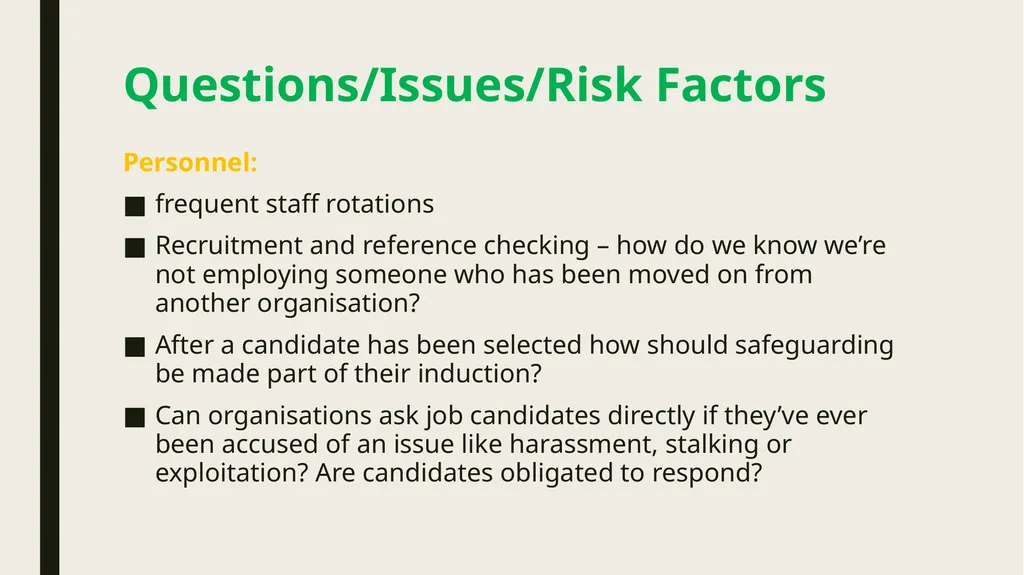
Questions/Issues/Risk Factors Personnel:
frequent staff rotations
Recruitment and reference checking – how do we know we’re not employing someone who has been moved on from another organisation?
After a candidate has been selected how should safeguarding be made part of their induction?
Can organisations ask job candidates directly if they’ve ever been accused of an issue like harassment, stalking or exploitation? Are candidates obligated to respond?<br>
83
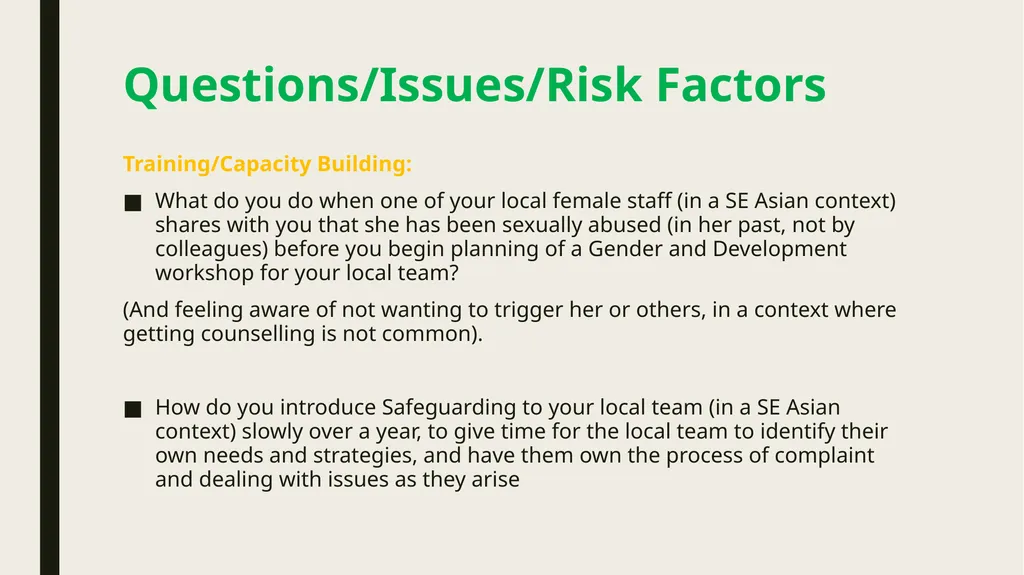
Questions/Issues/Risk Factors Training/Capacity Building:
What do you do when one of your local female staff (in a SE Asian context) shares with you that she has been sexually abused (in her past, not by colleagues) before you begin planning of a Gender and Development workshop for your local team?
(And feeling aware of not wanting to trigger her or others, in a context where getting counselling is not common).
How do you introduce Safeguarding to your local team (in a SE Asian context) slowly over a year, to give time for the local team to identify their own needs and strategies, and have them own the process of complaint and dealing with issues as they arise<br>
84
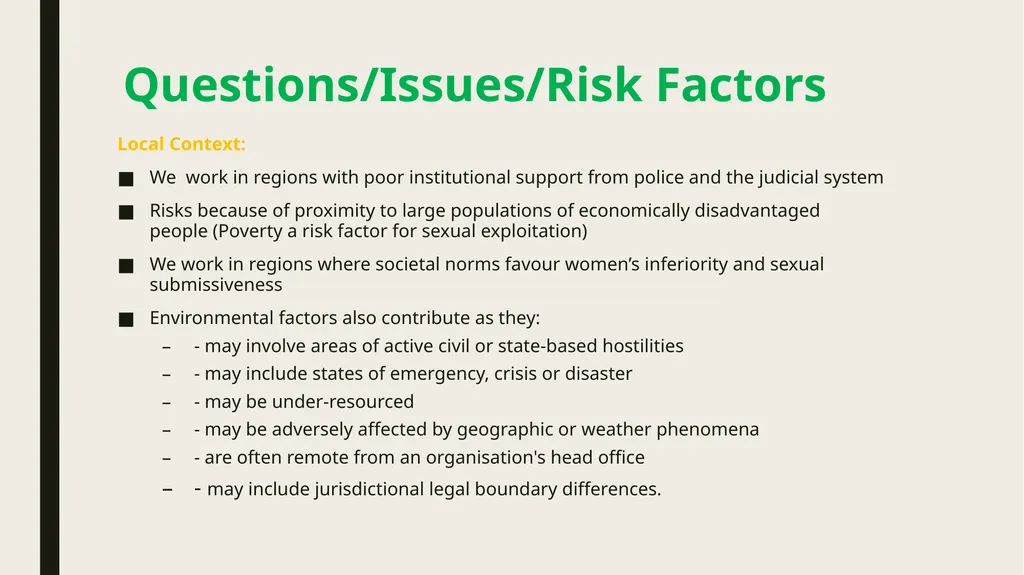
Questions/Issues/Risk Factors Local Context:
We work in regions with poor institutional support from police and the judicial system
Risks because of proximity to large populations of economically disadvantaged people (Poverty a risk factor for sexual exploitation)
We work in regions where societal norms favour women’s inferiority and sexual submissiveness
Environmental factors also contribute as they:
- may involve areas of active civil or state-based hostilities
- may include states of emergency, crisis or disaster
- may be under-resourced
- may be adversely affected by geographic or weather phenomena
- are often remote from an organisation's head office
- may include jurisdictional legal boundary differences.<br>
85
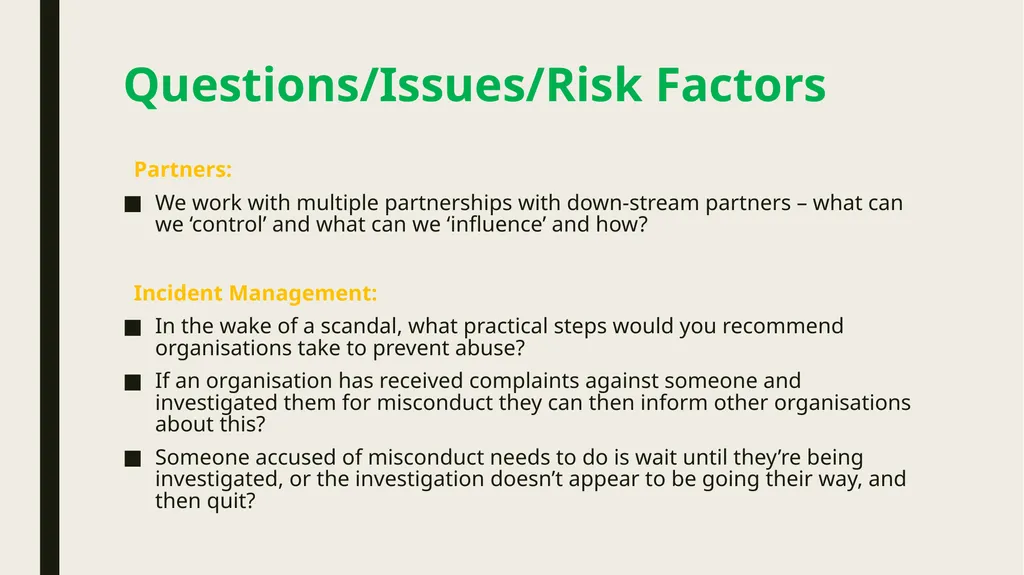
Questions/Issues/Risk Factors Partners:
We work with multiple partnerships with down-stream partners – what can we ‘control’ and what can we ‘influence’ and how?
Incident Management:
In the wake of a scandal, what practical steps would you recommend organisations take to prevent abuse?
If an organisation has received complaints against someone and investigated them for misconduct they can then inform other organisations about this?
Someone accused of misconduct needs to do is wait until they’re being investigated, or the investigation doesn’t appear to be going their way, and then quit?<br>
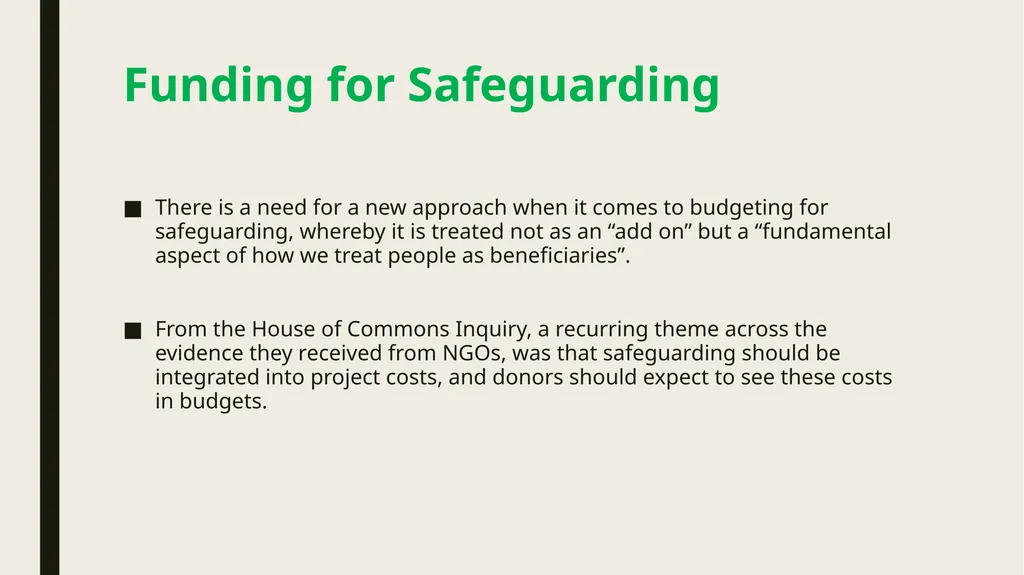
86
Funding for Safeguarding There is a need for a new approach when it comes to budgeting for safeguarding, whereby it is treated not as an “add on” but a “fundamental aspect of how we treat people as beneficiaries”.
From the House of Commons Inquiry, a recurring theme across the evidence they received from NGOs, was that safeguarding should be integrated into project costs, and donors should expect to see these costs in budgets.<br>
From the House of Commons Inquiry, a recurring theme across the evidence they received from NGOs, was that safeguarding should be integrated into project costs, and donors should expect to see these costs in budgets.<br>
87
Recommendations for ourselves as a sector and government<br>
88
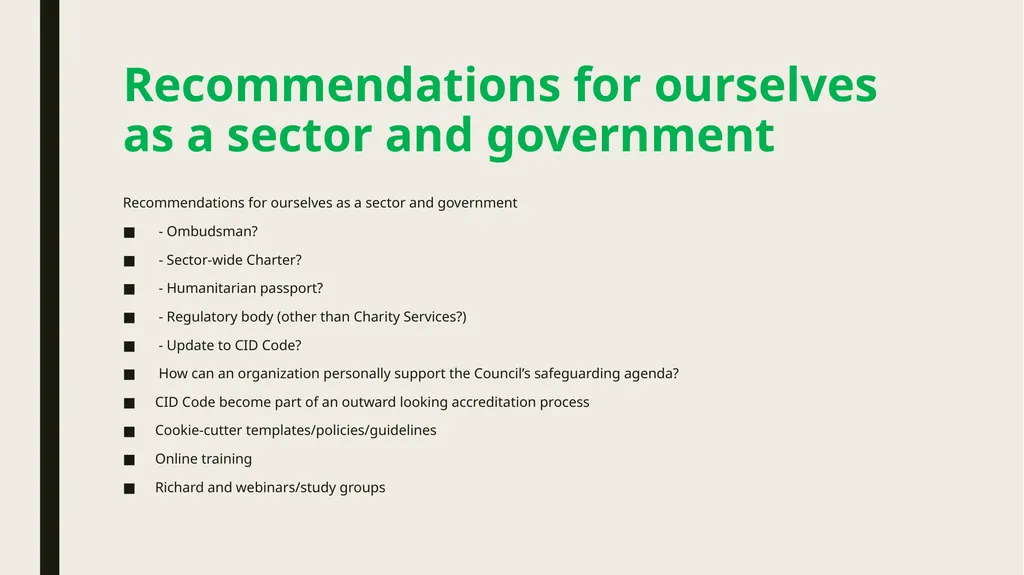
Recommendations for ourselves as a sector and government Recommendations for ourselves as a sector and government
- Ombudsman?
- Sector-wide Charter?
- Humanitarian passport?
- Regulatory body (other than Charity Services?)
- Update to CID Code?
How can an organization personally support the Council’s safeguarding agenda?
CID Code become part of an outward looking accreditation process
Cookie-cutter templates/policies/guidelines
Online training
Richard and webinars/study groups<br>
89
Tools & Resources Keeping Children Safe UK – Child Safeguarding Standards Handbook
https://keepingchildrensafe.org.uk/how-we-keep-children-safe/capacity-building/resources/child-safeguarding-standards-and-how-implement
Minimum Operating Standards Protection from Sexual Exploitation and Abuse by own Personnel
https://interagencystandingcommittee.org/system/files/3_minimum_operating_standards_mos-psea.pdf<br>
90
Tools & Resources Bond UK – Safeguarding Guidance and Tools
https://www.bond.org.uk/resources/safeguarding-guidance-and-tools
DFAT Code of Conduct for Overseas Service
https://dfat.gov.au/about-us/publications/Pages/dfat-code-of-conduct-for-overseas-service.aspx
ACFID Review into Prevention of Sexual Misconduct
https://acfid.asn.au/media-releases/independent-review-begins-prevention-sexual-misconduct<br>
91
Tools & Resources Sexual exploitation and abuse in the aid sector, International Development Committee, House of Commons UK
https://publications.parliament.uk/pa/cm201719/cmselect/cmintdev/840/84018.htm#_idTextAnchor141
Best Practice Guide – Inter-Agency Community-Based Complaint Mechanisms
https://interagencystandingcommittee.org/accountability-affected-populations-including-protection-sexual-exploitation-and-abuse/documents-50<br>
92
Tools & Resources Terminology Guidelines for the Protection of Children from Sexual Exploitation and Sexual Abuse- Adopted by the Interagency Working Group in Luxembourg, 28 January 2016
http://www.ilo.org/ipec/Informationresources/WCMS_490167/lang--en/index.htm
IASC Six Core Principles Relating to Sexual Exploitation and Abuse
https://reliefweb.int/report/world/protection-sexual-exploitation-and-abuse-psea-inter-agency-cooperation-community-based
DFAT Child Protection Guidance Notes
https://dfat.gov.au/about-us/publications/Pages/child-protection-policy.aspx<br>