
Session 1: Introducing the Bystander The Scottish



Description: Session 1: Introducing the Bystander The Scottish Intervention Initiative Bystander Training 1 2 Who is a Bystander? 3 Type of Bystander? 4 Its a lovely sunny day and you are sitting by the river on your own, no one else is around.
Related Topics
Download Presentation
"Session 1: Introducing the Bystander The Scottish" is the property of its rightful owner. Permission is granted to download and print the materials on this website for personal, non-commercial use only, and to display it on your personal computer provided you do not modify the materials and that you retain all copyright notices contained in the materials. By downloading content from our website, you accept the terms of this agreement.
Presentation Transcript
slide1. Session 1: Introducing the Bystander The Scottish
Intervention Initiative
Bystander Training 1<br>
slide2. 2<br>
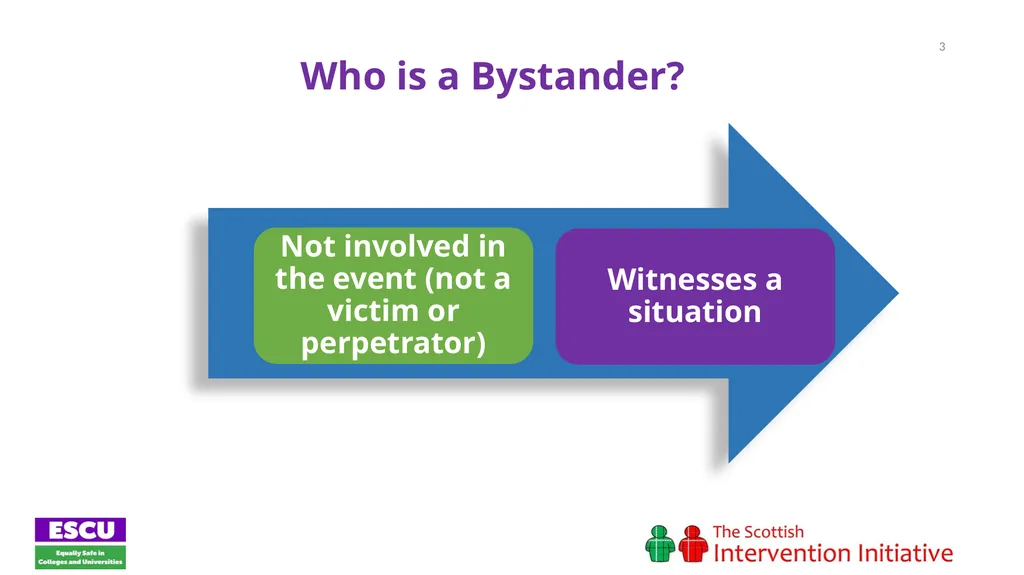
slide3. Who is a Bystander? 3<br>
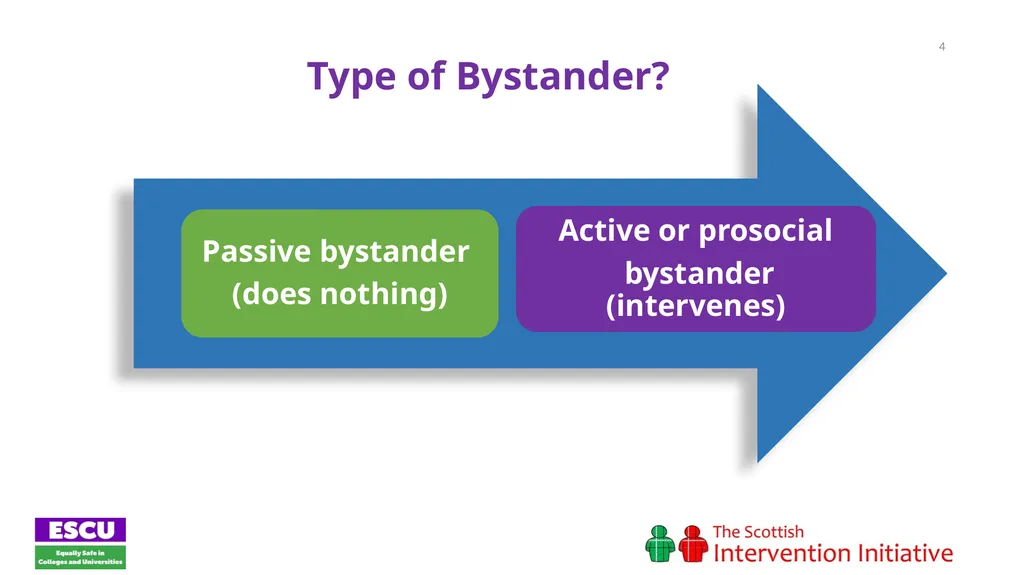
slide4. Type of Bystander? 4<br>
slide5. It’s a lovely sunny day and you are sitting by the river on your own, no one else is around. Suddenly you hear splashing and screaming for help. A person is caught in the current and drowning.
You are the bystander. There is no mobile phone signal. You can swim. There is a life ring on the riverbank.
What do you do?
[Adapted from Crapser, B. G., & Stewart, A. L. (2014). Men's Project: Sexual assault prevention program for college men program manual. Storrs, CT: University of Connecticut,pp.26-27] 5<br>
slide6. A bystander can intervene to stop events before they happen or while they are happening
a bystander can PREVENT the potential outcome as well as deal with an outcome. 6<br>
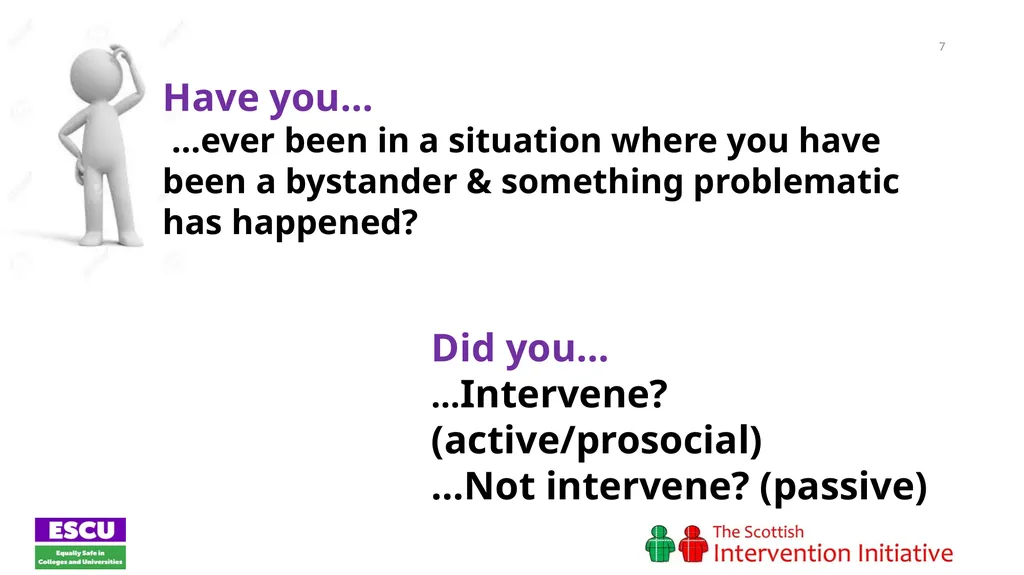
slide7. Have you…
…ever been in a situation where you have been a bystander & something problematic has happened?
Did you…
…Intervene? (active/prosocial)
…Not intervene? (passive) 7<br>
slide8. What factors are at play in… 8<br>
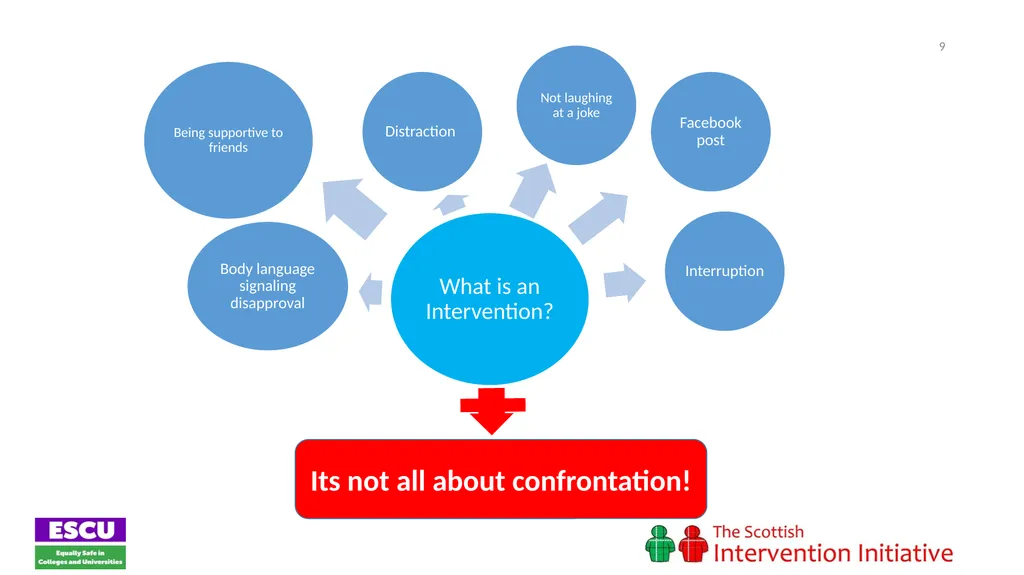
slide9. Its not all about confrontation! 9<br>
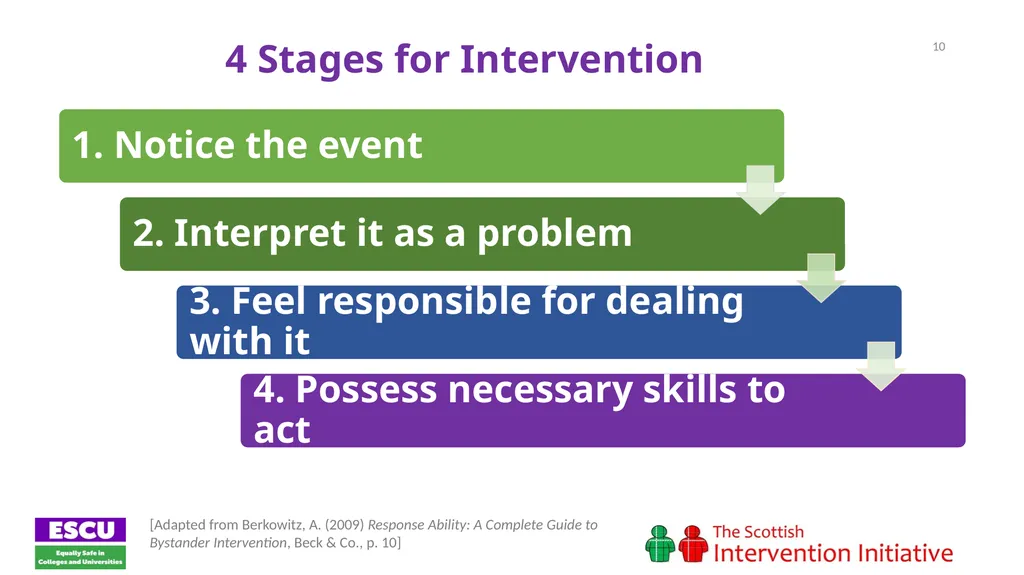
slide10. 4 Stages for Intervention [Adapted from Berkowitz, A. (2009) Response Ability: A Complete Guide to Bystander Intervention, Beck & Co., p. 10] 10<br>
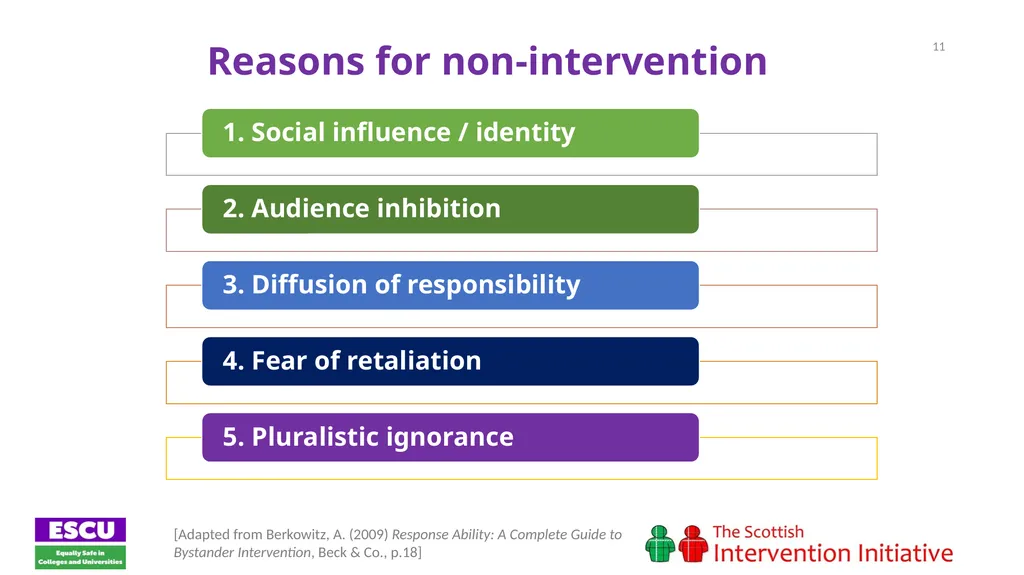
slide11. Reasons for non-intervention [Adapted from Berkowitz, A. (2009) Response Ability: A Complete Guide to Bystander Intervention, Beck & Co., p.18] 11<br>
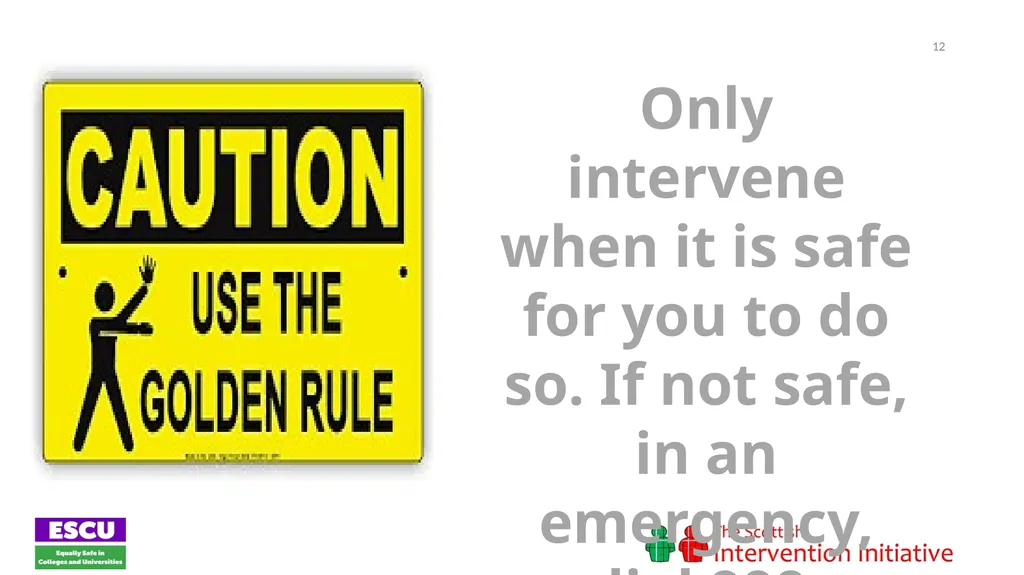
slide12. Only intervene when it is safe for you to do so. If not safe, in an emergency, dial 999. 12<br>
slide13. This programme is
specifically about
bystander intervention
in sexual violence &
domestic abuse. 13<br>
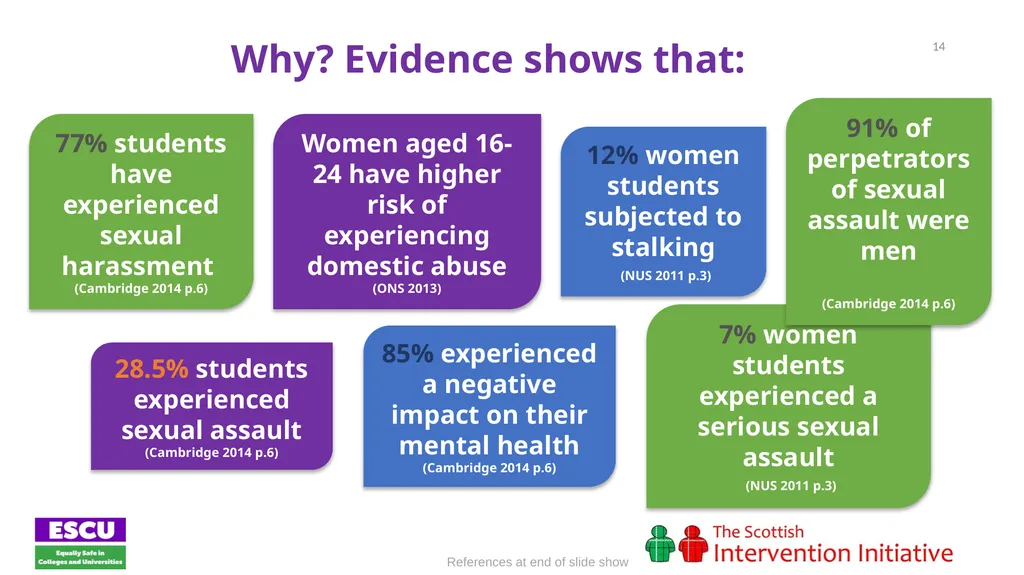
slide14. Why? Evidence shows that: 77% students have experienced sexual harassment
(Cambridge 2014 p.6) 12% women students subjected to stalking
(NUS 2011 p.3) 28.5% students experienced sexual assault
(Cambridge 2014 p.6) 7% women students experienced a serious sexual assault
(NUS 2011 p.3) 91% of perpetrators of sexual assault were men
(Cambridge 2014 p.6) 85% experienced a negative impact on their mental health
(Cambridge 2014 p.6) Women aged 16-24 have higher risk of experiencing domestic abuse (ONS 2013) References at end of slide show 14<br>
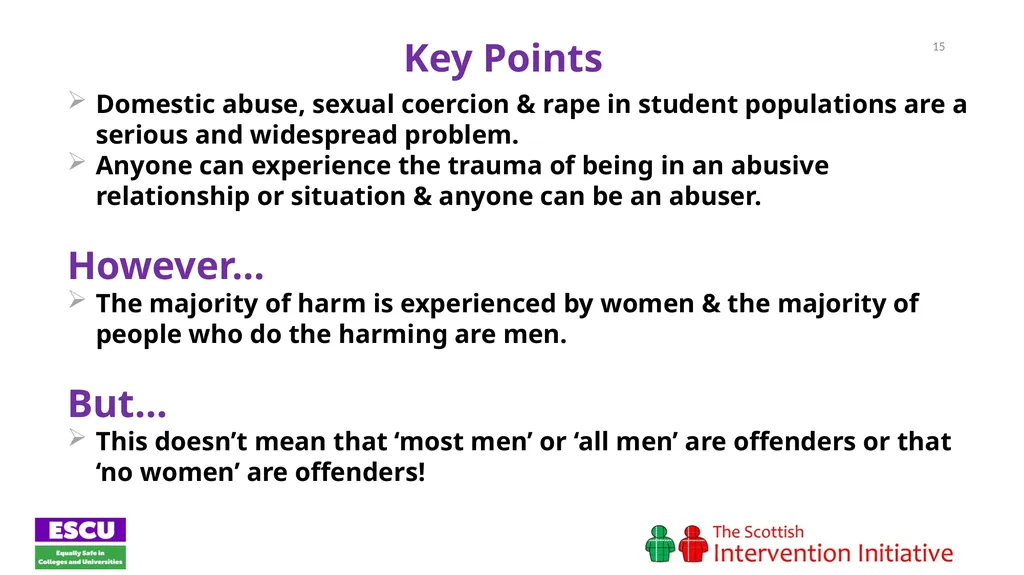
slide15. Key Points Domestic abuse, sexual coercion & rape in student populations are a serious and widespread problem.
Anyone can experience the trauma of being in an abusive relationship or situation & anyone can be an abuser.
However…
The majority of harm is experienced by women & the majority of people who do the harming are men.
But…
This doesn’t mean that ‘most men’ or ‘all men’ are offenders or that ‘no women’ are offenders! 15<br>
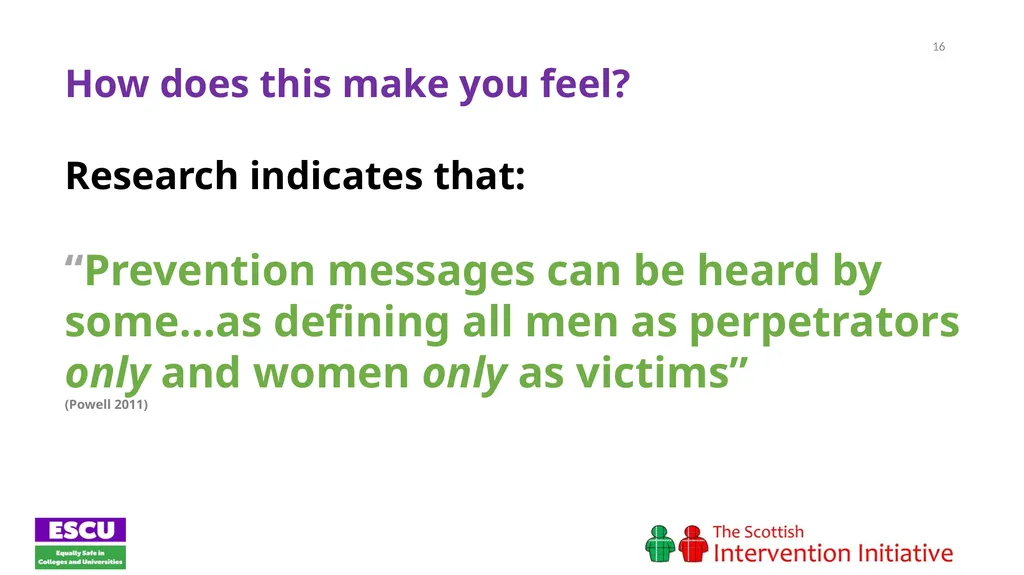
slide16. How does this make you feel?
Research indicates that:
“Prevention messages can be heard by some…as defining all men as perpetrators only and women only as victims”
(Powell 2011) 16<br>
slide17. (NUS study: NUS (National Union of Students) (2011) (2nd Ed.) Hidden Marks. London: NUS. Online at: http://www.nus.org.uk/Global/NUS_hidden_marks_report_2nd_edition_web.pdf, Foreword) All students (& staff) have the right to
live and study in an environment of
dignity & respect, free from the fear of harassment or violence. 17<br>
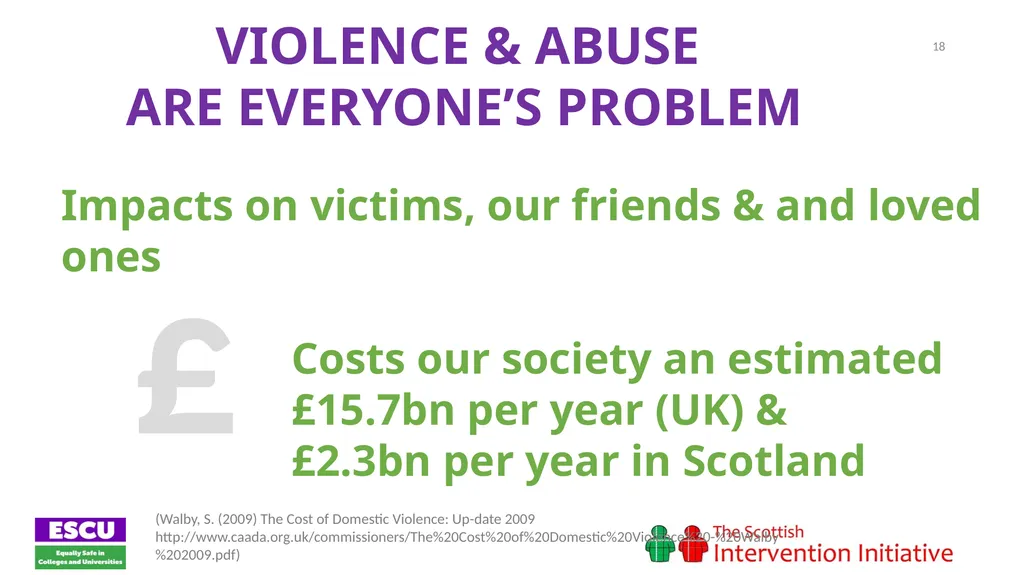
slide18. VIOLENCE & ABUSE
ARE EVERYONE’S PROBLEM Impacts on victims, our friends & and loved ones
Costs our society an estimated
£15.7bn per year (UK) &
£2.3bn per year in Scotland (Walby, S. (2009) The Cost of Domestic Violence: Up-date 2009 http://www.caada.org.uk/commissioners/The%20Cost%20of%20Domestic%20Violence%20-%20Walby%202009.pdf) £ 18<br>
slide19. YOU ARE OUR FUTURE LEADERS! STEP UP! SPEAK OUT!
BE HEARD! University of the West of England bystander film
YouTube: https://youtu.be/SgVQB0SKbFU 2014 White House video
YouTube: https://youtu.be/xLdElcv5qqc 19<br>
slide20. 20<br>
Intervention Initiative
Bystander Training 1<br>
slide2. 2<br>
slide3. Who is a Bystander? 3<br>
slide4. Type of Bystander? 4<br>
slide5. It’s a lovely sunny day and you are sitting by the river on your own, no one else is around. Suddenly you hear splashing and screaming for help. A person is caught in the current and drowning.
You are the bystander. There is no mobile phone signal. You can swim. There is a life ring on the riverbank.
What do you do?
[Adapted from Crapser, B. G., & Stewart, A. L. (2014). Men's Project: Sexual assault prevention program for college men program manual. Storrs, CT: University of Connecticut,pp.26-27] 5<br>
slide6. A bystander can intervene to stop events before they happen or while they are happening
a bystander can PREVENT the potential outcome as well as deal with an outcome. 6<br>
slide7. Have you…
…ever been in a situation where you have been a bystander & something problematic has happened?
Did you…
…Intervene? (active/prosocial)
…Not intervene? (passive) 7<br>
slide8. What factors are at play in… 8<br>
slide9. Its not all about confrontation! 9<br>
slide10. 4 Stages for Intervention [Adapted from Berkowitz, A. (2009) Response Ability: A Complete Guide to Bystander Intervention, Beck & Co., p. 10] 10<br>
slide11. Reasons for non-intervention [Adapted from Berkowitz, A. (2009) Response Ability: A Complete Guide to Bystander Intervention, Beck & Co., p.18] 11<br>
slide12. Only intervene when it is safe for you to do so. If not safe, in an emergency, dial 999. 12<br>
slide13. This programme is
specifically about
bystander intervention
in sexual violence &
domestic abuse. 13<br>
slide14. Why? Evidence shows that: 77% students have experienced sexual harassment
(Cambridge 2014 p.6) 12% women students subjected to stalking
(NUS 2011 p.3) 28.5% students experienced sexual assault
(Cambridge 2014 p.6) 7% women students experienced a serious sexual assault
(NUS 2011 p.3) 91% of perpetrators of sexual assault were men
(Cambridge 2014 p.6) 85% experienced a negative impact on their mental health
(Cambridge 2014 p.6) Women aged 16-24 have higher risk of experiencing domestic abuse (ONS 2013) References at end of slide show 14<br>
slide15. Key Points Domestic abuse, sexual coercion & rape in student populations are a serious and widespread problem.
Anyone can experience the trauma of being in an abusive relationship or situation & anyone can be an abuser.
However…
The majority of harm is experienced by women & the majority of people who do the harming are men.
But…
This doesn’t mean that ‘most men’ or ‘all men’ are offenders or that ‘no women’ are offenders! 15<br>
slide16. How does this make you feel?
Research indicates that:
“Prevention messages can be heard by some…as defining all men as perpetrators only and women only as victims”
(Powell 2011) 16<br>
slide17. (NUS study: NUS (National Union of Students) (2011) (2nd Ed.) Hidden Marks. London: NUS. Online at: http://www.nus.org.uk/Global/NUS_hidden_marks_report_2nd_edition_web.pdf, Foreword) All students (& staff) have the right to
live and study in an environment of
dignity & respect, free from the fear of harassment or violence. 17<br>
slide18. VIOLENCE & ABUSE
ARE EVERYONE’S PROBLEM Impacts on victims, our friends & and loved ones
Costs our society an estimated
£15.7bn per year (UK) &
£2.3bn per year in Scotland (Walby, S. (2009) The Cost of Domestic Violence: Up-date 2009 http://www.caada.org.uk/commissioners/The%20Cost%20of%20Domestic%20Violence%20-%20Walby%202009.pdf) £ 18<br>
slide19. YOU ARE OUR FUTURE LEADERS! STEP UP! SPEAK OUT!
BE HEARD! University of the West of England bystander film
YouTube: https://youtu.be/SgVQB0SKbFU 2014 White House video
YouTube: https://youtu.be/xLdElcv5qqc 19<br>
slide20. 20<br>