Shannon Tsai Professor Rome Spring 2012
Description: Shannon Tsai Professor Rome Spring 2012 Biomechanics of a Pull in Ultimate Types of throws in Ultimate Normal throws Backhand Forehand- flick Thumber Push pass Pull Inverted Throws Hammer Scoober Research Questions How does each body
Related Topics
Download Presentation
"Shannon Tsai Professor Rome Spring 2012" is the property of its rightful owner. Permission is granted to download and print the materials on this website for personal, non-commercial use only, and to display it on your personal computer provided you do not modify the materials and that you retain all copyright notices contained in the materials. By downloading content from our website, you accept the terms of this agreement.
Presentation Transcript
slide1. Shannon Tsai
Professor Rome
Spring 2012 Biomechanics of a Pull in Ultimate<br>
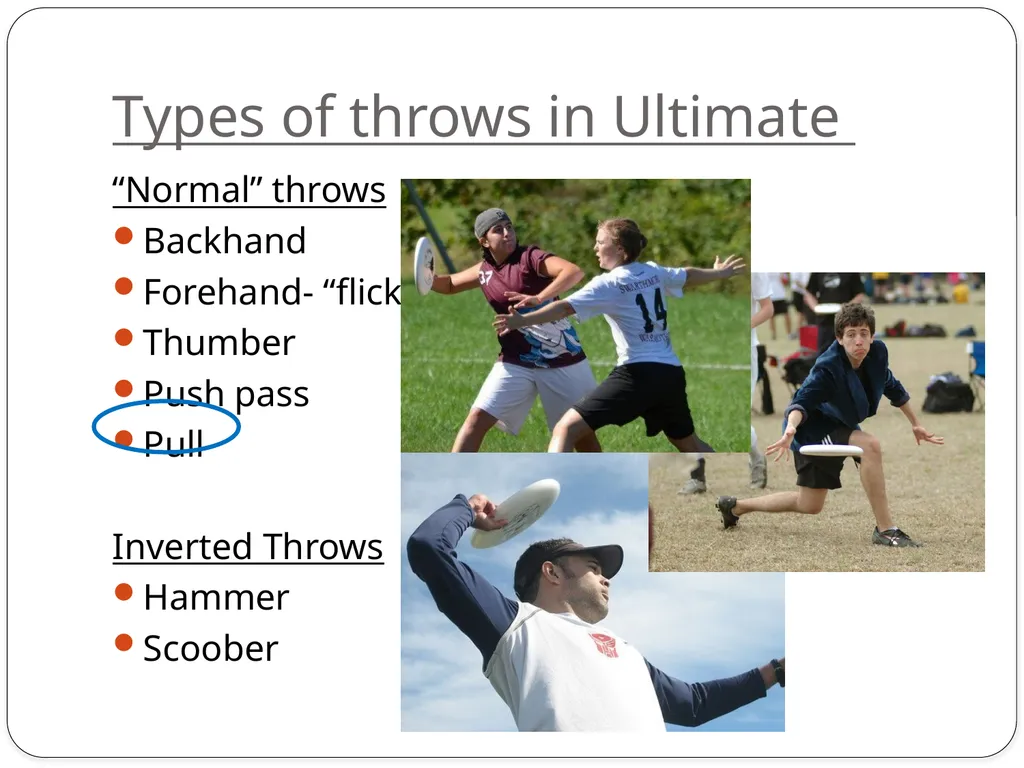
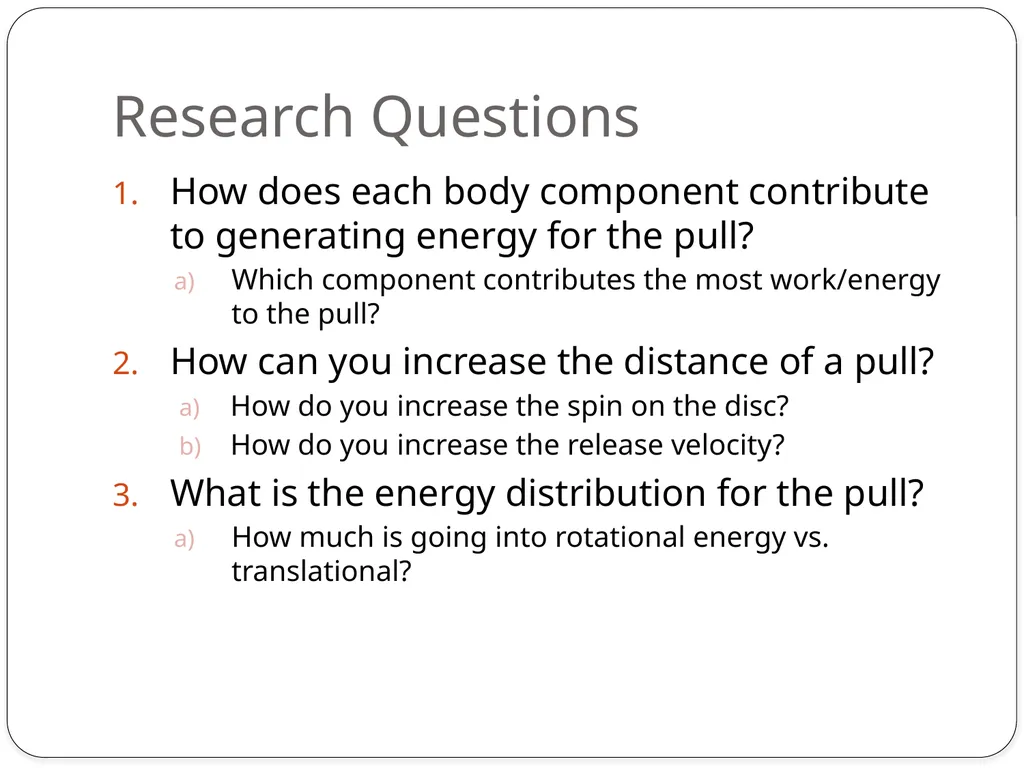
slide2. Types of throws in Ultimate “Normal” throws
Backhand
Forehand- “flick”
Thumber
Push pass
Pull
Inverted Throws
Hammer
Scoober<br>
slide3. Research Questions How does each body component contribute to generating energy for the pull?
Which component contributes the most work/energy to the pull?
How can you increase the distance of a pull?
How do you increase the spin on the disc?
How do you increase the release velocity?
What is the energy distribution for the pull?
How much is going into rotational energy vs. translational?<br>
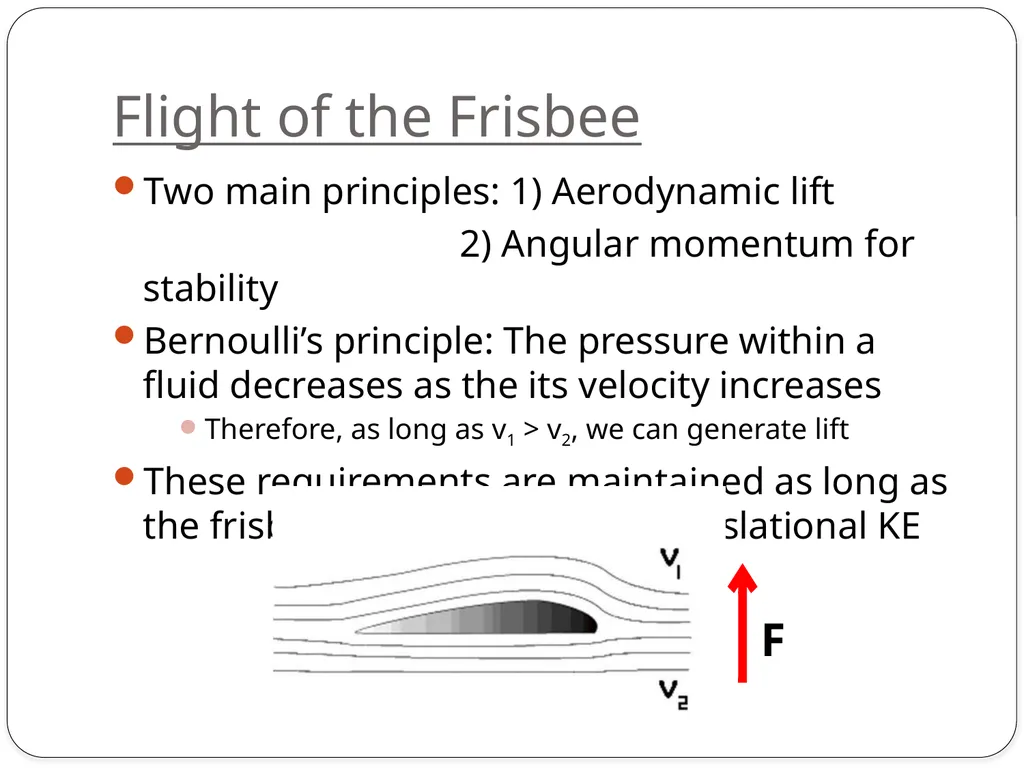
slide4. Flight of the Frisbee Two main principles: 1) Aerodynamic lift
2) Angular momentum for stability
Bernoulli’s principle: The pressure within a fluid decreases as the its velocity increases
Therefore, as long as v1 > v2, we can generate lift
These requirements are maintained as long as the frisbee stays flat and has translational KE F<br>
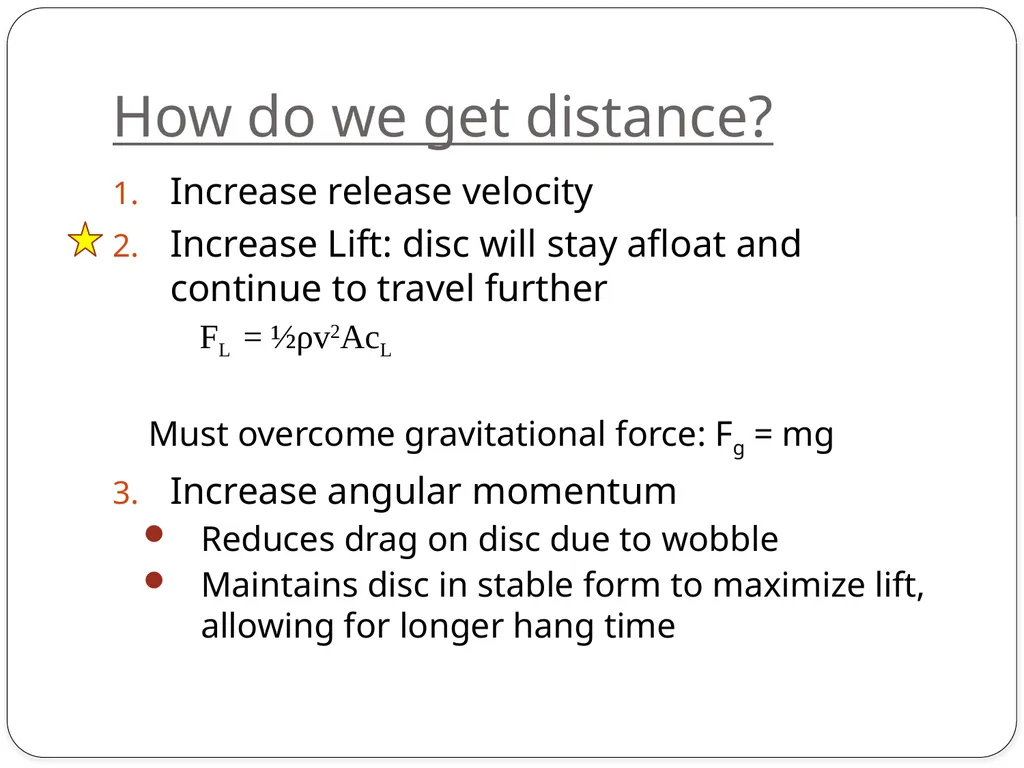
slide5. How do we get distance? Increase release velocity
Increase Lift: disc will stay afloat and continue to travel further
FL = ½ρv2AcL
Must overcome gravitational force: Fg = mg
Increase angular momentum
Reduces drag on disc due to wobble
Maintains disc in stable form to maximize lift, allowing for longer hang time<br>
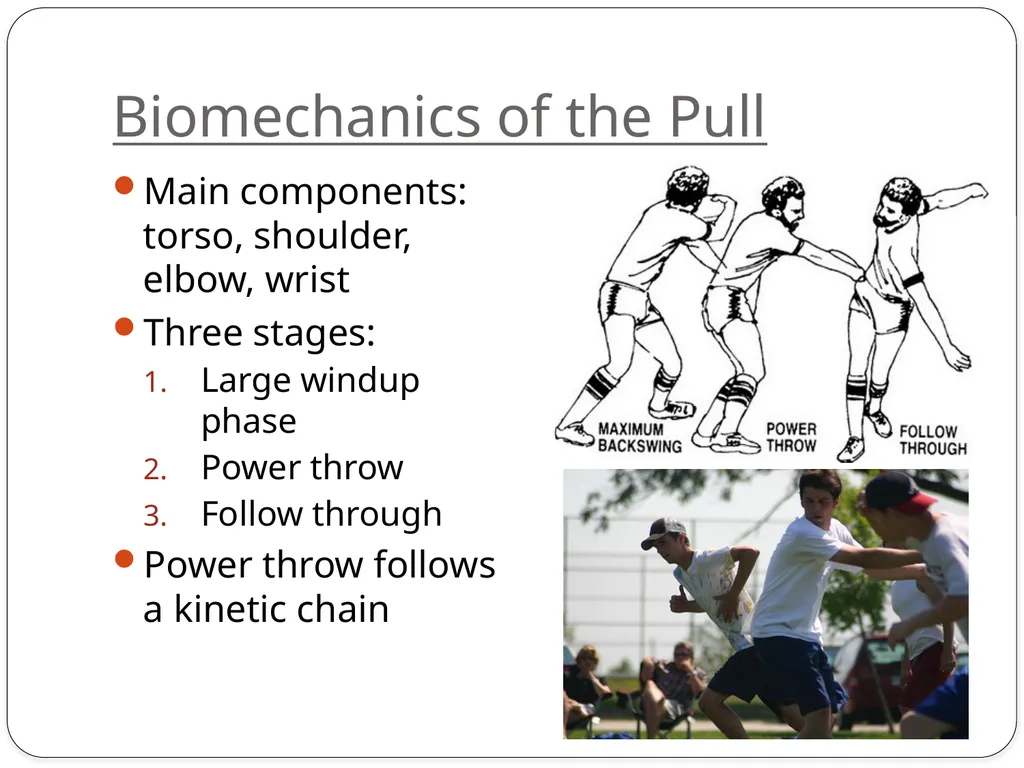
slide6. Biomechanics of the Pull Main components: torso, shoulder, elbow, wrist
Three stages:
Large windup phase
Power throw
Follow through
Power throw follows a kinetic chain<br>
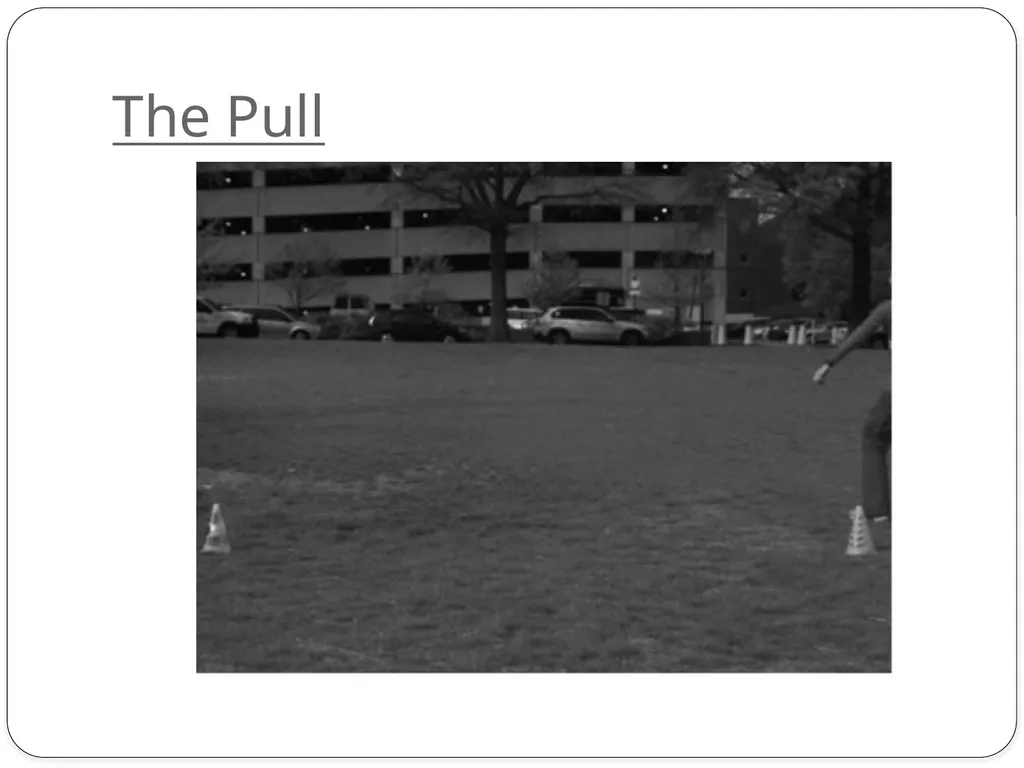
slide7. The Pull<br>
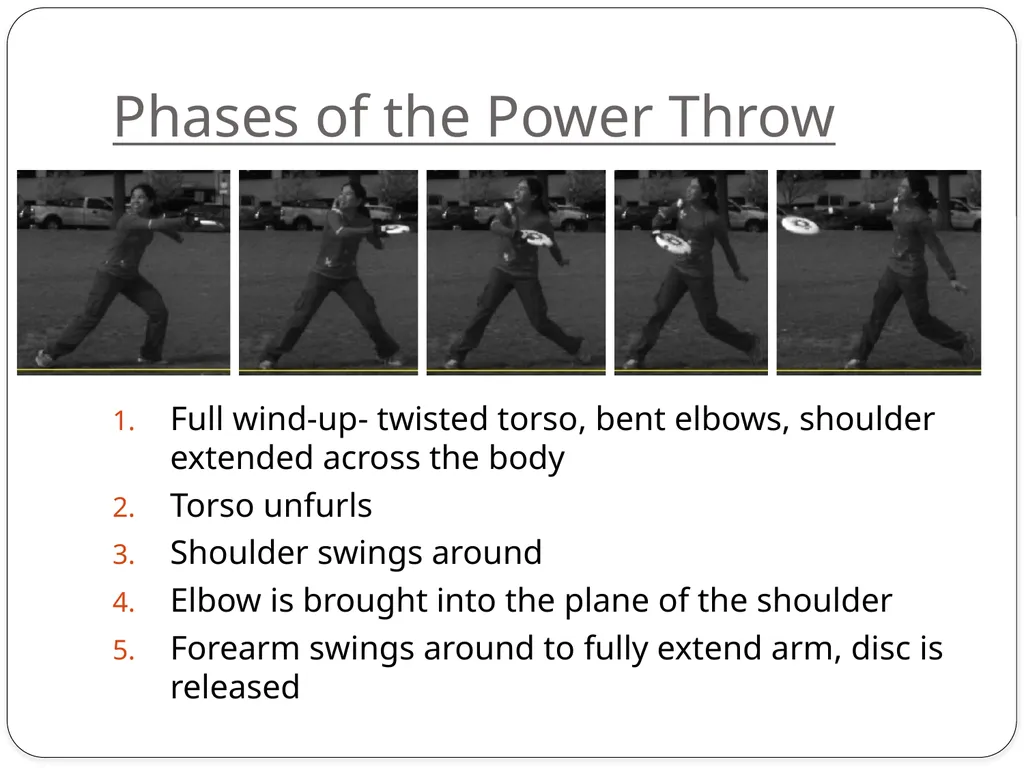
slide8. Phases of the Power Throw Full wind-up- twisted torso, bent elbows, shoulder extended across the body
Torso unfurls
Shoulder swings around
Elbow is brought into the plane of the shoulder
Forearm swings around to fully extend arm, disc is released<br>
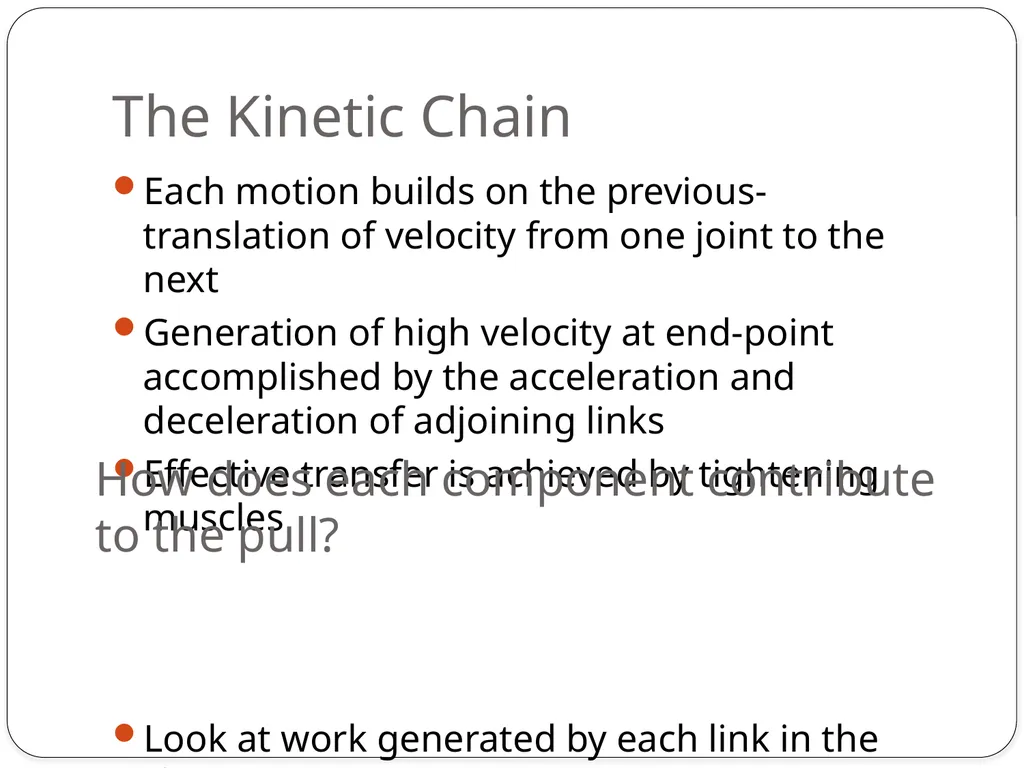
slide9. The Kinetic Chain Each motion builds on the previous- translation of velocity from one joint to the next
Generation of high velocity at end-point accomplished by the acceleration and deceleration of adjoining links
Effective transfer is achieved by tightening muscles
Look at work generated by each link in the chain How does each component contribute to the pull?<br>
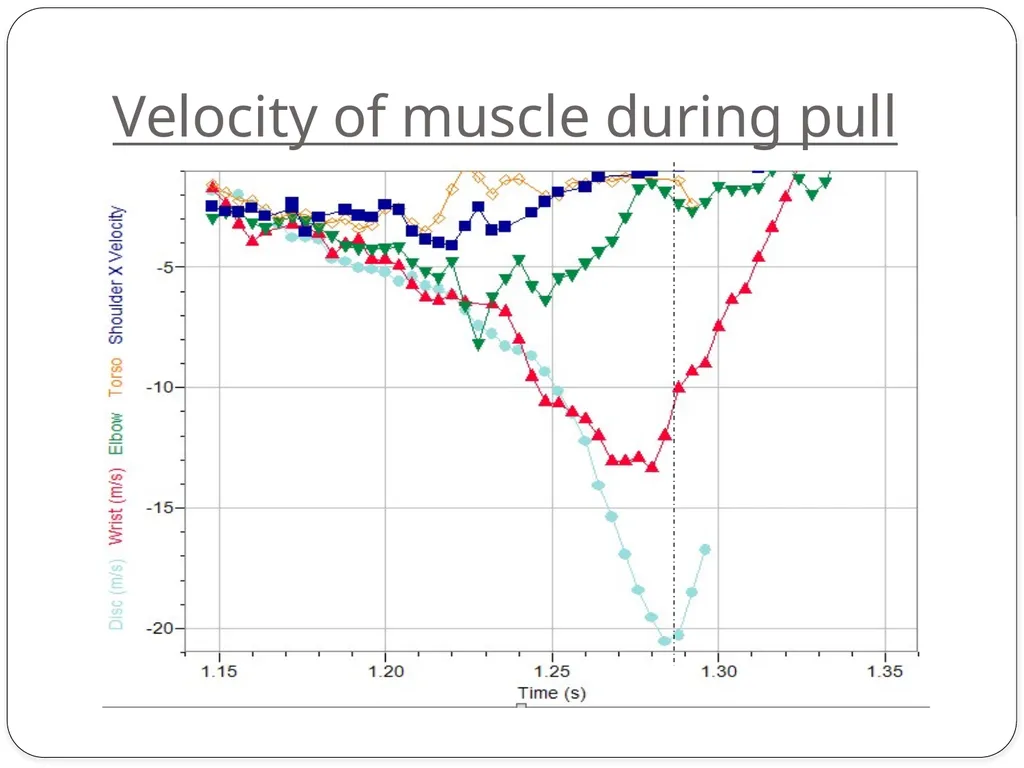
slide10. Velocity of muscle during pull<br>
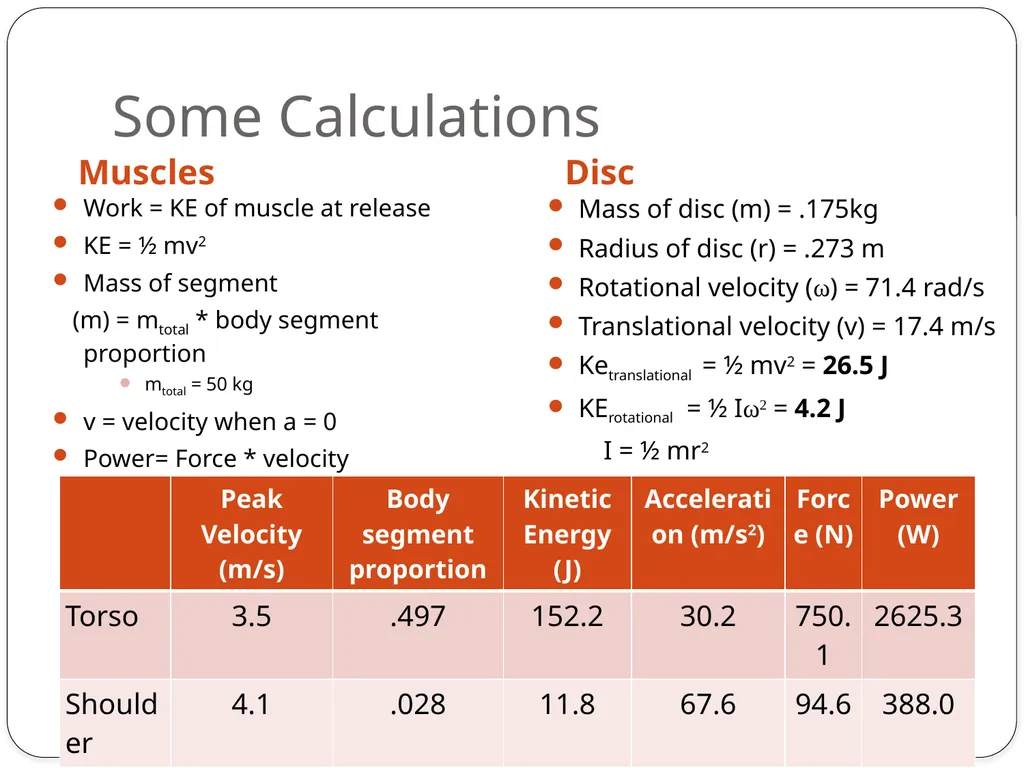
slide11. Some Calculations Muscles Disc Work = KE of muscle at release
KE = ½ mv2
Mass of segment
(m) = mtotal * body segment proportion
mtotal = 50 kg
v = velocity when a = 0
Power= Force * velocity
Force= m * acceleration Mass of disc (m) = .175kg
Radius of disc (r) = .273 m
Rotational velocity (ω) = 71.4 rad/s
Translational velocity (v) = 17.4 m/s
Ketranslational = ½ mv2 = 26.5 J
KErotational = ½ Iω2 = 4.2 J
I = ½ mr2<br>
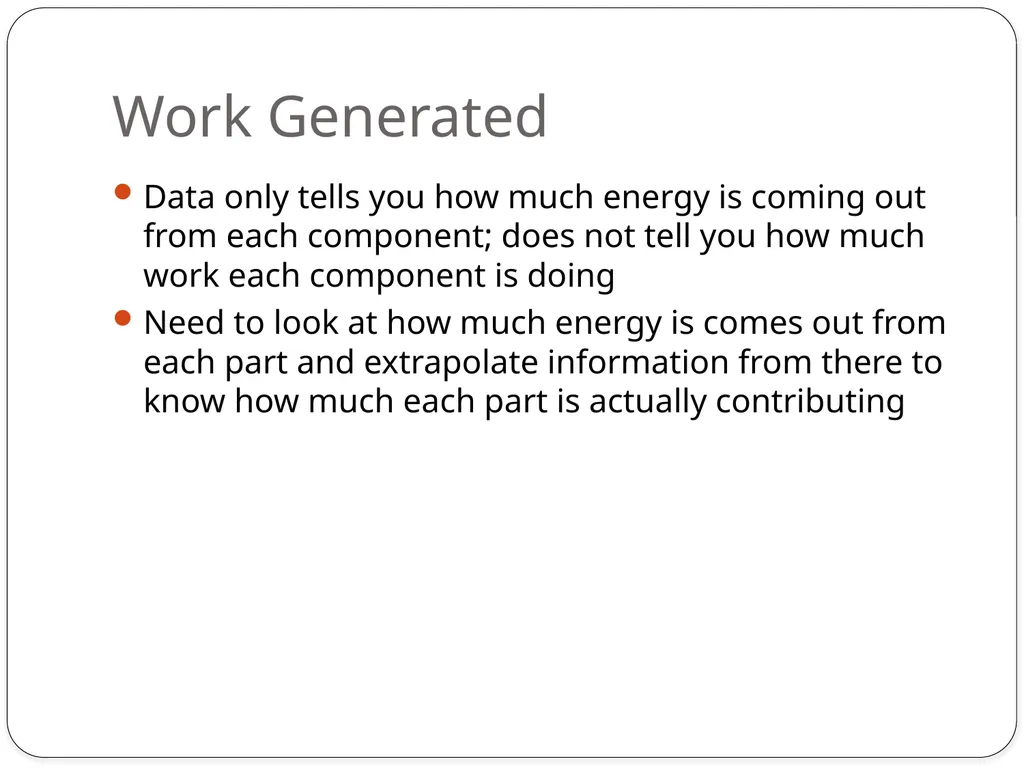
slide12. Work Generated Data only tells you how much energy is coming out from each component; does not tell you how much work each component is doing
Need to look at how much energy is comes out from each part and extrapolate information from there to know how much each part is actually contributing<br>
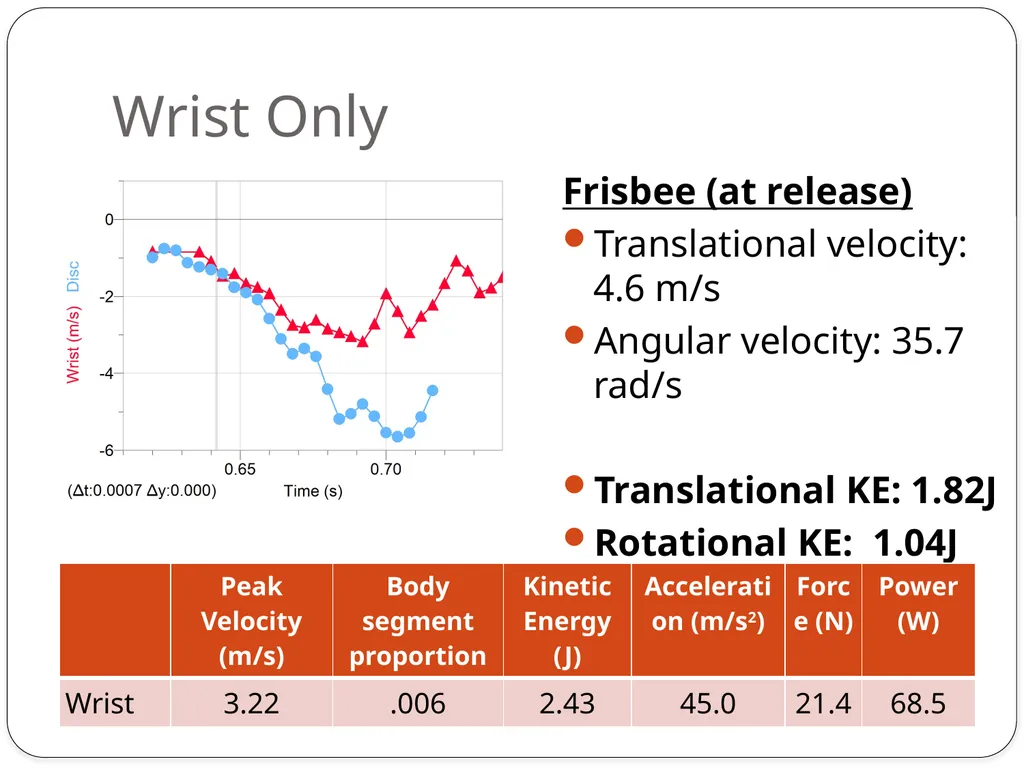
slide13. Wrist Only Frisbee (at release)
Translational velocity: 4.6 m/s
Angular velocity: 35.7 rad/s
Translational KE: 1.82J
Rotational KE: 1.04J<br>
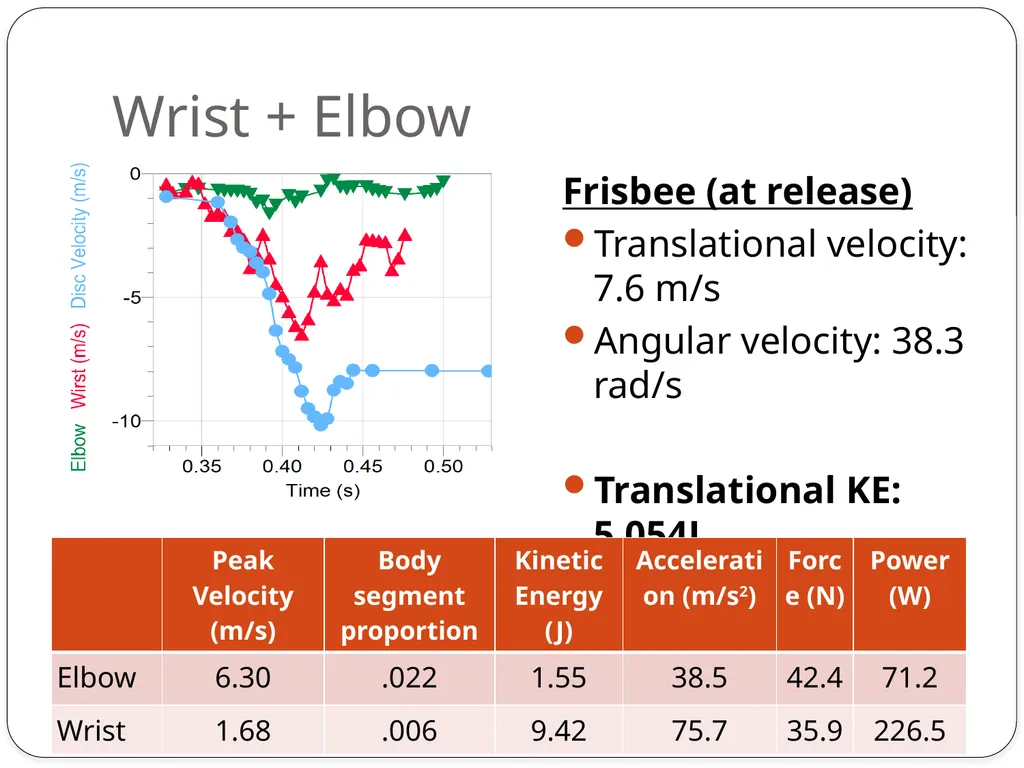
slide14. Wrist + Elbow Frisbee (at release)
Translational velocity: 7.6 m/s
Angular velocity: 38.3 rad/s
Translational KE: 5.054J
Rotational KE: 1.2J<br>
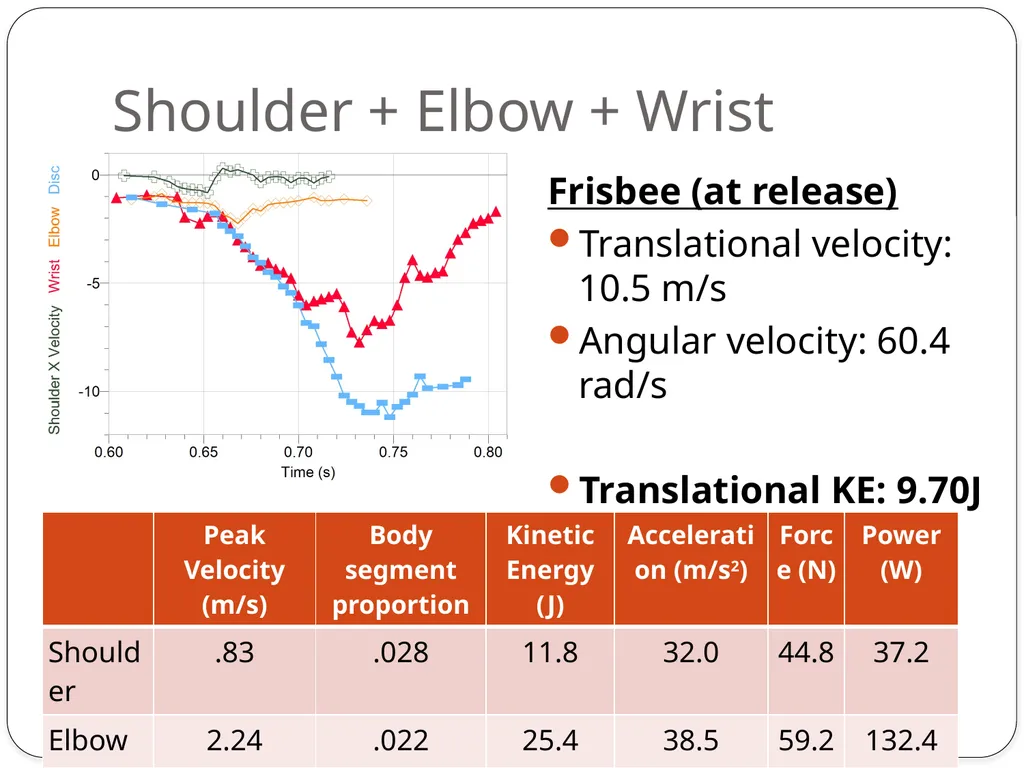
slide15. Shoulder + Elbow + Wrist Frisbee (at release)
Translational velocity: 10.5 m/s
Angular velocity: 60.4 rad/s
Translational KE: 9.70J
Rotational KE: 2.97J<br>
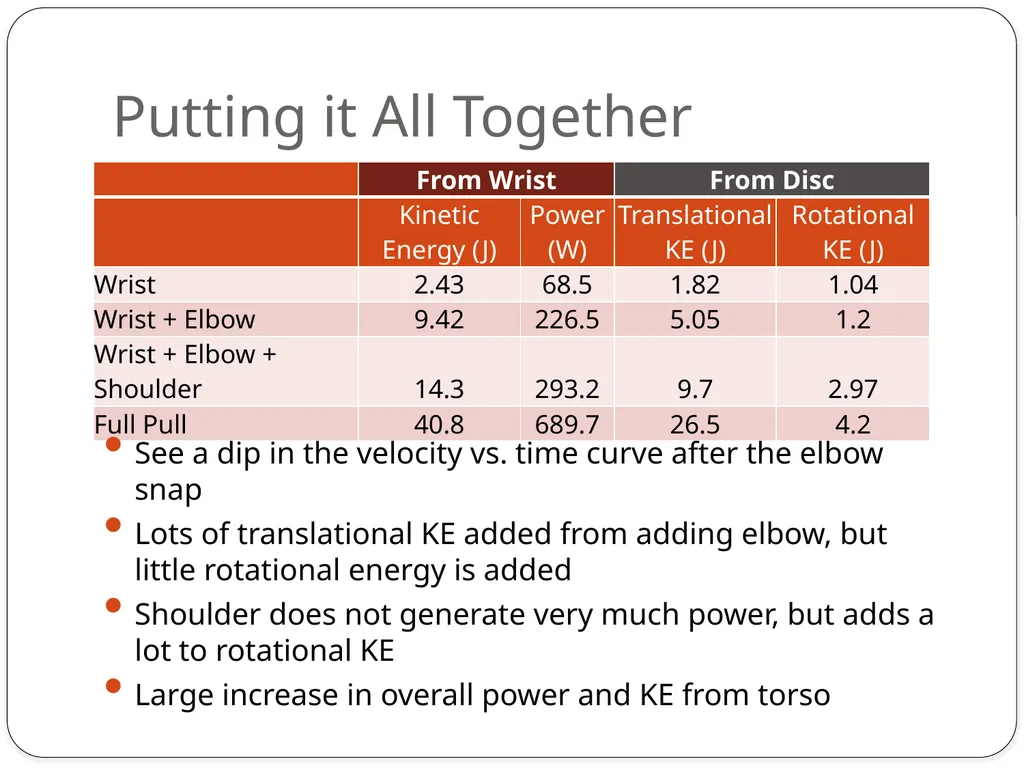
slide16. Putting it All Together See a dip in the velocity vs. time curve after the elbow snap
Lots of translational KE added from adding elbow, but little rotational energy is added
Shoulder does not generate very much power, but adds a lot to rotational KE
Large increase in overall power and KE from torso<br>
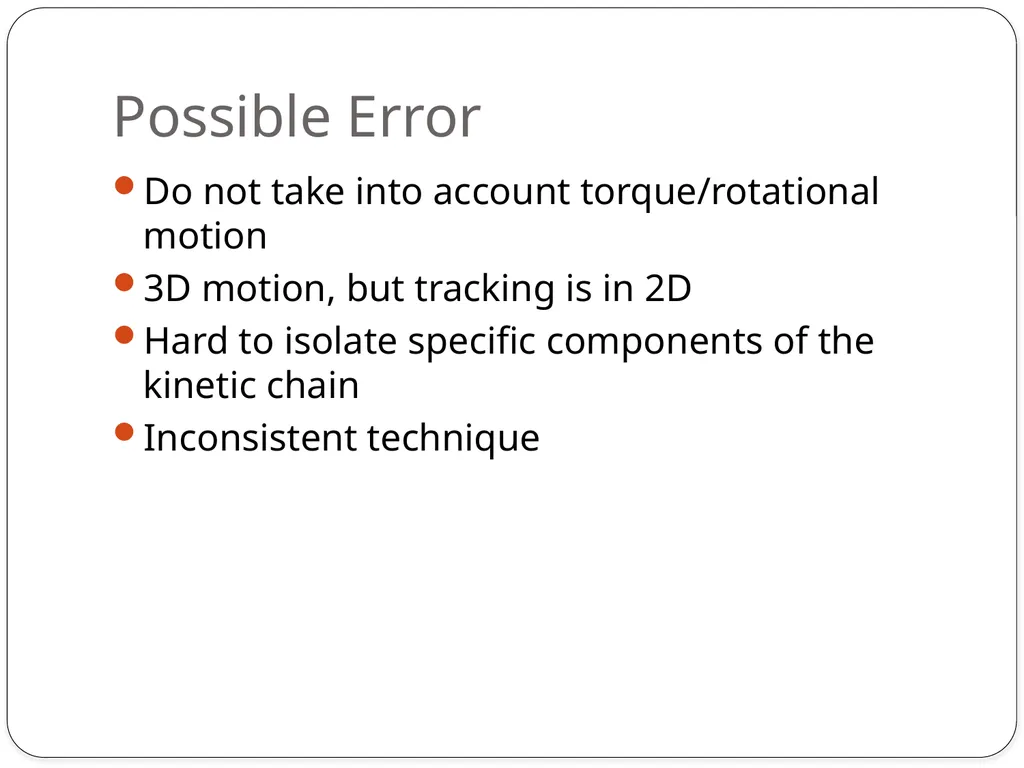
slide17. Possible Error Do not take into account torque/rotational motion
3D motion, but tracking is in 2D
Hard to isolate specific components of the kinetic chain
Inconsistent technique<br>
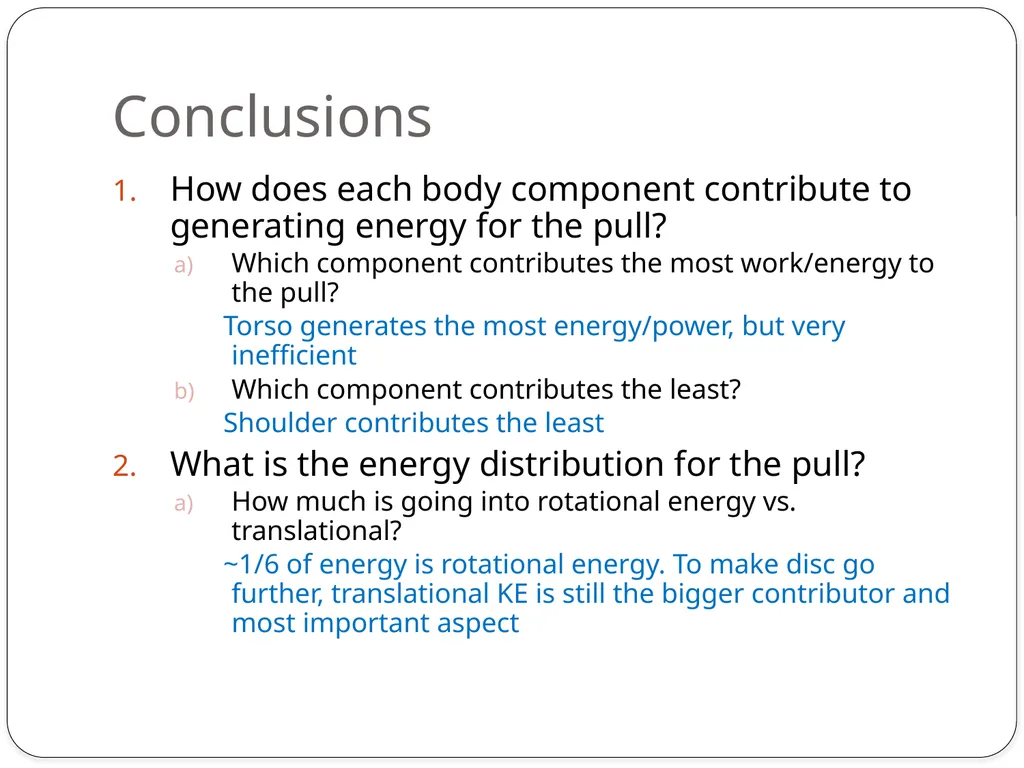
slide18. Conclusions How does each body component contribute to generating energy for the pull?
Which component contributes the most work/energy to the pull?
Torso generates the most energy/power, but very inefficient
Which component contributes the least?
Shoulder contributes the least
What is the energy distribution for the pull?
How much is going into rotational energy vs. translational?
~1/6 of energy is rotational energy. To make disc go further, translational KE is still the bigger contributor and most important aspect<br>
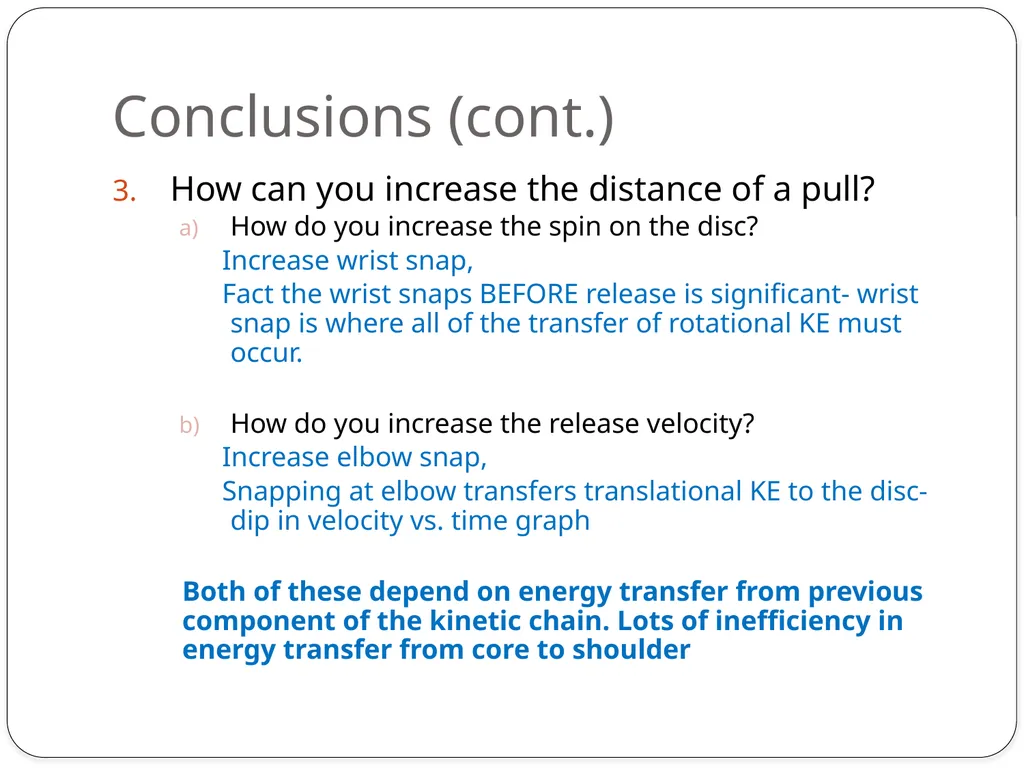
slide19. Conclusions (cont.) How can you increase the distance of a pull?
How do you increase the spin on the disc?
Increase wrist snap,
Fact the wrist snaps BEFORE release is significant- wrist snap is where all of the transfer of rotational KE must occur.
How do you increase the release velocity?
Increase elbow snap,
Snapping at elbow transfers translational KE to the disc- dip in velocity vs. time graph
Both of these depend on energy transfer from previous component of the kinetic chain. Lots of inefficiency in energy transfer from core to shoulder<br>
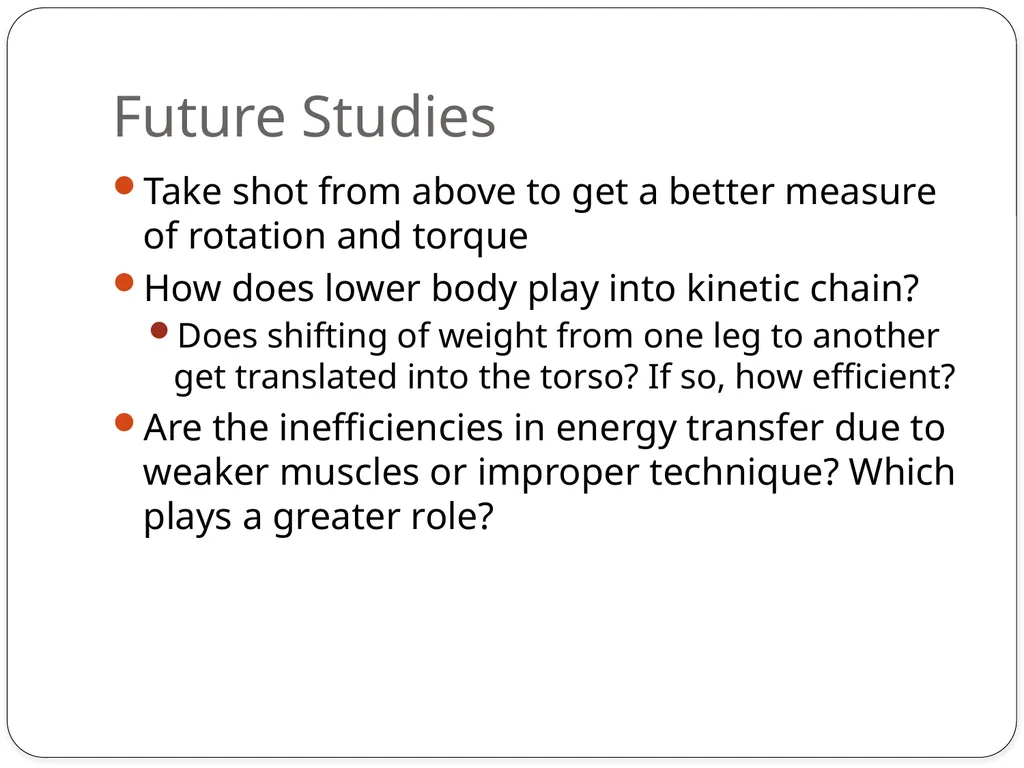
slide20. Future Studies Take shot from above to get a better measure of rotation and torque
How does lower body play into kinetic chain?
Does shifting of weight from one leg to another get translated into the torso? If so, how efficient?
Are the inefficiencies in energy transfer due to weaker muscles or improper technique? Which plays a greater role?<br>
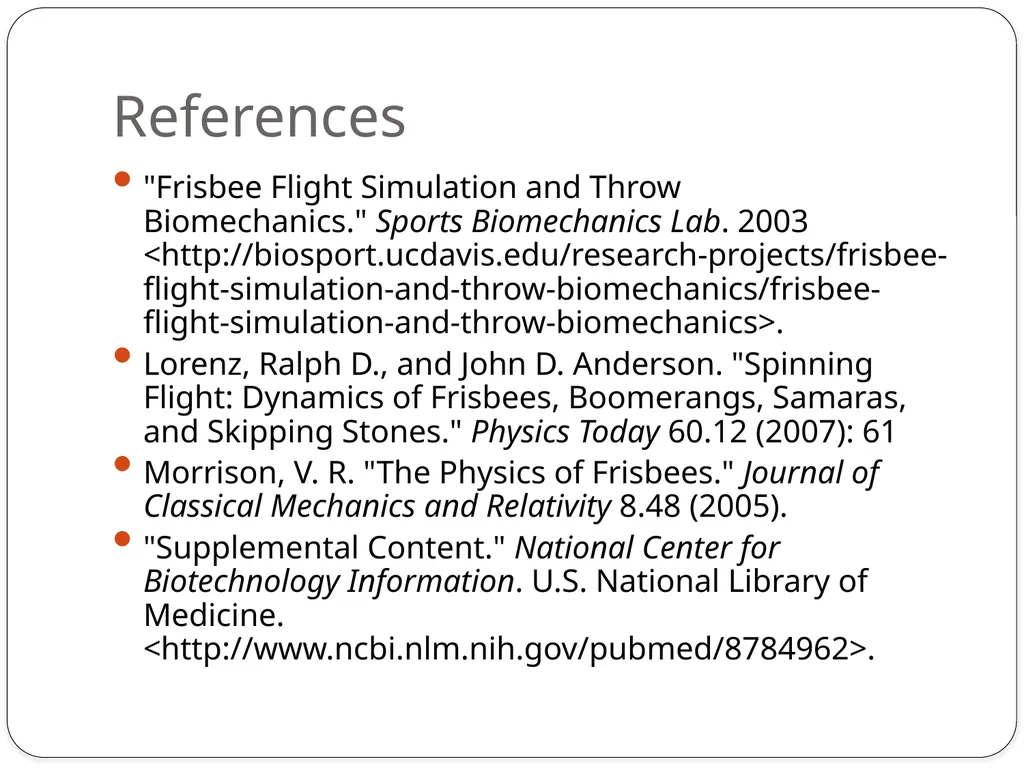
slide21. References "Frisbee Flight Simulation and Throw Biomechanics." Sports Biomechanics Lab. 2003 <http://biosport.ucdavis.edu/research-projects/frisbee-flight-simulation-and-throw-biomechanics/frisbee-flight-simulation-and-throw-biomechanics>.
Lorenz, Ralph D., and John D. Anderson. "Spinning Flight: Dynamics of Frisbees, Boomerangs, Samaras, and Skipping Stones." Physics Today 60.12 (2007): 61
Morrison, V. R. "The Physics of Frisbees." Journal of Classical Mechanics and Relativity 8.48 (2005).
"Supplemental Content." National Center for Biotechnology Information. U.S. National Library of Medicine. <http://www.ncbi.nlm.nih.gov/pubmed/8784962>.<br>

Professor Rome
Spring 2012 Biomechanics of a Pull in Ultimate<br>
slide2. Types of throws in Ultimate “Normal” throws
Backhand
Forehand- “flick”
Thumber
Push pass
Pull
Inverted Throws
Hammer
Scoober<br>
slide3. Research Questions How does each body component contribute to generating energy for the pull?
Which component contributes the most work/energy to the pull?
How can you increase the distance of a pull?
How do you increase the spin on the disc?
How do you increase the release velocity?
What is the energy distribution for the pull?
How much is going into rotational energy vs. translational?<br>
slide4. Flight of the Frisbee Two main principles: 1) Aerodynamic lift
2) Angular momentum for stability
Bernoulli’s principle: The pressure within a fluid decreases as the its velocity increases
Therefore, as long as v1 > v2, we can generate lift
These requirements are maintained as long as the frisbee stays flat and has translational KE F<br>
slide5. How do we get distance? Increase release velocity
Increase Lift: disc will stay afloat and continue to travel further
FL = ½ρv2AcL
Must overcome gravitational force: Fg = mg
Increase angular momentum
Reduces drag on disc due to wobble
Maintains disc in stable form to maximize lift, allowing for longer hang time<br>
slide6. Biomechanics of the Pull Main components: torso, shoulder, elbow, wrist
Three stages:
Large windup phase
Power throw
Follow through
Power throw follows a kinetic chain<br>
slide7. The Pull<br>
slide8. Phases of the Power Throw Full wind-up- twisted torso, bent elbows, shoulder extended across the body
Torso unfurls
Shoulder swings around
Elbow is brought into the plane of the shoulder
Forearm swings around to fully extend arm, disc is released<br>
slide9. The Kinetic Chain Each motion builds on the previous- translation of velocity from one joint to the next
Generation of high velocity at end-point accomplished by the acceleration and deceleration of adjoining links
Effective transfer is achieved by tightening muscles
Look at work generated by each link in the chain How does each component contribute to the pull?<br>
slide10. Velocity of muscle during pull<br>
slide11. Some Calculations Muscles Disc Work = KE of muscle at release
KE = ½ mv2
Mass of segment
(m) = mtotal * body segment proportion
mtotal = 50 kg
v = velocity when a = 0
Power= Force * velocity
Force= m * acceleration Mass of disc (m) = .175kg
Radius of disc (r) = .273 m
Rotational velocity (ω) = 71.4 rad/s
Translational velocity (v) = 17.4 m/s
Ketranslational = ½ mv2 = 26.5 J
KErotational = ½ Iω2 = 4.2 J
I = ½ mr2<br>
slide12. Work Generated Data only tells you how much energy is coming out from each component; does not tell you how much work each component is doing
Need to look at how much energy is comes out from each part and extrapolate information from there to know how much each part is actually contributing<br>
slide13. Wrist Only Frisbee (at release)
Translational velocity: 4.6 m/s
Angular velocity: 35.7 rad/s
Translational KE: 1.82J
Rotational KE: 1.04J<br>
slide14. Wrist + Elbow Frisbee (at release)
Translational velocity: 7.6 m/s
Angular velocity: 38.3 rad/s
Translational KE: 5.054J
Rotational KE: 1.2J<br>
slide15. Shoulder + Elbow + Wrist Frisbee (at release)
Translational velocity: 10.5 m/s
Angular velocity: 60.4 rad/s
Translational KE: 9.70J
Rotational KE: 2.97J<br>
slide16. Putting it All Together See a dip in the velocity vs. time curve after the elbow snap
Lots of translational KE added from adding elbow, but little rotational energy is added
Shoulder does not generate very much power, but adds a lot to rotational KE
Large increase in overall power and KE from torso<br>
slide17. Possible Error Do not take into account torque/rotational motion
3D motion, but tracking is in 2D
Hard to isolate specific components of the kinetic chain
Inconsistent technique<br>
slide18. Conclusions How does each body component contribute to generating energy for the pull?
Which component contributes the most work/energy to the pull?
Torso generates the most energy/power, but very inefficient
Which component contributes the least?
Shoulder contributes the least
What is the energy distribution for the pull?
How much is going into rotational energy vs. translational?
~1/6 of energy is rotational energy. To make disc go further, translational KE is still the bigger contributor and most important aspect<br>
slide19. Conclusions (cont.) How can you increase the distance of a pull?
How do you increase the spin on the disc?
Increase wrist snap,
Fact the wrist snaps BEFORE release is significant- wrist snap is where all of the transfer of rotational KE must occur.
How do you increase the release velocity?
Increase elbow snap,
Snapping at elbow transfers translational KE to the disc- dip in velocity vs. time graph
Both of these depend on energy transfer from previous component of the kinetic chain. Lots of inefficiency in energy transfer from core to shoulder<br>
slide20. Future Studies Take shot from above to get a better measure of rotation and torque
How does lower body play into kinetic chain?
Does shifting of weight from one leg to another get translated into the torso? If so, how efficient?
Are the inefficiencies in energy transfer due to weaker muscles or improper technique? Which plays a greater role?<br>
slide21. References "Frisbee Flight Simulation and Throw Biomechanics." Sports Biomechanics Lab. 2003 <http://biosport.ucdavis.edu/research-projects/frisbee-flight-simulation-and-throw-biomechanics/frisbee-flight-simulation-and-throw-biomechanics>.
Lorenz, Ralph D., and John D. Anderson. "Spinning Flight: Dynamics of Frisbees, Boomerangs, Samaras, and Skipping Stones." Physics Today 60.12 (2007): 61
Morrison, V. R. "The Physics of Frisbees." Journal of Classical Mechanics and Relativity 8.48 (2005).
"Supplemental Content." National Center for Biotechnology Information. U.S. National Library of Medicine. <http://www.ncbi.nlm.nih.gov/pubmed/8784962>.<br>