
STANDARDS: SS8CG4 The student will analyze the
PT
Published · 44 slides · 0 views

1 / 1








Description
STANDARDS: SS8CG4 The student will analyze the role of the judicial branch in Georgia state government. a. Explain the structure of the court system in Georgia including trial and appellate procedures and how judges are selected. b. Explain
Related Topics
Share
Embed code
Download this presentation From Below
"STANDARDS: SS8CG4 The student will analyze the" is the property of its rightful owner. Permission is granted to download and print the materials on this website for personal, non-commercial use only, and to display it on your personal computer provided you do not modify the materials and that you retain all copyright notices contained in the materials. By downloading content from our website, you accept the terms of this agreement.
Presentation Transcript
01
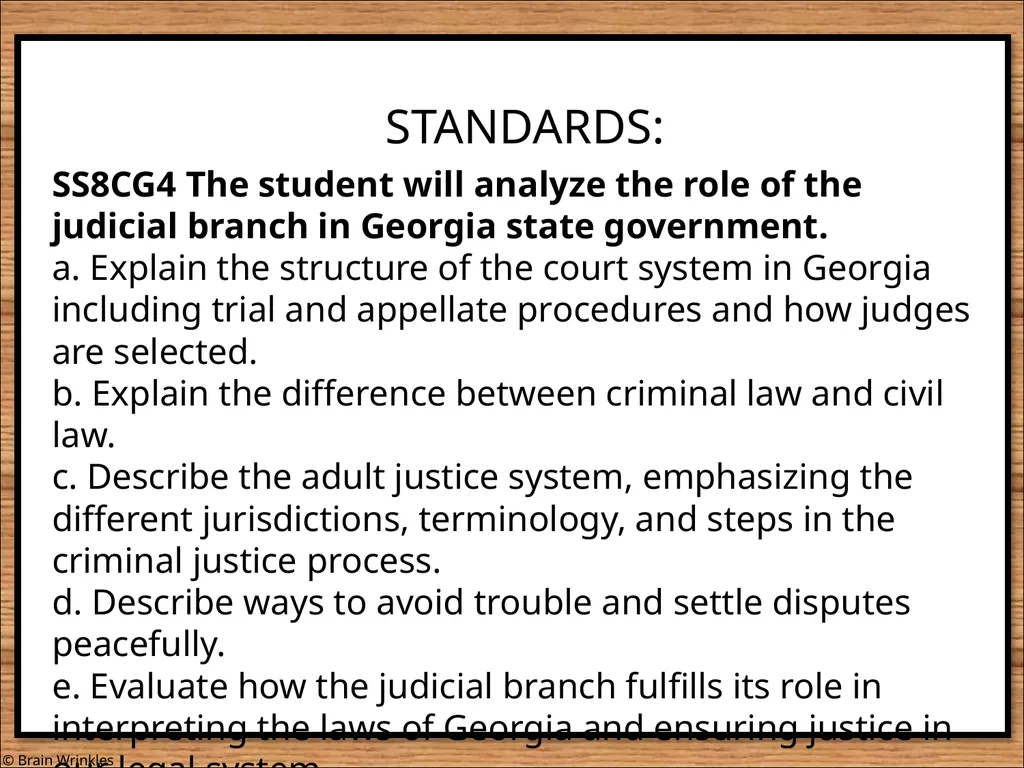
STANDARDS:
SS8CG4 The student will analyze the role of the judicial branch in Georgia state government.
a. Explain the structure of the court system in Georgia including trial and appellate procedures and how judges are selected.
b. Explain the difference between criminal law and civil law.
c. Describe the adult justice system, emphasizing the different jurisdictions, terminology, and steps in the criminal justice process.
d. Describe ways to avoid trouble and settle disputes peacefully.
e. Evaluate how the judicial branch fulfills its role in interpreting the laws of Georgia and ensuring justice in our legal system. © Brain Wrinkles<br>
SS8CG4 The student will analyze the role of the judicial branch in Georgia state government.
a. Explain the structure of the court system in Georgia including trial and appellate procedures and how judges are selected.
b. Explain the difference between criminal law and civil law.
c. Describe the adult justice system, emphasizing the different jurisdictions, terminology, and steps in the criminal justice process.
d. Describe ways to avoid trouble and settle disputes peacefully.
e. Evaluate how the judicial branch fulfills its role in interpreting the laws of Georgia and ensuring justice in our legal system. © Brain Wrinkles<br>
02
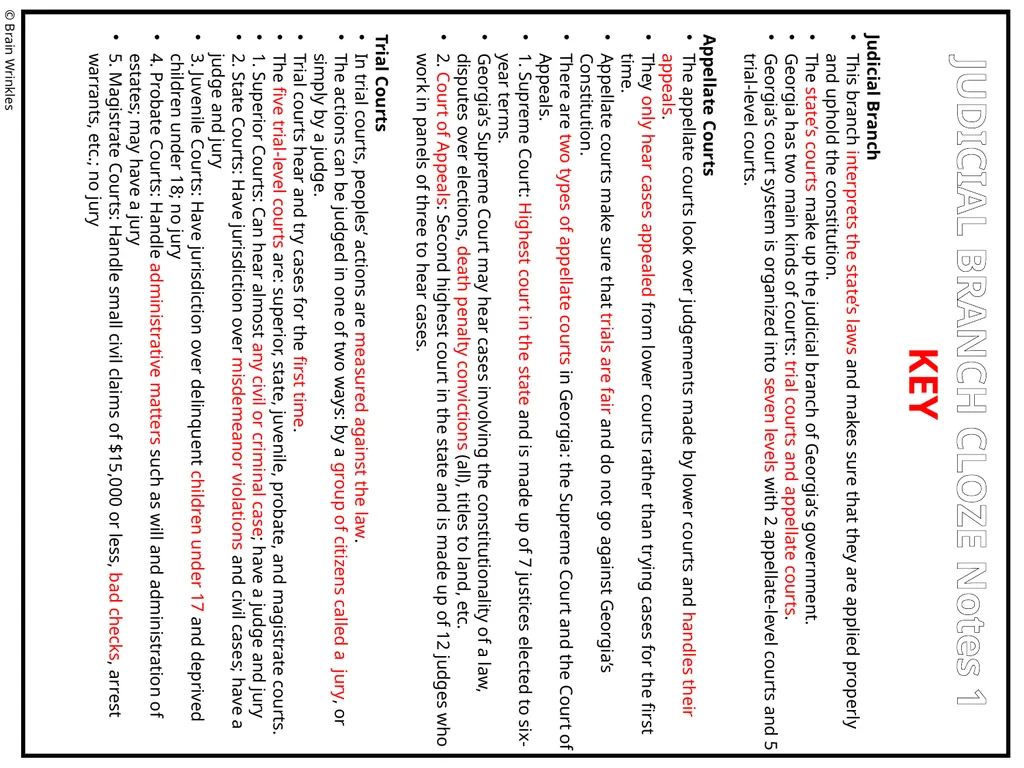
JUDICIAL BRANCH CLOZE Notes 1
KEY Judicial Branch
This branch interprets the state’s laws and makes sure that they are applied properly and uphold the constitution.
The state’s courts make up the judicial branch of Georgia’s government.
Georgia has two main kinds of courts: trial courts and appellate courts.
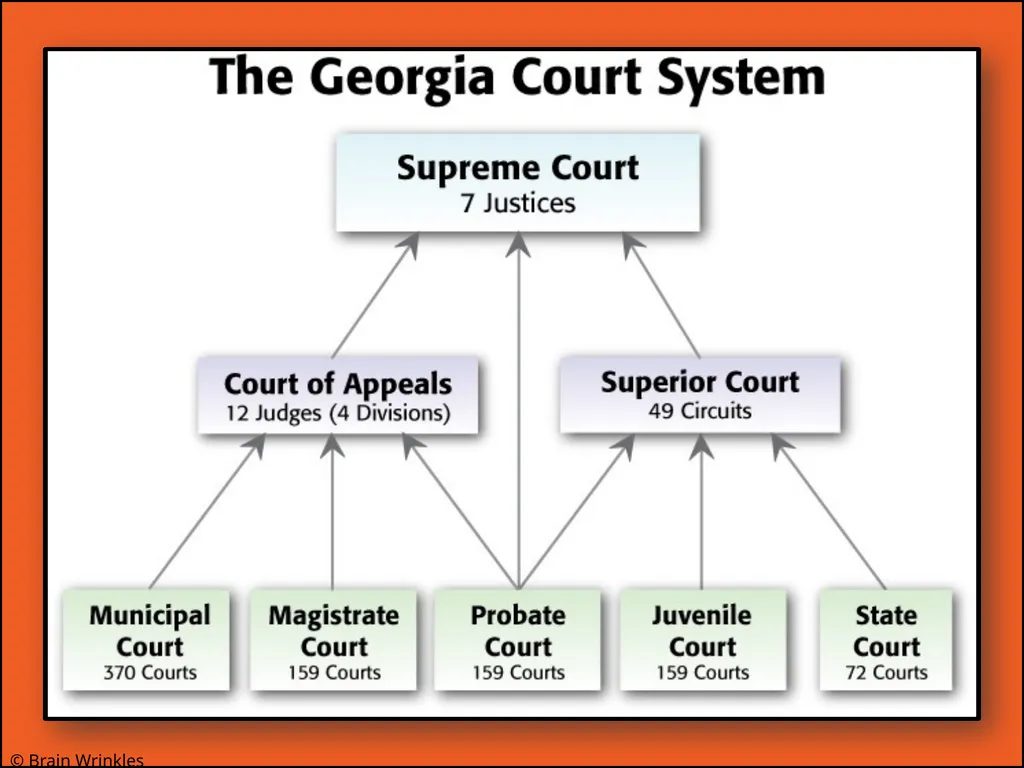
Georgia’s court system is organized into seven levels with 2 appellate-level courts and 5 trial-level courts.
Appellate Courts
The appellate courts look over judgements made by lower courts and handles their appeals.
They only hear cases appealed from lower courts rather than trying cases for the first time.
Appellate courts make sure that trials are fair and do not go against Georgia’s Constitution.
There are two types of appellate courts in Georgia: the Supreme Court and the Court of Appeals.
1. Supreme Court: Highest court in the state and is made up of 7 justices elected to six-year terms.
Georgia’s Supreme Court may hear cases involving the constitutionality of a law, disputes over elections, death penalty convictions (all), titles to land, etc.
2. Court of Appeals: Second highest court in the state and is made up of 12 judges who work in panels of three to hear cases.
Trial Courts
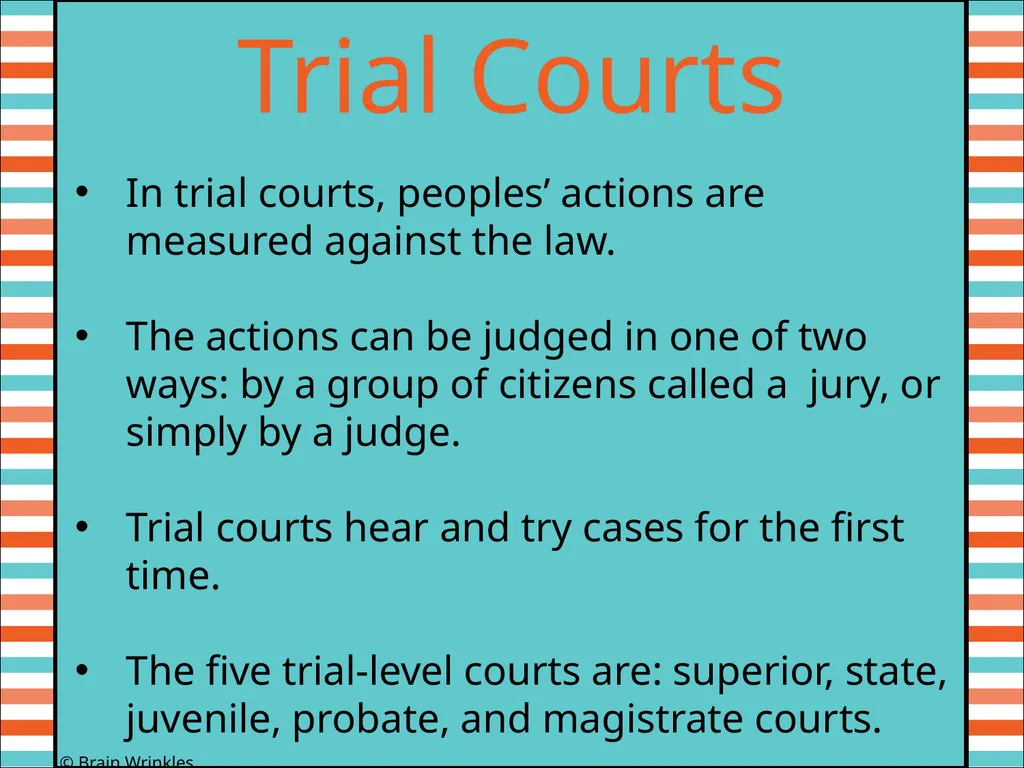
In trial courts, peoples’ actions are measured against the law.
The actions can be judged in one of two ways: by a group of citizens called a jury, or simply by a judge.
Trial courts hear and try cases for the first time.
The five trial-level courts are: superior, state, juvenile, probate, and magistrate courts.
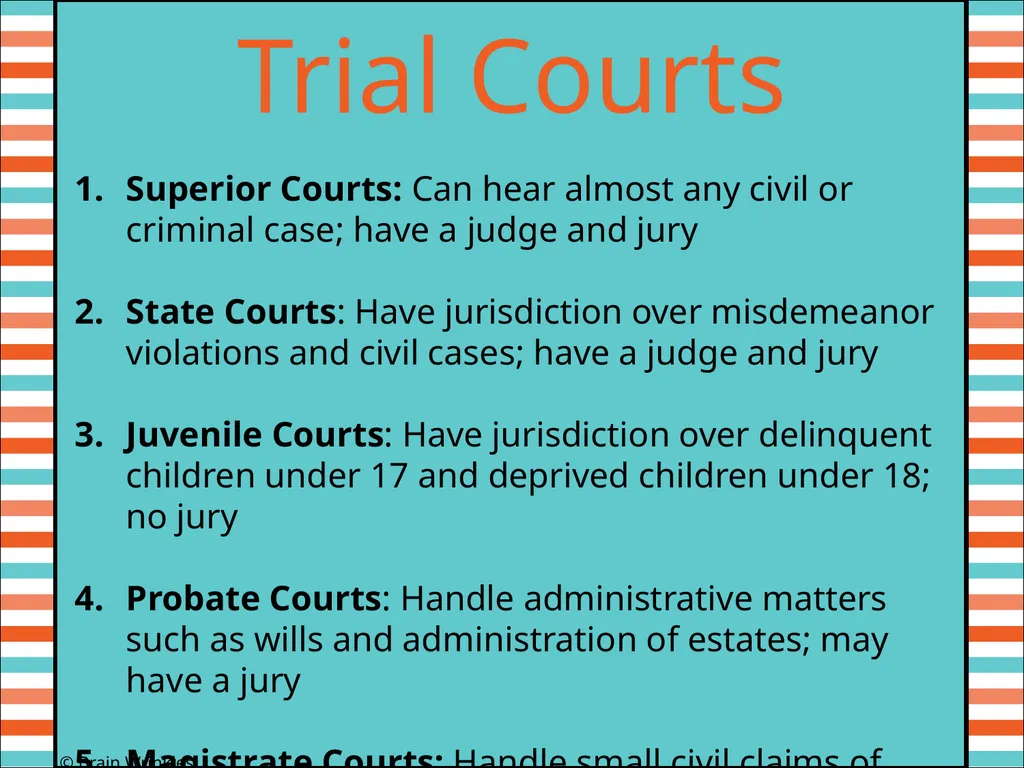
1. Superior Courts: Can hear almost any civil or criminal case; have a judge and jury
2. State Courts: Have jurisdiction over misdemeanor violations and civil cases; have a judge and jury
3. Juvenile Courts: Have jurisdiction over delinquent children under 17 and deprived children under 18; no jury
4. Probate Courts: Handle administrative matters such as will and administration of estates; may have a jury
5. Magistrate Courts: Handle small civil claims of $15,000 or less, bad checks, arrest warrants, etc.; no jury © Brain Wrinkles<br>
KEY Judicial Branch
This branch interprets the state’s laws and makes sure that they are applied properly and uphold the constitution.
The state’s courts make up the judicial branch of Georgia’s government.
Georgia has two main kinds of courts: trial courts and appellate courts.
Georgia’s court system is organized into seven levels with 2 appellate-level courts and 5 trial-level courts.
Appellate Courts
The appellate courts look over judgements made by lower courts and handles their appeals.
They only hear cases appealed from lower courts rather than trying cases for the first time.
Appellate courts make sure that trials are fair and do not go against Georgia’s Constitution.
There are two types of appellate courts in Georgia: the Supreme Court and the Court of Appeals.
1. Supreme Court: Highest court in the state and is made up of 7 justices elected to six-year terms.
Georgia’s Supreme Court may hear cases involving the constitutionality of a law, disputes over elections, death penalty convictions (all), titles to land, etc.
2. Court of Appeals: Second highest court in the state and is made up of 12 judges who work in panels of three to hear cases.
Trial Courts
In trial courts, peoples’ actions are measured against the law.
The actions can be judged in one of two ways: by a group of citizens called a jury, or simply by a judge.
Trial courts hear and try cases for the first time.
The five trial-level courts are: superior, state, juvenile, probate, and magistrate courts.
1. Superior Courts: Can hear almost any civil or criminal case; have a judge and jury
2. State Courts: Have jurisdiction over misdemeanor violations and civil cases; have a judge and jury
3. Juvenile Courts: Have jurisdiction over delinquent children under 17 and deprived children under 18; no jury
4. Probate Courts: Handle administrative matters such as will and administration of estates; may have a jury
5. Magistrate Courts: Handle small civil claims of $15,000 or less, bad checks, arrest warrants, etc.; no jury © Brain Wrinkles<br>
03
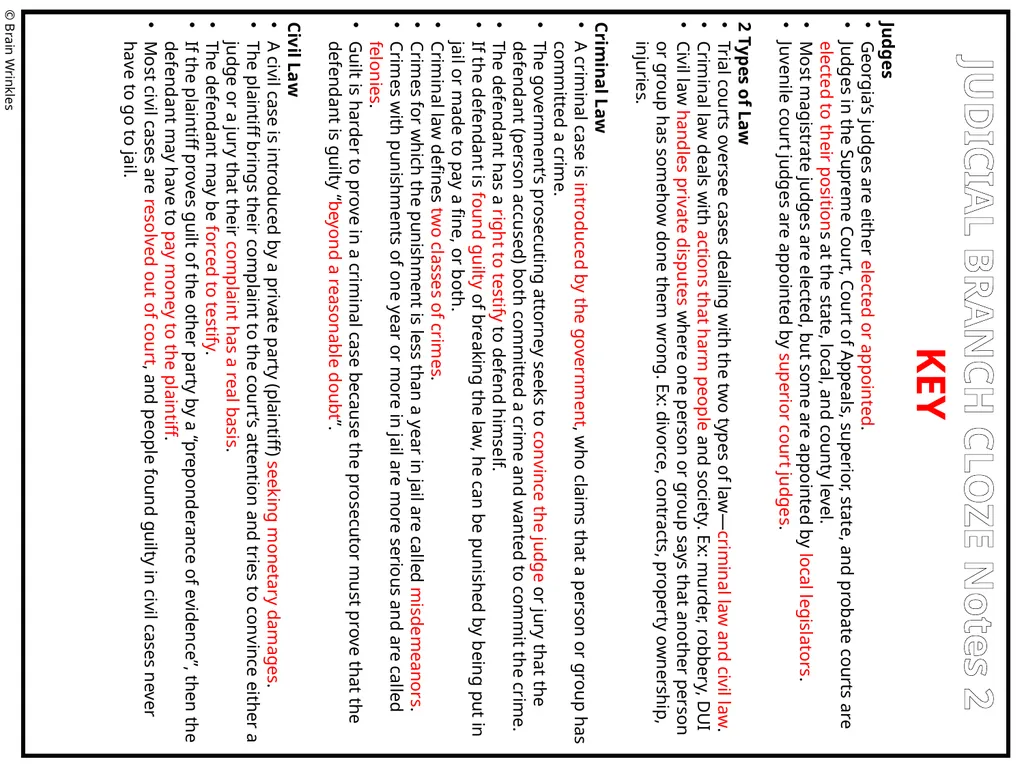
JUDICIAL BRANCH CLOZE Notes 2
KEY Judges
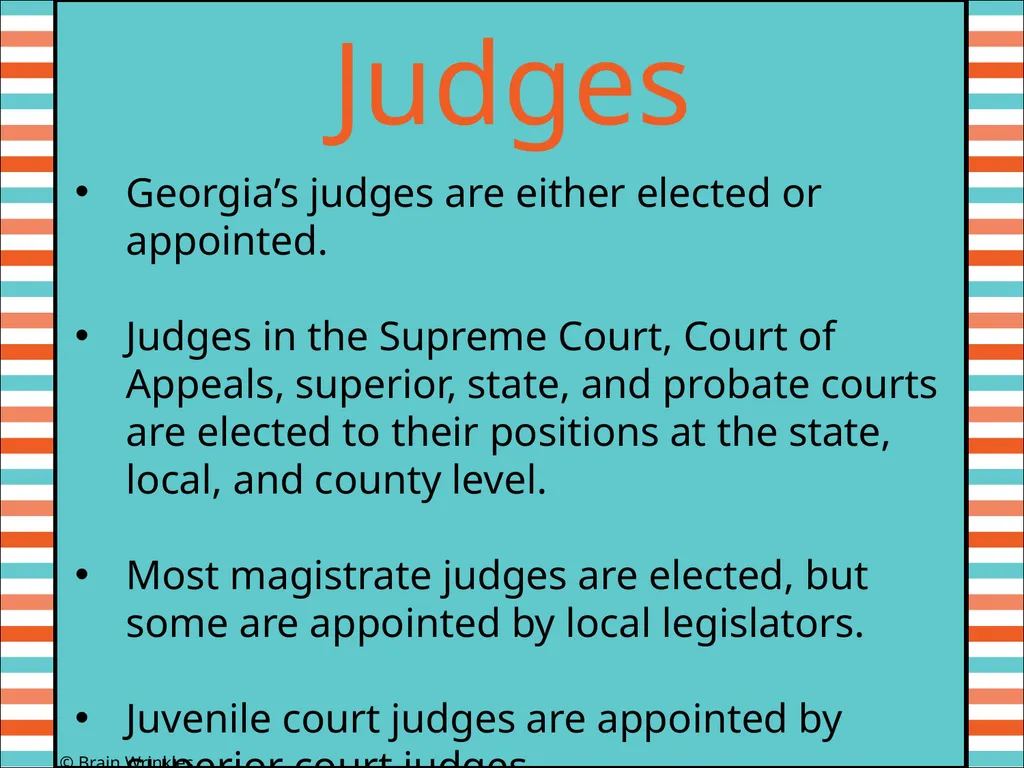
Georgia’s judges are either elected or appointed.
Judges in the Supreme Court, Court of Appeals, superior, state, and probate courts are elected to their positions at the state, local, and county level.
Most magistrate judges are elected, but some are appointed by local legislators.
Juvenile court judges are appointed by superior court judges.
2 Types of Law
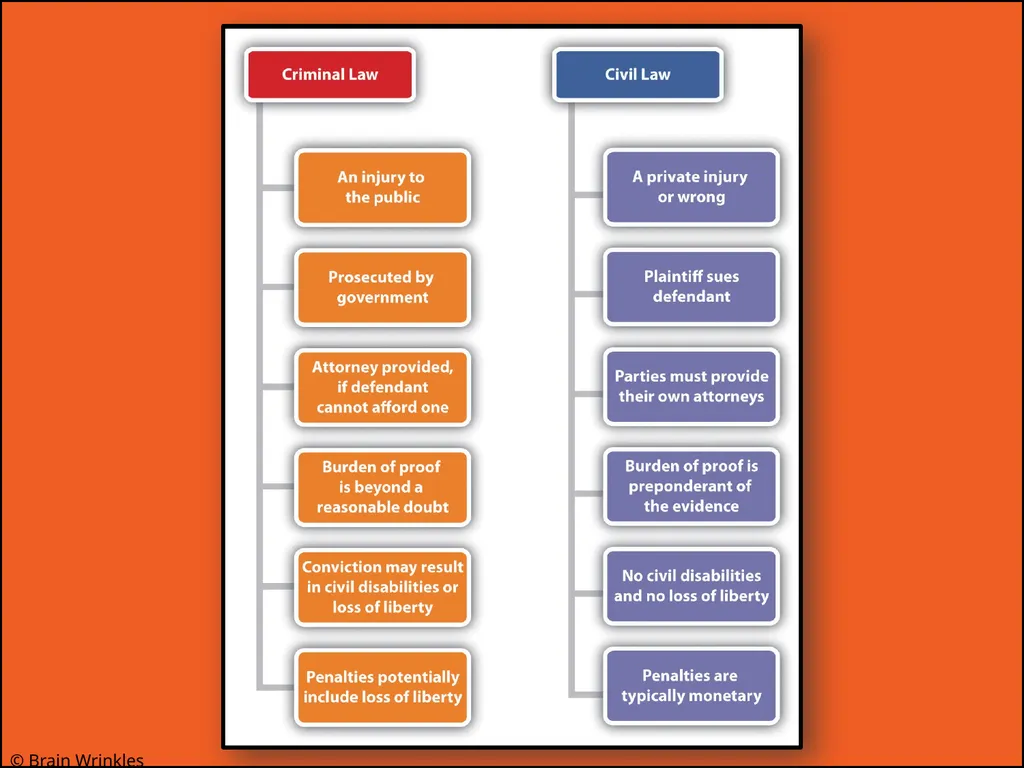
Trial courts oversee cases dealing with the two types of law—criminal law and civil law.
Criminal law deals with actions that harm people and society. Ex: murder, robbery, DUI
Civil law handles private disputes where one person or group says that another person or group has somehow done them wrong. Ex: divorce, contracts, property ownership, injuries.
Criminal Law
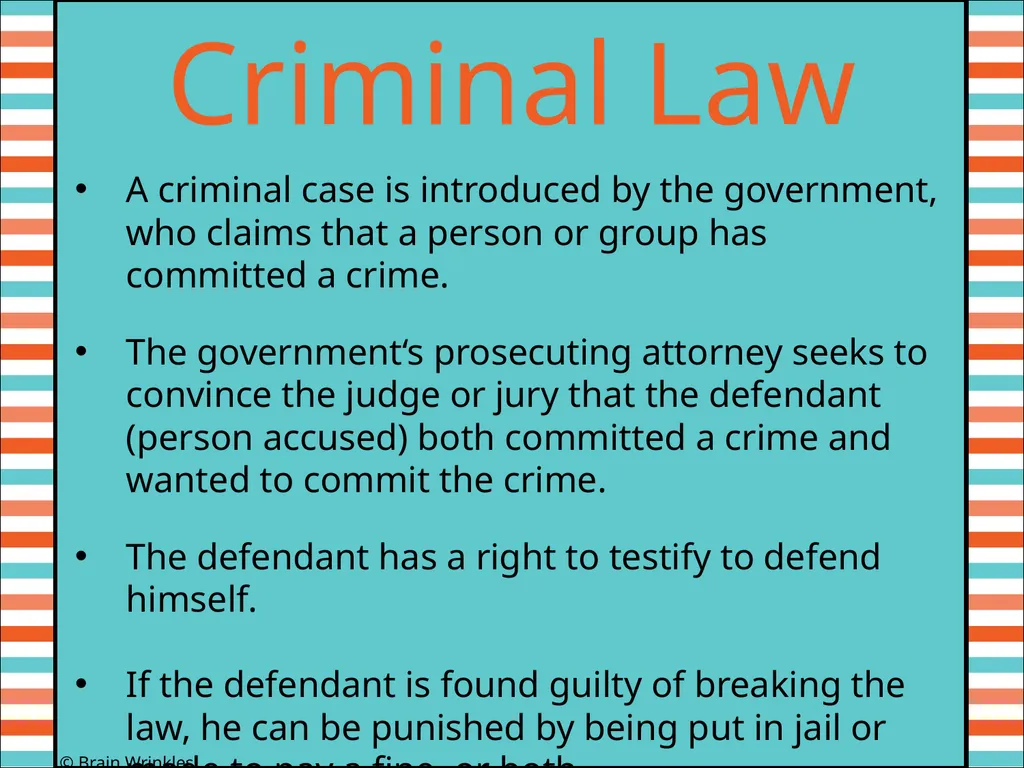
A criminal case is introduced by the government, who claims that a person or group has committed a crime.
The government‘s prosecuting attorney seeks to convince the judge or jury that the defendant (person accused) both committed a crime and wanted to commit the crime.
The defendant has a right to testify to defend himself.
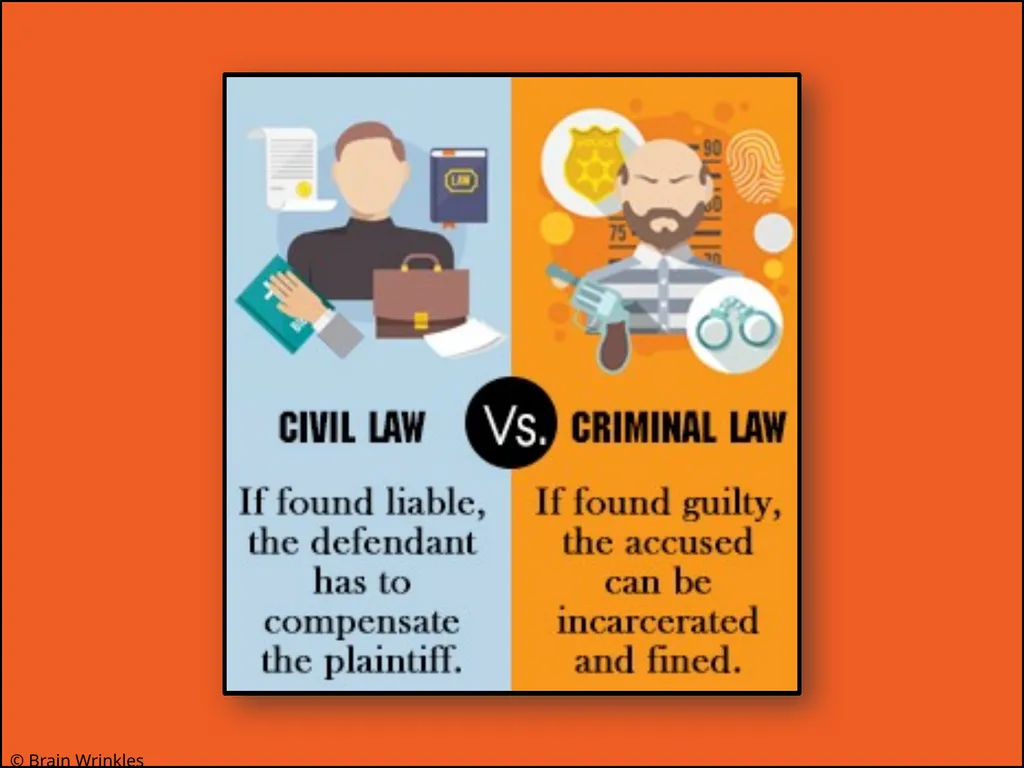
If the defendant is found guilty of breaking the law, he can be punished by being put in jail or made to pay a fine, or both.
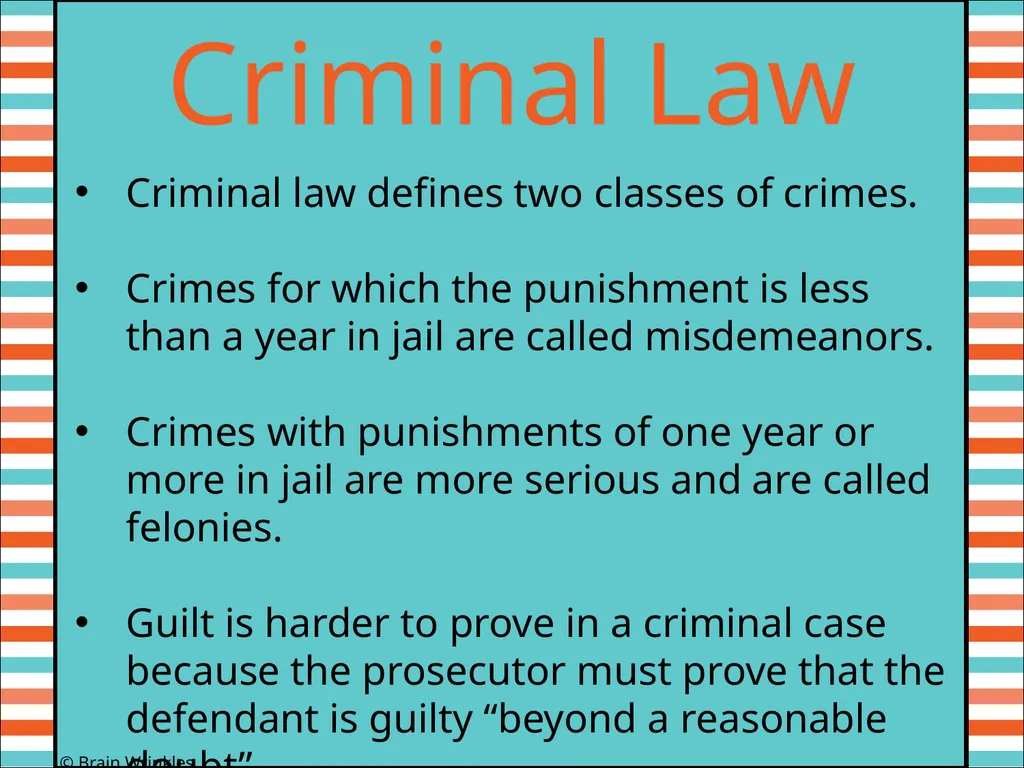
Criminal law defines two classes of crimes.
Crimes for which the punishment is less than a year in jail are called misdemeanors.
Crimes with punishments of one year or more in jail are more serious and are called felonies.
Guilt is harder to prove in a criminal case because the prosecutor must prove that the defendant is guilty “beyond a reasonable doubt”.
Civil Law
A civil case is introduced by a private party (plaintiff) seeking monetary damages.
The plaintiff brings their complaint to the court’s attention and tries to convince either a judge or a jury that their complaint has a real basis.
The defendant may be forced to testify.
If the plaintiff proves guilt of the other party by a “preponderance of evidence”, then the defendant may have to pay money to the plaintiff.
Most civil cases are resolved out of court, and people found guilty in civil cases never have to go to jail. © Brain Wrinkles<br>
KEY Judges
Georgia’s judges are either elected or appointed.
Judges in the Supreme Court, Court of Appeals, superior, state, and probate courts are elected to their positions at the state, local, and county level.
Most magistrate judges are elected, but some are appointed by local legislators.
Juvenile court judges are appointed by superior court judges.
2 Types of Law
Trial courts oversee cases dealing with the two types of law—criminal law and civil law.
Criminal law deals with actions that harm people and society. Ex: murder, robbery, DUI
Civil law handles private disputes where one person or group says that another person or group has somehow done them wrong. Ex: divorce, contracts, property ownership, injuries.
Criminal Law
A criminal case is introduced by the government, who claims that a person or group has committed a crime.
The government‘s prosecuting attorney seeks to convince the judge or jury that the defendant (person accused) both committed a crime and wanted to commit the crime.
The defendant has a right to testify to defend himself.
If the defendant is found guilty of breaking the law, he can be punished by being put in jail or made to pay a fine, or both.
Criminal law defines two classes of crimes.
Crimes for which the punishment is less than a year in jail are called misdemeanors.
Crimes with punishments of one year or more in jail are more serious and are called felonies.
Guilt is harder to prove in a criminal case because the prosecutor must prove that the defendant is guilty “beyond a reasonable doubt”.
Civil Law
A civil case is introduced by a private party (plaintiff) seeking monetary damages.
The plaintiff brings their complaint to the court’s attention and tries to convince either a judge or a jury that their complaint has a real basis.
The defendant may be forced to testify.
If the plaintiff proves guilt of the other party by a “preponderance of evidence”, then the defendant may have to pay money to the plaintiff.
Most civil cases are resolved out of court, and people found guilty in civil cases never have to go to jail. © Brain Wrinkles<br>
04
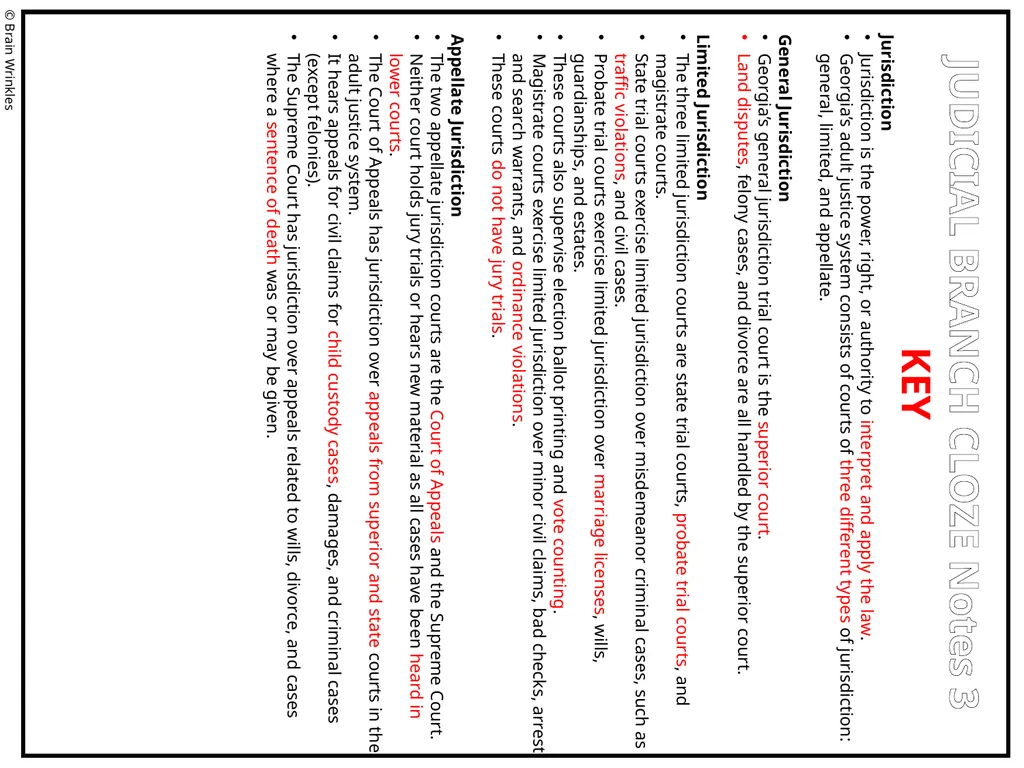
JUDICIAL BRANCH CLOZE Notes 3
KEY Jurisdiction
Jurisdiction is the power, right, or authority to interpret and apply the law.
Georgia’s adult justice system consists of courts of three different types of jurisdiction: general, limited, and appellate.
General Jurisdiction
Georgia’s general jurisdiction trial court is the superior court.
Land disputes, felony cases, and divorce are all handled by the superior court.
Limited Jurisdiction
The three limited jurisdiction courts are state trial courts, probate trial courts, and magistrate courts.
State trial courts exercise limited jurisdiction over misdemeanor criminal cases, such as traffic violations, and civil cases.
Probate trial courts exercise limited jurisdiction over marriage licenses, wills, guardianships, and estates.
These courts also supervise election ballot printing and vote counting.
Magistrate courts exercise limited jurisdiction over minor civil claims, bad checks, arrest and search warrants, and ordinance violations.
These courts do not have jury trials.
Appellate Jurisdiction
The two appellate jurisdiction courts are the Court of Appeals and the Supreme Court.
Neither court holds jury trials or hears new material as all cases have been heard in lower courts.
The Court of Appeals has jurisdiction over appeals from superior and state courts in the adult justice system.
It hears appeals for civil claims for child custody cases, damages, and criminal cases (except felonies).
The Supreme Court has jurisdiction over appeals related to wills, divorce, and cases where a sentence of death was or may be given. © Brain Wrinkles<br>
KEY Jurisdiction
Jurisdiction is the power, right, or authority to interpret and apply the law.
Georgia’s adult justice system consists of courts of three different types of jurisdiction: general, limited, and appellate.
General Jurisdiction
Georgia’s general jurisdiction trial court is the superior court.
Land disputes, felony cases, and divorce are all handled by the superior court.
Limited Jurisdiction
The three limited jurisdiction courts are state trial courts, probate trial courts, and magistrate courts.
State trial courts exercise limited jurisdiction over misdemeanor criminal cases, such as traffic violations, and civil cases.
Probate trial courts exercise limited jurisdiction over marriage licenses, wills, guardianships, and estates.
These courts also supervise election ballot printing and vote counting.
Magistrate courts exercise limited jurisdiction over minor civil claims, bad checks, arrest and search warrants, and ordinance violations.
These courts do not have jury trials.
Appellate Jurisdiction
The two appellate jurisdiction courts are the Court of Appeals and the Supreme Court.
Neither court holds jury trials or hears new material as all cases have been heard in lower courts.
The Court of Appeals has jurisdiction over appeals from superior and state courts in the adult justice system.
It hears appeals for civil claims for child custody cases, damages, and criminal cases (except felonies).
The Supreme Court has jurisdiction over appeals related to wills, divorce, and cases where a sentence of death was or may be given. © Brain Wrinkles<br>
05
JUDICIAL BRANCH CLOZE Notes 4
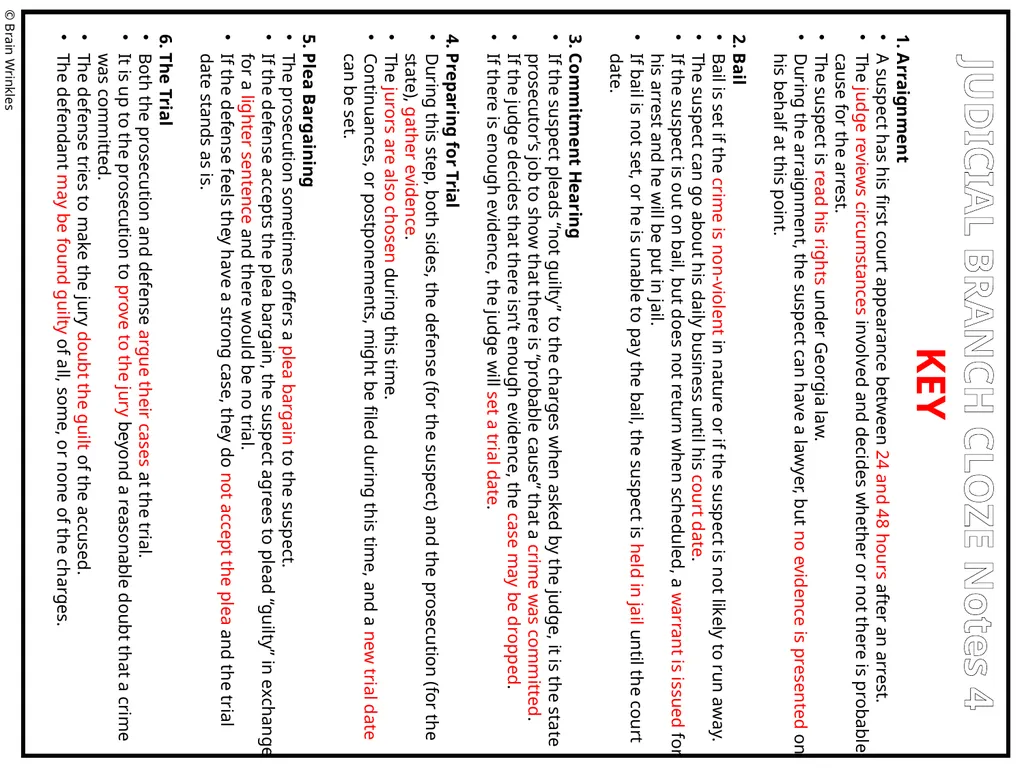
KEY 1. Arraignment
A suspect has his first court appearance between 24 and 48 hours after an arrest.
The judge reviews circumstances involved and decides whether or not there is probable cause for the arrest.
The suspect is read his rights under Georgia law.
During the arraignment, the suspect can have a lawyer, but no evidence is presented on his behalf at this point.
2. Bail
Bail is set if the crime is non-violent in nature or if the suspect is not likely to run away.
The suspect can go about his daily business until his court date.
If the suspect is out on bail, but does not return when scheduled, a warrant is issued for his arrest and he will be put in jail.
If bail is not set, or he is unable to pay the bail, the suspect is held in jail until the court date.
3. Commitment Hearing
If the suspect pleads “not guilty” to the charges when asked by the judge, it is the state prosecutor’s job to show that there is “probable cause” that a crime was committed.
If the judge decides that there isn’t enough evidence, the case may be dropped.
If there is enough evidence, the judge will set a trial date.
4. Preparing for Trial
During this step, both sides, the defense (for the suspect) and the prosecution (for the state), gather evidence.
The jurors are also chosen during this time.
Continuances, or postponements, might be filed during this time, and a new trial date can be set.
5. Plea Bargaining
The prosecution sometimes offers a plea bargain to the suspect.
If the defense accepts the plea bargain, the suspect agrees to plead “guilty” in exchange for a lighter sentence and there would be no trial.
If the defense feels they have a strong case, they do not accept the plea and the trial date stands as is.
6. The Trial
Both the prosecution and defense argue their cases at the trial.
It is up to the prosecution to prove to the jury beyond a reasonable doubt that a crime was committed.
The defense tries to make the jury doubt the guilt of the accused.
The defendant may be found guilty of all, some, or none of the charges. © Brain Wrinkles<br>
KEY 1. Arraignment
A suspect has his first court appearance between 24 and 48 hours after an arrest.
The judge reviews circumstances involved and decides whether or not there is probable cause for the arrest.
The suspect is read his rights under Georgia law.
During the arraignment, the suspect can have a lawyer, but no evidence is presented on his behalf at this point.
2. Bail
Bail is set if the crime is non-violent in nature or if the suspect is not likely to run away.
The suspect can go about his daily business until his court date.
If the suspect is out on bail, but does not return when scheduled, a warrant is issued for his arrest and he will be put in jail.
If bail is not set, or he is unable to pay the bail, the suspect is held in jail until the court date.
3. Commitment Hearing
If the suspect pleads “not guilty” to the charges when asked by the judge, it is the state prosecutor’s job to show that there is “probable cause” that a crime was committed.
If the judge decides that there isn’t enough evidence, the case may be dropped.
If there is enough evidence, the judge will set a trial date.
4. Preparing for Trial
During this step, both sides, the defense (for the suspect) and the prosecution (for the state), gather evidence.
The jurors are also chosen during this time.
Continuances, or postponements, might be filed during this time, and a new trial date can be set.
5. Plea Bargaining
The prosecution sometimes offers a plea bargain to the suspect.
If the defense accepts the plea bargain, the suspect agrees to plead “guilty” in exchange for a lighter sentence and there would be no trial.
If the defense feels they have a strong case, they do not accept the plea and the trial date stands as is.
6. The Trial
Both the prosecution and defense argue their cases at the trial.
It is up to the prosecution to prove to the jury beyond a reasonable doubt that a crime was committed.
The defense tries to make the jury doubt the guilt of the accused.
The defendant may be found guilty of all, some, or none of the charges. © Brain Wrinkles<br>
06
JUDICIAL BRANCH CLOZE Notes 5
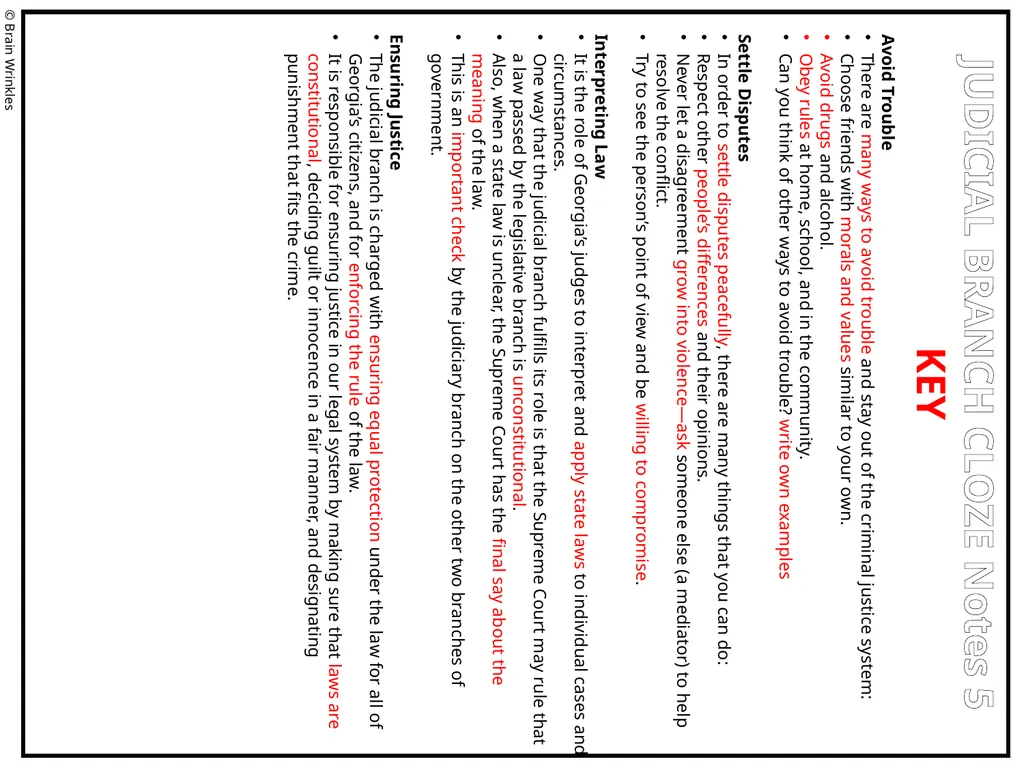
KEY Avoid Trouble
There are many ways to avoid trouble and stay out of the criminal justice system:
Choose friends with morals and values similar to your own.
Avoid drugs and alcohol.
Obey rules at home, school, and in the community.
Can you think of other ways to avoid trouble? write own examples
Settle Disputes
In order to settle disputes peacefully, there are many things that you can do:
Respect other people’s differences and their opinions.
Never let a disagreement grow into violence—ask someone else (a mediator) to help resolve the conflict.
Try to see the person’s point of view and be willing to compromise.
Interpreting Law
It is the role of Georgia’s judges to interpret and apply state laws to individual cases and circumstances.
One way that the judicial branch fulfills its role is that the Supreme Court may rule that a law passed by the legislative branch is unconstitutional.
Also, when a state law is unclear, the Supreme Court has the final say about the meaning of the law.
This is an important check by the judiciary branch on the other two branches of government.
Ensuring Justice
The judicial branch is charged with ensuring equal protection under the law for all of Georgia’s citizens, and for enforcing the rule of the law.
It is responsible for ensuring justice in our legal system by making sure that laws are constitutional, deciding guilt or innocence in a fair manner, and designating punishment that fits the crime. © Brain Wrinkles<br>
KEY Avoid Trouble
There are many ways to avoid trouble and stay out of the criminal justice system:
Choose friends with morals and values similar to your own.
Avoid drugs and alcohol.
Obey rules at home, school, and in the community.
Can you think of other ways to avoid trouble? write own examples
Settle Disputes
In order to settle disputes peacefully, there are many things that you can do:
Respect other people’s differences and their opinions.
Never let a disagreement grow into violence—ask someone else (a mediator) to help resolve the conflict.
Try to see the person’s point of view and be willing to compromise.
Interpreting Law
It is the role of Georgia’s judges to interpret and apply state laws to individual cases and circumstances.
One way that the judicial branch fulfills its role is that the Supreme Court may rule that a law passed by the legislative branch is unconstitutional.
Also, when a state law is unclear, the Supreme Court has the final say about the meaning of the law.
This is an important check by the judiciary branch on the other two branches of government.
Ensuring Justice
The judicial branch is charged with ensuring equal protection under the law for all of Georgia’s citizens, and for enforcing the rule of the law.
It is responsible for ensuring justice in our legal system by making sure that laws are constitutional, deciding guilt or innocence in a fair manner, and designating punishment that fits the crime. © Brain Wrinkles<br>
07
© Brain Wrinkles JUDICIAL
BRANCH Georgia’s Government JUDICIAL
BRANCH<br>
BRANCH Georgia’s Government JUDICIAL
BRANCH<br>
08
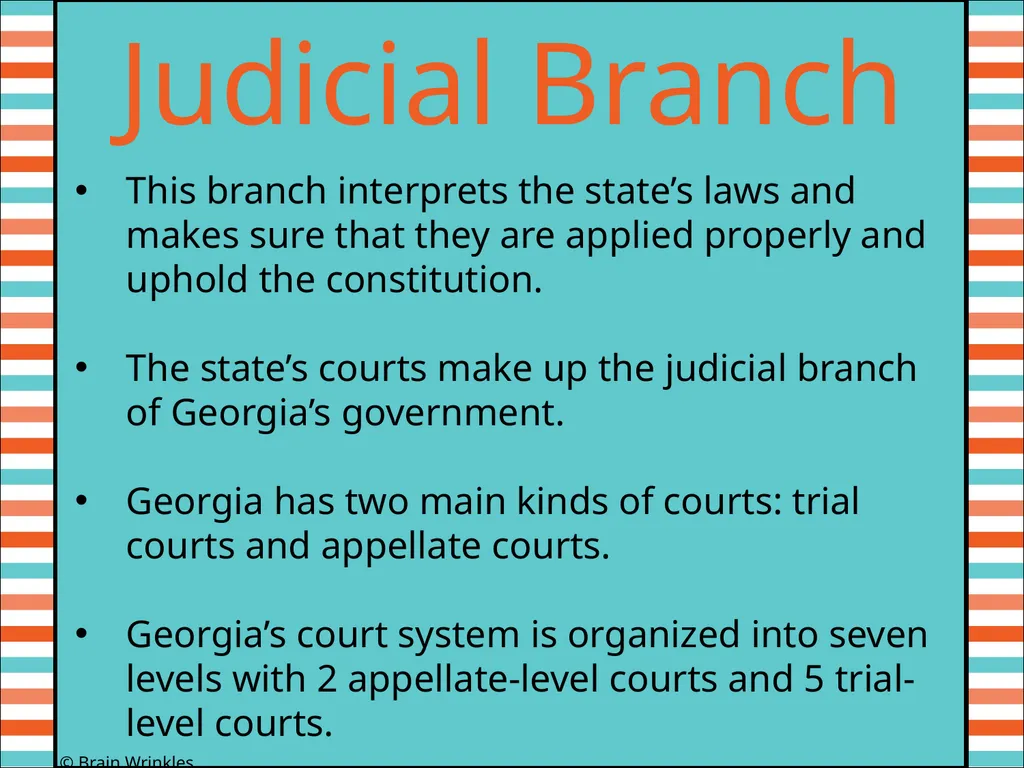
This branch interprets the state’s laws and makes sure that they are applied properly and uphold the constitution.
The state’s courts make up the judicial branch of Georgia’s government.
Georgia has two main kinds of courts: trial courts and appellate courts.
Georgia’s court system is organized into seven levels with 2 appellate-level courts and 5 trial-level courts. Judicial Branch © Brain Wrinkles<br>
The state’s courts make up the judicial branch of Georgia’s government.
Georgia has two main kinds of courts: trial courts and appellate courts.
Georgia’s court system is organized into seven levels with 2 appellate-level courts and 5 trial-level courts. Judicial Branch © Brain Wrinkles<br>
09
© Brain Wrinkles<br>
10
The appellate courts look over judgements made by lower courts and handles their appeals.
They only hear cases appealed from lower courts rather than trying cases for the first time.
Appellate courts make sure that trials are fair and do not go against Georgia’s Constitution.
There are two types of appellate courts in Georgia: the Supreme Court and the Court of Appeals. Appellate Courts © Brain Wrinkles<br>
They only hear cases appealed from lower courts rather than trying cases for the first time.
Appellate courts make sure that trials are fair and do not go against Georgia’s Constitution.
There are two types of appellate courts in Georgia: the Supreme Court and the Court of Appeals. Appellate Courts © Brain Wrinkles<br>
11
1. Supreme Court: Highest court in the state and is made up of 7 justices elected to six-year terms.
Georgia’s Supreme Court may hear cases involving the constitutionality of a law, disputes over elections, death penalty convictions (all), titles to land, etc.
2. Court of Appeals: Second highest court in the state and is made up of 12 judges who work in panels of three to hear cases. Appellate Courts © Brain Wrinkles<br>
Georgia’s Supreme Court may hear cases involving the constitutionality of a law, disputes over elections, death penalty convictions (all), titles to land, etc.
2. Court of Appeals: Second highest court in the state and is made up of 12 judges who work in panels of three to hear cases. Appellate Courts © Brain Wrinkles<br>
12
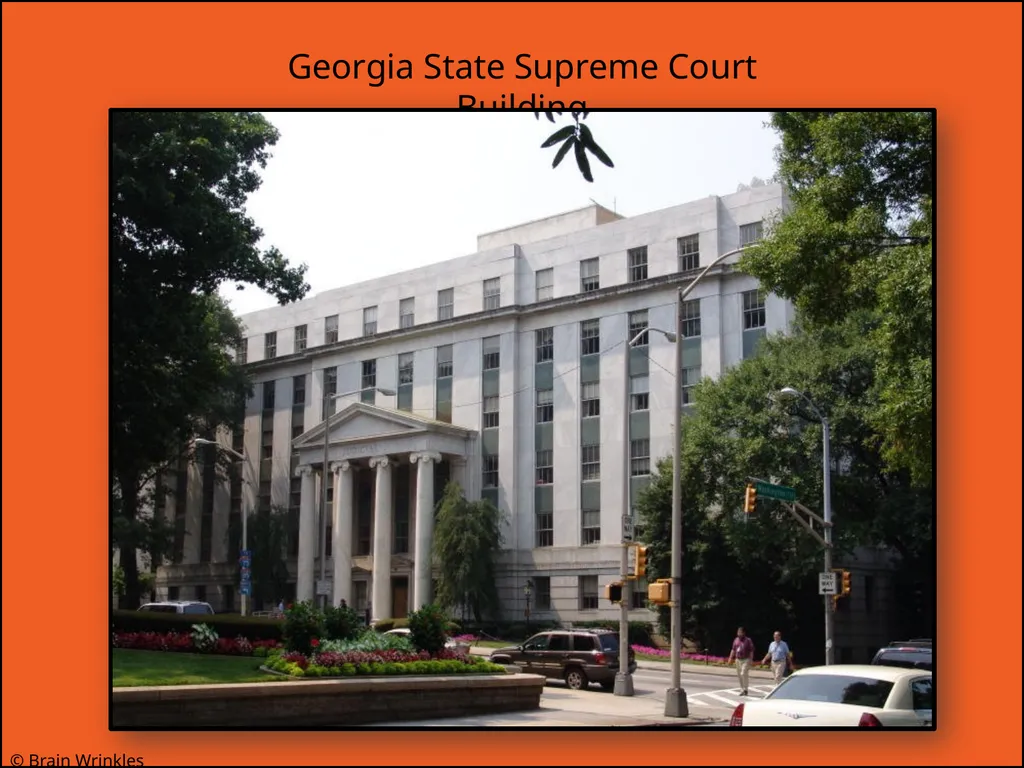
© Brain Wrinkles Georgia State Supreme Court Building<br>
13
In trial courts, peoples’ actions are measured against the law.
The actions can be judged in one of two ways: by a group of citizens called a jury, or simply by a judge.
Trial courts hear and try cases for the first time.
The five trial-level courts are: superior, state, juvenile, probate, and magistrate courts. Trial Courts © Brain Wrinkles<br>
The actions can be judged in one of two ways: by a group of citizens called a jury, or simply by a judge.
Trial courts hear and try cases for the first time.
The five trial-level courts are: superior, state, juvenile, probate, and magistrate courts. Trial Courts © Brain Wrinkles<br>
14
Superior Courts: Can hear almost any civil or criminal case; have a judge and jury
State Courts: Have jurisdiction over misdemeanor violations and civil cases; have a judge and jury
Juvenile Courts: Have jurisdiction over delinquent children under 17 and deprived children under 18; no jury
Probate Courts: Handle administrative matters such as wills and administration of estates; may have a jury
Magistrate Courts: Handle small civil claims of $15,000 or less, bad checks, arrest warrants, etc.; no jury Trial Courts © Brain Wrinkles<br>
State Courts: Have jurisdiction over misdemeanor violations and civil cases; have a judge and jury
Juvenile Courts: Have jurisdiction over delinquent children under 17 and deprived children under 18; no jury
Probate Courts: Handle administrative matters such as wills and administration of estates; may have a jury
Magistrate Courts: Handle small civil claims of $15,000 or less, bad checks, arrest warrants, etc.; no jury Trial Courts © Brain Wrinkles<br>
15
© Brain Wrinkles<br>
16
Georgia’s judges are either elected or appointed.
Judges in the Supreme Court, Court of Appeals, superior, state, and probate courts are elected to their positions at the state, local, and county level.
Most magistrate judges are elected, but some are appointed by local legislators.
Juvenile court judges are appointed by superior court judges. Judges © Brain Wrinkles<br>
Judges in the Supreme Court, Court of Appeals, superior, state, and probate courts are elected to their positions at the state, local, and county level.
Most magistrate judges are elected, but some are appointed by local legislators.
Juvenile court judges are appointed by superior court judges. Judges © Brain Wrinkles<br>
17
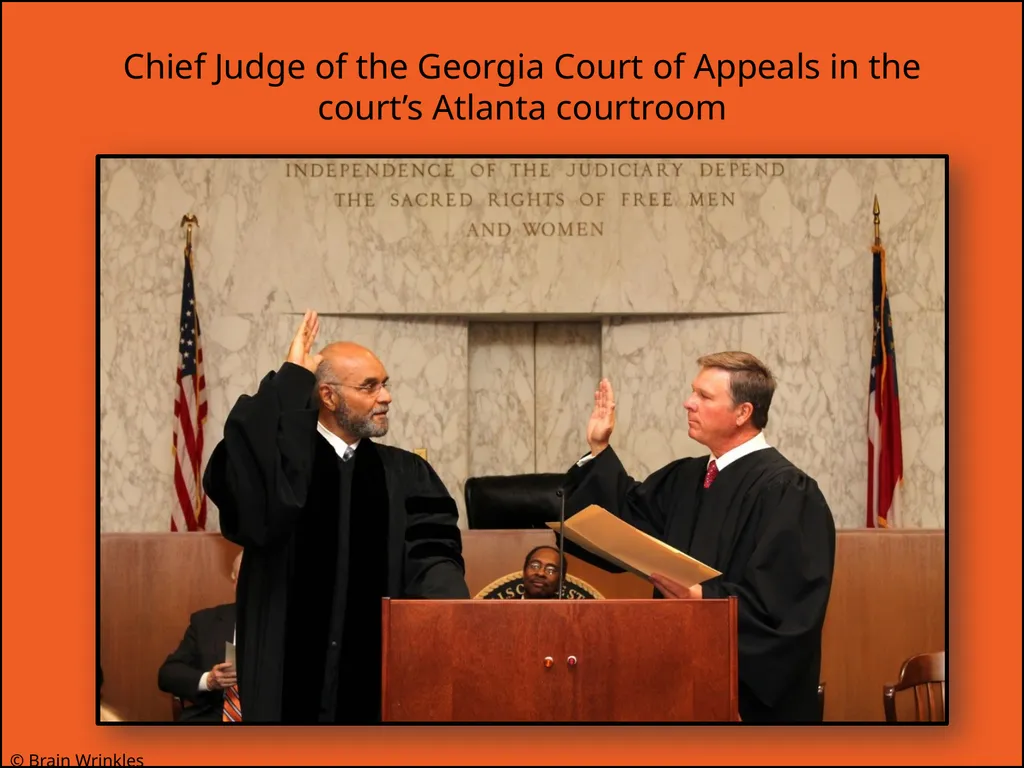
© Brain Wrinkles Chief Judge of the Georgia Court of Appeals in the court’s Atlanta courtroom<br>
18
© Brain Wrinkles Two Types of Law: CRIMINAL
&
CIVIL<br>
CIVIL<br>
19
Trial courts oversee cases dealing with the two types of law—criminal law and civil law.
Criminal law deals with actions that harm people and society. Ex: murder, robbery, DUI
Civil law handles private disputes where one person or group says that another person or group has somehow done them wrong. Ex: divorce, contracts, property ownership, injuries. 2 Types of Law © Brain Wrinkles<br>
Criminal law deals with actions that harm people and society. Ex: murder, robbery, DUI
Civil law handles private disputes where one person or group says that another person or group has somehow done them wrong. Ex: divorce, contracts, property ownership, injuries. 2 Types of Law © Brain Wrinkles<br>
20
© Brain Wrinkles<br>
21
A criminal case is introduced by the government, who claims that a person or group has committed a crime.
The government‘s prosecuting attorney seeks to convince the judge or jury that the defendant (person accused) both committed a crime and wanted to commit the crime.
The defendant has a right to testify to defend himself.
If the defendant is found guilty of breaking the law, he can be punished by being put in jail or made to pay a fine, or both. Criminal Law © Brain Wrinkles<br>
The government‘s prosecuting attorney seeks to convince the judge or jury that the defendant (person accused) both committed a crime and wanted to commit the crime.
The defendant has a right to testify to defend himself.
If the defendant is found guilty of breaking the law, he can be punished by being put in jail or made to pay a fine, or both. Criminal Law © Brain Wrinkles<br>
22
Criminal law defines two classes of crimes.
Crimes for which the punishment is less than a year in jail are called misdemeanors.
Crimes with punishments of one year or more in jail are more serious and are called felonies.
Guilt is harder to prove in a criminal case because the prosecutor must prove that the defendant is guilty “beyond a reasonable doubt”. Criminal Law © Brain Wrinkles<br>
Crimes for which the punishment is less than a year in jail are called misdemeanors.
Crimes with punishments of one year or more in jail are more serious and are called felonies.
Guilt is harder to prove in a criminal case because the prosecutor must prove that the defendant is guilty “beyond a reasonable doubt”. Criminal Law © Brain Wrinkles<br>
23
A civil case is introduced by a private party (plaintiff) seeking monetary damages.
The plaintiff brings their complaint to the court’s attention and tries to convince either a judge or a jury that their complaint has a real basis.
The defendant may be forced to testify.
If the plaintiff proves guilt of the other party by a “preponderance of evidence”, then the defendant may have to pay money to the plaintiff.
Most civil cases are resolved out of court, and people found guilty in civil cases never have to go to jail. Civil Law © Brain Wrinkles<br>
The plaintiff brings their complaint to the court’s attention and tries to convince either a judge or a jury that their complaint has a real basis.
The defendant may be forced to testify.
If the plaintiff proves guilt of the other party by a “preponderance of evidence”, then the defendant may have to pay money to the plaintiff.
Most civil cases are resolved out of court, and people found guilty in civil cases never have to go to jail. Civil Law © Brain Wrinkles<br>
24
© Brain Wrinkles<br>
25
© Brain Wrinkles Georgia’s JURISDICTIONS<br>
26
Jurisdiction is the power, right, or authority to interpret and apply the law.
Georgia’s adult justice system consists of courts of three different types of jurisdiction: general, limited, and appellate. Jurisdiction © Brain Wrinkles<br>
Georgia’s adult justice system consists of courts of three different types of jurisdiction: general, limited, and appellate. Jurisdiction © Brain Wrinkles<br>
27
Georgia’s general jurisdiction trial court is the superior court.
Land disputes, felony cases, and divorce are all handled by the superior court. General
Jurisdiction © Brain Wrinkles<br>
Land disputes, felony cases, and divorce are all handled by the superior court. General
Jurisdiction © Brain Wrinkles<br>
28
The three limited jurisdiction courts are state trial courts, probate trial courts, and magistrate courts.
State trial courts exercise limited jurisdiction over misdemeanor criminal cases, such as traffic violations, and civil cases. Limited
Jurisdiction © Brain Wrinkles<br>
State trial courts exercise limited jurisdiction over misdemeanor criminal cases, such as traffic violations, and civil cases. Limited
Jurisdiction © Brain Wrinkles<br>
29
Probate trial courts exercise limited jurisdiction over marriage licenses, wills, guardianships, and estates.
These courts also supervise election ballot printing and vote counting.
Magistrate courts exercise limited jurisdiction over minor civil claims, bad checks, arrest and search warrants, and ordinance violations.
These courts do not have jury trials. Limited
Jurisdiction © Brain Wrinkles<br>
These courts also supervise election ballot printing and vote counting.
Magistrate courts exercise limited jurisdiction over minor civil claims, bad checks, arrest and search warrants, and ordinance violations.
These courts do not have jury trials. Limited
Jurisdiction © Brain Wrinkles<br>
30
The two appellate jurisdiction courts are the Court of Appeals and the Supreme Court.
Neither court holds jury trials or hears new material as all cases have been heard in lower courts. Appellate
Jurisdiction © Brain Wrinkles<br>
Neither court holds jury trials or hears new material as all cases have been heard in lower courts. Appellate
Jurisdiction © Brain Wrinkles<br>
31
The Court of Appeals has jurisdiction over appeals from superior and state courts in the adult justice system.
It hears appeals for civil claims for child custody cases, damages, and criminal cases (except felonies).
The Supreme Court has jurisdiction over appeals related to wills, divorce, and cases where a sentence of death was or may be given. Appellate
Jurisdiction © Brain Wrinkles<br>
It hears appeals for civil claims for child custody cases, damages, and criminal cases (except felonies).
The Supreme Court has jurisdiction over appeals related to wills, divorce, and cases where a sentence of death was or may be given. Appellate
Jurisdiction © Brain Wrinkles<br>
32
© Brain Wrinkles Steps in the CRIMINAL
JUSTICE
PROCESS<br>
PROCESS<br>
33
A suspect has his first court appearance between 24 and 48 hours after an arrest.
The judge reviews circumstances involved and decides whether or not there is probable cause for the arrest.
The suspect is read his rights under Georgia law.
During the arraignment, the suspect can have a lawyer, but no evidence is presented on his behalf at this point. 1. Arraignment © Brain Wrinkles<br>
The judge reviews circumstances involved and decides whether or not there is probable cause for the arrest.
The suspect is read his rights under Georgia law.
During the arraignment, the suspect can have a lawyer, but no evidence is presented on his behalf at this point. 1. Arraignment © Brain Wrinkles<br>
34
Bail is set if the crime is non-violent in nature or if the suspect is not likely to run away.
The suspect can go about his daily business until his court date.
If the suspect is out on bail, but does not return when scheduled, a warrant is issued for his arrest and he will be put in jail.
If bail is not set, or he is unable to pay the bail, the suspect is held in jail until the court date. 2. Bail © Brain Wrinkles<br>
The suspect can go about his daily business until his court date.
If the suspect is out on bail, but does not return when scheduled, a warrant is issued for his arrest and he will be put in jail.
If bail is not set, or he is unable to pay the bail, the suspect is held in jail until the court date. 2. Bail © Brain Wrinkles<br>
35
If the suspect pleads “not guilty” to the charges when asked by the judge, it is the state prosecutor’s job to show that there is “probable cause” that a crime was committed.
If the judge decides that there isn’t enough evidence, the case may be dropped.
If there is enough evidence, the judge will set a trial date. 3. Commitment
Hearing © Brain Wrinkles<br>
If the judge decides that there isn’t enough evidence, the case may be dropped.
If there is enough evidence, the judge will set a trial date. 3. Commitment
Hearing © Brain Wrinkles<br>
36
During this step, both sides, the defense (for the suspect) and the prosecution (for the state), gather evidence.
The jurors are also chosen during this time.
Continuances, or postponements, might be filed during this time, and a new trial date can be set. 4. Preparing for
Trial © Brain Wrinkles<br>
The jurors are also chosen during this time.
Continuances, or postponements, might be filed during this time, and a new trial date can be set. 4. Preparing for
Trial © Brain Wrinkles<br>
37
The prosecution sometimes offers a plea bargain to the suspect.
If the defense accepts the plea bargain, the suspect agrees to plead “guilty” in exchange for a lighter sentence and there would be no trial.
If the defense feels they have a strong case, they do not accept the plea and the trial date stands as is. 5. Plea Bargaining © Brain Wrinkles<br>
If the defense accepts the plea bargain, the suspect agrees to plead “guilty” in exchange for a lighter sentence and there would be no trial.
If the defense feels they have a strong case, they do not accept the plea and the trial date stands as is. 5. Plea Bargaining © Brain Wrinkles<br>
38
Both the prosecution and defense argue their cases at the trial.
It is up to the prosecution to prove to the jury beyond a reasonable doubt that a crime was committed.
The defense tries to make the jury doubt the guilt of the accused.
The defendant may be found guilty of all, some, or none of the charges. 6. The Trial © Brain Wrinkles<br>
It is up to the prosecution to prove to the jury beyond a reasonable doubt that a crime was committed.
The defense tries to make the jury doubt the guilt of the accused.
The defendant may be found guilty of all, some, or none of the charges. 6. The Trial © Brain Wrinkles<br>
39
© Brain Wrinkles Ways to Avoid Trouble and Settle Disputes Peacefully<br>
40
There are many ways to avoid trouble and stay out of the criminal justice system:
Choose friends with morals and values similar to your own.
Avoid drugs and alcohol.
Obey rules at home, school, and in the community.
Can you think of other ways to avoid trouble? Avoid Trouble © Brain Wrinkles<br>
Choose friends with morals and values similar to your own.
Avoid drugs and alcohol.
Obey rules at home, school, and in the community.
Can you think of other ways to avoid trouble? Avoid Trouble © Brain Wrinkles<br>
41
In order to settle disputes peacefully, there are many things that you can do:
Respect other people’s differences and their opinions.
Never let a disagreement grow into violence—ask someone else (a mediator) to help resolve the conflict.
Try to see the person’s point of view and be willing to compromise. Settle Disputes © Brain Wrinkles<br>
Respect other people’s differences and their opinions.
Never let a disagreement grow into violence—ask someone else (a mediator) to help resolve the conflict.
Try to see the person’s point of view and be willing to compromise. Settle Disputes © Brain Wrinkles<br>
42
© Brain Wrinkles Judicial Branch: Interpreting
Laws &
Ensuring
Justice<br>
Laws &
Ensuring
Justice<br>
43
It is the role of Georgia’s judges to interpret and apply state laws to individual cases and circumstances.
One way that the judicial branch fulfills its role is that the Supreme Court may rule that a law passed by the legislative branch is unconstitutional.
Also, when a state law is unclear, the Supreme Court has the final say about the meaning of the law.
This is an important check by the judiciary branch on the other two branches of government. Interpreting Law © Brain Wrinkles<br>
One way that the judicial branch fulfills its role is that the Supreme Court may rule that a law passed by the legislative branch is unconstitutional.
Also, when a state law is unclear, the Supreme Court has the final say about the meaning of the law.
This is an important check by the judiciary branch on the other two branches of government. Interpreting Law © Brain Wrinkles<br>
44
The judicial branch is charged with ensuring equal protection under the law for all of Georgia’s citizens, and for enforcing the rule of the law.
It is responsible for ensuring justice in our legal system by making sure that laws are constitutional, deciding guilt or innocence in a fair manner, and designating punishment that fits the crime. Ensuring Justice © Brain Wrinkles<br>
It is responsible for ensuring justice in our legal system by making sure that laws are constitutional, deciding guilt or innocence in a fair manner, and designating punishment that fits the crime. Ensuring Justice © Brain Wrinkles<br>