
StudyMafia.Org Submitted To: Submitted By:
MJ
Published · 26 slides · 0 views

1 / 1



Description
StudyMafia.Org Submitted To: Submitted By: Studymafia.org Studymafia.org Atomic Structure Table Contents Definition Introduction Atomic Models Subatomic Particles Electronic Configuration of an Atom Quantum Numbers Conclusion 2 Definition
Related Topics
Share
Embed code
Download this presentation From Below
"StudyMafia.Org Submitted To: Submitted By:" is the property of its rightful owner. Permission is granted to download and print the materials on this website for personal, non-commercial use only, and to display it on your personal computer provided you do not modify the materials and that you retain all copyright notices contained in the materials. By downloading content from our website, you accept the terms of this agreement.
Presentation Transcript
01
StudyMafia.Org Submitted To: Submitted By:
Studymafia.org Studymafia.org Atomic
Structure<br>
Studymafia.org Studymafia.org Atomic
Structure<br>
02
Table Contents Definition
Introduction
Atomic Models
Subatomic Particles
Electronic Configuration of an Atom
Quantum Numbers
Conclusion 2<br>
Introduction
Atomic Models
Subatomic Particles
Electronic Configuration of an Atom
Quantum Numbers
Conclusion 2<br>
03
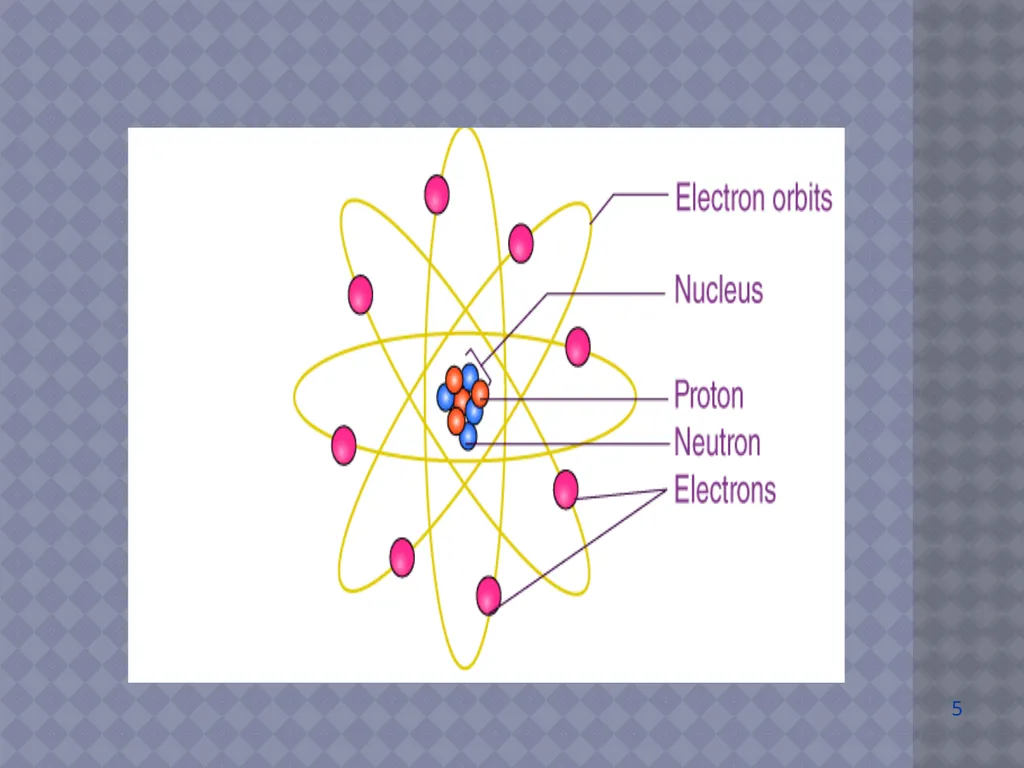
Definition Atomic structure refers to the structure of an atom comprising a nucleus (centre) in which the protons (positively charged) and neutrons (neutral) are present.
The negatively charged particles called electrons revolve around the centre of the nucleus. 3<br>
The negatively charged particles called electrons revolve around the centre of the nucleus. 3<br>
04
Introduction The history of atomic structure and quantum mechanics dates back to the times of Democritus, the man who first proposed that matter is composed of atoms.
The study about the structure of an atom gives a great insight into the entire class of chemical reactions, bonds and their physical properties.
The first scientific theory of atomic structure was proposed by John Dalton in the 1800s. 4<br>
The study about the structure of an atom gives a great insight into the entire class of chemical reactions, bonds and their physical properties.
The first scientific theory of atomic structure was proposed by John Dalton in the 1800s. 4<br>
05
5<br>
06
Atomic Models Dalton’s Atomic Theory
The English chemist John Dalton suggested that all matter is made up of atoms, which were indivisible and indestructible. He also stated that all the atoms of an element were exactly the same, but the atoms of different elements differ in size and mass.
Dalton’s atomic theory successfully explained the Laws of chemical reactions, namely, the Law of conservation of mass, Law of constant properties, Law of multiple proportions and Law of reciprocal proportions. ●●●
6<br>
The English chemist John Dalton suggested that all matter is made up of atoms, which were indivisible and indestructible. He also stated that all the atoms of an element were exactly the same, but the atoms of different elements differ in size and mass.
Dalton’s atomic theory successfully explained the Laws of chemical reactions, namely, the Law of conservation of mass, Law of constant properties, Law of multiple proportions and Law of reciprocal proportions. ●●●
6<br>
07
Atomic Models The following are the postulates of his theory:
Every matter is made up of atoms.
Atoms are indivisible.
Specific elements have only one type of atoms in them.
Each atom has its own constant mass that varies from element to element.
Atoms undergo rearrangement during a chemical reaction.
Atoms can neither be created nor be destroyed but can be transformed from one form to another. ●●●
7<br>
Every matter is made up of atoms.
Atoms are indivisible.
Specific elements have only one type of atoms in them.
Each atom has its own constant mass that varies from element to element.
Atoms undergo rearrangement during a chemical reaction.
Atoms can neither be created nor be destroyed but can be transformed from one form to another. ●●●
7<br>
08
Atomic Models Demerits of Dalton’s Atomic Theory
The theory was unable to explain the existence of isotopes.
Nothing about the structure of atom was appropriately explained.
Later, the scientists discovered particles inside the atom that proved, the atoms are divisible. ●●●
8<br>
The theory was unable to explain the existence of isotopes.
Nothing about the structure of atom was appropriately explained.
Later, the scientists discovered particles inside the atom that proved, the atoms are divisible. ●●●
8<br>
09
Atomic Models Thomson Atomic Model
The English chemist Sir Joseph John Thomson put forth his model describing the atomic structure in the early 1900s.
He was later awarded the Nobel prize for the discovery of “electrons”. His work is based on an experiment called cathode ray experiment. Cathode Ray Experiment
It has a tube made of glass which has two openings, one for the vacuum pump and the other for the inlet through which a gas is pumped in. ●●●
9<br>
The English chemist Sir Joseph John Thomson put forth his model describing the atomic structure in the early 1900s.
He was later awarded the Nobel prize for the discovery of “electrons”. His work is based on an experiment called cathode ray experiment. Cathode Ray Experiment
It has a tube made of glass which has two openings, one for the vacuum pump and the other for the inlet through which a gas is pumped in. ●●●
9<br>
10
Atomic Models Observations:
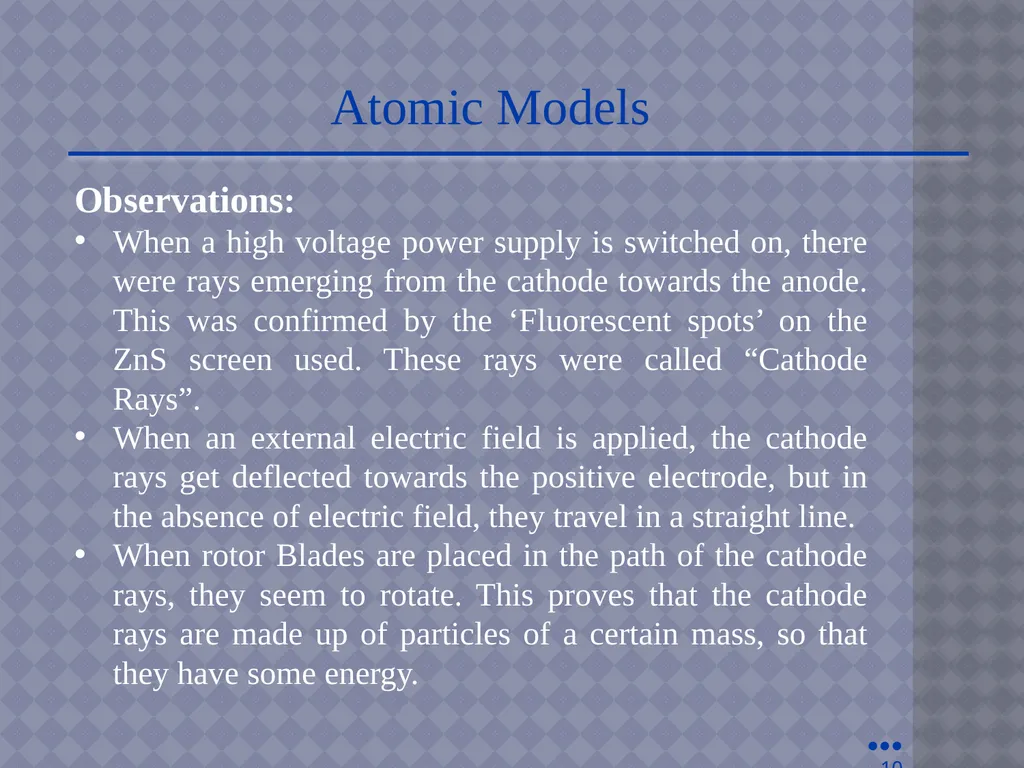
When a high voltage power supply is switched on, there were rays emerging from the cathode towards the anode. This was confirmed by the ‘Fluorescent spots’ on the ZnS screen used. These rays were called “Cathode Rays”.
When an external electric field is applied, the cathode rays get deflected towards the positive electrode, but in the absence of electric field, they travel in a straight line.
When rotor Blades are placed in the path of the cathode rays, they seem to rotate. This proves that the cathode rays are made up of particles of a certain mass, so that they have some energy. ●●●
10<br>
When a high voltage power supply is switched on, there were rays emerging from the cathode towards the anode. This was confirmed by the ‘Fluorescent spots’ on the ZnS screen used. These rays were called “Cathode Rays”.
When an external electric field is applied, the cathode rays get deflected towards the positive electrode, but in the absence of electric field, they travel in a straight line.
When rotor Blades are placed in the path of the cathode rays, they seem to rotate. This proves that the cathode rays are made up of particles of a certain mass, so that they have some energy. ●●●
10<br>
11
Atomic Models Limitations of Thomson’s Atomic Structure:
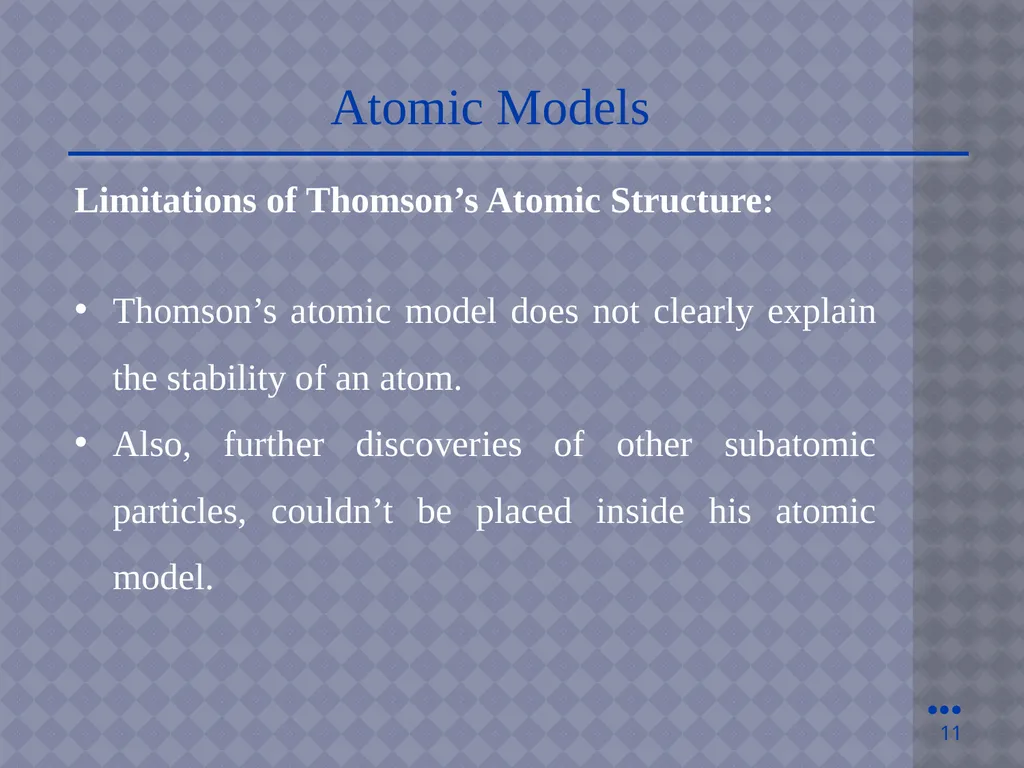
Thomson’s atomic model does not clearly explain the stability of an atom.
Also, further discoveries of other subatomic particles, couldn’t be placed inside his atomic model. ●●●
11<br>
Thomson’s atomic model does not clearly explain the stability of an atom.
Also, further discoveries of other subatomic particles, couldn’t be placed inside his atomic model. ●●●
11<br>
12
Atomic Models Rutherford Atomic Theory
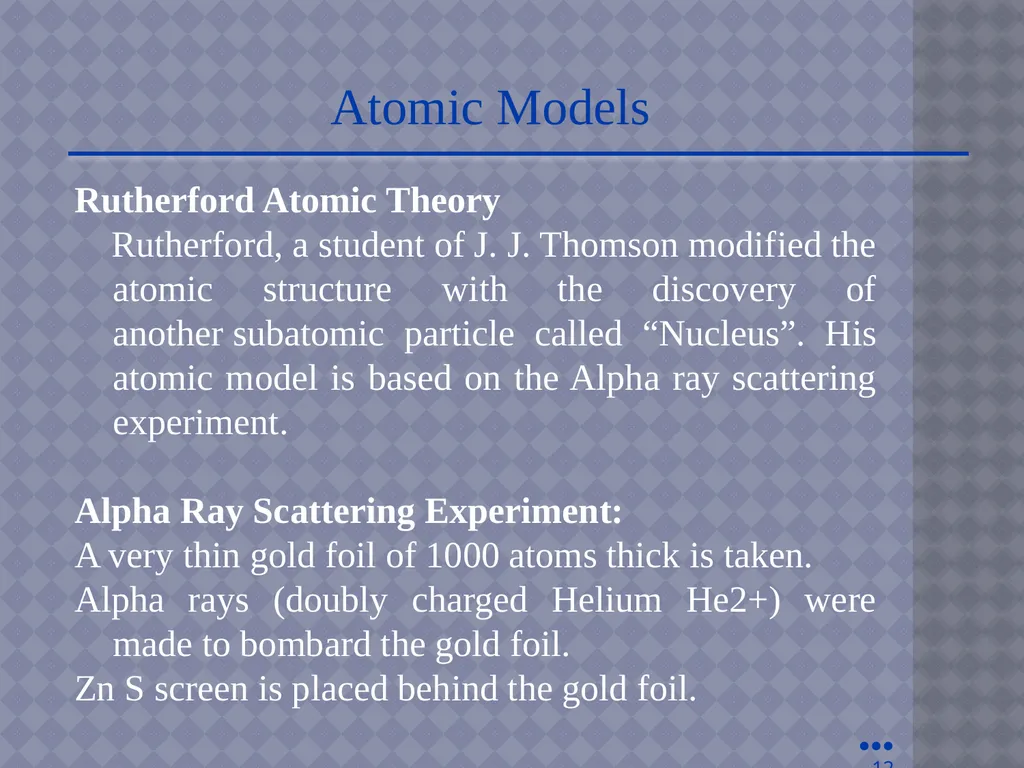
Rutherford, a student of J. J. Thomson modified the atomic structure with the discovery of another subatomic particle called “Nucleus”. His atomic model is based on the Alpha ray scattering experiment.
Alpha Ray Scattering Experiment:
A very thin gold foil of 1000 atoms thick is taken.
Alpha rays (doubly charged Helium He2+) were made to bombard the gold foil.
Zn S screen is placed behind the gold foil. ●●●
12<br>
Rutherford, a student of J. J. Thomson modified the atomic structure with the discovery of another subatomic particle called “Nucleus”. His atomic model is based on the Alpha ray scattering experiment.
Alpha Ray Scattering Experiment:
A very thin gold foil of 1000 atoms thick is taken.
Alpha rays (doubly charged Helium He2+) were made to bombard the gold foil.
Zn S screen is placed behind the gold foil. ●●●
12<br>
13
Atomic Models Observations:
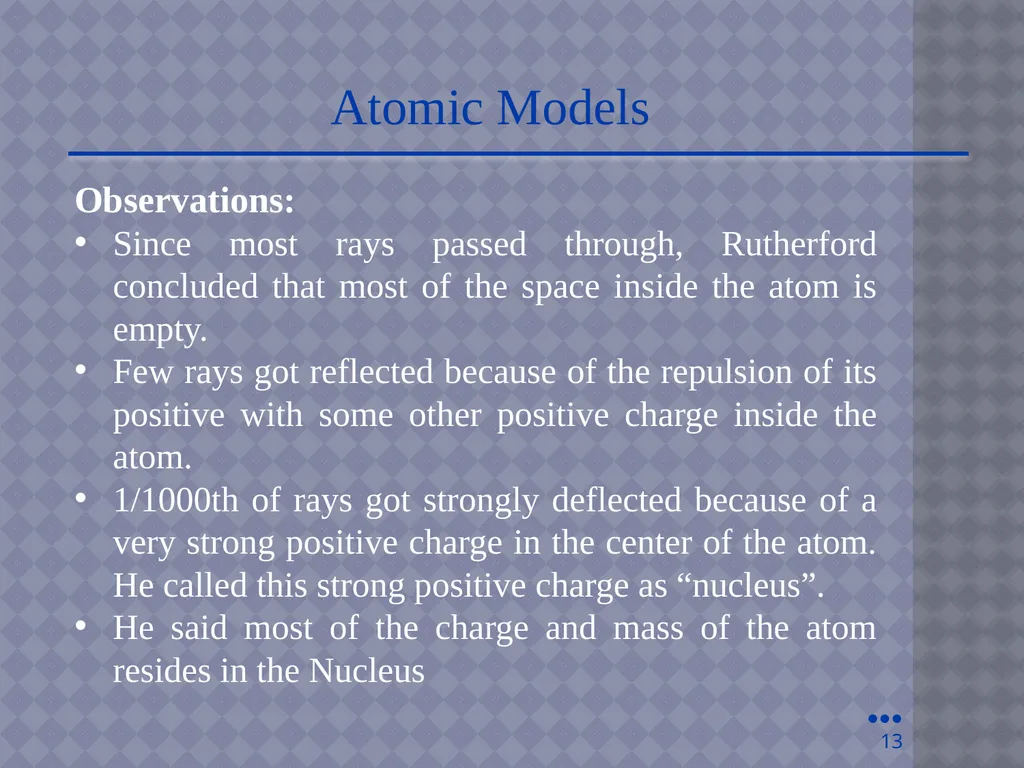
Since most rays passed through, Rutherford concluded that most of the space inside the atom is empty.
Few rays got reflected because of the repulsion of its positive with some other positive charge inside the atom.
1/1000th of rays got strongly deflected because of a very strong positive charge in the center of the atom. He called this strong positive charge as “nucleus”.
He said most of the charge and mass of the atom resides in the Nucleus ●●●
13<br>
Since most rays passed through, Rutherford concluded that most of the space inside the atom is empty.
Few rays got reflected because of the repulsion of its positive with some other positive charge inside the atom.
1/1000th of rays got strongly deflected because of a very strong positive charge in the center of the atom. He called this strong positive charge as “nucleus”.
He said most of the charge and mass of the atom resides in the Nucleus ●●●
13<br>
14
Atomic Models Limitations of Rutherford Atomic Model
If electrons have to revolve around the nucleus, they will spend energy and that too against the strong force of attraction from the nucleus, a lot of energy will be spent by the electrons and eventually, they will lose all their energy and will fall into the nucleus so the stability of atom is not explained.
If electrons continuously revolve around the ‘nucleus, the type of spectrum expected is a continuous spectrum. But in reality, what we see is a line spectrum. ●●●
14<br>
If electrons have to revolve around the nucleus, they will spend energy and that too against the strong force of attraction from the nucleus, a lot of energy will be spent by the electrons and eventually, they will lose all their energy and will fall into the nucleus so the stability of atom is not explained.
If electrons continuously revolve around the ‘nucleus, the type of spectrum expected is a continuous spectrum. But in reality, what we see is a line spectrum. ●●●
14<br>
15
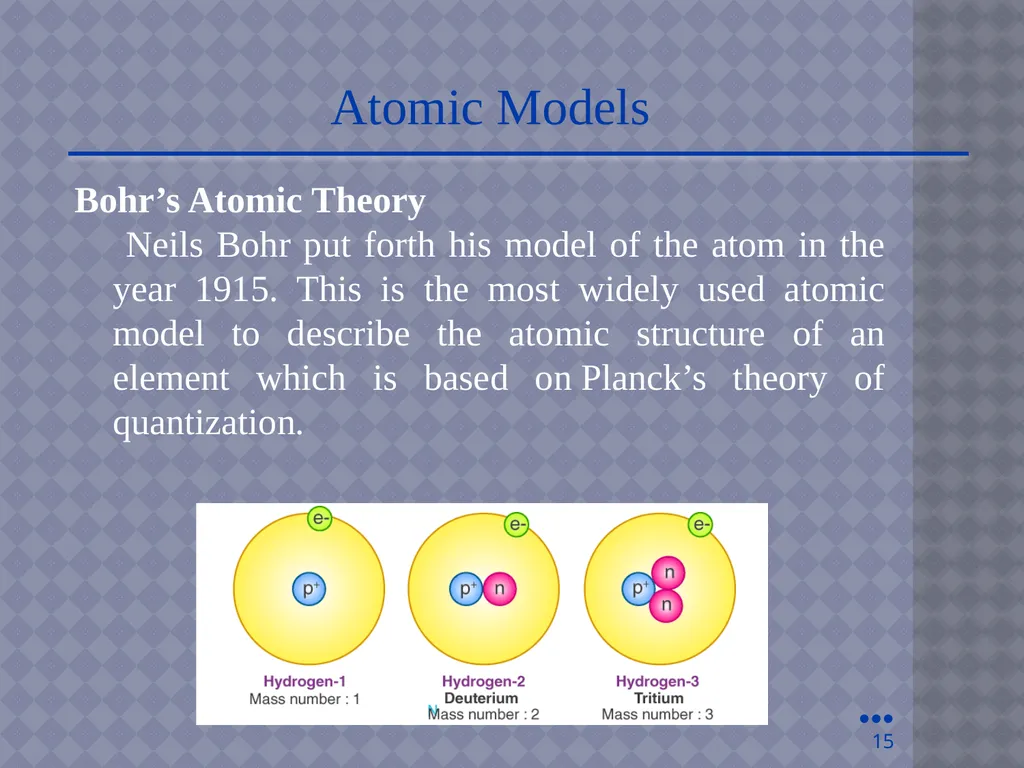
Atomic Models Bohr’s Atomic Theory
Neils Bohr put forth his model of the atom in the year 1915. This is the most widely used atomic model to describe the atomic structure of an element which is based on Planck’s theory of quantization. ●●●
15<br>
Neils Bohr put forth his model of the atom in the year 1915. This is the most widely used atomic model to describe the atomic structure of an element which is based on Planck’s theory of quantization. ●●●
15<br>
16
Atomic Models Postulates:
The electrons inside atoms are placed in discrete orbits called “stationery orbits”.
The energy levels of these shells can be represented via quantum numbers.
Electrons can jump to higher levels by absorbing energy and move to lower energy levels by losing or emitting its energy.
As longs as, an electron stays in its own stationery, there will be no absorption or emission of energy.
Electrons revolve around the nucleus in these stationery orbits only.
The energy of the stationary orbits is quantized. ●●●
16<br>
The electrons inside atoms are placed in discrete orbits called “stationery orbits”.
The energy levels of these shells can be represented via quantum numbers.
Electrons can jump to higher levels by absorbing energy and move to lower energy levels by losing or emitting its energy.
As longs as, an electron stays in its own stationery, there will be no absorption or emission of energy.
Electrons revolve around the nucleus in these stationery orbits only.
The energy of the stationary orbits is quantized. ●●●
16<br>
17
Atomic Models Limitations of Bohr’s Atomic Theory:
Bohr’s atomic structure works only for single electron species such as H, He+, Li2+, Be3+, ….
When the emission spectrum of hydrogen was observed under a more accurate spectrometer, each line spectrum was seen to be a combination of no of smaller discrete lines.
Both Stark and Zeeman effects couldn’t be explain using Bohr’s theory. 17<br>
Bohr’s atomic structure works only for single electron species such as H, He+, Li2+, Be3+, ….
When the emission spectrum of hydrogen was observed under a more accurate spectrometer, each line spectrum was seen to be a combination of no of smaller discrete lines.
Both Stark and Zeeman effects couldn’t be explain using Bohr’s theory. 17<br>
18
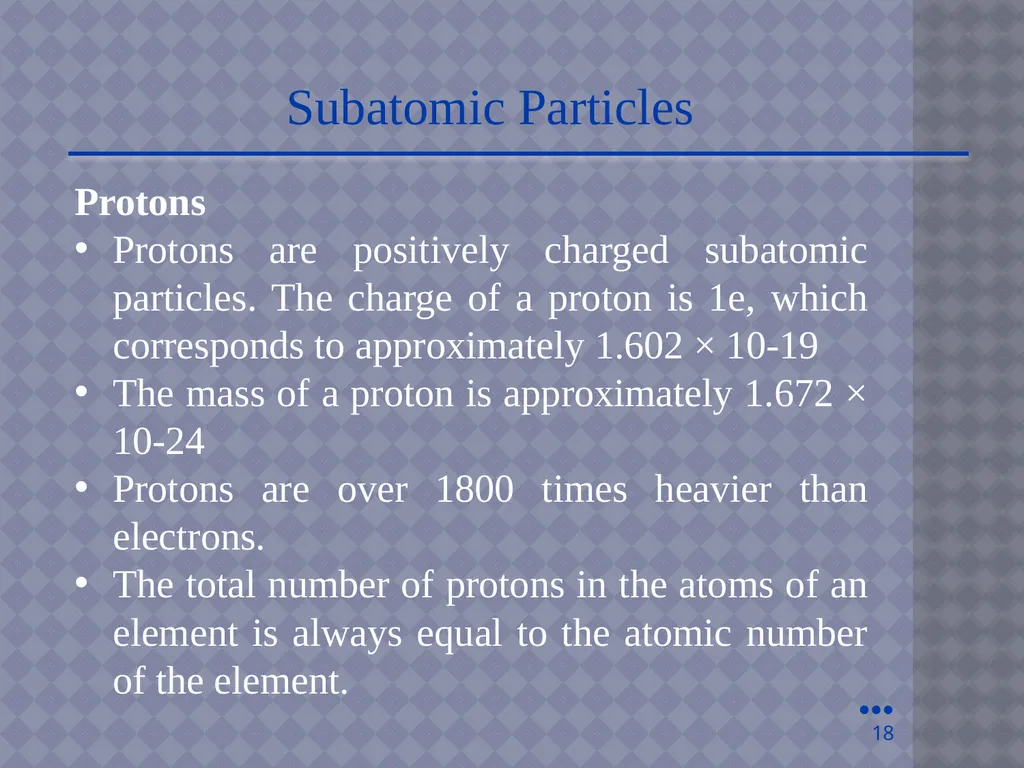
Subatomic Particles Protons
Protons are positively charged subatomic particles. The charge of a proton is 1e, which corresponds to approximately 1.602 × 10⁻¹⁹
The mass of a proton is approximately 1.672 × 10⁻²⁴
Protons are over 1800 times heavier than electrons.
The total number of protons in the atoms of an element is always equal to the atomic number of the element. ●●●
18<br>
Protons are positively charged subatomic particles. The charge of a proton is 1e, which corresponds to approximately 1.602 × 10⁻¹⁹
The mass of a proton is approximately 1.672 × 10⁻²⁴
Protons are over 1800 times heavier than electrons.
The total number of protons in the atoms of an element is always equal to the atomic number of the element. ●●●
18<br>
19
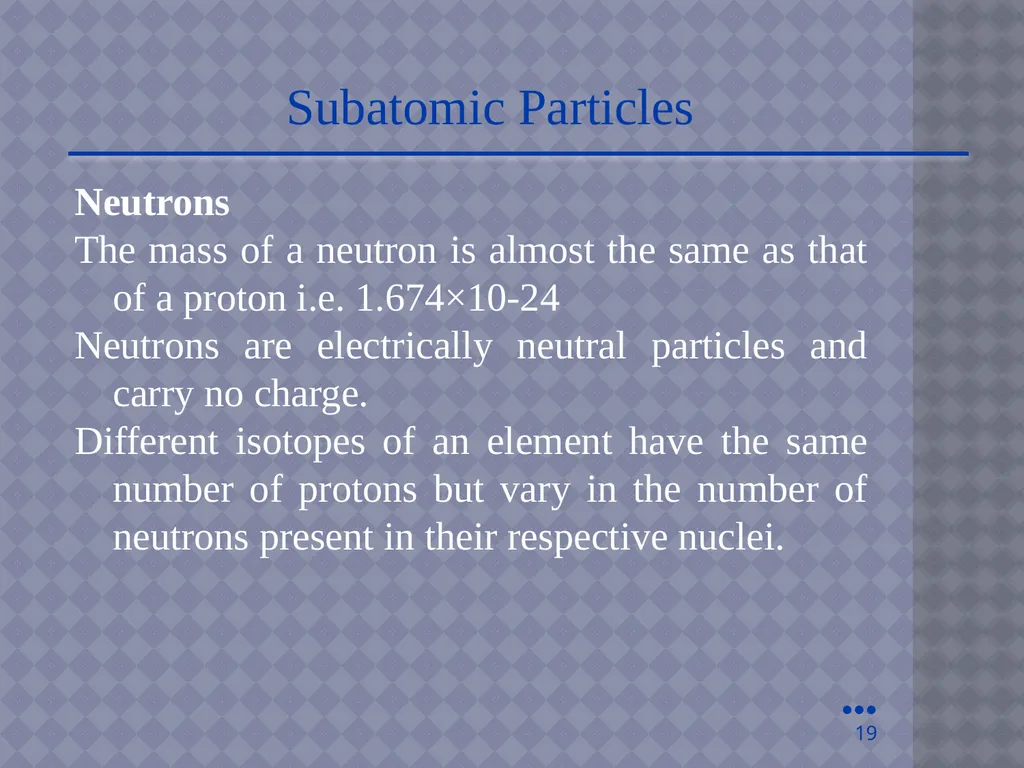
Subatomic Particles Neutrons
The mass of a neutron is almost the same as that of a proton i.e. 1.674×10⁻²⁴
Neutrons are electrically neutral particles and carry no charge.
Different isotopes of an element have the same number of protons but vary in the number of neutrons present in their respective nuclei. ●●●
19<br>
The mass of a neutron is almost the same as that of a proton i.e. 1.674×10⁻²⁴
Neutrons are electrically neutral particles and carry no charge.
Different isotopes of an element have the same number of protons but vary in the number of neutrons present in their respective nuclei. ●●●
19<br>
20
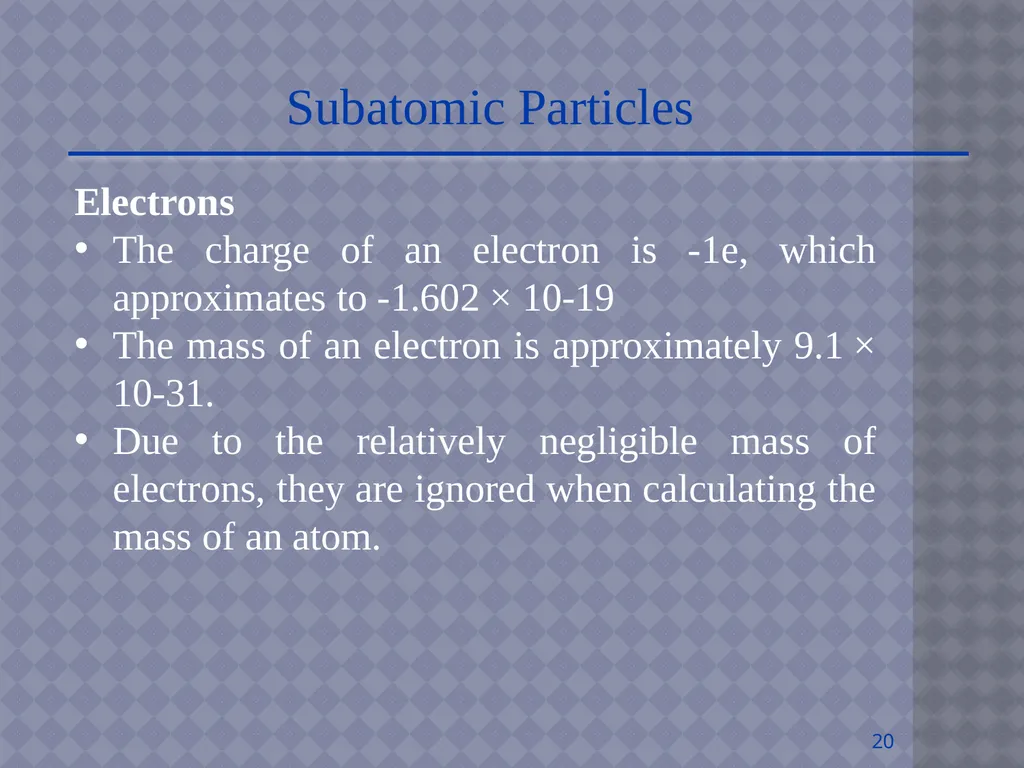
Subatomic Particles Electrons
The charge of an electron is -1e, which approximates to -1.602 × 10⁻¹⁹
The mass of an electron is approximately 9.1 × 10⁻³¹.
Due to the relatively negligible mass of electrons, they are ignored when calculating the mass of an atom. 20<br>
The charge of an electron is -1e, which approximates to -1.602 × 10⁻¹⁹
The mass of an electron is approximately 9.1 × 10⁻³¹.
Due to the relatively negligible mass of electrons, they are ignored when calculating the mass of an atom. 20<br>
21
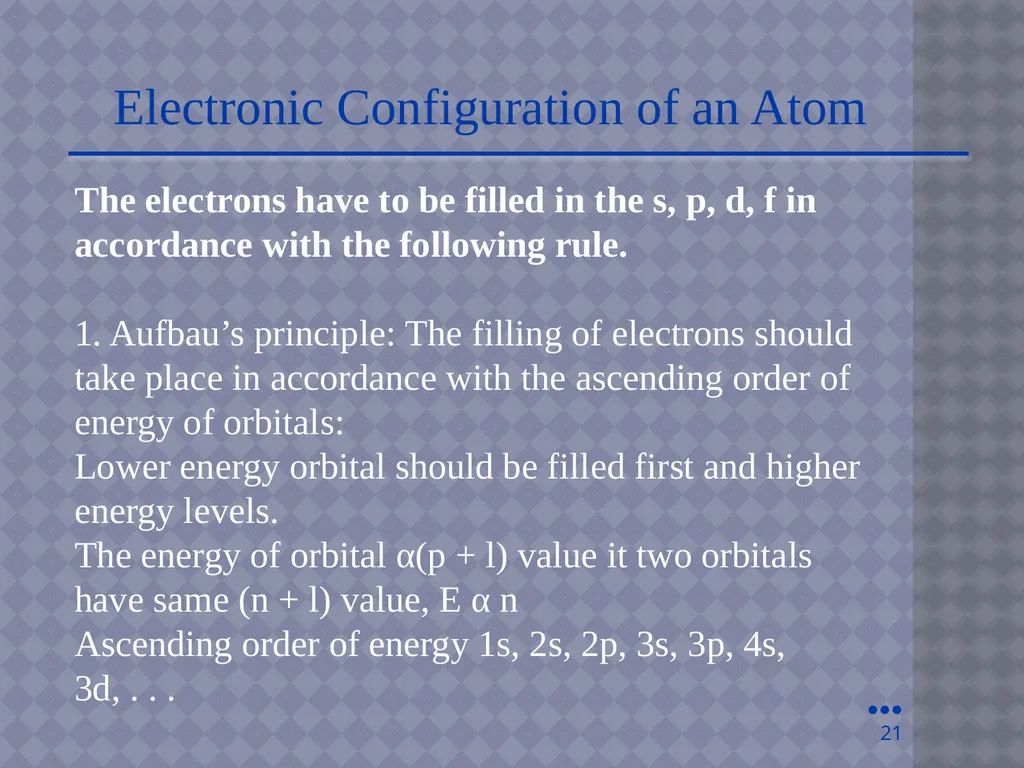
Electronic Configuration of an Atom The electrons have to be filled in the s, p, d, f in accordance with the following rule.
1. Aufbau’s principle: The filling of electrons should take place in accordance with the ascending order of energy of orbitals:
Lower energy orbital should be filled first and higher energy levels.
The energy of orbital α(p + l) value it two orbitals have same (n + l) value, E α n
Ascending order of energy 1s, 2s, 2p, 3s, 3p, 4s, 3d, . . . ●●●
21<br>
1. Aufbau’s principle: The filling of electrons should take place in accordance with the ascending order of energy of orbitals:
Lower energy orbital should be filled first and higher energy levels.
The energy of orbital α(p + l) value it two orbitals have same (n + l) value, E α n
Ascending order of energy 1s, 2s, 2p, 3s, 3p, 4s, 3d, . . . ●●●
21<br>
22
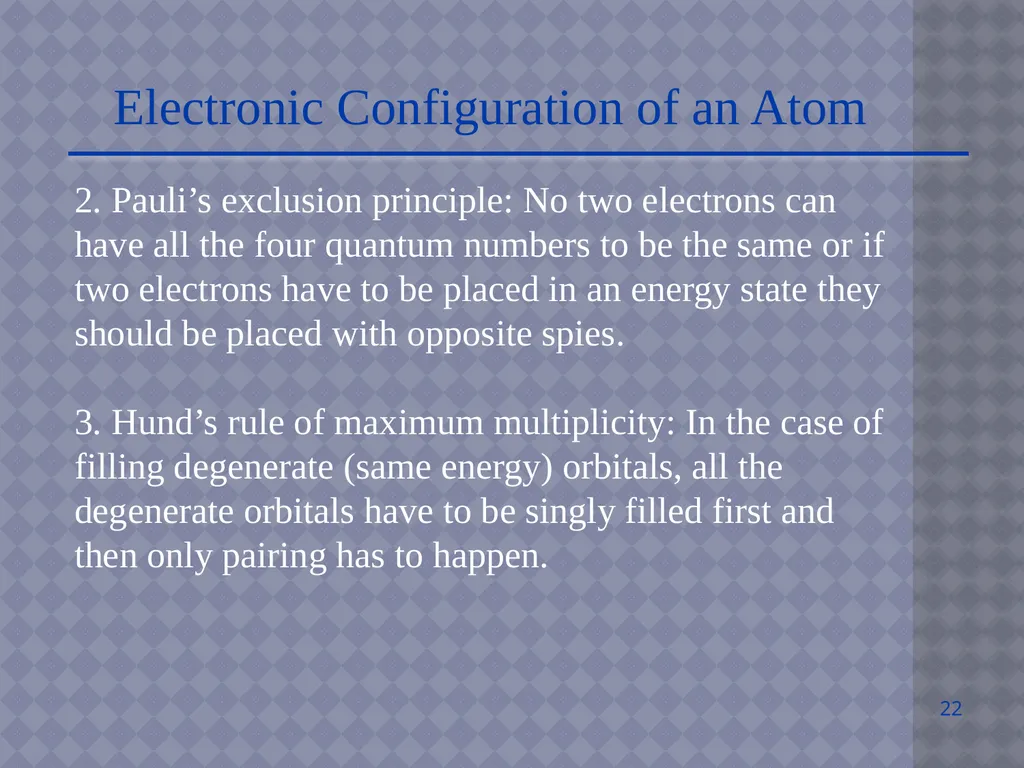
Electronic Configuration of an Atom 2. Pauli’s exclusion principle: No two electrons can have all the four quantum numbers to be the same or if two electrons have to be placed in an energy state they should be placed with opposite spies.
3. Hund’s rule of maximum multiplicity: In the case of filling degenerate (same energy) orbitals, all the degenerate orbitals have to be singly filled first and then only pairing has to happen. 22<br>
3. Hund’s rule of maximum multiplicity: In the case of filling degenerate (same energy) orbitals, all the degenerate orbitals have to be singly filled first and then only pairing has to happen. 22<br>
23
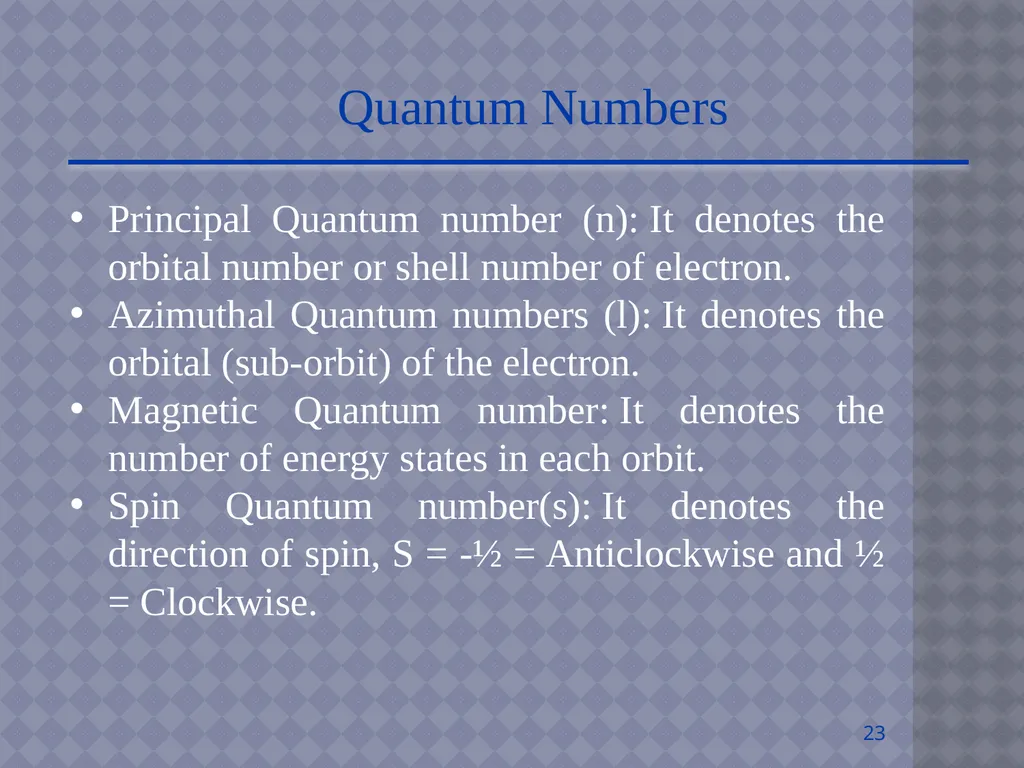
Principal Quantum number (n): It denotes the orbital number or shell number of electron.
Azimuthal Quantum numbers (l): It denotes the orbital (sub-orbit) of the electron.
Magnetic Quantum number: It denotes the number of energy states in each orbit.
Spin Quantum number(s): It denotes the direction of spin, S = -½ = Anticlockwise and ½ = Clockwise. 23 Quantum Numbers<br>
Azimuthal Quantum numbers (l): It denotes the orbital (sub-orbit) of the electron.
Magnetic Quantum number: It denotes the number of energy states in each orbit.
Spin Quantum number(s): It denotes the direction of spin, S = -½ = Anticlockwise and ½ = Clockwise. 23 Quantum Numbers<br>
24
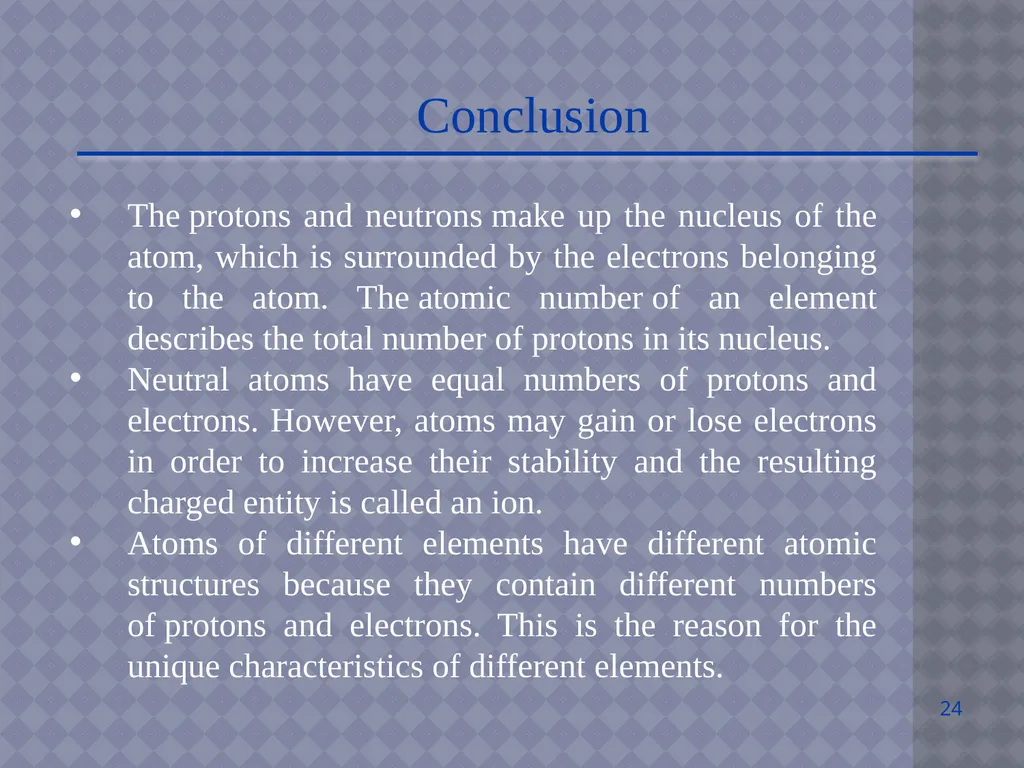
Conclusion The protons and neutrons make up the nucleus of the atom, which is surrounded by the electrons belonging to the atom. The atomic number of an element describes the total number of protons in its nucleus.
Neutral atoms have equal numbers of protons and electrons. However, atoms may gain or lose electrons in order to increase their stability and the resulting charged entity is called an ion.
Atoms of different elements have different atomic structures because they contain different numbers of protons and electrons. This is the reason for the unique characteristics of different elements. 24<br>
Neutral atoms have equal numbers of protons and electrons. However, atoms may gain or lose electrons in order to increase their stability and the resulting charged entity is called an ion.
Atoms of different elements have different atomic structures because they contain different numbers of protons and electrons. This is the reason for the unique characteristics of different elements. 24<br>
25
References Google.com
Wikipedia.org
Studymafia.org
Slidespanda.com<br>
Wikipedia.org
Studymafia.org
Slidespanda.com<br>
26
Thanks
To
StudyMafia.org<br>