
StudyMafia.Org Submitted To: Submitted By:






Description: StudyMafia.Org Submitted To: Submitted By: Studymafia.org Studymafia.org Culture Media Table Contents Definition Introduction Types of Culture Media Culture Media Methods Challenges of Culture Media Conclusion Definition Culture media, also
Related Topics
Download Presentation
"StudyMafia.Org Submitted To: Submitted By:" is the property of its rightful owner. Permission is granted to download and print the materials on this website for personal, non-commercial use only, and to display it on your personal computer provided you do not modify the materials and that you retain all copyright notices contained in the materials. By downloading content from our website, you accept the terms of this agreement.
Presentation Transcript
slide1. StudyMafia.Org Submitted To: Submitted By:
Studymafia.org Studymafia.org Culture
Media<br>
slide2. Table Contents Definition
Introduction
Types of Culture Media
Culture Media Methods
Challenges of Culture Media
Conclusion<br>
slide3. Definition Culture media, also known as growth media, are specific mixtures of nutrients and other substances that support the growth of microorganisms such as bacteria and fungi (yeasts and molds).<br>
slide4. Introduction Culture media are used for quality control tests of nonsterile raw materials and finished products as well as for microbial contamination (sterility) tests in applications such as hygiene monitoring, sterilization process validation and determination of the effectiveness of preservatives and antimicrobial agents.
Microbial enumeration tests for nonsterile products are performed according to the harmonized test procedures of the European, US and Japanese pharmacopoeias. These tests, formerly known as Microbial Limit Tests (MLT), determine the bioburden of the product sample.<br>
slide5. Types of culture media Based on their consistency
a) solid medium
b) liquid medium
c) semi solid medium
Based on the constituents/ ingredients
a) simple medium
b) complex medium
c) synthetic or defined medium
●●●<br>
slide6. Types of culture media Solid media – contains 2% agar
Colony morphology, pigmentation, hemolysis can be appreciated.
Eg: Nutrient agar, Blood agar
Liquid media – no agar.
For inoculum preparation, Blood culture, for the isolation of pathogens from a mixture.
Eg: Nutrient broth
●●●<br>
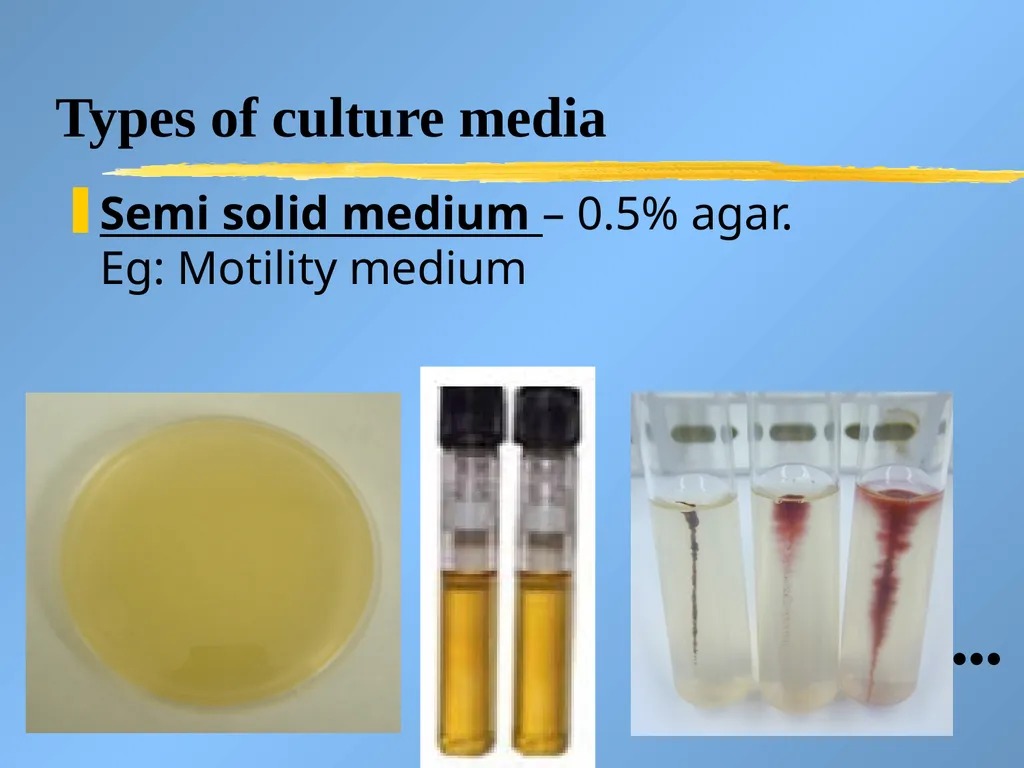
slide7. Types of culture media Semi solid medium – 0.5% agar. Eg: Motility medium
●●●<br>
slide8. Types of culture media Based on the constituents/ ingredients
Simple media / basal media
- Eg: NB, NA
- NB consists of peptone, meat extract, NaCl,
NB + 2% agar = Nutrient agar
●●●<br>
slide9. Types of culture media Complex media
Media other than basal media.
They have added ingredients.
Provide special nutrients
Synthetic or defined media
Media prepared from pure chemical substances and its exact composition is known
Eg: peptone water – 1% peptone + 0.5% NaCl in water<br>
slide10. CULTURE METHODS Culture methods employed depend on the purpose for which they are intended.
The indications for culture are:
To isolate bacteria in pure cultures.
To demonstrate their properties.
To obtain sufficient growth for the preparation of antigens and for other tests.
For bacteriophage & bacteriocin susceptibility.
To determine sensitivity to antibiotics.
To estimate viable counts.
Maintain stock cultures.
●●●<br>
slide11. Culture methods include:
Streak culture
Lawn culture
Stroke culture
Stab culture
Pour plate method
Liquid culture
●●●<br>
slide12. CULTURE METHODS STREAK CULTURE
Used for the isolation of bacteria in pure culture from clinical specimens.
Platinum wire or Nichrome wire is used.
One loopful of the specimen is transferred onto the surface of a well dried plate.
Spread over a small area at the periphery.
The inoculum is then distributed thinly over the plate by streaking it with a loop in a series of parallel lines in different segments of the plate.
On incubation, separated colonies are obtained over the last series of streaks.
●●●<br>
slide14. CULTURE METHODS LAWN CULTURE
Provides a uniform surface growth of the bacterium.
Uses
For bacteriophage typing.
Antibiotic sensitivity testing.
In the preparation of bacterial antigens and vaccines.
Lawn cultures are prepared by flooding the surface of the plate with a liquid suspension of the bacterium.
●●●<br>
slide15. CULTURE METHODS STROKE CULTURE
Stroke culture is made in tubes containing agar slope / slant.
Uses
Provide a pure growth of bacterium for slide agglutination and other diagnostic tests.
●●●<br>
slide16. CULTURE METHODS STAB CULTURE
Prepared by puncturing a suitable medium – gelatin or glucose agar with a long, straight, charged wire.
Uses
Demonstration of gelatin liquefaction.
Oxygen requirements of the bacterium under study.
Maintenance of stoke cultures.
●●●<br>
slide17. CULTURE METHODS POUR PLATE CULTURE
Agar medium is melted (15 ml) and cooled to 45oC.
1 ml of the inoculum is added to the molten agar.
Mix well and pour to a sterile petri dish.
Allow it to set.
Incubate at 37oC, colonies will be distributed throughout the depth of the medium.
Uses
Gives an estimate of the viable bacterial count in a suspension.
For the quantitative urine cultures.
●●●<br>
slide18. CULTURE METHODS LIQUID CULTURES
Liquid cultures are inoculated by touching with a charged loop or by adding the inoculum with pipettes or syringes.
Uses
Blood culture
Sterility tests
Continuous culture methods
Disadvantage
It does not provide a pure culture from mixed inocula.<br>
slide19. Challenges Culture media calculations.
Weighing and recording weight results.
Weighing influences.
The difficulties of weighing in a safety cabinet or fume hood.
Documentation<br>
slide20. Conclusion The preparation of culture media and their underlying culture technique goes hand in handand affect each other in either a good or bad way. When the preparation of a culture media isalready poor that is, it was not sterilized properly or that the experimenter made some form ofmistake on the culture process, even though the culture technique is good, the output or thegrowth of bacteria would be influenced by the quality of media used.
For the culture technique, itgoes to say that if the culture technique was executed in an unsatisfactory manner then microbialgrowth would still be affected.<br>
slide21. References Google.com
Wikipedia.org
Studymafia.org
Slidespanda.com<br>
slide22. Thanks To StudyMafia.org<br>
Studymafia.org Studymafia.org Culture
Media<br>
slide2. Table Contents Definition
Introduction
Types of Culture Media
Culture Media Methods
Challenges of Culture Media
Conclusion<br>
slide3. Definition Culture media, also known as growth media, are specific mixtures of nutrients and other substances that support the growth of microorganisms such as bacteria and fungi (yeasts and molds).<br>
slide4. Introduction Culture media are used for quality control tests of nonsterile raw materials and finished products as well as for microbial contamination (sterility) tests in applications such as hygiene monitoring, sterilization process validation and determination of the effectiveness of preservatives and antimicrobial agents.
Microbial enumeration tests for nonsterile products are performed according to the harmonized test procedures of the European, US and Japanese pharmacopoeias. These tests, formerly known as Microbial Limit Tests (MLT), determine the bioburden of the product sample.<br>
slide5. Types of culture media Based on their consistency
a) solid medium
b) liquid medium
c) semi solid medium
Based on the constituents/ ingredients
a) simple medium
b) complex medium
c) synthetic or defined medium
●●●<br>
slide6. Types of culture media Solid media – contains 2% agar
Colony morphology, pigmentation, hemolysis can be appreciated.
Eg: Nutrient agar, Blood agar
Liquid media – no agar.
For inoculum preparation, Blood culture, for the isolation of pathogens from a mixture.
Eg: Nutrient broth
●●●<br>
slide7. Types of culture media Semi solid medium – 0.5% agar. Eg: Motility medium
●●●<br>
slide8. Types of culture media Based on the constituents/ ingredients
Simple media / basal media
- Eg: NB, NA
- NB consists of peptone, meat extract, NaCl,
NB + 2% agar = Nutrient agar
●●●<br>
slide9. Types of culture media Complex media
Media other than basal media.
They have added ingredients.
Provide special nutrients
Synthetic or defined media
Media prepared from pure chemical substances and its exact composition is known
Eg: peptone water – 1% peptone + 0.5% NaCl in water<br>
slide10. CULTURE METHODS Culture methods employed depend on the purpose for which they are intended.
The indications for culture are:
To isolate bacteria in pure cultures.
To demonstrate their properties.
To obtain sufficient growth for the preparation of antigens and for other tests.
For bacteriophage & bacteriocin susceptibility.
To determine sensitivity to antibiotics.
To estimate viable counts.
Maintain stock cultures.
●●●<br>
slide11. Culture methods include:
Streak culture
Lawn culture
Stroke culture
Stab culture
Pour plate method
Liquid culture
●●●<br>
slide12. CULTURE METHODS STREAK CULTURE
Used for the isolation of bacteria in pure culture from clinical specimens.
Platinum wire or Nichrome wire is used.
One loopful of the specimen is transferred onto the surface of a well dried plate.
Spread over a small area at the periphery.
The inoculum is then distributed thinly over the plate by streaking it with a loop in a series of parallel lines in different segments of the plate.
On incubation, separated colonies are obtained over the last series of streaks.
●●●<br>
slide14. CULTURE METHODS LAWN CULTURE
Provides a uniform surface growth of the bacterium.
Uses
For bacteriophage typing.
Antibiotic sensitivity testing.
In the preparation of bacterial antigens and vaccines.
Lawn cultures are prepared by flooding the surface of the plate with a liquid suspension of the bacterium.
●●●<br>
slide15. CULTURE METHODS STROKE CULTURE
Stroke culture is made in tubes containing agar slope / slant.
Uses
Provide a pure growth of bacterium for slide agglutination and other diagnostic tests.
●●●<br>
slide16. CULTURE METHODS STAB CULTURE
Prepared by puncturing a suitable medium – gelatin or glucose agar with a long, straight, charged wire.
Uses
Demonstration of gelatin liquefaction.
Oxygen requirements of the bacterium under study.
Maintenance of stoke cultures.
●●●<br>
slide17. CULTURE METHODS POUR PLATE CULTURE
Agar medium is melted (15 ml) and cooled to 45oC.
1 ml of the inoculum is added to the molten agar.
Mix well and pour to a sterile petri dish.
Allow it to set.
Incubate at 37oC, colonies will be distributed throughout the depth of the medium.
Uses
Gives an estimate of the viable bacterial count in a suspension.
For the quantitative urine cultures.
●●●<br>
slide18. CULTURE METHODS LIQUID CULTURES
Liquid cultures are inoculated by touching with a charged loop or by adding the inoculum with pipettes or syringes.
Uses
Blood culture
Sterility tests
Continuous culture methods
Disadvantage
It does not provide a pure culture from mixed inocula.<br>
slide19. Challenges Culture media calculations.
Weighing and recording weight results.
Weighing influences.
The difficulties of weighing in a safety cabinet or fume hood.
Documentation<br>
slide20. Conclusion The preparation of culture media and their underlying culture technique goes hand in handand affect each other in either a good or bad way. When the preparation of a culture media isalready poor that is, it was not sterilized properly or that the experimenter made some form ofmistake on the culture process, even though the culture technique is good, the output or thegrowth of bacteria would be influenced by the quality of media used.
For the culture technique, itgoes to say that if the culture technique was executed in an unsatisfactory manner then microbialgrowth would still be affected.<br>
slide21. References Google.com
Wikipedia.org
Studymafia.org
Slidespanda.com<br>
slide22. Thanks To StudyMafia.org<br>