
StudyMafia.Org Submitted To: Submitted By:





Description: StudyMafia.Org Submitted To: Submitted By: Studymafia.org Studymafia.org Pleural Effusions Table Contents Definition Introduction Symptoms of Pleural Effusions Causes of Pleural Effusions Diagnosis of Pleural Effusions Treatment of Pleural
Related Topics
Download Presentation
"StudyMafia.Org Submitted To: Submitted By:" is the property of its rightful owner. Permission is granted to download and print the materials on this website for personal, non-commercial use only, and to display it on your personal computer provided you do not modify the materials and that you retain all copyright notices contained in the materials. By downloading content from our website, you accept the terms of this agreement.
Presentation Transcript
slide1. StudyMafia.Org Submitted To: Submitted By:
Studymafia.org Studymafia.org Pleural Effusions<br>
slide2. Table Contents Definition
Introduction
Symptoms of Pleural Effusions
Causes of Pleural Effusions
Diagnosis of Pleural Effusions
Treatment of Pleural Effusions
Conclusion 2<br>
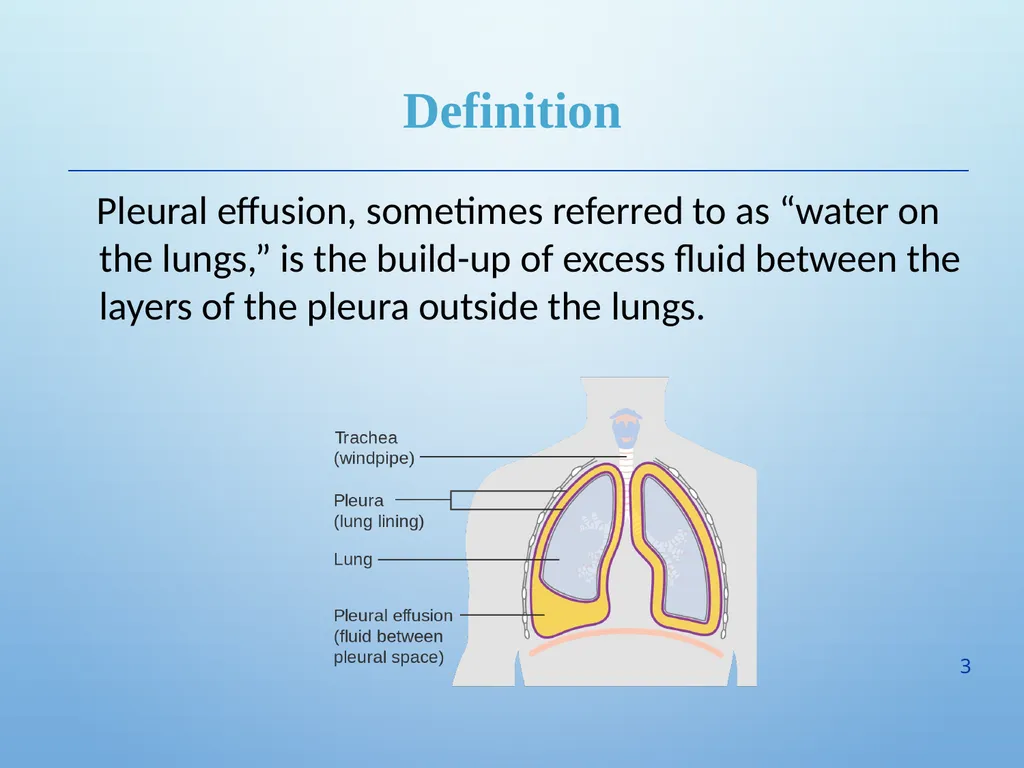
slide3. Definition Pleural effusion, sometimes referred to as “water on the lungs,” is the build-up of excess fluid between the layers of the pleura outside the lungs. 3<br>
slide4. Introduction The seriousness of the condition depends on the primary cause of pleural effusion, whether breathing is affected, and whether it can be treated effectively.
Causes of pleural effusion that can be effectively treated or controlled include an infection due to a virus, pneumonia or heart failure. Two factors that must be considered are treatment for associated mechanical problems as well as treatment of the underlying cause of the pleural effusion. 4<br>
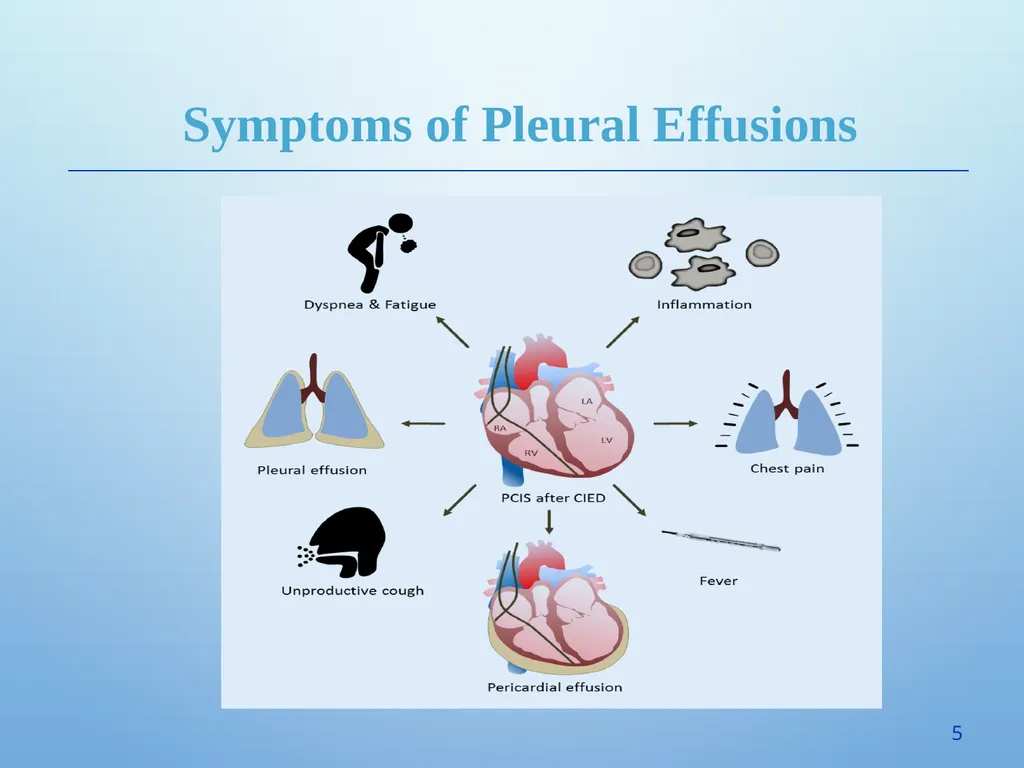
slide5. 5 Symptoms of Pleural Effusions<br>
slide6. Causes of Pleural Effusions Pleural effusions are very common, with approximately 100,000 cases diagnosed in the United States each year, according to the National Cancer Institute.
Depending on the cause, the excess fluid may be either protein-poor (transudative) or protein-rich (exudative). These two categories help physicians determine the cause of the pleural effusion. ●●●
6<br>
slide7. Causes of Pleural Effusions Exudative (protein-rich fluid) pleural effusions are most commonly caused by:
Pneumonia
Cancer
Pulmonary embolism
Kidney disease
Inflammatory disease ●●●
7<br>
slide8. Causes of Pleural Effusions Tuberculosis
Autoimmune disease
Bleeding (due to chest trauma)
Chylothorax (due to trauma)
Rare chest and abdominal infections
Asbestos pleural effusion (due to exposure to asbestos)
Meig’s syndrome (due to a benign ovarian tumor) ●●●
8<br>
slide9. Causes of Pleural Effusions The most common causes of transudative (watery fluid) pleural effusions include:
Heart failure
Pulmonary embolism
Cirrhosis
Post open heart surgery 9<br>
slide10. Diagnosis of Pleural Effusions Chest x-ray
Computed tomography (CT) scan of the chest
Ultrasound of the chest
Thoracentesis (a needle is inserted between the ribs to remove a biopsy, or sample of fluid)
Pleural fluid analysis (an examination of the fluid removed from the pleura space) ●●●
10<br>
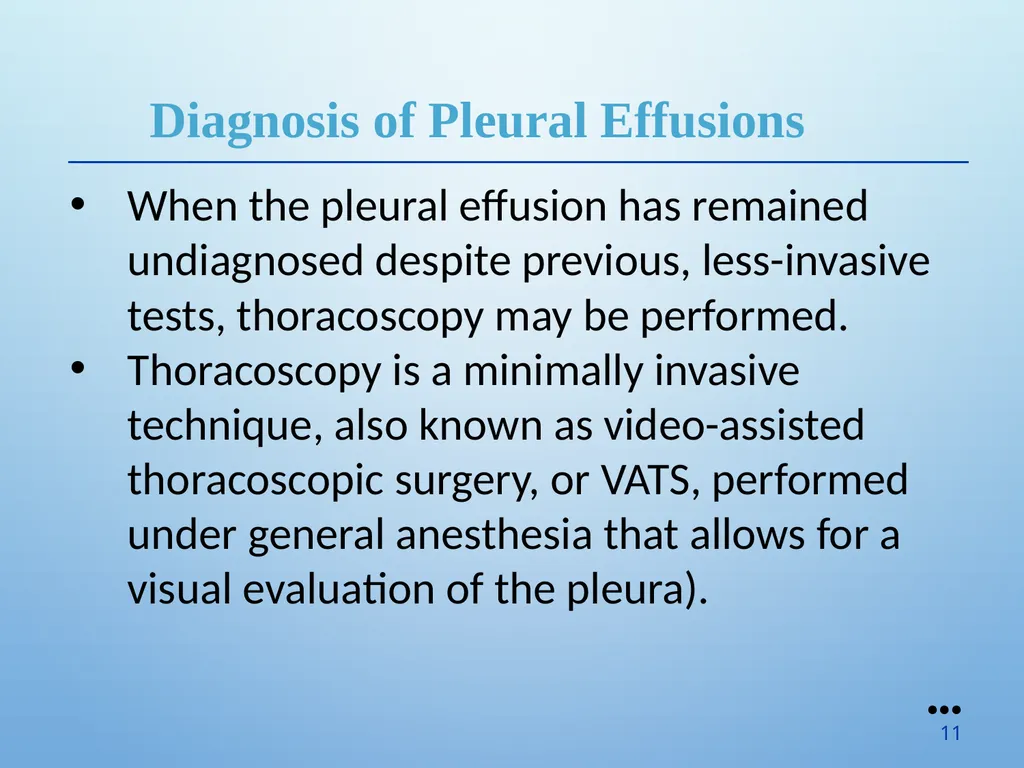
slide11. Diagnosis of Pleural Effusions When the pleural effusion has remained undiagnosed despite previous, less-invasive tests, thoracoscopy may be performed.
Thoracoscopy is a minimally invasive technique, also known as video-assisted thoracoscopic surgery, or VATS, performed under general anesthesia that allows for a visual evaluation of the pleura). ●●●
11<br>
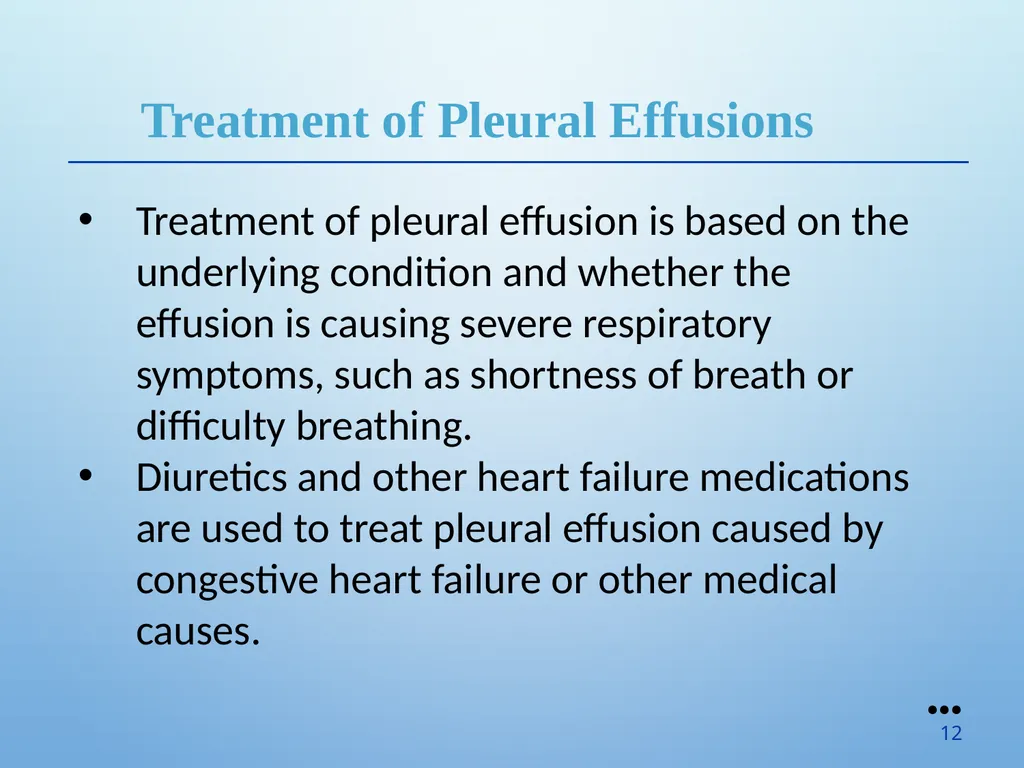
slide12. Treatment of Pleural Effusions Treatment of pleural effusion is based on the underlying condition and whether the effusion is causing severe respiratory symptoms, such as shortness of breath or difficulty breathing.
Diuretics and other heart failure medications are used to treat pleural effusion caused by congestive heart failure or other medical causes. ●●●
12<br>
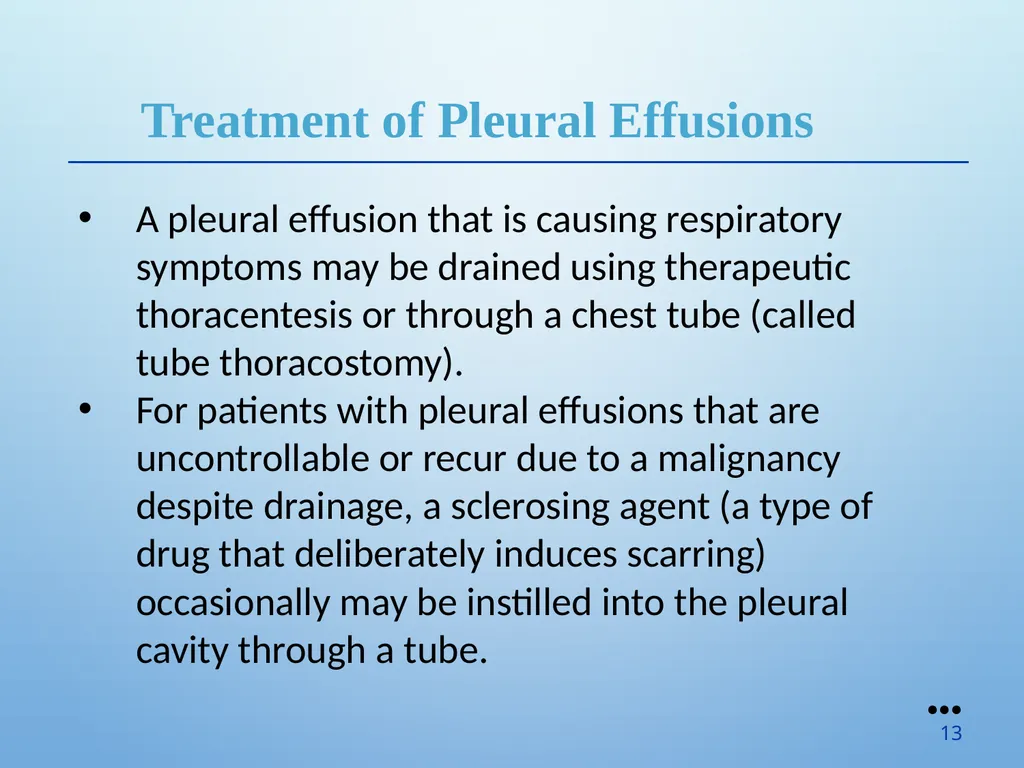
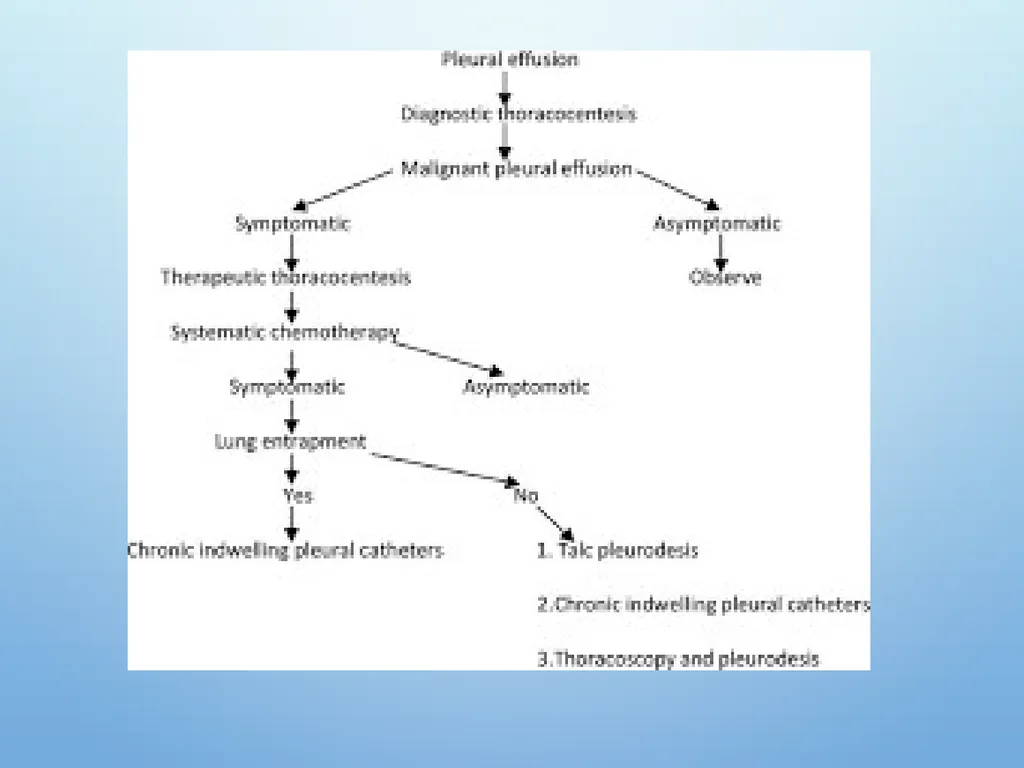
slide13. Treatment of Pleural Effusions A pleural effusion that is causing respiratory symptoms may be drained using therapeutic thoracentesis or through a chest tube (called tube thoracostomy).
For patients with pleural effusions that are uncontrollable or recur due to a malignancy despite drainage, a sclerosing agent (a type of drug that deliberately induces scarring) occasionally may be instilled into the pleural cavity through a tube. ●●●
13<br>
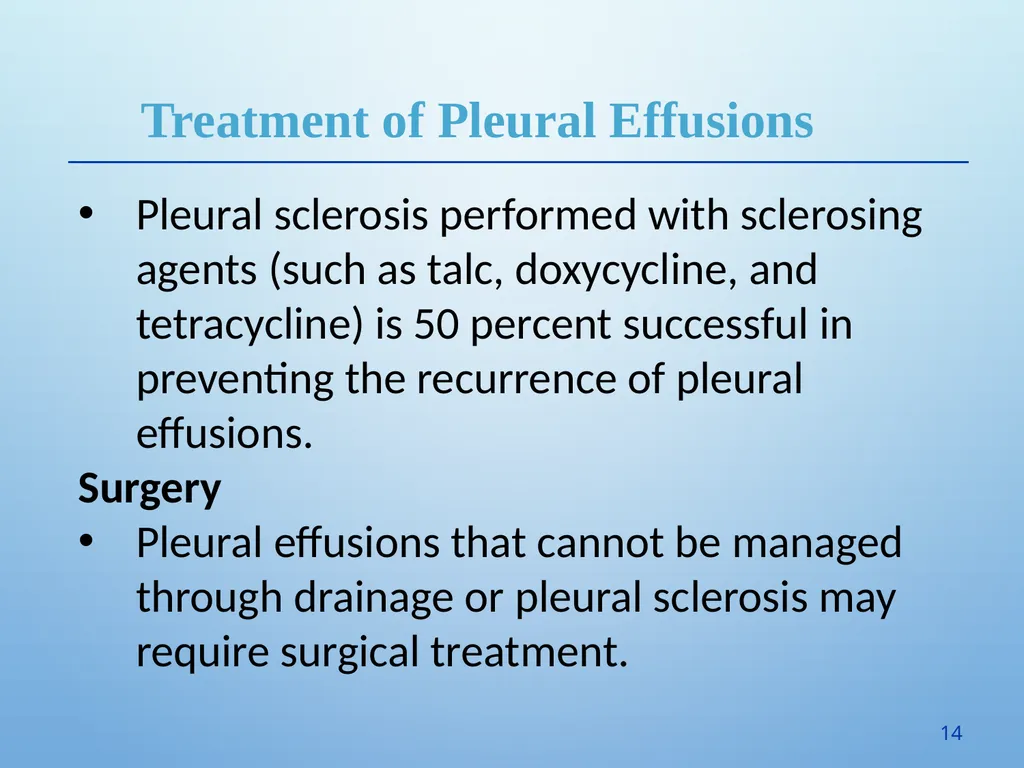
slide14. Treatment of Pleural Effusions Pleural sclerosis performed with sclerosing agents (such as talc, doxycycline, and tetracycline) is 50 percent successful in preventing the recurrence of pleural effusions.
Surgery
Pleural effusions that cannot be managed through drainage or pleural sclerosis may require surgical treatment. 14<br>
slide16. Conclusion Pleural effusion should be systematically evaluated as it has a wide range of differential diagnoses and basic fluid analysis is not specific for any particular diagnosis in many patients.
After the pleural fluid analysis, if the diagnosis is elusive, thoracic CT imaging is desirable. 16<br>
slide17. References Google.com
Wikipedia.org
Studymafia.org
Slidespanda.com<br>
slide18. Thanks To StudyMafia.org<br>
Studymafia.org Studymafia.org Pleural Effusions<br>
slide2. Table Contents Definition
Introduction
Symptoms of Pleural Effusions
Causes of Pleural Effusions
Diagnosis of Pleural Effusions
Treatment of Pleural Effusions
Conclusion 2<br>
slide3. Definition Pleural effusion, sometimes referred to as “water on the lungs,” is the build-up of excess fluid between the layers of the pleura outside the lungs. 3<br>
slide4. Introduction The seriousness of the condition depends on the primary cause of pleural effusion, whether breathing is affected, and whether it can be treated effectively.
Causes of pleural effusion that can be effectively treated or controlled include an infection due to a virus, pneumonia or heart failure. Two factors that must be considered are treatment for associated mechanical problems as well as treatment of the underlying cause of the pleural effusion. 4<br>
slide5. 5 Symptoms of Pleural Effusions<br>
slide6. Causes of Pleural Effusions Pleural effusions are very common, with approximately 100,000 cases diagnosed in the United States each year, according to the National Cancer Institute.
Depending on the cause, the excess fluid may be either protein-poor (transudative) or protein-rich (exudative). These two categories help physicians determine the cause of the pleural effusion. ●●●
6<br>
slide7. Causes of Pleural Effusions Exudative (protein-rich fluid) pleural effusions are most commonly caused by:
Pneumonia
Cancer
Pulmonary embolism
Kidney disease
Inflammatory disease ●●●
7<br>
slide8. Causes of Pleural Effusions Tuberculosis
Autoimmune disease
Bleeding (due to chest trauma)
Chylothorax (due to trauma)
Rare chest and abdominal infections
Asbestos pleural effusion (due to exposure to asbestos)
Meig’s syndrome (due to a benign ovarian tumor) ●●●
8<br>
slide9. Causes of Pleural Effusions The most common causes of transudative (watery fluid) pleural effusions include:
Heart failure
Pulmonary embolism
Cirrhosis
Post open heart surgery 9<br>
slide10. Diagnosis of Pleural Effusions Chest x-ray
Computed tomography (CT) scan of the chest
Ultrasound of the chest
Thoracentesis (a needle is inserted between the ribs to remove a biopsy, or sample of fluid)
Pleural fluid analysis (an examination of the fluid removed from the pleura space) ●●●
10<br>
slide11. Diagnosis of Pleural Effusions When the pleural effusion has remained undiagnosed despite previous, less-invasive tests, thoracoscopy may be performed.
Thoracoscopy is a minimally invasive technique, also known as video-assisted thoracoscopic surgery, or VATS, performed under general anesthesia that allows for a visual evaluation of the pleura). ●●●
11<br>
slide12. Treatment of Pleural Effusions Treatment of pleural effusion is based on the underlying condition and whether the effusion is causing severe respiratory symptoms, such as shortness of breath or difficulty breathing.
Diuretics and other heart failure medications are used to treat pleural effusion caused by congestive heart failure or other medical causes. ●●●
12<br>
slide13. Treatment of Pleural Effusions A pleural effusion that is causing respiratory symptoms may be drained using therapeutic thoracentesis or through a chest tube (called tube thoracostomy).
For patients with pleural effusions that are uncontrollable or recur due to a malignancy despite drainage, a sclerosing agent (a type of drug that deliberately induces scarring) occasionally may be instilled into the pleural cavity through a tube. ●●●
13<br>
slide14. Treatment of Pleural Effusions Pleural sclerosis performed with sclerosing agents (such as talc, doxycycline, and tetracycline) is 50 percent successful in preventing the recurrence of pleural effusions.
Surgery
Pleural effusions that cannot be managed through drainage or pleural sclerosis may require surgical treatment. 14<br>
slide16. Conclusion Pleural effusion should be systematically evaluated as it has a wide range of differential diagnoses and basic fluid analysis is not specific for any particular diagnosis in many patients.
After the pleural fluid analysis, if the diagnosis is elusive, thoracic CT imaging is desirable. 16<br>
slide17. References Google.com
Wikipedia.org
Studymafia.org
Slidespanda.com<br>
slide18. Thanks To StudyMafia.org<br>