
StudyMafia.Org Submitted To: Submitted By:


Description: StudyMafia.Org Submitted To: Submitted By: Studymafia.org Studymafia.org How Do Organism Reproduce Table Contents Introduction How do Organism Reproduce? Asexual Reproduction Sexual Reproduction Conclusion 2 Introduction Organisms reproduce
Related Topics
Download Presentation
"StudyMafia.Org Submitted To: Submitted By:" is the property of its rightful owner. Permission is granted to download and print the materials on this website for personal, non-commercial use only, and to display it on your personal computer provided you do not modify the materials and that you retain all copyright notices contained in the materials. By downloading content from our website, you accept the terms of this agreement.
Presentation Transcript
slide1. StudyMafia.Org Submitted To: Submitted By:
Studymafia.org Studymafia.org How Do Organism
Reproduce<br>
slide2. Table Contents Introduction
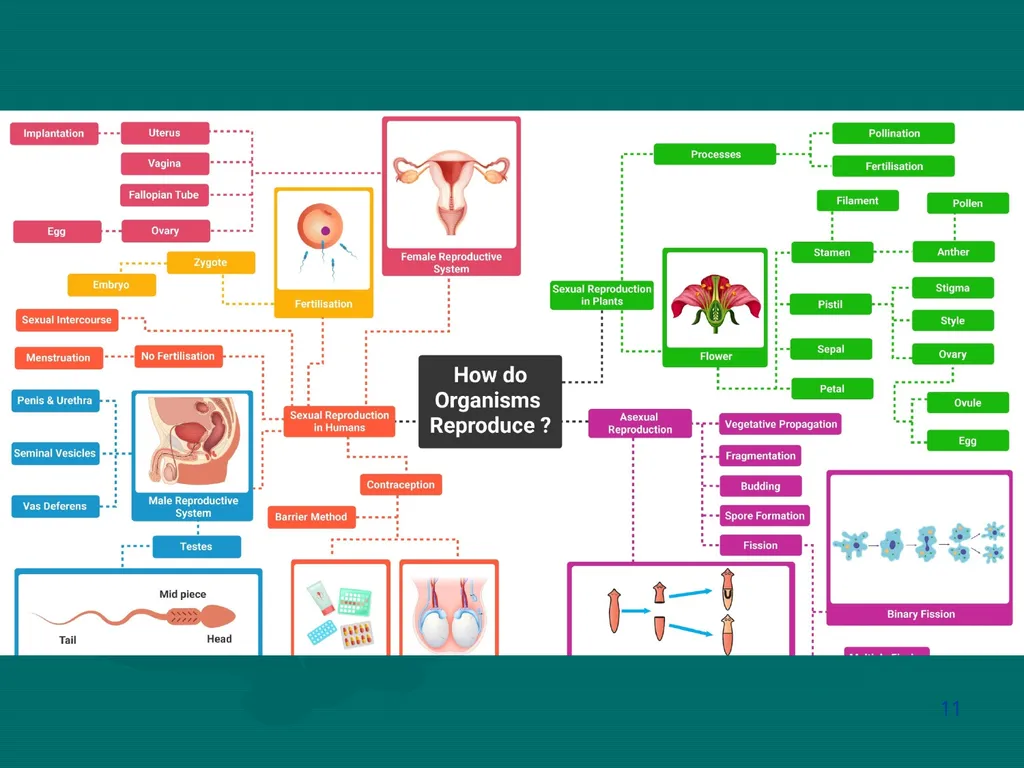
How do Organism Reproduce?
Asexual Reproduction
Sexual Reproduction
Conclusion 2<br>
slide3. Introduction Organisms reproduce to continue the chain of life, to pass on its genes which are acquired over millennia. Reproduction is essentially a process by which individuals produce new individuals of the same kind. And this process is very important for the existence of life on earth.
Different organisms reproduce in different ways. 3<br>
slide4. The organisms reproduce in two ways:
Asexual Reproduction– In this process, only a single parent is involved and no gamete formation takes place.
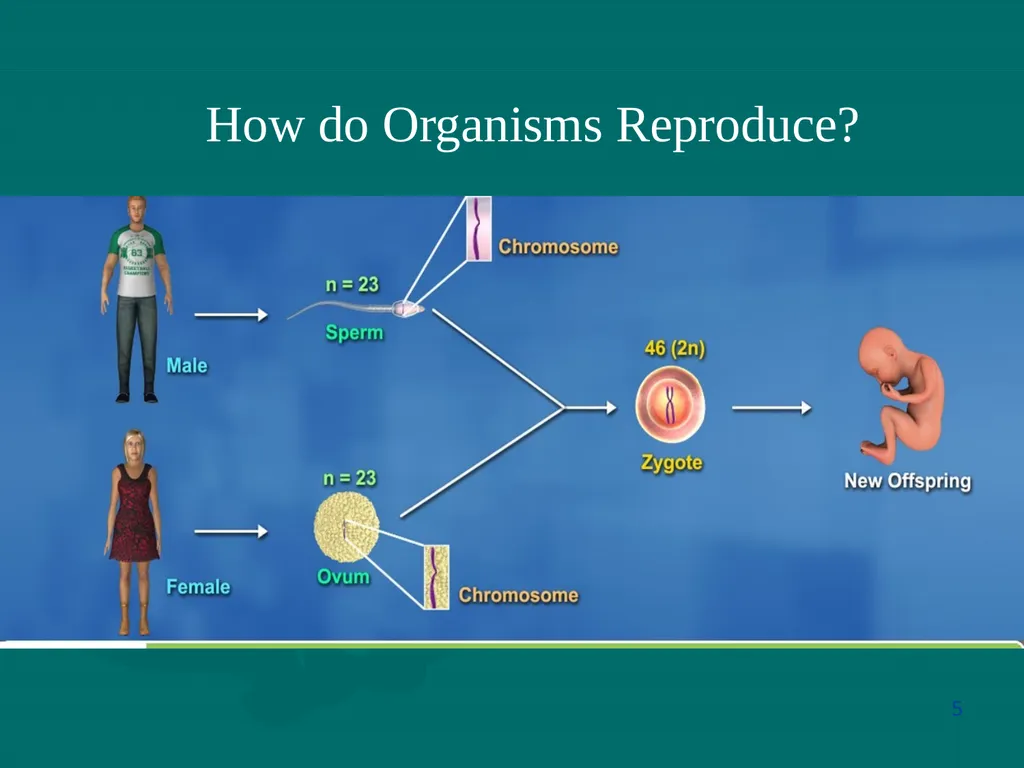
Sexual Reproduction– In this process, two parents are involved and gamete formation takes place. Meiosis is an important step in sexual reproduction. 4 How do Organisms Reproduce?<br>
slide5. How do Organisms Reproduce? 5<br>
slide6. Asexual Reproduction Fission: This process takes place in unicellular organisms. It is of two types:
Binary Fission– The organisms reproduce by binary fission only when adequate amounts of food and moisture is available. In this, the mother cell divides into two daughter cells, each containing a nucleus. Amoeba divides by binary fission.
Multiple Fission– The unicellular organisms reproduce by multiple fission when the conditions are unfavourable with no proper amounts of food, moisture, and temperature. In this, the organism forms a cyst around itself. ●●●
6<br>
slide7. Asexual Reproduction Budding: In this process, an outgrowth is produced from the cell from which a new organism is developed. The developed organism remains attached to the parent organism and detaches only when it matures, leaving behind scar tissue. The process is prominent in yeast and hydra.
Vegetative propagation: In this, a new plant grows from the fragments of the parent plant or a specialized reproductive structure. The offspring are the exact clones of the original plant and there is no mixing of DNA. ●●●
7<br>
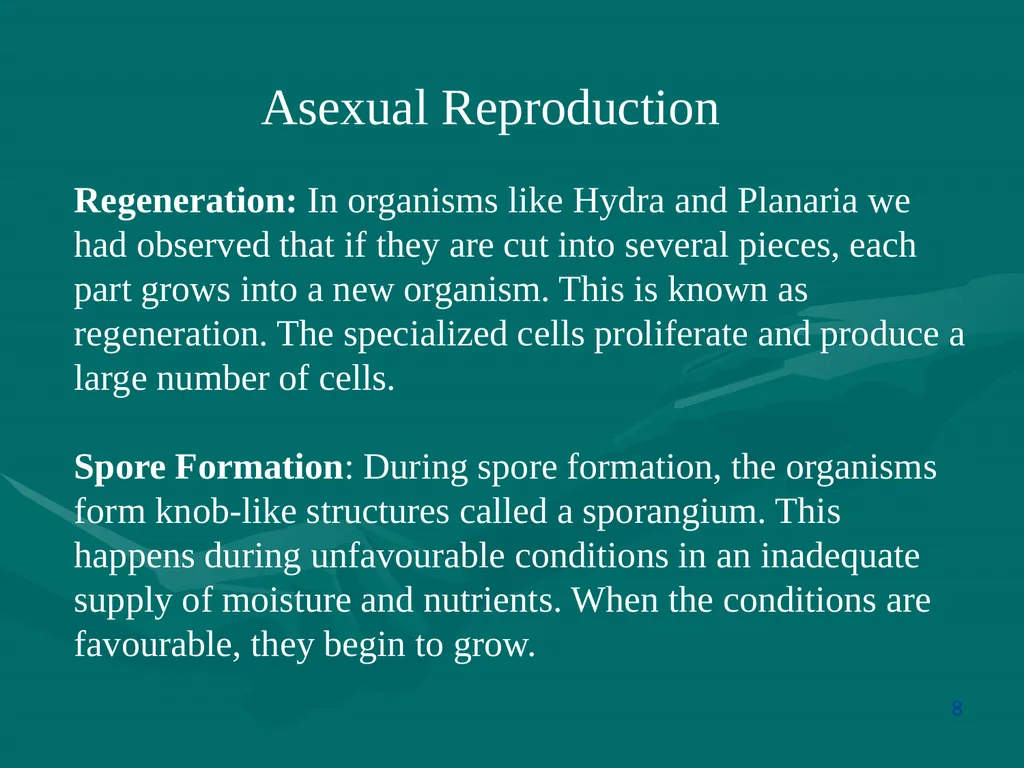
slide8. Asexual Reproduction Regeneration: In organisms like Hydra and Planaria we had observed that if they are cut into several pieces, each part grows into a new organism. This is known as regeneration. The specialized cells proliferate and produce a large number of cells.
Spore Formation: During spore formation, the organisms form knob-like structures called a sporangium. This happens during unfavourable conditions in an inadequate supply of moisture and nutrients. When the conditions are favourable, they begin to grow. 8<br>
slide9. Sexual reproduction is a natural way of reproduction and takes place in all multicellular organisms. This process involves two individuals to produce offspring. In this, the male and the female gametes fuse together and give rise to a new cell.
Sexual reproduction in Plants:
The angiosperms have both the male and female reproductive organs. The pollen grains produce male gametes which fuse with the egg cell of the female. The formation of gametes is known as gametogenesis. ●●●
9 Sexual Reproduction<br>
slide10. Sexual Reproduction in Humans:
The testes in males and the ovaries in females are responsible for the production of sperm in males and eggs in females.
The sperm fuses with the egg during fertilization, which results in the formation of a zygote and gets implanted in the wall of the uterus. It further divides and forms an embryo. 10 Sexual Reproduction<br>
slide11. 11<br>
slide12. Conclusion Reproduction is the process of producing new individuals of the same kind.
Organisms reproduce in two ways- asexually and sexually.
Asexual reproduction does not involve the fusion of male and female gametes. This takes place in bacteria, amoeba, hydra, etc.
Sexual reproduction involves the fusion of male and female gametes and can be seen in humans and many animals. 12<br>
slide13. References Google.com
Wikipedia.org
Studymafia.org
Slidespanda.com<br>
slide14. Thanks To StudyMafia.org<br>
Studymafia.org Studymafia.org How Do Organism
Reproduce<br>
slide2. Table Contents Introduction
How do Organism Reproduce?
Asexual Reproduction
Sexual Reproduction
Conclusion 2<br>
slide3. Introduction Organisms reproduce to continue the chain of life, to pass on its genes which are acquired over millennia. Reproduction is essentially a process by which individuals produce new individuals of the same kind. And this process is very important for the existence of life on earth.
Different organisms reproduce in different ways. 3<br>
slide4. The organisms reproduce in two ways:
Asexual Reproduction– In this process, only a single parent is involved and no gamete formation takes place.
Sexual Reproduction– In this process, two parents are involved and gamete formation takes place. Meiosis is an important step in sexual reproduction. 4 How do Organisms Reproduce?<br>
slide5. How do Organisms Reproduce? 5<br>
slide6. Asexual Reproduction Fission: This process takes place in unicellular organisms. It is of two types:
Binary Fission– The organisms reproduce by binary fission only when adequate amounts of food and moisture is available. In this, the mother cell divides into two daughter cells, each containing a nucleus. Amoeba divides by binary fission.
Multiple Fission– The unicellular organisms reproduce by multiple fission when the conditions are unfavourable with no proper amounts of food, moisture, and temperature. In this, the organism forms a cyst around itself. ●●●
6<br>
slide7. Asexual Reproduction Budding: In this process, an outgrowth is produced from the cell from which a new organism is developed. The developed organism remains attached to the parent organism and detaches only when it matures, leaving behind scar tissue. The process is prominent in yeast and hydra.
Vegetative propagation: In this, a new plant grows from the fragments of the parent plant or a specialized reproductive structure. The offspring are the exact clones of the original plant and there is no mixing of DNA. ●●●
7<br>
slide8. Asexual Reproduction Regeneration: In organisms like Hydra and Planaria we had observed that if they are cut into several pieces, each part grows into a new organism. This is known as regeneration. The specialized cells proliferate and produce a large number of cells.
Spore Formation: During spore formation, the organisms form knob-like structures called a sporangium. This happens during unfavourable conditions in an inadequate supply of moisture and nutrients. When the conditions are favourable, they begin to grow. 8<br>
slide9. Sexual reproduction is a natural way of reproduction and takes place in all multicellular organisms. This process involves two individuals to produce offspring. In this, the male and the female gametes fuse together and give rise to a new cell.
Sexual reproduction in Plants:
The angiosperms have both the male and female reproductive organs. The pollen grains produce male gametes which fuse with the egg cell of the female. The formation of gametes is known as gametogenesis. ●●●
9 Sexual Reproduction<br>
slide10. Sexual Reproduction in Humans:
The testes in males and the ovaries in females are responsible for the production of sperm in males and eggs in females.
The sperm fuses with the egg during fertilization, which results in the formation of a zygote and gets implanted in the wall of the uterus. It further divides and forms an embryo. 10 Sexual Reproduction<br>
slide11. 11<br>
slide12. Conclusion Reproduction is the process of producing new individuals of the same kind.
Organisms reproduce in two ways- asexually and sexually.
Asexual reproduction does not involve the fusion of male and female gametes. This takes place in bacteria, amoeba, hydra, etc.
Sexual reproduction involves the fusion of male and female gametes and can be seen in humans and many animals. 12<br>
slide13. References Google.com
Wikipedia.org
Studymafia.org
Slidespanda.com<br>
slide14. Thanks To StudyMafia.org<br>