04
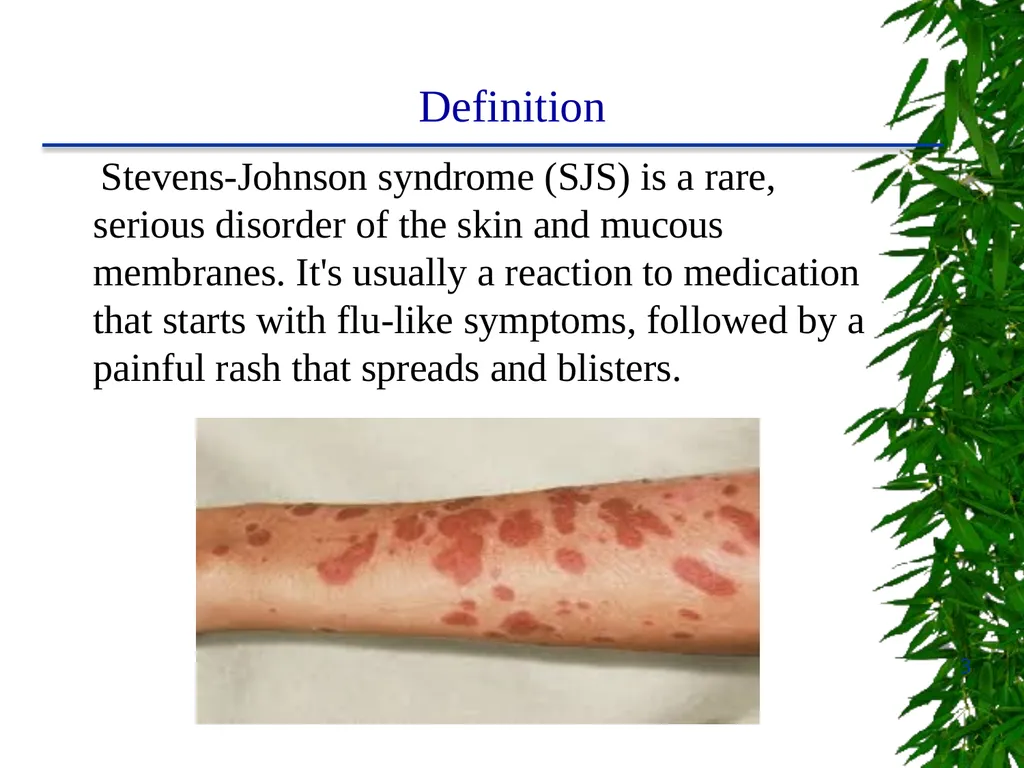
Introduction Stevens-Johnson syndrome is a medical emergency that usually requires hospitalization. Treatment focuses on removing the cause, caring for wounds, controlling pain and minimizing complications as skin regrows. It can take weeks to months to recover.
A more severe form of the condition is called toxic epidermal necrolysis (TEN). It involves more than 30% of the skin surface and extensive damage to the mucous membranes. 4<br>
06
Stevens-Johnson syndrome requires immediate medical attention. Seek emergency medical care if you experience signs and symptoms of this condition.
Drug-induced reactions may occur during the use of a medication or up to two weeks after discontinuing it. 6 When to see a doctor<br>
07
Causes of SJS Drugs that can cause Stevens-Johnson syndrome include:
Anti-gout medications, such as allopurinol
Medications to treat seizures and mental illness (anticonvulsants and antipsychotics)
Antibacterial sulfonamides (including sulfasalazine)
Nevirapine (Viramune, Viramune XR)
Pain relievers, such as acetaminophen (Tylenol, others), ibuprofen (Advil, Motrin IB, others) and naproxen sodium (Aleve)
Infections that can cause Stevens-Johnson syndrome include pneumonia and HIV 7<br>
08
Risk factors of SJS Factors that increase your risk of developing Stevens-Johnson syndrome include:
An HIV infection: Among people with HIV, the incidence of Stevens-Johnson syndrome is about 100 times greater than among the general population.
A weakened immune system: The immune system can be affected by an organ transplant, HIV/AIDS and autoimmune diseases.
Cancer : People with cancer, particularly blood cancer, are at increased risk of Stevens-Johnson syndrome. ●●●
8<br>
09
Risk factors of SJS A history of Stevens-Johnson syndrome: If you've had a medication-related form of this condition, you are at risk of a recurrence if you use that drug again.
A family history of Stevens-Johnson syndrome: If an immediate blood relative has had Stevens-Johnson syndrome, you may be at increased risk of getting it too.
Genetic factors: Having certain genetic variations puts you at increased risk of Stevens-Johnson syndrome, especially if you're also taking drugs for seizures, gout or mental illness. 9<br>
10
Complications of SJS Dehydration: Areas where the skin has shed lose fluids. And sores in the mouth and throat can make fluid intake difficult, resulting in dehydration.
Blood infection (sepsis): Sepsis occurs when bacteria from an infection enter the bloodstream and spread throughout the body. Sepsis is a rapidly progressing, life-threatening condition that can cause shock and organ failure.
Eye problems: The rash caused by Stevens-Johnson syndrome can lead to eye inflammation, dry eye and light sensitivity. In severe cases, it can lead to visual impairment and, rarely, blindness. ●●●
10<br>
11
Complications of SJS Lung involvement: The condition may lead to an emergency situation in which the lungs can't get enough oxygen into the blood (acute respiratory failure).
Permanent skin damage: When your skin grows back following Stevens-Johnson syndrome, it may have bumps and unusual coloring (dyspigmentation). And you may have scars. Lasting skin problems may cause your hair to fall out, and your fingernails and toenails may not grow as well as they did before. 11<br>
12
Prevention of SJS Consider genetic testing before taking certain drugs. The U.S. Food and Drug Administration recommends screening people of Asian and South Asian ancestry for a gene variation called HLA-B*1502 before starting treatment.
If you've had this condition, avoid the medication that triggered it. If you've had Stevens-Johnson syndrome and your health care provider told you it was caused by a medication, avoid that drug and others like it. This is key to preventing a recurrence, which is usually more severe than the first episode and can be fatal. 12<br>
13
Diagnosis of SJS Tests and procedures used to diagnose Stevens-Johnson syndrome include:
A review of your medical history and a physical exam. Health care providers often can identify Stevens-Johnson syndrome based on your medical history, including a review of your current and recently stopped medications, and a physical exam.
Skin biopsy. To confirm the diagnosis, and rule out other possible causes, your health care provider removes a sample of skin for laboratory testing (biopsy). ●●●
13<br>
14
Diagnosis of SJS Culture. To rule out an infection, your health care provider takes a sample of skin, tissue or fluid for laboratory testing (culture).
Imaging. Depending on your symptoms, your health care provider may have you undergo an imaging such as a chest X-ray to check for pneumonia.
Blood tests. These are used to confirm infection or other possible causes. ●●●
14<br>
15
Treatment of SJS Stopping nonessential medications
The first and most important step in treating Stevens-Johnson syndrome is to stop taking any medications that may be causing it. If you're taking more than one drug, it may be hard to tell which drug is causing the problem.
So your health care provider may have you stop taking all nonessential medications. ●●●
15<br>
16
Treatment of SJS Fluid replacement and nutrition: Because skin loss can result in significant loss of fluid from your body, replacing fluids is an important part of treatment.
Wound care: Cool, wet compresses might help soothe blisters while they heal.
Eye care: You may also need care from an eye specialist (ophthalmologist). ●●●
16<br>
17
Treatment of SJS Medications
Medications used in the treatment of Stevens-Johnson syndrome include:
Pain medication to reduce discomfort.
Medication to reduce inflammation of the eyes and mucous membranes (topical steroids).
Antibiotics to control infection, when needed. ●●●
17<br>
18
Treatment of SJS Know what caused your reaction. If your condition was caused by a medication, learn its name and that of others like it. Avoid them.
Inform your health care providers. Tell all your health care providers that you have a history of Stevens-Johnson syndrome. If the reaction was caused by a medication, tell them which one.
Wear a medical information bracelet or necklace. Have information about your condition and what caused it inscribed on a medical information bracelet or necklace. Always wear it. 18<br>
19
Conclusion Although SJS/TEN is a rare diagnosis, it is an important one to consider as a dermatologic emergency given the high morbidity and mortality associated with it. A cautious approach to SJS/TEN with treatment similar to that for burns may help to decrease morbidity and mortality. 19<br>
20
References Google.com
Wikipedia.org
Studymafia.org
Slidespanda.com<br>
21
Thanks�To �StudyMafia.org<br>