04
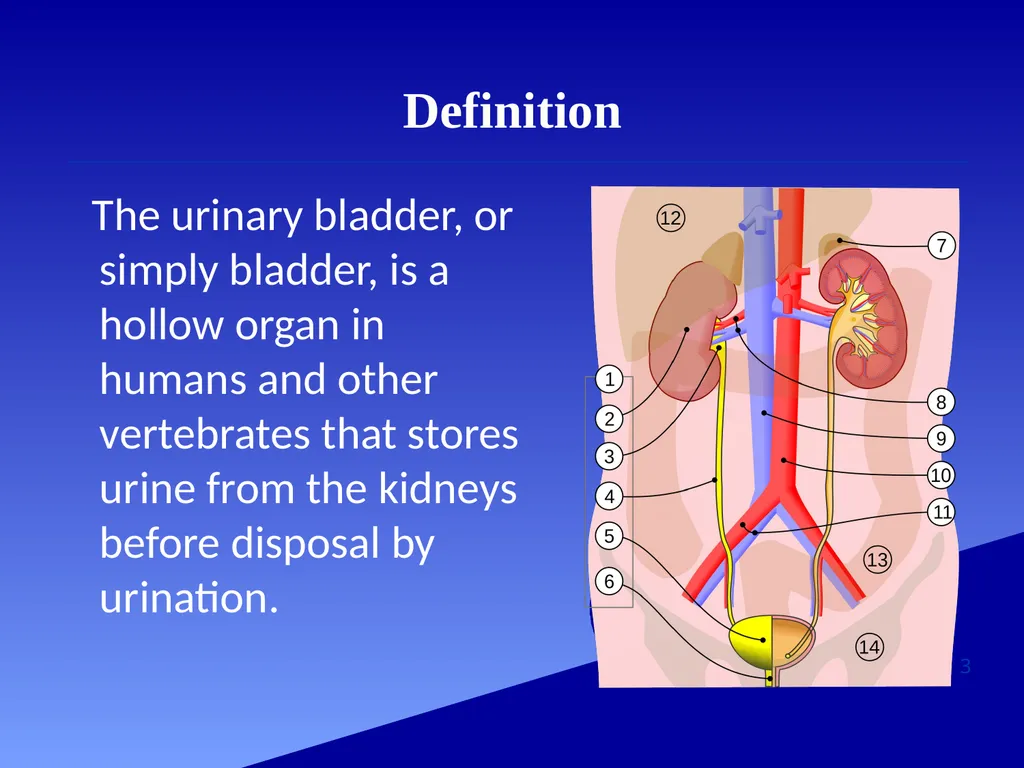
Introduction In humans the bladder is a distensible organ that sits on the pelvic floor. Urine enters the bladder via the ureters and exits via the urethra. The typical adult human bladder will hold between 300 and 500 ml (10.14 and 16.91 fl oz) before the urge to empty occurs, but can hold considerably more.
The Latin phrase for "urinary bladder" is vesica urinaria, and the term vesical or prefix vesico - appear in connection with associated structures such as vesical veins. 4<br>
06
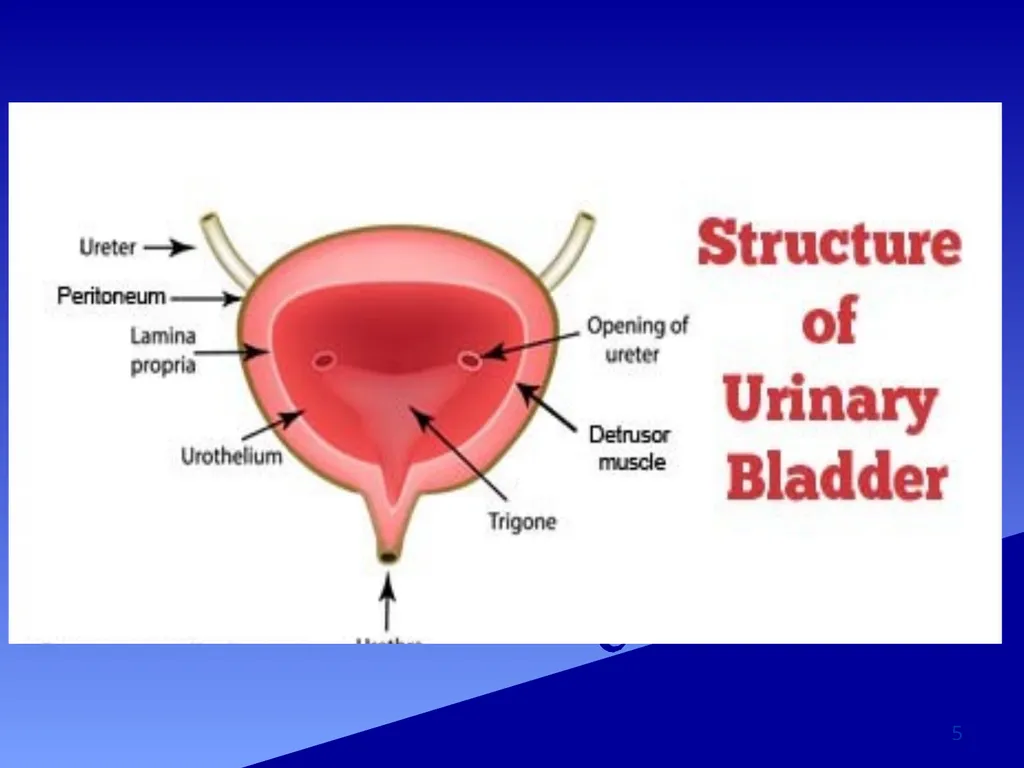
Structure of Urinary Bladder In humans, the bladder is a hollow muscular organ situated at the base of the pelvis. In gross anatomy, the bladder can be divided into a broad fundus, a body, an apex, and a neck.
The apex (also called the vertex) is directed forward toward the upper part of the pubic symphysis, and from there the median umbilical ligament continues upward on the back of the anterior abdominal wall to the umbilicus. ●●●
6<br>
07
Structure of Urinary Bladder Bladder location and associated structures in the male
In men, the prostate gland lies outside the opening for the urethra. The middle lobe of the prostate causes an elevation in the mucous membrane behind the internal urethral orifice called the uvula of urinary bladder. The uvula can enlarge when the prostate becomes enlarged. ●●●
7<br>
08
Structure of Urinary Bladder Blood and lymph supply
The bladder receives blood by the vesical arteries and drained into a network of vesical veins.[9] The superior vesical artery supplies blood to the upper part of the bladder. The lower part of the bladder is supplied by the inferior vesical artery, both of which are branches of the internal iliac arteries ●●●
8<br>
09
Structure of Urinary Bladder Nerve supply
The bladder receives both sensory and motor supply from sympathetic and the parasympathetic nervous systems.
The motor supply from both sympathetic fibers, most of which arise from the superior and inferior hypogastric plexuses and nerves, and from parasympathetic fibers, which come from the pelvic splanchnic nerves ●●●
9<br>
10
Structure of Urinary Bladder Microanatomy
The inner wall of the bladder is called urothelium, a type of transitional epithelium formed by three to six layers of cells; the cells may become more cuboidal or flatter depending on whether the bladder is empty or full. ●●●
10<br>
11
Parts of Urinary Bladder The transitional epithelium layer: This is the initial sheath that surrounds the inside of the bladder.
Lamina Propia: Lamina propia has nerve endings, adipocytes, fibrocytes, and interstitial cells. They jointly create a matrix.
Muscularis propia layer: It is elastic like a muscle which is also known as a detrusor. 11<br>
12
Functions of Urinary Bladder The main functions of the human urinary system to keep us healthy are as follows:
Remove all waste and medications from your body.
The fluids in the body are kept in balance.
A number of electrolytes are balanced. ●●●
12<br>
13
Functions of Urinary Bladder Hormones are released to regulate blood pressure.
To regulate red blood cell activity by releasing necessary hormones.
Controlling calcium and phosphorus to help with bone health. 13<br>
14
Features of Urinary Bladder The urinary bladder is a part of the urinary system that is concerned with the removal of waste products from the body through the medium of urine and the facilitation of blood purification.
It is somewhat triangular and has a hollow within itself to allow urine storage. ●●●
14<br>
15
Features of Urinary Bladder Urinary bladder capacity: It has an average capacity of 500 ml, which can vary from individual to individual.
Contraction and expansion: The muscles in the bladder contract and expand according to the need to facilitate retention or excretion. ●●●
15<br>
16
Features of Urinary Bladder Storage time: Generally, a person can hold urine for 5 hours. With more practice, it can extend to 7- 8 hours. However, it is not advisable to do so.
Location: It is located in the lower abdomen, near the pubic bone. 16<br>
17
Diseases of Urinary Bladder Bladder Cancer
The most common type of bladder cancer occurs in the epithelial lining of the bladder. In fact, approximately 90% of all bladder cancer are carcinomas.
The use of certain medications, cigarette smoke exposure, and infections are considered the most common causes of bladder cancer. ●●●
17<br>
18
Diseases of Urinary Bladder Urinary Tract Infection
Urinary tract infections (UTIs) are a common occurrence that can be severe and pose a major public health concern.
These infections are caused by bacterial infections in the bladder, usually caused by bacteria traveling up the urethra and into the bladder. When left untreated, UTIs can be very dangerous ●●●
18<br>
19
Diseases of Urinary Bladder Bladder Stones
Bladder stones are hard deposits composed of minerals found in the bladder caused by dehydration and highly concentrated urine residing in the bladder. Stones can vary in size and are typically asymptomatic. ●●●
19<br>
20
Diseases of Urinary Bladder Bladder Exstrophy
Bladder exstrophy is a congenital abnormality which involves the protrusion of the bladder through the wall of the abdomen.
This condition is extremely rare and is often accompanied by the abnormal development of the pelvic floor and other muscles, as well as the genitals, especially in women. ●●●
20<br>
21
Diseases of Urinary Bladder Urinary Retention
Urinary retention is a condition in which an individual is unable to completely empty the bladder.
Symptoms include poor pressure when urinating, the sensation of a full bladder, and straining to urinate. 21<br>
22
Conclusion The urinary bladder is a delicate organ of our body, which serves the function of storing urine or waste fluids that come out of the Kidneys.
It is a vital organ that can cause trouble, like a stone in the urinary bladder, when not taken proper care of. Situated at the pelvis, near the pubic bone, it is a sac-like structure that facilitates the flow of the urine through expansion and contraction. 22<br>
23
Thanks�To �StudyMafia.org<br>