"StudyMafia.Org Submitted To: Submitted By:" is the property of its rightful owner. Permission is granted to
download and print the materials on this website for personal, non-commercial use only, and to display it
on your personal computer provided you do not modify the materials and that you retain all copyright
notices contained in the materials. By downloading content from our website, you accept the terms of this
agreement.
Presentation Transcript
01
StudyMafia.Org Submitted To: Submitted By:
Studymafia.org Studymafia.org Placental Abruption<br>
02
Table Contents Definition
Introduction
Symptoms of Placental abruption
Causes of Placental abruption
Risks Factors for Placental abruption
Complications of Placental abruption
Prevention of Placental abruption
Diagnosis of Placental abruption
Treatment of Placental abruption
Conclusion 2<br>
03
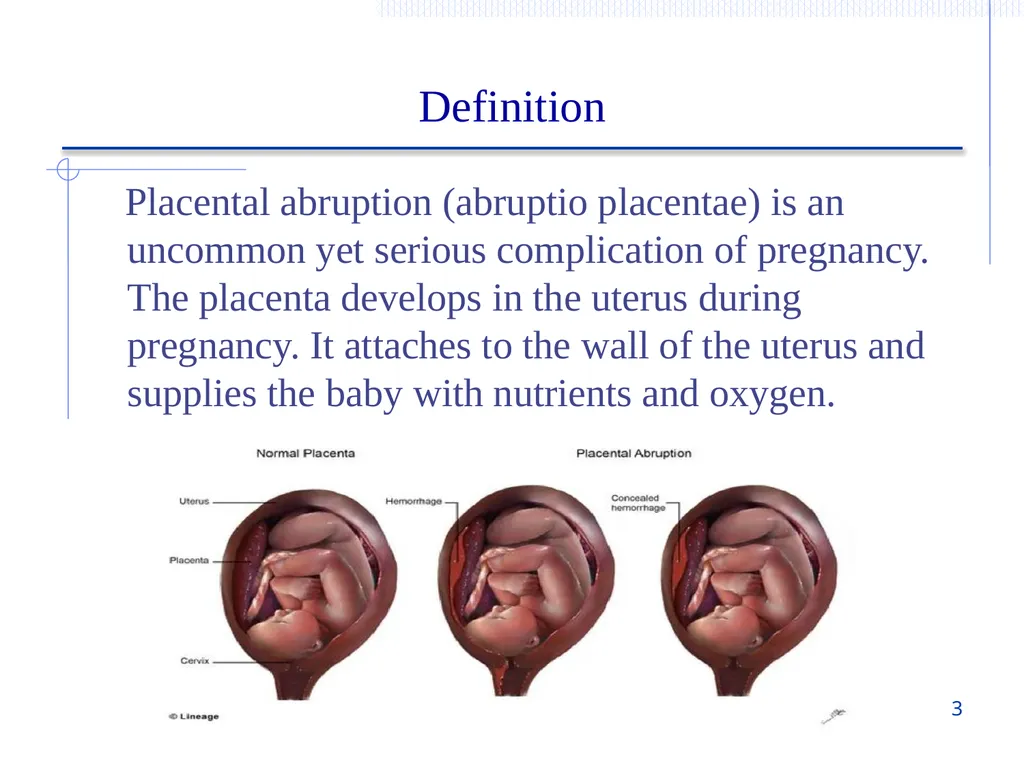
Definition Placental abruption (abruptio placentae) is an uncommon yet serious complication of pregnancy. The placenta develops in the uterus during pregnancy. It attaches to the wall of the uterus and supplies the baby with nutrients and oxygen. 3<br>
04
Introduction Placental abruption occurs when the placenta partly or completely separates from the inner wall of the uterus before delivery.
This can decrease or block the baby’s supply of oxygen and nutrients and cause heavy bleeding in the mother.
Placental abruption often happens suddenly. Left untreated, it endangers both the mother and the baby. 4<br>
05
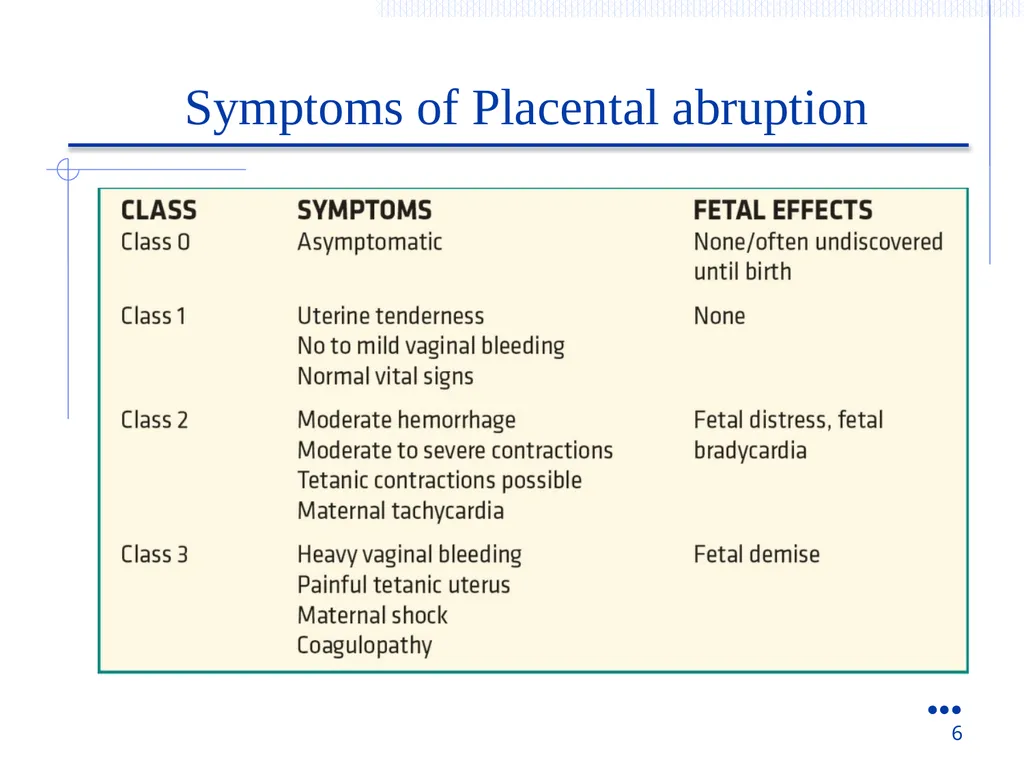
Placental abruption is most likely to occur in the last trimester of pregnancy, especially in the last few weeks before birth.
Abdominal pain and back pain often begin suddenly. The amount of vaginal bleeding can vary greatly, and doesn't necessarily indicate how much of the placenta has separated from the uterus.
In some cases, placental abruption develops slowly (chronic abruption), which can cause light, intermittent vaginal bleeding. ●●●
5 Symptoms of Placental abruption<br>
06
●●●
6 Symptoms of Placental abruption<br>
07
The cause of placental abruption is often unknown. Possible causes include trauma or injury to the abdomen — from an auto accident or fall, for example — or rapid loss of the fluid that surrounds and cushions the baby in the uterus (amniotic fluid). 7 Causes of Placental abruption<br>
08
Placental abruption in a previous pregnancy that wasn't caused by abdominal trauma
Chronic high blood pressure (hypertension)
Hypertension-related problems during pregnancy, including preeclampsia, HELLP syndrome or eclampsia
A fall or other type of blow to the abdomen ●●●
8 Risk factors for Placental abruption<br>
09
Smoking
Cocaine use during pregnancy
Early rupture of membranes, which causes leaking amniotic fluid before the end of pregnancy
Infection inside of the uterus during pregnancy (chorioamnionitis)
Being older, especially older than 40 9 Risk factors for Placental abruption<br>
10
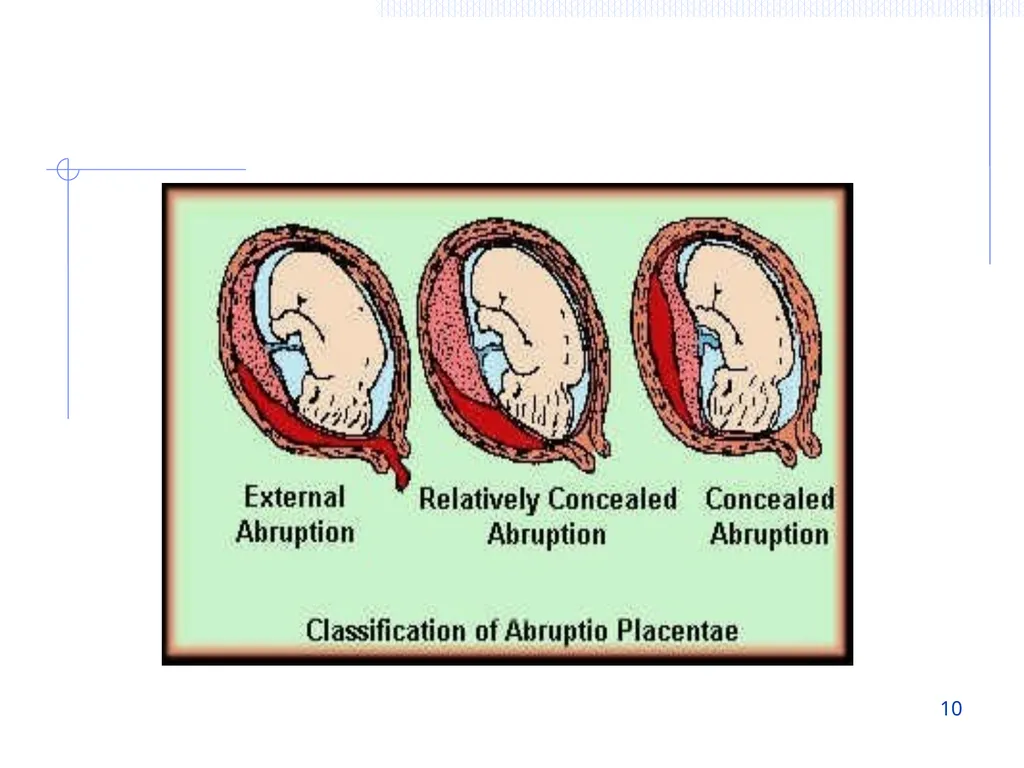
10<br>
11
Complications of Placental abruption For the mother, placental abruption can lead to:
Shock due to blood loss
Blood clotting problems
The need for a blood transfusion
Failure of the kidneys or other organs resulting from blood loss
Rarely, the need for hysterectomy, if uterine bleeding can't be controlled ●●●
11<br>
12
Complications of Placental abruption For the baby, placental abruption can lead to:
Restricted growth from not getting enough nutrients
Not getting enough oxygen
Premature birth
Stillbirth 12<br>
13
Prevention of Placental abruption You can't prevent placental abruption, but you can decrease certain risk factors. For example, don't smoke or use illegal drugs, such as cocaine. If you have high blood pressure, work with your health care provider to monitor the condition.
Always wear your seatbelt when in a motor vehicle. If you've had abdominal trauma — from an auto accident, fall or other injury — seek immediate medical help.
If you've had a placental abruption, and you're planning another pregnancy, talk to your health care provider before you conceive to see if there are ways to reduce the risk of another abruption. 13<br>
14
Diagnosis of Placental abruption If your health care provider suspects placental abruption, he or she will do a physical exam to check for uterine tenderness or rigidity. To help identify possible sources of vaginal bleeding, your provider will likely recommend blood and urine tests and ultrasound.
During an ultrasound, high-frequency sound waves create an image of your uterus on a monitor. It's not always possible to see a placental abruption on an ultrasound, however. 14<br>
15
Treatment of Placental abruption Treatment options for placental abruption depend on the circumstances:
The baby isn't close to full term:
If the abruption seems mild, your baby's heart rate is normal and it's too early for the baby to be born, you might be hospitalized for close monitoring. If the bleeding stops and your baby's condition is stable, you might be able to rest at home.
You might be given medication to help your baby's lungs mature and to protect the baby's brain, in case early delivery becomes necessary. ●●●
15<br>
16
Treatment of Placental abruption The baby is close to full term:
Generally after 34 weeks of pregnancy, if the placental abruption seems minimal, a closely monitored vaginal delivery might be possible. If the abruption worsens or jeopardizes your or your baby's health, you'll need an immediate delivery — usually by C-section.
For severe bleeding, you might need a blood transfusion. 16<br>
17
Conclusion Abruptio placenta is life threatening complication of pregnancy and it is associated with poor maternal and fetal outcome if not managed appropriately.
Hence early diagnosis and prompt resuscitative measures would prevent both perinatal and maternal mortality and morbidity. 17<br>