
Sub-heading Author & date Culture and Leadership
AM
Published · 26 slides · 0 views

1 / 1







Description
Sub-heading Author date Culture and Leadership Programme Purpose of this presentation Aim: to seek our boards engagement and advice on beginning a programme of work on culture and leadership across our Trust. This Photo by Unknown Author
Related Topics
Share
Embed code
Download this presentation From Below
"Sub-heading Author & date Culture and Leadership" is the property of its rightful owner. Permission is granted to download and print the materials on this website for personal, non-commercial use only, and to display it on your personal computer provided you do not modify the materials and that you retain all copyright notices contained in the materials. By downloading content from our website, you accept the terms of this agreement.
Presentation Transcript
01
Sub-heading Author & date Culture and Leadership Programme<br>
02
Purpose of this presentation Aim: to seek our board’s engagement and advice on beginning a programme of work on culture and leadership across our Trust. This Photo by Unknown Author is licensed under CC BY<br>
03
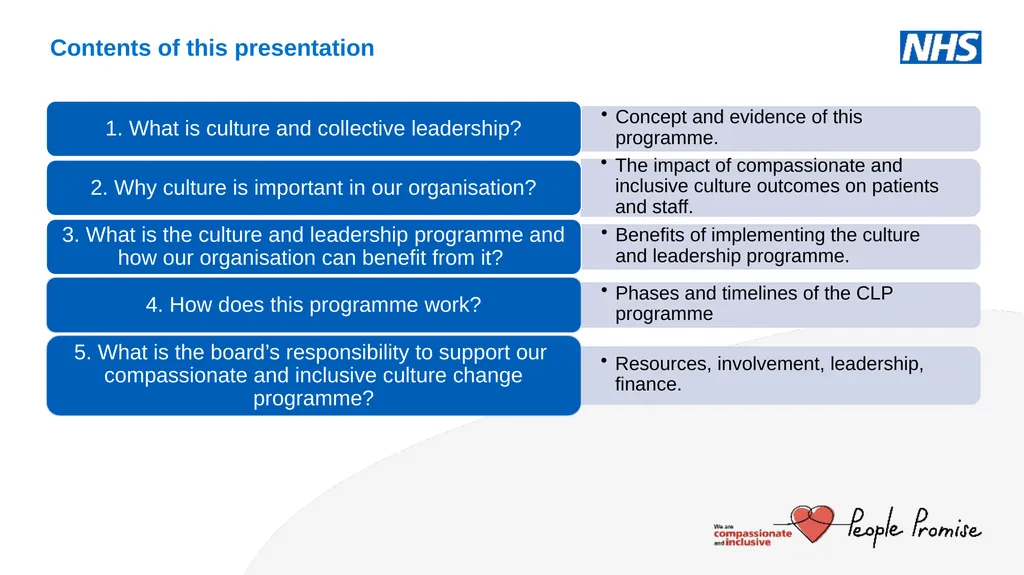
Contents of this presentation<br>
04
1. What is culture and collective leadership?<br>
05
Bringing culture to life through leadership A culture where all are empowered as individuals and in teams to provide leadership at various points in their daily work and in their careers. Collective Leadership A culture where all feel supported, listened to and where action is taken which leads to improvement. Compassionate Leadership A culture which recognises the unique needs of individuals, so that all feel valued and have the opportunity to thrive. Inclusive Leadership Leadership by all, and for all Listens to understand and takes action Enables equity, true inclusion and belonging<br>
06
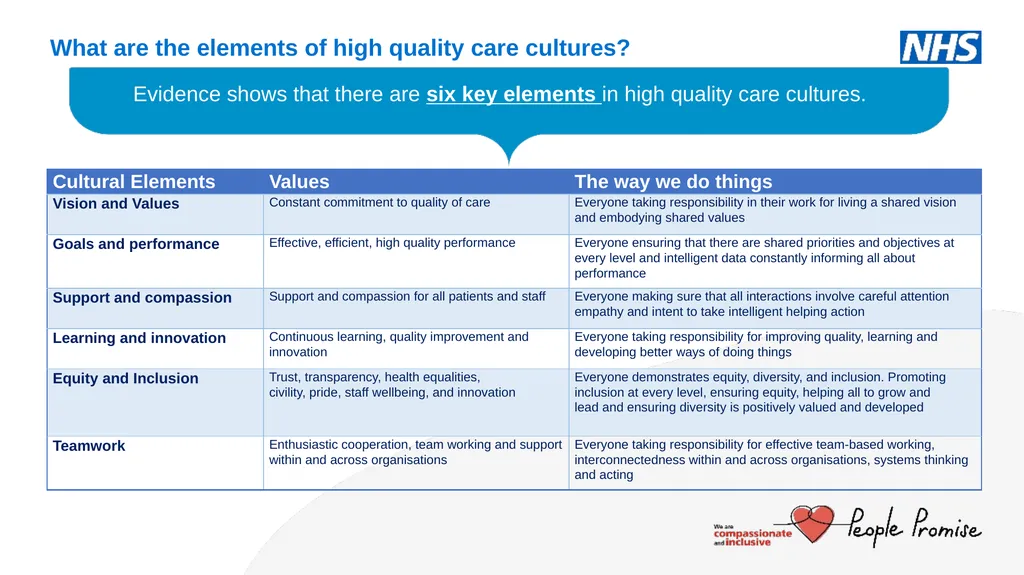
What are the elements of high quality care cultures? Evidence shows that there are six key elements in high quality care cultures.<br>
07
Our vision and values Populate with the vision and values for your organisation on this page.
Ask the Leaders of the system:
Do you identify with a particular set of values?
Are they being lived in your member organisations?
Provide the data by showing your Trust’s cultural dashboard with real life examples (Available via Model Health System or using the blank template available on www.england.nhs.uk/culture)
Explain to them why it’s important to implement it now?<br>
08
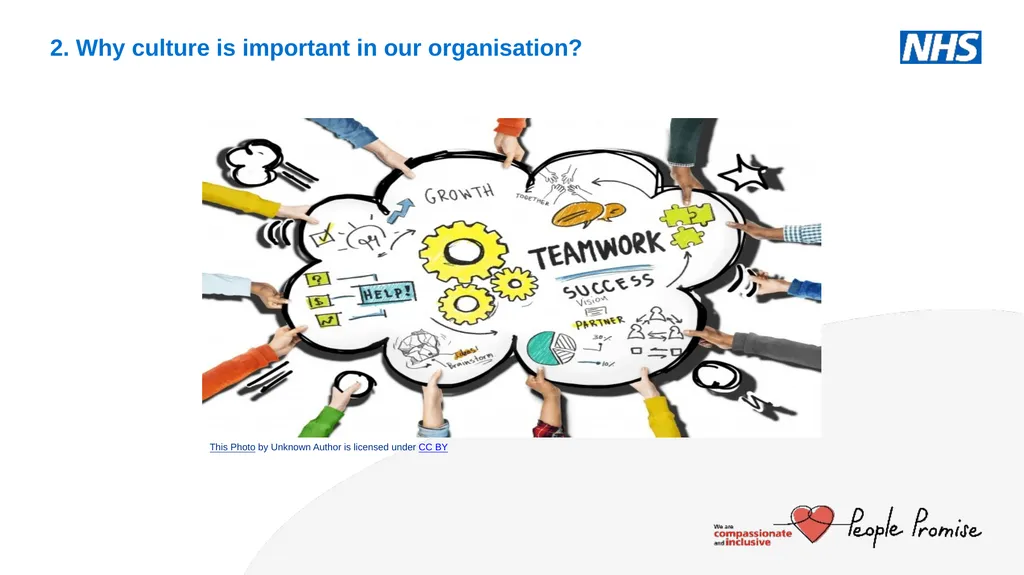
2. Why culture is important in our organisation?<br>
09
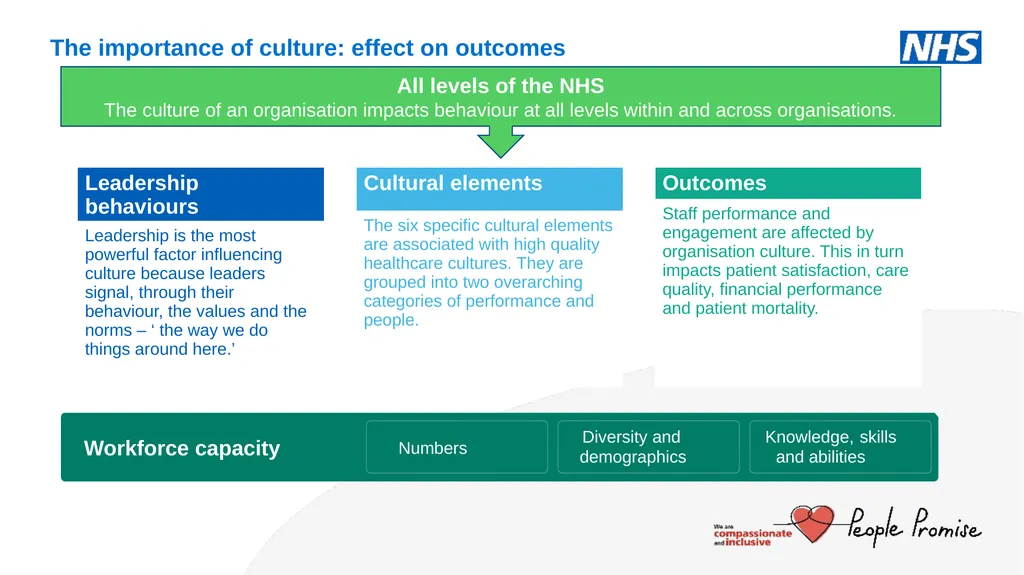
The importance of culture: effect on outcomes All levels of the NHS
The culture of an organisation impacts behaviour at all levels within and across organisations.<br>
The culture of an organisation impacts behaviour at all levels within and across organisations.<br>
10
The importance of culture: the concept framework<br>
11
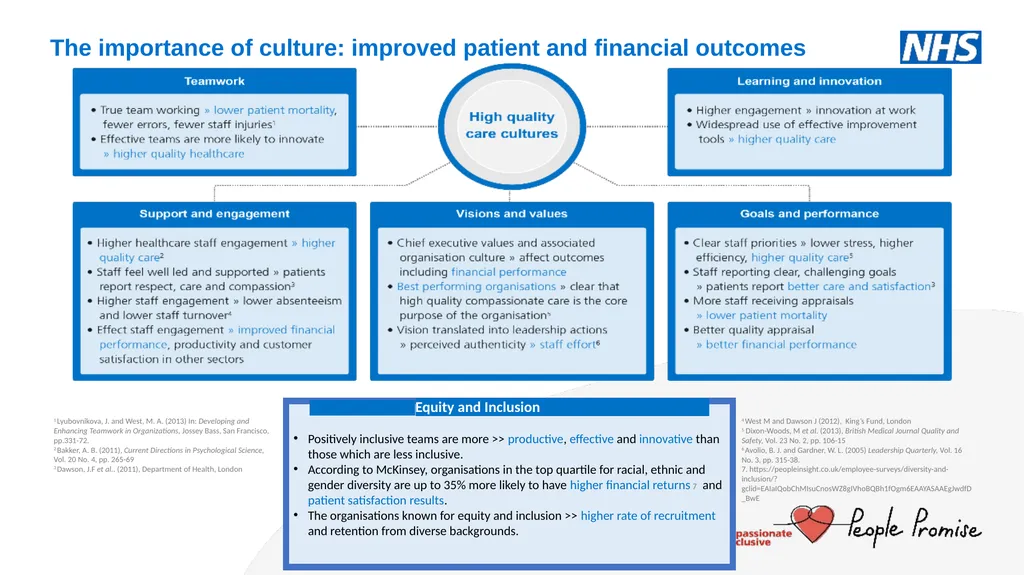
The importance of culture: improved patient and financial outcomes ………………………………Equity and Inclusion………………………………………….
Positively inclusive teams are more >> productive, effective and innovative than those which are less inclusive.
According to McKinsey, organisations in the top quartile for racial, ethnic and gender diversity are up to 35% more likely to have higher financial returns 7 and patient satisfaction results.
The organisations known for equity and inclusion >> higher rate of recruitment and retention from diverse backgrounds. 1 Lyubovnikova, J. and West, M. A. (2013) In: Developing and Enhancing Teamwork in Organizations, Jossey Bass, San Francisco, pp.331-72.
2 Bakker, A. B. (2011), Current Directions in Psychological Science, Vol. 20 No. 4, pp. 265-69
3 Dawson, J.F et al.. (2011), Department of Health, London 4 West M and Dawson J (2012), King’s Fund, London
5 Dixon-Woods, M et al. (2013), British Medical Journal Quality and Safety, Vol. 23 No. 2, pp. 106-15
6 Avolio, B. J. and Gardner, W. L. (2005) Leadership Quarterly, Vol. 16 No. 3, pp. 315-38.
7. https://peopleinsight.co.uk/employee-surveys/diversity-and-inclusion/?gclid=EAIaIQobChMIsuCnosWZ8gIVhoBQBh1fOgm6EAAYASAAEgJwdfD_BwE<br>
12
The importance of culture: Case Study for equity, inclusion & diversity North East London NHS Foundation Trust (NELFT), a mental health and community services provider employing 6,000 staff working over 200 sites, has achieved sustained improvements across all WRES indicators from 2016 - 2018.
Equality and inclusion-related issues were discussed by the board, the ethnic minority network (EMN), and at all meetings and levels in the trust, including inductions for new starters.
There was a clear message that race inequality was an issue that required the concerted effort of everyone in the trust. The board reviewed and endorsed a strategy to address racial inequality at the trust, and each executive board member worked with an EMN strategic ambassador to deliver specific actions for which they were accountable.
The organisation came up with a strategy that focused their attention and took specific actions in the following areas: recruitment, career progression, formal disciplinary methods, reverse mentoring. Conclusion
NELFT has the highest proportion in London of minority ethnic group staff reporting that the organisation provides equal opportunities for career progression.
It also has the second lowest proportion of minority ethnic group staff (and the fourth lowest proportion of white staff) reporting discrimination, harassment and bullying from colleagues in London
For more, see: https://www.england.nhs.uk/wp-content/uploads/2019/11/nelft-case-study.pdf<br>
13
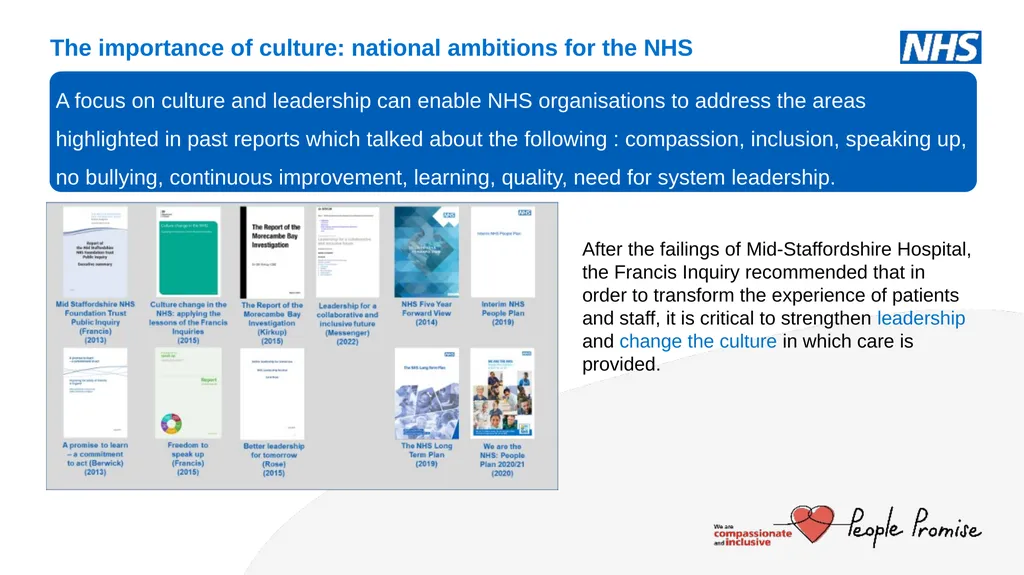
The importance of culture: national ambitions for the NHS After the failings of Mid-Staffordshire Hospital, the Francis Inquiry recommended that in order to transform the experience of patients and staff, it is critical to strengthen leadership and change the culture in which care is provided. <br>
14
The importance of culture: Our NHS People Promise The People Promise has come from those who work in the NHS.
People in different healthcare roles and organisations have made it clear what matters most to them, and what would make the greatest difference in improving their experience in the workplace. The culture and leadership programme can enable our organisation to address the aims of the people promise: compassionate and inclusive, recognition for job well done, a voice that counts, a workplace which is safe and healthy, continuous improvement, work flexibility, the feeling of belonging and a need for system leadership.<br>
People in different healthcare roles and organisations have made it clear what matters most to them, and what would make the greatest difference in improving their experience in the workplace. The culture and leadership programme can enable our organisation to address the aims of the people promise: compassionate and inclusive, recognition for job well done, a voice that counts, a workplace which is safe and healthy, continuous improvement, work flexibility, the feeling of belonging and a need for system leadership.<br>
15
3. What is the Culture and Leadership Programme?<br>
16
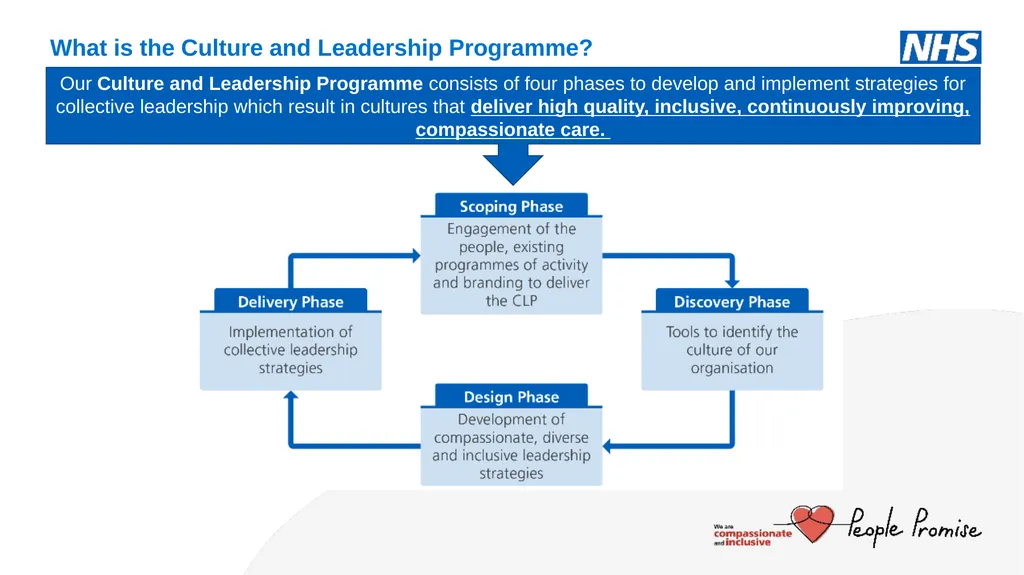
What is the Culture and Leadership Programme? Our Culture and Leadership Programme consists of four phases to develop and implement strategies for collective leadership which result in cultures that deliver high quality, inclusive, continuously improving, compassionate care.<br>
17
What happens in the Scoping Phase? Below is a simple checklist to focus on in the Scoping Phase:
Build our case
Identify our purpose
Conceptualise and communicate our purpose
Recruit our change team
Develop our change team
Create a project plan
Create an evaluation plan In the Scoping Phase, we take the time to discover and visualise our purpose, to understand why we are undertaking the Culture and Leadership programme. It’s the time to build our resources, funding, comms and putting our project plan in place before we begin diagnosing the culture of our organisation in the Discovery Phase.<br>
18
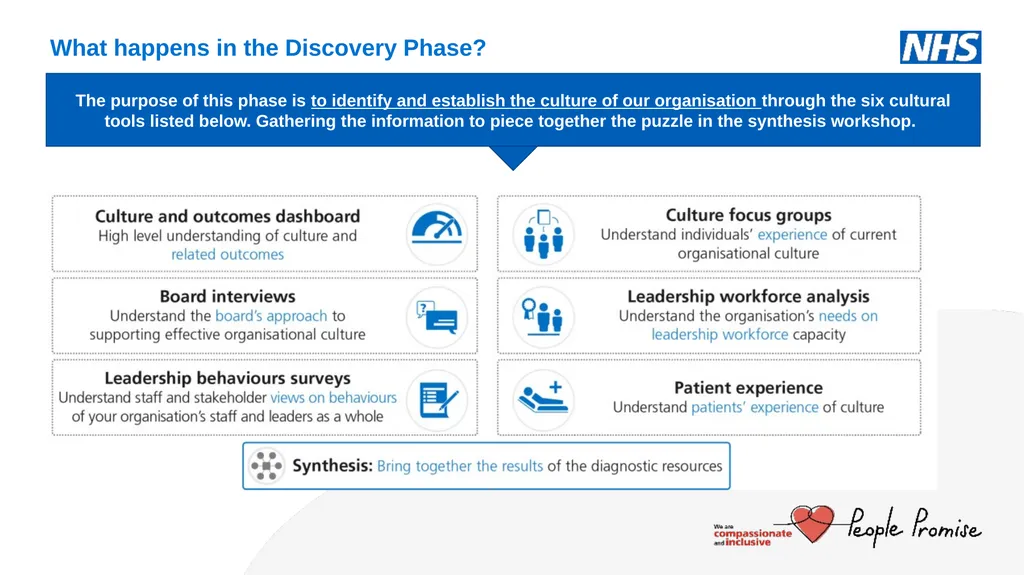
What happens in the Discovery Phase? The purpose of this phase is to identify and establish the culture of our organisation through the six cultural tools listed below. Gathering the information to piece together the puzzle in the synthesis workshop.<br>
19
Why do we need this programme? Explain your organisation’s context and why it might benefit you.
You may wish to include:
reference to the evidence on outcomes detailed above or that the programme will allow your organisation to address areas highlighted in the national reports mentioned
That the programme can contribute to the ‘culture and capability’ domain of the well-led framework for governance reviews, and improve results in governance reviews
key findings from the NHS staff survey which indicate areas of focus
any other issues that suggest the need to improve culture, leadership and overall employee health and wellbeing
Alternatively, you may want to ask this as a question for the board to answer<br>
20
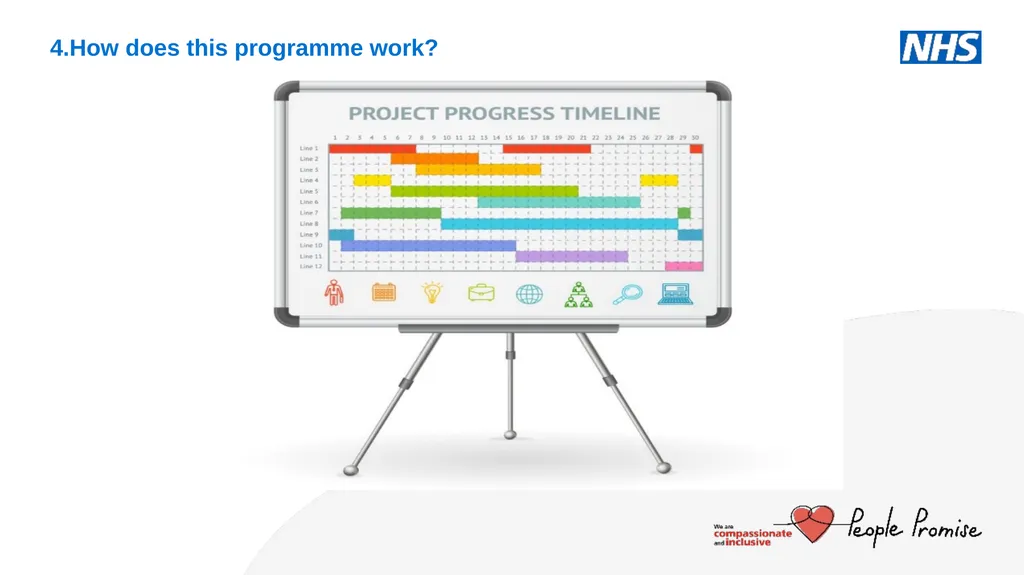
4.How does this programme work?<br>
21
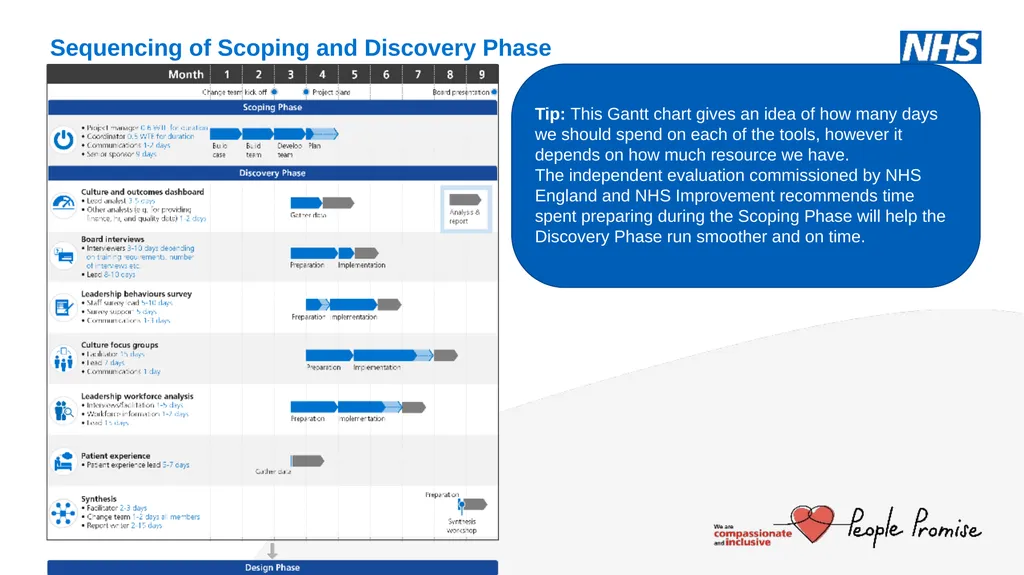
Sequencing of Scoping and Discovery Phase Tip: This Gantt chart gives an idea of how many days we should spend on each of the tools, however it depends on how much resource we have.
The independent evaluation commissioned by NHS England and NHS Improvement recommends time spent preparing during the Scoping Phase will help the Discovery Phase run smoother and on time.<br>
The independent evaluation commissioned by NHS England and NHS Improvement recommends time spent preparing during the Scoping Phase will help the Discovery Phase run smoother and on time.<br>
22
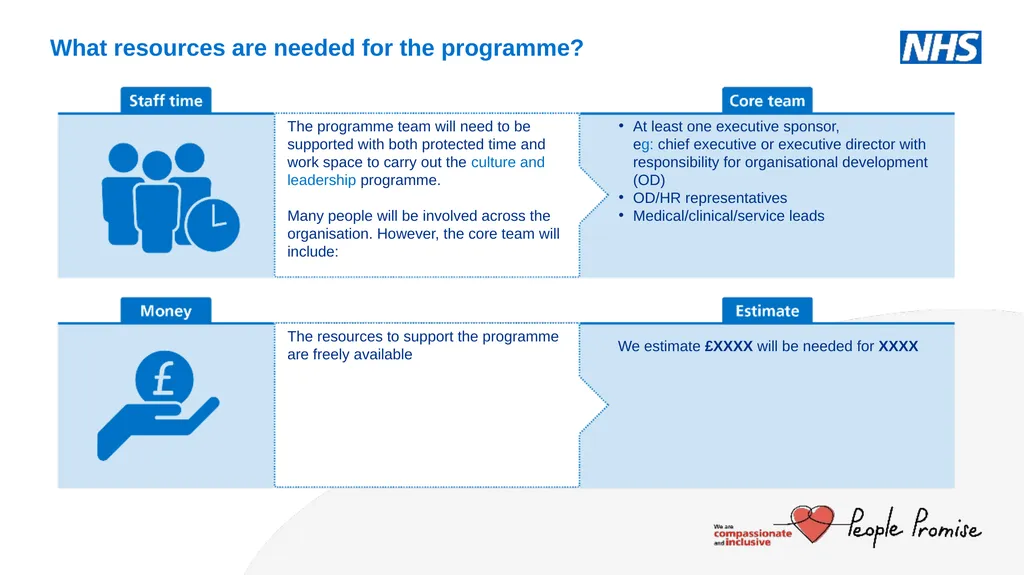
What resources are needed for the programme? The programme team will need to be supported with both protected time and work space to carry out the culture and leadership programme.
Many people will be involved across the organisation. However, the core team will include: The resources to support the programme are freely available At least one executive sponsor, eg: chief executive or executive director with responsibility for organisational development (OD)
OD/HR representatives
Medical/clinical/service leads We estimate £XXXX will be needed for XXXX<br>
23
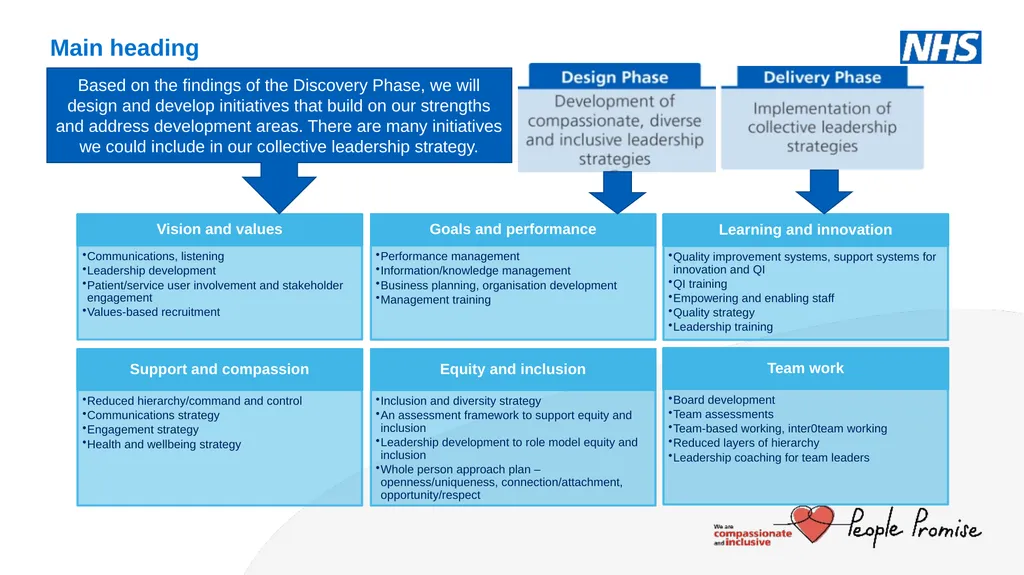
Main heading Based on the findings of the Discovery Phase, we will design and develop initiatives that build on our strengths and address development areas. There are many initiatives we could include in our collective leadership strategy.<br>
24
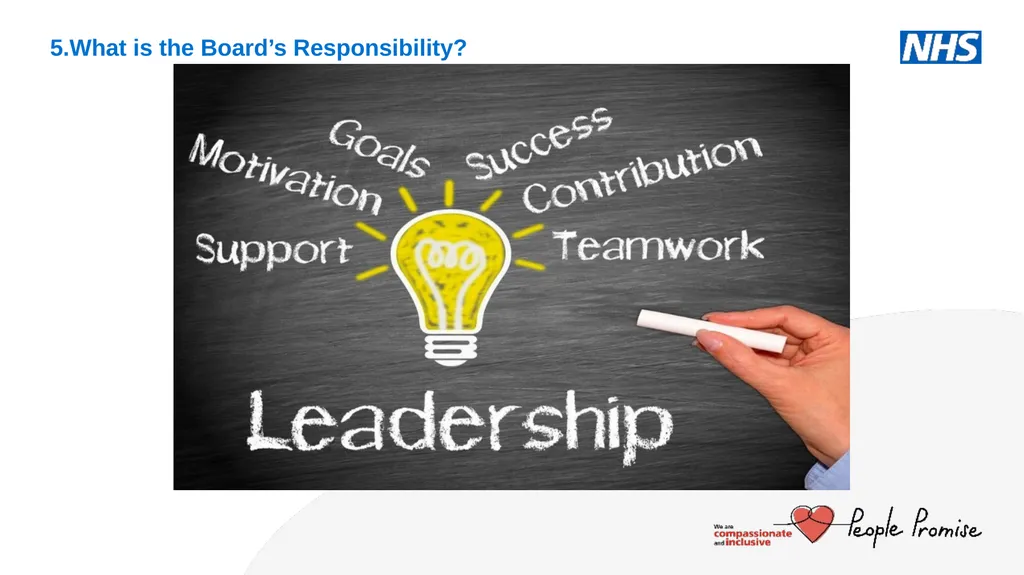
5.What is the Board’s Responsibility?<br>
25
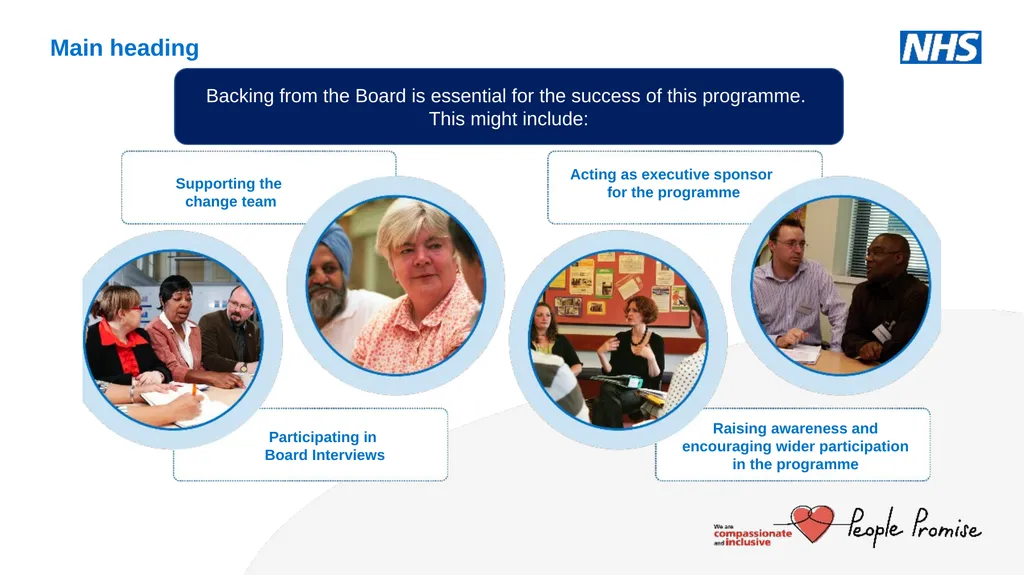
Main heading Backing from the Board is essential for the success of this programme.
This might include: Supporting the
change team Participating in Board Interviews Acting as executive sponsor
for the programme Raising awareness and
encouraging wider participation
in the programme<br>
This might include: Supporting the
change team Participating in Board Interviews Acting as executive sponsor
for the programme Raising awareness and
encouraging wider participation
in the programme<br>
26
Questions What outcomes would you like to see from this programme?
What would the challenges be?
What areas should this programme focus on?
What is your advice/insight?
[Modify the above as required]<br>
What would the challenges be?
What areas should this programme focus on?
What is your advice/insight?
[Modify the above as required]<br>