
Subject : Artificial Intelligence Topic :

Description: Subject : Artificial Intelligence Topic : Knowledge Representation Prepared By. Prof. Syed Rehan Anjuman College Of Engg. Tech. Department Of Computer Science Engg. Introduction: What is AI? History Applications, Artificial
Related Topics
Download Presentation
"Subject : Artificial Intelligence Topic :" is the property of its rightful owner. Permission is granted to download and print the materials on this website for personal, non-commercial use only, and to display it on your personal computer provided you do not modify the materials and that you retain all copyright notices contained in the materials. By downloading content from our website, you accept the terms of this agreement.
Presentation Transcript
slide1. Subject : Artificial Intelligence Topic : Knowledge Representation Prepared By.
Prof. Syed Rehan
Anjuman College Of Engg. & Tech.
Department Of Computer Science & Engg.<br>
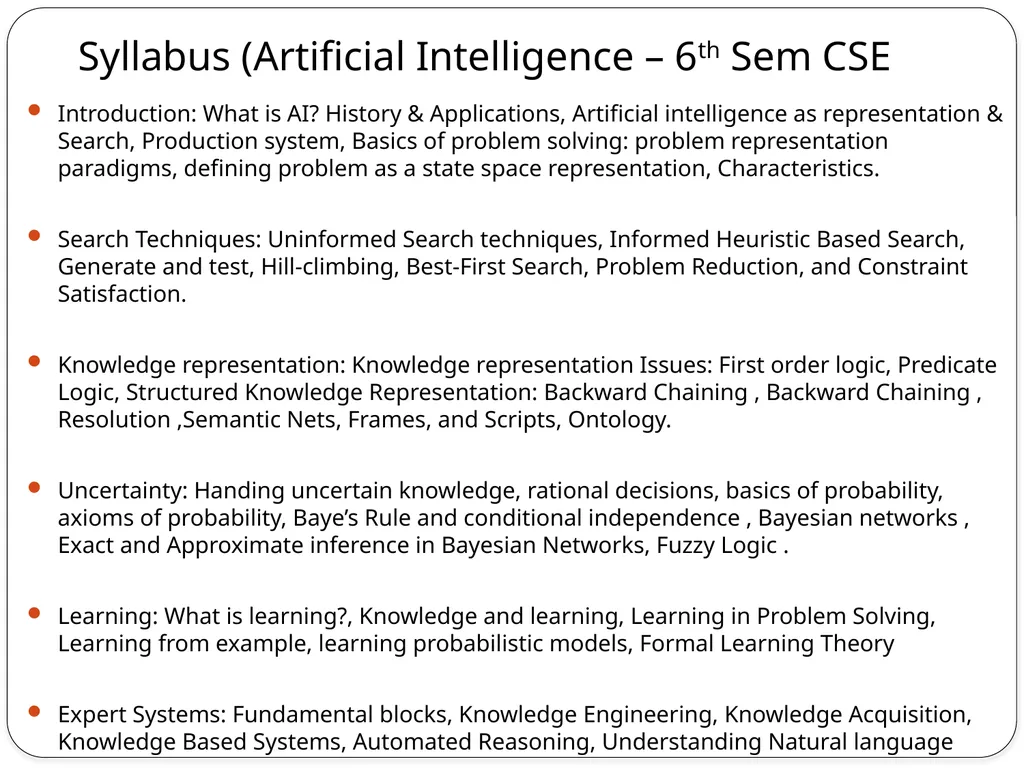
slide2. Introduction: What is AI? History & Applications, Artificial intelligence as representation & Search, Production system, Basics of problem solving: problem representation paradigms, defining problem as a state space representation, Characteristics.
Search Techniques: Uninformed Search techniques, Informed Heuristic Based Search, Generate and test, Hill-climbing, Best-First Search, Problem Reduction, and Constraint Satisfaction.
Knowledge representation: Knowledge representation Issues: First order logic, Predicate Logic, Structured Knowledge Representation: Backward Chaining , Backward Chaining , Resolution ,Semantic Nets, Frames, and Scripts, Ontology.
Uncertainty: Handing uncertain knowledge, rational decisions, basics of probability, axioms of probability, Baye’s Rule and conditional independence , Bayesian networks , Exact and Approximate inference in Bayesian Networks, Fuzzy Logic .
Learning: What is learning?, Knowledge and learning, Learning in Problem Solving, Learning from example, learning probabilistic models, Formal Learning Theory
Expert Systems: Fundamental blocks, Knowledge Engineering, Knowledge Acquisition, Knowledge Based Systems, Automated Reasoning, Understanding Natural language Syllabus (Artificial Intelligence – 6th Sem CSE<br>
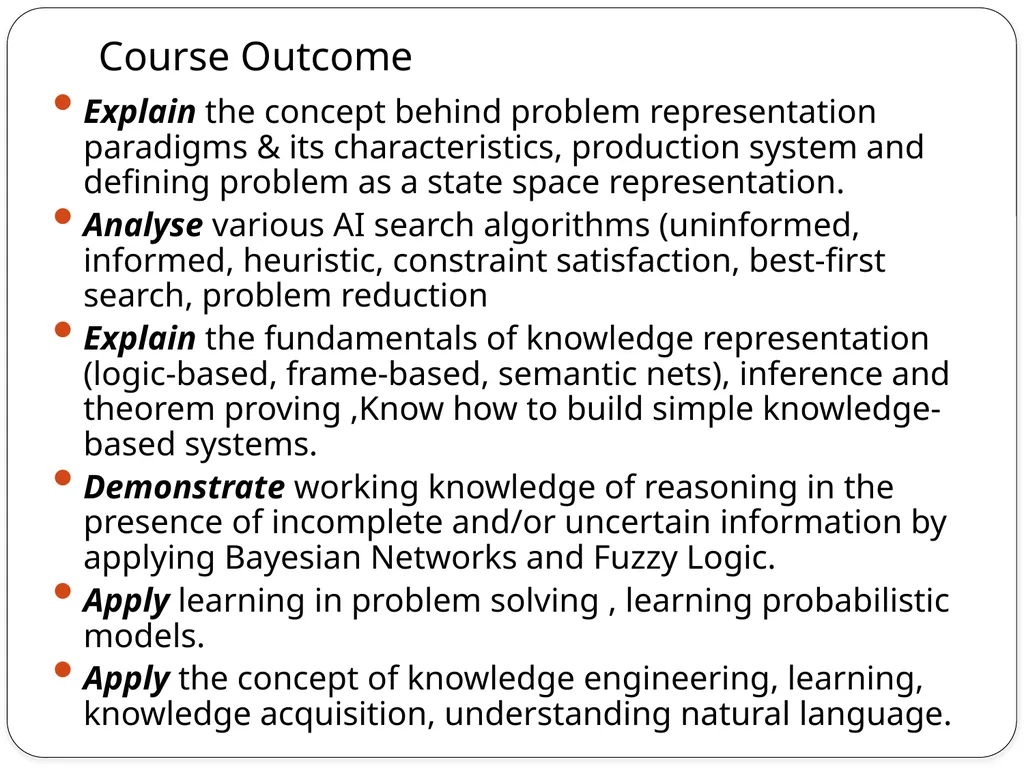
slide3. Explain the concept behind problem representation paradigms & its characteristics, production system and defining problem as a state space representation.
Analyse various AI search algorithms (uninformed, informed, heuristic, constraint satisfaction, best-first search, problem reduction
Explain the fundamentals of knowledge representation (logic-based, frame-based, semantic nets), inference and theorem proving ,Know how to build simple knowledge-based systems.
Demonstrate working knowledge of reasoning in the presence of incomplete and/or uncertain information by applying Bayesian Networks and Fuzzy Logic.
Apply learning in problem solving , learning probabilistic models.
Apply the concept of knowledge engineering, learning, knowledge acquisition, understanding natural language. Course Outcome<br>
slide4. Knowledge Representation Issues
Semantic Networks
FRAMES
Scripts Contents:-<br>
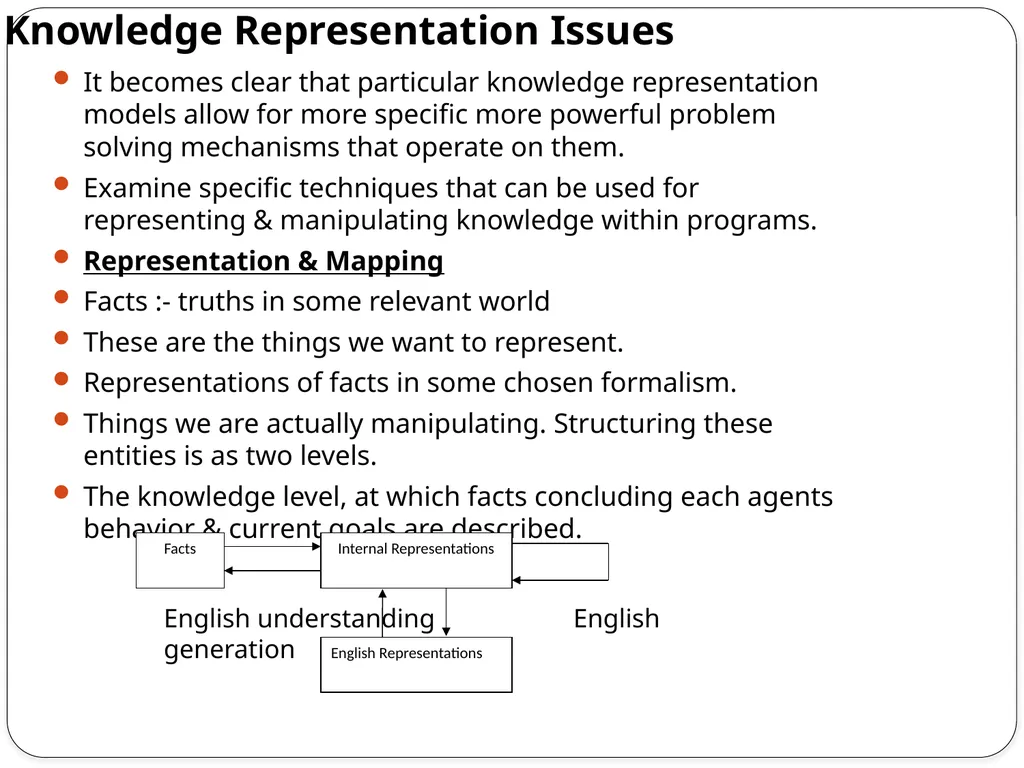
slide5. It becomes clear that particular knowledge representation models allow for more specific more powerful problem solving mechanisms that operate on them.
Examine specific techniques that can be used for representing & manipulating knowledge within programs.
Representation & Mapping
Facts :- truths in some relevant world
These are the things we want to represent.
Representations of facts in some chosen formalism.
Things we are actually manipulating. Structuring these entities is as two levels.
The knowledge level, at which facts concluding each agents behavior & current goals are described. Knowledge Representation Issues Internal Representations Facts English Representations English understanding English generation<br>
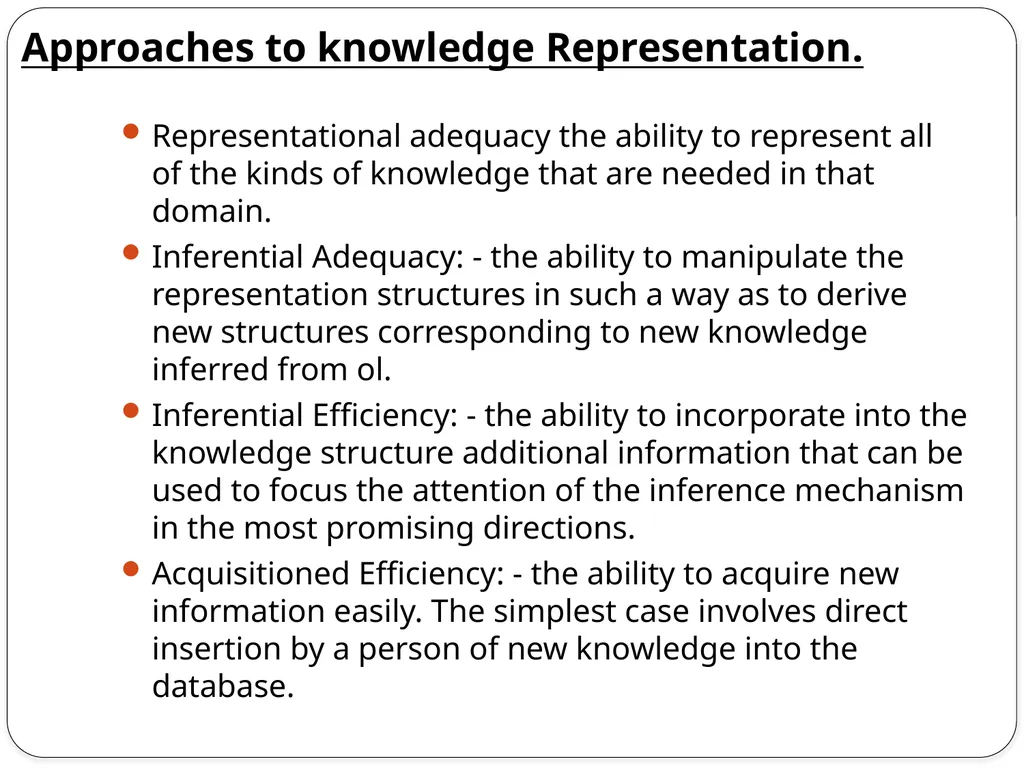
slide6. Representational adequacy the ability to represent all of the kinds of knowledge that are needed in that domain.
Inferential Adequacy: - the ability to manipulate the representation structures in such a way as to derive new structures corresponding to new knowledge inferred from ol.
Inferential Efficiency: - the ability to incorporate into the knowledge structure additional information that can be used to focus the attention of the inference mechanism in the most promising directions.
Acquisitioned Efficiency: - the ability to acquire new information easily. The simplest case involves direct insertion by a person of new knowledge into the database. Approaches to knowledge Representation.<br>
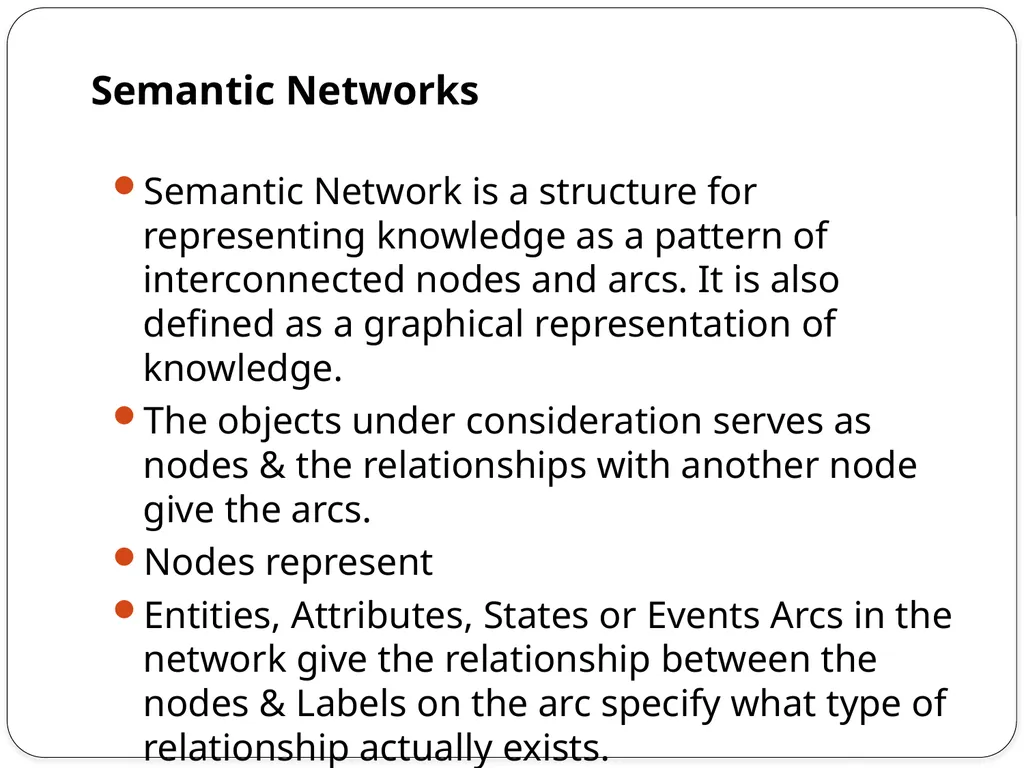
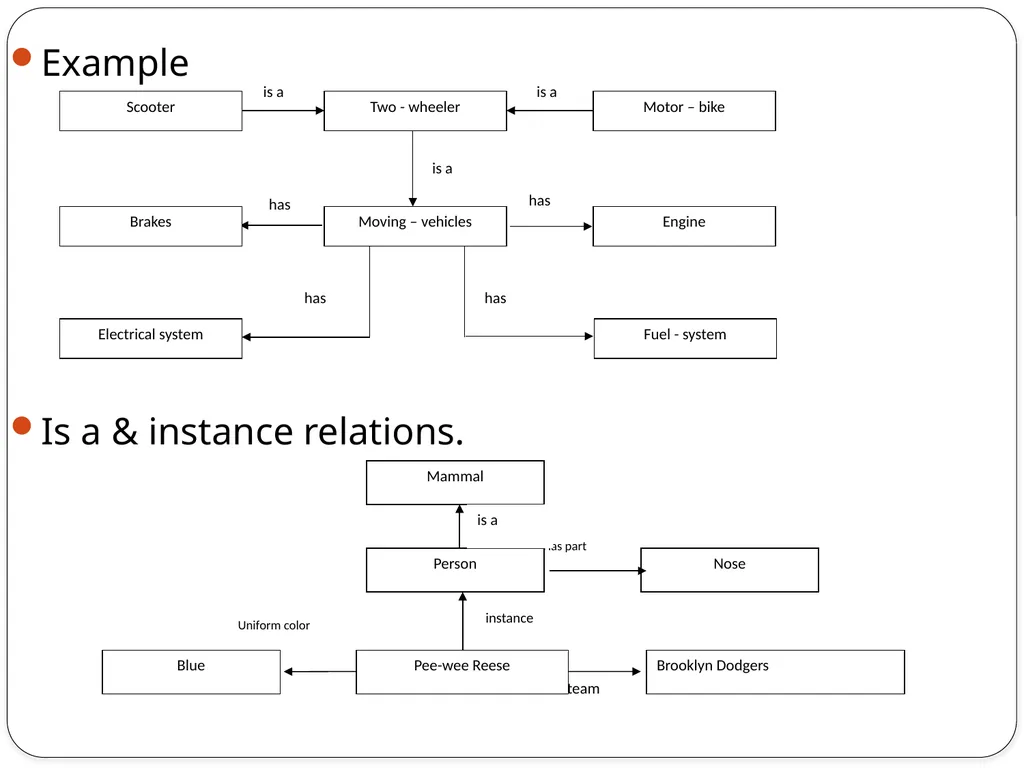
slide7. Semantic Network is a structure for representing knowledge as a pattern of interconnected nodes and arcs. It is also defined as a graphical representation of knowledge.
The objects under consideration serves as nodes & the relationships with another node give the arcs.
Nodes represent
Entities, Attributes, States or Events Arcs in the network give the relationship between the nodes & Labels on the arc specify what type of relationship actually exists. Semantic Networks<br>
slide8. Example
Is a & instance relations.<br>
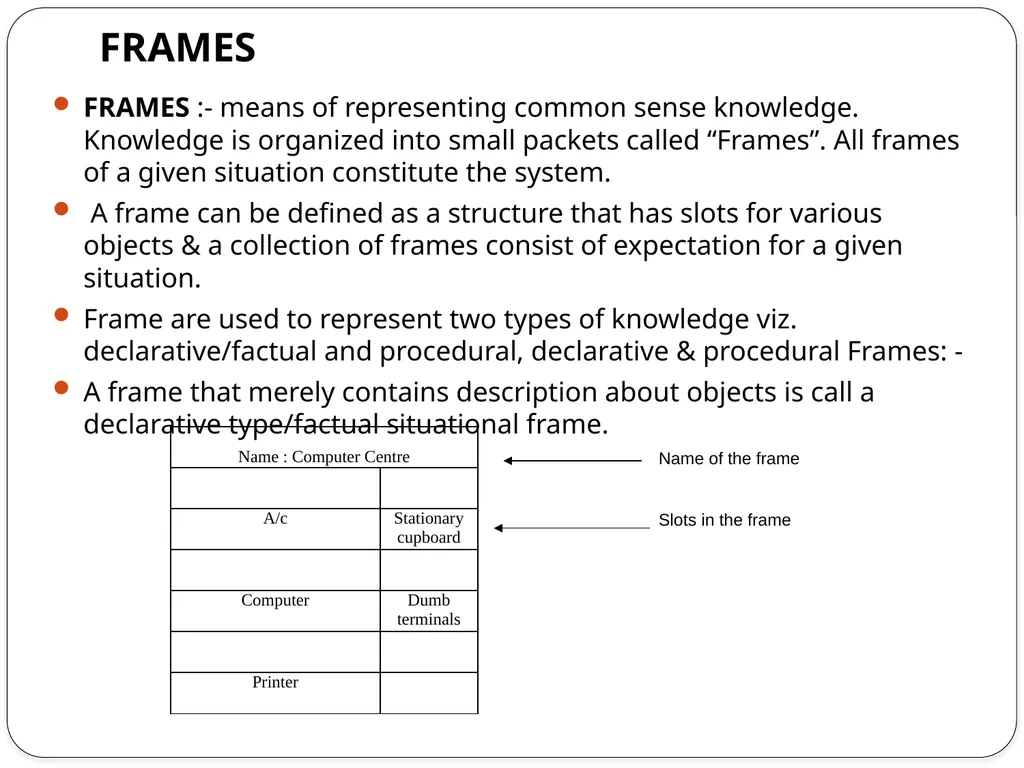
slide9. FRAMES :- means of representing common sense knowledge. Knowledge is organized into small packets called “Frames”. All frames of a given situation constitute the system.
A frame can be defined as a structure that has slots for various objects & a collection of frames consist of expectation for a given situation.
Frame are used to represent two types of knowledge viz. declarative/factual and procedural, declarative & procedural Frames: -
A frame that merely contains description about objects is call a declarative type/factual situational frame. FRAMES Name of the frame
Slots in the frame<br>
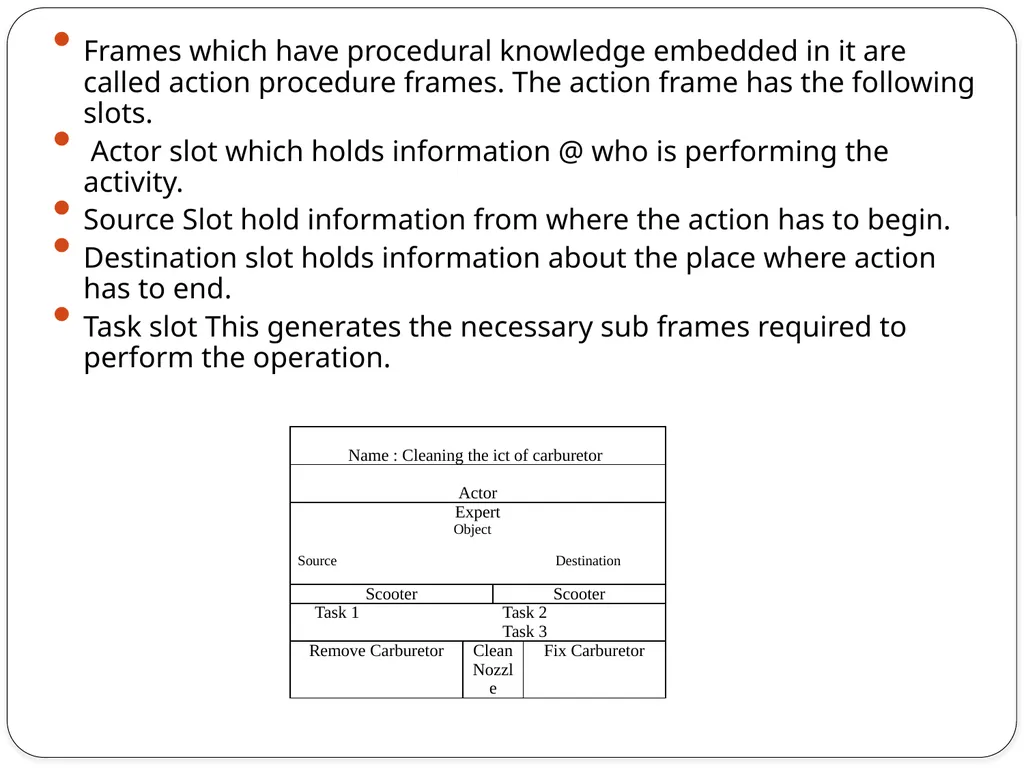
slide10. Frames which have procedural knowledge embedded in it are called action procedure frames. The action frame has the following slots.
Actor slot which holds information @ who is performing the activity.
Source Slot hold information from where the action has to begin.
Destination slot holds information about the place where action has to end.
Task slot This generates the necessary sub frames required to perform the operation.<br>
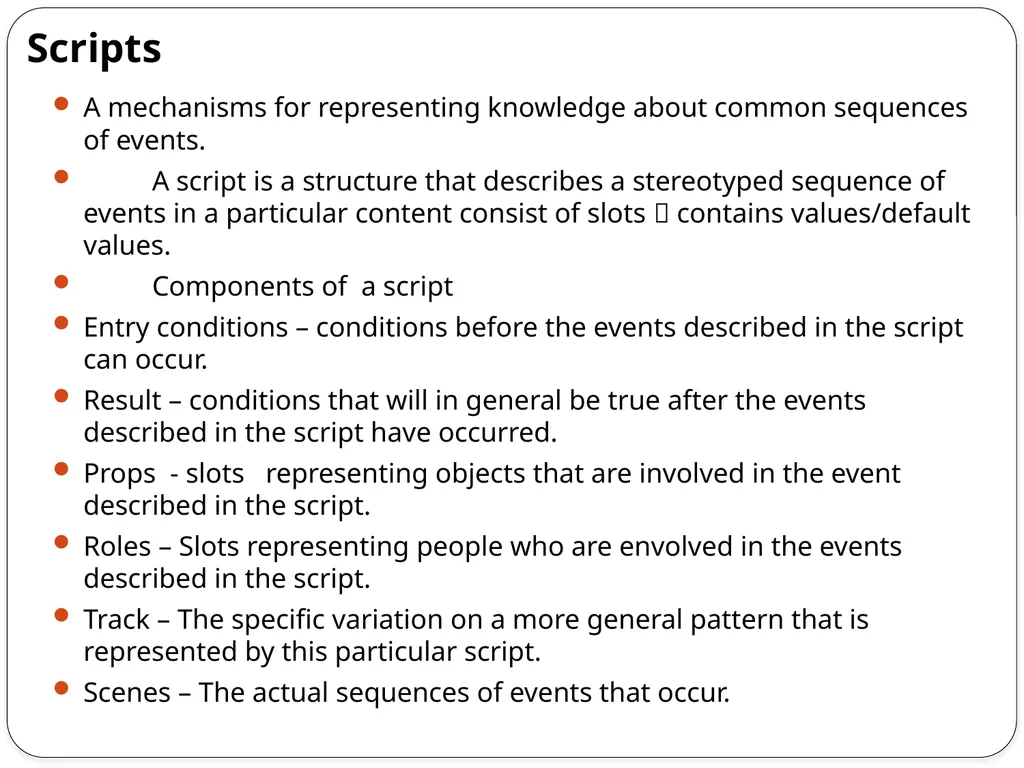
slide11. A mechanisms for representing knowledge about common sequences of events.
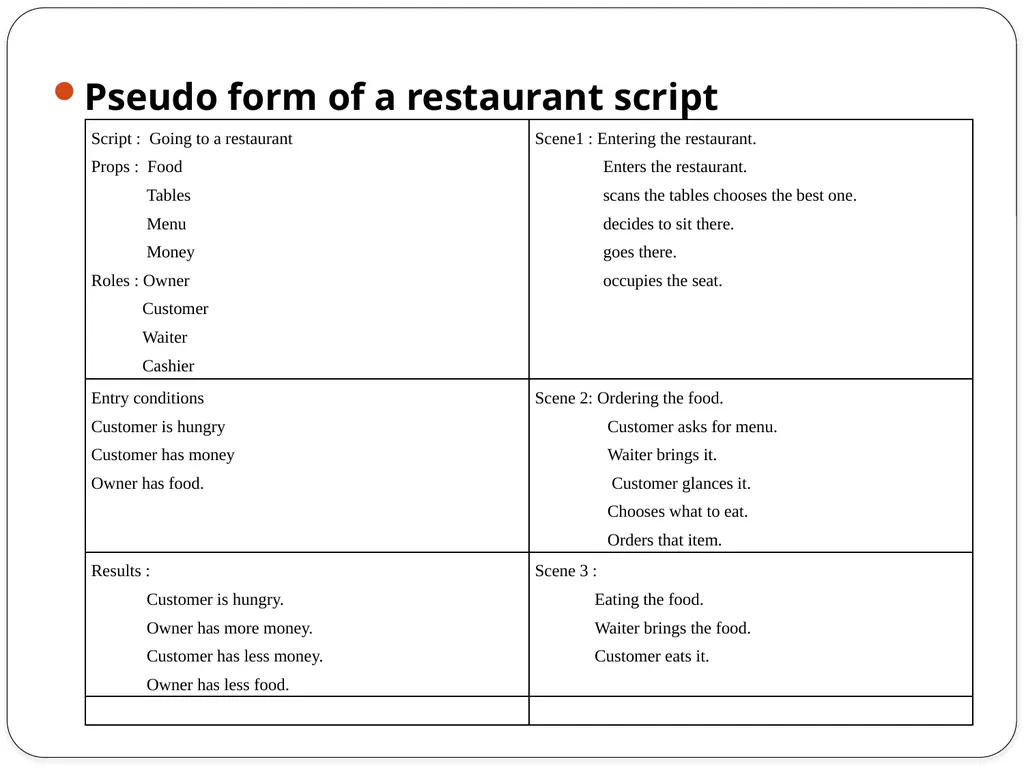
A script is a structure that describes a stereotyped sequence of events in a particular content consist of slots contains values/default values.
Components of a script
Entry conditions – conditions before the events described in the script can occur.
Result – conditions that will in general be true after the events described in the script have occurred.
Props - slots representing objects that are involved in the event described in the script.
Roles – Slots representing people who are envolved in the events described in the script.
Track – The specific variation on a more general pattern that is represented by this particular script.
Scenes – The actual sequences of events that occur. Scripts<br>
slide12. Pseudo form of a restaurant script<br>
slide13. THANK YOU<br>
Prof. Syed Rehan
Anjuman College Of Engg. & Tech.
Department Of Computer Science & Engg.<br>
slide2. Introduction: What is AI? History & Applications, Artificial intelligence as representation & Search, Production system, Basics of problem solving: problem representation paradigms, defining problem as a state space representation, Characteristics.
Search Techniques: Uninformed Search techniques, Informed Heuristic Based Search, Generate and test, Hill-climbing, Best-First Search, Problem Reduction, and Constraint Satisfaction.
Knowledge representation: Knowledge representation Issues: First order logic, Predicate Logic, Structured Knowledge Representation: Backward Chaining , Backward Chaining , Resolution ,Semantic Nets, Frames, and Scripts, Ontology.
Uncertainty: Handing uncertain knowledge, rational decisions, basics of probability, axioms of probability, Baye’s Rule and conditional independence , Bayesian networks , Exact and Approximate inference in Bayesian Networks, Fuzzy Logic .
Learning: What is learning?, Knowledge and learning, Learning in Problem Solving, Learning from example, learning probabilistic models, Formal Learning Theory
Expert Systems: Fundamental blocks, Knowledge Engineering, Knowledge Acquisition, Knowledge Based Systems, Automated Reasoning, Understanding Natural language Syllabus (Artificial Intelligence – 6th Sem CSE<br>
slide3. Explain the concept behind problem representation paradigms & its characteristics, production system and defining problem as a state space representation.
Analyse various AI search algorithms (uninformed, informed, heuristic, constraint satisfaction, best-first search, problem reduction
Explain the fundamentals of knowledge representation (logic-based, frame-based, semantic nets), inference and theorem proving ,Know how to build simple knowledge-based systems.
Demonstrate working knowledge of reasoning in the presence of incomplete and/or uncertain information by applying Bayesian Networks and Fuzzy Logic.
Apply learning in problem solving , learning probabilistic models.
Apply the concept of knowledge engineering, learning, knowledge acquisition, understanding natural language. Course Outcome<br>
slide4. Knowledge Representation Issues
Semantic Networks
FRAMES
Scripts Contents:-<br>
slide5. It becomes clear that particular knowledge representation models allow for more specific more powerful problem solving mechanisms that operate on them.
Examine specific techniques that can be used for representing & manipulating knowledge within programs.
Representation & Mapping
Facts :- truths in some relevant world
These are the things we want to represent.
Representations of facts in some chosen formalism.
Things we are actually manipulating. Structuring these entities is as two levels.
The knowledge level, at which facts concluding each agents behavior & current goals are described. Knowledge Representation Issues Internal Representations Facts English Representations English understanding English generation<br>
slide6. Representational adequacy the ability to represent all of the kinds of knowledge that are needed in that domain.
Inferential Adequacy: - the ability to manipulate the representation structures in such a way as to derive new structures corresponding to new knowledge inferred from ol.
Inferential Efficiency: - the ability to incorporate into the knowledge structure additional information that can be used to focus the attention of the inference mechanism in the most promising directions.
Acquisitioned Efficiency: - the ability to acquire new information easily. The simplest case involves direct insertion by a person of new knowledge into the database. Approaches to knowledge Representation.<br>
slide7. Semantic Network is a structure for representing knowledge as a pattern of interconnected nodes and arcs. It is also defined as a graphical representation of knowledge.
The objects under consideration serves as nodes & the relationships with another node give the arcs.
Nodes represent
Entities, Attributes, States or Events Arcs in the network give the relationship between the nodes & Labels on the arc specify what type of relationship actually exists. Semantic Networks<br>
slide8. Example
Is a & instance relations.<br>
slide9. FRAMES :- means of representing common sense knowledge. Knowledge is organized into small packets called “Frames”. All frames of a given situation constitute the system.
A frame can be defined as a structure that has slots for various objects & a collection of frames consist of expectation for a given situation.
Frame are used to represent two types of knowledge viz. declarative/factual and procedural, declarative & procedural Frames: -
A frame that merely contains description about objects is call a declarative type/factual situational frame. FRAMES Name of the frame
Slots in the frame<br>
slide10. Frames which have procedural knowledge embedded in it are called action procedure frames. The action frame has the following slots.
Actor slot which holds information @ who is performing the activity.
Source Slot hold information from where the action has to begin.
Destination slot holds information about the place where action has to end.
Task slot This generates the necessary sub frames required to perform the operation.<br>
slide11. A mechanisms for representing knowledge about common sequences of events.
A script is a structure that describes a stereotyped sequence of events in a particular content consist of slots contains values/default values.
Components of a script
Entry conditions – conditions before the events described in the script can occur.
Result – conditions that will in general be true after the events described in the script have occurred.
Props - slots representing objects that are involved in the event described in the script.
Roles – Slots representing people who are envolved in the events described in the script.
Track – The specific variation on a more general pattern that is represented by this particular script.
Scenes – The actual sequences of events that occur. Scripts<br>
slide12. Pseudo form of a restaurant script<br>
slide13. THANK YOU<br>