
The Prevent Duty = Safeguarding Since July 2015
DJ
Published · 9 slides · 0 views

1 / 1
Description
The Prevent Duty Safeguarding Since July 2015 all schools and registered childcare providers (settings) are subject to the Prevent Duty: to have due regard to the need to prevent people from being radicalised into terrorism. Promote
Related Topics
Share
Embed code
Download this presentation From Below
"The Prevent Duty = Safeguarding Since July 2015" is the property of its rightful owner. Permission is granted to download and print the materials on this website for personal, non-commercial use only, and to display it on your personal computer provided you do not modify the materials and that you retain all copyright notices contained in the materials. By downloading content from our website, you accept the terms of this agreement.
Presentation Transcript
01
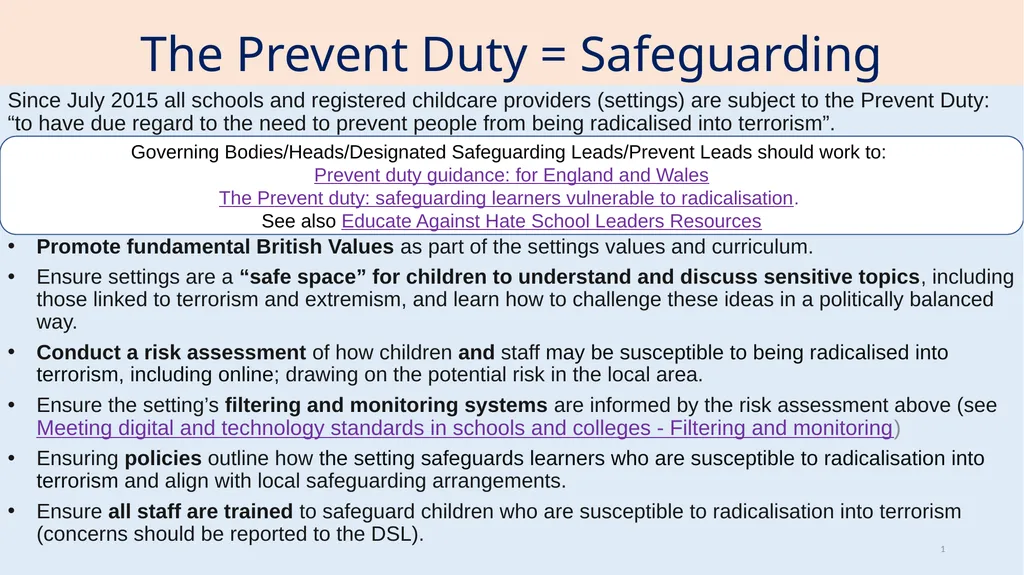
The Prevent Duty = Safeguarding Since July 2015 all schools and registered childcare providers (settings) are subject to the Prevent Duty: “to have due regard to the need to prevent people from being radicalised into terrorism”.
Promote fundamental British Values as part of the settings values and curriculum.
Ensure settings are a “safe space” for children to understand and discuss sensitive topics, including those linked to terrorism and extremism, and learn how to challenge these ideas in a politically balanced way.
Conduct a risk assessment of how children and staff may be susceptible to being radicalised into terrorism, including online; drawing on the potential risk in the local area.
Ensure the setting’s filtering and monitoring systems are informed by the risk assessment above (see Meeting digital and technology standards in schools and colleges - Filtering and monitoring)
Ensuring policies outline how the setting safeguards learners who are susceptible to radicalisation into terrorism and align with local safeguarding arrangements.
Ensure all staff are trained to safeguard children who are susceptible to radicalisation into terrorism (concerns should be reported to the DSL). 1 Governing Bodies/Heads/Designated Safeguarding Leads/Prevent Leads should work to:
Prevent duty guidance: for England and Wales
The Prevent duty: safeguarding learners vulnerable to radicalisation.
See also Educate Against Hate School Leaders Resources<br>
02
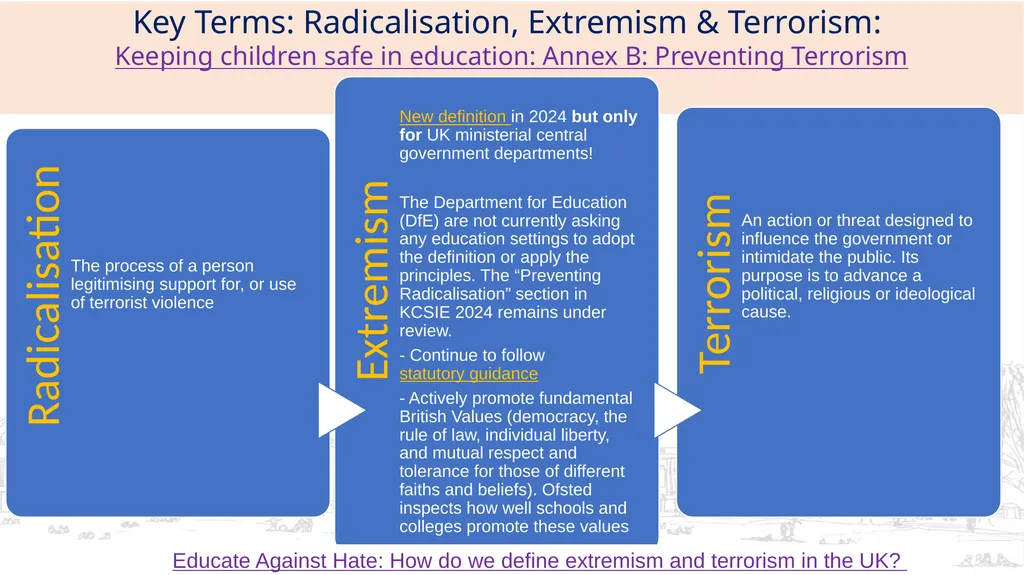
Key Terms: Radicalisation, Extremism & Terrorism:
Keeping children safe in education: Annex B: Preventing Terrorism Educate Against Hate: How do we define extremism and terrorism in the UK?<br>
03
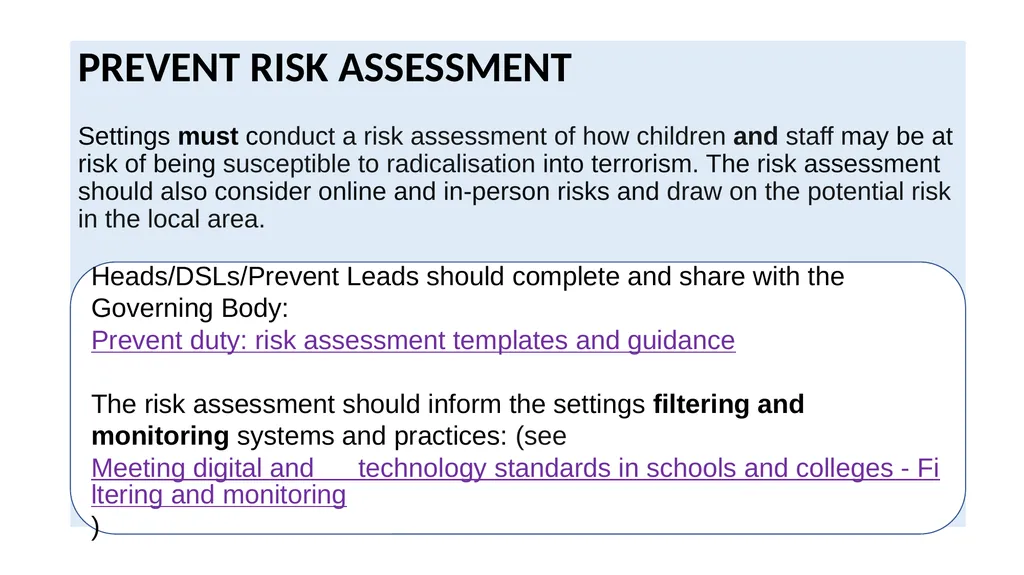
PREVENT RISK ASSESSMENT
Settings must conduct a risk assessment of how children and staff may be at risk of being susceptible to radicalisation into terrorism. The risk assessment should also consider online and in-person risks and draw on the potential risk in the local area. Heads/DSLs/Prevent Leads should complete and share with the Governing Body:
Prevent duty: risk assessment templates and guidance
The risk assessment should inform the settings filtering and monitoring systems and practices: (see Meeting digital and technology standards in schools and colleges - Filtering and monitoring)<br>
04
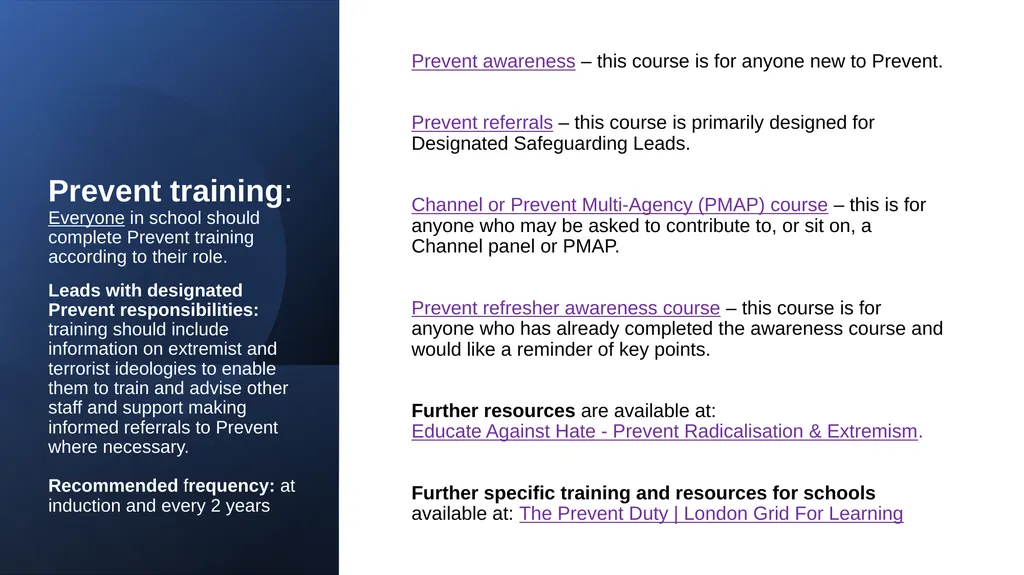
Prevent training:
Everyone in school should complete Prevent training according to their role.
Leads with designated Prevent responsibilities: training should include information on extremist and terrorist ideologies to enable them to train and advise other staff and support making informed referrals to Prevent where necessary.
Recommended frequency: at induction and every 2 years Prevent awareness – this course is for anyone new to Prevent.
Prevent referrals – this course is primarily designed for Designated Safeguarding Leads.
Channel or Prevent Multi-Agency (PMAP) course – this is for anyone who may be asked to contribute to, or sit on, a Channel panel or PMAP.
Prevent refresher awareness course – this course is for anyone who has already completed the awareness course and would like a reminder of key points.
Further resources are available at: Educate Against Hate - Prevent Radicalisation & Extremism.
Further specific training and resources for schools available at: The Prevent Duty | London Grid For Learning<br>
05
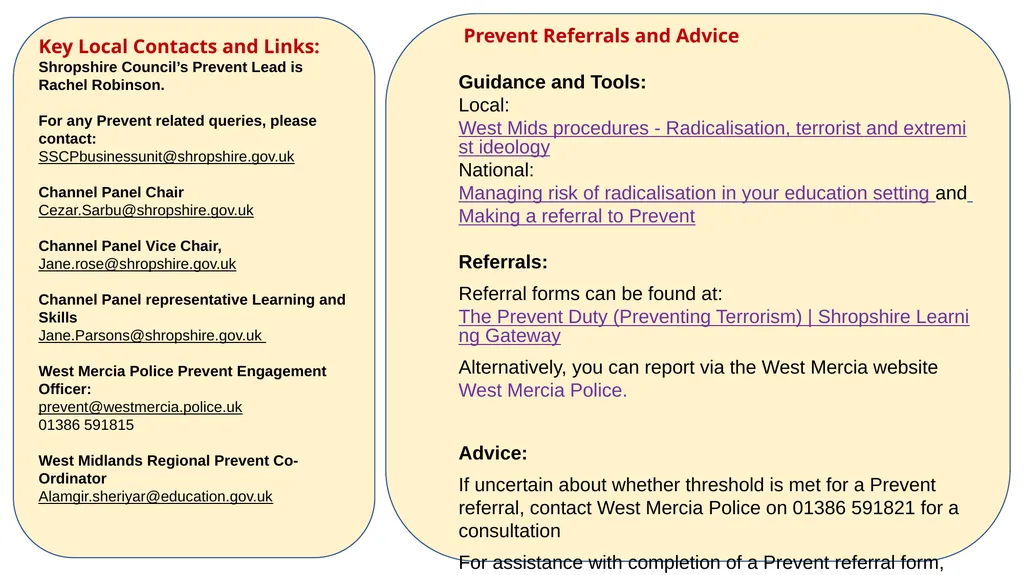
Key Local Contacts and Links:
Shropshire Council’s Prevent Lead is Rachel Robinson.
For any Prevent related queries, please contact: SSCPbusinessunit@shropshire.gov.uk
Channel Panel Chair
Cezar.Sarbu@shropshire.gov.uk
Channel Panel Vice Chair,
Jane.rose@shropshire.gov.uk
Channel Panel representative Learning and Skills
Jane.Parsons@shropshire.gov.uk
West Mercia Police Prevent Engagement Officer:
prevent@westmercia.police.uk
01386 591815
West Midlands Regional Prevent Co-Ordinator
Alamgir.sheriyar@education.gov.uk Prevent Referrals and Advice
Guidance and Tools:
Local: West Mids procedures - Radicalisation, terrorist and extremist ideology
National: Managing risk of radicalisation in your education setting and Making a referral to Prevent
Referrals:
Referral forms can be found at: The Prevent Duty (Preventing Terrorism) | Shropshire Learning Gateway
Alternatively, you can report via the West Mercia website West Mercia Police.
Advice:
If uncertain about whether threshold is met for a Prevent referral, contact West Mercia Police on 01386 591821 for a consultation
For assistance with completion of a Prevent referral form, contact the West Midlands Prevent hub 0121 251 0241.<br>
06
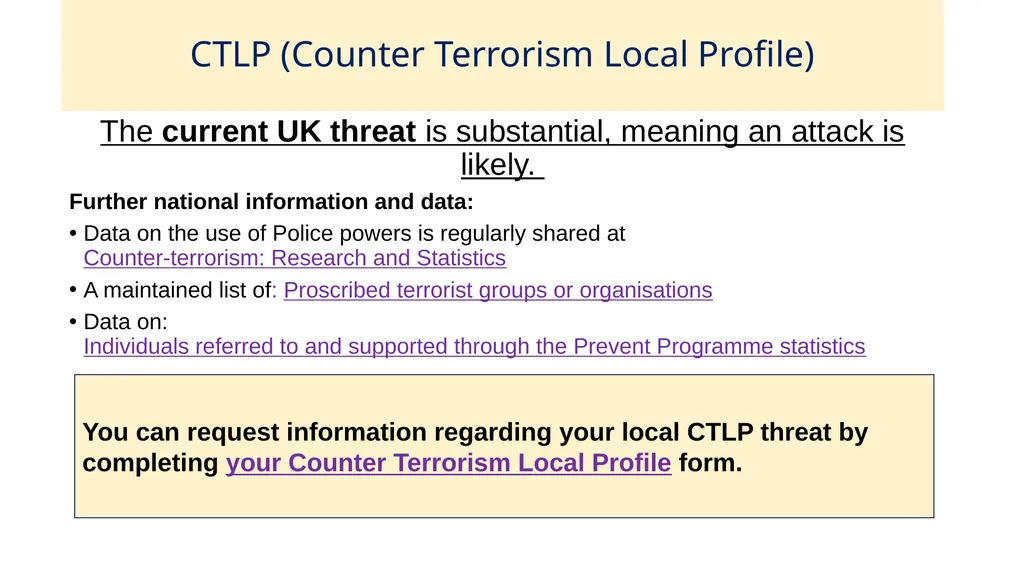
CTLP (Counter Terrorism Local Profile) The current UK threat is substantial, meaning an attack is likely.
Further national information and data:
Data on the use of Police powers is regularly shared at Counter-terrorism: Research and Statistics
A maintained list of: Proscribed terrorist groups or organisations
Data on: Individuals referred to and supported through the Prevent Programme statistics You can request information regarding your local CTLP threat by completing your Counter Terrorism Local Profile form.<br>
07
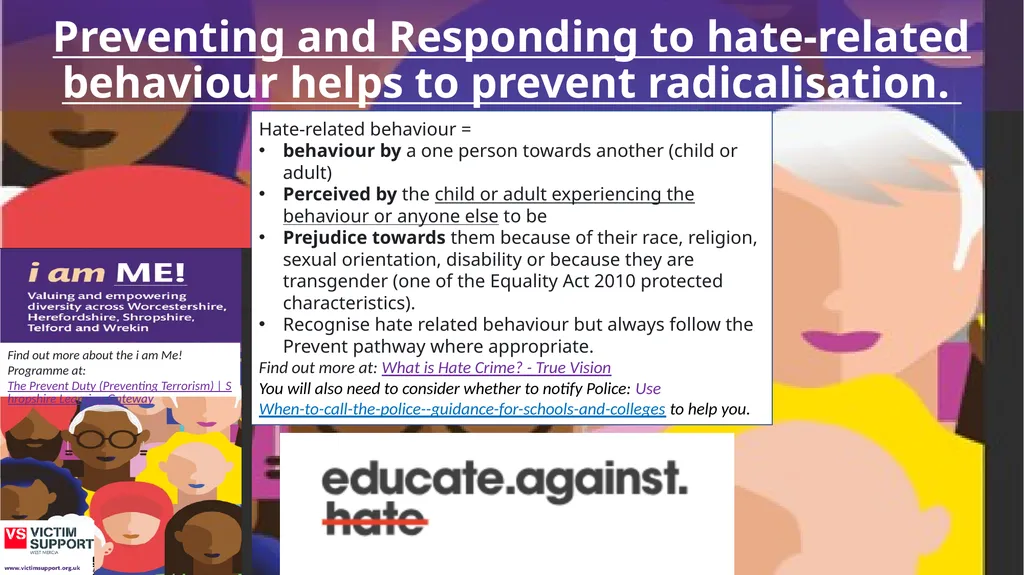
Preventing and Responding to hate-related behaviour helps to prevent radicalisation. Hate-related behaviour =
behaviour by a one person towards another (child or adult)
Perceived by the child or adult experiencing the behaviour or anyone else to be
Prejudice towards them because of their race, religion, sexual orientation, disability or because they are transgender (one of the Equality Act 2010 protected characteristics).
Recognise hate related behaviour but always follow the Prevent pathway where appropriate.
Find out more at: What is Hate Crime? - True Vision
You will also need to consider whether to notify Police: Use When-to-call-the-police--guidance-for-schools-and-colleges to help you. Find out more about the i am Me! Programme at: The Prevent Duty (Preventing Terrorism) | Shropshire Learning Gateway<br>
08
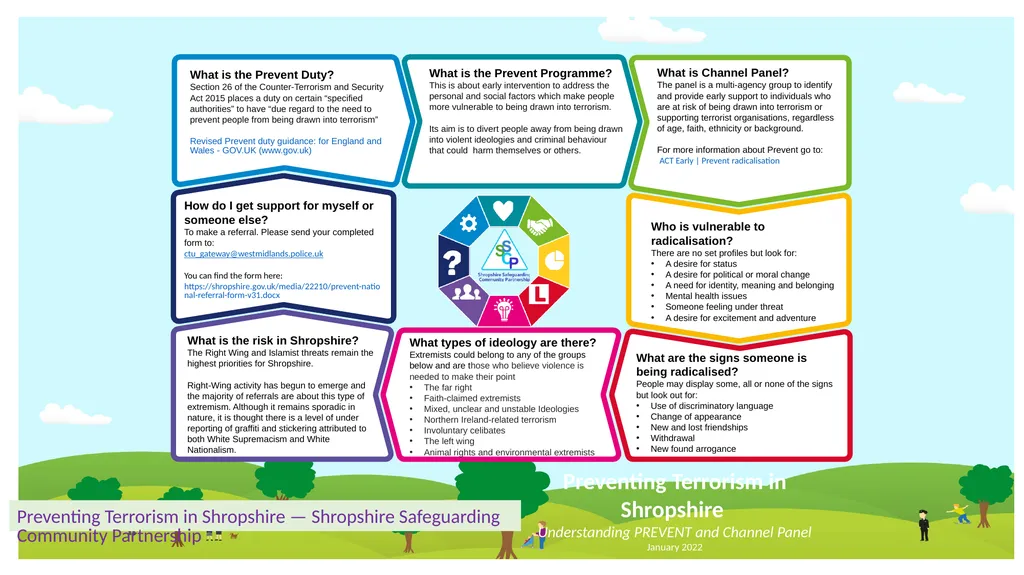
What is the Prevent Programme? This is about early intervention to address the personal and social factors which make people more vulnerable to being drawn into terrorism.
Its aim is to divert people away from being drawn into violent ideologies and criminal behaviour that could harm themselves or others. Preventing Terrorism in Shropshire
Understanding PREVENT and Channel Panel
January 2022 What is the Prevent Duty?
Section 26 of the Counter-Terrorism and Security Act 2015 places a duty on certain “specified authorities” to have “due regard to the need to prevent people from being drawn into terrorism”
Revised Prevent duty guidance: for England and Wales - GOV.UK (www.gov.uk) What is Channel Panel?
The panel is a multi-agency group to identify and provide early support to individuals who are at risk of being drawn into terrorism or supporting terrorist organisations, regardless of age, faith, ethnicity or background.
For more information about Prevent go to:
ACT Early | Prevent radicalisation How do I get support for myself or someone else?
To make a referral. Please send your completed form to:
ctu_gateway@westmidlands.police.uk
You can find the form here:
https://shropshire.gov.uk/media/22210/prevent-national-referral-form-v31.docx Who is vulnerable to radicalisation?
There are no set profiles but look for:
A desire for status
A desire for political or moral change
A need for identity, meaning and belonging
Mental health issues
Someone feeling under threat
A desire for excitement and adventure What is the risk in Shropshire?
The Right Wing and Islamist threats remain the highest priorities for Shropshire.
Right-Wing activity has begun to emerge and the majority of referrals are about this type of
extremism. Although it remains sporadic in nature, it is thought there is a level of under reporting of graffiti and stickering attributed to both White Supremacism and White Nationalism. What types of ideology are there? Extremists could belong to any of the groups below and are those who believe violence is needed to make their point
The far right
Faith-claimed extremists
Mixed, unclear and unstable Ideologies
Northern Ireland-related terrorism
Involuntary celibates
The left wing
Animal rights and environmental extremists What are the signs someone is being radicalised?
People may display some, all or none of the signs but look out for:
Use of discriminatory language
Change of appearance
New and lost friendships
Withdrawal
New found arrogance Preventing Terrorism in Shropshire — Shropshire Safeguarding Community Partnership<br>
09
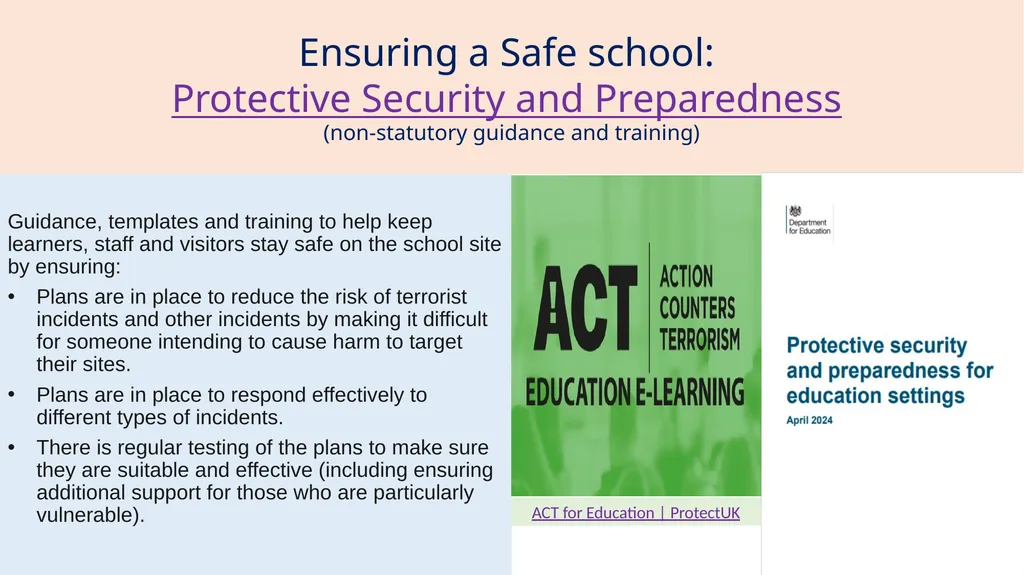
Ensuring a Safe school:
Protective Security and Preparedness
(non-statutory guidance and training) Guidance, templates and training to help keep learners, staff and visitors stay safe on the school site by ensuring:
Plans are in place to reduce the risk of terrorist incidents and other incidents by making it difficult for someone intending to cause harm to target their sites.
Plans are in place to respond effectively to different types of incidents.
There is regular testing of the plans to make sure they are suitable and effective (including ensuring additional support for those who are particularly vulnerable). 9 ACT for Education | ProtectUK<br>