
These slides are provided for educational purposes
PM
Published · 32 slides · 0 views
1 / 1



Description
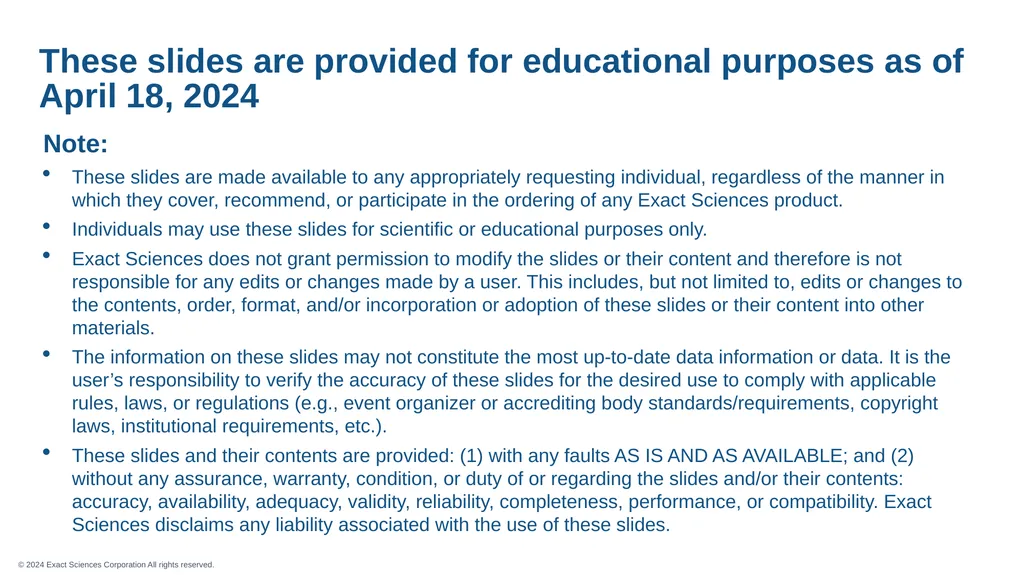
These slides are provided for educational purposes as of April 18, 2024 Note: These slides are made available to any appropriately requesting individual, regardless of the manner in which they cover, recommend, or participate in the
Related Topics
Share
Embed code
Download this presentation From Below
"These slides are provided for educational purposes" is the property of its rightful owner. Permission is granted to download and print the materials on this website for personal, non-commercial use only, and to display it on your personal computer provided you do not modify the materials and that you retain all copyright notices contained in the materials. By downloading content from our website, you accept the terms of this agreement.
Presentation Transcript
01
These slides are provided for educational purposes as of April 18, 2024 Note:
These slides are made available to any appropriately requesting individual, regardless of the manner in which they cover, recommend, or participate in the ordering of any Exact Sciences product.
Individuals may use these slides for scientific or educational purposes only.
Exact Sciences does not grant permission to modify the slides or their content and therefore is not responsible for any edits or changes made by a user. This includes, but not limited to, edits or changes to the contents, order, format, and/or incorporation or adoption of these slides or their content into other materials.
The information on these slides may not constitute the most up-to-date data information or data. It is the user’s responsibility to verify the accuracy of these slides for the desired use to comply with applicable rules, laws, or regulations (e.g., event organizer or accrediting body standards/requirements, copyright laws, institutional requirements, etc.).
These slides and their contents are provided: (1) with any faults AS IS AND AS AVAILABLE; and (2) without any assurance, warranty, condition, or duty of or regarding the slides and/or their contents: accuracy, availability, adequacy, validity, reliability, completeness, performance, or compatibility. Exact Sciences disclaims any liability associated with the use of these slides. © 2024 Exact Sciences Corporation All rights reserved.<br>
These slides are made available to any appropriately requesting individual, regardless of the manner in which they cover, recommend, or participate in the ordering of any Exact Sciences product.
Individuals may use these slides for scientific or educational purposes only.
Exact Sciences does not grant permission to modify the slides or their content and therefore is not responsible for any edits or changes made by a user. This includes, but not limited to, edits or changes to the contents, order, format, and/or incorporation or adoption of these slides or their content into other materials.
The information on these slides may not constitute the most up-to-date data information or data. It is the user’s responsibility to verify the accuracy of these slides for the desired use to comply with applicable rules, laws, or regulations (e.g., event organizer or accrediting body standards/requirements, copyright laws, institutional requirements, etc.).
These slides and their contents are provided: (1) with any faults AS IS AND AS AVAILABLE; and (2) without any assurance, warranty, condition, or duty of or regarding the slides and/or their contents: accuracy, availability, adequacy, validity, reliability, completeness, performance, or compatibility. Exact Sciences disclaims any liability associated with the use of these slides. © 2024 Exact Sciences Corporation All rights reserved.<br>
02
Multi-Cancer Early Detection Through Multiple Analyte Testing 04.18.2024 / MED-CAG-2200134 (v6.0)<br>
03
Disclaimer
This presentation contains information for a technology under development and has not been cleared or approved by the Food and Drug Administration or any other national regulatory authority. The features describe current development goals, and claims have yet to be established.<br>
This presentation contains information for a technology under development and has not been cleared or approved by the Food and Drug Administration or any other national regulatory authority. The features describe current development goals, and claims have yet to be established.<br>
04
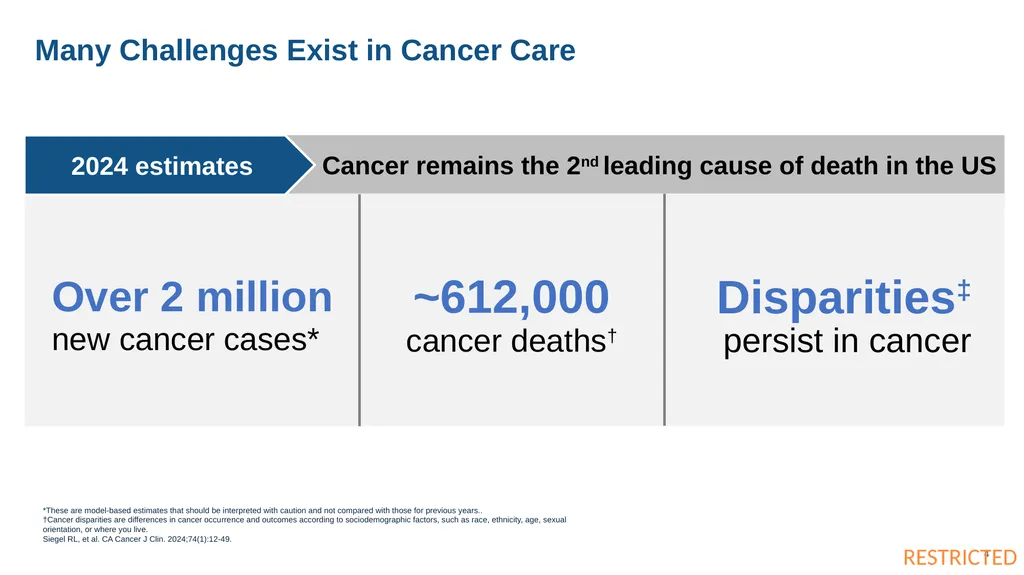
Many Challenges Exist in Cancer Care Cancer remains the 2nd leading cause of death in the US Over 2 million new cancer cases* ~612,000 cancer deaths† Disparities‡ persist in cancer 2024 estimates *These are model-based estimates that should be interpreted with caution and not compared with those for previous years..
†Cancer disparities are differences in cancer occurrence and outcomes according to sociodemographic factors, such as race, ethnicity, age, sexual orientation, or where you live.
Siegel RL, et al. CA Cancer J Clin. 2024;74(1):12-49.<br>
†Cancer disparities are differences in cancer occurrence and outcomes according to sociodemographic factors, such as race, ethnicity, age, sexual orientation, or where you live.
Siegel RL, et al. CA Cancer J Clin. 2024;74(1):12-49.<br>
05
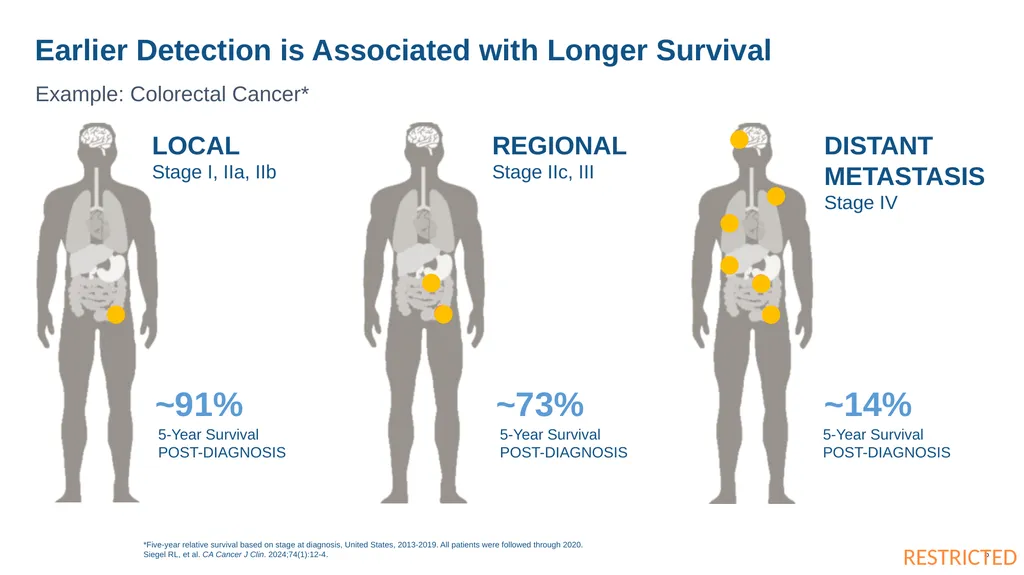
Earlier Detection is Associated with Longer Survival *Five-year relative survival based on stage at diagnosis, United States, 2013-2019. All patients were followed through 2020.
Siegel RL, et al. CA Cancer J Clin. 2024;74(1):12-49. Example: Colorectal Cancer*<br>
Siegel RL, et al. CA Cancer J Clin. 2024;74(1):12-49. Example: Colorectal Cancer*<br>
06
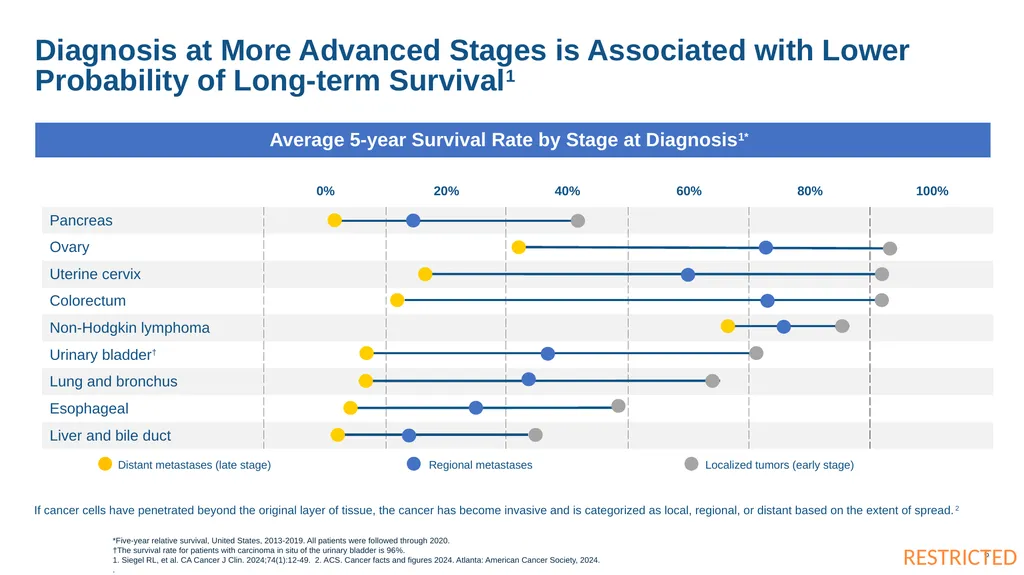
Diagnosis at More Advanced Stages is Associated with Lower Probability of Long-term Survival1 *Five-year relative survival, United States, 2013-2019. All patients were followed through 2020.
†The survival rate for patients with carcinoma in situ of the urinary bladder is 96%.
1. Siegel RL, et al. CA Cancer J Clin. 2024;74(1):12-49. 2. ACS. Cancer facts and figures 2024. Atlanta: American Cancer Society, 2024.
. Average 5-year Survival Rate by Stage at Diagnosis1* If cancer cells have penetrated beyond the original layer of tissue, the cancer has become invasive and is categorized as local, regional, or distant based on the extent of spread.2 Distant metastases (late stage) Regional metastases Localized tumors (early stage)<br>
†The survival rate for patients with carcinoma in situ of the urinary bladder is 96%.
1. Siegel RL, et al. CA Cancer J Clin. 2024;74(1):12-49. 2. ACS. Cancer facts and figures 2024. Atlanta: American Cancer Society, 2024.
. Average 5-year Survival Rate by Stage at Diagnosis1* If cancer cells have penetrated beyond the original layer of tissue, the cancer has become invasive and is categorized as local, regional, or distant based on the extent of spread.2 Distant metastases (late stage) Regional metastases Localized tumors (early stage)<br>
07
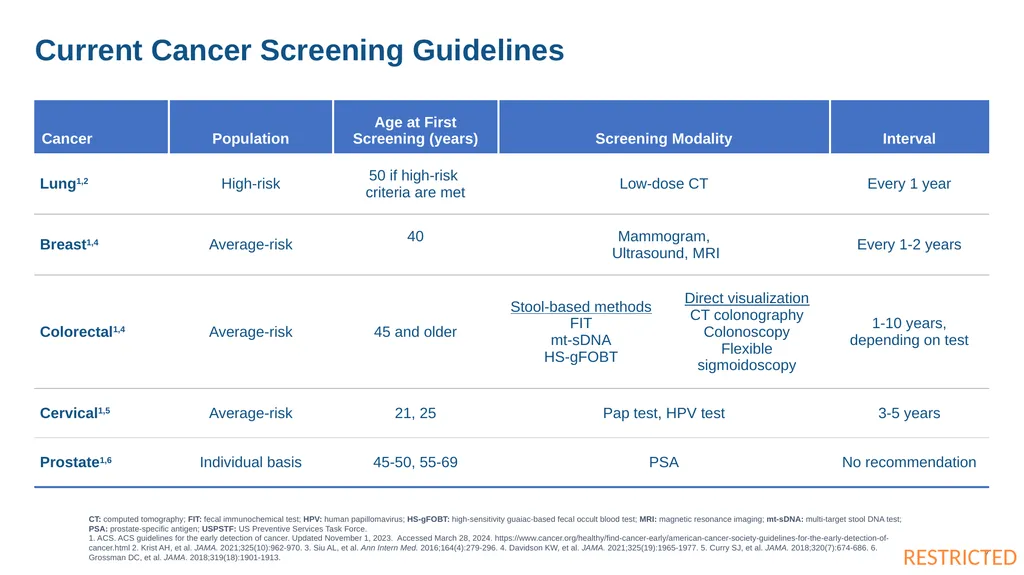
Current Cancer Screening Guidelines CT: computed tomography; FIT: fecal immunochemical test; HPV: human papillomavirus; HS-gFOBT: high-sensitivity guaiac-based fecal occult blood test; MRI: magnetic resonance imaging; mt-sDNA: multi-target stool DNA test; PSA: prostate-specific antigen; USPSTF: US Preventive Services Task Force.
1. ACS. ACS guidelines for the early detection of cancer. Updated November 1, 2023. Accessed March 28, 2024. https://www.cancer.org/healthy/find-cancer-early/american-cancer-society-guidelines-for-the-early-detection-of-cancer.html 2. Krist AH, et al. JAMA. 2021;325(10):962-970. 3. Siu AL, et al. Ann Intern Med. 2016;164(4):279-296. 4. Davidson KW, et al. JAMA. 2021;325(19):1965-1977. 5. Curry SJ, et al. JAMA. 2018;320(7):674-686. 6. Grossman DC, et al. JAMA. 2018;319(18):1901-1913.<br>
1. ACS. ACS guidelines for the early detection of cancer. Updated November 1, 2023. Accessed March 28, 2024. https://www.cancer.org/healthy/find-cancer-early/american-cancer-society-guidelines-for-the-early-detection-of-cancer.html 2. Krist AH, et al. JAMA. 2021;325(10):962-970. 3. Siu AL, et al. Ann Intern Med. 2016;164(4):279-296. 4. Davidson KW, et al. JAMA. 2021;325(19):1965-1977. 5. Curry SJ, et al. JAMA. 2018;320(7):674-686. 6. Grossman DC, et al. JAMA. 2018;319(18):1901-1913.<br>
08
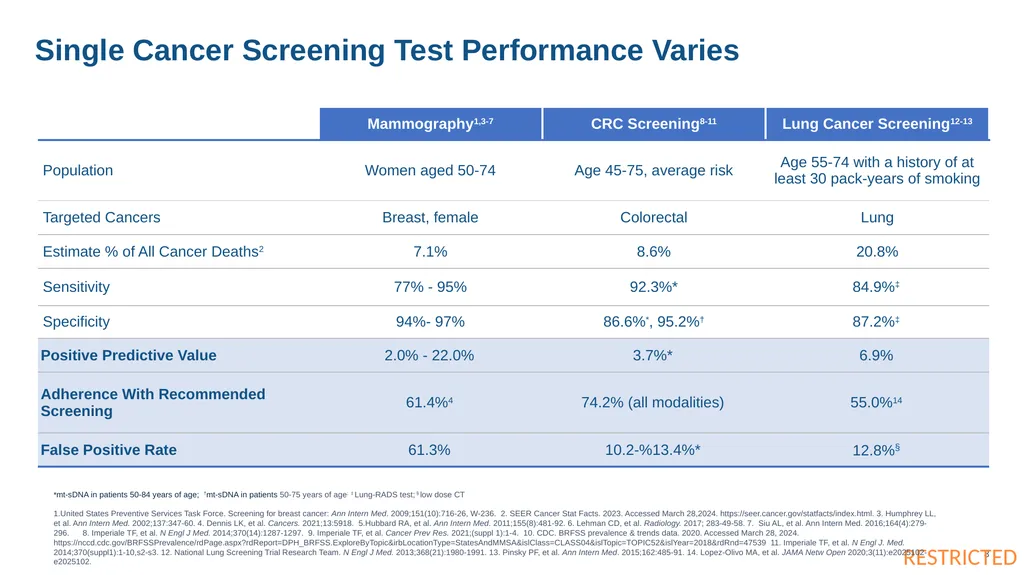
Single Cancer Screening Test Performance Varies *mt-sDNA in patients 50-84 years of age; †mt-sDNA in patients 50-75 years of age; ‡ Lung-RADS test; § low dose CT
1.United States Preventive Services Task Force. Screening for breast cancer: Ann Intern Med. 2009;151(10):716-26, W-236. 2. SEER Cancer Stat Facts. 2023. Accessed March 28,2024. https://seer.cancer.gov/statfacts/index.html. 3. Humphrey LL, et al. Ann Intern Med. 2002;137:347-60. 4. Dennis LK, et al. Cancers. 2021;13:5918. 5.Hubbard RA, et al. Ann Intern Med. 2011;155(8):481-92. 6. Lehman CD, et al. Radiology. 2017; 283-49-58. 7. Siu AL, et al. Ann Intern Med. 2016;164(4):279-296. 8. Imperiale TF, et al. N Engl J Med. 2014;370(14):1287-1297. 9. Imperiale TF, et al. Cancer Prev Res. 2021;(suppl 1):1-4. 10. CDC. BRFSS prevalence & trends data. 2020. Accessed March 28, 2024. https://nccd.cdc.gov/BRFSSPrevalence/rdPage.aspx?rdReport=DPH_BRFSS.ExploreByTopic&irbLocationType=StatesAndMMSA&islClass=CLASS04&islTopic=TOPIC52&islYear=2018&rdRnd=47539 11. Imperiale TF, et al. N Engl J. Med. 2014;370(suppl1):1-10,s2-s3. 12. National Lung Screening Trial Research Team. N Engl J Med. 2013;368(21):1980-1991. 13. Pinsky PF, et al. Ann Intern Med. 2015;162:485-91. 14. Lopez-Olivo MA, et al. JAMA Netw Open 2020;3(11):e2025102-e2025102.<br>
1.United States Preventive Services Task Force. Screening for breast cancer: Ann Intern Med. 2009;151(10):716-26, W-236. 2. SEER Cancer Stat Facts. 2023. Accessed March 28,2024. https://seer.cancer.gov/statfacts/index.html. 3. Humphrey LL, et al. Ann Intern Med. 2002;137:347-60. 4. Dennis LK, et al. Cancers. 2021;13:5918. 5.Hubbard RA, et al. Ann Intern Med. 2011;155(8):481-92. 6. Lehman CD, et al. Radiology. 2017; 283-49-58. 7. Siu AL, et al. Ann Intern Med. 2016;164(4):279-296. 8. Imperiale TF, et al. N Engl J Med. 2014;370(14):1287-1297. 9. Imperiale TF, et al. Cancer Prev Res. 2021;(suppl 1):1-4. 10. CDC. BRFSS prevalence & trends data. 2020. Accessed March 28, 2024. https://nccd.cdc.gov/BRFSSPrevalence/rdPage.aspx?rdReport=DPH_BRFSS.ExploreByTopic&irbLocationType=StatesAndMMSA&islClass=CLASS04&islTopic=TOPIC52&islYear=2018&rdRnd=47539 11. Imperiale TF, et al. N Engl J. Med. 2014;370(suppl1):1-10,s2-s3. 12. National Lung Screening Trial Research Team. N Engl J Med. 2013;368(21):1980-1991. 13. Pinsky PF, et al. Ann Intern Med. 2015;162:485-91. 14. Lopez-Olivo MA, et al. JAMA Netw Open 2020;3(11):e2025102-e2025102.<br>
09
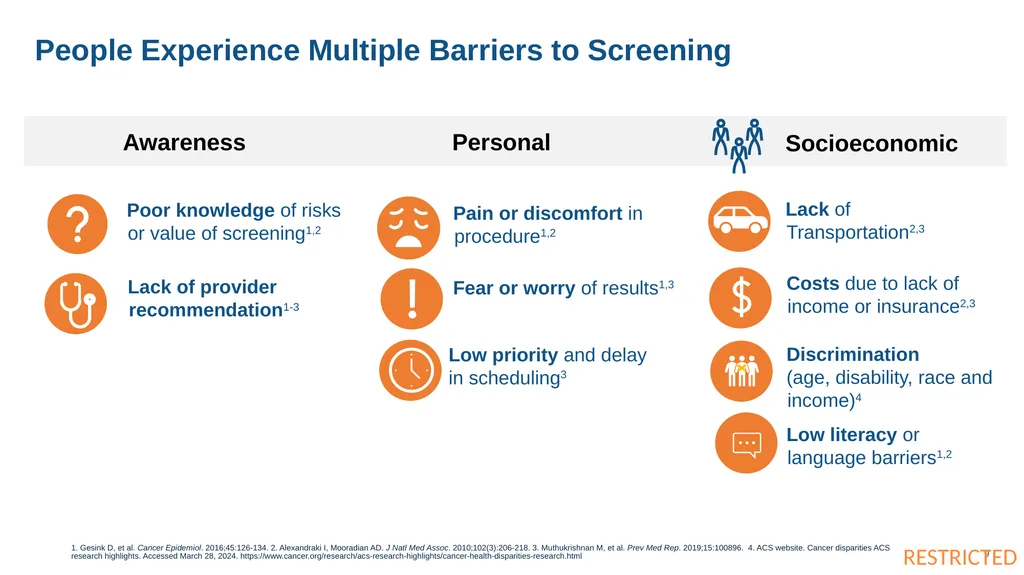
People Experience Multiple Barriers to Screening Awareness Personal Socioeconomic 1. Gesink D, et al. Cancer Epidemiol. 2016;45:126-134. 2. Alexandraki I, Mooradian AD. J Natl Med Assoc. 2010;102(3):206-218. 3. Muthukrishnan M, et al. Prev Med Rep. 2019;15:100896. 4. ACS website. Cancer disparities ACS research highlights. Accessed March 28, 2024. https://www.cancer.org/research/acs-research-highlights/cancer-health-disparities-research.html<br>
10
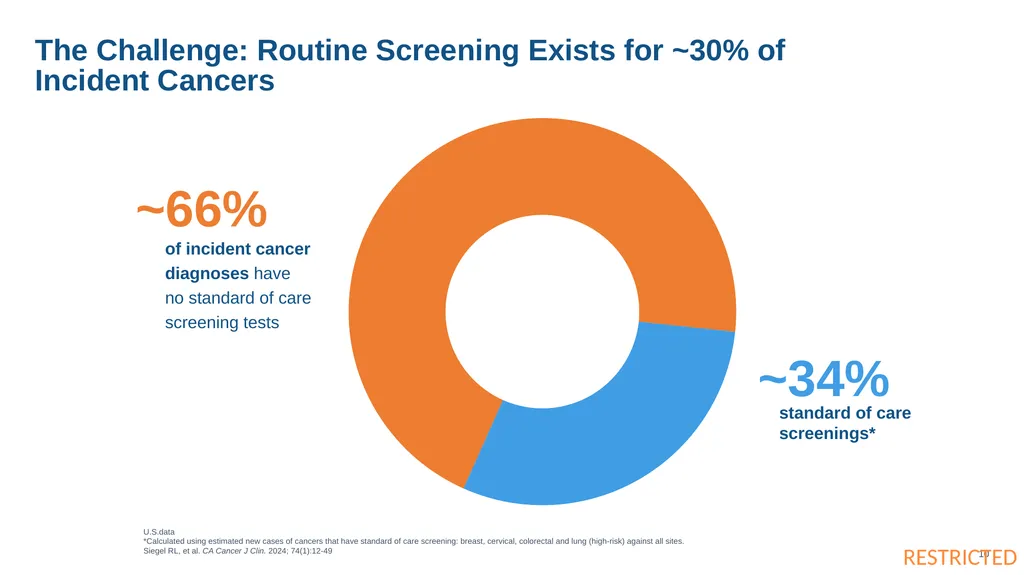
The Challenge: Routine Screening Exists for ~30% of Incident Cancers U.S.data
*Calculated using estimated new cases of cancers that have standard of care screening: breast, cervical, colorectal and lung (high-risk) against all sites.
Siegel RL, et al. CA Cancer J Clin. 2024; 74(1):12-49<br>
*Calculated using estimated new cases of cancers that have standard of care screening: breast, cervical, colorectal and lung (high-risk) against all sites.
Siegel RL, et al. CA Cancer J Clin. 2024; 74(1):12-49<br>
11
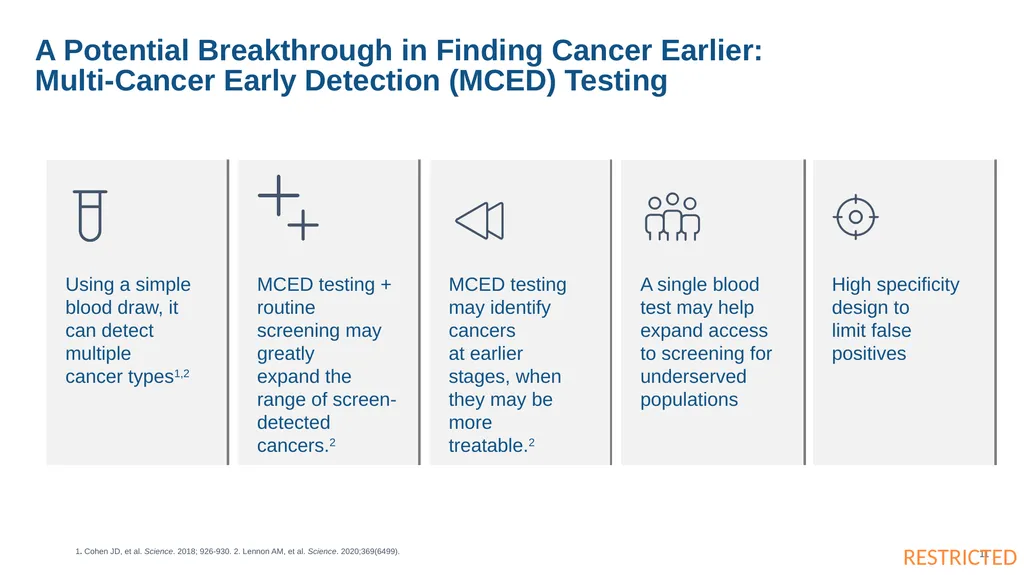
A Potential Breakthrough in Finding Cancer Earlier: Multi-Cancer Early Detection (MCED) Testing 1. Cohen JD, et al. Science. 2018; 926-930. 2. Lennon AM, et al. Science. 2020;369(6499). Using a simple blood draw, it can detect multiple
cancer types1,2 MCED testing + routine screening may greatly
expand the range of screen-detected cancers.2 MCED testing may identify cancers
at earlier stages, when they may be more treatable.2 A single blood test may help expand access to screening for underserved populations High specificity
design to
limit false positives<br>
12
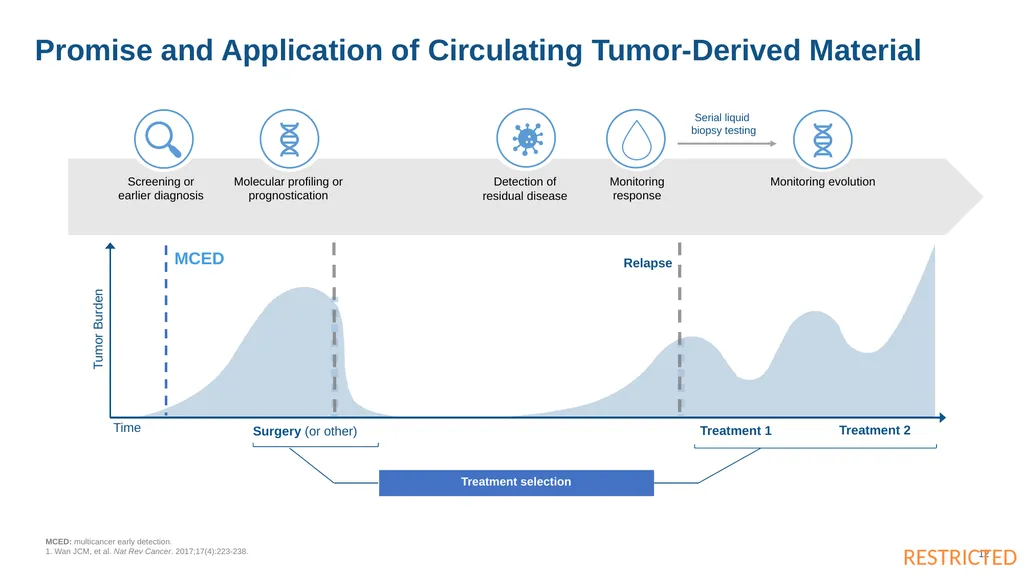
Promise and Application of Circulating Tumor-Derived Material MCED MCED: multicancer early detection.
1. Wan JCM, et al. Nat Rev Cancer. 2017;17(4):223-238.<br>
1. Wan JCM, et al. Nat Rev Cancer. 2017;17(4):223-238.<br>
13
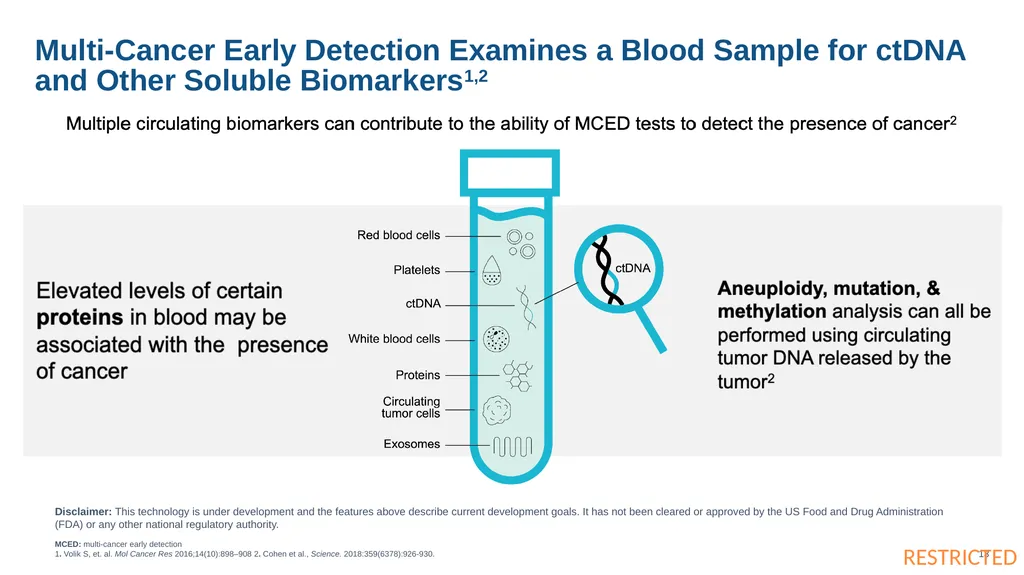
Multi-Cancer Early Detection Examines a Blood Sample for ctDNA and Other Soluble Biomarkers1,2 MCED: multi-cancer early detection
1. Volik S, et. al. Mol Cancer Res 2016;14(10):898–908 2. Cohen et al., Science. 2018:359(6378):926-930. Disclaimer: This technology is under development and the features above describe current development goals. It has not been cleared or approved by the US Food and Drug Administration (FDA) or any other national regulatory authority.<br>
1. Volik S, et. al. Mol Cancer Res 2016;14(10):898–908 2. Cohen et al., Science. 2018:359(6378):926-930. Disclaimer: This technology is under development and the features above describe current development goals. It has not been cleared or approved by the US Food and Drug Administration (FDA) or any other national regulatory authority.<br>
14
Multi-Cancer Early Detection Testing:
Clinical Studies<br>
15
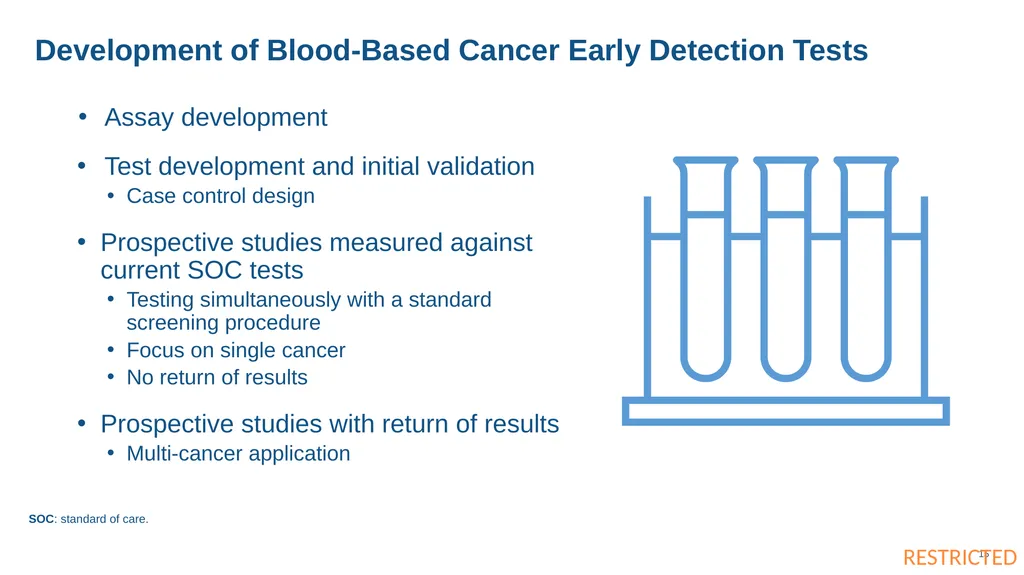
Development of Blood-Based Cancer Early Detection Tests Assay development
Test development and initial validation
Case control design
Prospective studies measured against current SOC tests
Testing simultaneously with a standard screening procedure
Focus on single cancer
No return of results
Prospective studies with return of results
Multi-cancer application SOC: standard of care.<br>
Test development and initial validation
Case control design
Prospective studies measured against current SOC tests
Testing simultaneously with a standard screening procedure
Focus on single cancer
No return of results
Prospective studies with return of results
Multi-cancer application SOC: standard of care.<br>
16
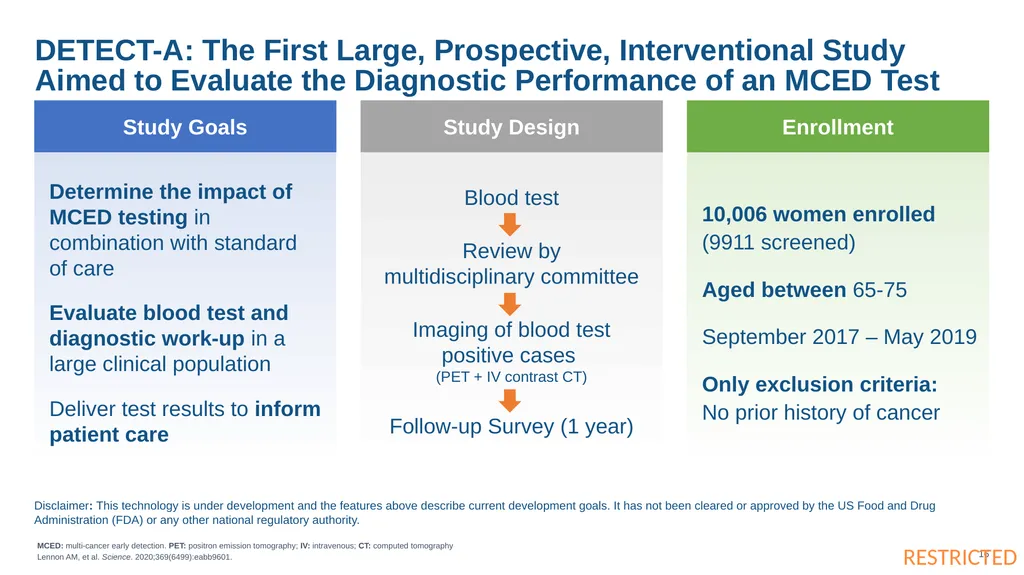
DETECT-A: The First Large, Prospective, Interventional Study Aimed to Evaluate the Diagnostic Performance of an MCED Test MCED: multi-cancer early detection. PET: positron emission tomography; IV: intravenous; CT: computed tomography
Lennon AM, et al. Science. 2020;369(6499):eabb9601. Disclaimer: This technology is under development and the features above describe current development goals. It has not been cleared or approved by the US Food and Drug Administration (FDA) or any other national regulatory authority.<br>
Lennon AM, et al. Science. 2020;369(6499):eabb9601. Disclaimer: This technology is under development and the features above describe current development goals. It has not been cleared or approved by the US Food and Drug Administration (FDA) or any other national regulatory authority.<br>
17
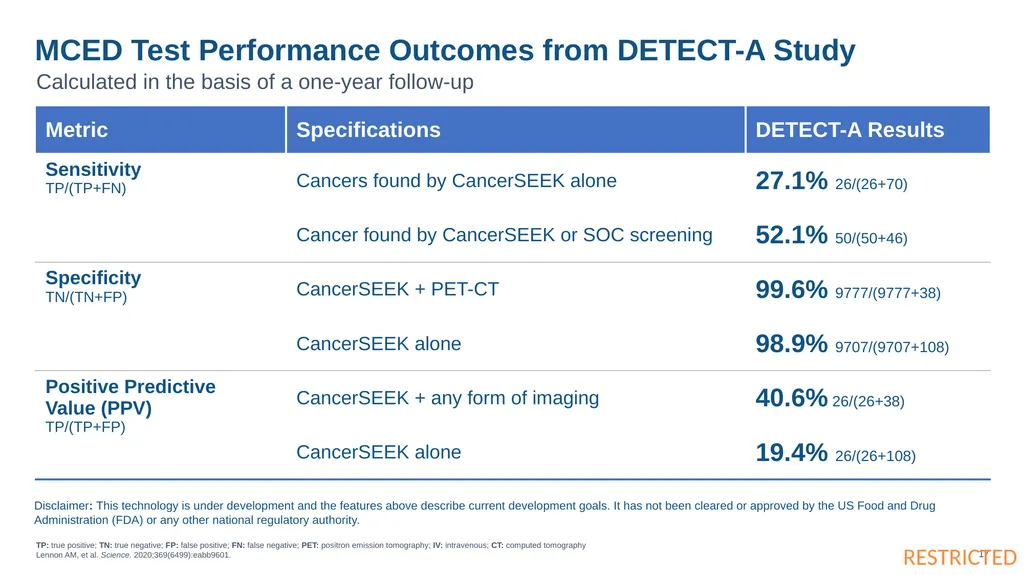
MCED Test Performance Outcomes from DETECT-A Study TP: true positive; TN: true negative; FP: false positive; FN: false negative; PET: positron emission tomography; IV: intravenous; CT: computed tomography
Lennon AM, et al. Science. 2020;369(6499):eabb9601. Disclaimer: This technology is under development and the features above describe current development goals. It has not been cleared or approved by the US Food and Drug Administration (FDA) or any other national regulatory authority. Calculated in the basis of a one-year follow-up<br>
Lennon AM, et al. Science. 2020;369(6499):eabb9601. Disclaimer: This technology is under development and the features above describe current development goals. It has not been cleared or approved by the US Food and Drug Administration (FDA) or any other national regulatory authority. Calculated in the basis of a one-year follow-up<br>
18
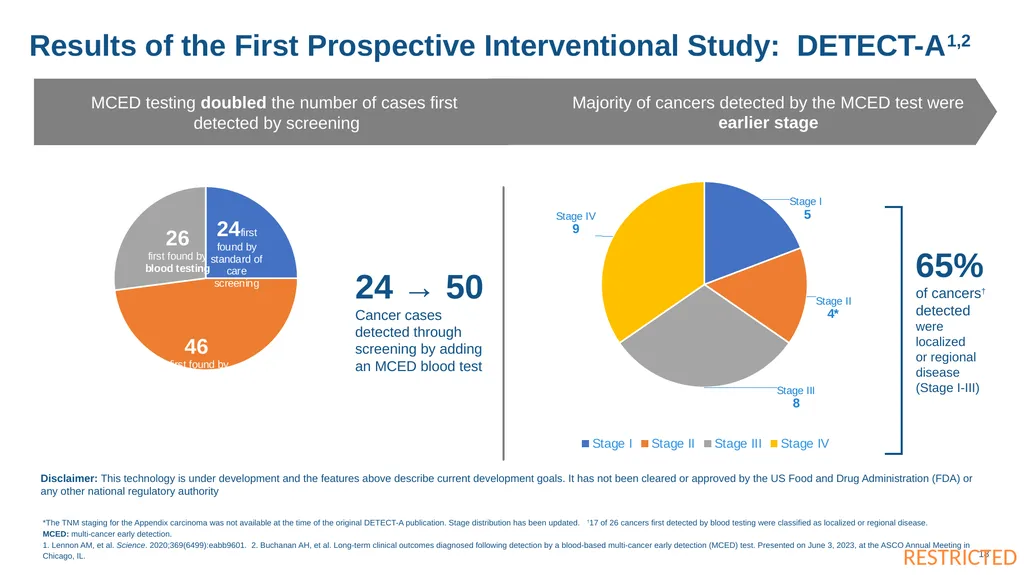
Results of the First Prospective Interventional Study: DETECT-A1,2 *The TNM staging for the Appendix carcinoma was not available at the time of the original DETECT-A publication. Stage distribution has been updated. †17 of 26 cancers first detected by blood testing were classified as localized or regional disease.
MCED: multi-cancer early detection.
1. Lennon AM, et al. Science. 2020;369(6499):eabb9601. 2. Buchanan AH, et al. Long-term clinical outcomes diagnosed following detection by a blood-based multi-cancer early detection (MCED) test. Presented on June 3, 2023, at the ASCO Annual Meeting in Chicago, IL. Disclaimer: This technology is under development and the features above describe current development goals. It has not been cleared or approved by the US Food and Drug Administration (FDA) or any other national regulatory authority 65%
of cancers† detected
were
localized
or regional disease
(Stage I-III) 24 → 50
Cancer cases detected through screening by adding an MCED blood test<br>
MCED: multi-cancer early detection.
1. Lennon AM, et al. Science. 2020;369(6499):eabb9601. 2. Buchanan AH, et al. Long-term clinical outcomes diagnosed following detection by a blood-based multi-cancer early detection (MCED) test. Presented on June 3, 2023, at the ASCO Annual Meeting in Chicago, IL. Disclaimer: This technology is under development and the features above describe current development goals. It has not been cleared or approved by the US Food and Drug Administration (FDA) or any other national regulatory authority 65%
of cancers† detected
were
localized
or regional disease
(Stage I-III) 24 → 50
Cancer cases detected through screening by adding an MCED blood test<br>
19
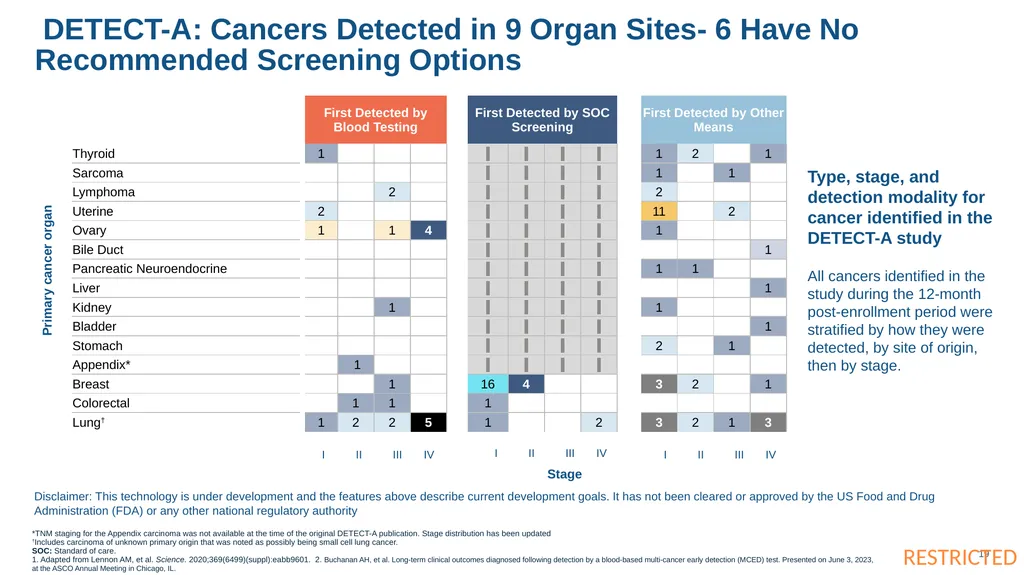
DETECT-A: Cancers Detected in 9 Organ Sites- 6 Have No Recommended Screening Options Disclaimer: This technology is under development and the features above describe current development goals. It has not been cleared or approved by the US Food and Drug Administration (FDA) or any other national regulatory authority Type, stage, and detection modality for cancer identified in the DETECT-A study
All cancers identified in the study during the 12-month post-enrollment period were stratified by how they were detected, by site of origin, then by stage. I II III IV Stage Primary cancer organ I II III IV I II III IV *TNM staging for the Appendix carcinoma was not available at the time of the original DETECT-A publication. Stage distribution has been updated
†Includes carcinoma of unknown primary origin that was noted as possibly being small cell lung cancer.
SOC: Standard of care.
1. Adapted from Lennon AM, et al. Science. 2020;369(6499)(suppl):eabb9601. 2. Buchanan AH, et al. Long-term clinical outcomes diagnosed following detection by a blood-based multi-cancer early detection (MCED) test. Presented on June 3, 2023, at the ASCO Annual Meeting in Chicago, IL.<br>
All cancers identified in the study during the 12-month post-enrollment period were stratified by how they were detected, by site of origin, then by stage. I II III IV Stage Primary cancer organ I II III IV I II III IV *TNM staging for the Appendix carcinoma was not available at the time of the original DETECT-A publication. Stage distribution has been updated
†Includes carcinoma of unknown primary origin that was noted as possibly being small cell lung cancer.
SOC: Standard of care.
1. Adapted from Lennon AM, et al. Science. 2020;369(6499)(suppl):eabb9601. 2. Buchanan AH, et al. Long-term clinical outcomes diagnosed following detection by a blood-based multi-cancer early detection (MCED) test. Presented on June 3, 2023, at the ASCO Annual Meeting in Chicago, IL.<br>
20
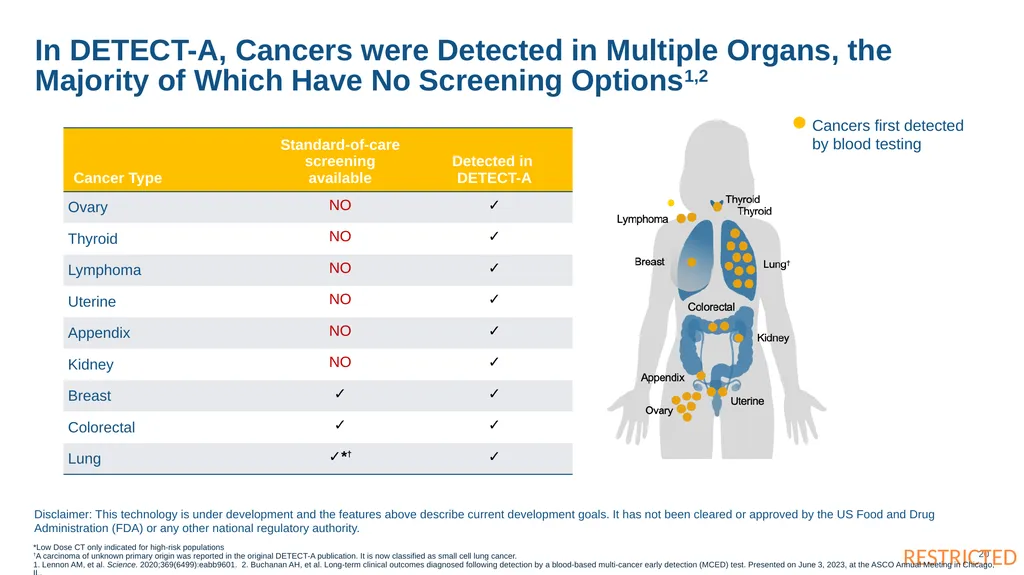
In DETECT-A, Cancers were Detected in Multiple Organs, the Majority of Which Have No Screening Options1,2 Disclaimer: This technology is under development and the features above describe current development goals. It has not been cleared or approved by the US Food and Drug Administration (FDA) or any other national regulatory authority. Cancers first detected by blood testing *Low Dose CT only indicated for high-risk populations
†A carcinoma of unknown primary origin was reported in the original DETECT-A publication. It is now classified as small cell lung cancer.
1. Lennon AM, et al. Science. 2020;369(6499):eabb9601. 2. Buchanan AH, et al. Long-term clinical outcomes diagnosed following detection by a blood-based multi-cancer early detection (MCED) test. Presented on June 3, 2023, at the ASCO Annual Meeting in Chicago, IL.<br>
†A carcinoma of unknown primary origin was reported in the original DETECT-A publication. It is now classified as small cell lung cancer.
1. Lennon AM, et al. Science. 2020;369(6499):eabb9601. 2. Buchanan AH, et al. Long-term clinical outcomes diagnosed following detection by a blood-based multi-cancer early detection (MCED) test. Presented on June 3, 2023, at the ASCO Annual Meeting in Chicago, IL.<br>
21
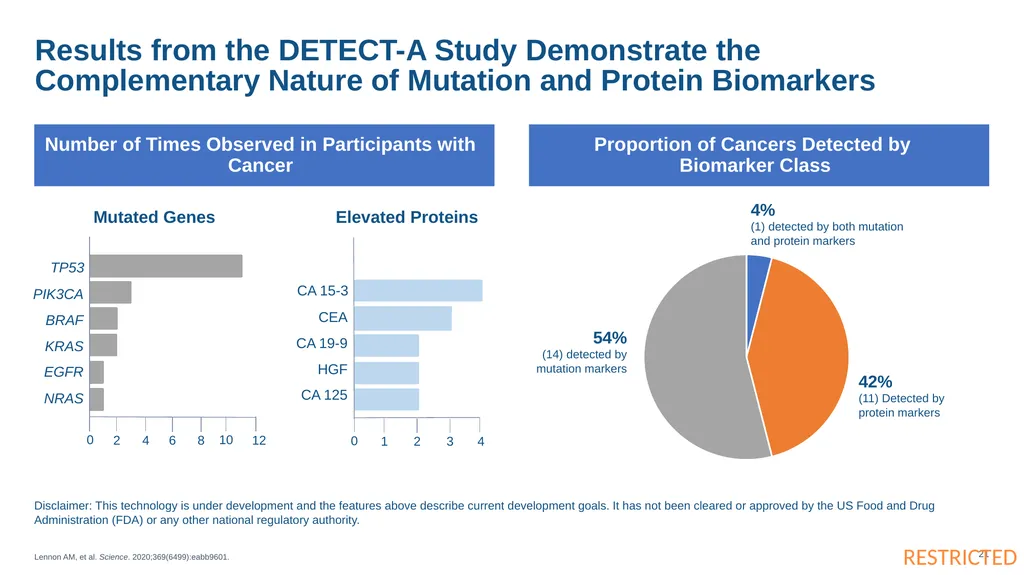
Results from the DETECT-A Study Demonstrate the Complementary Nature of Mutation and Protein Biomarkers Lennon AM, et al. Science. 2020;369(6499):eabb9601. Disclaimer: This technology is under development and the features above describe current development goals. It has not been cleared or approved by the US Food and Drug Administration (FDA) or any other national regulatory authority. Proportion of Cancers Detected by
Biomarker Class Number of Times Observed in Participants with Cancer Mutated Genes Elevated Proteins 4% (1) detected by both mutation and protein markers 54%
(14) detected by
mutation markers 42% (11) Detected by protein markers<br>
Biomarker Class Number of Times Observed in Participants with Cancer Mutated Genes Elevated Proteins 4% (1) detected by both mutation and protein markers 54%
(14) detected by
mutation markers 42% (11) Detected by protein markers<br>
22
Exploring the Value of Multi-Analyte Analysis in MCED Testing<br>
23
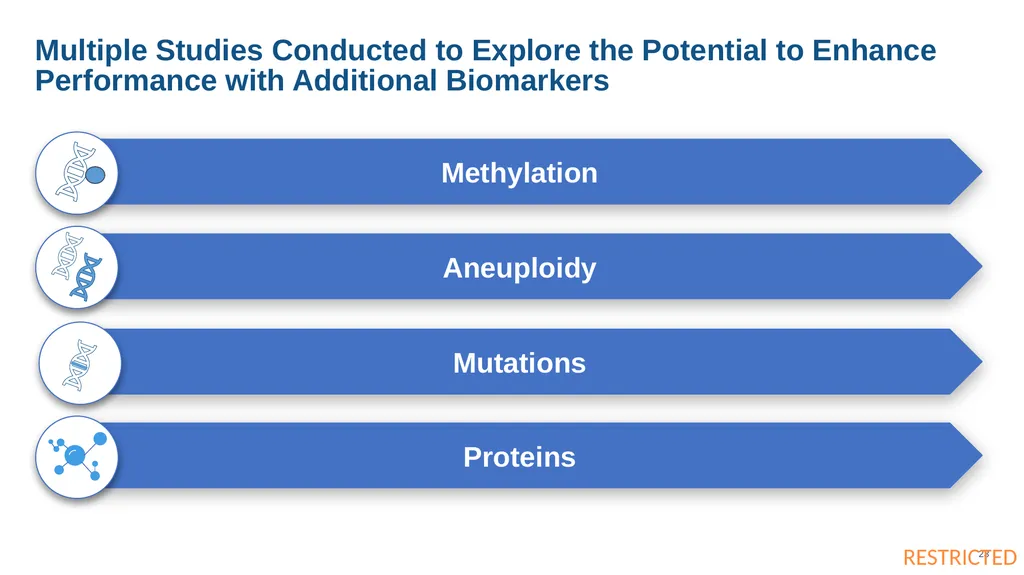
Multiple Studies Conducted to Explore the Potential to Enhance Performance with Additional Biomarkers<br>
24
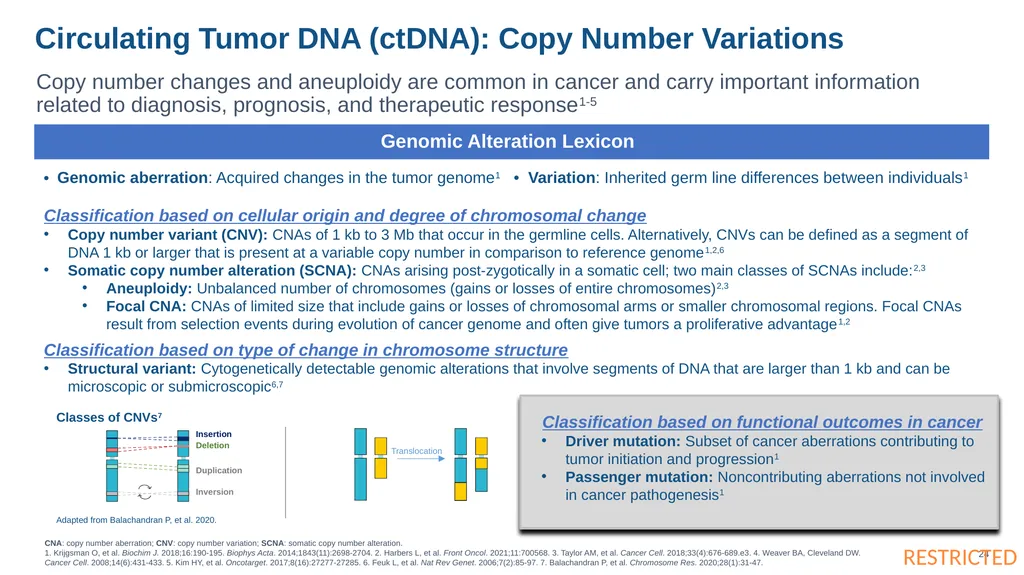
Circulating Tumor DNA (ctDNA): Copy Number Variations CNA: copy number aberration; CNV: copy number variation; SCNA: somatic copy number alteration.
1. Krijgsman O, et al. Biochim J. 2018;16:190-195. Biophys Acta. 2014;1843(11):2698-2704. 2. Harbers L, et al. Front Oncol. 2021;11:700568. 3. Taylor AM, et al. Cancer Cell. 2018;33(4):676-689.e3. 4. Weaver BA, Cleveland DW. Cancer Cell. 2008;14(6):431-433. 5. Kim HY, et al. Oncotarget. 2017;8(16):27277-27285. 6. Feuk L, et al. Nat Rev Genet. 2006;7(2):85-97. 7. Balachandran P, et al. Chromosome Res. 2020;28(1):31-47. Copy number changes and aneuploidy are common in cancer and carry important information related to diagnosis, prognosis, and therapeutic response1-5 Genomic Alteration Lexicon • Genomic aberration: Acquired changes in the tumor genome1 • Variation: Inherited germ line differences between individuals1
Classification based on cellular origin and degree of chromosomal change
Copy number variant (CNV): CNAs of 1 kb to 3 Mb that occur in the germline cells. Alternatively, CNVs can be defined as a segment of DNA 1 kb or larger that is present at a variable copy number in comparison to reference genome1,2,6
Somatic copy number alteration (SCNA): CNAs arising post-zygotically in a somatic cell; two main classes of SCNAs include:2,3
Aneuploidy: Unbalanced number of chromosomes (gains or losses of entire chromosomes)2,3
Focal CNA: CNAs of limited size that include gains or losses of chromosomal arms or smaller chromosomal regions. Focal CNAs result from selection events during evolution of cancer genome and often give tumors a proliferative advantage1,2
Classification based on type of change in chromosome structure
Structural variant: Cytogenetically detectable genomic alterations that involve segments of DNA that are larger than 1 kb and can be microscopic or submicroscopic6,7 Classification based on functional outcomes in cancer
Driver mutation: Subset of cancer aberrations contributing to tumor initiation and progression1
Passenger mutation: Noncontributing aberrations not involved in cancer pathogenesis1<br>
1. Krijgsman O, et al. Biochim J. 2018;16:190-195. Biophys Acta. 2014;1843(11):2698-2704. 2. Harbers L, et al. Front Oncol. 2021;11:700568. 3. Taylor AM, et al. Cancer Cell. 2018;33(4):676-689.e3. 4. Weaver BA, Cleveland DW. Cancer Cell. 2008;14(6):431-433. 5. Kim HY, et al. Oncotarget. 2017;8(16):27277-27285. 6. Feuk L, et al. Nat Rev Genet. 2006;7(2):85-97. 7. Balachandran P, et al. Chromosome Res. 2020;28(1):31-47. Copy number changes and aneuploidy are common in cancer and carry important information related to diagnosis, prognosis, and therapeutic response1-5 Genomic Alteration Lexicon • Genomic aberration: Acquired changes in the tumor genome1 • Variation: Inherited germ line differences between individuals1
Classification based on cellular origin and degree of chromosomal change
Copy number variant (CNV): CNAs of 1 kb to 3 Mb that occur in the germline cells. Alternatively, CNVs can be defined as a segment of DNA 1 kb or larger that is present at a variable copy number in comparison to reference genome1,2,6
Somatic copy number alteration (SCNA): CNAs arising post-zygotically in a somatic cell; two main classes of SCNAs include:2,3
Aneuploidy: Unbalanced number of chromosomes (gains or losses of entire chromosomes)2,3
Focal CNA: CNAs of limited size that include gains or losses of chromosomal arms or smaller chromosomal regions. Focal CNAs result from selection events during evolution of cancer genome and often give tumors a proliferative advantage1,2
Classification based on type of change in chromosome structure
Structural variant: Cytogenetically detectable genomic alterations that involve segments of DNA that are larger than 1 kb and can be microscopic or submicroscopic6,7 Classification based on functional outcomes in cancer
Driver mutation: Subset of cancer aberrations contributing to tumor initiation and progression1
Passenger mutation: Noncontributing aberrations not involved in cancer pathogenesis1<br>
25
Douville C, et al. Proc Natl Acad Sci. 2020;117(9):4858-4863. Disclaimer: This technology is under development and the features above describe current development goals. It has not been cleared or approved by the US Food and Drug Administration (FDA) or any other national regulatory authority.<br>
26
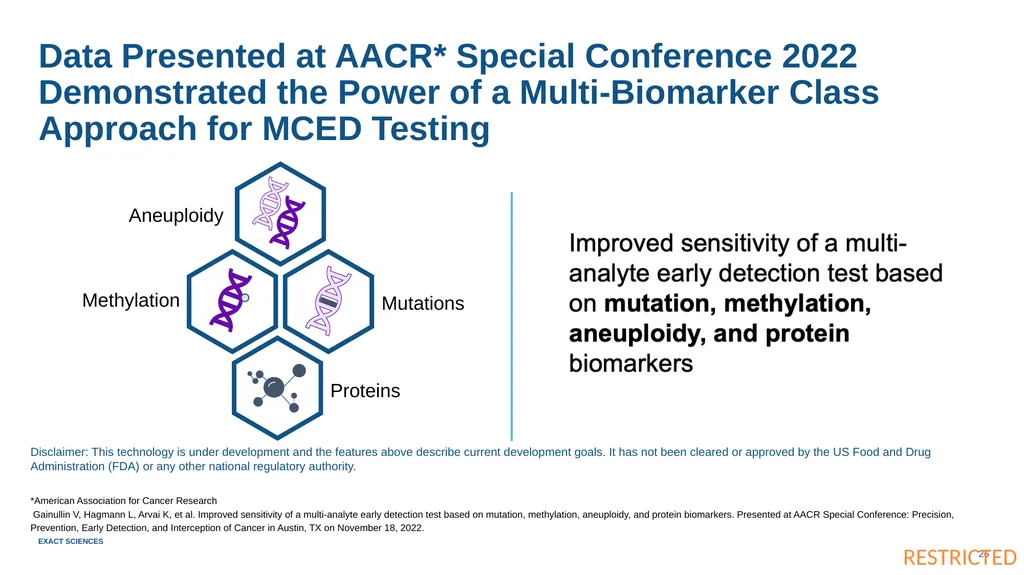
Data Presented at AACR* Special Conference 2022 Demonstrated the Power of a Multi-Biomarker Class Approach for MCED Testing *American Association for Cancer Research
Gainullin V, Hagmann L, Arvai K, et al. Improved sensitivity of a multi-analyte early detection test based on mutation, methylation, aneuploidy, and protein biomarkers. Presented at AACR Special Conference: Precision, Prevention, Early Detection, and Interception of Cancer in Austin, TX on November 18, 2022. Disclaimer: This technology is under development and the features above describe current development goals. It has not been cleared or approved by the US Food and Drug Administration (FDA) or any other national regulatory authority.<br>
Gainullin V, Hagmann L, Arvai K, et al. Improved sensitivity of a multi-analyte early detection test based on mutation, methylation, aneuploidy, and protein biomarkers. Presented at AACR Special Conference: Precision, Prevention, Early Detection, and Interception of Cancer in Austin, TX on November 18, 2022. Disclaimer: This technology is under development and the features above describe current development goals. It has not been cleared or approved by the US Food and Drug Administration (FDA) or any other national regulatory authority.<br>
27
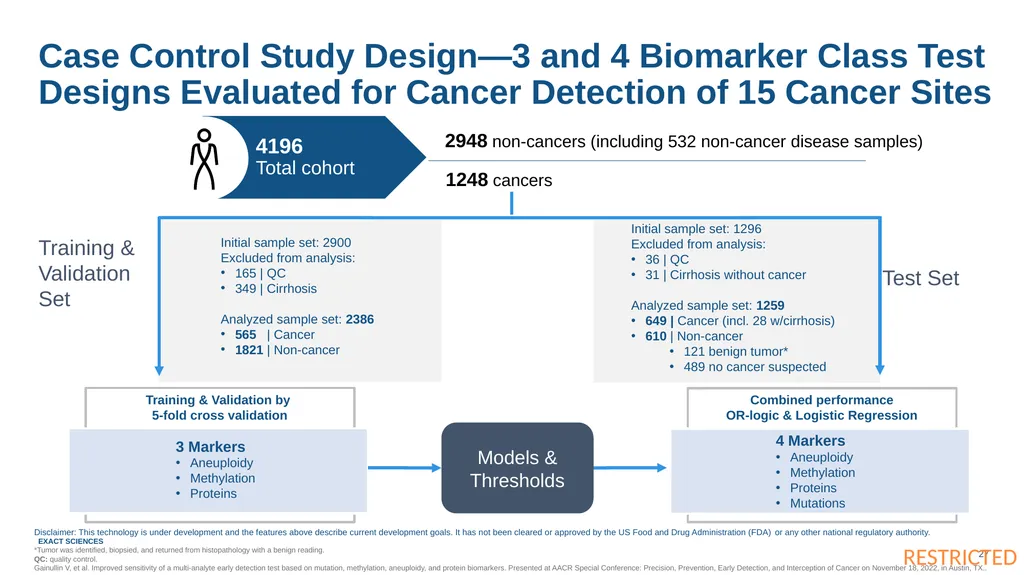
Case Control Study Design—3 and 4 Biomarker Class Test Designs Evaluated for Cancer Detection of 15 Cancer Sites Combined performance
OR-logic & Logistic Regression Initial sample set: 2900
Excluded from analysis:
165 | QC
349 | Cirrhosis
Analyzed sample set: 2386
565 | Cancer
1821 | Non-cancer Initial sample set: 1296
Excluded from analysis:
36 | QC
31 | Cirrhosis without cancer
Analyzed sample set: 1259
649 | Cancer (incl. 28 w/cirrhosis)
610 | Non-cancer
121 benign tumor*
489 no cancer suspected 4 Markers
Aneuploidy
Methylation
Proteins
Mutations Models & Thresholds Training & Validation by
5-fold cross validation 3 Markers
Aneuploidy
Methylation
Proteins *Tumor was identified, biopsied, and returned from histopathology with a benign reading.
QC: quality control.
Gainullin V, et al. Improved sensitivity of a multi-analyte early detection test based on mutation, methylation, aneuploidy, and protein biomarkers. Presented at AACR Special Conference: Precision, Prevention, Early Detection, and Interception of Cancer on November 18, 2022, in Austin, TX.. Training & Validation Set Test Set Disclaimer: This technology is under development and the features above describe current development goals. It has not been cleared or approved by the US Food and Drug Administration (FDA) or any other national regulatory authority.<br>
OR-logic & Logistic Regression Initial sample set: 2900
Excluded from analysis:
165 | QC
349 | Cirrhosis
Analyzed sample set: 2386
565 | Cancer
1821 | Non-cancer Initial sample set: 1296
Excluded from analysis:
36 | QC
31 | Cirrhosis without cancer
Analyzed sample set: 1259
649 | Cancer (incl. 28 w/cirrhosis)
610 | Non-cancer
121 benign tumor*
489 no cancer suspected 4 Markers
Aneuploidy
Methylation
Proteins
Mutations Models & Thresholds Training & Validation by
5-fold cross validation 3 Markers
Aneuploidy
Methylation
Proteins *Tumor was identified, biopsied, and returned from histopathology with a benign reading.
QC: quality control.
Gainullin V, et al. Improved sensitivity of a multi-analyte early detection test based on mutation, methylation, aneuploidy, and protein biomarkers. Presented at AACR Special Conference: Precision, Prevention, Early Detection, and Interception of Cancer on November 18, 2022, in Austin, TX.. Training & Validation Set Test Set Disclaimer: This technology is under development and the features above describe current development goals. It has not been cleared or approved by the US Food and Drug Administration (FDA) or any other national regulatory authority.<br>
28
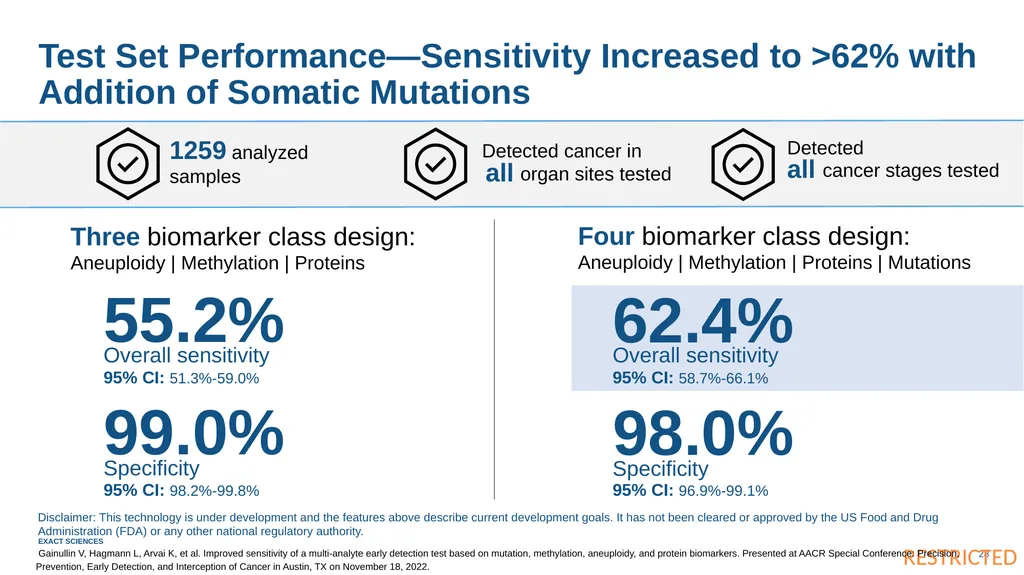
Test Set Performance—Sensitivity Increased to >62% with Addition of Somatic Mutations 1259 analyzed samples Four biomarker class design:
Aneuploidy | Methylation | Proteins | Mutations Three biomarker class design:
Aneuploidy | Methylation | Proteins Gainullin V, Hagmann L, Arvai K, et al. Improved sensitivity of a multi-analyte early detection test based on mutation, methylation, aneuploidy, and protein biomarkers. Presented at AACR Special Conference: Precision, Prevention, Early Detection, and Interception of Cancer in Austin, TX on November 18, 2022. Disclaimer: This technology is under development and the features above describe current development goals. It has not been cleared or approved by the US Food and Drug Administration (FDA) or any other national regulatory authority.<br>
Aneuploidy | Methylation | Proteins | Mutations Three biomarker class design:
Aneuploidy | Methylation | Proteins Gainullin V, Hagmann L, Arvai K, et al. Improved sensitivity of a multi-analyte early detection test based on mutation, methylation, aneuploidy, and protein biomarkers. Presented at AACR Special Conference: Precision, Prevention, Early Detection, and Interception of Cancer in Austin, TX on November 18, 2022. Disclaimer: This technology is under development and the features above describe current development goals. It has not been cleared or approved by the US Food and Drug Administration (FDA) or any other national regulatory authority.<br>
29
1. Gainullin V, Hagmann L, Arvai K, et al. Improved sensitivity of a multi-analyte early detection test based on mutation, methylation, aneuploidy, and protein biomarkers. Presented at AACR Special Conference: Precision, Prevention, Early Detection, and Interception of Cancer in Austin, TX on November 18, 2022. 2. Siegel RL, Miller KD, Wagel NS, Jemal A. Cancer statistics, 2023. CA Cancer J Clin. 2023;73:17-48. 3. Internal Data on File. Exact Sciences Corporation. Madison, WI The 4-Biomarker Class Approach with a Machine Learning Classifier Improved Early-Stage Sensitivity 17.4 +4.2% +6.8% +5.1% +12.9% Sensitivity % Stage I - III
4 marker class panel3
Sensitivity: 53.1%
+6.8% vs. 3 marker class panel3 Stage I + II
4 marker class panel3
Sensitivity: 40.5%
+8.9% vs. 3 marker class panel3 Disclaimer: This technology is under development and the features above describe current development goals. It has not been cleared or approved by the US Food and Drug Administration (FDA) or any other national regulatory authority. 17.4<br>
4 marker class panel3
Sensitivity: 53.1%
+6.8% vs. 3 marker class panel3 Stage I + II
4 marker class panel3
Sensitivity: 40.5%
+8.9% vs. 3 marker class panel3 Disclaimer: This technology is under development and the features above describe current development goals. It has not been cleared or approved by the US Food and Drug Administration (FDA) or any other national regulatory authority. 17.4<br>
30
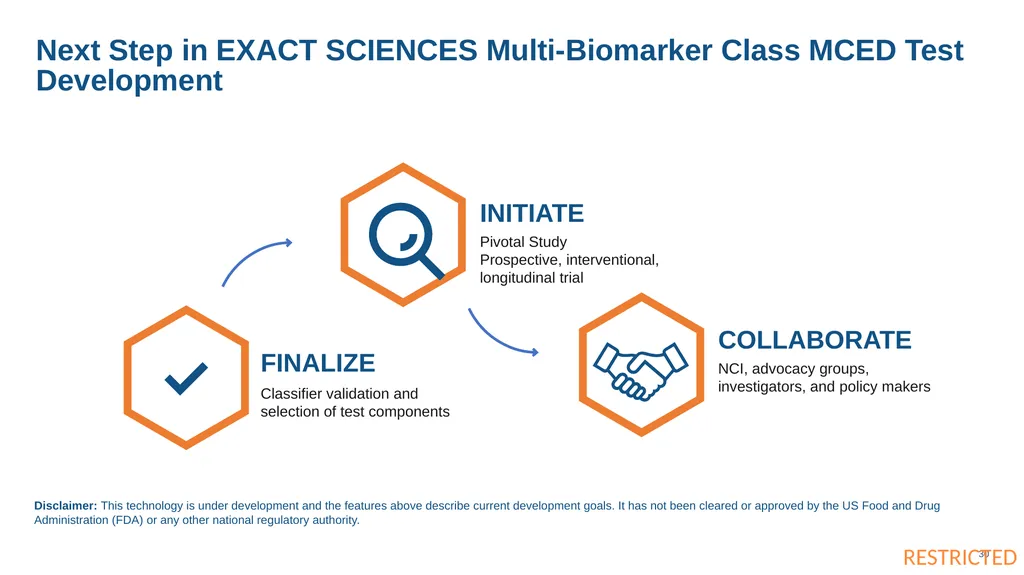
Next Step in EXACT SCIENCES Multi-Biomarker Class MCED Test Development Disclaimer: This technology is under development and the features above describe current development goals. It has not been cleared or approved by the US Food and Drug Administration (FDA) or any other national regulatory authority. Complete
ASCEND-2
Classifier validation study and final selection of test components Initiate pivotal trial
Prospective, interventional, longitudinal trial Collaborate
NCI, advocacy groups, and policy makers Collaborate
NCI, advocacy groups, and policy makers FINALIZE Classifier validation and selection of test components INITIATE Pivotal Study
Prospective, interventional, longitudinal trial COLLABORATE NCI, advocacy groups, investigators, and policy makers<br>
Classifier validation study and final selection of test components Initiate pivotal trial
Prospective, interventional, longitudinal trial Collaborate
NCI, advocacy groups, and policy makers Collaborate
NCI, advocacy groups, and policy makers FINALIZE Classifier validation and selection of test components INITIATE Pivotal Study
Prospective, interventional, longitudinal trial COLLABORATE NCI, advocacy groups, investigators, and policy makers<br>
31
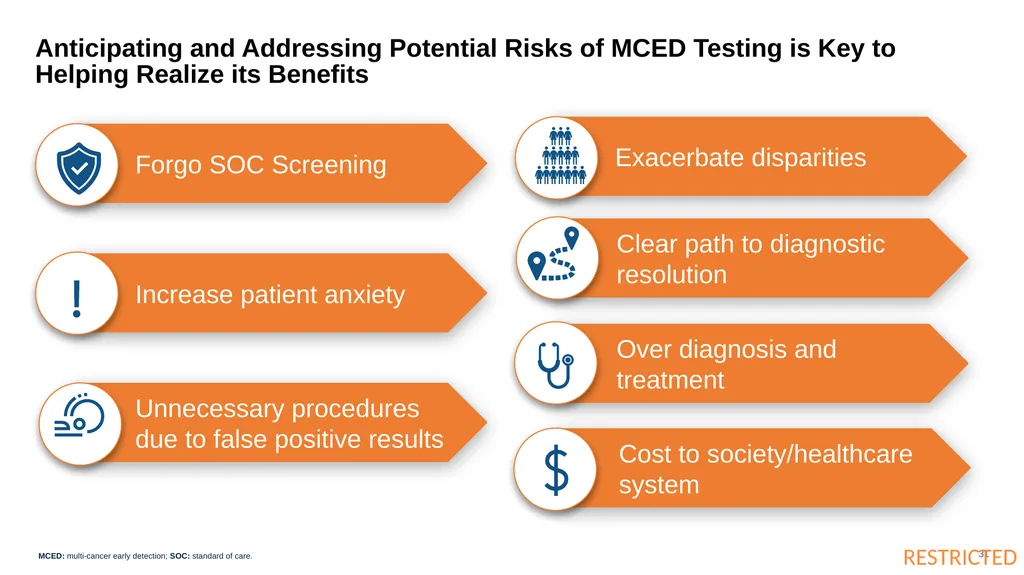
Anticipating and Addressing Potential Risks of MCED Testing is Key to Helping Realize its Benefits Exacerbate disparities Over diagnosis and treatment Cost to society/healthcare system Clear path to diagnostic resolution MCED: multi-cancer early detection; SOC: standard of care.<br>
32
These slides are provided for educational purposes as of April 18, 2024 Note:
These slides are made available to any appropriately requesting individual, regardless of the manner in which they cover, recommend, or participate in the ordering of any Exact Sciences product.
Individuals may use these slides for scientific or educational purposes only.
Exact Sciences does not grant permission to modify the slides or their content and therefore is not responsible for any edits or changes made by a user. This includes, but not limited to, edits or changes to the contents, order, format, and/or incorporation or adoption of these slides or their content into other materials.
The information on these slides may not constitute the most up-to-date data information or data. It is the user’s responsibility to verify the accuracy of these slides for the desired use to comply with applicable rules, laws, or regulations (e.g., event organizer or accrediting body standards/requirements, copyright laws, institutional requirements, etc.).
These slides and their contents are provided: (1) with any faults AS IS AND AS AVAILABLE; and (2) without any assurance, warranty, condition, or duty of or regarding the slides and/or their contents: accuracy, availability, adequacy, validity, reliability, completeness, performance, or compatibility. Exact Sciences disclaims any liability associated with the use of these slides. © 2023 Exact Sciences Corporation. All rights reserved.<br>
These slides are made available to any appropriately requesting individual, regardless of the manner in which they cover, recommend, or participate in the ordering of any Exact Sciences product.
Individuals may use these slides for scientific or educational purposes only.
Exact Sciences does not grant permission to modify the slides or their content and therefore is not responsible for any edits or changes made by a user. This includes, but not limited to, edits or changes to the contents, order, format, and/or incorporation or adoption of these slides or their content into other materials.
The information on these slides may not constitute the most up-to-date data information or data. It is the user’s responsibility to verify the accuracy of these slides for the desired use to comply with applicable rules, laws, or regulations (e.g., event organizer or accrediting body standards/requirements, copyright laws, institutional requirements, etc.).
These slides and their contents are provided: (1) with any faults AS IS AND AS AVAILABLE; and (2) without any assurance, warranty, condition, or duty of or regarding the slides and/or their contents: accuracy, availability, adequacy, validity, reliability, completeness, performance, or compatibility. Exact Sciences disclaims any liability associated with the use of these slides. © 2023 Exact Sciences Corporation. All rights reserved.<br>