Thinking and Learning Styles Historical
Description: Thinking and Learning Styles Historical Background: The Nature of the Concept of Styles 1. The term cognitive styles was first used in psychological literature in the 1940s to describe individual differences in perceptual ability

Related Topics
Download Presentation
"Thinking and Learning Styles Historical" is the property of its rightful owner. Permission is granted to download and print the materials on this website for personal, non-commercial use only, and to display it on your personal computer provided you do not modify the materials and that you retain all copyright notices contained in the materials. By downloading content from our website, you accept the terms of this agreement.
Presentation Transcript
slide1. Thinking and Learning Styles<br>
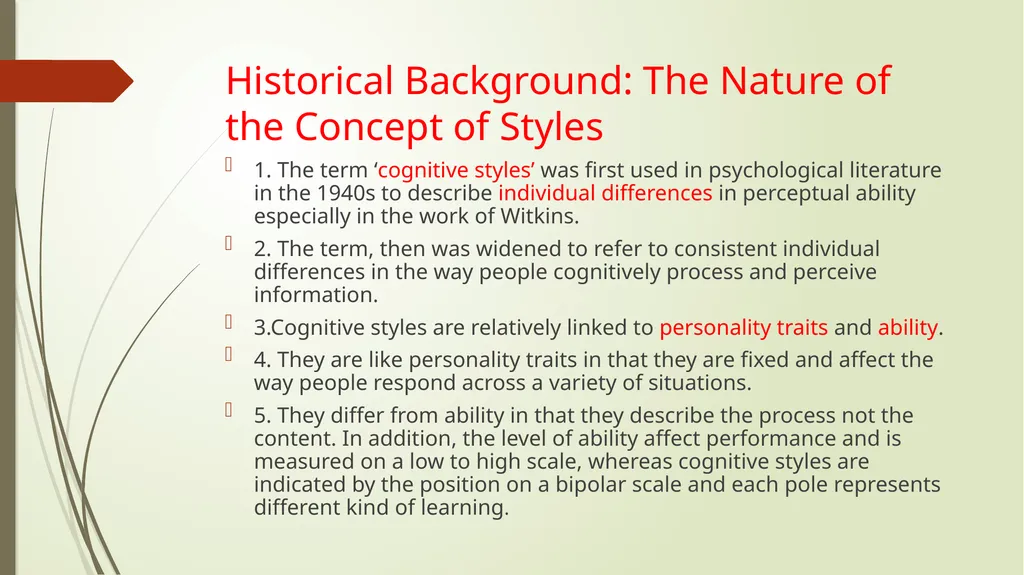
slide2. Historical Background: The Nature of the Concept of Styles 1. The term ‘cognitive styles’ was first used in psychological literature in the 1940s to describe individual differences in perceptual ability especially in the work of Witkins.
2. The term, then was widened to refer to consistent individual differences in the way people cognitively process and perceive information.
3.Cognitive styles are relatively linked to personality traits and ability.
4. They are like personality traits in that they are fixed and affect the way people respond across a variety of situations.
5. They differ from ability in that they describe the process not the content. In addition, the level of ability affect performance and is measured on a low to high scale, whereas cognitive styles are indicated by the position on a bipolar scale and each pole represents different kind of learning.<br>
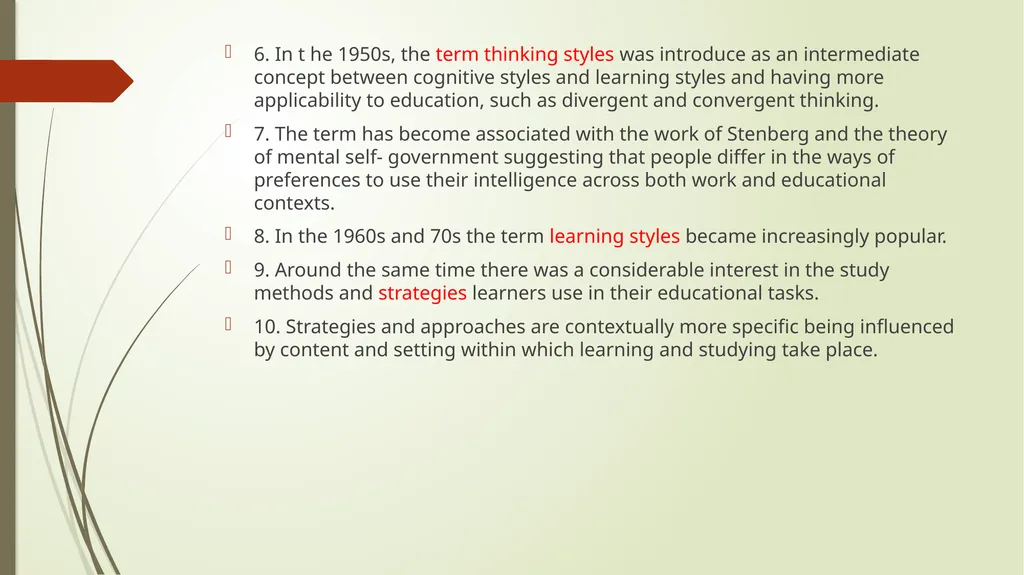
slide3. 6. In t he 1950s, the term thinking styles was introduce as an intermediate concept between cognitive styles and learning styles and having more applicability to education, such as divergent and convergent thinking.
7. The term has become associated with the work of Stenberg and the theory of mental self- government suggesting that people differ in the ways of preferences to use their intelligence across both work and educational contexts.
8. In the 1960s and 70s the term learning styles became increasingly popular.
9. Around the same time there was a considerable interest in the study methods and strategies learners use in their educational tasks.
10. Strategies and approaches are contextually more specific being influenced by content and setting within which learning and studying take place.<br>
slide2. Historical Background: The Nature of the Concept of Styles 1. The term ‘cognitive styles’ was first used in psychological literature in the 1940s to describe individual differences in perceptual ability especially in the work of Witkins.
2. The term, then was widened to refer to consistent individual differences in the way people cognitively process and perceive information.
3.Cognitive styles are relatively linked to personality traits and ability.
4. They are like personality traits in that they are fixed and affect the way people respond across a variety of situations.
5. They differ from ability in that they describe the process not the content. In addition, the level of ability affect performance and is measured on a low to high scale, whereas cognitive styles are indicated by the position on a bipolar scale and each pole represents different kind of learning.<br>
slide3. 6. In t he 1950s, the term thinking styles was introduce as an intermediate concept between cognitive styles and learning styles and having more applicability to education, such as divergent and convergent thinking.
7. The term has become associated with the work of Stenberg and the theory of mental self- government suggesting that people differ in the ways of preferences to use their intelligence across both work and educational contexts.
8. In the 1960s and 70s the term learning styles became increasingly popular.
9. Around the same time there was a considerable interest in the study methods and strategies learners use in their educational tasks.
10. Strategies and approaches are contextually more specific being influenced by content and setting within which learning and studying take place.<br>