Topic:Role of Artificial Intelligence for Research Scholars: Boon or Bane Rocky Kumar Komal Rani Assistant Professor Senior Research Fellow Maitreya College of Education and Management Central University of South Bihar, Gaya Email-
"Topic:Role of Artificial Intelligence for Research" is the property of its rightful owner. Permission is granted to
download and print the materials on this website for personal, non-commercial use only, and to display it
on your personal computer provided you do not modify the materials and that you retain all copyright
notices contained in the materials. By downloading content from our website, you accept the terms of this
agreement.
Presentation Transcript
01
Topic:Role of Artificial Intelligence for Research Scholars: Boon or Bane
Rocky Kumar Komal Rani
Assistant Professor Senior Research Fellow
Maitreya College of Education and Management & Central University of South Bihar, Gaya
Email- rockybhardwaj2846@gmail.com Email- krani9377@gmail.com International Conference on Artificial Intelligence and Technology in Academia and Profession organized by Center for Academic & Professional Career Development and Research (CAPCDR)<br>
02
Introduction Artificial Intelligence (AI) is a collection of technologies that give computers the ability to perform a variety of complex tasks, such as seeing, understanding, and translating spoken and written language, analyzing data, making suggestions, etc.
Artificial intelligence is the ability to duplicate human behaviour intelligently in every circumstance so that activities can be completed with technology practically and efficiently (Abe, 2024).<br>
03
Rational of the study: The study aims to examine the advantages and difficulties of using AI in research-by-research scholars that emphasize the potential and challenges of using AI technologies in the field of their study.
The study also aims to provide a thorough understanding of the implications of AI in research and offer insights into navigating the changing landscape of AI-driven research methodologies by looking at the current state of AI applications in research and exploring the ethical issues and limitations.<br>
04
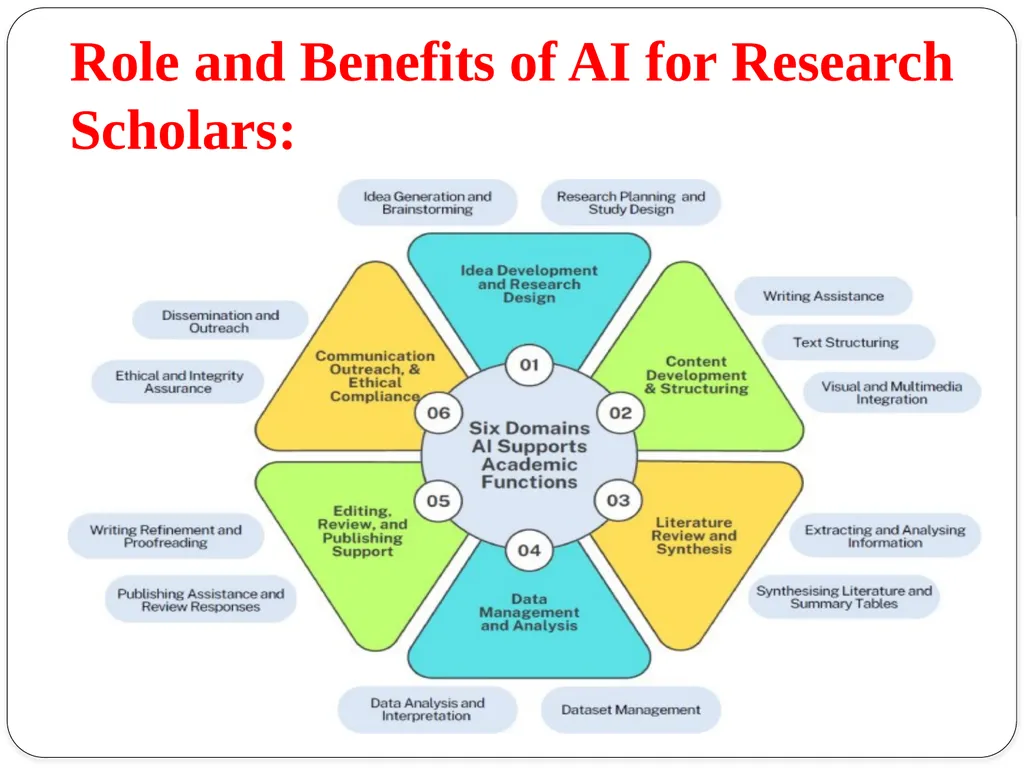
Role and Benefits of AI for Research Scholars:<br>
05
AI tools in Research: The various AI tools are given which are useful in research work for research scholars:
Julius- It is an AI tool designed specifically for contemporary scholarly study. It sets itself apart by providing individualized support for literature reviews and statistical analysis, which makes it a priceless tool for both academics and students.
Zotero-The process of gathering, organizing, and citing research is made smooth by Zotero.
ChatGPT- Research-related task including writing, research technique, and citation can be aided by ChatGPT, a generative AI tool. It also examines and combines information from researchers to create titles that are effective and succinct.
Quillbot-It can generate high-quality text. It is similar to the more widely used Grammarly app, which is driven by AI.
Research Rabbit- It is a freeAI-powered tool that helps research scholars to find relevant papers and explore new variables and topics.<br>
06
Drawbacks of Using AI in Research Ethical Concerns
Transparency Concerns
Algorithm Bias
Data Privacy and Security<br>
07
Conclusion: The study concludes that using AI by research scholars has both benefits and drawbacks.
Researchers can evaluate easily and accurately large amounts of data by using AI-powered tools.
Increases the quality and reproducibility of studies and allows researchers to conduct previously difficult research.
There are also concerns about ethical implications, job losses, and exacerbating pre-existing imbalances.
To ensure the appropriate and equitable use of AI in research procedures, research scholars must concurrently address the issues even as they gain benefits from using AI capabilities.<br>
08
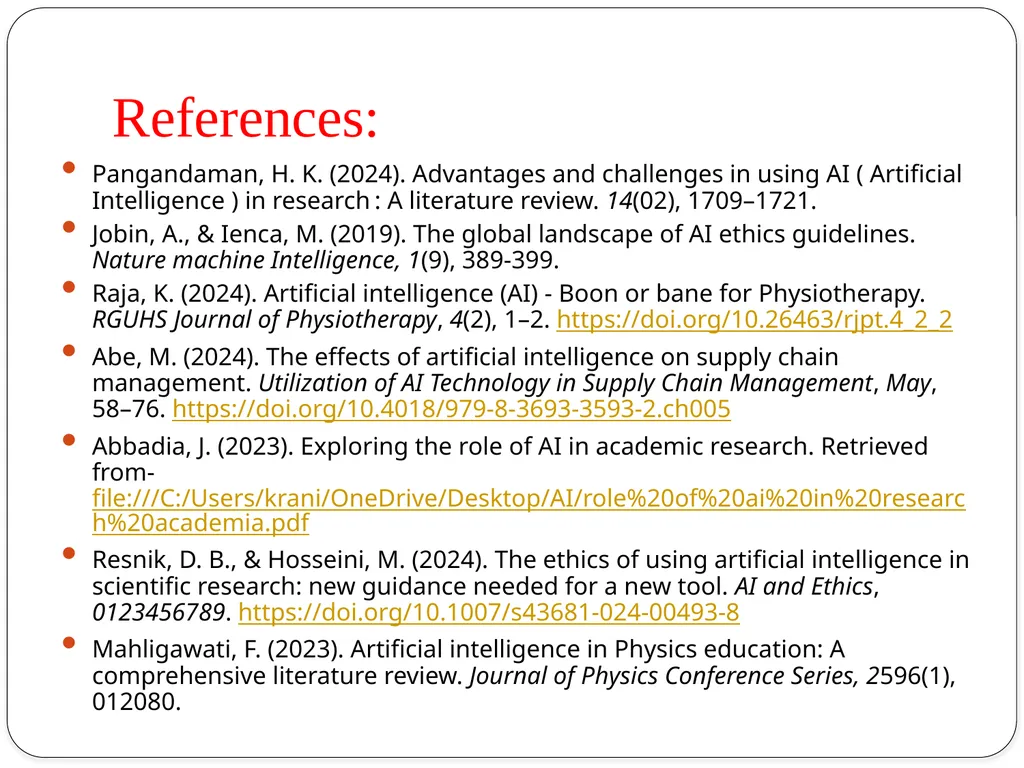
References: Pangandaman, H. K. (2024). Advantages and challenges in using AI ( Artificial Intelligence ) in research : A literature review. 14(02), 1709–1721.
Jobin, A., & Ienca, M. (2019). The global landscape of AI ethics guidelines. Nature machine Intelligence, 1(9), 389-399.
Raja, K. (2024). Artificial intelligence (AI) - Boon or bane for Physiotherapy. RGUHS Journal of Physiotherapy, 4(2), 1–2. https://doi.org/10.26463/rjpt.4_2_2
Abe, M. (2024). The effects of artificial intelligence on supply chain management. Utilization of AI Technology in Supply Chain Management, May, 58–76. https://doi.org/10.4018/979-8-3693-3593-2.ch005
Abbadia, J. (2023). Exploring the role of AI in academic research. Retrieved from- file:///C:/Users/krani/OneDrive/Desktop/AI/role%20of%20ai%20in%20research%20academia.pdf
Resnik, D. B., & Hosseini, M. (2024). The ethics of using artificial intelligence in scientific research: new guidance needed for a new tool. AI and Ethics, 0123456789. https://doi.org/10.1007/s43681-024-00493-8
Mahligawati, F. (2023). Artificial intelligence in Physics education: A comprehensive literature review. Journal of Physics Conference Series, 2596(1), 012080.<br>