
Training Module Cultural Competency Cultural
TF
Published · 25 slides · 0 views
1 / 1
Description
Training Module Cultural Competency Cultural Competency: Module Overview Understanding Cultural Competency and why it is important Cultural Identity Cultural Misinformation Cultural Sensitivity Cultural Sensitivity in Specific Areas Poverty
Related Topics
Share
Embed code
Download this presentation From Below
"Training Module Cultural Competency Cultural" is the property of its rightful owner. Permission is granted to download and print the materials on this website for personal, non-commercial use only, and to display it on your personal computer provided you do not modify the materials and that you retain all copyright notices contained in the materials. By downloading content from our website, you accept the terms of this agreement.
Presentation Transcript
01
Training Module Cultural Competency<br>
02
Cultural Competency: Module Overview Understanding Cultural Competency and why it is important
Cultural Identity
Cultural Misinformation
Cultural Sensitivity
Cultural Sensitivity in Specific Areas
Poverty
Language
Sexual Orientation
Spirituality and Religion
Based on: https://www.weber.edu/ccel/training.html Cultural Sensitivity Training<br>
Cultural Identity
Cultural Misinformation
Cultural Sensitivity
Cultural Sensitivity in Specific Areas
Poverty
Language
Sexual Orientation
Spirituality and Religion
Based on: https://www.weber.edu/ccel/training.html Cultural Sensitivity Training<br>
03
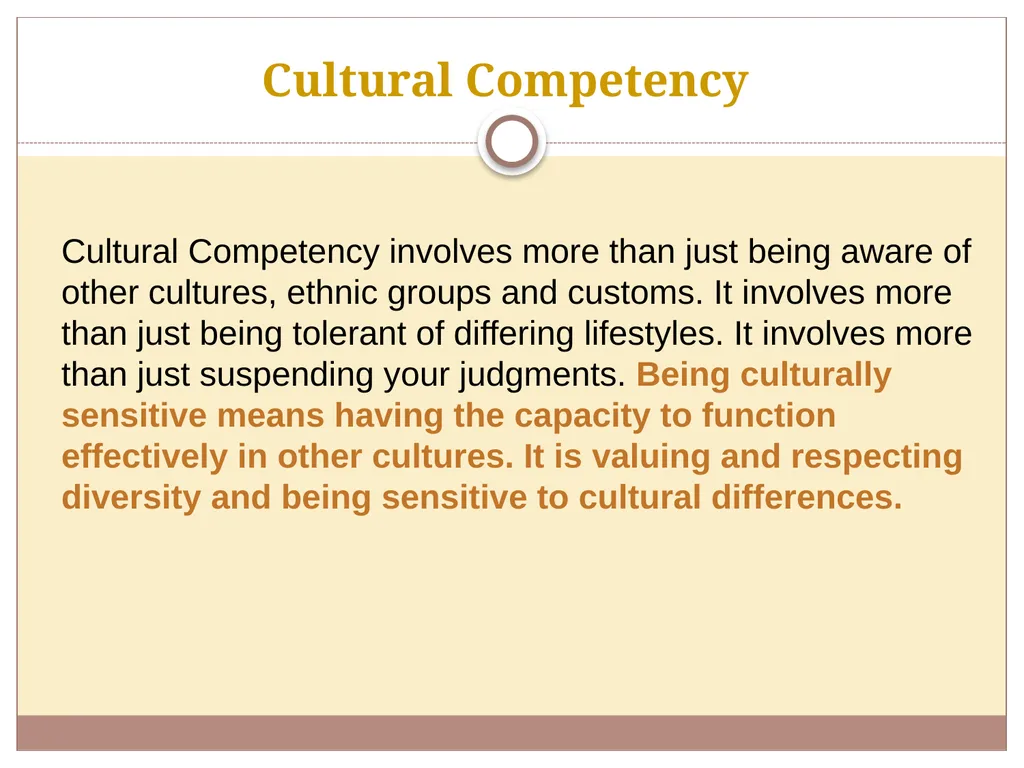
Cultural Competency Cultural Competency involves more than just being aware of other cultures, ethnic groups and customs. It involves more than just being tolerant of differing lifestyles. It involves more than just suspending your judgments. Being culturally sensitive means having the capacity to function effectively in other cultures. It is valuing and respecting diversity and being sensitive to cultural differences.<br>
04
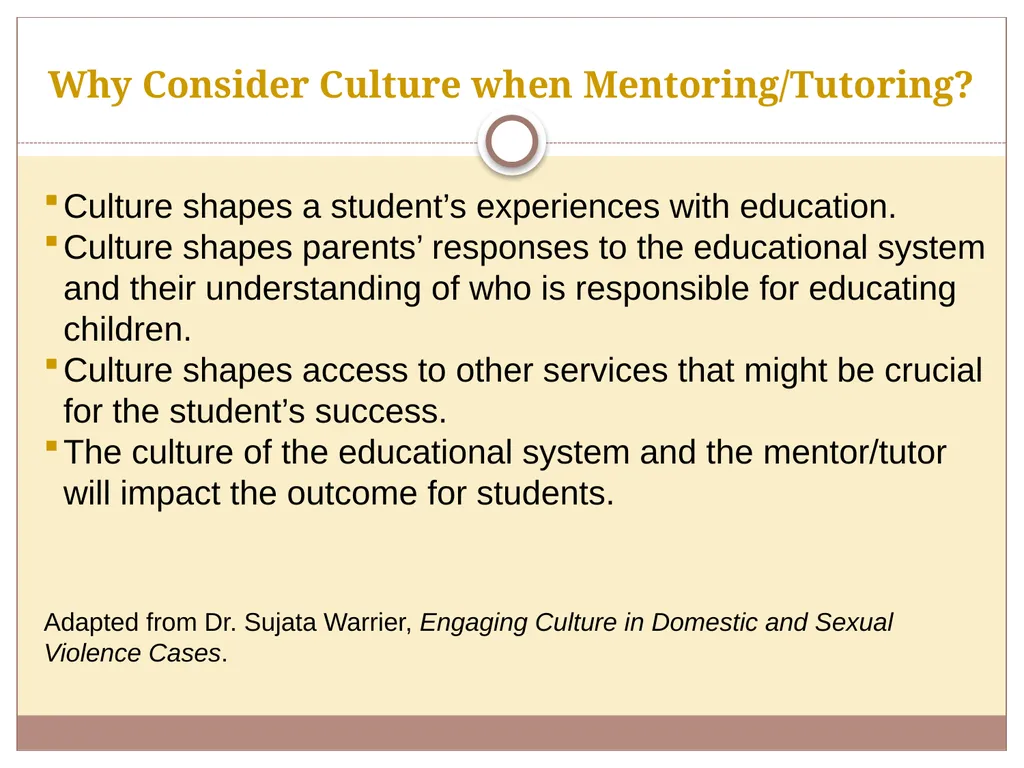
Why Consider Culture when Mentoring/Tutoring? Culture shapes a student’s experiences with education.
Culture shapes parents’ responses to the educational system and their understanding of who is responsible for educating children.
Culture shapes access to other services that might be crucial for the student’s success.
The culture of the educational system and the mentor/tutor will impact the outcome for students.
Adapted from Dr. Sujata Warrier, Engaging Culture in Domestic and Sexual Violence Cases.<br>
Culture shapes parents’ responses to the educational system and their understanding of who is responsible for educating children.
Culture shapes access to other services that might be crucial for the student’s success.
The culture of the educational system and the mentor/tutor will impact the outcome for students.
Adapted from Dr. Sujata Warrier, Engaging Culture in Domestic and Sexual Violence Cases.<br>
05
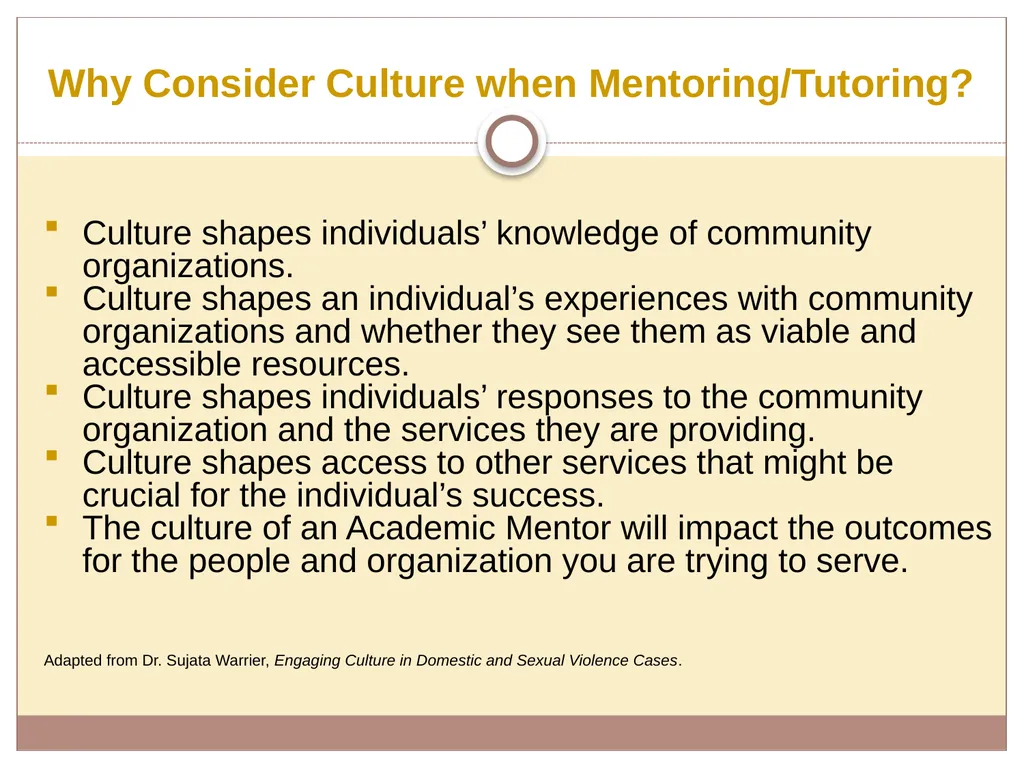
Why Consider Culture when Mentoring/Tutoring? Culture shapes individuals’ knowledge of community organizations.
Culture shapes an individual’s experiences with community organizations and whether they see them as viable and accessible resources.
Culture shapes individuals’ responses to the community organization and the services they are providing.
Culture shapes access to other services that might be crucial for the individual’s success.
The culture of an Academic Mentor will impact the outcomes for the people and organization you are trying to serve.
Adapted from Dr. Sujata Warrier, Engaging Culture in Domestic and Sexual Violence Cases.<br>
Culture shapes an individual’s experiences with community organizations and whether they see them as viable and accessible resources.
Culture shapes individuals’ responses to the community organization and the services they are providing.
Culture shapes access to other services that might be crucial for the individual’s success.
The culture of an Academic Mentor will impact the outcomes for the people and organization you are trying to serve.
Adapted from Dr. Sujata Warrier, Engaging Culture in Domestic and Sexual Violence Cases.<br>
06
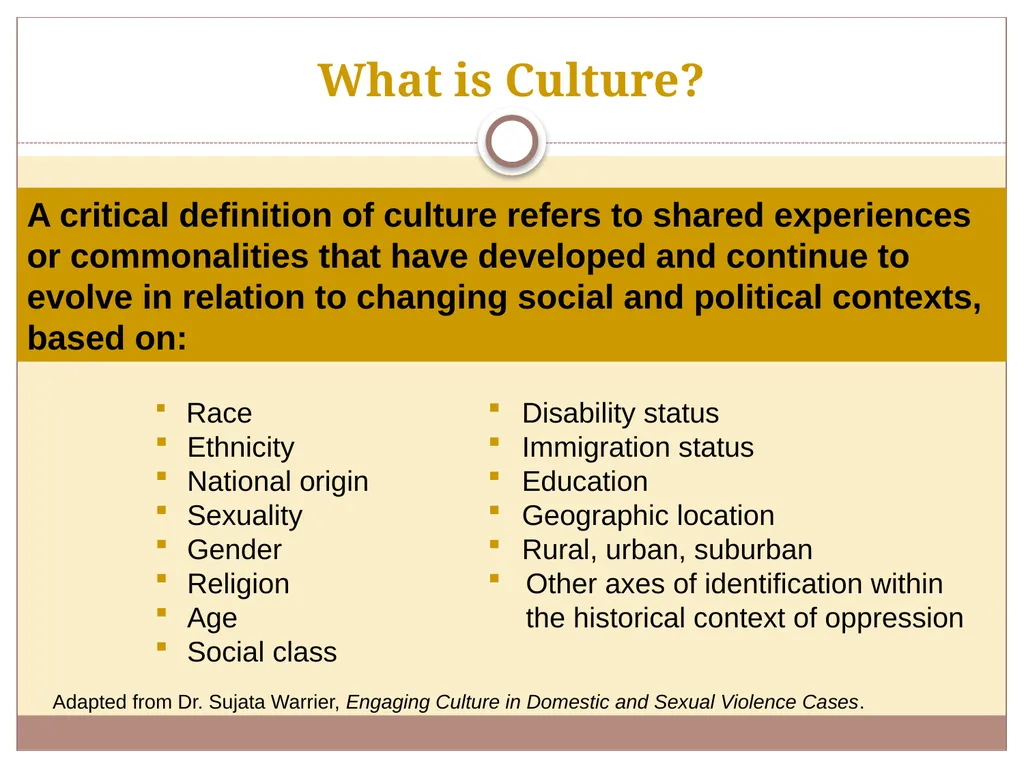
What is Culture? A critical definition of culture refers to shared experiences or commonalities that have developed and continue to evolve in relation to changing social and political contexts, based on: Race
Ethnicity
National origin
Sexuality
Gender
Religion
Age
Social class Disability status
Immigration status
Education
Geographic location
Rural, urban, suburban
Other axes of identification within the historical context of oppression Adapted from Dr. Sujata Warrier, Engaging Culture in Domestic and Sexual Violence Cases.<br>
Ethnicity
National origin
Sexuality
Gender
Religion
Age
Social class Disability status
Immigration status
Education
Geographic location
Rural, urban, suburban
Other axes of identification within the historical context of oppression Adapted from Dr. Sujata Warrier, Engaging Culture in Domestic and Sexual Violence Cases.<br>
07
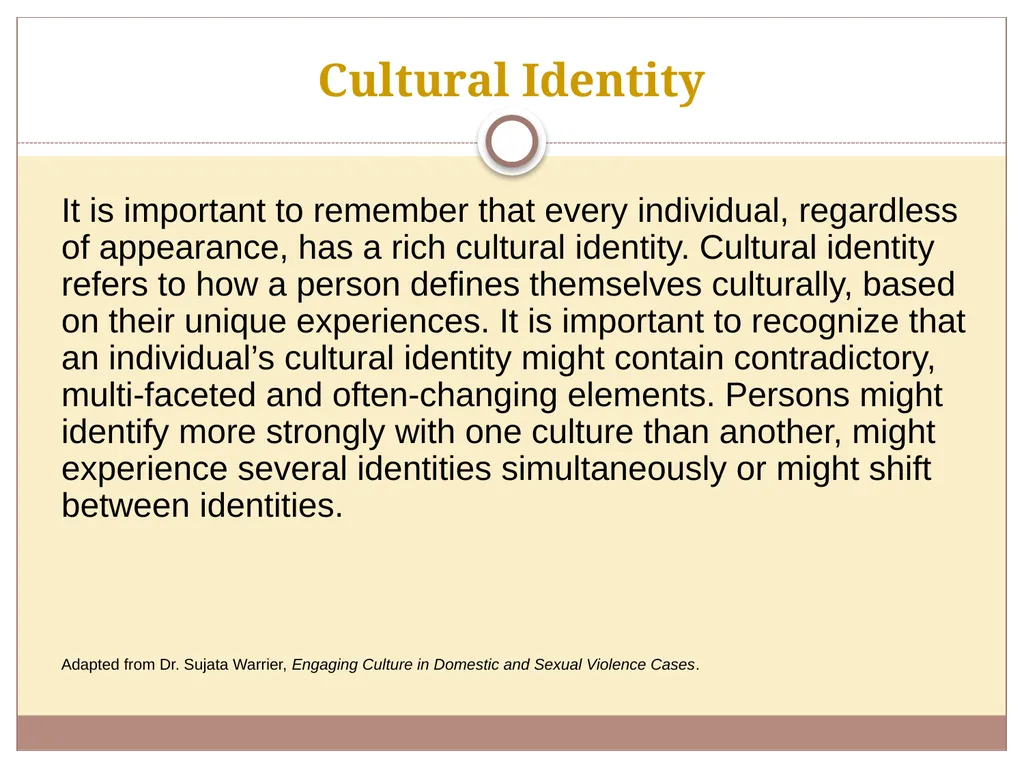
Cultural Identity It is important to remember that every individual, regardless of appearance, has a rich cultural identity. Cultural identity refers to how a person defines themselves culturally, based on their unique experiences. It is important to recognize that an individual’s cultural identity might contain contradictory, multi-faceted and often-changing elements. Persons might identify more strongly with one culture than another, might experience several identities simultaneously or might shift between identities.
Adapted from Dr. Sujata Warrier, Engaging Culture in Domestic and Sexual Violence Cases.<br>
Adapted from Dr. Sujata Warrier, Engaging Culture in Domestic and Sexual Violence Cases.<br>
08
Cultural Misinformation Every human being holds perceptions about different cultures. Many times these perceptions are inaccurate because they are based on cultural misinformation. Cultural misinformation refers to historical information about a group of people that is applied as a generalization to an individual. In other words, misinformation involves stereotyping, wherein an individual associates a set of attributes to a group and then applies group attributes to an individual believed to be part of that group. This limits what we can see and understand about an individual and is often used to justify mistreatment of individuals by the dominant culture. Therefore, we must deliberately and intentionally examine cultural misinformation.
Adapted from Dr. Sujata Warrier, Engaging Culture in Domestic and Sexual Violence Cases.<br>
Adapted from Dr. Sujata Warrier, Engaging Culture in Domestic and Sexual Violence Cases.<br>
09
Self-Reflection Pause for a minute now and recall a time when you made a cultural assumption about someone else. What assumption was made? What effect did it have on the situation?
Now, recall a time when someone else made an assumption about you based on their perception of your culture. What assumption was made? What effect did it have on you and on the situation?
Adapted from Dr. Sujata Warrier, Engaging Culture in Domestic and Sexual Violence Cases.<br>
Now, recall a time when someone else made an assumption about you based on their perception of your culture. What assumption was made? What effect did it have on you and on the situation?
Adapted from Dr. Sujata Warrier, Engaging Culture in Domestic and Sexual Violence Cases.<br>
10
Culture Does Matter Cultural identities are individual and complex
AND
Cultural commonalities do exist
BUT
They are often over-simplified, assumed where they may not exist, and overlooked when they may be there
AND
Cultural assumptions are rooted in unequal power and privilege
AND
The consequences of these assumptions can be serious.
Adapted from Dr. Sujata Warrier, Engaging Culture in Domestic and Sexual Violence Cases.<br>
AND
Cultural commonalities do exist
BUT
They are often over-simplified, assumed where they may not exist, and overlooked when they may be there
AND
Cultural assumptions are rooted in unequal power and privilege
AND
The consequences of these assumptions can be serious.
Adapted from Dr. Sujata Warrier, Engaging Culture in Domestic and Sexual Violence Cases.<br>
11
Cultural Sensitivity Begins With: Being aware of one’s biases, prejudices and knowledge about the person with whom you are interacting.
Begin by
Challenging your assumptions.
Using appropriate language. Recognizing the power and privilege your culture affords you and avoiding the imposition of those values. Begin by
Using non-judgmental questions
Do not assume people have resources.
Do not assume everyone is like you.<br>
Begin by
Challenging your assumptions.
Using appropriate language. Recognizing the power and privilege your culture affords you and avoiding the imposition of those values. Begin by
Using non-judgmental questions
Do not assume people have resources.
Do not assume everyone is like you.<br>
12
Cultural Sensitivity Checking assumptions and suspending judgments is crucial to being a successful Academic Mentor. Assumptions, or the belief that something is true without evidence, lead to stereotypes. An example would be believing what you have heard concerning groups of people via friends, neighbors, social media, etc.<br>
13
Cultural Sensitivity in Specific Areas: The rest of this module will focus on developing cultural sensitivity around the following topics:
Poverty
Language
Sexual Orientation
Spirituality and Religion<br>
Poverty
Language
Sexual Orientation
Spirituality and Religion<br>
14
Poverty Poverty has many complex definitions depending on the source. To best understand what poverty is we will define it as does Ruby Payne, professional educator.
Poverty is the extent to which an individual does without resources. These resources include; financial, emotional, mental, spiritual, physical, support systems, relationships/role models, and knowledge of hidden rules.<br>
Poverty is the extent to which an individual does without resources. These resources include; financial, emotional, mental, spiritual, physical, support systems, relationships/role models, and knowledge of hidden rules.<br>
15
Assumptions about People in Poverty Assumption: The poor are lazy.
Fact: People in poverty expend a lot of energy on daily survival including working multiple jobs or finding employment, providing food, finding childcare, finding transportation and attending agency mandated trainings and meetings.
Fact: Many of the poor are children, who cannot legally work.<br>
Fact: People in poverty expend a lot of energy on daily survival including working multiple jobs or finding employment, providing food, finding childcare, finding transportation and attending agency mandated trainings and meetings.
Fact: Many of the poor are children, who cannot legally work.<br>
16
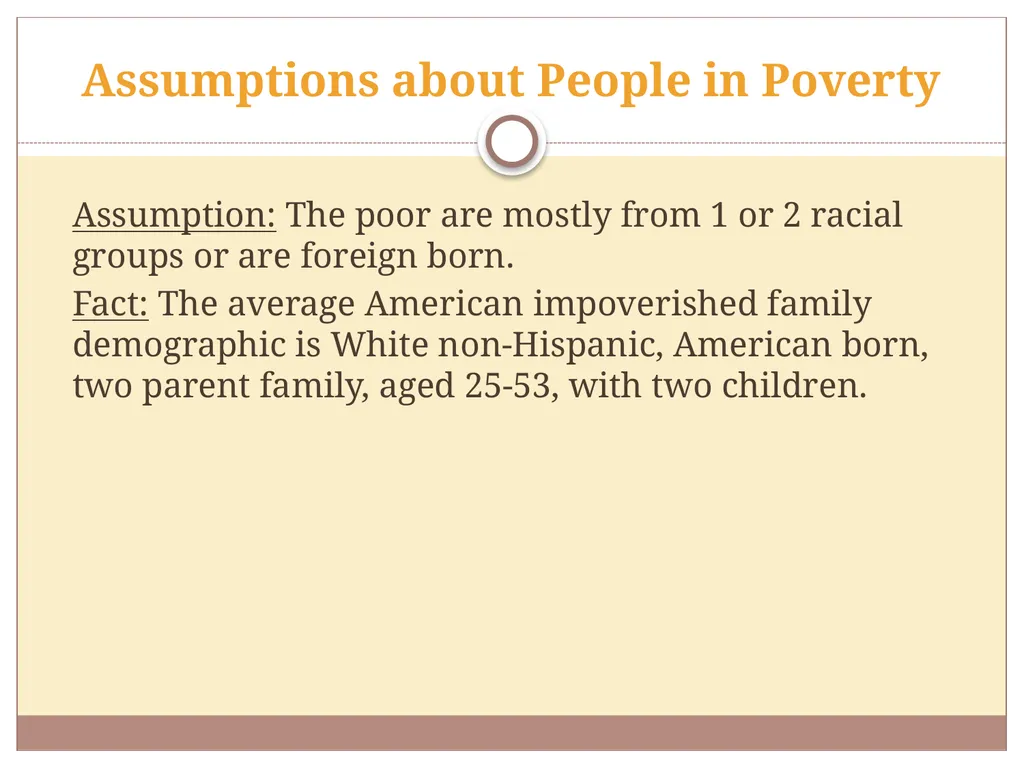
Assumptions about People in Poverty Assumption: The poor are mostly from 1 or 2 racial groups or are foreign born.
Fact: The average American impoverished family demographic is White non-Hispanic, American born, two parent family, aged 25-53, with two children.<br>
Fact: The average American impoverished family demographic is White non-Hispanic, American born, two parent family, aged 25-53, with two children.<br>
17
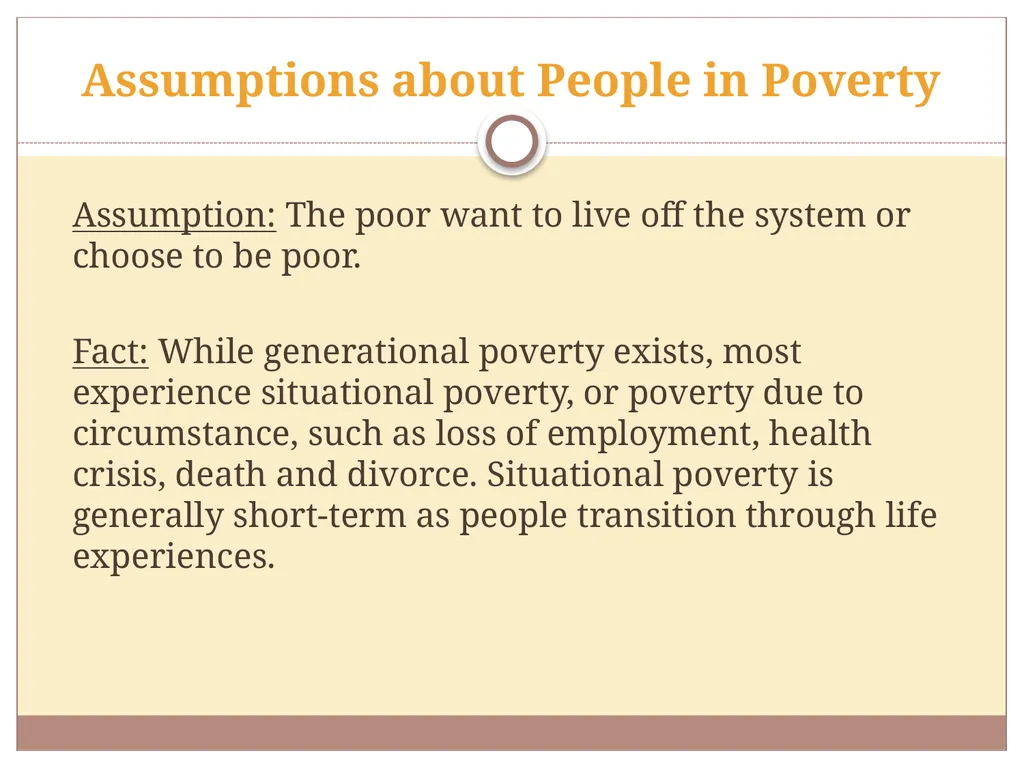
Assumptions about People in Poverty Assumption: The poor want to live off the system or choose to be poor.
Fact: While generational poverty exists, most experience situational poverty, or poverty due to circumstance, such as loss of employment, health crisis, death and divorce. Situational poverty is generally short-term as people transition through life experiences.<br>
Fact: While generational poverty exists, most experience situational poverty, or poverty due to circumstance, such as loss of employment, health crisis, death and divorce. Situational poverty is generally short-term as people transition through life experiences.<br>
18
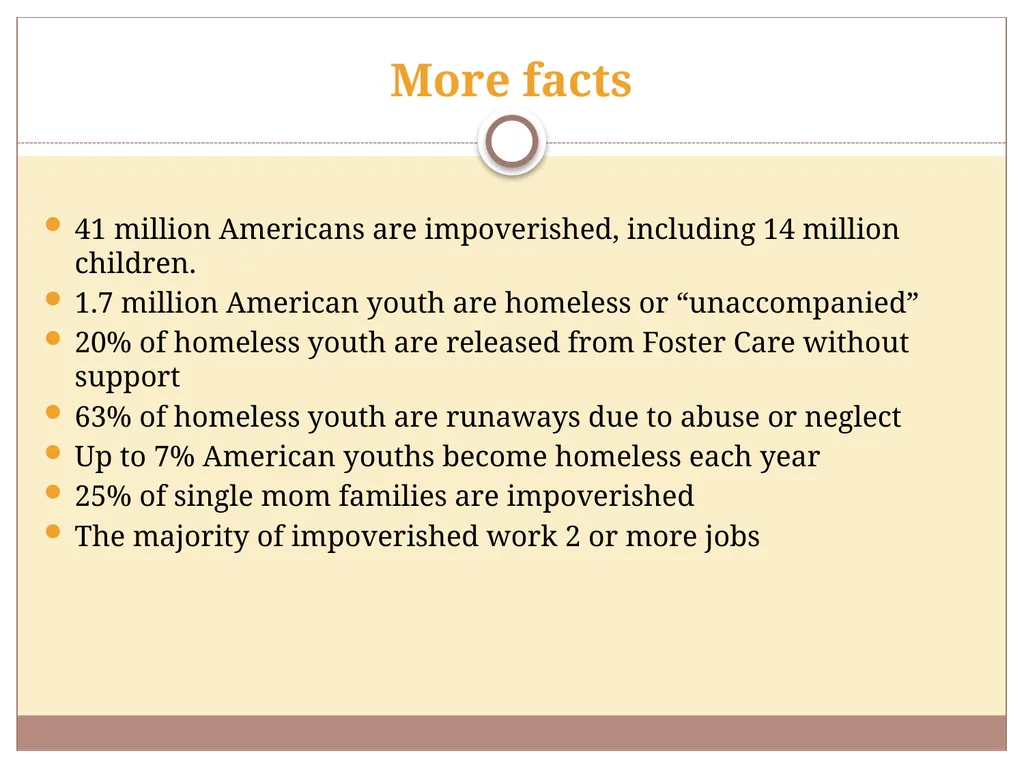
More facts 41 million Americans are impoverished, including 14 million children.
1.7 million American youth are homeless or “unaccompanied”
20% of homeless youth are released from Foster Care without support
63% of homeless youth are runaways due to abuse or neglect
Up to 7% American youths become homeless each year
25% of single mom families are impoverished
The majority of impoverished work 2 or more jobs<br>
1.7 million American youth are homeless or “unaccompanied”
20% of homeless youth are released from Foster Care without support
63% of homeless youth are runaways due to abuse or neglect
Up to 7% American youths become homeless each year
25% of single mom families are impoverished
The majority of impoverished work 2 or more jobs<br>
19
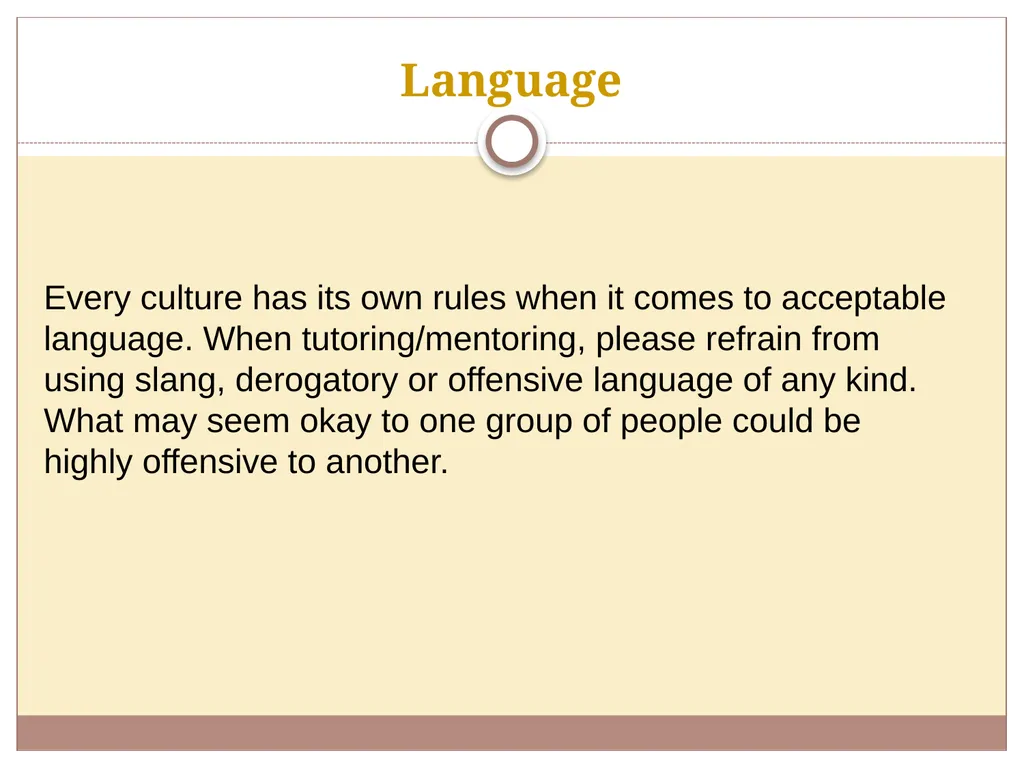
Language Every culture has its own rules when it comes to acceptable language. When tutoring/mentoring, please refrain from using slang, derogatory or offensive language of any kind. What may seem okay to one group of people could be highly offensive to another.<br>
20
Sexual Orientation Please be respectful of others’ sexual orientation. The government recognizes sexual orientation as a personal right that is protected under the law just as religion, sex, race, and age are. Discrimination towards others of a different sexual orientation will not be tolerated.<br>
21
Spirituality and Religion Not everyone is from your church of choice.
You are at this school to serve, not proselytize.
Respect religious clothing requirements.
Respect food preferences.
Your religious beliefs, if any, belong to you. Please keep them to yourself.<br>
You are at this school to serve, not proselytize.
Respect religious clothing requirements.
Respect food preferences.
Your religious beliefs, if any, belong to you. Please keep them to yourself.<br>
22
Respecting Others Learn about other cultures, lifestyles and religions to broaden your knowledge and understanding.
Remain sensitive to the effect of your actions and words on people of different ethnicities, religions, and cultures. What you consider to be acceptable may actually be offensive to another.
Apologize if you offend someone.<br>
Remain sensitive to the effect of your actions and words on people of different ethnicities, religions, and cultures. What you consider to be acceptable may actually be offensive to another.
Apologize if you offend someone.<br>
23
Final Note: When a student is acting out or under-achieving, it is not your responsibility to correct or discipline that student.
You cannot be both a mentor and a disciplinarian.
Report any incident to the GEAR UP Coordinator or classroom teacher and let her/him provide the necessary discipline, if any.<br>
You cannot be both a mentor and a disciplinarian.
Report any incident to the GEAR UP Coordinator or classroom teacher and let her/him provide the necessary discipline, if any.<br>
24
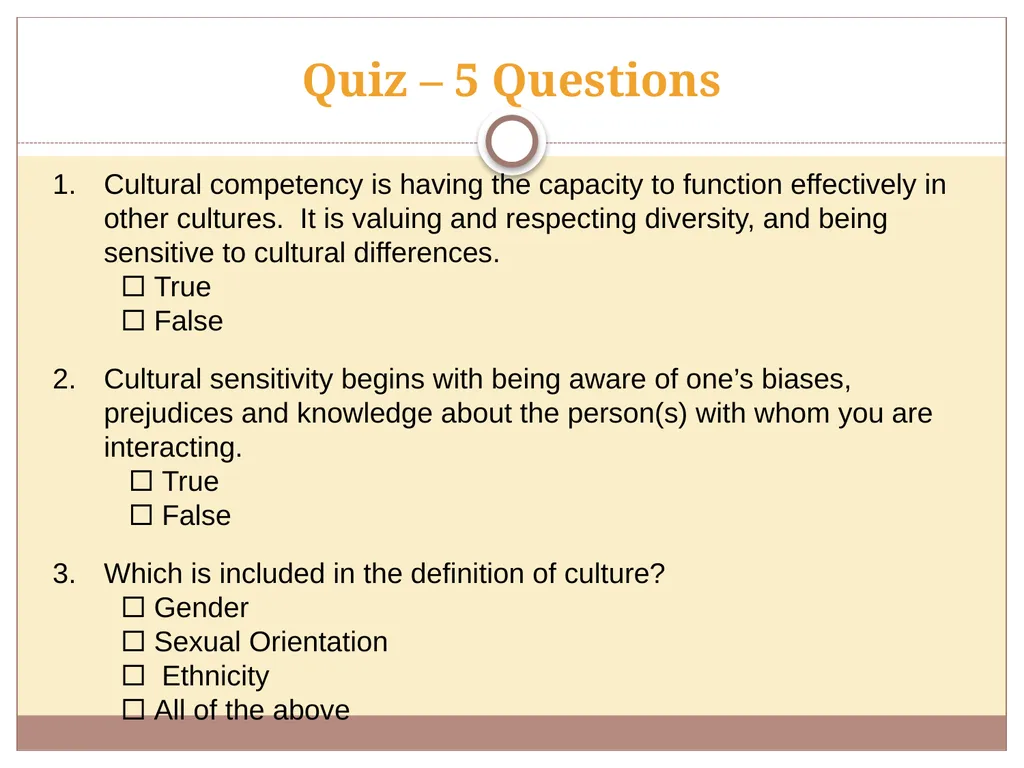
Quiz – 5 Questions Cultural competency is having the capacity to function effectively in other cultures. It is valuing and respecting diversity, and being sensitive to cultural differences.
True
False
Cultural sensitivity begins with being aware of one’s biases, prejudices and knowledge about the person(s) with whom you are interacting.
True
False
Which is included in the definition of culture?
Gender
Sexual Orientation
Ethnicity
All of the above<br>
True
False
Cultural sensitivity begins with being aware of one’s biases, prejudices and knowledge about the person(s) with whom you are interacting.
True
False
Which is included in the definition of culture?
Gender
Sexual Orientation
Ethnicity
All of the above<br>
25
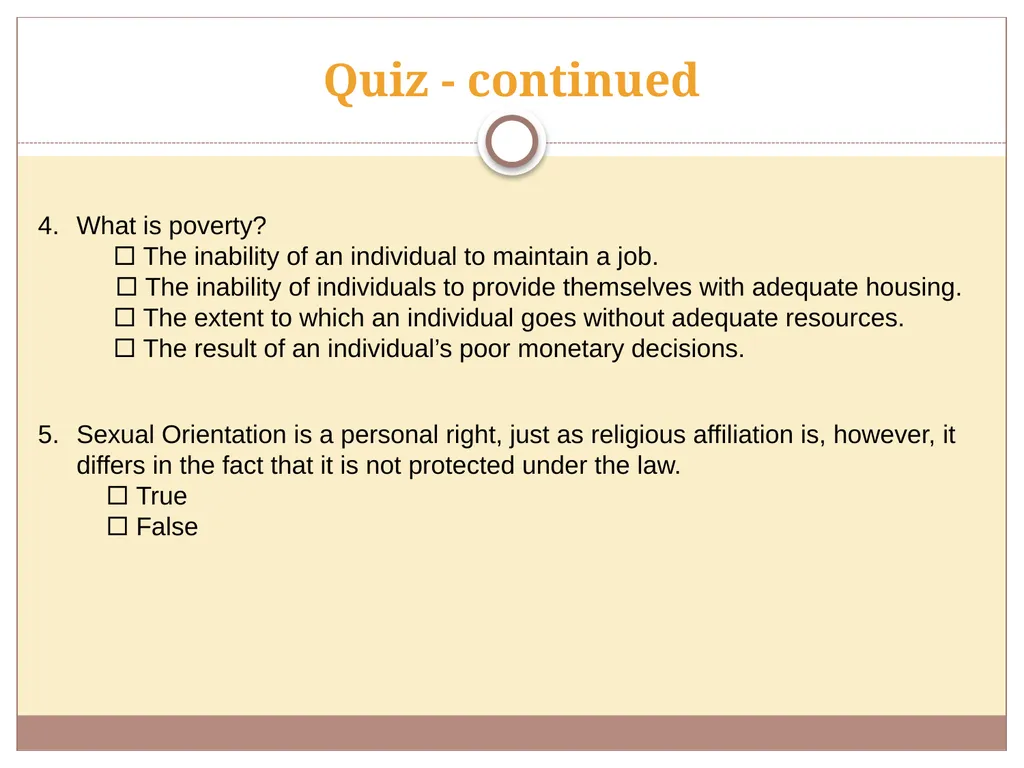
Quiz - continued What is poverty?
The inability of an individual to maintain a job.
The inability of individuals to provide themselves with adequate housing.
The extent to which an individual goes without adequate resources.
The result of an individual’s poor monetary decisions.
Sexual Orientation is a personal right, just as religious affiliation is, however, it differs in the fact that it is not protected under the law.
True
False<br>
The inability of an individual to maintain a job.
The inability of individuals to provide themselves with adequate housing.
The extent to which an individual goes without adequate resources.
The result of an individual’s poor monetary decisions.
Sexual Orientation is a personal right, just as religious affiliation is, however, it differs in the fact that it is not protected under the law.
True
False<br>